

Development of structure–function coupling in human brain networks during youth
Open accessPublished version of a preprint
The DOI matches its Crossref record; 51 of the 51 references it cites were found in a registry or an index.
Abstract
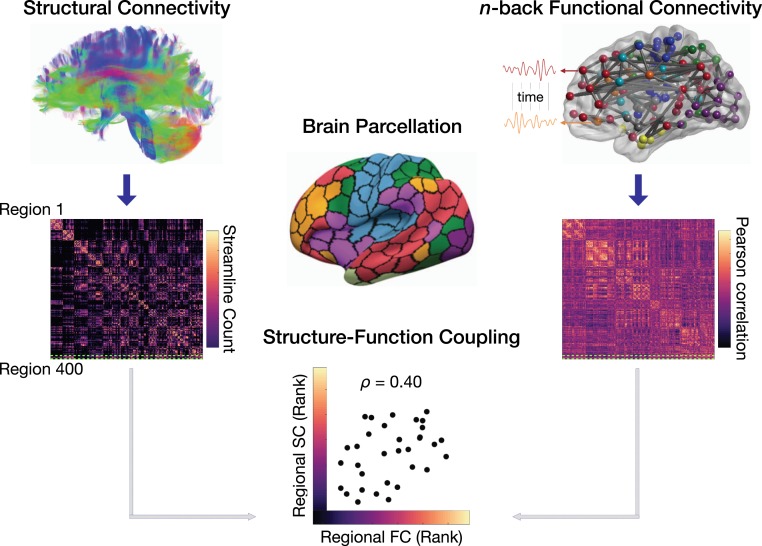
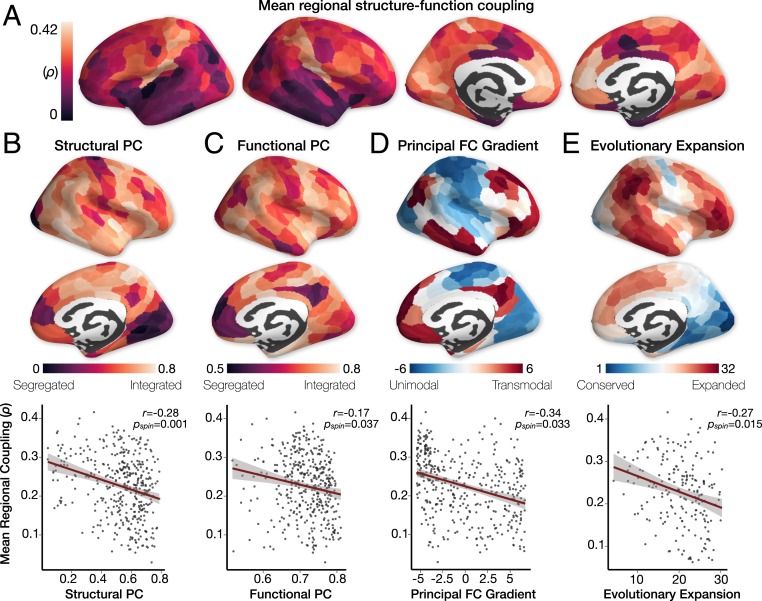
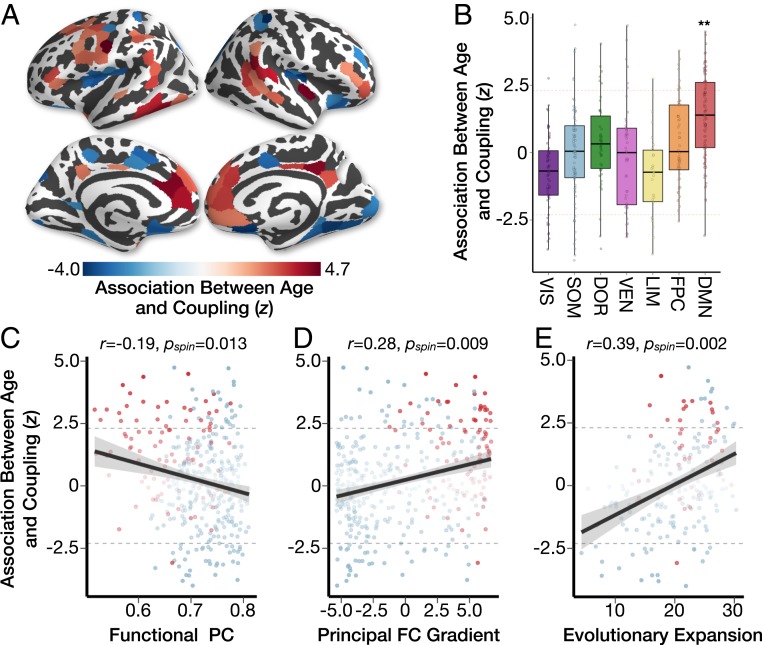
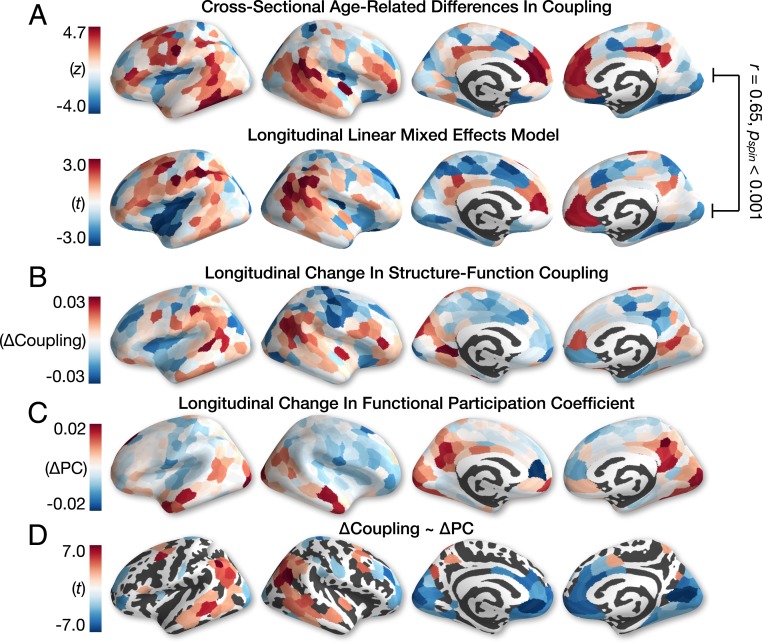
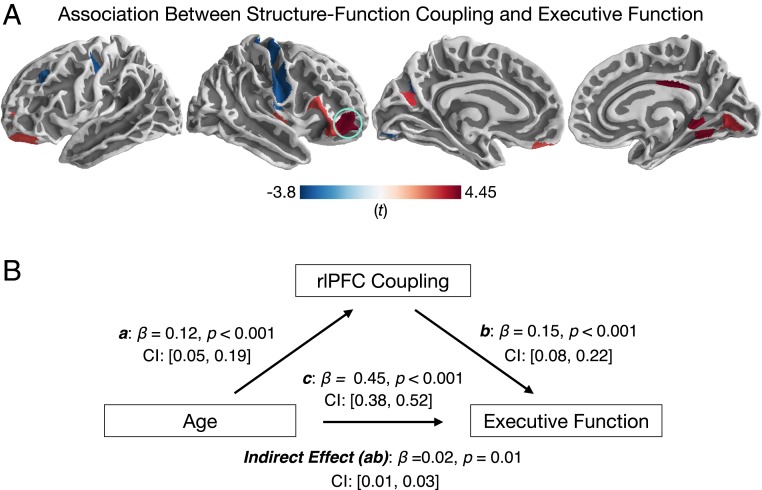
The protracted development of structural and functional brain connectivity within distributed association networks coincides with improvements in higher-order cognitive processes such as executive function. However, it remains unclear how white-matter architecture develops during youth to directly support coordinated neural activity. Here, we characterize the development of structure–function coupling using diffusion-weighted imaging and n -back functional MRI data in a sample of 727 individuals (ages 8 to 23 y). We found that spatial variability in structure–function coupling aligned with cortical hierarchies of functional specialization and evolutionary expansion. Furthermore, hierarchy-dependent age effects on structure–function coupling localized to transmodal cortex in both cross-sectional data and a subset of participants with longitudinal data ( n = 294). Moreover, structure–function coupling in rostrolateral prefrontal cortex was associated with executive performance and partially mediated age-related improvements in executive function. Together, these findings delineate a critical dimension of adolescent brain development, whereby the coupling between structural and functional connectivity remodels to support functional specialization and cognition.
Overview
The claims and statistics of this paper haven’t been checked yet.
Free: it reads the open-access text and checks the first 5 claims that cite a source we can check. Create a free account to check every claim.
Integrity signals
Registry
Cites
Statistics
Figures
Verification
Claims the paper makes
The claims and statistics of this paper haven’t been checked yet.
Free: it reads the open-access text and checks the first 5 claims that cite a source we can check. Create a free account to check every claim.
Claims other papers make about this one
Each is checked against this paper’s own text: does it say what the citing paper says it does?
The cited source says what the claim attributes to it.
In the citing paper
“while separately examining coupling between SC and rsFC.”
From Similarity-based multimodal regression (2024) · cites this paper as Baum et al. (2020)
The cited source says what the claim attributes to it.
In the citing paper
“UsingSCandFCmatricesfromthePNC,Baum et al. (2020)demonstratedneurodevelopmental changes in a coupling metric computed between SC and n-back FC”
From Similarity-based multimodal regression (2024) · cites this paper as Baum et al. (2020)
Self-check
Percentages, sums and reported differences re-computed from the paper’s own numbers.
The self-check needs the paper’s full text.
Citations
Cites
The organization of the human cerebral cortex estimated by intrinsic functional connectivity
Thomas Yeo, B. T., Krienen, F. M., Sepulcre, J., Sabuncu, M. R., Lashkari, D., Hollinshead, M., Roffman, J. L., Smoller, J. W., Zöllei, L., Polimeni, J. R., et al. (2011) · Journal of Neurophysiology · doi:10.1152/jn.00338.2011 · Cited by 9,182 · cited 1×
“Each brain region was assigned to one of seven canonical functional brain networks (25).”
MethodDistributed hierarchical processing in the primate cerebral cortex
Felleman, D. J., & Van Essen, D. C. (1991) · Cerebral Cortex · doi:10.1093/cercor/1.1.1 · Cited by 7,783
Wood, S. N. (2011) · Journal of the Royal Statistical Society Series B: Statistical Methodology · doi:10.1111/j.1467-9868.2010.00749.x · Cited by 7,537
The organization of the human cerebellum estimated by intrinsic functional connectivity
Buckner, R. L., Krienen, F. M., Castellanos, A., Diaz, J. C., & Yeo, B. T. T. (2011) · Journal of Neurophysiology · doi:10.1152/jn.00339.2011 · Cited by 7,304
Local-global parcellation of the human cerebral cortex from intrinsic functional connectivity MRI
Schaefer, A., Kong, R., Gordon, E. M., Laumann, T. O., Zuo, X.-N., Holmes, A. J., Eickhoff, S. B., & Yeo, B. T. T. (2018) · Cerebral Cortex · doi:10.1093/cercor/bhx179 · Cited by 3,657
Preface: Cerebral Cortex Has Come of Age
Goldman-Rakic, P. S., & Rakic, P. (1991) · Cerebral Cortex · doi:10.1093/cercor/1.1.1-a · Cited by 3,393
Predicting human resting-state functional connectivity from structural connectivity
Honey, C. J., Sporns, O., Cammoun, L., Gigandet, X., Thiran, J. P., Meuli, R., & Hagmann, P. (2009) · Proceedings of the National Academy of Sciences · doi:10.1073/pnas.0811168106 · Cited by 3,307
Bassett, D. S., & Sporns, O. (2017) · Nature Neuroscience · doi:10.1038/nn.4502 · Cited by 2,398 · cited 1×
“Network theory has provided a parsimonious framework for modeling structure – function mappings in neurobiological systems across species and spatial scales (10).”
Self-citationSituating the default-mode network along a principal gradient of macroscale cortical organization
Margulies, D. S., Ghosh, S. S., Goulas, A., Falkiewicz, M., Huntenburg, J. M., Langs, G., Bezgin, G., Eickhoff, S. B., Castellanos, F. X., Petrides, M., et al. (2016) · Proceedings of the National Academy of Sciences · doi:10.1073/pnas.1608282113 · Cited by 2,321 · cited 5×
“Cortical hierarchy has provided a unifying principle for understanding the multiscale organization of primate cortical anatomy and function (2, 8, 27).”
InfluentialNeuronal activity promotes oligodendrogenesis and adaptive myelination in the mammalian brain
Gibson, E. M., Purger, D., Mount, C. W., Goldstein, A. K., Lin, G. L., Wood, L. S., Inema, I., Miller, S. E., Bieri, G., Zuchero, J. B., et al. (2014) · Science · doi:10.1126/science.1252304 · Cited by 1,472
Extraordinary neoteny of synaptic spines in the human prefrontal cortex
Petanjek, Z., Judaš, M., Šimić, G., Rašin, M. R., Uylings, H. B. M., Rakic, P., & Kostović, I. (2011) · Proceedings of the National Academy of Sciences · doi:10.1073/pnas.1105108108 · Cited by 1,411
Dysconnection in schizophrenia: from abnormal synaptic plasticity to failures of self-monitoring
Stephan, K. E., Friston, K. J., & Frith, C. D. (2009) · Schizophrenia Bulletin · doi:10.1093/schbul/sbn176 · Cited by 1,134 · cited 1×
“Furthermore, aberrant development of structural constraints on functional communication could contribute to deficits in executive function and the emergence of neuropsychiatric disorders during adolescence (16, 17).”
BackgroundThe anatomical basis of functional localization in the cortex
Passingham, R. E., Stephan, K. E., & Kötter, R. (2002) · Nature Reviews Neuroscience · doi:10.1038/nrn893 · Cited by 1,024 · cited 2×
“Third, under the premise that structure – function coupling reflects functional specialization of a cortical area (9), we hypothesized that higher structure – function coupling in frontoparietal association cortex would support specialized computations relevant for executive functioning (16, 20).”
Large-Scale Gradients in Human Cortical Organization
Huntenburg, J. M., Bazin, P.-L., & Margulies, D. S. (2018) · Trends in Cognitive Sciences · doi:10.1016/j.tics.2017.11.002 · Cited by 968
On testing for spatial correspondence between maps of human brain structure and function
Alexander-Bloch, A. F., Shou, H., Liu, S., Satterthwaite, T. D., Glahn, D. C., Shinohara, R. T., Vandekar, S. N., & Raznahan, A. (2018) · NeuroImage · doi:10.1016/j.neuroimage.2018.05.070 · Cited by 947
Self-citationBrain connectivity related to working memory performance
Hampson, M., Driesen, N. R., Skudlarski, P., Gore, J. C., & Constable, R. T. (2006) · The Journal of Neuroscience · doi:10.1523/jneurosci.3408-06.2006 · Cited by 853 · cited 1×
“Third, under the premise that structure–function coupling reflects functional specialization of a cortical area (9), we hypothesized that higher structure–function coupling in frontoparietal association cortex would support specialized computations relevant for executive functioning (16, 20).”
BackgroundAdolescence as a neurobiological critical period for the development of higher-order cognition
Larsen, B., & Luna, B. (2018) · Neuroscience & Biobehavioral Reviews · doi:10.1016/j.neubiorev.2018.09.005 · Cited by 853
Self-citationSynaptic plasticity and dysconnection in schizophrenia
Stephan, K. E., Baldeweg, T., & Friston, K. J. (2006) · Biological Psychiatry · doi:10.1016/j.biopsych.2005.10.005 · Cited by 841 · cited 1×
“Furthermore, aberrant development of structural constraints on functional communication could contribute to deficits in executive function and the emergence of neuropsychiatric disorders during adolescence (16 – 18).”
The evolution of distributed association networks in the human brain
Buckner, R. L., & Krienen, F. M. (2013) · Trends in Cognitive Sciences · doi:10.1016/j.tics.2013.09.017 · Cited by 836 · cited 3×
“Specifically, we predicted structure – function coupling would be high in somatosensory cortex, due to highly conserved programming that governs the early development of specialized sensory hierarchies (19).”
InfluentialSimilar patterns of cortical expansion during human development and evolution
Hill, J., Inder, T., Neil, J., Dierker, D., Harwell, J., & Van Essen, D. (2010) · Proceedings of the National Academy of Sciences · doi:10.1073/pnas.1001229107 · Cited by 811 · cited 2×
“Both primate cortical evolution and human brain development have been characterized by the targeted expansion and remodeling of transmodal association areas (3, 4), which underpin the integration of sensory representations and abstract rules for executing goals.”
Anatomy of hierarchy: Feedforward and feedback pathways in macaque visual cortex
Markov, N. T., Vezoli, J., Chameau, P., Falchier, A., Quilodran, R., Huissoud, C., Lamy, C., Misery, P., Giroud, P., Ullman, S., et al. (2014) · Journal of Comparative Neurology · doi:10.1002/cne.23458 · Cited by 759
Cartography of complex networks: modules and universal roles
Guimerà, R., & Amaral, L. A. N. (2005) · Journal of Statistical Mechanics: Theory and Experiment · doi:10.1088/1742-5468/2005/02/p02001 · Cited by 749
Prolonged myelination in human neocortical evolution
Miller, D. J., Duka, T., Stimpson, C. D., Schapiro, S. J., Baze, W. B., McArthur, M. J., Fobbs, A. J., Sousa, A. M. M., Šestan, N., Wildman, D. E., et al. (2012) · Proceedings of the National Academy of Sciences · doi:10.1073/pnas.1117943109 · Cited by 699 · cited 3×
“The protracted development of transmodal association cortex in humans provides an extended window for activity-dependent myelination (5) and synaptic pruning (6).”
Burt, J. B., Demirtaş, M., Eckner, W. J., Navejar, N. M., Ji, J. L., Martin, W. J., Bernacchia, A., Anticevic, A., & Murray, J. D. (2018) · Nature Neuroscience · doi:10.1038/s41593-018-0195-0 · Cited by 657
Dixon, M. L., De La Vega, A., Mills, C., Andrews-Hanna, J., Spreng, R. N., Cole, M. W., & Christoff, K. (2018) · Proceedings of the National Academy of Sciences · doi:10.1073/pnas.1715766115 · Cited by 595 · cited 1×
“The capacity of RLPFC to support executive processing may be understood through its role in integrating information between frontoparietal and dorsal attention networks to regulate perceptual attention (33).”
BackgroundResting-brain functional connectivity predicted by analytic measures of network communication
Goñi, J., van den Heuvel, M. P., Avena-Koenigsberger, A., Velez de Mendizabal, N., Betzel, R. F., Griffa, A., Hagmann, P., Corominas-Murtra, B., Thiran, J.-P., & Sporns, O. (2014) · Proceedings of the National Academy of Sciences · doi:10.1073/pnas.1315529111 · Cited by 576
Self-citationThe modular and integrative functional architecture of the human brain
Bertolero, M. A., Yeo, B. T. T., & D’Esposito, M. (2015) · Proceedings of the National Academy of Sciences · doi:10.1073/pnas.1510619112 · Cited by 565
Microstructural and functional gradients are increasingly dissociated in transmodal cortices
Paquola, C., Vos De Wael, R., Wagstyl, K., Bethlehem, R. A. I., Hong, S.-J., Seidlitz, J., Bullmore, E. T., Evans, A. C., Misic, B., Margulies, D. S., et al. (2019) · PLOS Biology · doi:10.1371/journal.pbio.3000284 · Cited by 519
Neuroimaging of the Philadelphia Neurodevelopmental Cohort
Satterthwaite, T. D., Elliott, M. A., Ruparel, K., Loughead, J., Prabhakaran, K., Calkins, M. E., Hopson, R., Jackson, C., Keefe, J., Riley, M., et al. (2014) · NeuroImage · doi:10.1016/j.neuroimage.2013.07.064 · Cited by 504 · cited 1×
“Neuroimaging was completed as part of the Philadelphia Neurodevelopmental Cohort (46).”
Self-citationTask-induced brain state manipulation improves prediction of individual traits
Greene, A. S., Gao, S., Scheinost, D., & Constable, R. T. (2018) · Nature Communications · doi:10.1038/s41467-018-04920-3 · Cited by 496
Gradients of structure–function tethering across neocortex
Vázquez-Rodríguez, B., Suárez, L. E., Markello, R. D., Shafiei, G., Paquola, C., Hagmann, P., van den Heuvel, M. P., Bernhardt, B. C., Spreng, R. N., & Misic, B. (2019) · Proceedings of the National Academy of Sciences · doi:10.1073/pnas.1903403116 · Cited by 489
Functional Specialization and Flexibility in Human Association Cortex
Yeo, B. T. T., Krienen, F. M., Eickhoff, S. B., Yaakub, S. N., Fox, P. T., Buckner, R. L., Asplund, C. L., & Chee, M. W. L. (2015) · Cerebral Cortex · doi:10.1093/cercor/bhu217 · Cited by 413
Baum, G. L., Ciric, R., Roalf, D. R., Betzel, R. F., Moore, T. M., Shinohara, R. T., Kahn, A. E., Vandekar, S. N., Rupert, P. E., Quarmley, M., et al. (2017) · Current Biology · doi:10.1016/j.cub.2017.04.051 · Cited by 401 · cited 1×
“Third, under the premise that structure–function coupling reflects functional specialization of a cortical area (9), we hypothesized that higher structure–function coupling in frontoparietal association cortex would support specialized computations relevant for executive functioning (16, 20).”
Self-citationCortical structure predicts the pattern of corticocortical connections
Barbas, H. (1997) · Cerebral Cortex · doi:10.1093/cercor/7.7.635 · Cited by 382
Hampson, M., Driesen, N., Roth, J. K., Gore, J. C., & Constable, R. T. (2010) · Magnetic Resonance Imaging · doi:10.1016/j.mri.2010.03.021 · Cited by 361
Unraveling the Miswired Connectome: A Developmental Perspective
Di Martino, A., Fair, D. A., Kelly, C., Satterthwaite, T. D., Castellanos, F. X., Thomason, M. E., Craddock, R. C., Luna, B., Leventhal, B. L., Zuo, X.-N., et al. (2014) · Neuron · doi:10.1016/j.neuron.2014.08.050 · Cited by 353
Self-citationSatterthwaite, T. D., Connolly, J. J., Ruparel, K., Calkins, M. E., Jackson, C., Elliott, M. A., Roalf, D. R., Hopson, R., Prabhakaran, K., Behr, M., et al. (2016) · NeuroImage · doi:10.1016/j.neuroimage.2015.03.056 · Cited by 335 · cited 1×
“Neuroimaging and behavioral data were originally obtained from 1,601 youth who participated in the Philadelphia Neurodevelopmental Cohort (PNC), a large community-based study of brain development (1, 2).”
MethodSelf-citationAnatomical connectivity patterns predict face selectivity in the fusiform gyrus
Saygin, Z. M., Osher, D. E., Koldewyn, K., Reynolds, G., Gabrieli, J. D. E., & Saxe, R. R. (2012) · Nature Neuroscience · doi:10.1038/nn.3001 · Cited by 316
Mitigating head motion artifact in functional connectivity MRI
Ciric, R., Rosen, A. F. G., Erus, G., Cieslak, M., Adebimpe, A., Cook, P. A., Bassett, D. S., Davatzikos, C., Wolf, D. H., & Satterthwaite, T. D. (2018) · Nature Protocols · doi:10.1038/s41596-018-0065-y · Cited by 311
Self-citationNetwork-Level Structure-Function Relationships in Human Neocortex
Mišić, B., Betzel, R. F., de Reus, M. A., van den Heuvel, M. P., Berman, M. G., McIntosh, A. R., & Sporns, O. (2016) · Cerebral Cortex · doi:10.1093/cercor/bhw089 · Cited by 286
Self-citationConnectome sensitivity or specificity: which is more important?
Zalesky, A., Fornito, A., Cocchi, L., Gollo, L. L., van den Heuvel, M. P., & Breakspear, M. (2016) · NeuroImage · doi:10.1016/j.neuroimage.2016.06.035 · Cited by 275
Satterthwaite, T. D., Wolf, D. H., Ruparel, K., Erus, G., Elliott, M. A., Eickhoff, S. B., Gennatas, E. D., Jackson, C., Prabhakaran, K., Smith, A., et al. (2013) · NeuroImage · doi:10.1016/j.neuroimage.2013.06.045 · Cited by 253 · cited 1×
“Second, motion artifact remains an important confound for all neuroimaging-based studies of brain development (43, 44).”
Self-citationWrapped to Adapt: Experience-Dependent Myelination
Mount, C. W., & Monje, M. (2017) · Neuron · doi:10.1016/j.neuron.2017.07.009 · Cited by 252
Functional alignment with anatomical networks is associated with cognitive flexibility
Medaglia, J. D., Huang, W., Karuza, E. A., Kelkar, A., Thompson-Schill, S. L., Ribeiro, A., & Bassett, D. S. (2017) · Nature Human Behaviour · doi:10.1038/s41562-017-0260-9 · Cited by 223 · cited 1×
“One recent study in adults found that lower switch costs during a cognitive switching task were linked with individual differences in the alignment between blood-oxygenlevel-dependent signals and the eigenspectrum of structural brain networks (34).”
Self-citationConsistency-based thresholding of the human connectome
Roberts, J. A., Perry, A., Roberts, G., Mitchell, P. B., & Breakspear, M. (2017) · NeuroImage · doi:10.1016/j.neuroimage.2016.09.053 · Cited by 189
Sotiras, A., Toledo, J. B., Gur, R. E., Gur, R. C., Satterthwaite, T. D., & Davatzikos, C. (2017) · Proceedings of the National Academy of Sciences · doi:10.1073/pnas.1620928114 · Cited by 154
Self-citationInformation processing architecture of functionally defined clusters in the macaque cortex
Shen, K., Bezgin, G., Hutchison, R. M., Gati, J. S., Menon, R. S., Everling, S., & McIntosh, A. R. (2012) · The Journal of Neuroscience · doi:10.1523/jneurosci.2709-12.2012 · Cited by 123 · cited 1×
“Convergent evidence has highlighted the strong correspondence between measures of structural and functional brain connectivity at different spatiotemporal scales, including neural populations (11), specialized cortical regions (12), and large-scale brain networks (13–15).”
BackgroundWendelken, C., Ferrer, E. E., Ghetti, S., Bailey, S., Cutting, L. E., & Bunge, S. A. (2017) · Journal of Neuroscience · doi:10.1523/jneurosci.3726-16.2017 · Cited by 119
The impact of in-scanner head motion on structural connectivity derived from diffusion MRI
Baum, G. L., Roalf, D. R., Cook, P. A., Ciric, R., Rosen, A. F. G., Xia, C., Elliott, M. A., Ruparel, K., Verma, R., Tunç, B., et al. (2018) · NeuroImage · doi:10.1016/j.neuroimage.2018.02.041 · Cited by 116
Self-citationFronto-Parietal Network Reconfiguration Supports the Development of Reasoning Ability
Wendelken, C., Ferrer, E., Whitaker, K. J., & Bunge, S. A. (2016) · Cerebral Cortex · doi:10.1093/cercor/bhv050 · Cited by 114
The Necessity of Rostrolateral Prefrontal Cortex for Higher-Level Sequential Behavior
Desrochers, T. M., Chatham, C. H., & Badre, D. (2015) · Neuron · doi:10.1016/j.neuron.2015.08.026 · Cited by 104
Cited by
Linking Structure and Function in Macroscale Brain Networks
Suárez, L. E., Markello, R. D., Betzel, R. F., & Misic, B. (2020) · Trends in Cognitive Sciences · doi:10.1016/j.tics.2020.01.008 · Cited by 764
Self-citationSydnor, V. J., Larsen, B., Bassett, D. S., Alexander-Bloch, A., Fair, D. A., Liston, C., Mackey, A. P., Milham, M. P., Pines, A., Roalf, D. R., et al. (2021) · Neuron · doi:10.1016/j.neuron.2021.06.016 · Cited by 724
Self-citationEnvironmental influences on the pace of brain development
Tooley, U. A., Bassett, D. S., & Mackey, A. P. (2021) · Nature reviews. Neuroscience · doi:10.1038/s41583-021-00457-5 · Cited by 488
Self-citationneuromaps: structural and functional interpretation of brain maps
Markello, R. D., Hansen, J. Y., Liu, Z.-Q., Bazinet, V., Shafiei, G., Suárez, L. E., Blostein, N., Seidlitz, J., Baillet, S., Satterthwaite, T. D., et al. (2022) · Nature Methods · doi:10.1038/s41592-022-01625-w · Cited by 479
“These frameworks differ in how they reassign the medial wall—for which most brain maps contain no data—whether that be by discarding missing data [7, 16], ignoring the medial wall entirely [79], or reassigning missing data to the nearest parcel [80].”
BackgroundInfluentialSelf-citationComparing spatial null models for brain maps
Markello, R. D., & Misic, B. (2021) · NeuroImage · doi:10.1016/j.neuroimage.2021.118052 · Cited by 342
Metadata
- Authors
- Baum, G. L., Cui, Z., Roalf, D. R., Ciric, R., Betzel, R. F., Larsen, B., Cieslak, M., Cook, P. A., Xia, C. H., Moore, T. M., Ruparel, K., Oathes, D. J., Alexander-Bloch, A. F., Shinohara, R. T., Raznahan, A., Gur, R. E., Gur, R. C., Bassett, D. S., & Satterthwaite, T. D.
- Affiliations
- Children's Hospital of Philadelphia (US)
- Department of Bioengineering, Stanford University, Stanford, CA 94305;
- Indiana University Bloomington (US)
- University of Pennsylvania (US)
- Department of Psychiatry, Yale University School of Medicine, New Haven, CT 06510;
- National Institutes of Health (US)
- Santa Fe Institute (US)
- Corresponding author
- Satterthwaite, Theodore D.
- ORCID
- Venue
- Proceedings of the National Academy of Sciences
- Publisher
- National Academy of Sciences
- Published
- 2019-12-24
- Volume
- 117
- Issue
- 1
- Pages
- 771-778
- ISSN
- 0027-8424 (ISSN-L)
- 1091-6490
- PMC
- PMC6955327
- OpenAlex
- W2998426506
- Cited by
- 544
- References
- 50
- Citations by year
- 2026: 97 · 2025: 99 · 2024: 109 · 2023: 85 · 2022: 76 · 2021: 51 · 2020: 27
- FWCI
- 25.24
- Type
- journal article
- Language
- en
- Open access
- hybrid
- doi.org
- Licence
- Locations
- Proceedings of the National Academy of Sciences (publishedVersion, cc-by-nc-nd)
- bioRxiv (Cold Spring Harbor Laboratory) (acceptedVersion, cc-by-nc-nd)
- PubMed Central (publishedVersion, cc-by-nc-nd)
- PubMed (publishedVersion)
- IUScholarWorks Open (Indiana University) (submittedVersion, cc-by-nc-nd)
- Funders
- HHS | NIH | National Institute of Mental Health (F31MH115709, R01MH113550)
- Topics
- Health Sciences › Medicine › Radiology, Nuclear Medicine and Imaging › Advanced Neuroimaging Techniques and Applications
- Life Sciences › Neuroscience › Cognitive Neuroscience › Functional Brain Connectivity Studies
- Life Sciences › Neuroscience › Cognitive Neuroscience › Neural and Behavioral Psychology Studies
- Keywords
- structure-function coupling, brain development, white matter architecture, structural connectivity, functional connectivity, executive function, rostrolateral prefrontal cortex, cortical hierarchy, functional specialization, adolescence, n-back task, diffusion-weighted imaging, functional MRI
- MeSH terms
- Adolescent, Cerebral Cortex, Child, Cognition, Cross-Sectional Studies, Female, Humans, Longitudinal Studies, Male, Nerve Net, Adolescent Development, Young Adult, Diffusion Tensor Imaging, Executive Function, Spatial Analysis, Connectome
About these checks
Registry, retraction, Cites and statistics results are computed, not judged, with one exception: a printed reference that no index lists is read once by a model before it counts as a citation error. Claims are extracted by a model and kept only when their quote appears verbatim in the text; each cited source is then checked, with a model’s help, for whether it says what the claim relies on. Those verdicts can be wrong — read the claim’s quote and the cited source before relying on one.
Statistics and arithmetic are recomputed, not judged.
Confidence bands are shown only for fields calibrated on our annotated test set. None is calibrated yet, so no band is shown.
What counts as a claim ›How we measure confidence ›How we check this ›
Are you an author, or do you see a problem with this page? Request a review
Data sources
Bibliographic data: Semantic Scholar, OpenAlex, Crossref.
Contains information from the Semantic Scholar Academic Graph Datasets, made available under the ODC Attribution License (ODC-BY 1.0).
Semantic Scholar’s data is described in: Kinney, R., et al. (2023). The Semantic Scholar Open Data Platform. arXiv:2301.10140.
