

Out-group animosity drives engagement on social media
Open accessThe DOI matches its Crossref record; 74 of the 75 references it cites were found in a registry or an index; 13 of the 61 sources its claims cite were checked for support.
Abstract
= 2,730,215), we found that posts about the political out-group were shared or retweeted about twice as often as posts about the in-group. Each individual term referring to the political out-group increased the odds of a social media post being shared by 67%. Out-group language consistently emerged as the strongest predictor of shares and retweets: the average effect size of out-group language was about 4.8 times as strong as that of negative affect language and about 6.7 times as strong as that of moral-emotional language-both established predictors of social media engagement. Language about the out-group was a very strong predictor of "angry" reactions (the most popular reactions across all datasets), and language about the in-group was a strong predictor of "love" reactions, reflecting in-group favoritism and out-group derogation. This out-group effect was not moderated by political orientation or social media platform, but stronger effects were found among political leaders than among news media accounts. In sum, out-group language is the strongest predictor of social media engagement across all relevant predictors measured, suggesting that social media may be creating perverse incentives for content expressing out-group animosity.
Overview
CoChat Summary
TL;DR
Across 2,730,215 Facebook posts and tweets from news media and US congressional accounts, political out-group language was the strongest predictor of sharing and retweeting. The out-group effect was much larger than in-group language or emotional language, and out-group posts especially elicited “angry” reactions.
Key findings
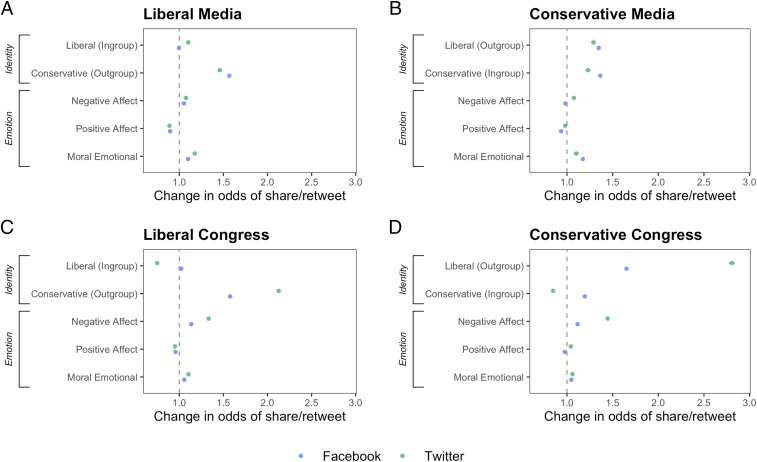
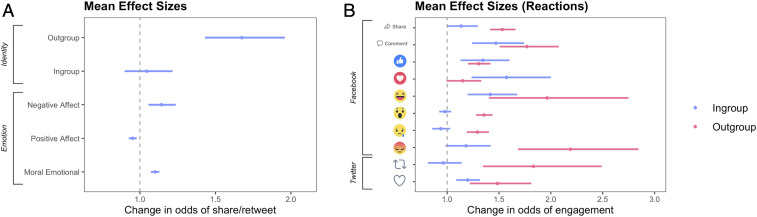
- In an internal meta-analysis across eight datasets, each political out-group word increased the odds of a retweet or share by about 67% (exp(b) = 1.67, 95% CI = [1.43, 1.69], P < 0.001), whereas political in-group language had no statistically significant effect (exp(b) = 1.05, 95% CI = [0.90, 1.22], P = 0.563).
- The out-group effect was larger than established emotional predictors: the percent increase in shares associated with out-group language was about 4.8 times that of negative affect language and about 6.7 times that of moral-emotional language. Meta-analytically, negative affect increased diffusion by about 14% per word, moral-emotional language by 10%, and positive affect decreased diffusion by about 5%.
- Posts with at least one out-group word were more than twice as likely to be shared as posts with at least one in-group word (exp(b) = 2.32, 95% CI = [1.57, 2.47], P < 0.001; a 132% increase).
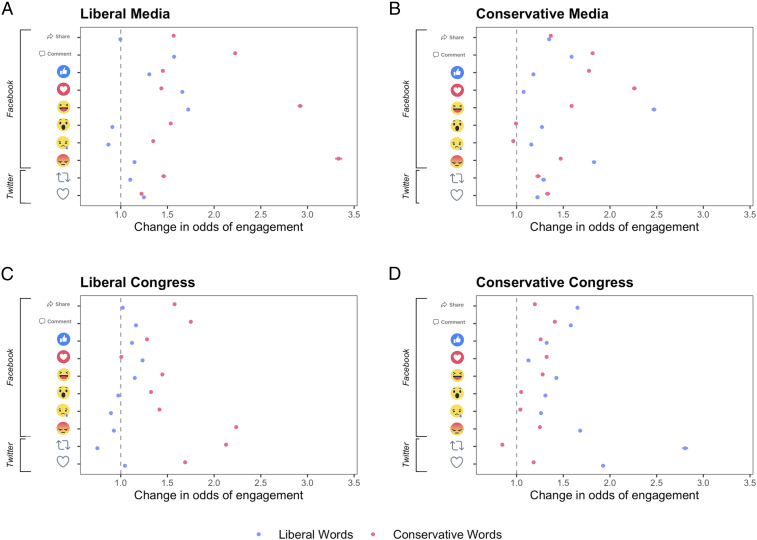
- Out-group language strongly predicted “angry” reactions (meta-analytic exp(b) = 2.19, 95% CI = [1.68, 2.84], P < 0.001), while in-group language strongly predicted “love” reactions (exp(b) = 1.57, 95% CI = [1.24, 2.00], P < 0.001). The “angry” reaction was the most popular reaction in seven of eight datasets.
Methods
- Observational big-data study of public Facebook posts and tweets from liberal and conservative news media accounts and Democratic and Republican members of Congress, totaling n = 2,730,215 observations. Study 1 media data included 599,999 Facebook posts and 227,229 tweets; Study 2 congressional data included 1,078,562 tweets and 825,424 Facebook posts.
- Text was analyzed with dictionaries for liberal/conservative in-group and out-group terms, positive and negative affect, and moral-emotional language. Ordinary least squares regressions predicted log-transformed retweet/share counts, controlling for URL, media, follower count, and retweet status, followed by random-effects internal meta-analyses across the eight datasets.
Limitations
- The paper states the results are correlational, not causal, and calls for experimental work to determine causation and clarify why out-group content is engaging.
- The paper states data access limitations prevented following up important questions such as who is producing the engagement.
- The paper states the data likely reflect a specific time frame—the years leading up to the 2020 election—so generalizability to other time periods or nations is unclear, and the role of platform algorithms is unclear because companies are not transparent about them.
Model-written summary. Check it against the paper before relying on it.
Integrity signals
Registry
Cites
Statistics
Figures
Verification
Claims the paper makes
12 Valid · 0 Not valid · 31 Not checked · 104 Own results and interpretations
Every source the paper cites for this claim was checked and supports it.
In the paper
“Indeed, false political news tends to be highly negative about the outgroup (39), so our findings may be relevant to the viral spread of misinformation online.”
§ Out-group animosity drives engagement on social media > Discussion
What the sources say
- Supportedcites [39] M. Osmundsen, A. Bor, P. B. Vahlstrup, A. Bechmann, M. B. Petersen, Partisan polarization is the primary psychological motivation behind “fake news” sharing on Twitter. Am. Polit. Sci. Rev., in press. (2021). source
The paper’s Figure 5 discussion (Additional information; page unavailable) reports that headlines become more negative about opposing-party politicians as news sources become more partisan. It notes an exception to the relative pattern: pro-Democratic fake-news sources portray both parties negatively, rather than singling out the out-party. (LLM, conf=0.86)
plainstates an association- Asserted: passes — The authors put it forward as true.
- Checkable: passes — It can be checked against evidence.
- Load-bearing: passes — The paper’s conclusions depend on it.
- Based: passes — The paper gives a reason why it holds.
- Supported
The cited sources support only part of this claim — read each source’s verdict below.
In the paper
“replicating prior work on the moral contagion effect with similar effect sizes and extending on this work by showing that moral contagion operates on multiple social media platforms, including Facebook (21).”
§ Out-group animosity drives engagement on social media > Results > Study 1: Major Media Outlets.
What the sources say
- Partly supportedcites [21] W. J. Brady, J. A. Wills, J. T. Jost, J. A. Tucker, J. J. Van Bavel, Emotion shapes the diffusion of moralized content in social networks. Proc. Natl. Acad. Sci. U.S.A. 114, 7313– 7318 (2017). 28652356 PMC5514704 sourceExperimental — accuracy not yet measured
The Results report moral contagion as an increased retweet rate, supporting the effect on Twitter. The Methods measure diffusion by retweet count, while the Discussion mentions Facebook only to compare platform user numbers; our copy does not show that the effect operates on Facebook or multiple platforms. In the citing sentence, that cross-platform finding is described as an extension of the prior work. (LLM, conf=0.87)
boostedstates a causen = 599,999- Asserted: passes — The authors put it forward as true.
- Checkable: passes — It can be checked against evidence.
- Load-bearing: passes — The paper’s conclusions depend on it.
- Based: passes — The paper gives a reason why it holds.
- Partly supported
Every source the paper cites for this claim was checked and supports it.
In the paper
“Affective polarization, which reflects dislike of people in the opposing political party as compared to one’s own party, has most strikingly increased (43)”
§ Out-group animosity drives engagement on social media > Abstract
What the sources say
- Supportedcites [43] S. Iyengar, Y. Lelkes, M. Levendusky, N. Malhotra, S. J. Westwood, The origins and consequences of affective polarization in the United States. Annu. Rev. Political Sci. 22, 129– 146 (2019). source
The Survey Self-Reports section (p. 3) defines affective polarization as the difference between feelings toward one's own party and the opposing party, and reports a significant increase in the United States from 1978 to 2016. Figure 1 (p. 4) says that increase was driven mainly by growing animus toward the opposing party. (LLM, conf=0.93)
boostedstates a cause- Asserted: passes — The authors put it forward as true.
- Checkable: passes — It can be checked against evidence.
- Load-bearing: passes — The paper’s conclusions depend on it.
- Based: passes — The paper gives a reason why it holds.
- Supported
The sources with a verdict support this claim; the rest weren’t checked yet, have no full text we could read, or their verdicts aren’t rated yet.
In the paper
“Out-party animosity, more so than in-party warmth, has also become a more powerful predictor of important behaviors, such as voting behavior (46) and the sharing of political fake news (39).”
§ Out-group animosity drives engagement on social media > Abstract
What the sources say
- Not checked — no full text of the sourcecites [46] E. J. Finkel., Political sectarianism in America. Science 370, 533– 536 (2020). 33122374 source
- Supportedcites [39] M. Osmundsen, A. Bor, P. B. Vahlstrup, A. Bechmann, M. B. Petersen, Partisan polarization is the primary psychological motivation behind “fake news” sharing on Twitter. Am. Polit. Sci. Rev., in press. (2021). source
In “Do people share news from fake news sources?”, the paper reports that negative out-party affect coefficients were about twice as large as positive in-party affect coefficients for sharing fake news sources. Citation (39) supports the fake-news-sharing part of the sentence; the voting-behavior part has a separate citation. (LLM, conf=0.94)
plainstates an association- Asserted: passes — The authors put it forward as true.
- Checkable: passes — It can be checked against evidence.
- Load-bearing: passes — The paper’s conclusions depend on it.
- Based: passes — The paper gives a reason why it holds.
Every source the paper cites for this claim was checked and supports it.
In the paper
“This may help explain why exposure to opposing views on Twitter can actually increase political polarization (62).”
§ Out-group animosity drives engagement on social media > Discussion
What the sources say
- Supportedcites [62] C. A. Bail., Exposure to opposing views on social media can increase political polarization. Proc. Natl. Acad. Sci. U.S.A. 115, 9216– 9221 (2018). 30154168 PMC6140520 source
The Abstract reports that Republican participants expressed substantially more conservative views after following a bot retweeting opposing views on Twitter. The Discussion and Conclusion describes this as a backfire effect, while cautioning against generalizing it to all settings. The claim says exposure *can* increase polarization, which fits those findings. (LLM, conf=0.94)
hedgedstates a cause- Asserted: passes — The authors put it forward as true.
- Checkable: passes — It can be checked against evidence.
- Load-bearing: passes — The paper’s conclusions depend on it.
- Based: passes — The paper gives a reason why it holds.
- Supported
73 more claims
Create a free account to see all 147 claims and to verify the 5 references still open.
- Probably not a substantial claim. 40
- It may state two separate claims as one. 36
Claims other papers make about this one
Each is checked against this paper’s own text: does it say what the citing paper says it does?
The source backs part of the claim, not all of it — or backs it for a different population, condition or comparison.
In the citing paper
“Further, online stories from social media perceived as negative garner more reactions (for example, likes, Facebook reactions)42,43.”
From Negativity drives online news consumption (2023) · cites this paper as [43]
Experimental — accuracy not yet measuredThe source backs part of the claim, not all of it — or backs it for a different population, condition or comparison.
In the citing paper
“Consistent with findings from previous literature21,43,61, we found that several dyads such as outrage and disapproval are associated with higher CTRs.”
From Negativity drives online news consumption (2023) · cites this paper as [43]
Experimental — accuracy not yet measuredThe source backs part of the claim, not all of it — or backs it for a different population, condition or comparison.
In the citing paper
“Moreover, previous observational studies have found that tweets with more emotion and out-group animosity tend to receive higher engagement [11,41].”
From Twitter's Algorithm: Amplifying Anger, Animosity, and Affective Polarization (2023) · cites this paper as [41]
Experimental — accuracy not yet measuredThe source backs part of the claim, not all of it — or backs it for a different population, condition or comparison.
In the citing paper
“A follow-up study of more than 800 Facebook posts and a million Twitter posts from the official accounts of members of the US Congress showed that messages mentioning the out-group, but not the in-group, were more likely to be shared than other posts (increased diffusion rates ranging from 58% to 180%260).”
From Cognitive–motivational mechanisms of political polarization in social-communicative contexts (2022) · cites this paper as [260]
Experimental — accuracy not yet measuredThe source backs part of the claim, not all of it — or backs it for a different population, condition or comparison.
In the citing paper
“These market incentives both reflect and exacerbate ideological and affective forms of polarization, insofar as emotionally charged material, such as that which is contemptuous of ideological adversaries, is more likely to go ‘viral’ than more measured types of political discourse260,263,269,270.”
From Cognitive–motivational mechanisms of political polarization in social-communicative contexts (2022) · cites this paper as [260]
Experimental — accuracy not yet measured
9 more claims about this paper
Create a free account to see every claim other papers make about this one.
Self-check
Percentages, sums and reported differences re-computed from the paper’s own numbers.
Each contradiction between two passages listed here was confirmed by an independent check.
Rated major: it would touch a result — a value a result rests on, reported and recomputed p-values on opposite sides of the significance level, two passages that conflict with no sign which is right, or a cited work retracted before this paper was published.
In the paper
§ Out-group animosity drives engagement on social media > Results > Internal Meta-Analysis.
“exp(b) = 1.39, 95% CI = [0.91, 1.58]”
§ Out-group animosity drives engagement on social media > Results > Internal Meta-Analysis.
“P < 0.018”
Rated minor: it would not touch a result — a value no result rests on, a p-value that stays on the same side of the significance level, or a conflict that is clerical, resolved elsewhere in the paper, or outside its own findings.
In the paper
§ Out-group animosity drives engagement on social media > Results > Internal Meta-Analysis.
“95% CI = [0.99, 0.42]”
§ Out-group animosity drives engagement on social media > Results > Internal Meta-Analysis.
“exp(b) = 1.18”
Citations
Cites
An Integrative Theory of Intergroup Conflict
Tajfel, H., & Turner, J. (2000) · Organizational Identity · doi:10.1093/oso/9780199269464.003.0005 · Cited by 12,487
The case for motivated reasoning.
Kunda, Z. (1990) · Psychological Bulletin · doi:10.1037/0033-2909.108.3.480 · Cited by 9,022
The spread of true and false news online
Vosoughi, S., Roy, D., & Aral, S. (2018) · Science · doi:10.1126/science.aap9559 · Cited by 8,847 · cited 2×
“Thus, we could directly compare how much posts about only the out-group (coded as 1) diffused compared to posts about only the in-group (coded as 0), following the methods of past research that have looked at how the diffusion of false news compares to true news (25).”
Rediscovering the Social Group: A Self‐Categorization Theory
REID, F. (1987) · British Journal of Social Psychology · doi:10.1111/j.2044-8309.1987.tb00799.x · Cited by 8,091
Rediscovering the Social Group: A Self-Categorization Theory.
Willer, D., Turner, J. C., Hogg, M. A., Oakes, P. J., Reicher, S. D., & Wetherell, M. S. (1989) · Contemporary Sociology · doi:10.2307/2073157 · Cited by 7,159
The Psychological Meaning of Words: LIWC and Computerized Text Analysis Methods
Tausczik, Y. R., & Pennebaker, J. W. (2010) · Journal of Language and Social Psychology · doi:10.1177/0261927x09351676 · Cited by 5,774 · cited 2×
“and negative affect words per post (51) and the number of moral-emotional”
(2011) · Cited by 4,430
Motivated Skepticism in the Evaluation of Political Beliefs
Taber, C. S., & Lodge, M. (2006) · American Journal of Political Science · doi:10.1111/j.1540-5907.2006.00214.x · Cited by 4,344
The Origins and Consequences of Affective Polarization in the United States
Iyengar, S., Lelkes, Y., Levendusky, M., Malhotra, N., & Westwood, S. J. (2019) · Annual Review of Political Science · doi:10.1146/annurev-polisci-051117-073034 · Cited by 3,603
Exposure to ideologically diverse news and opinion on Facebook
Bakshy, E., Messing, S., & Adamic, L. A. (2015) · Science · doi:10.1126/science.aaa1160 · Cited by 3,245
Research works printed but not linked: 2
- A. Campbell, P. E. Converse, W. E. Miller, D. E. Stokes, The American Voter New York (Wiley, 1960).
- A. Mosseri, News Feed FYI: Bringing People Closer Together (Facebook Newsroom, 2018).
Cited by
Items 301–400 of 584
Yoo, J., Johnson, T. J., & Lacasa-Mas, I. (2024) · Mass Communication & Society · doi:10.1080/15205436.2024.2401842 · Cited by 9
Social media, AI, and the rise of extremism during intergroup conflict
Lavie-Driver, N. I., & van der Linden, S. (2025) · Frontiers in Social Psychology · doi:10.3389/frsps.2025.1711791 · Cited by 11
Polarization: linking loneliness and social media dependency
Rynarzewska, A. I., Waldsmith, C., & Nikolov, A. N. (2025) · Journal of Services Marketing · doi:10.1108/jsm-08-2025-0508 · Cited by 7
Internet‐Based Platforms and Trends Towards Online Social Networking
Keswani, B., Kushwaha, S., Shiwani, S., & Parashar, N. K. (2024) · Wiley eBooks · doi:10.1002/9781394231126.ch18 · Cited by 4
The Influence of Social Media-like Cues on Visual Attention—An Eye-Tracking Study with Food Products
Mamalikou, M., Gkatzionis, K., & Παναγιώτου, Μ. (2025) · Journal of Eye Movement Research · doi:10.3390/jemr18060062 · Cited by 5
Overgaard, C. S. B., Lukito, J., & Soorholtz, K. (2024) · Proceedings of the International AAAI Conference on Web and Social Media · doi:10.1609/icwsm.v18i1.31380 · Cited by 11
Repairing cognitive distortions in political divides.
Santos, L. A., Garton, C., & Zaki, J. (2025) · Trends in Cognitive Sciences · doi:10.1016/j.tics.2025.06.007 · Cited by 3
Huber, G. A., Gerber, A. S., Fang, A. H. G., & Cho, J. J. (2025) · British Journal of Political Science · doi:10.1017/s0007123425000298 · Cited by 3
Artificial Intelligence Chatbots Mimic Human Collective BehaviourPreprint
He, J. K., Wallis, F. P. S., Gvirtz, A., & Rathje, S. (2023) · PsyArXiv (OSF Preprints) · doi:10.31234/osf.io/vf5ap · Cited by 2
Self-citationWalker, A. C., Fugelsang, J. A., & Koehler, D. J. (2024) · SSRN Electronic Journal · doi:10.2139/ssrn.4724808 · Cited by 2
Social reference cues can reduce misinformation sharing behaviour on social mediaPreprint
Jones, C. M., Diethei, D., Schöning, J., Shrestha, R., Jahnel, T., & Schüz, B. (2021) · PsyArXiv (OSF Preprints) · doi:10.31234/osf.io/v6fc9 · Cited by 3
Depolarizing Within the Comfort of Your Party: Experimental Evidence from Online WorkshopsPreprint
Blair, R., Gottlieb, J., Schenk, M., et al. (2023) · doi:10.31219/osf.io/eha8r · Cited by 2
Bird, C. C., Houston, R., & Shieh, M. (2024) · Political Research Quarterly · doi:10.1177/10659129241280248 · Cited by 3
Bor, A., Marie, A., Pradella, L., & Petersen, M. B. (2026) · Nature Human Behaviour · doi:10.1038/s41562-026-02432-5 · Cited by 10
Beyond negativity? A laboratory study on emotional responses to populist strategies on social media
Lindholm, J., Eklund, J., Strandberg, K., Carlson, T., & Andersson, S. (2024) · Frontiers in Political Science · doi:10.3389/fpos.2024.1415403 · Cited by 7
Alizadeh, M., Hoes, E., & Gilardi, F. (2022) · doi:10.31219/osf.io/har52 · Cited by 2
Not our kind of crowd! How partisan bias distorts perceptions of political bots on Twitter (now X)
Lueders, A., Reiß, S., Dinkelberg, A., MacCarron, P., & Quayle, M. (2024) · British Journal of Social Psychology · doi:10.1111/bjso.12794 · Cited by 3
Zhong, J., Mo, Y., Zhang, J., Liu, P., Luo, X., Liu, L., Ding, R., Huang, J., & Zheng, Y. (2025) · Humanities and Social Sciences Communications · doi:10.1057/s41599-025-05689-9 · Cited by 5
On The Role of Social Identity in the Market for (Mis)information
Hebbar, V., & Langbort, C. (2022) · IEEE Conference on Decision and Control (CDC) · doi:10.1109/cdc51059.2022.9993142 · Cited by 6
Stronger Than Yesterday: Investigating Peoples' Experiences of View Strengthening on Social Media
Beall, S., Makri, S., & McKay, D. (2023) · Proceedings of the Association for Information Science and Technology · doi:10.1002/pra2.767 · Cited by 8
Beikzadeh, M., Holloway, I. W., Kärkkäinen, K., Hong, C., Cascalheira, C. J., Wu, E. S. C., Boka, C., Avendaño, A., Yonko, E. A., & Sarrafzadeh, M. (2025) · Online Journal of Public Health Informatics · doi:10.2196/68013 · Cited by 3
Cohen, S. G., & Dishon, G. (2024) · Journal of Computer Assisted Learning · doi:10.1111/jcal.13086 · Cited by 4
Building Support Through the Personalization of Twitter Messages in a Permanent Campaign
Gaynor, S. W., & Gimpel, J. G. (2023) · American Politics Research · doi:10.1177/1532673x231184434 · Cited by 3
Altay, S., Hoes, E., & Wojcieszak, M. (2024) · PsyArXiv (OSF Preprints) · doi:10.31234/osf.io/hq5ru · Cited by 6
Analyzing differences between discursive communities using dialectograms
Enggaard, T., Lohse, A., Pedersen, M. A., & Lehmann, S. (2024) · Scientific Reports · doi:10.1038/s41598-024-72144-1 · Cited by 5
Humorous political rhetoric in the US: analysing Trump’s and Ocasio-Cortez’s use of humour
Prakken, B. P. (2025) · European Journal of Humour Research · doi:10.7592/ejhr.2025.13.4.1087 · Cited by 5
Yuan, N. A., & Chang, H. H.-C. (2026) · SSRN Electronic Journal · doi:10.2139/ssrn.6161926 · Cited by 3
Ranking by engagement and non‐engagement signals: Learnings from industry
Cunningham, T., Pandey, S., Sigerson, L., Stray, J., Allen, J., Barrilleaux, B., Iyer, R., Kothari, M., Rezaei, B., Kairam, S., et al. (2025) · Annals of the New York Academy of Sciences · doi:10.1111/nyas.15399 · Cited by 36
Heltzel, G., & Laurin, K. (2024) · doi:10.31234/osf.io/f3p4s · Cited by 2
The immortality trap: Terror management in the digital context
Fa, H. (2025) · Death Studies · doi:10.1080/07481187.2025.2525189 · Cited by 3
TikTok’s Influence on Social Health and Democracy: Bioethical Perspective
Janhonen, J., Zimmerman, A., & Bowers, O. (2025) · Digital Society · doi:10.1007/s44206-025-00210-w · Cited by 2
‘Unfollow Them!’: The Role of Morality‐ and Emotion‐Related Factors in the Cancelling Process
Greig, M. A., & Hogg, R. C. (2025) · Human Behavior and Emerging Technologies · doi:10.1155/hbe2/7144903 · Cited by 7
Speech Repression and Threat Narratives in Politics: Social Goals and Cognitive Foundations
Marie, A. (2025) · Annals of the New York Academy of Sciences · doi:10.1111/nyas.70089 · Cited by 1
Arceneaux, K., Foucault, M., Giannelos, K., Ladd, J. M., & Zengin, C. (2024) · Royal Society Open Science · doi:10.1098/rsos.240280 · Cited by 9
Individual-Level Moderating and Differential Effects of DeplatformingPreprint
Buntain, C., & Snegovaya, M. (2024) · SSRN Electronic Journal · doi:10.2139/ssrn.4739537 · Cited by 5
Misinformation as strategy: Epistemic consequences and the undermining of shared truth
Ecker, U. K. H., Spearing, E. R., DiResta, R., & Lewandowsky, S. (2026) · Trends in Cognitive Sciences · doi:10.1016/j.tics.2026.06.009 · Cited by 4
Intelligent Systems, Vulnerable Minds: A Framework for Radicalization to Violence in the Age of AI
Kunst, J. R., Obaidi, M., Gollwitzer, A., Brandtzæg, P. B., Hinrichs, Y., Saini, N., & Schroeder, D. T. (2026) · Personality and Social Psychology Review · doi:10.1177/10888683261430089 · Cited by 14
Adolescents and the dark side of social media—Law enforcement perspectives
Äijälä, J., Riikonen, R., Huhtinen, A., & Sederholm, T. (2023) · Frontiers in Communication · doi:10.3389/fcomm.2023.1106165 · Cited by 5
Facciani, M., & Traberg, C. S. (2024) · Connections · doi:10.21307/connections-2019.044 · Cited by 6
Ganapini, M. B., & Panai, E. (2025) · American Philosophical Quarterly · doi:10.5406/21521123.62.3.05 · Cited by 3
Hanley, H. W. A., & Durumeric, Z. (2025) · Proceedings of the ACM on Human-Computer Interaction · doi:10.1145/3757661 · Cited by 9
Heide‐Jørgensen, T., Eady, G., & Rasmussen, A. (2025) · Science Advances · doi:10.1126/sciadv.adv7864 · Cited by 6
Addressing Online Political HostilityPreprint
Rasmussen, J. S. (2023) · Thesis Commons (OSF Preprints) · doi:10.31237/osf.io/745px · Cited by 2
What does my group consider moral?: How social influence shapes moral expressionsPreprint
del Rosario, K., Bavel, J. J. V., & West, T. V. (2024) · PsyArXiv (OSF Preprints) · doi:10.31234/osf.io/dwzq2 · Cited by 4
Digital Distractions and Misinformation
Kaliebe, K., & Shah, K. (2024) · Pediatric Clinics of North America · doi:10.1016/j.pcl.2024.08.002 · Cited by 4
Networks of inclusion: Using teams and technology to create diverse social capital
Gordon, S., Baker, W. E., Uribe, J. N., Chambers, C. R., & Desmarais, B. A. (2025) · Social Networks · doi:10.1016/j.socnet.2025.05.003 · Cited by 5
Méndez, A. R. (2024) · Sintaxis · doi:10.36105/stx.2024n13.07 · Cited by 5
News source bias and sentiment on social mediaPreprint
Knutson, B. D., Hsu, T. W., Ko, M., et al. (2024) · doi:10.31234/osf.io/jxu95 · Cited by 2
Navigating diversity: identity perceptions and workplace dynamics
Qureshi, F. (2024) · Journal of Asia Business Studies · doi:10.1108/jabs-09-2023-0367 · Cited by 3
Borghouts, J. W., Huang, Y., Hopfer, S., Li, C., & Mark, G. J. (2024) · ACM Transactions on Computer-Human Interaction · doi:10.1145/3637876 · Cited by 4
Lutzke, L., Otten, C. D., Sen, S., & Árvai, J. (2024) · Journal of Risk Research · doi:10.1080/13669877.2024.2317320 · Cited by 1
How quotation marks do mockery in online politicized discourse
Robles, J. S., & Xiong, B. (2024) · Journal of Language and Politics · doi:10.1075/jlp.22008.rob · Cited by 2
That's So Cringeworthy! Understanding What Cringe Is and Why We Want to Share It
Escoe, B., Martin, N. S., & Salerno, A. G. (2024) · Journal of Marketing Research · doi:10.1177/00222437241305104 · Cited by 7
Does Incentivization Promote Sharing “True” Content Online?Preprint
Kapoor, H., Rezaei, S., Gurjar, S., Tagat, A., Denny, D., Budhwar, Y., & Puthillam, A. (2022) · doi:10.31234/osf.io/nykxz · Cited by 2
Kim, D., & Kokuryo, J. (2024) · Societies · doi:10.3390/soc14090192 · Cited by 4
A research agenda for encouraging prosocial behaviour on social media
Dorr, T. G., Nagpal, T., Watts, D. J., & Bail, C. A. (2025) · Nature Human Behaviour · doi:10.1038/s41562-025-02102-y · Cited by 18
The Agenda-Setting Function of Social Media
Kim, R. M., & Anderson, A. (2025) · International World Wide Web Conference (WWW) · doi:10.1145/3696410.3714750 · Cited by 11
Hussein, M. A., & Tormala, Z. L. (2023) · Cambridge University Press eBooks · doi:10.1017/9781009243957.003 · Cited by 6
Kane, J., & Anson, I. G. (2024) · Politics Groups and Identities · doi:10.1080/21565503.2024.2304316 · Cited by 4
Palchikova, V., & Schulte-Cloos, J. (2026) · Electoral Studies · doi:10.1016/j.electstud.2026.103115 · Cited by 1
How People Justify Online Political HostilityPreprint
Rasmussen, J. S. (2023) · PsyArXiv (OSF Preprints) · doi:10.31234/osf.io/r3y5u · Cited by 1
Mohammadinodooshan, A., & Carlsson, N. F. (2025) · Proceedings of the International AAAI Conference on Web and Social Media · doi:10.1609/icwsm.v19i1.35871 · Cited by 3
Tella, R. D., Gálvez, R. H., & Schargrodsky, E. (2024) · SSRN Electronic Journal · doi:10.2139/ssrn.4721023 · Cited by 1
Live Free and Die: How Social Media Amplify Populist Vaccine Resistance
Rojecki, A., Conner, V. A., & Royal, P. G. (2024) · Social Media + Society · doi:10.1177/20563051241277293 · Cited by 1
Regulating misinformation online: permissible content moderation
Ganapini, M. B. (2026) · Inquiry · doi:10.1080/0020174x.2026.2624389 · Cited by 1
Assessing How Fact‐Checks Influence Accuracy and Consensus Judgments: Evidence From the Olympics
Wack, M., Allan, J. N., Boatwright, B., & Cranmer, G. A. (2026) · Risk Analysis · doi:10.1111/risa.70293 · Cited by 2
Popowski, L., Wu, X., Zhu, X., Piccardi, T., & Bernstein, M. S. (2026) · CHI Conference on Human Factors in Computing Systems · doi:10.1145/3772318.3791569 · Cited by 8
Is It Worth Posting? Testing the Influence of State Legislators in Simulated Social Media
Hemmen, A. (2025) · State Politics & Policy Quarterly · doi:10.1017/spq.2025.10011 · Cited by 2
Hoffmann, C. P., & Lutz, C. (2025) · Information Communication & Society · doi:10.1080/1369118x.2025.2598053 · Cited by 2
Divisive or Bridging? Personal Stories in Cross-Cutting Political Discussions on Reddit
Rajadesingan, A., & Chebrolu, T. (2026) · Social Media + Society · doi:10.1177/20563051261462091 · Cited by 1
Emotions moderate the influence of moral values on attitude stability
Phillips, S. C., Ng, L. H. X., Zhou, W., & Carley, K. M. (2025) · Computational and Mathematical Organization Theory · doi:10.1007/s10588-025-09407-3 · Cited by 3
Mentions of prejudice in news media – an international comparison
Rozado, D. (2024) · Journal of Computational Social Science · doi:10.1007/s42001-024-00295-2 · Cited by 10
Social feedback mechanisms & misinformation: A neuroscience-based argument for algorithm regulation
Cohen, M. S., & Decety, J. (2026) · Behavioral Science & Policy · doi:10.1177/23794607251403323 · Cited by 1
Lee, A. S. G., Kirkland, K., & Bastian, B. B. (2026) · Communications Psychology · doi:10.1038/s44271-026-00422-x · Cited by 1
Kabbara, J., Phan, T.-M., Rakhilin, M., Detwiller, M. E., Dimitrakopoulou, D., & Roy, D. K. (2025) · CHI Conference Extended Abstracts on Human Factors in Computing Systems (CHI EA) · doi:10.1145/3706599.3706688 · Cited by 6
Disclosing sample bias fails to fully correct judgments of partisan extremity
van der Valk, A. M., Walker, A. C., Fugelsang, J. A., & Koehler, D. J. (2025) · Cognition · doi:10.1016/j.cognition.2024.106050 · Cited by 1
Refracting Blame in the Fentanyl Era: The Narrative Battleground on Facebook and Instagram
Kresovich, A., Emery, S., Borowiecki, M., Ngobo-Ekamby, M., Shi, H., Lamuda, P. A., Taylor, B. G., Schneider, J. A., & Pollack, H. A. (2025) · Substance Use & Misuse · doi:10.1080/10826084.2025.2547390 · Cited by 2
Zhang, Z. (2025) · SHS Web of Conferences · doi:10.1051/shsconf/202522004023 · Cited by 3
Forecasting Political News Engagement on Social Media
Shivaram, K., Bilgic, M., Shapiro, M., & Culotta, A. (2024) · Proceedings of the International AAAI Conference on Web and Social Media · doi:10.1609/icwsm.v18i1.31401 · Cited by 3
Vasiliu, V., Shibli, H., & Yavetz, G. (2025) · Media War & Conflict · doi:10.1177/17506352251392725 · Cited by 1
Audience Engagement and the Dynamics of Online Activism: Far-Right Mobilization on FacebookPreprint
Davidson, T. (2021) · doi:10.31235/osf.io/rwfjc · Cited by 1
Affective Polarization and Dynamics of Information Spread in Online NetworksPreprint
Lerman, K., Feldman, D., He, Z., & Rao, A. (2024) · Research Square · doi:10.21203/rs.3.rs-3855114/v1 · Cited by 3
Erlandsson, A., Nilsson, A., Persson, R., Rosander, J., & Leaf Van Boven, A. (2023) · SSRN Electronic Journal · doi:10.2139/ssrn.4457721 · Cited by 1
Predictors of partisan news selection and political misinformation sharing
Jackson, D. L., & Hoewe, J. (2025) · Communication Monographs · doi:10.1080/03637751.2025.2557484 · Cited by 3
Sentiment-Driven Differential Engagement: Hyperpartisan Vs. Non-hyperpartisan Users on X
Mohammadinodooshan, A., & Carlsson, N. F. (2026) · Lecture notes in computer science · doi:10.1007/978-3-032-13821-7_10 · Cited by 1
Outrage Fatigue? Cognitive Costs and Decisions to BlamePreprint
Bambrah, V., Cameron, D., & Inzlicht, M. (2021) · PsyArXiv (OSF Preprints) · doi:10.31234/osf.io/6y4ad · Cited by 1
Chuai, Y., Zhao, J., & Lenzini, G. (2025) · Proceedings of the ACM on Human-Computer Interaction · doi:10.1145/3757479 · Cited by 3
Park, J., & Pitassi, N. (2025) · Journal of Innovation & Knowledge · doi:10.1016/j.jik.2025.100906 · Cited by 1
Xu, C., & Ge, X. (2025) · Proceedings of the ACM on Human-Computer Interaction · doi:10.1145/3757396 · Cited by 1
Gill, H., Lee, H., Kim, S. Y., Liao, X., & Rojas, H. (2025) · International Journal of Public Opinion Research · doi:10.1093/ijpor/edaf053 · Cited by 2
The Duty to Promote Digital Minimalism in Group Agents
Aylsworth, T., & Castro, C. (2024) · Springer eBooks · doi:10.1007/978-3-031-45638-1_7 · Cited by 2
Still unsafe: what’s holding us back on online safety for women
Pérez, Á. P., Farrell, T., de Kock, C., Jurasz, O., Nozza, D., & Fernandez, M. (2026) · AI and Ethics · doi:10.1007/s43681-026-01097-0 · Cited by 2
Peters, U., & Quintana, I. O. (2024) · Synthese · doi:10.1007/s11229-024-04639-3 · Cited by 2
Political polarization in low- and middle-income countries
Larreguy, H., & Tiburcio, E. (2026) · Nature Human Behaviour · doi:10.1038/s41562-026-02507-3 · Cited by 6
Metadata
- Authors
- Rathje, S., Van Bavel, J. J., & van der Linden, S.
- Affiliations
- University of Cambridge (GB)
- Department of Psychology, Center for Neural Science, New York University, New York, NY 10003
- Department of Psychology, University of Cambridge, Cambridge CB2 3RQ, United Kingdom;
- Corresponding author
- Rathje, Steve
- Venue
- Proceedings of the National Academy of Sciences
- Publisher
- National Academy of Sciences
- Published
- 2021-06-23
- Volume
- 118
- Issue
- 26
- ISSN
- 0027-8424 (ISSN-L)
- 1091-6490
- PMC
- PMC8256037
- OpenAlex
- W3176626547
- Cited by
- 560
- References
- 72
- Citations by year
- 2026: 103 · 2025: 126 · 2024: 133 · 2023: 106 · 2022: 72 · 2021: 18
- FWCI
- 108.57
- Type
- journal article
- Language
- en
- Open access
- hybrid
- doi.org
- Licence
- Locations
- Proceedings of the National Academy of Sciences (publishedVersion, cc-by)
- PubMed Central (publishedVersion, cc-by)
- PubMed (publishedVersion)
- Apollo (University of Cambridge) (submittedVersion, cc-by)
- OSF Preprints (OSF Preprints) (submittedVersion)
- Apollo (cc-by)
- Funders
- Gates Cambridge Trust (OPP1144)
- John Templeton Foundation (61378)
- Topics
- Social Sciences › Communication › Social Media and Politics
- Social Sciences › Sociology and Political Science › Misinformation and Its Impacts
- Social Sciences › Sociology and Political Science › Social and Intergroup Psychology
- Keywords
- social media engagement, in-group favoritism, outgroup derogation, political polarization, social media sharing, retweets, political language, political leaders, political orientation
- MeSH terms
- Emotions, Humans, Politics, Databases as Topic, Social Media
About these checks
Registry, retraction, Cites and statistics results are computed, not judged, with one exception: a printed reference that no index lists is read once by a model before it counts as a citation error. Claims are extracted by a model and kept only when their quote appears verbatim in the text; each cited source is then checked, with a model’s help, for whether it says what the claim relies on. Those verdicts can be wrong — read the claim’s quote and the cited source before relying on one.
The claim verdicts this report counts are experimental: their accuracy is not yet measured.
A language model drew the claims from the paper on 2026-10-10, under version 3 of the claim definition (model deepseek-v4.1-flash, prompt extract-v3).
A second model labelled each claim on 2026-10-10 (model jev-1.13-20260917, definition revision gold-guideline-v0.2).
Cited sources are checked with a language model’s help (gpt-6-sol).
Statistics and arithmetic are recomputed, not judged.
Confidence bands are shown only for fields calibrated on our annotated test set. None is calibrated yet, so no band is shown.
What counts as a claim ›How we measure confidence ›How we check this ›
Are you an author, or do you see a problem with this page? Request a review
Data sources
Bibliographic data: Semantic Scholar, OpenAlex, Crossref.
Contains information from the Semantic Scholar Academic Graph Datasets, made available under the ODC Attribution License (ODC-BY 1.0).
Semantic Scholar’s data is described in: Kinney, R., et al. (2023). The Semantic Scholar Open Data Platform. arXiv:2301.10140.
