

Out-group animosity drives engagement on social media
Open accessThe DOI matches its Crossref record; 74 of the 75 references it cites were found in a registry or an index; 13 of the 61 sources its claims cite were checked for support.
Abstract
= 2,730,215), we found that posts about the political out-group were shared or retweeted about twice as often as posts about the in-group. Each individual term referring to the political out-group increased the odds of a social media post being shared by 67%. Out-group language consistently emerged as the strongest predictor of shares and retweets: the average effect size of out-group language was about 4.8 times as strong as that of negative affect language and about 6.7 times as strong as that of moral-emotional language-both established predictors of social media engagement. Language about the out-group was a very strong predictor of "angry" reactions (the most popular reactions across all datasets), and language about the in-group was a strong predictor of "love" reactions, reflecting in-group favoritism and out-group derogation. This out-group effect was not moderated by political orientation or social media platform, but stronger effects were found among political leaders than among news media accounts. In sum, out-group language is the strongest predictor of social media engagement across all relevant predictors measured, suggesting that social media may be creating perverse incentives for content expressing out-group animosity.
Overview
CoChat Summary
TL;DR
Across 2,730,215 Facebook posts and tweets from news media and US congressional accounts, political out-group language was the strongest predictor of sharing and retweeting. The out-group effect was much larger than in-group language or emotional language, and out-group posts especially elicited “angry” reactions.
Key findings
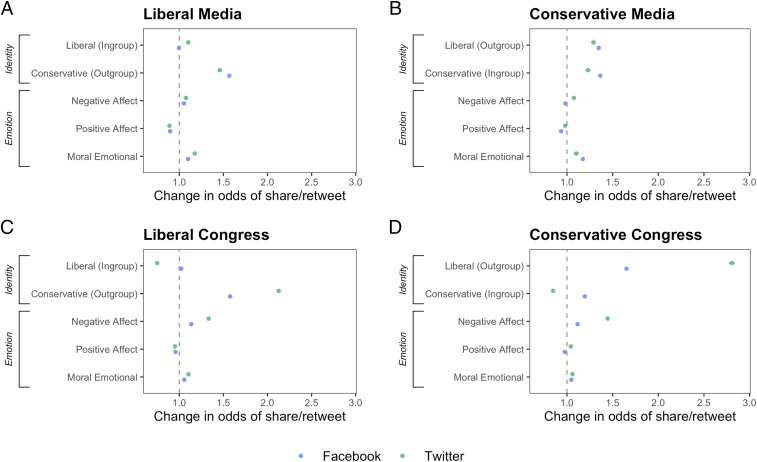
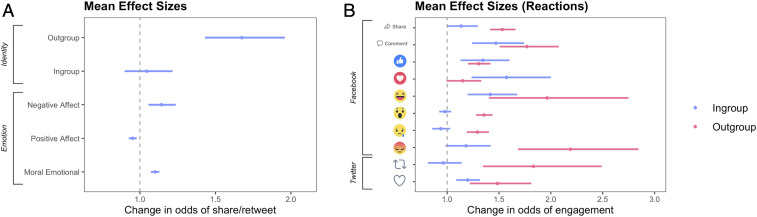
- In an internal meta-analysis across eight datasets, each political out-group word increased the odds of a retweet or share by about 67% (exp(b) = 1.67, 95% CI = [1.43, 1.69], P < 0.001), whereas political in-group language had no statistically significant effect (exp(b) = 1.05, 95% CI = [0.90, 1.22], P = 0.563).
- The out-group effect was larger than established emotional predictors: the percent increase in shares associated with out-group language was about 4.8 times that of negative affect language and about 6.7 times that of moral-emotional language. Meta-analytically, negative affect increased diffusion by about 14% per word, moral-emotional language by 10%, and positive affect decreased diffusion by about 5%.
- Posts with at least one out-group word were more than twice as likely to be shared as posts with at least one in-group word (exp(b) = 2.32, 95% CI = [1.57, 2.47], P < 0.001; a 132% increase).
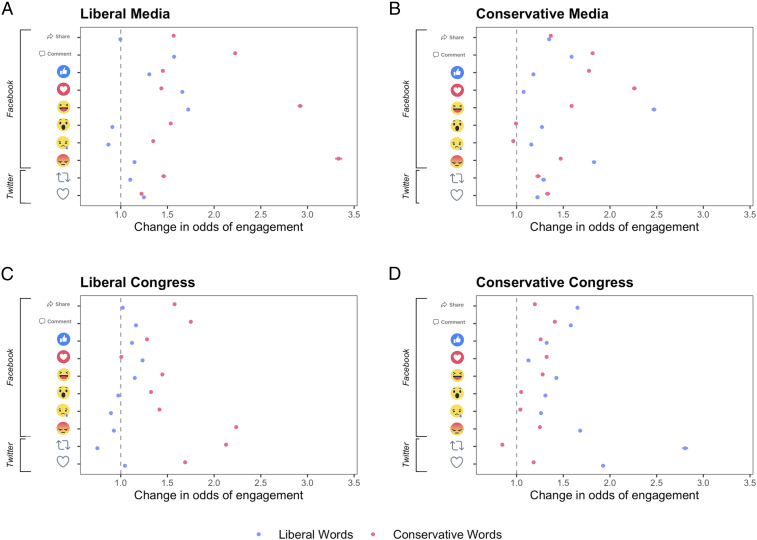
- Out-group language strongly predicted “angry” reactions (meta-analytic exp(b) = 2.19, 95% CI = [1.68, 2.84], P < 0.001), while in-group language strongly predicted “love” reactions (exp(b) = 1.57, 95% CI = [1.24, 2.00], P < 0.001). The “angry” reaction was the most popular reaction in seven of eight datasets.
Methods
- Observational big-data study of public Facebook posts and tweets from liberal and conservative news media accounts and Democratic and Republican members of Congress, totaling n = 2,730,215 observations. Study 1 media data included 599,999 Facebook posts and 227,229 tweets; Study 2 congressional data included 1,078,562 tweets and 825,424 Facebook posts.
- Text was analyzed with dictionaries for liberal/conservative in-group and out-group terms, positive and negative affect, and moral-emotional language. Ordinary least squares regressions predicted log-transformed retweet/share counts, controlling for URL, media, follower count, and retweet status, followed by random-effects internal meta-analyses across the eight datasets.
Limitations
- The paper states the results are correlational, not causal, and calls for experimental work to determine causation and clarify why out-group content is engaging.
- The paper states data access limitations prevented following up important questions such as who is producing the engagement.
- The paper states the data likely reflect a specific time frame—the years leading up to the 2020 election—so generalizability to other time periods or nations is unclear, and the role of platform algorithms is unclear because companies are not transparent about them.
Model-written summary. Check it against the paper before relying on it.
Integrity signals
Registry
Cites
Statistics
Figures
Verification
Claims the paper makes
12 Valid · 0 Not valid · 31 Not checked · 104 Own results and interpretations
Every source the paper cites for this claim was checked and supports it.
In the paper
“Indeed, false political news tends to be highly negative about the outgroup (39), so our findings may be relevant to the viral spread of misinformation online.”
§ Out-group animosity drives engagement on social media > Discussion
What the sources say
- Supportedcites [39] M. Osmundsen, A. Bor, P. B. Vahlstrup, A. Bechmann, M. B. Petersen, Partisan polarization is the primary psychological motivation behind “fake news” sharing on Twitter. Am. Polit. Sci. Rev., in press. (2021). source
The paper’s Figure 5 discussion (Additional information; page unavailable) reports that headlines become more negative about opposing-party politicians as news sources become more partisan. It notes an exception to the relative pattern: pro-Democratic fake-news sources portray both parties negatively, rather than singling out the out-party. (LLM, conf=0.86)
plainstates an association- Asserted: passes — The authors put it forward as true.
- Checkable: passes — It can be checked against evidence.
- Load-bearing: passes — The paper’s conclusions depend on it.
- Based: passes — The paper gives a reason why it holds.
- Supported
The cited sources support only part of this claim — read each source’s verdict below.
In the paper
“replicating prior work on the moral contagion effect with similar effect sizes and extending on this work by showing that moral contagion operates on multiple social media platforms, including Facebook (21).”
§ Out-group animosity drives engagement on social media > Results > Study 1: Major Media Outlets.
What the sources say
- Partly supportedcites [21] W. J. Brady, J. A. Wills, J. T. Jost, J. A. Tucker, J. J. Van Bavel, Emotion shapes the diffusion of moralized content in social networks. Proc. Natl. Acad. Sci. U.S.A. 114, 7313– 7318 (2017). 28652356 PMC5514704 sourceExperimental — accuracy not yet measured
The Results report moral contagion as an increased retweet rate, supporting the effect on Twitter. The Methods measure diffusion by retweet count, while the Discussion mentions Facebook only to compare platform user numbers; our copy does not show that the effect operates on Facebook or multiple platforms. In the citing sentence, that cross-platform finding is described as an extension of the prior work. (LLM, conf=0.87)
boostedstates a causen = 599,999- Asserted: passes — The authors put it forward as true.
- Checkable: passes — It can be checked against evidence.
- Load-bearing: passes — The paper’s conclusions depend on it.
- Based: passes — The paper gives a reason why it holds.
- Partly supported
Every source the paper cites for this claim was checked and supports it.
In the paper
“Affective polarization, which reflects dislike of people in the opposing political party as compared to one’s own party, has most strikingly increased (43)”
§ Out-group animosity drives engagement on social media > Abstract
What the sources say
- Supportedcites [43] S. Iyengar, Y. Lelkes, M. Levendusky, N. Malhotra, S. J. Westwood, The origins and consequences of affective polarization in the United States. Annu. Rev. Political Sci. 22, 129– 146 (2019). source
The Survey Self-Reports section (p. 3) defines affective polarization as the difference between feelings toward one's own party and the opposing party, and reports a significant increase in the United States from 1978 to 2016. Figure 1 (p. 4) says that increase was driven mainly by growing animus toward the opposing party. (LLM, conf=0.93)
boostedstates a cause- Asserted: passes — The authors put it forward as true.
- Checkable: passes — It can be checked against evidence.
- Load-bearing: passes — The paper’s conclusions depend on it.
- Based: passes — The paper gives a reason why it holds.
- Supported
The sources with a verdict support this claim; the rest weren’t checked yet, have no full text we could read, or their verdicts aren’t rated yet.
In the paper
“Out-party animosity, more so than in-party warmth, has also become a more powerful predictor of important behaviors, such as voting behavior (46) and the sharing of political fake news (39).”
§ Out-group animosity drives engagement on social media > Abstract
What the sources say
- Not checked — no full text of the sourcecites [46] E. J. Finkel., Political sectarianism in America. Science 370, 533– 536 (2020). 33122374 source
- Supportedcites [39] M. Osmundsen, A. Bor, P. B. Vahlstrup, A. Bechmann, M. B. Petersen, Partisan polarization is the primary psychological motivation behind “fake news” sharing on Twitter. Am. Polit. Sci. Rev., in press. (2021). source
In “Do people share news from fake news sources?”, the paper reports that negative out-party affect coefficients were about twice as large as positive in-party affect coefficients for sharing fake news sources. Citation (39) supports the fake-news-sharing part of the sentence; the voting-behavior part has a separate citation. (LLM, conf=0.94)
plainstates an association- Asserted: passes — The authors put it forward as true.
- Checkable: passes — It can be checked against evidence.
- Load-bearing: passes — The paper’s conclusions depend on it.
- Based: passes — The paper gives a reason why it holds.
Every source the paper cites for this claim was checked and supports it.
In the paper
“This may help explain why exposure to opposing views on Twitter can actually increase political polarization (62).”
§ Out-group animosity drives engagement on social media > Discussion
What the sources say
- Supportedcites [62] C. A. Bail., Exposure to opposing views on social media can increase political polarization. Proc. Natl. Acad. Sci. U.S.A. 115, 9216– 9221 (2018). 30154168 PMC6140520 source
The Abstract reports that Republican participants expressed substantially more conservative views after following a bot retweeting opposing views on Twitter. The Discussion and Conclusion describes this as a backfire effect, while cautioning against generalizing it to all settings. The claim says exposure *can* increase polarization, which fits those findings. (LLM, conf=0.94)
hedgedstates a cause- Asserted: passes — The authors put it forward as true.
- Checkable: passes — It can be checked against evidence.
- Load-bearing: passes — The paper’s conclusions depend on it.
- Based: passes — The paper gives a reason why it holds.
- Supported
73 more claims
Create a free account to see all 147 claims and to verify the 3 references still open.
- Probably not a substantial claim. 40
- It may state two separate claims as one. 36
Claims other papers make about this one
Each is checked against this paper’s own text: does it say what the citing paper says it does?
The source backs part of the claim, not all of it — or backs it for a different population, condition or comparison.
In the citing paper
“Further, online stories from social media perceived as negative garner more reactions (for example, likes, Facebook reactions)42,43.”
From Negativity drives online news consumption (2023) · cites this paper as [43]
Experimental — accuracy not yet measuredThe source backs part of the claim, not all of it — or backs it for a different population, condition or comparison.
In the citing paper
“Consistent with findings from previous literature21,43,61, we found that several dyads such as outrage and disapproval are associated with higher CTRs.”
From Negativity drives online news consumption (2023) · cites this paper as [43]
Experimental — accuracy not yet measuredThe source backs part of the claim, not all of it — or backs it for a different population, condition or comparison.
In the citing paper
“Moreover, previous observational studies have found that tweets with more emotion and out-group animosity tend to receive higher engagement [11,41].”
From Twitter's Algorithm: Amplifying Anger, Animosity, and Affective Polarization (2023) · cites this paper as [41]
Experimental — accuracy not yet measuredThe source backs part of the claim, not all of it — or backs it for a different population, condition or comparison.
In the citing paper
“A follow-up study of more than 800 Facebook posts and a million Twitter posts from the official accounts of members of the US Congress showed that messages mentioning the out-group, but not the in-group, were more likely to be shared than other posts (increased diffusion rates ranging from 58% to 180%260).”
From Cognitive–motivational mechanisms of political polarization in social-communicative contexts (2022) · cites this paper as [260]
Experimental — accuracy not yet measuredThe source backs part of the claim, not all of it — or backs it for a different population, condition or comparison.
In the citing paper
“These market incentives both reflect and exacerbate ideological and affective forms of polarization, insofar as emotionally charged material, such as that which is contemptuous of ideological adversaries, is more likely to go ‘viral’ than more measured types of political discourse260,263,269,270.”
From Cognitive–motivational mechanisms of political polarization in social-communicative contexts (2022) · cites this paper as [260]
Experimental — accuracy not yet measured
8 more claims about this paper
Create a free account to see every claim other papers make about this one.
Self-check
Percentages, sums and reported differences re-computed from the paper’s own numbers.
Each contradiction between two passages listed here was confirmed by an independent check.
Rated major: it would touch a result — a value a result rests on, reported and recomputed p-values on opposite sides of the significance level, two passages that conflict with no sign which is right, or a cited work retracted before this paper was published.
In the paper
§ Out-group animosity drives engagement on social media > Results > Internal Meta-Analysis.
“exp(b) = 1.39, 95% CI = [0.91, 1.58]”
§ Out-group animosity drives engagement on social media > Results > Internal Meta-Analysis.
“P < 0.018”
Rated minor: it would not touch a result — a value no result rests on, a p-value that stays on the same side of the significance level, or a conflict that is clerical, resolved elsewhere in the paper, or outside its own findings.
In the paper
§ Out-group animosity drives engagement on social media > Results > Internal Meta-Analysis.
“95% CI = [0.99, 0.42]”
§ Out-group animosity drives engagement on social media > Results > Internal Meta-Analysis.
“exp(b) = 1.18”
Citations
Cites
An Integrative Theory of Intergroup Conflict
Tajfel, H., & Turner, J. (2000) · Organizational Identity · doi:10.1093/oso/9780199269464.003.0005 · Cited by 12,487
The case for motivated reasoning.
Kunda, Z. (1990) · Psychological Bulletin · doi:10.1037/0033-2909.108.3.480 · Cited by 9,022
The spread of true and false news online
Vosoughi, S., Roy, D., & Aral, S. (2018) · Science · doi:10.1126/science.aap9559 · Cited by 8,847 · cited 2×
“Thus, we could directly compare how much posts about only the out-group (coded as 1) diffused compared to posts about only the in-group (coded as 0), following the methods of past research that have looked at how the diffusion of false news compares to true news (25).”
Rediscovering the Social Group: A Self‐Categorization Theory
REID, F. (1987) · British Journal of Social Psychology · doi:10.1111/j.2044-8309.1987.tb00799.x · Cited by 8,091
Rediscovering the Social Group: A Self-Categorization Theory.
Willer, D., Turner, J. C., Hogg, M. A., Oakes, P. J., Reicher, S. D., & Wetherell, M. S. (1989) · Contemporary Sociology · doi:10.2307/2073157 · Cited by 7,159
The Psychological Meaning of Words: LIWC and Computerized Text Analysis Methods
Tausczik, Y. R., & Pennebaker, J. W. (2010) · Journal of Language and Social Psychology · doi:10.1177/0261927x09351676 · Cited by 5,774 · cited 2×
“and negative affect words per post (51) and the number of moral-emotional”
(2011) · Cited by 4,430
Motivated Skepticism in the Evaluation of Political Beliefs
Taber, C. S., & Lodge, M. (2006) · American Journal of Political Science · doi:10.1111/j.1540-5907.2006.00214.x · Cited by 4,344
The Origins and Consequences of Affective Polarization in the United States
Iyengar, S., Lelkes, Y., Levendusky, M., Malhotra, N., & Westwood, S. J. (2019) · Annual Review of Political Science · doi:10.1146/annurev-polisci-051117-073034 · Cited by 3,603
Exposure to ideologically diverse news and opinion on Facebook
Bakshy, E., Messing, S., & Adamic, L. A. (2015) · Science · doi:10.1126/science.aaa1160 · Cited by 3,245
What Makes Online Content Viral?
Berger, J., & Milkman, K. L. (2012) · Journal of Marketing Research · doi:10.1509/jmr.10.0353 · Cited by 3,178 · cited 2×
“The effect of out-group language was the most important predictor of sharing behavior in posts from both news media accounts and politicians—considerably stronger than the effects of political in-group language or various discrete emotions, which have previously been the main focus when assessing what makes content go…”
The spreading of misinformation online
Del Vicario, M., Bessi, A., Zollo, F., Petroni, F., Scala, A., Caldarelli, G., Stanley, H. E., & Quattrociocchi, W. (2016) · Proceedings of the National Academy of Sciences · doi:10.1073/pnas.1517441113 · Cited by 2,407
The echo chamber effect on social media
Cinelli, M., De Francisci Morales, G., Galeazzi, A., Quattrociocchi, W., & Starnini, M. (2021) · Proceedings of the National Academy of Sciences · doi:10.1073/pnas.2023301118 · Cited by 2,092 · cited 1×
“A large portion of this work has centered on the position that social media sorts us into “ echo chambers ” or “ filter bubbles ” that selectively expose people to content that aligns with their preexisting beliefs (6 – 11).”
Exposure to opposing views on social media can increase political polarization
Bail, C. A., Argyle, L. P., Brown, T. W., Bumpus, J. P., Chen, H., Hunzaker, M. B. F., Lee, J., Mann, M., Merhout, F., & Volfovsky, A. (2018) · Proceedings of the National Academy of Sciences · doi:10.1073/pnas.1804840115 · Cited by 1,863 · cited 1×
“This may help explain why exposure to opposing views on Twitter can actually increase political polarization (62).”
FILTER BUBBLE: Wie wir im Internet entmündigt werden
Pariser, E. (2012) · doi:10.3139/9783446431164 · Cited by 1,849
Emotion shapes the diffusion of moralized content in social networks
Brady, W. J., Wills, J. A., Jost, J. T., Tucker, J. A., & Van Bavel, J. J. (2017) · Proceedings of the National Academy of Sciences · doi:10.1073/pnas.1618923114 · Cited by 1,580 · cited 4×
“…words consistently increased shares and retweets in all datasets by 10 to 17%, replicating prior work on the moral contagion effect with similar effect sizes and extending on this work by showing that moral contagion operates on multiple social media platforms, including Facebook (21).”
InfluentialSelf-citationHow Elite Partisan Polarization Affects Public Opinion Formation
DRUCKMAN, J. N., PETERSON, E., & SLOTHUUS, R. (2013) · American Political Science Review · doi:10.1017/s0003055412000500 · Cited by 1,569 · cited 1×
“Given growing levels of polarization in Congress (53), and because political elites are often agenda setters who frame political debates and influence public opinion (54, 55), we thought this was an important additional context to investigate the virality of social media posts.”
Tweeting From Left to Right: Is Online Political Communication More Than an Echo Chamber?
Barberá, P., Jost, J. T., Nagler, J., Tucker, J. A., & Bonneau, R. (2015) · Psychological Science · doi:10.1177/0956797615594620 · Cited by 1,472
Rahwan, I., Cebrian, M., Obradovich, N., Bongard, J., Bonnefon, J.-F., Breazeal, C., Crandall, J. W., Christakis, N. A., Couzin, I. D., Jackson, M. O., et al. (2019) · Nature · doi:10.1038/s41586-019-1138-y · Cited by 1,364
Resurgent Mass Partisanship: The Role of Elite Polarization
Hetherington, M. J. (2001) · American Political Science Review · doi:10.1017/s0003055401003045 · Cited by 1,038
(2015) · Wiley eBooks · doi:10.1002/9781118900772 · Cited by 956
Political Sectarianism in America
Finkel, E. J., Bail, C. A., Cikara, M., Ditto, P. H., Iyengar, S., Klar, S., Mason, L., McGrath, M. C., Nyhan, B., Rand, D. G., et al. (2020) · Science · doi:10.1126/science.abe1715 · Cited by 931 · cited 5×
“Additionally, there is also a strong asymmetry such that out-group negativity is stronger than in-group positivity, reflecting the current state of negative partisanship in the United States (45, 46).”
Influential‘You have one identity’: performing the self on Facebook and LinkedIn
van Dijck, J. (2013) · Media, Culture & Society · doi:10.1177/0163443712468605 · Cited by 925 · cited 1×
“Additionally, since sharing behavior is public, it can reflect self-conscious identity presentation (28, 29).”
The welfare effects of social media
Allcott, H., Braghieri, L., Eichmeyer, S., & Gentzkow, M. (2020) · American Economic Review · doi:10.1257/aer.20190658 · Cited by 857 · cited 1×
“For example, temporarily deactivating Facebook can reduce polarization on policy issues (14).”
The Partisan Brain: An Identity-Based Model of Political Belief
Van Bavel, J. J., & Pereira, A. (2018) · Trends in Cognitive Sciences · doi:10.1016/j.tics.2018.01.004 · Cited by 743 · cited 1×
“People may process information in a manner that is consistent with their partisan identities, prior beliefs, and motivations, a process known as motivated cognition (34 – 37).”
Party Polarization in Congress
Theriault, S. M. (2008) · Cambridge University Press eBooks · doi:10.1017/cbo9780511790652 · Cited by 656
Moral outrage in the digital age
Crockett, M. J. (2017) · Nature Human Behaviour · doi:10.1038/s41562-017-0213-3 · Cited by 618 · cited 2×
“Strikingly, descriptive statistics ( SI Appendix , Table S9) show that, on average, the angry reaction was the most popular of the six reactions for both liberals and conservatives in the news media accounts, consistent with the perspective that outrage is popular on online social networks (18).”
OSMUNDSEN, M., BOR, A., VAHLSTRUP, P. B., BECHMANN, A., & PETERSEN, M. B. (2021) · American Political Science Review · doi:10.1017/s0003055421000290 · Cited by 614
Arousal Increases Social Transmission of Information
Berger, J. (2011) · Psychological Science · doi:10.1177/0956797611413294 · Cited by 600
Klein, E. (2020) · Cited by 600
Mass polarization: Manifestations and measurements
Lelkes, Y. (2016) · Public Opinion Quarterly · doi:10.1093/poq/nfw005 · Cited by 591 · cited 2×
“Since the language of political elites can change depending on which party is in power (63), and the United States is at historically high levels of polarization (44), it is unclear whether these results would generalize to different time periods or nations.”
Negative Partisanship: Why Americans Dislike Parties But Behave Like Rabid Partisans
Abramowitz, A. I., & Webster, S. W. (2018) · Political Psychology · doi:10.1111/pops.12479 · Cited by 559 · cited 4×
“Since the language of political elites can change depending on which party is in power (63), and the United States is at historically high levels of polarization (44), it is unclear whether these results would generalize to different time periods or nations.”
Influential(2017) · Project Muse (Johns Hopkins University) · Cited by 529
#republic: Divided Democracy in the Age of Social Media
Aulisio, G. J. (2018) · The European Legacy · doi:10.1080/10848770.2018.1449394 · Cited by 493
Shin, J., & Thorson, K. (2017) · Journal of Communication · doi:10.1111/jcom.12284 · Cited by 481 · cited 1×
“There is already evidence suggesting that people selectively follow (41) and retweet (10, 42) in-group members at much higher rates than out-group members.”
Boxell, L., Gentzkow, M., & Shapiro, J. M. (2017) · Proceedings of the National Academy of Sciences · doi:10.1073/pnas.1706588114 · Cited by 467 · cited 1×
“However, other work suggests that polarization has grown the most among older demographic groups, who are the least likely to use social media (15), albeit the most likely to vote.”
Cross-national evidence of a negativity bias in psychophysiological reactions to news
Soroka, S., Fournier, P., & Nir, L. (2019) · Proceedings of the National Academy of Sciences · doi:10.1073/pnas.1908369116 · Cited by 465 · cited 3×
“diffusion on social networks (19, 21, 22, 52) and have been the main focus of prior work looking at social media diffusion.”
Affective polarization, local contexts and public opinion in America
Druckman, J. N., Klar, S., Krupnikov, Y., Levendusky, M., & Ryan, J. B. (2020) · Nature Human Behaviour · doi:10.1038/s41562-020-01012-5 · Cited by 463 · cited 2×
“However, in online contexts where political identity is highly salient, and where political conflict is driven by negative partisanship, the best way to maintain an image of a good in-group member and to distinguish oneself from the out-group may be to share expressions of out-party animosity (47).”
Nicholson, S. P. (2012) · American Journal of Political Science · doi:10.1111/j.1540-5907.2011.00541.x · Cited by 455
Boczkowski, P. J., Mitchelstein, E., & Matassi, M. (2018) · New Media & Society · doi:10.1177/1461444817750396 · Cited by 435 · cited 1×
“Social media is encroaching on more aspects of our lives, becoming one of the main ways in which people consume news and interact with politicians (64).”
Brady, W. J., Crockett, M. J., & Van Bavel, J. J. (2020) · Perspectives on Psychological Science · doi:10.1177/1745691620917336 · Cited by 417 · cited 4×
“The effect of out-group language was the most important predictor of sharing behavior in posts from both news media accounts and politicians—considerably stronger than the effects of political in-group language or various discrete emotions, which have previously been the main focus when assessing what makes content go…”
InfluentialElusive consensus: Polarization in elite communication on the COVID-19 pandemic
Green, J., Edgerton, J., Naftel, D., Shoub, K., & Cranmer, S. J. (2020) · Science Advances · doi:10.1126/sciadv.abc2717 · Cited by 378
How social learning amplifies moral outrage expression in online social networks
Brady, W. J., McLoughlin, K., Doan, T. N., & Crockett, M. J. (2021) · Science Advances · doi:10.1126/sciadv.abe5641 · Cited by 375 · cited 1×
“This can lead to different outcomes depending on the context, social norms, and design features of one ’ s online network (59), since strategies to maintain a positive self-image may differ by context (26, 60).”
Good Friends, Bad News - Affect and Virality in Twitter
Hansen, L. K., Arvidsson, A., Nielsen, F. A., Colleoni, E., & Etter, M. (2011) · Communications in Computer and Information Science · doi:10.1007/978-3-642-22309-9_5 · Cited by 361
Kahan, D. M. (2016) · Emerging Trends in the Social and Behavioral Sciences · doi:10.1002/9781118900772.etrds0417 · Cited by 341 · cited 1×
“People may process information in a manner that is consistent with their partisan identities, prior beliefs, and motivations, a process known as motivated cognition (34 – 37).”
The Limits of Partisan Prejudice
Lelkes, Y., & Westwood, S. J. (2017) · The Journal of Politics · doi:10.1086/688223 · Cited by 311 · cited 1×
“While some research suggests that out-group cues might be more powerful than in-group cues (48), there is still debate about the extent to which partisan belief and behavior is driven by in-group favoritism versus out-group derogation (49).”
Stand out of our Light: Freedom and Resistance in the Attention Economy
Williams, J. (2018) · doi:10.1017/9781108453004 · Cited by 303
Social Media and Democracy: The State of the Field, Prospects for Reform
(2020) · Cambridge University Press eBooks · doi:10.1017/9781108890960 · Cited by 295
Eady, G., Nagler, J., Guess, A., Zilinsky, J., & Tucker, J. A. (2019) · Sage Open · doi:10.1177/2158244019832705 · Cited by 281
#Republic: Divided Democracy in the Age of Social Media
Sunstein, C. (2018) · Princeton University Press eBooks · doi:10.1515/9781400890521 · Cited by 272
Partisan Elites as Culprits? How Party Cues Shape Partisan Perceptual Gaps
Bisgaard, M., & Slothuus, R. (2018) · American Journal of Political Science · doi:10.1111/ajps.12349 · Cited by 269
In-Group Identification as a Function of Depersonalization, Distinctiveness, and Status
Brewer, M. B., Manzi, J. M., & Shaw, J. S. (1993) · Psychological Science · doi:10.1111/j.1467-9280.1993.tb00466.x · Cited by 237 · cited 1×
“…for creating healthier social media environments. identities are highly salient, this can lead individuals to align themselves more with their fellow in-group members, facilitating in-group favoritism and out-group derogation in order to maintain a positive sense of group distinctiveness (32).”
How behavioural sciences can promote truth, autonomy and democratic discourse online
Lorenz-Spreen, P., Lewandowsky, S., Sunstein, C. R., & Hertwig, R. (2020) · Nature Human Behaviour · doi:10.1038/s41562-020-0889-7 · Cited by 223 · cited 1×
“In addition to informing algorithmic changes (69), this research might inform other design changes (70), or policy changes that can be implemented to improve social media conversations, as well as future research on the role of social identity in online engagement.”
Political Psychology in the Digital (mis)Information age: A Model of News Belief and Sharing
Van Bavel, J. J., Harris, E. A., Pärnamets, P., Rathje, S., Doell, K. C., & Tucker, J. A. (2021) · Social Issues and Policy Review · doi:10.1111/sipr.12077 · Cited by 213
Self-citationBrady, W. J., Wills, J. A., Burkart, D., Jost, J. T., & Van Bavel, J. J. (2019) · Journal of Experimental Psychology: General · doi:10.1037/xge0000532 · Cited by 188
Attentional capture helps explain why moral and emotional content go viral.
Brady, W. J., Gantman, A. P., & Van Bavel, J. J. (2020) · Journal of Experimental Psychology: General · doi:10.1037/xge0000673 · Cited by 166
The science of sharing and the sharing of science
Milkman, K. L., & Berger, J. (2014) · Proceedings of the National Academy of Sciences · doi:10.1073/pnas.1317511111 · Cited by 154 · cited 2×
“The effect of out-group language was the most important predictor of sharing behavior in posts from both news media accounts and politicians—considerably stronger than the effects of political in-group language or various discrete emotions, which have previously been the main focus when assessing what makes content go…”
Stand Out of Our Light: Freedom and Resistance in the Attention Economy
Williams, J. (2018) · Cited by 151
Shared partisanship dramatically increases social tie formation in a Twitter field experiment
Mosleh, M., Martel, C., Eckles, D., & Rand, D. G. (2021) · Proceedings of the National Academy of Sciences · doi:10.1073/pnas.2022761118 · Cited by 123 · cited 1×
“There is already evidence suggesting that people selectively follow (41) and retweet (10, 42) in-group members at much higher rates than out-group members.”
Ideology, Not Affect: What Americans Want from Political Representation
Costa, M. (2021) · American Journal of Political Science · doi:10.1111/ajps.12571 · Cited by 118 · cited 1×
“For instance, people report that they do not want political leaders to express partisan animus (66), but our results suggest this content receives the most engagement.”
Osmundsen, M., Bor, A., Vahlstrup, P. B., et al. (2020) · doi:10.31234/osf.io/v45bk · Cited by 118
The nature of viral altruism and how to make it stick
van der Linden, S. (2017) · Nature Human Behaviour · doi:10.1038/s41562-016-0041 · Cited by 95 · cited 2×
“High-arousal emotions, whether they are positive (e.g., awe) or negative (e.g., anger or outrage), contribute to the sharing of content online (16 – 20).”
The Welfare Effects of Social Media
Allcott, H., Braghieri, L., Eichmeyer, S., & Gentzkow, M. (2019) · doi:10.3386/w25514 · Cited by 81
What makes online content viral?
Berger, J. (2012) · Strategic Direction · doi:10.1108/sd.2012.05628haa.014 · Cited by 76
How Can Psychological Science Help Counter the Spread of Fake News?
van der Linden, S., Roozenbeek, J., Maertens, R., Basol, M., Kácha, O., Rathje, S., & Traberg, C. S. (2021) · The Spanish Journal of Psychology · doi:10.1017/sjp.2021.23 · Cited by 71 · cited 1×
“Partisan motivations have been hypothesized to influence online behavior, such as the sharing of true and false news online (39, 40).”
Self-citationLarge networks of rational agents form persistent echo chambers
Madsen, J. K., Bailey, R. M., & Pilditch, T. D. (2018) · Scientific Reports · doi:10.1038/s41598-018-25558-7 · Cited by 66
Moral-Language Use by U.S. Political Elites
Wang, S.-Y. N., & Inbar, Y. (2021) · Psychological Science · doi:10.1177/0956797620960397 · Cited by 60
Park, J., Lee, C., & Горяная, Ж. (2011) · Communications in computer and information science · doi:10.1007/978-3-642-22309-9 · Cited by 48
Rogers, N., & Jones, J. J. (2021) · Journal of Social Computing · doi:10.23919/jsc.2021.0002 · Cited by 47 · cited 2×
“For example, an analysis of Twitter accounts found that people are increasingly categorizing themselves by their political identities in their Twitter bios over time, providing a public signal of their social identity (27).”
Social Media and the Changing Information Environment
Kraft, P. W., Krupnikov, Y., Milita, K., Ryan, J. B., & Soroka, S. (2020) · Public Opinion Quarterly · doi:10.1093/poq/nfaa015 · Cited by 46
Wojcieszak, M., Casas, A., Yu, X., Nagler, J., & Tucker, J. A. (2021) · doi:10.31219/osf.io/xwc79 · Cited by 20 · cited 1×
“There is already evidence suggesting that people selectively follow (41) and retweet (10, 42) in-group members at much higher rates than out-group members.”
Weak ties strengthen anger contagion in social media
Fan, R., Xu, K., & Zhao, J. (2020) · arXiv · doi:10.48550/arxiv.2005.01924 · Cited by 18 · cited 2×
“diffusion on social networks (19, 21, 22, 52) and have been the main focus of prior work looking at social media diffusion.”
Profiling Insurrection: Characterizing Collective Action Using Mobile Device DataPreprint
Dijcke, D. V., & Wright, A. L. (2021) · SSRN Electronic Journal · doi:10.2139/ssrn.3776854 · Cited by 17
Replication Data for: Partisan Elites as Culprits? How Party Cues Shape Partisan Perceptual Gaps
Bisgaard, M., & Slothuus, R. (2017) · Harvard Dataverse · doi:10.7910/dvn/tj1zxx · Cited by 1
Political psychology in the digital (mis)information age: A model of news belief and sharing
Bavel, J. J. V., Harris, E. A., Pärnamets, P., Rathje, S., Doell, K. C., & Tucker, J. A. (2020) · doi:10.31234/osf.io/u5yts
Self-citation
Research works printed but not linked: 2
- A. Campbell, P. E. Converse, W. E. Miller, D. E. Stokes, The American Voter New York (Wiley, 1960).
- A. Mosseri, News Feed FYI: Bringing People Closer Together (Facebook Newsroom, 2018).
Cited by
Misinformation: susceptibility, spread, and interventions to immunize the public
van der Linden, S. (2022) · Nature Medicine · doi:10.1038/s41591-022-01713-6 · Cited by 570
A systematic review of worldwide causal and correlational evidence on digital media and democracy
Lorenz-Spreen, P., Oswald, L., Lewandowsky, S., & Hertwig, R. (2022) · Nature Human Behaviour · doi:10.1038/s41562-022-01460-1 · Cited by 348
Negativity drives online news consumption
Robertson, C. E., Pröllochs, N., Schwarzenegger, K., Pärnamets, P., Van Bavel, J. J., & Feuerriegel, S. (2023) · Nature Human Behaviour · doi:10.1038/s41562-023-01538-4 · Cited by 333
GPT is an effective tool for multilingual psychological text analysis
Rathje, S., Mirea, D.-M., Sucholutsky, I., Marjieh, R., Robertson, C. E., & Van Bavel, J. J. (2024) · Proceedings of the National Academy of Sciences · doi:10.1073/pnas.2308950121 · Cited by 297
“For example, researchers have used text analysis tools to examine societal trends (5–8), explore what goes “viral” on social media (9–11), and identify linguistic correlates of mental health conditions (12, 13), ideology (14–16), and personality (17).”
BackgroundMethodSelf-citationCognitive–motivational mechanisms of political polarization in social-communicative contexts
Jost, J. T., Baldassarri, D. S., & Druckman, J. N. (2022) · Nature Reviews Psychology · doi:10.1038/s44159-022-00093-5 · Cited by 379
Metadata
- Authors
- Rathje, S., Van Bavel, J. J., & van der Linden, S.
- Affiliations
- University of Cambridge (GB)
- Department of Psychology, Center for Neural Science, New York University, New York, NY 10003
- Department of Psychology, University of Cambridge, Cambridge CB2 3RQ, United Kingdom;
- Corresponding author
- Rathje, Steve
- Venue
- Proceedings of the National Academy of Sciences
- Publisher
- National Academy of Sciences
- Published
- 2021-06-23
- Volume
- 118
- Issue
- 26
- ISSN
- 0027-8424 (ISSN-L)
- 1091-6490
- PMC
- PMC8256037
- OpenAlex
- W3176626547
- Cited by
- 560
- References
- 72
- Citations by year
- 2026: 103 · 2025: 126 · 2024: 133 · 2023: 106 · 2022: 72 · 2021: 18
- FWCI
- 108.57
- Type
- journal article
- Language
- en
- Open access
- hybrid
- doi.org
- Licence
- Locations
- Proceedings of the National Academy of Sciences (publishedVersion, cc-by)
- PubMed Central (publishedVersion, cc-by)
- PubMed (publishedVersion)
- Apollo (University of Cambridge) (submittedVersion, cc-by)
- OSF Preprints (OSF Preprints) (submittedVersion)
- Apollo (cc-by)
- Funders
- Gates Cambridge Trust (OPP1144)
- John Templeton Foundation (61378)
- Topics
- Social Sciences › Communication › Social Media and Politics
- Social Sciences › Sociology and Political Science › Misinformation and Its Impacts
- Social Sciences › Sociology and Political Science › Social and Intergroup Psychology
- Keywords
- social media engagement, in-group favoritism, outgroup derogation, political polarization, social media sharing, retweets, political language, political leaders, political orientation
- MeSH terms
- Emotions, Humans, Politics, Databases as Topic, Social Media
About these checks
Registry, retraction, Cites and statistics results are computed, not judged, with one exception: a printed reference that no index lists is read once by a model before it counts as a citation error. Claims are extracted by a model and kept only when their quote appears verbatim in the text; each cited source is then checked, with a model’s help, for whether it says what the claim relies on. Those verdicts can be wrong — read the claim’s quote and the cited source before relying on one.
The claim verdicts this report counts are experimental: their accuracy is not yet measured.
A language model drew the claims from the paper on 2026-10-10, under version 3 of the claim definition (model deepseek-v4.1-flash, prompt extract-v3).
A second model labelled each claim on 2026-10-10 (model jev-1.13-20260917, definition revision gold-guideline-v0.2).
Cited sources are checked with a language model’s help (gpt-6-sol).
Statistics and arithmetic are recomputed, not judged.
Confidence bands are shown only for fields calibrated on our annotated test set. None is calibrated yet, so no band is shown.
What counts as a claim ›How we measure confidence ›How we check this ›
Are you an author, or do you see a problem with this page? Request a review
Data sources
Bibliographic data: Semantic Scholar, OpenAlex, Crossref.
Contains information from the Semantic Scholar Academic Graph Datasets, made available under the ODC Attribution License (ODC-BY 1.0).
Semantic Scholar’s data is described in: Kinney, R., et al. (2023). The Semantic Scholar Open Data Platform. arXiv:2301.10140.
