

Out-group animosity drives engagement on social media
Open accessThe DOI matches its Crossref record; 74 of the 75 references it cites were found in a registry or an index; 13 of the 61 sources its claims cite were checked for support.
Abstract
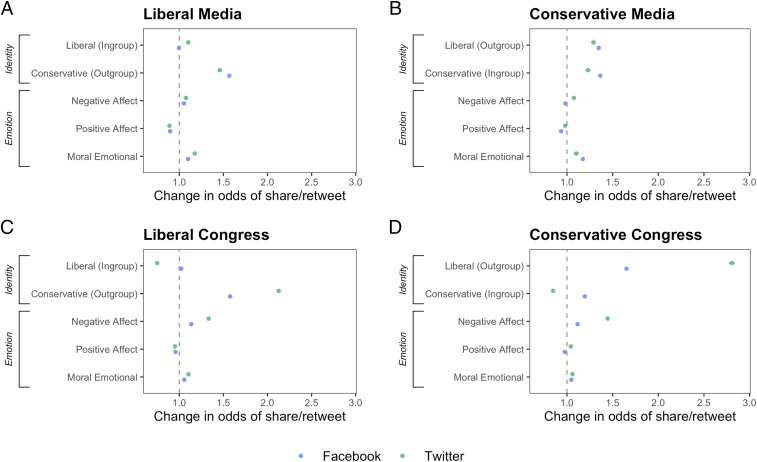
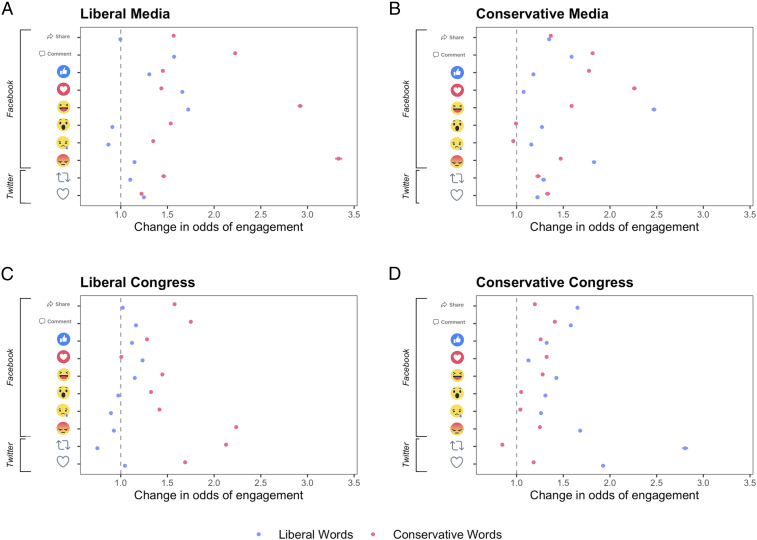
= 2,730,215), we found that posts about the political out-group were shared or retweeted about twice as often as posts about the in-group. Each individual term referring to the political out-group increased the odds of a social media post being shared by 67%. Out-group language consistently emerged as the strongest predictor of shares and retweets: the average effect size of out-group language was about 4.8 times as strong as that of negative affect language and about 6.7 times as strong as that of moral-emotional language-both established predictors of social media engagement. Language about the out-group was a very strong predictor of "angry" reactions (the most popular reactions across all datasets), and language about the in-group was a strong predictor of "love" reactions, reflecting in-group favoritism and out-group derogation. This out-group effect was not moderated by political orientation or social media platform, but stronger effects were found among political leaders than among news media accounts. In sum, out-group language is the strongest predictor of social media engagement across all relevant predictors measured, suggesting that social media may be creating perverse incentives for content expressing out-group animosity.
Overview
CoChat Summary
TL;DR
Across 2,730,215 Facebook posts and tweets from news media and US congressional accounts, political out-group language was the strongest predictor of sharing and retweeting. The out-group effect was much larger than in-group language or emotional language, and out-group posts especially elicited “angry” reactions.
Key findings
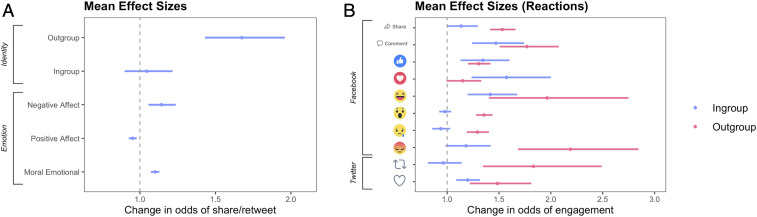
- In an internal meta-analysis across eight datasets, each political out-group word increased the odds of a retweet or share by about 67% (exp(b) = 1.67, 95% CI = [1.43, 1.69], P < 0.001), whereas political in-group language had no statistically significant effect (exp(b) = 1.05, 95% CI = [0.90, 1.22], P = 0.563).
- The out-group effect was larger than established emotional predictors: the percent increase in shares associated with out-group language was about 4.8 times that of negative affect language and about 6.7 times that of moral-emotional language. Meta-analytically, negative affect increased diffusion by about 14% per word, moral-emotional language by 10%, and positive affect decreased diffusion by about 5%.
- Posts with at least one out-group word were more than twice as likely to be shared as posts with at least one in-group word (exp(b) = 2.32, 95% CI = [1.57, 2.47], P < 0.001; a 132% increase).
- Out-group language strongly predicted “angry” reactions (meta-analytic exp(b) = 2.19, 95% CI = [1.68, 2.84], P < 0.001), while in-group language strongly predicted “love” reactions (exp(b) = 1.57, 95% CI = [1.24, 2.00], P < 0.001). The “angry” reaction was the most popular reaction in seven of eight datasets.
Methods
- Observational big-data study of public Facebook posts and tweets from liberal and conservative news media accounts and Democratic and Republican members of Congress, totaling n = 2,730,215 observations. Study 1 media data included 599,999 Facebook posts and 227,229 tweets; Study 2 congressional data included 1,078,562 tweets and 825,424 Facebook posts.
- Text was analyzed with dictionaries for liberal/conservative in-group and out-group terms, positive and negative affect, and moral-emotional language. Ordinary least squares regressions predicted log-transformed retweet/share counts, controlling for URL, media, follower count, and retweet status, followed by random-effects internal meta-analyses across the eight datasets.
Limitations
- The paper states the results are correlational, not causal, and calls for experimental work to determine causation and clarify why out-group content is engaging.
- The paper states data access limitations prevented following up important questions such as who is producing the engagement.
- The paper states the data likely reflect a specific time frame—the years leading up to the 2020 election—so generalizability to other time periods or nations is unclear, and the role of platform algorithms is unclear because companies are not transparent about them.
Model-written summary. Check it against the paper before relying on it.
Integrity signals
Registry
Cites
Statistics
Figures
Verification
Claims the paper makes
12 Valid · 0 Not valid · 31 Not checked · 104 Own results and interpretations
Every source the paper cites for this claim was checked and supports it.
In the paper
“Indeed, false political news tends to be highly negative about the outgroup (39), so our findings may be relevant to the viral spread of misinformation online.”
§ Out-group animosity drives engagement on social media > Discussion
What the sources say
- Supportedcites [39] M. Osmundsen, A. Bor, P. B. Vahlstrup, A. Bechmann, M. B. Petersen, Partisan polarization is the primary psychological motivation behind “fake news” sharing on Twitter. Am. Polit. Sci. Rev., in press. (2021). source
The paper’s Figure 5 discussion (Additional information; page unavailable) reports that headlines become more negative about opposing-party politicians as news sources become more partisan. It notes an exception to the relative pattern: pro-Democratic fake-news sources portray both parties negatively, rather than singling out the out-party. (LLM, conf=0.86)
plainstates an association- Asserted: passes — The authors put it forward as true.
- Checkable: passes — It can be checked against evidence.
- Load-bearing: passes — The paper’s conclusions depend on it.
- Based: passes — The paper gives a reason why it holds.
- Supported
The cited sources support only part of this claim — read each source’s verdict below.
In the paper
“replicating prior work on the moral contagion effect with similar effect sizes and extending on this work by showing that moral contagion operates on multiple social media platforms, including Facebook (21).”
§ Out-group animosity drives engagement on social media > Results > Study 1: Major Media Outlets.
What the sources say
- Partly supportedcites [21] W. J. Brady, J. A. Wills, J. T. Jost, J. A. Tucker, J. J. Van Bavel, Emotion shapes the diffusion of moralized content in social networks. Proc. Natl. Acad. Sci. U.S.A. 114, 7313– 7318 (2017). 28652356 PMC5514704 sourceExperimental — accuracy not yet measured
The Results report moral contagion as an increased retweet rate, supporting the effect on Twitter. The Methods measure diffusion by retweet count, while the Discussion mentions Facebook only to compare platform user numbers; our copy does not show that the effect operates on Facebook or multiple platforms. In the citing sentence, that cross-platform finding is described as an extension of the prior work. (LLM, conf=0.87)
boostedstates a causen = 599,999- Asserted: passes — The authors put it forward as true.
- Checkable: passes — It can be checked against evidence.
- Load-bearing: passes — The paper’s conclusions depend on it.
- Based: passes — The paper gives a reason why it holds.
- Partly supported
Every source the paper cites for this claim was checked and supports it.
In the paper
“Affective polarization, which reflects dislike of people in the opposing political party as compared to one’s own party, has most strikingly increased (43)”
§ Out-group animosity drives engagement on social media > Abstract
What the sources say
- Supportedcites [43] S. Iyengar, Y. Lelkes, M. Levendusky, N. Malhotra, S. J. Westwood, The origins and consequences of affective polarization in the United States. Annu. Rev. Political Sci. 22, 129– 146 (2019). source
The Survey Self-Reports section (p. 3) defines affective polarization as the difference between feelings toward one's own party and the opposing party, and reports a significant increase in the United States from 1978 to 2016. Figure 1 (p. 4) says that increase was driven mainly by growing animus toward the opposing party. (LLM, conf=0.93)
boostedstates a cause- Asserted: passes — The authors put it forward as true.
- Checkable: passes — It can be checked against evidence.
- Load-bearing: passes — The paper’s conclusions depend on it.
- Based: passes — The paper gives a reason why it holds.
- Supported
The sources with a verdict support this claim; the rest weren’t checked yet, have no full text we could read, or their verdicts aren’t rated yet.
In the paper
“Out-party animosity, more so than in-party warmth, has also become a more powerful predictor of important behaviors, such as voting behavior (46) and the sharing of political fake news (39).”
§ Out-group animosity drives engagement on social media > Abstract
What the sources say
- Not checked — no full text of the sourcecites [46] E. J. Finkel., Political sectarianism in America. Science 370, 533– 536 (2020). 33122374 source
- Supportedcites [39] M. Osmundsen, A. Bor, P. B. Vahlstrup, A. Bechmann, M. B. Petersen, Partisan polarization is the primary psychological motivation behind “fake news” sharing on Twitter. Am. Polit. Sci. Rev., in press. (2021). source
In “Do people share news from fake news sources?”, the paper reports that negative out-party affect coefficients were about twice as large as positive in-party affect coefficients for sharing fake news sources. Citation (39) supports the fake-news-sharing part of the sentence; the voting-behavior part has a separate citation. (LLM, conf=0.94)
plainstates an association- Asserted: passes — The authors put it forward as true.
- Checkable: passes — It can be checked against evidence.
- Load-bearing: passes — The paper’s conclusions depend on it.
- Based: passes — The paper gives a reason why it holds.
Every source the paper cites for this claim was checked and supports it.
In the paper
“This may help explain why exposure to opposing views on Twitter can actually increase political polarization (62).”
§ Out-group animosity drives engagement on social media > Discussion
What the sources say
- Supportedcites [62] C. A. Bail., Exposure to opposing views on social media can increase political polarization. Proc. Natl. Acad. Sci. U.S.A. 115, 9216– 9221 (2018). 30154168 PMC6140520 source
The Abstract reports that Republican participants expressed substantially more conservative views after following a bot retweeting opposing views on Twitter. The Discussion and Conclusion describes this as a backfire effect, while cautioning against generalizing it to all settings. The claim says exposure *can* increase polarization, which fits those findings. (LLM, conf=0.94)
hedgedstates a cause- Asserted: passes — The authors put it forward as true.
- Checkable: passes — It can be checked against evidence.
- Load-bearing: passes — The paper’s conclusions depend on it.
- Based: passes — The paper gives a reason why it holds.
- Supported
73 more claims
Create a free account to see all 147 claims and to verify the 5 references still open.
- Probably not a substantial claim. 40
- It may state two separate claims as one. 36
Claims other papers make about this one
Each is checked against this paper’s own text: does it say what the citing paper says it does?
The source backs part of the claim, not all of it — or backs it for a different population, condition or comparison.
In the citing paper
“Further, online stories from social media perceived as negative garner more reactions (for example, likes, Facebook reactions)42,43.”
From Negativity drives online news consumption (2023) · cites this paper as [43]
Experimental — accuracy not yet measuredThe source backs part of the claim, not all of it — or backs it for a different population, condition or comparison.
In the citing paper
“Consistent with findings from previous literature21,43,61, we found that several dyads such as outrage and disapproval are associated with higher CTRs.”
From Negativity drives online news consumption (2023) · cites this paper as [43]
Experimental — accuracy not yet measuredThe source backs part of the claim, not all of it — or backs it for a different population, condition or comparison.
In the citing paper
“Moreover, previous observational studies have found that tweets with more emotion and out-group animosity tend to receive higher engagement [11,41].”
From Twitter's Algorithm: Amplifying Anger, Animosity, and Affective Polarization (2023) · cites this paper as [41]
Experimental — accuracy not yet measuredThe source backs part of the claim, not all of it — or backs it for a different population, condition or comparison.
In the citing paper
“A follow-up study of more than 800 Facebook posts and a million Twitter posts from the official accounts of members of the US Congress showed that messages mentioning the out-group, but not the in-group, were more likely to be shared than other posts (increased diffusion rates ranging from 58% to 180%260).”
From Cognitive–motivational mechanisms of political polarization in social-communicative contexts (2022) · cites this paper as [260]
Experimental — accuracy not yet measuredThe source backs part of the claim, not all of it — or backs it for a different population, condition or comparison.
In the citing paper
“These market incentives both reflect and exacerbate ideological and affective forms of polarization, insofar as emotionally charged material, such as that which is contemptuous of ideological adversaries, is more likely to go ‘viral’ than more measured types of political discourse260,263,269,270.”
From Cognitive–motivational mechanisms of political polarization in social-communicative contexts (2022) · cites this paper as [260]
Experimental — accuracy not yet measured
9 more claims about this paper
Create a free account to see every claim other papers make about this one.
Self-check
Percentages, sums and reported differences re-computed from the paper’s own numbers.
Each contradiction between two passages listed here was confirmed by an independent check.
Rated major: it would touch a result — a value a result rests on, reported and recomputed p-values on opposite sides of the significance level, two passages that conflict with no sign which is right, or a cited work retracted before this paper was published.
In the paper
§ Out-group animosity drives engagement on social media > Results > Internal Meta-Analysis.
“exp(b) = 1.39, 95% CI = [0.91, 1.58]”
§ Out-group animosity drives engagement on social media > Results > Internal Meta-Analysis.
“P < 0.018”
Rated minor: it would not touch a result — a value no result rests on, a p-value that stays on the same side of the significance level, or a conflict that is clerical, resolved elsewhere in the paper, or outside its own findings.
In the paper
§ Out-group animosity drives engagement on social media > Results > Internal Meta-Analysis.
“95% CI = [0.99, 0.42]”
§ Out-group animosity drives engagement on social media > Results > Internal Meta-Analysis.
“exp(b) = 1.18”
Citations
Cites
An Integrative Theory of Intergroup Conflict
Tajfel, H., & Turner, J. (2000) · Organizational Identity · doi:10.1093/oso/9780199269464.003.0005 · Cited by 12,487
The case for motivated reasoning.
Kunda, Z. (1990) · Psychological Bulletin · doi:10.1037/0033-2909.108.3.480 · Cited by 9,022
The spread of true and false news online
Vosoughi, S., Roy, D., & Aral, S. (2018) · Science · doi:10.1126/science.aap9559 · Cited by 8,847 · cited 2×
“Thus, we could directly compare how much posts about only the out-group (coded as 1) diffused compared to posts about only the in-group (coded as 0), following the methods of past research that have looked at how the diffusion of false news compares to true news (25).”
Rediscovering the Social Group: A Self‐Categorization Theory
REID, F. (1987) · British Journal of Social Psychology · doi:10.1111/j.2044-8309.1987.tb00799.x · Cited by 8,091
Rediscovering the Social Group: A Self-Categorization Theory.
Willer, D., Turner, J. C., Hogg, M. A., Oakes, P. J., Reicher, S. D., & Wetherell, M. S. (1989) · Contemporary Sociology · doi:10.2307/2073157 · Cited by 7,159
The Psychological Meaning of Words: LIWC and Computerized Text Analysis Methods
Tausczik, Y. R., & Pennebaker, J. W. (2010) · Journal of Language and Social Psychology · doi:10.1177/0261927x09351676 · Cited by 5,774 · cited 2×
“and negative affect words per post (51) and the number of moral-emotional”
(2011) · Cited by 4,430
Motivated Skepticism in the Evaluation of Political Beliefs
Taber, C. S., & Lodge, M. (2006) · American Journal of Political Science · doi:10.1111/j.1540-5907.2006.00214.x · Cited by 4,344
The Origins and Consequences of Affective Polarization in the United States
Iyengar, S., Lelkes, Y., Levendusky, M., Malhotra, N., & Westwood, S. J. (2019) · Annual Review of Political Science · doi:10.1146/annurev-polisci-051117-073034 · Cited by 3,603
Exposure to ideologically diverse news and opinion on Facebook
Bakshy, E., Messing, S., & Adamic, L. A. (2015) · Science · doi:10.1126/science.aaa1160 · Cited by 3,245
Research works printed but not linked: 2
- A. Campbell, P. E. Converse, W. E. Miller, D. E. Stokes, The American Voter New York (Wiley, 1960).
- A. Mosseri, News Feed FYI: Bringing People Closer Together (Facebook Newsroom, 2018).
Cited by
Misinformation: susceptibility, spread, and interventions to immunize the public
van der Linden, S. (2022) · Nature Medicine · doi:10.1038/s41591-022-01713-6 · Cited by 570
A systematic review of worldwide causal and correlational evidence on digital media and democracy
Lorenz-Spreen, P., Oswald, L., Lewandowsky, S., & Hertwig, R. (2022) · Nature Human Behaviour · doi:10.1038/s41562-022-01460-1 · Cited by 348
Negativity drives online news consumption
Robertson, C. E., Pröllochs, N., Schwarzenegger, K., Pärnamets, P., Van Bavel, J. J., & Feuerriegel, S. (2023) · Nature Human Behaviour · doi:10.1038/s41562-023-01538-4 · Cited by 333
GPT is an effective tool for multilingual psychological text analysis
Rathje, S., Mirea, D.-M., Sucholutsky, I., Marjieh, R., Robertson, C. E., & Van Bavel, J. J. (2024) · Proceedings of the National Academy of Sciences · doi:10.1073/pnas.2308950121 · Cited by 297
“For example, researchers have used text analysis tools to examine societal trends (5–8), explore what goes “viral” on social media (9–11), and identify linguistic correlates of mental health conditions (12, 13), ideology (14–16), and personality (17).”
BackgroundMethodSelf-citationCognitive–motivational mechanisms of political polarization in social-communicative contexts
Jost, J. T., Baldassarri, D. S., & Druckman, J. N. (2022) · Nature Reviews Psychology · doi:10.1038/s44159-022-00093-5 · Cited by 379
AI can help people feel heard, but an AI label diminishes this impact
Yin, Y., Jia, N., & Wakslak, C. J. (2024) · Proceedings of the National Academy of Sciences · doi:10.1073/pnas.2319112121 · Cited by 247
“Given the resource constraints and deepening societal divisions in society (12), as well as declining levels of dispositional empathy (13), it may be increasingly difficult for people to feel heard.”
Kim, J. W., Guess, A., Nyhan, B., & Reifler, J. (2021) · Journal of Communication · doi:10.1093/joc/jqab034 · Cited by 219
“On the other hand, toxicity could activate in-group favoritism and out-group antagonism, thus motivating people to toe the partisan line instead of engaging with diverse perspectives and new ideas (Bail 2021; Rathje et al. 2021; Suhay et al. 2018).”
BackgroundPolitical Psychology in the Digital (mis)Information age: A Model of News Belief and Sharing
Van Bavel, J. J., Harris, E. A., Pärnamets, P., Rathje, S., Doell, K. C., & Tucker, J. A. (2021) · Social Issues and Policy Review · doi:10.1111/sipr.12077 · Cited by 213
Self-citationZuboff, S. (2022) · Organization Theory · doi:10.1177/26317877221129290 · Cited by 209
“…researchers have closely examined many of the dynamics identified in this discussion and their causal role in rising societal polarization and diminished social resilience (Cinelli et al., 2021; R. Levy, 2021; Rathje et al., 2021; Santos et al., 2021; Tokita et al., 2021; Vasconcelos et al., 2021).”
BackgroundMilli, S., Carroll, M., Wang, Y., Pandey, S., & Dragan, A. D. (2023) · arXiv.org · doi:10.48550/arxiv.2305.16941 · Cited by 200
“[18] Steve Rathje, Jay J Van Bavel, and Sander Van Der Linden.”
InfluentialHow social media shapes polarization
Van Bavel, J. J., Rathje, S., Harris, E., Robertson, C., & Sternisko, A. (2021) · Trends in Cognitive Sciences · doi:10.1016/j.tics.2021.07.013 · Cited by 192
“As social media tends to amplify extreme viewpoints [7,8], exposure to hyper-partisans from the out-group may lead people to become even more entrenched in their own viewpoint.”
Self-citationInterventions to reduce partisan animosity
Hartman, R., Blakey, W., Womick, J., Bail, C., Finkel, E. J., Han, H., Sarrouf, J., Schroeder, J., Sheeran, P., Van Bavel, J. J., et al. (2022) · Nature Human Behaviour · doi:10.1038/s41562-022-01442-3 · Cited by 171
A review and provocation: On polarization and platforms
Kreiss, D., & McGregor, S. C. (2024) · New Media & Society · doi:10.1177/14614448231161880 · Cited by 151
“…as Dahlgren (2021) has compellingly argued, much of the literature on filter bubbles is actually not primarily concerned with platforms but with human psychology, and specifically motivated reasoning and selective exposure (e.g. Allcott et al., 2020; Asker and Dinas, 2019; Rathje et al., 2021).”
BackgroundCorrecting inaccurate metaperceptions reduces Americans’ support for partisan violence
Mernyk, J. S., Pink, S. L., Druckman, J. N., & Willer, R. (2022) · Proceedings of the National Academy of Sciences · doi:10.1073/pnas.2116851119 · Cited by 146
GPT is an effective tool for multilingual psychological text analysis
Rathje, S., Mirea, D.-M., Sucholutsky, I., Marjieh, R., Robertson, C., & Van Bavel, J. J. (2023) · doi:10.31234/osf.io/sekf5 · Cited by 129
Self-citationUsing natural language processing to analyse text data in behavioural science
Feuerriegel, S., Maarouf, A., Bär, D., Geissler, D., Schweisthal, J., Pröllochs, N., Robertson, C. E., Rathje, S., Hartmann, J., Mohammad, S. M., et al. (2025) · Nature Reviews Psychology · doi:10.1038/s44159-024-00392-z · Cited by 140
“Inferring out-group animosity from social media content to study its effect on online engagement 12 Identifying political orientation from texts 141 and then comparing language use across political ideologies 142–144 Measuring how morally tinged messages about political issues are transmitted…”
Self-citationSycophantic AI decreases prosocial intentions and promotes dependence
Cheng, M., Lee, C., Khadpe, P., Yu, S., Han, D., & Jurafsky, D. (2026) · Science · doi:10.1126/science.aec8352 · Cited by 185
Algorithm-mediated social learning in online social networks
Brady, W. J., Jackson, J. C., Lindström, B., & Crockett, M. J. (2023) · Trends in Cognitive Sciences · doi:10.1016/j.tics.2023.06.008 · Cited by 132
Van Bavel, J. J., Robertson, C. E., del Rosario, K., Rasmussen, J., & Rathje, S. (2024) · Annual Review of Psychology · doi:10.1146/annurev-psych-022123-110258 · Cited by 121
Self-citationAccuracy and social motivations shape judgements of (mis)information
Rathje, S., Roozenbeek, J., Van Bavel, J. J., & van der Linden, S. (2023) · Nature Human Behaviour · doi:10.1038/s41562-023-01540-w · Cited by 110
Self-citationDo social media undermine social cohesion? A critical review
González‐Bailón, S., & Lelkes, Y. (2022) · Social Issues and Policy Review · doi:10.1111/sipr.12091 · Cited by 207
Hate Trumps Love: The Impact of Political Polarization on Social Preferences
Dimant, E. (2023) · Management Science · doi:10.1287/mnsc.2023.4701 · Cited by 144
Rozado, D., Hughes, R., & Halberstadt, J. (2022) · PLOS ONE · doi:10.1371/journal.pone.0276367 · Cited by 103
Allen, J. N. L., Martel, C., & Rand, D. G. (2022) · CHI Conference on Human Factors in Computing Systems · doi:10.1145/3491102.3502040 · Cited by 185
Social media behavior is associated with vaccine hesitancy
Rathje, S., He, J. K., Roozenbeek, J., Van Bavel, J. J., & van der Linden, S. (2022) · PNAS Nexus · doi:10.1093/pnasnexus/pgac207 · Cited by 100
“(31)] negatively predicted confidence in the COVID-19 vaccine, β = −0.”
BackgroundSelf-citationThe effects of Facebook and Instagram on the 2020 election: A deactivation experiment
Allcott, H., Gentzkow, M. A., Mason, W., Wilkins, A. S., Barberá, P., Brown, T., Cisneros, J. C., Crespo-Tenorio, A., Dimmery, D., Freelon, D., et al. (2024) · Proceedings of the National Academy of Sciences · doi:10.1073/pnas.2321584121 · Cited by 170
Polarized information ecosystems can reorganize social networks via information cascades
Tokita, C. K., Guess, A. M., & Tarnita, C. E. (2021) · Proceedings of the National Academy of Sciences · doi:10.1073/pnas.2102147118 · Cited by 92
“However, without much loss of generality, one could assume that activation operates via negative emotional reactions, such as anger or outrage, consistent with evidence on negativity bias in news coverage (48, 49) and moral contagion on social media (50, 51).”
BackgroundGenerative language models exhibit social identity biases
Hu, T., Kyrychenko, Y., Rathje, S., Collier, N., van der Linden, S., & Roozenbeek, J. (2024) · Nature Computational Science · doi:10.1038/s43588-024-00741-1 · Cited by 100
“Language models, on average, become roughly five times more hostile toward a general (non-specific) outgroup after fine-tuning with US partisan social media data, in line with previous work on outgroup hostility on US social media [53].”
Self-citationWojcieszak, M., Casas, A., Yu, X., Nagler, J., & Tucker, J. A. (2022) · Science Advances · doi:10.1126/sciadv.abn9418 · Cited by 90
“Furthermore, those who are ideologically and affectively polarized are the ones who also amplify highly polarizing and sometimes misinformative content on-line ( 40 , 41 ).”
The marketplace of rationalizations
Williams, D. (2022) · Economics and Philosophy · doi:10.1017/s0266267121000389 · Cited by 129
Human-centricity in AI governance: A systemic approach
Sigfrids, A., Leikas, J., Salo-Pöntinen, H., & Koskimies, E. (2023) · Frontiers in Artificial Intelligence · doi:10.3389/frai.2023.976887 · Cited by 155
Troll and divide: the language of online polarization
Simchon, A., Brady, W. J., & Van Bavel, J. J. (2022) · PNAS Nexus · doi:10.1093/pnasnexus/pgac019 · Cited by 85
“In addition, we showed that all troll groups use more polarized language than a random sample of American social media users and that this holds for both affective and issue polarization (although effect sizes of issue polarization are substantially larger).”
Carrasco-Farré, C. (2022) · Humanities and Social Sciences Communications · doi:10.1057/s41599-022-01174-9 · Cited by 84
“Although there is little research on how moral content contributes to online virality (Rathje et al., 2021), the mechanism is grounded in social identity theory (Tajfel & Turner, 1979) and self-categorization theory (Turner et al.”
BackgroundAntypas, D., Preece, A. D., & Camacho-Collados, J. (2023) · Online Social Networks and Media · doi:10.1016/j.osnem.2023.100242 · Cited by 122
Psychological inoculation strategies to fight climate disinformation across 12 countries
Spampatti, T., Hahnel, U. J. J., Trutnevyte, E., & Brosch, T. (2023) · Nature Human Behaviour · doi:10.1038/s41562-023-01736-0 · Cited by 119
Mantello, P. A., Ho, T. M., Nguyen, M., & Vuong, Q. (2023) · Humanities and Social Sciences Communications · doi:10.1057/s41599-023-01837-1 · Cited by 110
Misinformation exploits outrage to spread online
McLoughlin, K. L., Brady, W. J., Goolsbee, A., Kaiser, B., Klonick, K., & Crockett, M. J. (2024) · Science · doi:10.1126/science.adl2829 · Cited by 145
Ali, K. I., Li, C., Zain-ul-abdin, K., & Muqtadir, S. A. (2022) · Computers in Human Behavior · doi:10.1016/j.chb.2022.107307 · Cited by 100
Negative online news articles are shared more to social media
Watson, J., van der Linden, S., Watson, M., & Stillwell, D. (2024) · Scientific Reports · doi:10.1038/s41598-024-71263-z · Cited by 70
Social media sharing of low-quality news sources by political elites
Lasser, J., Aroyehun, S. T., Simchon, A., Carrella, F., Garcia, D., & Lewandowsky, S. (2022) · PNAS Nexus · doi:10.1093/pnasnexus/pgac186 · Cited by 59
Zhang, Y., Chen, F., & Lukito, J. (2022) · Political Communication · doi:10.1080/10584609.2022.2113844 · Cited by 89
Cole, J. C., Gillis, A. J., van der Linden, S., Cohen, M. A., & Vandenbergh, M. P. (2025) · Perspectives on Psychological Science · doi:10.1177/17456916231186409 · Cited by 61
“Con-servatives across the world can be more likely to endorse conspiracy theories (Imhoff et al., 2022; van der Linden et al., 2021).”
Environmental Decision-Making in Times of Polarization
Judge, M., Kashima, Y., Steg, L., & Dietz, T. M. (2023) · Annual Review of Environment and Resources · doi:10.1146/annurev-environ-112321-115339 · Cited by 98
Updating the identity-based model of belief: From false belief to the spread of misinformation
Bavel, J. J. V., Rathje, S., Vlasceanu, M., & Pretus, C. (2024) · Current Opinion in Psychology · doi:10.1016/j.copsyc.2023.101787 · Cited by 99
Self-citationHow to Combat Health Misinformation: A Psychological Approach
Roozenbeek, J., & van der Linden, S. (2022) · American Journal of Health Promotion · doi:10.1177/08901171211070958 · Cited by 60
People think that social media platforms do (but should not) amplify divisive content
Rathje, S., Robertson, C., Brady, W. J., & Van Bavel, J. J. (2024) · Perspectives on Psychological Science · doi:10.1177/17456916231190392 · Cited by 59
“Although both conservatives and liberals benefit roughly equally from expressing out-group animosity (Rathje et al., 2021), recent work suggests that conservative voices may be amplified more in general by social media (González-Bailón et al., 2022; Huszár et al., 2022), although it is unclear why…”
InfluentialSelf-citationGender biases within Artificial Intelligence and ChatGPT: Evidence, Sources of Biases and Solutions
Ho, J. Q. H., Hartanto, A., Koh, A., & Majeed, N. M. (2025) · Computers in Human Behavior Artificial Humans · doi:10.1016/j.chbah.2025.100145 · Cited by 112
The value affordances of social media engagement features
Scharlach, R., & Hallinan, B. (2023) · Journal of Computer-Mediated Communication · doi:10.1093/jcmc/zmad040 · Cited by 105
How social identity shapes conspiratorial belief
Robertson, C. E., Pretus, C., Rathje, S., Harris, E. A., & Van Bavel, J. J. (2022) · Current Opinion in Psychology · doi:10.1016/j.copsyc.2022.101423 · Cited by 57
“To maintain a positive social identity, people are motivated to believe content that bolsters their in-group and derrogates their out-group (Van Bavel & Pereira, 2018) and share this content with others (Rathje et al., 2021; Sternisko et al., 2021).”
BackgroundSelf-citationCampante, F. R., Durante, R., & Tesei, A. (2022) · Annual Review of Economics · doi:10.1146/annurev-economics-083121-050914 · Cited by 69
Less is more: Engagement with the content of social media influencers
van der Harst, J. P., & Angelopoulos, S. (2024) · Journal of Business Research · doi:10.1016/j.jbusres.2024.114746 · Cited by 51
Inside the funhouse mirror factory: How social media distorts perceptions of norms
Robertson, C. E., del Rosario, K., & Bavel, J. J. V. (2024) · Current Opinion in Psychology · doi:10.1016/j.copsyc.2024.101918 · Cited by 136
Self-citationHuman-algorithm interactions help explain the spread of misinformation
McLoughlin, K. L., & Brady, W. J. (2023) · Current Opinion in Psychology · doi:10.1016/j.copsyc.2023.101770 · Cited by 87
Negative expressions are shared more on Twitter for public figures than for ordinary users
Schöne, J. P., Garcia, D., Parkinson, B., & Goldenberg, A. (2023) · PNAS Nexus · doi:10.1093/pnasnexus/pgad219 · Cited by 46
AI language model rivals expert ethicist in perceived moral expertise
Dillion, D., Mondal, D., Tandon, N., & Gray, K. (2025) · Scientific Reports · doi:10.1038/s41598-025-86510-0 · Cited by 47
Youths’ sensitivity to social media feedback: A computational account
Pinho, A. D. S., Izquierdo, V. C., Lindström, B., & van den Bos, W. (2024) · Science Advances · doi:10.1126/sciadv.adp8775 · Cited by 82
Purnat, T. D., Nguyen, T., & Briand, S. C. (2023) · Springer eBooks · doi:10.1007/978-3-031-27789-4 · Cited by 70
Yu, X., Wojcieszak, M., & Casas, A. (2023) · Political Behavior · doi:10.1007/s11109-022-09850-x · Cited by 85
Comparative analysis of social bots and humans during the COVID-19 pandemic
Chang, H.-C. H., & Ferrara, E. (2022) · Journal of Computational Social Science · doi:10.1007/s42001-022-00173-9 · Cited by 46
Putting the affect into affective polarisation
Bakker, B. N., & Lelkes, Y. (2024) · Cognition and Emotion · doi:10.1080/02699931.2024.2362366 · Cited by 43
Zhang, Y., Lukito, J., Suk, J., & McGrady, R. (2024) · Journal of Information Technology & Politics · doi:10.1080/19331681.2024.2328156 · Cited by 70
Chan, M., & Yi, J. (2024) · Political Communication · doi:10.1080/10584609.2024.2325423 · Cited by 89
A Systematic Review of Worldwide Causal and Correlational Evidence on Digital Media and DemocracyPreprint
Lorenz-Spreen, P., Oswald, L., Lewandowsky, S., & Hertwig, R. (2021) · doi:10.31235/osf.io/p3z9v · Cited by 35
Hate Trumps Love: The Impact of Political Polarization on Social PreferencesPreprint
Dimant, E. (2020) · SSRN Electronic Journal · doi:10.2139/ssrn.3680871 · Cited by 44
Government crisis messaging on social media, citizen online engagement and compliance with policies
Han, X., & Baird, C. (2022) · Public Management Review · doi:10.1080/14719037.2022.2103843 · Cited by 50
Reranking partisan animosity in algorithmic social media feeds alters affective polarization
Piccardi, T., Saveski, M., Jia, C., Hancock, J., Tsai, J. L., & Bernstein, M. S. (2025) · Science · doi:10.1126/science.adu5584 · Cited by 117
Falkenberg, M., Zollo, F., Quattrociocchi, W., Pfeffer, J., & Baronchelli, A. (2024) · Nature Communications · doi:10.1038/s41467-024-53868-0 · Cited by 75
What Gets Shared, and Why? Interpersonal Communication and Word of Mouth
Berger, J. A. (2024) · Annual Review of Psychology · doi:10.1146/annurev-psych-013024-031524 · Cited by 51
Kantian Ethics and the Attention Economy: Duty and Distraction
Aylsworth, T., & Castro, C. (2024) · Springer eBooks · doi:10.1007/978-3-031-45638-1 · Cited by 37
Temporal dynamics of coordinated online behavior: Stability, archetypes, and influence
Tardelli, S., Nizzoli, L., Tesconi, M., Conti, M., Nakov, P., Martino, G. D. S., & Cresci, S. (2024) · Proceedings of the National Academy of Sciences · doi:10.1073/pnas.2307038121 · Cited by 68
Metrics in action: how social media metrics shape news production on Facebook
Mukerjee, S., Tian, Y., & Peng, Y. (2023) · Journal of Communication · doi:10.1093/joc/jqad012 · Cited by 46
Humprecht, E. (2023) · Digital Journalism · doi:10.1080/21670811.2023.2200196 · Cited by 54
The social media discourse of engaged partisans is toxic even when politics are irrelevant
Mamakos, M., & Finkel, E. J. (2023) · PNAS Nexus · doi:10.1093/pnasnexus/pgad325 · Cited by 53
How Do Logistics Disruptions Affect Rural Households? Evidence from COVID-19 in China
Huang, D., Chen, M., & Nan, L. (2022) · Sustainability · doi:10.3390/su15010465 · Cited by 43
The Costs of Polarizing a Pandemic: Antecedents, Consequences, and Lessons
Van Bavel, J. J., Pretus, C., Rathje, S., Pärnamets, P., Vlasceanu, M., & Knowles, E. D. (2024) · Perspectives on Psychological Science · doi:10.1177/17456916231190395 · Cited by 29
“…elites and news sources on social media can play a role in both increasing (Bail et al., 2018) and decreasing (Levy, 2021) polarization—and that social media algorithms can limit exposure to counter-attitu-dinal news and thus increase polarization (Levy, 2021; Van Bavel, Rathje, et al., 2021).”
InfluentialSelf-citationNudging recommendation algorithms increases news consumption and diversity on YouTube
Yu, X., Haroon, M., Menchen-Trevino, E., & Wojcieszak, M. (2024) · PNAS Nexus · doi:10.1093/pnasnexus/pgae518 · Cited by 72
van der Linden, S., Albarracín, D., Fazio, L. K., Freelon, D., Roozenbeek, J., Swire‐Thompson, B., & Bavel, J. J. V. (2023) · PsycEXTRA Dataset · doi:10.1037/e506432023-001 · Cited by 34
Self-citationEvaluating the effect of viral posts on social media engagement
Sangiorgio, E., Marco, N. D., Etta, G., Cinelli, M., Cerqueti, R., & Quattrociocchi, W. (2025) · Scientific Reports · doi:10.1038/s41598-024-84960-6 · Cited by 67
Kemp, P. S., Subbiah, G., Barnes, R. A., Boerder, K., O’Leary, B. C., Stewart, B. D., & Williams, C. (2022) · Marine Policy · doi:10.1016/j.marpol.2022.105335 · Cited by 38
Brady, W. J., & Van Bavel, J. J. (2021) · doi:10.31219/osf.io/dgt6u · Cited by 28
Emotional content and sharing on Facebook: A theory cage match
Paletz, S. B. F., Johns, M., Murauskaitė, E., Golonka, E., Pandža, N. B., Rytting, C. A., Buntain, C., & Ellis, D. H. (2023) · Science Advances · doi:10.1126/sciadv.ade9231 · Cited by 47
Accuracy and Social Motivations Shape Judgements of (Mis)InformationPreprint
Rathje, S., Roozenbeek, J., Bavel, J. J. V., & van der Linden, S. (2022) · doi:10.31234/osf.io/hkqyv · Cited by 26
Self-citationWells, C., & Friedland, L. A. (2023) · Political Communication · doi:10.1080/10584609.2023.2222267 · Cited by 52
Guay, B., Berinsky, A. J., Pennycook, G., & Rand, D. G. (2022) · doi:10.31234/osf.io/y762k · Cited by 25
Following news on social media boosts knowledge, belief accuracy and trust
Altay, S., Hoes, E., & Wojcieszak, M. (2025) · Nature Human Behaviour · doi:10.1038/s41562-025-02205-6 · Cited by 53
Hatemongers ride on echo chambers to escalate hate speech diffusion
Goel, V., Sahnan, D., Dutta, S., Bandhakavi, A., & Chakraborty, T. (2023) · PNAS Nexus · doi:10.1093/pnasnexus/pgad041 · Cited by 25
“though in this case, Twitter shows the most disparity in user engagement [38], with Reddit being the closest to a balanced scenario among the three.”
BackgroundNorm Psychology in the Digital Age: How Social Media Shapes the Cultural Evolution of Normativity
Brady, W. J., & Crockett, M. J. (2024) · Perspectives on Psychological Science · doi:10.1177/17456916231187395 · Cited by 26
Gamified Inoculation Against Misinformation in India: A Randomized Control Trial
Harjani, T., Basol, M., Roozenbeek, J., & van der Linden, S. (2023) · Journal of Trial and Error · doi:10.36850/e12 · Cited by 41
Self-citationKyrychenko, Y., Brik, T., van der Linden, S., & Roozenbeek, J. (2024) · Nature Communications · doi:10.1038/s41467-024-52179-8 · Cited by 48
Self-citationChen, A., Chen, K., Zhang, J., Meng, J., & Shen, C. (2022) · Journal of Computer-Mediated Communication · doi:10.1093/jcmc/zmac034 · Cited by 32
Don't Let Netflix Drive the Bus: User's Sense of Agency Over Time and Content Choice on Netflix
Schaffner, B., Stefanescu, A., Campili, O., & Chetty, M. (2023) · Proceedings of the ACM on Human-Computer Interaction · doi:10.1145/3579604 · Cited by 40
DePaula, N., Hagen, L., Roytman, S., & Alnahass, D. (2022) · JMIR Infodemiology · doi:10.2196/40198 · Cited by 25
Ballara, N. B. (2023) · International Journal of Research Publication and Reviews · doi:10.55248/gengpi.4.723.51227 · Cited by 59
The Cambridge Handbook of Consumer Psychology
Lamberton, C., Rucker, D. D., Spiller, S. A., Hussein, M. A., Tormala, Z. L., Krause-Galoni, R., Mazzocco, P., Gamlin, J., Touré-Tillery, M., Sussman, A. B., et al. (2023) · Cambridge University Press eBooks · doi:10.1017/9781009243957 · Cited by 28
Liu, N., Hu, X. E., Savas, Y., Baum, M., Berinsky, A. J., Chaney, A. J. B., Lucas, C., Mariman, R., Benedictis-Kessner, J. D., Guess, A. M., et al. (2025) · Proceedings of the National Academy of Sciences · doi:10.1073/pnas.2318127122 · Cited by 61
What’s Not to Like? Facebook Page Likes Reveal Limited Polarization in Lifestyle Preferences
Praet, S., Guess, A. M., Tucker, J. A., Bonneau, R., & Nagler, J. (2022) · Political Communication · doi:10.1080/10584609.2021.1994066 · Cited by 22
“Social media itself may drive these misperceptions by fueling cycles of engagement with content that promotes disparagement of partisan outgroups (Rathje et al., 2021; Wojcieszak et al., 2021).”
BackgroundOvergaard, C. S. B. (2024) · Social Media + Society · doi:10.1177/20563051241232662 · Cited by 38
Kim, S. J., Villanueva, I. I., & Chen, K. (2023) · Political Communication · doi:10.1080/10584609.2023.2243852 · Cited by 36
Affective polarization and dynamics of information spread in online networks
Lerman, K., Feldman, D., He, Z., & Rao, A. (2024) · npj Complexity · doi:10.1038/s44260-024-00008-w · Cited by 55
Metadata
- Authors
- Rathje, S., Van Bavel, J. J., & van der Linden, S.
- Affiliations
- University of Cambridge (GB)
- Department of Psychology, Center for Neural Science, New York University, New York, NY 10003
- Department of Psychology, University of Cambridge, Cambridge CB2 3RQ, United Kingdom;
- Corresponding author
- Rathje, Steve
- Venue
- Proceedings of the National Academy of Sciences
- Publisher
- National Academy of Sciences
- Published
- 2021-06-23
- Volume
- 118
- Issue
- 26
- ISSN
- 0027-8424 (ISSN-L)
- 1091-6490
- PMC
- PMC8256037
- OpenAlex
- W3176626547
- Cited by
- 560
- References
- 72
- Citations by year
- 2026: 103 · 2025: 126 · 2024: 133 · 2023: 106 · 2022: 72 · 2021: 18
- FWCI
- 108.57
- Type
- journal article
- Language
- en
- Open access
- hybrid
- doi.org
- Licence
- Locations
- Proceedings of the National Academy of Sciences (publishedVersion, cc-by)
- PubMed Central (publishedVersion, cc-by)
- PubMed (publishedVersion)
- Apollo (University of Cambridge) (submittedVersion, cc-by)
- OSF Preprints (OSF Preprints) (submittedVersion)
- Apollo (cc-by)
- Funders
- Gates Cambridge Trust (OPP1144)
- John Templeton Foundation (61378)
- Topics
- Social Sciences › Communication › Social Media and Politics
- Social Sciences › Sociology and Political Science › Misinformation and Its Impacts
- Social Sciences › Sociology and Political Science › Social and Intergroup Psychology
- Keywords
- social media engagement, in-group favoritism, outgroup derogation, political polarization, social media sharing, retweets, political language, political leaders, political orientation
- MeSH terms
- Emotions, Humans, Politics, Databases as Topic, Social Media
About these checks
Registry, retraction, Cites and statistics results are computed, not judged, with one exception: a printed reference that no index lists is read once by a model before it counts as a citation error. Claims are extracted by a model and kept only when their quote appears verbatim in the text; each cited source is then checked, with a model’s help, for whether it says what the claim relies on. Those verdicts can be wrong — read the claim’s quote and the cited source before relying on one.
The claim verdicts this report counts are experimental: their accuracy is not yet measured.
A language model drew the claims from the paper on 2026-10-10, under version 3 of the claim definition (model deepseek-v4.1-flash, prompt extract-v3).
A second model labelled each claim on 2026-10-10 (model jev-1.13-20260917, definition revision gold-guideline-v0.2).
Cited sources are checked with a language model’s help (gpt-6-sol).
Statistics and arithmetic are recomputed, not judged.
Confidence bands are shown only for fields calibrated on our annotated test set. None is calibrated yet, so no band is shown.
What counts as a claim ›How we measure confidence ›How we check this ›
Are you an author, or do you see a problem with this page? Request a review
Data sources
Bibliographic data: Semantic Scholar, OpenAlex, Crossref.
Contains information from the Semantic Scholar Academic Graph Datasets, made available under the ODC Attribution License (ODC-BY 1.0).
Semantic Scholar’s data is described in: Kinney, R., et al. (2023). The Semantic Scholar Open Data Platform. arXiv:2301.10140.
