

Out-group animosity drives engagement on social media
Open accessThe DOI matches its Crossref record; 74 of the 75 references it cites were found in a registry or an index; 13 of the 61 sources its claims cite were checked for support.
Abstract
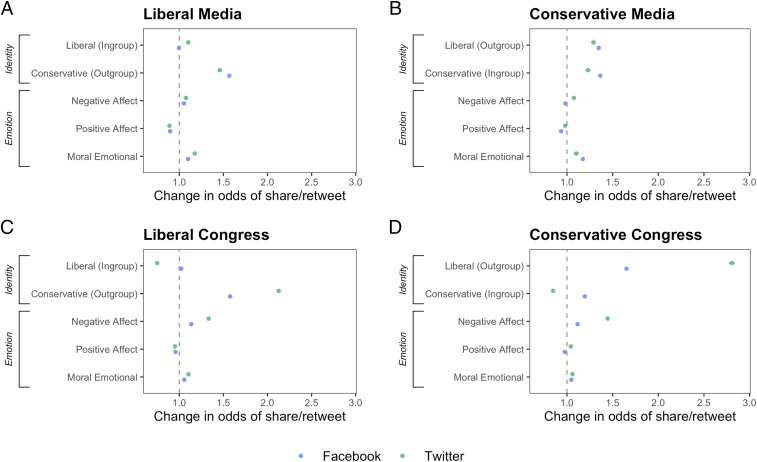
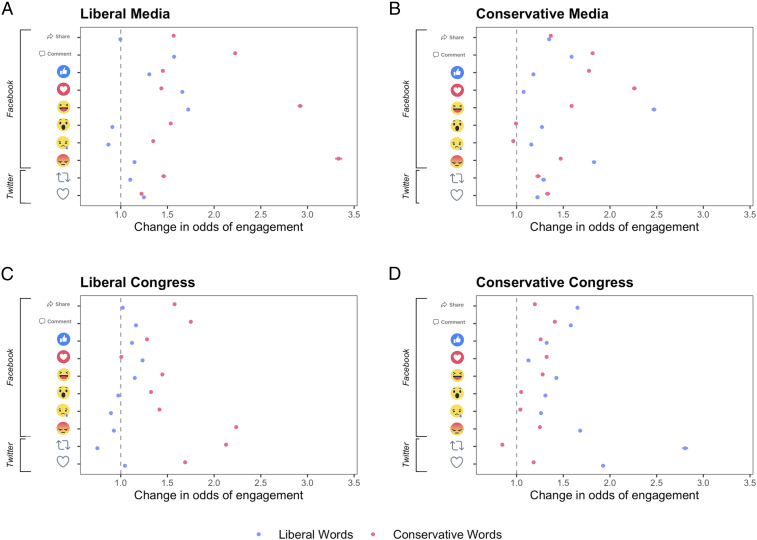
= 2,730,215), we found that posts about the political out-group were shared or retweeted about twice as often as posts about the in-group. Each individual term referring to the political out-group increased the odds of a social media post being shared by 67%. Out-group language consistently emerged as the strongest predictor of shares and retweets: the average effect size of out-group language was about 4.8 times as strong as that of negative affect language and about 6.7 times as strong as that of moral-emotional language-both established predictors of social media engagement. Language about the out-group was a very strong predictor of "angry" reactions (the most popular reactions across all datasets), and language about the in-group was a strong predictor of "love" reactions, reflecting in-group favoritism and out-group derogation. This out-group effect was not moderated by political orientation or social media platform, but stronger effects were found among political leaders than among news media accounts. In sum, out-group language is the strongest predictor of social media engagement across all relevant predictors measured, suggesting that social media may be creating perverse incentives for content expressing out-group animosity.
Overview
CoChat Summary
TL;DR
Across 2,730,215 Facebook posts and tweets from news media and US congressional accounts, political out-group language was the strongest predictor of sharing and retweeting. The out-group effect was much larger than in-group language or emotional language, and out-group posts especially elicited “angry” reactions.
Key findings
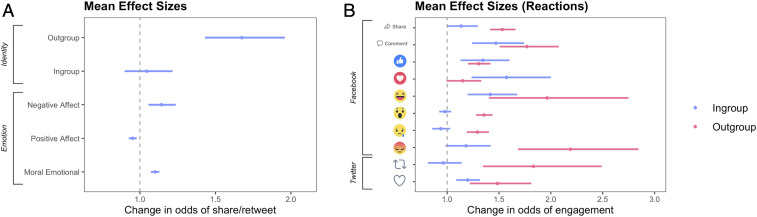
- In an internal meta-analysis across eight datasets, each political out-group word increased the odds of a retweet or share by about 67% (exp(b) = 1.67, 95% CI = [1.43, 1.69], P < 0.001), whereas political in-group language had no statistically significant effect (exp(b) = 1.05, 95% CI = [0.90, 1.22], P = 0.563).
- The out-group effect was larger than established emotional predictors: the percent increase in shares associated with out-group language was about 4.8 times that of negative affect language and about 6.7 times that of moral-emotional language. Meta-analytically, negative affect increased diffusion by about 14% per word, moral-emotional language by 10%, and positive affect decreased diffusion by about 5%.
- Posts with at least one out-group word were more than twice as likely to be shared as posts with at least one in-group word (exp(b) = 2.32, 95% CI = [1.57, 2.47], P < 0.001; a 132% increase).
- Out-group language strongly predicted “angry” reactions (meta-analytic exp(b) = 2.19, 95% CI = [1.68, 2.84], P < 0.001), while in-group language strongly predicted “love” reactions (exp(b) = 1.57, 95% CI = [1.24, 2.00], P < 0.001). The “angry” reaction was the most popular reaction in seven of eight datasets.
Methods
- Observational big-data study of public Facebook posts and tweets from liberal and conservative news media accounts and Democratic and Republican members of Congress, totaling n = 2,730,215 observations. Study 1 media data included 599,999 Facebook posts and 227,229 tweets; Study 2 congressional data included 1,078,562 tweets and 825,424 Facebook posts.
- Text was analyzed with dictionaries for liberal/conservative in-group and out-group terms, positive and negative affect, and moral-emotional language. Ordinary least squares regressions predicted log-transformed retweet/share counts, controlling for URL, media, follower count, and retweet status, followed by random-effects internal meta-analyses across the eight datasets.
Limitations
- The paper states the results are correlational, not causal, and calls for experimental work to determine causation and clarify why out-group content is engaging.
- The paper states data access limitations prevented following up important questions such as who is producing the engagement.
- The paper states the data likely reflect a specific time frame—the years leading up to the 2020 election—so generalizability to other time periods or nations is unclear, and the role of platform algorithms is unclear because companies are not transparent about them.
Model-written summary. Check it against the paper before relying on it.
Integrity signals
Registry
Cites
Statistics
Figures
Verification
Claims the paper makes
12 Valid · 0 Not valid · 31 Not checked · 104 Own results and interpretations
Every source the paper cites for this claim was checked and supports it.
In the paper
“Indeed, false political news tends to be highly negative about the outgroup (39), so our findings may be relevant to the viral spread of misinformation online.”
§ Out-group animosity drives engagement on social media > Discussion
What the sources say
- Supportedcites [39] M. Osmundsen, A. Bor, P. B. Vahlstrup, A. Bechmann, M. B. Petersen, Partisan polarization is the primary psychological motivation behind “fake news” sharing on Twitter. Am. Polit. Sci. Rev., in press. (2021). source
The paper’s Figure 5 discussion (Additional information; page unavailable) reports that headlines become more negative about opposing-party politicians as news sources become more partisan. It notes an exception to the relative pattern: pro-Democratic fake-news sources portray both parties negatively, rather than singling out the out-party. (LLM, conf=0.86)
plainstates an association- Asserted: passes — The authors put it forward as true.
- Checkable: passes — It can be checked against evidence.
- Load-bearing: passes — The paper’s conclusions depend on it.
- Based: passes — The paper gives a reason why it holds.
- Supported
The cited sources support only part of this claim — read each source’s verdict below.
In the paper
“replicating prior work on the moral contagion effect with similar effect sizes and extending on this work by showing that moral contagion operates on multiple social media platforms, including Facebook (21).”
§ Out-group animosity drives engagement on social media > Results > Study 1: Major Media Outlets.
What the sources say
- Partly supportedcites [21] W. J. Brady, J. A. Wills, J. T. Jost, J. A. Tucker, J. J. Van Bavel, Emotion shapes the diffusion of moralized content in social networks. Proc. Natl. Acad. Sci. U.S.A. 114, 7313– 7318 (2017). 28652356 PMC5514704 sourceExperimental — accuracy not yet measured
The Results report moral contagion as an increased retweet rate, supporting the effect on Twitter. The Methods measure diffusion by retweet count, while the Discussion mentions Facebook only to compare platform user numbers; our copy does not show that the effect operates on Facebook or multiple platforms. In the citing sentence, that cross-platform finding is described as an extension of the prior work. (LLM, conf=0.87)
boostedstates a causen = 599,999- Asserted: passes — The authors put it forward as true.
- Checkable: passes — It can be checked against evidence.
- Load-bearing: passes — The paper’s conclusions depend on it.
- Based: passes — The paper gives a reason why it holds.
- Partly supported
Every source the paper cites for this claim was checked and supports it.
In the paper
“Affective polarization, which reflects dislike of people in the opposing political party as compared to one’s own party, has most strikingly increased (43)”
§ Out-group animosity drives engagement on social media > Abstract
What the sources say
- Supportedcites [43] S. Iyengar, Y. Lelkes, M. Levendusky, N. Malhotra, S. J. Westwood, The origins and consequences of affective polarization in the United States. Annu. Rev. Political Sci. 22, 129– 146 (2019). source
The Survey Self-Reports section (p. 3) defines affective polarization as the difference between feelings toward one's own party and the opposing party, and reports a significant increase in the United States from 1978 to 2016. Figure 1 (p. 4) says that increase was driven mainly by growing animus toward the opposing party. (LLM, conf=0.93)
boostedstates a cause- Asserted: passes — The authors put it forward as true.
- Checkable: passes — It can be checked against evidence.
- Load-bearing: passes — The paper’s conclusions depend on it.
- Based: passes — The paper gives a reason why it holds.
- Supported
The sources with a verdict support this claim; the rest weren’t checked yet, have no full text we could read, or their verdicts aren’t rated yet.
In the paper
“Out-party animosity, more so than in-party warmth, has also become a more powerful predictor of important behaviors, such as voting behavior (46) and the sharing of political fake news (39).”
§ Out-group animosity drives engagement on social media > Abstract
What the sources say
- Not checked — no full text of the sourcecites [46] E. J. Finkel., Political sectarianism in America. Science 370, 533– 536 (2020). 33122374 source
- Supportedcites [39] M. Osmundsen, A. Bor, P. B. Vahlstrup, A. Bechmann, M. B. Petersen, Partisan polarization is the primary psychological motivation behind “fake news” sharing on Twitter. Am. Polit. Sci. Rev., in press. (2021). source
In “Do people share news from fake news sources?”, the paper reports that negative out-party affect coefficients were about twice as large as positive in-party affect coefficients for sharing fake news sources. Citation (39) supports the fake-news-sharing part of the sentence; the voting-behavior part has a separate citation. (LLM, conf=0.94)
plainstates an association- Asserted: passes — The authors put it forward as true.
- Checkable: passes — It can be checked against evidence.
- Load-bearing: passes — The paper’s conclusions depend on it.
- Based: passes — The paper gives a reason why it holds.
Every source the paper cites for this claim was checked and supports it.
In the paper
“This may help explain why exposure to opposing views on Twitter can actually increase political polarization (62).”
§ Out-group animosity drives engagement on social media > Discussion
What the sources say
- Supportedcites [62] C. A. Bail., Exposure to opposing views on social media can increase political polarization. Proc. Natl. Acad. Sci. U.S.A. 115, 9216– 9221 (2018). 30154168 PMC6140520 source
The Abstract reports that Republican participants expressed substantially more conservative views after following a bot retweeting opposing views on Twitter. The Discussion and Conclusion describes this as a backfire effect, while cautioning against generalizing it to all settings. The claim says exposure *can* increase polarization, which fits those findings. (LLM, conf=0.94)
hedgedstates a cause- Asserted: passes — The authors put it forward as true.
- Checkable: passes — It can be checked against evidence.
- Load-bearing: passes — The paper’s conclusions depend on it.
- Based: passes — The paper gives a reason why it holds.
- Supported
73 more claims
Create a free account to see all 147 claims and to verify the 5 references still open.
- Probably not a substantial claim. 40
- It may state two separate claims as one. 36
Claims other papers make about this one
Each is checked against this paper’s own text: does it say what the citing paper says it does?
The source backs part of the claim, not all of it — or backs it for a different population, condition or comparison.
In the citing paper
“Further, online stories from social media perceived as negative garner more reactions (for example, likes, Facebook reactions)42,43.”
From Negativity drives online news consumption (2023) · cites this paper as [43]
Experimental — accuracy not yet measuredThe source backs part of the claim, not all of it — or backs it for a different population, condition or comparison.
In the citing paper
“Consistent with findings from previous literature21,43,61, we found that several dyads such as outrage and disapproval are associated with higher CTRs.”
From Negativity drives online news consumption (2023) · cites this paper as [43]
Experimental — accuracy not yet measuredThe source backs part of the claim, not all of it — or backs it for a different population, condition or comparison.
In the citing paper
“Moreover, previous observational studies have found that tweets with more emotion and out-group animosity tend to receive higher engagement [11,41].”
From Twitter's Algorithm: Amplifying Anger, Animosity, and Affective Polarization (2023) · cites this paper as [41]
Experimental — accuracy not yet measuredThe source backs part of the claim, not all of it — or backs it for a different population, condition or comparison.
In the citing paper
“A follow-up study of more than 800 Facebook posts and a million Twitter posts from the official accounts of members of the US Congress showed that messages mentioning the out-group, but not the in-group, were more likely to be shared than other posts (increased diffusion rates ranging from 58% to 180%260).”
From Cognitive–motivational mechanisms of political polarization in social-communicative contexts (2022) · cites this paper as [260]
Experimental — accuracy not yet measuredThe source backs part of the claim, not all of it — or backs it for a different population, condition or comparison.
In the citing paper
“These market incentives both reflect and exacerbate ideological and affective forms of polarization, insofar as emotionally charged material, such as that which is contemptuous of ideological adversaries, is more likely to go ‘viral’ than more measured types of political discourse260,263,269,270.”
From Cognitive–motivational mechanisms of political polarization in social-communicative contexts (2022) · cites this paper as [260]
Experimental — accuracy not yet measured
9 more claims about this paper
Create a free account to see every claim other papers make about this one.
Self-check
Percentages, sums and reported differences re-computed from the paper’s own numbers.
Each contradiction between two passages listed here was confirmed by an independent check.
Rated major: it would touch a result — a value a result rests on, reported and recomputed p-values on opposite sides of the significance level, two passages that conflict with no sign which is right, or a cited work retracted before this paper was published.
In the paper
§ Out-group animosity drives engagement on social media > Results > Internal Meta-Analysis.
“exp(b) = 1.39, 95% CI = [0.91, 1.58]”
§ Out-group animosity drives engagement on social media > Results > Internal Meta-Analysis.
“P < 0.018”
Rated minor: it would not touch a result — a value no result rests on, a p-value that stays on the same side of the significance level, or a conflict that is clerical, resolved elsewhere in the paper, or outside its own findings.
In the paper
§ Out-group animosity drives engagement on social media > Results > Internal Meta-Analysis.
“95% CI = [0.99, 0.42]”
§ Out-group animosity drives engagement on social media > Results > Internal Meta-Analysis.
“exp(b) = 1.18”
Citations
Cites
An Integrative Theory of Intergroup Conflict
Tajfel, H., & Turner, J. (2000) · Organizational Identity · doi:10.1093/oso/9780199269464.003.0005 · Cited by 12,487
The case for motivated reasoning.
Kunda, Z. (1990) · Psychological Bulletin · doi:10.1037/0033-2909.108.3.480 · Cited by 9,022
The spread of true and false news online
Vosoughi, S., Roy, D., & Aral, S. (2018) · Science · doi:10.1126/science.aap9559 · Cited by 8,847 · cited 2×
“Thus, we could directly compare how much posts about only the out-group (coded as 1) diffused compared to posts about only the in-group (coded as 0), following the methods of past research that have looked at how the diffusion of false news compares to true news (25).”
Rediscovering the Social Group: A Self‐Categorization Theory
REID, F. (1987) · British Journal of Social Psychology · doi:10.1111/j.2044-8309.1987.tb00799.x · Cited by 8,091
Rediscovering the Social Group: A Self-Categorization Theory.
Willer, D., Turner, J. C., Hogg, M. A., Oakes, P. J., Reicher, S. D., & Wetherell, M. S. (1989) · Contemporary Sociology · doi:10.2307/2073157 · Cited by 7,159
The Psychological Meaning of Words: LIWC and Computerized Text Analysis Methods
Tausczik, Y. R., & Pennebaker, J. W. (2010) · Journal of Language and Social Psychology · doi:10.1177/0261927x09351676 · Cited by 5,774 · cited 2×
“and negative affect words per post (51) and the number of moral-emotional”
(2011) · Cited by 4,430
Motivated Skepticism in the Evaluation of Political Beliefs
Taber, C. S., & Lodge, M. (2006) · American Journal of Political Science · doi:10.1111/j.1540-5907.2006.00214.x · Cited by 4,344
The Origins and Consequences of Affective Polarization in the United States
Iyengar, S., Lelkes, Y., Levendusky, M., Malhotra, N., & Westwood, S. J. (2019) · Annual Review of Political Science · doi:10.1146/annurev-polisci-051117-073034 · Cited by 3,603
Exposure to ideologically diverse news and opinion on Facebook
Bakshy, E., Messing, S., & Adamic, L. A. (2015) · Science · doi:10.1126/science.aaa1160 · Cited by 3,245
Research works printed but not linked: 2
- A. Campbell, P. E. Converse, W. E. Miller, D. E. Stokes, The American Voter New York (Wiley, 1960).
- A. Mosseri, News Feed FYI: Bringing People Closer Together (Facebook Newsroom, 2018).
Cited by
Items 401–500 of 584
Dissecting chirping patterns of invasive Tweeter flocks in the German Twitter forest
Reubold, J. L., Escher, S., Pflugmacher, J., & Strufe, T. (2022) · Online Social Networks and Media · doi:10.1016/j.osnem.2022.100228 · Cited by 1
Patterns, Models, and Challenges in Online Social Media: A SurveyPreprint
Marco, A. D., Bonetti, A., Martino, E. D., Loru, E., Nudo, J., Pandolfo, M. E., Pecile, G., Sangiorgio, E., Scalco, I., Zollo, S., et al. (2025) · SSRN Electronic Journal · doi:10.2139/ssrn.5355426 · Cited by 1
Marshall Lecture 2025: Political Information and Network Effects
Egorov, G., Guriev, S. M., Mironov, M., & Zhuravskaya, E. V. (2025) · Journal of the European Economic Association · doi:10.1093/jeea/jvaf052 · Cited by 3
Einstein, D. A., Marsh, S., Moshel, M. L., Sinani, T., & Burrell, T. (2026) · International Journal of Environmental Research and Public Health · doi:10.3390/ijerph23030364 · Cited by 3
Beyond post-truth: Projecting the future trajectory of climate misinformation
Rice, J. K. (2026) · PLOS Climate · doi:10.1371/journal.pclm.0000916 · Cited by 1
Lee, S. H. (2025) · Journal of East Asian Studies · doi:10.1017/jea.2025.10 · Cited by 4
Journalists “Attagged”: The @-tag as a Bonding Tool for “Supercharged Critical Publics”
Geboers, M. A., Dodds, T., Boukes, M., & Rahman, E. A. (2025) · Journalism Practice · doi:10.1080/17512786.2025.2539338 · Cited by 1
Okholm, C. S., Fard, A. E., & ten Thij, M. (2024) · Harvard Kennedy School Misinformation Review · doi:10.37016/mr-2020-134 · Cited by 2
Mazur, M. (2023) · Zeszyty Prasoznawcze · doi:10.4467/22996362pz.23.037.18671 · Cited by 1
Alsinet, T., Argelich, J., Béjar, R., & Martínez, S. (2024) · Algorithms · doi:10.3390/a17080369 · Cited by 1
Škripcová, L. N. (2025) · Media Literacy and Academic Research · doi:10.34135/mlar-25-02-03 · Cited by 1
Invitations to fascism: Mediated nostalgia in far-right Discord servers
Wood, J. (2026) · Crime Media Culture An International Journal · doi:10.1177/17416590261446319 · Cited by 1
Safety versus performance: How multi-objective learning reduces barriers to market entry
Jagadeesan, M., Jordan, M. I., & Steinhardt, J. (2025) · Proceedings of the National Academy of Sciences · doi:10.1073/pnas.2510004122 · Cited by 10
Making the other side mad: How out‐group distaste benefits less competent candidates
Strayhorn, J. A. (2025) · American Journal of Political Science · doi:10.1111/ajps.12948 · Cited by 1
Thumbs Up to Get Feet on the Ground? How Social Media Affects Ethnic Identities
Gremler, F. (2025) · Politische Vierteljahresschrift · doi:10.1007/s11615-025-00625-7 · Cited by 2
Polarized Speech on Online PlatformsPreprint
Fulay, S. P., & Roy, D. K. (2023) · Research Square · doi:10.21203/rs.3.rs-3304585/v1 · Cited by 1
Blazek, E. S., Deedat, S., Kinney, O., Londerée, A. M., Frede, S. M., & Bucher, A. (2025) · Humanities and Social Sciences Communications · doi:10.1057/s41599-025-04961-2 · Cited by 2
Walker, A. C., Fugelsang, J. A., & Koehler, D. J. (2024) · PsyArXiv (OSF Preprints) · doi:10.31234/osf.io/kxard · Cited by 1
Osmundsen, M. (2022) · Politica · doi:10.7146/politica.v54i2.132522 · Cited by 1
Opinion dynamics: Statistical physics and beyond
Starnini, M., Baumann, F., Galla, T., Garcia, D., Íñiguez, G., Karsai, M., Lorenz, J., & Sznajd-Weron, K. (2026) · Reviews of Modern Physics · doi:10.1103/j1zg-ddqv · Cited by 73
Park, S., Kim, J. H., Kim, H., Bin, H., Moon, S. B., & Lee, W. (2026) · International World Wide Web Conference (WWW) · doi:10.1145/3774904.3792728 · Cited by 4
Quantification of the Self-Excited Emotion Dynamics in Online InteractionsPreprint
Luo, Y., Sornette, D., & Lera, S. C. (2024) · SSRN Electronic Journal · doi:10.2139/ssrn.4922502 · Cited by 1
Value misalignment in X’s feed algorithm is a reflection of value tensions in engagement
Epstein, Z., Jahanbakhsh, F., Piccardi, T., Peytavin, A., Gallegos, I. O., Sapkota, S., Zhao, D., Ugander, J. H., & Bernstein, M. S. (2026) · Proceedings of the National Academy of Sciences · doi:10.1073/pnas.2610388123 · Cited by 4
Social Protest: The Psychological Science and Practical Art of Motivation and Mobilization
van Zomeren, M. (2025) · doi:10.1093/9780197782347.001.0001 · Cited by 1
Koch, A. S., & Woitzel, J. (2024) · doi:10.31234/osf.io/6aj7y · Cited by 1
U.S. Partisan Media Criticize the Out-Party More than They Praise the In-Party
Yu, X., & Wojcieszak, M. (2026) · Political Behavior · doi:10.1007/s11109-025-10115-6 · Cited by 2
Wilson, F. A., Stimpson, J. P., Young, M. D. T., Bustamante, A. V., Ponce, N. A., & Ortega, A. N. (2025) · BMJ Open · doi:10.1136/bmjopen-2024-096465 · Cited by 1
Levi, E., Bayerlein, M., Grimalda, G. F., & Reggiani, T. (2023) · MUNI ECON Working Papers · doi:10.5817/wp_muni_econ_2023-07 · Cited by 15
Reranking Social Media Feeds: A Practical Guide for Field Experiments
Piccardi, T., Saveski, M., Jia, C., Hancock, J. T., Tsai, J. L., & Bernstein, M. S. (2026) · ACM Transactions on Social Computing · doi:10.1145/3800557 · Cited by 24
Social technologies need societal alignment
Kyrychenko, Y., & van der Linden, S. (2026) · Nature Computational Science · doi:10.1038/s43588-026-01004-x · Cited by 5
Segado-Boj, F., Quevedo, J. M., González-Aguilar, J.-M., & Jimeno, T. A. (2026) · Frontiers in Political Science · doi:10.3389/fpos.2025.1712927 · Cited by 3
Seitz, P., Eisenegger, M., & Bergman, M. M. (2023) · MDPI eBooks · doi:10.3390/books978-3-0365-1347-8
Introduction: Polarization and Deep Contestations of the Liberal Script in the US
Börzel, T. A., Risse, T., Anderson, S. B., & Garrison, J. A. (2024) · Oxford University Press eBooks · doi:10.1093/oso/9780198916444.003.0001 · Cited by 1
Goyanes, M., Oktavianus, J., & Jordá, B. (2026) · Mass Communication & Society · doi:10.1080/15205436.2026.2635740
Motivations to connect with like-minded audiences increase partisan sharing on social mediaPreprint
Marie, A., & Petersen, M. B. (2025) · OSF Preprints (OSF Preprints) · doi:10.31219/osf.io/nmg9h_v3
Xiong, B., Hou, F., Tan, C., & Liu, H. (2026) · Decision Support Systems · doi:10.1016/j.dss.2026.114648 · Cited by 1
Experiments offering social media users the choice to avoid toxic political content
Alqabandi, F., Tierney, G., Bail, C. A., Hillygus, D. S., & Volfovsky, A. (2026) · New Media & Society · doi:10.1177/14614448261418999
Information Literacy in a Mobile World
Rackaway, C. (2023) · Springer eBooks · doi:10.1007/978-3-031-24056-0_3
van Zomeren, M. (2025) · Oxford University Press eBooks · doi:10.1093/9780197782347.003.0006
Generational warfare online? Social media use and intergroup attitudes in a national survey
Lindner, A. M., & O'Connell, E. (2026) · Information Communication & Society · doi:10.1080/1369118x.2026.2717383
The Role of Cultural Policy in Countering the Division of the EU by Digital Culture Wars
Klimpe, H. (2026) · The future of Europe · doi:10.1007/978-3-032-32360-6_3
Lestari, Y., Rinaldi, & Okditazeini, V. (2026) · Ilomata International Journal of Social Science · doi:10.61194/ijss.v7i2.1990
Measuring Social and Political Identities in Social Media Self-Descriptions
Vandeweerdt, C., Eady, G., Hjorth, F., & Dinesen, P. T. (2026) · Sociological Methods & Research · doi:10.1177/00491241261427726
Yang, J., Chen, L., & Song, L. (2026) · Sustainability · doi:10.3390/su18168062
Dijital Etkileşim Kültürünün Duygusal Dönüşümü: Tık Tuzağından Öfke Tuzağına Kavramsal Bir Tartışma
Çelebi, E. (2026) · Medya ve Kültür · doi:10.60077/medkul.1948262
Punishing gender-affirming care: social media and U.S. anti-trans politics
Scott, D. (2025) · Communication Culture and Critique · doi:10.1093/ccc/tcaf054 · Cited by 3
Everyone, everyday, everywhere: Designing a quantitative measure of information behaviors
Bahl, R., Chang, S., Buchanan, G. R., McKay, D., & Cheong, M. (2025) · Telematics and Informatics Reports · doi:10.1016/j.teler.2025.100238
Suk, J., Zhong, W., Zhang, Y., Pruden, M., Yang, Y., Mao, C., & DiFranzo, D. J. (2026) · Journal of Information Technology & Politics · doi:10.1080/19331681.2026.2731442
How influencers and algorithms mobilize propaganda — and distort reality
van der Linden, S. (2024) · Nature · doi:10.1038/d41586-024-02917-1
Kumler, L. M., & Howell, A. J. (2024) · Journal of Political Science Education · doi:10.1080/15512169.2024.2414876 · Cited by 2
Banerjee, A., & Urminsky, O. (2025) · OSF Preprints (OSF Preprints) · doi:10.31219/osf.io/fxp7g_v1
Saturation of moral language predicts lower content engagement on social media
Candia, C., Atari, M., Kteily, N., & Uzzi, B. (2026) · Nature Human Behaviour · doi:10.1038/s41562-026-02560-y · Cited by 9
Attention on social media depends more on how you express yourself than on who you are
Zhao, Y., Qiao, T., Chen, Y., Kuang, M., Bai, W., Yi, Y., Huang, X., Li, W., & Wang, W. (2025) · Nature Human Behaviour · doi:10.1038/s41562-025-02323-1 · Cited by 7
Digital Sustainability and Mindfulness
O’Brien, O. (2026) · Springer eBooks · doi:10.1007/978-3-031-52643-5_99-1
Haltman, C., Jin, J., Donnelly, G. E., & Reczek, R. W. (2026) · Journal of Consumer Research · doi:10.1093/jcr/ucag010 · Cited by 2
Sojka, A., Paradés, M., & Medrano, J. D. (2026) · Journal of Information Technology & Politics · doi:10.1080/19331681.2026.2666559
Engaging to Oppose: Cross-Cutting Patterns in Hostile News Commentary
Noh, S. Y., & Soroka, S. (2026) · The International Journal of Press/Politics · doi:10.1177/19401612261416569
Kim, S., & Oh, S. (2024) · International Journal of Strategic Communication · doi:10.1080/1553118x.2024.2342460 · Cited by 1
Does AI undermine democratic deliberation? How engagement algorithms hijack epistemic agency
Dorsch, J., Coeckelbergh, M., & Vierkant, T. (2026) · Synthese · doi:10.1007/s11229-026-05820-6 · Cited by 2
Research on the cognitive mechanism of the widening gender ideological gap
Li, Y. (2026) · Journal of Education and Educational Research · doi:10.54097/8eyepg93
Toxicity and U.S. Senate candidate Twitter messaging in the 2022 election
Stone, J. A. (2025) · Research & Politics · doi:10.1177/20531680251397567
Sui, C. Y. (2026) · Political Science Research and Methods · doi:10.1017/psrm.2026.10120 · Cited by 1
Zhang, L., & Cummings, J. J. (2026) · International Journal of Human-Computer Interaction · doi:10.1080/10447318.2026.2707670
Filipiak, A. (2025) · Środkowoeuropejskie Studia Polityczne · doi:10.14746/ssp.2025.2.2
Prevedello, G., Verheyen, L., Brugnoli, E., Sardo, D. R. L., & van Trijp, R. (2025) · Lecture notes in computer science · doi:10.1007/978-3-031-85463-7_4
Dong, B., Zhang, Q., & Liang, Z. (2026) · Chaos An Interdisciplinary Journal of Nonlinear Science · doi:10.1063/5.0337453
Vallstrom, D. (2024) · arXiv · doi:10.31219/osf.io/bq438 · Cited by 1
How Human-Centered Are the AI Systems That Implement Social Media Platforms?
Knott, A., Chakraborti, T., & Pedreschi, D. (2024) · Chapman & Hall/CRC eBooks · doi:10.1201/9781003320791-19
Levi, E., Bayerlein, M., Grimalda, G. F., & Reggiani, T. (2025) · SSRN Electronic Journal · doi:10.2139/ssrn.5167714 · Cited by 4
Englezos, E. (2024) · SSRN Electronic Journal · doi:10.2139/ssrn.5035442
Pandemic Personas: Analyzing Identity Signals in COVID-19 Discourse on Twitter
Renshaw, S. L., Phillips, S. C., Yoder, M. M., & Carley, K. M. (2023) · Lecture notes in computer science · doi:10.1007/978-3-031-43129-6_31
Experiments offering social media users the choice to avoid toxic political contentPreprint
Alqabandi, F., Tierney, G., Bail, C. A., Hillygus, D. S., & Volfovsky, A. (2023) · SocArXiv (OSF Preprints) · doi:10.31235/osf.io/ubyac · Cited by 1
Williams, W. M., Lee, R. T., Clark, C. J., & Williams-Ceci, W. (2025) · Springer eBooks · doi:10.1007/978-3-031-82640-5_2
From Disagreement to Discord: How Social Media Platforms Fuel Conflict Instead of Bridging Divides
Boutsikaris, L., & Polykalas, S. E. (2025) · IT Professional · doi:10.1109/mitp.2025.3536006 · Cited by 3
Niazi, S. K. (2026) · Brain Sciences · doi:10.3390/brainsci16080847
Heikkila, T., & Novotný, V. (2026) · Oxford University Press eBooks · doi:10.1093/9780197851821.003.2305 · Cited by 1
Retributive Impulses in Online Cancel Culture: The Role of Echo Chambers and Individual DifferencesPreprint
McLean, J. C., Gogan, T. D., & Sivasubramaniam, D. (2026) · Research Square · doi:10.21203/rs.3.rs-8883436/v1
Value computations underpin flexible emotion expression
Teoh, Y. Y., & Hutcherson, C. A. C. (2025) · Communications Psychology · doi:10.1038/s44271-025-00343-1 · Cited by 2
DuBosar, E., & Shin, J. (2026) · Mass Communication & Society · doi:10.1080/15205436.2026.2637143
A Waste of Time? Partisan Deliberative Bias as a Barrier to Political Crosstalk
McLaughlin, B., Geiger, N., & Rocha, P. H. P. (2025) · Political Behavior · doi:10.1007/s11109-025-10068-w
Chen, Y., & Deng, K. K. (2026) · Communication & Sport · doi:10.1177/21674795261445805
Luo, K., Yang, Y., & Teo, H. (2022) · doi:10.2196/preprints.37331
Ecological traps as a failure mode of niche construction: A diagnostic for the polycrisis
Parsons, S. A. (2026) · AMBIO · doi:10.1007/s13280-026-02475-y
Bhattacharya, P., Simons, J. J., Yuen, C. T. H., & Quek, B. (2024) · SocArXiv (OSF Preprints) · doi:10.31235/osf.io/r8fhm
Chinchella, N., Gangemi, A., Gazineo, A., & Lucifora, C. (2026) · Research Square · doi:10.21203/rs.3.rs-8328737/v1
Characterizing Online Criticism of Partisan News Media Using Weakly Supervised Learning
Shivaram, K., Bilgic, M., Shapiro, M. A., & Culotta, A. (2024) · Proceedings of the International AAAI Conference on Web and Social Media · doi:10.1609/icwsm.v18i1.31400 · Cited by 1
Manipulation of mass consciousness: concepts and methods
Борисович, М. Е. (2023) · National Security and Strategic Planning · doi:10.37468/2307-1400-2024-2023-4-5-44
Martuza, J., & Aslan, E. (2023) · SSRN Electronic Journal · doi:10.31234/osf.io/nz2fy
Carrillo, F. (2022) · Edward Elgar Publishing eBooks · doi:10.4337/9781800378636.00020
Buntain, C. (2022) · IEEE International Conference on Collaboration and Internet Computing (CIC) · doi:10.1109/cic56439.2022.00017 · Cited by 1
Beikzadeh, M., Holloway, I. W., Kärkkäinen, K., Hong, C., Cascalheira, C. J., Wu, E. S. C., Boka, C., Avandaño, A., & Sarrafzadeh, M. (2024) · doi:10.2196/preprints.68013
Metadata
- Authors
- Rathje, S., Van Bavel, J. J., & van der Linden, S.
- Affiliations
- University of Cambridge (GB)
- Department of Psychology, Center for Neural Science, New York University, New York, NY 10003
- Department of Psychology, University of Cambridge, Cambridge CB2 3RQ, United Kingdom;
- Corresponding author
- Rathje, Steve
- Venue
- Proceedings of the National Academy of Sciences
- Publisher
- National Academy of Sciences
- Published
- 2021-06-23
- Volume
- 118
- Issue
- 26
- ISSN
- 0027-8424 (ISSN-L)
- 1091-6490
- PMC
- PMC8256037
- OpenAlex
- W3176626547
- Cited by
- 560
- References
- 72
- Citations by year
- 2026: 103 · 2025: 126 · 2024: 133 · 2023: 106 · 2022: 72 · 2021: 18
- FWCI
- 108.57
- Type
- journal article
- Language
- en
- Open access
- hybrid
- doi.org
- Licence
- Locations
- Proceedings of the National Academy of Sciences (publishedVersion, cc-by)
- PubMed Central (publishedVersion, cc-by)
- PubMed (publishedVersion)
- Apollo (University of Cambridge) (submittedVersion, cc-by)
- OSF Preprints (OSF Preprints) (submittedVersion)
- Apollo (cc-by)
- Funders
- Gates Cambridge Trust (OPP1144)
- John Templeton Foundation (61378)
- Topics
- Social Sciences › Communication › Social Media and Politics
- Social Sciences › Sociology and Political Science › Misinformation and Its Impacts
- Social Sciences › Sociology and Political Science › Social and Intergroup Psychology
- Keywords
- social media engagement, in-group favoritism, outgroup derogation, political polarization, social media sharing, retweets, political language, political leaders, political orientation
- MeSH terms
- Emotions, Humans, Politics, Databases as Topic, Social Media
About these checks
Registry, retraction, Cites and statistics results are computed, not judged, with one exception: a printed reference that no index lists is read once by a model before it counts as a citation error. Claims are extracted by a model and kept only when their quote appears verbatim in the text; each cited source is then checked, with a model’s help, for whether it says what the claim relies on. Those verdicts can be wrong — read the claim’s quote and the cited source before relying on one.
The claim verdicts this report counts are experimental: their accuracy is not yet measured.
A language model drew the claims from the paper on 2026-10-10, under version 3 of the claim definition (model deepseek-v4.1-flash, prompt extract-v3).
A second model labelled each claim on 2026-10-10 (model jev-1.13-20260917, definition revision gold-guideline-v0.2).
Cited sources are checked with a language model’s help (gpt-6-sol).
Statistics and arithmetic are recomputed, not judged.
Confidence bands are shown only for fields calibrated on our annotated test set. None is calibrated yet, so no band is shown.
What counts as a claim ›How we measure confidence ›How we check this ›
Are you an author, or do you see a problem with this page? Request a review
Data sources
Bibliographic data: Semantic Scholar, OpenAlex, Crossref.
Contains information from the Semantic Scholar Academic Graph Datasets, made available under the ODC Attribution License (ODC-BY 1.0).
Semantic Scholar’s data is described in: Kinney, R., et al. (2023). The Semantic Scholar Open Data Platform. arXiv:2301.10140.
