

Deepfake detection by human crowds, machines, and machine-informed crowds
Open accessThe DOI matches its Crossref record; 103 of the 103 references it cites were found in a registry or an index; 13 of the 41 sources its claims cite were checked for support.
Abstract
Significance: The recent emergence of deepfake videos raises theoretical and practical questions. Are humans or the leading machine learning model more capable of detecting algorithmic visual manipulations of videos? How should content moderation systems be designed to detect and flag video-based misinformation? We present data showing that ordinary humans perform in the range of the leading machine learning model on a large set of minimal context videos. While we find that a system integrating human and model predictions is more accurate than either humans or the model alone, we show inaccurate model predictions often lead humans to incorrectly update their responses. Finally, we demonstrate that specialized face processing and the ability to consider context may specially equip humans for deepfake detection.
Overview
CoChat Summary
TL;DR
In two online experiments, ordinary people performed near or above the leading 2020 deepfake-detection model on minimal-context DFDC videos, and crowd averages matched or exceeded the model. Combining human and model predictions improved accuracy overall, but incorrect model predictions often led participants to update toward wrong answers.
Key findings
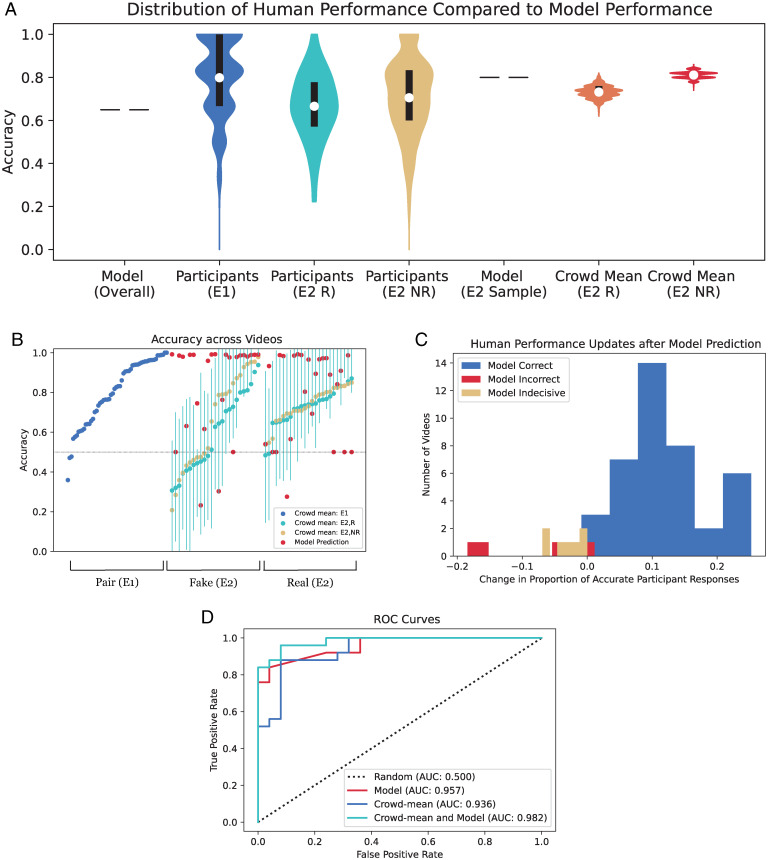
- Experiment 1: 5,524 individuals completed 26,820 trials; among 882 participants who saw at least 10 pairs, 82% outperformed the leading model, which achieved 65% accuracy on the holdout dataset. Experiment 2: recruited participants accurately identified deepfakes in 66% of attempts, nonrecruited participants in 69% of trials (72% for those seeing at least 10 videos), versus the leading model’s 80% on sampled videos; 13% of recruited, 27% of nonrecruited with ≥10 videos, and 37% of nonrecruited with <10 videos outperformed the model.
- Crowd wisdom: the crowd mean accurately identified 74% of videos for recruited participants, 80% for nonrecruited participants, and 86% for the 1,879 nonrecruited participants who saw at least 10 videos, compared with 80% for the leading model. After seeing the model’s prediction, recruited participants’ accurate identification increased from 66% to 73% (P < 0.001), but on 10 videos with incorrect or equivocal model predictions, participants became 2.7% less accurate on average; on political deepfakes the model was confidently wrong (2%, 8%, and 1% deepfake probability) and participants’ accurate identification dropped from 56% to 34% for Kim Jong-un and 70% to 55% for Vladimir Putin.
- Specialized face processing: inversion, misalignment, and eye occlusion reduced human accuracy by 4.3 percentage points (P = 0.002), 6.3 percentage points (P < 0.001), and 4.4 percentage points (P = 0.004) on a base rate of 65.5%; the model was affected only by inversion, dropping 12.1 percentage points (P = 0.005). Anger elicitation had no overall significant effect (P = 0.280), but on real videos the anger group underperformed controls by 5.2 percentage points (P = 0.032).
- Video features: a flickering face increased recruited participants’ accuracy by 24.2 percentage points (P < 0.001) and the model’s by 21.7 percentage points (P = 0.170); two people increased recruited participants’ accuracy by 7.6% (P < 0.001) but decreased the model’s accuracy by 21.9% (P = 0.023) on real videos; dark-skin presence decreased recruited participants’ accuracy by 8.8% (P < 0.001) and the model’s by 12.0% (P = 0.192).
Methods
- Two randomized online experiments on the Detect Fakes website. Experiment 1 used a two-alternative forced-choice design with 56 pairs of videos from the DFDC training dataset (n = 5,524; 26,820 trials; analysis focused on 882 participants who saw at least 10 pairs). Experiment 2 used a single-video design (n = 9,492: 304 recruited from Prolific and 9,188 organic visitors) with 50 videos randomly sampled from the DFDC holdout set (half deepfake, half nonmanipulated), 4 political-leader videos, and a deepfake attention check; participants reported confidence from 50% to 100% in 1% increments and could update after seeing the model’s prediction.
- Embedded randomized interventions tested anger elicitation and obstruction of specialized face processing via inversion, misalignment, and occlusion. Analyses used linear regression with robust SEs clustered on participants unless otherwise stated; accuracy was normalized between 0 and 1, with crowd means, ROC/AUC comparisons, and hand-labeled video-level features.
Limitations
- Paper states: the study evaluated 167 videos (84 deepfake and 83 authentic); only the two political deepfake videos include lip-syncing manipulations; no expert fact-checkers or forensic analysts were recruited, so results generalize only to ordinary people; the comparison is limited to the best model in 2020; minimal-context videos may not resemble the most problematic deepfakes; the half-real/half-deepfake base rate does not reflect real misinformation base rates; and emotion results were mixed, so no firm conclusions are drawn.
- Paper states: future work is needed on persuasive manipulated video, larger samples of political deepfakes, social media context, and additional or integral emotions.
- Evident from text: the nonrecruited participants were not preregistered and arrived organically/self-selected via the public website, while recruited participants came from Prolific.
Model-written summary. Check it against the paper before relying on it.
Integrity signals
Registry
Cites
Statistics
Figures
Verification
Claims the paper makes
5 Valid · 1 Not valid · 18 Not checked · 170 Own results and interpretations
At least one cited source doesn’t support this claim or points to a different paper, and none confirmed it — see the verdicts below.
In the paper
“adults are less accurate at recognizing faces when images are inverted or contain misaligned parts (60–62).”
§ Deepfake detection by human crowds, machines, and machine-informed crowds > Abstract
What the sources say
- Not checked yetcites [60] R. K. Yin, Looking at upside-down faces. J. Exp. Psychol. 81, 141– 145 (1969). source
- Not checked yetcites [61] G. Rhodes, S. Brake, A. P. Atkinson, What’s lost in inverted faces? Cognition 47, 25– 57 (1993). 8482070 source
- Disputedcites [62] J. J. Richler, O. S. Cheung, I. Gauthier, Holistic processing predicts face recognition. Psychol. Sci. 22, 464– 471 (2011). 21393576 PMC3077885 sourceExperimental — accuracy not yet measured
Our copy never reports an inversion cost for face recognition — 'inverted' appears only inside reference titles (Richler, Mack, Palmeri & Gauthier, 2011; Goffaux, 2009; Duchaine & Nakayama, 2006), which is not the paper's own claim. On alignment, the paper states the opposite direction: in the Method > Composite task section it writes that in the partial design 'Accuracy is greater or reaction time (RT) is faster in misaligned trials than in aligned trials,' and in Results and discussion that 'when face parts are misaligned, selective attention to a part is more successful, as evidenced by the smaller congruency effect on misaligned trials.' Its face-recognition measures (CFMT, face-identification task) used intact upright faces varying in lighting and pose, with no misaligned-parts or inverted condition, so the attributed decrement is not what this source says. (LLM, conf=0.65)
Checked by a reasoning model — may be wrong.
plainstates a cause- Asserted: passes — The authors put it forward as true.
- Checkable: passes — It can be checked against evidence.
- Load-bearing: passes — The paper’s conclusions depend on it.
- Based: passes — The paper gives a reason why it holds.
The cited sources support only part of this claim — read each source’s verdict below.
In the paper
“visual processing of faces appears to proceed holistically for the vast majority of people (64, 65).”
§ Deepfake detection by human crowds, machines, and machine-informed crowds > Abstract
What the sources say
- Partly supportedcites [64] J. J. Richler, I. Gauthier, A meta-analysis and review of holistic face processing. Psychol. Bull. 140, 1281– 1302 (2014). 24956123 PMC4152424 sourceExperimental — accuracy not yet measured
The Holistic Processing section describes face processing as holistic, and the Meta-Analysis Results report an average holistic-processing effect across studies. However, those group-level findings do not establish that the effect occurs in the vast majority of individual people. (LLM, conf=0.82)
- Supportedcites [65] A. W. Young, A. M. Burton, Are we face experts? Trends Cogn. Sci. 22, 100– 110 (2018). 29254899 source
In “The facial expertise debate” (page not provided), the paper calls holistic processing a well-known property of face recognition. Its “Holistic processing” entry defines this as processing faces as a whole. Although it gives no percentage, these passages support the citing sentence’s broad, hedged description of typical face processing. (LLM, conf=0.83)
hedged- Asserted: passes — The authors put it forward as true.
- Checkable: passes — It can be checked against evidence.
- Load-bearing: passes — The paper’s conclusions depend on it.
- Based: passes — The paper gives a reason why it holds.
- Partly supported
The cited sources support only part of this claim — read each source’s verdict below.
In the paper
“Likewise, these results mirror other recent research revealing human–AI collaborative decision-making does not necessarily lead to more accurate results than either humans or AI alone (72–76).”
§ Deepfake detection by human crowds, machines, and machine-informed crowds > Discussion
What the sources say
- Not checked yetcites [72] M. Vaccaro, J. Waldo, The effects of mixing machine learning and human judgment. Commun. ACM 62, 104– 110 (2019). source
- Not checked yetcites [73] P. Tschandl., Human-computer collaboration for skin cancer recognition. Nat. Med. 26, 1229– 1234 (2020). 32572267 source
- Partly supportedcites [74] S. Gaube., Do as AI say: Susceptibility in deployment of clinical decision-aids. NPJ Digit. Med. 4, 31 (2021). 33608629 PMC7896064 sourceExperimental — accuracy not yet measured
Our copy supports the 'collaboration does not necessarily yield better accuracy' half: the Results section 'Diagnostic accuracy is similarly impacted by human/AI advice' reports accuracy was worse with inaccurate advice regardless of purported source, and the Discussion states 'physicians were not able to effectively filter inaccurate advice'. However, the comparison 'than either humans or AI alone' is not tested here — the Methods 'Experimental design' describes a 2 × 2 design varying only advice source (AI vs human label) and advice accuracy, with no unaided-physician or AI-alone condition, and the Discussion instead says outcomes 'may improve overall' only 'if the underlying model has a higher diagnostic accuracy than the physicians using it'. The related statement that implemented systems 'showed no improved clinical outcomes' (Introduction) is itself credited to other works (refs 6,7) rather than shown by this study. (LLM, conf=0.78)
- Partly supportedcites [75] A. Abeliuk, D. M. Benjamin, F. Morstatter, A. Galstyan, Quantifying machine influence over human forecasters. Sci. Rep. 10, 15940 (2020). 32994447 PMC7524768 sourceExperimental — accuracy not yet measured
The Discussion (para. on implications) states that 'algorithms are far from perfect and do not necessarily beat humans in some deeply uncertain settings' and that 'overconfidence on algorithms may lead to detrimental results', and the Impact on performance / Discussion sections report that confirmation bias and trust in low-quality models decrease forecast accuracy ('users would do better to trust their prior'), so the source does support the idea that pairing humans with machine models does not necessarily beat humans alone. However, the paper never compares the hybrid against the machine/AI component alone; its own headline conclusion is the more positive 'machine models can improve the judgment of a human pool but highlight the importance of accounting for trust and cognitive biases' (Abstract), and the Machine predictions section frames machines as under-performing humans rather than the team being worse than machines. The 'or AI alone' half of the claim is therefore not supported by this source. (LLM, conf=0.75)
- Supportedcites [76] M. Jacobs., How machine-learning recommendations influence clinician treatment selections: The example of the antidepressant selection. Transl. Psychiatry 11, 108 (2021). 33542191 PMC7862671 source
The Results section 'No change in overall accuracy between clinicians and clinician-ML collaboration' (p. Results) reports clinician-ML collaborative accuracy (M = 0.356) statistically indistinguishable from clinicians alone (M = 0.357; p = 0.925) and significantly below the simulated ML system acting alone (0.667; p < 0.0001). The Discussion restates this: 'interacting with ML recommendations did not improve treatment selection accuracy' and 'Our work challenges the validity of this assumption' that humans interacting with ML tools will perform better than either actor individually. This matches the cited sentence's paraphrase that human-AI collaboration does not necessarily yield more accurate results than either humans or AI alone. (LLM, conf=0.90)
plain- Asserted: passes — The authors put it forward as true.
- Checkable: passes — It can be checked against evidence.
- Load-bearing: unclear — It is unclear whether the paper’s conclusions depend on it.
- Based: passes — The paper gives a reason why it holds.
In the paper
“Eighty-two percent of participants outperform the leading model, which achieves 65% accuracy on the holdout dataset (36).”
§ Deepfake detection by human crowds, machines, and machine-informed crowds > Results > Experiment 1: Two-Alternative Forced Choice (n = 5,524).
What the sources say
- Not checked yetcites [36] B. Dolhansky., Deepfake detection challenge results: An open initiative to advance AI (2020). Accessed 27 January 2021.
plainn = 882- Asserted: passes — The authors put it forward as true.
- Checkable: passes — It can be checked against evidence.
- Load-bearing: passes — The paper’s conclusions depend on it.
- Based: passes — The paper gives a reason why it holds.
A result the paper reports from its own data — it cites no other source for it, so there is none to check. The quote shows it is in the paper.
In the paper
“Half of the stimuli set (28 of 56 pairs of videos) was identified correctly by over 83% of participants”
§ Deepfake detection by human crowds, machines, and machine-informed crowds > Results > Experiment 1: Two-Alternative Forced Choice (n = 5,524).
plainn = 882- Asserted: passes — The authors put it forward as true.
- Checkable: passes — It can be checked against evidence.
- Load-bearing: unclear — It is unclear whether the paper’s conclusions depend on it.
- Based: passes — The paper gives a reason why it holds.
126 more claims
Create a free account to see all 194 claims and to verify the 28 references still open.
- It may state two separate claims as one. 34
- Probably not a substantial claim. 31
- The quote only partly states this claim. 2
Claims other papers make about this one
Each is checked against this paper’s own text: does it say what the citing paper says it does?
The source backs part of the claim, not all of it — or backs it for a different population, condition or comparison.
In the citing paper
“There is no improvement when evaluating videos either [24–26].”
From Warning: Humans cannot reliably detect speech deepfakes (2023) · cites this paper as [24]
Experimental — accuracy not yet measuredThe source backs part of the claim, not all of it — or backs it for a different population, condition or comparison.
In the citing paper
“On a sample of 166 videos from the largest publicly available dataset of deepfake videos to date from the Deepfake Detection Contest (DFDC)48, people are significantly better than chance but far from perfect at discerning whether an unknown actor’s face has been visually manipulated by a deepfake algorithm49.”
From Human detection of political speech deepfakes across transcripts, audio, and video (2024) · cites this paper as [49]
Experimental — accuracy not yet measuredThe source backs part of the claim, not all of it — or backs it for a different population, condition or comparison.
In the citing paper
“Furthermore, Groh et al. [2] point out that the brain possesses a specialized region for processing faces holistically. In their research, humans were adversely a ff ected by manipulations obstructing specialized face processing (e.g., inversion, misalignment, and eye occlusion), whereas computer performance remained una ff ected.”
From Human Performance in Deepfake Detection: A Systematic Review (2025) · cites this paper as [2]
Experimental — accuracy not yet measuredThe source backs part of the claim, not all of it — or backs it for a different population, condition or comparison.
In the citing paper
“Groh et al. [2] compared human performance with the winning model using videos from DFDC and found that, among the participants who saw at least 10 videos, 82% outperformed the winning model.”
From Human Performance in Deepfake Detection: A Systematic Review (2025) · cites this paper as [2]
Experimental — accuracy not yet measuredThe source backs part of the claim, not all of it — or backs it for a different population, condition or comparison.
In the citing paper
“Second, while lower-quality deepfakes are generally easier to detect [20, 35, 36, 42], imperfections in authentic videos (e.g., lighting inconsistencies or unusual framing) can lead viewers to miscategorize genuine content as manipulated [2, 22, 27, 35, 37].”
From Human Performance in Deepfake Detection: A Systematic Review (2025) · cites this paper as [2]
Experimental — accuracy not yet measured
12 more claims about this paper
Create a free account to see every claim other papers make about this one.
Self-check
Percentages, sums and reported differences re-computed from the paper’s own numbers.
Each contradiction between two passages listed here was confirmed by an independent check.
Rated major: it would touch a result — a value a result rests on, reported and recomputed p-values on opposite sides of the significance level, two passages that conflict with no sign which is right, or a cited work retracted before this paper was published.
In the paper
§ Deepfake detection by human crowds, machines, and machine-informed crowds > Results > Experiment 2: Single-Video Design (n = 9,492).
“For nonrecruited participants, the crowd mean accurately identifies 80% of videos.”
§ Deepfake detection by human crowds, machines, and machine-informed crowds > Results > Experiment 2: Single-Video Design (n = 9,492).
“the crowd wisdom of nonrecruited participants and the model is correct on 10 videos. When we examine the 36 videos that are neither grainy, blurry, nor extremely dark, the crowd wisdom of recruited participants is correct on 29 out of 36 videos, the crowd wisdom of nonrecruited participants is correct on 32 out of 36 videos”
Citations
Cites
EfficientNet: Rethinking Model Scaling for Convolutional Neural Networks
Tan, M., & Le, Q. V. (2019) · arXiv · doi:10.48550/arxiv.1905.11946 · Cited by 17,072 · cited 2×
“While there are many proposed techniques for algorithmically detecting fakes (including affective computing approaches like examining heart rate and breathing rate (37) and looking for emotion-congruent speech and facial expressions) (38, 39), the most accurate computer vision model in the contest (40) focused on loca…”
Mastering the game of Go with deep neural networks and tree search
Silver, D., Huang, A., Maddison, C. J., Guez, A., Sifre, L., van den Driessche, G., Schrittwieser, J., Antonoglou, I., Panneershelvam, V., Lanctot, M., et al. (2016) · Nature · doi:10.1038/nature16961 · Cited by 15,612 · cited 1×
“Recent advances in training neural networks for computer vision reveal that algorithms are capable of surpassing the performance of human experts in some complex strategy games (5, 6) and medical diagnoses (7, 8), so we might expect algorithms to be similarly capable of outperforming people at deepfake detection.”
Dermatologist-level classification of skin cancer with deep neural networks
Esteva, A., Kuprel, B., Novoa, R. A., Ko, J., Swetter, S. M., Blau, H. M., & Thrun, S. (2017) · Nature · doi:10.1038/nature21056 · Cited by 14,362
A Style-Based Generator Architecture for Generative Adversarial Networks
Karras, T., Laine, S., & Aila, T. (2019) · 2019 IEEE/CVF Conference on Computer Vision and Pattern Recognition (CVPR) · doi:10.1109/cvpr.2019.00453 · Cited by 11,714 · cited 3×
“The deepfakes examined here contain only visual manipulations produced using seven synthetic techniques: two deepfake autoencoders, a neural network face swap model 32 , the NTH talking heads model 33 , the FSGAN method for reenactment and inpainting 34 , StyleGAN 35 , and sharpening refinement on blended faces 31 .”
BackgroundMethodMastering the game of Go without human knowledge
Silver, D., Schrittwieser, J., Simonyan, K., Antonoglou, I., Huang, A., Guez, A., Hubert, T., Baker, L., Lai, M., Bolton, A., et al. (2017) · Nature · doi:10.1038/nature24270 · Cited by 9,084 · cited 1×
“Recent advances in training neural networks for computer vision reveal that algorithms are capable of surpassing the performance of human experts in some complex strategy games (5, 6) and medical diagnoses (7, 8), so we might expect algorithms to be similarly capable of outperforming people at deepfake detection.”
The spread of true and false news online
Vosoughi, S., Roy, D., & Aral, S. (2018) · Science · doi:10.1126/science.aap9559 · Cited by 8,847 · cited 1×
“The role of emotion in deepfake detection is of practical concern because people share misinformation, especially political misinformation, because of its novelty and emotional content (55).”
The fusiform face area: a module in human extrastriate cortex specialized for face perception
Kanwisher, N., McDermott, J., & Chun, M. M. (1997) · The Journal of Neuroscience · doi:10.1523/jneurosci.17-11-04302.1997 · Cited by 7,738 · cited 1×
“For example, there is a region of the brain specialized for processing faces (57).”
Joint Face Detection and Alignment Using Multitask Cascaded Convolutional Networks
Zhang, K., Zhang, Z., Li, Z., & Qiao, Y. (2016) · IEEE Signal Processing Letters · doi:10.1109/lsp.2016.2603342 · Cited by 6,214
Lazer, D. M. J., Baum, M. A., Benkler, Y., Berinsky, A. J., Greenhill, K. M., Menczer, F., Metzger, M. J., Nyhan, B., Pennycook, G., Rothschild, D., et al. (2018) · Science · doi:10.1126/science.aao2998 · Cited by 4,160
(2018) · Cited by 3,510
Cited by
When combinations of humans and AI are useful: A systematic review and meta-analysis
Vaccaro, M., Almaatouq, A., & Malone, T. (2024) · Nature Human Behaviour · doi:10.1038/s41562-024-02024-1 · Cited by 1,314
Deep learning-aided decision support for diagnosis of skin disease across skin tones
Groh, M., Badri, O., Daneshjou, R., Koochek, A., Harris, C., Soenksen, L. R., Doraiswamy, P. M., & Picard, R. (2024) · Nature Medicine · doi:10.1038/s41591-023-02728-3 · Cited by 160
“However, an emerging literature on human and artificial intelligence (AI) collaboration reveals that physician–machine partnerships are not guaranteed to be better than either physicians or machines alone 10–14 .”
Self-citationAlgorithm-mediated social learning in online social networks
Brady, W. J., Jackson, J. C., Lindström, B., & Crockett, M. J. (2023) · Trends in Cognitive Sciences · doi:10.1016/j.tics.2023.06.008 · Cited by 132
Abbas, F., & Taeihagh, A. (2024) · Expert Systems with Applications · doi:10.1016/j.eswa.2024.124260 · Cited by 186
Danry, V., Pataranutaporn, P., Mao, Y., & Maes, P. (2023) · Proceedings of the 2023 CHI Conference on Human Factors in Computing Systems · doi:10.1145/3544548.3580672 · Cited by 110
“a member of a minority group which can lead to over-policing of marginalized communities, or a social media information recommendation system might falsely claim incorrect or misleading news stories to be true which can lead to political instability and social unrest [17, 18, 46].”
BackgroundHameleers, M. (2023) · Communication Theory · doi:10.1093/ct/qtac021 · Cited by 108
Voice-Face Homogeneity Tells Deepfake
Cheng, H., Guo, Y., Wang, T., Li, Q., Chang, X., & Nie, L. (2024) · ACM Transactions on Multimedia Computing, Communications, and Applications · doi:10.1145/3625231 · Cited by 102
Warning: Humans cannot reliably detect speech deepfakes
Mai, K. T., Bray, S., Davies, T., & Griffin, L. D. (2023) · PLOS ONE · doi:10.1371/journal.pone.0285333 · Cited by 98
“[24] to disentangle the effects of each intervention on performance.”
BackgroundMethodResultInfluentialTesting human ability to detect ‘deepfake’ images of human faces
Bray, S. D., Johnson, S. D., & Kleinberg, B. (2023) · Journal of Cybersecurity · doi:10.1093/cybsec/tyad011 · Cited by 96
AI-enhanced collective intelligence
Cui, H., & Yasseri, T. (2024) · Patterns · doi:10.1016/j.patter.2024.101074 · Cited by 145
Creating, Using, Misusing, and Detecting Deep Fakes
Farid, H. (2022) · Journal of Online Trust and Safety · doi:10.54501/jots.v1i4.56 · Cited by 89
Deepfakes and scientific knowledge dissemination
Doss, C., Mondschein, J., Shu, D., Wolfson, T., Kopecky, D., Fitton-Kane, V. A., Bush, L., & Tucker, C. (2023) · Scientific Reports · doi:10.1038/s41598-023-39944-3 · Cited by 90
“These rates also closely mirror the susceptibility rates of individuals to digital images altered manually without artificial intelligence 41,58 .”
BackgroundResultInfluentialBartsch, A., Neuberger, C., Stark, B., Karnowski, V., Maurer, M., Pentzold, C., Quandt, T., Quiring, O., & Schemer, C. (2025) · Communication Theory · doi:10.1093/ct/qtae020 · Cited by 88
Human detection of political speech deepfakes across transcripts, audio, and video
Groh, M., Sankaranarayanan, A., Singh, N., Kim, D. Y., Lippman, A., & Picard, R. (2024) · Nature Communications · doi:10.1038/s41467-024-51998-z · Cited by 89
Self-citationNon-Consensual Synthetic Intimate Imagery: Prevalence, Attitudes, and Knowledge in 10 Countries
Umbach, R., Henry, N., Beard, G. F., & Berryessa, C. M. (2024) · Proceedings of the CHI Conference on Human Factors in Computing Systems · doi:10.1145/3613904.3642382 · Cited by 73
“This is seen across a variety deepfake types, from deepfake audio [51] to photos [11, 58] and videos [37].”
BackgroundInitial policy considerations for generative artificial intelligence
(2023) · OECD Artificial Intelligence Papers · doi:10.1787/fae2d1e6-en · Cited by 36
Human Perception of Audio Deepfakes
Müller, N. M., Pizzi, K., & Williams, J. (2022) · Proceedings of the 1st International Workshop on Deepfake Detection for Audio Multimedia · doi:10.1145/3552466.3556531 · Cited by 68
“The most extensive video deepfake dataset to date was composed and analyzed in [11].”
BackgroundPark, J., Oh, C., & Kim, H. Y. (2024) · Technology in Society · doi:10.1016/j.techsoc.2024.102705 · Cited by 98
Deepfakes and the epistemic apocalypse
Habgood-Coote, J. (2023) · Synthese · doi:10.1007/s11229-023-04097-3 · Cited by 62
Human performance in detecting deepfakes: A systematic review and meta-analysis of 56 papers
Diel, A., Lalgi, T., Schröter, I. C., MacDorman, K. F., Teufel, M., & Bäuerle, A. (2024) · Computers in Human Behavior Reports · doi:10.1016/j.chbr.2024.100538 · Cited by 64
Groh, M., Harris, C., Daneshjou, R., Badri, O., & Koochek, A. (2022) · Proceedings of the ACM on Human-Computer Interaction · doi:10.1145/3555634 · Cited by 102
Self-citationBabaei, R., Cheng, S. S. M., Duan, R., & Zhao, S. (2025) · Journal of Sensor and Actuator Networks · doi:10.3390/jsan14010017 · Cited by 106
People are poorly equipped to detect AI-powered voice clones
Barrington, S., Cooper, E. A., & Farid, H. (2025) · Scientific Reports · doi:10.1038/s41598-025-94170-3 · Cited by 131
Deepfakes as a threat to a speaker and facial recognition: An overview of tools and attack vectors
Firc, A., Malinka, K., & Hanáček, P. (2023) · Heliyon · doi:10.1016/j.heliyon.2023.e15090 · Cited by 81
Classification performance assessment for imbalanced multiclass data
Aguilar–Ruiz, J. S., & Michalak, M. (2024) · Scientific Reports · doi:10.1038/s41598-024-61365-z · Cited by 78
Sociotechnical Safety Evaluation of Generative AI Systems
Weidinger, L., Rauh, M., Marchal, N., Manzini, A., Hendricks, L. A., Mateos-Garcia, J., Bergman, S., Kay, J., Griffin, C., Bariach, B., et al. (2023) · arXiv · doi:10.48550/arxiv.2310.11986 · Cited by 49
Providing detection strategies to improve human detection of deepfakes: An experimental study
Somoray, K., & Miller, D. J. (2023) · Computers in Human Behavior · doi:10.1016/j.chb.2023.107917 · Cited by 47
Human perception of art in the age of artificial intelligence
van Hees, J., Grootswagers, T., Quek, G. L., & Varlet, M. (2025) · Frontiers in Psychology · doi:10.3389/fpsyg.2024.1497469 · Cited by 68
Protecting world leaders against deep fakes using facial, gestural, and vocal mannerisms
Bohacek, M., & Farid, H. (2022) · Proceedings of the National Academy of Sciences · doi:10.1073/pnas.2216035119 · Cited by 45
What label should be applied to content produced by generative AI?
Epstein, Z., Fang, M. C., Arechar, A. A., & Rand, D. G. (2023) · doi:10.31234/osf.io/v4mfz · Cited by 41
Self-citationThe Liar’s Dividend: Can Politicians Claim Misinformation to Evade Accountability?
Schiff, K. J., Schiff, D. S., & Bueno, N. S. (2024) · American Political Science Review · doi:10.1017/s0003055423001454 · Cited by 102
Labeling AI-Generated Content: Promises, Perils, and Future Directions
Wittenberg, C., Epstein, Z., Berinsky, A. J., & Rand, D. G. (2024) · An MIT Exploration of Generative AI · doi:10.21428/e4baedd9.0319e3a6 · Cited by 74
Self-citationExploring deepfake technology: creation, consequences and countermeasures
Alanazi, S., & Asif, S. (2024) · Human-Intelligent Systems Integration · doi:10.1007/s42454-024-00054-8 · Cited by 76
Video and Audio Deepfake Datasets and Open Issues in Deepfake Technology: Being Ahead of the Curve
Akhtar, Z., Pendyala, T. L., & Athmakuri, V. S. (2024) · Forensic Sciences · doi:10.3390/forensicsci4030021 · Cited by 60
As Good as a Coin Toss: Human Detection of AI-Generated Content
Cooke, D., Edwards, A., Barkoff, S., & Kelly, K. (2025) · Communications of the ACM · doi:10.1145/3729417 · Cited by 106
Human, Do You Think This Painting is the Work of a Real Artist?
Park, J., Kang, H., & Kim, H. Y. (2023) · International Journal of Human-Computer Interaction · doi:10.1080/10447318.2023.2232978 · Cited by 39
The spread of synthetic media on X
Corsi, G., Marino, B., & Wong, W. (2024) · Harvard Kennedy School Misinformation Review · doi:10.37016/mr-2020-140 · Cited by 53
Cyberattacks Using ChatGPT: Exploring Malicious Content Generation Through Prompt Engineering
Alotaibi, L., Seher, S., & Mohammad, N. (2024) · ASU International Conference in Emerging Technologies for Sustainability and Intelligent Systems (ICETSIS) · doi:10.1109/icetsis61505.2024.10459698 · Cited by 45
Conspiracy thinking and social media use are associated with ability to detect deepfakes
Nas, E., & de Kleijn, R. (2023) · Telematics and Informatics · doi:10.1016/j.tele.2023.102093 · Cited by 30
Kaate, I., Salminen, J. O., Jung, S., Almerekhi, H., & Jansen, B. J. J. (2023) · Biannual Conference of the Italian SIGCHI Chapter (CHItaly) · doi:10.1145/3605390.3605397 · Cited by 45
Deepfake detection with and without content warnings
Lewis, A., Vu, P., Duch, R. M., & Chowdhury, A. (2023) · Royal Society Open Science · doi:10.1098/rsos.231214 · Cited by 54
Sohrawardi, S. J., Wu, Y.-C., Hickerson, A., & Wright, M. (2024) · CHI Conference on Human Factors in Computing Systems · doi:10.1145/3613904.3641973 · Cited by 31
Ding, Y., Guo, B., Liu, Y., Jing, Y., Yin, M., Li, N., Wang, H., & Yu, Z. (2024) · Information Processing & Management · doi:10.1016/j.ipm.2024.103878 · Cited by 28
Walker, C., Schiff, D. S., & Schiff, K. J. (2024) · Proceedings of the AAAI Conference on Artificial Intelligence · doi:10.1609/aaai.v38i21.30349 · Cited by 46
Deepfake Image Forensics for Privacy Protection and Authenticity Using Deep Learning
Sohail, S., Sajjad, S. M., Zafar, A., Iqbal, Z., Muhammad, Z., & Kazim, M. Z. (2025) · Information · doi:10.3390/info16040270 · Cited by 44
Gotcha: Real-Time Video Deepfake Detection via Challenge-Response
Mittal, G., Hegde, C., & Memon, N. D. (2024) · IEEE European Symposium on Security and Privacy · doi:10.1109/eurosp60621.2024.00009 · Cited by 42
Rathje, S., & Bavel, J. J. V. (2025) · Trends in Cognitive Sciences · doi:10.1016/j.tics.2025.06.014 · Cited by 36
The continued influence of AI-generated deepfake videos despite transparency warnings
Clark, S. P., & Lewandowsky, S. (2026) · Communications Psychology · doi:10.1038/s44271-025-00381-9 · Cited by 42
Multiclass Classification Performance Curve
Aguilar–Ruiz, J. S., & Michalak, M. (2022) · IEEE Access · doi:10.1109/access.2022.3186444 · Cited by 32
Ng, Y.-L. (2023) · Current Psychology · doi:10.1007/s12144-022-03621-x · Cited by 19
Kaate, I., Salminen, J. O., Santos, J. M., Jung, S., Almerekhi, H., & Jansen, B. J. J. (2023) · Computers in Human Behavior Artificial Humans · doi:10.1016/j.chbah.2023.100031 · Cited by 31
Einav, G., Allen, O., Gur, T., Maaravi, Y., & Ravner, D. (2022) · Technology in Society · doi:10.1016/j.techsoc.2022.102136 · Cited by 32
Algorithm-Mediated Social Learning in Online Social NetworksPreprint
Brady, W. J., Jackson, J. C., Lindström, B., & Crockett, M. J. (2023) · doi:10.31219/osf.io/yw5ah · Cited by 18
Human Performance in Deepfake Detection: A Systematic Review
Somoray, K., Miller, D. J., & Holmes, M. (2025) · Human Behavior and Emerging Technologies · doi:10.1155/hbe2/1833228 · Cited by 19
FakeBench: Probing Explainable Fake Image Detection via Large Multimodal Models
Li, Y., Liu, X., Wang, X., Lee, B., Wang, S., Rocha, A. D. R., & Lin, W. (2025) · IEEE Transactions on Information Forensics and Security · doi:10.1109/tifs.2025.3597211 · Cited by 94
Ataş, S., İlhan, İ., & Karakse, M. (2022) · doi:10.1109/it54280.2022.9743542 · Cited by 20
What You See Is Not What You Know: Studying Deception in Deepfake Video Manipulation
Allen, C., Payne, B. R., Abegaz, T. T., & Robertson, C. L. (2023) · Journal of Cybersecurity Education Research and Practice · doi:10.32727/8.2023.25 · Cited by 19
Cortical-striatal brain network distinguishes deepfake from real speaker identity
Roswandowitz, C., Kathiresan, T., Pellegrino, E., Dellwo, V., & Frühholz, S. (2024) · Communications Biology · doi:10.1038/s42003-024-06372-6 · Cited by 21
Furizal, F., Ma’arif, A., Maghfiroh, H., Suwarno, I., Prayogi, D., Kariyamin, K., Lonang, S., & Sharkawy, A. (2025) · Social Sciences & Humanities Open · doi:10.1016/j.ssaho.2025.101882 · Cited by 61
Hernández, A. D., Owen, R., Nielsen, D. S., & McConville, R. (2023) · Journal of Responsible Innovation · doi:10.1080/23299460.2023.2222514 · Cited by 17
Diverse misinformation: impacts of human biases on detection of deepfakes on networks
Lovato, J., St-Onge, J., Harp, R., Salazar Lopez, G., Rogers, S. P., Haq, I. U., Hébert-Dufresne, L., & Onaolapo, J. (2024) · npj Complexity · doi:10.1038/s44260-024-00006-y · Cited by 16
“Human-aided interventions for deepfake detection can be a valuable tool to help to assist automated techniques, especially when there are gaps in automation (5).”
InfluentialWhen Are Combinations of Humans and AI Useful?Preprint
Vaccaro, M. A., Almaatouq, A., & Malone, T. W. (2024) · doi:10.31234/osf.io/mk46p · Cited by 16
"Better Be Computer or I'm Dumb": A Large-Scale Evaluation of Humans as Audio Deepfake Detectors
Warren, K., Tucker, T., Crowder, A., Olszewski, D., Lu, A., Fedele, C., Pasternak, M., Layton, S., Butler, K., Gates, C., et al. (2024) · Proceedings of the 2024 on ACM SIGSAC Conference on Computer and Communications Security · doi:10.1145/3658644.3670325 · Cited by 15
Pitfalls (and advantages) of sophisticated large language models
Strasser, A. (2024) · Elsevier eBooks · doi:10.1016/b978-0-443-18851-0.00007-x · Cited by 20
Learning When to Advise Human Decision Makers
Noti, G., & Chen, Y. (2023) · International Joint Conference on Artificial Intelligence · doi:10.24963/ijcai.2023/339 · Cited by 44
Pataranutaporn, P., Archiwaranguprok, C., Chan, S., Loftus, E. F., & Maes, P. (2025) · CHI Conference on Human Factors in Computing Systems · doi:10.1145/3706598.3713697 · Cited by 50
Voice clones sound realistic but not (yet) hyperrealistic
Lavan, N., Irvine, M., Rosi, V., & McGettigan, C. (2025) · PLoS ONE · doi:10.1371/journal.pone.0332692 · Cited by 38
Identifying and minimising the impact of fake visual media: Current and future directions
Nightingale, S. J., & Wade, K. A. (2022) · Memory Mind & Media · doi:10.1017/mem.2022.8 · Cited by 20
Outperformed by AI: Interacting with Superhuman AI Changes the Way We Perceive Ourselves
Schaap, G., van de Sande, Y., & Schraffenberger, H. (2024) · CHI Conference Extended Abstracts on Human Factors in Computing Systems (CHI EA) · doi:10.1145/3613905.3650961 · Cited by 17
Reinforced Disentanglement for Face Swapping without Skip Connection
Ren, X., Chen, X., Yao, P., Shum, H., & Wang, B. (2023) · IEEE/CVF International Conference on Computer Vision (ICCV) · doi:10.1109/iccv51070.2023.01889 · Cited by 21
Deepfake Detection in Super-Recognizers and Police Officers
Ramon, M., Vowels, M. J., & Groh, M. (2024) · IEEE Security & Privacy · doi:10.1109/msec.2024.3371030 · Cited by 24
Self-citationCan deepfakes be used to study emotion perception? A comparison of dynamic face stimuli
Becker, C., Conduit, R., Chouinard, P. A., & Laycock, R. (2024) · Behavior Research Methods · doi:10.3758/s13428-024-02443-y · Cited by 20
Synthetic and natural face identity processing share common mechanisms
Uittenhove, K. L., Shahreza, H. O., Marcel, S., & Ramon, M. (2024) · Computers in Human Behavior Reports · doi:10.1016/j.chbr.2024.100563 · Cited by 16
DeepExplain: Enhancing DeepFake Detection Through Transparent and Explainable AI model
Sunkari, V., & Srinagesh, A. (2024) · Informatica · doi:10.31449/inf.v48i8.5792 · Cited by 26
Comprehensive multiparametric analysis of human deepfake speech recognition
Malinka, K., Firc, A., Šalko, M., Prudký, D., Radačovská, K., & Hanáček, P. (2024) · EURASIP Journal on Image and Video Processing · doi:10.1186/s13640-024-00641-4 · Cited by 20
Understanding Deepfakes: A Comprehensive Analysis of Creation, Generation, and Detection
Alanazi, S., & Asif, S. (2023) · AHFE international · doi:10.54941/ahfe1003290 · Cited by 13
Deepfake AI images: should deepfakes be banned in Thailand?
Songja, R., Promboot, I., Haetanurak, B., & Kerdvibulvech, C. (2023) · AI and Ethics · doi:10.1007/s43681-023-00350-0 · Cited by 13
It's Trying Too Hard To Look Real: Deepfake Moderation Mistakes and Identity-Based Bias
Mink, J., Wei, M., Munyendo, C. W., Hugenberg, K., Kohno, T., Redmiles, E. M., & Wang, G. (2024) · Proceedings of the CHI Conference on Human Factors in Computing Systems · doi:10.1145/3613904.3641999 · Cited by 11
Human Versus Machine: A Comparative Analysis in Detecting Artificial Intelligence-Generated Images
Maiano, L., Benova, A., Papa, L., Stockner, M., Marchetti, M., Convertino, G., Mazzoni, G. A. L., & Amerini, I. (2024) · IEEE Security & Privacy · doi:10.1109/msec.2024.3390555 · Cited by 16
Park, J., Gu, J., & Kim, H. Y. (2022) · Computers in Human Behavior · doi:10.1016/j.chb.2022.107418 · Cited by 10
Folk Models of Misinformation on Social Media
Sharevski, F., Devine, A., Pieroni, E., & Jachim, P. (2023) · Network and Distributed System Security Symposium · doi:10.14722/ndss.2023.24293 · Cited by 17
Unmasking Illusions: Understanding Human Perception of Audiovisual DeepfakesPreprint
Hashmi, A., Shahzad, S. A., Lin, C., Tsao, Y., & Wang, H. (2024) · doi:10.36227/techrxiv.171560542.29368554/v1 · Cited by 36
Hasan, E., Duhaime, E., & Trueblood, J. S. (2024) · Cognitive Research Principles and Implications · doi:10.1186/s41235-024-00558-6 · Cited by 14
Khimi, W., Albarqi, K., Saif, K., & Elhag, S. (2024) · International Journal of Computers and Informatics · doi:10.59992/ijci.2024.v3n8p3 · Cited by 11
Deepfakes in Social Engineering Attacks
Dsouza, D. S., Hajjar, A. E., & Jahankhani, H. (2024) · Space Law and Policy · doi:10.1007/978-3-031-64045-2_8 · Cited by 15
Can You Tell Real from Fake Face Images? Perception of Computer-Generated Faces by Humans
Bozkir, E., Riedmiller, C., Skodras, A. N., Kasneci, G., & Kasneci, E. (2024) · ACM Transactions on Applied Perception · doi:10.1145/3696667 · Cited by 17
Seeing through the fake: how users detect and interpret deepfakes
Shin, D. (2025) · Information Communication & Society · doi:10.1080/1369118x.2025.2518260 · Cited by 20
Mitigating the harms of manipulated media: Confronting deepfakes and digital deception
Farid, H. (2025) · PNAS Nexus · doi:10.1093/pnasnexus/pgaf194 · Cited by 22
Deepfake Technology and Gender-Based Violence: A Scoping Review
Lazard, L., Capdevila, R., Turley, E. L., Gilfoyle, K., & Stavropoulou, N. (2025) · Trauma Violence & Abuse · doi:10.1177/15248380251384271 · Cited by 34
Raza, A., Basit, A., Amin, A., Arfeen, Z. A., Masud, M. I., Fayyaz, U., & Jumani, T. A. (2026) · AI · doi:10.3390/ai7020068 · Cited by 23
The Liar’s Dividend: Can Politicians Claim Misinformation to Evade Accountability?
Schiff, K. J., Schiff, D. S., & Bueno, N. (2023) · doi:10.31235/osf.io/x43ph · Cited by 8
Ruffin, M., Seo, H., Xiong, A., & Wang, G. (2024) · Proceedings of the International AAAI Conference on Web and Social Media · doi:10.1609/icwsm.v18i1.31392 · Cited by 15
Deepfake Technology and Its Implications for Influencer Marketing
Arora, M., Mishra, K. K., Singh, M., Singh, P., & Tripathi, R. (2024) · Advances in information security, privacy, and ethics book series · doi:10.4018/979-8-3693-5298-4.ch005 · Cited by 10
Characterizing Photorealism and Artifacts in Diffusion Model-Generated Images
Kamali, N., Nakamura, K., Kumar, A., Chatzimparmpas, A., Hullman, J. R., & Groh, M. (2025) · CHI Conference on Human Factors in Computing Systems · doi:10.1145/3706598.3713962 · Cited by 38
Self-citationCan You Hear Me Now? Sensitive Comparisons of Human and Machine Perception
Lepori, M. A., & Firestone, C. (2022) · Cognitive Science · doi:10.1111/cogs.13191 · Cited by 7
Self-citationEffects of Browsing Conditions and Visual Alert Design on Human Susceptibility to Deepfakes
Josephs, E., Fosco, C. L., & Oliva, A. (2024) · Journal of Online Trust and Safety · doi:10.54501/jots.v2i2.144 · Cited by 10
Assessing the Human Ability to Recognize Synthetic Speech in Ordinary Conversation
Prudký, D., Firc, A., & Malinka, K. (2023) · International Conference of the Biometrics Special Interest Group (BIOSIG) · doi:10.1109/biosig58226.2023.10346006 · Cited by 13
Prediction of self-efficacy in recognizing deepfakes based on personality traits
Abraham, J., Putra, H. A., Prayoga, T., Warnars, H. L. H. S., Manurung, R. H., & Nainggolan, T. (2022) · F1000Research · doi:10.12688/f1000research.128915.1 · Cited by 8
Generational effects of culture and digital media in former Soviet Republics
Horne, B. D., Rice, N. M., Luther, C. A., Ruck, D. J., Borycz, J., Allard, S. L., Fitzgerald, M., Манаев, О. Т., Prins, B., Taylor, M., et al. (2023) · Humanities and Social Sciences Communications · doi:10.1057/s41599-023-01670-6 · Cited by 10
Memory online: introduction to the special issue
Wang, Q. (2022) · Memory · doi:10.1080/09658211.2022.2065306 · Cited by 11
Metadata
- Authors
- Groh, M., Epstein, Z., Firestone, C., & Picard, R.
- Affiliations
- MIT Media Lab (US)
- Johns Hopkins University (US)
- Corresponding author
- Groh, Matthew
- Venue
- Proceedings of the National Academy of Sciences
- Publisher
- National Academy of Sciences
- Published
- 2021-12-28
- Volume
- 119
- Issue
- 1
- ISSN
- 0027-8424 (ISSN-L)
- 1091-6490
- PMC
- PMC8740705
- OpenAlex
- W3209972423
- Cited by
- 248
- References
- 100
- Citations by year
- 2026: 64 · 2025: 55 · 2024: 65 · 2023: 43 · 2022: 20 · 2021: 1
- FWCI
- 11.59
- Type
- journal article
- Language
- en
- Open access
- hybrid
- doi.org
- Licence
- Locations
- Proceedings of the National Academy of Sciences (publishedVersion, cc-by-nc-nd)
- PubMed Central (publishedVersion, cc-by-nc-nd)
- PubMed (publishedVersion)
- arXiv (Cornell University) (submittedVersion)
- PhilPapers (PhilPapers Foundation) (submittedVersion)
- arXiv (Cornell University)
- Funders
- MIT Media Lab member companies (NA)
- Topics
- Physical Sciences › Computer Science › Computer Vision and Pattern Recognition › Digital Media Forensic Detection
- Social Sciences › Sociology and Political Science › Misinformation and Its Impacts
- Life Sciences › Neuroscience › Cognitive Neuroscience › Face Recognition and Perception
- Keywords
- deepfake detection, human-machine comparison, face processing
- MeSH terms
- Facial Recognition, Artificial Intelligence, Communication, Humans, Deception, Video Recording, Forensic Sciences, Social Media
About these checks
Registry, retraction, Cites and statistics results are computed, not judged, with one exception: a printed reference that no index lists is read once by a model before it counts as a citation error. Claims are extracted by a model and kept only when their quote appears verbatim in the text; each cited source is then checked, with a model’s help, for whether it says what the claim relies on. Those verdicts can be wrong — read the claim’s quote and the cited source before relying on one.
The claim verdicts this report counts are experimental: their accuracy is not yet measured.
A language model drew the claims from the paper on 2026-10-11, under version 3 of the claim definition (model deepseek-v4.1-flash, prompt extract-v3).
A second model labelled each claim on 2026-10-11 (model jev-1.13-20260917, definition revision gold-guideline-v0.2).
Cited sources are checked with a language model’s help (qwen3.8-omni-flash and gpt-6-sol).
Statistics and arithmetic are recomputed, not judged.
Confidence bands are shown only for fields calibrated on our annotated test set. None is calibrated yet, so no band is shown.
What counts as a claim ›How we measure confidence ›How we check this ›
Are you an author, or do you see a problem with this page? Request a review
Data sources
Bibliographic data: Semantic Scholar, OpenAlex, Crossref.
Contains information from the Semantic Scholar Academic Graph Datasets, made available under the ODC Attribution License (ODC-BY 1.0).
Semantic Scholar’s data is described in: Kinney, R., et al. (2023). The Semantic Scholar Open Data Platform. arXiv:2301.10140.
