

The Effects of Student–Teacher Ethnoracial Matching on Chronic Absenteeism: Exploring the Role of Relational Dynamics in Early Education
Open accessThe DOI matches its Crossref record; 75 of the 79 references it cites were found in a registry or an index, and 1 are not checked yet; 2 of the 30 sources its claims cite were checked for support.
Abstract
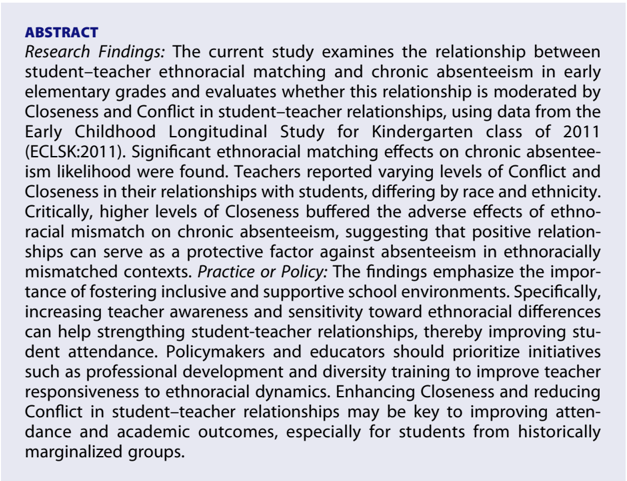
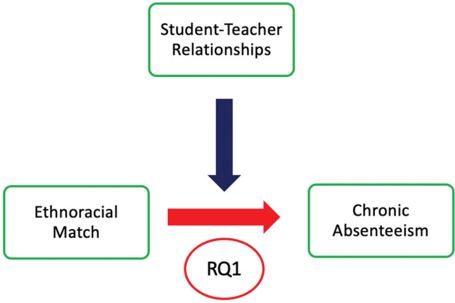
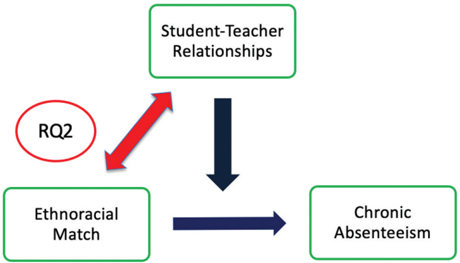
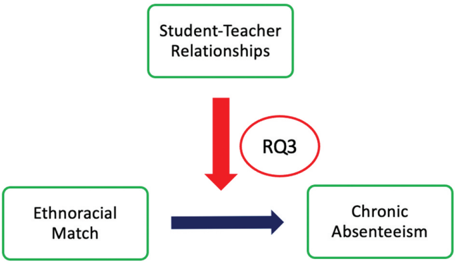
Research Findings: The current study examines the relationship between student–teacher ethnoracial matching and chronic absenteeism in early elementary grades and evaluates whether this relationship is moderated by Closeness and Conflict in student–teacher relationships, using data from the Early Childhood Longitudinal Study for Kindergarten class of 2011 (ECLSK:2011). Significant ethnoracial matching effects on chronic absenteeism likelihood were found. Teachers reported varying levels of Conflict and Closeness in their relationships with students, differing by race and ethnicity. Critically, higher levels of Closeness buffered the adverse effects of ethnoracial mismatch on chronic absenteeism, suggesting that positive relationships can serve as a protective factor against absenteeism in ethnoracially mismatched contexts. Practice or Policy: The findings emphasize the importance of fostering inclusive and supportive school environments. Specifically, increasing teacher awareness and sensitivity toward ethnoracial differences can help strengthing student-teacher relationships, thereby improving student attendance. Policymakers and educators should prioritize initiatives such as professional development and diversity training to improve teacher responsiveness to ethnoracial dynamics. Enhancing Closeness and reducing Conflict in student–teacher relationships may be key to improving attendance and academic outcomes, especially for students from historically marginalized groups.
Verified 2026-11-25 · 1 reference not checked yet
Overview
CoChat Summary
TL;DR
Using ECLS-K:2011, this study finds that student–teacher ethnoracial mismatch is associated with a higher probability of chronic absenteeism in early elementary grades, and teacher-reported closeness buffers that association. It also documents racial disparities in closeness and conflict, especially for Black students with White teachers.
Key findings
- Ethnoracial mismatch is associated with greater chronic absenteeism: in the most robust student-year fixed effects model, not having an ethnoracial match is associated with a 2-percentage-point increase in the probability of chronic absenteeism (OtherRE = 0.02); the school/year fixed effects model shows 0.01*.
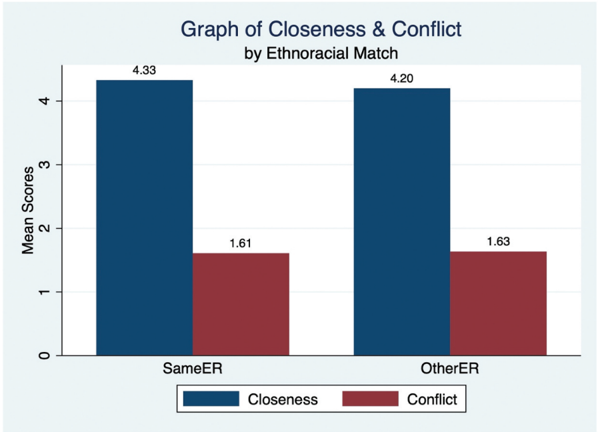
- Descriptively, students matched with their teachers are chronically absent at 9%, compared with 11% among mismatched students; teachers report mean Closeness of 4.33 with matched students versus 4.20 with mismatched students, while Conflict is nearly identical (1.61 vs. 1.63).
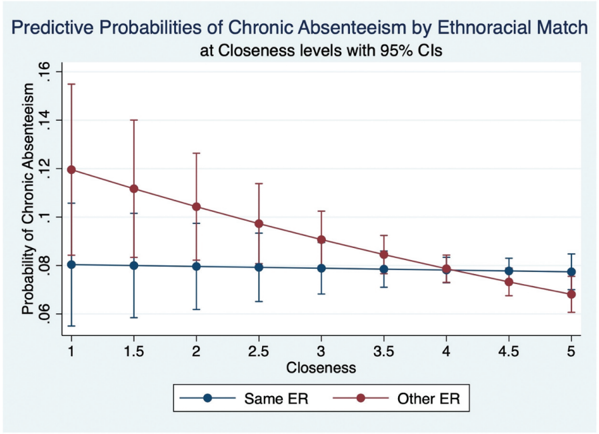
- Closeness moderates the mismatch–absenteeism association: the interaction Closeness × OtherRE is negative (e.g., −0.02 in student fixed effects; −0.02* in school fixed effects). At 0 units of Closeness, mismatch corresponds to a 10-percentage-point higher likelihood of chronic absenteeism; each unit increase in Closeness reduces that disparity by .02 (2 percentage points). Conflict moderation is not presented because there were no significantly different moderating effects after controlling for student fixed effects.
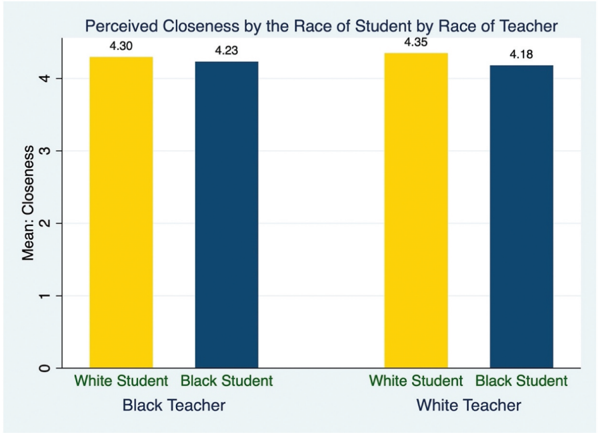
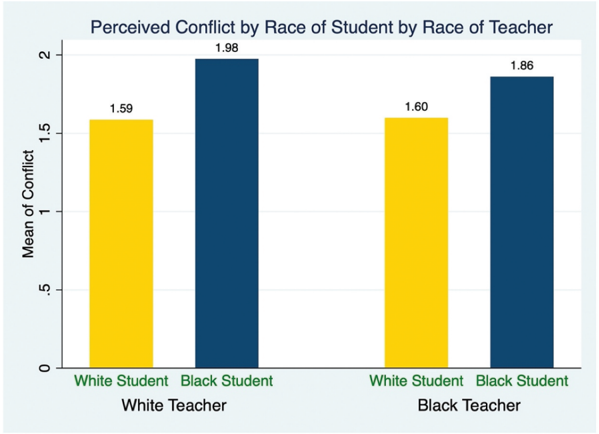
- Black students experience the greatest Conflict and lowest Closeness with White teachers: Black students’ mean Conflict is 1.94 versus 1.59 for White students, and mean Closeness is 4.20 versus 4.34 for White students. White teachers report mean Closeness of 4.35 with White students and 4.18 with Black students; White teachers report higher perceived Conflict with Black students (mean = 1.98) than Black teachers do (mean = 1.86).
Methods
- Data: Early Childhood Longitudinal Study, Kindergarten Class of 2011 (ECLS-K:2011), first four waves, focusing on approximately 16,950 students with racial information and Closeness/Conflict scores. The analytical sample is 46.8% White, 13.2% Black, 25.3% Latinx, and 8.5% Asian; about 10.1% are chronically absent.
- Design: Linear probability models estimate chronic absenteeism (1 if missing more than 10 days, 0 otherwise) on ethnoracial mismatch (OtherRE), with baseline, student fixed effects, and school fixed effects models; controls include child, family, school/classroom, and teacher characteristics; standard errors are clustered by teacher-year.
- Analysis: Moderation models interact OtherRE with Closeness and Conflict. Robustness checks include logit marginal effects, lagged absenteeism, cross-lagged panel analysis, alternative functional forms, and a stable-school subsample.
Limitations
- Stated: fixed-effects models may still be biased by time-varying experiences or unobserved confounders not captured in the analysis, such as changes in family dynamics, external support systems, or district/school DEI initiatives.
- Stated: the study does not ascertain whether relationships are consistent across ethnoracial subgroups; data are scarce on teacher subgroups other than White and Black teachers, and findings may vary by district/state demographics. It also relies exclusively on teacher-reported Closeness and Conflict from a single theoretical framework.
- Evident: the paper notes that linear probability models can produce predicted probabilities outside [0,1] and addresses this with logit models; it also reports attrition/school-leaving checks (losing approximately 8,000 students, with 9,000 remaining) and uses observational data with fixed effects and lagged controls to approximate causal effects rather than random assignment.
Model-written summary. Check it against the paper before relying on it.
Integrity signals
Registry
Cites
Statistics
Figures




Verification
Claims the paper makes
1 Valid · 5 Not valid · 24 Not checked · 77 Own results and interpretations
The cited sources that could be checked couldn’t confirm or dispute this claim.
In the paper
“This empirical evidence underscores the importance of prior outcomes as proxies for unobserved confounders, particularly when outcomes exhibit relative stability over short intervals (Heckman et al., 2006).”
§ The Effects of Student-Teacher Ethnoracial Matching on Chronic Absenteeism: Exploring the Role of Relational Dynamics in Early Education > Moderation Models
What the sources say
- Could not verifycites Heckman et al., 2006 matched to “The effects of cognitive and noncognitive abilities on labor market outcomes and social behavior” (2006) sourceExperimental — accuracy not yet measured
Section 2 describes controlling for estimated latent skills, not using prior outcomes as proxies for unobserved confounders. Section 8 discusses earlier ability measurements but cautions that they can introduce measurement error as abilities change with age. Searches for prior outcomes, lagged outcomes, and short-interval stability found no passage addressing the attributed claim; page numbers were unavailable in our copy. (LLM, conf=0.70)
boostedstates an association- Asserted: passes — The authors put it forward as true.
- Checkable: passes — It can be checked against evidence.
- Load-bearing: passes — The paper’s conclusions depend on it.
- Based: passes — The paper gives a reason why it holds.
- Could not verify
A result the paper reports from its own data — it cites no other source for it, so there is none to check. The quote shows it is in the paper.
In the paper
“Further, Table 2 shows that mean Closeness score of 4.34 for White students is higher than the score received by any other student racial subgroup.”
§ The Effects of Student-Teacher Ethnoracial Matching on Chronic Absenteeism: Exploring the Role of Relational Dynamics in Early Education > Data and Descriptive Summary
plain- Asserted: passes — The authors put it forward as true.
- Checkable: passes — It can be checked against evidence.
- Load-bearing: unclear — It is unclear whether the paper’s conclusions depend on it.
- Based: passes — The paper gives a reason why it holds.
A result the paper reports from its own data — it cites no other source for it, so there is none to check. The quote shows it is in the paper.
In the paper
“Critically, higher levels of Closeness buffered the adverse effects of ethnoracial mismatch on chronic absenteeism, suggesting that positive relationships can serve as a protective factor against absenteeism in ethnoracially mismatched contexts.”
- Also stated in: § Introduction · plain
“Importantly, the adverse effects of ethnoracial mismatch on absenteeism are found to diminish in contexts where students and teachers report higher levels of Closeness in their interactions.”
- Also stated in: § Introduction · plain
“The present study provides empirical evidence that deeper relational ties, particularly Closeness between teachers and students can buffer some of the challenges associated with ethnoracial mismatch.”
§ The Effects of Student-Teacher Ethnoracial Matching on Chronic Absenteeism: Exploring the Role of Relational Dynamics in Early Education > Abstract
plainstates a cause- Asserted: passes — The authors put it forward as true.
- Checkable: passes — It can be checked against evidence.
- Load-bearing: passes — The paper’s conclusions depend on it.
- Based: passes — The paper gives a reason why it holds.
- Also stated in: § Introduction · plain
A result the paper states — it cites no source for it, so there is none to check. The quote shows it is in the paper.
In the paper
“For instance, relationships between Black students and White teachers are reported as being significantly more conflictual than those involving any other combination of racial or ethnic backgrounds.”
§ The Effects of Student-Teacher Ethnoracial Matching on Chronic Absenteeism: Exploring the Role of Relational Dynamics in Early Education > Introduction
plainstates an association- Asserted: passes — The authors put it forward as true.
- Checkable: passes — It can be checked against evidence.
- Load-bearing: passes — The paper’s conclusions depend on it.
- Based: passes — The paper gives a reason why it holds.
A result the paper reports from its own data — it cites no other source for it, so there is none to check. The quote shows it is in the paper.
In the paper
“Students who are racially or ethnically matched with their teachers are chronically absent at a rate of 9%, compared to 11% among students who are mismatched.”
§ The Effects of Student-Teacher Ethnoracial Matching on Chronic Absenteeism: Exploring the Role of Relational Dynamics in Early Education > Data and Descriptive Summary
plainstates an association- Asserted: passes — The authors put it forward as true.
- Checkable: passes — It can be checked against evidence.
- Load-bearing: passes — The paper’s conclusions depend on it.
- Based: passes — The paper gives a reason why it holds.
56 more claims
Create a free account to see all 107 claims and to verify the 4 references still open.
- Probably not a substantial claim. 26
- It may state two separate claims as one. 27
- Borderline: one of the tests for a substantial claim is unclear. 2
Self-check
Percentages, sums and reported differences re-computed from the paper’s own numbers.
Each contradiction between two passages listed here was confirmed by an independent check.
Rated minor: it would not touch a result — a value no result rests on, a p-value that stays on the same side of the significance level, or a conflict that is clerical, resolved elsewhere in the paper, or outside its own findings.
In the paper
§ The Effects of Student-Teacher Ethnoracial Matching on Chronic Absenteeism: Exploring the Role of Relational Dynamics in Early Education > Disclosure Statement
“Home Learning Activities are highly correlated with Parental Involvement, they were excluded from the final models.”
§ The Effects of Student-Teacher Ethnoracial Matching on Chronic Absenteeism: Exploring the Role of Relational Dynamics in Early Education > Disclosure Statement
“| Home Learning Activities | 0.00 | 0.00 | 0.01** |”
Rated minor: it would not touch a result — a value no result rests on, a p-value that stays on the same side of the significance level, or a conflict that is clerical, resolved elsewhere in the paper, or outside its own findings.
In the paper
§ The Effects of Student-Teacher Ethnoracial Matching on Chronic Absenteeism: Exploring the Role of Relational Dynamics in Early Education > Introduction
“the adverse effects of ethnoracial mismatch on absenteeism are found to diminish in contexts where students and teachers report higher levels of Closeness in their interactions.”
§ The Effects of Student-Teacher Ethnoracial Matching on Chronic Absenteeism: Exploring the Role of Relational Dynamics in Early Education > Limitations
“Lastly, the study relies exclusively on teacher-reported measures of relational Closeness and Conflict, derived from a singular theoretical framework.”
Citations
Cites
(2001) · RePEc: Research Papers in Economics · Cited by 27,577
The Ecology of Human Development: Experiments by Nature and Design
Bronfenbrenner, U. (1979) · Harvard University Press eBooks · doi:10.4159/9780674028845 · Cited by 26,084
Hierarchical Linear Models: Applications and Data Analysis Methods
Davidian, M. (2003) · Journal of the American Statistical Association · doi:10.1198/jasa.2003.s288 · Cited by 13,723
Stereotype threat and the intellectual test performance of African Americans.
Steele, C. M., & Aronson, J. (1995) · Journal of Personality and Social Psychology · doi:10.1037/0022-3514.69.5.797 · Cited by 9,020
Toward a Theory of Culturally Relevant Pedagogy
Ladson-Billings, G. (1995) · American Educational Research Journal · doi:10.3102/00028312032003465 · Cited by 8,057 · cited 1×
“Teachers who share their students’ racial or ethnic backgrounds often have a better grasp of the cultural nuances affecting students’ behavior and learning processes, facilitating a more supportive educational environment (Ladson-Billings, 1995; Tatum, 2010).”
The Bioecological Model of Human Development
Bronfenbrenner, U., & Morris, P. A. (2007) · Handbook of Child Psychology · doi:10.1002/9780470147658.chpsy0114 · Cited by 5,760 · cited 1×
“This perspective is aligned with Bronfenbrenner’s bioecological model, which conceptua-lizes human development as shaped by interactions between individuals and their multi-layered environments over time (Bronfenbrenner, 1979; Bronfenbrenner & Morris, 2006).”
National Center for Education Statistics
(2008) · Encyclopedia of Educational Psychology · doi:10.4135/9781412963848.n192 · Cited by 4,546
The effects of cognitive and noncognitive abilities on labor market outcomes and social behavior
Heckman, J. J., Stixrud, J., & Urzua, S. (2006) · Journal of Labor Economics · doi:10.1086/504455 · Cited by 4,427 · cited 1×
“This empirical evidence underscores the importance of prior outcomes as proxies for unobserved confounders, particularly when outcomes exhibit relative stability over short intervals (Heckman et al., 2006).”
Hamre, B. K., & Pianta, R. C. (2001) · Child Development · doi:10.1111/1467-8624.00301 · Cited by 3,307 · cited 1×
“Relationships that children form and maintain with their teachers are a part of the early schooling processes that impact student growth, social adjustment, and academic performance in schools (Hamre & Pianta, 2001; Roorda et al., 2017).”
Implications for educational practice of the science of learning and development
Darling-Hammond, L., Flook, L., Cook-Harvey, C., Barron, B., & Osher, D. (2020) · Applied Developmental Science · doi:10.1080/10888691.2018.1537791 · Cited by 2,733
Culturally responsive teaching: theory, research, and practice
(2000) · Choice Reviews Online · doi:10.5860/choice.38-1683 · Cited by 2,270
The color of discipline: Sources of racial and gender disproportionality in school punishment
Skiba, R. J., Michael, R. S., Nardo, A. C., & Peterson, R. L. (2002) · The Urban Review · doi:10.1023/a:1021320817372 · Cited by 1,758 · cited 1×
“These include systemic inequities, as Black students often attend schools in under-resourced neighborhoods, leading to poor health outcomes and higher absenteeism rates (Skiba et al., 2002).”
(2010) · Cited by 1,657
Skiba, R. J., Horner, R. H., Chung, C.-G., Rausch, M. K., May, S. L., & Tobin, T. (2011) · School Psychology Review · doi:10.1080/02796015.2011.12087730 · Cited by 1,593
The Achievement Gap and the Discipline Gap: Two Sides of the Same Coin?
Gregory, A., Skiba, R. J., & Noguera, P. A. (2010) · Educational Researcher · doi:10.3102/0013189x09357621 · Cited by 1,395
A teacher like me: Does race, ethnicity, or gender matter?
Dee, T. S. (2005) · American Economic Review · doi:10.1257/000282805774670446 · Cited by 1,078 · cited 2×
“Dee (2005) also examined the role of demographic similarity between students and teachers in shaping teachers’ subjective evaluations and perceptions of student behavior and performance.”
Tatum, B. (1992) · Harvard Educational Review · doi:10.17763/haer.62.1.146k5v980r703023 · Cited by 1,040 · cited 1×
“Teachers who share their students’ racial or ethnic backgrounds often have a better grasp of the cultural nuances affecting students’ behavior and learning processes, facilitating a more supportive educational environment (Ladson-Billings, 1995; Tatum, 2010).”
Teachers, race, and student achievement in a randomized experiment
Dee, T. S. (2004) · Review of Economics and Statistics · doi:10.1162/003465304323023750 · Cited by 965 · cited 2×
“The interaction between student–teacher relationships and race, particularly within the context of ethnoracial matching, extends beyond shared identity to encompass a mutual cultural understanding that enhances educational engagement and outcomes (Dee, 2004; Gershenson etal., 2017).”
American Economic Journal: Economic Policy
(2017) · American Economic Journal Economic Policy · doi:10.1257/pol · Cited by 877
BALFANZ, R., HERZOG, L., & MAC IVER, D. J. (2007) · Educational Psychologist · doi:10.1080/00461520701621079 · Cited by 804 · cited 1×
“Students who are frequently absent not only perform worse academically but are also more likely to drop out of high school (Balfanz et al., 2007; Barge, 2011; Byrnes & Reyna, 2012; Hickman et al., 2008).”
Teaching To and Through Cultural Diversity
Gay, G. (2013) · Curriculum Inquiry · doi:10.1111/curi.12002 · Cited by 755 · cited 1×
“Ethnoracially matched teachers are more likely to provide feedback and support in culturally resonant and affirming ways, enhancing students’ academic and social development (Battey et al., 2018; Gay, 2015).”
Handbook of Education Policy Research
(2012) · Routledge eBooks · doi:10.4324/9780203880968 · Cited by 689
Children's needs III: Development, prevention, and intervention.
Bear, G. G., & Minke, K. M. (2006) · Cited by 670
Roorda, D. L., Jak, S., Zee, M., Oort, F. J., & Koomen, H. M. Y. (2017) · School Psychology Review · doi:10.17105/spr-2017-0035.v46-3 · Cited by 612 · cited 1×
“Relationships that children form and maintain with their teachers are a part of the early schooling processes that impact student growth, social adjustment, and academic performance in schools (Hamre & Pianta, 2001; Roorda et al., 2017).”
When Race Matters: Teachers' Evaluations of Students' Classroom Behavior
Downey, D. B., & Pribesh, S. (2004) · Sociology of Education · doi:10.1177/003804070407700401 · Cited by 531 · cited 1×
“Notably, past studies, such as those by Downey and Pribesh (2004), have shown that Black students’ classroom behavior is rated more favorably by Black teachers than by White teachers.”
Diversifying the Teaching Force: An Examination of Major Arguments
Villegas, A. M., & Irvine, J. J. (2010) · The Urban Review · doi:10.1007/s11256-010-0150-1 · Cited by 524 · cited 1×
“One perspective suggests that students develop stronger connections to school and more positive attitudes toward education when taught by teachers of the same racial or ethnic background (Irvine, 1989; Villegas & Irvine, 2010; Warikoo, 2004).”
Brief intervention to encourage empathic discipline cuts suspension rates in half among adolescents
Okonofua, J. A., Paunesku, D., & Walton, G. M. (2016) · Proceedings of the National Academy of Sciences · doi:10.1073/pnas.1523698113 · Cited by 510 · cited 1×
“Additionally, discrimination and bias from teachers and peers can result in disengagement from school (Gregory et al., 2010; Okonofua et al., 2016).”
Redding, C. (2019) · Review of Educational Research · doi:10.3102/0034654319853545 · Cited by 453 · cited 2×
“Research consistently demonstrates that ethnoracial matching can have profound positive impacts on outcomes for students from traditionally marginalized groups (Bristol & Martin-Fernandez, 2019; Gershenson et al., 2022; Redding, 2019).”
Reading between the lines and beyond the pages: A culturally relevant approach to literacy teaching
Ladson‐Billings, G. (1992) · Theory Into Practice · doi:10.1080/00405849209543558 · Cited by 447
Leszczensky, L., & Wolbring, T. (2022) · Sociological Methods & Research · doi:10.1177/0049124119882473 · Cited by 424
Culturally Relevant Pedagogy in a Diverse Urban Classroom
Milner, H. R. (2011) · The Urban Review · doi:10.1007/s11256-009-0143-0 · Cited by 373
Lindsay, C. A., & Hart, C. M. D. (2017) · Educational Evaluation and Policy Analysis · doi:10.3102/0162373717693109 · Cited by 360 · cited 1×
“Evidence from a longitudinal study of administrative data from North Carolina further underscores these trends, revealing that schools with higher percentages of Black teachers report significantly lower rates of exclusionary discipline practices and fewer suspensions (Lindsay & Hart, 2017).”
Ready, D. D. (2010) · Sociology of Education · doi:10.1177/0038040710383520 · Cited by 358
Chronic Absenteeism and Its Effects on Students' Academic and Socioemotional Outcomes
Gottfried, M. A. (2014) · Journal of Education for Students Placed at Risk (JESPAR) · doi:10.1080/10824669.2014.962696 · Cited by 328 · cited 2×
“Chronic absenteeism has been consistently associated with a range of adverse effects for children, including lower academic performance and an increased risk for behavioral challenges (Gershenson, 2016; M. A. Gottfried, 2014).”
Excused versus unexcused: How student absences in elementary school affect academic achievement
Gottfried, M. A. (2009) · Educational Evaluation and Policy Analysis · doi:10.3102/0162373709342467 · Cited by 315 · cited 1×
“Reduced absences are linked to higher academic achievement, especially for students from lower socioeconomic backgrounds (M. A. Gottfried, 2009; Ready, 2010).”
Improving Student Attendance With School, Family, and Community Partnerships
Sheldon, S. B. (2007) · The Journal of Educational Research · doi:10.3200/joer.100.5.267-275 · Cited by 311 · cited 1×
“Absenteeism has been linked to various negative student outcomes, including poor academic performance, increased juvenile delinquency, and higher dropout rates (Ehrlich et al., 2013; Eklund et al., 2020; Sheldon, 2007).”
Allensworth, E. M., & Easton, J. Q. (2013) · Cited by 305
What You Can—and Can’t—Do With Three-Wave Panel Data
Vaisey, S., & Miles, A. (2017) · Sociological Methods & Research · doi:10.1177/0049124114547769 · Cited by 299 · cited 1×
“…models assume that there are no unobserved time-varying confounders that past outcomes do not directly affect the explanatory variables (reverse causality) and that past explanatory variables do not directly affect current outcomes (lagged treatments) (Vaisey & Miles, 2017; Woolridge, 2010).”
Returns to Teacher Experience: Student Achievement and Motivation in Middle School
Ladd, H. F., & Sorensen, L. C. (2017) · Education Finance and Policy · doi:10.1162/edfp_a_00194 · Cited by 290 · cited 1×
“They can influence attendance by fostering engagement, creating a sense of community, and stressing the importance of regular attendance (Kelly, 2011; Ladd & Sorensen, 2017).”
Getting Students to School: Using Family and Community Involvement to Reduce Chronic Absenteeism.
Sheldon, S. B., & Epstein, J. L. (2004) · The School community journal/School community journal · Cited by 272
Teachers Are People Too: Examining the Racial Bias of Teachers Compared to Other American Adults
Starck, J. G., Riddle, T., Sinclair, S., & Warikoo, N. (2020) · Educational Researcher · doi:10.3102/0013189x20912758 · Cited by 255
Chin, M. J., Quinn, D. M., Dhaliwal, T. K., & Lovison, V. S. (2020) · Educational Researcher · doi:10.3102/0013189x20937240 · Cited by 249
Chang, H. N.-L., & Romero, M. (2008) · Issue Lab (Candid) · doi:10.7916/d84b392g · Cited by 234 · cited 3×
“When students miss a significant portion of the school year, it is termed “chronic absenteeism” (Chang & Romero, 2008).”
InfluentialRacial Mismatch in the Classroom: Beyond Black-white Differences
McGrady, P. B., & Reynolds, J. R. (2013) · Sociology of Education · doi:10.1177/0038040712444857 · Cited by 227
Match Quality, Worker Productivity, and Worker Mobility: Direct Evidence from Teachers
Jackson, C. K. (2013) · The Review of Economics and Statistics · doi:10.1162/rest_a_00339 · Cited by 225
Linking Teacher Quality, Student Attendance, and Student Achievement
Gershenson, S. (2016) · Education Finance and Policy · doi:10.1162/edfp_a_00180 · Cited by 215 · cited 2×
“Chronic absenteeism has been consistently associated with a range of adverse effects for children, including lower academic performance and an increased risk for behavioral challenges (Gershenson, 2016; M. A. Gottfried, 2014).”
The Long-Run Impacts of Same-Race Teachers
Gershenson, S., Hart, C. M. D., Hyman, J., Lindsay, C. A., & Papageorge, N. W. (2022) · American Economic Journal: Economic Policy · doi:10.1257/pol.20190573 · Cited by 207
Irvine, J. J. (1989) · Peabody Journal of Education · doi:10.1080/01619568909538662 · Cited by 202 · cited 2×
“This shared cultural understanding tends to reduce conflicts and misunderstandings that are more prevalent in ethnoracially mismatched pairings, where cultural misinterpretations can lead to perceived behavioral problems (Irvine, 1989; Milner, 2006).”
Differential Developmental Pathways of High School Dropouts and Graduates
Hickman, G. P., Bartholomew, M. K., Mathwig, J., & Heinrich, R. S. (2008) · The Journal of Educational Research · doi:10.3200/joer.102.1.3-14 · Cited by 193 · cited 1×
“Students who are frequently absent not only perform worse academically but are also more likely to drop out of high school (Balfanz et al., 2007; Barge, 2011; Byrnes & Reyna, 2012; Hickman et al., 2008).”
Grissom, J. A., Kern, E. C., & Rodriguez, L. A. (2015) · Educational Researcher · doi:10.3102/0013189x15580102 · Cited by 192
The Detrimental Effects of Missing School: Evidence from Urban Siblings
Gottfried, M. A. (2011) · American Journal of Education · doi:10.1086/657886 · Cited by 170 · cited 1×
“Besides contributing to high dropout rates, absenteeism affects long-term academic and socio-emotional outcomes (M. A. Gottfried, 2011).”
Grissom, J. A., Rodríguez, L. A., & Kern, E. C. (2017) · The Elementary School Journal · doi:10.1086/690274 · Cited by 165 · cited 2×
“Similarly, in districts with a more representative teaching workforce, Black students experience improved outcomes in key areas such as academic achievement, tracking, and reduced rates of suspensions and expulsions (Grissom et al., 2017; Shirrell et al., 2024).”
Chronic Absenteeism in the Classroom Context: Effects on Achievement
Gottfried, M. A. (2019) · Urban Education · doi:10.1177/0042085915618709 · Cited by 147
Cultivating a Critical Race Consciousness for African American School Success.
Carter, D. J. (2008) · Educational foundations · Cited by 142
The Added Value of Latinx and Black Teachers for Latinx and Black Students: Implications for Policy
Bristol, T. J., & Martin-Fernandez, J. (2019) · Policy Insights from the Behavioral and Brain Sciences · doi:10.1177/2372732219862573 · Cited by 141 · cited 1×
“Research consistently demonstrates that ethnoracial matching can have profound positive impacts on outcomes for students from traditionally marginalized groups (Bristol & Martin-Fernandez, 2019; Gershenson et al., 2022; Redding, 2019).”
(2006) · Educational foundations · Cited by 123
Bosman, R. J., Roorda, D. L., van der Veen, I., & Koomen, H. M. Y. (2018) · Journal of School Psychology · doi:10.1016/j.jsp.2018.03.006 · Cited by 115
The Impact of Demographic Representation on Absences and Suspensions
Holt, S. B., & Gershenson, S. (2019) · Policy Studies Journal · doi:10.1111/psj.12229 · Cited by 109 · cited 3×
“For example, chronically absent students in kindergarten demonstrate notably lower literacy skills, performing 14% worse than their peers with average attendance (Ready, 2010, as cited in Holt & Gershenson, 2019).”
Identifying the Determinants of Chronic Absenteeism: A Bioecological Systems Approach
Gottfried, M. A., & Gee, K. A. (2017) · Teachers College Record: The Voice of Scholarship in Education · doi:10.1177/016146811711900704 · Cited by 103 · cited 4×
“Absenteeism is a complex issue influenced by individual, family, school, and community factors (Balfanz & Byrnes, 2012; M. A. Gottfried & Gee, 2017; Lenhoff & Pogodzinski, 2018).”
InfluentialAssessed by a Teacher Like Me: Race and Teacher Assessments
Ouazad, A. (2014) · Education Finance and Policy · doi:10.1162/edfp_a_00136 · Cited by 101 · cited 1×
“A second perspective emphasizes the role of cultural competence and critical race consciousness, arguing that teachers of color adopt asset-based mind-sets and hold higher expectations for their students (Fox, 2016; Ladson-Billings, 1992; Ouazad, 2014).”
Fox, L. (2015) · AERA Open · doi:10.1177/2332858415623758 · Cited by 82
Addressing chronic absenteeism in schools: A meta-analysis of evidence-based interventions.
Eklund, K., Burns, M. K., Oyen, K., DeMarchena, S., & McCollom, E. M. (2022) · School Psychology Review · doi:10.1080/2372966x.2020.1789436 · Cited by 79 · cited 1×
“Absenteeism has been linked to various negative student outcomes, including poor academic performance, increased juvenile delinquency, and higher dropout rates (Ehrlich et al., 2013; Eklund et al., 2020; Sheldon, 2007).”
Do High School Students With a Same-Race Teacher Attend Class More Often?
Gottfried, M. A., Kirksey, J. J., & Fletcher, T. L. (2021) · Educational Evaluation and Policy Analysis · doi:10.3102/01623737211032241 · Cited by 78
Warikoo, N. K. (2004) · Race Ethnicity and Education · doi:10.1080/1361332042000234268 · Cited by 72 · cited 1×
“One perspective suggests that students develop stronger connections to school and more positive attitudes toward education when taught by teachers of the same racial or ethnic background (Irvine, 1989; Villegas & Irvine, 2010; Warikoo, 2004).”
Gee, K. A. (2018) · Journal of Education for Students Placed at Risk (JESPAR) · doi:10.1080/10824669.2018.1428610 · Cited by 72
Kirksey, J. J. (2019) · AERA Open · doi:10.1177/2332858419867692 · Cited by 57
Advancing an Ecological Approach to Chronic Absenteeism: Evidence from Detroit
Singer, J., Pogodzinski, B., Lenhoff, S. W., & Cook, W. (2021) · Teachers College Record: The Voice of Scholarship in Education · doi:10.1177/016146812112300406 · Cited by 53
(2018) · Cited by 51
School Organizational Effectiveness and Chronic Absenteeism: Implications for Accountability
Lenhoff, S. W., & Pogodzinski, B. (2018) · Journal of Education for Students Placed at Risk (JESPAR) · doi:10.1080/10824669.2018.1434656 · Cited by 49 · cited 1×
“Absenteeism is a complex issue influenced by individual, family, school, and community factors (Balfanz & Byrnes, 2012; M. A. Gottfried & Gee, 2017; Lenhoff & Pogodzinski, 2018).”
Shirrell, M., Bristol, T. J., & Britton, T. A. (2024) · Educational Evaluation and Policy Analysis · doi:10.3102/01623737231175461 · Cited by 45 · cited 1×
“Similarly, in districts with a more representative teaching workforce, Black students experience improved outcomes in key areas such as academic achievement, tracking, and reduced rates of suspensions and expulsions (Grissom et al., 2017; Shirrell et al., 2024).”
(2011) · Cited by 42
Experimental Estimates of the Student Attendance Production Function
Tran, L., & Gershenson, S. (2021) · Educational Evaluation and Policy Analysis · doi:10.3102/0162373720984463 · Cited by 36
BATTEY, D., LEYVA, L. A., WILLIAMS, I., BELIZARIO, V. A., GRECO, R., & SHAH, R. (2018) · Harvard Educational Review · doi:10.17763/1943-5045-88.4.455 · Cited by 30 · cited 3×
“In racially matched scenarios, teachers often manage behavior discretely and respectfully, appreciating the social and emotional ramifications of public reprimands (Battey et al., 2018).”
Zimmermann, C. R. (2024) · Sociology of Education · doi:10.1177/00380407241228581 · Cited by 21
Student-Teacher Ethnoracial Matching in the Earliest Grades: Benefits for Executive Function Skills?
Gottfried, M., Little, M., & Ansari, A. (2023) · Early Education and Development · doi:10.1080/10409289.2023.2172674 · Cited by 8 · cited 3×
“This current study’s analytical strategy is modeled after the approach previously used by M. Gottfried et al. (2023), using the first four waves of ECLSK:2011 for which Closeness and Conflict scores are provided.”
Causal Inferences From Observational Studies in Education Policy:
Frank, K. A., Lin, Q., & Maroulis, S. J. (2025) · Handbook of Education Policy Research · doi:10.2307/jj.31510356.28 · Cited by 1
Research works printed but not linked: 7
- 2. Attendance Works. (2023, October 12). Rising tide of chronic absence challenges schools. https://www.attendanceworks. org/rising-tide-of-chronic-absence-challenges-schools/
- 5. Barge, J. (2011). Student attendance and student achievement. Georgia Department of Education.
- 11. Byrnes, V., & Reyna, R. (2012). Summary of state level analysis of early warning indicators. Everyone Graduates Center.
- 14. Chhikara, D. (2023). The Impacts of Student-Teacher Relationships and Race-Match moderation on Absenteeism: A Four-Wave Longitudinal Data Study (Doctoral dissertation, Michigan State University), ProQuest Dissertations Publishing.
- 50. Kane, T. J., Kerr, K. A., & Pianta, R. C. (Eds.). (2014). Designing teaching evaluation systems. John Wiley.
- 62. Musser, M. P. (2011). Taking attendance seriously: How school absences undermine student and school performance in New York City. New School Center for New York City Affairs.
- 66. Pianta, R. C. (2001). Student-teacher relationship scale: Professional manual. Psychological Assessment Resources, Inc.
Cited by
Creating Welcoming Schools: The Role of Positive Climates in Reducing Absenteeism
Graham, J., Chiang, Y.-C., & Choi, S. Y. (2026) · American Educational Research Journal · doi:10.3102/00028312261417687 · Cited by 3
“Teacher-student race-match studies consistently show improved outcomes when students are assigned to race-congruent teachers, including substantial reductions in chronic absenteeism (Chhikara, 2025; M. Gottfried et al., 2022; Redding, 2019).”
Exclusion or inclusion? An analysis of teachers’ words and actions in Pakistani classrooms
Bhutta, S. M., Ansari, A. N., Ahmad, S., & Nimarta, W. (2026) · International Journal of Inclusive Education · doi:10.1080/13603116.2025.2612111 · Cited by 3
“Teachers’ words, gestures, and actions not only affect students’ academic learning but also their emotional security, self-esteem and sense of belonging (Abrol 2023; Chhikara 2025; Hymel and Katz 2019; Kyere, Hong, and Gentle-Genitty 2023; Rau-felder et al. 2021).”
InfluentialChoi, S. Y., Graham, J., Ye, Y., & Chiang, Y.-C. (2026) · Urban Education · doi:10.1177/00420859261417317 · Cited by 2
“Also, having positive relationships with teachers and being assigned to a race-congruent teacher can substantially decrease chronic absenteeism (Chhikara, 2025; Gottfried et al., 2022).”
Peer Victimization Among English Learners: The Protective Impact of Dual Language Programs
Chhikara, D. (2025) · Educational Researcher · doi:10.3102/0013189x251378466 · Cited by 1
“This approach accounts for stable school-level characteristics (e.g., leadership, curriculum, ethos) by absorbing time-invariant differences, allowing for cleaner estimation of within-school variation (Chhikara, 2025; Gottfried, 2019).”
Self-citationPan, X., & Gu, B. (2026) · Acta Psychologica · doi:10.1016/j.actpsy.2026.106896
Metadata
- Authors
- Chhikara, D.
- Affiliations
- Michigan State University (US)
- Corresponding author
- Chhikara, Daman
- ORCID
- Chhikara, Daman
- Venue
- Early Education and Development
- Publisher
- Informa UK Limited
- Published
- 2025-04
- Volume
- 36
- Issue
- 5
- Pages
- 1066-1091
- ISSN
- 1040-9289 (ISSN-L)
- 1556-6935
- OpenAlex
- W4409174044
- Cited by
- 6
- References
- 79
- Citations by year
- 2026: 5 · 2025: 1
- FWCI
- 18.75
- Type
- journal article
- Language
- en
- Open access
- hybrid
- doi.org
- Licence
- Locations
- Early Education and Development (publishedVersion, cc-by-nc-nd)
- eScholarship (California Digital Library) (submittedVersion, cc-by)
- Funders
- National Science Foundation (1749275)
- American Educational Research Association (1749275)
- Topics
- Social Sciences › Education › Early Childhood Education and Development
- Social Sciences › Education › School Choice and Performance
- Social Sciences › Sociology and Political Science › Critical Race Theory in Education
- Keywords
- chronic absenteeism, teacher-student relationship, relationship closeness, relationship conflict, early elementary education, kindergarten, racial and ethnic minority students, teacher sensitivity, inclusive school environment, teacher professional development
About these checks
Registry, retraction, Cites and statistics results are computed, not judged, with one exception: a printed reference that no index lists is read once by a model before it counts as a citation error. Claims are extracted by a model and kept only when their quote appears verbatim in the text; each cited source is then checked, with a model’s help, for whether it says what the claim relies on. Those verdicts can be wrong — read the claim’s quote and the cited source before relying on one.
The claim verdicts this report counts are experimental: their accuracy is not yet measured.
A language model drew the claims from the paper on 2026-10-01, under version 3 of the claim definition (model deepseek-v4.1-flash, prompt extract-v3).
A second model labelled each claim on 2026-10-01 (model jev-1.13-20260917, definition revision gold-guideline-v0.2).
Cited sources are checked with a language model’s help (gpt-6-sol).
Statistics and arithmetic are recomputed, not judged.
Confidence bands are shown only for fields calibrated on our annotated test set. None is calibrated yet, so no band is shown.
What counts as a claim ›How we measure confidence ›How we check this ›
Are you an author, or do you see a problem with this page? Request a review
Data sources
Bibliographic data: Semantic Scholar, OpenAlex, Crossref.
Contains information from the Semantic Scholar Academic Graph Datasets, made available under the ODC Attribution License (ODC-BY 1.0).
Semantic Scholar’s data is described in: Kinney, R., et al. (2023). The Semantic Scholar Open Data Platform. arXiv:2301.10140.
