

The DOI matches its Crossref record; 229 of the 233 references it cites were found in a registry or an index; 38 of the 138 sources its claims cite were checked for support.
Delivering CRISPR: a review of the challenges and approaches
Open accessAbstract
Gene therapy has long held promise to correct a variety of human diseases and defects. Discovery of the Clustered Regularly-Interspaced Short Palindromic Repeats (CRISPR), the mechanism of the CRISPR-based prokaryotic adaptive immune system (CRISPR-associated system, Cas), and its repurposing into a potent gene editing tool has revolutionized the field of molecular biology and generated excitement for new and improved gene therapies. Additionally, the simplicity and flexibility of the CRISPR/Cas9 site-specific nuclease system has led to its widespread use in many biological research areas including development of model cell lines, discovering mechanisms of disease, identifying disease targets, development of transgene animals and plants, and transcriptional modulation. In this review, we present the brief history and basic mechanisms of the CRISPR/Cas9 system and its predecessors (ZFNs and TALENs), lessons learned from past human gene therapy efforts, and recent modifications of CRISPR/Cas9 to provide functions beyond gene editing. We introduce several factors that influence CRISPR/Cas9 efficacy which must be addressed before effective in vivo human gene therapy can be realized. The focus then turns to the most difficult barrier to potential in vivo use of CRISPR/Cas9, delivery. We detail the various cargos and delivery vehicles reported for CRISPR/Cas9, including physical delivery methods (e.g. microinjection; electroporation), viral delivery methods (e.g. adeno-associated virus (AAV); full-sized adenovirus and lentivirus), and non-viral delivery methods (e.g. liposomes; polyplexes; gold particles), and discuss their relative merits. We also examine several technologies that, while not currently reported for CRISPR/Cas9 delivery, appear to have promise in this field. The therapeutic potential of CRISPR/Cas9 is vast and will only increase as the technology and its delivery improves.
Overview
AI snapshot
Written from the paper’s full text.
TL;DR
This review summarizes CRISPR/Cas9 biology, modifications beyond gene editing, factors affecting efficacy, and delivery vehicles for in vivo gene therapy, concluding that delivery is the greatest obstacle. It surveys physical, viral, non-viral, and emerging delivery approaches and their relative merits.
Key findings
- CRISPR/Cas9 is a two-component RNA-guided nuclease that has been repurposed beyond editing, including CRISPRi, CRISPRa, base editing of A•T to G•C at ~50% efficiency with few undesired mutations in human cells, epigenetic modulation, inducible systems, CASFISH, and RNA targeting.
- Delivery remains the greatest obstacle; cargo options are DNA plasmid, Cas9 mRNA plus sgRNA, or Cas9:sgRNA ribonucleoprotein (RNP), with RNP generally giving the best editing and minimal off-target effects. Reported efficiencies include microinjection approaching 100%, DNA nanoclew ~36% versus 5% for bare Cas9:sgRNA plus PEI, gold nanoparticles ~30%, iTOP ~70% knockout, and lipid nanoparticles ~70% in vitro after lipid screening.
- Viral vector capacities differ: AAV ~4.5–5 kb, adenovirus 8 kb, and lentivirus ~10 kb up to 18 kb; AAV is ~20 nm while lentivirus/adenovirus are ~80–100 nm. Viral vectors are common for in vivo work but carry immunogenicity and integration risks.
- Efficacy factors include HDR versus NHEJ repair (in mice, HDR 0.5–20% and NHEJ 20–60%), Scr7 increasing HDR up to 19-fold, low Cas9 turnover of ~0.3–1.0 min−1, and persistent off-target cutting. Early gene therapy tragedies were delivery-related: in the SCID-X1 trial 17 were cured, five developed T-cell leukemia, and one died; an OTC patient died from an adenovirus vector inflammatory response.
Methods
- Narrative review with no primary experiments; it synthesizes published literature on CRISPR/Cas9 history, mechanism, modifications, efficacy factors, and delivery.
- Includes Table 1 comparing delivery vehicles by composition, common cargo, capacity, advantages, limitations, ease of use, and references, and discusses selected preclinical studies.
- Main analysis is qualitative synthesis; no systematic search, meta-analysis, or new data are reported.
Limitations
- Stated: delivery remains the greatest obstacle and no all-purpose method has emerged; off-target effects and poor understanding of them remain; safety and long-term toxicity of nanoparticle components have limited information; many emerging technologies are not yet proven with CRISPR.
- Stated: some methods are in vitro/ex vivo only (microinjection and electroporation generally; hydrodynamic delivery is not being considered clinically due to trauma; CPPs are not generally used in vivo); viral vectors elicit immune responses and cannot completely eliminate integration risk.
- Evident: as a narrative review, it lacks systematic search/meta-analysis and primary data; Table 1 ease-of-use is explicitly described as subjective.
Model-written summary. Check it against the paper before relying on it.
Integrity signals
Registry
Cites
Statistics
Figures
Verification
Claims the paper makes
54 Not checked yet · 42 No basis given · 35 Own interpretation · 19 Supported · 15 Partly supported · 8 Sources not found · 8 No full text of the sources · accuracy not yet measured
Every source the paper cites for this claim was checked and supports it.
In the paper
“Gene therapy may greatly benefit from CRISPR/Cas9 technology.”
§ Delivering CRISPR: a review of the challenges and approaches > Introduction
What the sources say
- Supportedcites Cox et al., 2015 source
The Abstract identifies CRISPR-associated Cas9 as a technology with therapeutic genome-editing potential. The Therapeutic Genome Editing Strategies section explains that targeted gene insertion can serve a purpose similar to viral gene therapy while offering better control over transgene copy number and expression. This supports the broad, hedged claim; the indexed passages provide no page numbers. (LLM, conf=0.88)
hedgedconditional- Asserted: passes — The authors put it forward as true.
- Checkable: unclear — It is unclear whether it could be checked against evidence.
- Load-bearing: passes — The paper’s conclusions depend on it.
- Based: passes — The paper gives a reason why it holds.
- Rests on an assumption: Effective in vivo human gene therapy with CRISPR/Cas9 is achievable once the factors influencing efficacy and delivery are addressed.
- Supported
The cited sources support only part of this claim — read each source’s verdict below.
In the paper
“Using a seventh-generation evolved transfer RNA adenosine deaminase attached to dCas9, researchers demonstrated conversion of A*T base pairs to G*C base pairs in a targeted fashion at efficiencies of around 50% with few undesired mutations in human cells.”
§ Delivering CRISPR: a review of the challenges and approaches > CRISPR: beyond gene editing
What the sources say
- Partly supportedcites Gaudelli et al., 2017 sourceExperimental — accuracy not yet measured
The Results (Characterization of Late-Stage ABEs; page unavailable) report 54% on-target editing by ABE7.10 in human cells and relatively low off-target editing. But the Results (Evolution of an adenine deaminase that processes DNA; page unavailable) say the mammalian editor replaces dCas9 with a Cas9 nickase. The claim’s dCas9 description therefore does not accurately describe the editor used for the human-cell result. (LLM, conf=0.88)
boosteddirect- Asserted: passes — The authors put it forward as true.
- Checkable: passes — It can be checked against evidence.
- Load-bearing: unclear — It is unclear whether the paper’s conclusions depend on it.
- Based: passes — The paper gives a reason why it holds.
- Partly supported
Every source the paper cites for this claim was checked and supports it.
In the paper
“Increasing access to the NLS by adding a 32 amino acid spacer between the NLS and Cas9 was shown to increase DNA cleavage activity (Shen et al., 2013).”
§ Delivering CRISPR: a review of the challenges and approaches > Factors affecting efficacy of the CRISPR/Cas9 system > Cas9 activity
What the sources say
- Supportedcites Shen et al., 2013 source
The Dear Editor section states that adding a 32-amino-acid linker between the NLS and Cas9 enabled nuclear localization and that the resulting NLS-flag-linker-Cas9 showed enhanced cleavage activity. The proposed explanation—that the NLS had been buried or shielded—is presented as a possibility, not an established mechanism. (LLM, conf=0.93)
plaindirect- Asserted: passes — The authors put it forward as true.
- Checkable: passes — It can be checked against evidence.
- Load-bearing: unclear — It is unclear whether the paper’s conclusions depend on it.
- Based: passes — The paper gives a reason why it holds.
- Supported
The cited sources support only part of this claim — read each source’s verdict below.
In the paper
“A powerful advantage of the CRISPR/Cas9 system is the ability to target any ∼23-bp sequence that contains a PAM motif on either strand of DNA.”
§ Delivering CRISPR: a review of the challenges and approaches > Factors affecting efficacy of the CRISPR/Cas9 system > Target DNA site selection and sgRNA design
What the sources say
- Partly supportedcites Ramakrishna et al., 2014 sourceExperimental — accuracy not yet measured
The Abstract (page unavailable) says that Streptococcus pyogenes Cas9 targets a sequence complementary to a 20-nt guide followed by a 3-nt NGG PAM, supporting the approximately 23-bp target description. Our copy does not state that targets can be selected on either DNA strand, and it specifies NGG rather than an unspecified PAM motif. (LLM, conf=0.82)
plaindirect- Asserted: passes — The authors put it forward as true.
- Checkable: passes — It can be checked against evidence.
- Load-bearing: unclear — It is unclear whether the paper’s conclusions depend on it.
- Based: passes — The paper gives a reason why it holds.
- Partly supported
The cited sources support only part of this claim — read each source’s verdict below.
In the paper
“Several Cas9 proteins from differing species have been identified and used for gene editing, including Staphylococcus aureus (SaCas9) (Ran et al., 2013), Neisseria meningitidis (NmCas9) (Hou et al., 2013), and S. thermophiles (St1Cas9) (Kleinstiver et al., 2015).”
§ Delivering CRISPR: a review of the challenges and approaches > Factors affecting efficacy of the CRISPR/Cas9 system > Cas9 activity
What the sources say
- Could not verifycites Ran et al., 2013 sourceExperimental — accuracy not yet measured
The Introduction identifies the Cas9 nuclease studied as coming from Streptococcus pyogenes, not Staphylococcus aureus. A search for Staphylococcus aureus and SaCas9 found no passage in our copy addressing whether SaCas9 had been identified or used for gene editing; the other species in the citing sentence have separate citations. (LLM, conf=0.76)
- Supportedcites Hou et al., 2013 source
The paper identifies NmCas9 as the Cas9 protein from Neisseria meningitidis and reports its use for genome editing in human pluripotent stem cells (opening section, passage 7; page not provided). The Hou et al. citation is attached specifically to NmCas9, not to the other species in the sentence. (LLM, conf=0.95)
- Not matchedcites Kleinstiver et al., 2015
Couldn’t be matched to a paper in Crossref, so it can’t be checked.
plain- Asserted: passes — The authors put it forward as true.
- Checkable: passes — It can be checked against evidence.
- Load-bearing: unclear — It is unclear whether the paper’s conclusions depend on it.
- Based: passes — The paper gives a reason why it holds.
- Could not verify
The cited sources support only part of this claim — read each source’s verdict below.
In the paper
“Additionally, directed evolution and structure-guided rational design has allowed for engineering of Cas9 variants with altered PAM sequence specificity (Kleinstiver et al., 2015; Anders et al., 2016; Hirano et al., 2016). As examples, the VGR, EQR, and VRER variants of SpCas9 have PAM sequences of 5′-NGAN-3′, 5′-NGAG-3′, and 5′-NGCG-3′, respectively, further reducing limits on genome target sele”
§ Delivering CRISPR: a review of the challenges and approaches > Factors affecting efficacy of the CRISPR/Cas9 system > Target DNA site selection and sgRNA design
What the sources say
- Not matchedcites Kleinstiver et al., 2015
Couldn’t be matched to a paper in Crossref, so it can’t be checked.
- Partly supportedcites Anders et al., 2016 sourceExperimental — accuracy not yet measured
The Introduction (page unavailable) identifies VQR—not VGR—as the variant that primarily recognizes NGAN, and identifies VRER with NGCG. The Results section on NGAG recognition (page unavailable) says EQR has its highest preference for NGAG, though it also has activity with other PAMs. The paper supports the engineering claim and most of the examples, but not the named VGR variant. (LLM, conf=0.90)
- Not checked — no full text of the sourcecites Hirano et al., 2016 source
plaindirect- Asserted: passes — The authors put it forward as true.
- Checkable: passes — It can be checked against evidence.
- Load-bearing: unclear — It is unclear whether the paper’s conclusions depend on it.
- Based: passes — The paper gives a reason why it holds.
- Not matched
Every source the paper cites for this claim was checked and supports it.
In the paper
“Cas9 mutants have also been designed to reduce non-specific DNA contacts by weakening binding of the target DNA strand (Kleinstiver et al., 2016) or the non-target DNA strand (Slaymaker et al., 2016) to Cas9 while maintaining robust on-target cleavage.”
§ Delivering CRISPR: a review of the challenges and approaches > Factors affecting efficacy of the CRISPR/Cas9 system > Off-target cutting
What the sources say
- Supportedcites Kleinstiver et al., 2016 source
The Abstract describes designing SpCas9 substitutions to disrupt non-specific contacts with the target DNA strand while retaining robust on-target activity. In “Alteration of SpCas9 DNA contacts,” the authors report that the tested variants had on-target activity comparable to wild-type SpCas9 in an EGFP assay. The Kleinstiver citation is attached to the target-strand part of the sentence, not the non-target-strand part. (LLM, conf=0.91)
- Supportedcites Slaymaker et al., 2016 source
The cited paper supports the non-target-strand part of the sentence; the target-strand part is attributed to a different citation. Its reported findings state that mutations weakened Cas9 interactions with the non-target DNA strand, reduced off-target cutting, and preserved on-target activity. (LLM, conf=0.94)
plaindirect- Asserted: passes — The authors put it forward as true.
- Checkable: passes — It can be checked against evidence.
- Load-bearing: unclear — It is unclear whether the paper’s conclusions depend on it.
- Based: passes — The paper gives a reason why it holds.
- Supported
Every source the paper cites for this claim was checked and supports it.
In the paper
“Even in the presence of donor template DNA, NHEJ is the more frequent repair mechanism observed from CRISPR/Cas9 editing (Maruyama et al., 2015).”
§ Delivering CRISPR: a review of the challenges and approaches > Factors affecting efficacy of the CRISPR/Cas9 system > Incidence/efficiency of HDR
What the sources say
- Supportedcites Maruyama et al., 2015 source
The passage on baseline editing in mouse zygotes (indexed as Abstract; no page given) reports that insertional mutagenesis was less frequent than deletional mutagenesis in the same experiment. At both reported loci, deletion frequencies exceeded insertion frequencies, supporting the claim that NHEJ was more frequent despite the use of donor templates. (LLM, conf=0.92)
plain- Asserted: passes — The authors put it forward as true.
- Checkable: passes — It can be checked against evidence.
- Load-bearing: passes — The paper’s conclusions depend on it.
- Based: passes — The paper gives a reason why it holds.
- Supported
Every source the paper cites for this claim was checked and supports it.
In the paper
“Increasing the relative concentration of sgRNA to Cas9 protein was also shown in increase on-target cutting activity, presumably by ensuring all Cas9 proteins formed the active ribonucleoprotein complex (Kim et al., 2014).”
§ Delivering CRISPR: a review of the challenges and approaches > Factors affecting efficacy of the CRISPR/Cas9 system > Cas9 activity
What the sources say
- Supportedcites Kim et al., 2014 source
The Results section (‘Targeted mutagenesis in human cells using RGEN RNPs’) reports that up to a sixfold molar excess of sgRNA over Cas9 was required to maximize mutation frequencies. This supports the claim that increasing sgRNA relative to Cas9 increased on-target editing activity. (LLM, conf=0.92)
plaindirect- Asserted: passes — The authors put it forward as true.
- Checkable: passes — It can be checked against evidence.
- Load-bearing: unclear — It is unclear whether the paper’s conclusions depend on it.
- Based: passes — The paper gives a reason why it holds.
- Supported
The cited sources support only part of this claim — read each source’s verdict below.
In the paper
“The use of this system in mammalian cells reduced off-target cutting by three orders of magnitude with little to no reduction in on-target cutting efficacy (Mali et al., 2013; Ran et al., 2013; Cho et al., 2014).”
§ Delivering CRISPR: a review of the challenges and approaches > Factors affecting efficacy of the CRISPR/Cas9 system > Off-target cutting
What the sources say
- Not matchedcites Mali et al., 2013
Couldn’t be matched to a paper in Crossref, so it can’t be checked.
- Partly supportedcites Ran et al., 2013 sourceExperimental — accuracy not yet measured
The Abstract reports that paired nicking reduced off-target activity by 50–1,000-fold in cell lines without sacrificing on-target cleavage efficiency. The Results also report comparable on-target editing, but a three-orders-of-magnitude reduction is the upper end of the reported range, not the reduction observed throughout. (LLM, conf=0.86)
- Partly supportedcites Cho et al., 2014 sourceExperimental — accuracy not yet measured
The Results ('Paired Cas9 nickases,' Fig. 5A–B; page not provided) report on-target indel frequencies comparable to paired nucleases and no detectable off-target indels from paired nickases at six sites where Cas9 nucleases caused mutations. They do not establish a three-orders-of-magnitude reduction in off-target cutting: the reported 990-fold figure compares on-target with off-target activity for one nickase pair, not nickase with nuclease off-target activity. (LLM, conf=0.88)
plaindirect- Asserted: passes — The authors put it forward as true.
- Checkable: passes — It can be checked against evidence.
- Load-bearing: unclear — It is unclear whether the paper’s conclusions depend on it.
- Based: passes — The paper gives a reason why it holds.
- Not matched
- It may state two separate claims as one. 65
- Probably not a substantial claim. 30
None of the sources cited for this claim have been checked yet.
In the paper
“However, five children subsequently developed T-cell leukemia, with one child dying from chemotherapy-refractory leukemia.”
§ Delivering CRISPR: a review of the challenges and approaches > Introduction
plainn = 5- Asserted: passes — The authors put it forward as true.
- Checkable: passes — It can be checked against evidence.
- Load-bearing: unclear — It is unclear whether the paper’s conclusions depend on it.
- Based: passes — The paper gives a reason why it holds.
It may state two separate claims as one.
None of the sources cited for this claim have been checked yet.
In the paper
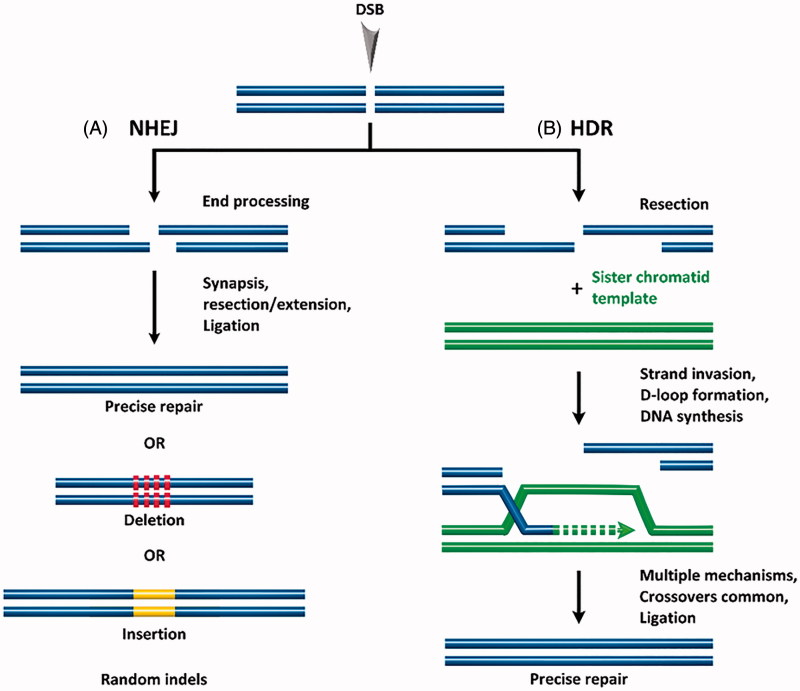
“In NHEJ, protein factors re-ligate the broken DNA strand either directly or by including nucleotide insertions or deletions (indels) (Hefferin & Tomkinson, 2005). This process occurs without a homologous DNA template, regularly leading to mutations and deletions in the repaired strand (Bibikova et al., 2002), as shown in Figure 1(A). NHEJ is, therefore, characterized as error-prone.”
§ Delivering CRISPR: a review of the challenges and approaches > Gene editing
What the sources say
- Not checked yetcites Hefferin & Tomkinson, 2005
- Not checked — no full text of the sourcecites Bibikova et al., 2002 source
plaindirect- Asserted: passes — The authors put it forward as true.
- Checkable: passes — It can be checked against evidence.
- Load-bearing: unclear — It is unclear whether the paper’s conclusions depend on it.
- Based: passes — The paper gives a reason why it holds.
It may state two separate claims as one.
None of the sources cited for this claim have been checked yet.
In the paper
“Discovery of the Clustered Regularly-Interspaced Short Palindromic Repeats (CRISPR) (Ishino et al., 1987; Mojica et al., 1993; van Soolingen et al., 1993), their function as part of an adaptive prokaryotic immune system (CRISPR-associated system, Cas) (Bolotin et al., 2005; Mojica et al., 2005; Pourcel et al., 2005; van der Oost et al., 2009), and subsequent development into a genomic editing tool”
§ Delivering CRISPR: a review of the challenges and approaches > Introduction
What the sources say
- Not checked yetcites Ishino et al., 1987
- Not checked yetcites Jinek et al., 2012
- Not checked yetcites Mali et al., 2013
plaindirect- Asserted: passes — The authors put it forward as true.
- Checkable: passes — It can be checked against evidence.
- Load-bearing: unclear — It is unclear whether the paper’s conclusions depend on it.
- Based: passes — The paper gives a reason why it holds.
It may state two separate claims as one.
The paper states this without a source or data behind it here, so there is nothing to check it against. The quote shows it is in the paper.
In the paper
“TALENs, however, are substantially larger than ZFNs, requiring 3 kb of cDNA encoding for one TALEN versus just 1 kb for a single ZFN. This makes delivery of a pair of TALENs more challenging than a pair of ZFNs due to delivery vehicle cargo size limitations.”
§ Delivering CRISPR: a review of the challenges and approaches > Site-specific nucleases > Transcription activator-like effector nucleases (TALENS)
plaindirect- Asserted: passes — The authors put it forward as true.
- Checkable: passes — It can be checked against evidence.
- Load-bearing: unclear — It is unclear whether the paper’s conclusions depend on it.
- Based: passes — The paper gives a reason why it holds.
It may state two separate claims as one.
The paper states this without a source or data behind it here, so there is nothing to check it against. The quote shows it is in the paper.
In the paper
“The use of CRISPR/Cas9 avoids the need for protein engineering to develop a site-specific nuclease against a specific DNA target sequence, requiring only the synthesis of a new piece of RNA. This dramatically simplifies and greatly reduces the time needed for gene editing design and implementation.”
§ Delivering CRISPR: a review of the challenges and approaches > Site-specific nucleases > CRISPR/Cas9
plaindirect- Asserted: passes — The authors put it forward as true.
- Checkable: passes — It can be checked against evidence.
- Load-bearing: unclear — It is unclear whether the paper’s conclusions depend on it.
- Based: passes — The paper gives a reason why it holds.
It may state two separate claims as one.
None of the sources cited for this claim have been checked yet.
In the paper
“Single mismatches, and sometimes multiple mismatches, can be tolerated by the Cas9:RNA complex, with mismatches being more tolerated in regions downstream of the seed region (Cong et al., 2013; Sternberg et al., 2014).”
§ Delivering CRISPR: a review of the challenges and approaches > Biological mechanism of CRISPR
What the sources say
- Not checked yetcites Cong et al., 2013
- Not checked yetcites Sternberg et al., 2014
plaincorrelational- Asserted: passes — The authors put it forward as true.
- Checkable: passes — It can be checked against evidence.
- Load-bearing: unclear — It is unclear whether the paper’s conclusions depend on it.
- Based: passes — The paper gives a reason why it holds.
It may state two separate claims as one.
None of the sources cited for this claim have been checked yet.
In the paper
“Unlike ZFNs, design and engineering of TALENs is much simpler and can be done in a shorter time (Cermak et al., 2011; Reyon et al., 2012). TALENs are also not as limited as ZFNs in target site selection due to the 1:1 TALE–DNA binding (Zhu et al., 2013).”
§ Delivering CRISPR: a review of the challenges and approaches > Site-specific nucleases > Transcription activator-like effector nucleases (TALENS)
What the sources say
- Not checked yetcites Cermak et al., 2011
- Not checked yetcites Reyon et al., 2012
- Not checked yetcites Zhu et al., 2013
plaindirect- Asserted: passes — The authors put it forward as true.
- Checkable: passes — It can be checked against evidence.
- Load-bearing: unclear — It is unclear whether the paper’s conclusions depend on it.
- Based: passes — The paper gives a reason why it holds.
It may state two separate claims as one.
In the paper
“To date, over 3000 genes have been associated with disease-causing mutations (Cox et al., 2015).”
§ Delivering CRISPR: a review of the challenges and approaches > Introduction
What the sources say
- Not checked yetcites Cox et al., 2015
plaincorrelational- Asserted: passes — The authors put it forward as true.
- Checkable: passes — It can be checked against evidence.
- Load-bearing: fails — The paper’s conclusions may not depend on it.
- Based: passes — The paper gives a reason why it holds.
Probably not a substantial claim. The paper’s conclusions may not depend on it.
None of the sources cited for this claim have been checked yet.
In the paper
“In all cases of leukemia, the SCID X-1 correcting gene had inserted into the patient genome within or near tumor-promoting genes and caused transcriptional activation (Check, 2002; Kaiser, 2003; Thomas et al., 2003).”
§ Delivering CRISPR: a review of the challenges and approaches > Introduction
What the sources say
- Not checked yetcites Check, 2002
- Not checked yetcites Kaiser, 2003
- Not checked yetcites Thomas et al., 2003
plaindirectn = 5- Asserted: passes — The authors put it forward as true.
- Checkable: passes — It can be checked against evidence.
- Load-bearing: unclear — It is unclear whether the paper’s conclusions depend on it.
- Based: passes — The paper gives a reason why it holds.
It may state two separate claims as one.
None of the sources cited for this claim have been checked yet.
In the paper
“In contrast, HDR uses a homologous repair template to precisely repair the DSB (Capecchi, 1989; Takata et al., 1998) (see Figure 1(B)). HDR typically occurs in late S- or G2-phase, when a sister chromatid can serve as the repair template.”
§ Delivering CRISPR: a review of the challenges and approaches > Gene editing
What the sources say
- Not checked yetcites Capecchi, 1989
- Not checked yetcites Takata et al., 1998
plaindirect- Asserted: passes — The authors put it forward as true.
- Checkable: passes — It can be checked against evidence.
- Load-bearing: unclear — It is unclear whether the paper’s conclusions depend on it.
- Based: passes — The paper gives a reason why it holds.
It may state two separate claims as one.
The paper states this without a source or data behind it here, so there is nothing to check it against. The quote shows it is in the paper.
In the paper
“Additionally, the simplicity and flexibility of the CRISPR/Cas9 site-specific nuclease system has led to its widespread use in many biological research areas including development of model cell lines, discovering mechanisms of disease, identifying disease targets, development of transgene animals and plants, and transcriptional modulation.”
§ Delivering CRISPR: a review of the challenges and approaches > Abstract
plaindirect- Asserted: passes — The authors put it forward as true.
- Checkable: passes — It can be checked against evidence.
- Load-bearing: fails — The paper’s conclusions may not depend on it.
- Based: fails — The paper may give no reason why it holds.
Probably not a substantial claim. The paper’s conclusions may not depend on it. The paper may give no reason why it holds.
None of the sources cited for this claim have been checked yet.
In the paper
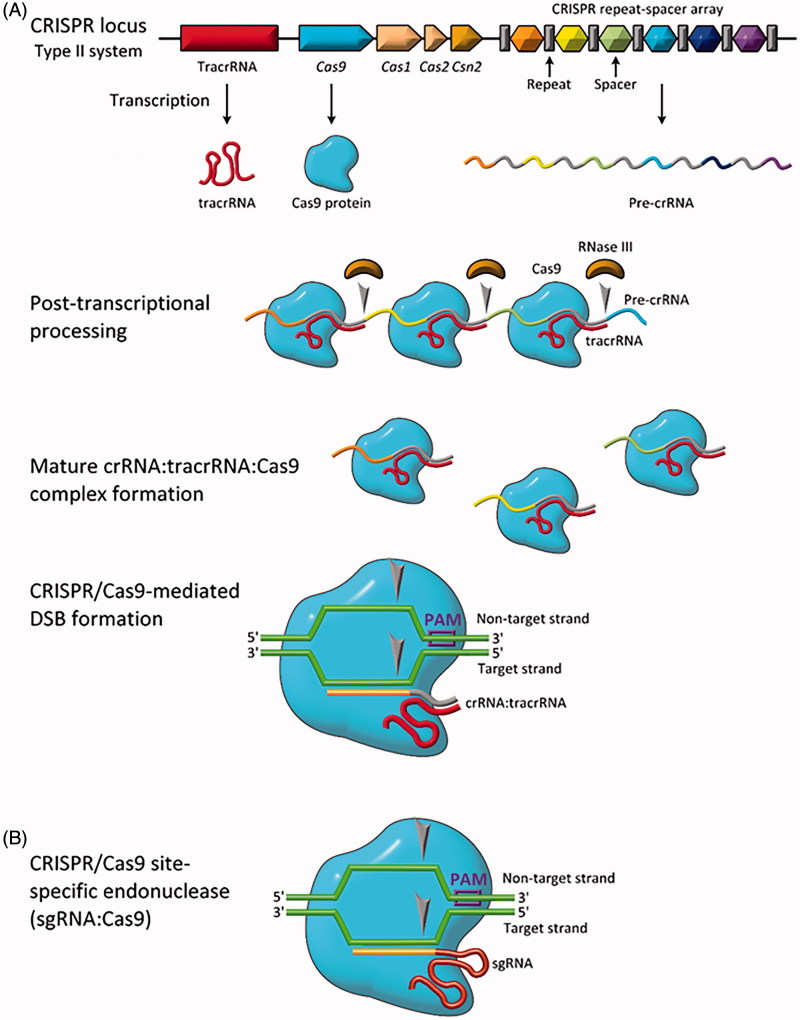
“The Cas9:RNA complex randomly interrogates DNA in the cell, searching first for the appropriate protospacer adjacent motif (PAM), a short motif (5′-NGG-3′ for Cas9 from Streptococcus pyogenes) adjacent to the target sequence (Chylinski et al., 2013).”
- Also stated in: § Biological mechanism of CRISPR · plain
“If the interrogated DNA sequence matches the crRNA target sequence, the HNH nuclease domain of the Cas9 nuclease lobe cleaves the target strand while the RuvC-like nuclease domain of the Cas9 α-helical lobe cleaves the non-target strand (Anders et al., 2014; Jinek et al., 2014; Nishimasu et al., 2015).”
§ Delivering CRISPR: a review of the challenges and approaches > Biological mechanism of CRISPR
What the sources say
- Not checked yetcites Chylinski et al., 2013
- Not checked yetcites Anders et al., 2014
- Not checked yetcites Jinek et al., 2014
plaindirect- Asserted: passes — The authors put it forward as true.
- Checkable: passes — It can be checked against evidence.
- Load-bearing: unclear — It is unclear whether the paper’s conclusions depend on it.
- Based: passes — The paper gives a reason why it holds.
It may state two separate claims as one.
- Also stated in: § Biological mechanism of CRISPR · plain
In the paper
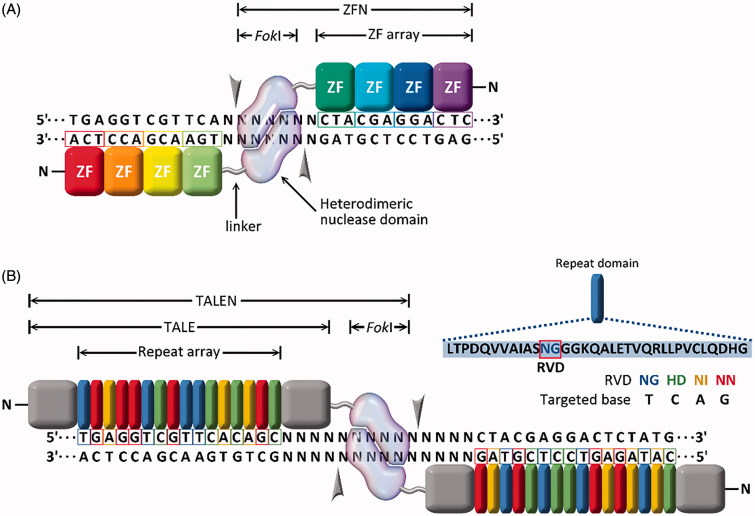
“ZFNs are a fusion protein of Cys2-His2 zinc finger proteins (ZFPs) and a non-specific DNA restriction enzyme derived from FokI endonucleases, as shown in Figure 3(A).”
§ Delivering CRISPR: a review of the challenges and approaches > Site-specific nucleases > Zinc finger nucleases (ZFNs)
What the sources say
- Not matchedcites Bibikova et al., 2002, 2003
Couldn’t be matched to a paper in Crossref, so it can’t be checked.
plain- Asserted: passes — The authors put it forward as true.
- Checkable: passes — It can be checked against evidence.
- Load-bearing: fails — The paper’s conclusions may not depend on it.
- Based: passes — The paper gives a reason why it holds.
Probably not a substantial claim. The paper’s conclusions may not depend on it.
- Not matched
In the paper
“While off-target cutting remains a concern, TALENs have been shown in one side-by-side comparison study to be more specific and less cytotoxic than ZFNs (Mussolino et al., 2014).”
§ Delivering CRISPR: a review of the challenges and approaches > Site-specific nucleases > Transcription activator-like effector nucleases (TALENS)
What the sources say
- Not checked yetcites Mussolino et al., 2014
boosteddirect- Asserted: passes — The authors put it forward as true.
- Checkable: passes — It can be checked against evidence.
- Load-bearing: unclear — It is unclear whether the paper’s conclusions depend on it.
- Based: passes — The paper gives a reason why it holds.
It may state two separate claims as one.
None of the sources cited for this claim have been checked yet.
In the paper
“Challenges with ZFNs include design and engineering of the ZFP for high-affinity binding of the desired sequence, which can prove non-trivial (Ramirez et al., 2008). Also, not all sequences are available for ZFP binding, so site selection is limited. Using open-source ZFP domains, sites could be targeted only every 200-bps in a random DNA sequence (Gupta & Musunuru, 2014).”
- Also stated in: § Zinc finger nucleases (ZFNs) · plain
“Another significant challenge is off-target cutting (Gabriel et al., 2011; Pattanayak et al., 2011).”
§ Delivering CRISPR: a review of the challenges and approaches > Site-specific nucleases > Zinc finger nucleases (ZFNs)
What the sources say
- Not checked yetcites Ramirez et al., 2008
- Not checked yetcites Gupta & Musunuru, 2014
- Not checked yetcites Gabriel et al., 2011
plain- Asserted: passes — The authors put it forward as true.
- Checkable: passes — It can be checked against evidence.
- Load-bearing: unclear — It is unclear whether the paper’s conclusions depend on it.
- Based: passes — The paper gives a reason why it holds.
It may state two separate claims as one.
- Also stated in: § Zinc finger nucleases (ZFNs) · plain
The paper states this without a source or data behind it here, so there is nothing to check it against. The quote shows it is in the paper.
In the paper
“The most recently developed site-specific gene editing tool, CRISPR/Cas9, is a naturally occurring RNA-guided endonuclease.”
§ Delivering CRISPR: a review of the challenges and approaches > Site-specific nucleases > CRISPR/Cas9
plain- Asserted: passes — The authors put it forward as true.
- Checkable: passes — It can be checked against evidence.
- Load-bearing: fails — The paper’s conclusions may not depend on it.
- Based: fails — The paper may give no reason why it holds.
Probably not a substantial claim. The paper’s conclusions may not depend on it. The paper may give no reason why it holds.
The paper states this without a source or data behind it here, so there is nothing to check it against. The quote shows it is in the paper.
In the paper
“Vehicles used to deliver the gene editing system cargo (Table 1) can be classified into three general groups: physical delivery, viral vectors, and non-viral vectors.”
§ Delivering CRISPR: a review of the challenges and approaches > CRISPR delivery systems
plain- Asserted: passes — The authors put it forward as true.
- Checkable: passes — It can be checked against evidence.
- Load-bearing: fails — The paper’s conclusions may not depend on it.
- Based: passes — The paper gives a reason why it holds.
Probably not a substantial claim. The paper’s conclusions may not depend on it.
None of the sources cited for this claim have been checked yet.
In the paper
“While these approaches increase specificity and reduce off-target cutting, the number of potential target sites is lower due to PAM and other sgRNA design constraints. This system also significantly increased the size of the gene editing tool, providing greater constraints on in vivo delivery approaches.”
§ Delivering CRISPR: a review of the challenges and approaches > Factors affecting efficacy of the CRISPR/Cas9 system > Off-target cutting
What the sources say
- Not checked yetcites Guilinger et al., 2014
- Not checked yetcites Tsai et al., 2014
plaindirect- Asserted: passes — The authors put it forward as true.
- Checkable: passes — It can be checked against evidence.
- Load-bearing: unclear — It is unclear whether the paper’s conclusions depend on it.
- Based: passes — The paper gives a reason why it holds.
It may state two separate claims as one.
The paper states this without a source or data behind it here, so there is nothing to check it against. The quote shows it is in the paper.
In the paper
“Especially for in vivo work, viral vectors have found favor and are the most common CRISPR/Cas9 delivery vectors.”
§ Delivering CRISPR: a review of the challenges and approaches > CRISPR delivery systems
plain- Asserted: passes — The authors put it forward as true.
- Checkable: passes — It can be checked against evidence.
- Load-bearing: fails — The paper’s conclusions may not depend on it.
- Based: fails — The paper may give no reason why it holds.
Probably not a substantial claim. The paper’s conclusions may not depend on it. The paper may give no reason why it holds.
In the paper
“Strutt and colleagues demonstrated that Cas9 subtypes II-A and II-C can recognize and cleave RNA in a directed manner utilizing RNA–RNA interactions independent of the presence of a PAM site in the target RNA molecule (Strutt et al., 2018). This cleavage protected E. coli cells from infection with bacteriophage MS2 particles, suggesting that Cas9 can provide cellular defense against both DNA and R”
§ Delivering CRISPR: a review of the challenges and approaches > CRISPR: beyond gene editing
What the sources say
- Not checked yetcites Strutt et al., 2018
boosteddirect- Asserted: passes — The authors put it forward as true.
- Checkable: passes — It can be checked against evidence.
- Load-bearing: passes — The paper’s conclusions depend on it.
- Based: passes — The paper gives a reason why it holds.
It may state two separate claims as one.
In the paper
“Finally, in comparison with other enzymes, the activity of Cas9 is quite low, with a single turnover rate of ∼0.3–1.0 min−1(Jinek et al., 2012).”
§ Delivering CRISPR: a review of the challenges and approaches > Factors affecting efficacy of the CRISPR/Cas9 system > Cas9 activity
What the sources say
- Not checked yetcites Jinek et al., 2012
plain- Asserted: passes — The authors put it forward as true.
- Checkable: passes — It can be checked against evidence.
- Load-bearing: passes — The paper’s conclusions depend on it.
- Based: passes — The paper gives a reason why it holds.
It may state two separate claims as one.
A conclusion the paper draws from its own results — it cites no other source for it, so there is none to check. The quote shows it is in the paper.
In the paper
“The delivery vehicle used will often dictate which of these three cargos can be packaged, and whether the system is usable in vitro and/or in vivo.”
§ Delivering CRISPR: a review of the challenges and approaches > CRISPR delivery systems
hedgedconditional- Asserted: passes — The authors put it forward as true.
- Checkable: passes — It can be checked against evidence.
- Load-bearing: passes — The paper’s conclusions depend on it.
- Based: passes — The paper gives a reason why it holds.
It may state two separate claims as one.
In the paper
“However, caution is still needed, as shown in a recent study by Haeussler et al. (2016) that compared predictions from several sgRNA design tools with experimental results published in eight SpCas9 off-target studies. The authors showed evidence of algorithmic overfitting and the importance of using a model trained on data from the same guide RNA expression system.”
§ Delivering CRISPR: a review of the challenges and approaches > Factors affecting efficacy of the CRISPR/Cas9 system > Target DNA site selection and sgRNA design
What the sources say
- Not checked yetcites Haeussler et al., 2016
plaincorrelational- Asserted: passes — The authors put it forward as true.
- Checkable: passes — It can be checked against evidence.
- Load-bearing: passes — The paper’s conclusions depend on it.
- Based: passes — The paper gives a reason why it holds.
It may state two separate claims as one.
In the paper
“And, once bound to the target DNA sequence, displacement of Cas9 from the DNA strand, even after DSB formation, is challenging – 1 nM Cas9 cleaved ∼2.5 nM plasmid DNA after 120 min (Jinek et al., 2012).”
§ Delivering CRISPR: a review of the challenges and approaches > Factors affecting efficacy of the CRISPR/Cas9 system > Cas9 activity
What the sources say
- Not checked yetcites Jinek et al., 2012
plaindirect- Asserted: passes — The authors put it forward as true.
- Checkable: passes — It can be checked against evidence.
- Load-bearing: passes — The paper’s conclusions depend on it.
- Based: passes — The paper gives a reason why it holds.
It may state two separate claims as one.
None of the sources cited for this claim have been checked yet.
In the paper
“Microinjection is considered the ‘gold standard’ for introducing CRISPR components into cells, with efficiencies approaching 100% (Yang et al., 2013; Horii et al., 2014).”
§ Delivering CRISPR: a review of the challenges and approaches > Physical delivery methods > Microinjection
What the sources say
- Not checked yetcites Yang et al., 2013
- Not checked yetcites Horii et al., 2014
plaindirect- Asserted: passes — The authors put it forward as true.
- Checkable: passes — It can be checked against evidence.
- Load-bearing: unclear — It is unclear whether the paper’s conclusions depend on it.
- Based: passes — The paper gives a reason why it holds.
It may state two separate claims as one.
None of the sources cited for this claim have been checked yet.
In the paper
“One of the most commonly used inhibitors, Scr7, targets the NHEJ component DNA ligase IV, and has been reported to increase efficiency of HDR from Cas9 editing by up to 19-fold (Srivastava et al., 2012; Chu et al., 2015; Vartak & Raghavan, 2015).”
§ Delivering CRISPR: a review of the challenges and approaches > Factors affecting efficacy of the CRISPR/Cas9 system > Incidence/efficiency of HDR
What the sources say
- Not checked yetcites Srivastava et al., 2012
- Not checked yetcites Chu et al., 2015
- Not checked yetcites Vartak & Raghavan, 2015
plaindirect- Asserted: passes — The authors put it forward as true.
- Checkable: passes — It can be checked against evidence.
- Load-bearing: unclear — It is unclear whether the paper’s conclusions depend on it.
- Based: passes — The paper gives a reason why it holds.
It may state two separate claims as one.
In the paper
“One report suggests that CRISPR/Cas9 may be less specific than ZFNs or TALENs due to the relatively shorter targeting sequence (Cradick et al., 2013).”
§ Delivering CRISPR: a review of the challenges and approaches > Factors affecting efficacy of the CRISPR/Cas9 system > Target DNA site selection and sgRNA design
What the sources say
- Not checked yetcites Cradick et al., 2013
hedgedconditional- Asserted: passes — The authors put it forward as true.
- Checkable: passes — It can be checked against evidence.
- Load-bearing: fails — The paper’s conclusions may not depend on it.
- Based: passes — The paper gives a reason why it holds.
Probably not a substantial claim. The paper’s conclusions may not depend on it.
In the paper
“In 2012, Doudna and Charpentier showed the first use of CRISPR/Cas9 to introduce DSBs in target DNA (Jinek et al., 2012). Further, they showed that the duo-tracrRNA:crRNA units could be engineered into a single, truncated RNA chimera and still direct efficient DNA cleavage.”
§ Delivering CRISPR: a review of the challenges and approaches > Type II CRISPR/Cas9 for gene editing
What the sources say
- Not checked yetcites Jinek et al., 2012
plaindirect- Asserted: passes — The authors put it forward as true.
- Checkable: passes — It can be checked against evidence.
- Load-bearing: unclear — It is unclear whether the paper’s conclusions depend on it.
- Based: passes — The paper gives a reason why it holds.
It may state two separate claims as one.
In the paper
“This motif has been reported to occur every eight bps, on an average, for the SpCas9 PAM (Ramakrishna et al., 2014).”
§ Delivering CRISPR: a review of the challenges and approaches > Factors affecting efficacy of the CRISPR/Cas9 system > Target DNA site selection and sgRNA design
What the sources say
- Not checked yetcites Ramakrishna et al., 2014
plain- Asserted: passes — The authors put it forward as true.
- Checkable: passes — It can be checked against evidence.
- Load-bearing: fails — The paper’s conclusions may not depend on it.
- Based: passes — The paper gives a reason why it holds.
Probably not a substantial claim. The paper’s conclusions may not depend on it.
In the paper
“As an example, Cas9 protein is positively-charged, but oligonucleotides and Cas9:sgRNA RNP are negatively charged (Sun et al., 2015).”
§ Delivering CRISPR: a review of the challenges and approaches > CRISPR delivery systems
What the sources say
- Not checked yetcites Sun et al., 2015
plain- Asserted: passes — The authors put it forward as true.
- Checkable: passes — It can be checked against evidence.
- Load-bearing: unclear — It is unclear whether the paper’s conclusions depend on it.
- Based: passes — The paper gives a reason why it holds.
It may state two separate claims as one.
In the paper
“For example, Cas9-based gene editing in mice resulted in HDR repair efficiencies of 0.5–20%, while NHEJ-mediated repair occurred at 20–60% (Maruyama et al., 2015).”
§ Delivering CRISPR: a review of the challenges and approaches > Factors affecting efficacy of the CRISPR/Cas9 system > Incidence/efficiency of HDR
What the sources say
- Not checked yetcites Maruyama et al., 2015
plaindirect- Asserted: passes — The authors put it forward as true.
- Checkable: passes — It can be checked against evidence.
- Load-bearing: passes — The paper’s conclusions depend on it.
- Based: passes — The paper gives a reason why it holds.
It may state two separate claims as one.
None of the sources cited for this claim have been checked yet.
In the paper
“This contrasts with many reports that show no detectable off-target cleavage from CRISPR/Cas9 editing, with off-target effects being guide-RNA-specific (Cradick et al., 2013; Fu et al., 2013; Hsu et al., 2013; Pattanayak et al., 2013;Cho et al., 2014).”
§ Delivering CRISPR: a review of the challenges and approaches > Factors affecting efficacy of the CRISPR/Cas9 system > Target DNA site selection and sgRNA design
What the sources say
- Not checked yetcites Cradick et al., 2013
- Not checked yetcites Fu et al., 2013
- Not checked yetcites Hsu et al., 2013
plain- Asserted: passes — The authors put it forward as true.
- Checkable: passes — It can be checked against evidence.
- Load-bearing: unclear — It is unclear whether the paper’s conclusions depend on it.
- Based: passes — The paper gives a reason why it holds.
It may state two separate claims as one.
The paper states this without a source or data behind it here, so there is nothing to check it against. The quote shows it is in the paper.
In the paper
“Each has differing PAM sequences and variable activity.”
§ Delivering CRISPR: a review of the challenges and approaches > Factors affecting efficacy of the CRISPR/Cas9 system > Cas9 activity
plaincorrelational- Asserted: passes — The authors put it forward as true.
- Checkable: passes — It can be checked against evidence.
- Load-bearing: passes — The paper’s conclusions depend on it.
- Based: passes — The paper gives a reason why it holds.
It may state two separate claims as one.
The paper states this without a source or data behind it here, so there is nothing to check it against. The quote shows it is in the paper.
In the paper
“These factors include target DNA site selection, sgRNA design, off-target cutting, incidence/efficiency of HDR vs. NHEJ, Cas9 activity, and the method of delivery.”
§ Delivering CRISPR: a review of the challenges and approaches > Factors affecting efficacy of the CRISPR/Cas9 system
plaincorrelational- Asserted: passes — The authors put it forward as true.
- Checkable: passes — It can be checked against evidence.
- Load-bearing: passes — The paper’s conclusions depend on it.
- Based: passes — The paper gives a reason why it holds.
Probably not a substantial claim. It may state two separate claims as one.
In the paper
“They showed that this system, termed CRISPR interference (CRISPRi), could repress expression of multiple genes simultaneously without altering the genome. They demonstrated this gene repression in both Escherichia coli and human cells.”
§ Delivering CRISPR: a review of the challenges and approaches > CRISPR: beyond gene editing
What the sources say
- Not checked yetcites Qi et al., 2013
boosteddirect- Asserted: passes — The authors put it forward as true.
- Checkable: passes — It can be checked against evidence.
- Load-bearing: unclear — It is unclear whether the paper’s conclusions depend on it.
- Based: passes — The paper gives a reason why it holds.
It may state two separate claims as one.
None of the sources cited for this claim have been checked yet.
In the paper
“As an example, the PAM from Neisseria meningitidis Cas9 is reported to be 5′-NNNNGATT-3′ (Jiang et al., 2013; Ma et al., 2014).”
§ Delivering CRISPR: a review of the challenges and approaches > Factors affecting efficacy of the CRISPR/Cas9 system > Target DNA site selection and sgRNA design
What the sources say
- Not checked yetcites Jiang et al., 2013
- Not checked yetcites Ma et al., 2014
plain- Asserted: passes — The authors put it forward as true.
- Checkable: passes — It can be checked against evidence.
- Load-bearing: fails — The paper’s conclusions may not depend on it.
- Based: passes — The paper gives a reason why it holds.
Probably not a substantial claim. The paper’s conclusions may not depend on it.
In the paper
“While Wang et al. (2016) could achieve ∼70% in vitro modification efficiency in cells (see Figure 7(A)), that only came after an intense screen to determine the most optimal lipids with which to construct their liposomes for their system.”
§ Delivering CRISPR: a review of the challenges and approaches > Non-viral vector delivery vehicles > Lipid nanoparticles/liposomes
What the sources say
- Not checked yetcites Wang et al., 2016
hedgeddirect- Asserted: passes — The authors put it forward as true.
- Checkable: passes — It can be checked against evidence.
- Load-bearing: unclear — It is unclear whether the paper’s conclusions depend on it.
- Based: passes — The paper gives a reason why it holds.
It may state two separate claims as one.
None of the sources cited for this claim have been checked yet.
In the paper
“This can result in an increase of expression and off-target effects, or even potential damage to the cell if the insertion randomly occurs within an important cellular protein (Bestor, 2000; Papapetrou and Schambach, 2016).”
§ Delivering CRISPR: a review of the challenges and approaches > Viral vector delivery methods > Lentivirus (LV) and adenovirus (AdV)
What the sources say
- Not checked yetcites Bestor, 2000
- Not checked yetcites Papapetrou and Schambach, 2016
plainconditional- Asserted: passes — The authors put it forward as true.
- Checkable: passes — It can be checked against evidence.
- Load-bearing: passes — The paper’s conclusions depend on it.
- Based: passes — The paper gives a reason why it holds.
It may state two separate claims as one.
In the paper
“This version of Cas9 is roughly 70% the size of SpCas9 while retaining the same potent cutting ability.”
§ Delivering CRISPR: a review of the challenges and approaches > Viral vector delivery methods > Adeno-associated virus (AAV)
What the sources say
- Not checked yetcites Ran et al., 2015
plain- Asserted: passes — The authors put it forward as true.
- Checkable: passes — It can be checked against evidence.
- Load-bearing: passes — The paper’s conclusions depend on it.
- Based: passes — The paper gives a reason why it holds.
It may state two separate claims as one.
In the paper
“Importantly, in addition to displaying AdV vector-associated immunotoxicity in the liver, humoral immunity against SpCas9 was detected, as was a potential SpCas9-specific cellular immune response.”
§ Delivering CRISPR: a review of the challenges and approaches > Viral vector delivery methods > Lentivirus (LV) and adenovirus (AdV)
What the sources say
- Not checked yetcites Wang et al., 2015
hedgedcorrelational- Asserted: passes — The authors put it forward as true.
- Checkable: passes — It can be checked against evidence.
- Load-bearing: passes — The paper’s conclusions depend on it.
- Based: passes — The paper gives a reason why it holds.
It may state two separate claims as one.
In the paper
“Immune responses are eventually seen to the capsid, sometimes even causing CD-8 T-cell toxicity (Samulski and Muzyczka, 2014).”
§ Delivering CRISPR: a review of the challenges and approaches > Viral vector delivery methods > Adeno-associated virus (AAV)
What the sources say
- Not checked yetcites Samulski and Muzyczka, 2014
plaindirect- Asserted: passes — The authors put it forward as true.
- Checkable: passes — It can be checked against evidence.
- Load-bearing: unclear — It is unclear whether the paper’s conclusions depend on it.
- Based: passes — The paper gives a reason why it holds.
It may state two separate claims as one.
The paper states this without a source or data behind it here, so there is nothing to check it against. The quote shows it is in the paper.
In the paper
“The biggest difference between LV/AdV delivery and AAV delivery is the size of the particle; both LVs and AdVs are roughly 80–100 nm in diameter. Compared with the ∼20 nm diameter of AAV, larger insertions are better tolerated in these systems.”
§ Delivering CRISPR: a review of the challenges and approaches > Viral vector delivery methods > Lentivirus (LV) and adenovirus (AdV)
plaindirect- Asserted: passes — The authors put it forward as true.
- Checkable: passes — It can be checked against evidence.
- Load-bearing: passes — The paper’s conclusions depend on it.
- Based: passes — The paper gives a reason why it holds.
It may state two separate claims as one.
The paper states this without a source or data behind it here, so there is nothing to check it against. The quote shows it is in the paper.
In the paper
“Both LV and AdV can infect dividing and non-dividing cells; however, unlike LV, AdV does not integrate into the genome.”
§ Delivering CRISPR: a review of the challenges and approaches > Viral vector delivery methods > Lentivirus (LV) and adenovirus (AdV)
plain- Asserted: passes — The authors put it forward as true.
- Checkable: passes — It can be checked against evidence.
- Load-bearing: unclear — It is unclear whether the paper’s conclusions depend on it.
- Based: passes — The paper gives a reason why it holds.
It may state two separate claims as one.
The paper states this without a source or data behind it here, so there is nothing to check it against. The quote shows it is in the paper.
In the paper
“Further, microinjection is not limited by the molecular weight of the cargo, which is a significant limiting factor with viral vector delivery systems.”
§ Delivering CRISPR: a review of the challenges and approaches > Physical delivery methods > Microinjection
plain- Asserted: passes — The authors put it forward as true.
- Checkable: passes — It can be checked against evidence.
- Load-bearing: unclear — It is unclear whether the paper’s conclusions depend on it.
- Based: passes — The paper gives a reason why it holds.
It may state two separate claims as one.
A conclusion the paper draws from its own results — it cites no other source for it, so there is none to check. The quote shows it is in the paper.
In the paper
“This is advantageous in the case of CRISPR/Cas9-based editing for limiting off-target effects.”
§ Delivering CRISPR: a review of the challenges and approaches > Viral vector delivery methods > Lentivirus (LV) and adenovirus (AdV)
plaindirect- Asserted: passes — The authors put it forward as true.
- Checkable: passes — It can be checked against evidence.
- Load-bearing: passes — The paper’s conclusions depend on it.
- Based: passes — The paper gives a reason why it holds.
It may state two separate claims as one.
A conclusion the paper draws from its own results — it cites no other source for it, so there is none to check. The quote shows it is in the paper.
In the paper
“This makes consistent packaging of this construct challenging, and it is also extremely difficult to include other elements (such as reporters, fluorescent tags, multiple sgRNAs, or DNA templates for HDR) to help ensure successful delivery of CRISPR/Cas9 components to cells and meet desired gene editing objectives.”
§ Delivering CRISPR: a review of the challenges and approaches > Viral vector delivery methods > Adeno-associated virus (AAV)
plaindirect- Asserted: passes — The authors put it forward as true.
- Checkable: passes — It can be checked against evidence.
- Load-bearing: passes — The paper’s conclusions depend on it.
- Based: passes — The paper gives a reason why it holds.
It may state two separate claims as one.
The paper states this without a source or data behind it here, so there is nothing to check it against. The quote shows it is in the paper.
In the paper
“They can also, like viral particles, be utilized in vitro, ex vivo, and in vivo, allowing for extensive testing on a variety of scales of cell populations.”
§ Delivering CRISPR: a review of the challenges and approaches > Non-viral vector delivery vehicles > Lipid nanoparticles/liposomes
plain- Asserted: passes — The authors put it forward as true.
- Checkable: passes — It can be checked against evidence.
- Load-bearing: fails — The paper’s conclusions may not depend on it.
- Based: passes — The paper gives a reason why it holds.
Probably not a substantial claim. The paper’s conclusions may not depend on it.
The paper states this without a source or data behind it here, so there is nothing to check it against. The quote shows it is in the paper.
In the paper
“Electroporation is less dependent on cell type than other delivery techniques and can efficiently transfer cargo into cells that are traditionally difficult to manipulate.”
§ Delivering CRISPR: a review of the challenges and approaches > Physical delivery methods > Electroporation
plaindirect- Asserted: passes — The authors put it forward as true.
- Checkable: passes — It can be checked against evidence.
- Load-bearing: fails — The paper’s conclusions may not depend on it.
- Based: fails — The paper may give no reason why it holds.
Probably not a substantial claim. The paper’s conclusions may not depend on it. The paper may give no reason why it holds. It may state two separate claims as one.
In the paper
“However, single-stranded DNA is prone to random integration into the host genome, which may disrupt genes, result in constitutive expression of Cas9, and lead to greater off-target effects.”
§ Delivering CRISPR: a review of the challenges and approaches > Physical delivery methods > Microinjection
What the sources say
- Not checked yetcites Yang et al., 2013
hedgedconditional- Asserted: passes — The authors put it forward as true.
- Checkable: passes — It can be checked against evidence.
- Load-bearing: passes — The paper’s conclusions depend on it.
- Based: passes — The paper gives a reason why it holds.
It may state two separate claims as one.
The paper states this without a source or data behind it here, so there is nothing to check it against. The quote shows it is in the paper.
In the paper
“Delivery of cargo using this method is significantly enriched in the liver, but also includes cells of the kidneys, lung, muscles, and heart.”
§ Delivering CRISPR: a review of the challenges and approaches > Physical delivery methods > Hydrodynamic delivery
plaindirect- Asserted: passes — The authors put it forward as true.
- Checkable: passes — It can be checked against evidence.
- Load-bearing: unclear — It is unclear whether the paper’s conclusions depend on it.
- Based: passes — The paper gives a reason why it holds.
It may state two separate claims as one.
A conclusion the paper draws from its own results — it cites no other source for it, so there is none to check. The quote shows it is in the paper.
In the paper
“Lipid nanoparticles do not contain any viral components, which helps minimize safety and immunogenicity concerns.”
§ Delivering CRISPR: a review of the challenges and approaches > Non-viral vector delivery vehicles > Lipid nanoparticles/liposomes
plainconditional- Asserted: passes — The authors put it forward as true.
- Checkable: passes — It can be checked against evidence.
- Load-bearing: unclear — It is unclear whether the paper’s conclusions depend on it.
- Based: passes — The paper gives a reason why it holds.
It may state two separate claims as one.
In the paper
“The use of RNP was shown to reduce off-target effects versus plasmid transfection and be less stressful on the cells, producing two-fold more embryonic stem cell colonies than with plasmid transfection (Kim et al., 2014).”
§ Delivering CRISPR: a review of the challenges and approaches > Physical delivery methods > Electroporation
What the sources say
- Not checked yetcites Kim et al., 2014
plaindirect- Asserted: passes — The authors put it forward as true.
- Checkable: passes — It can be checked against evidence.
- Load-bearing: unclear — It is unclear whether the paper’s conclusions depend on it.
- Based: passes — The paper gives a reason why it holds.
It may state two separate claims as one.
In the paper
“Finally, unlike some other methods, the use of AAV for gene therapy provides a persistent source of the provided DNA, as AAV-delivered genomic material can exist indefinitely in cells either as exogenous DNA or, with some modification, be directly integrated into the host DNA (Deyle and Russell, 2009).”
§ Delivering CRISPR: a review of the challenges and approaches > Viral vector delivery methods > Adeno-associated virus (AAV)
What the sources say
- Not checked yetcites Deyle and Russell, 2009
plaindirect- Asserted: passes — The authors put it forward as true.
- Checkable: passes — It can be checked against evidence.
- Load-bearing: unclear — It is unclear whether the paper’s conclusions depend on it.
- Based: passes — The paper gives a reason why it holds.
It may state two separate claims as one.
In the paper
“Koike-Yusa et al. (2014) delivered 87,897 sgRNAs targeting 19,150 protein coding genes in mouse embryonic stem cells, both again constitutively expressing Cas9.”
§ Delivering CRISPR: a review of the challenges and approaches > Viral vector delivery methods > Lentivirus (LV) and adenovirus (AdV)
What the sources say
- Not checked yetcites Koike-Yusa et al., 2014
plain- Asserted: passes — The authors put it forward as true.
- Checkable: passes — It can be checked against evidence.
- Load-bearing: unclear — It is unclear whether the paper’s conclusions depend on it.
- Based: passes — The paper gives a reason why it holds.
It may state two separate claims as one.
In the paper
“The virus itself is able to efficiently infect cells while provoking little to no innate or adaptive immune response or associated toxicity, at least upon first treatment with a serotype (Daya and Berns, 2008).”
§ Delivering CRISPR: a review of the challenges and approaches > Viral vector delivery methods > Adeno-associated virus (AAV)
What the sources say
- Not checked yetcites Daya and Berns, 2008
plain- Asserted: passes — The authors put it forward as true.
- Checkable: passes — It can be checked against evidence.
- Load-bearing: unclear — It is unclear whether the paper’s conclusions depend on it.
- Based: passes — The paper gives a reason why it holds.
It may state two separate claims as one.
The paper states this without a source or data behind it here, so there is nothing to check it against. The quote shows it is in the paper.
In the paper
“PLL has been used to complex with Cas9 plasmid DNA, forming a multifunctional envelope-type nanodevice (MEND), described in the Emerging Delivery Technologies section of this review.”
§ Delivering CRISPR: a review of the challenges and approaches > Non-viral vector delivery vehicles > Lipoplexes/polyplexes
plaindirect- Asserted: passes — The authors put it forward as true.
- Checkable: passes — It can be checked against evidence.
- Load-bearing: fails — The paper’s conclusions may not depend on it.
- Based: passes — The paper gives a reason why it holds.
Probably not a substantial claim. The paper’s conclusions may not depend on it.
A conclusion the paper draws from its own results — it cites no other source for it, so there is none to check. The quote shows it is in the paper.
In the paper
“This allowed the nanoclew to attain efficiencies on the order of other high-efficiency CRISPR/Cas9 delivery systems, but still contain no viral components (or indeed, any exogenous material besides repeating DNA and PEI).”
§ Delivering CRISPR: a review of the challenges and approaches > Non-viral vector delivery vehicles > DNA nanoclew
plain- Asserted: passes — The authors put it forward as true.
- Checkable: passes — It can be checked against evidence.
- Load-bearing: passes — The paper’s conclusions depend on it.
- Based: passes — The paper gives a reason why it holds.
It may state two separate claims as one.
In the paper
“Axford et al. (2017) in which the authors demonstrated cellular and sub-cellular localization of CPP-delivered CRISPR/Cas9 RNP using confocal microscopy.”
§ Delivering CRISPR: a review of the challenges and approaches > Non-viral vector delivery vehicles > Cell-penetrating peptides (CPPs)
What the sources say
- Not checked — no full text of the sourcecites Axford et al., 2017 source
boosted- Asserted: passes — The authors put it forward as true.
- Checkable: passes — It can be checked against evidence.
- Load-bearing: fails — The paper’s conclusions may not depend on it.
- Based: passes — The paper gives a reason why it holds.
Probably not a substantial claim. The paper’s conclusions may not depend on it.
In the paper
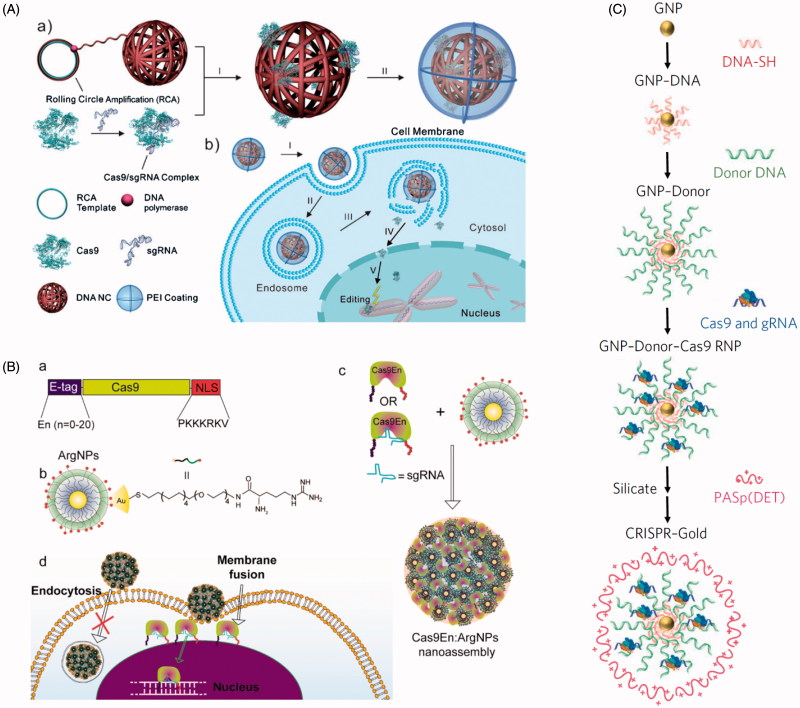
“Mout et al. (2017) demonstrated that, by engineering Cas9:sgRNA RNP and AuNPs to associate with one another (Figure 8(B)), a complex is created that can be efficiently delivered to cells and cause a desired mutation at a rate of roughly 30%.”
§ Delivering CRISPR: a review of the challenges and approaches > Non-viral vector delivery vehicles > Gold nanoparticles (AuNPs)
What the sources say
- Not checked yetcites Mout et al., 2017
boosteddirect- Asserted: passes — The authors put it forward as true.
- Checkable: passes — It can be checked against evidence.
- Load-bearing: unclear — It is unclear whether the paper’s conclusions depend on it.
- Based: passes — The paper gives a reason why it holds.
It may state two separate claims as one.
In the paper
“SLO is a toxin produced by Group A streptococci that works by creating pores in mammalian cell membranes (Sierig et al., 2003).”
§ Delivering CRISPR: a review of the challenges and approaches > Emerging delivery technologies > SLO
What the sources say
- Not checked yetcites Sierig et al., 2003
plaindirect- Asserted: passes — The authors put it forward as true.
- Checkable: passes — It can be checked against evidence.
- Load-bearing: passes — The paper’s conclusions depend on it.
- Based: passes — The paper gives a reason why it holds.
It may state two separate claims as one.
In the paper
“AuNPs are inert and will not trigger an immune response to the nanoparticle itself (Lee et al., 2017).”
§ Delivering CRISPR: a review of the challenges and approaches > Non-viral vector delivery vehicles > Gold nanoparticles (AuNPs)
What the sources say
- Not checked yetcites Lee et al., 2017
plain- Asserted: passes — The authors put it forward as true.
- Checkable: passes — It can be checked against evidence.
- Load-bearing: passes — The paper’s conclusions depend on it.
- Based: passes — The paper gives a reason why it holds.
It may state two separate claims as one.
In the paper
“ZALs were complexed with Cas9 mRNA and sgRNA, forming nanoparticles with ∼15 nm diameter which showed effective transfection in mice, accumulating primarily in the liver, kidney, and lungs.”
§ Delivering CRISPR: a review of the challenges and approaches > Non-viral vector delivery vehicles > Lipoplexes/polyplexes
What the sources say
- Not checked yetcites Miller et al., 2017
plaindirect- Asserted: passes — The authors put it forward as true.
- Checkable: passes — It can be checked against evidence.
- Load-bearing: unclear — It is unclear whether the paper’s conclusions depend on it.
- Based: passes — The paper gives a reason why it holds.
It may state two separate claims as one.
The paper states this without a source or data behind it here, so there is nothing to check it against. The quote shows it is in the paper.
In the paper
“As another newer delivery technique, applications of iTOP have been limited to in vitro settings at this time.”
§ Delivering CRISPR: a review of the challenges and approaches > Non-viral vector delivery vehicles > iTOP
plain- Asserted: passes — The authors put it forward as true.
- Checkable: passes — It can be checked against evidence.
- Load-bearing: fails — The paper’s conclusions may not depend on it.
- Based: passes — The paper gives a reason why it holds.
Probably not a substantial claim. The paper’s conclusions may not depend on it.
In the paper
“Kennedy et al. used FuGENE-6 to deliver Cas9 and sgRNA encoding plasmid DNA, inactivating human papillomavirus E6 or E7 gene in cervical carcinoma cells, resulting in cell-cycle arrest and eventual cell death (Kennedy et al., 2014).”
§ Delivering CRISPR: a review of the challenges and approaches > Non-viral vector delivery vehicles > Lipoplexes/polyplexes
What the sources say
- Not checked yetcites Kennedy et al., 2014
plaindirect- Asserted: passes — The authors put it forward as true.
- Checkable: passes — It can be checked against evidence.
- Load-bearing: unclear — It is unclear whether the paper’s conclusions depend on it.
- Based: passes — The paper gives a reason why it holds.
It may state two separate claims as one.
In the paper
“The CRISPR construct targeted the provirus genome, blocking expression of viral components and removing internal viral genes from the host cell chromosome.”
§ Delivering CRISPR: a review of the challenges and approaches > Non-viral vector delivery vehicles > Lipoplexes/polyplexes
What the sources say
- Not checked yetcites Ebina et al., 2013
plaindirect- Asserted: passes — The authors put it forward as true.
- Checkable: passes — It can be checked against evidence.
- Load-bearing: unclear — It is unclear whether the paper’s conclusions depend on it.
- Based: passes — The paper gives a reason why it holds.
It may state two separate claims as one.
In the paper
“Still, AuNPs have been shown to stimulate immune cytokine production in general (for a recent review, see Dykman and Khlebtsov, 2017).”
§ Delivering CRISPR: a review of the challenges and approaches > Non-viral vector delivery vehicles > Gold nanoparticles (AuNPs)
What the sources say
- Not checked yetcites Dykman and Khlebtsov, 2017
plaindirect- Asserted: passes — The authors put it forward as true.
- Checkable: passes — It can be checked against evidence.
- Load-bearing: fails — The paper’s conclusions may not depend on it.
- Based: passes — The paper gives a reason why it holds.
Probably not a substantial claim. The paper’s conclusions may not depend on it.
In the paper
“Treated mice further showed partial restoration of muscle function and reduced levels of fibrosis.”
§ Delivering CRISPR: a review of the challenges and approaches > Non-viral vector delivery vehicles > Gold nanoparticles (AuNPs)
What the sources say
- Not checked yetcites Lee et al., 2017
plaindirect- Asserted: passes — The authors put it forward as true.
- Checkable: passes — It can be checked against evidence.
- Load-bearing: passes — The paper’s conclusions depend on it.
- Based: passes — The paper gives a reason why it holds.
It may state two separate claims as one.
In the paper
“A single injection of the AuNP-Cas9 conjugate corrected 5.4% of the mutated DMD-causing dystrophin gene and showed recovered dystrophin gene expression.”
§ Delivering CRISPR: a review of the challenges and approaches > Non-viral vector delivery vehicles > Gold nanoparticles (AuNPs)
What the sources say
- Not checked yetcites Lee et al., 2017
plaindirect- Asserted: passes — The authors put it forward as true.
- Checkable: passes — It can be checked against evidence.
- Load-bearing: unclear — It is unclear whether the paper’s conclusions depend on it.
- Based: passes — The paper gives a reason why it holds.
It may state two separate claims as one.
The paper states this without a source or data behind it here, so there is nothing to check it against. The quote shows it is in the paper.
In the paper
“However, branched PEI is cytotoxic.”
§ Delivering CRISPR: a review of the challenges and approaches > Non-viral vector delivery vehicles > Lipoplexes/polyplexes
plain- Asserted: passes — The authors put it forward as true.
- Checkable: passes — It can be checked against evidence.
- Load-bearing: fails — The paper’s conclusions may not depend on it.
- Based: fails — The paper may give no reason why it holds.
Probably not a substantial claim. The paper’s conclusions may not depend on it. The paper may give no reason why it holds.
The paper states this without a source or data behind it here, so there is nothing to check it against. The quote shows it is in the paper.
In the paper
“Branched PEI have high charge density, facilitating efficient plasmid DNA packing, and pH-buffering ability which enables escape from endosomes.”
§ Delivering CRISPR: a review of the challenges and approaches > Non-viral vector delivery vehicles > Lipoplexes/polyplexes
plaindirect- Asserted: passes — The authors put it forward as true.
- Checkable: passes — It can be checked against evidence.
- Load-bearing: fails — The paper’s conclusions may not depend on it.
- Based: passes — The paper gives a reason why it holds.
Probably not a substantial claim. The paper’s conclusions may not depend on it. It may state two separate claims as one.
The paper states this without a source or data behind it here, so there is nothing to check it against. The quote shows it is in the paper.
In the paper
“as efficiencies of the CPP themselves to penetrate cellular membranes vary with both attached cargo and cell type.”
§ Delivering CRISPR: a review of the challenges and approaches > Non-viral vector delivery vehicles > Cell-penetrating peptides (CPPs)
plaincorrelational- Asserted: passes — The authors put it forward as true.
- Checkable: passes — It can be checked against evidence.
- Load-bearing: fails — The paper’s conclusions may not depend on it.
- Based: fails — The paper may give no reason why it holds.
Probably not a substantial claim. The paper’s conclusions may not depend on it. The paper may give no reason why it holds.
The paper states this without a source or data behind it here, so there is nothing to check it against. The quote shows it is in the paper.
In the paper
“Each class of CPPs can facilitate uptake of different types of proteins into different cell types, and often different combinations of CPPs and the desired molecule for uptake will result in different uptake levels.”
§ Delivering CRISPR: a review of the challenges and approaches > Non-viral vector delivery vehicles > Cell-penetrating peptides (CPPs)
plaindirect- Asserted: passes — The authors put it forward as true.
- Checkable: passes — It can be checked against evidence.
- Load-bearing: fails — The paper’s conclusions may not depend on it.
- Based: fails — The paper may give no reason why it holds.
Probably not a substantial claim. The paper’s conclusions may not depend on it. The paper may give no reason why it holds. It may state two separate claims as one.
The paper states this without a source or data behind it here, so there is nothing to check it against. The quote shows it is in the paper.
In the paper
“CPPs can be used for in vitro and ex vivo work quite readily, and extensive optimization for each cargo and cell type is usually required.”
§ Delivering CRISPR: a review of the challenges and approaches > Non-viral vector delivery vehicles > Cell-penetrating peptides (CPPs)
plain- Asserted: passes — The authors put it forward as true.
- Checkable: passes — It can be checked against evidence.
- Load-bearing: unclear — It is unclear whether the paper’s conclusions depend on it.
- Based: passes — The paper gives a reason why it holds.
It may state two separate claims as one.
The paper states this without a source or data behind it here, so there is nothing to check it against. The quote shows it is in the paper.
In the paper
“The same challenges of translocating the Cas9:sgRNA complex into the nucleus once it is within the cell must also be overcome.”
§ Delivering CRISPR: a review of the challenges and approaches > Non-viral vector delivery vehicles > Cell-penetrating peptides (CPPs)
plain- Asserted: passes — The authors put it forward as true.
- Checkable: passes — It can be checked against evidence.
- Load-bearing: fails — The paper’s conclusions may not depend on it.
- Based: passes — The paper gives a reason why it holds.
Probably not a substantial claim. The paper’s conclusions may not depend on it.
A conclusion the paper draws from its own results — it cites no other source for it, so there is none to check. The quote shows it is in the paper.
In the paper
“Cas9 nickases and mutants that reduce non-specific DNA binding have been engineered specifically to ameliorate this problem, though they are an imperfect solution.”
§ Delivering CRISPR: a review of the challenges and approaches > Perspective and future directions
plaindirect- Asserted: passes — The authors put it forward as true.
- Checkable: passes — It can be checked against evidence.
- Load-bearing: unclear — It is unclear whether the paper’s conclusions depend on it.
- Based: passes — The paper gives a reason why it holds.
It may state two separate claims as one.
A conclusion the paper draws from its own results — it cites no other source for it, so there is none to check. The quote shows it is in the paper.
In the paper
“Every method has both advantages and disadvantages, and some can be quite specific or ill-suited to certain types of delivery (e.g. delivery to cells in a flask vs. delivery to a living organism).”
§ Delivering CRISPR: a review of the challenges and approaches > Perspective and future directions
plain- Asserted: passes — The authors put it forward as true.
- Checkable: passes — It can be checked against evidence.
- Load-bearing: passes — The paper’s conclusions depend on it.
- Based: passes — The paper gives a reason why it holds.
It may state two separate claims as one.
A conclusion the paper draws from its own results — it cites no other source for it, so there is none to check. The quote shows it is in the paper.
In the paper
“There is currently limited information available on where various components of nanoparticle delivery systems end up in the body, how long they stay there, and whether there is any long-term toxicity associated with any”
§ Delivering CRISPR: a review of the challenges and approaches > Perspective and future directions
plain- Asserted: passes — The authors put it forward as true.
- Checkable: passes — It can be checked against evidence.
- Load-bearing: passes — The paper’s conclusions depend on it.
- Based: fails — The paper may give no reason why it holds.
Probably not a substantial claim. The paper may give no reason why it holds.
None of the sources cited for this claim have been checked yet.
In the paper
“Other groups have used SLO for delivery of siRNA (Brito et al., 2008) and imaging agents for live-cell microscopy (Teng et al., 2017).”
§ Delivering CRISPR: a review of the challenges and approaches > Emerging delivery technologies > SLO
What the sources say
- Not checked yetcites Brito et al., 2008
- Not checked yetcites Teng et al., 2017
plaindirect- Asserted: passes — The authors put it forward as true.
- Checkable: passes — It can be checked against evidence.
- Load-bearing: unclear — It is unclear whether the paper’s conclusions depend on it.
- Based: passes — The paper gives a reason why it holds.
It may state two separate claims as one.
The paper states this without a source or data behind it here, so there is nothing to check it against. The quote shows it is in the paper.
In the paper
“Already, much has been published on the altering of cell line genotypes and phenotypes using this gene editing system.”
§ Delivering CRISPR: a review of the challenges and approaches > Perspective and future directions
plain- Asserted: passes — The authors put it forward as true.
- Checkable: passes — It can be checked against evidence.
- Load-bearing: fails — The paper’s conclusions may not depend on it.
- Based: passes — The paper gives a reason why it holds.
Probably not a substantial claim. The paper’s conclusions may not depend on it.
A conclusion the paper draws from its own results — it cites no other source for it, so there is none to check. The quote shows it is in the paper.
In the paper
“Extensive efforts have been made in understanding sgRNA binding and mismatch tolerance, leading to the development of several predictive software sgRNA design tools;”
§ Delivering CRISPR: a review of the challenges and approaches > Perspective and future directions
plaindirect- Asserted: passes — The authors put it forward as true.
- Checkable: passes — It can be checked against evidence.
- Load-bearing: fails — The paper’s conclusions may not depend on it.
- Based: fails — The paper may give no reason why it holds.
Probably not a substantial claim. The paper’s conclusions may not depend on it. The paper may give no reason why it holds.
A conclusion the paper draws from its own results — it cites no other source for it, so there is none to check. The quote shows it is in the paper.
In the paper
“Currently, there are more options for delivery of small-molecule cargo than for the relatively large protein–nucleic acid complex.”
§ Delivering CRISPR: a review of the challenges and approaches > Perspective and future directions
plain- Asserted: passes — The authors put it forward as true.
- Checkable: passes — It can be checked against evidence.
- Load-bearing: fails — The paper’s conclusions may not depend on it.
- Based: fails — The paper may give no reason why it holds.
Probably not a substantial claim. The paper’s conclusions may not depend on it. The paper may give no reason why it holds.
A conclusion the paper draws from its own results — it cites no other source for it, so there is none to check. The quote shows it is in the paper.
In the paper
“Still another barrier for delivery systems is ensuring that the chosen system is both safe and specific.”
§ Delivering CRISPR: a review of the challenges and approaches > Perspective and future directions
plain- Asserted: passes — The authors put it forward as true.
- Checkable: passes — It can be checked against evidence.
- Load-bearing: passes — The paper’s conclusions depend on it.
- Based: passes — The paper gives a reason why it holds.
Probably not a substantial claim.
The paper states this without a source or data behind it here, so there is nothing to check it against. The quote shows it is in the paper.
In the paper
“The lipid coating of the particle can also be tailored to maximize cargo loading, increase circulation times, and provide precise targeting and cargo release.”
§ Delivering CRISPR: a review of the challenges and approaches > Emerging delivery technologies > Lipid-coated mesoporous silica particles
plaindirect- Asserted: passes — The authors put it forward as true.
- Checkable: passes — It can be checked against evidence.
- Load-bearing: unclear — It is unclear whether the paper’s conclusions depend on it.
- Based: passes — The paper gives a reason why it holds.
It may state two separate claims as one.
A conclusion the paper draws from its own results — it cites no other source for it, so there is none to check. The quote shows it is in the paper.
In the paper
“a delivery vehicle that can target the desired cells with high-specificity will also limit off-target effects and improve safety.”
§ Delivering CRISPR: a review of the challenges and approaches > Perspective and future directions
plaindirect- Asserted: passes — The authors put it forward as true.
- Checkable: passes — It can be checked against evidence.
- Load-bearing: passes — The paper’s conclusions depend on it.
- Based: fails — The paper may give no reason why it holds.
Probably not a substantial claim. The paper may give no reason why it holds. It may state two separate claims as one.
The paper states this without a source or data behind it here, so there is nothing to check it against. The quote shows it is in the paper.
In the paper
“Importantly, the CRISPR field is evolving at an incredible pace, with the number of peer-reviewed scientific papers with the term CRISPR in the title or abstract increasing by 1,453% since 2011.”
§ Delivering CRISPR: a review of the challenges and approaches > Perspective and future directions
plaindirect- Asserted: passes — The authors put it forward as true.
- Checkable: passes — It can be checked against evidence.
- Load-bearing: fails — The paper’s conclusions may not depend on it.
- Based: fails — The paper may give no reason why it holds.
Probably not a substantial claim. The paper’s conclusions may not depend on it. The paper may give no reason why it holds.
- Rests on an assumption: The number of peer-reviewed scientific papers with the term CRISPR in the title or abstract has increased by 1,453% since 2011.
A conclusion the paper draws from its own results — it cites no other source for it, so there is none to check. The quote shows it is in the paper.
In the paper
“As evident through the many examples presented in the ‘Delivery Methods’ portion of this review, the therapeutic potential of CRISPR/Cas9 is great.”
§ Delivering CRISPR: a review of the challenges and approaches > Perspective and future directions
plain- Asserted: passes — The authors put it forward as true.
- Checkable: fails — It may be too vague to check against evidence.
- Load-bearing: passes — The paper’s conclusions depend on it.
- Based: passes — The paper gives a reason why it holds.
Probably not a substantial claim. It may be too vague to check against evidence.
In the paper
“Recently, a tetra-lamellar MEND (T-MEND) was developed that targeted the cellular nucleus and mitochondria, and a PEG-peptide-DOPE-conjugated MEND (PPD-MEND) was developed that targeted bladder cancer cells (Nakamura et al., 2012).”
§ Delivering CRISPR: a review of the challenges and approaches > Emerging delivery technologies > MENDs
What the sources say
- Not checked yetcites Nakamura et al., 2012
plain- Asserted: passes — The authors put it forward as true.
- Checkable: passes — It can be checked against evidence.
- Load-bearing: unclear — It is unclear whether the paper’s conclusions depend on it.
- Based: passes — The paper gives a reason why it holds.
It may state two separate claims as one.
A conclusion the paper draws from its own results — it cites no other source for it, so there is none to check. The quote shows it is in the paper.
In the paper
“However, when compared with viral and lipid/polymer based vectors, inorganic nanoparticles are simpler to generate, with reproducible composition, size, and size distribution, are simpler to characterize and chemically functionalize, and are more stable over time.”
§ Delivering CRISPR: a review of the challenges and approaches > Emerging delivery technologies > Inorganic nanoparticles
plain- Asserted: passes — The authors put it forward as true.
- Checkable: passes — It can be checked against evidence.
- Load-bearing: passes — The paper’s conclusions depend on it.
- Based: fails — The paper may give no reason why it holds.
Probably not a substantial claim. The paper may give no reason why it holds. It may state two separate claims as one.
The paper states this without a source or data behind it here, so there is nothing to check it against. The quote shows it is in the paper.
In the paper
“Work has even moved into animal models, and therapeutic effects are broad-ranging, including inhibition of viral infection, reversal of debilitating conditions such as muscular dystrophy, and elimination of tumors in cancer models.”
§ Delivering CRISPR: a review of the challenges and approaches > Perspective and future directions
plaindirect- Asserted: passes — The authors put it forward as true.
- Checkable: passes — It can be checked against evidence.
- Load-bearing: unclear — It is unclear whether the paper’s conclusions depend on it.
- Based: unclear — It is unclear why the paper says it holds.
It may state two separate claims as one.
The paper relies on this without support.
Effective in vivo human gene therapy with CRISPR/Cas9 is achievable once the factors influencing efficacy and delivery are addressed.
“We introduce several factors that influence CRISPR/Cas9 efficacy which must be addressed before effective in vivo human gene therapy can be realized.”
The paper relies on this without support.
In eukaryotic cells, Cas9 must translocate into the nucleus.
“For gene editing in eukaryotic cells, Cas9 must translocate into the nucleus.”
The paper relies on this without support.
Blood is incompressible.
“As blood is incompressible, the large bolus of liquid results in an increase in hydrodynamic pressure that temporarily enhances permeability into endothelial and parenchymal cells, allowing for cargo not normally capable of crossing a cellular membrane to pass into cells.”
The paper relies on this without support.
AAV is not known to cause or relate with any diseases in humans.
“AAV is not known to cause or relate with any diseases in humans.”
The paper relies on this without support.
Hydrodynamic delivery is not currently being considered for clinical applications.
“Despite these successes, hydrodynamic delivery is not currently being considered for clinical applications.”
The paper relies on this without support.
Nucleic acids are typically unstable outside of cells and, owing to their highly anionic nature, do not easily pass through the cell membrane.
“Nucleic acids are typically unstable outside of cells, and owing to their highly anionic nature, they do not easily pass through the cell membrane.”
The paper relies on this without support.
Branched PEI is cytotoxic.
“However, branched PEI is cytotoxic.”
The paper relies on this without support.
CPPs typically show low efficiency of the desired targeted mutation in cells, usually around 10–20%.
“Typically, CPPs show low efficiency of the desired targeted mutation in cells – usually around 10–20%.”
The paper relies on this without support.
Naked plasmids can achieve tangible long-term effects with an efficiency rate of just 0.4%.
“As shown above, however, naked plasmids can achieve tangible long-term effects with an efficiency rate of just 0.4%.”
The paper relies on this without support.
CRISPR/Cas9 components, whether in an RNP complex, as mRNA, or as DNA plasmids, are larger than other components that have been reported to load within lipid-coated mesoporous silica particles.
“CRISPR/Cas9 components, whether in an RNP complex, as mRNA, or as DNA plasmids, are larger than other components that have been reported to load within the particles.”
The paper relies on this without support.
The number of peer-reviewed scientific papers with the term CRISPR in the title or abstract has increased by 1,453% since 2011.
“Importantly, the CRISPR field is evolving at an incredible pace, with the number of peer-reviewed scientific papers with the term CRISPR in the title or abstract increasing by 1,453% since 2011.”
Claims other papers make about this one
Each is checked against this paper’s own text: does it say what the citing paper says it does?
The source backs part of the claim, not all of it — or backs it for a different population, condition or comparison.
In the citing paper
“Moreover, the constitutive expression of both Cas9 protein and gRNA increases the risk of off‐target effects (Lino et al., 2018; Papapetrou & Schambach, 2016).”
From CRISPR/Cas9 Ribonucleoprotein Nucleofection for Genome Editing in Primary Human Keratinocytes: Knockouts, Deletions, and Homology‐Directed Repair Mutagenesis (2024) · cites this paper as Lino et al., 2018
Experimental — accuracy not yet measuredThe source backs part of the claim, not all of it — or backs it for a different population, condition or comparison.
In the citing paper
“Although this method is simple, fast, efficient, and versatile, it has not yet been used in clinical applications due to possible complications.57”
From Mechanism and Applications of CRISPR/Cas-9-Mediated Genome Editing (2021) · cites this paper as [57]
Experimental — accuracy not yet measuredThe check wasn’t confident either way, so it gives no verdict — never disputed.
In the citing paper
“For a Phase I clinical trial, researchers manufactured an autologous, bispecific CD19/CD22-targeted CAR T cell therapy using the FasT CAR platform, reducing cell culture time to less than 24 hours (117,118).”
From Scalable Manufacturing of CAR T Cells for Cancer Immunotherapy (2021) · cites this paper as [117]
Experimental — accuracy not yet measuredIn the citing paper
“These materials are similar to those used for mRNA delivery.[202, 205, 207–211]”
From RNA delivery biomaterials for the treatment of genetic and rare diseases (2019) · cites this paper as [209]
In the citing paper
“Generally, these methods carry low risk of immune responses commonly associated with viral delivery [44,63,64].”
From Viral Delivery Systems for CRISPR (2019) · cites this paper as [44]
In the citing paper
“The designed sgRNA will mismatch to the non-target DNA and can result in nonspecific, unexpected genetic modification, which is called the off-target effect.57”
From Mechanism and Applications of CRISPR/Cas-9-Mediated Genome Editing (2021) · cites this paper as [57]
Self-check
Percentages, sums and reported differences re-computed from the paper’s own numbers.
Each contradiction between two passages listed here was confirmed by an independent check.
Rated minor: it would not touch a result — a value no result rests on, a p-value that stays on the same side of the significance level, or a conflict that is clerical, resolved elsewhere in the paper, or outside its own findings.
In the paper
§ Delivering CRISPR: a review of the challenges and approaches > Emerging delivery technologies
“While none of these have been demonstrated in the literature for CRISPR/Cas9 delivery, their properties make them naturally amenable for use as CRISPR/Cas delivery vehicles.”
§ Delivering CRISPR: a review of the challenges and approaches > Emerging delivery technologies > Inorganic nanoparticles
“Examples of these include AuNPs, carbon nanotubes (CNTs), bare mesoporous silica nanoparticles (MSNPs), and dense silica nanoparticles (SiNPs). The use of AuNPs for CRISPR/Cas9 delivery was described above.”
Rated minor: it would not touch a result — a value no result rests on, a p-value that stays on the same side of the significance level, or a conflict that is clerical, resolved elsewhere in the paper, or outside its own findings.
In the paper
§ Delivering CRISPR: a review of the challenges and approaches > Viral vector delivery methods > Adeno-associated virus (AAV)
“Adapted with permission from Platt et al. (2016). Copyright 2014 Elsevier Inc.”
§ Delivering CRISPR: a review of the challenges and approaches > References
“148. Platt RJ, Chen S, Zhou Y, et al (2014). CRISPR-Cas9 knockin mice for genome editing and cancer modeling.”
Rated minor: it would not touch a result — a value no result rests on, a p-value that stays on the same side of the significance level, or a conflict that is clerical, resolved elsewhere in the paper, or outside its own findings.
In the paper
§ Delivering CRISPR: a review of the challenges and approaches > Non-viral vector delivery vehicles > Lipoplexes/polyplexes
“PLL has been used to complex with Cas9 plasmid DNA, forming a multifunctional envelope-type nanodevice (MEND), described in the Emerging Delivery Technologies section of this review.”
§ Delivering CRISPR: a review of the challenges and approaches > Emerging delivery technologies
“While none of these have been demonstrated in the literature for CRISPR/Cas9 delivery, their properties make them naturally amenable for use as CRISPR/Cas delivery vehicles.”
Rated minor: it would not touch a result — a value no result rests on, a p-value that stays on the same side of the significance level, or a conflict that is clerical, resolved elsewhere in the paper, or outside its own findings.
In the paper
§ Delivering CRISPR: a review of the challenges and approaches > History of CRISPR
“Two significant advances in the understanding of the CRISPR system were then made in 2002”
§ Delivering CRISPR: a review of the challenges and approaches > History of CRISPR
“The second significant advance occurred in 2005”
Citations
Cites
A Programmable Dual-RNA–Guided DNA Endonuclease in Adaptive Bacterial Immunity
Jinek, M., Chylinski, K., Fonfara, I., Hauer, M., Doudna, J. A., & Charpentier, E. (2012) · Science · doi:10.1126/science.1225829 · Cited by 17,116
Multiplex Genome Engineering Using CRISPR/Cas Systems
Cong, L., Ran, F. A., Cox, D., Lin, S., Barretto, R., Habib, N., Hsu, P. D., Wu, X., Jiang, W., Marraffini, L. A., et al. (2013) · Science · doi:10.1126/science.1231143 · Cited by 15,339
RNA-Guided Human Genome Engineering via Cas9
Mali, P., Yang, L., Esvelt, K. M., Aach, J., Guell, M., DiCarlo, J. E., Norville, J. E., & Church, G. M. (2013) · Science · doi:10.1126/science.1232033 · Cited by 9,210
CRISPR Provides Acquired Resistance Against Viruses in Prokaryotes
Barrangou, R., Fremaux, C., Deveau, H., Richards, M., Boyaval, P., Moineau, S., Romero, D. A., & Horvath, P. (2007) · Science · doi:10.1126/science.1138140 · Cited by 5,947
Genome-scale CRISPR-Cas9 knockout screening in human cells
Shalem, O., Sanjana, N. E., Hartenian, E., Shi, X., Scott, D. A., Mikkelsen, T. S., Heckl, D., Ebert, B. L., Root, D. E., Doench, J. G., et al. (2014) · Science · doi:10.1126/science.1247005 · Cited by 5,234
Repurposing CRISPR as an RNA-Guided Platform for Sequence-Specific Control of Gene Expression
Qi, L. S., Larson, M. H., Gilbert, L. A., Doudna, J. A., Weissman, J. S., Arkin, A. P., & Lim, W. A. (2013) · Cell · doi:10.1016/j.cell.2013.02.022 · Cited by 5,016 · cited 2×
“Qu et al. repurposed CRISPR into an RNA-guided platform for controlling gene expression by developing a catalytically-dead Cas9 enzyme (dCas9) that retained its capability to recognize and bind a target DNA sequence (Qi et al., 2013).”
BackgroundIn Vivo Gene Delivery and Stable Transduction of Nondividing Cells by a Lentiviral Vector
Naldini, L., Blömer, U., Gallay, P., Ory, D., Mulligan, R., Gage, F. H., Verma, I. M., & Trono, D. (1996) · Science · doi:10.1126/science.272.5259.263 · Cited by 4,903
DNA targeting specificity of RNA-guided Cas9 nucleases
Hsu, P. D., Scott, D. A., Weinstein, J. A., Ran, F. A., Konermann, S., Agarwala, V., Li, Y., Fine, E. J., Wu, X., Shalem, O., et al. (2013) · Nature Biotechnology · doi:10.1038/nbt.2647 · Cited by 4,741
Programmable base editing of A•T to G•C in genomic DNA without DNA cleavage
Gaudelli, N. M., Komor, A. C., Rees, H. A., Packer, M. S., Badran, A. H., Bryson, D. I., & Liu, D. R. (2017) · Nature · doi:10.1038/nature24644 · Cited by 4,184
Wang, H., Yang, H., Shivalila, C. S., Dawlaty, M. M., Cheng, A. W., Zhang, F., & Jaenisch, R. (2013) · Cell · doi:10.1016/j.cell.2013.04.025 · Cited by 3,495
Research works printed but not linked: 3
- Deyle DR, 2009, Curr Opin Mol Ther, 11, 442
- Garrett RA, 2015, Life (Basel, Switzerland), 5, 783
- Tomkinson AE, 2013, Translational Cancer Res, 2, 1219
Cited by
Sorted by citations
Items 301–400 of 1,000
Ghani, M. W., Iqbal, A., Ghani, H., Bibi, S., Wang, Z., & Pei, R. (2023) · Journal of Materials Chemistry B · doi:10.1039/d2tb02610d · Cited by 32
Kinetics of RNA-LNP delivery and protein expression
Müller, J., Schäffler, N. G., Kellerer, T., Schwake, G., Ligon, T. S., & Rädler, J. O. (2024) · European Journal of Pharmaceutics and Biopharmaceutics · doi:10.1016/j.ejpb.2024.114222 · Cited by 35
Strengthening the CAR‐T cell therapeutic application using CRISPR/Cas9 technology
Nezhad, M. S., Yazdanifar, M., Abdollahpour‐Alitappeh, M., Sattari, A., Seifalian, A. M., & Bagheri, N. (2021) · Biotechnology and Bioengineering · doi:10.1002/bit.27882 · Cited by 30
Applications of CRISPR/Cas gene-editing technology in yeast and fungi
Liao, B., Chen, X., Zhou, X., Zhou, Y., Shi, Y., Ye, X., Liao, M., Zhou, Z., Cheng, L., & Ren, B. (2021) · Archives of Microbiology · doi:10.1007/s00203-021-02723-7 · Cited by 34
Regulatory Considerations for Clinical Trial Applications with CRISPR-Based Medicinal Products
Anliker, B., Childs, L. H., Rau, J., Renner, M., Schüle, S., Schuessler‐Lenz, M., & Sebe, A. (2022) · The CRISPR Journal · doi:10.1089/crispr.2021.0148 · Cited by 33
Mutation accumulation opposes polymorphism: supergenes and the curious case of balanced lethals
Berdan, E. L., Blanckaert, A., Butlin, R. K., Flatt, T., Slotte, T., & Wielstra, B. (2022) · Philosophical Transactions of the Royal Society B Biological Sciences · doi:10.1098/rstb.2021.0199 · Cited by 30
CRISPR in Modulating Antibiotic Resistance of ESKAPE Pathogens
Saha, U., Gondi, R., Patil, A. M., & Saroj, S. D. (2022) · Molecular Biotechnology · doi:10.1007/s12033-022-00543-8 · Cited by 30
Arnaoutova, I., Zhang, L., Chen, H., Mansfield, B. C., & CHOU, J. Y. (2020) · Molecular Therapy · doi:10.1016/j.ymthe.2020.12.027 · Cited by 30
Allemailem, K. S., Almatroudi, A., Rahmani, A. H., Alrumaihi, F., Alradhi, A. E., Al-Subaiyel, A., Algahtani, M., Almousa, R. M., Mahzari, A., Sindi, A. A. A., et al. (2024) · International Journal of Nanomedicine · doi:10.2147/ijn.s455574 · Cited by 36
Harnessing the evolving CRISPR/Cas9 for precision oncology
Li, T., Li, S., Kang, Y., Zhou, J., & Yi, M. (2024) · Journal of Translational Medicine · doi:10.1186/s12967-024-05570-4 · Cited by 35
Ethics assessment in research proposals adopting CRISPR technology
Hirsch, F., Iphofen, R., & Koporc, Z. (2019) · Biochemia Medica · doi:10.11613/bm.2019.020202 · Cited by 29
MS‐based strategies for identification of protein SUMOylation modification
Sheng, Z., Wang, X., Ma, Y., Zhang, D., Yang, Y., Zhang, P., Zhu, H., Xu, N., & Liang, S. (2019) · Electrophoresis · doi:10.1002/elps.201900100 · Cited by 30
Anti-ageing gene therapy: Not so far away?
Vaiserman, A. M., FALCO, E. D., Koliada, A. K., Maslova, O., & Balistreri, C. R. (2019) · Ageing Research Reviews · doi:10.1016/j.arr.2019.100977 · Cited by 33
Engineered Type Six Secretion Systems Deliver Active Exogenous Effectors and Cre Recombinase
Hersch, S. J., Lam, L., & Dong, T. (2021) · mBio · doi:10.1128/mbio.01115-21 · Cited by 31
Application of CRISPR/Cas9 in Rapeseed for Gene Function Research and Genetic Improvement
Tian, Q. C., Li, B., Feng, Y., Zhao, W., Huang, J., & Chao, H. (2022) · Agronomy · doi:10.3390/agronomy12040824 · Cited by 33
Controlling CRISPR‐Cas9 by guide RNA engineering
Hu, L., Li, Y., Wang, J., Zhao, Y., & Wang, Y. (2022) · Wiley Interdisciplinary Reviews - RNA · doi:10.1002/wrna.1731 · Cited by 31
Current and Prospective Applications of CRISPR-Cas12a in Pluricellular Organisms
Khan, S., & Sallard, E. (2022) · Molecular Biotechnology · doi:10.1007/s12033-022-00538-5 · Cited by 31
Bhattacharjee, R., Jana, A., Nandi, A., Sinha, A., Bhattacharjee, A., Mitra, S., Kar, S., Dey, A., Singh, S. K., Varma, R. S., et al. (2022) · Materials & Design · doi:10.1016/j.matdes.2022.111415 · Cited by 29
Dubey, S., Chen, Z., Jiang, Y. J., Talis, A., Molotkov, A., Alì, A., Mintz, A., & Momen‐Heravi, F. (2024) · Theranostics · doi:10.7150/thno.92133 · Cited by 41
A CRISPR/Cas9 based polymeric nanoparticles to treat/inhibit microbial infections
Verma, R., Sahu, R., Singh, D. D., & Egbo, T. E. (2019) · Seminars in Cell and Developmental Biology · doi:10.1016/j.semcdb.2019.04.007 · Cited by 29
Improvement of baculovirus as protein expression vector and as biopesticide by CRISPR/Cas9 editing
Pazmiño‐Ibarra, V., Mengual‐Martí, A., Targovnik, A. M., & Herrero, S. (2019) · Biotechnology and Bioengineering · doi:10.1002/bit.27139 · Cited by 28
Redesigning small ruminant genomes with CRISPR toolkit: Overview and perspectives
Kalds, P., Gao, Y., Zhou, S., Cai, B., Huang, X., Wang, X., & Chen, Y. (2020) · Theriogenology · doi:10.1016/j.theriogenology.2020.02.015 · Cited by 27
Applications of CRISPR technologies in transplantation
Kuscu, C., Kuscu, C., Bajwa, A., Eason, J. D., Maluf, D. G., & Mas, V. R. (2020) · American Journal of Transplantation · doi:10.1111/ajt.16095 · Cited by 28
Ros, C., Bieri, J., & Leisi, R. (2020) · Viruses · doi:10.3390/v12121463 · Cited by 28
Gene therapy in wound healing using nanotechnology
Pang, C., Fan, K. S., Wei, L., & Kolar, M. K. (2020) · Wound Repair and Regeneration · doi:10.1111/wrr.12881 · Cited by 29
Levy, E. S., Yu, J., Estevez, A., Mao, J., Liu, L., Torres, E., Leung, D., & Yen, C. (2021) · The AAPS Journal · doi:10.1208/s12248-021-00651-4 · Cited by 28
Meng, H., Nan, M., Li, Y., Ding, Y., Yin, Y., & Zhang, M. (2023) · Frontiers in Endocrinology · doi:10.3389/fendo.2023.1148412 · Cited by 31
Phaneuf, C. R., Seamon, K. J., Eckles, T., Sinha, A., Schoeniger, J. S., Harmon, B., Meagher, R. J., Abhyankar, V. V., & Koh, C. (2019) · Analytical Methods · doi:10.1039/c8ay02726a · Cited by 27
Hematopoietic stem cell gene therapy: The optimal use of lentivirus and gene editing approaches
Lamsfus‐Calle, A., Daniel-Moreno, A., Ureña-Bailén, G., Raju, J., Antony, J. S., Handgretinger, R., & Mezger, M. (2019) · Blood Reviews · doi:10.1016/j.blre.2019.100641 · Cited by 29
CRISPR-Cas9 in agriculture: Approaches, applications, future perspectives, and associated challenges
Adhikari, P., & Poudel, M. (2020) · Malaysian Journal of Halal Research · doi:10.2478/mjhr-2020-0002 · Cited by 23
Culibrk, R. A., & Hahn, M. S. (2020) · Frontiers in Aging Neuroscience · doi:10.3389/fnagi.2020.583884 · Cited by 28
On the Corner of Models and Cure: Gene Editing in Cystic Fibrosis
Ensinck, M. M., Mottais, A., Detry, C., Leal, T., & Carlon, M. S. (2021) · Frontiers in Pharmacology · doi:10.3389/fphar.2021.662110 · Cited by 31
CRISPR/Cas based gene editing: marking a new era in medical science
Prasad, K. M., George, A., Ravi, N. S., & Mohankumar, K. M. (2021) · Molecular Biology Reports · doi:10.1007/s11033-021-06479-7 · Cited by 27
Nanotechnology for Age-Related Macular Degeneration
Yang, B. X., Li, G., Liu, J., Li, X., Zhang, S., Sun, F., & Liu, W. (2021) · Pharmaceutics · doi:10.3390/pharmaceutics13122035 · Cited by 30
Mani, S., Jindal, D., & Singh, M. (2022) · Current Gene Therapy · doi:10.2174/1566523222666220328142427 · Cited by 30
New Therapeutics for Extracellular Vesicles: Delivering CRISPR for Cancer Treatment
Yan, B., & Liang, Y. (2022) · International Journal of Molecular Sciences · doi:10.3390/ijms232415758 · Cited by 28
Thach, T. T., Bae, D. H., Kim, N. H., Kang, E. S., Lee, B. S., Han, K., Kwak, M., Choi, H., Nam, J., Bae, T., et al. (2019) · Small · doi:10.1002/smll.201903172 · Cited by 26
CRISPR/Cas9-Edited Rice: A New Frontier for Sustainable Agriculture
Mehta, S., Lal, S. K., Sahu, K. P., Venkatapuram, A. K., Kumar, M., Sheri, V., Panditi, V., Vishwakarma, C., Yadav, R., Jameel, M. R., et al. (2020) · Springer eBooks · doi:10.1007/978-981-15-1322-0_23 · Cited by 27
Efficient Genome Editing in Bacillus licheniformis Mediated by a Conditional CRISPR/Cas9 System
Li, Y., Wang, H., Zhang, L. N., Ding, Z., Xu, S., Gu, Z., & Shi, G. (2020) · Microorganisms · doi:10.3390/microorganisms8050754 · Cited by 25
Vascular Tissue Engineering: Advanced Techniques and Gene Editing in Stem Cells for Graft Generation
Chen, S.-G., Ugwu, F. N., Li, W., Caplice, N. M., Petcu, E. B., Yip, S. P., & Huang, C. (2020) · Tissue Engineering Part B Reviews · doi:10.1089/ten.teb.2019.0264 · Cited by 26
Application of CRISPR/Cas9 in Understanding Avian Viruses and Developing Poultry Vaccines
Vilela, J. A., Rohaim, M. A., & Munir, M. (2020) · Frontiers in Cellular and Infection Microbiology · doi:10.3389/fcimb.2020.581504 · Cited by 29
Sousa, D. A., Gaspar, R., Ferreira, C. J. O., Baltazar, F., Rodrigues, L. R., & Silva, B. F. B. (2022) · Pharmaceutics · doi:10.3390/pharmaceutics14051087 · Cited by 26
Advances in biomaterials for the treatment of retinoblastoma
Farhat, W., Yeung, V., Ross, A., Kahale, F., Boychev, N., Kuang, L., Chen, L., & Ciolino, J. B. (2022) · Biomaterials Science · doi:10.1039/d2bm01005d · Cited by 26
Shetty, V. P., Akshay, S. D., Rai, P., & Deekshit, V. K. (2023) · Journal of Applied Microbiology · doi:10.1093/jambio/lxad137 · Cited by 26
Nanoblades allow high-level genome editing in murine and human organoids
Tiroille, V., Krug, A., Bokobza, E., Kahi, M., Bulcaen, M., Ensinck, M. M., Geurts, M. H., Hendriks, D., Vermeulen, F., Larbret, F., et al. (2023) · Molecular Therapy - Nucleic Acids · doi:10.1016/j.omtn.2023.06.004 · Cited by 25
Godbole, N., Quinn, A., Carrión, F., Pelosi, E., & Salomón, C. (2023) · Seminars in Cancer Biology · doi:10.1016/j.semcancer.2023.10.002 · Cited by 25
Exploring CRISPR-Cas: The transformative impact of gene editing in molecular biology
Pandey, V. P., Sharma, S., & Pokharel, Y. R. (2025) · Molecular Therapy — Nucleic Acids · doi:10.1016/j.omtn.2025.102717 · Cited by 29
Gallego, C., Gonçalves, M. A. F. V., & Wijnholds, J. (2020) · Frontiers in Neuroscience · doi:10.3389/fnins.2020.00838 · Cited by 26
HDAC inhibitors improve CRISPR-mediated HDR editing efficiency in iPSCs
Zhang, J., Yang, Z.-X., Zhang, F., Fu, Y.-W., Dai, X., Wen, W., Zhang, B., Choi, H., Chen, W., Brown, M., et al. (2021) · Science China Life Sciences · doi:10.1007/s11427-020-1855-4 · Cited by 26
Pyreddy, S., Poddar, A., Carraro, F., Polash, S. A., Dekiwadia, C. D., Murdoch, B. J., Nasa, Z., Reddy, T. S., Falcaro, P., & Shukla, R. (2023) · Biomaterials Advances · doi:10.1016/j.bioadv.2023.213420 · Cited by 25
Exploring Advanced CRISPR Delivery Technologies for Therapeutic Genome Editing
Rostami, N., Gomari, M. M., Choupani, E., Abkhiz, S., Fadaie, M., Eslami, S. S., Mahmoudi, Z., Zhang, Y., Puri, M., Monfared, F. N., et al. (2024) · Small Science · doi:10.1002/smsc.202400192 · Cited by 27
Zhou, J. Y., Suwan, K., & Hajitou, A. (2020) · Journal of Clinical Medicine · doi:10.3390/jcm9051498 · Cited by 25
A review of the literature on the use of CRISPR/Cas9 gene therapy to treat hepatocellular carcinoma
Amjad, E., Pezzani, R., & Sokouti, B. (2024) · Oncology Research Featuring Preclinical and Clinical Cancer Therapeutics · doi:10.32604/or.2023.044473 · Cited by 26
Hii, A. R. K., Qi, X., & Wu, Z. (2024) · Journal of Materials Chemistry B · doi:10.1039/d3tb01850d · Cited by 26
Moitra, P., Skrodzki, D., Molinaro, M., Gunaseelan, N., Sar, D., Aditya, T., Dahal, D., Ray, P., & Pan, D. (2024) · ACS Nano · doi:10.1021/acsnano.4c01400 · Cited by 24
Cho, H., Yoo, M., Pongkulapa, T., Rabie, H., Muotri, A. R., Yin, P. T., Choi, J., & Lee, K. (2024) · Advanced Science · doi:10.1002/advs.202306432 · Cited by 29
CRISPR/Cas9: A new tool for the study and control of helminth parasites
Du, X., McManus, D. P., French, J. D., Jones, M. K., & You, H. (2020) · BioEssays · doi:10.1002/bies.202000185 · Cited by 24
Nonviral Delivery of CRISPR/Cas Systems in mRNA Format
Liu, Z., Li, Z., & Li, B. (2022) · Advanced NanoBiomed Research · doi:10.1002/anbr.202200082 · Cited by 25
Genome editing for vegetable crop improvement: Challenges and future prospects
Devi, R., Chauhan, S., & Dhillon, T. S. (2022) · Frontiers in Genetics · doi:10.3389/fgene.2022.1037091 · Cited by 26
High-content CRISPR screening in tumor immunology
Holcomb, E. A., Pearson, A. N., Jungles, K. M., Tate, A., James, J. G., Jiang, L., Huber, A. K., & Green, M. D. (2022) · Frontiers in Immunology · doi:10.3389/fimmu.2022.1041451 · Cited by 24
Carpenter, M. A., Law, E. K., Serebrenik, A. A., Brown, W. L., & Harris, R. S. (2018) · Methods · doi:10.1016/j.ymeth.2018.12.006 · Cited by 24
Streamlined procedure for gene knockouts using all-in-one adenoviral CRISPR-Cas9
Jin, Y., Joo, H., Lee, K., Kim, H., Didier, R., Yang, Y. D., Shin, H., & Lee, C. (2019) · Scientific Reports · doi:10.1038/s41598-018-36736-y · Cited by 24
Pulmonary gene delivery—Realities and possibilities
Baliga, U. K., & Dean, D. A. (2020) · Experimental Biology and Medicine · doi:10.1177/1535370220965985 · Cited by 25
Yang, X., Bui, T. A., Mei, H., Aksoy, Y. A., Deng, F., Hutvágner, G., & Deng, W. (2024) · Advanced Functional Materials · doi:10.1002/adfm.202402630 · Cited by 28
CRISPR/Cas9 gene editing: a novel strategy for fighting drug resistance in respiratory disorders
Hussen, B. M., Najmadden, Z. B., Abdullah, S. R., Rasul, M. F., Mustafa, S. A., Ghafouri‐Fard, S., & Taheri, M. N. (2024) · Cell Communication and Signaling · doi:10.1186/s12964-024-01713-8 · Cited by 28
The Impact of CRISPR-Cas9 on Age-related Disorders: From Pathology to Therapy
Caobi, A., Dutta, R. K., Garbinski, L. D., Esteban-López, M., Ceyhan, Y., Andre, M., Manevski, M., Ojha, C. R., Lapierre, J., Tiwari, S., et al. (2020) · Aging and Disease · doi:10.14336/ad.2019.0927 · Cited by 24
Maria, V. D., Moindrot, M., Ryde, M., Bono, A., Quintino, L., & Ledri, M. (2020) · Frontiers in Molecular Neuroscience · doi:10.3389/fnmol.2020.00168 · Cited by 23
Bestrophinopathies: perspectives on clinical disease, Bestrophin-1 function and developing therapies
Grewal, S., Smith, J. J., & Carr, A. F. (2021) · Therapeutic Advances in Ophthalmology · doi:10.1177/2515841421997191 · Cited by 24
Pagant, S., Huston, M. W., Moreira, L., Gan, L., Martin, S. S., Sproul, S., Holmes, M. C., Meyer, K. E., Wechsler, T., Desnick, R. J., et al. (2021) · Molecular Therapy · doi:10.1016/j.ymthe.2021.03.018 · Cited by 25
CRISPR/Cas9 in cancer therapy: A review with a special focus on tumor angiogenesis
Hariprabu, K. N. G., Muthusamy, S., & Vimalraj, S. (2021) · International Journal of Biological Macromolecules · doi:10.1016/j.ijbiomac.2021.10.029 · Cited by 23
Integrating CRISPR/Cas systems with programmable DNA nanostructures for delivery and beyond
Piskunen, P., Latham, R., West, C. E., Castronovo, M., & Linko, V. (2022) · iScience · doi:10.1016/j.isci.2022.104389 · Cited by 23
Challenges, Recent Advances and Perspectives in the Treatment of Human Cytomegalovirus Infections
Chen, S., Wang, S.-C., & Chen, Y. (2022) · Tropical Medicine and Infectious Disease · doi:10.3390/tropicalmed7120439 · Cited by 23
An optimized SpCas9 high-fidelity variant for direct protein delivery
Pedrazzoli, E., Bianchi, A., Umbach, A., Amistadi, S., Brusson, M., Frati, G., Ciciani, M., Badowska, K. A., Arosio, D., Miccio, A., et al. (2023) · Molecular Therapy · doi:10.1016/j.ymthe.2023.03.007 · Cited by 24
Advances of Genome Editing with CRISPR/Cas9 in Neurodegeneration: The Right Path towards Therapy
Klinkovskij, A., Shepelev, M. V., Isaakyan, Y. A., Aniskin, D., & Ulasov, I. V. (2023) · Biomedicines · doi:10.3390/biomedicines11123333 · Cited by 24
Puthumana, J., Chandrababu, A., Sarasan, M., Joseph, V., & Singh, I. S. B. (2024) · 3 Biotech · doi:10.1007/s13205-023-03891-7 · Cited by 24
A review on molecular scissoring with CRISPR/Cas9 genome editing technology
Irfan, M., Majeed, H., Iftikhar, T., & Ravi, P. K. (2024) · Toxicology Research · doi:10.1093/toxres/tfae105 · Cited by 25
Clinical Progress in Hepatic Targeting for Novel Prophylactic Therapies in Hereditary Angioedema
Riedl, M. A., Bordone, L., Revenko, A. S., Newman, K. B., & Cohn, D. M. (2023) · The Journal of Allergy and Clinical Immunology In Practice · doi:10.1016/j.jaip.2023.12.025 · Cited by 22
Zhen, S., Qiang, R., Lu, J., Tuo, X., Yang, X., & Li, X. (2020) · Molecular Immunology · doi:10.1016/j.molimm.2020.12.004 · Cited by 22
A novel therapeutic modality using CRISPR-engineered dendritic cells to treat allergies
Kim, B., Lee, Y. E., Yeon, J. W., Go, G.-Y., Byun, J., Lee, K., Lee, H. K., Hur, J. K., Jang, M., & Kim, T. H. (2021) · Biomaterials · doi:10.1016/j.biomaterials.2021.120798 · Cited by 22
Numerical optimization of microfluidic vortex shedding for genome editing T cells with Cas9
Jarrell, J. A., Sytsma, B. J., Wilson, L. H., Pan, F. L., Lau, K. H. W. J., Kirby, G. T. S., Lievano, A. A., & Pawell, R. S. (2021) · Scientific Reports · doi:10.1038/s41598-021-91307-y · Cited by 25
Kholosy, W. M., Visscher, M., Ogink, K., Buttstedt, H., Griffin, K., Beier, A., Gerlach, J. P., Molenaar, J. J., Geijsen, N., de Boer, M., et al. (2021) · Journal of Biotechnology · doi:10.1016/j.jbiotec.2021.07.006 · Cited by 21
CRISPR detectives against SARS-CoV-2: a major setback against COVID-19 blowout
Gupta, R. K., Kazi, T. A., Dey, D., Ghosh, A., Ravichandiran, V., Swarnakar, S., Roy, S., Biswas, S. R., & Ghosh, D. (2021) · Applied Microbiology and Biotechnology · doi:10.1007/s00253-021-11583-6 · Cited by 24
Ultrasound-targeted nucleic acid delivery for solid tumor therapy
Schwartz, M. R., Debski, A. C., & Price, R. J. (2021) · Journal of Controlled Release · doi:10.1016/j.jconrel.2021.10.010 · Cited by 23
Jin, K., Zhang, B., Jin, Q., Cai, Z., Wei, L., Wang, X., Zheng, Y., Huang, B., Zhang, M., Qi, Y., et al. (2021) · Frontiers in Marine Science · doi:10.3389/fmars.2021.763470 · Cited by 22
CRISPR and KRAS: a match yet to be made
Bender, G., Yamaci, R. F., & Taneri, B. (2021) · Journal of Biomedical Science · doi:10.1186/s12929-021-00772-0 · Cited by 25
CRISPR Gene Editing in Lipid Disorders and Atherosclerosis: Mechanisms and Opportunities
Walker, H. E., Rizzo, M., Fras, Z., Jug, B., Banach, M., & Penson, P. E. (2021) · Metabolites · doi:10.3390/metabo11120857 · Cited by 23
Cruz, L. J., Rezaei, S., Grosveld, F. G., Philipsen, S., & Eich, C. (2022) · Frontiers in Genome Editing · doi:10.3389/fgeed.2022.1030285 · Cited by 23
Applications of CRISPR Technology to Breast Cancer and Triple Negative Breast Cancer Research
Pont, M., Marqués, M., Sorolla, M. A., Parisi, E., Urdanibia, I., Morales, S. M., Salud, A., & Sorolla, A. (2023) · Cancers · doi:10.3390/cancers15174364 · Cited by 22
CRISPR, CAR-T, and NK: Current applications and future perspectives
Khoshandam, M., Soltaninejad, H., Hamidieh, A. A., & Hosseinkhani, S. (2023) · Genes & Diseases · doi:10.1016/j.gendis.2023.101121 · Cited by 25
Engineered mischarged transfer RNAs for correcting pathogenic missense mutations
Hou, Y., Zhang, W., McGilvray, P. T., Sobczyk, M., Wang, T., Weng, S. H. S., Huff, A., Huang, S., Peña, N., Katanski, C. D., et al. (2023) · Molecular Therapy · doi:10.1016/j.ymthe.2023.12.014 · Cited by 22
Luo, J. D., Padhi, P., Jin, H., Anantharam, V., Zenitsky, G. D., Wang, Q., Willette, A. A., Kanthasamy, A. G., & Kanthasamy, A. G. (2019) · Journal of Neuroimmune Pharmacology · doi:10.1007/s11481-019-09844-3 · Cited by 24
CRISPR/Cas9 gene drive technology to control transmission of vector‐borne parasitic infections
Rostami, M. N. (2020) · Parasite Immunology · doi:10.1111/pim.12762 · Cited by 22
Global View of Candidate Therapeutic Target Genes in Hormone-Responsive Breast Cancer
Salvati, A., Gigantino, V., Nassa, G., Cappa, V. M., Ventola, G. M., Cracas, D. G. C., Mastrocinque, R., Rizzo, F. M., Tarallo, R., Weisz, A., et al. (2020) · International Journal of Molecular Sciences · doi:10.3390/ijms21114068 · Cited by 21
A Blue Light-Inducible CRISPR-Cas9 System for Inhibiting Progression of Melanoma Cells
Wu, X., Huang, H., Yu, B., & Zhang, J. (2020) · Frontiers in Molecular Biosciences · doi:10.3389/fmolb.2020.606593 · Cited by 21
Roles of BMI1 in the Initiation, Progression, and Treatment of Hepatocellular Carcinoma
Wang, R., Fan, H., Sun, M., Lv, Z., & Yi, W. (2022) · Technology in Cancer Research & Treatment · doi:10.1177/15330338211070689 · Cited by 21
The role of metal transporters in phytoremediation: A closer look at Arabidopsis
Maharajan, T., Chellasamy, G., Krishna, T. P. A., Ceasar, S. A., & Yun, K. (2022) · Chemosphere · doi:10.1016/j.chemosphere.2022.136881 · Cited by 21
Nasrallah, A., Sulpice, E., Kobaisi, F., Gidrol, X., & Rachidi, W. (2022) · Cells · doi:10.3390/cells11223615 · Cited by 26
The clinical progress and challenges of mRNA vaccines
Yu, M., Wang, N., Zhu, J., & Lin, Y. (2023) · Wiley Interdisciplinary Reviews Nanomedicine and Nanobiotechnology · doi:10.1002/wnan.1894 · Cited by 23
Saxena, S., & Kumar, S. (2020) · GeroScience · doi:10.1007/s11357-020-00167-3 · Cited by 23
Lambert, M., Leijonhufvud, C., Segerberg, F., Melenhorst, J. J., & Carlsten, M. (2020) · Methods in molecular biology · doi:10.1007/978-1-0716-0338-3_18 · Cited by 19
Metadata
- Authors
- Lino, C. A., Harper, J. C., Carney, J. P., & Timlin, J. A.
- Affiliations
- Sandia National Laboratories (US)
- Corresponding author
- Timlin, Jerilyn A.
- ORCID
- Timlin, Jerilyn A.
- Venue
- Drug Delivery
- Publisher
- Informa UK Limited
- Published
- 2018-01-01
- Volume
- 25
- Issue
- 1
- Pages
- 1234-1257
- ISSN
- 1071-7544 (ISSN-L)
- 1521-0464
- PMC
- PMC6058482
- OpenAlex
- W2804566227
- Semantic Scholar
- 4323701c82b00327c9d78ad5bf360877de31d0dd
- Cited by
- 1,185
- References
- 233
- Citations by year
- 2026: 101 · 2025: 127 · 2024: 151 · 2023: 171 · 2022: 183 · 2021: 177 · 2020: 198 · 2019: 63 · 2018: 10
- FWCI
- 10.99
- Type
- journal article
- Language
- en
- Open access
- gold
- doi.org
- Licence
- Locations
- Drug Delivery (publishedVersion, cc-by)
- Europe PMC (PubMed Central) (publishedVersion, cc-by)
- PubMed Central (publishedVersion, cc-by)
- PubMed (publishedVersion)
- DOAJ (DOAJ: Directory of Open Access Journals) (submittedVersion, cc-by-sa)
- OSTI OAI (U.S. Department of Energy Office of Scientific and Technical Information) (submittedVersion)
- Funders
- Sandia National Laboratories
- US Department of Energy's National Nuclear Security Administration (DE-NA0003525)
- Topics
- Life Sciences › Biochemistry, Genetics and Molecular Biology › Molecular Biology › CRISPR and Genetic Engineering
- Life Sciences › Biochemistry, Genetics and Molecular Biology › Molecular Biology › RNA Interference and Gene Delivery
- Life Sciences › Biochemistry, Genetics and Molecular Biology › Genetics › Virus-based gene therapy research
- Keywords
- CRISPR/Cas9, gene therapy, genome editing, CRISPR/Cas9 delivery, adeno-associated virus vectors, adenoviral vector, lentiviral vectors, liposomes, polyplexes, gold nanoparticles, electroporation, microinjection, zinc finger nucleases, TALEN, in vivo gene therapy
- MeSH terms
- Gene Editing, Animals, Humans, Genetic Therapy, Gene Transfer Techniques, Clustered Regularly Interspaced Short Palindromic Repeats
About these checks
Registry, retraction, Cites and statistics results are computed, not judged, with one exception: a printed reference that no index lists is read once by a model before it counts as a citation error. Claims are extracted by a model and kept only when their quote appears verbatim in the text; each cited source is then checked, with a model’s help, for whether it says what the claim relies on. Those verdicts can be wrong — read the claim’s quote and the cited source before relying on one.
A language model drew the claims from the paper on 2026-10-10, under version 3 of the claim definition (model deepseek-v4.1-flash, prompt extract-v3).
A second model labelled each claim on 2026-10-10 (model jev-1.13-20260917, definition revision gold-guideline-v0.2).
Cited sources are checked with a language model’s help (gpt-6-sol).
Statistics and arithmetic are recomputed, not judged.
Confidence bands are shown only for fields calibrated on our annotated test set. None is calibrated yet, so no band is shown.
What counts as a claim ›How we measure confidence ›How we check this ›
Are you an author, or do you see a problem with this page? Request a review
