

Does online learning work better than offline learning in undergraduate medical education? A systematic review and meta-analysis
Open accessThe DOI matches its Crossref record; 49 of the 49 references it cites were found in a registry or an index.
Abstract
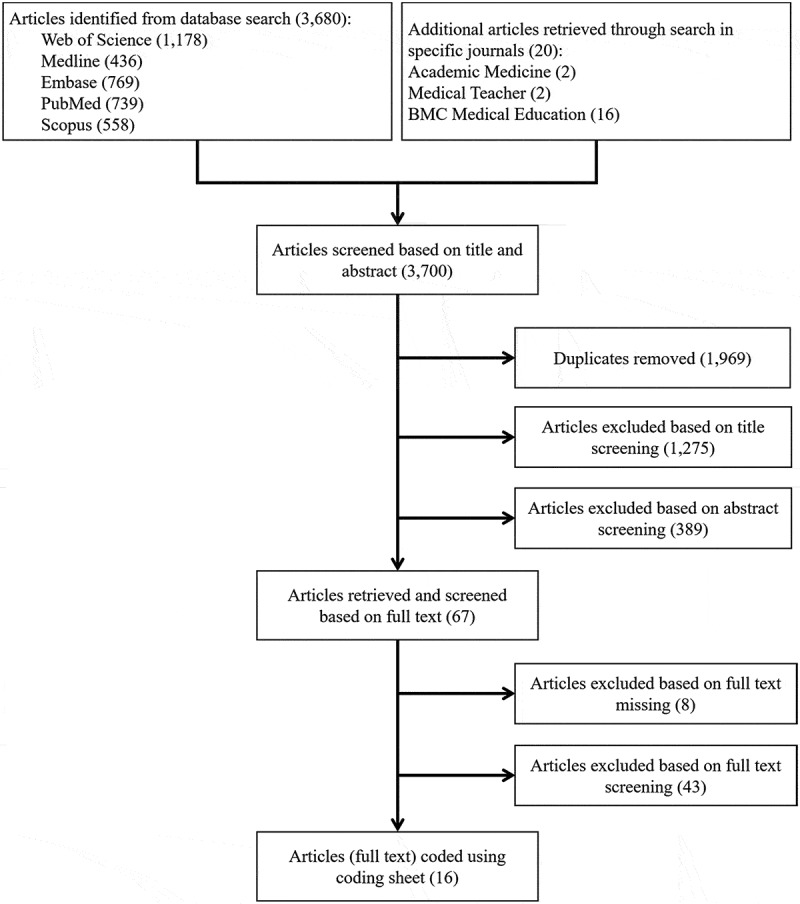
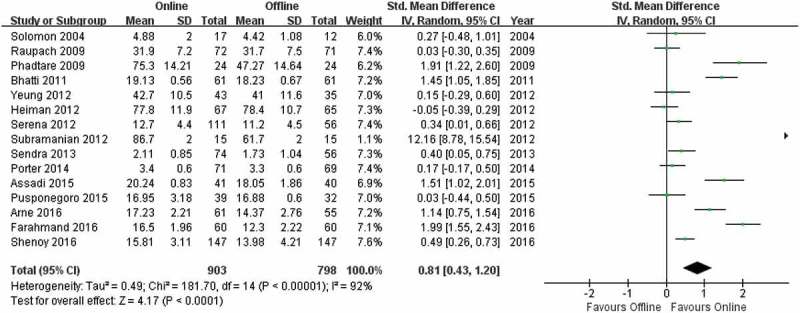
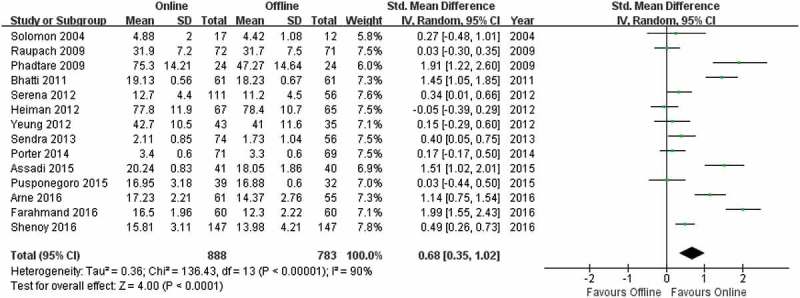
With the increasing use of technology in education, online learning has become a common teaching method. How effective online learning is for undergraduate medical education remains unknown. This article's aim is to evaluate whether online learning when compared to offline learning can improve learning outcomes of undergraduate medical students. Five databases and four key journals of medical education were searched using 10 terms and their Boolean combinations during 2000-2017. The extracted articles on undergraduates' knowledge and skill outcomes were synthesized using a random effects model for the meta-analysis.16 out of 3,700 published articles were identified. The meta-analyses affirmed a statistically significant difference between online and offline learning for knowledge and skill outcomes based on post-test scores (SMD = 0.81; 95% CI: 0.43, 1.20; p < 0.0001; n = 15). The only comparison result based on retention test scores was also statistically significant (SMD = 4.64; 95% CI: 3.19, 6.09; p < 0.00001). The meta-analyses discovered no significant difference when using pre- and post-test score gains (SMD = 3.03; 95% CI: -0.13, 4.13; p = 0.07; n = 3). There is no evidence that offline learning works better. And compared to offline learning, online learning has advantages to enhance undergraduates' knowledge and skills, therefore, can be considered as a potential method in undergraduate medical teaching.
Overview
The claims and statistics of this paper haven’t been checked yet.
Free: it reads the open-access text and checks the first 5 claims that cite a source we can check. Create a free account to check every claim.
Integrity signals
Registry
Cites
Statistics
Figures


Verification
Claims the paper makes
The claims and statistics of this paper haven’t been checked yet.
Free: it reads the open-access text and checks the first 5 claims that cite a source we can check. Create a free account to check every claim.
Claims other papers make about this one
Each is checked against this paper’s own text: does it say what the citing paper says it does?
The cited source says what the claim attributes to it.
In the citing paper
“Online learning allows teaching and learning to be done separately using internetbased information delivery systems [21].”
From Impact of online learning on student's performance and engagement: a systematic review (2024) · cites this paper as [21]
Self-check
Percentages, sums and reported differences re-computed from the paper’s own numbers.
The self-check needs the paper’s full text.
Citations
Cites
Measuring inconsistency in meta-analyses
Higgins, J. P. T., Thompson, S. G., Deeks, J. J., & Altman, D. G. (2003) · BMJ · doi:10.1136/bmj.327.7414.557 · Cited by 63,139 · cited 1×
“The statistical heterogeneity was calculated using the I(2) statistic [16].”
MethodDermyshi, E., Wang, Y., Yan, C., Hong, W., Qiu, G., Gong, X., & Zhang, T. (2017) · Neonatology · doi:10.1159/000454668 · Cited by 24,451
Liberati, A., Altman, D. G., Tetzlaff, J., Mulrow, C., Gotzsche, P. C., Ioannidis, J. P. A., Clarke, M., Devereaux, P. J., Kleijnen, J., & Moher, D. (2009) · BMJ · doi:10.1136/bmj.b2700 · Cited by 17,648
Liberati, A., Altman, D. G., Tetzlaff, J., Mulrow, C., Gøtzsche, P. C., Ioannidis, J. P. A., Clarke, M., Devereaux, P. J., Kleijnen, J., & Moher, D. (2009) · Journal of Clinical Epidemiology · doi:10.1016/j.jclinepi.2009.06.006 · Cited by 10,578
Mayer, R. E. (2009) · doi:10.1017/cbo9780511811678 · Cited by 7,800
Mayer, R. (2020) · doi:10.1017/9781316941355 · Cited by 7,777
Cook, D. A., Hatala, R., Brydges, R., Zendejas, B., Szostek, J. H., Wang, A. T., Erwin, P. J., & Hamstra, S. J. (2011) · JAMA · doi:10.1001/jama.2011.1234 · Cited by 2,170
Blended Learning in Higher Education: Framework, Principles, and Guidelines
Garrison, D. R., & Vaughan, N. D. (2007) · Wiley eBooks · doi:10.1002/9781118269558 · Cited by 1,609
Internet-Based Learning in the Health Professions: A Meta-analysis
Cook, D. A., Levinson, A. J., Garside, S., Dupras, D. M., Erwin, P. J., & Montori, V. M. (2008) · JAMA · doi:10.1001/jama.300.10.1181 · Cited by 1,498 · cited 2×
“Evaluations have failed to reach consistent conclusions [4,5], resulting in complex decisions when selecting a teaching method for medical education.”
BackgroundStudent barriers to online learning: A factor analytic study
Muilenburg, L. Y., & Berge, Z. L. (2005) · Distance Education · doi:10.1080/01587910500081269 · Cited by 1,219 · cited 1×
“Some factors create barriers for online learning, such as administrative issues, social interaction, academic skills, technical skills, learner motivation, time and support for studies, technical problems, cost and access to the internet [6].”
Background
Research works printed but not linked: 2
- Cattagni A, Farris E Internet access in U.S. Public schools and classrooms: 1994-2000. Educ Stat Q. 2001; 3(4): 85.
- Review Manager (RevMan) [computer program]. Version 5.3. Copenhagen: The Nordic Cochrane Centre, The Cochrane Collaboration; 2014.
Cited by
Items 101–200 of 1,000
Heldt, J. P., Agrawal, A., Loeb, R., Richards, M., Castillo, E. G., & DeBonis, K. (2021) · Academic Psychiatry · doi:10.1007/s40596-021-01403-4 · Cited by 35
Comparison of perceived educational value of an in-person versus virtual medical conference
Chan, A., Cao, A. W., Kim, L., Gui, S., Ahuja, M., Kamhawy, R., & Latchupatula, L. (2021) · Canadian Medical Education Journal · doi:10.36834/cmej.71975 · Cited by 34
Effectiveness of an online module: climate-change and sustainability in clinical practice
Dunne, H., Rizan, C., Jones, A., Bhutta, M. F., Taylor, T. R., Barna, S., Taylor, C., & Okorie, M. (2022) · BMC Medical Education · doi:10.1186/s12909-022-03734-8 · Cited by 34
The Effect of Web-Based Biology Learning Environment on Academic Performance: A Meta-analysis Study
Vekli, G. S., & Çalık, M. (2023) · Journal of Science Education and Technology · doi:10.1007/s10956-023-10033-4 · Cited by 34
“Pei and Wu (2019), who included 16 studies from 2000 to 2017, found a statistically significant difference between online and offline learning for knowledge and skill outcomes.”
BackgroundMeylani, R. (2024) · Edelweiss Applied Science and Technology · doi:10.55214/25768484.v8i6.3763 · Cited by 35
“Effective design and organization of these materials maximize their educational benefits [155].”
Esfandiari, M., Sciacca, B., Feijóo, S., Laffan, D. A., Milošević, T., O'Toole, C., & Norman, J. O. (2025) · International Journal of Educational Research Open · doi:10.1016/j.ijedro.2025.100462 · Cited by 33
Utilization of e-learning platforms by lecturers during the COVID-19 pandemic in Indonesia
Tauhidah, D., Jayanti, U. N. A. D., Rahmasiwi, A., Pamungkas, R., & Saifulloh, A. (2021) · JPBI (Jurnal Pendidikan Biologi Indonesia) · doi:10.22219/jpbi.v7i3.16816 · Cited by 34
Castellanos-Reyes, D., Richardson, J. C., & Maeda, Y. (2024) · The Internet and Higher Education · doi:10.1016/j.iheduc.2024.100939 · Cited by 34
Techniques adopted in teaching students organic chemistry course for several years
Sukmawati, W. (2020) · Jurnal Inovasi Pendidikan IPA · doi:10.21831/jipi.v6i2.38094 · Cited by 33
“…2015) collaborative learning (O’Neal et al., 2016) case learning design (Xiong, 2016) service-learning design (Najmr et al., 2018) reverses classroom design integrated with ICT and e-learning (Ahn, 2019) online learning design (Pei & Wu, 2019) and active learning design (Theobald et al., 2020).”
BackgroundConsorti, F., Kanter, S. L., Basili, S., & Ho, M. (2021) · Medical Teacher · doi:10.1080/0142159x.2021.1877266 · Cited by 32
“There is also a need for stronger theoretical foundations to evaluate online pedagogies (Picciano 2017) and their impacts on student-teacher relationship (Cleland 2020c).”
BackgroundWang, Y., Liu, Y., Qian, W., & 喻荣彬 (2021) · Advances in Medical Education and Practice · doi:10.2147/amep.s323397 · Cited by 32
Cross-Country Student Perceptions about Online Medical Education during the COVID-19 Pandemic
Suzuki, T., Murayama, A., Kotera, Y., Bhandari, D., Senoo, Y., Tani, Y., Harada, K. S., Kawamoto, A., Sato, S., Sawano, T., et al. (2022) · International Journal of Environmental Research and Public Health · doi:10.3390/ijerph19052840 · Cited by 32
“The interview guide was developed based on our study interest and previous studies [5,17,19,20,25].”
MethodE-Learning for Undergraduate Medical Students
Tashkandi, E. M. (2021) · Advances in Medical Education and Practice · doi:10.2147/amep.s314509 · Cited by 30
“any e-learning programs 80 (8) 157 (16) 176 (18) 310 (31) 272 (27) 3.”
Fijačko, N., Masterson Creber, R., Metličar, Š., Strnad, M., Greif, R., Štiglic, G., & Skok, P. (2024) · JMIR Serious Games · doi:10.2196/56037 · Cited by 29
“The most recent adult BLS guidelines highlight the integration of TEL into adult BLS courses [8,13,14].”
BackgroundMenon, U. K., Gopalakrishnan, S., Unni, S. N., Ramachandran, R., Baby, P., Sasidharan, A., & Radhakrishnan, N. (2021) · Medical Journal Armed Forces India · doi:10.1016/j.mjafi.2021.01.006 · Cited by 29
Yao, J., Zhang, X., Xue, H., Zhu, M., Wang, J., Wang, Q., Chen, Z., & Yuan, H. (2022) · Nurse Education Today · doi:10.1016/j.nedt.2022.105395 · Cited by 29
Lestari, W., Ichwan, S. J. A., Yaakop, S. Z., Sabaznur, N., Ismail, A., & Sukotjo, C. (2022) · Dentistry Journal · doi:10.3390/dj10070131 · Cited by 29
“According to Pei and Wu (2019) [30], online learning was superior to conventional face-to-face learning, purely based on knowledge and skill outcomes, specifically in medical education.”
BackgroundImpact of COVID-19 on Medical Education: A Narrative Review of Reports from Selected Countries
Restini, C. B. A., Faner, M., Miglio, M. C., Bazzi, L., & Singhal, N. (2023) · Journal of Medical Education and Curricular Development · doi:10.1177/23821205231218122 · Cited by 29
Ethical Implications of AI and Machine Learning in Education: A Systematic Analysis
Thelma, C. C., Sain, Z. H., Shogbesan, Y. O., Phiri, E. V., & Akpan, W. M. (2024) · International Journal of Instructional Technology · doi:10.33650/ijit.v3i1.9364 · Cited by 29
“AI-powered systems can administer and optimise online courses, making them more flexible and accessible to students who cannot attend on-campus sessions [38].”
Torda, A. J., & Shulruf, B. (2021) · BMC Medical Education · doi:10.1186/s12909-021-02981-5 · Cited by 29
“This major finding has also been reported elsewhere [21, 22].”
MethodResultChoosing the Right Tool for the Job: Screening Tools for Systematic Reviews in Education
Zhang, Q., & Neitzel, A. (2024) · Journal of Research on Educational Effectiveness · doi:10.1080/19345747.2023.2209079 · Cited by 28
Cooper, L., Sneddon, J., Thompson, W., Guise, T., Robertson, D. P., & Smith, A. J. (2022) · JAC-Antimicrobial Resistance · doi:10.1093/jacamr/dlac039 · Cited by 29
Maqbool, S., Farhan, M., Safian, H. A., Zulqarnain, I., Asif, H., Noor, Z., Yavari, M., Saeed, S., Abbas, K., Basit, J., et al. (2022) · Annals of Medicine and Surgery · doi:10.1016/j.amsu.2022.104713 · Cited by 28
“Many studies have also reported that excessive use of internet networks in almost every field of life during the COVID-19 pandemic was the main cause of slow internet connections [16].”
Learners’ Continuous Use Intention of Blended Learning: TAM-SET Model
Chen, X., Xu, X., Wu, Y. J., & Pok, W. F. (2022) · Sustainability · doi:10.3390/su142416428 · Cited by 29
Parental Involvement and Academic Performance of Grade 12 Students
Quijano, H. U., Uy, A. C., & Franca, G. C. (2023) · Asian Journal of Education and Social Studies · doi:10.9734/ajess/2023/v47i41029 · Cited by 28
Hussain, F. N., Al-Mannai, R., & Agouni, A. (2020) · Medical Science Educator · doi:10.1007/s40670-020-01079-9 · Cited by 28
Handaya, A. Y., Fauzi, A. R., Andrew, J., Hanif, A. S., Tjendra, K. R., & Aditya, A. F. K. (2021) · Annals of Medicine and Surgery · doi:10.1016/j.amsu.2021.102751 · Cited by 28
“However, there are some challenges in online medical education, namely student ’ s lack of time management, uneven ability to access and gadgets between students, communication and interaction between lecturers and students, and difficulty in students ’ assessments [11,13].”
Remote Pathology teaching under the COVID-19 pandemic: Medical students' perceptions
Rodrigues, M. A. M., Zornoff, D. D. C. M., & Kobayasi, R. (2021) · Annals of Diagnostic Pathology · doi:10.1016/j.anndiagpath.2021.151875 · Cited by 27
Sustainable Distance Online Educational Process for Dental Students during COVID-19 Pandemic
Αντωνιάδου, Μ., Rahiotis, C., & Kakaboura, A. (2022) · International Journal of Environmental Research and Public Health · doi:10.3390/ijerph19159470 · Cited by 27
Bakanienė, I., Dominiak-Świgoń, M., Santos, M., Pantazatos, D., Grammatikou, M., Montanari, M., Virgili, I., Galeoto, G., Flocco, P., Bernabei, L., et al. (2022) · Journal of Intellectual & Developmental Disability · doi:10.3109/13668250.2022.2096956 · Cited by 27
“A lot of research on online learning has been done at the level of higher education with positive outcomes (González-Gómez et al., 2016; Pei & Wu, 2019; Lockman & Schirmer, 2020).”
BackgroundDindar, M., Çelik, İ., & Muukkonen, H. (2022) · Technology Knowledge and Learning · doi:10.1007/s10758-022-09621-x · Cited by 28
“Several meta-analyses have found that students in online education conditions perform better than their counterparts in face-to-face education conditions (Ebner & Gegenfurtner, 2019; Means et al., 2013; Pei & Wu, 2019 ).”
BackgroundE-learning: a Modality of Medical Education in the Period of Crisis
Baral, G., & Baral, R. S. (2021) · Journal of Nepal Health Research Council · doi:10.33314/jnhrc.v18i4.2767 · Cited by 27
Promoting Transfer of Learning to Practice in Online Continuing Professional Development
Luhanga, U., Chen, W., Minor, S., Drowos, J. L., Berry, A., Rudd, M. J., Gupta, S., & Bailey, J. M. (2021) · Journal of Continuing Education in the Health Professions · doi:10.1097/ceh.0000000000000393 · Cited by 26
“Furthermore, from the lens of the practical inquiry model, questions remain about the ability of participants to sustain reflective opportunities and the ability to develop group cohesion that is crucial for achieving higher levels of discourse and critical inquiry.(18,51) For example, while online CPD activities ofte…”
BackgroundWright, G. W., Volodarsky, S., Hecht, S., & Saxe, L. (2023) · Online Learning · doi:10.24059/olj.v27i1.3224 · Cited by 27
“…on academic outcomes have concluded that there are “no significant differences” between online learning and in-person teaching (Bernard et al., 2004; Pei & Wu, 2019; Russell, 1999), while others suggest that online learning is associated with lower academic performance (Lack, 2013; Nguyen, 2015;…”
BackgroundGoncharuk-Khomyn, M., Kaliy, V. V., POHORİLYAK, R., Cavalcanti, A. L., Кенюк, А. Т., Yavuz, Y., & BOYCHUK, O. (2023) · Brazilian Oral Research · doi:10.1590/1807-3107bor-2023.vol37.0026 · Cited by 26
“18,20,21,23 The results regarding the equally high quality of education before and during the war should be interpreted with caution because of the several factors related with the distance of different universities from the warfare and from the EU border that affect students differently.”
BackgroundThe application of blended teaching in medical practical course of clinical skills training
He, Z.-C., Li, H., Lu, L., Wang, Q., Lu, L., & Lu, L. (2024) · BMC Medical Education · doi:10.1186/s12909-024-05730-6 · Cited by 26
“It allows for more intuitive guidance in developing students’ skills and provides faster feedback [30].”
BackgroundOnline Learning During Ongoing Covid-19 Pandemic: A Survey of Students’ Satisfaction
Shaid, N. A. N., Kamaruzaman, F. M., & Sulaiman, N. A. (2021) · International Journal of Academic Research in Business and Social Sciences · doi:10.6007/ijarbss/v11-i7/10557 · Cited by 26
Hamdy, H., Sreedharan, J., Rotgans, J. I., Zary, N., Bahous, S. A., Venkatramana, M., AbdelFattah Elzayat, E., Lamba, P., Sebastian, S. K., & Momen, N. K. A. (2021) · Medical Teacher · doi:10.1080/0142159x.2021.1935828 · Cited by 25
“Online technologies and methods of communication have sped up its implementation with different degrees of success (Cook et al. 2008; Pei and Wu 2019; Ruiz et al. 2006).”
BackgroundLong, Q., Li, S., An, R., Yasmin, F., & Akbar, A. (2025) · Acta Psychologica · doi:10.1016/j.actpsy.2025.105410 · Cited by 25
RetractedLoock, V. S., Fleischer, J., Scheunemann, A., Froese, L., Teich, K., & Wirth, J. (2022) · Frontiers in Psychology · doi:10.3389/fpsyg.2022.1033524 · Cited by 25
Learner engagement and teaching effectiveness in livestreamed versus in‐person CME
Stephenson, C. R., Yudkowsky, R., Wittich, C. M., & Cook, D. A. (2022) · Medical Education · doi:10.1111/medu.14996 · Cited by 26
Qiang, S., & Zhang, L. J. (2023) · Porta Linguarum Revista Interuniversitaria de Didáctica de las Lenguas Extranjeras · doi:10.30827/portalin.vi2023c.29619 · Cited by 25
Impact of the Covid-19 pandemic and ensuing online teaching on pre-clinical medical education
Goudarzi, H., Onozawa, M., & Takahashi, M. (2024) · BMC Medical Education · doi:10.1186/s12909-023-04967-x · Cited by 24
“Data are presented as mean ± standard deviation A recent systematic review and meta-analysis examined whether online versus offline learning influenced learning outcomes among undergraduate medical students [10].”
BackgroundPaldy, P., Sthevaniocy, Y. R., Baharuddin, M. R., & Yunus, R. Y. I. (2025) · Journal of Languages and Language Teaching · doi:10.33394/jollt.v13i1.13009 · Cited by 24
“As Pei and Wu (2019) argue that the adaptability of flashcards, whether in physical or digital formats, enhances their potential to maintain student motivation and engagement, particularly in language acquisition contexts.”
Hamidy, A. (2021) · Tarbiyah Wa Ta lim Jurnal Penelitian Pendidikan dan Pembelajaran · doi:10.21093/twt.v8i1.3225 · Cited by 24
“Perubahan metode pembelajaran yang terjadi secara penuh ini diduga berdampak kepada siswa, baik pada aspek afektif (Hedges, 2017; Singh, Rylander, & Mims, 2012), kognitif (Lestari & Benardi, 2020; Pei & Wu, 2019; Singh et al., 2012) maupun psikomotorik (Pei & Wu, 2019).”
BackgroundKim, K., Lee, Y. J., Lee, M.-J., & Kim, Y. H. (2021) · PLoS ONE · doi:10.1371/journal.pone.0253860 · Cited by 25
“e-Learning is known to be at least as effective as conventional learning in medical education [20, 21].”
BackgroundGoing remote: Recommendations for normalizing virtual internships
Hruska, A. M., Cawood, A. M., Lohan, K. M. P., Ogburn, M. B., & Komatsu, K. J. (2022) · Ecosphere · doi:10.1002/ecs2.3961 · Cited by 24
Hai, L., Sang, G., Wang, H., Li, W., & Bao, X. (2022) · Behavioral Sciences · doi:10.3390/bs12100403 · Cited by 23
“Generally, students in online learning conditions are viewed as performing better than those receiving offline learning [5,6], which is partly due to the advantages of online learning; for example, online learning can be better adapted to students’ diverse needs by breaking down geographical and physical barriers, and…”
BackgroundXu, Y., Wang, L., Li, P., Xu, H. X., Liu, Z., Ji, M., & Luo, Z. (2023) · BMC Medical Education · doi:10.1186/s12909-023-04549-x · Cited by 23
“Moreover, previous studies have demonstrated that online learning can enhance the knowledge and skills of medical students [27].”
BackgroundSamara, M., Algdah, A., Nassar, Y. H., Zahra, S. A., Halim, M., & Barsom, R. M. M. (2023) · Journal of Technology and Science Education · doi:10.3926/jotse.2057 · Cited by 24
“With this mode of education, students’ learning abilities, communication skills, critical thinking, and problem-solving abilities have been improved (Lockman & Schirmer, 2020; Pei & Wu, 2019).”
MethodOnline Synchronous Clinical Communication Training During the Covid-19 Pandemic
Perron, N. J., Dao, M. D., Rieder, A., Sommer, J., & Audétat, M. (2020) · Advances in Medical Education and Practice · doi:10.2147/amep.s286552 · Cited by 23
“A systematic review showed that online learning works as well as offline learning, but the conditions under which it can be used must be further clarified.(6) Blended learning, the combination of Correspondence: Noelle Junod Perron Unit of Development and Research in Medical Education, Faculty of Medicine, Geneva Univ…”
BackgroundKositanurit, W., Vivatvakin, S., Kaikaew, K., Varachotisate, P., Burana, C., Chayanupatkul, M., Thanprasertsuk, S., Wangsaturaka, D., & Kulaputana, O. (2022) · BMC Medical Education · doi:10.1186/s12909-022-03217-w · Cited by 23
“the instability of the e-learning platform and errors in internet connection), and the non-interactive nature of asynchronous online learning between teachers and students, as mentioned in previous studies [14, 16, 25, 38].”
ResultConsolidating Medical Education in Sudan During War
Taha, M. H., Husain, N. E., Mukhtar, W. N. O., & Abdalla, M. E. (2023) · Sudan Journal of Medical Sciences · doi:10.18502/sjms.v18i3.14093 · Cited by 23
“(2019) concluded that online learning offers advantages in enhancing knowledge and skills among undergraduate students, making it a promising approach in undergraduate medical teaching (15).”
BackgroundA Comparative Study of Online Education and Traditional Offline Education During COVID-19Preprint
Hong, Y., Li, X., Lin, Y., Xie, J., Yan, X., & Lin, Z. (2020) · Research Square · doi:10.21203/rs.3.rs-61593/v1 · Cited by 23
Virtual teaching of undergraduate primary care small groups during Covid-19
Patel, B., & Taggar, J. (2021) · Education for Primary Care · doi:10.1080/14739879.2021.1920475 · Cited by 22
“The findings are in keeping with a systematic review that found online learning was as effective as more traditional face-to-face learning [12].”
ResultMedical Education 4.0: A Neurology Perspective
Zafar, Z., Umair, M., Faheem, F., Bhatti, D., & Kalia, J. S. (2022) · Cureus · doi:10.7759/cureus.31668 · Cited by 22
“The data suggests that online medical education is as beneficial, if not more, than offline learning, with the added benefit of mastering one's skills and overcoming weaknesses at one's own pace [71].”
BackgroundVisuddho, V., Nugraha, D., Melbiarta, R. R., Rimbun, R., Purba, A. K. R., Syafa’ah, I., Bakhtiar, A., Rejeki, P. S., & Romdhoni, A. C. (2023) · Medical Education Online · doi:10.1080/10872981.2023.2182665 · Cited by 22
“Finally, the current evidence still does not show which methods work better for medical education [13].”
BackgroundE-learning and Physics Teaching Materials Based on Malay Ethnoscience on the East Coast
Irfandi, I., Sudarma, T. F., Festiyed, F., Yohandri, Y., Diliarosta, S., Surahman, D., & Siregar, A. M. (2023) · Jurnal Pendidikan IPA Indonesia · doi:10.15294/jpii.v12i3.45442 · Cited by 22
Pande, A., & Mishra, D. (2024) · Behaviour and Information Technology · doi:10.1080/0144929x.2024.2344726 · Cited by 22
“In contrast, Pei and Wu (2019) conducted a systematic review and suggested that online learning is more effective than offline learning in enhancing the knowledge and skills of undergraduate students.”
de Rooij, D., Belfroid, E., Hadjichristodoulou, C. S., Mouchtouri, V. Α., Raab, J., & Timen, A. (2020) · Globalization and Health · doi:10.1186/s12992-020-00604-0 · Cited by 22
Chandran, D. S., Kaur, S., & Deepak, K. K. (2021) · AJP Advances in Physiology Education · doi:10.1152/advan.00226.2020 · Cited by 22
“undergraduate medical teaching even before the COVID era (10).”
BackgroundCraig, C. A., Petrun, E. L., Gilbertz, S. J., Karam, R., & Feng, S. (2021) · Organizational Behavior Teaching Review · doi:10.1177/10525629211056316 · Cited by 22
“For example, a review of online learning for undergraduate medical education suggests that it is equally as effective as offline learning (Pei & Wu, 2019).”
BackgroundGolovanova, I., Alipichev, A. Y., Ayupov, T., Baltina, T., Gorskaya, T. Y., Donetskaya, O., Lapina, M., Uteeva, E., Fazlyeva, F., & Khasanova, E. (2022) · Education & Self Development · doi:10.26907/esd.17.3.16 · Cited by 22
Hong, Y. K., Wu, J., Wu, J., Xu, H., Li, X., Lin, Z., & Xia, J. (2023) · BMC Medical Education · doi:10.1186/s12909-023-04017-6 · Cited by 23
“[19] conducted a meta-analysis of the literature in 2000–2017.”
BackgroundMethodInfluentialComparing the impact of online and in-person active learning in preclinical medical education
Malta, K., Glickman, C., Hunter, K. M., & McBride, A. (2025) · BMC Medical Education · doi:10.1186/s12909-025-06846-z · Cited by 21
“…have attempted to elucidate the value of online vs. offline learning in medical education and have reported positive effects of internet-based interventions [2]; however, either the effect sizes were generally small or were not significantly different from those of offline teaching [3, 4].”
Distance Education in Nutrition and Dietetics Education over the Past 30 Years: A Narrative Review
Bueche, J. L., Jensen, J., Martin, K., Riddle, E., & Stote, K. S. (2022) · Journal of the Academy of Nutrition and Dietetics · doi:10.1016/j.jand.2022.11.006 · Cited by 21
Baskaran, R., Mukhopadhyay, S., Ganesananthan, S., Gamage, M. P., Dalavaye, N., Ng, V., Bennett, R., Srinivasan, S., Sureshkumarnair, P., Spencer, R., et al. (2023) · BMC Medical Education · doi:10.1186/s12909-022-03970-y · Cited by 21
“In contrast, small group methods foster camaraderie among participants and group learning [9, 10].”
BackgroundResultInfluentialAshour, O., Alkhatib, A. M., Zureikat, Q. A., Al-Shaikhli, M., Ata, B. B., Massad, T., Al‐Huneidy, L., Al-Sabbagh, M. Q., & Al-Ani, A. T. (2023) · Korean journal of medical education · doi:10.3946/kjme.2023.246 · Cited by 21
“The adoption of online learning frees institutions from time and space limitations [11].”
BackgroundBeyond Collaborative Learning: a Comparison of Small Groups in Face-to-Face and Online Settings
Song, X., & Elftman, M. D. (2024) · Medical Science Educator · doi:10.1007/s40670-024-01983-4 · Cited by 21
“Several studies have found that online learning is no less effecting than face-to-face instruction for the acquisition of knowledge and skills [12, 13].”
Effectiveness of virtual team learning in entrepreneurship education: a survey study
Chen, L., Ifenthaler, D., Sun, W.-T., Xu, T., & Yan, G.-H. (2022) · Entrepreneurship Education · doi:10.1007/s41959-022-00064-0 · Cited by 12
“Previous research showed online learning activities can facilitate learners’ knowledge and skills (Hart et al., 2019; Pei & Wu, 2019).”
BackgroundIslam, M. I., Jahan, S. S., Chowdhury, M. T. H., Isha, S. N., Saha, A. K., Nath, S. K., Jahan, M. S., Kabir, M. H., Apu, E. H., Kabir, R., et al. (2022) · International Journal of Environmental Research and Public Health · doi:10.3390/ijerph19137786 · Cited by 21
“However, there is limited scientific evidence on how online learning affects dental and medical education in LMICs, including its strengths and weaknesses [19,20].”
BackgroundDergham, P., Saudagar, F. N., Nazar, C. C. J., Hashim, S. A., Saleh, K., Mohammedhussain, A. A., Wafai, S. A., & Madadin, M. S. (2023) · Advances in Medical Education and Practice · doi:10.2147/amep.s396912 · Cited by 21
“On the other hand, significant issues have been pointed out about the use of entirely online education such as: physical and social isolation, increased use of emails, difficulty to keep boundaries between time at the workplace and at home, lack of interaction, disturbance and technical problems, deficiency in integra…”
BackgroundResultSingh, S., Kumar, V., Paliwal, M., Singh, S. V. P., & Mahlawat, S. (2023) · Data and Information Management · doi:10.1016/j.dim.2023.100052 · Cited by 21
Nhan, P. N. T., Lan, N. M., Hien, T. H., Phương, N. T. T., & Phi, N. T. N. (2022) · Journal of Education and e-Learning Research · doi:10.20448/jeelr.v9i1.3660 · Cited by 20
“The article by Pei and Wu (2019) evaluated the difference between online and offline learning to improve students' learning quality.”
BackgroundZhang, H., Morris, M. E., Nurius, P. S., Mack, K., Brown, J., Kuehn, K. S., Sefidgar, Y. S., Xu, X., Riskin, E. A., Dey, A. K., et al. (2022) · ACM Transactions on Accessible Computing · doi:10.1145/3538514 · Cited by 20
“For some, online learning has becomemore common over the last decade [53], and even before the radical changes imposed by social distancing in the era of the COVID-19 pandemic, issues existed with the accessibility of online courses [59].”
BackgroundSuwannaphisit, S., Anusitviwat, C., Hongnaparak, T., & Bvonpanttarananon, J. (2021) · Annals of Medicine and Surgery · doi:10.1016/j.amsu.2021.102493 · Cited by 20
“Online healthcare information is currently continually updated, and medical students can easily reach these data to enhance their knowledge [2].”
BackgroundJannah, E. I., & Hentasmaka, D. (2021) · Premise Journal of English Education · doi:10.24127/pj.v10i2.4168 · Cited by 19
“…learning, did not have the time and space limitations, and therefore, made teaching and learning separable via internet-based information PJEE -------------------------------------------------------------------------------------------------------------------- delivery systems (Peia & Wub, 2019).”
Vakilian, A., Ranjbar, E., Hassanipour, M., Ahmadinia, H., & Hasani, H. (2022) · Journal of Education and Health Promotion · doi:10.4103/jehp.jehp_1297_21 · Cited by 19
“2 Journal of Education and Health Promotion | Volume 11 | July 2022 In the third millennium, e‐learning is no longer just an alternative, it is a necessity, and should attract the attention of more and more educational designers and planners.[4,5]”
BackgroundOmole, A. E., Villamil, M. E., & Amiralli, H. (2023) · Cureus · doi:10.7759/cureus.35837 · Cited by 19
“In a 2019 meta-analysis comparing online versus offline learning in undergraduate medical education, online learning was shown to be either equal to or superior to face-to-face traditional learning modality [9].”
BackgroundNurse Educator's experiences and challenges with online teaching: A qualitative descriptive study
Albloushi, M., Aldawsari, A. N., Alghamdi, R., Alenazy, B. A., Alanazi, H. A. H., & Almutairi, H. (2024) · Heliyon · doi:10.1016/j.heliyon.2024.e29533 · Cited by 19
“Prior to COVID-19, online learning had been a part of nursing education for many years [44,45].”
BackgroundListen up: a systematic review of the utilization and efficacy of podcasts for medical education
Caldwell, K. E., Rodríguez, J., Fox, J., Yaeger, L., & Wise, P. E. (2024) · Global Surgical Education - Journal of the Association for Surgical Education · doi:10.1007/s44186-024-00301-1 · Cited by 19
“With the speed of information change, podcasts and other online resources may offer the benefit of more rapid production speed and the ability to be updated as compared to textbook-based resources [114].”
Dental students’ perceptions of integrating online learning in the dental curriculum
Al‐Natour, B., Safadi, R. A., Hamasha, A. A., Karasneh, R. A., Alkandari, M. A., & Hamasha, S. A. (2024) · BMC Medical Education · doi:10.1186/s12909-024-06497-6 · Cited by 19
Semerikov, S. O., Nechypurenko, P. P., Вакалюк, Т. А., Мінтій, І. С., & Фадєєва, Л. О. (2025) · Smart Learning Environments · doi:10.1186/s40561-025-00400-6 · Cited by 19
“Pei and Wu (2019) conducted a meta-analysis showing online learning in medical education led to higher post-test scores (SMD = 0.81) compared to offline learning.”
InfluentialThe Use of Blended Teaching in Higher Medical Education during the Pandemic Era
Fu, X., Hu, Y. C., Yan, B., Jiao, Y., Zheng, S.-J., Wang, Y.-G., Zhang, J.-Y., & Wang, Z. (2022) · International Journal of Clinical Practice · doi:10.1155/2022/3882975 · Cited by 19
“It plays an important role in the teaching reform of colleges and universities [3, 4].”
Azizan, A. (2025) · Education in Medicine Journal · doi:10.21315/eimj2025.17.3.1 · Cited by 18
Yun, H., Kim, S. R., & Chung, E. (2021) · Korean journal of medical education · doi:10.3946/kjme.2021.193 · Cited by 18
“preparations during the COVID-19 outbreaks despite the growing attention to online learning used for medical education for the last two decades [1].”
BackgroundJaam, M. J., Nazar, Z. J., Rainkie, D. C., Hassan, D. A., Hussain, F. N., Kassab, S. E., & Agouni, A. (2021) · PLoS ONE · doi:10.1371/journal.pone.0254444 · Cited by 18
“Further, TEL has demonstrated its capacity to enhance the student learning experience both inside the classroom and through distant learning [2,3].”
BackgroundUkrani, R. D., Shaikh, A. N., Martins, R. S., Fatima, S. S., Naseem, H. A., & Baig, M. A. (2021) · BMC Medical Education · doi:10.1186/s12909-021-02996-y · Cited by 18
Ma, J., Jiang, X., Wang, J., Liang, Z., Sun, Z., Qian, H., & Gong, A. (2021) · Biochemistry and Molecular Biology Education · doi:10.1002/bmb.21591 · Cited by 18
Hsu, P.-T., & Ho, Y. (2022) · Healthcare · doi:10.3390/healthcare10081461 · Cited by 18
“Apart from the content design and arrangement of online courses, students’ feedback or interaction with teachers [26], familiarity with operations of computer equipment, and network stability affect the effectiveness of online learning [19,24,29].”
BackgroundWhat contributed to students’ online learning satisfaction during the pandemic?
Kim, S., & Park, S. (2022) · Distance Education · doi:10.1080/01587919.2022.2150147 · Cited by 18
“In contrast to prior systematic review and meta-analytic studies conducted in the non-pandemic period (Pei & Wu, 2019; Than & Khaing, 2020; Vallee et al., 2020), the current study determined various associating factors of student satisfaction in online learning in a situation where online education…”
ResultZhao, J., Xiao, H., Li, Y., Wen, D., Xu, P., Fu, Y., Piao, J., Liu, J., Cao, D., Zhong, Z., et al. (2020) · doi:10.21203/rs.3.rs-29678/v1 · Cited by 18
“Meanwhile, online education could not only ensure its timeliness and interaction to a certain extent [7, 8], but also could help students repeatedly study the least understood contents after class.”
BackgroundEnoch, L. C., Abraham, R. M., & Singaram, V. S. (2023) · Advances in Medical Education and Practice · doi:10.2147/amep.s398376 · Cited by 17
“Although this single-center study included only third-year students and examined a limited number of clinical skills, the findings supported the systematic review and meta-analysis by Pei et al.20 The contributing factors for this successful transfer of learning are not well established.”
ResultZhang, P., Li, X., Pan, Y. J., Zhai, H., & Li, T. X. (2023) · Medicine · doi:10.1097/md.0000000000035377 · Cited by 21
“[11] This shows that studies published before 2020 received wide attention after the outbreak of COVID-19, for example, the second most cited article written by O’Doherty (2018) [12] and the fourth cited article written by Pei (2019).”
BackgroundExploring Emerging Technologies in Online Medical Education: A Survey of Women's Online University
Quraishi, T., Hakimi, M., Hakimi, N., Khani, A. M., Zahid, N., & Mohammadi, F. G. (2024) · Journal of Education Method and Learning Strategy · doi:10.59653/jemls.v2i02.650 · Cited by 17
Closing the Gap in Global Neurosurgical Education via Online Conference: A Pre-Covid Survey
Downes, S. R., & Lykina, T. (2020) · Cureus · doi:10.7759/cureus.8015 · Cited by 17
“Although online CME is relatively new, numerous studies have pointed to its efficacy by evaluating measurements of its effectiveness over time [2] [3] [4] [5] [6] [7] [8] .”
BackgroundLiu, Q., Wen-ping, S., Du, C., Yang, L., Yuan, N., Cui, H., Song, W.-G., & Li, G. (2021) · JMIR Medical Informatics · doi:10.2196/24497 · Cited by 17
“In this new era of information, web-based learning creates conditions for life-long learning and greater flexibility for people to learn on their own personal time; also, varied locations, good availability, and cost-effectiveness are associated with web-based teaching [5-9].”
The COVID-19 pandemic: the benefits and challenges it presents for medical education in Africa
Adefuye, A. O., Adeola, H. A., & Busari, J. O. (2021) · Pan African Medical Journal · doi:10.11604/pamj.2021.40.42.28489 · Cited by 17
“E-learning has been credited for its advantages, such as enhanced knowledge and skills in undergraduate students compared to the traditional educational methods [21].”
BackgroundLins, R. M. L., Pugliesi, D. M. C., de Lima, F. J. C., Moreira, A. R. O., de Marcelos, P. G. C. L., & dos Santos, V. E. (2021) · European Journal Of Dental Education · doi:10.1111/eje.12750 · Cited by 17
Fehl, M., Gehres, V., Geier, A.-K., Mundt, T., Klinge, K., Frese, T., Bleckwenn, M., & Deutsch, T. (2022) · Medical Education Online · doi:10.1080/10872981.2022.2028334 · Cited by 17
“regarding the transfer of knowledge and that there is no indication for less effectiveness [34].”
Background
Metadata
- Authors
- Pei, L., & Wu, H.
- Affiliations
- Institute of Basic Education Science, Beijing Academy of Educational Sciences, Beijing, China
- Peking University (CN)
- Corresponding author
- Wu, Hongbin
- ORCID
- Wu, Hongbin
- Venue
- Medical Education Online
- Publisher
- Informa UK Limited
- Published
- 2019-01-01
- Volume
- 24
- Issue
- 1
- Pages
- 1666538
- ISSN
- 1087-2981 (ISSN-L)
- PMC
- PMC6758693
- OpenAlex
- W2973845887
- Cited by
- 852
- References
- 49
- Citations by year
- 2026: 36 · 2025: 59 · 2024: 130 · 2023: 185 · 2022: 214 · 2021: 165 · 2020: 63
- FWCI
- 18.07
- Type
- journal article
- Language
- en
- Open access
- gold
- doi.org
- Licence
- Locations
- Medical Education Online (publishedVersion, cc-by)
- PubMed Central (publishedVersion, cc-by)
- PubMed (publishedVersion)
- DOAJ (DOAJ: Directory of Open Access Journals) (submittedVersion, cc-by-sa)
- Topics
- Social Sciences › Education › Innovations in Medical Education
- Social Sciences › Education › Online and Blended Learning
- Health Sciences › Health Professions › General Health Professions › Health and Medical Education
- Keywords
- online learning, offline learning, undergraduate medical education, learning outcomes, knowledge retention, clinical skills, e-learning effectiveness, medical students
- MeSH terms
- Education, Medical, Undergraduate, Humans, Students, Medical, Teaching, Education, Distance, Internet
About these checks
Registry, retraction, Cites and statistics results are computed, not judged, with one exception: a printed reference that no index lists is read once by a model before it counts as a citation error. Claims are extracted by a model and kept only when their quote appears verbatim in the text; each cited source is then checked, with a model’s help, for whether it says what the claim relies on. Those verdicts can be wrong — read the claim’s quote and the cited source before relying on one.
Statistics and arithmetic are recomputed, not judged.
Confidence bands are shown only for fields calibrated on our annotated test set. None is calibrated yet, so no band is shown.
What counts as a claim ›How we measure confidence ›How we check this ›
Are you an author, or do you see a problem with this page? Request a review
Data sources
Bibliographic data: Semantic Scholar, OpenAlex, Crossref.
Contains information from the Semantic Scholar Academic Graph Datasets, made available under the ODC Attribution License (ODC-BY 1.0).
Semantic Scholar’s data is described in: Kinney, R., et al. (2023). The Semantic Scholar Open Data Platform. arXiv:2301.10140.
