

Does online learning work better than offline learning in undergraduate medical education? A systematic review and meta-analysis
Open accessThe DOI matches its Crossref record; 49 of the 49 references it cites were found in a registry or an index.
Abstract
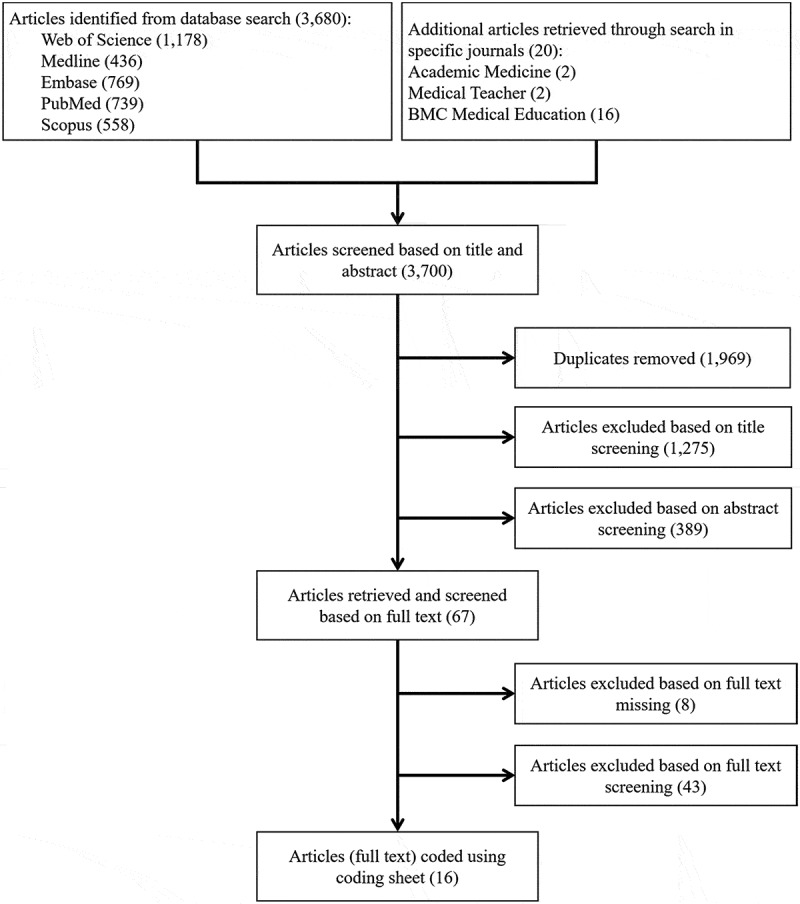
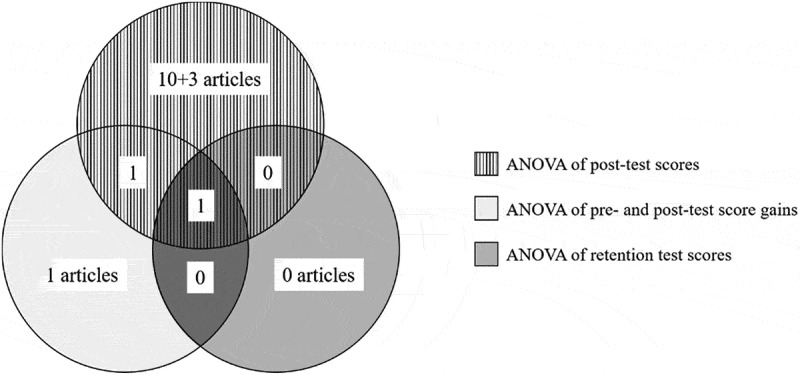
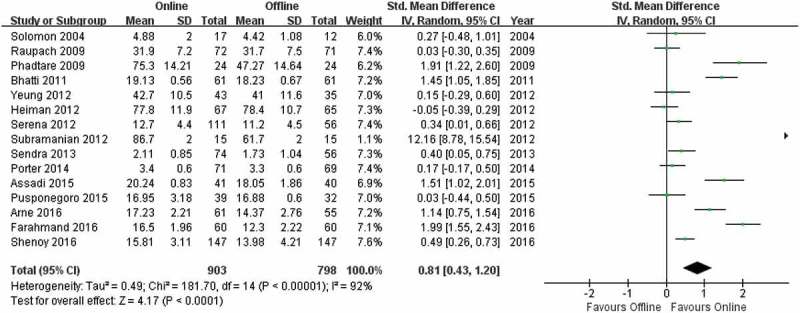
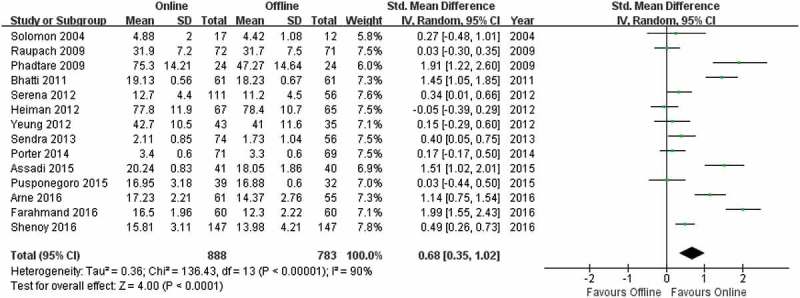
With the increasing use of technology in education, online learning has become a common teaching method. How effective online learning is for undergraduate medical education remains unknown. This article's aim is to evaluate whether online learning when compared to offline learning can improve learning outcomes of undergraduate medical students. Five databases and four key journals of medical education were searched using 10 terms and their Boolean combinations during 2000-2017. The extracted articles on undergraduates' knowledge and skill outcomes were synthesized using a random effects model for the meta-analysis.16 out of 3,700 published articles were identified. The meta-analyses affirmed a statistically significant difference between online and offline learning for knowledge and skill outcomes based on post-test scores (SMD = 0.81; 95% CI: 0.43, 1.20; p < 0.0001; n = 15). The only comparison result based on retention test scores was also statistically significant (SMD = 4.64; 95% CI: 3.19, 6.09; p < 0.00001). The meta-analyses discovered no significant difference when using pre- and post-test score gains (SMD = 3.03; 95% CI: -0.13, 4.13; p = 0.07; n = 3). There is no evidence that offline learning works better. And compared to offline learning, online learning has advantages to enhance undergraduates' knowledge and skills, therefore, can be considered as a potential method in undergraduate medical teaching.
Overview
The claims and statistics of this paper haven’t been checked yet.
Free: it reads the open-access text and checks the first 5 claims that cite a source we can check. Create a free account to check every claim.
Integrity signals
Registry
Cites
Statistics
Figures


Verification
Claims the paper makes
The claims and statistics of this paper haven’t been checked yet.
Free: it reads the open-access text and checks the first 5 claims that cite a source we can check. Create a free account to check every claim.
Claims other papers make about this one
Each is checked against this paper’s own text: does it say what the citing paper says it does?
The cited source says what the claim attributes to it.
In the citing paper
“Online learning allows teaching and learning to be done separately using internetbased information delivery systems [21].”
From Impact of online learning on student's performance and engagement: a systematic review (2024) · cites this paper as [21]
Self-check
Percentages, sums and reported differences re-computed from the paper’s own numbers.
The self-check needs the paper’s full text.
Citations
Cites
Measuring inconsistency in meta-analyses
Higgins, J. P. T., Thompson, S. G., Deeks, J. J., & Altman, D. G. (2003) · BMJ · doi:10.1136/bmj.327.7414.557 · Cited by 63,139 · cited 1×
“The statistical heterogeneity was calculated using the I(2) statistic [16].”
MethodDermyshi, E., Wang, Y., Yan, C., Hong, W., Qiu, G., Gong, X., & Zhang, T. (2017) · Neonatology · doi:10.1159/000454668 · Cited by 24,451
Liberati, A., Altman, D. G., Tetzlaff, J., Mulrow, C., Gotzsche, P. C., Ioannidis, J. P. A., Clarke, M., Devereaux, P. J., Kleijnen, J., & Moher, D. (2009) · BMJ · doi:10.1136/bmj.b2700 · Cited by 17,648
Liberati, A., Altman, D. G., Tetzlaff, J., Mulrow, C., Gøtzsche, P. C., Ioannidis, J. P. A., Clarke, M., Devereaux, P. J., Kleijnen, J., & Moher, D. (2009) · Journal of Clinical Epidemiology · doi:10.1016/j.jclinepi.2009.06.006 · Cited by 10,578
Mayer, R. E. (2009) · doi:10.1017/cbo9780511811678 · Cited by 7,800
Mayer, R. (2020) · doi:10.1017/9781316941355 · Cited by 7,777
Cook, D. A., Hatala, R., Brydges, R., Zendejas, B., Szostek, J. H., Wang, A. T., Erwin, P. J., & Hamstra, S. J. (2011) · JAMA · doi:10.1001/jama.2011.1234 · Cited by 2,170
Blended Learning in Higher Education: Framework, Principles, and Guidelines
Garrison, D. R., & Vaughan, N. D. (2007) · Wiley eBooks · doi:10.1002/9781118269558 · Cited by 1,609
Internet-Based Learning in the Health Professions: A Meta-analysis
Cook, D. A., Levinson, A. J., Garside, S., Dupras, D. M., Erwin, P. J., & Montori, V. M. (2008) · JAMA · doi:10.1001/jama.300.10.1181 · Cited by 1,498 · cited 2×
“Evaluations have failed to reach consistent conclusions [4,5], resulting in complex decisions when selecting a teaching method for medical education.”
BackgroundStudent barriers to online learning: A factor analytic study
Muilenburg, L. Y., & Berge, Z. L. (2005) · Distance Education · doi:10.1080/01587910500081269 · Cited by 1,219 · cited 1×
“Some factors create barriers for online learning, such as administrative issues, social interaction, academic skills, technical skills, learner motivation, time and support for studies, technical problems, cost and access to the internet [6].”
Background
Research works printed but not linked: 2
- Cattagni A, Farris E Internet access in U.S. Public schools and classrooms: 1994-2000. Educ Stat Q. 2001; 3(4): 85.
- Review Manager (RevMan) [computer program]. Version 5.3. Copenhagen: The Nordic Cochrane Centre, The Cochrane Collaboration; 2014.
Cited by
Items 301–400 of 1,000
Sarli, L., Artioli, G., Bogotto, S., Labelli, E., Pittella, F., Guasconi, M., Simone, R. D., Luca, E. D., Rossi, S., & D’Apice, C. (2022) · Acta bio-medica dell'Ateneo parmense/Acta biomedica · doi:10.23750/abm.v93is2.13080 · Cited by 9
“Research showed that there are no big learning outcomes differences between offline and online modalities (11).”
BackgroundOpportunity Amid Crisis in Medical Education: Teaching During the Pandemic of COVID-19
Rahayu, G. R., Utomo, P. S., Riskiyana, R., & Hidayah, R. N. (2022) · Journal of Multidisciplinary Healthcare · doi:10.2147/jmdh.s379140 · Cited by 9
“Online learning has more potential to improve the knowledge and skills of medical students compared to conventional offline learning.(3) The growth of online education is supported by continuous innovations in technology-based learning resources, namely medical apps, games apps, online”
BackgroundVideoaulas como organizadores prévios no ensino em saúde durante a pandemia: relato de experiência
Silva, E. D. S. M. E., Monteiro, B. M. M., Ono, B. H. V. S., & Souza, J. C. (2020) · Research Society and Development · doi:10.33448/rsd-v9i10.8839 · Cited by 9
Shahkarami, F., Taghavi, A. A., Dolama, R. H., Khajavirad, N., Mirzazadeh, A., & Gandomkar, R. (2025) · BMC Medical Education · doi:10.1186/s12909-025-07812-5 · Cited by 8
“The results of these studies identified that online learning offers substantial possible benefits over more traditional instruction methods as it has the potential to disseminate large amounts of information and provide valuable educational resources to great numbers of students [17, 18].”
Cahyani, I. N., & Subiantoro, A. W. (2021) · Advances in Social Science, Education and Humanities Research/Advances in social science, education and humanities research · doi:10.2991/assehr.k.210326.026 · Cited by 8
Monemi, E., & Nematollahi, M. (2023) · BMC Nursing · doi:10.1186/s12912-023-01315-8 · Cited by 8
“A systematic review study comparing offline and online educational methods showed that online learning has advantages to enhance undergraduates’ knowledge and skills, therefore, can be considered as a potential method in undergraduate medical teaching [34].”
BackgroundAspect-oriented extraction and sentiment analysis using optimized hybrid deep learning approaches
Kotagiri, S., Sowjanya, A. M., Anilkumar, B., & Devi, N. L. (2024) · Multimedia Tools and Applications · doi:10.1007/s11042-024-18964-9 · Cited by 8
“However, finding the precise emotion is difficult since lengthy reviews sometimes include mixed criticism, meaning that a client may express his thoughts on several different product characteristics in the same review [4].”
Liem, I. K., Fatril, A. E., & Husna, F. A. (2024) · BMC Medical Education · doi:10.1186/s12909-024-05620-x · Cited by 8
“In addition, with online classes, students could still have open access to skill and knowledge enhancement without having to worry about the risk of coronavirus infection [31].”
BackgroundHundekari, J., Mittal, R., Wasnik, S., & Kot, L. (2020) · DOAJ (DOAJ: Directory of Open Access Journals) · doi:10.30485/ijsrdms.2020.253310.1091 · Cited by 8
Lin, Q., Qiu, Y., Zhang, Y., Zheng, Y., Zhang, L., Liang, J., Yilifate, A., Liao, Y., Jiang, Y., Lang, S., et al. (2021) · Medical Science Monitor · doi:10.12659/msm.931748 · Cited by 8
“Pei et al [16] reviewed 16 articles and found that compared to traditional classes, online classes present advantages to enhance undergraduates’ knowledge and skills and thus can be considered as a potential method in undergraduate medical teaching.”
BackgroundCárdenas-Cruz, A., Moreno, G. G., Matas-Lara, A., Romero, P., & Parrilla-Ruiz, F. M. (2022) · Medical Education Online · doi:10.1080/10872981.2022.2040191 · Cited by 8
“To guarantee the efficacy of online learning, the design principles of digital learning materials, objectives, and the students’ characteristics and preferences must be carefully assessed [4].”
BackgroundCase-based learning in der Thoraxchirurgie
Rathberger, K., Ried, M., & Hofmann, H. (2022) · Die Chirurgie · doi:10.1007/s00104-022-01626-7 · Cited by 8
Inamochi, Y., Yoshida‐Kohno, E., Wada, J., Murakami, N., Takaichi, A., Arai, Y., Ueno, T., Fueki, K., & Wakabayashi, N. (2022) · Journal of Prosthodontic Research · doi:10.2186/jpr.jpr_d_22_00147 · Cited by 8
Appraisal of E-Learning and students’ academic performance: A perspective from secondary schools
Olusegun, A. A., Uranta, E., Ukhurebor, K. E., Jokthan, G. E., & Nalwadda, D. (2023) · Cypriot Journal of Educational Sciences · doi:10.18844/cjes.v18i1.7996 · Cited by 8
Stackhouse, A. A., Rafi, D., Walls, R., Dodd, R. V., Badger, K., Davies, D., Brown, C., Cowell, A., Meeran, K. M., Halse, O., et al. (2023) · Advances in Medical Education and Practice · doi:10.2147/amep.s391816 · Cited by 8
“Case Vignette 4 (1) 4 (1) 4 (1) 4 (1) 4 (1) 4 (1)”
Effectiveness of In‐Person Versus Online Negotiation Teaching for Practitioners
Oehlschläger, P., & Merz, M. A. (2023) · Negotiation Journal · doi:10.1111/nejo.12429 · Cited by 9
Nwadi, C. L. (2023) · International Journal of Home Economics Hospitality and Allied Research · doi:10.57012/ijhhr.v2n2.011 · Cited by 8
“E-learning refers to the use of electronic devices to access educational content outside of a traditional classroom (Pei & Wu, 2019; Wang et al., 2021), typically in the form of online courses, programs, or degrees.”
BackgroundRawat, R., & Singh, P. (2022) · National Journal of Community Medicine · doi:10.5455/njcm.20200902070715 · Cited by 8
Joseph, M., & Nisker, J. (2020) · Canadian Journal of Disability Studies · doi:10.15353/cjds.v9i5.697 · Cited by 8
“…engagement in medical education because they are inexpensive and easy to implement (Cook et al., 2008; Evans et al., 2017; Metcalf et al., 2010; Pei & Wu, 2019; Subramanian et al., 2012; Wilson et al., 2004; Zhang et al., 2017), we contend that they are formulaic, lack intimacy and often allow…”
BackgroundInfluentialA Qualitative Study on the Perceptions and Learning Behavior of Medical Students in Online Classes
Kang, Y., & Kim, D.-H. (2021) · Korean Medical Education Review · doi:10.17496/kmer.2021.23.1.46 · Cited by 8
“학부 의학교육에서 온라인 교육이 도입된 시점은 오래 전임에도[9], 팬데믹 이전의 온라인 수업은 교수자의 기술적 숙련도, 관심사, 대학의 정책, 교육내용의 특수성 등에 따른 선택사항에 가까 웠다.”
Issabella, C. M., & Prabandari, F. H. (2021) · Journal of Health (JoH) · doi:10.30590/joh.v8n2.p151-163.2021 · Cited by 8
Impact of SARS-CoV-2 infection on veterinary medical education
Islam, M. A., & Alam, M. S. (2021) · Journal of University Teaching and Learning Practice · doi:10.53761/1.18.5.14 · Cited by 8
“…that the performance of examinations taught via traditional classroom lecturing and online lecturing were often similar for medical students (Pei and Wu, 2019), but prevention of disadvantages of online examination platforms such as question paper leakage is essential (Alsoufi et al., 2020).”
Bowers, R., Young, L. B., Comnick, C. L., Kasundra, H. P., & Barwacz, C. A. (2022) · Dentistry Journal · doi:10.3390/dj10040060 · Cited by 8
“demonstrated that 13 of the 14 studies meeting inclusion criteria had higher test score outcomes, although not all being statistically significant [16].”
BackgroundRole of Technology in Medical Education: SWOC Analysis
Jha, S. (2022) · SBV Journal of Basic Clinical and Applied Health Science · doi:10.5005/jp-journals-10082-03131 · Cited by 8
“13 19 c hAllenges High risk of creating an economic divide among the students, noncompliance with the traditional aids of teaching, learning, and assessment, and without the presence of trained and competent faculties and students would lead to a disruption in the learning of students and improper…”
Andragogy in Graduate Health Programs During the COVID-19 Pandemic
Ladwig, A., Berg-Poppe, P. J., Ikiugu, M. N., & Ness, B. M. (2021) · Distance Learning · doi:10.1108/dl-12-2021-0004 · Cited by 8
Barrow, J. (2022) · Methods in physiology · doi:10.1007/978-3-030-95633-2_17 · Cited by 8
Curran, V. R., Glynn, R., Whitton, C., & Hollett, A. (2024) · JMIR Medical Education · doi:10.2196/52906 · Cited by 7
“This approach allows primary care providers across the province to access the instructional material at their convenience, thereby providing the flexibility needed to balance professional learning with varied work hours, family, and other personal or professional commitments [40-42].”
Gallo, J. J., Murray, S. M., Creswell, J. W., Deutsch, C., & Guetterman, T. C. (2024) · BMC Medical Education · doi:10.1186/s12909-024-05877-2 · Cited by 7
“Online training in health also appears to be effective [2, 4, 5, 25], though studies are limited because often no skills were evaluated, no comparison groups were used, the response rate was low, or the sample size was small [1, 6].”
BackgroundComputer-based assessment research trends and future directions: A bibliometric analysis
Syahbrudin, J., Istiyono, E., Khairudin, M., Anggraini, A., Wusqo, I. U., Mariam, M., & Muflihan, Y. (2024) · Contemporary Educational Technology · doi:10.30935/cedtech/15743 · Cited by 7
Chen, Z., Xiong, J., Bai, J., Hu, Y., Wu, H. L., Zhou, B., & Wang, Y. (2025) · Psychology Health & Medicine · doi:10.1080/13548506.2025.2481195 · Cited by 7
“Before the COVID-19 pandemic, a systematic review showed that online learning and offline learning have similar learning effects (Pei & Wu, 2019).”
Self-citationRuesseler, M., Britz, V., Herrmann‐Werner, A., Wietek, T. F., Weckwerth, C., Bepler, L., Beaugé, Y., & Sterz, J. (2025) · BMC Medical Education · doi:10.1186/s12909-025-07898-x · Cited by 8
Ro’isatin, U. A., Thamrin, M., & Setiawan, A. W. (2021) · Bulletin of Science Education · doi:10.51278/bse.v1i3.264 · Cited by 7
The impact of virtual learning on Multimedia University student performance: a cross-sectional study
Tai, H. T., Liyen, L., & Ping, L. Y. (2021) · F1000Research · doi:10.12688/f1000research.72881.1 · Cited by 7
Assessment of Online Learning Effectiveness by Students of Engineering and IT Degree Programs
Baskakova, D. Y., Belash, O. Y., & Shaposhnikov, S. O. (2021) · International Conference "Quality Management, Transport and Information Security, Information Technologies" (IT&QM&IS) · doi:10.1109/itqmis53292.2021.9642752 · Cited by 7
Barua, K., Rasania, S. K., Acharya, A. S., & Singh, A. (2021) · Indian Journal of Community Health · doi:10.47203/ijch.2021.v33i04.007 · Cited by 7
Shah, S. (2022) · JMIR Medical Education · doi:10.2196/37872 · Cited by 7
“For instance, a recent meta-analysis found that online learning results in significantly better knowledge and skills outcomes based on posttest scores compared to traditional “offline” classroom teaching [9].”
BackgroundBoonmak, S., Plailaharn, N., Sripadungkul, D., Somjit, M., Gaysonsiri, D., & Boonmak, P. (2022) · Journal of Dental Education · doi:10.1002/jdd.13089 · Cited by 7
Almatham, K., Alwadie, A. D., Kasule, O., AlFadil, S., & Alshaya, O. S. (2022) · Advances in Medical Education and Practice · doi:10.2147/amep.s370308 · Cited by 7
“A recent meta-analysis of studies reported from 2000 to 2017, which compared online with offline undergraduate medical education, reported that knowledge and skills were significantly improved with online learning.(28) Although not all studies in the review signify that online learning was more effective, none conclud…”
BackgroundArumugam, S., Subbiah, N. K., & Priya, S. J. (2022) · PubMed Central · doi:10.30476/jamp.2022.94591.1597 · Cited by 7
“One of the established e-learning modes for anatomy practical demonstration was dissection videos of cadavers recorded by anatomy faculties with specific learning needs and objectives (8, 9).”
Elcokany, N. M., Jaramillo, J., Llaguno, M. B. B., Seweid, M. M., & Mousa, O. (2022) · International Journal of Innovative Research in Medical Science · doi:10.23958/ijirms/vol07-i11/1536 · Cited by 7
Kurniawati, E. M., Bachtiar, C. A., Joewono, H. T., & Utomo, B. (2023) · Heliyon · doi:10.1016/j.heliyon.2023.e13907 · Cited by 7
“Video tutorials and mannequin simulations were compared for effectiveness in several studies [19,20].”
BackgroundMethodRemote training for combat medics during the COVID-19 era: lessons learnt for future crises?
Hodgetts, J. M., Claireaux, H. A., & Naumann, D. N. (2020) · BMJ Military Health · doi:10.1136/bmjmilitary-2020-001527 · Cited by 7
Leunig, A., Winkler, M., Gernert, J. A., Graupe, T., & Dimitriadis, K. A. (2021) · GMS journal for medical education · doi:10.3205/zma001421 · Cited by 7
Casanova, V. J., Toledo, T. M., Morales, M. M., Zaitoun, E. S., & Valdés, T. W. (2021) · Revista Confluencia · doi:10.52611/confluencia.num1.2021.575 · Cited by 7
Berniak‐Woźny, J., Rataj, M., & Plebańska, M. (2021) · EUROPEAN RESEARCH STUDIES JOURNAL · doi:10.35808/ersj/2497 · Cited by 7
“…studies have been carried out to investigate whether face-to-face or traditional teaching methods are more productive or whether online or hybrid learning is more effective (Gopal et al., 2021; Lockman and Schirmer, 2020; Pei and Wu, 2019; González-Gómez et al., 2016; Khan et al., 2020).”
BackgroundScott, K., Wissinger, J., Maus, E., & Heathcock, J. (2022) · Pediatric Physical Therapy · doi:10.1097/pep.0000000000000910 · Cited by 7
Geier, A.-K., Lippmann, S., Rau, A., Schrimpf, A. M., Bleckwenn, M., & Deutsch, T. (2022) · BMC Geriatrics · doi:10.1186/s12877-022-03470-0 · Cited by 7
Designing Knowledge Dissemination in a Digital Era – Analysing TED Talk’s Multimodal Orchestration
Jiang, J., & Lim, F. V. (2022) · Canadian Journal of Learning and Technology · doi:10.21432/cjlt28263 · Cited by 7
“Meanwhile, teachers and instructors are also faced with challenges such as how to communicate their content in online instruction, how to keep students engaged in online learning, and how to use multimedia resources effectively (Oyedotun, 2020; Pei & Wu, 2019).”
BackgroundChunkhare, M., & Jadhav, S. J. (2022) · International Journal of Virtual and Personal Learning Environments · doi:10.4018/ijvple.315595 · Cited by 7
Saeed, S., Raza, M., Kaleem, S., Qureshi, S., Hussain, A., Aslam, N., & Madhwani, A. (2023) · E-Learning and Digital Media · doi:10.1177/20427530231156177 · Cited by 7
“…done on articles from 2000-2017, to differentiate between online and of fl ine learning via pre and post-tests, seven articles reported no signi fi cant difference between the two teaching methods, and nine articles reported substantial improvement in the online learning groups (Pei and Wu, 2019).”
BackgroundMukhina, Y. N., & Ковальчук, С. С. (2023) · Science for Education Today · doi:10.15293/2658-6762.2301.02 · Cited by 7
“В обзор публикаций по теме исследова-ния вошли статьи последних пяти лет, наглядно иллюстрирующие результаты иссле-дований мотивации студентов традиционной и дистанционной форм обучения [2; 3; 7; 8; 14; 18; 20; 24; 26; 28].”
The Transition from Offline to Online: Unveiling the Challenges and Opportunities
-, D. B., & -, S. K. R. (2023) · International Journal For Multidisciplinary Research · doi:10.36948/ijfmr.2023.v05i04.4444 · Cited by 7
Puyana‐Romero, V., Larrea-Álvarez, C. M., Díaz-Márquez, A. M., Molina, R. H., & Ciaburro, G. (2024) · Sustainability · doi:10.3390/su16114411 · Cited by 7
Development of Interactive Multimedia on Electron Configuration Concept
Dzikrika, N., Junanto, T., Erlina, E., Enawaty, E., Sasri, R., Rasmawan, R., & Nizam, D. N. M. (2024) · Jurnal Pendidikan Sains Indonesia · doi:10.24815/jpsi.v12i2.36061 · Cited by 10
“Videos play a role in introducing information that is easy to improve students' abilities through the presentation of structured information that can be repeated (replay) and is easily distributed and accessed via mobile devices such as smartphones (Pei & Wu, 2019; Paksi & Harmianto, 2022).”
BackgroundShaibani, T. A. A., Naguib, Y. M., Razzak, R. L. A., & Ali, F. A. F. (2020) · Arab Gulf Journal of Scientific Research · doi:10.51758/agjsr-02-2020-0005 · Cited by 7
Kumar, S., & Todd, G. (2022) · Focus on Health Professional Education: A Multi-Professional Journal · doi:10.11157/fohpe.v23i3.430 · Cited by 6
Puyana‐Romero, V., Díaz-Márquez, A. M., Garzón, C., & Ciaburro, G. (2024) · Buildings · doi:10.3390/buildings15010084 · Cited by 6
Bashir, F., Warraich, N. F., & Malik, A. (2025) · Medical Science Educator · doi:10.1007/s40670-025-02294-y · Cited by 6
“Furthermore, during crucial moments, smooth learning experiences were frequently hampered by technical constraints such low connectivity and device incompatibility [22].”
Analisis Literatur Inovasi Pembelajaran Media Digital dalam Pengajaran Akidah Akhlak
Ananda, N. A., & Santiani, S. (2025) · Jurnal Miftahul Ilmi Jurnal Pendidikan Agama Islam · doi:10.59841/miftahulilmi.v2i2.92 · Cited by 6
Nartthanarung, A., Plangsiri, K., & Kongmalai, P. (2026) · Advances in Medical Education and Practice · doi:10.2147/amep.s603679 · Cited by 7
Spor Bilimleri Öğrencilerinin Uzaktan Eğitime Yönelik Tutum ve Görüşlerinin İncelenmesi
Ünlü, H., Aktaş, Ö., & BÜYÜKTAŞ, B. (2021) · Spor Bilimleri Araştırmaları Dergisi · doi:10.25307/jssr.961588 · Cited by 6
Ma, J., Zhu, Z., & Liu, X. (2023) · Soft Computing · doi:10.1007/s00500-023-08523-z · Cited by 6
RetractedFazriyah, L., & Kusrohmaniah, S. (2023) · International Journal of Evaluation and Research in Education (IJERE) · doi:10.11591/ijere.v12i3.25382 · Cited by 6
Faculty perceptions and use of e-learning resources for medical education and future predictions
Kim, K., Kim, G., & Kang, Y. (2023) · Korean journal of medical education · doi:10.3946/kjme.2023.270 · Cited by 6
Perceptions of psychological safety in healthcare professionals’ online learner-learner interactions
Knickerbocker, J., & Tawfik, A. A. (2024) · Journal of Computing in Higher Education · doi:10.1007/s12528-024-09401-9 · Cited by 6
“While problem-solving in online learning supports various learning outcomes, research shows this approach to instruction is often associated with social isolation and a lack of deep discussion (Pei & Wu, 2019 ; Yücel & Usluel, 2016).”
Sheehan, S., Dowling, M., Shewbridge, A., de la Serna, C. D. D. L. R., Bağçıvan, G., Kotronoulas, G., Erdem, S., Aroyo, V., Wiseman, T., & Drury, A. (2024) · Nurse Education Today · doi:10.1016/j.nedt.2024.106533 · Cited by 6
Kanapathipillai, K., & Narayanan, S. (2021) · European Journal of Education Studies · doi:10.46827/ejes.v8i11.3969 · Cited by 6
“…of this study result can be corroborated by previous scholars (Gopal et al., 2021; Loton et al., 2020; Fatoni et al., 2020; Zameni et al., 2011; Pei & Wu, 2019; Means et al., 2010), who discovered that that student who used online learning mode performed reasonably better than students who…”
BackgroundResultDigital space and its influence on the lifestyle and health of students: A literature review
Shubochkina, E. I. (2021) · Sociology of Medicine · doi:10.17816/1728-2810-20-1-91 · Cited by 6
Besse, M., Signerski-Krieger, J., Wiltfang, J., Bartels, C., & Belz, M. (2022) · PLoS ONE · doi:10.1371/journal.pone.0276660 · Cited by 6
“This is in line with other studies, which found comparable knowledge gain / teaching success between digital- and face-to-face-teaching [11, 12].”
ResultMacLeod, A., Cameron, P., Luong, V., Parker, R. M. N., Li, V., & Munroe-Lynds, C.-L. (2022) · Academic Medicine · doi:10.1097/acm.0000000000005119 · Cited by 6
Online Learning: What We Know and What We Don't Know
Wart, M. V. (2022) · International Journal of Adult Education and Technology · doi:10.4018/ijaet.312581 · Cited by 6
Ma, G., deLuca, L. S., Bernatchez, J., Ojeda, C. C., Chauhan, A., Botros, D., Selim, O. A., & Kayssi, A. (2023) · Journal of surgical education · doi:10.1016/j.jsurg.2023.05.007 · Cited by 6
Mehta, M., Teymouri, M., Puthuparampil-Mehta, B., Sawh, C., Paty, P. S. K., Kostun, Z. W., Jayakumar, L., & Scher, L. A. (2022) · Journal of Vascular Surgery · doi:10.1016/j.jvs.2022.12.014 · Cited by 6
Park, J. J. (2021) · Korean Medical Education Review · doi:10.17496/kmer.2021.23.3.147 · Cited by 6
The Smart Class Teaching Module for Rehabilitation Medicine English Education in China
Lin, Q., Qiu, Y., Liang, J., Zheng, Y., Liao, Y., Huang, H., Hou, L., Lang, S., Zhao, B., Yiming, Z., et al. (2021) · Medical Science Monitor · doi:10.12659/msm.929834 · Cited by 6
“A systematic review suggested that the online teaching module improved medical-related teaching [12].”
BackgroundPROBLEMS OF DISTANT LEARNING OF MEDICAL STUDENTS DURING THE COVID-19 PANDEMIC
Bondarenko, M., Kurovska, V., Okhrei, A., Подпалова, О., & Reshetnik, Y. (2021) · Science and Education · doi:10.24195/2414-4665-2021-1-3 · Cited by 6
Percepción del aprendizaje en línea adaptado en contexto de COVID-19 en estudiantes de Nutrición
Méndez, C., Fuentes, C., Pimentel, C. B., & Villagrán, I. (2021) · Investigación en Educación Médica · doi:10.22201/fm.20075057e.2021.40.21354 · Cited by 6
Kuroda, N., Suzuki, A., Ozawa, K., Nagai, N., Okuyama, Y., Koshiishi, K., YAMADA, M., & Kikukawa, M. (2022) · PLoS ONE · doi:10.1371/journal.pone.0263182 · Cited by 6
Learning, Technology, and Technique
Dron, J. (2022) · Canadian Journal of Learning and Technology · doi:10.21432/cjlt28315 · Cited by 6
Online and Offline English Learning Systems: Perceptual from Teachers and Students
Irma, I., Rafiqa, R., & Danial, M. (2022) · LETS Journal of Linguistics and English Teaching Studies · doi:10.46870/lets.v4i1.346 · Cited by 6
Suyatno, S., Sibawaihi, S., Wantini, W., Firdausi, D. K. A., & Patimah, L. (2023) · The Qualitative Report · doi:10.46743/2160-3715/2023.5727 · Cited by 6
Zheng, T., & Zhu, X. (2020) · Research Square · doi:10.21203/rs.3.rs-108407/v1 · Cited by 6
Editorial: Public Health Promotion and Medical Education Reform
Chen, J., & Zhang, Z. (2022) · Frontiers in Public Health · doi:10.3389/fpubh.2022.918962 · Cited by 6
“Accordingly, educators have developedmore effective pedagogies for online learning, by which students have greater access to online medical resources and they can study on their own pace (10).”
BackgroundLimbumbu, A. N., Kabwe, J. C., Kumwenda, A., Kasonkomona, P. C., Mwila, G., & Lubeya, M. K. (2022) · F1000Research · doi:10.12688/f1000research.124823.1 · Cited by 5
Students’ perceptions of different assessment modes and student experience
Hancock, P., Birt, J. L., Lange, P. D., Fowler, C. J., Kavanagh, M., Mitrione, L., & Rankin, M. (2025) · Journal of Accounting Education · doi:10.1016/j.jaccedu.2025.100953 · Cited by 5
Martin, F., Westine, C. D., Wu, T., & Sun, T. (2025) · American Journal of Distance Education · doi:10.1080/08923647.2025.2487248 · Cited by 5
“…et al., 2004; Martin et al., 2020), and web-based learning and online learning (Camnalbur et al., 2013; Jahng et al., 2007; Means et al., 2013; Pei & Wu, 2019; Sitzmann et al., 2006), etc. Taking several first-order meta-analyses into account, some researchers have conducted second-order…”
Лобань, Г. А., Faustova, M. O., Ananieva, M. M., & Kostenko, V. О. (2020) · Fundamental and applied researches in practice of leading scientific schools · doi:10.33531/farplss.2020.2.25 · Cited by 5
Psychiatric training program during the COVID-19 pandemic: An experience in Iran
Mirsepassi, Z., Karimi, E., & Mohammadjafari, A. (2022) · Asian Journal of Psychiatry · doi:10.1016/j.ajp.2022.103130 · Cited by 5
“Several studies showed the efficacy and usefulness of e-learning in medical education (O’Doherty et al., 2018; Pei and Wu, 2019; Papapanou et al., 2021).”
Verse, T., Verse, J. M., Meyer, J. E., Grundmann, T., Külkens, C., & Berger, B. (2022) · HNO · doi:10.1007/s00106-022-01200-x · Cited by 5
Ruck, J., Pramberger, M., Späth, I., Simmenroth, A., & Zirkel, J. (2023) · GMS journal for medical education · doi:10.3205/zma001592 · Cited by 5
A comparison of the effectiveness of online and offline learning
Kumari, R., & Kumar, D. (2023) · International journal of applied research · doi:10.22271/allresearch.2023.v9.i5a.10761 · Cited by 5
Colleges Require ICT Facilities to Enhance Educational and Employment Prospects
Sihare, S. R. (2023) · International Journal of Modern Education and Computer Science · doi:10.5815/ijmecs.2023.03.02 · Cited by 5
Feng, X., & Yao, J. (2023) · Soft Computing · doi:10.1007/s00500-023-08694-9 · Cited by 5
RetractedEvaluation of virtual problem-based tutorials in healthcare professional education
Smith‐Turchyn, J., Hamilton, J., Harris, J. E., & Wojkowski, S. (2023) · Disability and Rehabilitation · doi:10.1080/09638288.2023.2269841 · Cited by 5
“These described benefits are consistent with those described for other forms of virtual learning [26], and previous research has found these virtual education methods maintain high levels of knowledge retention and skill acquisition [27].”
Tapeh, Z. A., & Darvishpour, A. (2024) · Nursing Research and Practice · doi:10.1155/2024/7801500 · Cited by 5
Aljohani, N. J., & Aljehani, K. (2024) · Discover Education · doi:10.1007/s44217-024-00286-5 · Cited by 5
Differences in the Effectiveness of Three OHS Training Delivery Methods
Robson, L. S., Chen, C., Mustard, C., Shahidi, F. V., Landsman, V., Smith, P. M., & Biswas, A. (2025) · American Journal of Industrial Medicine · doi:10.1002/ajim.23719 · Cited by 5
“The exception is a study by Pei and Wu [7], which showed a large advantage of online learning in the education of medical students.”
Wiguna, F., Budiman, B., & Nilapsari, R. (2022) · Bandung Conference Series Medical Science · doi:10.29313/bcsms.v2i1.786 · Cited by 5
James, C., Chui, K., Brown, A. D. H., Poacher, A. T., Carpenter, C., & Jesudason, E. C. (2022) · Cureus · doi:10.7759/cureus.28628 · Cited by 6
“Studies have demonstrated virtual teaching to be as effective, if not more effective than offline learning [5].”
BackgroundTomej, K. (2022) · Teaching & Learning Inquiry The ISSOTL Journal · doi:10.20343/teachlearninqu.10.35 · Cited by 5
“Some studies show that the motivation of online students is similar or even stronger than that of on-campus students (Francis, Wormington, and Hulleman 2019; Lin, Chen, and Liu 2017; Pei and Wu 2019; Rovai et al. 2007; Shroff and Vogel 2009; Stewart, Bachman, and Johnson 2010).”
Result
Metadata
- Authors
- Pei, L., & Wu, H.
- Affiliations
- Institute of Basic Education Science, Beijing Academy of Educational Sciences, Beijing, China
- Peking University (CN)
- Corresponding author
- Wu, Hongbin
- ORCID
- Wu, Hongbin
- Venue
- Medical Education Online
- Publisher
- Informa UK Limited
- Published
- 2019-01-01
- Volume
- 24
- Issue
- 1
- Pages
- 1666538
- ISSN
- 1087-2981 (ISSN-L)
- PMC
- PMC6758693
- OpenAlex
- W2973845887
- Cited by
- 852
- References
- 49
- Citations by year
- 2026: 36 · 2025: 59 · 2024: 130 · 2023: 185 · 2022: 214 · 2021: 165 · 2020: 63
- FWCI
- 18.07
- Type
- journal article
- Language
- en
- Open access
- gold
- doi.org
- Licence
- Locations
- Medical Education Online (publishedVersion, cc-by)
- PubMed Central (publishedVersion, cc-by)
- PubMed (publishedVersion)
- DOAJ (DOAJ: Directory of Open Access Journals) (submittedVersion, cc-by-sa)
- Topics
- Social Sciences › Education › Innovations in Medical Education
- Social Sciences › Education › Online and Blended Learning
- Health Sciences › Health Professions › General Health Professions › Health and Medical Education
- Keywords
- online learning, offline learning, undergraduate medical education, learning outcomes, knowledge retention, clinical skills, e-learning effectiveness, medical students
- MeSH terms
- Education, Medical, Undergraduate, Humans, Students, Medical, Teaching, Education, Distance, Internet
About these checks
Registry, retraction, Cites and statistics results are computed, not judged, with one exception: a printed reference that no index lists is read once by a model before it counts as a citation error. Claims are extracted by a model and kept only when their quote appears verbatim in the text; each cited source is then checked, with a model’s help, for whether it says what the claim relies on. Those verdicts can be wrong — read the claim’s quote and the cited source before relying on one.
Statistics and arithmetic are recomputed, not judged.
Confidence bands are shown only for fields calibrated on our annotated test set. None is calibrated yet, so no band is shown.
What counts as a claim ›How we measure confidence ›How we check this ›
Are you an author, or do you see a problem with this page? Request a review
Data sources
Bibliographic data: Semantic Scholar, OpenAlex, Crossref.
Contains information from the Semantic Scholar Academic Graph Datasets, made available under the ODC Attribution License (ODC-BY 1.0).
Semantic Scholar’s data is described in: Kinney, R., et al. (2023). The Semantic Scholar Open Data Platform. arXiv:2301.10140.
