

Does online learning work better than offline learning in undergraduate medical education? A systematic review and meta-analysis
Open accessThe DOI matches its Crossref record; 49 of the 49 references it cites were found in a registry or an index.
Abstract
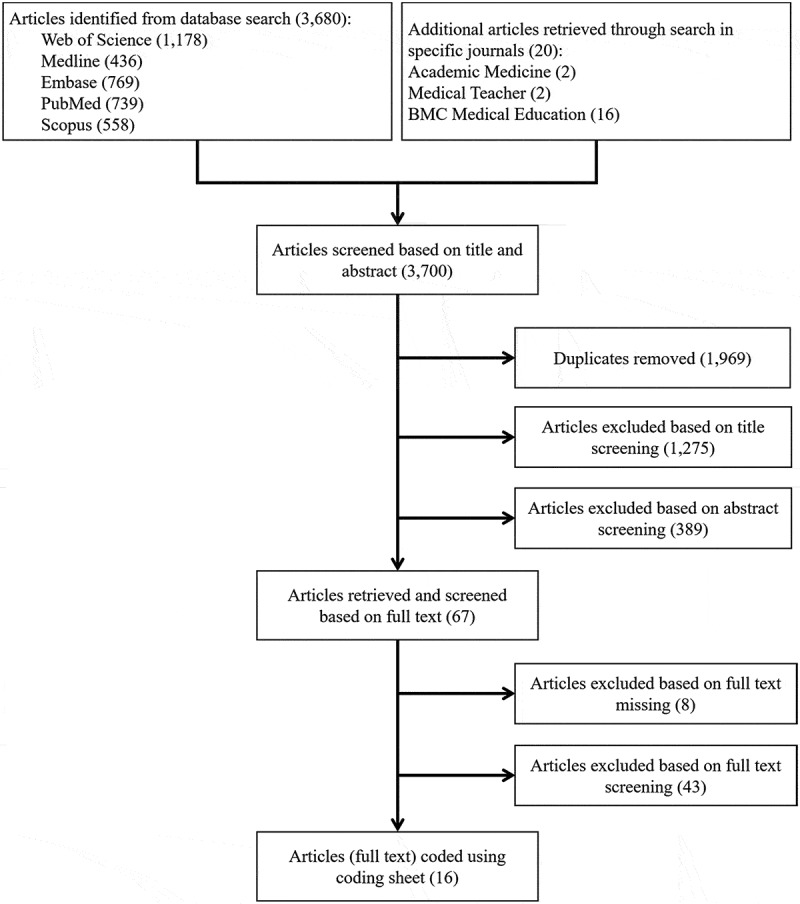
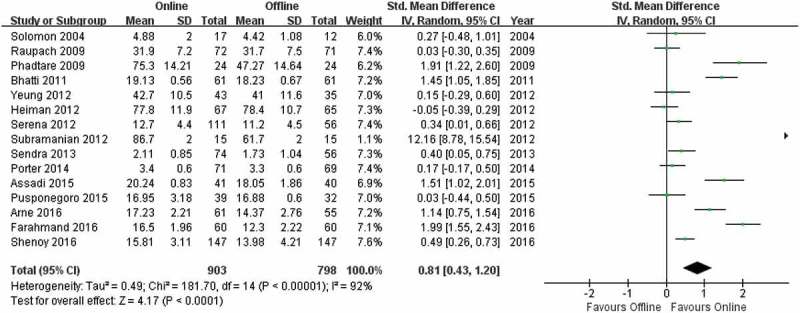
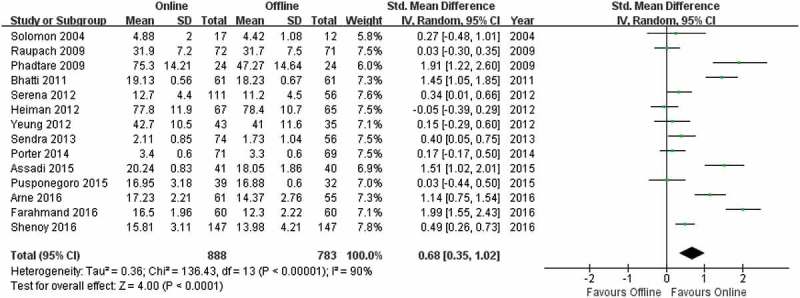
With the increasing use of technology in education, online learning has become a common teaching method. How effective online learning is for undergraduate medical education remains unknown. This article's aim is to evaluate whether online learning when compared to offline learning can improve learning outcomes of undergraduate medical students. Five databases and four key journals of medical education were searched using 10 terms and their Boolean combinations during 2000-2017. The extracted articles on undergraduates' knowledge and skill outcomes were synthesized using a random effects model for the meta-analysis.16 out of 3,700 published articles were identified. The meta-analyses affirmed a statistically significant difference between online and offline learning for knowledge and skill outcomes based on post-test scores (SMD = 0.81; 95% CI: 0.43, 1.20; p < 0.0001; n = 15). The only comparison result based on retention test scores was also statistically significant (SMD = 4.64; 95% CI: 3.19, 6.09; p < 0.00001). The meta-analyses discovered no significant difference when using pre- and post-test score gains (SMD = 3.03; 95% CI: -0.13, 4.13; p = 0.07; n = 3). There is no evidence that offline learning works better. And compared to offline learning, online learning has advantages to enhance undergraduates' knowledge and skills, therefore, can be considered as a potential method in undergraduate medical teaching.
Overview
The claims and statistics of this paper haven’t been checked yet.
Free: it reads the open-access text and checks the first 5 claims that cite a source we can check. Create a free account to check every claim.
Integrity signals
Registry
Cites
Statistics
Figures


Verification
Claims the paper makes
The claims and statistics of this paper haven’t been checked yet.
Free: it reads the open-access text and checks the first 5 claims that cite a source we can check. Create a free account to check every claim.
Claims other papers make about this one
Each is checked against this paper’s own text: does it say what the citing paper says it does?
The cited source says what the claim attributes to it.
In the citing paper
“Online learning allows teaching and learning to be done separately using internetbased information delivery systems [21].”
From Impact of online learning on student's performance and engagement: a systematic review (2024) · cites this paper as [21]
Self-check
Percentages, sums and reported differences re-computed from the paper’s own numbers.
The self-check needs the paper’s full text.
Citations
Cites
Measuring inconsistency in meta-analyses
Higgins, J. P. T., Thompson, S. G., Deeks, J. J., & Altman, D. G. (2003) · BMJ · doi:10.1136/bmj.327.7414.557 · Cited by 63,139 · cited 1×
“The statistical heterogeneity was calculated using the I(2) statistic [16].”
MethodDermyshi, E., Wang, Y., Yan, C., Hong, W., Qiu, G., Gong, X., & Zhang, T. (2017) · Neonatology · doi:10.1159/000454668 · Cited by 24,451
Liberati, A., Altman, D. G., Tetzlaff, J., Mulrow, C., Gotzsche, P. C., Ioannidis, J. P. A., Clarke, M., Devereaux, P. J., Kleijnen, J., & Moher, D. (2009) · BMJ · doi:10.1136/bmj.b2700 · Cited by 17,648
Liberati, A., Altman, D. G., Tetzlaff, J., Mulrow, C., Gøtzsche, P. C., Ioannidis, J. P. A., Clarke, M., Devereaux, P. J., Kleijnen, J., & Moher, D. (2009) · Journal of Clinical Epidemiology · doi:10.1016/j.jclinepi.2009.06.006 · Cited by 10,578
Mayer, R. E. (2009) · doi:10.1017/cbo9780511811678 · Cited by 7,800
Mayer, R. (2020) · doi:10.1017/9781316941355 · Cited by 7,777
Cook, D. A., Hatala, R., Brydges, R., Zendejas, B., Szostek, J. H., Wang, A. T., Erwin, P. J., & Hamstra, S. J. (2011) · JAMA · doi:10.1001/jama.2011.1234 · Cited by 2,170
Blended Learning in Higher Education: Framework, Principles, and Guidelines
Garrison, D. R., & Vaughan, N. D. (2007) · Wiley eBooks · doi:10.1002/9781118269558 · Cited by 1,609
Internet-Based Learning in the Health Professions: A Meta-analysis
Cook, D. A., Levinson, A. J., Garside, S., Dupras, D. M., Erwin, P. J., & Montori, V. M. (2008) · JAMA · doi:10.1001/jama.300.10.1181 · Cited by 1,498 · cited 2×
“Evaluations have failed to reach consistent conclusions [4,5], resulting in complex decisions when selecting a teaching method for medical education.”
BackgroundStudent barriers to online learning: A factor analytic study
Muilenburg, L. Y., & Berge, Z. L. (2005) · Distance Education · doi:10.1080/01587910500081269 · Cited by 1,219 · cited 1×
“Some factors create barriers for online learning, such as administrative issues, social interaction, academic skills, technical skills, learner motivation, time and support for studies, technical problems, cost and access to the internet [6].”
Background
Research works printed but not linked: 2
- Cattagni A, Farris E Internet access in U.S. Public schools and classrooms: 1994-2000. Educ Stat Q. 2001; 3(4): 85.
- Review Manager (RevMan) [computer program]. Version 5.3. Copenhagen: The Nordic Cochrane Centre, The Cochrane Collaboration; 2014.
Cited by
Dost, S., Hossain, A., Shehab, M., Abdelwahed, A., & Al-Nusair, L. (2020) · BMJ Open · doi:10.1136/bmjopen-2020-042378 · Cited by 912
Gopal, R., Singh, V., & Aggarwal, A. (2021) · Education and Information Technologies · doi:10.1007/s10639-021-10523-1 · Cited by 618
Amir, L. R., Tanti, I., Maharani, D. A., Wimardhani, Y. S., Julia, V., Sulijaya, B., & Puspitawati, R. (2020) · BMC Medical Education · doi:10.1186/s12909-020-02312-0 · Cited by 596
“The knowledge gain and performance of the students as a result of E-learning were shown to be equivalent to that of face to face methods [9,10].”
BackgroundResultUnger, S., & Meiran, W. (2020) · International Journal of Technology in Education and Science · doi:10.46328/ijtes.v4i4.107 · Cited by 302
“Alternatively, other studies have found no significant difference between online learning and in-class or off-line learning, and may even enhance the undergraduate learning experience (Pei & Wu, 2019).”
BackgroundSindiani, A. M., Obeidat, N., Alshdaifat, E., Elsalem, L., Alwani, M. M., Rawashdeh, H., Fares, A. S., Alalawne, T., & Tawalbeh, L. I. (2020) · Annals of Medicine and Surgery · doi:10.1016/j.amsu.2020.09.036 · Cited by 246
“We share our beliefs with other studies that the effectiveness of online learning is affected by several diverse parameters such as age, attitude, satisfaction, and level of engagement [14].”
Online-Learning due to COVID-19 Improved Mental Health Among Medical Students
Bolatov, A. K., Seisembekov, T. Z., Askarova, A. Z., Baikanova, R. K., Smailova, D. S., & Fabbro, E. (2021) · Medical Science Educator · doi:10.1007/s40670-020-01165-y · Cited by 235
“Pei and Wuin’s systematic review concluded that OL has advantages to enhance knowledge and skills of medical student compared to the TL format [20].”
BackgroundHelm, C., Huber, S. G., & Loisinger, T. (2021) · Zeitschrift für Erziehungswissenschaft · doi:10.1007/s11618-021-01000-z · Cited by 213
Singh, T., Saiyad, S., Virk, A., & Mahajan, R. (2020) · International Journal of Applied and Basic Medical Research · doi:10.4103/ijabmr.ijabmr_358_20 · Cited by 211
“[11] Hence, a targeted institutional goal, aim, and objectives are essential for successful outcome of any online program.”
BackgroundImpact of online learning on student's performance and engagement: a systematic review
Akpen, C. N., Asaolu, S., Atobatele, S., Okagbue, H., & Sampson, S. (2024) · Discover Education · doi:10.1007/s44217-024-00253-0 · Cited by 205
“Online learning allows teaching and learning to be done separately using internet-based information delivery systems [21].”
Zheng, M., Bender, D., & Lyon, C. (2021) · BMC Medical Education · doi:10.1186/s12909-021-02909-z · Cited by 205
Li, W., Gillies, R., He, M., Wu, C., Liu, S., Gong, Z., & Sun, H. (2021) · Human Resources for Health · doi:10.1186/s12960-021-00609-9 · Cited by 202
Ibrahim, N. K., Al Raddadi, R., AlDarmasi, M., Al Ghamdi, A., Gaddoury, M., AlBar, H. M., & Ramadan, I. K. (2021) · Journal of Infection and Public Health · doi:10.1016/j.jiph.2020.11.007 · Cited by 198
Wang, C., Xie, A., Wang, W., & Wu, H. (2020) · BMJ Open · doi:10.1136/bmjopen-2020-041886 · Cited by 149
Self-citationParents' perceptions of distance learning during COVID-19 in rural Indonesia
Lase, D., Zega, T. G. C., Daeli, D. O., & Zaluchu, S. E. (2022) · Journal of Education and Learning (EduLearn) · doi:10.11591/edulearn.v16i1.20122 · Cited by 148
“Especially for offline (luring) learning, it is interpreted more broadly than just represents teaching in the pre-internet era, where the teaching and learning process must be done at the same time and place [4].”
BackgroundSharma, K., Deo, G. P., Timalsina, S., Joshi, A. R., Shrestha, N., & Neupane, H. C. (2020) · Kathmandu University Medical Journal · doi:10.3126/kumj.v18i2.32943 · Cited by 148
Car, L. T., Poon, S., Kyaw, B. M., Cook, D. A., Ward, V. C., Atun, R. A., Majeed, A., Johnston, J. S., van der Kleij, R., Molokhia, M., et al. (2022) · Journal of Medical Internet Research · doi:10.2196/31977 · Cited by 148
“[42,71,98] Education (modality) What is the effectiveness of digital education (mixed or single modality) compared with nondigital education to deliver health professions education?”
BackgroundChou, C.-M., Shen, T.-C., Shen, T.-C., & Shen, C.-H. (2022) · Education and Information Technologies · doi:10.1007/s10639-021-10866-9 · Cited by 140
“The viewpoint of the Technology Acceptance Model (TAM) advocates that influencing students’ usefulness and ease of use in HCIE cognition will affect their attitude toward using technology and thus impact specific behavior (Hornbæk & Hertzum, 2017; Oberländer et al., 2020; Pei & Wu, 2019).”
BackgroundDampak Pandemi Covid-19 terhadap Minat Baca Siswa Sekolah Dasar
Fahmy, Z., Utomo, A. P. Y., Nugroho, Y. E., Maharani, A. T., Liana, N. I., Alfatimi, N. A., Wuryani, T., & Kesuma, R. G. (2021) · Jurnal Sastra Indonesia · doi:10.15294/jsi.v10i2.48469 · Cited by 137
The effectiveness of artificial intelligence on English language learning achievement
Xu, T., & Wang, H. Y. (2024) · System · doi:10.1016/j.system.2024.103428 · Cited by 137
The Impact of COVID-19 Lockdown on Health Behaviors among Students of a French University
Tavolacci, M., Wouters, E., de Velde, S. M. V., Buffel, V., Déchelotte, P., Hal, G. F. V., & Ladner, J. (2021) · International Journal of Environmental Research and Public Health · doi:10.3390/ijerph18084346 · Cited by 135
“To guarantee the effectiveness of online learning, the design principles of digital learning materials, learning goals and students’ preferences and characteristics should be rigorously evaluated [25].”
BackgroundMotte‐Signoret, E., Labbé, A., Benoist, G., Linglart, A., Gajdos, V., & Lapillonne, A. (2021) · Medical Education Online · doi:10.1080/10872981.2021.1919042 · Cited by 134
“Whereas emergency decisions had to be taken in March 2020 after closure of universities and disruption of usual curriculum to allow the students to complete the academic year remotely, there is an urgent need to optimize online teaching, which was already being implemented in Medical Schools all over the world during…”
BackgroundNishimura, Y., Ochi, K., Tokumasu, K., Obika, M., Hagiya, H., Kataoka, H., & Otsuka, F. (2021) · Journal of Medical Internet Research · doi:10.2196/25232 · Cited by 133
“While previous studies have reported the utility and noninferiority of online learning compared to offline in-person learning [40,41], this study’s results revealed a potential gap in perception regarding the effectiveness of online education between medical students and educators.”
ResultEducational technology: what it is and how it works
Dron, J. (2021) · AI & Society · doi:10.1007/s00146-021-01195-z · Cited by 129
MacNeill, H., Masters, K., Nemethy, K., & Correia, R. (2023) · Medical Teacher · doi:10.1080/0142159x.2023.2197135 · Cited by 127
“Decades of research have shown that online learning outcomes are similar to F2F outcomes (U.S. Department of Education, Office of Planning, Evaluation, and Policy Development, Policy and Program Studies Service 2010; Nguyen 2015), including in healthcare contexts (Cook et al. 2008; Pei and Wu 2019).”
BackgroundHao, X., Peng, X., Ding, X., Qin, Y., Lv, M., Li, J., & Li, K. (2021) · Nurse Education Today · doi:10.1016/j.nedt.2021.105183 · Cited by 124
“Therefore, it may be worthwhile to combine the advantages of digital and face-to-face teaching methods to maximize the benefits (Pei and Wu, 2019).”
Maintaining health professional education during war: A scoping review
Dobiesz, V., Schwid, M., DIAS, R. D., Aiwonodagbon, B., Tayeb, B. O., Fricke, A., Pham, P. N., & Erickson, T. B. (2022) · Medical Education · doi:10.1111/medu.14808 · Cited by 116
“, security breaches, identification surveillance, and real-time location of platform users).(62,63) Many of the interventions described were based on a unique historical context, and the feasibility of these interventions in future wars will depend on the country and circumstances involved.”
BackgroundDutta, S., Ambwani, S. R., Lal, H., Ram, K., Mishra, G., Kumar, T., & Varthya, S. B. (2021) · Advances in Medical Education and Practice · doi:10.2147/amep.s290142 · Cited by 107
“found that test scores of learning outcomes between virtual and traditional teaching methods were comparable, which indicates that theoretical knowledge was not greatly affected but hands-on training may be compromised.(20) Practical learning has been highly compromised during this pandemic and junior undergraduates s…”
BackgroundExamining research on the impact of distance and online learning: A second-order meta-analysis study
Martin, F., Sun, T., Westine, C. D., & Ritzhaupt, A. D. (2022) · Educational Research Review · doi:10.1016/j.edurev.2022.100438 · Cited by 104
Lin, Y., Saragih, I. D., Lin, C., Liu, H.-L., Chen, C., & Yeh, Y. (2024) · BMC Psychology · doi:10.1186/s40359-024-01838-y · Cited by 99
“Previous studies have reported the utility and equivalent effectiveness of online learning in comparison with offline or in-person learning [167].”
BackgroundMortagy, M., ABDELHAMEED, A. S. A., Sexton, P. S., Olken, M. H., Hegazy, M. T., Gawad, M. A. A., Senna, F., Mahmoud, I. A., Shah, J., Elkholy, A., et al. (2022) · BMC Medical Education · doi:10.1186/s12909-022-03249-2 · Cited by 97
Sarfraz, M., Khawaja, K. F., & Ivaşcu, L. (2022) · The International Journal of Management Education · doi:10.1016/j.ijme.2022.100630 · Cited by 93
Roskvist, R. P., Eggleton, K. S., & Goodyear‐Smith, F. (2020) · Education for Primary Care · doi:10.1080/14739879.2020.1772123 · Cited by 90
Zahrani, E. M. A., Alnaam, Y., AlRabeeah, S. M., Aldossary, D. N., Al-Jamea, L. H., Woodman, A., Shawaheen, M. S., Altiti, O., Quiambao, J. V., Jebakumar, A. Z., et al. (2021) · BMC Medical Education · doi:10.1186/s12909-021-02860-z · Cited by 89
“Moreover, some studies have considered elearning as a potential tool in undergraduate medical teaching [13].”
BackgroundSoubra, L., Al-Ghouti, M. A., Abu‐Dieyeh, M. H., Crovella, S., & Abou-Saleh, H. (2022) · Sustainability · doi:10.3390/su14159625 · Cited by 87
Gewalt, S. C., Berger, S. J., Brinster, R., & Breuer, M. (2022) · PLoS ONE · doi:10.1371/journal.pone.0273928 · Cited by 87
“In contrast, a systematic review and meta-analysis of undergraduate medical education found that there was no proof that offline learning was better compared to online learning [32].”
BackgroundRETRACTED ARTICLE: Distance learning impact on the English language teaching during COVID-19
Kamal, M. I., Zubanova, S. G., Isaeva, A., & Movchun, V. (2021) · Education and Information Technologies · doi:10.1007/s10639-021-10588-y · Cited by 86
RetractedMaulyda, M. A., Erfan, M., & Hidayati, V. R. (2021) · COLLASE (Creative of Learning Students Elementary Education) · Cited by 86
Can Media Literacy Intervention Improve Fake News Credibility Assessment? A Meta-Analysis
Lu, C. F., Hu, B., Bao, M.-M., Wang, C., Bi, C., & Ju, X. (2024) · Cyberpsychology Behavior and Social Networking · doi:10.1089/cyber.2023.0324 · Cited by 87
“60 Therefore, this study analyzed differences in intervention effects based on the channel of delivery.”
A Statistical Analysis of System Usability Scale (SUS) Evaluations in Online Learning Platform
Suria, O. (2024) · Journal of Information Systems and Informatics · doi:10.51519/journalisi.v6i2.750 · Cited by 84
“Recent studies have underscored the benefits of online learning, including the flexibility, improved access to educational content anytime and anywhere, increased student engagement, and enhanced collaboration through digital platforms [5], [6], [7], [8], [9].”
BackgroundFindyartini, A., Anggraeni, D., Husin, J. M., & Greviana, N. (2020) · Journal of Public Health Research · doi:10.4081/jphr.2020.1918 · Cited by 84
Alavudeen, S. S., Easwaran, V., Mir, J. I., Shahrani, S., Aseeri, A. A., Khan, N. A., Almodeer, A. M., & Asiri, A. A. (2021) · Saudi Pharmaceutical Journal · doi:10.1016/j.jsps.2021.05.009 · Cited by 81
“Although many studies claim that there is no significant difference between the performance of students taught by e-learning and face to face learning (Adnan and Anwar, 2020; Pei and Wu, 2019), our study found that e-learning is perceived to have little impact on improving the skills.”
Batdı, V., Doğan, Y., & Talan, T. (2021) · Interactive Learning Environments · doi:10.1080/10494820.2021.1954035 · Cited by 79
Online aviation learning experience during the COVID‐19 pandemic in Hong Kong and Mainland China
Ng, D. T. K. (2022) · British Journal of Educational Technology · doi:10.1111/bjet.13185 · Cited by 79
Forde, C., & OBrien, A. (2022) · Medical Education Online · doi:10.1080/10872981.2022.2068210 · Cited by 79
“Traditional teaching has become representative of the pre-internet era [6] while maximising the benefits of both online and offline teaching approaches in the form of blended learning is viewed as a lifelong approach to education [53].”
BackgroundInfluentialAL-Mugheed, K., Bayraktar, N., Al‐Bsheish, M., Alsyouf, A., Aldhmadi, B. K., Jarrar, M., & Alkhazali, M. N. (2022) · PLoS ONE · doi:10.1371/journal.pone.0275130 · Cited by 76
Hanafy, S. M., Jumaa, M. I., & Arafa, M. A. (2021) · Saudi Medical Journal · doi:10.15537/smj.2021.42.3.20200741 · Cited by 75
Digital Teaching in Medical Education: Scientific Literature Landscape Review
Yeung, A. W. K., Parvanov, E. D., Hriberšek, M., Eibensteiner, F., Klager, E., Kletečka-Pulker, M., Rössler, B., Schebesta, K., Willschke, H., Atanasov, A. G., et al. (2022) · JMIR Medical Education · doi:10.2196/32747 · Cited by 74
Identification of Preferred Learning Style of Medical and Dental Students Using VARK Questionnaire
Fahim, A., Rehman, S., Fayyaz, F., Javed, M., Alam, M. A., Rana, S., Jafari, F. H., & Alam, M. K. (2021) · BioMed Research International · doi:10.1155/2021/4355158 · Cited by 68
“In the recent past, even with technological advancement, students mainly relied on textbooks for gaining new knowledge in the traditional education system [18].”
BackgroundImage-Guided Surgical e-Learning in the Post-COVID-19 Pandemic Era: What Is Next?
Vázquez, A. G., Verde, J. M., Mas, F. D., Palermo, M., Cobianchi, L., Marescaux, J., Gallix, B., Dallemagne, B., Perretta, S., & Giménez, M. (2020) · Journal of Laparoendoscopic & Advanced Surgical Techniques · doi:10.1089/lap.2020.0535 · Cited by 66
“Efforts to consider e-learning as a teaching and training method for medical education have proven to be efficient 9 and have demonstrated that health care professionals may improve their academic performance when a blended learning style is adopted when compared with traditional teaching methods.”
Advantages and Disadvantages of Online and Face-to-Face Peer Learning in Higher Education: A Review
Topping, K. J. (2023) · Education Sciences · doi:10.3390/educsci13040326 · Cited by 64
“There are many reviews asserting that online learning is at least as effective as face-to-face learning (e.g., [20]).”
BackgroundDhillon, J. S., Salimi, A., & ElHawary, H. (2020) · Journal of Medical Education and Curricular Development · doi:10.1177/2382120520965247 · Cited by 64
Kunaviktikul, W., Ang, E. N. K., Syamsir, S. B., Bernal, A. B. S., Dones, L. B. P., Flores, J. L., Freedman-Doan, R., Klunklin, A., Lee, W. L., Lin, C., et al. (2022) · Nurse Education Today · doi:10.1016/j.nedt.2022.105307 · Cited by 63
Zhang, C., Hao, J., Liu, Y., Cui, J., & Yu, H. (2022) · Frontiers in Public Health · doi:10.3389/fpubh.2022.881074 · Cited by 63
“Pei and Wuin concluded that online learning could enhance knowledge and skills to a greater degree than face-to-face learning (14).”
BackgroundZhang, M., Wu, S., Ibrahim, M. I., Noor, S. S. M., & Mohammad, W. M. Z. W. (2024) · Journal of Medical Signals & Sensors · doi:10.4103/jmss.jmss_37_23 · Cited by 61
“[41] However, scheduling training courses suitable for all employees can be challenging, particularly after the COVID‑19 outbreak, as each employee has different roles and responsibilities, making offline training less suitable in certain cases.”
BackgroundReinhart, A., Malzkorn, B., Döing, C., Beyer, I., Jünger, J., & Bosse, H. M. (2021) · Medical Education Online · doi:10.1080/10872981.2021.1940765 · Cited by 59
“Skills were acquired as competencies in case management, data acquisition, personal organisation, and managing personal time, as well as in drafting medical reports, and structuring referrals, in line with prior findings [32].”
ResultLase, D., Ndraha, A., & Harefa, G. G. (2020) · SUNDERMANN Jurnal Ilmiah Teologi Pendidikan Sains Humaniora dan Kebudayaan · doi:10.36588/sundermann.v13i2.46 · Cited by 58
Randazzo, M., Priefer, R., & Khamis-Dakwar, R. (2021) · Frontiers in Education · doi:10.3389/feduc.2021.662850 · Cited by 59
Syed, S., Rastogi, A., Bansal, A., Kumar, A., Jindal, A., Prakash, A., Agarwal, G., & Varshney, M. (2021) · Frontiers in Education · doi:10.3389/feduc.2021.598309 · Cited by 55
Paul, A. M., Leung, D. G., Salas, R. M. E., Cruz, T. E., Abras, C. N., Saylor, D. R., Gugliucciello, V., Nunn, J., Gamaldo, C. E., & Strowd, R. E., III (2022) · Medical Education Online · doi:10.1080/10872981.2022.2142358 · Cited by 54
“online versus in-person learning demonstrated online learning is equal to or superior to in-person instruction [33].”
BackgroundThom, M. L., Kimble, B. A., Qua, K., & Wish‐Baratz, S. (2021) · Anatomical Sciences Education · doi:10.1002/ase.2122 · Cited by 52
“…of qualitative student feedback, the authors suggest the following considerations for adapting online NPT of anatomy: (1) Near- peer sessions should prioritize the use of interactive- learning exercises (Pinder et al., 2008; Gadbury- Amyot et al., 2013; O’Doherty et al., 2018; Singh et al., 2019).”
BackgroundInfluentialZhu, P., Xu, T., Xu, H., Ji, Q., Wang, W. C., Qian, M., & Shi, G. (2023) · International Journal of Environmental Research and Public Health · doi:10.3390/ijerph20054194 · Cited by 50
Sen, S., Desai, D., Desai, S., Desai, R., & Dash, S. (2020) · Indian Journal of Ophthalmology · doi:10.4103/ijo.ijo_2049_20 · Cited by 48
“[24] The most recent meta-analysis concluded that through an interplay of various factors online medical education is beneficial to undergraduate teaching.[25]”
BackgroundFlexible Teaching and Learning Modalities in Undergraduate Science Amid the COVID-19 Pandemic
Anderton, R. S., Vitali, J., Blackmore, C., & Bakeberg, M. C. (2021) · Frontiers in Education · doi:10.3389/feduc.2020.609703 · Cited by 47
Comparing the effectiveness of blended learning and traditional learning in an orthopedics course
Suwannaphisit, S., Anusitviwat, C., Tuntarattanapong, P., & Chuaychoosakoon, C. (2021) · Annals of Medicine and Surgery · doi:10.1016/j.amsu.2021.103037 · Cited by 46
Atasoy, R., Özden, C., & Dönay Nisa, K. A. R. A. (2020) · Journal of Turkish Studies · doi:10.7827/turkishstudies.44491 · Cited by 45
Jiang, Z., Zhu, D., Li, J., Ren, L., Pu, R., & Yang, G. (2021) · BMC Oral Health · doi:10.1186/s12903-021-01547-7 · Cited by 45
Learning anatomy before and during COVID-19 pandemic: Students’ perceptions and exam performance
Potu, B. K., Atwa, H. S. M., El‐Din, W. A. N., Othman, M. A., Sarwani, N. A. L., Fatima, A., Deifalla, A., & Fadel, R. A. (2021) · Morphologie · doi:10.1016/j.morpho.2021.07.003 · Cited by 45
“On this note, a systematic review before the panemic concluded that face-to-face and online teaching are quivalent in terms of outcomes of examinations [7].”
BackgroundBrown, T., Robinson, L., Gledhill, K., Yu, M., Isbel, S. T., Greber, C., Parsons, D. N., & Etherington, J. (2022) · Australian Occupational Therapy Journal · doi:10.1111/1440-1630.12793 · Cited by 45
Hakami, Z. W. (2021) · Healthcare · doi:10.3390/healthcare9091092 · Cited by 45
“The results of the current study were consistent with those of other studies in the medical field, where online learning can be considered a potential method in undergraduate medical teaching [24].”
ResultRaj, U., & Fatima, A. (2020) · SSRN Electronic Journal · doi:10.2139/ssrn.3584220 · Cited by 44
Pour, M. J., Mesrābādi, J., & Asarian, M. (2021) · Online Information Review · doi:10.1108/oir-01-2021-0011 · Cited by 43
A Narrative Review of Immersive Technology Enhanced Learning in Healthcare Education
Jacobs, C., Foote, G., Joiner, R., & Williams, M. A. (2022) · International Medical Education · doi:10.3390/ime1020008 · Cited by 43
“Author CJ screened all 4751 publications for suitability using the PRISMA scoping review guidelines [51].”
MethodSaad, S. L., Richmond, C., King, D. A., Jones, C., & Malau‐Aduli, B. S. (2023) · BMC Medical Education · doi:10.1186/s12909-023-04351-9 · Cited by 42
Gachanja, F., Mwangi, N., & Gicheru, W. (2021) · BMC Medical Education · doi:10.1186/s12909-021-03050-7 · Cited by 42
“For medical training institutions in resource-limited settings, the adoption of e-learning may present both opportunities and challenges [5].”
BackgroundRondonuwu, V. W. K., Mewo, Y. M., & Wungow, H. I. S. (2021) · Jurnal Biomedik JBM · doi:10.35790/jbm.13.1.2021.31764 · Cited by 42
Hendratmoko, A. F., Madlazim, M., Wıdodo, W., & Sanjaya, I. G. M. (2023) · Turkish Online Journal of Distance Education · doi:10.17718/tojde.1129263 · Cited by 42
Molise, H. V., & Dube, B. (2020) · International Journal of Learning Teaching and Educational Research · doi:10.26803/ijlter.19.6.23 · Cited by 41
Brown, A. D., Kassam, A., Paget, M., Blades, K., Mercia, M., & Kachra, R. (2021) · Canadian Medical Education Journal · doi:10.36834/cmej.71149 · Cited by 41
“21 It can also be argued that the uptake and refinement of technology to allow for online learning – which has been long resisted at some schools – may represent a key innovation in medical training as it has increased accessibility for many medical students who can now learn remotely, and, if…”
BackgroundKim, D.-H., Lee, H. J., Lin, Y., & Kang, Y. J. (2021) · Journal of Educational Evaluation for Health Professions · doi:10.3352/jeehp.2021.18.24 · Cited by 41
“Interestingly, in a meta-analysis prior to the COVID-19 pandemic, which included research published from 2000 to 2017, the knowledge outcomes of online learning were found to be at least equal or superior to those of offline learning in undergraduate medical education [8].”
BackgroundThepwongsa, I., Sripa, P., Muthukumar, R., Jenwitheesuk, K., Virasiri, S., & Nonjui, P. (2021) · Heliyon · doi:10.1016/j.heliyon.2021.e08182 · Cited by 41
Online learning in nursing students: Satisfaction and barriers
Kumar, A., Kalal, N., Rana, N., Vyas, H., Choudhary, V., & Rani, R. (2021) · Journal of Education and Health Promotion · doi:10.4103/jehp.jehp_1221_20 · Cited by 41
“6 years.[5] Moreover, in one more study, it is found that almost 83% of the students are between 17 and 30 years of age.”
BackgroundImpact of COVID-19 on medical students in the United Kingdom
Rainbow, S., & Dorji, T. (2020) · GERMS · doi:10.18683/germs.2020.1210 · Cited by 40
Impact of 360° vs 2D Videos on Engagement in Anatomy Education
Chan, V., Larson, N. D., Moody, D., Moyer, D. G., & Shah, N. L. (2021) · Cureus · doi:10.7759/cureus.14260 · Cited by 41
“A recent meta-analysis comparing online to offline learning in undergraduate medical education suggested that online learning, including computer-based modules, virtual lectures, and recorded videos, is at least as good as - or possibly better than - offline learning when students were assessed on both knowledge and s…”
BackgroundWang, Q., Dai, W., Xu, S., Zhu, S., Sui, Y., Kan, C., Shen, Y., Zhu, Y., Guo, C., & Wang, T. (2023) · Frontiers in Neuroscience · doi:10.3389/fnins.2023.1111274 · Cited by 39
Un reto en tiempos de pandemia para la educación médica en Cuba
García, S. G., Pérez, I. C., Urda, M. O., Sampayo, T. F., de Pedro, N. M., & Rodríguez, R. G. (2020) · Educación Médica Superior · Cited by 39
Schoenfeld-Tacher, R. M., & Dorman, D. C. (2021) · Veterinary Sciences · doi:10.3390/vetsci8020013 · Cited by 39
“A recent meta-analysis provides no evidence that traditional classrooms were superior to online teaching of undergraduate medical students [10].”
BackgroundYustina, Y. R., Mahadi, I., Daryanes, F., Alimin, E., & Nengsih, B. (2022) · Jurnal Pendidikan IPA Indonesia · doi:10.15294/jpii.v11i4.38082 · Cited by 39
Parents' Perceptions of Distance Learning during Covid-19 Pandemic in Rural IndonesiaPreprint
Lase, D., Zaluchu, S. E., Daeli, D. O., & Ndraha, A. (2020) · EdArXiv (OSF Preprints) · doi:10.35542/osf.io/hfza7 · Cited by 39
Abbas, U., Parveen, M., Sahito, F. S., Hussain, N., & Munir, S. (2024) · BMC Medical Education · doi:10.1186/s12909-024-05158-y · Cited by 38
“Furthermore, a meta-analysis reported improvement in skills learned by medical students through online learning [34].”
BackgroundZhang, Y., Liu, J., Liang, J., Jie, L., Zhang, L., Tang, M., Chen, X., Xie, Y., Zhang, J., Su, L., et al. (2023) · BMC Medical Education · doi:10.1186/s12909-023-04746-8 · Cited by 38
Jun, C., & Ye, J. (2024) · Heliyon · doi:10.1016/j.heliyon.2024.e28107 · Cited by 37
“Online learning can be considered as a potential teaching method because of its advantages for improving the knowledge and skills of undergraduate students compared to offline learning [56].”
BackgroundSebbani, M., Adarmouch, L., Mansouri, A., Mansoury, O., Michaud, S., Adib, A. R. E., Bouskraoui, M., & Amine, M. (2021) · Education Research International · doi:10.1155/2021/5547821 · Cited by 37
“Compared to offline learning, online learning has advantages to enhance undergraduates’ knowledge and skills; therefore, it can be considered as a potential method in undergraduate medical education [10].”
MethodNikas, I. P., Lamnisos, D., Meletiou-Mavrotheris, Μ., Themistocleous, S., Pieridi, C., Mytilinaios, D. G., Michaelides, C., & Johnson, E. O. (2021) · Anatomical Sciences Education · doi:10.1002/ase.2159 · Cited by 37
“Further supporting evidence comes from a recent meta- analysis, which has shown that e- learning results in superior learning outcomes in medical education (Pei & Wu, 2019).”
BackgroundAzar, A. J., Khamis, A. H., Naidoo, N. S., Lindsbro, M., Boukhaled, J. H., Gonuguntla, S., Davis, D., & Banerjee, Y. (2021) · Journal of Medical Education and Curricular Development · doi:10.1177/23821205211000349 · Cited by 37
Mojumder, B., Uddin, M. J., & Dey, K. (2025) · Discover Education · doi:10.1007/s44217-025-00417-6 · Cited by 36
“Many students expressed, "We believe it is high time to utilize the blessing of technology for online education and learn something new with making much new collaboration” (Res, 3, 8, 10, 13).”
Adoption of Google Meet by Postgraduate Students: The Role of Task Technology Fit and the TAM Model
Alturki, U., & Aldraiweesh, A. (2022) · Sustainability · doi:10.3390/su142315765 · Cited by 36
“Furthermore, several researchers have investigated using online learning as a tool in undergraduate medical education [33].”
BackgroundThe Effects of an Online Positive Psychology Course on Happiness, Health, and Well-Being
Smith, B. W., deCruz-Dixon, N., Erickson, K. S., Guzman, A., Phan, A., & Schodt, K. B. (2023) · Journal of Happiness Studies · doi:10.1007/s10902-022-00577-4 · Cited by 36
“On the other hand, it is possible that the thoughtful use of new technologies may enhance personal engagement and social presence making online courses as engaging and effective as face-to-face courses 1 3 (Lehman & Conceicao, 2010; Pei & Wu, 2019; Richardson et al., 2017; Soffer & Nachmias, 2018).”
BackgroundSimmenroth, A., Harding, A., Vallersnes, O. M., Dowek, A., Carelli, F., Kiknadze, N., & Karppinen, H. (2022) · Medical Teacher · doi:10.1080/0142159x.2022.2137014 · Cited by 35
“2020), and e-learning formats have increased due to the COVID pandemic (Pei and Wu 2019; Dost et al. 2020).”
BackgroundForde, C., O’Brien, A., Croitoru, O., Molloy, N., Amisano, C., Brennan, I., & McInerney, A. (2024) · Medical Science Educator · doi:10.1007/s40670-024-02026-8 · Cited by 35
“While these findings contrast with those of a meta-analysis which concluded that online learning was as effective as traditional in-person teaching methods [31], there appears to be mounting evidence in the area of practical skill acquisition that a blended approach is preferable and effective.”
BackgroundResultGong, B., Zhang, X., Lu, C., Wu, C., & Yang, J. (2024) · BMC Medical Education · doi:10.1186/s12909-024-06098-3 · Cited by 35
“A random-effects model was recommended for the meta-analysis to calculate the pooled weighted effect sizes [47].”
Method
Metadata
- Authors
- Pei, L., & Wu, H.
- Affiliations
- Institute of Basic Education Science, Beijing Academy of Educational Sciences, Beijing, China
- Peking University (CN)
- Corresponding author
- Wu, Hongbin
- ORCID
- Wu, Hongbin
- Venue
- Medical Education Online
- Publisher
- Informa UK Limited
- Published
- 2019-01-01
- Volume
- 24
- Issue
- 1
- Pages
- 1666538
- ISSN
- 1087-2981 (ISSN-L)
- PMC
- PMC6758693
- OpenAlex
- W2973845887
- Cited by
- 852
- References
- 49
- Citations by year
- 2026: 36 · 2025: 59 · 2024: 130 · 2023: 185 · 2022: 214 · 2021: 165 · 2020: 63
- FWCI
- 18.07
- Type
- journal article
- Language
- en
- Open access
- gold
- doi.org
- Licence
- Locations
- Medical Education Online (publishedVersion, cc-by)
- PubMed Central (publishedVersion, cc-by)
- PubMed (publishedVersion)
- DOAJ (DOAJ: Directory of Open Access Journals) (submittedVersion, cc-by-sa)
- Topics
- Social Sciences › Education › Innovations in Medical Education
- Social Sciences › Education › Online and Blended Learning
- Health Sciences › Health Professions › General Health Professions › Health and Medical Education
- Keywords
- online learning, offline learning, undergraduate medical education, learning outcomes, knowledge retention, clinical skills, e-learning effectiveness, medical students
- MeSH terms
- Education, Medical, Undergraduate, Humans, Students, Medical, Teaching, Education, Distance, Internet
About these checks
Registry, retraction, Cites and statistics results are computed, not judged, with one exception: a printed reference that no index lists is read once by a model before it counts as a citation error. Claims are extracted by a model and kept only when their quote appears verbatim in the text; each cited source is then checked, with a model’s help, for whether it says what the claim relies on. Those verdicts can be wrong — read the claim’s quote and the cited source before relying on one.
Statistics and arithmetic are recomputed, not judged.
Confidence bands are shown only for fields calibrated on our annotated test set. None is calibrated yet, so no band is shown.
What counts as a claim ›How we measure confidence ›How we check this ›
Are you an author, or do you see a problem with this page? Request a review
Data sources
Bibliographic data: Semantic Scholar, OpenAlex, Crossref.
Contains information from the Semantic Scholar Academic Graph Datasets, made available under the ODC Attribution License (ODC-BY 1.0).
Semantic Scholar’s data is described in: Kinney, R., et al. (2023). The Semantic Scholar Open Data Platform. arXiv:2301.10140.
