

Does online learning work better than offline learning in undergraduate medical education? A systematic review and meta-analysis
Open accessThe DOI matches its Crossref record; 49 of the 49 references it cites were found in a registry or an index.
Abstract
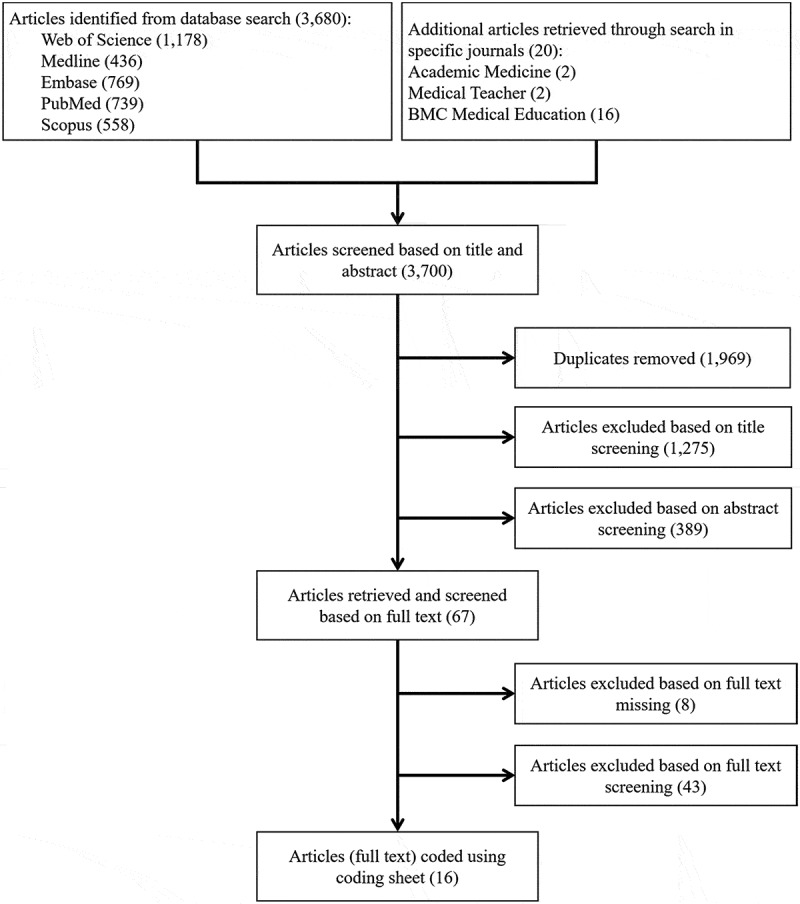
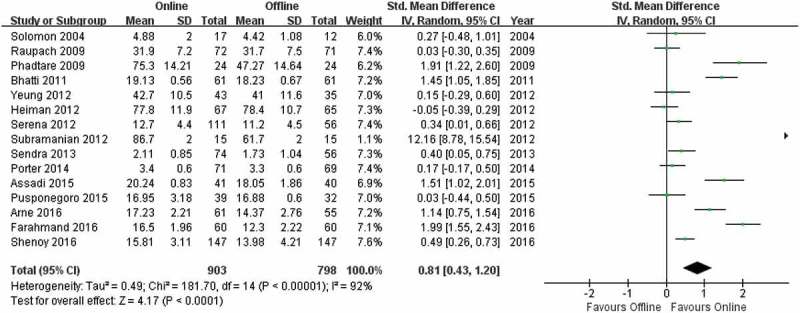
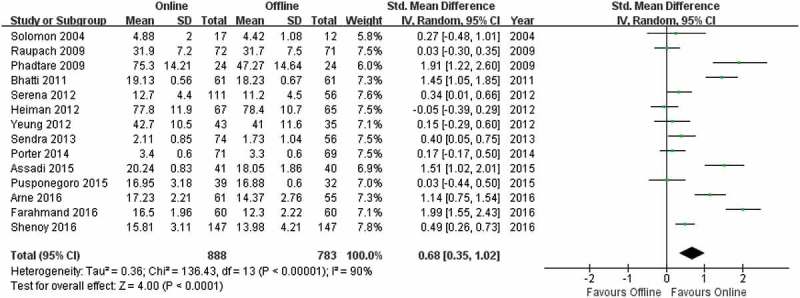
With the increasing use of technology in education, online learning has become a common teaching method. How effective online learning is for undergraduate medical education remains unknown. This article's aim is to evaluate whether online learning when compared to offline learning can improve learning outcomes of undergraduate medical students. Five databases and four key journals of medical education were searched using 10 terms and their Boolean combinations during 2000-2017. The extracted articles on undergraduates' knowledge and skill outcomes were synthesized using a random effects model for the meta-analysis.16 out of 3,700 published articles were identified. The meta-analyses affirmed a statistically significant difference between online and offline learning for knowledge and skill outcomes based on post-test scores (SMD = 0.81; 95% CI: 0.43, 1.20; p < 0.0001; n = 15). The only comparison result based on retention test scores was also statistically significant (SMD = 4.64; 95% CI: 3.19, 6.09; p < 0.00001). The meta-analyses discovered no significant difference when using pre- and post-test score gains (SMD = 3.03; 95% CI: -0.13, 4.13; p = 0.07; n = 3). There is no evidence that offline learning works better. And compared to offline learning, online learning has advantages to enhance undergraduates' knowledge and skills, therefore, can be considered as a potential method in undergraduate medical teaching.
Overview
The claims and statistics of this paper haven’t been checked yet.
Free: it reads the open-access text and checks the first 5 claims that cite a source we can check. Create a free account to check every claim.
Integrity signals
Registry
Cites
Statistics
Figures


Verification
Claims the paper makes
The claims and statistics of this paper haven’t been checked yet.
Free: it reads the open-access text and checks the first 5 claims that cite a source we can check. Create a free account to check every claim.
Claims other papers make about this one
Each is checked against this paper’s own text: does it say what the citing paper says it does?
The cited source says what the claim attributes to it.
In the citing paper
“Online learning allows teaching and learning to be done separately using internetbased information delivery systems [21].”
From Impact of online learning on student's performance and engagement: a systematic review (2024) · cites this paper as [21]
Self-check
Percentages, sums and reported differences re-computed from the paper’s own numbers.
The self-check needs the paper’s full text.
Citations
Cites
Measuring inconsistency in meta-analyses
Higgins, J. P. T., Thompson, S. G., Deeks, J. J., & Altman, D. G. (2003) · BMJ · doi:10.1136/bmj.327.7414.557 · Cited by 63,139 · cited 1×
“The statistical heterogeneity was calculated using the I(2) statistic [16].”
MethodDermyshi, E., Wang, Y., Yan, C., Hong, W., Qiu, G., Gong, X., & Zhang, T. (2017) · Neonatology · doi:10.1159/000454668 · Cited by 24,451
Liberati, A., Altman, D. G., Tetzlaff, J., Mulrow, C., Gotzsche, P. C., Ioannidis, J. P. A., Clarke, M., Devereaux, P. J., Kleijnen, J., & Moher, D. (2009) · BMJ · doi:10.1136/bmj.b2700 · Cited by 17,648
Liberati, A., Altman, D. G., Tetzlaff, J., Mulrow, C., Gøtzsche, P. C., Ioannidis, J. P. A., Clarke, M., Devereaux, P. J., Kleijnen, J., & Moher, D. (2009) · Journal of Clinical Epidemiology · doi:10.1016/j.jclinepi.2009.06.006 · Cited by 10,578
Mayer, R. E. (2009) · doi:10.1017/cbo9780511811678 · Cited by 7,800
Mayer, R. (2020) · doi:10.1017/9781316941355 · Cited by 7,777
Cook, D. A., Hatala, R., Brydges, R., Zendejas, B., Szostek, J. H., Wang, A. T., Erwin, P. J., & Hamstra, S. J. (2011) · JAMA · doi:10.1001/jama.2011.1234 · Cited by 2,170
Blended Learning in Higher Education: Framework, Principles, and Guidelines
Garrison, D. R., & Vaughan, N. D. (2007) · Wiley eBooks · doi:10.1002/9781118269558 · Cited by 1,609
Internet-Based Learning in the Health Professions: A Meta-analysis
Cook, D. A., Levinson, A. J., Garside, S., Dupras, D. M., Erwin, P. J., & Montori, V. M. (2008) · JAMA · doi:10.1001/jama.300.10.1181 · Cited by 1,498 · cited 2×
“Evaluations have failed to reach consistent conclusions [4,5], resulting in complex decisions when selecting a teaching method for medical education.”
BackgroundStudent barriers to online learning: A factor analytic study
Muilenburg, L. Y., & Berge, Z. L. (2005) · Distance Education · doi:10.1080/01587910500081269 · Cited by 1,219 · cited 1×
“Some factors create barriers for online learning, such as administrative issues, social interaction, academic skills, technical skills, learner motivation, time and support for studies, technical problems, cost and access to the internet [6].”
Background
Research works printed but not linked: 2
- Cattagni A, Farris E Internet access in U.S. Public schools and classrooms: 1994-2000. Educ Stat Q. 2001; 3(4): 85.
- Review Manager (RevMan) [computer program]. Version 5.3. Copenhagen: The Nordic Cochrane Centre, The Cochrane Collaboration; 2014.
Cited by
Items 501–600 of 1,000
Jha, A. N., Gaikwad, V. R., Asar, M., Shah, A. H., Shukla, S., & Galani, V. (2023) · Asian Journal of Research in Pharmaceutical Sciences · doi:10.52711/2231-5659.2023.00046 · Cited by 3
Tasneem, S., & Bano, B. (2023) · Health Professions Educator Journal · doi:10.53708/hpej.v6i2.2537 · Cited by 3
Garg, A., Rathnam, U., Gupta, V., Grover, S., & Manna, S. (2024) · Cureus · doi:10.7759/cureus.62137 · Cited by 3
“A systematic review and meta-analysis found that online learning increased undergraduates' cognitive and psychomotor abilities, compared to conventional face-to-face learning [2].”
BackgroundStudent's Perception of Learning in the New Normal Era of Covid-19
Wati, D. R., Miranti, M. G., Suhartiningsih, S., & Purwidiani, N. (2022) · Innovation of Vocational Technology Education · doi:10.17509/invotec.v18i1.39823 · Cited by 3
“Offline learning is carried out without the internet and can be face to face with educators at the same time and place (Pei & Wu, 2019), although the implementation time is limited (Komarudin & Prabowo, 2020), the media used are worksheets, modules, PPT, props etc (Suhendro, 2020).”
BackgroundAlrumaihi, N., AlSheikh, M. H., Zaini, R. G., Alamri, A. A., Patel, A. A., Alassiri, A. H., Ageely, H., Abdulghani, H. M., Alamro, A., Alrumayyan, A., et al. (2022) · Journal of Nature and Science of Medicine · doi:10.4103/jnsm.jnsm_50_21 · Cited by 3
Consorti, F., & Consorti, G. (2021) · Tutor · doi:10.13135/1971-8551/5670 · Cited by 3
THE FORCE FIELD ANALYSIS OF ONLINE LEARNING
Shamsher, S., Praba, T., & Sethuraman, K. R. (2021) · Asian Journal of Medicine & Health Sciences · Cited by 3
Inspiration amidst crisis: E-learning in a medical school of Nepal during COVID-19 pandemic
Pandey, M., & Aryal, B. (2020) · Canadian Medical Education Journal · doi:10.36834/cmej.70759 · Cited by 3
Returning in‘new normal’– a thematic analysis of Twitter chat by pharmacy students
Ali, M., Alhajjaji, A., Kurdi, A., Faqeh, S., Alansari, S., Abdulaziz, A., & Allihyani, M. (2021) · Journal Of Advanced Pharmacy Education And Research · doi:10.51847/tifawab · Cited by 3
Bauer, K. M., Corcorran, M. A., Budak, J. Z., Johnston, C., & Spach, D. H. (2021) · Sexually Transmitted Diseases · doi:10.1097/olq.0000000000001462 · Cited by 3
Lessons Learned During the Pandemic: Recommendations for Kinesiology Programs’ Emerging Future
Leary, M. E., Bryner, R. W., & Eddo, O. O. (2021) · Kinesiology Review · doi:10.1123/kr.2021-0050 · Cited by 3
Debnath, K. (2020) · MedEdPublish · doi:10.15694/mep.2020.000272.2 · Cited by 3
Identification of Students' Online Learning Readiness (KBO) in the Post-Pandemic Period
Darmiany, D., Erfan, M., & Maulyda, M. A. (2023) · Jurnal Penelitian Pendidikan IPA · doi:10.29303/jppipa.v9i6.3987 · Cited by 3
Teaching Epidemiology: An Overview of Strategies and ConsiderationsPreprint
Hossain, M. M. (2022) · SSRN Electronic Journal · doi:10.2139/ssrn.4141332 · Cited by 3
Leadership Capability Framework for the Queensland Public Sector – Interim Evidence Review
Hastings, B. J., Gary, M. S., Jackson, C. J., Criado‐Perez, C., Cahill, A., Hodroj, B., & Cunico, G. (2024) · Research insights · doi:10.54810/cvpc9985 · Cited by 3
Reshaping the Undegraduate Curriculum Development and Delivery through Visual AnalyticsPreprint
Fatima, S., Khan, R. A., & Arooj, M. (2024) · Research Square · doi:10.21203/rs.3.rs-5135234/v1 · Cited by 3
Liu, Y. (2021) · Tuwhera (Auckland University of Technology) · Cited by 3
Understanding, assessing, and facilitating entrepreneurship competence in the digital age
Chen, L. (2023) · MADOC (University of Mannheim) · Cited by 3
Lanzieri, N., Maher, S., & Munson, M. R. (2023) · Journal of Social Work Education · doi:10.1080/10437797.2023.2263511 · Cited by 2
“Given the diverse educational curricula in both disciplines, course formats have proliferated, ranging from brief and specific modules (Pei & Wu, 2019) to semester-long courses that combine hybrid, flipped, and blended modalities (O’Doherty et al., 2018; Pei & Wu, 2019).”
A comparison of in-person vs. asynchronous learning with self-care patient cases
Donohoe, K. L., Eukel, H. N., Riskin, J. W., Ahmed‐Sarwar, N., Ohman, T., Sutton, E. M., Powers, K. E., & Caldas, L. M. (2024) · Currents in Pharmacy Teaching and Learning · doi:10.1016/j.cptl.2023.12.022 · Cited by 2
Hrdy, M., Faig, W. G., Ren, D., Lee, B., Tay, K., Guttadauria, B. C., Zaveri, P. P., Lavoie, M., & Zhao, X. (2024) · Pediatric Emergency Care · doi:10.1097/pec.0000000000003256 · Cited by 2
Innovative Teaching Methods in Healthcare Education: A Comparative analysis
Soni, I., Mane, M., Singh, S. K., Upadhye, V. J., Deo, R. C., Saini, P., & Surale-Patil, S. A. (2024) · Health Leadership and Quality of Life · doi:10.56294/hl2024.394 · Cited by 2
The impact of online teaching curricula on undergraduate basic surgical skills acquisition
Tandon, D., Gupta, A., Patel, R., Shukla, A., Gill, S. S., Patel, R. E., Krishnan, K., Yassa, B., Tandon, S., Rai, A. K., et al. (2025) · Surgery Open Science · doi:10.1016/j.sopen.2025.06.002 · Cited by 2
“Online formats often enable asynchronous learning, allowing students to practise at their own pace and revisit instructional videos, which can reinforce procedural memory and motor skills acquisition [33,34].”
Acharya, T. A., Chinawale, C. G., Mer, R. J., Chhaiya, S., & Trivedi, M. D. (2025) · Cureus · doi:10.7759/cureus.90862 · Cited by 2
Anis, R., Shafique, S., Alam, F., & Feroze, H. (2025) · Pakistan Journal of Medical Sciences · doi:10.12669/pjms.41.10.10817 · Cited by 2
“6 The potential of video podcasts to provide an engaging learning environment may be diminished by these factors.”
AAPM WGTEACH Report 366: Best practices in the teaching and mentoring of medical physics
Montemayor, V. J., Bossart, E. L., Burmeister, J. W., Cetnar, A. J., Deeley, M. A., Fagerstrom, J. M., Harper, J. M., Homann, K. L., James, J. R., Lee, T. K., et al. (2025) · Journal of Applied Clinical Medical Physics · doi:10.1002/acm2.70259 · Cited by 2
Geng, W., Cao, J., Hu, J., Duan, Y., Li, T., Jiang, Y., Shi, L., & Wei, J. (2025) · Frontiers in Medicine · doi:10.3389/fmed.2025.1685789 · Cited by 2
“Changes in empathy and DPR orientation scores by gender and specialty before and after the training were presented in the Supplementary Tables 1, 2.”
Turkel, S., Ramirez‑Vasquez, M., Abdi, J., & Nasr, P. (2026) · American Journal of Clinical Pathology · doi:10.1093/ajcp/aqaf155 · Cited by 2
Putri, N. I., & Basikin, B. (2025) · JOURNAL OF EDUCATIONAL SCIENCES · doi:10.31258/jes.9.4.p.2313-2322 · Cited by 2
Chemotherapy Training Model To Improve Nurse Competence In The New Life Order Era
Poetri Srioetari, S. (2022) · Journal Of World Science · doi:10.58344/jws.v1i5.39 · Cited by 2
Uso de videos como material complementario en la enseñanza de la Otorrinolaringología
Morales‐Puebla, J. M., Gómez-Camacho, H., Gavilán, J., & Lassaletta, L. (2023) · Revista ORL · doi:10.14201/orl.31242 · Cited by 2
“Sin embargo, existe controversia al respecto, pues sin dejar de reconocer la utilidad de los videos como complemento didáctico, algunos autores defienden la superioridad de la enseñanza presencial demostrando en sus estudios mejores resultados académicos en el grupo de enseñanza presencial frente al grupo de enseñanza…”
BackgroundUse of Active Learning During Emergency Remote Teaching in COVID-19 Pandemic
Testa, G., Souza, M. B. D. O., Paes, Â. T., & Magdalon, J. (2023) · Medical Science Educator · doi:10.1007/s40670-023-01816-w · Cited by 2
“Two meta-analyses comparing online with faceto-face teaching in healthcare courses applied before the COVID-19 pandemic showed that the online learning process showed to be as efficient as the face-to-face process [14, 15].”
BackgroundEffectiveness of E-learning in primary education
Kumar, V. (2021) · doi:10.52783/nveo.5502 · Cited by 2
Shafei, I. (2023) · Springer eBooks · doi:10.1007/978-981-99-5211-3_19 · Cited by 2
Alani, F., Alfonso, M., & Grewal, R. (2024) · Creative Education · doi:10.4236/ce.2024.156062 · Cited by 2
“Furthermore, in a systematic review reported by Pei & Wu (2019), the authors present that while online learning was comparable to face-to-face learning, corroborating online-learning being effective compared to in-person learning has yet to be confirmed.”
BackgroundAisyah, D., Mudinillah, A., Rezi, M., & Hanifaturrahmi, H. (2024) · Tanwir Arabiyyah Arabic As Foreign Language Journal · doi:10.31869/aflj.v4i1.5425 · Cited by 2
Fostering Self-Directed Learning Capacity in Medical Students through Learning Online Course
Wang, Z., Weı, C., Yang, Y., Wang, H., Wang, Z., & Chen, Y. M. (2024) · Creative Education · doi:10.4236/ce.2024.1512145 · Cited by 2
Marotta, D. A., Aita, S. L., Witten, A. J., Haider, A. S., & Cohen‐Gadol, A. (2022) · World Neurosurgery · doi:10.1016/j.wneu.2021.09.028 · Cited by 2
Ara, M. Y., Karim, M. A., & Nandi, D. (2022) · International Conference on Computing Advancements (ICCA) · doi:10.1145/3542954.3543030 · Cited by 2
“The purpose of this study [3] is to see if online learning may enhance learning outcomes for undergraduate medical students when compared to offline learning.”
BackgroundАналіз дистанційного навчання іноземних громадян у медичних закладах вищої освіти України
Reznikov, Y. P., & Andrushko, I. I. (2022) · Науковий вісник Ужгородського університету Серія Медицина · doi:10.32782/2415-8127.2022.65.13 · Cited by 2
Looking for patterns of change amid pandemic period in students’ evaluation of academic teaching
Sarra, A., Evangelista, A., Iannone, B., & Battista, T. D. (2022) · Quality & Quantity · doi:10.1007/s11135-022-01567-7 · Cited by 2
“Additionally, further comparative surveys were aimed at exploring whether face-to-face or traditional teaching methods are more productive or whether online or hybrid learning is better (Gonzalez-Gomez et al. 2016; Lockman and Schirmer 2020; Pei and Wu 2019).”
BackgroundBoulos, A. N. (2023) · Clinical Anatomy · doi:10.1002/ca.24047 · Cited by 2
Lamminmäki, A., Hökkä, M., Hirvonen, O., Rahko, E. K., Saarto, T. H., & Lehto, J. T. (2023) · Journal of Palliative Care · doi:10.1177/08258597231171823 · Cited by 2
“36 However, a Cochrane review including 16 randomized trials about E-learning for different groups of healthcare professionals challenged this through a conclusion statement: “ compared to traditional learning, E-learning may make little or no difference in patient outcomes or health professionals…”
BackgroundPharmacy Students’ Perceptions of Remote versus Face-to-Face Learning Experience
Mills, J. M., VanAtta, C. N., Hendershot, R. S., & Rao, S. (2023) · Pharmacy · doi:10.3390/pharmacy11030097 · Cited by 2
“Remote learning has not been shown to be less effective than FTF learning for undergraduate medical students [9].”
BackgroundRupani, S., Trimble, N. S., Schweinle, W. E., & Hulse, B. (2023) · The Journal of Physician Assistant Education · doi:10.1097/jpa.0000000000000521 · Cited by 2
Ye, J.-J., Zhao, Y.-K., Teng, Z.-S., Ye, H.-W., Yuan, Q., & Nie, X. (2023) · World Journal of Clinical Cases · doi:10.12998/wjcc.v11.i21.5063 · Cited by 2
Influence of Learning Intervention on Online Learners’ Performance
Ren, L., Fu, K., & Cao, R. (2023) · International Journal of Emerging Technologies in Learning (iJET) · doi:10.3991/ijet.v18i16.42297 · Cited by 2
Kamalisabeti, A., Sedeh, S. S., Rafatjou, R., & Farhadian, M. (2023) · Avicenna journal of dental research · doi:10.34172/ajdr.2023.1683 · Cited by 2
“Aljarbou and Riyahi (24) and Pei and Wu (25) obtained similar findings in this regard.”
ResultYamaguchi, H., Kagoshima, S., Okura, Y., Nakanishi, Y., Kawahito, K., & Tani, K. (2023) · The Journal of Medical Investigation · doi:10.2152/jmi.70.483 · Cited by 2
Hosseini, S. A., & Amirkhani, Z. (2023) · International Journal of Multicultural and Multireligious Understanding · doi:10.18415/ijmmu.v10i10.5142 · Cited by 2
“In recent years, numerous studies have examined assessing the impacts of synchronous and asynchronous learning methods on different aspects of education (Bartley & Golek, 2004; Pei & Wu, 2019; Shirkhani & Shiran, 2023; Zeinali Nejad, Golshan, & Naeimi, 2021).”
BackgroundBalmith, M., Cordier, W., Bhayat, A., Basson, C., Morule, M., & Schellack, N. (2024) · International Journal of Dental Hygiene · doi:10.1111/idh.12794 · Cited by 2
Gür, D., Offergeld, C., Fabry, G., & Wünsch, A. (2024) · HNO · doi:10.1007/s00106-024-01475-2 · Cited by 2
Kgare, K. S., Maepane, C., Mabusela, G., Mphahlele, M., & Rinae, R. (2024) · Atlantis highlights in social sciences, education and humanities/Atlantis Highlights in Social Sciences, Education and Humanities · doi:10.2991/978-94-6463-439-6_10 · Cited by 2
Fawzy, N. A., Arabi, T. Z., Dabaliz, A., Shaar, B. A., Baqal, O. J., Taha, R. M., Baqal, E. J., Alkodaymi, M. S., Obeidat, A. S., & Ouban, A. (2024) · Frontiers in Psychiatry · doi:10.3389/fpsyt.2024.1359348 · Cited by 2
Research on Evaluation of Online Education Effectiveness Based on AI Teaching Aid System
An, X. (2024) · Applied Mathematics and Nonlinear Sciences · doi:10.2478/amns-2024-2849 · Cited by 2
Ruiz, P., Cáceres-Hernández, A., König-López, B., Quintana-Guiñez, F., & Castro-Cruz, M. (2024) · Revista Médica Clínica Las Condes · doi:10.1016/j.rmclc.2024.05.012 · Cited by 2
Online Framework of Examination for EvaluatingLearner’s Knowledge
Das, B., Debnath, R., & Khatua, D. (2024) · International Journal of Education and Management Engineering · doi:10.5815/ijeme.2024.06.05 · Cited by 2
Training Motor and Specialized Skills Online: A Systematic Review
Kim, T., Park, J., Yun, S., & Yli-Piipari, S. R. (2025) · Kinesiology Review · doi:10.1123/kr.2024-0018 · Cited by 2
Jan, H., Fatima, A., Ahmad, M. B., Arshad, A., Abideen, M. Z. U., & Tareen, J. (2024) · Journal of Rawalpindi Medical College · doi:10.37939/jrmc.v28i3.2594 · Cited by 2
Exploring the implementation of online learning at medical-CLIL classes: EFL students’ satisfaction
Khoiriyah, K., Roy, S., & Hasan, M. K. (2025) · Journal of Education and e-Learning Research · doi:10.20448/jeelr.v12i4.7798 · Cited by 2
“Furthermore, some research also found that students who took part in either fully or partially online courses outperformed those who attended in-person sessions (Farahmand et al., 2016; Pei & Wu, 2019; Subramanian, Timberlake, Mittakanti, Lara, & Brandt, 2012).”
Ladas, V., Afendouli, P., & Louka, P. (2021) · Dialogues in Clinical Neuroscience & Mental Health · doi:10.26386/obrela.v4i3.155 · Cited by 2
Rishipathak, P., Bhandari2, M., & Hinduja3, A. (2020) · Indian Journal of Forensic Medicine & Toxicology · doi:10.37506/ijfmt.v14i4.12205 · Cited by 2
Evaluating Preceptee’s Learning Achievements During the Covid-19 Pandemic
Rumbo, H., Mbaloto, F. R., Mauruh, C. V., Metungku, F., Sondakh, J. R., & Ambabunga, S. (2021) · KnE Life Sciences · doi:10.18502/kls.v6i1.8618 · Cited by 2
“According to Pei & Wu, to ensure the effectiveness of online learning, digital learning design principles, materials, learning objectives, and student preferences and characteristics must be rigorously evaluated [4].”
BackgroundNurshahidah, S. A. S., Sufiean, H. M., Rauf, R. A., Yahaya, F. Y., Shafezah, A. W., & Hamidah, I. (2021) · AIP conference proceedings · doi:10.1063/5.0051618 · Cited by 2
Freire, M. M., Dias, V. C. A., Rita, A. C. M. S., Gomes, L. F. M., Gagossian, D. I., Costa, A. B., & Lazaroni, T. L. D. N. (2021) · Revista Eletrônica Acervo Saúde · doi:10.25248/reas.e8883.2021 · Cited by 2
Chaudhuri, A., Mondal, T., Paul, S., & Goswami, A. (2021) · Medical Journal of Dr D Y Patil Vidyapeeth · doi:10.4103/mjdrdypu.mjdrdypu_506_20 · Cited by 2
ELGHARIEB, M. S. F. H. A. N., & ABDELAZEIM, F. H. (2021) · The Medical Journal of Cairo University/The Medical Journal of Cairo University · doi:10.21608/mjcu.2021.203330 · Cited by 2
Hunt, J., Anderson, S. L., Winter, M. D., Hack, G. O., & Berry, C. R. (2022) · Journal of Veterinary Medical Education · doi:10.3138/jvme-2021-0101 · Cited by 2
Shanta, S. A. (2022) · Journal of Management Info · doi:10.31580/jmi.v8i4.2080 · Cited by 2
Practical postgraduate teaching in Human Anatomy: A review
Departamento de Anatomía y Embriología Humanas, U. C. D. M., Sañudo, J. R., PHD, E. F. T. J., Duparc, F., Paulsen, F. P., Macchi, V., Feigl, G., Elizondo‐Omaña, R. E., De, R., Aragonés, P., et al. (2021) · European Journal of Anatomy · doi:10.52083/zdge3745 · Cited by 2
Jamaludin, S. Y. N., & Ibrahim, M. S. (2022) · International Journal of Learning Teaching and Educational Research · doi:10.26803/ijlter.21.5.3 · Cited by 2
“The random-effects statistical model established no significant difference between the two mediums of teaching delivery in pre- and post-test scores (Pei & Wu, 2019).”
BackgroundMethodPerceptions of Digital Teaching During COVID-19; A National Survey of 359 Internal Medicine Trainees
Sivananthan, A., Nicholas, V., Kerry, G., Harlow, C. F., Saha, P., Younan, H.-C., Williams, S., David, L., Lisk, C., & Schofield, L. (2022) · Advances in Medical Education and Practice · doi:10.2147/amep.s355786 · Cited by 2
“Notably, a systematic review found that online and offline teaching is equivalent in terms of exam results for undergraduates.(5) Evidence for the role of online medical education in postgraduates is more limited.”
BackgroundThe perceptions of dental hygiene students about an asynchronous oral biology course.
Sharmin, N., & Chow, A. K. (2022) · PubMed Central · Cited by 2
Ashour, L., & Funjan, K. (2022) · PubMed Central · doi:10.12865/chsj.48.04.06 · Cited by 2
“…distance learning has been a proposed method of learning for medical students and students of different health-oriented disciplines, and is now a popular teaching method in many countries [7,8], with many methods being used as a way to implement the idea of distance learning in educational systems.”
MethodFrom Online to In-Person: Indonesian Students’ Insights on Education Post-pandemic
Novita, D., Megawati, F., Agustina, S., Rachmawati, D. L., & Cahyani, C. R. (2023) · Advances in Social Science, Education and Humanities Research/Advances in social science, education and humanities research · doi:10.2991/978-2-38476-052-7_9 · Cited by 2
Thormann, M., Neumann, H., Behme, D., & Surov, A. (2023) · Die Radiologie · doi:10.1007/s00117-023-01185-w · Cited by 2
Ismail, F. A., Jaapar, N. H., Saidon, R., Ayob, M. A. S., & Mustaffa, F. (2023) · International Journal of Academic Research in Business and Social Sciences · doi:10.6007/ijarbss/v13-i7/17808 · Cited by 2
“The effectiveness of online learning varied, which is as or more effective than offline learning for some target knowledge and skills and also the students despite the uncertainties of online learning it should be allowed in (Pei and Wu, 2019).”
BackgroundIBRAHIM, A., & Shafia, A. (2020) · The Maldives National Journal of Research · doi:10.62338/6zqmcg64 · Cited by 2
DISTINGSI HASIL BELAJAR BIOLOGI SISTEM DARING DAN LURING: STUDI DI SMUN 1 BOJONEGORO
Wakhidah, N., & Wahyuni, D. (2022) · JURNAL BIOEDUCATION · doi:10.29406/bioed.v9i1.3481 · Cited by 2
Casavilca, M. A. M., Sinti, C. A. S., Flecha, E. C., & Medina, M. D. P. (2026) · Teaching and Learning in Medicine · doi:10.1080/10401334.2026.2618480 · Cited by 2
Using Drugs to Keep Learning Active During a Pandemic
Lee, M. W. (2020) · Medical Science Educator · doi:10.1007/s40670-020-01024-w · Cited by 2
“It remains to be determined how presenting this material in an online format will affect student performance on formative and summative assessments, but a recent meta-analysis suggests that those differences may be minor, but slightly favor online learning [6].”
BackgroundZhao, P., Zhang, X., Fan, Y., & Wang, H. (2022) · Research Square · doi:10.21203/rs.3.rs-1813585/v1 · Cited by 2
de Rooij, D. (2024) · doi:10.5463/thesis.359 · Cited by 2
Tias, S. A. (2024) · Dublin City University Open Access Institutional Repository (Dublin City University) · Cited by 3
A Systematic Review of Online Teaching during COVID-19 Pandemic: A Lock Opened in Lockdown
Padwal, M. K., & Takale, L. R. (2022) · Indian Journal of Medical Biochemistry · doi:10.5005/jp-journals-10054-0189 · Cited by 1
Mohite, P. (2022) · International Journal of Nursing Education · doi:10.37506/ijone.v14i3.18362 · Cited by 1
Western, L. F., Gillam, L., Moore, C., Wong, K., & Hinchliffe, R. J. (2022) · BMC Medical Education · doi:10.1186/s12909-022-03961-z · Cited by 1
Assessment of Virtual Peer Learning by Peer Feedback: A Pilot Project
Uthraraj, N. S., Charles, N. M., Garcia, S., Maatough, A., Anazor, F. C., Krishnamurthy, S., Sriraam, L. M., Venkatachalam, K. U. C., & Relwani, J. (2022) · Cureus · doi:10.7759/cureus.30596 · Cited by 1
“It is shown to have similar outcomes to conventional faceto-face teaching [2].”
BackgroundResultSripadungkul, D., Sripadungkul, S., Boonmak, S., & Boonmak, P. (2023) · Korean journal of medical education · doi:10.3946/kjme.2023.248 · Cited by 1
EdTech: Concept And Connections
Natalia, B. (2022) · International Conference on Electronics, Communications and Computing (IC|ECCO) · doi:10.52326/ic-ecco.2022/kbs.01 · Cited by 1
“…Chen, Lambert, & Guidry, 2010 [2]; Tamim, Bernard, 20-21 October, 2022 Chisinau, Republic of Moldova IC ECCO-2022 The 12th International Conference on Electronics, Communications and Computing Borokhovski, Abrami, & Schmid, 2011 [3]; Means, Toyama, Murphy, & Baki, 2013 [4]; Pei & Wu, 2019 [5]).”
张, 一. (2023) · Advances in Social Sciences · doi:10.12677/ass.2023.126422 · Cited by 1
Ladwig, A., Berg-Poppe, P. J., Ikiugu, M. N., & Ness, B. M. (2023) · Applied Cognitive Psychology · doi:10.1002/acp.4119 · Cited by 1
Orak, S. D. (2023) · Advances in higher education and professional development book series · doi:10.4018/978-1-6684-8546-0.ch008 · Cited by 1
Maimun, M., & Jannah, M. (2023) · Jurnal Ilmiah Mandala Education · doi:10.58258/jime.v9i3.5894 · Cited by 1
A REVIEW OF ONLINE LEARNING IMPACTS DURING PANDEMIC COVID-19 AMONG UNIVERSITY STUDENTS
Salam, S. N. A., Yap, H. Y., Yap, H. M., & Annamalai, S. (2023) · International Journal of Education Psychology and Counseling · doi:10.35631/ijepc.850048 · Cited by 1
Sreedevi, A., Raghunathan, D., Ramakrishnan, D., Sruthi, K. S., Mahadev.S.B, S., & Agneya., G. (2023) · Journal of Indian Association of Public Health Dentistry · doi:10.4103/jiaphd.jiaphd_49_22 · Cited by 1
The Effect of Teaching Methods and Formal Reasoning Ability on Student Learning Outcomes
Sappaile, B. I., & Nuridayanti, N. (2024) · Journal International Inspire Education Technology · doi:10.55849/jiiet.v3i1.601 · Cited by 1
“In the context of education, formal reasoning is an important cognitive ability in problem solving, critical thinking, and higher learning (Alalwan et al., 2019).”
Background(2024) · Frontiers research topics · doi:10.3389/978-2-8325-4913-1 · Cited by 1
Jain, A., Shamoon, M., Diller, D., & Riddell, J. (2024) · Cureus · doi:10.7759/cureus.60784 · Cited by 1
“Existing studies of asynchronous courses have examined learner reactions and educational effectiveness but have neglected to consider how learners behave when engaging with asynchronous material [11,12].”
BackgroundResultBENEFITS AND DISBENEFITS OF ONLINE TEACHING DURING THE PANDEMIC: STUDENTS’ LEARNING EXPERIENCE
Khan, S. P., Shaikh, M., Hamidani, M. A. A., Raja, I. H., Mubeen, S. A., & Naqvi, S. F. (2023) · Pakistan Journal of Physiology · doi:10.69656/pjp.v19i1.1493 · Cited by 1
Metadata
- Authors
- Pei, L., & Wu, H.
- Affiliations
- Institute of Basic Education Science, Beijing Academy of Educational Sciences, Beijing, China
- Peking University (CN)
- Corresponding author
- Wu, Hongbin
- ORCID
- Wu, Hongbin
- Venue
- Medical Education Online
- Publisher
- Informa UK Limited
- Published
- 2019-01-01
- Volume
- 24
- Issue
- 1
- Pages
- 1666538
- ISSN
- 1087-2981 (ISSN-L)
- PMC
- PMC6758693
- OpenAlex
- W2973845887
- Cited by
- 852
- References
- 49
- Citations by year
- 2026: 36 · 2025: 59 · 2024: 130 · 2023: 185 · 2022: 214 · 2021: 165 · 2020: 63
- FWCI
- 18.07
- Type
- journal article
- Language
- en
- Open access
- gold
- doi.org
- Licence
- Locations
- Medical Education Online (publishedVersion, cc-by)
- PubMed Central (publishedVersion, cc-by)
- PubMed (publishedVersion)
- DOAJ (DOAJ: Directory of Open Access Journals) (submittedVersion, cc-by-sa)
- Topics
- Social Sciences › Education › Innovations in Medical Education
- Social Sciences › Education › Online and Blended Learning
- Health Sciences › Health Professions › General Health Professions › Health and Medical Education
- Keywords
- online learning, offline learning, undergraduate medical education, learning outcomes, knowledge retention, clinical skills, e-learning effectiveness, medical students
- MeSH terms
- Education, Medical, Undergraduate, Humans, Students, Medical, Teaching, Education, Distance, Internet
About these checks
Registry, retraction, Cites and statistics results are computed, not judged, with one exception: a printed reference that no index lists is read once by a model before it counts as a citation error. Claims are extracted by a model and kept only when their quote appears verbatim in the text; each cited source is then checked, with a model’s help, for whether it says what the claim relies on. Those verdicts can be wrong — read the claim’s quote and the cited source before relying on one.
Statistics and arithmetic are recomputed, not judged.
Confidence bands are shown only for fields calibrated on our annotated test set. None is calibrated yet, so no band is shown.
What counts as a claim ›How we measure confidence ›How we check this ›
Are you an author, or do you see a problem with this page? Request a review
Data sources
Bibliographic data: Semantic Scholar, OpenAlex, Crossref.
Contains information from the Semantic Scholar Academic Graph Datasets, made available under the ODC Attribution License (ODC-BY 1.0).
Semantic Scholar’s data is described in: Kinney, R., et al. (2023). The Semantic Scholar Open Data Platform. arXiv:2301.10140.
