

Does online learning work better than offline learning in undergraduate medical education? A systematic review and meta-analysis
Open accessThe DOI matches its Crossref record; 49 of the 49 references it cites were found in a registry or an index.
Abstract
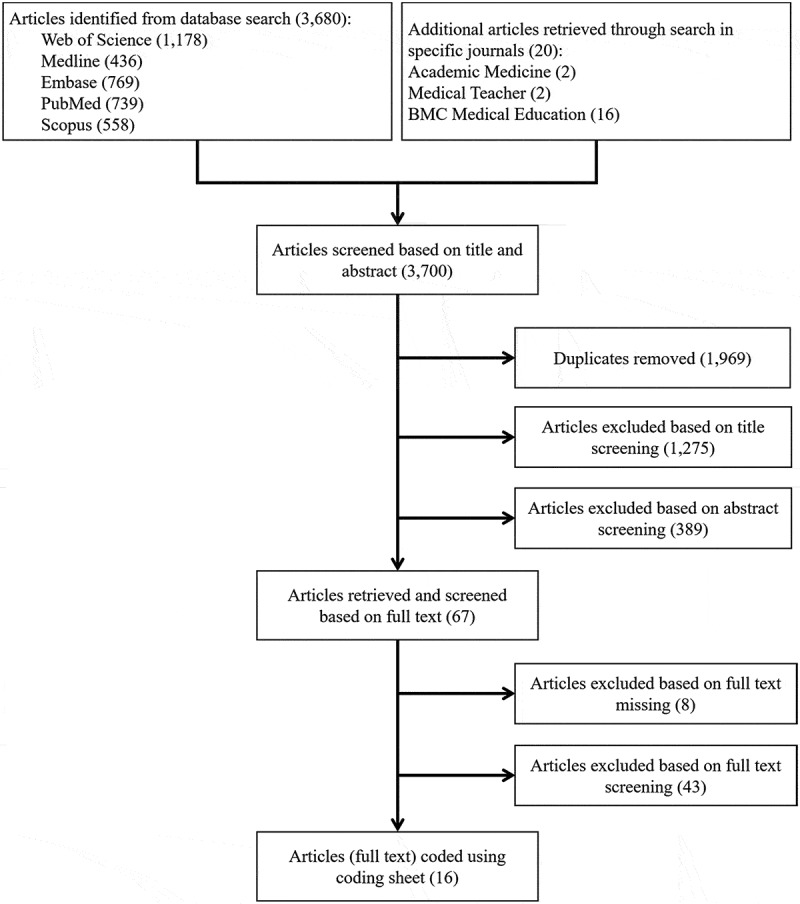
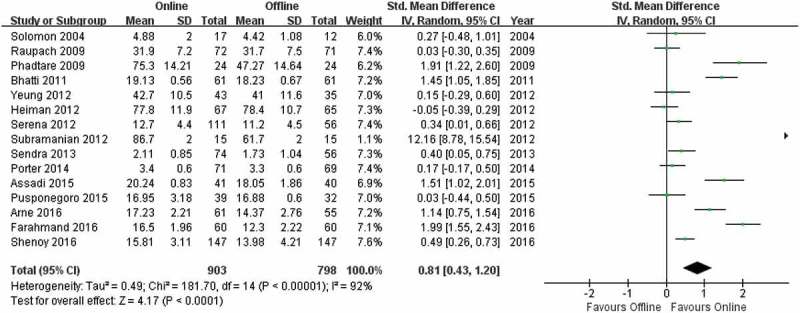
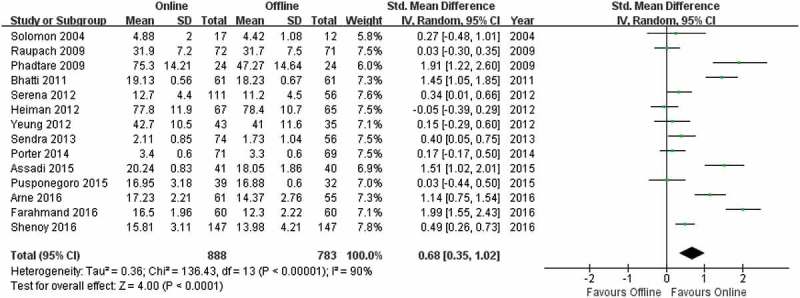
With the increasing use of technology in education, online learning has become a common teaching method. How effective online learning is for undergraduate medical education remains unknown. This article's aim is to evaluate whether online learning when compared to offline learning can improve learning outcomes of undergraduate medical students. Five databases and four key journals of medical education were searched using 10 terms and their Boolean combinations during 2000-2017. The extracted articles on undergraduates' knowledge and skill outcomes were synthesized using a random effects model for the meta-analysis.16 out of 3,700 published articles were identified. The meta-analyses affirmed a statistically significant difference between online and offline learning for knowledge and skill outcomes based on post-test scores (SMD = 0.81; 95% CI: 0.43, 1.20; p < 0.0001; n = 15). The only comparison result based on retention test scores was also statistically significant (SMD = 4.64; 95% CI: 3.19, 6.09; p < 0.00001). The meta-analyses discovered no significant difference when using pre- and post-test score gains (SMD = 3.03; 95% CI: -0.13, 4.13; p = 0.07; n = 3). There is no evidence that offline learning works better. And compared to offline learning, online learning has advantages to enhance undergraduates' knowledge and skills, therefore, can be considered as a potential method in undergraduate medical teaching.
Overview
The claims and statistics of this paper haven’t been checked yet.
Free: it reads the open-access text and checks the first 5 claims that cite a source we can check. Create a free account to check every claim.
Integrity signals
Registry
Cites
Statistics
Figures


Verification
Claims the paper makes
The claims and statistics of this paper haven’t been checked yet.
Free: it reads the open-access text and checks the first 5 claims that cite a source we can check. Create a free account to check every claim.
Claims other papers make about this one
Each is checked against this paper’s own text: does it say what the citing paper says it does?
The cited source says what the claim attributes to it.
In the citing paper
“Online learning allows teaching and learning to be done separately using internetbased information delivery systems [21].”
From Impact of online learning on student's performance and engagement: a systematic review (2024) · cites this paper as [21]
Self-check
Percentages, sums and reported differences re-computed from the paper’s own numbers.
The self-check needs the paper’s full text.
Citations
Cites
Measuring inconsistency in meta-analyses
Higgins, J. P. T., Thompson, S. G., Deeks, J. J., & Altman, D. G. (2003) · BMJ · doi:10.1136/bmj.327.7414.557 · Cited by 63,139 · cited 1×
“The statistical heterogeneity was calculated using the I(2) statistic [16].”
MethodDermyshi, E., Wang, Y., Yan, C., Hong, W., Qiu, G., Gong, X., & Zhang, T. (2017) · Neonatology · doi:10.1159/000454668 · Cited by 24,451
Liberati, A., Altman, D. G., Tetzlaff, J., Mulrow, C., Gotzsche, P. C., Ioannidis, J. P. A., Clarke, M., Devereaux, P. J., Kleijnen, J., & Moher, D. (2009) · BMJ · doi:10.1136/bmj.b2700 · Cited by 17,648
Liberati, A., Altman, D. G., Tetzlaff, J., Mulrow, C., Gøtzsche, P. C., Ioannidis, J. P. A., Clarke, M., Devereaux, P. J., Kleijnen, J., & Moher, D. (2009) · Journal of Clinical Epidemiology · doi:10.1016/j.jclinepi.2009.06.006 · Cited by 10,578
Mayer, R. E. (2009) · doi:10.1017/cbo9780511811678 · Cited by 7,800
Mayer, R. (2020) · doi:10.1017/9781316941355 · Cited by 7,777
Cook, D. A., Hatala, R., Brydges, R., Zendejas, B., Szostek, J. H., Wang, A. T., Erwin, P. J., & Hamstra, S. J. (2011) · JAMA · doi:10.1001/jama.2011.1234 · Cited by 2,170
Blended Learning in Higher Education: Framework, Principles, and Guidelines
Garrison, D. R., & Vaughan, N. D. (2007) · Wiley eBooks · doi:10.1002/9781118269558 · Cited by 1,609
Internet-Based Learning in the Health Professions: A Meta-analysis
Cook, D. A., Levinson, A. J., Garside, S., Dupras, D. M., Erwin, P. J., & Montori, V. M. (2008) · JAMA · doi:10.1001/jama.300.10.1181 · Cited by 1,498 · cited 2×
“Evaluations have failed to reach consistent conclusions [4,5], resulting in complex decisions when selecting a teaching method for medical education.”
BackgroundStudent barriers to online learning: A factor analytic study
Muilenburg, L. Y., & Berge, Z. L. (2005) · Distance Education · doi:10.1080/01587910500081269 · Cited by 1,219 · cited 1×
“Some factors create barriers for online learning, such as administrative issues, social interaction, academic skills, technical skills, learner motivation, time and support for studies, technical problems, cost and access to the internet [6].”
Background
Research works printed but not linked: 2
- Cattagni A, Farris E Internet access in U.S. Public schools and classrooms: 1994-2000. Educ Stat Q. 2001; 3(4): 85.
- Review Manager (RevMan) [computer program]. Version 5.3. Copenhagen: The Nordic Cochrane Centre, The Cochrane Collaboration; 2014.
Cited by
Items 201–300 of 1,000
Rossiter, L., Turk, R., Judd, B. K., Brentnall, J., Grimmett, C., Cowley, E. E., McCormick, K. G., & Thackray, D. (2023) · BMC Medical Education · doi:10.1186/s12909-023-04086-7 · Cited by 16
“However, literature is conflicting regarding the efficacy and acceptability of online learning, and there is scant literature concerning online learning specifically for clinical preparation in allied health students [18, 19].”
BackgroundMahbub, M. A. (2021) · TRANSFORMASI Jurnal Pengabdian Masyarakat · doi:10.20414/transformasi.v17i1.3055 · Cited by 16
Karattuthodi, M. S., Sarath Chandran, C., Thorakkattil, S. A., Chandrasekhar, D., Naseef, P. P., Ageeli, M. M. A., & Madathil, H. (2021) · Social Sciences & Humanities Open · doi:10.1016/j.ssaho.2021.100241 · Cited by 16
COVID-19: a catalyst for the digitization of surgical teaching at a German University Hospital
Wolf, M. A., Pizanis, A., Fischer, G., Langer, F., Scherber, P. R., Stutz, J., Orth, M., Pohlemann, T., & Fritz, T. (2022) · BMC Medical Education · doi:10.1186/s12909-022-03362-2 · Cited by 17
Pros and cons of remote medical education in Ukraine in terms of COVID-19 pandemics
Odintsova, T. A., Kopchak, O. O., Bachinskaya, N. Y., Ivniev, B. B., & Pokanevych, O. V. (2022) · Informatics in Medicine Unlocked · doi:10.1016/j.imu.2022.101051 · Cited by 17
“Although a recent systematic review showed that offline teaching and online teaching are equivalent in terms of exam results [11,12], we aimed to analyze the advantages and disadvantages of online learning during the COVID 19 pandemic in the study of neurology at the Department of Neurology, Psychiatry and Physical Re…”
Langseth, I. D., Jacobsen, D. Y., & Haugsbakken, H. (2023) · Technology Knowledge and Learning · doi:10.1007/s10758-023-09647-9 · Cited by 16
“This development is facilitated by new technology, such as open platforms, automated feedback, social and participatory media and video tools, which makes it possible for faculties to develop a social learning environment for a wide range of students online (Conole, 2012; Pei & Wu, 2019).”
Zgheib, N. K., Ali, A., & Sabra, R. (2021) · The Asia Pacific Scholar · doi:10.29060/taps.2021-6-3/oa2377 · Cited by 16
Gummerson, C. E., Lo, B. D., Rodriguez, K. A. P., Cosner, Z. L., Hardenbergh, D., Bongiorno, D. M., Wainger, J. J., Hu, K., Gamaldo, C. E., Salas, R. M. E., et al. (2021) · BMC Medical Education · doi:10.1186/s12909-021-02979-z · Cited by 16
Electronic-learning: Friend or Foe
Kapoor, G., Chahal, A., Sharma, N., Kaur, S., & Hendrik, H. (2022) · International Journal of Educational Reform · doi:10.1177/10567879221140095 · Cited by 15
“Some students have felt that their IT abilities have improved as a result of their online learning (Pei & Wu, 2019, pp. 1666538).”
Mistry, U., Megally, R., & Rashed, R. A. (2024) · Accounting Education · doi:10.1080/09639284.2024.2341242 · Cited by 16
“…and hybrid (asynchronous and synchronous) learning Several comparative studies have been conducted to determine whether online or hybrid (asynchronous and synchronous) learning is superior to traditional face-to-face teaching (González-Gómez et al., 2016; Lockman & Schirmer, 2020; Pei & Wu, 2019).”
Cuberos, R. C., Gamarra-Vengoechea, M. A., Pérez-Mármol, M., Billah, F. Z. R. A., García-Garnica, M., & Sánchez, M. C. (2024) · Revista de Educación a Distancia (RED) · doi:10.6018/red.601931 · Cited by 15
“In this sense, they are forced to better and more efficiently plan their learning and develop strategies that facilitate knowledge assimilation (e.g., outlines and summaries) (Abbas et al., 2024; Broadbent, 2017; Girelli et al., 2018; Jaap et al., 2021; Lin et al., 2017; Pei & Wu, 2019).”
BackgroundMoving online: roadmap and long-term forecast
Radcliffe, J. S., Aaron, D. K., Sterle, J. A., von Keyserlingk, M. A. G., Irlbeck, N. A., Maquivar, M., Wulster-Radcliffe, M. C., & Jones, C. K. (2020) · Animal Frontiers · doi:10.1093/af/vfaa027 · Cited by 15
Shabila, N. P., Alkhateeb, N. E., Dauod, A. S., & Al-Dabbagh, A. (2021) · Work · doi:10.3233/wor-205339 · Cited by 15
“However, a combination of online and offline learning (blended learning environment) might be the most effective way to maximize the benefits [64] and allowing more flexibility in delivering medical education [65].”
BackgroundLollobrigida, M., Ottolenghi, L., Corridore, D., Pingitore, G., Damiano, C., Serafini, G., & Biase, A. D. (2022) · International Journal of Environmental Research and Public Health · doi:10.3390/ijerph191610351 · Cited by 15
“On the other hand, limits of DL have clearly emerged, primarily related to the need for up-to-date computer equipment and adequate domestic environmental conditions and the lesser interaction between students and teachers and among students [29,30].”
BackgroundKeesler, J. M., Purcell, A., & Thomas‐Giyer, J. (2023) · Journal of Applied Research in Intellectual Disabilities · doi:10.1111/jar.13085 · Cited by 15
Alenezi, S., Bahathig, A. M., Soliman, M., Alhassoun, H. Y., Alkadi, N., Albarrak, M., Albadrani, W. F., Alghoraiby, R. M., Alhaddab, A., & Al-Eyadhy, A. A. (2023) · Heliyon · doi:10.1016/j.heliyon.2023.e16844 · Cited by 15
“Although online learning comes with many obstacles, one meta112 analysis and systemic review published months before the pandemic found that online learning 113 was as effective as onsite learning for undergraduate medical students (14).”
BackgroundVirtual grand rounds in COVID‐19: A financial analysis
Crossman, M., Papanagnou, D., Sullivan, T., & Zhang, X. C. (2021) · Academic Emergency Medicine · doi:10.1111/acem.14224 · Cited by 15
Khan, A., Patra, S., Gupta, P., Sharma, A., & Jain, A. (2021) · Journal of Education and Health Promotion · doi:10.4103/jehp.jehp_606_20 · Cited by 15
Parents' Perceptions of Distance Learning during Covid-19 Pandemic in Rural IndonesiaPreprint
Lase, D., Zaluchu, S. E., Daeli, D. O., & Ndraha, A. (2020) · EdArXiv (OSF Preprints) · doi:10.35542/osf.io/hz7t8 · Cited by 15
Thepwongsa, I., Muthukumar, R., Sripa, P., Waraasawapati, S., Jenwitheesuk, K., Virasiri, S., & Nonjui, P. (2023) · Medical Education Online · doi:10.1080/10872981.2023.2299535 · Cited by 14
“Many studies have examined the effectiveness of online educational methods [13–15 ,17, 18].”
BackgroundValle, L. C. (2024) · International Journal of Education and Practice · doi:10.18488/61.v12i3.3723 · Cited by 14
“Furthermore, the results are also consistent with previous studies which demonstrate that the notion of face-to-face interaction in formal classroom settings continues to be the most effective method of instruction (Makruf, Putra, Choiriyah, & Nugroho, 2021; Pei & Wu, 2019; Setyawan, 2019).”
ResultZhou, T., Dong, X., Zhang, L., Chen, W., Zhang, X., Zhang, J., & Chen, J. (2024) · BMC Nursing · doi:10.1186/s12912-024-02200-8 · Cited by 15
“Within a reasonable scope, nursing managers should allow postpartum nurses to return to work early or late according to their own needs, arrange for postpartum nurses to transition from auxiliary to primary positions [57], and combine online and offline methods of training and assessment [58].”
BackgroundRajesh, E., Subramaniam, S., Pasupathy, P., Suresh, T., & Gopichandran, V. (2024) · BMC Medical Education · doi:10.1186/s12909-024-05953-7 · Cited by 14
“They are also immensely advantageous for offering continuing medical education programs for the busy practicing clinician [7].”
BackgroundLifestyle, behavior, perception and practices of Nepalese during lockdown due to COVID-19 pandemic
Kandel, S., Lamsal, M., Yadav, S. A., Bhandari, D., Adhikari, G., Poudel, S., Sharma, P., & Gautam, S. (2020) · Journal of Nepal Medical Association · doi:10.31729/jnma.5284 · Cited by 14
Besche, H. C., Onorato, S. E., Pelletier, S. R., Ashrafzadeh, S., Joshi, A., Nelsen, B., Yoon, J., Zhou, J., Schwartz, A. W., & Cockrill, B. A. (2022) · BMC Medical Education · doi:10.1186/s12909-022-03479-4 · Cited by 15
Sodeify, R., Habibpour, Z., & Akbarbegloo, M. (2022) · Journal of Education and Health Promotion · doi:10.4103/jehp.jehp_147_21 · Cited by 15
“Therefore, combination training is recommended.[30] A similar study of virtual learning during the Corona pandemic found that WhatsApp‐based learning promotes collaborative learning, motivation, and self‐directed learning in students.”
BackgroundStudent Perceptions of the Visual Design of Learning Management Systems
Stoesz, B. M., & Niknam, M. (2023) · Canadian Journal of Learning and Technology · doi:10.21432/cjlt28154 · Cited by 14
“…better outcomes in numerous areas, such as understanding the course structure, communication with instructors, increased engagement and satisfaction with course material, and higher final grades, compared to face-to-face courses (Panigrahi et al., 2018; Pei & Wu, 2019; Soffer & Nachmias, 2018).”
BackgroundTransversal competences and employability: comparing in-person learning and distance education
Kulal, A., Dinesh, S., Abhishek, N., & Rahiman, H. U. (2023) · Cogent Education · doi:10.1080/2331186x.2023.2204716 · Cited by 14
“In another study, Pei and Wu (2019) found a statistically Page 3 of 39 significant difference between online and offline learning for knowledge and skill outcomes, however, they found no evidence to prove the superiority of offline learning over online learning.”
BackgroundInfluentialO’Brien, A., & Forde, C. (2023) · Annals of Medicine · doi:10.1080/07853890.2023.2256656 · Cited by 14
Ridgway, L., McKenna, L., Hokke, S., Hackworth, N. J., & Nicholson, J. M. (2022) · Journal of Professional Nursing · doi:10.1016/j.profnurs.2022.04.007 · Cited by 14
“While there are many positive aspects of online learning, it requires time to develop and implement well (Peddle et al., 2020) and reported experiences vary (Pei & Wu, 2019; Regmi & Jones, 2020; Sarli et al., 2021).”
BackgroundJalali, M., Moradi, V., Babaee, T., Aminian, G., Mojgani, P., & Shahabi, S. (2023) · BMC Medical Education · doi:10.1186/s12909-023-04339-5 · Cited by 14
Daryanto, B., Kurniawan, J., Wiranigitasari, Hioe, F., Nurhadi, P., & Yudhantara, D. S. (2023) · PLoS ONE · doi:10.1371/journal.pone.0285986 · Cited by 13
“The new learning process has provided new challenges to the medical students since they need to promptly improve and update their current body of knowledge during the unprecedented times, as well as to ensure the preparation to be qualified medical doctors by possessing all standard competencies despite limited clinic…”
BackgroundSusanti, S., Putra, R. P., Agustina, R. D., Quy, N. P., Siregar, H. S., & da Silva, J. C. T. (2024) · Indonesian Journal on Learning and Advanced Education (IJOLAE) · doi:10.23917/ijolae.v6i1.22179 · Cited by 15
“Based on the narrative from research conducted by Pei & Wu (2019) which revealed that offline learning is felt to make undergraduate students more enthusiastic, compared to online learning activities, this is because when carrying out offline learning activities, undergraduate students tend to be…”
MethodMuthukumar, R., Thepwongsa, I., Sripa, P., Jindawong, B., Jenwitheesuk, K., & Virasiri, S. (2025) · JMIR Medical Education · doi:10.2196/65779 · Cited by 15
“Web-based education, proven to be as effective as traditional methods [22,23,29,30], offers unique advantages such as flexibility and accessibility [24].”
InfluentialStrategies to improve student engagement in online nursing education: A systematic review
Elias, S. D., Taylor, K. S., Jenkins, E., Robinson, K., Tesfai, Y., & Han, H. (2025) · Nurse Education Today · doi:10.1016/j.nedt.2025.106762 · Cited by 13
Alcontin, T. N. (2021) · Journal of Educational Management and Instruction (JEMIN) · doi:10.22515/jemin.v1i2.4287 · Cited by 13
Working Online During COVID-19: Accounts of First Year Students Experiences and Well-Being
Moosa, M., & Bekker, T. L.-A. (2022) · Frontiers in Psychology · doi:10.3389/fpsyg.2022.794279 · Cited by 14
Barche, A., Nayak, V., Pandey, A. K., Bhandarkar, A. M., Nayak, S. G., & Nayak, K. R. (2022) · F1000Research · doi:10.12688/f1000research.123582.1 · Cited by 13
Shojaei, A., Feili, A., Kojuri, J., Noorafshan, A., & Bazrafkan, L. (2022) · BMC Medical Education · doi:10.1186/s12909-022-03800-1 · Cited by 13
Comparative Study of Student Learning Outcomes in Online and Offline Learning during the Pandemic
Kamalia, P. U., Sakti, N. C., & Kurniawan, R. Y. (2022) · IJORER International Journal of Recent Educational Research · doi:10.46245/ijorer.v3i6.256 · Cited by 13
“In line with Pei & Wu (2019) since online learning has the advantage of expanding students' knowledge and skills, there is no evidence that offline learning is more effective than online learning and is considered a potential method of undergraduate medical education.”
BackgroundDungeons and dragons and digital writing: A case study of worldbuilding
McKenzie, B. (2023) · Journal of University Teaching and Learning Practice · doi:10.53761/1.20.02.10 · Cited by 13
Jedwab, R., Boas, S., Potashner, D., Ostrovsky, D. A., Wacht, O., Taragin, B. H., Gat, T., Dayan, R. R., & Fuchs, L. (2023) · Academic Medicine · doi:10.1097/acm.0000000000005462 · Cited by 13
The Covid-19 shutdown: when studying turns digital, students want more structure
Gjerde, V., Gray, R., Holst, B., & Kolstø, S. D. (2021) · Physics Education · doi:10.1088/1361-6552/ac031e · Cited by 13
“In a meta-analysis from 2019, Pei and Wu (2019) found that medical students learned significantly more from online vs offline teaching, although they did caution that the experimental designs in the included articles varied greatly.”
BackgroundOrtega, M. A. C., Marchese, V. G., Zarro, M. J., Film, R. J., Shipper, A. G., & Felter, C. E. (2021) · Physical Therapy Reviews · doi:10.1080/10833196.2021.2000286 · Cited by 13
“There were two meta-analyses which both concluded that online or blended learning was at least as effective as offline or traditional learning [38,43].”
BackgroundResultInfluentialTiedemann, E., & Simmenroth, A. (2021) · GMS journal for medical education · doi:10.3205/zma001513 · Cited by 13
Implementation of Self-Directed Learning in Physiology for Phase 1 Undergraduate Medical Students
Bhandari, B., Agarwal, P., Chopra, D., Panwar, A., Kaur, D., & Sidhu, T. K. (2022) · Medical Science Educator · doi:10.1007/s40670-022-01585-y · Cited by 13
“A meta-analysis showed that online learning enhances undergraduates' knowledge and skills, and therefore can be considered as a potential method in undergraduate medical teaching [23].”
MethodPrasetyo, Y., Sir, I., & Amir, A. (2022) · ETDC Indonesian Journal of Research and Educational Review · doi:10.51574/ijrer.v1i3.293 · Cited by 13
“This model applies several modifications to the learning process, ranging from reducing the number of students presented to reducing the duration of face-to-face lessons per lesson (Pei & Wu, 2019; Kumar et al., 2020).”
MethodMaia, E. B. S., Banca, R. O. L., Nascimento, L. C., Schultz, L. F., Furtado, M. C. D. C., Sulino, M. C., & de Lima, R. A. G. (2020) · Journal of Pediatric Nursing · doi:10.1016/j.pedn.2020.10.008 · Cited by 13
Wang, Q., Huang, C., Hu, X., & Mei, H. (2021) · Education Research International · doi:10.1155/2021/3098374 · Cited by 13
Sharif, S., Sherbino, J., Centofanti, J., & Karachi, T. (2020) · ATS Scholar · doi:10.34197/ats-scholar.2020-0084cm · Cited by 13
“Finally, a third and more recent metaanalysis by Pei andWu (10) found that there is no evidence that in-person learning is superior for undergraduate medical education, with online learning leading to greater post hoc test and retention scores.”
BackgroundCross-disciplinary perspectives on the transition to remote education
Houghton, N., Houstoun, W., Yates, S., Badley, B., & Kneebone, R. L. (2021) · BMJ Simulation & Technology Enhanced Learning · doi:10.1136/bmjstel-2020-000814 · Cited by 12
“21 In 2019, Turk et al at the University of Vienna detailed a virtual case-based learning intervention which explicitly aimed to expedite the transfer of declarative knowledge to procedural knowledge (communication and clinical reasoning) in psychiatry.”
BackgroundOtt, T., Demare, T., Möhrke, J., Silber, S., Schwab, J., Reuter, L., Westhphal, R., Schmidtmann, I. M., Dietz, S.-O., Pirlich, N., et al. (2024) · BMC Medical Education · doi:10.1186/s12909-024-05714-6 · Cited by 12
Jiao, Z., Yang, Y., Zhang, S., & Xu, J. (2022) · Annals of Translational Medicine · doi:10.21037/atm-22-5112 · Cited by 14
“In a meta-analysis, Pei et al. (2) found that in online medical education, the humanistic care received by both undergraduates and postgraduates was gradually decreasing.”
Гриценко, О., & Kopchak, O. O. (2023) · Ukrainian Educational Journal · doi:10.32405/2411-1317-2023-1-128-132 · Cited by 12
Azman, N. B. N., Zhou, T. W., & Shorey, S. (2023) · Nurse Education in Practice · doi:10.1016/j.nepr.2023.103820 · Cited by 12
Utilisation of Digital Storytelling to Increase Student Learning Motivation
Solissa, E. M., Yonaevy, U., Anggraheni, D., Febianti, K., & Taqiyuddin, T. (2024) · World Psychology · doi:10.55849/wp.v3i1.570 · Cited by 13
Pathak, S., Gupta, B., Jain, G., & Mishra, P. (2020) · Indian Journal of Anaesthesia · doi:10.4103/ija.ija_655_20 · Cited by 12
“concluded in a systematic review that online learning for medical education might be more effective than offline learning.[9] Similar results were found by Cook et al.”
ResultMedical education advances and innovations: A silver lining during the COVID-19 pandemic
Mehta, N., Sayed, C., Sharma, R., & Do, V. (2020) · Canadian Medical Education Journal · doi:10.36834/cmej.70926 · Cited by 12
King, C., Trevino, C. L., & Biswas, P. (2020) · Biomedical Engineering Education · doi:10.1007/s43683-020-00034-9 · Cited by 12
Digital Transformation of Healthcare and Medical Education, Within, and Beyond Pandemic COVID-19
Pauzi, M. F., & Juhari, S. N. (2020) · Asian Journal of Medicine and Biomedicine · doi:10.37231/ajmb.2020.4.2.363 · Cited by 12
“attributes should be accessed to achieve greater effectiveness of online learning ([8]).”
BackgroundE-Learning Is Not Inferior to On-Site Teaching in a Psychiatric Examination Course
Rauch, C., Utz, J., Rauch, M., Kornhuber, J., & Spitzer, P. (2021) · Frontiers in Psychiatry · doi:10.3389/fpsyt.2021.624005 · Cited by 12
“There are several findings that video lectures and live lectures are equally effective in teaching new content (1, 16, 17).”
BackgroundVirumbrales, M., Elorduy, M., Graell, M., Mezquita, P., Brotons, P., & Balaguer, A. (2022) · Medical Science Educator · doi:10.1007/s40670-022-01518-9 · Cited by 12
“Similarly, a recent systematic review suggested that online learning is not less effective than face-to-face learning in medical education [37].”
BackgroundEdukasi Online Menurunkan Nyeri Dismenore di Masa Pandemi Covid-19
Issabella, C. M., Prabandari, F. H., Ananti, Y., & Arisandi, D. (2022) · Journal of Health (JoH) · doi:10.30590/joh.v9n1.423 · Cited by 14
Shariq, M., Lutfy, K., Alahdal, A., & Aldhali, F. I. A. (2022) · Sustainability · doi:10.3390/su14106063 · Cited by 12
Suryanti, H. H. S., Hartini, S. H. A., & Utami, F. P. (2021) · Jurnal Cakrawala Pendidikan · doi:10.21831/cp.v41i1.43943 · Cited by 11
Ghanbarzadeh, R., & Ghapanchi, A. H. (2022) · Technology Knowledge and Learning · doi:10.1007/s10758-022-09600-2 · Cited by 11
Tian, J. M. L. H., Watson, J. R., Deyman, M., Tran, B. K., Kerber, P., Nanami, K., Norris, D., Samson, K., Cioppa, L., Murphy, M. F., et al. (2022) · Research Involvement and Engagement · doi:10.1186/s40900-022-00390-6 · Cited by 11
Muhadhoroh and English Public Speaking Skills: Benefits, Challenges, and Strategies
Budianto, L. (2023) · JET ADI BUANA · doi:10.36456/jet.v8.n01.2023.7088 · Cited by 12
“Extracurricular activities are activities designed by institutions as extra learning efforts and are not limited to curriculum guidelines (Pei & Wu, 2019).”
BackgroundIs online learning effective for practice-based tourism courses? A constructive learning approach
Junaid, I., & Σιγάλα, Μ. (2024) · Tourism and hospitality management · doi:10.20867/thm.30.2.6 · Cited by 11
“Most research indicates that online learning is a novel and effective learning strategy encouraging students to learn independently (Girik Allo, 2020; Panigrahi et al., 2018; Paudel, 2021; Pei & Wu, 2019).”
BackgroundRenshaw, S. L., & Carley, K. M. (2024) · Emerging Trends in Drugs Addictions and Health · doi:10.1016/j.etdah.2024.100154 · Cited by 11
Wu, J., Ke, Y., Chen, Z., Alhendi, M. A., Zhu, L.-N., & Ma, K. (2024) · BMC Medical Education · doi:10.1186/s12909-024-05675-w · Cited by 11
“The PBL approach has gained substantial traction in the realm of clinical education due to its effectiveness in enhancing clinical thinking and practical skills [29, 30].”
BackgroundBEST PRACTICES OF SCHOOL TEACHERS TO SUSTAIN THEIR STUDENTS LEARNING DURING CRISIS
Salhab, R. A., Hashaykeh, S., Rabo, A., Khlaif, Z. N., Salha, S. H., & Affouneh, S. J. (2021) · Journal of Southwest Jiaotong University · doi:10.35741/issn.0258-2724.56.4.6 · Cited by 11
Xiberta, P., Boada, I., Thió‐Henestrosa, S., Pedraza, S., & Pineda, V. (2022) · Medical Education Online · doi:10.1080/10872981.2022.2118116 · Cited by 11
“with the advantages of online learning in mind, it can be considered as a potential method in medical teaching [10].”
MethodResultIida, H., Okada, T., Nemoto, K., Hasegawa, N., Numata, S., Ogasawara, K., Miura, K., Matsumoto, J., Hori, H., Iga, J., et al. (2022) · Neuropsychopharmacology Reports · doi:10.1002/npr2.12300 · Cited by 11
Galoyan, T., Kysh, L., Lulejian, A., Dickhoner, J., Sikder, A. T., Lee, M., Ben-Isaac, E., & Espinoza, J. (2022) · International Journal of Medical Education · doi:10.5116/ijme.6238.459f · Cited by 11
Learner training for phonetic transcription of typical and/or disordered speech: A scoping review
Lee, A., & Bessell, N. (2024) · International Journal of Language & Communication Disorders · doi:10.1111/1460-6984.13126 · Cited by 10
Exploring Online Group Work Using Tuckman’s Model
Rick, A. M. M., Mohd, W. N. H. W., Rahman, M. A., Sukiman, S. A., Mokhtar, R., & Katawazai, R. (2022) · International Journal of Academic Research in Business and Social Sciences · doi:10.6007/ijarbss/v12-i11/14945 · Cited by 13
“This makes online group work more flexible and convenient in terms of availability and accessibility for all participants (Koh & Hill, 2009; Pei & Wu, 2019).”
BackgroundDaulatabad, V. S., Kamble, P., John, N. A., & John, J. (2022) · Journal of Education and Health Promotion · doi:10.4103/jehp.jehp_11_22 · Cited by 10
“,[9] on the other hand, found that online learning improves medical undergraduates’ knowledge and abilities and is a far more viable strategy than offline learning.”
BackgroundOnline Group Supervision in Graduate Psychology Training During the COVID-19 Pandemic
Geller, S., Hanetz‐Gamliel, K., & Levy, S. (2023) · Online Learning · doi:10.24059/olj.v27i1.3321 · Cited by 10
“…previous research demonstrating that, despite many concerns and challenges, online learning in general, and online group supervision, are comparable to in-person learning (e.g., Lowenthal et al., 2020; Pei & Wu, 2019) and supervision (Abbass et al., 2011; Elliott et al., 2016; Traube et al., 2021).”
ResultPerrotta, C., Downey, V., Elabbasy, D., Ingram, C., Lo, C., Naseer, A., Thorson, A. E., & Brizuela, V. (2023) · BMC Public Health · doi:10.1186/s12889-023-16851-w · Cited by 10
Kubbara, E. A., Ahmed, N. M., Alamri, T. A., Bakarman, M. A., Malibary, H. M., Eid, R., & Alzahrani, A. O. (2023) · Biochemistry and Molecular Biology Education · doi:10.1002/bmb.21795 · Cited by 10
Lynch‐Godrei, A., Sapkota, S., Rowe, J., Paudel, B. D., Aryal, G., & Doherty, M. (2024) · Journal of Medical Education and Curricular Development · doi:10.1177/23821205241234541 · Cited by 10
“28 However, despite the potential bene fi ts of this approach, further studies are needed to compare the quality of learning online compared to in-person, in palliative care and in LMICs.”
BackgroundNavigating digital assessments in medical education: Findings from a scoping review
Ang, C., Ito, S., & Cleland, J. (2024) · Medical Teacher · doi:10.1080/0142159x.2024.2425033 · Cited by 11
Bridging technology and humanity: humanizing online pedagogy in digital environments
Razak, N. A., Zulkifli, C. Z., Abdullah, Y., Khairuddin, A. Z., Misron, A., Somasundram, P., & Shakirdjanovna, A. G. (2025) · International Journal of Evaluation and Research in Education (IJERE) · doi:10.11591/ijere.v14i3.31937 · Cited by 10
“According to Pei and Wu [2] this flexibility is a significant advantage, enabling a broader range of students to pursue education.”
InfluentialBenbassat, J., Baumal, R., & Cohen, R. (2022) · Rambam Maimonides Medical Journal · doi:10.5041/rmmj.10480 · Cited by 10
Grandparenting Role on Math Online Learning in Chinese Multigenerational Households
Guan, C. Q., Wang, Y., & Wang, Y. (2022) · Sustainability · doi:10.3390/su141811551 · Cited by 10
“Additionally, online learning can be downloaded and repeated so that students can review the important and difficult points to achieve better understanding [10].”
BackgroundCastellanos-Reyes, D., Koehler, A. A., & Richardson, J. C. (2023) · Frontiers in Communication · doi:10.3389/fcomm.2023.1212324 · Cited by 10
Yamada, M., Sekine, M., & Tatsuse, T. (2024) · BMJ Open · doi:10.1136/bmjopen-2023-083344 · Cited by 9
Ueno, K., Tanaka, H., Niki, K., Ueda, M., Tanaka, A., Yokoi, K., Naito, Y., & Ishii, R. (2023) · Psychiatry and Clinical Neurosciences Reports · doi:10.1002/pcn5.160 · Cited by 9
“4,5 We reported that stigma, assessed as attitudes and images of mental disorders, was improved in occupational therapy students by observing group therapy for people with a mental disorder using the Zoom application on PCs. 6 However, online clinical practice using PCs is less immersive than face…”
MethodOnline learning in palliative care education of undergraduate medical students: a realist synthesis
Martucci, G., Pereira, J. L., Busa, C., Centeno, C., Csikós, Á., Franchini, L., Elsner, F., Raccichini, M., Mihăilescu-Marin, M.-M., Mosoiu, D. V., et al. (2023) · Palliative Care and Social Practice · doi:10.1177/26323524231218279 · Cited by 9
“…in the delivery of good quality IT-DL: While IT-DL is not inferior to face-to-face teaching for the knowledge and skill outcomes considered, 22,25,26,28 factors like adequate provision of exercises and objective outcome assessment 28 have a positive impact, and other meta-analyses 23,24 suggest…”
BackgroundA cross‐sectional study of online learning during the COVID‐19 pandemic: Student perceptions
Koja, G., & Abazaj, E. (2024) · Health Science Reports · doi:10.1002/hsr2.1946 · Cited by 10
“24 Pei and Wu found out in their systematic study 25 that online learning is at least as effective as face ‐ to ‐ face learning for undergraduate medical students.”
BackgroundSarli, L., Artioli, G., Luca, E. D., Moretti, C., Camacho, V. C., Niro, V. D., Deiana, L., & Monaco, F. (2021) · Creative Education · doi:10.4236/ce.2021.126094 · Cited by 9
“A consistent body of research showed that there are no big learning outcomes differences between offline and online modality; nevertheless online learning has some advantages (Pei & Wu, 2019).”
BackgroundPrioritising teaching modalities by extending TOPSIS to single-valued neutrosophic environment
Chopra, N., Sindwani, R., & Goel, M. (2021) · International Journal of Systems Assurance Engineering and Management · doi:10.1007/s13198-021-01347-w · Cited by 9
Virtual and Traditional Lecturing Technique Impact on Dental Education
Bartok-Nicolae, C., Raftu, G., Briceag, R., Sachelarie, L., Caraiane, A., Duta, M., & Farcaș, D. M. (2022) · Applied Sciences · doi:10.3390/app12031678 · Cited by 9
FEATURES OF PERCEPTION OF APPLICANTS TO HIGHER EDUCATION DISTANCE LEARNING
Krupnyk, I. R., Бабатіна, С. І., & Krupnyk, H. A. (2022) · Information Technologies and Learning Tools · doi:10.33407/itlt.v91i5.4853 · Cited by 9
Student’s commitments and preferences in online learning
Muhfahroyin, M., & Sujarwanta, A. (2023) · Journal of Education and Learning (EduLearn) · doi:10.11591/edulearn.v17i2.20698 · Cited by 9
Nugraha, D., Melbiarta, R. R., Visuddho, V., Rimbun, R., Sakina, S., Herawati, L., Ummah, F. C., Rejeki, P. S., & Romdhoni, A. C. (2023) · Korean journal of medical education · doi:10.3946/kjme.2023.274 · Cited by 9
Piedrahíta, M. L. (2020) · Medicina UPB · doi:10.18566/medupb.v39n2.a11 · Cited by 9
Education, Scholarship, Academic, and Public Services during and after Corona Crisis
Kupesic, S. P., Kranjcevic, N., Rodriguez, M. A., & Vazquez, E. (2020) · Donald School Journal of Ultrasound in Obstetrics & Gynecology · doi:10.5005/jp-journals-10009-1658 · Cited by 9
“28 Many researchers, advocacy groups, and the general public believe that such an expensive system for publishing in both subscription and OAJs is slowing dissemination of the scientific knowledge, which contradicts the Article 27 of the Universal Declaration of Human Rights that (1) everyone has the right to freely p…”
BackgroundHolmberg, M. H., Cruz, E. D., Longino, A. A., Longino, N., Çoruh, B., & Merel, S. E. (2021) · Academic Medicine · doi:10.1097/acm.0000000000004219 · Cited by 9
Metadata
- Authors
- Pei, L., & Wu, H.
- Affiliations
- Institute of Basic Education Science, Beijing Academy of Educational Sciences, Beijing, China
- Peking University (CN)
- Corresponding author
- Wu, Hongbin
- ORCID
- Wu, Hongbin
- Venue
- Medical Education Online
- Publisher
- Informa UK Limited
- Published
- 2019-01-01
- Volume
- 24
- Issue
- 1
- Pages
- 1666538
- ISSN
- 1087-2981 (ISSN-L)
- PMC
- PMC6758693
- OpenAlex
- W2973845887
- Cited by
- 852
- References
- 49
- Citations by year
- 2026: 36 · 2025: 59 · 2024: 130 · 2023: 185 · 2022: 214 · 2021: 165 · 2020: 63
- FWCI
- 18.07
- Type
- journal article
- Language
- en
- Open access
- gold
- doi.org
- Licence
- Locations
- Medical Education Online (publishedVersion, cc-by)
- PubMed Central (publishedVersion, cc-by)
- PubMed (publishedVersion)
- DOAJ (DOAJ: Directory of Open Access Journals) (submittedVersion, cc-by-sa)
- Topics
- Social Sciences › Education › Innovations in Medical Education
- Social Sciences › Education › Online and Blended Learning
- Health Sciences › Health Professions › General Health Professions › Health and Medical Education
- Keywords
- online learning, offline learning, undergraduate medical education, learning outcomes, knowledge retention, clinical skills, e-learning effectiveness, medical students
- MeSH terms
- Education, Medical, Undergraduate, Humans, Students, Medical, Teaching, Education, Distance, Internet
About these checks
Registry, retraction, Cites and statistics results are computed, not judged, with one exception: a printed reference that no index lists is read once by a model before it counts as a citation error. Claims are extracted by a model and kept only when their quote appears verbatim in the text; each cited source is then checked, with a model’s help, for whether it says what the claim relies on. Those verdicts can be wrong — read the claim’s quote and the cited source before relying on one.
Statistics and arithmetic are recomputed, not judged.
Confidence bands are shown only for fields calibrated on our annotated test set. None is calibrated yet, so no band is shown.
What counts as a claim ›How we measure confidence ›How we check this ›
Are you an author, or do you see a problem with this page? Request a review
Data sources
Bibliographic data: Semantic Scholar, OpenAlex, Crossref.
Contains information from the Semantic Scholar Academic Graph Datasets, made available under the ODC Attribution License (ODC-BY 1.0).
Semantic Scholar’s data is described in: Kinney, R., et al. (2023). The Semantic Scholar Open Data Platform. arXiv:2301.10140.
