

Does online learning work better than offline learning in undergraduate medical education? A systematic review and meta-analysis
Open accessThe DOI matches its Crossref record; 49 of the 49 references it cites were found in a registry or an index.
Abstract
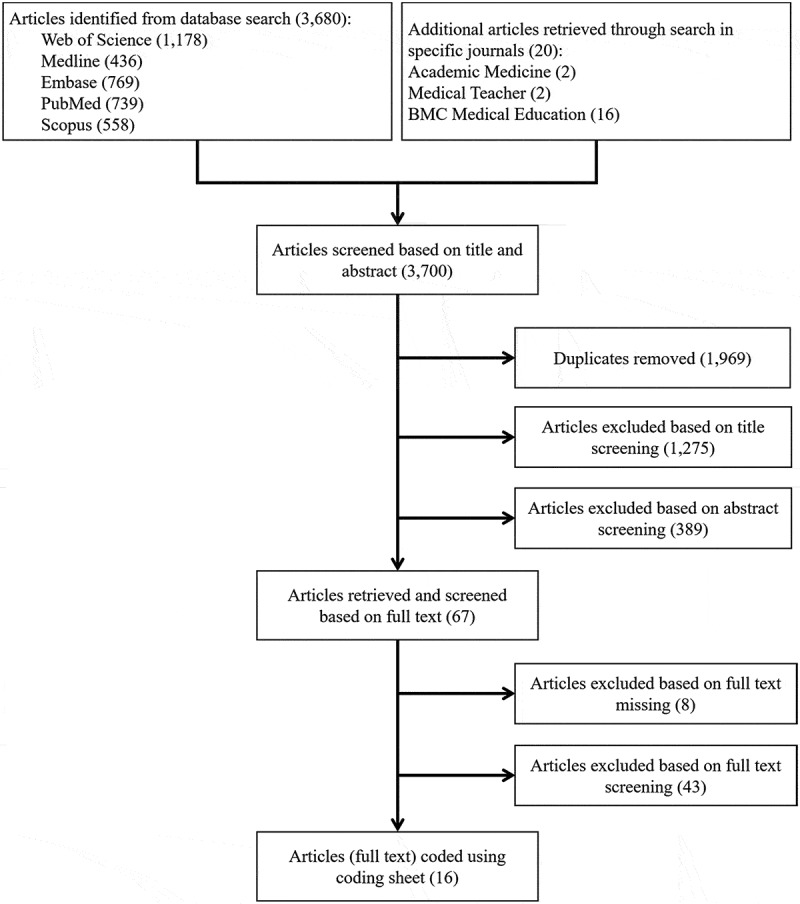
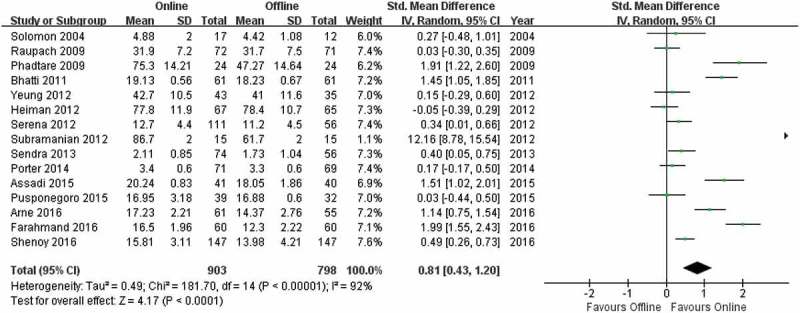
With the increasing use of technology in education, online learning has become a common teaching method. How effective online learning is for undergraduate medical education remains unknown. This article's aim is to evaluate whether online learning when compared to offline learning can improve learning outcomes of undergraduate medical students. Five databases and four key journals of medical education were searched using 10 terms and their Boolean combinations during 2000-2017. The extracted articles on undergraduates' knowledge and skill outcomes were synthesized using a random effects model for the meta-analysis.16 out of 3,700 published articles were identified. The meta-analyses affirmed a statistically significant difference between online and offline learning for knowledge and skill outcomes based on post-test scores (SMD = 0.81; 95% CI: 0.43, 1.20; p < 0.0001; n = 15). The only comparison result based on retention test scores was also statistically significant (SMD = 4.64; 95% CI: 3.19, 6.09; p < 0.00001). The meta-analyses discovered no significant difference when using pre- and post-test score gains (SMD = 3.03; 95% CI: -0.13, 4.13; p = 0.07; n = 3). There is no evidence that offline learning works better. And compared to offline learning, online learning has advantages to enhance undergraduates' knowledge and skills, therefore, can be considered as a potential method in undergraduate medical teaching.
Overview
The claims and statistics of this paper haven’t been checked yet.
Free: it reads the open-access text and checks the first 5 claims that cite a source we can check. Create a free account to check every claim.
Integrity signals
Registry
Cites
Statistics
Figures


Verification
Claims the paper makes
The claims and statistics of this paper haven’t been checked yet.
Free: it reads the open-access text and checks the first 5 claims that cite a source we can check. Create a free account to check every claim.
Claims other papers make about this one
Each is checked against this paper’s own text: does it say what the citing paper says it does?
The cited source says what the claim attributes to it.
In the citing paper
“Online learning allows teaching and learning to be done separately using internetbased information delivery systems [21].”
From Impact of online learning on student's performance and engagement: a systematic review (2024) · cites this paper as [21]
Self-check
Percentages, sums and reported differences re-computed from the paper’s own numbers.
The self-check needs the paper’s full text.
Citations
Cites
Measuring inconsistency in meta-analyses
Higgins, J. P. T., Thompson, S. G., Deeks, J. J., & Altman, D. G. (2003) · BMJ · doi:10.1136/bmj.327.7414.557 · Cited by 63,139 · cited 1×
“The statistical heterogeneity was calculated using the I(2) statistic [16].”
MethodDermyshi, E., Wang, Y., Yan, C., Hong, W., Qiu, G., Gong, X., & Zhang, T. (2017) · Neonatology · doi:10.1159/000454668 · Cited by 24,451
Liberati, A., Altman, D. G., Tetzlaff, J., Mulrow, C., Gotzsche, P. C., Ioannidis, J. P. A., Clarke, M., Devereaux, P. J., Kleijnen, J., & Moher, D. (2009) · BMJ · doi:10.1136/bmj.b2700 · Cited by 17,648
Liberati, A., Altman, D. G., Tetzlaff, J., Mulrow, C., Gøtzsche, P. C., Ioannidis, J. P. A., Clarke, M., Devereaux, P. J., Kleijnen, J., & Moher, D. (2009) · Journal of Clinical Epidemiology · doi:10.1016/j.jclinepi.2009.06.006 · Cited by 10,578
Mayer, R. E. (2009) · doi:10.1017/cbo9780511811678 · Cited by 7,800
Mayer, R. (2020) · doi:10.1017/9781316941355 · Cited by 7,777
Cook, D. A., Hatala, R., Brydges, R., Zendejas, B., Szostek, J. H., Wang, A. T., Erwin, P. J., & Hamstra, S. J. (2011) · JAMA · doi:10.1001/jama.2011.1234 · Cited by 2,170
Blended Learning in Higher Education: Framework, Principles, and Guidelines
Garrison, D. R., & Vaughan, N. D. (2007) · Wiley eBooks · doi:10.1002/9781118269558 · Cited by 1,609
Internet-Based Learning in the Health Professions: A Meta-analysis
Cook, D. A., Levinson, A. J., Garside, S., Dupras, D. M., Erwin, P. J., & Montori, V. M. (2008) · JAMA · doi:10.1001/jama.300.10.1181 · Cited by 1,498 · cited 2×
“Evaluations have failed to reach consistent conclusions [4,5], resulting in complex decisions when selecting a teaching method for medical education.”
BackgroundStudent barriers to online learning: A factor analytic study
Muilenburg, L. Y., & Berge, Z. L. (2005) · Distance Education · doi:10.1080/01587910500081269 · Cited by 1,219 · cited 1×
“Some factors create barriers for online learning, such as administrative issues, social interaction, academic skills, technical skills, learner motivation, time and support for studies, technical problems, cost and access to the internet [6].”
BackgroundMaking Sense of MOOCs: Musings in a Maze of Myth, Paradox and Possibility
Daniel, J. (2012) · Journal of Interactive Media in Education · doi:10.5334/2012-18 · Cited by 1,148 · cited 1×
“The use of online learning has vastly increased since 2012, as evidenced by the thriving of massive open online courses (MOOCs) [3].”
BackgroundGomez M, P. J., & Jacome S, J. E. (2018) · DSPACE System - Metalibrary (University of the Coast) · Cited by 982
Association Between Funding and Quality of Published Medical Education Research
Reed, D. A., Cook, D. A., Beckman, T. J., Levine, R. B., Kern, D. E., & Wright, S. M. (2007) · JAMA · doi:10.1001/jama.298.9.1002 · Cited by 958 · cited 3×
“Quality assessment The quality of methodology used in each article was evaluated based on the Medical Education Research Study Quality Instrument (MERSQI) [14].”
MethodInfluentialJohnson, S. D., Aragon, S. R., Shaik, N., & Palma‐Rivas, N. (2000) · The Journal of Interactive Learning Research · doi:10.5555/344452.344454 · Cited by 620
New Benchmarks in Higher Education: Student Engagement in Online Learning
Robinson, C. C., & Hullinger, H. (2008) · Journal of Education for Business · doi:10.3200/joeb.84.2.101-109 · Cited by 618 · cited 1×
“Besides above, the effectiveness could also be influenced by characteristics of students themselves, such as gender, learning style [37], attitude [38], satisfaction [39] and level of engagement [40].”
BackgroundThe digital natives as learners: Technology use patterns and approaches to learning
Thompson, P. (2013) · Computers & Education · doi:10.1016/j.compedu.2012.12.022 · Cited by 557 · cited 1×
“On the other hand, the informatic competency requirements of healthcare technology, such as utilizing electronic healthcare records, learning systems and aided-diagnosis systems, also present a new challenge for medical students to master [1], even for the so-called digital native learners [2].”
BackgroundVirtual Classrooms: How Online College Courses Affect Student Success
Bettinger, E. P., Fox, L., Loeb, S., & Taylor, E. S. (2017) · American Economic Review · doi:10.1257/aer.20151193 · Cited by 441 · cited 1×
“As a result, students got lower grades for both the course taken online and the courses that followed [42].”
BackgroundA Rude Awakening: Internet Shakeout in 2000
Demers, E., & Lev, B. (2001) · Review of Accounting Studies · doi:10.1023/a:1011675227890 · Cited by 297
Internet Access in U.S. Public Schools and Classrooms: 1994-2005. Highlights. NCES 2007-020.
Wells, J. M., & Lewis, L. L. (2006) · National Center for Education Statistics · Cited by 276
Evaluating the Cost Effectiveness of Online and Face-to-Face Instruction
Bartley, S. J., & Golek, J. H. (2004) · Cited by 244
Can Online Learning Bend the Higher Education Cost Curve?
Deming, D. J., Goldin, C., Katz, L. F., & Yuchtman, N. (2015) · American Economic Review · doi:10.1257/aer.p20151024 · Cited by 239 · cited 1×
“The rapid growth of online learning in higher education has also benefited from the potential cost savings for limitless students [41].”
BackgroundHow does peer teaching compare to faculty teaching? A systematic review and meta-analysis
Rees, E. L., Quinn, P. J., Davies, B., & Fotheringham, V. (2016) · Medical Teacher · doi:10.3109/0142159x.2015.1112888 · Cited by 221
Self‐regulated learning in simulation‐based training: a systematic review and meta‐analysis
Brydges, R., Manzone, J., Shanks, D., Hatala, R., Hamstra, S. J., Zendejas, B., & Cook, D. A. (2015) · Medical Education · doi:10.1111/medu.12649 · Cited by 177 · cited 1×
“Then, we only included one comparison result under one genre of meta-analysis in each article, because including multiple comparison results from the same article obviously does not meet the criteria of statistical independence [15].”
MethodRichmond, H., Copsey, B., Hall, A. M., Davies, D., & Lamb, S. E. (2017) · BMC Medical Education · doi:10.1186/s12909-017-1047-4 · Cited by 138 · cited 1×
“[8] then updated the evidence in this rapidly developing field by subdividing different formats of offline learning and comparing these formats to online learning.”
BackgroundTerrell, S. R., & Dringus, L. (2000) · Journal of Educational Technology Systems · doi:10.2190/r53m-bvbd-ugv5-77eh · Cited by 131 · cited 1×
“Besides above, the effectiveness could also be influenced by characteristics of students themselves, such as gender, learning style [37], attitude [38], satisfaction [39] and level of engagement [40].”
BackgroundDavis, J., Chryssafidou, E., Zamora, J., Davies, D., Khan, K. S., & Coomarasamy, A. (2007) · BMC Medical Education · doi:10.1186/1472-6920-7-23 · Cited by 130
Davis, J., Crabb, S., Rogers, E., Zamora, J., & Khan, K. S. (2008) · Medical Teacher · doi:10.1080/01421590701784349 · Cited by 112
Subramanian, A., Timberlake, M. D., Mittakanti, H. R., Lara, M., & Brandt, M. L. (2012) · Journal of surgical education · doi:10.1016/j.jsurg.2012.05.013 · Cited by 111
Subramanian, A., Timberlake, M. D., Mittakanti, H. R., Lara, M., & Brandt, M. L. (2012) · Journal of surgical education · doi:10.1016/j.jsurg.2011.12.007 · Cited by 107 · cited 6×
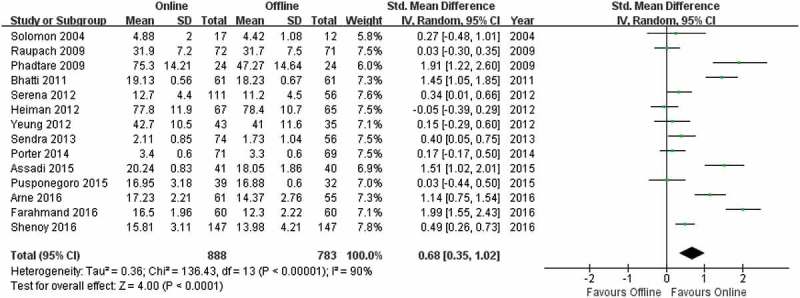
“[32] reported a larger SMD than the other articles, and this value could contribute heavily Figure 1.”
BackgroundResultInfluentialE‐learning vs lecture: which is the best approach to surgical teaching?
Bhatti, I. K., Jones, K., Richardson, L., Foreman, D., Lund, J. N., & Tierney, G. M. (2009) · Colorectal Disease · doi:10.1111/j.1463-1318.2009.02173.x · Cited by 107
Student Engagement in Online Learning: Learners Attitude Toward E-Mentoring
Omar, N. D., Hassan, H., & Atan, H. (2012) · Procedia - Social and Behavioral Sciences · doi:10.1016/j.sbspro.2012.11.351 · Cited by 103 · cited 1×
“Besides above, the effectiveness could also be influenced by characteristics of students themselves, such as gender, learning style [37], attitude [38], satisfaction [39] and level of engagement [40].”
BackgroundA randomized trial comparing digital and live lecture formats [ISRCTN40455708
Solomon, D., Ferenchick, G. S., Laird-Fick, H. S., & Kavanaugh, K. (2004) · BMC Medical Education · doi:10.1186/1472-6920-4-27 · Cited by 93 · cited 1×
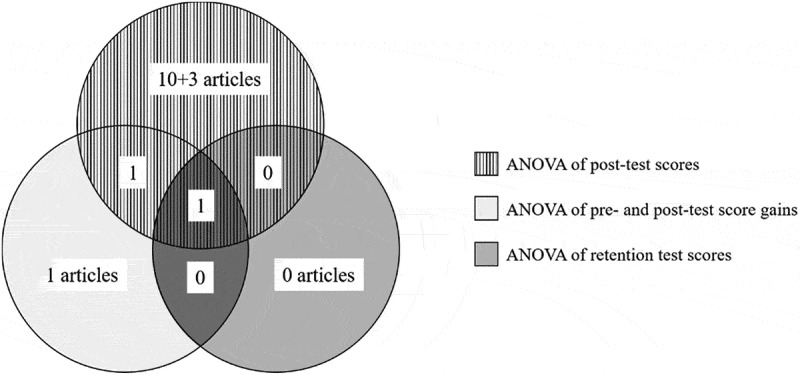
“The remaining 3 articles contained more than one comparison arm but were all based on ANOVAs of post-test scores: 2 articles reported 2 comparisons using 2 different measure instruments [33,34]; and 1 article reported 2 comparison results for 2 different learning goals on the same sample [35].”
ResultPeine, A., Kabino, K., & Spreckelsen, C. (2016) · BMC Medical Education · doi:10.1186/s12909-016-0679-0 · Cited by 92
Asynchronous vs didactic education: it’s too early to throw in the towel on tradition
Jordan, J., Jalali, A., Clarke, S., Dyne, P. L., Spector, T., & Coates, W. C. (2013) · BMC Medical Education · doi:10.1186/1472-6920-13-105 · Cited by 86 · cited 2×
“Among them, 13 articles reported only one comparison arm based on one or more statistical method based on ANOVA: 10 articles compared post-test scores [20–29]; 1 article compared pre- and post-test score gains [30]; 1 article compared both post-test scores and pre- and post-test score gains on the same sample [31]; an…”
BackgroundMethodRandomized controlled trials and meta-analysis in medical education: What role do they play?
Cook, D. A. (2012) · Medical Teacher · doi:10.3109/0142159x.2012.671978 · Cited by 68 · cited 1×
“For a high heterogeneity value (I(2)> 50%) [17], the recommended random-effects model was used in the meta-analysis for the pool weighted effect sizes [18].”
MethodComparison of Online Versus Classroom Delivery of an Immunization Elective Course
Porter, A. L., Pitterle, M. E., & Hayney, M. S. (2014) · American Journal of Pharmaceutical Education · doi:10.5688/ajpe78596 · Cited by 65
Web-based collaborative training of clinical reasoning: A randomized trial
Raupach, T., Muenscher, C., Anders, S., Steinbach, R., Pukrop, T., Hege, I., & Tullius, M. (2009) · Medical Teacher · doi:10.1080/01421590903095502 · Cited by 64 · cited 1×
“The remaining 3 articles contained more than one comparison arm but were all based on ANOVAs of post-test scores: 2 articles reported 2 comparisons using 2 different measure instruments [33,34]; and 1 article reported 2 comparison results for 2 different learning goals on the same sample [35].”
ResultE-learning and deliberate practice for oral case presentation skills: A randomized trial
Heiman, H. L., Uchida, T., Adams, C., Butter, J., Cohen, E., Persell, S. D., Pribaz, P., McGaghie, W. C., & Martin, G. J. (2012) · Medical Teacher · doi:10.3109/0142159x.2012.714879 · Cited by 61 · cited 2×
“Only two articles sampled from more than one institution [20,21].”
BackgroundScientific writing: a randomized controlled trial comparing standard and on-line instruction
Phadtare, A., Bahmani, A., Shah, A., & Pietrobon, R. S. (2009) · BMC Medical Education · doi:10.1186/1472-6920-9-27 · Cited by 56 · cited 2×
“Only two articles sampled from more than one institution [20,21].”
Educating medical students in the era of ubiquitous information
Friedman, C. P., Donaldson, K. M., & Vantsevich, A. V. (2016) · Medical Teacher · doi:10.3109/0142159x.2016.1150990 · Cited by 51 · cited 1×
“Such limitations could create opportunities for students to obtain self-learning abilities through information technology, such as information literacy and metacognition controlling [43].”
BackgroundA pilot study to evaluate the use of virtual lectures for undergraduate radiology teaching
Sendra‐Portero, F., Torales-Chaparro, O. E., Ruiz-Gomez, M. J., & Martínez-Morillo, M. (2013) · European Journal of Radiology · doi:10.1016/j.ejrad.2013.01.027 · Cited by 50 · cited 1×
“The remaining 3 articles contained more than one comparison arm but were all based on ANOVAs of post-test scores: 2 articles reported 2 comparisons using 2 different measure instruments [33,34]; and 1 article reported 2 comparison results for 2 different learning goals on the same sample [35].”
ResultYavner, S. D., Pusic, M. V., Kalet, A. L., Song, H. S., Hopkins, M. A., Nick, M. W., & Ellaway, R. (2014) · Medical Teacher · doi:10.3109/0142159x.2014.933202 · Cited by 45 · cited 1×
“Through a comprehensive evaluation, we determined that the format of online learning used by Subramanian’s team, StepStone Interactive Medical Software, might have played a key role in that study, since the rich feedback and guidance, matched task difficulties to students’ developmental level [36] and case-based teach…”
MethodHealth information technology and the medical school curriculum.
Triola, M. M., Friedman, E., Cimino, C., Geyer, E. M., Wiederhorn, J., & Mainiero, C. (2010) · PubMed · Cited by 38
Chao, S. H.-L., Brett, B., Wiecha, J., Norton, L. E., & Levine, S. A. (2012) · Journal of the American Geriatrics Society · doi:10.1111/j.1532-5415.2012.04035.x · Cited by 36
Assadi, T., Mofìdi, M., Rezai, M., Hafezimoghadam, P., Maghsoudi, M., Mosaddegh, R., & Aghdam, H. (2015) · Hong Kong Journal of Emergency Medicine · doi:10.1177/102490791502200505 · Cited by 27
Prospective evaluation of a web-based three-dimensional cranial nerve simulation.
Yeung, J. C., Fung, K., & Wilson, T. D. (2012) · PubMed · Cited by 25
Farahmand, S., Jalili, E., Arbab, M., Sedaghat, M., Shirazi, M., Keshmiri, F., Azizpour, A., Valadkhani, S., & Bagheri-Hariri, S. (2016) · PubMed · Cited by 24
Web-Based Versus Conventional Training for Medical Students on Infant Gross Motor Screening
Pusponegoro, H. D., Soebadi, A., & Surya, R. (2015) · Telemedicine Journal and e-Health · doi:10.1089/tmj.2015.0024 · Cited by 16 · cited 1×
“Among them, 13 articles reported only one comparison arm based on one or more statistical method based on ANOVA: 10 articles compared post-test scores [20–29]; 1 article compared pre- and post-test score gains [30]; 1 article compared both post-test scores and pre- and post-test score gains on the same sample [31]; an…”
EFFECTS OF E-LEARNING AS A TEACHING LEARNING METHOD IN MEDICAL EDUCATION
Saritha Shenoy, J., & Kuriakose, C. (2016) · Journal of Evolution of Medical and Dental Sciences · doi:10.14260/jemds/2016/1645 · Cited by 8
Research works printed but not linked: 2
- Cattagni A, Farris E Internet access in U.S. Public schools and classrooms: 1994-2000. Educ Stat Q. 2001; 3(4): 85.
- Review Manager (RevMan) [computer program]. Version 5.3. Copenhagen: The Nordic Cochrane Centre, The Cochrane Collaboration; 2014.
Cited by
Dost, S., Hossain, A., Shehab, M., Abdelwahed, A., & Al-Nusair, L. (2020) · BMJ Open · doi:10.1136/bmjopen-2020-042378 · Cited by 912
Gopal, R., Singh, V., & Aggarwal, A. (2021) · Education and Information Technologies · doi:10.1007/s10639-021-10523-1 · Cited by 618
Amir, L. R., Tanti, I., Maharani, D. A., Wimardhani, Y. S., Julia, V., Sulijaya, B., & Puspitawati, R. (2020) · BMC Medical Education · doi:10.1186/s12909-020-02312-0 · Cited by 596
“The knowledge gain and performance of the students as a result of E-learning were shown to be equivalent to that of face to face methods [9,10].”
BackgroundResultUnger, S., & Meiran, W. (2020) · International Journal of Technology in Education and Science · doi:10.46328/ijtes.v4i4.107 · Cited by 302
“Alternatively, other studies have found no significant difference between online learning and in-class or off-line learning, and may even enhance the undergraduate learning experience (Pei & Wu, 2019).”
BackgroundSindiani, A. M., Obeidat, N., Alshdaifat, E., Elsalem, L., Alwani, M. M., Rawashdeh, H., Fares, A. S., Alalawne, T., & Tawalbeh, L. I. (2020) · Annals of Medicine and Surgery · doi:10.1016/j.amsu.2020.09.036 · Cited by 246
“We share our beliefs with other studies that the effectiveness of online learning is affected by several diverse parameters such as age, attitude, satisfaction, and level of engagement [14].”
Metadata
- Authors
- Pei, L., & Wu, H.
- Affiliations
- Institute of Basic Education Science, Beijing Academy of Educational Sciences, Beijing, China
- Peking University (CN)
- Corresponding author
- Wu, Hongbin
- ORCID
- Wu, Hongbin
- Venue
- Medical Education Online
- Publisher
- Informa UK Limited
- Published
- 2019-01-01
- Volume
- 24
- Issue
- 1
- Pages
- 1666538
- ISSN
- 1087-2981 (ISSN-L)
- PMC
- PMC6758693
- OpenAlex
- W2973845887
- Cited by
- 852
- References
- 49
- Citations by year
- 2026: 36 · 2025: 59 · 2024: 130 · 2023: 185 · 2022: 214 · 2021: 165 · 2020: 63
- FWCI
- 18.07
- Type
- journal article
- Language
- en
- Open access
- gold
- doi.org
- Licence
- Locations
- Medical Education Online (publishedVersion, cc-by)
- PubMed Central (publishedVersion, cc-by)
- PubMed (publishedVersion)
- DOAJ (DOAJ: Directory of Open Access Journals) (submittedVersion, cc-by-sa)
- Topics
- Social Sciences › Education › Innovations in Medical Education
- Social Sciences › Education › Online and Blended Learning
- Health Sciences › Health Professions › General Health Professions › Health and Medical Education
- Keywords
- online learning, offline learning, undergraduate medical education, learning outcomes, knowledge retention, clinical skills, e-learning effectiveness, medical students
- MeSH terms
- Education, Medical, Undergraduate, Humans, Students, Medical, Teaching, Education, Distance, Internet
About these checks
Registry, retraction, Cites and statistics results are computed, not judged, with one exception: a printed reference that no index lists is read once by a model before it counts as a citation error. Claims are extracted by a model and kept only when their quote appears verbatim in the text; each cited source is then checked, with a model’s help, for whether it says what the claim relies on. Those verdicts can be wrong — read the claim’s quote and the cited source before relying on one.
Statistics and arithmetic are recomputed, not judged.
Confidence bands are shown only for fields calibrated on our annotated test set. None is calibrated yet, so no band is shown.
What counts as a claim ›How we measure confidence ›How we check this ›
Are you an author, or do you see a problem with this page? Request a review
Data sources
Bibliographic data: Semantic Scholar, OpenAlex, Crossref.
Contains information from the Semantic Scholar Academic Graph Datasets, made available under the ODC Attribution License (ODC-BY 1.0).
Semantic Scholar’s data is described in: Kinney, R., et al. (2023). The Semantic Scholar Open Data Platform. arXiv:2301.10140.
