

Testing the Effects of GraphoGame Against a Computer-Assisted Math Intervention in Primary School
Open accessThe DOI matches its Crossref record; 53 of the 53 references it cites were found in a registry or an index; 8 of the 31 sources its claims cite were checked for support.
Abstract
Intervention study in grade 1 children comparing GraphoGame and a computer-assisted math intervention over about four months.
Overview
CoChat Summary
TL;DR
In a quasi-experimental study of 921 French grade-1 children from socioeconomically disadvantaged neighborhoods, a French GraphoGame intervention improved phoneme awareness, orthographic choice, and word reading fluency relative to an active math control, while the math intervention improved math achievement. Effects were largely domain-specific, with no significant GraphoGame effect on pseudoword reading fluency and no math effect on number comparison.
Key findings
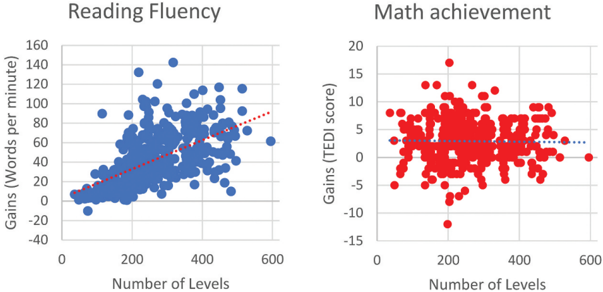
- GraphoGame produced positive intervention effects on phoneme awareness (ES = 0.23), orthographic choice (ES = 0.27), and word reading fluency (ES = 0.18); pseudoword reading fluency did not reach significance (p = .081, ES = 0.11).
- Fiete Math had a significant effect on math achievement (ES = 0.28) but not on symbolic number comparison.
- For phoneme awareness, children with initially lower scores benefited more from GraphoGame; for pseudoword reading fluency, GraphoGame was more beneficial for children with initially better decoding skills.
- Correlations between GraphoGame game variables and reading gains were positive for pseudoword reading fluency, orthographic choice, and word reading fluency (.41 < r < .59), while none of the GraphoGame game variables correlated with math achievement gains.
Methods
- Quasi-experimental design with two successive cohorts: 451 children received GraphoGame in year 1 and 470 received Fiete Math in year 2, from the same 9 schools and mostly the same teachers; total N = 921 grade-1 children in priority education areas in Marseille.
- Interventions lasted about four months, approximately 20 minutes per day, 4 times per week for 16 weeks; mean GraphoGame duration was 14.73 h (± 3.51 h).
- Hierarchical linear mixed models predicted posttest scores from pretest scores with intervention as a fixed effect and individuals and classes as random effects; outcome measures included phoneme awareness, pseudoword reading fluency, orthographic choice, word reading fluency, math achievement, and symbolic number comparison.
Limitations
- The paper states that the study was not a randomized controlled trial but a quasi-experimental design in which the same teachers administered both interventions successively; the math group started significantly higher at pretest on all reading measures.
- The paper states that long-term follow-up was not available for the math group because of the COVID-19 lockdown, so durable effects could not be fully tested across both groups.
- The paper states that GraphoGame does not train reading aloud or allow lip reading, which may partially explain weaker effects on reading fluency measures.
Model-written summary. Check it against the paper before relying on it.
Integrity signals
Registry
Cites
Statistics
Figures


Verification
Claims the paper makes
8 Valid · 0 Not valid · 13 Not checked · 61 Own results and interpretations
The cited sources support only part of this claim — read each source’s verdict below.
In the paper
“it is necessary for the acquisition of less transparent writing systems (such as English and to a lesser extent French) to introduce and train these mappings at various grain sizes including graphemes, syllables, rimes, whole words and even sentences”
§ Testing the Effects of GraphoGame Against a Computer-Assisted Math Intervention in Primary School > GraphoGame intervention
What the sources say
- Not checked — no full text of the sourcecites Kyle et al., 2013 source
- Partly supportedcites Lassault & Ziegler, 2018 sourceExperimental — accuracy not yet measured
Sections 3 and 4 describe training grapheme–phoneme correspondences in GraphoLearn and adding word- and sentence-construction exercises in its French version; the figure in Section 5 also shows a syllable exercise. The copy does not establish that all the listed grain sizes, particularly rimes, must be trained to acquire English or French reading. Its mention of a rhyme task in Section 2.2 does not make that broader necessity claim. (LLM, conf=0.85)
plainstates a cause- Asserted: passes — The authors put it forward as true.
- Checkable: passes — It can be checked against evidence.
- Load-bearing: passes — The paper’s conclusions depend on it.
- Based: passes — The paper gives a reason why it holds.
The cited sources support only part of this claim — read each source’s verdict below.
In the paper
“Yet, some children struggle to enter this unsupervised self-teaching loop because they might lack sufficient basic decoding skills, vocabulary or reading opportunities (Perry et al., 2019).”
§ Testing the Effects of GraphoGame Against a Computer-Assisted Math Intervention in Primary School > GraphoGame intervention
What the sources say
- Partly supportedcites Perry et al., 2019 sourceExperimental — accuracy not yet measured
The Model Description and Method section (page unavailable) describes self-teaching as requiring successful decoding and a matching word in the phonological lexicon, supporting the decoding-skills and vocabulary parts of the claim. The Results (page unavailable) report that simulated poor readers learned fewer words through decoding. Our copy does not identify insufficient reading opportunities as a reason children struggle to enter the loop. (LLM, conf=0.86)
hedgedstates a possible cause- Asserted: passes — The authors put it forward as true.
- Checkable: passes — It can be checked against evidence.
- Load-bearing: passes — The paper’s conclusions depend on it.
- Based: passes — The paper gives a reason why it holds.
- Partly supported
Every source the paper cites for this claim was checked and supports it.
In the paper
“Also, recent data suggest that children with poor phonemic discrimination skills need to use lip reading more than their peers without such difficulties (Piquard-Kipffer et al., 2021).”
§ Testing the Effects of GraphoGame Against a Computer-Assisted Math Intervention in Primary School > Discussion
What the sources say
- Supportedcites Piquard-Kipffer et al., 2021 source
The Discussion reports that access to lip reading improved syllabic-counting performance only in the at-risk group, whose members had poor phonemic discrimination skills. It suggests that these children may use visual speech information to compensate for that difficulty, supporting the citing sentence’s comparison with their peers. (LLM, conf=0.91)
hedgedstates an association- Asserted: passes — The authors put it forward as true.
- Checkable: passes — It can be checked against evidence.
- Load-bearing: passes — The paper’s conclusions depend on it.
- Based: passes — The paper gives a reason why it holds.
- Supported
A result the paper reports from its own data — it cites no other source for it, so there is none to check. The quote shows it is in the paper.
In the paper
“The analysis showed no effect of intervention and no interaction between the initial level of number comparison ability and the effects of intervention.”
§ Testing the Effects of GraphoGame Against a Computer-Assisted Math Intervention in Primary School > Number comparison
plain- Asserted: passes — The authors put it forward as true.
- Checkable: passes — It can be checked against evidence.
- Load-bearing: unclear — It is unclear whether the paper’s conclusions depend on it.
- Based: passes — The paper gives a reason why it holds.
A result the paper reports from its own data — it cites no other source for it, so there is none to check. The quote shows it is in the paper.
In the paper
“The analysis showed no effect of intervention and no interaction between the initial level of number comparison ability and the effects of intervention.”
- Also stated in: § Abstract · plain
“FM had a significant effect on math achievement (ES = 0.28) but not number comparison.”
§ Testing the Effects of GraphoGame Against a Computer-Assisted Math Intervention in Primary School > Number comparison
plain- Asserted: passes — The authors put it forward as true.
- Checkable: passes — It can be checked against evidence.
- Load-bearing: passes — The paper’s conclusions depend on it.
- Based: passes — The paper gives a reason why it holds.
- Also stated in: § Abstract · plain
44 more claims
Create a free account to see all 82 claims and every source verdict.
- Probably not a substantial claim. 19
- It may state two separate claims as one. 18
Self-check
Percentages, sums and reported differences re-computed from the paper’s own numbers.
Each contradiction between two passages listed here was confirmed by an independent check.
Rated major: it would touch a result — a value a result rests on, reported and recomputed p-values on opposite sides of the significance level, two passages that conflict with no sign which is right, or a cited work retracted before this paper was published.
In the paper
§ Testing the Effects of GraphoGame Against a Computer-Assisted Math Intervention in Primary School > Pseudoword reading fluency
“Pseudoword reading fluency was assessed with a 1-minute reading test, in which children had to read a list of pseudowords (max 30) in one minute”
§ Testing the Effects of GraphoGame Against a Computer-Assisted Math Intervention in Primary School > Discussion
“| Pseudoword Fluency (Pre) | 9.2 | 6.1 | 0-38 | 1.16 | 1.97 | | Pseudoword Fluency (Post) | 28.1 | 16.0 | 1-104 | 0.79 | 0.75 |”
Rated minor: it would not touch a result — a value no result rests on, a p-value that stays on the same side of the significance level, or a conflict that is clerical, resolved elsewhere in the paper, or outside its own findings.
In the paper
§ Testing the Effects of GraphoGame Against a Computer-Assisted Math Intervention in Primary School > Abstract
“used GG or FM for about four months four times a week for 30 minutes.”
§ Testing the Effects of GraphoGame Against a Computer-Assisted Math Intervention in Primary School > Procedure
“Teachers signed an agreement to implement the GG and math application approximately 20 minutes per day, 4 times per week, for a total of 16 weeks.”
Rated minor: it would not touch a result — a value no result rests on, a p-value that stays on the same side of the significance level, or a conflict that is clerical, resolved elsewhere in the paper, or outside its own findings.
In the paper
§ Testing the Effects of GraphoGame Against a Computer-Assisted Math Intervention in Primary School > Discussion
“| Orthographic Choice (Pre) | 6.5 | 3.4 | 0-24 | 1.08 | 1.78 |”
§ Testing the Effects of GraphoGame Against a Computer-Assisted Math Intervention in Primary School > Discussion
“| Orthographic Choice (Pre) | 13.0 | 4.4 | 0-24 | -0.27 | -0.27 |”
Rated minor: it would not touch a result — a value no result rests on, a p-value that stays on the same side of the significance level, or a conflict that is clerical, resolved elsewhere in the paper, or outside its own findings.
In the paper
§ Testing the Effects of GraphoGame Against a Computer-Assisted Math Intervention in Primary School > Discussion
“| Phoneme Awareness (Post) | 15.5 | 6.4 | 0-25 | -0.65 | -0.50 |”
§ Testing the Effects of GraphoGame Against a Computer-Assisted Math Intervention in Primary School > Outcome measures
“In the first task, the examiner pronounced a consonant-vowel-consonant pseudoword and the students had to mentally delete the first phoneme and sound out the pseudoword without the first phoneme (12 items).In the second task, the examiner pronounced a consonant- consonant-vowel pseudoword and students had to delete the first phoneme (12 items).The final score was the total of correct responses.”
Citations
Cites
Ziegler, J. C., & Goswami, U. (2005) · Psychological Bulletin · doi:10.1037/0033-2909.131.1.3 · Cited by 2,871 · cited 1×
“…of reading acquisition are all about learning the mapping between visual symbols (e.g., letters, graphemes) and their equivalent units in spoken language (Castles et al., 2018; Ehri, 1992; Goswami, 2002; Share, 1995; Sprenger-Charolles et al., 2003; Ziegler & Goswami, 2005; Ziegler et al., 2014).”
BackgroundSelf-citationPhonological recoding and self-teaching: sine qua non of reading acquisition
Share, D. L. (1995) · Cognition · doi:10.1016/0010-0277(94)00645-2 · Cited by 2,352 · cited 3×
“In a natural reading situation, this happens in a non-supervised way through “self-teaching” (Share, 1995; Ziegler et al., 2020).”
BackgroundMethodPISA 2018 Results (Volume I): What Students Know and Can Do
OECD (2019) · PISA · doi:10.1787/5f07c754-en · Cited by 2,350
A meta-analysis of the cognitive and motivational effects of serious games.
Wouters, P., van Nimwegen, C., van Oostendorp, H., & van der Spek, E. D. (2013) · Journal of Educational Psychology · doi:10.1037/a0031311 · Cited by 1,864 · cited 1×
“Indeed, in a meta-analysis of 31 studies, Wouters et al. (2013) found that, contrary to common beliefs, serious games were not more motivating than conventional instruction methods.”
BackgroundEnding the reading wars: Reading acquisition from novice to expert
Castles, A., Rastle, K., & Nation, K. (2018) · Psychological Science in the Public Interest · doi:10.1177/1529100618772271 · Cited by 1,297 · cited 3×
“…day of school (Loeb & Bassok, 2007) and that early and focused interventions for at-risk children within the school setting is the way to go about reducing them (Castles et al., 2018; Foorman et al., 2003; Foorman & Torgesen, 2001; Hulme et al., 2020; Rayner et al., 2001; Ziegler et al., 2020).”
BackgroundTeacher and Classroom Context Effects on Student Achievement: Implications for Teacher Evaluation
Sanders, W. L., Wright, S. P., & Horn, S. P. (1997) · Journal of Personnel Evaluation in Education · doi:10.1023/a:1007999204543 · Cited by 1,044 · cited 1×
“It is well known that teacher effects are the dominant factor affecting student academic gain (Sanders et al., 1997).”
BackgroundHow Psychological Science Informs the Teaching of Reading
Rayner, K., Foorman, B. R., Perfetti, C. A., Pesetsky, D., & Seidenberg, M. S. (2001) · Psychological Science in the Public Interest · doi:10.1111/1529-1006.00004 · Cited by 928
Psychological Science: The Consequences of Choosing Soft
Locurto, C. (2024) · SpringerBriefs in Psychology · doi:10.1007/978-3-031-69402-8 · Cited by 927
Orthographic Depth and Its Impact on Universal Predictors of Reading: A Cross-Language Investigation
Ziegler, J. C., Bertrand, D., Tóth, D., Csépe, V., Reis, A., Faísca, L., Saine, N., Lyytinen, H., Vaessen, A., & Blomert, L. (2010) · Psychological Science · doi:10.1177/0956797610363406 · Cited by 803 · cited 1×
“…writing system where literally all words can be correctly decoded on the basis of 20 letter-sound correspondences (see Landerl et al., 2013; Ziegler et al., 2010), it is necessary for the acquisition of less transparent writing systems (such as English and to a lesser extent French) to…”
BackgroundSelf-citationCheung, A. C. K., & Slavin, R. E. (2013) · Educational Research Review · doi:10.1016/j.edurev.2013.01.001 · Cited by 792 · cited 2×
“…intervention for reading within the school context, educational technology, and in particular computer-assisted instruction (CAI), held the promise to support the learning process in unpreceded ways because of its potential to provide individualized and adaptive support (Cheung & Slavin, 2013).”
BackgroundInfluential
Research works printed but not linked: 10
- Campuzano L., 2009, Effectiveness of Reading and Mathematics Software Products: Findings From Two Student Cohorts
- Dehaene S, 2011, Apprendre à lire: Des sciences cognitives à la salle de classe
- Ecalle J, 2003, Timé-2: Test d’identification de mots écrits pour enfants de 6 à 8 ans
- Ehri L. C, 1992, Reading acquisition, 105
- Heck R., 2009, An introduction to multilevel modeling techniques (Quantitative methodology series)
- Lefavrais J, 2005, Test de l’Alouette (revised version)
- Perfetti C. A., 1987, Merrill-Palmer Quarterly-Journal of Developmental Psychology, 33, 283
- Rayner K., 2001, Psychological Science, 2, 31
- Sprenger-Charolles L, 2017, Approche Neuropsychologique des Apprentissages chez l’Enfant (ANAE), 148, 247
- Van Nieuwenhoven C., 2001, Tedi-math: Test diagnostique des compétences de base en mathématiques
Cited by
Valdois, S., Zaher, A., Meyer, S., Diard, J., Mandin, S., & Bosse, M. (2024) · Reading Research Quarterly · doi:10.1002/rrq.576 · Cited by 11
“However, positive effects of a French version of GraphoGame on phoneme awareness and word reading fluency have been recently reported (Lassault et al., 2022).”
InfluentialOmer, S. M. S., Evers, K., Wang, C.-Y., & Chen, S. (2025) · Humanities and Social Sciences Communications · doi:10.1057/s41599-025-05475-7 · Cited by 48
“In contrast, Application Software such as Fiete Math (Lassault et al. 2022), designed for early learners, features a simple interface and limited interactivity, offering drag-and-drop tasks to introduce basic arithmetic concepts in gami fi ed, tablet-based environments.”
Richter, C. G., Siegelman, N., Mahaffy, K. E., van den Bunt, M. R., Kearns, D. M., Landi, N., Sabatini, J., Pugh, K. R., & Hoeft, F. (2022) · Frontiers in Psychology · doi:10.3389/fpsyg.2022.1001555 · Cited by 17
“Despite this, there is some evidence for the efficacy of the program and studies show that GraphoLearn is superior to various control conditions when the intervention group receives sufficient exposure to the game (Bhide et al., 2013; Kyle et al., 2013; Patel et al., 2018; Lassault et al., 2022).”
ResultHarrar-Eskinazi, K. L., Cara, B. D., Leloup, G., Nothelier, J., Caci, H. M., Ziegler, J. C., & Faure, S. (2022) · BMC Pediatrics · doi:10.1186/s12887-022-03701-8 · Cited by 15
“28 for independent practice with the program [82].”
BackgroundSelf-citationCasalini, C., & Pecini, C. (2024) · Brain Sciences · doi:10.3390/brainsci14080793 · Cited by 9
Metadata
- Authors
- Lassault, J., Sprenger-Charolles, L., Albrand, J.-P., Alavoine, E., Richardson, U., Lyytinen, H., & Ziegler, J. C.
- Affiliations
- Centre National de la Recherche Scientifique (FR)
- University of Jyväskylä (FI)
- UNESCO (FR)
- Corresponding author
- Ziegler, Johannes C.
- Venue
- Scientific Studies of Reading
- Publisher
- Informa UK Limited
- Published
- 2022-03-16
- Volume
- 26
- Issue
- 6
- Pages
- 449-468
- ISSN
- 1088-8438 (ISSN-L)
- 1532-799X
- OpenAlex
- W4220939164
- Cited by
- 20
- References
- 51
- Citations by year
- 2026: 4 · 2025: 5 · 2024: 4 · 2023: 4 · 2022: 3
- FWCI
- 6.09
- Type
- journal article
- Language
- en
- Open access
- hybrid
- doi.org
- Licence
- Locations
- Scientific Studies of Reading (publishedVersion, cc-by-nc-nd)
- Jyväskylä University Digital Archive (University of Jyväskylä) (submittedVersion, cc-by-nc-nd)
- HAL (submittedVersion, cc-by-nc-nd)
- Funders
- French National Agency for Research (ANR-13-APPR-0003)
- Institute of Convergence ILCB (ANR-16-CONV-0002)
- Excellence Initiative of Aix-Marseille University A*MIDEX (ANR-11-IDEX-0001-02)
- Topics
- Social Sciences › Psychology › Developmental and Educational Psychology › Reading and Literacy Development
- Social Sciences › Psychology › Developmental and Educational Psychology › Cognitive and developmental aspects of mathematical skills
- Social Sciences › Psychology › Developmental and Educational Psychology › Educational Games and Gamification
- Keywords
- GraphoGame, game-based learning, phoneme awareness, orthographic choice, word reading fluency, mathematics achievement, numerical comparison, early grade reading, elementary school students, socioeconomic deprivation, digital literacy
About these checks
Registry, retraction, Cites and statistics results are computed, not judged, with one exception: a printed reference that no index lists is read once by a model before it counts as a citation error. Claims are extracted by a model and kept only when their quote appears verbatim in the text; each cited source is then checked, with a model’s help, for whether it says what the claim relies on. Those verdicts can be wrong — read the claim’s quote and the cited source before relying on one.
The claim verdicts this report counts are experimental: their accuracy is not yet measured.
A language model drew the claims from the paper on 2026-10-12, under version 3 of the claim definition (model deepseek-v4.1-flash, prompt extract-v3).
A second model labelled each claim on 2026-10-12 (model jev-1.13-20260917, definition revision gold-guideline-v0.2).
Cited sources are checked with a language model’s help (gpt-6-sol).
Statistics and arithmetic are recomputed, not judged.
Confidence bands are shown only for fields calibrated on our annotated test set. None is calibrated yet, so no band is shown.
What counts as a claim ›How we measure confidence ›How we check this ›
Are you an author, or do you see a problem with this page? Request a review
How to cite
Cite CoChat for the checks on this page, and the paper for its own findings.
- This page
- CoChat. (2026). Citation check: Testing the Effects of GraphoGame Against a Computer-Assisted Math Intervention in Primary School. https://app.cochat.ai/papers/10.1080/10888438.2022.2052884
- The paper
- Lassault, J., Sprenger-Charolles, L., Albrand, J.-P., Alavoine, E., Richardson, U., Lyytinen, H., & Ziegler, J. C. (2022). Testing the Effects of GraphoGame Against a Computer-Assisted Math Intervention in Primary School. Scientific Studies of Reading. https://doi.org/10.1080/10888438.2022.2052884
Data sources
Bibliographic data: Semantic Scholar, OpenAlex, Crossref.
Contains information from the Semantic Scholar Academic Graph Datasets, made available under the ODC Attribution License (ODC-BY 1.0).
Semantic Scholar’s data is described in: Kinney, R., et al. (2023). The Semantic Scholar Open Data Platform. arXiv:2301.10140.
