

The role of beliefs in teacher agency
Open accessThe DOI matches its Crossref record; 44 of the 47 references it cites were found in a registry or an index; none of the 31 sources its claims cite is checked for support yet.
Abstract
There is an ongoing tension within educational policy worldwide between countries that seek to reduce the opportunities for teachers to exert judgement and control over their own work, and those who seek to promote it. Some see teacher agency as a weakness within the operation of schools and seek to replace it with evidence-based and data-driven approaches, whereas others argue that because of the complexities of situated educational practices, teacher agency is an indispensable element of good and meaningful education. While the ideological debate about the shape and form of teacher professionalism is important, it is equally important to understand the dynamics of teacher agency and the factors that contribute to its promotion and enhancement. In this paper, we draw from a two-year study into teacher agency against the backdrop of large-scale educational reform – the implementation of Scotland’s Curriculum for Excellence – in order to explore these questions. We focus on teachers’ beliefs in order to get a sense of the individual and collective discourses that inform teachers’ perceptions, judgements and decision-making and that motivate and drive teachers’ action. While the research suggests that beliefs play an important role in teachers’ work, an apparent mismatch between teachers’ individual beliefs and values and wider institutional discourses and cultures, and a relative lack of a clear and robust professional vision of the purposes of education indicate that the promotion of teacher agency does not just rely on the beliefs that individual teachers bring to their practice, but also requires collective development and consideration.
Overview
CoChat Summary
## TL;DR
The paper argues that teacher beliefs matter for agency, but mainly insofar as they are shaped by policy discourse, schooling culture, and limited professional visions of what education is for. Using ethnographic case studies from three Scottish schools during Curriculum for Excellence, the authors find that teachers’ beliefs were often short-term, instrumental, and only loosely connected to broader purposes or values.
## Key findings
- Across the six classroom teachers, beliefs about children, teaching, and educational purpose were notably similar, and often framed by recent policy language rather than a robust professional discourse.
- Teachers strongly emphasized relationships, safety, care, enjoyment, skills, socialisation, and “maximising student potential,” but gave little sustained attention to knowledge, qualification, social justice, or democratic values.
- The paper argues that a narrow view of purpose limits agency: teachers were effective at short-term classroom management and curriculum delivery, but less able to use beliefs to imagine or enact longer-term educational aims.
- The authors report that teachers’ understandings of Curriculum for Excellence were often superficial or vague; some described the curriculum as “airy fairy,” “overly complicated,” or something they were “fumbling about trying.”
## Methods
- Ethnographic research in one Scottish education authority, in one primary school and two secondary schools, focusing on two experienced classroom teachers in each setting; senior managers were also interviewed.
- The project ran over a full year with three data-collection phases and used observation, semi-structured individual and group interviews, a personal/professional history interview, policy-text analysis, and teacher network mapping.
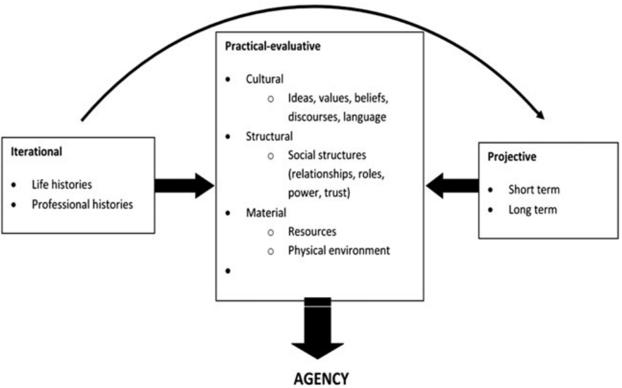
- For this paper, the authors primarily analyzed interview data from all three phases, using codes from an agency model and then open coding to interpret beliefs and aspirations.
## Limitations
- The authors explicitly say the data refer to “one particular though nonetheless interesting case,” so the findings are limited in scope.
- The study draws primarily on the stories of six classroom teachers, which is a small sample; this is evident in the text.
- The analysis focuses on interviews and selected themes from one reform context in Scotland, so transferability beyond this setting is not established; this is evident in the text.
Model-written summary. Check it against the paper before relying on it.
Integrity signals
Registry
Cites
Statistics
Figures
Verification
Claims the paper makes
0 Valid · 2 Not valid · 30 Not checked · 99 Own results and interpretations
A result the paper reports from its own data — it cites no other source for it, so there is none to check. The quote shows it is in the paper.
In the paper
“The significance of what was often referred to as a safe and caring learning environment for everyone who came into their classrooms was articulated strongly.”
§ 4. Teachers’ beliefs > 4.1. Beliefs relating to children and young people
boosted- Asserted: passes — The authors put it forward as true.
- Checkable: passes — It can be checked against evidence.
- Load-bearing: unclear — It is unclear whether the paper’s conclusions depend on it.
- Based: passes — The paper gives a reason why it holds.
A result the paper reports from its own data — it cites no other source for it, so there is none to check. The quote shows it is in the paper.
In the paper
“In analysing the data, we were struck by the similarity of beliefs articulated across this small group of teachers, despite their location in different sectors of education.”
plain- Asserted: passes — The authors put it forward as true.
- Checkable: passes — It can be checked against evidence.
- Load-bearing: passes — The paper’s conclusions depend on it.
- Based: passes — The paper gives a reason why it holds.
A result the paper reports from its own data — it cites no other source for it, so there is none to check. The quote shows it is in the paper.
In the paper
“The data clearly convey the strong sense of teachers’ professional responsibility towards their students.”
§ 4. Teachers’ beliefs > 4.1. Beliefs relating to children and young people
boosted- Asserted: passes — The authors put it forward as true.
- Checkable: passes — It can be checked against evidence.
- Load-bearing: unclear — It is unclear whether the paper’s conclusions depend on it.
- Based: passes — The paper gives a reason why it holds.
A result the paper reports from its own data — it cites no other source for it, so there is none to check. The quote shows it is in the paper.
In the paper
“Indeed, only one participant strongly referred to the importance of subject knowledge, lamenting what she saw as the detrimental effects of vocationalism on the academic content of her subject.”
§ 4. Teachers’ beliefs > 4.2. Beliefs about the role of the teacher
plainSingle case- Asserted: passes — The authors put it forward as true.
- Checkable: passes — It can be checked against evidence.
- Load-bearing: unclear — It is unclear whether the paper’s conclusions depend on it.
- Based: passes — The paper gives a reason why it holds.
A result the paper reports from its own data — it cites no other source for it, so there is none to check. The quote shows it is in the paper.
In the paper
“these discourses appear to be fairly restricted in scope, more geared to short-term goals, and predominantly articulated via the language of recent policy documentation.”
hedged- Asserted: passes — The authors put it forward as true.
- Checkable: passes — It can be checked against evidence.
- Load-bearing: passes — The paper’s conclusions depend on it.
- Based: passes — The paper gives a reason why it holds.
57 more claims
Create a free account to see all 131 claims and every source verdict.
- It may state two separate claims as one. 39
- Probably not a substantial claim. 46
Claims other papers make about this one
Each is checked against this paper’s own text: does it say what the citing paper says it does?
The cited source says what the claim attributes to it.
In the citing paper
“This absence leaves teachers unsure about their roles and contributions (Biesta et al. 2015).”
From Unveiling teachers’ professional agency and decision-making in professional learning: the illusion of choice (2025) · cites this paper as Biesta et al. 2015
The cited source says what the claim attributes to it.
In the citing paper
“As Biesta et al. (2015) suggests, teachers' agency is influenced not just by their attributes, but also by their professional experience.”
From Unveiling teachers’ professional agency and decision-making in professional learning: the illusion of choice (2025) · cites this paper as Biesta et al. 2015
The cited source says what the claim attributes to it.
In the citing paper
“Likewise Biesta, Priestley and Robinson (2015) point to a lack of discourses among teachers that constructs education in terms other than the technical-rational concerns of 'efficiency' to include questions of purpose and value.”
From Teacher agency and professional learning communities; what can Learning Rounds in Scotland teach us? (2017) · cites this paper as Biesta, Priestley and Robinson (2015)
The cited source says what the claim attributes to it.
In the citing paper
“Biesta, Priestley and Robinson (2015) report that the Scottish teachers in their research had a very similar set of views about teaching, learning and education more broadly, even though they were from diverse locations and sectors.”
From Teacher agency and professional learning communities; what can Learning Rounds in Scotland teach us? (2017) · cites this paper as Biesta, Priestley and Robinson (2015)
The cited source says what the claim attributes to it.
In the citing paper
“Biesta, Priestley and Robinson (2015) report a similar experience in their research on teacher agency.”
From Teacher agency and professional learning communities; what can Learning Rounds in Scotland teach us? (2017) · cites this paper as Biesta, Priestley and Robinson (2015)
Citations
Cites
Outline of a Theory of Practice
Bourdieu, P. (1977) · doi:10.1017/cbo9780511812507 · Cited by 27,606
(1984) · Cited by 21,166
Outline of a Theory of Practice.
Frank, A. W., & Bourdieu, P. (1980) · Contemporary Sociology · doi:10.2307/2066038 · Cited by 14,545
Teachers' beliefs and educational research: cleaning up a messy construct
Pajares, M. F. (1992) · Review of Educational Research · doi:10.3102/00346543062003307 · Cited by 9,007 · cited 2×
“In the discussion section, we explore what this reveals about the role of beliefs in teacher agency.”
BackgroundEmirbayer, M., & Mische, A. (1998) · American Journal of Sociology · doi:10.1086/231294 · Cited by 6,165
Outline of a Theory of Practice
BOURDIEU, P. (2007) · On Violence · doi:10.2307/j.ctv120qr2d.16 · Cited by 5,527
Realist Social Theory: The Morphogenetic Approach
Archer, M. S. (1995) · Cambridge University Press eBooks · doi:10.1017/cbo9780511557675 · Cited by 3,125
Change Forces: Probing the Depths of Educational Reform
Fullan, M. (1993) · doi:10.4324/9780203059005 · Cited by 3,111
Realist social theory the morphogenetic approach
Archer, M. S. (1995) · Cited by 2,938
Change Forces: Probing the Depths of Educational Reform
Davies, S., & Fullan, M. (1995) · Canadian Public Policy / Analyse de Politiques · doi:10.2307/3552051 · Cited by 2,809
Elias, N. (1939) · Medical Entomology and Zoology · Cited by 2,209
The role of beliefs in the practice of teaching
Nespor, J. (1987) · Journal of Curriculum Studies · doi:10.1080/0022027870190403 · Cited by 2,052 · cited 3×
“In the discussion section, we explore what this reveals about the role of beliefs in teacher agency.”
BackgroundThe Civilizing Process: Sociogenetic and Psychogenetic Investigations
Elias, N., Jephcott, E., Dunning, E., Goudsblom, J., & Mennell, S. (2000) · Cited by 1,900
Realist social theory: List of figures
Archer, M. S. (1995) · Cited by 1,672
Good Education in an Age of Measurement: Ethics, Politics, Democracy
Biesta, G. (2010) · Cited by 1,245
Self-citationAgency and learning in the lifecourse: Towards an ecological perspective
Biesta, G., & Tedder, M. (2007) · Studies in the Education of Adults · doi:10.1080/02660830.2007.11661545 · Cited by 1,198 · cited 1×
“(Biesta & Tedder, 2007, p. 137; emphasis added) Agency, in other words, is not something that people can have – as a property, capacity or competence – but is something that people do.”
BackgroundSelf-citationPriestley, M., Biesta, G., & Robinson, S. (2015) · Flip the System · doi:10.4324/9781315678573-15 · Cited by 935
Self-citationWhat is agency? Conceptualizing professional agency at work
Eteläpelto, A., Vähäsantanen, K., Hökkä, P., & Paloniemi, S. (2013) · Educational Research Review · doi:10.1016/j.edurev.2013.05.001 · Cited by 934
Teacher Agency in Curriculum Making: Agents of Change and Spaces for Manoeuvre
Priestley, M., Edwards, R., Priestley, A., & Miller, K. (2012) · Curriculum Inquiry · doi:10.1111/j.1467-873x.2012.00588.x · Cited by 707 · cited 1×
“See Priestley et al. (2012) for further discussion of the mechanisms (or lack of) for sense-making to occur in schools.”
BackgroundSelf-citationTurner, J. H. (1997) · Social Forces · doi:10.1093/sf/76.1.335 · Cited by 632
(2006) · Science Education · doi:10.1002/(issn)1098-237x · Cited by 520
Subjectification: the relevance of Butler’s analysis for education
Davies, B. (2006) · British Journal of Sociology of Education · doi:10.1080/01425690600802907 · Cited by 365
Teacher Agency : An Ecological Approach
(2015) · Bloomsbury Academic eBooks · doi:10.5040/9781474219426 · Cited by 362
Self-citationEducating the “Good” Citizen: Political Choices and Pedagogical Goals
Westheimer, J., & Kahne, J. (2004) · PS: Political Science & Politics · doi:10.1017/s1049096504004160 · Cited by 340 · cited 1×
“…to rest with notions of personal responsibility and participation as core goals of citizenship, for which schools should prepare students (see Westheimer and Kahne (2004) for an extended discussion of these concepts in a North American context; and Biesta (2008) for an application of these…”
BackgroundEffective and responsible teaching: the new synthesis
(1993) · Choice Reviews Online · doi:10.5860/choice.30-5719 · Cited by 250 · cited 2×
“Thus, students with ‘poor’ ability, or students who do not take ‘responsibility’ for their own learning provide a justification for the teacher to abdicate some professional responsibility, blaming students as ‘mad, bad or stupid’ (Watzlawick, Wickland & Fisch, in Salomon, 1992, p. 45).”
BackgroundMeirink, J. A., Meijer, P. C., Verloop, N., & Bergen, T. C. M. (2009) · Teaching and Teacher Education · doi:10.1016/j.tate.2008.07.003 · Cited by 229 · cited 2×
“Meirink, Meijer, Verloop, & Bergen, 2009; Nespor, 1987; Pajares, 1992; Wallace & Priestley, 2011). Nespor (1987) views teacher beliefs as affective, narrative in nature and relying on correspondences with evaluations from the past, such as a particular student being ‘immature’ or ‘bright’.”
BackgroundPyhältö, K., Pietarinen, J., & Soini, T. (2011) · Journal of Educational Change · doi:10.1007/s10833-011-9171-0 · Cited by 202
How Does a Competent Teacher Become a Good Teacher?
Biesta, G. (2015) · Wiley eBooks · doi:10.1002/9781118977859.ch1 · Cited by 200
Self-citationHow is agency possible? Towards an ecological understanding of agency-as-achievement
Biesta, G., & Tedder, M. (2006) · Open Repository and Bibliography (University of Luxembourg) · Cited by 189
Self-citationReinventing the Curriculum: New Trends in Curriculum Policy and Practice
(2013) · Bloomsbury Publishing Plc eBooks · doi:10.5040/9781472553195 · Cited by 184
Wallace, C. S., & Priestley, M. (2011) · Journal of Curriculum Studies · doi:10.1080/00220272.2011.563447 · Cited by 182 · cited 1×
“The term ‘teacher beliefs’ has been widely used in the educational literature to explain classroom decision-making (e.g. Meirink, Meijer, Verloop, & Bergen, 2009; Nespor, 1987; Pajares, 1992; Wallace & Priestley, 2011).”
BackgroundSelf-citationReinventing the curriculum : new trends in curriculum policy and practice
Priestley, M., & Biesta, G. (2014) · Cited by 179
Self-citationMedwell, J., Wray, D., Minns, H., Coates, E., & Griffiths, V. (2014) · Learning Matters eBooks · Cited by 143
Whatever happened to curriculum theory? Critical realism and curriculum change
Priestley, M. (2011) · Pedagogy, Culture & Society · doi:10.1080/14681366.2011.582258 · Cited by 116 · cited 2×
“There is an emerging tendency in curriculum policy in the UK and elsewhere to acknowledge the importance of teachers’ agency – that is, their active contribution to shaping their work and its conditions – for the overall quality of education (see, e.g. Goodson, 2003; Nieveen, 2011; Priestley, 2011).”
BackgroundSelf-citationI, Teacher: re‐territorialization of teachers’ multi‐faceted agency in globalized education
Vongalis‐Macrow, A. (2007) · British Journal of Sociology of Education · doi:10.1080/01425690701369376 · Cited by 114 · cited 2×
“Teacher agency, that is, agency that is theorised specifically in respect of the activities of teachers in schools, has been subject to little explicit research or theory development (Vongalis-Macrow, 2007).”
BackgroundComplex positioning: teachers as agents of curricular and pedagogical reform
Leander, K. M., & Osborne, M. D. (2008) · Journal of Curriculum Studies · doi:10.1080/00220270601089199 · Cited by 103 · cited 2×
“…Pyhältö, Pietarinen, & Soini, 2012), existing change models tend to both underplay and misconstrue the role of teacher agency in educational change (Leander & Osborne, 2008), albeit that a more interesting body of work is beginning to emerge (e.g. Eteläpelto, Vähäsantanen, Hökkä, & Paloniemi,…”
BackgroundProfessional Knowledge, Professional Lives
Goodson, I. (2003) · Cited by 96
Norris, S. P. (1997) · Science Education · doi:10.1002/(sici)1098-237x(199704)81:2<239::aid-sce7>3.0.co;2-g · Cited by 91
Teachers and the National Curriculum
Helsby, G., & McCulloch, G. (1999) · Cassell eBooks · Cited by 90
What Can I Do? Foucault on Freedom and the Question of Teacher Agency.
Pignatelli, F. (1993) · Educational Theory · doi:10.1111/j.1741-5446.1993.00411.x · Cited by 83 · cited 2×
“While there is some literature that locates the concept in relation to wider theoretical discussions of agency (e.g. Pignatelli, 1993; Priestley, Edwards, Priestley, & Miller, 2012; Pyhältö, Pietarinen, & Soini, 2012), existing change models tend to both underplay and misconstrue the role of…”
BackgroundBiesta, G. (2015) · Brunel University Research Archive (BURA) (Brunel University London) · doi:10.1002/9781118977859.ch1/summary · Cited by 72 · cited 1×
“This is one important reason why we think that access to robust professional discourses about teaching does matter for teacher agency, and thus should be an important dimension of teacher education and further professional development (see also Biesta, 2015).”
BackgroundSelf-citationProfessional Knowledge, Professional Lives
Egan, B. (2004) · Journal of In-service Education · doi:10.1080/13674580400200458 · Cited by 67 · cited 2×
“There is an emerging tendency in curriculum policy in the UK and elsewhere to acknowledge the importance of teachers’ agency – that is, their active contribution to shaping their work and its conditions – for the overall quality of education (see, e.g. Goodson, 2003; Nieveen, 2011; Priestley, 2011).”
BackgroundInfluentialBiesta, G. (2008) · Scottish Educational Review · doi:10.1163/27730840-04002005 · Cited by 64 · cited 1×
“…personal responsibility and participation as core goals of citizenship, for which schools should prepare students (see Westheimer and Kahne (2004) for an extended discussion of these concepts in a North American context; and Biesta (2008) for an application of these ideas in the Scottish context).”
BackgroundSelf-citationPolicy into Practice and Practice into Policy: Creative Mediation in the Primary Classroom
Osborn, M., Croll, P., Broadfoot, P., Pollard, A., McNess, E., & Triggs, P. (1997) · Bristol Research (University of Bristol) · Cited by 43
Research works printed but not linked: 3
- Brown, S., & McIntyre, D. (1993). Making sense of teaching: Developing teachers and teaching. Buckingham: Open University Press. (Open in a new window)Google Scholar
- Hollis, M. (1994). The philosophy of social science: An introduction. Cambridge: Cambridge University Press. (Open in a new window)Google Scholar · doi:10.1017/ccol0521447801
- Nieveen N. (2011 September 14). Teachers’ professional development in curriculum design in the Netherlands. Paper presented at the European Conference for Educational Research Berlin.
Cited by
What is Education For? On Good Education, Teacher Judgement, and Educational Professionalism
Biesta, G. (2015) · European Journal of Education · doi:10.1111/ejed.12109 · Cited by 900
Self-citationTeacher agency and identity commitment in curricular reform
Tao, J., & Gao, X. (2017) · Teaching and Teacher Education · doi:10.1016/j.tate.2017.01.010 · Cited by 408
An Entangled Pedagogy: Looking Beyond the Pedagogy—Technology Dichotomy
Fawns, T. (2022) · Postdigital Science and Education · doi:10.1007/s42438-022-00302-7 · Cited by 350
“However, teachers may hold only vague notions of purpose, and a clear articulation of purposes (particularly longer-term ones) is challenging (Priestley et al. 2015).”
BackgroundHuman-centred learning analytics and AI in education: A systematic literature review
Alfredo, R., Echeverria, V., Jin, Y., Yan, L., Swiecki, Z., Gašević, D., & Martinez-Maldonado, R. (2024) · Computers and Education: Artificial Intelligence · doi:10.1016/j.caeai.2024.100215 · Cited by 281
“This notion of human control encompasses key elements of intentional, purposeful, and meaningful learning (Jääskelä et al., 2021) and teaching (Biesta et al., 2015).”
BackgroundA model of teacher agency in professional development and school reform
Imants, J., & Van der Wal, M. M. (2020) · Journal of Curriculum Studies · doi:10.1080/00220272.2019.1604809 · Cited by 251
“Within thediscourse of agency, teacher agency is considered a specific formof professional agency—their active contribution to shaping their work and its conditions is assumed to be an indispensable element of good and meaningful education (Biesta et al., 2015).”
BackgroundInfluential
Metadata
- Authors
- Biesta, G., Priestley, M., & Robinson, S.
- Affiliations
- ArtEZ University of the Arts (NL)
- University of Stirling (GB)
- Aarhus University (DK)
- Corresponding author
- Biesta, Gert
- Venue
- Teachers and Teaching
- Publisher
- Informa UK Limited
- Published
- 2015-06-15
- Volume
- 21
- Issue
- 6
- Pages
- 624-640
- ISSN
- 1354-0602 (ISSN-L)
- 1470-1278
- OpenAlex
- W1911902575
- Cited by
- 1,318
- References
- 47
- Citations by year
- 2026: 233 · 2025: 161 · 2024: 141 · 2023: 157 · 2022: 139 · 2021: 131 · 2020: 118 · 2019: 96 · 2018: 73 · 2017: 48 · 2016: 17 · 2015: 4
- FWCI
- 236.15
- Type
- journal article
- Language
- en
- Open access
- hybrid
- doi.org
- Licence
- cc-by-nc-nd
- Locations
- Teachers and Teaching (publishedVersion, cc-by-nc-nd)
- Brunel University Research Archive (BURA) (Brunel University London) (submittedVersion)
- Stirling Online Research Repository (University of Stirling) (submittedVersion, cc-by-nc-nd)
- Edinburgh Research Explorer (University of Edinburgh) (submittedVersion, other-oa)
- Funders
- Economic and Social Research Council (ES/I006907/1)
- Topics
- Social Sciences › Education › Teacher Education and Leadership Studies
- Social Sciences › Education › Education Pedagogy and Practices
- Social Sciences › Arts and Humanities › Philosophy › Education, Philosophy, and Society
- Keywords
- teacher agency, teacher beliefs, Curriculum for Excellence, educational reform, teacher professionalism, teacher decision-making, institutional discourse, professional vision, Scotland
About these checks
Registry, retraction, Cites and statistics results are computed, not judged, with one exception: a printed reference that no index lists is read once by a model before it counts as a citation error. Claims are extracted by a model and kept only when their quote appears verbatim in the text; each cited source is then checked, with a model’s help, for whether it says what the claim relies on. Those verdicts can be wrong — read the claim’s quote and the cited source before relying on one.
A language model drew the claims from the paper on 2026-10-11, under version 3 of the claim definition (model deepseek-v4.1-flash, prompt extract-v3).
A second model labelled each claim on 2026-10-11 (model jev-1.13-20260917, definition revision gold-guideline-v0.2).
Statistics and arithmetic are recomputed, not judged.
Confidence bands are shown only for fields calibrated on our annotated test set. None is calibrated yet, so no band is shown.
What counts as a claim ›How we measure confidence ›How we check this ›
Are you an author, or do you see a problem with this page? Request a review
Data sources
Bibliographic data: Semantic Scholar, OpenAlex, Crossref.
Contains information from the Semantic Scholar Academic Graph Datasets, made available under the ODC Attribution License (ODC-BY 1.0).
Semantic Scholar’s data is described in: Kinney, R., et al. (2023). The Semantic Scholar Open Data Platform. arXiv:2301.10140.
