

The pursuit of quality in grounded theory
Open accessThe DOI matches its Crossref record; 84 of the 85 references it cites were found in a registry or an index, and 1 are not checked yet; 2 of the 63 sources its claims cite were checked for support.
Abstract
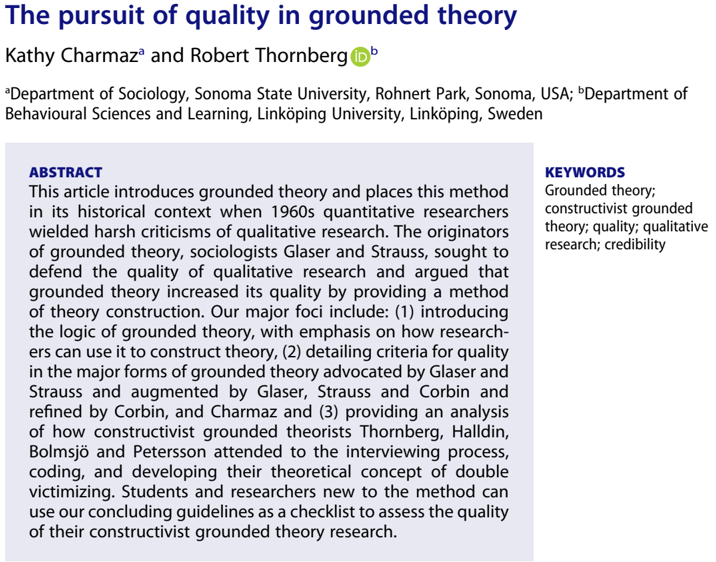
This article introduces grounded theory and places this method in its historical context when 1960s quantitative researchers wielded harsh criticisms of qualitative research. The originators of grounded theory, sociologists Glaser and Strauss, sought to defend the quality of qualitative research and argued that grounded theory increased its quality by providing a method of theory construction. Our major foci include: (1) introducing the logic of grounded theory, with emphasis on how researchers can use it to construct theory, (2) detailing criteria for quality in the major forms of grounded theory advocated by Glaser and Strauss and augmented by Glaser, Strauss and Corbin and refined by Corbin, and Charmaz and (3) providing an analysis of how constructivist grounded theorists Thornberg, Halldin, Bolmsjö and Petersson attended to the interviewing process, coding, and developing their theoretical concept of double victimizing. Students and researchers new to the method can use our concluding guidelines as a checklist to assess the quality of their constructivist grounded theory research.
Verified 2026-11-22 · 1 reference not checked yet
Overview
CoChat Summary
TL;DR
This article reviews grounded theory’s historical development and argues that quality criteria must fit the specific version of grounded theory, culminating in constructivist criteria and a checklist. It illustrates constructivist quality through Thornberg et al.’s (2013) study of school bullying and the concept of double victimizing.
Key findings
- Quality criteria differ across grounded theory versions: original Glaser and Strauss focused on credibility and applicability with fitness, understanding, generality, and control; Glaser added workability, relevance, fit, and modifiability; Strauss and Corbin emphasized data quality, plausibility/value of theory, adequacy of process, and empirical grounding; constructivist Charmaz proposes credibility, originality, resonance, and usefulness.
- The paper argues quality is built through iterative data collection and analysis, line-by-line and focused coding, memo-writing, theoretical sampling and saturation, constant comparison, and reflexivity/methodological self-consciousness.
- In the illustrative constructivist study, Thornberg et al. (2013) distributed 523 open-ended questionnaires to students in three secondary schools and two universities in Sweden; of 511 responses, 168 reported past bullying, 36 volunteered, and 21 who had been bullied for more than one year were interviewed; analysis produced the core category “double victimizing” (external and internal victimizing).
- In psychology, Rubin, Bell, and McCleland (2018) found only 13% of responding graduate psychology programs required a qualitative research course, and respondents described qualitative research as “inaccurate,” “subjective,” and “lacking rigor” while also describing it as providing the “best methods for feminist, community-based, and social justice research.”
Methods
- Design: methodological/conceptual article introducing grounded theory, comparing quality criteria across Glaserian, Straussian, and constructivist versions, and offering guidelines/checklist for constructivist grounded theory.
- Data or sample: no primary empirical sample for the article; it analyzes historical and methodological literature and uses Thornberg et al. (2013) as an illustrative constructivist grounded theory study (523 questionnaires; 511 responses; 168 bullied; 36 volunteers; 21 interviewed).
- Main analysis: narrative synthesis and comparison of quality criteria, with an illustration of coding, constant comparison, memo-writing, theoretical sampling, and category development leading to “double victimizing.”
Limitations
- Stated: the authors caution that checklists risk becoming a “methodological crutch” that avoids deep engagement with method and data (citing Barbour 2001), and present their guidelines as flexible, not substitutes for rigorous research.
- Stated: criteria for quality in qualitative research remain unsettled, with “little consensus” about appropriate evaluation criteria, and meanings of quality markers may differ among researchers.
- Evident from the text: the article is not an empirical validation of the checklist; the double victimizing case is a secondary illustration rather than a new test, and the guidelines are aimed mainly at constructivist grounded theory though claimed mostly applicable to other versions.
Model-written summary. Check it against the paper before relying on it.
Integrity signals
Registry
Cites
Statistics
Figures



Verification
Claims the paper makes
2 Valid · 13 Not valid · 38 Not checked · 38 Own results and interpretations
None of the sources cited for this claim have been checked yet.
In the paper
“Concerns about objectivity, validity, reliability and replicability in qualitative research still pervade academic psychology.”
§ The pursuit of quality in grounded theory > Qualitative research and psychology
plain- Asserted: passes — The authors put it forward as true.
- Checkable: passes — It can be checked against evidence.
- Load-bearing: passes — The paper’s conclusions depend on it.
- Based: passes — The paper gives a reason why it holds.
In the paper
“Until Glaser and Strauss's (1967) statement, little had been written, much less codified into a systematic statement, about how to construct a qualitative theoretical analysis of high quality.”
§ The pursuit of quality in grounded theory > Concerns about quality in the development of grounded theory
What the sources say
- Not matchedcites Glaser and Strauss's (1967)
An author–year citation the paper’s reference list doesn’t settle. We don’t search these by name.
plain- Asserted: passes — The authors put it forward as true.
- Checkable: passes — It can be checked against evidence.
- Load-bearing: unclear — It is unclear whether the paper’s conclusions depend on it.
- Based: passes — The paper gives a reason why it holds.
- Not matched
A statement the paper makes itself — it cites no source for it, so there is none to check. The quote shows it is in the paper.
In the paper
“If, however, researchers only ask the same questions of each participant, they are likely to elicit similar stories about the topic.”
§ The pursuit of quality in grounded theory > Introduction
hedgedstates a possible cause- Asserted: passes — The authors put it forward as true.
- Checkable: passes — It can be checked against evidence.
- Load-bearing: passes — The paper’s conclusions depend on it.
- Based: passes — The paper gives a reason why it holds.
A statement the paper makes itself — it cites no source for it, so there is none to check. The quote shows it is in the paper.
In the paper
“If, however, researchers systematically interrogate their data as they gather it, their early ideas can then inform subsequent data collection.”
§ The pursuit of quality in grounded theory > Introduction
plainstates a possible cause- Asserted: passes — The authors put it forward as true.
- Checkable: passes — It can be checked against evidence.
- Load-bearing: passes — The paper’s conclusions depend on it.
- Based: passes — The paper gives a reason why it holds.
A statement the paper makes itself — it cites no source for it, so there is none to check. The quote shows it is in the paper.
In the paper
“When answering quantitative social scientists' sharp criticisms of its quality, Glaser and Strauss rejected the common practice of evaluating qualitative research according to the tenets of the quantitative tradition.”
§ The pursuit of quality in grounded theory > Concerns about quality in the development of grounded theory
plain- Asserted: passes — The authors put it forward as true.
- Checkable: passes — It can be checked against evidence.
- Load-bearing: unclear — It is unclear whether the paper’s conclusions depend on it.
- Based: passes — The paper gives a reason why it holds.
22 more claims
Create a free account to see all 91 claims and to verify the 3 references still open.
- Probably not a substantial claim. 61
- It may state two separate claims as one. 26
Claims other papers make about this one
Each is checked against this paper’s own text: does it say what the citing paper says it does?
The source backs part of the claim, not all of it — or backs it for a different population, condition or comparison.
In the citing paper
“An explicitly constructivist approach aims to produce an abstract understanding of a phenomenon (rather than an explanation, as in other versions of GTM)”
From Quality Criteria: General and Specific Guidelines for Qualitative Approaches in Psychology Research. A Concise Guide for Novice Researchers and Reviewers (2024) · cites this paper as Charmaz & Thornberg, 2021
Experimental — accuracy not yet measuredThe source backs part of the claim, not all of it — or backs it for a different population, condition or comparison.
In the citing paper
“Constant comparison is a systematic strategy combining the advantages of simultaneous data generation and analysis, enabling a concentration on significant issues (Charmaz and Thornberg, 2021).”
From Application and challenges of using a Constructivist Grounded Theory methodology to address an undertheorized clinical challenge: A discussion paper (2024) · cites this paper as Charmaz and Thornberg, 2021
Experimental — accuracy not yet measuredThe cited source says what the claim attributes to it.
In the citing paper
“focuses on actions, meanings and constructions”
From Quality Criteria: General and Specific Guidelines for Qualitative Approaches in Psychology Research. A Concise Guide for Novice Researchers and Reviewers (2024) · cites this paper as Charmaz & Thornberg, 2021
The cited source says what the claim attributes to it.
In the citing paper
“and acknowledges both subjectivity (of participants and researchers) and context (Charmaz, 2014; Charmaz & Thornberg, 2021).”
From Quality Criteria: General and Specific Guidelines for Qualitative Approaches in Psychology Research. A Concise Guide for Novice Researchers and Reviewers (2024) · cites this paper as Charmaz & Thornberg, 2021
The cited source says what the claim attributes to it.
In the citing paper
“The primary focus is the theory ' s ability to clarify participants ' lives and contribute to knowledge and practice (Charmaz & Thornberg, 2021).”
From Quality Criteria: General and Specific Guidelines for Qualitative Approaches in Psychology Research. A Concise Guide for Novice Researchers and Reviewers (2024) · cites this paper as Charmaz & Thornberg, 2021
5 more claims about this paper
Create a free account to see every claim other papers make about this one.
Citations
Cites
Using thematic analysis in psychology
Braun, V., & Clarke, V. (2006) · Qualitative Research in Psychology · doi:10.1191/1478088706qp063oa · Cited by 194,414
The Discovery of Grounded Theory: Strategies for Qualitative Research.
Wagner, H. R., Glaser, B. G., & Strauss, A. L. (1968) · Social Forces · doi:10.2307/2575405 · Cited by 46,361
The Discovery of Grounded Theory; Strategies for Qualitative Research
Glaser, B. G., Strauss, A. L., & Strutzel, E. (1968) · Nursing Research · doi:10.1097/00006199-196807000-00014 · Cited by 39,449
Basics of Qualitative Research: Grounded Theory Procedures and Techniques.
Ellis, C., Strauss, A., & Corbin, J. (1992) · Contemporary Sociology · doi:10.2307/2074814 · Cited by 29,249
(2006) · Cited by 18,730
Self-citationBasics of Qualitative Research
Ozanne, J. L., Strauss, A., & Corbin, J. (1992) · Journal of Marketing Research · doi:10.2307/3172751 · Cited by 17,850 · cited 2×
“In their development of grounded theory, Strauss and Corbin (1990; Corbin and Strauss 1990; Strauss and Corbin 1998) emphasized four general criteria: (1) quality of the data, in other words, grounded theorists need to carefully address and adopt quality criteria related to methods used for data…”
BackgroundMethodBasics of Qualitative Research: Grounded Theory Procedures and Techniques
Long, D. R., Strauss, A., & Corbin, J. (1993) · The Modern Language Journal · doi:10.2307/328955 · Cited by 17,576
(2014) · Cited by 15,747
Self-citationInterviewing as qualitative research a guide for researchers in education and the social sciences
Seidman, I. (2006) · Cited by 12,757
Basics of Qualitative Research (3rd ed.): Techniques and Procedures for Developing Grounded Theory
Corbin, J., & Strauss, A. (2008) · SAGE · doi:10.4135/9781452230153 · Cited by 12,136
Grounded theory research: Procedures, canons, and evaluative criteria
Corbin, J. M., & Strauss, A. (1990) · Qualitative Sociology · doi:10.1007/bf00988593 · Cited by 11,133
(1990) · Cited by 11,110
Qualitative Quality: Eight “Big-Tent” Criteria for Excellent Qualitative Research
Tracy, S. J. (2010) · Qualitative Inquiry · doi:10.1177/1077800410383121 · Cited by 7,536
Constructing grounded theory. A practical guide through qualitative analysis
Brink, E., Dellve, L., Hallberg, U., Abrahamsson, K. H., Klingberg, G., & Wentz, K. (2006) · International Journal of Qualitative Studies on Health and Well-being · doi:10.3402/qhw.v1i3.4932 · Cited by 6,862
Paradigmatic Controversies, Contradictions, and Emerging Confluences.
Guba, E. G., & Lincoln, Y. S. (2005) · Cited by 6,831
(2008) · Cited by 6,727
Interviews – Learning the Craft of Qualitative Research Interviewing
Vaivio, J. (2012) · European Accounting Review · doi:10.1080/09638180.2012.675165 · Cited by 4,535
Goulding, C. (2002) · SAGE Publications Ltd eBooks · doi:10.4135/9781849209236 · Cited by 4,455
Quality and trustworthiness in qualitative research in counseling psychology.
Morrow, S. L. (2005) · Journal of Counseling Psychology · doi:10.1037/0022-0167.52.2.250 · Cited by 3,199 · cited 1×
“In short, grounded theorists are building the kind of ‘trustworthiness,’ of their research that counseling psychologists Morrow (2005) and Williams and Morrow (2009) rightly argue is imperative to achieve in research practice.”
Background(1998) · Medical Entomology and Zoology · Cited by 2,953
Checklists for improving rigour in qualitative research: a case of the tail wagging the dog?
Barbour, R. S. (2001) · BMJ · doi:10.1136/bmj.322.7294.1115 · Cited by 2,613 · cited 1×
“As Barbour (2001) observes, using checklists risks becoming a methodological crutch that avoids deep engagement with the method.”
BackgroundThe SAGE Handbook of Qualitative Data Analysis
Flick, U. (2014) · doi:10.4135/9781446282243 · Cited by 2,469
Interviews in Qualitative Research
(2011) · QMiP Bulletin · doi:10.53841/bpsqmip.2011.1.12.57 · Cited by 2,207
The Sage Handbook of Qualitative Research
Ho, R. T. H., Ng, S. M., & Ho, D. Y. F. (2007) · Asian Journal of Social Psychology · doi:10.1111/j.1467-839x.2007.00237.x · Cited by 2,167
(1965) · Medical Entomology and Zoology · Cited by 1,510
(2001) · Cited by 1,204
Healy, M., & Perry, C. (2000) · Qualitative Market Research: An International Journal · doi:10.1108/13522750010333861 · Cited by 1,038
The Power of Constructivist Grounded Theory for Critical Inquiry
Charmaz, K. (2017) · Qualitative Inquiry · doi:10.1177/1077800416657105 · Cited by 1,003 · cited 14×
“…it contributes to increase our understanding of meanings and actions and how victims construct them; and (c) relevance (Glaser 1998) and resonance (Charmaz 2014) as participants in the study and other victims of school bullying could recognize most or all processes included in the grounded theory…”
BackgroundMethodInfluentialSelf-citationGlaser, B. G., & Strauss, A. L. (1968) · Medical Entomology and Zoology · Cited by 951
Grounded Theory and Theoretical Coding
Thornberg, R., & Charmaz, K. (2014) · The SAGE Handbook of Qualitative Data Analysis · doi:10.4135/9781446282243.n11 · Cited by 741 · cited 2×
“Unlike earlier manuals describing how to do grounded theory, contemporary versions of the method including Bryant (2017, 2019), Charmaz (2006, 2014), Corbin and Strauss (2008, 2015), and Thornberg and Charmaz (2014) take a flexible approach to grounded theory and adopt more recent epistemologies.”
BackgroundMethodSelf-citationThornberg, R. (2012) · Scandinavian Journal of Educational Research · doi:10.1080/00313831.2011.581686 · Cited by 668 · cited 2×
“In accordance with the pragmatistic view of knowledge and knowing, underlying the constructivist grounded theory approach (Charmaz 2006, 2014; Thornberg 2012), Thornberg et al. (2013) grounded theory of double victimizing is considered to be situated, fallible and provisional, and therefore…”
BackgroundSelf-citationThe SAGE Handbook of Current Developments in Grounded Theory
Bryant, A., & Charmaz, K. (2019) · doi:10.4135/9781526485656 · Cited by 614
Self-citationThe “core category” of grounded theory: Making constant comparisons
Hallberg, L. R.-M. (2006) · International Journal of Qualitative Studies on Health and Well-being · doi:10.1080/17482620600858399 · Cited by 600
GLASER, B. G., & STRAUSS, A. L. (1968) · AJN, American Journal of Nursing · doi:10.1097/00000446-196812000-00048 · Cited by 524
Rigour and grounded theory research
Chiovitti, R. F., & Piran, N. (2003) · Journal of Advanced Nursing · doi:10.1046/j.0309-2402.2003.02822.x · Cited by 523 · cited 1×
“…theory needs its own set of criteria for evaluating quality due to its unique features (cf., Berthelsen, Grimshaw-Aagaard, and Hansen 2018; Chiovitti and Piran 2003; Elliott and Lazenbatt 2005; Hutchison, Johnston, and Breckon 2011), although grounded theorists cannot escape more general…”
BackgroundMirrors & Masks: The Search for Identity
Strauss, A. L. (2017) · Routledge eBooks · doi:10.4324/9781315124582 · Cited by 505
Grounded Theory in Historical Perspective: An Epistemological Account
Bryant, A., & Charmaz, K. (2007) · The SAGE Handbook of Grounded Theory · doi:10.4135/9781848607941.n1 · Cited by 462 · cited 1×
“By the 1960s, qualitative research had come under attack by US quantitative sociologists who viewed qualitative inquiry as lacking objectivity, validity, reliability, and replicability (Bryant & Charmaz 2007; Charmaz, 1995, Charmaz 2006).”
BackgroundSelf-citationAchieving trustworthiness in qualitative research: A pan-paradigmatic perspective
Williams, E. N., & Morrow, S. L. (2009) · Psychotherapy Research · doi:10.1080/10503300802702113 · Cited by 411 · cited 1×
“In short, grounded theorists are building the kind of ‘trustworthiness,’ of their research that counseling psychologists Morrow (2005) and Williams and Morrow (2009) rightly argue is imperative to achieve in research practice.”
BackgroundQualitative Research in Clinical and Health Psychology
(2015) · doi:10.1007/978-1-137-29105-9 · Cited by 409
A pluralist view of generalization in qualitative research
Larsson, S. (2009) · International Journal of Research & Method in Education · doi:10.1080/17437270902759931 · Cited by 365 · cited 1×
“Applicability, in turn, can be connected to generalizability (cf., Larsson 2009), and Glaser and Strauss (1967) proposed four interrelated criteria: (1) Fitness: The ‘theory must fit the substantive area to which it will be applied’ (p. 238), and they emphasized that the theory needs to fit the…”
BackgroundMirrors and Masks: The Search for Identity
Kenkel, W. F., & Strauss, A. L. (1959) · The American Catholic Sociological Review · doi:10.2307/3709297 · Cited by 325
Grounded theory in psychological research.
Henwood, K., & Pidgeon, N. (2003) · Qualitative research in psychology: Expanding perspectives in methodology and design. · doi:10.1037/10595-008 · Cited by 320
Klomek, A. B., Sourander, A., & Elonheimo, H. (2015) · The Lancet Psychiatry · doi:10.1016/s2215-0366(15)00223-0 · Cited by 283
Charmaz, K. (2020) · Qualitative Inquiry · doi:10.1177/1077800419879081 · Cited by 248 · cited 1×
“…needs its own set of criteria for evaluating quality due to its unique features (cf., Berthelsen, Grimshaw-Aagaard, and Hansen 2018; Chiovitti and Piran 2003; Elliott and Lazenbatt 2005; Hutchison, Johnston, and Breckon 2011), although grounded theorists cannot escape more general guidelines…”
BackgroundSelf-citationGrounded Theory and Grounded Theorizing: Pragmatism in Research Practice
Bryant, A. (2017) · doi:10.1093/acprof:oso/9780199922604.001.0001 · Cited by 197 · cited 1×
“Unlike earlier manuals describing how to do grounded theory, contemporary versions of the method including Bryant (2017, 2019), Charmaz (2006, 2014), Corbin and Strauss (2008, 2015), and Thornberg and Charmaz (2014) take a flexible approach to grounded theory and adopt more recent epistemologies.”
MethodA Grounded Theory of the Development of Noble Youth Purpose
Bronk, K. C. (2012) · Journal of Adolescent Research · doi:10.1177/0743558411412958 · Cited by 162 · cited 4×
“Their locations and diverse publication outlets may mask both the quality of their research and the scope of their contributions (e.g. Bronk 2012; Mazzone et al. 2018; Tsai, Seballos-Llena, and Castellano-Datta 2017; Wójcik 2018).”
BackgroundInfluential(2011) · Cited by 161
HOW TO RECOGNISE A ‘QUALITY’ GROUNDED THEORY RESEARCH STUDY
Elliott, N., & Lazenbatt, A. (2005) · Australian Journal of Advanced Nursing · doi:10.37464/2005.223.1975 · Cited by 156 · cited 1×
“…own set of criteria for evaluating quality due to its unique features (cf., Berthelsen, Grimshaw-Aagaard, and Hansen 2018; Chiovitti and Piran 2003; Elliott and Lazenbatt 2005; Hutchison, Johnston, and Breckon 2011), although grounded theorists cannot escape more general guidelines concerning…”
BackgroundHallberg, L. R. ‐., & Strandmark, M. (2006) · International Journal of Qualitative Studies on Health and Well-Being · doi:10.1080/17482620600555664 · Cited by 143 · cited 1×
“Methodologist Uwe Flick (2014, 2019) holds advanced degrees in both psychology and sociology; Lillemor Hallberg (2006, Hallberg & Strandmark, 2006) served as the first editor of the International Journal of Qualitative Studies on Health and Well-Being and conducts research as an expert in nursing…”
BackgroundProtest on the Fly: Toward a Theory of Spontaneity in the Dynamics of Protest and Social Movements
Snow, D. A., & Moss, D. M. (2014) · American Sociological Review · doi:10.1177/0003122414554081 · Cited by 143 · cited 1×
“Using constructivist grounded theory, Snow and Moss (2014) delineate the conditions, including those shaping behavior and emotions, in which seemingly spontaneous collective action arises.”
Stress and Coping Strategies in the Lives of Recent Immigrants: A Grounded Theory Model
Yakushko, O. F. (2010) · International Journal for the Advancement of Counselling · doi:10.1007/s10447-010-9105-1 · Cited by 100 · cited 2×
“…major process (Qin and Lykes 2006), illuminating the situations of people denied a public voice (Ayón et al. 2017; Gibson 2016; Scull, Mbonyingabo, and Kotb 2016; Tuason 2013), developing policy (Faija et al. 2017), and implications for professional practice (Song and de Jong 2013; Yakushko 2010).”
Background(2017) · Cited by 98
The legacy of Anselm Strauss in constructivist grounded theory
Charmaz, K. (2008) · Studies in Symbolic Interaction · doi:10.1016/s0163-2396(08)32010-9 · Cited by 85 · cited 1×
“(Charmaz 2008).”
Self-citationThe Temporal Emotion Work of Motherhood: Homeschoolers’ Strategies for Managing Time Shortage
Lois, J. (2010) · Gender & Society · doi:10.1177/0891243210377762 · Cited by 82 · cited 1×
“Once Jennifer Lois (2010) realized her questions of homeschooling mothers focused on quantity of time instead of quality, she gained resonance by hearing their stories from a new standpoint and revising her questions.”
BackgroundVictimising of school bullying: A grounded theory
Thornberg, R., Halldin, K., Bolmsjö, N., & Petersson, A. (2013) · Research Papers in Education · doi:10.1080/02671522.2011.641999 · Cited by 74 · cited 8×
“…result of empirical grounding, fit, These tables first appeared in Thornberg and Charmaz (2014). credibility, relevance, workability and resonance, Thornberg et al. (2013) grounded theory of double victimizing also demonstrated usefulness (Charmaz 2014) as it contributes to creating new lines of…”
BackgroundMethodInfluentialSelf-citationEnsuring Quality in Qualitative Research
Treharne, G., & Riggs, D. (2015) · doi:10.1007/978-1-137-29105-9_5 · Cited by 70
The Varieties of Grounded Theory
Bryant, A. (2019) · doi:10.4135/9781529716542 · Cited by 67 · cited 1×
“Unlike earlier manuals describing how to do grounded theory, contemporary versions of the method including Bryant (2017, 2019), Charmaz (2006, 2014), Corbin and Strauss (2008, 2015), and Thornberg and Charmaz (2014) take a flexible approach to grounded theory and adopt more recent epistemologies.”
MethodA model to explain suicide by self-immolation among Iranian women: A grounded theory study
Khankeh, H. R., Hosseini, S. A., Rezaie, L., Shakeri, J., & Schwebel, D. C. (2015) · Burns · doi:10.1016/j.burns.2015.03.015 · Cited by 56 · cited 1×
“Also, qualitative psychologists often work in specialized areas on multidisciplinary teams (e.g. Khankeh et al. 2015).3 Furthermore, it is not unusual for psychologists to hold multi-disciplinary expertise, although they may not be employed in psychology programs.4 As in the 1960s, neither…”
BackgroundThe parallel culture of bullying in Polish secondary schools: A grounded theory study
Wójcik, M. (2018) · Journal of Adolescence · doi:10.1016/j.adolescence.2018.09.005 · Cited by 54 · cited 1×
“Their locations and diverse publication outlets may mask both the quality of their research and the scope of their contributions (e.g. Bronk 2012; Mazzone et al. 2018; Tsai, Seballos-Llena, and Castellano-Datta 2017; Wójcik 2018).”
BackgroundAyón, C., Messing, J. T., Gurrola, M., & Valencia-Garcia, D. (2018) · Violence Against Women · doi:10.1177/1077801217724451 · Cited by 52 · cited 3×
“Such purposes include exploring a new area of study (Bronk 2012) explicating and understanding a major process (Qin and Lykes 2006), illuminating the situations of people denied a public voice (Ayón et al. 2017; Gibson 2016; Scull, Mbonyingabo, and Kotb 2016; Tuason 2013), developing policy (Faija et al.”
Background(2018) · doi:10.15640/ijhs.v6n1a8 · Cited by 46
Grounded Theory-Based Research within Exercise Psychology: A Critical Review
Hutchison, A. J., Johnston, L., & Breckon, J. (2011) · Qualitative Research in Psychology · doi:10.1080/14780880903304527 · Cited by 45 · cited 1×
“…quality due to its unique features (cf., Berthelsen, Grimshaw-Aagaard, and Hansen 2018; Chiovitti and Piran 2003; Elliott and Lazenbatt 2005; Hutchison, Johnston, and Breckon 2011), although grounded theorists cannot escape more general guidelines concerning their use of data gathering…”
BackgroundQin, D., & Lykes, M. B. (2006) · International Journal of Qualitative Studies in Education · doi:10.1080/09518390600576087 · Cited by 43 · cited 2×
“credibility, relevance, workability and resonance, Thornberg et al. (2013) grounded theory of double victimizing also demonstrated usefulness (Charmaz 2014) as it contributes to creating new lines of research, clarifies bullying victim experiences, and reveals that an inner victimizing seems to continue several years…”
Background“Judging by the cover”: A grounded theory study of bullying towards same-country and immigrant peers
Mazzone, A., Thornberg, R., Stefanelli, S., Cadei, L., & Caravita, S. C. S. (2018) · Children and Youth Services Review · doi:10.1016/j.childyouth.2018.06.029 · Cited by 42 · cited 1×
“Their locations and diverse publication outlets may mask both the quality of their research and the scope of their contributions (e.g. Bronk 2012; Mazzone et al. 2018; Tsai, Seballos-Llena, and Castellano-Datta 2017; Wójcik 2018).”
BackgroundSelf-citationRubin, J. D., Bell, S., & McClelland, S. I. (2018) · Qualitative Research in Psychology · doi:10.1080/14780887.2017.1392668 · Cited by 40
Literature Review in Grounded Theory
Thornberg, R., & Dunne, C. (2019) · The SAGE Handbook of Current Developments in Grounded Theory · doi:10.4135/9781526485656.n12 · Cited by 31
Self-citationComplexity of the Paradigms Present in Quality Criteria of Qualitative Research Grids
Santiago-Delefosse, M. J., Bruchez, C., Gavin, A., Stephen, S. L., & Roux, P. (2015) · SAGE Open · doi:10.1177/2158244015621350 · Cited by 28
The Replication Crisis and Qualitative Research in the Psychology of Religion
Anczyk, A., Grzymała-Moszczyńska, H., Krzysztof-Świderska, A., & Prusak, J. (2019) · International Journal for the Psychology of Religion · doi:10.1080/10508619.2019.1687197 · Cited by 28 · cited 2×
“In a recent example, Anczyk et al. (2019) plea for replication in qualitative research. Rubin, Bell, and McCleland (2018) document the above concerns in their mixed methods study of graduate psychology programs.”
BackgroundTsai, L. C. (2017) · Journal of Human Trafficking · doi:10.1080/23322705.2016.1199181 · Cited by 27
Scull, N. C., Mbonyingabo, C., & Kotb, M. (2016) · Peace and Conflict Journal of Peace Psychology · doi:10.1037/pac0000158 · Cited by 27 · cited 2×
“…and understanding a major process (Qin and Lykes 2006), illuminating the situations of people denied a public voice (Ayón et al. 2017; Gibson 2016; Scull, Mbonyingabo, and Kotb 2016; Tuason 2013), developing policy (Faija et al. 2017), and implications for professional practice (Song and de Jong…”
BackgroundThe role of pride in women with anorexia nervosa: A grounded theory study
Faija, C. L., Tierney, S., Gooding, P. A., Peters, S., & Fox, J. R. E. (2017) · Psychology and Psychotherapy: Theory, Research and Practice · doi:10.1111/papt.12125 · Cited by 26
Epistemology in ethnography: assessing the quality of knowledge in human factors research
Lützhöft, M., Nyce, J. M., & Petersen, E. S. (2009) · Theoretical Issues in Ergonomics Science · doi:10.1080/14639220903247777 · Cited by 25
Lee, S. (2018) · Children and Youth Services Review · doi:10.1016/j.childyouth.2018.09.030 · Cited by 18 · cited 1×
“Psychologists have made enormous contributions in these areas, and many of them use grounded theory (see, for example, Ayón et al. 2017; Faija et al. 2017; Gibson, 2016; Lee 2018; Scull, Mbonyingabo, and Kotb 2016; Tsai, L. 2017; Tuason 2013).”
BackgroundThe Role of Silence in Burundian Former Child Soldiers
Song, S. J., & de Jong, J. T. V. M. (2013) · International Journal for the Advancement of Counselling · doi:10.1007/s10447-013-9192-x · Cited by 16
Thornberg, R. (2017) · The BERA/SAGE Handbook of Educational Research: Two Volume Set · doi:10.4135/9781473983953.n18 · Cited by 14
Self-citationTsai, L. C., Seballos-Llena, I. F., & Datta, R. (2016) · Forum qualitative Sozialforschung · doi:10.17169/fqs-18.2.2748 · Cited by 12 · cited 1×
“Their locations and diverse publication outlets may mask both the quality of their research and the scope of their contributions (e.g. Bronk 2012; Mazzone et al. 2018; Tsai, Seballos-Llena, and Castellano-Datta 2017; Wójcik 2018).”
BackgroundThose who were born poor: A qualitative study of Philippine poverty.
Tuason, M. T. (2013) · Qualitative Psychology · doi:10.1037/2326-3598.1.s.95 · Cited by 11
Those Who Were Born Poor: A Qualitative Study of Philippine Poverty
Tuason, M. T. (2011) · International Perspectives in Psychology · doi:10.1037/2157-3883.1.s.38 · Cited by 11
Barney, G. G., & Anselm, L. S. (2017) · Routledge eBooks · doi:10.4324/9781351327923 · Cited by 10
Minas, M., Anglin, J. P., & Ribeiro, M. T. (2017) · Qualitative Research in Psychology · doi:10.1080/14780887.2017.1392669 · Cited by 9 · cited 2×
“Thornberg et al. (2013) constructed codes that fit the data by engaging in initial coding, in which they compared data with data, data with codes, and codes with codes, and stayed close to and remained open to exploring what they interpreted was happening in the data. The provisional, initial codes were carefully comp…”
MethodBerthelsen (2018) · doi:10.4103/jihs.jihs_22_18 · Cited by 8
Qualitative Research in Psychology
Hanurawan, F. (2012) · Journal of Educational Health and Community Psychology · doi:10.12928/jehcp.v1i2.3802 · Cited by 8
Women growing older with environmental sensitivities: A grounded theory model of meeting one's needs
Gibson, P. R., Horan, M. C., & Billy, J. (2016) · Health Care for Women International · doi:10.1080/07399332.2016.1191495 · Cited by 8 · cited 2×
“…explicating and understanding a major process (Qin and Lykes 2006), illuminating the situations of people denied a public voice (Ayón et al. 2017; Gibson 2016; Scull, Mbonyingabo, and Kotb 2016; Tuason 2013), developing policy (Faija et al. 2017), and implications for professional practice (Song…”
BackgroundAchieving trustworthiness in qualitative research
Williams, E. N., & Morrow, S. L. (2014) · Routledge eBooks · doi:10.4324/9780203386071-22 · Cited by 7 · cited 1×
“In short, grounded theorists are building the kind of ‘trustworthiness,’ of their research that counseling psychologists Morrow (2005) and Williams and Morrow (2009) rightly argue is imperative to achieve in research practice.”
BackgroundHallberg, L. R.-M., & Margaretha Strandmark, K. (2006) · International Journal of Qualitative Studies on Health and Well-being · doi:10.3402/qhw.v1i2.4923
Research works printed but not linked: 5
- 10. Charmaz, K. 1995. Between positivism and postmodernism: implications for methods. In Studies in symbolic interaction, vol. 17, N. K. Denzin (Ed.), pp. 43-72. Greenwich, CT: JAI Press.
- 17. Cisneros-Puebla, C. A. 2007. The deconstructive and reconstructive faces of social construc- tion: Kenneth Gergen in conversation with César A. Cisneros-Puebla. With an introduction by Robert B. Faux [83 paragraphs]. Forum Qualitative Sozialforschung/Forum: Qualitative Social Research 9 (1):Art. 20. http://nbn-resolving.de/urn:nbn:de:0114-fqs0801204 .
- 26. Glaser, B. G. 1978. Theoretical sensitivity. Mill Valley, CA: Sociology Press.
- 27. Glaser, B. G. 1992. Basics of grounded theory analysis. Mill Valley, CA: Sociology Press.
- 30. Glaser, B. G. 2013. No preconceptions: The grounded theory dictum. Mill Valley, CA: Sociology Press.
Cited by
Braun, V., & Clarke, V. (2021) · Counselling and Psychotherapy Research · doi:10.1002/capr.12360 · Cited by 3,198
Ethics and discrimination in artificial intelligence-enabled recruitment practices
Chen, Z. (2023) · Humanities and Social Sciences Communications · doi:10.1057/s41599-023-02079-x · Cited by 450
Empowering education development through AIGC: A systematic literature review
Chen, X., Hu, Z., & Wang, C. (2024) · Education and Information Technologies · doi:10.1007/s10639-024-12549-7 · Cited by 203
Engagement and disengagement in online learning
Bergdahl, N. (2022) · Computers & Education · doi:10.1016/j.compedu.2022.104561 · Cited by 133
Ethical issues in the development of artificial intelligence: recognizing the risks
Kamila, M. K., & Jasrotia, S. S. (2025) · International Journal of Ethics and Systems · doi:10.1108/ijoes-05-2023-0107 · Cited by 102
Metadata
- Authors
- Charmaz, K., & Thornberg, R.
- Affiliations
- Sonoma State University (US)
- Linköping University (SE)
- Corresponding author
- Thornberg, Robert
- Venue
- Qualitative Research in Psychology
- Publisher
- Informa UK Limited
- Published
- 2020-06-22
- Volume
- 18
- Issue
- 3
- Pages
- 305-327
- ISSN
- 1478-0887 (ISSN-L)
- 1478-0895
- OpenAlex
- W3036803033
- Cited by
- 1,221
- References
- 81
- Citations by year
- 2026: 264 · 2025: 290 · 2024: 255 · 2023: 221 · 2022: 128 · 2021: 54 · 2020: 8
- FWCI
- 155.56
- Type
- journal article
- Language
- en
- Open access
- hybrid
- doi.org
- Licence
- Locations
- Qualitative Research in Psychology (publishedVersion, cc-by-nc-nd)
- Topics
- Social Sciences › Education › Qualitative Research Methods and Applications
- Social Sciences › Sociology and Political Science › Qualitative Research Methods and Ethics
- Social Sciences › Sociology and Political Science › Sociology and Education Studies
- Keywords
- grounded theory, constructivist grounded theory, qualitative research quality, theory development, Glaser and Strauss, interviewing, coding, history of grounded theory
About these checks
Registry, retraction, Cites and statistics results are computed, not judged, with one exception: a printed reference that no index lists is read once by a model before it counts as a citation error. Claims are extracted by a model and kept only when their quote appears verbatim in the text; each cited source is then checked, with a model’s help, for whether it says what the claim relies on. Those verdicts can be wrong — read the claim’s quote and the cited source before relying on one.
The claim verdicts this report counts are experimental: their accuracy is not yet measured.
A language model drew the claims from the paper on 2026-09-28, under version 3 of the claim definition (model deepseek-v4.1-flash, prompt extract-v3).
A second model labelled each claim on 2026-09-28 (model jev-1.13-20260917, definition revision gold-guideline-v0.2).
Statistics and arithmetic are recomputed, not judged.
Confidence bands are shown only for fields calibrated on our annotated test set. None is calibrated yet, so no band is shown.
What counts as a claim ›How we measure confidence ›How we check this ›
Are you an author, or do you see a problem with this page? Request a review
Data sources
Bibliographic data: Semantic Scholar, OpenAlex, Crossref.
Contains information from the Semantic Scholar Academic Graph Datasets, made available under the ODC Attribution License (ODC-BY 1.0).
Semantic Scholar’s data is described in: Kinney, R., et al. (2023). The Semantic Scholar Open Data Platform. arXiv:2301.10140.
