

The pursuit of quality in grounded theory
Open accessThe DOI matches its Crossref record; 84 of the 85 references it cites were found in a registry or an index, and 1 are not checked yet; 2 of the 63 sources its claims cite were checked for support.
Abstract
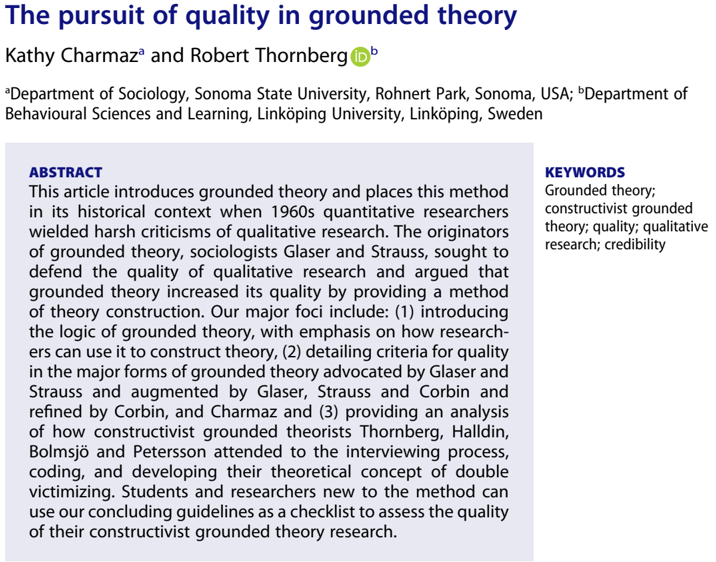
This article introduces grounded theory and places this method in its historical context when 1960s quantitative researchers wielded harsh criticisms of qualitative research. The originators of grounded theory, sociologists Glaser and Strauss, sought to defend the quality of qualitative research and argued that grounded theory increased its quality by providing a method of theory construction. Our major foci include: (1) introducing the logic of grounded theory, with emphasis on how researchers can use it to construct theory, (2) detailing criteria for quality in the major forms of grounded theory advocated by Glaser and Strauss and augmented by Glaser, Strauss and Corbin and refined by Corbin, and Charmaz and (3) providing an analysis of how constructivist grounded theorists Thornberg, Halldin, Bolmsjö and Petersson attended to the interviewing process, coding, and developing their theoretical concept of double victimizing. Students and researchers new to the method can use our concluding guidelines as a checklist to assess the quality of their constructivist grounded theory research.
Verified 2026-11-22 · 1 reference not checked yet
Overview
CoChat Summary
TL;DR
This article reviews grounded theory’s historical development and argues that quality criteria must fit the specific version of grounded theory, culminating in constructivist criteria and a checklist. It illustrates constructivist quality through Thornberg et al.’s (2013) study of school bullying and the concept of double victimizing.
Key findings
- Quality criteria differ across grounded theory versions: original Glaser and Strauss focused on credibility and applicability with fitness, understanding, generality, and control; Glaser added workability, relevance, fit, and modifiability; Strauss and Corbin emphasized data quality, plausibility/value of theory, adequacy of process, and empirical grounding; constructivist Charmaz proposes credibility, originality, resonance, and usefulness.
- The paper argues quality is built through iterative data collection and analysis, line-by-line and focused coding, memo-writing, theoretical sampling and saturation, constant comparison, and reflexivity/methodological self-consciousness.
- In the illustrative constructivist study, Thornberg et al. (2013) distributed 523 open-ended questionnaires to students in three secondary schools and two universities in Sweden; of 511 responses, 168 reported past bullying, 36 volunteered, and 21 who had been bullied for more than one year were interviewed; analysis produced the core category “double victimizing” (external and internal victimizing).
- In psychology, Rubin, Bell, and McCleland (2018) found only 13% of responding graduate psychology programs required a qualitative research course, and respondents described qualitative research as “inaccurate,” “subjective,” and “lacking rigor” while also describing it as providing the “best methods for feminist, community-based, and social justice research.”
Methods
- Design: methodological/conceptual article introducing grounded theory, comparing quality criteria across Glaserian, Straussian, and constructivist versions, and offering guidelines/checklist for constructivist grounded theory.
- Data or sample: no primary empirical sample for the article; it analyzes historical and methodological literature and uses Thornberg et al. (2013) as an illustrative constructivist grounded theory study (523 questionnaires; 511 responses; 168 bullied; 36 volunteers; 21 interviewed).
- Main analysis: narrative synthesis and comparison of quality criteria, with an illustration of coding, constant comparison, memo-writing, theoretical sampling, and category development leading to “double victimizing.”
Limitations
- Stated: the authors caution that checklists risk becoming a “methodological crutch” that avoids deep engagement with method and data (citing Barbour 2001), and present their guidelines as flexible, not substitutes for rigorous research.
- Stated: criteria for quality in qualitative research remain unsettled, with “little consensus” about appropriate evaluation criteria, and meanings of quality markers may differ among researchers.
- Evident from the text: the article is not an empirical validation of the checklist; the double victimizing case is a secondary illustration rather than a new test, and the guidelines are aimed mainly at constructivist grounded theory though claimed mostly applicable to other versions.
Model-written summary. Check it against the paper before relying on it.
Integrity signals
Registry
Cites
Statistics
Figures



Verification
Claims the paper makes
2 Valid · 13 Not valid · 38 Not checked · 38 Own results and interpretations
None of the sources cited for this claim have been checked yet.
In the paper
“Concerns about objectivity, validity, reliability and replicability in qualitative research still pervade academic psychology.”
§ The pursuit of quality in grounded theory > Qualitative research and psychology
plain- Asserted: passes — The authors put it forward as true.
- Checkable: passes — It can be checked against evidence.
- Load-bearing: passes — The paper’s conclusions depend on it.
- Based: passes — The paper gives a reason why it holds.
In the paper
“Until Glaser and Strauss's (1967) statement, little had been written, much less codified into a systematic statement, about how to construct a qualitative theoretical analysis of high quality.”
§ The pursuit of quality in grounded theory > Concerns about quality in the development of grounded theory
What the sources say
- Not matchedcites Glaser and Strauss's (1967)
An author–year citation the paper’s reference list doesn’t settle. We don’t search these by name.
plain- Asserted: passes — The authors put it forward as true.
- Checkable: passes — It can be checked against evidence.
- Load-bearing: unclear — It is unclear whether the paper’s conclusions depend on it.
- Based: passes — The paper gives a reason why it holds.
- Not matched
A statement the paper makes itself — it cites no source for it, so there is none to check. The quote shows it is in the paper.
In the paper
“If, however, researchers only ask the same questions of each participant, they are likely to elicit similar stories about the topic.”
§ The pursuit of quality in grounded theory > Introduction
hedgedstates a possible cause- Asserted: passes — The authors put it forward as true.
- Checkable: passes — It can be checked against evidence.
- Load-bearing: passes — The paper’s conclusions depend on it.
- Based: passes — The paper gives a reason why it holds.
A statement the paper makes itself — it cites no source for it, so there is none to check. The quote shows it is in the paper.
In the paper
“If, however, researchers systematically interrogate their data as they gather it, their early ideas can then inform subsequent data collection.”
§ The pursuit of quality in grounded theory > Introduction
plainstates a possible cause- Asserted: passes — The authors put it forward as true.
- Checkable: passes — It can be checked against evidence.
- Load-bearing: passes — The paper’s conclusions depend on it.
- Based: passes — The paper gives a reason why it holds.
A statement the paper makes itself — it cites no source for it, so there is none to check. The quote shows it is in the paper.
In the paper
“When answering quantitative social scientists' sharp criticisms of its quality, Glaser and Strauss rejected the common practice of evaluating qualitative research according to the tenets of the quantitative tradition.”
§ The pursuit of quality in grounded theory > Concerns about quality in the development of grounded theory
plain- Asserted: passes — The authors put it forward as true.
- Checkable: passes — It can be checked against evidence.
- Load-bearing: unclear — It is unclear whether the paper’s conclusions depend on it.
- Based: passes — The paper gives a reason why it holds.
22 more claims
Create a free account to see all 91 claims and to verify the 7 references still open.
- Probably not a substantial claim. 61
- It may state two separate claims as one. 26
Claims other papers make about this one
Each is checked against this paper’s own text: does it say what the citing paper says it does?
The source backs part of the claim, not all of it — or backs it for a different population, condition or comparison.
In the citing paper
“An explicitly constructivist approach aims to produce an abstract understanding of a phenomenon (rather than an explanation, as in other versions of GTM)”
From Quality Criteria: General and Specific Guidelines for Qualitative Approaches in Psychology Research. A Concise Guide for Novice Researchers and Reviewers (2024) · cites this paper as Charmaz & Thornberg, 2021
Experimental — accuracy not yet measuredThe source backs part of the claim, not all of it — or backs it for a different population, condition or comparison.
In the citing paper
“Constant comparison is a systematic strategy combining the advantages of simultaneous data generation and analysis, enabling a concentration on significant issues (Charmaz and Thornberg, 2021).”
From Application and challenges of using a Constructivist Grounded Theory methodology to address an undertheorized clinical challenge: A discussion paper (2024) · cites this paper as Charmaz and Thornberg, 2021
Experimental — accuracy not yet measuredThe cited source says what the claim attributes to it.
In the citing paper
“focuses on actions, meanings and constructions”
From Quality Criteria: General and Specific Guidelines for Qualitative Approaches in Psychology Research. A Concise Guide for Novice Researchers and Reviewers (2024) · cites this paper as Charmaz & Thornberg, 2021
The cited source says what the claim attributes to it.
In the citing paper
“and acknowledges both subjectivity (of participants and researchers) and context (Charmaz, 2014; Charmaz & Thornberg, 2021).”
From Quality Criteria: General and Specific Guidelines for Qualitative Approaches in Psychology Research. A Concise Guide for Novice Researchers and Reviewers (2024) · cites this paper as Charmaz & Thornberg, 2021
The cited source says what the claim attributes to it.
In the citing paper
“The primary focus is the theory ' s ability to clarify participants ' lives and contribute to knowledge and practice (Charmaz & Thornberg, 2021).”
From Quality Criteria: General and Specific Guidelines for Qualitative Approaches in Psychology Research. A Concise Guide for Novice Researchers and Reviewers (2024) · cites this paper as Charmaz & Thornberg, 2021
6 more claims about this paper
Create a free account to see every claim other papers make about this one.
Citations
Cites
Using thematic analysis in psychology
Braun, V., & Clarke, V. (2006) · Qualitative Research in Psychology · doi:10.1191/1478088706qp063oa · Cited by 194,414
The Discovery of Grounded Theory: Strategies for Qualitative Research.
Wagner, H. R., Glaser, B. G., & Strauss, A. L. (1968) · Social Forces · doi:10.2307/2575405 · Cited by 46,361
The Discovery of Grounded Theory; Strategies for Qualitative Research
Glaser, B. G., Strauss, A. L., & Strutzel, E. (1968) · Nursing Research · doi:10.1097/00006199-196807000-00014 · Cited by 39,449
Basics of Qualitative Research: Grounded Theory Procedures and Techniques.
Ellis, C., Strauss, A., & Corbin, J. (1992) · Contemporary Sociology · doi:10.2307/2074814 · Cited by 29,249
Basics of Qualitative Research (3rd ed.): Techniques and Procedures for Developing Grounded Theory
Corbin, J., & Strauss, A. (2008) · SAGE · doi:10.4135/9781452230153 · Cited by 24,827
(2006) · Cited by 18,730
Self-citationBasics of Qualitative Research
Ozanne, J. L., Strauss, A., & Corbin, J. (1992) · Journal of Marketing Research · doi:10.2307/3172751 · Cited by 17,850 · cited 2×
“In their development of grounded theory, Strauss and Corbin (1990; Corbin and Strauss 1990; Strauss and Corbin 1998) emphasized four general criteria: (1) quality of the data, in other words, grounded theorists need to carefully address and adopt quality criteria related to methods used for data…”
BackgroundMethodBasics of Qualitative Research: Grounded Theory Procedures and Techniques
Long, D. R., Strauss, A., & Corbin, J. (1993) · The Modern Language Journal · doi:10.2307/328955 · Cited by 17,576
(2014) · Cited by 15,747
Self-citationInterviewing as qualitative research a guide for researchers in education and the social sciences
Seidman, I. (2006) · Cited by 12,757
Research works printed but not linked: 5
- 10. Charmaz, K. 1995. Between positivism and postmodernism: implications for methods. In Studies in symbolic interaction, vol. 17, N. K. Denzin (Ed.), pp. 43-72. Greenwich, CT: JAI Press.
- 17. Cisneros-Puebla, C. A. 2007. The deconstructive and reconstructive faces of social construc- tion: Kenneth Gergen in conversation with César A. Cisneros-Puebla. With an introduction by Robert B. Faux [83 paragraphs]. Forum Qualitative Sozialforschung/Forum: Qualitative Social Research 9 (1):Art. 20. http://nbn-resolving.de/urn:nbn:de:0114-fqs0801204 .
- 26. Glaser, B. G. 1978. Theoretical sensitivity. Mill Valley, CA: Sociology Press.
- 27. Glaser, B. G. 1992. Basics of grounded theory analysis. Mill Valley, CA: Sociology Press.
- 30. Glaser, B. G. 2013. No preconceptions: The grounded theory dictum. Mill Valley, CA: Sociology Press.
Cited by
Braun, V., & Clarke, V. (2021) · Counselling and Psychotherapy Research · doi:10.1002/capr.12360 · Cited by 3,198
Ethics and discrimination in artificial intelligence-enabled recruitment practices
Chen, Z. (2023) · Humanities and Social Sciences Communications · doi:10.1057/s41599-023-02079-x · Cited by 450
Empowering education development through AIGC: A systematic literature review
Chen, X., Hu, Z., & Wang, C. (2024) · Education and Information Technologies · doi:10.1007/s10639-024-12549-7 · Cited by 203
Engagement and disengagement in online learning
Bergdahl, N. (2022) · Computers & Education · doi:10.1016/j.compedu.2022.104561 · Cited by 133
Ethical issues in the development of artificial intelligence: recognizing the risks
Kamila, M. K., & Jasrotia, S. S. (2025) · International Journal of Ethics and Systems · doi:10.1108/ijoes-05-2023-0107 · Cited by 102
Industry 4.0: Current practice and challenges in Malaysian manufacturing firms
Tay, S. I., Alipal, J., & Lee, T. C. (2021) · Technology in Society · doi:10.1016/j.techsoc.2021.101749 · Cited by 120
Ndibalema, P. M. (2022) · E-Learning and Digital Media · doi:10.1177/20427530221107510 · Cited by 167
“The rubric strategy was adapted from Charmaz and Thornberg (2021); Tracy (2010) in which each reviewer scored on each article based on the theoretical, methodological and the contribution of the article to the current analysis.”
MethodMetaverse in tourism: drivers and hindrances from stakeholders’ perspective
Chen, S., Chan, I. C. C., Xu, S., Law, R., & Zhang, M. (2023) · Journal of Travel & Tourism Marketing · doi:10.1080/10548408.2023.2227872 · Cited by 85
Wemette, M., Safi, A. G., Beauvais, W. A., Ceres, K., Shapiro, M. A., Moroni, P., Welcome, F. L., & Ivanek, R. (2020) · PLoS ONE · doi:10.1371/journal.pone.0232937 · Cited by 78
Equity and reliability of public electric vehicle charging stations in the United States
Yu, Q., Que, T., Cushing, L. J., Pierce, G., Shen, K., Kejriwal, M., Yao, Y., & Zhu, Y. (2025) · Nature Communications · doi:10.1038/s41467-025-60091-y · Cited by 95
“This step aligns with Charmaz and Thornberg ’ s suggestion to engage with existing literature.”
Li, J., & Kim, K. (2022) · Heritage Science · doi:10.1186/s40494-022-00760-z · Cited by 88
Virto, N. R., & Arróspide, C. V. (2024) · International Journal of Gastronomy and Food Science · doi:10.1016/j.ijgfs.2024.100931 · Cited by 139
Aydın, N. (2023) · Özgür Yayınları eBooks · doi:10.58830/ozgur.pub377 · Cited by 71
Bennis, I., & Mouwafaq, S. (2025) · BMC Medical Informatics and Decision Making · doi:10.1186/s12911-025-02961-5 · Cited by 119
Lim, W. M., Gupta, G., Biswas, B. N., & Gupta, R. (2021) · Electronic Markets · doi:10.1007/s12525-021-00486-z · Cited by 77
“…hypotheses; (3) memo-making to clarify and fill out codes, which is a crucial intermediate step between coding data and writing first drafts of the research paper; (4) a detailed literature review is not mandatory in the initial stages of the study (Charmaz & Thornberg, 2021; Makri & Neely, 2021).”
BackgroundAlternative Fuel Selection Framework toward Decarbonizing Maritime Deep-Sea Shipping
Moshiul, A. M., Mohammad, R., & Hira, F. A. (2023) · Sustainability · doi:10.3390/su15065571 · Cited by 55
Chaker, N. N., Nowlin, E. L., Walker, D., & Anaza, N. A. (2021) · Industrial Marketing Management · doi:10.1016/j.indmarman.2021.05.009 · Cited by 58
Advancing Grounded Theory with Mixed Methods
Creamer, E. G. (2021) · Routledge eBooks · doi:10.4324/9780429057007 · Cited by 90
Cena, E., Brooks, J., Day, W., Goodman, S., Rousaki, A., Ruby-Granger, V., & Seymour-Smith, S. (2024) · International Journal of Qualitative Methods · doi:10.1177/16094069241282843 · Cited by 49
“…approach aims to produce an abstract understanding of a phenomenon (rather than an explanation, as in other versions of GTM); focuses on actions, meanings and constructions; and acknowledges both sub-jectivity (of participants and researchers) and context (Charmaz, 2014; Charmaz & Thornberg, 2021).”
InfluentialDerrer‐Merk, E., Reyes, M. F., Salazar, A. M., Guevara, M., Rodríguez, G., Fonseca, A.-M., Camacho, N., Ferson, S. A., Mannis, A., Bentall, R. P., et al. (2022) · Journal of Social Issues · doi:10.1111/josi.12538 · Cited by 51
Smart HRM 4.0 for achieving organizational performance: a dynamic capability view perspective
Pillai, R., & Srivastava, K. B. L. (2022) · International Journal of Productivity and Performance Management · doi:10.1108/ijppm-04-2022-0174 · Cited by 66
Climate policy at the Bank of England: the possibilities and limits of green central banking
DiLeo, M. (2023) · Climate Policy · doi:10.1080/14693062.2023.2245790 · Cited by 51
Sample Size in Qualitative Research: Moving from Data Saturation to Theoretical Saturation
Lim, W. M. (2025) · Journal of Global Marketing · doi:10.1080/08911762.2025.2590757 · Cited by 104
“” Charmaz and thornberg (2021) • links quality in grounded theory to theoretical sampling toward theoretical saturation, with evaluation via credibility, originality, resonance, and usefulness.”
Large Language Models in Qualitative Research: Uses, Tensions, and Intentions
Schroeder, H., Quéré, M. A. L., Randazzo, C., Mimno, D., & Schoenebeck, S. Y. (2025) · CHI Conference on Human Factors in Computing Systems · doi:10.1145/3706598.3713120 · Cited by 144
“In particular, a stigma surrounding the perceived rigor of qualitative research [18] has sparked debates over how best to evaluate such methods [46, 51, 67].”
Understanding Teacher Resilience: Keys to Well-Being and Performance in Chilean Elementary Education
Salvo-Garrido, S. I., Cisternas-Salcedo, P., & Polanco-Levicán, K. (2025) · Behavioral Sciences · doi:10.3390/bs15030292 · Cited by 91
“The rigorous selection of codes ensures traceability to the original data, enhancing the validity of interpretations through constant comparison of contexts and coding processes (Charmaz & Thornberg, 2021).”
Can ChatGPT Perform a Grounded Theory Approach to Do Risk Analysis? An Empirical Study
Zhou, Y., Yuan, Y., Huang, K., & Hu, X. (2024) · Journal of Management Information Systems · doi:10.1080/07421222.2024.2415772 · Cited by 76
“This research selects the systematic GT introduced by Strauss and Corbin [104] for ChatGPT, since it provides a structured data coding framework about how to conduct GT [24].”
InfluentialQualitative data analysis: reflections, procedures, and some points for consideration
Dahal, N. (2025) · Frontiers in Research Metrics and Analytics · doi:10.3389/frma.2025.1669578 · Cited by 142
“Grounded theory is designed to develop a new theory grounded in the data collected, which includes interviews, observations, and documents (Barsalou, 2008; Bowen, 2009; Charmaz and Thornberg, 2021; Chun Tie et al., 2019; Corbin and Strauss, 1990).”
Cowden, R. G., Skinstad, D., Lomas, T., Johnson, B. R., & VanderWeele, T. J. (2024) · Quality & Quantity · doi:10.1007/s11135-024-01947-1 · Cited by 65
“Fifth, we selected the constant comparative method to guide our qualitative analysis because it is particularly well suited to exploring similarities and differences across groups (Charmaz & Thornberg 2021).”
Rural tourism in China: ‘Root-seeking’ and construction of national identity
Liu, T., & Chen, B. (2024) · Journal of Hospitality and Tourism Management · doi:10.1016/j.jhtm.2024.06.017 · Cited by 42
Oyelere, S. S., & Aruleba, K. (2025) · Computers and Education Open · doi:10.1016/j.caeo.2025.100245 · Cited by 62
“This initial stage was crucial to ensure that the questionnaire ’ s content was grounded in current academic discourse and pertinent issues within the field [19,22].”
Sudarsan, I., Hoare, K., Sheridan, N., & Roberts, J. (2022) · Research in Nursing & Health · doi:10.1002/nur.22231 · Cited by 55
Victim-Centred Peacemaking: The Colombian Experience
Brett, R. (2022) · Journal of Intervention and Statebuilding · doi:10.1080/17502977.2022.2104437 · Cited by 46
Barrow, E., Lear, R., Morbi, A. H. M., Long, S. J., Darzi, A. W., Mayer, E. K., & Archer, S. (2022) · BMJ Quality & Safety · doi:10.1136/bmjqs-2022-014695 · Cited by 40
“…conducted all of our interviews and had no opportunity to collect more data required for theoretical sampling (concurrent data collection and analysis and theoretical sampling are core tenets of grounded theory research 41 ), we opted for a ‘grounded theory-lite’ 42 43 or ‘abbreviated’ 44 approach.”
BackgroundThe emotional journey of the beginning teacher: Phases and coping strategies
Lindqvist, H., Weurlander, M., Wernerson, A. M., & Thornberg, R. (2022) · Research Papers in Education · doi:10.1080/02671522.2022.2065518 · Cited by 52
“The first author, who conducted all the interviews, aimed to co-construct credibility and trustworthiness of data (Charmaz and Thornberg 2020) together with the interviewees by attentive listening, probing, and asking follow-up questions (Hiller and Diluzio 2004).”
BackgroundSelf-citationHautamäki, P., & Heikinheimo, M. (2025) · Journal of Business Research · doi:10.1016/j.jbusres.2025.115396 · Cited by 31
The Analysis of Residents’ Intention to Consume Pre-Made Dishes in China: A Grounded Theory
Xiong, Y., Lin, X., Wen, X., Wang, Y., Liang, W., & Xing, T. (2023) · Foods · doi:10.3390/foods12203798 · Cited by 37
“The determination of the sample size was based on the principle of theoretical saturation.”
BackgroundDíaz, J., Pérez, J., Gallardo, C., & González-Prieto, Á. (2022) · Journal of Systems and Software · doi:10.1016/j.jss.2022.111520 · Cited by 78
Exploring memorable experiences in luxury hotels
Murray, J. C., Harrington, R. J., Chathoth, P. K., & Khan, M. S. (2024) · International Journal of Contemporary Hospitality Management · doi:10.1108/ijchm-03-2023-0428 · Cited by 37
From harassment to disappearance: Young women’s feelings of insecurity in public spaces
Avendaño, A. M. A., Mendoza, M. R., & Luis, A. H. G. S. (2022) · PLoS ONE · doi:10.1371/journal.pone.0272933 · Cited by 51
“Because the authors have carried out previous studies on feelings of insecurity related to organized crime with adult populations, it was not necessary to research the literature again to develop the theoretical framework [66].”
BackgroundMethodInfluentialYouth participation in global policy networks on climate change
Kolleck, N., & Schuster, J. (2022) · International Journal of Educational Research · doi:10.1016/j.ijer.2022.102002 · Cited by 32
Zimmermann, B. M., Paul, K. T., Araújo, E. R., Buyx, A., Ferstl, S., Fiske, A., Kraus, D., Marelli, L., McLennan, S., Porta, V., et al. (2023) · Vaccine · doi:10.1016/j.vaccine.2023.02.012 · Cited by 34
“10 Data analysis Qualitative analysis followed an inductive approach (Charmaz and Thornberg 2021).”
What makes a perinatal woman suicidal? A grounded theory study
Reid, H. E., Pratt, D., Edge, D., & Wittkowski, A. (2022) · BMC Psychiatry · doi:10.1186/s12888-022-04015-w · Cited by 46
“We followed Charmaz’s [21, 23] and Charmaz and Thornberg’s [27] guidance on conducting and ensuring quality in constructivist grounded theory studies.”
MethodResearch on sales and ethics: Mapping the past and charting the future
Hartmann, N. N., Wieland, H., Gustafson, B. M., & Habel, J. (2023) · Journal of the Academy of Marketing Science · doi:10.1007/s11747-023-00961-3 · Cited by 31
“RQ5 How should sales managers guide their salespeople to achieve the right balance between personal and professional activities in times of increased digitalization and social media use?”
Franchising brand benefits: An integrative perspective
Ghantous, N., & Christodoulides, G. (2020) · Industrial Marketing Management · doi:10.1016/j.indmarman.2020.10.009 · Cited by 44
Maxwell, C., McCreesh, K. M., Salsberg, J., & Robinson, K. (2022) · Health Expectations · doi:10.1111/hex.13464 · Cited by 30
“The study was conducted in line with guidelines on quality in CGT research.(18) Critical feedback and guidance were provided by K.”
MethodYuan, J., Lam, W., Xiao, J., Ni, M. Y., Cowling, B. J., & Liao, Q. (2022) · The Journals of Gerontology Series B · doi:10.1093/geronb/gbac184 · Cited by 29
Kang, J. (2023) · Intensive and Critical Care Nursing · doi:10.1016/j.iccn.2023.103448 · Cited by 44
Petiot, O., Visioli, J., & Kermarrec, G. (2023) · Physical Education and Sport Pedagogy · doi:10.1080/17408989.2023.2219269 · Cited by 33
“Data processing was conducted in five steps, inspired by grounded theory inductive categorization methods (Charmaz and Thornberg 2020).”
Arbia, G., Carbone, A., Stanzione, I., & Szpunar, G. (2023) · Education Sciences · doi:10.3390/educsci13050505 · Cited by 34
“For the investigation, a semi-structured interview [22] was built ad hoc by the research group on the basis of the knowledge of the scientific literature on the subject and through the experience gained in school contexts as teachers.”
BackgroundMethodHolt, N. L., Pankow, K., Ormond, I., Jørgensen, H., Deal, C. J., & Pynn, S. R. (2022) · International Review of Sport and Exercise Psychology · doi:10.1080/1750984x.2022.2028305 · Cited by 44
“Charmaz and Thornberg (2020) cautioned against using the guidelines as a methodological crutch and reminded researchers to be familiar with the methodological procedures of the specific variant of GTM they use.”
InfluentialWang, F., Song, H., Meng, X., Wang, T., Zhang, Q., Yu, Z., Fan, S., & Wu, Y. (2024) · Personality and Individual Differences · doi:10.1016/j.paid.2024.112869 · Cited by 37
Gedecho, E. K., Kim, S., & Senbeto, D. L. (2023) · Journal of Travel Research · doi:10.1177/00472875231195738 · Cited by 33
“Data were collected comprehensively, explained the sampling strategy transparently, and compared with the existing literature, indicating the quality of this study, as proposed by Charmaz and Thornberg (2021), to ensure the quality of the CGT-based research.”
O’Callaghan, C., Dwyer, J., & Schofield, P. (2024) · Qualitative Research in Psychology · doi:10.1080/14780887.2024.2347580 · Cited by 26
“Charmaz explained that constructivist GT emphasizes the theorist’s inter-pretive and abstract understanding of the studied phenomenon, whereas objectivist GT theorists seek causes, explanations, and generalizations (Charmaz 2014, Charmaz and Thornberg 2021).”
BackgroundMethane regulation in the EU: Stakeholder perspectives on MRV and emissions reductions
Olczak, M., Piebalgs, A., & Balcombe, P. (2022) · Environmental Science & Policy · doi:10.1016/j.envsci.2022.09.002 · Cited by 41
Tripodi, F. B., & Ma, Y. (2022) · Information Communication & Society · doi:10.1080/1369118x.2021.2020873 · Cited by 28
“During this phase, we relied on ‘grounded theory’ to move beyond description and construct thematic conceptions while simultaneously analyzing data (Charmaz, 2006; Charmaz & Thornberg, 2020).”
MethodDevelopment of Grounded Theory in Social Sciences: A Qualitative Approach
Mohajan, D., & Mohajan, H. K. (2022) · Studies in Social Science & Humanities · doi:10.56397/sssh.2022.12.02 · Cited by 73
Howell, F. (2023) · Psychology of Women Quarterly · doi:10.1177/03616843231168113 · Cited by 33
“In addition to re fl ective memo-taking and analytic journaling, I built quality checks into the data analysis process by conducting multiple readings of the interview data to support trustwor-thiness (Charmaz & Thornberg, 2021; Morrow, 2005).”
MethodBock, A., Breiter, A., Hartong, S., Jarke, J., Jornitz, S., Lange, A., & Macgilchrist, F. (2023) · Springer eBooks · doi:10.1007/978-3-658-38651-1 · Cited by 49
Seo, D., Satterfield, N., Alba-Lopez, L., Lee, S. H., Crabtree, C., & Cochran, N. (2023) · Harm Reduction Journal · doi:10.1186/s12954-023-00894-8 · Cited by 25
“Given the history of marginalization in the study community, we employed thematic analysis and grounded theory in our analysis to “[illuminate] the situations of people denied a public voice” [16].”
MethodOutdoor tourism to escape social surveillance: health gains but sustainability costs
Akhoundoghli, M., & Buckley, R. (2021) · Journal of Ecotourism · doi:10.1080/14724049.2021.1934688 · Cited by 33
“There are three or four principal schools of grounded theory (Aldiabat & Navenec, 2011; Allen, 2010; Apramian et al., 2017; Charmaz & Thornberg, 2020; Conlon et al., 2020; Morgan, 2020; Sebastian, 2019; Tarozzi, 2020; Tie et al., 2019).”
BackgroundGhorbani, A., Mousazadeh, H., Almani, F. A., Lajevardi, M., Hamidizadeh, M. R., Orouei, M., Zhu, K., & Dávid, L. D. (2023) · Sustainability · doi:10.3390/su15087022 · Cited by 39
“GT helps researchers incorporate data and generate new concepts, promoting theoretical investigation [52].”
BackgroundMethodGraser, K., Walzer, A. N., Hunhevicz, J., Jähne, R., Seiler, F., Wüst, R., & Hall, D. (2023) · Automation in Construction · doi:10.1016/j.autcon.2023.104964 · Cited by 24
Jayarathna, C. P., Agdas, D., & Dawes, L. A. (2023) · The International Journal of Logistics Management · doi:10.1108/ijlm-09-2022-0367 · Cited by 38
Belongingness challenged: Exploring the impact on older adults during the COVID-19 pandemic
Derrer‐Merk, E., Ferson, S. A., Mannis, A., Bentall, R. P., & Bennett, K. M. (2022) · PLoS ONE · doi:10.1371/journal.pone.0276561 · Cited by 39
“Recruitment was halted when theme saturation was reached (for more details see [47, 48, 54]).”
BackgroundBahar, V. S., Nenonen, S., & Starr, R. G., Jr. (2022) · Industrial Marketing Management · doi:10.1016/j.indmarman.2022.09.020 · Cited by 29
“We applied the constant comparison method throughout these three coding rounds (Charmaz & Thornberg, 2021; Urquhart, Lehmann, & Myers, 2010).”
MethodIssac, A. C., Dhir, A., & Christofi, M. (2024) · Journal of Managerial Psychology · doi:10.1108/jmp-05-2022-0217 · Cited by 35
A generative design of collaborative innovation space
Klooker, M., & Hölzle, K. (2023) · R and D Management · doi:10.1111/radm.12582 · Cited by 23
“Consequently, we identified scope of (re-)design and design approach as focus codes (Charmaz and Thornberg, 2021) of innovation space development and aligned our case selection to these aspects.”
BackgroundPoliticizing the future: on lithium exploration in Portugal
Araújo, E. R., Bento, S., & Silva, M. (2022) · European Journal of Futures Research · doi:10.1186/s40309-022-00209-3 · Cited by 29
“Charmaz K, Thornberg R (2021) The pursuit of quality in grounded theory.”
BackgroundMethodInfluentialPadda, H., Wemette, M., Safi, A. G., et al. (2021) · Preventive Veterinary Medicine · doi:10.1016/j.prevetmed.2021.105428 · Cited by 23
Classic grounded theory: identifying the main concern
Connor, J., Flenady, T., Massey, D. L., & Dwyer, T. (2024) · Research in Nursing & Health · doi:10.1002/nur.22381 · Cited by 40
Gül, U., Altuntaş, D., & Efe, E. (2022) · Nurse Education in Practice · doi:10.1016/j.nepr.2022.103381 · Cited by 27
“Theoretical sampling is an approach that enables creative concepts and theories from the collected data (Charmaz and Thornberg, 2021; McCrae and Purssell, 2016).”
Mehdiabadi, A. H. (2022) · ACM Transactions on Computing Education · doi:10.1145/3483841 · Cited by 36
“An increasing number of scholars in the field have started to study different aspects of computing ethics education, including the existing curricula across computing departments [17, 25], integration of ethics into technical courses [33], and the new approaches to teach computing ethics [11].”
BackgroundA dual-path model of work-family conflict and hospitality employees’ job and life satisfaction
Yang, H.-J., Zhao, X., & Ma, E. (2024) · Journal of Hospitality and Tourism Management · doi:10.1016/j.jhtm.2023.12.008 · Cited by 22
Zhang, S., & Chen, Y. (2022) · Behavioral Sciences · doi:10.3390/bs12110407 · Cited by 24
“Finally, from the perspective of these two research questions, the grounded theory method is suitable for generative theory and has certain exploratory research, so it fully meets the problems to be solved in this research [19,20].”
BackgroundJourney of Violence: Refugee Women’s Experiences Across Three Stages and Places
Borges, G. M. (2023) · Journal of International Migration and Integration / Revue de l integration et de la migration internationale · doi:10.1007/s12134-023-01102-z · Cited by 27
“The study used a constructivist grounded theory approach, emphasizing participants’ construction of meaning (Charmaz & Thornberg, 2021; Charmaz et al., 2017), supplemented by the abduction approach for discovering novel concepts (Kennedy & Thornberg, 2018).”
Zu, L., Wu, D., & Lyu, S. (2023) · Environmental Impact Assessment Review · doi:10.1016/j.eiar.2023.107326 · Cited by 23
Liu, Z., & Zhang, W. (2024) · Scientific Reports · doi:10.1038/s41598-024-65226-7 · Cited by 40
“In the process of selective coding, on the foundation of determining core categories, the aim is to specify the relationships between the core categories and the main categories 28,29, 31 .”
BackgroundTsarouha, E., Preiser, C., Weltermann, B., Junne, F., Seifried-Dübon, T., Stuber, F., Hartmann, S., Wittich, A., Rieger, M. A., & Rind, E. (2020) · International Journal of Environmental Research and Public Health · doi:10.3390/ijerph17197114 · Cited by 23
“Credibility, transferability, and resonance as quality measures [55] were achieved by the interdisciplinary team during the several stages of analysis and confirmed by an independent research support group [48].”
BackgroundMethodInfluentialMartin, A., Andrews, T., Goldbart, J., & Landers, M. G. (2022) · Journal of Intellectual Disability Research · doi:10.1111/jir.12921 · Cited by 27
Cooley, S. J., Jones, C. R., Moss, D., & Robertson, N. (2021) · British Journal of Clinical Psychology · doi:10.1111/bjc.12315 · Cited by 20
Tripodi, F. B. (2021) · Computational and Mathematical Organization Theory · doi:10.1007/s10588-021-09339-8 · Cited by 23
Petiot, O., Visioli, J., & Kermarrec, G. (2023) · Journal of Sport Psychology in Action · doi:10.1080/21520704.2023.2166183 · Cited by 19
“To overcome these limits, we respected the criteria of Charmaz and Thornberg (2021) for judging the quality of qualitative research.”
MethodKarlstad, J. L., Moe, C. F., Wattum, M., & Brinchmann, B. S. (2021) · BMC Psychiatry · doi:10.1186/s12888-021-03345-5 · Cited by 22
“More pointed questions were then developed by following up on codes from the early interviews [39].”
BackgroundSelf-perception evolution among university student TikTok users: evidence from China
Zhu, J. J., Ma, Y., Xia, G., Salle, S. M., Huang, H., & Sannusi, S. N. (2024) · Frontiers in Psychology · doi:10.3389/fpsyg.2023.1217014 · Cited by 32
“This saturation approach streamlined our research process, from the initial theoretical conceptualization and data collection to thematic analysis and theoretical refinement (Charmaz and Thornberg, 2021).”
MethodLearning from the Experts: Stimulating Student Engagement in Small-group Active Learning
Grijpma, J. W., Ramdas, S., Broeksma, L., Meeter, M., Kusurkar, R. A., & de la Croix, A. (2024) · Perspectives on Medical Education · doi:10.5334/pme.1245 · Cited by 52
Social marketing, shock advertising and risky consumption behavior
Mukattash, I. L., Dandis, A. O., Thomas, R., Nusair, M. B., & Mukattash, T. L. (2021) · International Journal of Emerging Markets · doi:10.1108/ijoem-09-2020-1111 · Cited by 23
Steinke, J., Ivanova, Y., Jones, S. K., Minh, T. T., Sánchez, A., Sánchez-Choy, J., & Mockshell, J. (2024) · World Development Sustainability · doi:10.1016/j.wds.2024.100185 · Cited by 36
Beyond Fatiguing Virtual Meetings: How Should Virtual Meetings for Workplaces Be Supported?
Lim, C. (2023) · International Journal of Human-Computer Interaction · doi:10.1080/10447318.2023.2231279 · Cited by 27
“Interviews were conducted while analyzing the early inter-view data simultaneously (Charmaz & Thornberg, 2021).”
Shrestha, R. K., Decosta, P. L., & Whitford, M. (2024) · Tourism Management · doi:10.1016/j.tourman.2024.105110 · Cited by 35
Cian, H., & Dou, R. (2024) · Journal of Research in Science Teaching · doi:10.1002/tea.21937 · Cited by 25
The Moral Economy of the Agatu “Massacre”: Reterritorializing Farmer-Herder Relations
Nwankwo, C. F. (2023) · Society · doi:10.1007/s12115-023-00860-x · Cited by 25
Gedecho, E. K., & Kim, S. (2024) · Tourism Management Perspectives · doi:10.1016/j.tmp.2024.101289 · Cited by 24
Exploring Customer Perceived Value towards non-deceptive counterfeiting: a grounded theory approach
Samaddar, K., & Gandhi, A. V. (2022) · South Asian Journal of Business Studies · doi:10.1108/sajbs-07-2021-0259 · Cited by 25
Karlstad, J. L., Moe, C. F., Wattum, M., et al. (2021) · Journal of Eating Disorders · doi:10.1186/s40337-021-00440-6 · Cited by 18
“Reflexivity is required throughout the research process by explicating takenfor-granted assumptions, while being aware of how hidden beliefs can enter this process [27].”
BackgroundQi, X., & Kuik, S. S. (2022) · Sustainability · doi:10.3390/su14105963 · Cited by 37
“This study used thematic analysis, similar to prior studies [34].”
ResultPreiser, C., Tsarouha, E., Weltermann, B., Junne, F., Seifried-Dübon, T., Hartmann, S., Bleckwenn, M., Rieger, M. A., & Rind, E. (2021) · Journal of Occupational Medicine and Toxicology · doi:10.1186/s12995-021-00336-w · Cited by 18
“There are, however, some unintended “blanks” [56] in our results: it is possible that relevant aspects were consciously not addressed by the GPs and PrAs or that given the abundance of received information, the researchers may not have asked for specific procedures, even if there were opportunities to do so.”
ResultInfluentialHuang, L., & Liu, M. Z. (2025) · Humanities and Social Sciences Communications · doi:10.1057/s41599-025-05921-6 · Cited by 53
“Grounded theory is a theory-generating method that involves inductive analysis of qualitative data to identify themes or categories and is widely applied in the social sciences (Charmaz & Thornberg, 2021; Glaser & Strauss, 2017).”
Kokorelias, K. M., Wasilewski, M. B., Flanagan, A. K., Zhabokritsky, A., Singh, H., Dove, E., Eaton, A. D., Valentine, D., Sheppard, C. L., Abdelhalim, R., et al. (2023) · International Journal of Qualitative Methods · doi:10.1177/16094069231205189 · Cited by 19
“The research process will also involve analytical insights to guide further data collection and purposeful sampling (Charmaz & Thornberg, 2021).”
MethodInfluentialNewson, L., Bould, K., Aspin‐Wood, B., Sinclair, L., Ikramullah, Z., & Abayomi, J. C. (2022) · Health Expectations · doi:10.1111/hex.13514 · Cited by 25
Financing social entrepreneurship in tourism in a volatile environment
Mahato, S. S., Blasco, D., & Prats, L. (2023) · Current Issues in Tourism · doi:10.1080/13683500.2023.2188583 · Cited by 21
“The constant comparative method, which compares data with data, data with code, and code with code, was used to fi nd similarities and di ff erences in the data collected (Charmaz & Thornberg, 2021; Glaser Barney & Strauss Anselm, 1967).”
Method
Metadata
- Authors
- Charmaz, K., & Thornberg, R.
- Affiliations
- Sonoma State University (US)
- Linköping University (SE)
- Corresponding author
- Thornberg, Robert
- Venue
- Qualitative Research in Psychology
- Publisher
- Informa UK Limited
- Published
- 2020-06-22
- Volume
- 18
- Issue
- 3
- Pages
- 305-327
- ISSN
- 1478-0887 (ISSN-L)
- 1478-0895
- OpenAlex
- W3036803033
- Cited by
- 1,221
- References
- 81
- Citations by year
- 2026: 264 · 2025: 290 · 2024: 255 · 2023: 221 · 2022: 128 · 2021: 54 · 2020: 8
- FWCI
- 155.56
- Type
- journal article
- Language
- en
- Open access
- hybrid
- doi.org
- Licence
- Locations
- Qualitative Research in Psychology (publishedVersion, cc-by-nc-nd)
- Topics
- Social Sciences › Education › Qualitative Research Methods and Applications
- Social Sciences › Sociology and Political Science › Qualitative Research Methods and Ethics
- Social Sciences › Sociology and Political Science › Sociology and Education Studies
- Keywords
- grounded theory, constructivist grounded theory, qualitative research quality, theory development, Glaser and Strauss, interviewing, coding, history of grounded theory
About these checks
Registry, retraction, Cites and statistics results are computed, not judged, with one exception: a printed reference that no index lists is read once by a model before it counts as a citation error. Claims are extracted by a model and kept only when their quote appears verbatim in the text; each cited source is then checked, with a model’s help, for whether it says what the claim relies on. Those verdicts can be wrong — read the claim’s quote and the cited source before relying on one.
The claim verdicts this report counts are experimental: their accuracy is not yet measured.
A language model drew the claims from the paper on 2026-09-28, under version 3 of the claim definition (model deepseek-v4.1-flash, prompt extract-v3).
A second model labelled each claim on 2026-09-28 (model jev-1.13-20260917, definition revision gold-guideline-v0.2).
Statistics and arithmetic are recomputed, not judged.
Confidence bands are shown only for fields calibrated on our annotated test set. None is calibrated yet, so no band is shown.
What counts as a claim ›How we measure confidence ›How we check this ›
Are you an author, or do you see a problem with this page? Request a review
Data sources
Bibliographic data: Semantic Scholar, OpenAlex, Crossref.
Contains information from the Semantic Scholar Academic Graph Datasets, made available under the ODC Attribution License (ODC-BY 1.0).
Semantic Scholar’s data is described in: Kinney, R., et al. (2023). The Semantic Scholar Open Data Platform. arXiv:2301.10140.
