

Picture Perfect: The Direct Effect of Manipulated Instagram Photos on Body Image in Adolescent Girls
Open accessThe DOI matches its Crossref record; 53 of the 54 references it cites were found in a registry or an index, and 1 are not checked yet; 5 of the 51 sources its claims cite were checked for support.
Abstract
This study investigates the effect of manipulated Instagram photos on adolescent girls’ body image, and whether social comparison tendency moderates this relation. A between-subject experiment was conducted in which 144 girls (14–18 years old) were randomly exposed to either original or manipulated (retouched and reshaped) Instagram selfies. Results showed that exposure to manipulated Instagram photos directly led to lower body image. Especially, girls with higher social comparison tendencies were negatively affected by exposure to the manipulated photos. Interestingly, the manipulated photos were rated more positively than the original photos. Although the use of filters and effects was detected, reshaping of the bodies was not noticed very well. Girls in both conditions reported to find the pictures realistic. Results of this study implied that the recent societal concern about the effects of manipulated photos in social media might be justified, especially for adolescent girls with a higher social comparison tendency.
Verified 2026-11-22 · 1 reference not checked yet
Overview
Integrity signals
Registry
Cites
Statistics
Figures
Verification
Claims the paper makes
5 Valid · 1 Not valid · 24 Not checked · 37 Own results and interpretations
A result the paper reports from its own data — it cites no other source for it, so there is none to check. The quote shows it is in the paper.
In the paper
“For faces, manipulated photos scored somewhat higher ( M = 1.82; SD = .81) than the original photos ( M = 1.61; SD = .70), t (142) = -1.674; p = .051.”
plain- Asserted: passes — The authors put it forward as true.
- Checkable: passes — It can be checked against evidence.
- Load-bearing: unclear — It is unclear whether the paper’s conclusions depend on it.
- Based: passes — The paper gives a reason why it holds.
A result the paper reports from its own data — it cites no other source for it, so there is none to check. The quote shows it is in the paper.
In the paper
“Results additionally showed that level of education (included as control variable) significantly affected body image, F (1,139) = 14.618; p < .001; r = .31.”
plainstates an association- Asserted: passes — The authors put it forward as true.
- Checkable: passes — It can be checked against evidence.
- Load-bearing: unclear — It is unclear whether the paper’s conclusions depend on it.
- Based: passes — The paper gives a reason why it holds.
A result the paper reports from its own data — it cites no other source for it, so there is none to check. The quote shows it is in the paper.
In the paper
“Original photos also affected the body image of these girls more compared to ones with a lower tendency to make social comparisons, but this influence is weaker, F (1,139) = 3.016; p = .043; r = .15.”
plainstates a cause- Asserted: passes — The authors put it forward as true.
- Checkable: passes — It can be checked against evidence.
- Load-bearing: unclear — It is unclear whether the paper’s conclusions depend on it.
- Based: passes — The paper gives a reason why it holds.
A result the paper reports from its own data — it cites no other source for it, so there is none to check. The quote shows it is in the paper.
In the paper
“results revealed that the negative effect of manipulated photos is more prevalent among girls with a higher tendency to make social comparisons, F (1,139) = 18.777; p < .001; r = .34.”
plainstates an association- Asserted: passes — The authors put it forward as true.
- Checkable: passes — It can be checked against evidence.
- Load-bearing: passes — The paper’s conclusions depend on it.
- Based: passes — The paper gives a reason why it holds.
A result the paper reports from its own data — it cites no other source for it, so there is none to check. The quote shows it is in the paper.
In the paper
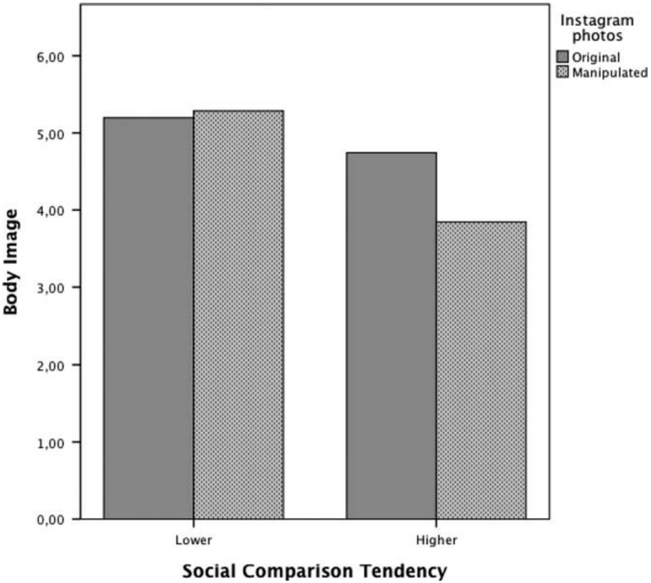
“the body image of girls with a higher tendency to make social comparisons is more negatively affected by manipulated Instagram photos ( M = 3.98; SE = .17) than by original photos ( M = 4.72; SE = .18), F (1,139) = 9.209; p = .002; r = . 25.”
plainstates a cause- Asserted: passes — The authors put it forward as true.
- Checkable: passes — It can be checked against evidence.
- Load-bearing: passes — The paper’s conclusions depend on it.
- Based: passes — The paper gives a reason why it holds.
29 more claims
Create a free account to see all 67 claims and to verify the 1 reference still open.
- Probably not a substantial claim. 23
- It may state two separate claims as one. 14
- The quote only partly states this claim. 1
Claims other papers make about this one
Each is checked against this paper’s own text: does it say what the citing paper says it does?
The source backs part of the claim, not all of it — or backs it for a different population, condition or comparison.
In the citing paper
“Experimental research consistently finds that exposure to idealized social media images, as well as the creation of self-images, results in increased body dissatisfaction [36,37,38].”
From Outcomes of a Cluster Randomized Controlled Trial of the SoMe Social Media Literacy Program for Improving Body Image-Related Outcomes in Adolescent Boys and Girls (2021) · cites this paper as [36]
Experimental — accuracy not yet measuredThe source backs part of the claim, not all of it — or backs it for a different population, condition or comparison.
In the citing paper
“Media representations of beauty and body ideals are often filtered through the lens of cultural norms, further influencing how gender impacts body image dissatisfaction.”
From Body Perceptions and Psychological Well-Being: A Review of the Impact of Social Media and Physical Measurements on Self-Esteem and Mental Health with a Focus on Body Image Satisfaction and Its Relationship with Cultural and Gender Factors (2024) · cites this paper as [172]
Experimental — accuracy not yet measuredThe source backs part of the claim, not all of it — or backs it for a different population, condition or comparison.
In the citing paper
“In individualistic cultures, media portrayals that emphasize thinness for women and muscularity for men can reinforce the gender disparities in body dissatisfaction.”
From Body Perceptions and Psychological Well-Being: A Review of the Impact of Social Media and Physical Measurements on Self-Esteem and Mental Health with a Focus on Body Image Satisfaction and Its Relationship with Cultural and Gender Factors (2024) · cites this paper as [172]
Experimental — accuracy not yet measuredThe cited source says what the claim attributes to it.
In the citing paper
“Such images have been shown to be related to increased appearance-related social comparison (Bonfanti et al., 2025), and subsequent body dissatisfaction (Kleemans et al., 2018).”
From Relation Between Social Media Use and Body Image Concerns and Disordered Eating in Adolescence: A Systematic Review and Meta-Analysis (2026) · cites this paper as Kleemans et al., 2018
5 more claims about this paper
Create a free account to see every claim other papers make about this one.
Statistics that don’t add up
Each reported p-value recomputed from its test statistic and degrees of freedom, each partial η² from its F, and each ratio, mean difference or B printed with a p checked against its own confidence interval.
Rated minor: it would not touch a result — a value no result rests on, a p-value that stays on the same side of the significance level, or a conflict that is clerical, resolved elsewhere in the paper, or outside its own findings.
In the paper
“F (1,139) = 9.209; p = .002”
Reported p = .002 · recomputed p = .003
Rated minor: it would not touch a result — a value no result rests on, a p-value that stays on the same side of the significance level, or a conflict that is clerical, resolved elsewhere in the paper, or outside its own findings.
In the paper
“t (142) = -1.674; p = .051”
Reported p = .051 · recomputed p = .096
Rated minor: it would not touch a result — a value no result rests on, a p-value that stays on the same side of the significance level, or a conflict that is clerical, resolved elsewhere in the paper, or outside its own findings.
In the paper
“t (142) = -1.347; p = .090”
Reported p = .09 · recomputed p = .180
Statistics recomputed
Every reported test result, recomputed from its test statistic and degrees of freedom. A result shows as not adding up only once an independent check has confirmed it.
- Doesn’t add upt(142) = -1.674reported p = .051 · recomputed p = .096
“t (142) = -1.674, p = .051”
- Doesn’t add upt(142) = -1.347reported p = .09 · recomputed p = .180
“t (142) = -1.347, p = .090”
- Doesn’t add upF(1, 139) = 9.209reported p = .002 · recomputed p = .003
“F (1,139) = 9.209, p = .002”
- Not confirmedF(1, 139) = 0.001reported p = .485 · recomputed p = .975
“F (1,139) = .001, p = .485”
- Not confirmedF(1, 139) = 3.016reported p = .043 · recomputed p = .085
“F (1,139) = 3.016, p = .043”
11 more recomputed tests
Create a free account to see every test the Stats check recomputed.
Self-check
Percentages, sums and reported differences re-computed from the paper’s own numbers.
Self-check results appear here once an independent check has confirmed them.
Citations
Cites
A theory of social comparison processes
Festinger, L. (1954) · Human Relations · doi:10.1177/001872675400700202 · Cited by 20,926 · cited 2×
“Especially the tendency to engage in social comparisons (Social Comparison Theory; Festinger, 1954) has proven to be influential in the relation between exposure to the thin ideal in the media and women’s body dissatisfaction (e.”
BackgroundSocial Cognitive Theory of Mass Communication
Bandura, A. (2001) · Media Psychology · doi:10.1207/s1532785xmep0303_03 · Cited by 3,386
Grabe, S., Ward, L. M., & Hyde, J. S. (2008) · Psychological Bulletin · doi:10.1037/0033-2909.134.3.460 · Cited by 2,053
Theory and research concerning social comparisons of personal attributes
Wood, J. V. (1989) · Psychological Bulletin · doi:10.1037/0033-2909.106.2.231 · Cited by 1,957
Gibbons, F. X., & Buunk, B. P. (1999) · Journal of Personality and Social Psychology · doi:10.1037/0022-3514.76.1.129 · Cited by 1,813 · cited 1×
“To measure girls’ social comparison tendency, the Iowa–Netherlands Comparison Orientation Measure (Gibbons & Buunk, 1999) was used.”
MethodSocial Comparison: Why, With Whom, and With What Effect?
Suls, J., Martin, R., & Wheeler, L. (2002) · Current Directions in Psychological Science · doi:10.1111/1467-8721.00191 · Cited by 1,012
Fardouly, J., Diedrichs, P. C., Vartanian, L. R., & Halliwell, E. (2015) · Body Image · doi:10.1016/j.bodyim.2014.12.002 · Cited by 1,009 · cited 2×
“Inspired by Fardouly et al. (2015), another criterion that was applied to the selection of stimulus materials was that photos varied in the parts of the body that were emphasized.”
MethodResultIs actual similarity necessary for attraction? A meta-analysis of actual and perceived similarity
Montoya, R. M., Horton, R. S., & Kirchner, J. (2008) · Journal of Social and Personal Relationships · doi:10.1177/0265407508096700 · Cited by 855
Keery, H., van den Berg, P., & Thompson, J. K. (2004) · Body Image · doi:10.1016/j.bodyim.2004.03.001 · Cited by 815
What We Instagram: A First Analysis of Instagram Photo Content and User Types
Hu, Y., Manikonda, L., & Kambhampati, S. (2014) · Proceedings of the International AAAI Conference on Web and Social Media · doi:10.1609/icwsm.v8i1.14578 · Cited by 807 · cited 1×
“Selfies were used because photos in this format are a popular trend on Instagram and other social network sites (Hu et al., 2014).”
Method
Research works printed but not linked: 2
- Altabe, M. (1998). Ethnicity and body image: Quantitative and qualitative analysis. International journal of eating disorders , 23 (2), 153 -159. doi:10.1002/(SICI)1098-108X (199803)23:2<153::AID-EAT5>3.0.CO;2-J · doi:10.1002/(sici)1098-108x
- Turpijn, L., Kneefel, S., & van der Veer, N. (2015). Nationale social media onderzoek 2015 [National Social Media Research 2015]. Amsterdam, The Netherlands: Newcom Research & Consultancy.
Cited by
Items 201–300 of 424
Risk Factors Leading to Preference for Extreme Facial Retouching
Nakano, T., & Uesugi, Y. (2020) · Cyberpsychology Behavior and Social Networking · doi:10.1089/cyber.2019.0545 · Cited by 7
“A slightly retouched face may make a good impression on others.(3) However, excessively retouched faces do not resemble a natural human face, and rather induce a strange impression to many.”
BackgroundSocial media use: attitudes, ‘detox’, and craving in typical and frequent usersPreprint
Robertson, D. J., Malin, J., Martin, S., et al. (2023) · doi:10.31234/osf.io/29zgf · Cited by 5
Fortunato, L., Gullo, S., Muscolino, A., La Tona, A., Rodgers, R. F., & Lo Coco, G. (2026) · Adolescent Research Review · doi:10.1007/s40894-026-00285-7 · Cited by 7
ÜSTÜNDAĞ, A., Kurtkaya, K., & Zaman, Ö. (2026) · Journal of Health Psychology · doi:10.1177/13591053251409898 · Cited by 6
“Research results show that adolescent girls who are exposed to idealised images of their peers have a more negative body image than those who are exposed to unedited photographs (Kleemans et al., 2018).”
Nguyen, N. D., Khoa, N. N. Đ., Dao, P. Q., & Pham, D. T. (2025) · Behaviour and Information Technology · doi:10.1080/0144929x.2025.2453566 · Cited by 7
“Several cross-sectional studies have demonstrated that comparing one’s physical appearance to others’ edited images negatively impacts self-image among teenage girls and decreases body satisfaction among young women (Kleemans et al. 2018; Pedalino and Camerini 2022).”
Wehrmann, W., Herrmann, L., Vogel, F., Barkmann, C., Fahrenkrug, S., & Becker-Hébly, I. (2025) · International Journal of Transgender Health · doi:10.1080/15532739.2025.2470417 · Cited by 7
The Role of Digital Media in Adolescents’ Body Image and Disordered Eating
Roberts, S. R., Maheux, A. J., Ladd, B. A., & Choukas‐Bradley, S. (2022) · Cambridge University Press eBooks · doi:10.1017/9781108976237.014 · Cited by 16
Vranken, I., Schreurs, L., Noon, E. J., & Vandenbosch, L. (2023) · Cyberpsychology Journal of Psychosocial Research on Cyberspace · doi:10.5817/cp2023-1-5 · Cited by 8
The negative impact of social media on self-esteem and body image – A narrative review
Nene, A., & Olayemi, O. (2023) · Indian Journal of Clinical Anatomy and Physiology · doi:10.18231/j.ijcap.2023.017 · Cited by 13
Jalali‐Farahani, S., Amiri, P., Zarani, F., & Azizi, F. (2021) · Child Psychiatry & Human Development · doi:10.1007/s10578-021-01235-1 · Cited by 6
Shafer, E. F. (2021) · American Journal of Epidemiology · doi:10.1093/aje/kwab003 · Cited by 4
Affre-Garcia, E., Bataille, P., Fraysse, M., & Rizzardi, D. (2024) · Réseaux · doi:10.3917/res.244.0259 · Cited by 5
Zhang, W., Chen, P., Rao, S.-Y., Jiang, Y., Su, Z., Cheung, T. C. C., Ng, C. H., Xiang, Y., & Wang, G. (2025) · Frontiers in Psychiatry · doi:10.3389/fpsyt.2025.1594968 · Cited by 4
Sexualized social and dress codes of girl performers in the West
Chapdelaine-Feliciati, C. (2025) · Semiotica · doi:10.1515/sem-2024-0159 · Cited by 3
“While studies have examined the phenomenon of over-sexualization in the past decades (Bissonette and Szymanski 2022; Darbyshire 2007; Kleemans et al. 2018; Maes and Vandenbosch 2022; Sorin 2005; Walkerdine 1998), the present article studies the semiotic meaning of “ sexualized social and dress…”
InfluentialYang, Z., Nie, Q., Wang, X., Pontes, H. M., & Teng, Z. (2026) · Cyberpsychology Journal of Psychosocial Research on Cyberspace · doi:10.5817/cp2026-1-6 · Cited by 6
“Importantly, according to the differential susceptibility to media effects model (Valkenburg & Peter, 2013), media effects may depend on individual differences, such as upward social comparisons (Kleemans et al., 2018; Vogel et al., 2015).”
Muigai, J. W. (2020) · INTERNATIONAL JOURNAL OF RESEARCH IN SOCIAL SCIENCE AND HUMANITIES · doi:10.47505/ijrss.2020.9145 · Cited by 5
Relationship between Body Image Dissatisfaction and Social Media Usage in Young Women
Bilal, A., Wazir, S., & Farooq, B. (2021) · Pakistan Journal of Humanities and Social Sciences · doi:10.52131/pjhss.2021.0903.0151 · Cited by 10
“Women have a stronger connection between social media and physical dissatisfaction (Kleemans et al., 2018).”
BackgroundSocial media addiction on mental health of undergraduates
Ajaegbu, O. O., Nwaolikpe, O. N., Okere, S., Binta, O. D., & Michelle, N. (2022) · International Journal of Health Sciences · doi:10.53730/ijhs.v6ns6.9799 · Cited by 8
“The findings from this study agree with the findings of Kleemans et al. (2016), which revealed that manipulated Instagram photos have a negative effect on the body image of adolescent girls, as it leads to negative self-comparison, which leads to lower bodily self-esteem and self-dissatisfaction.”
ResultBody Image Disturbance in Female Adolescents Using Online Learning Platforms: A Concept Analysis
Sauyoung Lee, M., & Erin Ziegler, P. (2022) · Canadian Nurse Practitioner Journal · doi:10.28984/npoj.vi2.361 · Cited by 5
Trajković, J. (2022) · MEDIA STUDIES AND APPLIED ETHICS · doi:10.46630/msae.2.2022.07 · Cited by 4
Robinson, A. K., de Almeida-Segundo, D. S., & Pizzinato, A. (2022) · Journal of Lesbian Studies · doi:10.1080/10894160.2022.2150371 · Cited by 3
Body Image: A Study Concerning Teenage Social Media Involvement and Body Satisfaction
Phan, M., & Dinh, A. (2023) · Journal of Student Research · doi:10.47611/jsrhs.v11i1.2281 · Cited by 3
Muñoz-Parralo, M., & Bujedo, J. G. (2023) · Análisis y Modificación de Conducta · doi:10.33776/amc.v49i179.7577 · Cited by 4
Trekels, J., & Eggermont, S. (2023) · Communication Research · doi:10.1177/00936502231151471 · Cited by 5
“Mass and social media’s focus on ideal appearances together with early adolescents’ inclination to evaluate themselves against standards (i.e., the ideal), may encourage them to take an appearance perspective on life (Kleemans et al., 2018; Zsakai et al., 2017).”
Dijital Flörtleşme: Post-Dijital Sorunlara Post-Dijital Çözümler
Kurtuluş, E. M., & Fatma Sıla, A. Y. A. N. (2023) · İstanbul Gelişim Üniversitesi Sosyal Bilimler Dergisi · doi:10.17336/igusbd.984369 · Cited by 5
The role of social media in children and young people's health information seeking
Garwood‐Cross, L. (2023) · British Journal of Child Health · doi:10.12968/chhe.2023.4.3.138 · Cited by 6
Price, M. J., Pink, A. E., Anagnostopoulou, V., Branford, L., Fleming, C., Jenkins, G., Jones, L., Lovesey, C., Mehta, A., & Gatzemeier, J. (2024) · Psychology of Popular Media · doi:10.1037/ppm0000493 · Cited by 9
Vanhoffelen, G., Schreurs, L., & Vandenbosch, L. (2024) · Media Psychology · doi:10.1080/15213269.2024.2366925 · Cited by 15
“Current research on this positivity bias mainly focused on how exposure to such content of others is related to, for instance, social comparisons and body image (e.g., Kleemans et al., 2018).”
Beauty ideals modulate recognition of filtered images
Bravo, I. M. F., Saux, G., Speranza, T. B., & Ramenzoni, V. C. (2024) · Body Image · doi:10.1016/j.bodyim.2024.101819 · Cited by 8
Sierra, I., Roncero, M., Testal, J. F. R., & Senín‐Calderón, C. (2025) · Current Psychology · doi:10.1007/s12144-024-07245-1 · Cited by 3
“On the one hand, Kleemans et al. (2018) found that exposure to edited Insta-gram photos impaired participant body image perception, resulting in greater dissatisfaction with their body size and shape, weight, feelings of unattractiveness, negative feelings towards their body, and comparisons of…”
Filtered realities: navigating the social consequences of edited photographs
McCrackin, S. D., Mayrand, F., Wei, C., & Ristic, J. (2025) · Current Psychology · doi:10.1007/s12144-025-07659-5 · Cited by 5
Lu, F., & Chia, S. C. (2025) · Communication and the Public · doi:10.1177/20570473251334841 · Cited by 4
“Following previous studies (e.g. Becker et al., 2022; Bue & Harrison, 2020; Kleemans et al., 2018; Livingston et al., 2020), 10 Instagram posts were contained in each set.”
Theran, S. A., & Dour, H. J. (2022) · Acta Psychologica · doi:10.1016/j.actpsy.2022.103559 · Cited by 3
Normative Discontent and Social Dysmorphia in the Cosmetic Patient
Rajanala, S., & Vashi, N. A. (2021) · Wiley eBooks · doi:10.1002/9781119680116.ch14 · Cited by 5
Hohlfeld, R., Godulla, A., & Planer, R. (2021) · Springer eBooks · doi:10.1007/978-3-662-59450-6_2 · Cited by 4
Mediensoziologische Perspektiven auf digitale Körperbildpraktiken und Subjektivierung
Hoffmann, D. (2023) · Springer eBooks · doi:10.1007/978-3-658-30766-0_4 · Cited by 2
Sekhar, M. A., Edward, S., Angeline Grace, G., Sushmitha, G., & Priscilla, S. E. (2025) · Indian Journal of Community Medicine · doi:10.4103/ijcm.ijcm_129_24 · Cited by 2
“[46] in the Netherlands showed that exposure to edited Instagram photos directly led to lower body image.”
Examining the Relationship Between Time Spent on Social Media Platforms and Body Image Concerns
Malhotra, K., Miles, S., Tan, E. J., & Phillipou, A. (2025) · European Eating Disorders Review · doi:10.1002/erv.70030 · Cited by 6
“…(photos of the self) until reaching a satisfactory one to post on SNSs, and engaging in digital modification, have also been associated with body dissatisfaction for both content creators and consumers (Burnell et al. 2022; Kleemans et al. 2018; Tiggemann and Anderberg 2020; Wick and Keel 2020).”
Parent-Child Interactions and Children's Phygital Risk Behaviors: A Human-Centric Approach
Yang, Z., Sun, S., Nie, X., Bartikowski, B., & Ma, H. (2025) · Journal of Macromarketing · doi:10.1177/02761467251409389 · Cited by 2
“The lack of authenticity in AI-generated content may further exacerbate feelings of inadequacy and mistrust, as the disparity between the physical identities and digital identities becomes even larger (Kleemans et al., 2018).”
Different Social Media Use Types, Psychological Needs, and Adolescents’ Mental Health: A Panel Study
(2026) · doi:10.2147/prbm.s555515 · Cited by 2
“Self-affirmation processes in public active use consist of not only presenting a positive depiction of themselves, 42 but also eliciting positive feedbacks.”
Das, K., & Raman, R. (2019) · Journal of Psychosexual Health · doi:10.1177/2631831819890778 · Cited by 2
Impact of Instagram Usage Intensity on Self-Esteem among Preclinical Medical Students
Sekarlangit, M. C., Ridjab, D. A., Suryani, E., & Juliawati, V. D. J. (2022) · Althea Medical Journal · doi:10.15850/amj.v9n2.2307 · Cited by 4
Sica, L. S. (2022) · PSICOLOGIA DI COMUNITA · doi:10.3280/psc2022-002003 · Cited by 8
Rakib, G. A., Adnin, R., Bashir, S. A. A., Islam, C. M., Turza, A. M., Manzur, S., Rashik, M. A., Azad, A. S., Chakraborty, T., Rahaman, S., et al. (2023) · Lecture notes of the Institute for Computer Sciences, Social Informatics and Telecommunications Engineering · doi:10.1007/978-3-031-34776-4_26 · Cited by 3
White, E., & Chen‐Wilson, J. (2023) · Counselling and Psychotherapy Research · doi:10.1002/capr.12732 · Cited by 3
Brown, C. A. (2024) · LLT Journal A Journal on Language and Language Teaching · doi:10.24071/llt.v27i1.7927 · Cited by 2
“…et al., 2018), internalization of norms for physical attractiveness and accompanying body dissatisfaction associated with visual media consumption (Kleemans et al., 2018), and unhealthy reliance upon product consumption as a dimension of selfhood resulting from exposure to commercials and other…”
BackgroundDo You Want to BeReal? Usage Intention and Well-Being for the Social Network BeReal
Fortagne, M. A., Brand, B. M., & Lis, B. (2024) · International Journal of Innovation and Technology Management · doi:10.1142/s0219877024500561 · Cited by 2
Vanhoffelen, G., Gonzalez, A. J., Schreurs, L., Giraudeau, C., & Vandenbosch, L. (2025) · Communication Research · doi:10.1177/00936502251337650 · Cited by 7
Maes, C., Vanherle, R., Fardouly, J., & Vandenbosch, L. (2025) · Communication Research · doi:10.1177/00936502251338901 · Cited by 7
Pembelajaran jarak jauh during covid 19 pandemic in Indonesia and development sustainable
Lawanda, I. I. (2020) · E3S Web of Conferences · doi:10.1051/e3sconf/202021104009 · Cited by 2
Modzelewska-Stalmach, A. (2018) · Zarządzanie Mediami · doi:10.4467/23540214zm.18.003.9025 · Cited by 5
Lv, C., Turel, O., & He, Q. (2021) · International Journal of Environmental Research and Public Health · doi:10.3390/ijerph18199942 · Cited by 9
Impact of the COVID-19 Pandemic on Changing the Content of Social Media Advertising
Seberíni, A., & Tokovská, M. (2021) · Studia Ecologiae et Bioethicae · doi:10.21697/seb.2021.19.3.06 · Cited by 2
Kaup, S. (2023) · MedienPädagogik Zeitschrift für Theorie und Praxis der Medienbildung · doi:10.21240/mpaed/00/2023.06.03.x · Cited by 2
Nderitu, B. N., Kihara, M., & Basnight-Brown, D. M. (2023) · The University Journal · doi:10.59952/tuj.v5i3.283 · Cited by 3
Hybrid representative sampling of social media
Beauvais, T. (2023) · Bulletin of Sociological Methodology/Bulletin de Méthodologie Sociologique · doi:10.1177/07591063231196162 · Cited by 2
“In contrast, digital communities on Instagram have been found to have a direct negative impact on the mental health and body image of teenagers (Cohen, Newton-John and Slater, 2017; Kleemans et al., 2018; Ridgway and Clayton, 2016).”
Background“Too Good to Be True”: Semi-Naked Bodies on Social Media
Kleim, A. J., Eckler, P., & Tonner, A. (2019) · Advances in media, entertainment and the arts (AMEA) book series · doi:10.4018/978-1-5225-8535-0.ch005 · Cited by 2
Machtvolle Bilder und Bildmanipulationen
Stein, J., Sehic, S., & Appel, M. (2019) · Springer eBooks · doi:10.1007/978-3-662-58695-2_16 · Cited by 3
Kohler, M. T., Turner, I. N., & Webster, G. D. (2020) · doi:10.31234/osf.io/vfh92 · Cited by 2
An Examination of Instagram Use and Body Image in a Sociocultural Model of Disordered Eating
Haller, S. (2020) · TSpace (University of Toronto) · Cited by 6
Kurek, A. (2018) · Open Access Victoria University of Wellington | Te Herenga Waka (Figshare) · doi:10.26686/wgtn.17072066 · Cited by 3
#Neverenough: Social Comparison by Young Women on Instagram
Parnell, B. (2021) · doi:10.32920/15117069 · Cited by 1
Digital technologies and adolescents’ body image
Aubrey, J. S., Yan, K., & Gahler, H. (2022) · Elsevier eBooks · doi:10.1016/b978-0-12-818872-9.00156-4 · Cited by 4
Brown, C. S. (2021) · The Conversation · doi:10.64628/aai.m479y6dvv · Cited by 2
ERGENLERİN SOSYAL MEDYA KULLANIMI ODAĞINDA ÖZ-ŞEFKATİN ROLÜNÜ ANLAMAK
Özyazıcı, K., & Emre, O. (2022) · Uluslararası Anadolu Sosyal Bilimler Dergisi · doi:10.47525/ulasbid.1124705 · Cited by 3
Wassalwa, U. S., & Khomsan, A. (2023) · Jurnal Ilmu Gizi dan Dietetik · doi:10.25182/jigd.2023.2.4.278-286 · Cited by 4
Užívání internetu, sociálních sítí a digitálních her u adolescentů:
Suchá, J., Aigelová, E., Pipová, H., Charvát, M., Dolejš, M., Václavková, N., & Babilonová, T. (2024) · doi:10.5507/ff.24.24464367 · Cited by 6
Vanwesenbeeck, I., Bouw, M., van der Waal, N. E., Uyttenhove, B., Croes, E. A. J., & Folkvord, F. (2024) · Springer eBooks · doi:10.1007/978-3-031-55736-1_7 · Cited by 7
Ravindran, L., & Ravindranath, P. (2024) · Advances in marketing, customer relationship management, and e-services book series · doi:10.4018/979-8-3693-2215-4.ch011 · Cited by 1
Ethnicity, Race, and Identity in the Digital Age
Shaban, A. (2024) · Springer eBooks · doi:10.1007/978-981-97-4734-4_5 · Cited by 3
Fang, W., & Lee, Y. (2025) · International Journal of Industrial Ergonomics · doi:10.1016/j.ergon.2025.103700 · Cited by 1
Holas, P., Roczon, P., Korczak, A., Styła, R., & Niemaszyk, J. (2024) · The American Journal of Psychology · doi:10.5406/19398298.137.4.04 · Cited by 2
Hung, K., Feldborg, M., Moseley, R. L., Peng, K., & Sui, J. (2025) · Scientific Reports · doi:10.1038/s41598-025-99056-y · Cited by 3
“However, other researchers reported that people had a more positive evaluation of edited selfies compared to unedited ones 12 , and especially that people tended to overestimate the size of their eyes when editing and representing their facial features when external features of the face are visible…”
Sosyal Medya Dış Görünüş Algısı: Dış Görünüşle İlgili Sosyal Medya Bilinci Ölçek Geliştirme
Kayan, F. (2025) · Akdeniz Üniversitesi İletişim Fakültesi Dergisi · doi:10.31123/akil.1625535 · Cited by 2
Coyne, S. M., Alfen, M. V., James, P., Hirschi, T., Densley, R. L., Christensen-Duerden, C., Shawcroft, J. E., Cingel, D. P., & Olsen, J. A. (2025) · Computers in Human Behavior Reports · doi:10.1016/j.chbr.2025.100737 · Cited by 7
Boeckxstaens, I., Schokkenbroek, J. M., Noë, M., & Schreurs, L. (2025) · Social Science Computer Review · doi:10.1177/08944393251366234 · Cited by 1
“For instance, it was found that girls with a stronger SCO have a lower body image after being exposed to manipulated Instagram photos (Kleemans et al., 2018), and that the self-esteem of people with a strong SCO is more strongly affected after exposure to comparison-based content (Vogel et al.,…”
‘Influence’ in the (post-)digital age: Girls’ experiences of online influencer culture
Setty, E., Muir, R., & Macpherson, R. (2025) · New Media & Society · doi:10.1177/14614448251392918 · Cited by 4
“While influencer culture entails comparison – which may be risky for girls’ self-concepts (Fardouly and Vartanian, 2016; Kleemans et al., 2018; Rounsefell et al., 2020) – comparison is inherent: it reflects the social need to identify and position oneself in relation to norms and the interpersonal…”
The double bind of beauty work
Smith, R., Yang, L. W., & Samper, A. (2025) · Consumer Psychology Review · doi:10.1002/arcp.70005 · Cited by 5
Cuthill, G., Mingoia, J., Conboy, L., & Busque, B. L. (2025) · Journal of Social and Personal Relationships · doi:10.1177/02654075251409556 · Cited by 1
“…limited research has speci fi cally explored the relationship between dating app use and body appreciation, existing studies suggest a positive association between higher body appreciation and reduced consumption of Western, appearance-focused media in adolescent women (Kleemans et al., 2018).”
Harriger, J. A., Brown, S. A., Chung, H. G., & Trammell, J. P. (2026) · Body Image · doi:10.1016/j.bodyim.2026.102030 · Cited by 2
Lao, C. H., Skandalakis, A., & Marshall, T. C. (2026) · Media Psychology · doi:10.1080/15213269.2026.2626701 · Cited by 2
One blind spot of the explainability debate: the specific needs and vulnerabilities of adolescents
Schweiger, G. (2026) · AI & Society · doi:10.1007/s00146-026-02962-6 · Cited by 1
“Research on idealized media imagery indicates that exposure to certain content on social media can have significant negative effects on body satisfaction and mental health (Kleemans et al. 2018; Robinson et al. 2017).”
Kowal, M., Jędrusiak, J., Krasucki, J., Kusztal, A., Nowakowska, M., Szaran, J., Kurowska, M., Fuławka, K., Nowacka, A., Góreczna, J., et al. (2026) · Quarterly Journal of Experimental Psychology · doi:10.1177/17470218261442099 · Cited by 1
“…often occur more readily with peers than with anonymous models on social media (Bruchmann et al., 2021; Dinh & Lee, 2025; Fardouly et al., 2021; Kleemans et al., 2018; but see also Brown & Tiggemann, 2016), while in our study, participants viewed idealized bodies of anonymous models rather…”
Tian, H., Rouse, S. V., Yoon, S., & Harriger, J. A. (2026) · Body Image · doi:10.1016/j.bodyim.2026.102130 · Cited by 2
Social media use frequency, body image, and weight-control behavior among U.S. high school students
Prakash, P., Beltran-Silva, F., & Teotia, A. (2026) · Acta Psychologica · doi:10.1016/j.actpsy.2026.107446 · Cited by 2
What Happened on Instagram: Instagram Usage Activities and Body Image in Adolescent
Mustikasari, D. S., & Rahayu, E. W. (2020) · ASEAN Conference on Psychology, Counselling, and Humanities (ACPCH) · doi:10.2991/assehr.k.200120.019 · Cited by 3
“In other words, activities to manipulate photographs that provide a picture of selfpresentation have a positive impact, which is adolescents no longer make a dissatisfaction question of their body image and reduce the negative impact on body image (Kleemans et al., 2018).”
BackgroundDigital Technologies and Youth Work: Opportunities and Challenges for Models and Theory
Cooper, T., Brooker, M. R., Tierney, H., & Sutcliffe, J. (2020) · Advances in human resources management and organizational development book series · doi:10.4018/978-1-7998-2956-0.ch001 · Cited by 2
BÜYÜKMUMCU, S. B., & Ceyhan, A. A. (2020) · Yaşam Becerileri Psikoloji Dergisi · doi:10.31461/ybpd.671414 · Cited by 2
Redes sociais: como o Instagram pode distorcer a autoimagem da mulher
Moura, C. R. D. M. (2023) · Revista Científica Multidisciplinar Núcleo do Conhecimento · doi:10.32749/nucleodoconhecimento.com.br/comunicacao/distorcer-a-autoimagem · Cited by 1
Social Media and Screen Time in the Clinical Interview: What to Ask and What It Means?
Sood, A., & Avari, J. M. (2023) · Springer eBooks · doi:10.1007/978-3-031-24804-7_2 · Cited by 2
Jankauskienė, R., & Bacevičienė, M. (2023) · Journal of Sports Sciences · doi:10.1080/02640414.2023.2193459 · Cited by 2
The Impact of Social Media on Chinese High School Students' Body and Image Anxiety
Lin, X. (2023) · Lecture Notes in Education Psychology and Public Media · doi:10.54254/2753-7048/2/2022470 · Cited by 1
“As most social media users upload beautiful selfies to the internet, and many photos that receive positive reviews are doctored, and teens are inundated with idealized images and become believable [6].”
BackgroundRasmussen, S. R., & Hvidtfeldt, K. (2023) · Kvinder Køn & Forskning · doi:10.7146/kkf.v35i1.133896 · Cited by 1
“…ltre og redigeringsmuligheder, er blevet diskuteret som problematisk i forskningen (Leaver et al., 2020; Tiggemann & Anderberg, 2020) oftest med fokus på, hvordan de sundheds- og skønhedsidealer, der skabes på platformen, påvirker unge kvinders selvværd og mentale helbred (Kleemans et al., 2018).”
Instagram Kullanımı, Nesneleştirme ve Kilo Damgalaması: Korelatif ve Deneysel Bir Çalışma
Şahin, M. N., & Abayhan, Y. (2024) · Kalem Uluslararasi Egitim ve Insan Bilimleri Dergisi · doi:10.23863/kalem.2023.265 · Cited by 1
Stein, J., Weber, S., Hutmacher, F., & Appel, M. (2023) · Springer eBooks · doi:10.1007/978-3-662-66608-1_7 · Cited by 1
ICT Use and Children’s Self-reported Life Satisfaction
Ayllón, S., Brugarolas, P., & Lado, S. (2024) · Springer eBooks · doi:10.1007/978-3-031-46929-9_9 · Cited by 3
PENGARUH MOTIF PENGGUNAAN SECOND ACCOUNT INSTAGRAM TERHADAP KEPUASAN HIDUP
Rahma, S., & Suwarto, D. H. (2019) · Lektur Jurnal Ilmu Komunikasi · doi:10.21831/lektur.v2i3.16310 · Cited by 4
Analysing Coping Strategies of Teenage Girls Towards Instagram’s Algorithmic Bias
Constant, I., Tsibolane, P., Budree, A., & Oosterwyk, G. (2024) · Lecture notes in computer science · doi:10.1007/978-3-031-61281-7_10 · Cited by 1
Hilse, A. (2023) · Carl Grossmann eBooks · doi:10.24921/2023.94115962 · Cited by 1
Triantoro, D. A., & Pramana, M. A. (2024) · CHANNEL Jurnal Komunikasi · doi:10.12928/channel.v12i1.724 · Cited by 11
Metadata
- Authors
- Kleemans, M., Daalmans, S., Carbaat, I., & Anschütz, D.
- Affiliations
- Radboud University Nijmegen (NL)
- Corresponding author
- Daalmans, Serena
- Venue
- Media Psychology
- Publisher
- Informa UK Limited
- Published
- 2016-12-15
- Volume
- 21
- Issue
- 1
- Pages
- 93-110
- ISSN
- 1521-3269 (ISSN-L)
- 1532-785X
- OpenAlex
- W2567680263
- Cited by
- 421
- References
- 51
- Citations by year
- 2026: 38 · 2025: 53 · 2024: 59 · 2023: 72 · 2022: 71 · 2021: 56 · 2020: 40 · 2019: 25 · 2018: 6 · 2017: 1
- FWCI
- 14.27
- Type
- journal article
- Language
- en
- Open access
- hybrid
- doi.org
- Licence
- Locations
- Media Psychology (publishedVersion, cc-by-nc-nd)
- Radboud Repository (Radboud University) (submittedVersion)
- Radboud Repository (Radboud University) (submittedVersion, other-oa)
- Topics
- Social Sciences › Psychology › Clinical Psychology › Body Image and Dysmorphia Studies
- Social Sciences › Psychology › Clinical Psychology › Eating Disorders and Behaviors
- Social Sciences › Sociology and Political Science › Impact of Technology on Adolescents
- Keywords
- Instagram, body image, photo manipulation, retouching, reshaping, social comparison, adolescent girls, selfies, social media, self-presentation, photo filters
About these checks
Registry, retraction, Cites and statistics results are computed, not judged, with one exception: a printed reference that no index lists is read once by a model before it counts as a citation error. Claims are extracted by a model and kept only when their quote appears verbatim in the text; each cited source is then checked, with a model’s help, for whether it says what the claim relies on. Those verdicts can be wrong — read the claim’s quote and the cited source before relying on one.
The claim verdicts this report counts are experimental: their accuracy is not yet measured.
A language model drew the claims from the paper on 2026-09-28, under version 3 of the claim definition (model deepseek-v4.1-flash, prompt extract-v3).
A second model labelled each claim on 2026-09-28 (model jev-1.13-20260917, definition revision gold-guideline-v0.2).
Statistics and arithmetic are recomputed, not judged.
Confidence bands are shown only for fields calibrated on our annotated test set. None is calibrated yet, so no band is shown.
What counts as a claim ›How we measure confidence ›How we check this ›
Are you an author, or do you see a problem with this page? Request a review
Data sources
Bibliographic data: Semantic Scholar, OpenAlex, Crossref.
Contains information from the Semantic Scholar Academic Graph Datasets, made available under the ODC Attribution License (ODC-BY 1.0).
Semantic Scholar’s data is described in: Kinney, R., et al. (2023). The Semantic Scholar Open Data Platform. arXiv:2301.10140.
