

Picture Perfect: The Direct Effect of Manipulated Instagram Photos on Body Image in Adolescent Girls
Open accessThe DOI matches its Crossref record; 53 of the 54 references it cites were found in a registry or an index, and 1 are not checked yet; 5 of the 51 sources its claims cite were checked for support.
Abstract
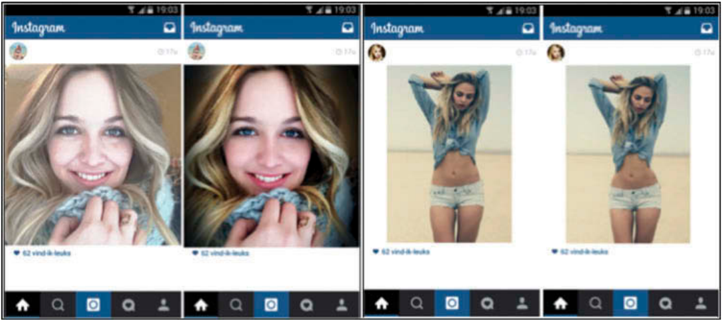
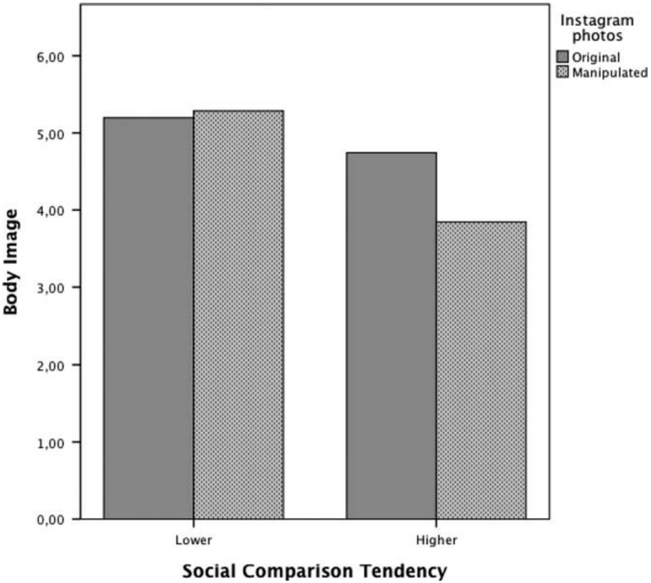
This study investigates the effect of manipulated Instagram photos on adolescent girls’ body image, and whether social comparison tendency moderates this relation. A between-subject experiment was conducted in which 144 girls (14–18 years old) were randomly exposed to either original or manipulated (retouched and reshaped) Instagram selfies. Results showed that exposure to manipulated Instagram photos directly led to lower body image. Especially, girls with higher social comparison tendencies were negatively affected by exposure to the manipulated photos. Interestingly, the manipulated photos were rated more positively than the original photos. Although the use of filters and effects was detected, reshaping of the bodies was not noticed very well. Girls in both conditions reported to find the pictures realistic. Results of this study implied that the recent societal concern about the effects of manipulated photos in social media might be justified, especially for adolescent girls with a higher social comparison tendency.
Verified 2026-11-22 · 1 reference not checked yet
Overview
Integrity signals
Registry
Cites
Statistics
Figures
Verification
Claims the paper makes
5 Valid · 1 Not valid · 24 Not checked · 37 Own results and interpretations
A result the paper reports from its own data — it cites no other source for it, so there is none to check. The quote shows it is in the paper.
In the paper
“For faces, manipulated photos scored somewhat higher ( M = 1.82; SD = .81) than the original photos ( M = 1.61; SD = .70), t (142) = -1.674; p = .051.”
plain- Asserted: passes — The authors put it forward as true.
- Checkable: passes — It can be checked against evidence.
- Load-bearing: unclear — It is unclear whether the paper’s conclusions depend on it.
- Based: passes — The paper gives a reason why it holds.
A result the paper reports from its own data — it cites no other source for it, so there is none to check. The quote shows it is in the paper.
In the paper
“Results additionally showed that level of education (included as control variable) significantly affected body image, F (1,139) = 14.618; p < .001; r = .31.”
plainstates an association- Asserted: passes — The authors put it forward as true.
- Checkable: passes — It can be checked against evidence.
- Load-bearing: unclear — It is unclear whether the paper’s conclusions depend on it.
- Based: passes — The paper gives a reason why it holds.
A result the paper reports from its own data — it cites no other source for it, so there is none to check. The quote shows it is in the paper.
In the paper
“Original photos also affected the body image of these girls more compared to ones with a lower tendency to make social comparisons, but this influence is weaker, F (1,139) = 3.016; p = .043; r = .15.”
plainstates a cause- Asserted: passes — The authors put it forward as true.
- Checkable: passes — It can be checked against evidence.
- Load-bearing: unclear — It is unclear whether the paper’s conclusions depend on it.
- Based: passes — The paper gives a reason why it holds.
A result the paper reports from its own data — it cites no other source for it, so there is none to check. The quote shows it is in the paper.
In the paper
“results revealed that the negative effect of manipulated photos is more prevalent among girls with a higher tendency to make social comparisons, F (1,139) = 18.777; p < .001; r = .34.”
plainstates an association- Asserted: passes — The authors put it forward as true.
- Checkable: passes — It can be checked against evidence.
- Load-bearing: passes — The paper’s conclusions depend on it.
- Based: passes — The paper gives a reason why it holds.
A result the paper reports from its own data — it cites no other source for it, so there is none to check. The quote shows it is in the paper.
In the paper
“the body image of girls with a higher tendency to make social comparisons is more negatively affected by manipulated Instagram photos ( M = 3.98; SE = .17) than by original photos ( M = 4.72; SE = .18), F (1,139) = 9.209; p = .002; r = . 25.”
plainstates a cause- Asserted: passes — The authors put it forward as true.
- Checkable: passes — It can be checked against evidence.
- Load-bearing: passes — The paper’s conclusions depend on it.
- Based: passes — The paper gives a reason why it holds.
29 more claims
Create a free account to see all 67 claims and to verify the 1 reference still open.
- Probably not a substantial claim. 23
- It may state two separate claims as one. 14
- The quote only partly states this claim. 1
Claims other papers make about this one
Each is checked against this paper’s own text: does it say what the citing paper says it does?
The source backs part of the claim, not all of it — or backs it for a different population, condition or comparison.
In the citing paper
“Experimental research consistently finds that exposure to idealized social media images, as well as the creation of self-images, results in increased body dissatisfaction [36,37,38].”
From Outcomes of a Cluster Randomized Controlled Trial of the SoMe Social Media Literacy Program for Improving Body Image-Related Outcomes in Adolescent Boys and Girls (2021) · cites this paper as [36]
Experimental — accuracy not yet measuredThe source backs part of the claim, not all of it — or backs it for a different population, condition or comparison.
In the citing paper
“Media representations of beauty and body ideals are often filtered through the lens of cultural norms, further influencing how gender impacts body image dissatisfaction.”
From Body Perceptions and Psychological Well-Being: A Review of the Impact of Social Media and Physical Measurements on Self-Esteem and Mental Health with a Focus on Body Image Satisfaction and Its Relationship with Cultural and Gender Factors (2024) · cites this paper as [172]
Experimental — accuracy not yet measuredThe source backs part of the claim, not all of it — or backs it for a different population, condition or comparison.
In the citing paper
“In individualistic cultures, media portrayals that emphasize thinness for women and muscularity for men can reinforce the gender disparities in body dissatisfaction.”
From Body Perceptions and Psychological Well-Being: A Review of the Impact of Social Media and Physical Measurements on Self-Esteem and Mental Health with a Focus on Body Image Satisfaction and Its Relationship with Cultural and Gender Factors (2024) · cites this paper as [172]
Experimental — accuracy not yet measuredThe cited source says what the claim attributes to it.
In the citing paper
“Such images have been shown to be related to increased appearance-related social comparison (Bonfanti et al., 2025), and subsequent body dissatisfaction (Kleemans et al., 2018).”
From Relation Between Social Media Use and Body Image Concerns and Disordered Eating in Adolescence: A Systematic Review and Meta-Analysis (2026) · cites this paper as Kleemans et al., 2018
5 more claims about this paper
Create a free account to see every claim other papers make about this one.
Statistics that don’t add up
Each reported p-value recomputed from its test statistic and degrees of freedom, each partial η² from its F, and each ratio, mean difference or B printed with a p checked against its own confidence interval.
Rated minor: it would not touch a result — a value no result rests on, a p-value that stays on the same side of the significance level, or a conflict that is clerical, resolved elsewhere in the paper, or outside its own findings.
In the paper
“F (1,139) = 9.209; p = .002”
Reported p = .002 · recomputed p = .003
Rated minor: it would not touch a result — a value no result rests on, a p-value that stays on the same side of the significance level, or a conflict that is clerical, resolved elsewhere in the paper, or outside its own findings.
In the paper
“t (142) = -1.674; p = .051”
Reported p = .051 · recomputed p = .096
Rated minor: it would not touch a result — a value no result rests on, a p-value that stays on the same side of the significance level, or a conflict that is clerical, resolved elsewhere in the paper, or outside its own findings.
In the paper
“t (142) = -1.347; p = .090”
Reported p = .09 · recomputed p = .180
Statistics recomputed
Every reported test result, recomputed from its test statistic and degrees of freedom. A result shows as not adding up only once an independent check has confirmed it.
- Doesn’t add upt(142) = -1.674reported p = .051 · recomputed p = .096
“t (142) = -1.674, p = .051”
- Doesn’t add upt(142) = -1.347reported p = .09 · recomputed p = .180
“t (142) = -1.347, p = .090”
- Doesn’t add upF(1, 139) = 9.209reported p = .002 · recomputed p = .003
“F (1,139) = 9.209, p = .002”
- Not confirmedF(1, 139) = 0.001reported p = .485 · recomputed p = .975
“F (1,139) = .001, p = .485”
- Not confirmedF(1, 139) = 3.016reported p = .043 · recomputed p = .085
“F (1,139) = 3.016, p = .043”
11 more recomputed tests
Create a free account to see every test the Stats check recomputed.
Self-check
Percentages, sums and reported differences re-computed from the paper’s own numbers.
Self-check results appear here once an independent check has confirmed them.
Citations
Cites
A theory of social comparison processes
Festinger, L. (1954) · Human Relations · doi:10.1177/001872675400700202 · Cited by 20,926 · cited 2×
“Especially the tendency to engage in social comparisons (Social Comparison Theory; Festinger, 1954) has proven to be influential in the relation between exposure to the thin ideal in the media and women’s body dissatisfaction (e.”
BackgroundSocial Cognitive Theory of Mass Communication
Bandura, A. (2001) · Media Psychology · doi:10.1207/s1532785xmep0303_03 · Cited by 3,386
Grabe, S., Ward, L. M., & Hyde, J. S. (2008) · Psychological Bulletin · doi:10.1037/0033-2909.134.3.460 · Cited by 2,053
Theory and research concerning social comparisons of personal attributes
Wood, J. V. (1989) · Psychological Bulletin · doi:10.1037/0033-2909.106.2.231 · Cited by 1,957
Gibbons, F. X., & Buunk, B. P. (1999) · Journal of Personality and Social Psychology · doi:10.1037/0022-3514.76.1.129 · Cited by 1,813 · cited 1×
“To measure girls’ social comparison tendency, the Iowa–Netherlands Comparison Orientation Measure (Gibbons & Buunk, 1999) was used.”
MethodSocial Comparison: Why, With Whom, and With What Effect?
Suls, J., Martin, R., & Wheeler, L. (2002) · Current Directions in Psychological Science · doi:10.1111/1467-8721.00191 · Cited by 1,012
Fardouly, J., Diedrichs, P. C., Vartanian, L. R., & Halliwell, E. (2015) · Body Image · doi:10.1016/j.bodyim.2014.12.002 · Cited by 1,009 · cited 2×
“Inspired by Fardouly et al. (2015), another criterion that was applied to the selection of stimulus materials was that photos varied in the parts of the body that were emphasized.”
MethodResultIs actual similarity necessary for attraction? A meta-analysis of actual and perceived similarity
Montoya, R. M., Horton, R. S., & Kirchner, J. (2008) · Journal of Social and Personal Relationships · doi:10.1177/0265407508096700 · Cited by 855
Keery, H., van den Berg, P., & Thompson, J. K. (2004) · Body Image · doi:10.1016/j.bodyim.2004.03.001 · Cited by 815
What We Instagram: A First Analysis of Instagram Photo Content and User Types
Hu, Y., Manikonda, L., & Kambhampati, S. (2014) · Proceedings of the International AAAI Conference on Web and Social Media · doi:10.1609/icwsm.v8i1.14578 · Cited by 807 · cited 1×
“Selfies were used because photos in this format are a popular trend on Instagram and other social network sites (Hu et al., 2014).”
Method
Research works printed but not linked: 2
- Altabe, M. (1998). Ethnicity and body image: Quantitative and qualitative analysis. International journal of eating disorders , 23 (2), 153 -159. doi:10.1002/(SICI)1098-108X (199803)23:2<153::AID-EAT5>3.0.CO;2-J · doi:10.1002/(sici)1098-108x
- Turpijn, L., Kneefel, S., & van der Veer, N. (2015). Nationale social media onderzoek 2015 [National Social Media Research 2015]. Amsterdam, The Netherlands: Newcom Research & Consultancy.
Cited by
Items 101–200 of 424
The Impact of Social Media Platforms on Self-Injurious Behavior in Adolescents
Polskaya, N. A., & Yakubovskaya, D. K. (2019) · Counseling Psychology and Psychotherapy · doi:10.17759/cpp.2019270310 · Cited by 23
The Association Between Sexism, Self-Sexualization, and the Evaluation of Sexy Photos on Instagram
Plieger, T., Groote, O., Hensky, R., Hurtenbach, L., Sahler, S., Thönes, L., & Reuter, M. (2021) · Frontiers in Psychology · doi:10.3389/fpsyg.2021.716417 · Cited by 29
“Kleemans et al. (2018) recently showed that photos that are rated most positive and attractive have the strongest effect on body dissatisfaction.”
BackgroundResultYour posts betray you: Detecting influencer-generated sponsored posts by finding the right clues
Shen, R.-P., Liu, D., Wei, X., & Zhang, M. (2022) · Information & Management · doi:10.1016/j.im.2022.103719 · Cited by 28
Wang, Y., Gu, X. M., Geng, J., Wei, X., & Lei, L. (2024) · Cyberpsychology Journal of Psychosocial Research on Cyberspace · doi:10.5817/cp2024-1-2 · Cited by 24
“Experimental research has also shown that exposure to others ’ selfies leads to lower body image among young women and adolescent girls (Fardouly & Rapee, 2019; Kleemans et al., 2018).”
BackgroundBLIP: Facilitating the Exploration of Undesirable Consequences of Digital Technologies
Pang, R. Y., Santy, S., Just, R., & Reinecke, K. (2024) · CHI Conference on Human Factors in Computing Systems · doi:10.1145/3613904.3642054 · Cited by 30
“Research and news headlines describe seemingly unavoidable side effects of digital technologies, from Instagram’s adverse effects on adolescent girls’ body images [52] to Microsoft’s chatbot Tay using racist language [112].”
BackgroundSocial media ills and evolutionary mismatches: a conceptual framework
Lim, A. J., & Tan, E. (2024) · Evolutionary Psychological Science · doi:10.1007/s40806-024-00398-z · Cited by 18
“In an experiment exposing original or manipulated photos to adolescent girls, girls with higher social comparison tendencies reported poorer body image (Kleemans et al., 2018).”
A diary study investigating the differential impacts of Instagram content on youths’ body image
Glaser, H. C., Jansma, S. R., & Scholten, H. (2024) · Humanities and Social Sciences Communications · doi:10.1057/s41599-024-02960-3 · Cited by 32
“Previous research has shown that social comparison on social media, especially in connection with thin-ideal imagery, is connected to overall increased body dissatisfaction (Aparicio-Martínez et al., 2019; Duan et al., 2022; Kleemans et al., 2016; Ralph ‐ Nearman and Filik, 2020).”
BackgroundSocial Media and Eating and Body Image Concerns Among Men and Boys
Lonergan, A. R., Mitchison, D., Bussey, K., & Fardouly, J. (2021) · Springer eBooks · doi:10.1007/978-3-030-67127-3_20 · Cited by 30
Wang, Y., Qiao, X., Yang, J., Geng, J., & Fu, L. S. (2022) · Scandinavian Journal of Psychology · doi:10.1111/sjop.12882 · Cited by 28
Prince, T., McLoughlin, L. T., Lagopoulos, J., Elwyn, R., & Hermens, D. F. (2022) · Journal of Psychiatric Research · doi:10.1016/j.jpsychires.2022.10.058 · Cited by 19
Nerini, A., Matera, C., Romani, F., Gesto, C. D., & Policardo, G. R. (2022) · Aesthetic Plastic Surgery · doi:10.1007/s00266-022-03225-7 · Cited by 21
“…ages since the results might differ if the sample comprised adolescents rather than young adults, especially since adolescence is a distinctive period of psychosocial development, and adolescent girls are particularly vulnerable to the effects of images portrayed on SNSs, especially Instagram [43].”
Body Esteem among Korean Adolescent Boys and Girls
You, S., & Shin, K. (2019) · Sustainability · doi:10.3390/su11072051 · Cited by 22
“The internalization of ideals refers to adopting social ideals presented through media as an individual standard [65].”
BackgroundExamining the Impact of AI-Generated Content on Self-Esteem and Body Image Through Social Comparison
Tufail, R., Shahwani, A. M., Khan, W., & Badar, Y. (2024) · Bulletin of Business and Economics (BBE) · doi:10.61506/01.00514 · Cited by 18
Fidan, M., Debbağ, M., & Fidan, B. (2021) · Journal of Educational Technology Systems · doi:10.1177/0047239520985176 · Cited by 16
“With respect to social comparison tendency, Kleemans et al. (2018) found that Instagram photos have a negative effect on the body image of adolescents, especially of girls.”
BackgroundLeggett‐James, M. P., & Laursen, B. P. (2022) · The Journal of Early Adolescence · doi:10.1177/02724316221136043 · Cited by 34
“Both boys and girls are exposed to unrealistic and unrepresentative depictions of the physiques of agemates and influencers, a situation exacerbated by an age-related naivete linked to the lack of digital experience and an inability to recognize tampered images (Kleemans et al., 2018).”
BackgroundExploring the Relations of Subjective and Objective Instagram Use on Young Adults' Mental Health
Zhao, Y., Cingel, D. P., Xie, L., & Yu, M. (2022) · Telematics and Informatics · doi:10.1016/j.tele.2022.101921 · Cited by 27
Vanhoffelen, G., Schreurs, L., Meeus, A., Janssens, N., Beullens, K., & Vandenbosch, L. (2023) · New Media & Society · doi:10.1177/14614448231207783 · Cited by 25
“Empirical research has indeed found that exposure to such idealized social media content may result in negative outcomes such as lowered body satisfaction, lower self-esteem and worse mood (e.g. Kleemans et al., 2018; Midgley et al., 2021).”
Hepburn, E. T., & Mulgrew, K. E. (2023) · Body Image · doi:10.1016/j.bodyim.2023.101642 · Cited by 18
Bonus, J. A. (2018) · Communication Research · doi:10.1177/0093650218793806 · Cited by 17
Papageorgiou, A., CROSS, D. S., & Fisher, C. M. (2022) · International Journal of Environmental Research and Public Health · doi:10.3390/ijerph20010433 · Cited by 27
“This finding aligns with previous research identifying the significant influence of peers on girls’ body image [14,48].”
BackgroundResultJin, R., & Le, T.-T. (2024) · Frontiers in Public Health · doi:10.3389/fpubh.2024.1445090 · Cited by 21
“This result provides a specific angle to look at how social media usage may have negative impacts on one’s self-image, especially physical appearance, as suggested in former studies (29–31).”
BackgroundResultQuintana, J. G., & Amoros, M. F.-G. (2020) · Texto Livre Linguagem e Tecnologia · doi:10.17851/1983-3652.13.1.20-44 · Cited by 15
#Beautyunedited: Is labeling unedited selfies helpful for body image and mood among young women?
Rodgers, R. F., Lowy, A. S., Kodama, E., & Bujold, H. (2021) · Body Image · doi:10.1016/j.bodyim.2021.08.001 · Cited by 16
Davis, K. S., Anderson, M., Yang, C., Choukas‐Bradley, S., Bell, B. T., & Slovák, P. (2024) · Journal of Adolescent Research · doi:10.1177/07435584241291163 · Cited by 25
“Girls who tend to engage in social comparison are more vulnerable to body image concerns when exposed to manipulated photos on social media (Kleemans et al., 2018).”
"I Just Don’t Care Enough To Be Interested": Teens’ Moment-By-Moment Experiences on Instagram
Landesman, R., Yoon, J., Kim, J., Lopez, D. E. M., Magis‐Weinberg, L., Hiniker, A., & Davis, K. S. (2024) · ACM International Conference on Interaction Design and Children (IDC) · doi:10.1145/3628516.3655812 · Cited by 31
“We chose Instagram because it is one of the most popular social media platforms among teens [7] and has elicited both public and scholarly attention regarding its impact on teen mental health research [28, 42, 43].”
BackgroundMethodKocaman, G., & Kazan, H. (2021) · Opus uluslararası toplum araştırmaları dergisi · doi:10.26466/opus.877656 · Cited by 14
Young, G., Smith, M. J., & Batten, J. (2022) · Youth · doi:10.3390/youth2030016 · Cited by 23
“Adding to this, the number of followers a user has, as well as the number of ‘likes’ and comments posted on images, provides additional information about the appreciation (or otherwise) of others [53].”
BackgroundBrannigan, R., Cronin, F. M., McEvoy, O., Stanistreet, D., & Layte, R. (2022) · Social Psychiatry and Psychiatric Epidemiology · doi:10.1007/s00127-022-02352-5 · Cited by 18
“Additionally, outside the realm of psychiatric symptoms, there has been numerous studies investigating associations between of digital media engagement and other psychological concepts, the results of which seem to be mixed, with positive associations being observed with aspects such as self-esteem and loneliness [5,…”
BackgroundGaze behaviour, body image in women and online apparel shopping
Hollett, R. C., Panaia, P. M., & Smart, A. H. (2023) · International Journal of Consumer Studies · doi:10.1111/ijcs.12977 · Cited by 15
López-Montón, M., Diego, G. A., & Estévez, A. (2024) · Behavioral Sciences · doi:10.3390/bs14070580 · Cited by 26
“As a result, body satisfaction becomes a difficult and unlikely goal [65].”
BackgroundInfluentialMayen, S., Reinhardt, A., & Wilhelm, C. (2025) · Journal of Children and Media · doi:10.1080/17482798.2024.2443662 · Cited by 21
“However, while development may partially explain this pattern for both boys and girls, the appearance-focused nature of social media, including heavy use of filters and image processing, may particularly affect younger girls, fostering unrealistic comparisons (Kleemans et al., 2018).”
Mediating the Magic Kingdom: Instagram, Fantasy, and Identity
Soto-Vásquez, A. D. (2021) · Western Journal of Communication · doi:10.1080/10570314.2021.1970797 · Cited by 19
Panova, T., & Carbonell, X. (2022) · Studies in neuroscience, psychology and behavioral economics · doi:10.1007/978-3-031-04772-5_3 · Cited by 18
Pressler, M. P., Kislevitz, M. L., Davis, J. J., & Amirlak, B. (2022) · Plastic & Reconstructive Surgery · doi:10.1097/prs.0000000000008961 · Cited by 13
Papageorgiou, A., Fisher, C. M., & Crossa, D. (2022) · Sexuality & Culture · doi:10.1007/s12119-022-10022-6 · Cited by 25
“…at the time of data collection between 2016 and 2018 (Selena Gomez, Gigi Hadid, Kylie Jenner and Kendall Jenner), and were selected to include variation in the parts of the body shown and a sexually suggestive pose, as used in previous studies (Ghaznavi & Taylor, 2015; Kleemans et al., 2016).”
Method“Real” bodies in plus-size fashion
Czerniawski, A. M. (2021) · Fat Studies · doi:10.1080/21604851.2021.1913827 · Cited by 21
“(Heitman 2019, 86) Both Jamil and Upton allude to the documented negative impact Photoshopped images have on adolescent self-image and the development of disordered eating (see Dereene and Beresin 2018; Harrison and Hefner 2014; Kleemans et al. 2018; Taylor, Yoon-Na Cho, and Smith 2018).”
BackgroundWenig, V., & Janetzke, H. (2022) · International Journal of Environmental Research and Public Health · doi:10.3390/ijerph191811334 · Cited by 15
“[59]—the edited pictures of other people can have a negative impact on the satisfaction with their own body—and thus also on the ED.”
BackgroundLiars and Trolls and Bots Online: The Problem of Fake Persons
Harris, K. R. (2023) · Philosophy & Technology · doi:10.1007/s13347-023-00640-9 · Cited by 18
“For example, the exposure to manipulated photos on Instagram has been shown to cause adolescent girls to develop unrealistic standards of female beauty and, consequently, anxieties about their own bodies (Kleemans et al., 2018).”
BackgroundTeenagers, Sexualities-Education Assemblages and Sexual Citizenship: A New Materialist Analysis
Alldred, P., & Fox, N. J. (2017) · Brunel University Research Archive (BURA) (Brunel University London) · doi:10.3726/b10545 · Cited by 5
Öztunç, M., Çötok, N. A., Işıkgöz, M. E., & Biricik, K. (2025) · BMC Psychology · doi:10.1186/s40359-025-03517-y · Cited by 19
“Over time, this can lead to an increased focus on aesthetics, particularly in adolescents [11, 19].”
Digennaro, S., & Iannaccone, A. (2023) · Sustainability · doi:10.3390/su15043046 · Cited by 33
Praet, N., Stevens, J., Casteels, K., & Toelen, J. (2024) · Children · doi:10.3390/children11070822 · Cited by 16
“Our data highlight the central role of comparison in perpetuating negative emotions, with photo manipulation tools like Photoshop exacerbating body dissatisfaction [41,42].”
BackgroundMedia Influences on Body Image & Eating Behaviors in Adolescents
Kwon, M. (2020) · Springer eBooks · doi:10.1007/978-3-030-45103-5_7 · Cited by 16
Digital dermatoses: skin disorders engendered by social media in tweens and teens
Young, T. K., & Oza, V. S. (2021) · Current Opinion in Pediatrics · doi:10.1097/mop.0000000000001037 · Cited by 12
Cetinkaya, A. B., Metin, A., Erbiçer, E. S., & YAVUZ, E. (2022) · International Journal of Social Sciences and Education Research · doi:10.24289/ijsser.1034318 · Cited by 17
Burnell, K., Fox, K. A., Maheux, A. J., & Prinstein, M. J. (2024) · Current Treatment Options in Psychiatry · doi:10.1007/s40501-024-00311-2 · Cited by 19
“Indeed, numerous experimental studies indicate that passively browsing social media content (especially idealized content) negatively impacts mental health outcomes, including well-being and body image [51–53], particularly for those who tend to socially compare [54, 55].”
BackgroundYu, M., Sun, X., Xu, Y., Liu, Z., Wu, Y., Yang, S. L., & Luo, F. (2022) · Applied Psychology Health and Well-Being · doi:10.1111/aphw.12425 · Cited by 13
Batool, F., & Qurat-ul-ain, A. (2023) · Journal of Professional & Applied Psychology · doi:10.52053/jpap.v4i4.212 · Cited by 9
“The users on these sites may idealize such visuals including their peer's pictures, and comparisons to such idealized photos then further lead to a dissatisfied attitude toward one's self (Kleemans et al., 2016; Fox & Vendemia, 2016).”
BackgroundDigennaro, S., & Tescione, A. (2024) · Frontiers in Education · doi:10.3389/feduc.2024.1390583 · Cited by 37
“These comparisons may occur with recognizing that the portrayed images are realistic representations of their peers (Kleemans et al., 2018).”
BackgroundSocial threat and adolescent mental health
Sequeira, S. L., Rodman, A. M., Nesi, J. L., & Silk, J. S. (2025) · Nature Reviews Psychology · doi:10.1038/s44159-025-00484-4 · Cited by 13
Addictive Potential of Social Media: A Cross Sectional Study in Portugal
Côrte‐Real, B., Cordeiro, C. R., Pestana, P. C., Silva, I. D. E., & Novais, F. (2022) · Acta Médica Portuguesa · doi:10.20344/amp.18470 · Cited by 13
Self-exposure on instagram and bmi: Relations with body image among both genders
Rodríguez, D. A., & Abella, M. C. (2023) · Europe’s Journal of Psychology · doi:10.5964/ejop.7221 · Cited by 13
Verrastro, V., Saladino, V., Eleuteri, S., Barberis, N., & Cuzzocrea, F. (2023) · Psychology in Russia State of Art · doi:10.11621/pir.2023.0401 · Cited by 19
“…about their aesthetic identity and that of others, basing themselves only on social comparisons. is interpretation is consistent with the study by Kleemans et al. (2018), who investigated the negative e ff ect on the body image of manipulated Instagram* photos, and the role played by the…”
ResultThe impact of excessive dieting on eating disorders in adolescent women: a literature review
Son, E., & Kwon, K. H. (2024) · Nutrition & Food Science · doi:10.1108/nfs-06-2023-0127 · Cited by 10
KONSTRUKSI CANTIK DALAM AKUN INSTAGRAM
Yanti, V. S., & Bajari, A. (2020) · Jurnal Ranah Komunikasi (JRK) · doi:10.25077/rk.3.2.55-68.2019 · Cited by 9
Diferencias de edad y género en el uso y consumo de medios sociales entre los adolescentes
Jiménez, A. G., Catalina-García, B., & Tur‐Viñes, V. (2021) · adComunica revista científica de estrategias tendencias e innovación en comunicación · doi:10.6035/2174-0992.2021.22.12 · Cited by 15
Zimmermann, D., Schneider, C., & Kaspar, K. (2025) · Frontiers in Psychology · doi:10.3389/fpsyg.2024.1472514 · Cited by 16
Davis, K. S., Landesman, R., Yoon, J., Kim, J., Lopez, D. E. M., Magis‐Weinberg, L., & Hiniker, A. (2025) · CHI Conference on Human Factors in Computing Systems · doi:10.1145/3706598.3713844 · Cited by 24
“We chose to focus on Instagram because of the platform’s popularity among teens [7] and its prevalence in teen mental health research [30, 53, 57].”
Gangguan Makan pada Remaja Dipengaruhi Oleh Media Sosial Melalui Citra Tubuh Negatif
Tunga, T. L. E. (2022) · JURNAL ILMIAH KESEHATAN SANDI HUSADA · doi:10.35816/jiskh.v11i1.684 · Cited by 19
Hollett, R. C., & Challis, M. (2023) · Body Image · doi:10.1016/j.bodyim.2023.07.004 · Cited by 11
Self-Tracking among Young People: Lived Experiences, Tensions and Bodily Outcomes
Alevizou, P., Michaelidou, N., Daskalopoulou, A., & Appiah-Campbell, R. (2023) · Sociology · doi:10.1177/00380385231218695 · Cited by 12
“…between weight management practices shared on social media and reality as what influencers and peers choose to share online does not capture the entire process of what it entails to maintain a healthy body, which may be distorted leading to unhealthy social comparisons (Kleemans et al., 2018).”
Vizcaíno-Verdú, A., Feijóo, B., & Sádaba, C. (2025) · Atlantic Journal of Communication · doi:10.1080/15456870.2025.2470737 · Cited by 15
“These results are in agreement with those of Kleemans et al. (2018), who established a link between frequent filter use and heightened body dissatisfaction as well as reduced self-esteem.”
Fat, sexy, and human? Perceptions of plus-size sexualized women and dehumanization
Biefeld, S. D., & Brown, C. S. (2022) · Body Image · doi:10.1016/j.bodyim.2022.05.002 · Cited by 12
Bluteau, J. M. (2022) · Journal of Bodies Sexualities and Masculinities · doi:10.3167/jbsm.2022.030203 · Cited by 11
Schreurs, L., & Vandenbosch, L. (2023) · Mass Communication & Society · doi:10.1080/15205436.2022.2159432 · Cited by 15
“They may then compare themselves and their lives to these social media examples of “perfection” (Kleemans et al., 2018).”
de Vaate, N. A. J. D. B., Veldhuis, J., & Konijn, E. A. (2023) · Computers in Human Behavior · doi:10.1016/j.chb.2023.107906 · Cited by 16
The Role of Photo Editing in Instagram Towards the Body Image Among Female Teenagers
Maharani, B. M., Hawa, B. C. N., & Devita, P. T. (2020) · Asian Journal of Media and Communication · doi:10.20885/asjmc.vol4.iss1.art5 · Cited by 13
Investigating the Perception of Facial Anonymization Techniques in 360° Videos
Wöhler, L., Ikehata, S., & Aizawa, K. (2024) · ACM Transactions on Applied Perception · doi:10.1145/3695254 · Cited by 10
“…creators might want to only use conventionally attractive people for face-swapping possibly introducing problems previously discussed for images in advertisement and social media which can negatively impact viewers’ body image if only very attractive models [54] or edited images [55, 56] are shown.”
ÜSTÜNDAĞ, A., Kanik, R., & Çinar, Y. R. (2024) · Journal of Pediatric Nursing · doi:10.1016/j.pedn.2024.10.010 · Cited by 15
Sahin, E., & Şanlıer, N. (2025) · BMC Public Health · doi:10.1186/s12889-025-22689-1 · Cited by 17
“In the study of Kleemans et al. [73] the results indicated that exposure to altered Instagram photos directly resulted in a decrease in body image.”
Teenagers: A Social Media Threat Vector
Collier, H., & Morton, C. (2024) · International Conference on Cyber Warfare and Security · doi:10.34190/iccws.19.1.1980 · Cited by 12
“This manipulation comes in many forms and can impact a teenager's perception of themselves in a negative fashion (Kleemans, et al., 2018).”
BackgroundKang, Y., Lee, H. K., & Kim, W. B. (2020) · Fashion & Textile Research Journal · doi:10.5805/sfti.2020.22.4.456 · Cited by 7
Gender and Culture Differences in Perception of Deceptive Video Filter Use
Herring, S. C., Dedema, M., Rodriguez, E., & Yang, L. (2022) · Lecture notes in computer science · doi:10.1007/978-3-031-22131-6_5 · Cited by 11
Pitiruţ, I.-B., Swami, V., Poamă‐Neagră, T., & Enea, V. (2023) · Scandinavian Journal of Psychology · doi:10.1111/sjop.12973 · Cited by 12
Psychologische Zugänge zu Medien und Geschlecht: Medienpsychologie und Sozialpsychologie
Döring, N. M. (2019) · Springer Reference Sozialwissenschaften · doi:10.1007/978-3-658-20712-0_32-1 · Cited by 11
Temmermans, F., Caldwell, S., Papadopoulos, S., Pereira, F., & Rixhon, P. (2023) · 2023 24th International Conference on Digital Signal Processing (DSP) · doi:10.1109/dsp58604.2023.10167884 · Cited by 6
“…as to whether dementia research progress was retarded by manipulated medical images in an influential 2006 Nature article [13], or whether traditional problems with adolescent children’s body images caused by manipulated images of models have simply gone online through social media platforms [14].”
BackgroundSocial media use: Attitudes, “detox,” and craving in typical and frequent users.
Robertson, D. J., Malin, J., Martin, S., Butler, S. H., John, B., Graff, M., Flowers, P., & Jones, B. C. (2023) · Technology Mind and Behavior · doi:10.1037/tmb0000120 · Cited by 16
An experimental study on the impact of social media images on users’ online social anxiety in China
Jia, Z. (2025) · Discover Psychology · doi:10.1007/s44202-025-00337-4 · Cited by 8
“A study found that girls with a high tendency for social comparison are negatively affected by manipulated photos on social media [7].”
Sánchez, G., & JENKINS, J. H. (2024) · Social Science & Medicine · doi:10.1016/j.socscimed.2024.116839 · Cited by 7
“…that developmental processes in early adolescence such as increased attunement toward peer acceptance may adversely intersect with SM images of “ idealized ” body types, potentially leading to body image concerns particularly among girls (Choukas-Bradley et al., 2020; Kleemans et al., 2018).”
Portingale, J., Krug, I., & Butler, D. L. (2024) · International Journal of Eating Disorders · doi:10.1002/eat.24230 · Cited by 6
Young, T. K., & Oza, V. S. (2020) · Pediatric Dermatology · doi:10.1111/pde.14275 · Cited by 6
Bulut, S. (2020) · Gümüşhane Üniversitesi İletişim Fakültesi Elektronik Dergisi · doi:10.19145/e-gifder.724110 · Cited by 6
The influence of selfie related behavior in social media on body image
Gu, X. M., Wang, Y., & Lei, L. (2021) · Advances in Psychological Science · doi:10.3724/sp.j.1042.2021.01497 · Cited by 14
“…同身份时对自拍态度的异同,为用户调整自拍相关行为提供指导。 4 自拍相关行为对身体映像的作用过程 4.1 身体监测 Fredrickson 和 Roberts(1997)在西方社会文化背景下提出客体化理论 (objectification theory)。该理论认为,女性总是被“性注视”从而产生“性客体化”, 久而久之,女性自身也会内化旁观者的视角,从而像看待物品一样看待自己的身 体,即自我客体化(self-objectification)。自我客体化会减少女性的心流体验,导 致抑郁、焦虑、进食障碍等问题。身体监测是自我客体化的主要行为表现…”
InfluentialBrahmini, I. A. B., & Supriyadi (2019) · Jurnal Psikologi Udayana · doi:10.24843/jpu.2019.v06.i01.p11 · Cited by 14
Effects of Korean Female Adolescent Makeup on School Adjustment
Kim, S. (2020) · The Korean Society of Costume · doi:10.7233/jksc.2020.70.4.065 · Cited by 6
Balaban, D. C., & Spoaller, D. (2020) · Studia Universitatis Babeș-Bolyai Ephemerides · doi:10.24193/subbeph.2020.2.01 · Cited by 7
Huong, X. V. (2023) · International Journal of Current Science Research and Review · doi:10.47191/ijcsrr/v6-i10-05 · Cited by 8
Instagram Use and Endorsement of a Voluptuous Body Ideal: A Serial Mediation Model
Belmonte, A., Hopper, K. M., & Aubrey, J. S. (2024) · Sex Roles · doi:10.1007/s11199-024-01442-9 · Cited by 12
“Kleemans et al. ( 2018) examined the impact of manipulated Instagram photos on adolescent girls’ (aged 14–18) body image and whether social comparison tendency moderated this relation.”
Exploring the multifaceted impact of breast cancer on the body image
Davis, A., Acevedo, G., Crowley‐Miller, A., Tran, A., Shah, M., Langlais, M. R., Sturdivant, R. X., Elkins, G. R., & Yoo, J. (2024) · Family and Consumer Sciences Research Journal · doi:10.1111/fcsr.12535 · Cited by 5
Levin, T., Tiggemann, M., Harriger, J. A., & Fardouly, J. (2025) · Body Image · doi:10.1016/j.bodyim.2025.102000 · Cited by 24
Plieger, T., Groote, O., Hartstein, A., Fotiadis, R., Griesberg, M. C., Onwubiko, S. N., Pöttgen, K., Sever, G., & Reuter, M. (2024) · Sexuality & Culture · doi:10.1007/s12119-023-10192-x · Cited by 7
“…a self-sexualizing way or edit their photos (e.g. by the use of filters) on their social media accounts are perceived as being less competent, intelligent, and attractive (Daniels & Zubriggen, 2016; Vendemia & DeAndrea, 2018) although there is also evidence to the contrary (Kleemans et al., 2018).”
Artigues-Barberà, E., Tort‐Nasarre, G., Pollina-Pocallet, M., Suquet, Y. F., Pallés, A. A., Niubó, O. G., Ortega, M., & García‐Martínez, E. (2025) · PLoS ONE · doi:10.1371/journal.pone.0318989 · Cited by 21
“Individual factors such as the tendency for social comparison [48,49] and media literacy level [49,50] may moderate this effect.”
Fan, L., Zuo, Y., & Yang, K. (2025) · Acta Psychologica · doi:10.1016/j.actpsy.2025.104953 · Cited by 8
Devos, S., Schreurs, L., Eggermont, S., & Vandenbosch, L. (2023) · New Media & Society · doi:10.1177/14614448231188935 · Cited by 9
“Adolescents might thus perceive others as more successful on one or several life domains then they actually are and therefore feel as if they, themselves, do not comply with the prevailing standards of success (Alfasi, 2019; Chou and Edge, 2012; Kleemans et al., 2018).”
Iftikhar, I., Yasmeen, B., Nadeem, M., & Ahmad, N. (2023) · Journal of Human Behavior in the Social Environment · doi:10.1080/10911359.2023.2244020 · Cited by 10
“Young women may feel enormous pressure to adhere to beauty norms and self-objectify due to the significance of obtaining feedback e.g., evaluating oneself as an object based on appearance (Kleemans et al., 2016).”
Hollett, R. C., Bhusal, M., Gilani, S., Harms, C., & Griffiths, S. (2024) · Body image · doi:10.1016/j.bodyim.2024.101778 · Cited by 7
Social Media Use, Body Image Concerns, and Disordered Eating Among Adolescents
Choukas‐Bradley, S., Maheux, A. J., Aubrey, J. S., Charmaraman, L., Maas, M. K., Nesi, J. L., Ward, L. M., & Yang, C. (2024) · Springer eBooks · doi:10.1007/978-3-031-69362-5_21 · Cited by 13
Social Comparison and Well-being under Social Media Influence
Han, Q. (2022) · Advances in Social Science, Education and Humanities Research/Advances in social science, education and humanities research · doi:10.2991/assehr.k.220504.116 · Cited by 11
O’Hara, K. (2022) · Foundations and Trends® in Web Science · doi:10.1561/1800000031 · Cited by 10
Pollack, C. C., Gilbert‐Diamond, D., Onega, T., Vosoughi, S., O’Malley, A. J., & Emond, J. A. (2023) · JMIR Infodemiology · doi:10.2196/40005 · Cited by 5
Metadata
- Authors
- Kleemans, M., Daalmans, S., Carbaat, I., & Anschütz, D.
- Affiliations
- Radboud University Nijmegen (NL)
- Corresponding author
- Daalmans, Serena
- Venue
- Media Psychology
- Publisher
- Informa UK Limited
- Published
- 2016-12-15
- Volume
- 21
- Issue
- 1
- Pages
- 93-110
- ISSN
- 1521-3269 (ISSN-L)
- 1532-785X
- OpenAlex
- W2567680263
- Cited by
- 421
- References
- 51
- Citations by year
- 2026: 38 · 2025: 53 · 2024: 59 · 2023: 72 · 2022: 71 · 2021: 56 · 2020: 40 · 2019: 25 · 2018: 6 · 2017: 1
- FWCI
- 14.27
- Type
- journal article
- Language
- en
- Open access
- hybrid
- doi.org
- Licence
- Locations
- Media Psychology (publishedVersion, cc-by-nc-nd)
- Radboud Repository (Radboud University) (submittedVersion)
- Radboud Repository (Radboud University) (submittedVersion, other-oa)
- Topics
- Social Sciences › Psychology › Clinical Psychology › Body Image and Dysmorphia Studies
- Social Sciences › Psychology › Clinical Psychology › Eating Disorders and Behaviors
- Social Sciences › Sociology and Political Science › Impact of Technology on Adolescents
- Keywords
- Instagram, body image, photo manipulation, retouching, reshaping, social comparison, adolescent girls, selfies, social media, self-presentation, photo filters
About these checks
Registry, retraction, Cites and statistics results are computed, not judged, with one exception: a printed reference that no index lists is read once by a model before it counts as a citation error. Claims are extracted by a model and kept only when their quote appears verbatim in the text; each cited source is then checked, with a model’s help, for whether it says what the claim relies on. Those verdicts can be wrong — read the claim’s quote and the cited source before relying on one.
The claim verdicts this report counts are experimental: their accuracy is not yet measured.
A language model drew the claims from the paper on 2026-09-28, under version 3 of the claim definition (model deepseek-v4.1-flash, prompt extract-v3).
A second model labelled each claim on 2026-09-28 (model jev-1.13-20260917, definition revision gold-guideline-v0.2).
Statistics and arithmetic are recomputed, not judged.
Confidence bands are shown only for fields calibrated on our annotated test set. None is calibrated yet, so no band is shown.
What counts as a claim ›How we measure confidence ›How we check this ›
Are you an author, or do you see a problem with this page? Request a review
Data sources
Bibliographic data: Semantic Scholar, OpenAlex, Crossref.
Contains information from the Semantic Scholar Academic Graph Datasets, made available under the ODC Attribution License (ODC-BY 1.0).
Semantic Scholar’s data is described in: Kinney, R., et al. (2023). The Semantic Scholar Open Data Platform. arXiv:2301.10140.
