

Picture Perfect: The Direct Effect of Manipulated Instagram Photos on Body Image in Adolescent Girls
Open accessThe DOI matches its Crossref record; 53 of the 54 references it cites were found in a registry or an index, and 1 are not checked yet; 5 of the 51 sources its claims cite were checked for support.
Abstract
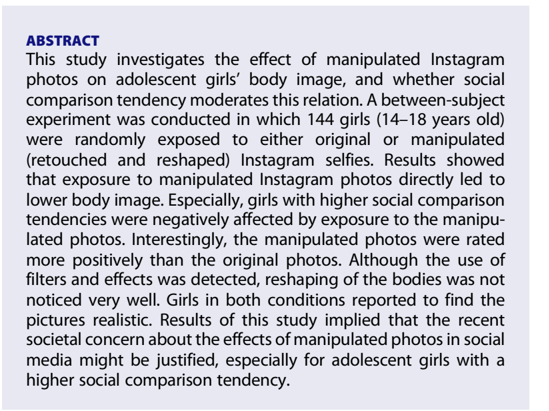
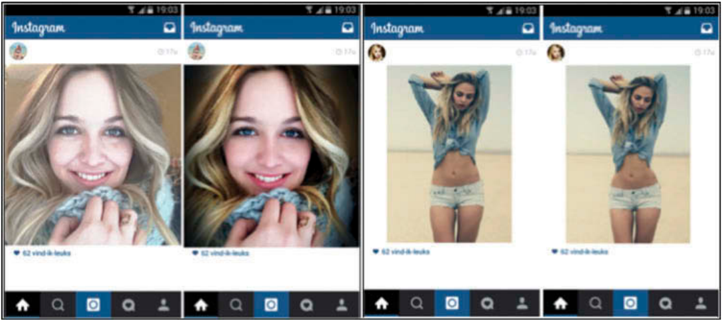
This study investigates the effect of manipulated Instagram photos on adolescent girls’ body image, and whether social comparison tendency moderates this relation. A between-subject experiment was conducted in which 144 girls (14–18 years old) were randomly exposed to either original or manipulated (retouched and reshaped) Instagram selfies. Results showed that exposure to manipulated Instagram photos directly led to lower body image. Especially, girls with higher social comparison tendencies were negatively affected by exposure to the manipulated photos. Interestingly, the manipulated photos were rated more positively than the original photos. Although the use of filters and effects was detected, reshaping of the bodies was not noticed very well. Girls in both conditions reported to find the pictures realistic. Results of this study implied that the recent societal concern about the effects of manipulated photos in social media might be justified, especially for adolescent girls with a higher social comparison tendency.
Verified 2026-11-22 · 1 reference not checked yet
Overview
Integrity signals
Registry
Cites
Statistics
Figures
Verification
Claims the paper makes
5 Valid · 1 Not valid · 24 Not checked · 37 Own results and interpretations
A result the paper reports from its own data — it cites no other source for it, so there is none to check. The quote shows it is in the paper.
In the paper
“For faces, manipulated photos scored somewhat higher ( M = 1.82; SD = .81) than the original photos ( M = 1.61; SD = .70), t (142) = -1.674; p = .051.”
plain- Asserted: passes — The authors put it forward as true.
- Checkable: passes — It can be checked against evidence.
- Load-bearing: unclear — It is unclear whether the paper’s conclusions depend on it.
- Based: passes — The paper gives a reason why it holds.
A result the paper reports from its own data — it cites no other source for it, so there is none to check. The quote shows it is in the paper.
In the paper
“Results additionally showed that level of education (included as control variable) significantly affected body image, F (1,139) = 14.618; p < .001; r = .31.”
plainstates an association- Asserted: passes — The authors put it forward as true.
- Checkable: passes — It can be checked against evidence.
- Load-bearing: unclear — It is unclear whether the paper’s conclusions depend on it.
- Based: passes — The paper gives a reason why it holds.
A result the paper reports from its own data — it cites no other source for it, so there is none to check. The quote shows it is in the paper.
In the paper
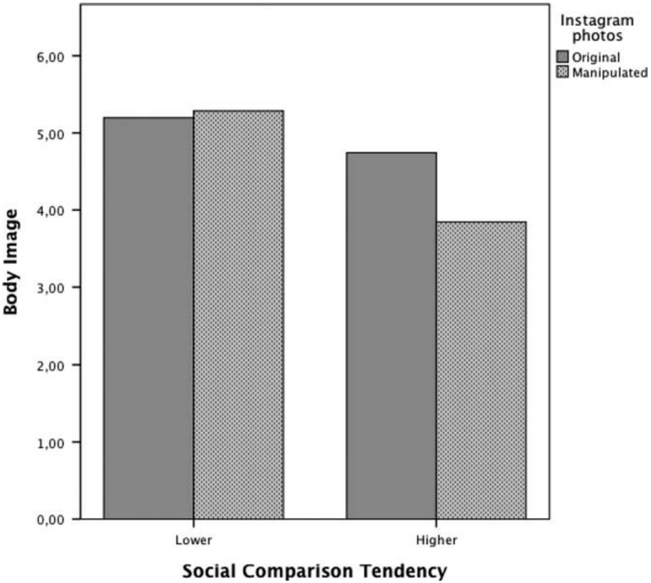
“Original photos also affected the body image of these girls more compared to ones with a lower tendency to make social comparisons, but this influence is weaker, F (1,139) = 3.016; p = .043; r = .15.”
plainstates a cause- Asserted: passes — The authors put it forward as true.
- Checkable: passes — It can be checked against evidence.
- Load-bearing: unclear — It is unclear whether the paper’s conclusions depend on it.
- Based: passes — The paper gives a reason why it holds.
A result the paper reports from its own data — it cites no other source for it, so there is none to check. The quote shows it is in the paper.
In the paper
“results revealed that the negative effect of manipulated photos is more prevalent among girls with a higher tendency to make social comparisons, F (1,139) = 18.777; p < .001; r = .34.”
plainstates an association- Asserted: passes — The authors put it forward as true.
- Checkable: passes — It can be checked against evidence.
- Load-bearing: passes — The paper’s conclusions depend on it.
- Based: passes — The paper gives a reason why it holds.
A result the paper reports from its own data — it cites no other source for it, so there is none to check. The quote shows it is in the paper.
In the paper
“the body image of girls with a higher tendency to make social comparisons is more negatively affected by manipulated Instagram photos ( M = 3.98; SE = .17) than by original photos ( M = 4.72; SE = .18), F (1,139) = 9.209; p = .002; r = . 25.”
plainstates a cause- Asserted: passes — The authors put it forward as true.
- Checkable: passes — It can be checked against evidence.
- Load-bearing: passes — The paper’s conclusions depend on it.
- Based: passes — The paper gives a reason why it holds.
29 more claims
Create a free account to see all 67 claims and to verify the 1 reference still open.
- Probably not a substantial claim. 23
- It may state two separate claims as one. 14
- The quote only partly states this claim. 1
Claims other papers make about this one
Each is checked against this paper’s own text: does it say what the citing paper says it does?
The source backs part of the claim, not all of it — or backs it for a different population, condition or comparison.
In the citing paper
“Experimental research consistently finds that exposure to idealized social media images, as well as the creation of self-images, results in increased body dissatisfaction [36,37,38].”
From Outcomes of a Cluster Randomized Controlled Trial of the SoMe Social Media Literacy Program for Improving Body Image-Related Outcomes in Adolescent Boys and Girls (2021) · cites this paper as [36]
Experimental — accuracy not yet measuredThe source backs part of the claim, not all of it — or backs it for a different population, condition or comparison.
In the citing paper
“Media representations of beauty and body ideals are often filtered through the lens of cultural norms, further influencing how gender impacts body image dissatisfaction.”
From Body Perceptions and Psychological Well-Being: A Review of the Impact of Social Media and Physical Measurements on Self-Esteem and Mental Health with a Focus on Body Image Satisfaction and Its Relationship with Cultural and Gender Factors (2024) · cites this paper as [172]
Experimental — accuracy not yet measuredThe source backs part of the claim, not all of it — or backs it for a different population, condition or comparison.
In the citing paper
“In individualistic cultures, media portrayals that emphasize thinness for women and muscularity for men can reinforce the gender disparities in body dissatisfaction.”
From Body Perceptions and Psychological Well-Being: A Review of the Impact of Social Media and Physical Measurements on Self-Esteem and Mental Health with a Focus on Body Image Satisfaction and Its Relationship with Cultural and Gender Factors (2024) · cites this paper as [172]
Experimental — accuracy not yet measuredThe cited source says what the claim attributes to it.
In the citing paper
“Such images have been shown to be related to increased appearance-related social comparison (Bonfanti et al., 2025), and subsequent body dissatisfaction (Kleemans et al., 2018).”
From Relation Between Social Media Use and Body Image Concerns and Disordered Eating in Adolescence: A Systematic Review and Meta-Analysis (2026) · cites this paper as Kleemans et al., 2018
5 more claims about this paper
Create a free account to see every claim other papers make about this one.
Statistics that don’t add up
Each reported p-value recomputed from its test statistic and degrees of freedom, each partial η² from its F, and each ratio, mean difference or B printed with a p checked against its own confidence interval.
Rated minor: it would not touch a result — a value no result rests on, a p-value that stays on the same side of the significance level, or a conflict that is clerical, resolved elsewhere in the paper, or outside its own findings.
In the paper
“F (1,139) = 9.209; p = .002”
Reported p = .002 · recomputed p = .003
Rated minor: it would not touch a result — a value no result rests on, a p-value that stays on the same side of the significance level, or a conflict that is clerical, resolved elsewhere in the paper, or outside its own findings.
In the paper
“t (142) = -1.674; p = .051”
Reported p = .051 · recomputed p = .096
Rated minor: it would not touch a result — a value no result rests on, a p-value that stays on the same side of the significance level, or a conflict that is clerical, resolved elsewhere in the paper, or outside its own findings.
In the paper
“t (142) = -1.347; p = .090”
Reported p = .09 · recomputed p = .180
Statistics recomputed
Every reported test result, recomputed from its test statistic and degrees of freedom. A result shows as not adding up only once an independent check has confirmed it.
- Doesn’t add upt(142) = -1.674reported p = .051 · recomputed p = .096
“t (142) = -1.674, p = .051”
- Doesn’t add upt(142) = -1.347reported p = .09 · recomputed p = .180
“t (142) = -1.347, p = .090”
- Doesn’t add upF(1, 139) = 9.209reported p = .002 · recomputed p = .003
“F (1,139) = 9.209, p = .002”
- Not confirmedF(1, 139) = 0.001reported p = .485 · recomputed p = .975
“F (1,139) = .001, p = .485”
- Not confirmedF(1, 139) = 3.016reported p = .043 · recomputed p = .085
“F (1,139) = 3.016, p = .043”
11 more recomputed tests
Create a free account to see every test the Stats check recomputed.
Self-check
Percentages, sums and reported differences re-computed from the paper’s own numbers.
Self-check results appear here once an independent check has confirmed them.
Citations
Cites
A theory of social comparison processes
Festinger, L. (1954) · Human Relations · doi:10.1177/001872675400700202 · Cited by 20,926 · cited 2×
“Especially the tendency to engage in social comparisons (Social Comparison Theory; Festinger, 1954) has proven to be influential in the relation between exposure to the thin ideal in the media and women’s body dissatisfaction (e.”
BackgroundSocial Cognitive Theory of Mass Communication
Bandura, A. (2001) · Media Psychology · doi:10.1207/s1532785xmep0303_03 · Cited by 3,386
Grabe, S., Ward, L. M., & Hyde, J. S. (2008) · Psychological Bulletin · doi:10.1037/0033-2909.134.3.460 · Cited by 2,053
Theory and research concerning social comparisons of personal attributes
Wood, J. V. (1989) · Psychological Bulletin · doi:10.1037/0033-2909.106.2.231 · Cited by 1,957
Gibbons, F. X., & Buunk, B. P. (1999) · Journal of Personality and Social Psychology · doi:10.1037/0022-3514.76.1.129 · Cited by 1,813 · cited 1×
“To measure girls’ social comparison tendency, the Iowa–Netherlands Comparison Orientation Measure (Gibbons & Buunk, 1999) was used.”
MethodSocial Comparison: Why, With Whom, and With What Effect?
Suls, J., Martin, R., & Wheeler, L. (2002) · Current Directions in Psychological Science · doi:10.1111/1467-8721.00191 · Cited by 1,012
Fardouly, J., Diedrichs, P. C., Vartanian, L. R., & Halliwell, E. (2015) · Body Image · doi:10.1016/j.bodyim.2014.12.002 · Cited by 1,009 · cited 2×
“Inspired by Fardouly et al. (2015), another criterion that was applied to the selection of stimulus materials was that photos varied in the parts of the body that were emphasized.”
MethodResultIs actual similarity necessary for attraction? A meta-analysis of actual and perceived similarity
Montoya, R. M., Horton, R. S., & Kirchner, J. (2008) · Journal of Social and Personal Relationships · doi:10.1177/0265407508096700 · Cited by 855
Keery, H., van den Berg, P., & Thompson, J. K. (2004) · Body Image · doi:10.1016/j.bodyim.2004.03.001 · Cited by 815
What We Instagram: A First Analysis of Instagram Photo Content and User Types
Hu, Y., Manikonda, L., & Kambhampati, S. (2014) · Proceedings of the International AAAI Conference on Web and Social Media · doi:10.1609/icwsm.v8i1.14578 · Cited by 807 · cited 1×
“Selfies were used because photos in this format are a popular trend on Instagram and other social network sites (Hu et al., 2014).”
Method
Research works printed but not linked: 2
- Altabe, M. (1998). Ethnicity and body image: Quantitative and qualitative analysis. International journal of eating disorders , 23 (2), 153 -159. doi:10.1002/(SICI)1098-108X (199803)23:2<153::AID-EAT5>3.0.CO;2-J · doi:10.1002/(sici)1098-108x
- Turpijn, L., Kneefel, S., & van der Veer, N. (2015). Nationale social media onderzoek 2015 [National Social Media Research 2015]. Amsterdam, The Netherlands: Newcom Research & Consultancy.
Cited by
Items 401–424 of 424
Bennett, B. L., Lamere, A., Kopan, A., Wood, E., Hari, R., & Wright, E. (2026) · International Journal of Eating Disorders · doi:10.1002/eat.70059 · Cited by 5
The Girl Child and Her Inferior Status in Society: The Road to Violence
Chapdelaine-Feliciati, C. (2026) · Gender, justice and legal feminism · doi:10.1007/978-3-032-06470-7_11
« Avoir une réputation » : étude du (cyber)harcèlement scolaire comme risque réputationnel genré
Déage, M. (2020) · theses.fr (ABES) · doi:10.70675/6e286ef4z0e62z42ffzb751zb322234c72db · Cited by 2
Expériences adverses durant l'enfance et entrée dans la vie adulte
Biscond, M. (2022) · theses.fr (ABES) · doi:10.70675/86d5d288z17f1z4ce5zad4cz6b997763d87d
TikTok, child safety, and the Digital Services Act: An empirical analysis of online harm mitigation
Mutu, A., & Pătraș, L. (2026) · Communications · doi:10.1515/commun-2025-0120
“…online including bullying, stalking, grooming, and sexual enticement (Leiser and Murray, 2025), unsafe viral challenges, depression, isolation (Capraro et al., 2025; Mayen et al., 2025), heightened risks of body image issues (Kleemans et al., 2016), and social withdrawal (Flayelle et al., 2023).”
Psychological Approaches to Media and Gender: Media Psychology and Social Psychology
Döring, N. M. (2026) · Springer eBooks · doi:10.1007/978-3-658-45789-1_60
Siddoway, C., Rogers, A. A., & Christensen-Duerden, C. (2026) · Archives of Sexual Behavior · doi:10.1007/s10508-026-03460-y · Cited by 1
“During adolescence, girls experience pressures for gender-role adherence, such as sexualizing pressures (Starr & Ferguson, 2012), unrealistic beauty standards (Kleemans et al., 2018), and expectations to maintain social harmony at all costs (Impett et al., 2008).”
Reflections in the Mirror: Unveiling High School Students′ Body Image Opinions
Martincová, J., Nováková, R. K., Staňková, I., & Machara, W. (2026) · New Directions for Child and Adolescent Development · doi:10.1155/cad/1010207
Reducing Adolescent Body Image Concerns: A Controlled Evaluation of a School-Based Intervention
Calugi, S., Cattaneo, G., Chimini, M., Grave, A. D., & Grave, R. D. (2026) · Media Psychology · doi:10.1080/15213269.2026.2678219
Jiang, Y., Wong, N. H., Lai, H., Chan, Y. C., & Poon, K. (2026) · Archives of Sexual Behavior · doi:10.1007/s10508-026-03442-0
“…media representations in real and virtual contexts contribute to increased body surveillance and body image concerns (Fardouly & Varta-nian, 2016; Kleemans et al., 2018; Krawczyk & Thompson, 2015; Szymanski, 2020), Therefore, on a systemic level, a fundamental change in body surveillance…”
Analyzing adolescents’ Social Media Posts: Insights from Data Donations in Three European Countries
Schreurs, L., Boeckxstaens, I., Lee, A. Y., Tabruyn, T., Liu, X., Fitzgerald, K., Hancock, J. T., & Vandenbosch, L. (2026) · Mass Communication & Society · doi:10.1080/15205436.2026.2679461 · Cited by 2
“At the same time, this desire for affirmation, combined with adolescents’ need for peer acceptance (Sherman et al., 2016) and heightened sensitivity to ideals presented on SM (Kleemans et al., 2018), might also lead them to post content aligning with prevailing beauty or lifestyle standards.”
Social media use, genotype and adolescent mental health: A social push pattern among girlsPreprint
Ghirardi, G., & Ferrara, A. (2026) · Research Square · doi:10.21203/rs.3.rs-9693680/v1
Characterizing the tobacco and nicotine information environment for information seekers on YouTube
Silver, N. A., Pearson, G. D. H., Koris, K., McKay, T. L., & Rath, J. M. (2026) · Digital Health · doi:10.1177/20552076261456579
“For example, Instagram’s image-centric platform which integrates user-friendly photo editing tools has been shown to drive increased body image concerns among users 15–17 prompting expert concerns that platform use is a plausible cause of eating disorders.”
A Developmental Neuroscience Framework for Youth-Centered Digital Media and Implications for Policy
Telzer, E. H., Burnell, K., Maheux, A. J., Vaccaro, A. G., & Prinstein, M. J. (2026) · Policy Insights from the Behavioral and Brain Sciences · doi:10.1177/23727322261471447 · Cited by 1
“…to unrealistic beauty standards ubiquitous and often indistinguishable from unedited images, and is linked to greater body dissatisfaction and appearance-based social comparison, even in young users who understand that these images are unrealistic(Kleemans et al., 2018; Tiggemann & Zaccardo, 2018).”
Hussein, S. T. (2026) · Visual Communication Quarterly · doi:10.1080/15551393.2026.2638156
Buster, R., Guffey, T., & Rana, S. (2026) · American Journal of Health Promotion · doi:10.1177/08901171261481913
Admiration Without Envy? Reading Instagram Bloggers in Kazakhstan
Filipov, M. (2026) · Media and Language Journal · doi:10.58894/5yf59082
“Kleemans et al. (2018) report body-image effects experimentally.”
Virtual Wounds: Reimagining Adverse Childhood Experiences (ACEs) in the Digital World
Méndez-Diaz, N., Hussein, Y. A., & Kauffman, S. (2026) · International Journal of Systemic Therapy · doi:10.1080/2692398x.2026.2722803
Przepiórka, A., Błachnio, A., Kot, P., & Cudo, A. (2026) · Current Issues in Personality Psychology · doi:10.5114/cipp/223927
“Moreover, taking into account earlier research results (Kleemans et al., 2018), we built a model with self-efficacy, distress, and health behaviors as predictors of body esteem (appearance, weight, attribution).”
Social comparisons on social media and mental health: A systematic review and meta-analysisPreprint
Hoppen, T. H., Höfer, L., Schlechter, P., Holling, H., Mutz, J., & Morina, N. (2026) · medRxiv · doi:10.64898/2026.09.15.26363124
Mali, N., Shankar, P., Wankhede, T., & Tarwate, N. (2026) · International Conference on Computing Communication Control and automation · doi:10.1109/iccubea69821.2026.11702361
“Previous studies reported a negative body image, self-esteem and mood impact on young people’s use of image-based social media platforms like Instagram [4].”
Dinç, F., Çelik, İ., Aykan, E. B., Griffiths, M. D., & Bektaş, M. (2026) · Current Psychology · doi:10.1007/s12144-026-10134-4
“In addition, it is thought that the techniques used to edit their photos on social media platforms and the perception of ‘per-fect’ photos may increase adolescents’ negative body image (Kleemans et al., 2018).”
Torres-Toukoumidis, Á., León-Alberca, T., & Lituma, J. P. C. (2026) · Current Psychology · doi:10.1007/s12144-026-10121-9
“Difficulty in distinguishing unaltered from digitally altered images has likewise been linked to body dissatisfaction (Cohen et al., 2021 ; Kleemans et al., 2018 ).”
Metadata
- Authors
- Kleemans, M., Daalmans, S., Carbaat, I., & Anschütz, D.
- Affiliations
- Radboud University Nijmegen (NL)
- Corresponding author
- Daalmans, Serena
- Venue
- Media Psychology
- Publisher
- Informa UK Limited
- Published
- 2016-12-15
- Volume
- 21
- Issue
- 1
- Pages
- 93-110
- ISSN
- 1521-3269 (ISSN-L)
- 1532-785X
- OpenAlex
- W2567680263
- Cited by
- 421
- References
- 51
- Citations by year
- 2026: 38 · 2025: 53 · 2024: 59 · 2023: 72 · 2022: 71 · 2021: 56 · 2020: 40 · 2019: 25 · 2018: 6 · 2017: 1
- FWCI
- 14.27
- Type
- journal article
- Language
- en
- Open access
- hybrid
- doi.org
- Licence
- Locations
- Media Psychology (publishedVersion, cc-by-nc-nd)
- Radboud Repository (Radboud University) (submittedVersion)
- Radboud Repository (Radboud University) (submittedVersion, other-oa)
- Topics
- Social Sciences › Psychology › Clinical Psychology › Body Image and Dysmorphia Studies
- Social Sciences › Psychology › Clinical Psychology › Eating Disorders and Behaviors
- Social Sciences › Sociology and Political Science › Impact of Technology on Adolescents
- Keywords
- Instagram, body image, photo manipulation, retouching, reshaping, social comparison, adolescent girls, selfies, social media, self-presentation, photo filters
About these checks
Registry, retraction, Cites and statistics results are computed, not judged, with one exception: a printed reference that no index lists is read once by a model before it counts as a citation error. Claims are extracted by a model and kept only when their quote appears verbatim in the text; each cited source is then checked, with a model’s help, for whether it says what the claim relies on. Those verdicts can be wrong — read the claim’s quote and the cited source before relying on one.
The claim verdicts this report counts are experimental: their accuracy is not yet measured.
A language model drew the claims from the paper on 2026-09-28, under version 3 of the claim definition (model deepseek-v4.1-flash, prompt extract-v3).
A second model labelled each claim on 2026-09-28 (model jev-1.13-20260917, definition revision gold-guideline-v0.2).
Statistics and arithmetic are recomputed, not judged.
Confidence bands are shown only for fields calibrated on our annotated test set. None is calibrated yet, so no band is shown.
What counts as a claim ›How we measure confidence ›How we check this ›
Are you an author, or do you see a problem with this page? Request a review
Data sources
Bibliographic data: Semantic Scholar, OpenAlex, Crossref.
Contains information from the Semantic Scholar Academic Graph Datasets, made available under the ODC Attribution License (ODC-BY 1.0).
Semantic Scholar’s data is described in: Kinney, R., et al. (2023). The Semantic Scholar Open Data Platform. arXiv:2301.10140.
