

Picture Perfect: The Direct Effect of Manipulated Instagram Photos on Body Image in Adolescent Girls
Open accessThe DOI matches its Crossref record; 53 of the 54 references it cites were found in a registry or an index, and 1 are not checked yet; 5 of the 51 sources its claims cite were checked for support.
Abstract
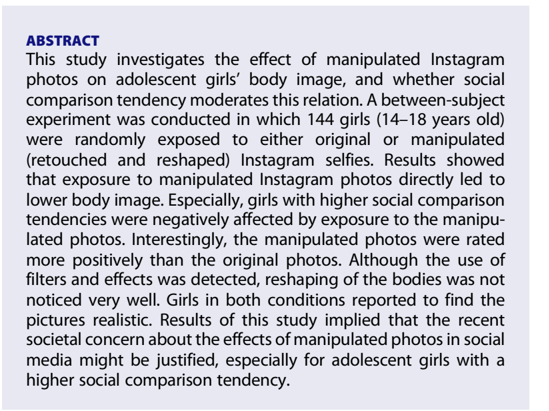
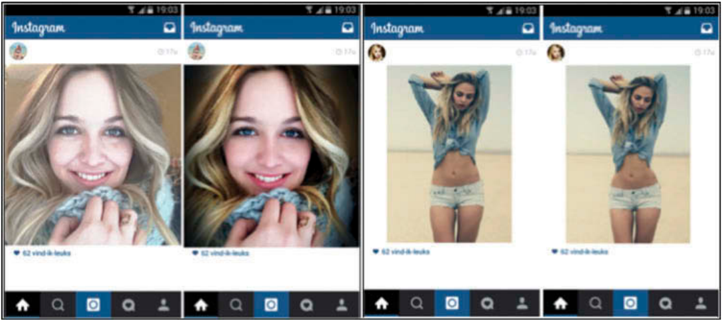
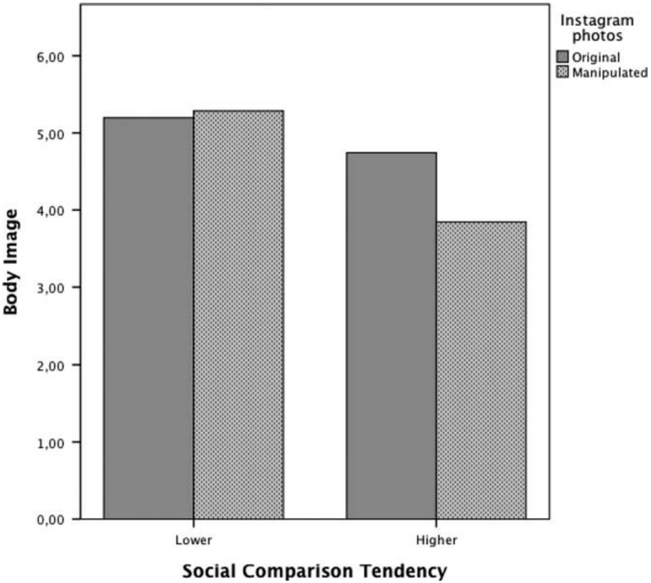
This study investigates the effect of manipulated Instagram photos on adolescent girls’ body image, and whether social comparison tendency moderates this relation. A between-subject experiment was conducted in which 144 girls (14–18 years old) were randomly exposed to either original or manipulated (retouched and reshaped) Instagram selfies. Results showed that exposure to manipulated Instagram photos directly led to lower body image. Especially, girls with higher social comparison tendencies were negatively affected by exposure to the manipulated photos. Interestingly, the manipulated photos were rated more positively than the original photos. Although the use of filters and effects was detected, reshaping of the bodies was not noticed very well. Girls in both conditions reported to find the pictures realistic. Results of this study implied that the recent societal concern about the effects of manipulated photos in social media might be justified, especially for adolescent girls with a higher social comparison tendency.
Verified 2026-11-22 · 1 reference not checked yet
Overview
Integrity signals
Registry
Cites
Statistics
Figures
Verification
Claims the paper makes
5 Valid · 1 Not valid · 24 Not checked · 37 Own results and interpretations
A result the paper reports from its own data — it cites no other source for it, so there is none to check. The quote shows it is in the paper.
In the paper
“For faces, manipulated photos scored somewhat higher ( M = 1.82; SD = .81) than the original photos ( M = 1.61; SD = .70), t (142) = -1.674; p = .051.”
plain- Asserted: passes — The authors put it forward as true.
- Checkable: passes — It can be checked against evidence.
- Load-bearing: unclear — It is unclear whether the paper’s conclusions depend on it.
- Based: passes — The paper gives a reason why it holds.
A result the paper reports from its own data — it cites no other source for it, so there is none to check. The quote shows it is in the paper.
In the paper
“Results additionally showed that level of education (included as control variable) significantly affected body image, F (1,139) = 14.618; p < .001; r = .31.”
plainstates an association- Asserted: passes — The authors put it forward as true.
- Checkable: passes — It can be checked against evidence.
- Load-bearing: unclear — It is unclear whether the paper’s conclusions depend on it.
- Based: passes — The paper gives a reason why it holds.
A result the paper reports from its own data — it cites no other source for it, so there is none to check. The quote shows it is in the paper.
In the paper
“Original photos also affected the body image of these girls more compared to ones with a lower tendency to make social comparisons, but this influence is weaker, F (1,139) = 3.016; p = .043; r = .15.”
plainstates a cause- Asserted: passes — The authors put it forward as true.
- Checkable: passes — It can be checked against evidence.
- Load-bearing: unclear — It is unclear whether the paper’s conclusions depend on it.
- Based: passes — The paper gives a reason why it holds.
A result the paper reports from its own data — it cites no other source for it, so there is none to check. The quote shows it is in the paper.
In the paper
“results revealed that the negative effect of manipulated photos is more prevalent among girls with a higher tendency to make social comparisons, F (1,139) = 18.777; p < .001; r = .34.”
plainstates an association- Asserted: passes — The authors put it forward as true.
- Checkable: passes — It can be checked against evidence.
- Load-bearing: passes — The paper’s conclusions depend on it.
- Based: passes — The paper gives a reason why it holds.
A result the paper reports from its own data — it cites no other source for it, so there is none to check. The quote shows it is in the paper.
In the paper
“the body image of girls with a higher tendency to make social comparisons is more negatively affected by manipulated Instagram photos ( M = 3.98; SE = .17) than by original photos ( M = 4.72; SE = .18), F (1,139) = 9.209; p = .002; r = . 25.”
plainstates a cause- Asserted: passes — The authors put it forward as true.
- Checkable: passes — It can be checked against evidence.
- Load-bearing: passes — The paper’s conclusions depend on it.
- Based: passes — The paper gives a reason why it holds.
29 more claims
Create a free account to see all 67 claims and to verify the 1 reference still open.
- Probably not a substantial claim. 23
- It may state two separate claims as one. 14
- The quote only partly states this claim. 1
Claims other papers make about this one
Each is checked against this paper’s own text: does it say what the citing paper says it does?
The source backs part of the claim, not all of it — or backs it for a different population, condition or comparison.
In the citing paper
“Experimental research consistently finds that exposure to idealized social media images, as well as the creation of self-images, results in increased body dissatisfaction [36,37,38].”
From Outcomes of a Cluster Randomized Controlled Trial of the SoMe Social Media Literacy Program for Improving Body Image-Related Outcomes in Adolescent Boys and Girls (2021) · cites this paper as [36]
Experimental — accuracy not yet measuredThe source backs part of the claim, not all of it — or backs it for a different population, condition or comparison.
In the citing paper
“Media representations of beauty and body ideals are often filtered through the lens of cultural norms, further influencing how gender impacts body image dissatisfaction.”
From Body Perceptions and Psychological Well-Being: A Review of the Impact of Social Media and Physical Measurements on Self-Esteem and Mental Health with a Focus on Body Image Satisfaction and Its Relationship with Cultural and Gender Factors (2024) · cites this paper as [172]
Experimental — accuracy not yet measuredThe source backs part of the claim, not all of it — or backs it for a different population, condition or comparison.
In the citing paper
“In individualistic cultures, media portrayals that emphasize thinness for women and muscularity for men can reinforce the gender disparities in body dissatisfaction.”
From Body Perceptions and Psychological Well-Being: A Review of the Impact of Social Media and Physical Measurements on Self-Esteem and Mental Health with a Focus on Body Image Satisfaction and Its Relationship with Cultural and Gender Factors (2024) · cites this paper as [172]
Experimental — accuracy not yet measuredThe cited source says what the claim attributes to it.
In the citing paper
“Such images have been shown to be related to increased appearance-related social comparison (Bonfanti et al., 2025), and subsequent body dissatisfaction (Kleemans et al., 2018).”
From Relation Between Social Media Use and Body Image Concerns and Disordered Eating in Adolescence: A Systematic Review and Meta-Analysis (2026) · cites this paper as Kleemans et al., 2018
5 more claims about this paper
Create a free account to see every claim other papers make about this one.
Statistics that don’t add up
Each reported p-value recomputed from its test statistic and degrees of freedom, each partial η² from its F, and each ratio, mean difference or B printed with a p checked against its own confidence interval.
Rated minor: it would not touch a result — a value no result rests on, a p-value that stays on the same side of the significance level, or a conflict that is clerical, resolved elsewhere in the paper, or outside its own findings.
In the paper
“F (1,139) = 9.209; p = .002”
Reported p = .002 · recomputed p = .003
Rated minor: it would not touch a result — a value no result rests on, a p-value that stays on the same side of the significance level, or a conflict that is clerical, resolved elsewhere in the paper, or outside its own findings.
In the paper
“t (142) = -1.674; p = .051”
Reported p = .051 · recomputed p = .096
Rated minor: it would not touch a result — a value no result rests on, a p-value that stays on the same side of the significance level, or a conflict that is clerical, resolved elsewhere in the paper, or outside its own findings.
In the paper
“t (142) = -1.347; p = .090”
Reported p = .09 · recomputed p = .180
Statistics recomputed
Every reported test result, recomputed from its test statistic and degrees of freedom. A result shows as not adding up only once an independent check has confirmed it.
- Doesn’t add upt(142) = -1.674reported p = .051 · recomputed p = .096
“t (142) = -1.674, p = .051”
- Doesn’t add upt(142) = -1.347reported p = .09 · recomputed p = .180
“t (142) = -1.347, p = .090”
- Doesn’t add upF(1, 139) = 9.209reported p = .002 · recomputed p = .003
“F (1,139) = 9.209, p = .002”
- Not confirmedF(1, 139) = 0.001reported p = .485 · recomputed p = .975
“F (1,139) = .001, p = .485”
- Not confirmedF(1, 139) = 3.016reported p = .043 · recomputed p = .085
“F (1,139) = 3.016, p = .043”
11 more recomputed tests
Create a free account to see every test the Stats check recomputed.
Self-check
Percentages, sums and reported differences re-computed from the paper’s own numbers.
Self-check results appear here once an independent check has confirmed them.
Citations
Cites
A theory of social comparison processes
Festinger, L. (1954) · Human Relations · doi:10.1177/001872675400700202 · Cited by 20,926 · cited 2×
“Especially the tendency to engage in social comparisons (Social Comparison Theory; Festinger, 1954) has proven to be influential in the relation between exposure to the thin ideal in the media and women’s body dissatisfaction (e.”
BackgroundSocial Cognitive Theory of Mass Communication
Bandura, A. (2001) · Media Psychology · doi:10.1207/s1532785xmep0303_03 · Cited by 3,386
Grabe, S., Ward, L. M., & Hyde, J. S. (2008) · Psychological Bulletin · doi:10.1037/0033-2909.134.3.460 · Cited by 2,053
Theory and research concerning social comparisons of personal attributes
Wood, J. V. (1989) · Psychological Bulletin · doi:10.1037/0033-2909.106.2.231 · Cited by 1,957
Gibbons, F. X., & Buunk, B. P. (1999) · Journal of Personality and Social Psychology · doi:10.1037/0022-3514.76.1.129 · Cited by 1,813 · cited 1×
“To measure girls’ social comparison tendency, the Iowa–Netherlands Comparison Orientation Measure (Gibbons & Buunk, 1999) was used.”
MethodSocial Comparison: Why, With Whom, and With What Effect?
Suls, J., Martin, R., & Wheeler, L. (2002) · Current Directions in Psychological Science · doi:10.1111/1467-8721.00191 · Cited by 1,012
Fardouly, J., Diedrichs, P. C., Vartanian, L. R., & Halliwell, E. (2015) · Body Image · doi:10.1016/j.bodyim.2014.12.002 · Cited by 1,009 · cited 2×
“Inspired by Fardouly et al. (2015), another criterion that was applied to the selection of stimulus materials was that photos varied in the parts of the body that were emphasized.”
MethodResultIs actual similarity necessary for attraction? A meta-analysis of actual and perceived similarity
Montoya, R. M., Horton, R. S., & Kirchner, J. (2008) · Journal of Social and Personal Relationships · doi:10.1177/0265407508096700 · Cited by 855
Keery, H., van den Berg, P., & Thompson, J. K. (2004) · Body Image · doi:10.1016/j.bodyim.2004.03.001 · Cited by 815
What We Instagram: A First Analysis of Instagram Photo Content and User Types
Hu, Y., Manikonda, L., & Kambhampati, S. (2014) · Proceedings of the International AAAI Conference on Web and Social Media · doi:10.1609/icwsm.v8i1.14578 · Cited by 807 · cited 1×
“Selfies were used because photos in this format are a popular trend on Instagram and other social network sites (Hu et al., 2014).”
Method
Research works printed but not linked: 2
- Altabe, M. (1998). Ethnicity and body image: Quantitative and qualitative analysis. International journal of eating disorders , 23 (2), 153 -159. doi:10.1002/(SICI)1098-108X (199803)23:2<153::AID-EAT5>3.0.CO;2-J · doi:10.1002/(sici)1098-108x
- Turpijn, L., Kneefel, S., & van der Veer, N. (2015). Nationale social media onderzoek 2015 [National Social Media Research 2015]. Amsterdam, The Netherlands: Newcom Research & Consultancy.
Cited by
Items 301–400 of 424
Edits or ethics: How manipulated images compromise brand equity on social media
Rambocas, M., & Roopnarine, R. (2025) · Journal of Marketing Communications · doi:10.1080/13527266.2025.2468955 · Cited by 1
The effect of social media on self-esteem and body image
Santoso, D. S., & Santoso, D. R. (2020) · International Journal of Psychology Sciences · doi:10.33545/26648377.2020.v2.i1a.73 · Cited by 2
Roggendorf, P., & Волков, А. А. (2025) · International Journal of Health Governance · doi:10.1108/ijhg-12-2024-0157 · Cited by 3
Social Networks and the Rhinoplasty Patient—Reply
Maymone, M. B. C., Rajanala, S., & Vashi, N. A. (2019) · JAMA Facial Plastic Surgery · doi:10.1001/jamafacial.2019.0071 · Cited by 1
Turner, M., & Ray, A. (2023) · Communications in computer and information science · doi:10.1007/978-3-031-36001-5_18 · Cited by 1
Bjønness, J., & Petersen, M. A. (2024) · Education and human development · doi:10.5772/intechopen.113962 · Cited by 1
The Self-representation of People with Disabilities on Instagram
Mañas-Viniegra, L., Barroso, C. L., Ferreira, I., & Viñarás-Abad, M. (2023) · Comunicar · doi:10.58262/v32i78.15 · Cited by 3
“Moreover, they place a high value on images of other users that are retouched to perfection (Kleemans et al., 2018), and they tend to compare themselves to the stimuli they view (De Perthuis & Findlay, 2019; Harris & Bardey, 2019).”
BackgroundSelf-Presentation by Young Ballet and Contemporary Dancers on Image-Based Social Media
Morrow, S. A. (2019) · White Rose eTheses Online (University of Leeds, The University of Sheffield, University of York) · Cited by 2
#Neverenough: Social Comparison by Young Women on Instagram
Parnell, B. (2021) · doi:10.32920/15117069.v1 · Cited by 1
Filice, E. (2021) · UWSpace (University of Waterloo) · Cited by 2
Sepas, A., El‐Hussuna, A., Atıcı, S. D., & Yang, W. (2021) · SSRN Electronic Journal · doi:10.2139/ssrn.3956428 · Cited by 1
Trekels, J., & Eggermont, S. (2021) · doi:10.31219/osf.io/u3pvg · Cited by 1
Gui, M., Gerosa, T., Argentin, G., & Losi, L. (2021) · SocArXiv (OSF Preprints) · doi:10.31235/osf.io/8bd43 · Cited by 3
Papageorgiou, A., Fisher, C. M., & CROSS, D. S. (2022) · Research Square · doi:10.21203/rs.3.rs-1464702/v1 · Cited by 1
Thomas, M. F., Binder, A., Stević, A., & Matthes, J. (2022) · SSRN Electronic Journal · doi:10.2139/ssrn.4112926 · Cited by 1
Titzmann, P. F., Paizan, M. A., & Aumann, L. (2023) · Elsevier eBooks · doi:10.1016/b978-0-323-96023-6.00038-5 · Cited by 6
Eating Disorder and Body Image Content
Branley-Bell, D. (2026) · Springer eBooks · doi:10.1007/978-3-031-52643-5_43-1 · Cited by 1
Like for Like: The Effect of Idealised Instagram Photos on the Body Satisfaction of Young Girls
Milson, R. (2019) · e-space (Manchester Metropolitan University)
Deviana, T., Tresniasari, N., & Latifa, R. (2020) · International Conference on Religion and Mental Health (ICRMH) · doi:10.4108/eai.18-9-2019.2293450 · Cited by 1
Post-truth Visuals, Untruth Visuals
Mallia, Ġ. (2021) · Emerald Group Publishing Limited eBooks · doi:10.1108/978-1-80043-906-120211013
Smit, S., & Daalmans, S. (2019) · Tijdschrift voor Communicatiewetenschappen · doi:10.5117/2019.047.003.007
Self-citationInterpersonal Attraction Traits on Facebook
Bolong, J., & Attan, S. A. (2021) · International Journal of Academic Research in Business and Social Sciences · doi:10.6007/ijarbss/v11-i15/10648
The Stakes of Social Media: Analyzing User Sentiments
Attié, E. A., Bouvet, A., & Guibert, J. (2021) · Advances in data mining and database management book series · doi:10.4018/978-1-7998-8413-2.ch009
#Neverenough: Social Comparison By Young Women On Instagram
Parnell, B. (2021) · doi:10.32920/17122130
#Neverenough: Social Comparison By Young Women On Instagram
Parnell, B. (2021) · doi:10.32920/17122130.v1
Cannard, C. (2019) · De Boeck Supérieur eBooks · doi:10.3917/dbu.canna.2019.01.0385
Apolo, V. A. T. (2022) · Gredos (University of Salamanca) · doi:10.14201/gredos.149561 · Cited by 3
Batra, P., & Karkun, R. (2022) · Journal of Oral Medicine Oral Surgery Oral Pathology and Oral Radiology · doi:10.18231/j.jooo.2022.016
Disability Representation: Sites of Grassroots Activism on Grief and Insidious Trauma
Sheperd, S. (2022) · ISU Red - Research and eData (Illinois State University) · doi:10.30707/etd2022.20220705065054530657.999964
Hajok, D., Kniazev, N., Le, T. H. N., & Lindner, S. (2022) · Jugend Medien Schutz-Report · doi:10.5771/0170-5067-2022-2-2 · Cited by 3
Amurao, R. M. L., Khan, I. A., Zubair, A., et al. (2021) · Journal of Advances in Humanities and Social Sciences · doi:10.20474/jahss-7.3.3
“Photo manipulation is a great tool for enhancements but it is also critical to consider how it would affect society (Kleemans, Daalmans, Carbaat, & Anschütz, 2018).”
“Too Good to Be True”: Semi-Naked Bodies on Social Media
Kleim, A. J., Eckler, P., & Tonner, A. (2022) · IGI Global eBooks · doi:10.4018/978-1-6684-6307-9.ch041
The impact of social media on self-esteem during COVID-19
Liyana, A., Ashraf, A., & Fatima, M. (2022) · International Journal of Science and Research Archive · doi:10.30574/ijsra.2022.7.1.0136
“Thus, social comparisons with peers' idealized photos on social media/Instagram may contribute to body dissatisfaction [63],[64].[65].”
BackgroundBody Image Disturbance in Female Adolescents Using Online Learning Platforms: A Concept Analysis
Lee, S., & Ziegler, E. (2022) · doi:10.32920/21696131
Body Image Disturbance in Female Adolescents Using Online Learning Platforms: A Concept Analysis
Lee, S., & Ziegler, E. (2022) · doi:10.32920/21696131.v1
Social Media Usage and Mental Health of Teenagers: Exploring the Feminist Undertone
Yakubu, L. C. (2022) · The Nigerian Journal of Sociology and Anthropology · doi:10.36108/njsa/2202.02.0270 · Cited by 1
de Vaate, N. A. J. D. B. (2023) · doi:10.5463/thesis.113 · Cited by 1
Bioetika, umjetnost i tjelesna kateksa u osoba s invaliditetom
Martinec, R. (2023) · JAHR · doi:10.21860/j.13.2.1
Taylor, C. S., Paddock, D. L., & Bell, B. T. (2019) · Developmental Psychology Forum · doi:10.53841/bpsdev.2019.1.90.6
Krug, H., Frommeld, D., & Bittner, U. (2023) · Springer eBooks · doi:10.1007/978-3-658-39129-4_4
(2021) · Emerald Group Publishing Limited eBooks · doi:10.1108/978-1-83909-135-320211004
Antos, A. R., Paleka, A., & Bushman, B. (2023) · Communication Studies · doi:10.1080/10510974.2023.2227668 · Cited by 1
“Tiggemann and Anderberg (2020) found when ideal Instagram images were observed body satisfaction diminished (see also Kleemans et al., 2018).”
Research Trends in Different Social Media Platform and Body Image
Wang, Z., Kasimon, D. N. B., Abas, W. A. W., Ma, Y., & Ruan, Q. (2023) · International Journal of Academic Research in Business and Social Sciences · doi:10.6007/ijarbss/v13-i5/16937 · Cited by 3
Psychologische Zugänge zu Medien und Geschlecht: Medienpsychologie und Sozialpsychologie
Döring, N. M. (2023) · Springer eBooks · doi:10.1007/978-3-658-20707-6_32
KAKO PREDSTAVNICI GENERACIJE Z PERCIPIRAJU INTERNET?
Šincek, D., Milić, M., & Barišić, A. (2023) · Annual of Social Work · doi:10.3935/ljsr.v30i1.510
O Efeito Moderador do Patrocínio no Impacto do Influenciador Digital no Comportamento do Consumidor
Brandão, A., & Nascimento, A. (2023) · International Journal of Marketing Communication and New Media · doi:10.54663/2182-9306.2023.v11.n20.41-74 · Cited by 1
Pengaruh body shaming terhadap body image remaja perempuan
Ningsih, F. S. A., Hudaniah, H., & Rokhmah, S. N. (2023) · Cognicia · doi:10.22219/cognicia.v11i1.24983 · Cited by 10
The Social Contexts of Young People - Engaging Youth and Young Adults
Herzog, P. S. (2023) · Education and human development · doi:10.5772/intechopen.111025 · Cited by 1
Widiastuti, N. N. E., Wulanyani, N. M. S., & Shaheen, S. (2023) · Sinergi International Journal of Psychology · doi:10.61194/psychology.v1i1.47 · Cited by 3
Hollett, R. C., Bhusal, M., Gilani, S. Z., et al. (2024) · doi:10.31219/osf.io/9rsd4
Hubungan literasi media dengan body dissatisfaction pada remaja perempuan di Kota Bukittinggi
Ramadhani, G. S., Rasyid, R., Anggreiny, N., Purna, R. S., & Mafaza, M. (2023) · Jurnal Psikologi Tabularasa · doi:10.26905/jpt.v18i2.10908
Beden İmgesinin Yaşam Niteliğine Etkisi
Alakaş, B., & Elmas, S. (2024) · Bingöl Üniversitesi Sağlık Dergisi · doi:10.58605/bingolsaglik.1397432
Determinants of Higher Body Shape Concern Among Medical Students in Universiti Putra Malaysia
Manap, A. H. A., Ali, H., Devaraj, N. K., Halim, A. N. A., Thaygaraja, T., & Azmi, N. D. N. (2023) · Malaysian Journal of Medicine and Health Sciences · doi:10.47836/mjmhs.19.s17.3 · Cited by 1
Chacón, V., & Langlais, M. R. (2024) · Sexuality & Culture · doi:10.1007/s12119-024-10204-4 · Cited by 3
“Although Instagram was initially developed as a communication tool, it has evolved for many individuals as a platform for self-presentation (Kleemans et al., 2018), as well as an environment to portray the ideal self (Mustikasari & Rahayu, 2019).”
Naderer, B., Seeger, C., & Karsay, K. (2024) · OSF Preprints (OSF Preprints) · doi:10.31219/osf.io/ap72f
Mental health of children and young people in the time of internet
Numanović, A., Solaković, Š., & Mladenović, Ž. (2023) · Univerzitetska misao - casopis za nauku kulturu i umjetnost Novi Pazar · doi:10.5937/univmis2322100n
Instagram kao izvor na mrežnim informativnim portalima
Novak, K., & Uldrijan, I. (2024) · Obnovljeni život : časopis za filozofiju i religijske znanosti · doi:10.31337/oz.79.2.1
College Students’ Instagram Usage and its Consequences: Upward Social Comparisons and Mindfulness
Kim, J. H. (2023) · Associative Journal of Health Sciences · doi:10.31031/ajhs.2023.02.000550 · Cited by 1
Internalized Beauty Ideals Modulate Detection of Filtered ImagesPreprint
Bravo, I. M. F., Saux, G., Speranza, T. B., & Ramenzoni, V. C. (2024) · doi:10.31234/osf.io/3hxr2
Skin Deep: Body Positivity Influencer Campaigns
Painter, D. L., Vierrether, T., & Guimaraes, C. L. (2024) · Advances in marketing, customer relationship management, and e-services book series · doi:10.4018/979-8-3693-0912-4.ch007
Social Media and Youth Mental Health: Simple Narratives Produce Biased InterpretationsPreprint
Sewall, C. J. R., & Parry, D. A. (2024) · doi:10.31234/osf.io/4zmxs
Cosmetic Surgery and Body Dysmorphic Disorder: A Challenging Diagnosis for Surgeons
Pereira, L. L. B., & Martinelli, L. B. (2024) · International Journal of Health Science · doi:10.22533/at.ed.1594512405062
Laskar, K. A., Reyaz, M., & Arshad, A. (2024) · Springer eBooks · doi:10.1007/978-3-031-57762-8_16
Jeon, M., Kim, Y., & Boguslavskaya, T. (2024) · Asian Communication Research · doi:10.20879/acr.2024.21.023
Ayaz, A. (2025) · Çukurova Üniversitesi Sosyal Bilimler Enstitüsü Dergisi · doi:10.35379/cusosbil.1513658 · Cited by 1
Ayase, I., Mori, M., & Kato, T. (2024) · Imagination Cognition and Personality · doi:10.1177/02762366241299381
“One possible explanation is that individuals post edited photos of themselves on social networking services to ful fi ll their desire for social approval and self-expression (Bazarova & Choi, 2014; Dutta et al., 2016; Guo et al., 2018; Katz & Crocker, 2015; Kleemans et al., 2018).”
Kaup, S. (2024) · MedienPädagogik Zeitschrift für Theorie und Praxis der Medienbildung · doi:10.21240/mpaed/00/2024.12.13.x · Cited by 1
Ακριτίδου, Α., Μέγαρης, Σ., & Georgaca, E. (2024) · Psychology the Journal of the Hellenic Psychological Society · doi:10.12681/psy_hps.37721 · Cited by 2
Tziatziou, A. U. K., & Gleasure, R. (2025) · Lecture notes in information systems and organisation · doi:10.1007/978-3-031-71385-9_32 · Cited by 1
INSTAGRAM USE AND IT'S RELATIONSHIP TO BODY IMAGE AND OBESITY PHOBIA IN ADOLESCENT GIRLS
(2025) · International Journal of Humanities and Educational Research · doi:10.47832/2757-5403.30.23
Gen DreadPreprint
Krueger, J. I. (2025) · doi:10.31234/osf.io/hf2g5_v1
Shackleford, K. E., & Bowman, N. D. (2025) · Oxford University Press eBooks · doi:10.1093/oxfordhb/9780197689875.013.0024 · Cited by 1
Parental Perceptions of Childhood Obesity Rates Among Hispanic and Black Children in New Jersey
Hosseini, H. M., Wasihun, G., An, S., & Atnafou, R. (2025) · Hospital Topics · doi:10.1080/00185868.2025.2531420
“Furthermore, some research has found that after controlling for age, education, and body weight, racial/ethnic differences in body image perceptions are diminished (Kleemans et al. 2018; Mendelson and White 1982).”
Hahn, K. H., & Bae, W. (2025) · International Journal of Fashion Design Technology and Education · doi:10.1080/17543266.2025.2536002 · Cited by 1
Pellizzer, M. L., Radünz, M., Pennesi, J., Zhou, Y., & Wade, T. D. (2025) · Body Image · doi:10.1016/j.bodyim.2025.101945
JanusGAN: GANs Disentangled Editing with Two Discriminators
Farmer, N., Soladié, C., Cazorla, G., & Séguier, R. (2025) · International Conference on Automatic Face and Gesture Recognition · doi:10.1109/fg61629.2025.11099171
“Recent studies [74], [68], [57], [46] have raised concerns about the mental health of social media users who use filters.”
Influenze socioculturali, immagine corporea e chirurgia estetica
Gesto, C. D. (2025) · Firenze University Press eBooks · doi:10.36253/979-12-215-0673-0
Comment plusieurs études montrent qu'Instagram peut nuire au bien-être des jeunes
Brown, C. S. (2021) · The Conversation · doi:10.64628/aak.dfxfh6v67
Facebook sabe que Instagram está dañando la mente de los adolescentes… y decide callar
Brown, C. S. (2021) · The Conversation · doi:10.64628/aai.c5crdpfkp
Kim, S., & Yang, S. (2025) · The Korean Society of Costume · doi:10.7233/jksc.2025.75.4.062
Preference for Average Anatomy in African American Faces
Peters, V., Saab, D., Steppe, C. S., et al. (2025) · Aesthetic Surgery Journal · doi:10.1093/asj/sjaf215
The Spatiality of Social Media: A Social-Phenomenological and Practice-Theoretical Approach
Chaudhary, S. (2025) · Springer eBooks · doi:10.1007/978-3-031-96848-8_10
Current Status and Future Prospects of Research on Appearance Anxiety among College Students
何, 席. (2025) · Advances in Social Sciences · doi:10.12677/ass.2025.148729
Growing into Perception: Pubertal Stages and the Accuracy of Body Size EstimationPreprint
Cagno, M. J. D. S., Wscieklica, T., & Gama, E. F. (2025) · medRxiv · doi:10.1101/2025.11.13.25340184
Tabak, M. Y., & Kahraman, S. (2025) · Universitas Psychologica · doi:10.11144/javeriana.upsy24.smib · Cited by 4
“…to idealized imagery, combined with the normalization of filtered selfies, creates a psychological environment where unfiltered photos are considered unusual, affecting users' self-perception and creating unrealistic expectations about natural appearance (Karam et al., 2023; Kleemans et al., 2018).”
Liang, F., Liu, J., Zhao, D., Chen, Y., He, X., & Yang, C. (2026) · Computers in Human Behavior · doi:10.1016/j.chb.2026.109029
Park, S. Y., Bailey, R. L., & Park, J. (2025) · Frontiers in Human Dynamics · doi:10.3389/fhumd.2025.1694787
“Additionally, scholars examined the correlation between the utilization of prevalent social media platforms (e.g., Instagram, TikTok) and concerns related to body image (Kleemans et al., 2018; Mink and Szymanski, 2022).”
Krueger, J. I. (2025) · The American Journal of Psychology · doi:10.5406/19398298.138.3.07
Foucault’un Öteki Mekânlarından Dijital Heterotopyaya: Instagram Üzerine Bir İnceleme
Çıkın, M. (2025) · Kastamonu İletişim Araştırmaları Dergisi · doi:10.56676/kiad.1648550
Zhang, X., & Zhang, Z. (2026) · Healthcare · doi:10.3390/healthcare14010120
“Frequent exposure to appearance‑focused social media tends to widen the perceived discrepancies between one’s own appearance and societal beauty ide‑ als, thereby undermining body satisfaction and mood among young women [3].”
Virtual mirrors: Social media’s role in body dissatisfaction and disordered eating habits in Cyprus
Davradou, C., & Argyridis, M. (2025) · Psychology the Journal of the Hellenic Psychological Society · doi:10.12681/psy_hps.43974 · Cited by 2
van Duffelen, E., Haverkort, R., Anschütz, D. J., & Daalmans, S. (2026) · Humanities and Social Sciences Communications · doi:10.1057/s41599-025-06410-6 · Cited by 4
“This more negative body perception particularly affects young women (Bearman et al., 2006; Berg et al., 2009; Kleemans et al., 2018; Neighbors and Sobal, 2007), who are also more avid social media users compared to young men (Central Bureau of Statistics, 2019), especially when it comes to social…”
InfluentialSelf-citation
Metadata
- Authors
- Kleemans, M., Daalmans, S., Carbaat, I., & Anschütz, D.
- Affiliations
- Radboud University Nijmegen (NL)
- Corresponding author
- Daalmans, Serena
- Venue
- Media Psychology
- Publisher
- Informa UK Limited
- Published
- 2016-12-15
- Volume
- 21
- Issue
- 1
- Pages
- 93-110
- ISSN
- 1521-3269 (ISSN-L)
- 1532-785X
- OpenAlex
- W2567680263
- Cited by
- 421
- References
- 51
- Citations by year
- 2026: 38 · 2025: 53 · 2024: 59 · 2023: 72 · 2022: 71 · 2021: 56 · 2020: 40 · 2019: 25 · 2018: 6 · 2017: 1
- FWCI
- 14.27
- Type
- journal article
- Language
- en
- Open access
- hybrid
- doi.org
- Licence
- Locations
- Media Psychology (publishedVersion, cc-by-nc-nd)
- Radboud Repository (Radboud University) (submittedVersion)
- Radboud Repository (Radboud University) (submittedVersion, other-oa)
- Topics
- Social Sciences › Psychology › Clinical Psychology › Body Image and Dysmorphia Studies
- Social Sciences › Psychology › Clinical Psychology › Eating Disorders and Behaviors
- Social Sciences › Sociology and Political Science › Impact of Technology on Adolescents
- Keywords
- Instagram, body image, photo manipulation, retouching, reshaping, social comparison, adolescent girls, selfies, social media, self-presentation, photo filters
About these checks
Registry, retraction, Cites and statistics results are computed, not judged, with one exception: a printed reference that no index lists is read once by a model before it counts as a citation error. Claims are extracted by a model and kept only when their quote appears verbatim in the text; each cited source is then checked, with a model’s help, for whether it says what the claim relies on. Those verdicts can be wrong — read the claim’s quote and the cited source before relying on one.
The claim verdicts this report counts are experimental: their accuracy is not yet measured.
A language model drew the claims from the paper on 2026-09-28, under version 3 of the claim definition (model deepseek-v4.1-flash, prompt extract-v3).
A second model labelled each claim on 2026-09-28 (model jev-1.13-20260917, definition revision gold-guideline-v0.2).
Statistics and arithmetic are recomputed, not judged.
Confidence bands are shown only for fields calibrated on our annotated test set. None is calibrated yet, so no band is shown.
What counts as a claim ›How we measure confidence ›How we check this ›
Are you an author, or do you see a problem with this page? Request a review
Data sources
Bibliographic data: Semantic Scholar, OpenAlex, Crossref.
Contains information from the Semantic Scholar Academic Graph Datasets, made available under the ODC Attribution License (ODC-BY 1.0).
Semantic Scholar’s data is described in: Kinney, R., et al. (2023). The Semantic Scholar Open Data Platform. arXiv:2301.10140.
