

The DOI matches its Crossref record; 44 of the 44 references it cites were found in a registry or an index.
Serum cortisol mediates the relationship between fecal Ruminococcus and brain N-acetylaspartate in the young pig
Open accessAbstract
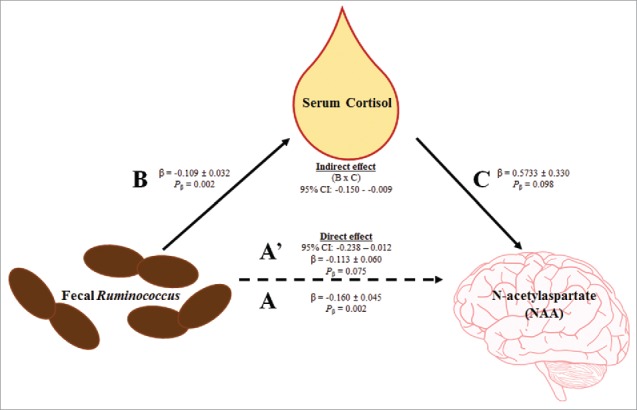
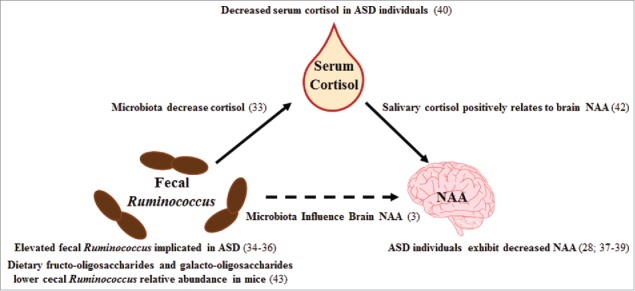
A dynamic relationship between the gut microbiota and brain is pivotal in neonatal development. Dysbiosis of the microbiome may result in altered neurodevelopment; however, it is unclear which specific members of microbiota are most influential and what factors might mediate the relationship between the gut and the brain. Twenty-four vaginally-derived male piglets were subjected to magnetic resonance spectroscopy at 30 d of age. Ascending colon contents, feces, and blood were collected and analyzed for volatile fatty acids, microbiota relative abundance by 16s rRNA, and serum metabolites, respectively. A mediation analysis was performed to assess the mediatory effect of serum biomarkers on the relationship between microbiota and neurometabolites. Results indicated fecal Ruminococcus and Butyricimonas predicted brain N-acetylaspartate (NAA). Analysis of serum biomarkers indicated Ruminococcus independently predicted serum serotonin and cortisol. A 3-step mediation indicated: i) Ruminococcus negatively predicted NAA, ii) Ruminococcus negatively predicted cortisol, and iii) a significant indirect effect (i.e., the effect of fecal Ruminococcus through cortisol on NAA) was observed and the direct effect became insignificant. Thus, serum cortisol fully mediated the relationship between fecal Ruminococcus and brain NAA. Using magnetic resonance spectroscopy, this study used a statistical mediation analysis and provides a novel perspective into the potential underlying mechanisms through which the microbiota may shape brain development. This is the first study to link Ruminococcus, cortisol, and NAA in vivo, and these findings are substantiated by previous literature indicating these factors may be influential in the etiology of neurodevelopmental disorders.
Overview
The claims and statistics of this paper haven’t been checked yet.
Run the check — free, no account needed. It reads the open-access text and checks the sources it cites.
Integrity signals
Registry
Cites
Statistics
Figures
Verification
Claims the paper makes
The claims and statistics of this paper haven’t been checked yet.
Run the check — free, no account needed. It reads the open-access text and checks the sources it cites.
Claims other papers make about this one
Each is checked against this paper’s own text: does it say what the citing paper says it does?
The source backs part of the claim, not all of it — or backs it for a different population, condition or comparison.
In the citing paper
“Microorganisms can influence CNS processes bidirectionally via the vagus nerve (12) and through modulation of the immune system (6), the hypothalamic-pituitary-adrenal (HPA) axis (13, 14), and tryptophan metabolism (15), along with their ability to synthetize a number of neurotransmitters (16–18) and produce metabolites, such as short-chain fatty acids (SCFAs), that possess neuroactive properties”
From The Role of Short-Chain Fatty Acids From Gut Microbiota in Gut-Brain Communication (2020) · cites this paper as [14]
Experimental — accuracy not yet measuredIn the citing paper
“Microbes influence CNS processes via modulation of the nervous system (52), endocrine system (51, 126), and immune system (120), together with their ability to synthesize neurotransmitters (127–129) and produce metabolites (127, 130–132) ( Figure 1 ).”
From Signalling cognition: The gut microbiota and hypothalamic-pituitary-adrenal axis (2023) · cites this paper as [126]
In the citing paper
“A study by Mudd et al. reported a predictive relationship between levels of fecal Ruminococcus, serum cortisol, and brain N-acetylaspartate in young pigs (126).”
From Signalling cognition: The gut microbiota and hypothalamic-pituitary-adrenal axis (2023) · cites this paper as [126]
In the citing paper
“Bifidobacteria are major producers of lactic acid, which suppress the growth of pathogens such as E. coli across the epithelium, reduce inflammation in the gut, and cooperate with the immune system (67, 68).”
From Association Between Gut Microbiota and Autism Spectrum Disorder: A Systematic Review and Meta-Analysis (2019) · cites this paper as [68]
Self-check
Percentages, sums and reported differences re-computed from the paper’s own numbers.
The self-check needs the paper’s full text.
Citations
Cites
Preacher, K. J., & Hayes, A. F. (2008) · Behavior Research Methods · doi:10.3758/brm.40.3.879 · Cited by 34,117
Reconsidering Baron and Kenny: myths and truths about mediation analysis
Zhao, X., Lynch, J. G., & Chen, Q. (2010) · Journal of Consumer Research · doi:10.1086/651257 · Cited by 12,583
Mind-altering microorganisms: the impact of the gut microbiota on brain and behaviour
Cryan, J. F., & Dinan, T. G. (2012) · Nature Reviews Neuroscience · doi:10.1038/nrn3346 · Cited by 4,572
Messaoudi, M., Lalonde, R., Violle, N., Javelot, H., Desor, D., Nejdi, A., Bisson, J.-F., Rougeot, C., Pichelin, M., Cazaubiel, M., et al. (2011) · British Journal of Nutrition · doi:10.1017/s0007114510004319 · Cited by 1,324
Evans, A. M., DeHaven, C. D., Barrett, T., Mitchell, M. W., & Milgram, K. E. (2009) · Analytical Chemistry · doi:10.1021/ac901536h · Cited by 1,317
Consumption of fermented milk product with probiotic modulates brain activity
Tillisch, K., Labus, J., Kilpatrick, L., Jiang, Z., Stains, J., Ebrat, B., Guyonnet, D., Legrain–Raspaud, S., Trotin, B., Naliboff, B., et al. (2013) · Gastroenterology · doi:10.1053/j.gastro.2013.02.043 · Cited by 1,192
Control of brain development, function, and behavior by the microbiome
Sampson, T. R., & Mazmanian, S. K. (2015) · Cell Host & Microbe · doi:10.1016/j.chom.2015.04.011 · Cited by 1,093
Microbiota and neurodevelopmental windows: implications for brain disorders
Borre, Y. E., O’Keeffe, G. W., Clarke, G., Stanton, C., Dinan, T. G., & Cryan, J. F. (2014) · Trends in Molecular Medicine · doi:10.1016/j.molmed.2014.05.002 · Cited by 1,089
Burokas, A., Arboleya, S., Moloney, R. D., Peterson, V. L., Murphy, K., Clarke, G., Stanton, C., Dinan, T. G., & Cryan, J. F. (2017) · Biological Psychiatry · doi:10.1016/j.biopsych.2016.12.031 · Cited by 952
Gastrointestinal Microflora Studies in Late‐Onset Autism
Finegold, S. M., Molitoris, D., Song, Y., Liu, C., Vaisanen, M., Bolte, E., McTeague, M., Sandler, R., Wexler, H., Marlowe, E. M., et al. (2002) · Clinical Infectious Diseases · doi:10.1086/341914 · Cited by 742
Charbonneau, M. R., O’Donnell, D., Blanton, L. V., Totten, S. M., Davis, J. C. C., Barratt, M. J., Cheng, J., Guruge, J., Talcott, M., Bain, J. R., et al. (2016) · Cell · doi:10.1016/j.cell.2016.01.024 · Cited by 606
Organization of GC/MS and LC/MS metabolomics data into chemical libraries
DeHaven, C. D., Evans, A. M., Dai, H., & Lawton, K. A. (2010) · Journal of Cheminformatics · doi:10.1186/1758-2946-2-9 · Cited by 595
Collective unconscious: How gut microbes shape human behavior
Dinan, T. G., Stilling, R. M., Stanton, C., & Cryan, J. F. (2015) · Journal of Psychiatric Research · doi:10.1016/j.jpsychires.2015.02.021 · Cited by 571
Rae, C. D. (2013) · Neurochemical Research · doi:10.1007/s11064-013-1199-5 · Cited by 524
Adult hippocampal neurogenesis is regulated by the microbiome
Ogbonnaya, E. S., Clarke, G., Shanahan, F., Dinan, T. G., Cryan, J. F., & O’Leary, O. F. (2015) · Biological Psychiatry · doi:10.1016/j.biopsych.2014.12.023 · Cited by 491
Wang, L., Christophersen, C. T., Sorich, M. J., Gerber, J. P., Angley, M. T., & Conlon, M. A. (2013) · Molecular Autism · doi:10.1186/2040-2392-4-42 · Cited by 418
Evans, A. M. (2014) · Journal of Postgenomics Drug & Biomarker Development · doi:10.4172/2153-0769.1000132 · Cited by 392
Janik, R., Thomason, L. A. M., Stanisz, A. M., Forsythe, P., Bienenstock, J., & Stanisz, G. J. (2016) · NeuroImage · doi:10.1016/j.neuroimage.2015.11.018 · Cited by 283
Nutritional Factors Influencing Intestinal Health of the Neonate
Jacobi, S. K., & Odle, J. (2012) · Advances in Nutrition · doi:10.3945/an.112.002683 · Cited by 187
Priming for health: gut microbiota acquired in early life regulates physiology, brain and behaviour
Clarke, G., O'Mahony, S., Dinan, T., & Cryan, J. (2014) · Acta Paediatrica · doi:10.1111/apa.12674 · Cited by 179
Regional brain chemical alterations in young children with autism spectrum disorder
Friedman, S. D., Shaw, D., Artru, A. A., Richards, T. L., Gardner, J. C., Dawson, G., Posse, S., & Dager, S. R. (2003) · Neurology · doi:10.1212/wnl.60.1.100 · Cited by 177
Evidence of altered energy metabolism in autistic children
Chugani, D. C., Sundram, B. S., Behen, M. E., Lee, M.-L., & Moore, G. J. (1999) · Progress in Neuro-Psychopharmacology and Biological Psychiatry · doi:10.1016/s0278-5846(99)00022-6 · Cited by 169
Blüml, S., Wisnowski, J. L., Nelson, M. D., Paquette, L. B., Gilles, F. H., Kinney, H. C., & Panigrahy, A. (2012) · Cerebral Cortex · doi:10.1093/cercor/bhs283 · Cited by 156
Leulier, F., MacNeil, L. T., Lee, W., Rawls, J. F., Cani, P. D., Schwarzer, M., Zhao, L., & Simpson, S. J. (2017) · Cell Metabolism · doi:10.1016/j.cmet.2017.02.001 · Cited by 152
Microbiome and nutrition in autism spectrum disorder: Current knowledge and research needs
Berding, K., & Donovan, S. M. (2016) · Nutrition Reviews · doi:10.1093/nutrit/nuw048 · Cited by 146
Self-citationGray and White Matter Brain Chemistry in Young Children With Autism
Friedman, S. D., Shaw, D., Artru, A. A., Dawson, G., Petropoulos, H., & Dager, S. R. (2006) · Archives of General Psychiatry · doi:10.1001/archpsyc.63.7.786 · Cited by 138
Early-Life Nutrition and Neurodevelopment: Use of the Piglet as a Translational Model
Mudd, A. T., & Dilger, R. N. (2017) · Advances in Nutrition · doi:10.3945/an.116.013243 · Cited by 125
Self-citationOtsuka, H., Harada, M., Mori, K., Hisaoka, S., & Nishitani, H. (1999) · Neuroradiology · doi:10.1007/s002340050795 · Cited by 119
Mudd, A. T., Alexander, L. S., Berding, K., Waworuntu, R. V., Berg, B. M., Donovan, S. M., & Dilger, R. N. (2016) · Frontiers in Pediatrics · doi:10.3389/fped.2016.00004 · Cited by 113
Self-citationDavis, D. J., Hecht, P. M., Jasarevic, E., Beversdorf, D. Q., Will, M. J., Fritsche, K., & Gillespie, C. H. (2017) · Brain, Behavior, and Immunity · doi:10.1016/j.bbi.2016.09.003 · Cited by 112
Li, M., Bauer, L. L., Chen, X., Wang, M., Kuhlenschmidt, T. B., Kuhlenschmidt, M. S., Fahey, G. C., Jr., & Donovan, S. M. (2012) · Journal of Nutrition · doi:10.3945/jn.111.154427 · Cited by 96
Self-citationTordjman, S., Anderson, G. M., Kermarrec, S., Bonnot, O., Geoffray, M., Brailly‐Tabard, S., Chaouch, A., Colliot, I., Trabado, S., Bronsard, G., et al. (2014) · Psychoneuroendocrinology · doi:10.1016/j.psyneuen.2014.08.010 · Cited by 94
Lower Cortisol and Higher ACTH Levels in Individuals with Autism
Ćurin, J. M., Terzić, J., Petković, Z. B., Zekan, L., Marinovic‐Terzić, I., & Šušnjara, I. M. (2003) · Journal of Autism and Developmental Disorders · doi:10.1023/a:1025019030121 · Cited by 92
Aoki, Y. Y., Kasai, K., & Yamasue, H. (2012) · Translational Psychiatry · doi:10.1038/tp.2011.65 · Cited by 85
Berding, K., Wang, M., Monaco, M. H., Alexander, L. S., Mudd, A. T., Chichlowski, M., Waworuntu, R. V., Berg, B. M., Miller, M. J., Dilger, R. N., et al. (2016) · Journal of Pediatric Gastroenterology and Nutrition · doi:10.1097/mpg.0000000000001200 · Cited by 85
Self-citationRadlowski, E. C., Conrad, M. S., Lezmi, S., Dilger, R. N., Sutton, B. P., Larsen, R. J., & Johnson, R. W. (2014) · PLoS ONE · doi:10.1371/journal.pone.0091951 · Cited by 77
Self-citationGabis, L. V., Huang, W., Azizian, A., DeVincent, C. J., Tudorica, A., Baruch, Y. K., Roche, P. E., & Pomeroy, J. C. (2008) · Journal of Child Neurology · doi:10.1177/0883073808315423 · Cited by 69
Cortisol levels are positively correlated with hippocampal N-acetylaspartate
Neylan, T. C., Schuff, N. W., Lenoci, M., Yehuda, R., Weiner, M. W., & Marmar, C. R. (2003) · Biological Psychiatry · doi:10.1016/s0006-3223(02)01974-1 · Cited by 62
Regional magnetic resonance spectroscopy of the brain in autistic individuals
Hisaoka, S., Harada, M., Nishitani, H., & Mori, K. (2001) · Neuroradiology · doi:10.1007/s002340000520 · Cited by 55
A defined intestinal colonization microbiota for gnotobiotic pigs
Laycock, G. M., Sait, L. C., Inman, C. F., Lewis, M. C., Smidt, H., van Diemen, P. M., Jorgensen, F., Stevens, M. P., & Bailey, M. (2012) · Veterinary Immunology and Immunopathology · doi:10.1016/j.vetimm.2012.07.004 · Cited by 48
Kelly, R. B. (2016) · Frontiers in Pediatrics · doi:10.3389/fped.2016.00001 · Cited by 47
1H-MRS in autism spectrum disorders: a systematic meta-analysis
Ipser, J., Syal, S., Bentley, J., Adnams, C. M., Steyn, B., & Stein, D. J. (2012) · Metabolic Brain Disease · doi:10.1007/s11011-012-9293-y · Cited by 43
KnowledgeSpace - a publicly available virtual chemistry space
Detering, C., Claussen, H., Gastreich, M., & Lemmen, C. (2010) · Journal of Cheminformatics · doi:10.1186/1758-2946-2-s1-o9 · Cited by 22
Comparison of Brain Development in Sow-Reared and Artificially Reared Piglets
Jacob, R., Mudd, A. T., Alexander, L. S., Lai, C.-S., & Dilger, R. N. (2016) · Frontiers in Pediatrics · doi:10.3389/fped.2016.00095 · Cited by 8
Self-citation
Research works printed but not linked: 1
- Naseribafrouei A. Correlation between gut microbiota and depression (Masters Thesis). Hedmark University College. 2013. Retrieved from BRAGE Hihm.
Cited by
Sorted by citations
The Role of Short-Chain Fatty Acids From Gut Microbiota in Gut-Brain Communication
Silva, Y. P., Bernardi, A., & Frozza, R. L. (2020) · Frontiers in Endocrinology · doi:10.3389/fendo.2020.00025 · Cited by 3,043
“Microorganisms can influence CNS processes bidirectionally via the vagus nerve (12) and through modulation of the immune system (6), the hypothalamic-pituitary-adrenal (HPA) axis (13, 14), and tryptophan metabolism (15), along with their ability to synthetize a number of neurotransmitters (16–18) and produce metabolit…”
BackgroundGut Microbiota is Altered in Patients with Alzheimer’s Disease
Zhuang, Z.-Q., Shen, L.-L., Li, W.-W., Fu, X., Zeng, F., Gui, L., Lü, Y., Cai, M., Zhu, C., Tan, Y.-L., et al. (2018) · Journal of Alzheimer's Disease · doi:10.3233/jad-180176 · Cited by 885
The role of the gut microbiome in systemic inflammatory disease
Clemente, J. C., Manasson, J., & Scher, J. U. (2018) · BMJ · doi:10.1136/bmj.j5145 · Cited by 587
Signalling cognition: The gut microbiota and hypothalamic-pituitary-adrenal axis
Rusch, J. A., Layden, B. T., & Dugas, L. R. (2023) · Frontiers in Endocrinology · doi:10.3389/fendo.2023.1130689 · Cited by 415
Role of microbiota-derived short-chain fatty acids in nervous system disorders
Mirzaei, R., Bouzari, B., Hosseini‐Fard, S. R., Mazaheri, M., Ahmadyousefi, Y., Abdi, M., Jalalifar, S., Karimitabar, Z., Teimoori, A., Keyvani, H., et al. (2021) · Biomedicine & Pharmacotherapy · doi:10.1016/j.biopha.2021.111661 · Cited by 408
Metadata
- Authors
- Mudd, A. T., Berding, K., Wang, M., Donovan, S. M., & Dilger, R. N.
- Affiliations
- University of Illinois Urbana-Champaign (US)
- Corresponding author
- Dilger, Ryan N.
- Venue
- Gut Microbes
- Publisher
- Informa UK Limited
- Published
- 2017-08-18
- Volume
- 8
- Issue
- 6
- Pages
- 589-600
- ISSN
- 1949-0976 (ISSN-L)
- 1949-0984
- PMC
- PMC5730385
- OpenAlex
- W2735229722
- Cited by
- 134
- References
- 44
- Citations by year
- 2026: 10 · 2025: 11 · 2024: 15 · 2023: 19 · 2022: 18 · 2021: 18 · 2020: 17 · 2019: 9 · 2018: 12 · 2017: 4
- FWCI
- 4.69
- Type
- journal article
- Language
- en
- Open access
- gold
- doi.org
- Licence
- Locations
- Gut Microbes (publishedVersion, cc-by-nc-nd)
- PubMed Central (publishedVersion, cc-by-nc-nd)
- PubMed (publishedVersion)
- Funders
- University of Illinois at Urbana-Champaign
- Topics
- Life Sciences › Biochemistry, Genetics and Molecular Biology › Molecular Biology › Gut microbiota and health
- Life Sciences › Agricultural and Biological Sciences › Animal Science and Zoology › Animal Nutrition and Physiology
- Life Sciences › Biochemistry, Genetics and Molecular Biology › Molecular Biology › Metabolomics and Mass Spectrometry Studies
- Keywords
- Ruminococcus, serum cortisol, N-acetylaspartate, gut-brain axis, newborn piglets, gut microbiota, brain development, serotonin, Butyricimonas, mediation analysis, neurodevelopmental disorders, fecal microbiota, neurometabolites
- MeSH terms
- Gastrointestinal Microbiome, Animals, Animals, Newborn, Aspartic Acid, Brain, Fatty Acids, Volatile, Feces, Hydrocortisone, Male, Magnetic Resonance Spectroscopy, Swine, Colon, Ascending, Ruminococcus, Dysbiosis
About these checks
Registry, retraction, Cites and statistics results are computed, not judged, with one exception: a printed reference that no index lists is read once by a model before it counts as a citation error. Claims are extracted by a model and kept only when their quote appears verbatim in the text; each cited source is then checked, with a model’s help, for whether it says what the claim relies on. Those verdicts can be wrong — read the claim’s quote and the cited source before relying on one.
Statistics and arithmetic are recomputed, not judged.
Confidence bands are shown only for fields calibrated on our annotated test set. None is calibrated yet, so no band is shown.
What counts as a claim ›How we measure confidence ›How we check this ›
Are you an author, or do you see a problem with this page? Request a review
