

The DOI matches its Crossref record; 44 of the 44 references it cites were found in a registry or an index.
Serum cortisol mediates the relationship between fecal Ruminococcus and brain N-acetylaspartate in the young pig
Open accessAbstract
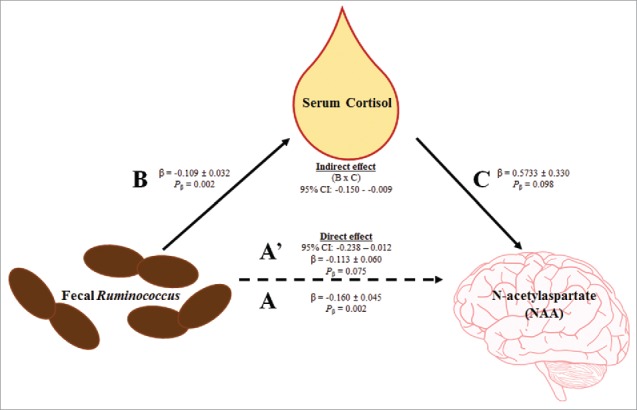
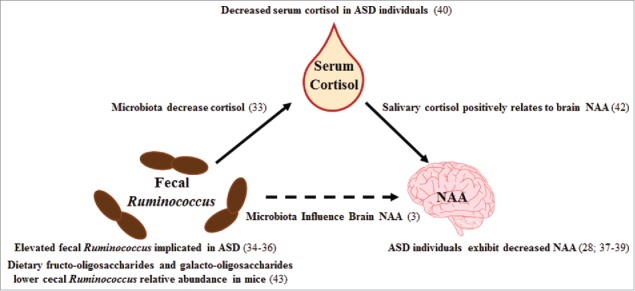
A dynamic relationship between the gut microbiota and brain is pivotal in neonatal development. Dysbiosis of the microbiome may result in altered neurodevelopment; however, it is unclear which specific members of microbiota are most influential and what factors might mediate the relationship between the gut and the brain. Twenty-four vaginally-derived male piglets were subjected to magnetic resonance spectroscopy at 30 d of age. Ascending colon contents, feces, and blood were collected and analyzed for volatile fatty acids, microbiota relative abundance by 16s rRNA, and serum metabolites, respectively. A mediation analysis was performed to assess the mediatory effect of serum biomarkers on the relationship between microbiota and neurometabolites. Results indicated fecal Ruminococcus and Butyricimonas predicted brain N-acetylaspartate (NAA). Analysis of serum biomarkers indicated Ruminococcus independently predicted serum serotonin and cortisol. A 3-step mediation indicated: i) Ruminococcus negatively predicted NAA, ii) Ruminococcus negatively predicted cortisol, and iii) a significant indirect effect (i.e., the effect of fecal Ruminococcus through cortisol on NAA) was observed and the direct effect became insignificant. Thus, serum cortisol fully mediated the relationship between fecal Ruminococcus and brain NAA. Using magnetic resonance spectroscopy, this study used a statistical mediation analysis and provides a novel perspective into the potential underlying mechanisms through which the microbiota may shape brain development. This is the first study to link Ruminococcus, cortisol, and NAA in vivo, and these findings are substantiated by previous literature indicating these factors may be influential in the etiology of neurodevelopmental disorders.
Overview
The claims and statistics of this paper haven’t been checked yet.
Run the check — free, no account needed. It reads the open-access text and checks the sources it cites.
Integrity signals
Registry
Cites
Statistics
Figures
Verification
Claims the paper makes
The claims and statistics of this paper haven’t been checked yet.
Run the check — free, no account needed. It reads the open-access text and checks the sources it cites.
Claims other papers make about this one
Each is checked against this paper’s own text: does it say what the citing paper says it does?
The source backs part of the claim, not all of it — or backs it for a different population, condition or comparison.
In the citing paper
“Microorganisms can influence CNS processes bidirectionally via the vagus nerve (12) and through modulation of the immune system (6), the hypothalamic-pituitary-adrenal (HPA) axis (13, 14), and tryptophan metabolism (15), along with their ability to synthetize a number of neurotransmitters (16–18) and produce metabolites, such as short-chain fatty acids (SCFAs), that possess neuroactive properties”
From The Role of Short-Chain Fatty Acids From Gut Microbiota in Gut-Brain Communication (2020) · cites this paper as [14]
Experimental — accuracy not yet measuredIn the citing paper
“Microbes influence CNS processes via modulation of the nervous system (52), endocrine system (51, 126), and immune system (120), together with their ability to synthesize neurotransmitters (127–129) and produce metabolites (127, 130–132) ( Figure 1 ).”
From Signalling cognition: The gut microbiota and hypothalamic-pituitary-adrenal axis (2023) · cites this paper as [126]
In the citing paper
“A study by Mudd et al. reported a predictive relationship between levels of fecal Ruminococcus, serum cortisol, and brain N-acetylaspartate in young pigs (126).”
From Signalling cognition: The gut microbiota and hypothalamic-pituitary-adrenal axis (2023) · cites this paper as [126]
In the citing paper
“Bifidobacteria are major producers of lactic acid, which suppress the growth of pathogens such as E. coli across the epithelium, reduce inflammation in the gut, and cooperate with the immune system (67, 68).”
From Association Between Gut Microbiota and Autism Spectrum Disorder: A Systematic Review and Meta-Analysis (2019) · cites this paper as [68]
Self-check
Percentages, sums and reported differences re-computed from the paper’s own numbers.
The self-check needs the paper’s full text.
Citations
Cites
Preacher, K. J., & Hayes, A. F. (2008) · Behavior Research Methods · doi:10.3758/brm.40.3.879 · Cited by 34,117
Reconsidering Baron and Kenny: myths and truths about mediation analysis
Zhao, X., Lynch, J. G., & Chen, Q. (2010) · Journal of Consumer Research · doi:10.1086/651257 · Cited by 12,583
Mind-altering microorganisms: the impact of the gut microbiota on brain and behaviour
Cryan, J. F., & Dinan, T. G. (2012) · Nature Reviews Neuroscience · doi:10.1038/nrn3346 · Cited by 4,572
Messaoudi, M., Lalonde, R., Violle, N., Javelot, H., Desor, D., Nejdi, A., Bisson, J.-F., Rougeot, C., Pichelin, M., Cazaubiel, M., et al. (2011) · British Journal of Nutrition · doi:10.1017/s0007114510004319 · Cited by 1,324
Evans, A. M., DeHaven, C. D., Barrett, T., Mitchell, M. W., & Milgram, K. E. (2009) · Analytical Chemistry · doi:10.1021/ac901536h · Cited by 1,317
Consumption of fermented milk product with probiotic modulates brain activity
Tillisch, K., Labus, J., Kilpatrick, L., Jiang, Z., Stains, J., Ebrat, B., Guyonnet, D., Legrain–Raspaud, S., Trotin, B., Naliboff, B., et al. (2013) · Gastroenterology · doi:10.1053/j.gastro.2013.02.043 · Cited by 1,192
Control of brain development, function, and behavior by the microbiome
Sampson, T. R., & Mazmanian, S. K. (2015) · Cell Host & Microbe · doi:10.1016/j.chom.2015.04.011 · Cited by 1,093
Microbiota and neurodevelopmental windows: implications for brain disorders
Borre, Y. E., O’Keeffe, G. W., Clarke, G., Stanton, C., Dinan, T. G., & Cryan, J. F. (2014) · Trends in Molecular Medicine · doi:10.1016/j.molmed.2014.05.002 · Cited by 1,089
Burokas, A., Arboleya, S., Moloney, R. D., Peterson, V. L., Murphy, K., Clarke, G., Stanton, C., Dinan, T. G., & Cryan, J. F. (2017) · Biological Psychiatry · doi:10.1016/j.biopsych.2016.12.031 · Cited by 952
Gastrointestinal Microflora Studies in Late‐Onset Autism
Finegold, S. M., Molitoris, D., Song, Y., Liu, C., Vaisanen, M., Bolte, E., McTeague, M., Sandler, R., Wexler, H., Marlowe, E. M., et al. (2002) · Clinical Infectious Diseases · doi:10.1086/341914 · Cited by 742
Research works printed but not linked: 1
- Naseribafrouei A. Correlation between gut microbiota and depression (Masters Thesis). Hedmark University College. 2013. Retrieved from BRAGE Hihm.
Cited by
Sorted by citations
The Role of Short-Chain Fatty Acids From Gut Microbiota in Gut-Brain Communication
Silva, Y. P., Bernardi, A., & Frozza, R. L. (2020) · Frontiers in Endocrinology · doi:10.3389/fendo.2020.00025 · Cited by 3,043
“Microorganisms can influence CNS processes bidirectionally via the vagus nerve (12) and through modulation of the immune system (6), the hypothalamic-pituitary-adrenal (HPA) axis (13, 14), and tryptophan metabolism (15), along with their ability to synthetize a number of neurotransmitters (16–18) and produce metabolit…”
BackgroundGut Microbiota is Altered in Patients with Alzheimer’s Disease
Zhuang, Z.-Q., Shen, L.-L., Li, W.-W., Fu, X., Zeng, F., Gui, L., Lü, Y., Cai, M., Zhu, C., Tan, Y.-L., et al. (2018) · Journal of Alzheimer's Disease · doi:10.3233/jad-180176 · Cited by 885
The role of the gut microbiome in systemic inflammatory disease
Clemente, J. C., Manasson, J., & Scher, J. U. (2018) · BMJ · doi:10.1136/bmj.j5145 · Cited by 587
Signalling cognition: The gut microbiota and hypothalamic-pituitary-adrenal axis
Rusch, J. A., Layden, B. T., & Dugas, L. R. (2023) · Frontiers in Endocrinology · doi:10.3389/fendo.2023.1130689 · Cited by 415
Role of microbiota-derived short-chain fatty acids in nervous system disorders
Mirzaei, R., Bouzari, B., Hosseini‐Fard, S. R., Mazaheri, M., Ahmadyousefi, Y., Abdi, M., Jalalifar, S., Karimitabar, Z., Teimoori, A., Keyvani, H., et al. (2021) · Biomedicine & Pharmacotherapy · doi:10.1016/j.biopha.2021.111661 · Cited by 408
Xu, M., Xu, X., Li, J., & Li, F. (2019) · Frontiers in Psychiatry · doi:10.3389/fpsyt.2019.00473 · Cited by 309
Cross talk: the microbiota and neurodevelopmental disorders
Kelly, J. R., Minuto, C., Cryan, J. F., Clarke, G., & Dinan, T. G. (2017) · Frontiers in Neuroscience · doi:10.3389/fnins.2017.00490 · Cited by 271
Zhou, M., Fan, Y., Xu, L., Yu, Z., Wang, S., Xu, H., Zhang, J., Zhang, L., Liu, W., Wu, L., et al. (2023) · Microbiome · doi:10.1186/s40168-023-01589-9 · Cited by 262
Altered composition of the gut microbiome in patients with drug-resistant epilepsy
Peng, A., Qiu, X., Lai, W., Li, W., Zhang, L., Zhu, X., He, S., Duan, J., & Chen, L. (2018) · Epilepsy Research · doi:10.1016/j.eplepsyres.2018.09.013 · Cited by 247
Making Sense of … the Microbiome in Psychiatry
Bastiaanssen, T. F. S., Cowan, C. S. M., Claesson, M. J., Dinan, T. G., & Cryan, J. F. (2018) · The International Journal of Neuropsychopharmacology · doi:10.1093/ijnp/pyy067 · Cited by 234
Pearson-Leary, J., Zhao, C., Bittinger, K., Eacret, D., Luz, S., Vigderman, A. S., Dayanim, G., & Bhatnagar, S. (2020) · Molecular Psychiatry · doi:10.1038/s41380-019-0380-x · Cited by 206
Chidambaram, S. B., Essa, M. M., Rathipriya, A. G., Bishir, M., Ray, B., Mahalakshmi, A. M., Tousif, A. H., Sakharkar, M. K., Kashyap, R. S., Friedland, R. P., et al. (2022) · Pharmacology & Therapeutics · doi:10.1016/j.pharmthera.2021.107988 · Cited by 204
The Role of Gut Dysbiosis in the Pathophysiology of Neuropsychiatric Disorders
Anand, N., Gorantla, V. R., & Chidambaram, S. B. (2022) · Cells · doi:10.3390/cells12010054 · Cited by 194
Mental health and periodontal and peri‐implant diseases
Ball, J., & Darby, I. B. (2022) · Periodontology 2000 · doi:10.1111/prd.12452 · Cited by 187
Microbiota–Gut–Brain Axis and Epilepsy: A Review on Mechanisms and Potential Therapeutics
Ding, M., Lang, Y., Shu, H., Shao, J., & Cui, L. (2021) · Frontiers in Immunology · doi:10.3389/fimmu.2021.742449 · Cited by 177
Neuromicrobiology, an emerging neurometabolic facet of the gut microbiome?
Miri, S., Yeo, J., Abubaker, S., & Hammami, R. (2023) · Frontiers in Microbiology · doi:10.3389/fmicb.2023.1098412 · Cited by 176
The Influence of Gut Dysbiosis in the Pathogenesis and Management of Ischemic Stroke
Chidambaram, S. B., Rathipriya, A. G., Mahalakshmi, A. M., Sonali, S., Hediyal, T. A., Ray, B., Sunanda, T., Rungratanawanich, W., Kashyap, R. S., Qoronfleh, M. W., et al. (2022) · Cells · doi:10.3390/cells11071239 · Cited by 168
Gutted! Unraveling the Role of the Microbiome in Major Depressive Disorder
Bastiaanssen, T. F. S., Cussotto, S., Claesson, M. J., Clarke, G., Dinan, T. G., & Cryan, J. F. (2020) · Harvard Review of Psychiatry · doi:10.1097/hrp.0000000000000243 · Cited by 159
Impact of Environmental Pollutants on Gut Microbiome and Mental Health via the Gut–Brain Axis
Singh, S., Sharma, P., Pal, N., Kumawat, M., Shubham, S., Sarma, D. K., Tiwari, R. R., Kumar, M., & Nagpal, R. (2022) · Microorganisms · doi:10.3390/microorganisms10071457 · Cited by 161
Altered gut microbiota associated with symptom severity in schizophrenia
Li, S., Zhuo, M., Huang, X., Huang, Y., Zhou, J., Xiong, D., Li, J., Liu, Y., Pan, Z., Li, H., et al. (2020) · PeerJ · doi:10.7717/peerj.9574 · Cited by 142
Gao, H., Jiang, Q., Ji, H., Ning, J., Li, C., & Zheng, H. X. (2019) · Biochimica et Biophysica Acta (BBA) - Molecular Basis of Disease · doi:10.1016/j.bbadis.2019.165541 · Cited by 141
Gut-Derived Protein-Bound Uremic Toxins
Graboski, A. L., & Redinbo, M. R. (2020) · Toxins · doi:10.3390/toxins12090590 · Cited by 137
Commensal bacteria‐immunity crosstalk shapes mucosal homeostasis in teleost fish
Yu, Y., Ding, L., Huang, Z., Xu, H., & Xu, Z. (2021) · Reviews in Aquaculture · doi:10.1111/raq.12570 · Cited by 121
Cortisol-Related Signatures of Stress in the Fish Microbiome
Webster, T. M. U., Rodríguez‐Barreto, D., Consuegra, S., & de Leániz, C. G. (2020) · Frontiers in Microbiology · doi:10.3389/fmicb.2020.01621 · Cited by 112
Dysbiosis and Alzheimer’s Disease: A Role for Chronic Stress?
Sharma, V., Singh, T. G., Garg, N., Dhiman, S., Gupta, S., Rahman, M. H., Najda, A., Walasek-Janusz, M., Kamel, M. S., Albadrani, G. M., et al. (2021) · Biomolecules · doi:10.3390/biom11050678 · Cited by 111
Dietary Pattern, Gut Microbiota, and Alzheimer’s Disease
Zhang, M., Zhao, D., Zhou, G., & Li, C. (2020) · Journal of Agricultural and Food Chemistry · doi:10.1021/acs.jafc.9b08309 · Cited by 109
The Oral-Microbiome-Brain Axis and Neuropsychiatric Disorders: An Anthropological Perspective
Bowland, G. B., & Weyrich, L. S. (2022) · Frontiers in Psychiatry · doi:10.3389/fpsyt.2022.810008 · Cited by 104
The effect of the stress hormone cortisol on the metatranscriptome of the oral microbiome
Duran-Pinedo, A. E., Solbiati, J., & Frias-Lopez, J. (2018) · npj Biofilms and Microbiomes · doi:10.1038/s41522-018-0068-z · Cited by 96
Interactions between reproductive biology and microbiomes in wild animal species
Comizzoli, P., Power, M. L., Bornbusch, S. L., & Muletz‐Wolz, C. R. (2021) · Animal Microbiome · doi:10.1186/s42523-021-00156-7 · Cited by 96
Of microbes and minds: A narrative review on the second brain aging
Calvani, R., Picca, A., Lo Monaco, M. R., Landi, F., Bernabei, R., & Marzetti, E. (2018) · Frontiers in Medicine · doi:10.3389/fmed.2018.00053 · Cited by 92
The gut-eye-lacrimal gland-microbiome axis in Sjögren Syndrome
Trujillo-Vargas, C. M., Schaefer, L., Alam, J., Pflugfelder, S. C., Britton, R. A., & de Paiva, C. S. (2019) · The Ocular Surface · doi:10.1016/j.jtos.2019.10.006 · Cited by 87
Impact of Gut Dysbiosis on Neurohormonal Pathways in Chronic Kidney Disease
Jazani, N. H., Savoj, J., Lustgarten, M. S., Lau, W. L., & Vaziri, N. D. (2019) · Diseases · doi:10.3390/diseases7010021 · Cited by 84
Regulation of endocrine systems by the microbiome: Perspectives from comparative animal models
Williams, C. L., García‐Reyero, N., Martyniuk, C. J., Tubbs, C. W., & Bisesi, J. H. (2020) · General and Comparative Endocrinology · doi:10.1016/j.ygcen.2020.113437 · Cited by 75
Cross talk between drug‐resistant epilepsy and the gut microbiome
Holmes, M., Flaminio, Z., Vardhan, M., Xu, F., Li, X., Devinsky, O., & Saxena, D. B. (2020) · Epilepsia · doi:10.1111/epi.16744 · Cited by 76
Mudd, A. T., Fleming, S. A., Labhart, B., Chichlowski, M., Berg, B. M., Donovan, S. M., & Dilger, R. N. (2017) · Nutrients · doi:10.3390/nu9121297 · Cited by 73
Self-citationGut Microbiota and Salivary Diagnostics: The Mouth Is Salivating to Tell Us Something
Kodukula, K., Faller, D. V., Harpp, D. N., Kanara, I., Pernokas, J., Pernokas, M., Powers, W. R., Soukos, N. S., Steliou, K., & Moos, W. H. (2017) · BioResearch open access · doi:10.1089/biores.2017.0020 · Cited by 70
The Microbiome–Metabolome Response in the Colon of Piglets Under the Status of Weaning Stress
Jiang, X., Lu, N., Zhao, H., Yuan, H., Xia, D., & Lei, H. (2020) · Frontiers in Microbiology · doi:10.3389/fmicb.2020.02055 · Cited by 69
Sialic acid, the secret gift for the brain
Fan, L., Simpson, A. B., D’Costa, E., Bunn, F. S., & van Leeuwen, S. S. (2022) · Critical Reviews in Food Science and Nutrition · doi:10.1080/10408398.2022.2072270 · Cited by 71
Effect of psychological stress on the oral-gut microbiota and the potential oral-gut-brain axis
Paudel, D., Uehara, O., Giri, S., Yoshida, K., Morikawa, T., Kitagawa, T., Matsuoka, H., Miura, H., Toyofuku, A., Kuramitsu, Y., et al. (2022) · Japanese Dental Science Review · doi:10.1016/j.jdsr.2022.11.003 · Cited by 69
Kentner, A. C., Cryan, J. F., & Brummelte, S. (2019) · Developmental Psychobiology · doi:10.1002/dev.21775 · Cited by 64
Aljeradat, B., Kumar, D., Abdulmuizz, S., Kundu, M., Almealawy, Y. F., Batarseh, D. R., Atallah, O., Ennabe, M., Alsarafandi, M., Alan, A., et al. (2024) · Pathophysiology · doi:10.3390/pathophysiology31020019 · Cited by 71
Berding, K., Holscher, H. D., Arthur, A. E., & Donovan, S. M. (2018) · The Journal of Nutritional Biochemistry · doi:10.1016/j.jnutbio.2018.01.002 · Cited by 61
Self-citationLee, H., Lee, S., Lee, D.-H., & Kim, D. W. (2021) · Epilepsy Research · doi:10.1016/j.eplepsyres.2021.106601 · Cited by 57
Liu, T., Gu, X., Li, L., Li, M., Li, B., Cui, X., & Zuo, X. (2020) · BMC Microbiology · doi:10.1186/s12866-020-01841-4 · Cited by 58
Crude fiber modulates the fecal microbiome and steroid hormones in pregnant Meishan sows
Jiang, X., Lu, N., Xue, Y., Liu, S., Lei, H., Tu, W., Yang, L., & Xia, D. (2019) · General and Comparative Endocrinology · doi:10.1016/j.ygcen.2019.04.006 · Cited by 54
Dietary supplementation of microalgae mitigates the negative effects of heat stress in broilers
Chaudhary, A., Mishra, P., Amaz, S. A., Mahato, P. L., Das, R., Jha, R., & Mishra, B. (2023) · Poultry Science · doi:10.1016/j.psj.2023.102958 · Cited by 50
Stress in the microbiome-immune crosstalk
Beurel, E. (2024) · Gut Microbes · doi:10.1080/19490976.2024.2327409 · Cited by 48
Amin, N., Schwarzkopf, S., Tröscher-Mußotter, J., Camarinha‐Silva, A., Dänicke, S., Huber, K., Frahm, J., & Seifert, J. (2023) · Animal Microbiome · doi:10.1186/s42523-023-00233-z · Cited by 48
Mottawea, W., Yousuf, B., Sultan, S., Ahmed, T. A., Yeo, J., Hüttmann, N., Li, Y., Bouhlel, N. E., Hassan, H., Zhang, X., et al. (2024) · Microbiology Spectrum · doi:10.1128/spectrum.01368-24 · Cited by 45
Yang, C., Fu, X., Hao, W., Xiang, X., Liu, T., Yang, B., & Zhang, X. (2020) · Addiction Biology · doi:10.1111/adb.12975 · Cited by 45
Early life stress causes persistent impacts on the microbiome of Atlantic salmon
Webster, T. M. U., Consuegra, S., & de Leániz, C. G. (2021) · Comparative Biochemistry and Physiology Part D Genomics and Proteomics · doi:10.1016/j.cbd.2021.100888 · Cited by 43
Su, A., Ma, G., Xie, M., Ji, Y., Li, X., Zhao, L., & Hu, Q. (2019) · International Journal of Food Science & Technology · doi:10.1111/ijfs.14142 · Cited by 39
Zhang, Y., Wang, G., Li, R., Liu, R., Yu, Z., Zhang, Z., & Wan, Z. (2023) · Neurochemistry International · doi:10.1016/j.neuint.2022.105459 · Cited by 37
Molecular imaging of autism spectrum disorder
Hwang, B. J., Mohamed, M. A., & Brašić, J. R. (2017) · International Review of Psychiatry · doi:10.1080/09540261.2017.1397606 · Cited by 38
Kundu, S., Nayak, S., Rakshit, D., Singh, T., Shukla, R., Khatri, D. K., & Mishra, A. (2023) · European Journal of Neurology · doi:10.1111/ene.15767 · Cited by 36
Tan, L. Y., Yeo, X. Y., Bae, H., Lee, D. P. S., Ho, R., Kim, J. E., Jo, D., & Jung, S. (2021) · Life · doi:10.3390/life11070698 · Cited by 35
Microbiota Gut–Brain Axis and Autism Spectrum Disorder: Mechanisms and Therapeutic Perspectives
Petropoulos, A., Stavropoulou, E., Tsigalou, C., & Bezirtzoglou, E. (2025) · Nutrients · doi:10.3390/nu17182984 · Cited by 35
David, M. M., Tataru, C. A., Daniels, J., Schwartz, J. N., Keating, J., Hampton‐Marcell, J., Gottel, N., Gilbert, J. A., & Wall, D. P. (2021) · mSystems · doi:10.1128/msystems.00193-20 · Cited by 33
The Many Ages of Microbiome–Gut–Brain Axis
Ratto, D., Roda, E., Romeo, M., Venuti, M. T., Desiderio, A., Lupo, G., Capelli, E., Sandionigi, A., & Rossi, P. (2022) · Nutrients · doi:10.3390/nu14142937 · Cited by 32
Role of the microbiota in inflammation-related related psychiatric disorders
Zhou, L., Wu, Q. J., Jiang, L., Rao, J., Gao, J., Zhao, F., & Wang, X. (2025) · Frontiers in Immunology · doi:10.3389/fimmu.2025.1613027 · Cited by 31
Pang, R., Wang, J., Xiong, Y.-S., Liu, J., Ma, X., Gou, X., He, X., Cheng, C., Wang, W., Zheng, J., et al. (2022) · Frontiers in Microbiology · doi:10.3389/fmicb.2022.986480 · Cited by 30
Amagase, Y., Kambayashi, R., Sugiyama, A., & Takei, Y. (2023) · International Journal of Molecular Sciences · doi:10.3390/ijms24043543 · Cited by 33
Positron Emission Tomography in the Neuroimaging of Autism Spectrum Disorder: A Review
Tan, Z., Wei, H., Song, X., Mai, W., Yan, J., Ye, W., Ling, X., Hou, L., Zhang, S., Yan, S., et al. (2022) · Frontiers in Neuroscience · doi:10.3389/fnins.2022.806876 · Cited by 26
The Characteristics of Intestinal-Barrier Damage in Rats With IgA Nephropathy
Zhou, N., Shen, Y., Fan, L., Sun, Q., Huang, C., Hao, J., Lan, J., & Yan, H. (2019) · The American Journal of the Medical Sciences · doi:10.1016/j.amjms.2019.11.011 · Cited by 26
Ouyang, Y., Chen, Y., Wang, G., Song, Y., Zhao, H., Xiao, B., Yang, Z., & Long, L. (2022) · Frontiers in Molecular Neuroscience · doi:10.3389/fnmol.2022.994270 · Cited by 25
Hammond, T. C., Green, S. J., Jacobs, Y., Chlipala, G. E., Xing, X., Heil, S. D., Chen, A., Aware, C. B., Flemister, A., Stromberg, A. J., et al. (2023) · Frontiers in Aging Neuroscience · doi:10.3389/fnagi.2023.1227203 · Cited by 24
Wu, Y., Wu, J., Lin, Z., Wang, Q., Li, Y., Wang, A., Shan, X., & Liu, J. (2021) · Journal of Immunology Research · doi:10.1155/2021/9321196 · Cited by 23
Alsholi, D. M., Yacoub, G. S., Rehman, A. U., Ullah, H., Khan, A. I., Deng, T., Siddiqui, N. Z., Alioui, Y., Farooqui, N. A., Elkharti, M., et al. (2023) · Pathogens · doi:10.3390/pathogens12111340 · Cited by 22
Microbiota-gut-brain axis and ketogenic diet: how close are we to tackling epilepsy?
Mengoli, M., Conti, G., Fabbrini, M., Candela, M., Brigidi, P., Turroni, S., & Barone, M. (2023) · Microbiome Research Reports · doi:10.20517/mrr.2023.24 · Cited by 23
Delaney, S., & Hornig, M. (2018) · Current Environmental Health Reports · doi:10.1007/s40572-018-0186-z · Cited by 21
The influence of the microbiome on aggressive behavior: an insight into age-related aggression
Gulledge, L. M., Oyebode, D., & Donaldson, J. R. (2023) · FEMS Microbiology Letters · doi:10.1093/femsle/fnac114 · Cited by 20
Selma‐Royo, M., García‐Mantrana, I., Calatayud, M., Llorca, A. P., Martínez‐Costa, C., & Collado, M. C. (2020) · Nutrients · doi:10.3390/nu12061779 · Cited by 19
Lai, Y., Dhingra, R., Zhang, Z., Ball, L. M., Zylka, M. J., & Lü, K. (2021) · Biochemistry · doi:10.1021/acs.biochem.1c00656 · Cited by 20
Liu, Y., Zhang, L., Wang, J., Sui, X., Li, J., Gui, Y., Wang, H., Zhao, Y., Xu, Y., Cao, W., et al. (2024) · Environment & Health · doi:10.1021/envhealth.4c00050 · Cited by 17
Could the Gut Microbiota Serve as a Therapeutic Target in Ischemic Stroke?
Zhang, J., Tang, Q., & Zhu, L. (2021) · Evidence-based Complementary and Alternative Medicine · doi:10.1155/2021/1391384 · Cited by 17
Liu, M.-Y., Yun, S., Cao, J., Cheng, F., Chang, M., Meng, J., Liu, J., Cheng, Y., Xu, L., Geng, X., et al. (2021) · Chemical and Biological Technologies in Agriculture · doi:10.1186/s40538-021-00225-8 · Cited by 17
Sumithra, T. G., Gayathri, S., Sharma, S. R. K., Ebeneezar, S., Anikuttan, K. K., Sajina, K. A., Narasimapallavan, G. I., Reshma, K. J., Vishnu, R., Tamilmani, G., et al. (2022) · Aquaculture · doi:10.1016/j.aquaculture.2022.738407 · Cited by 18
Malmuthuge, N., Howell, A., Arsic, N., Prysliak, T., Perez‐Casal, J., & Griebel, P. J. (2021) · Animal Microbiome · doi:10.1186/s42523-021-00123-2 · Cited by 15
Su, A., Ma, G., Ma, N., Pei, F., Yang, W., & Hu, Q. (2022) · Food Science and Biotechnology · doi:10.1007/s10068-022-01192-y · Cited by 15
Intestinal dysbiosis and hormonal neuroendocrine secretion in the fibromyalgic patient
Tomasello, G., Mazzola, M., Bosco, V., Tomasello, G., Damiani, P., Sinagra, E., & Carini, F. (2018) · Biomedical Papers · doi:10.5507/bp.2018.051 · Cited by 15
Icenhour, A., Tapper, S., Bednarska, O., Witt, S. T., Tisell, A., Lundberg, P., Elsenbruch, S., & Walter, S. (2019) · Scientific Reports · doi:10.1038/s41598-019-50024-3 · Cited by 14
Liang, X., Li, X., Jin, Y., Wang, Y., Wei, C., & Zhu, Z. A. (2023) · Metabolites · doi:10.3390/metabo13030361 · Cited by 13
Neely, W. J., Martins, R. A., da Silva, C. M. M., da Silva, T. F., Fleck, L. E., Whetstone, R. D., Woodhams, D. C., Cook, W. H., Prist, P. R., Valiati, V. H., et al. (2023) · Communications Biology · doi:10.1038/s42003-023-05600-9 · Cited by 13
Differences in gut microbes in captive pangolins and the effects of captive breeding
Jiao, W., Liu, L., Zeng, Z., Li, L., & Chen, J. (2022) · Frontiers in Microbiology · doi:10.3389/fmicb.2022.1053925 · Cited by 12
Fecal microbial composition associated with testosterone in the development of Meishan male pigs
Jiang, X., Deng, S., Lu, N., Yao, W., Xia, D., Tu, W., Lei, H., Jia, P., & Gan, Y. (2023) · Frontiers in Microbiology · doi:10.3389/fmicb.2023.1257295 · Cited by 12
Yousuf, B., Mottawea, W., Esmail, G. A., Nazemof, N., Bouhlel, N. E., Njoku, E. N., Li, Y., Zhang, X., Minić, Z., & Hammami, R. (2025) · Current Research in Microbial Sciences · doi:10.1016/j.crmicr.2025.100358 · Cited by 12
Uddin, M. S., Schwartzkopf-Genswein, K. S., Waldner, M., Meléndez, D. M., Niu, Y. D., & Alexander, T. W. (2023) · Frontiers in Microbiology · doi:10.3389/fmicb.2023.1192763 · Cited by 13
Schleupner, H. V., & Carmichael, M. J. (2022) · Women · doi:10.3390/women2030023 · Cited by 11
Li, T., Sun, Q., Feng, L., Yan, D., Wang, B., Li, M., Xiong, X., Ma, D., & Gao, Y. (2022) · PLoS ONE · doi:10.1371/journal.pone.0276598 · Cited by 10
Lynch, C. M. K., Nagpal, J. K., Luczynski, P., Neufeld, K. M., Dinan, T. G., Clarke, G. A., & Cryan, J. F. (2024) · Elsevier eBooks · doi:10.1016/b978-0-323-99971-7.00012-6 · Cited by 9
Rotem‐Kohavi, N., Keane, J., Clarke, G. A., Dinan, T. G., Cryan, J. F., McCarthy, F. P., Oberlander, T. F., & O’Mahony, S. M. (2021) · Springer eBooks · doi:10.1007/978-3-030-60159-1_8 · Cited by 9
The effect of the stress hormone cortisol on the metatranscriptome of the oral microbiomePreprint
Duran-Pinedo, A. E., Solbiati, J., & Frias‐Lopez, J. (2018) · bioRxiv (Cold Spring Harbor Laboratory) · doi:10.1101/339325 · Cited by 8
Yousuf, B., Esmail, G. A., Nazemof, N., Bouhlel, N. E., Minić, Z., & Hammami, R. (2025) · Applied and Environmental Microbiology · doi:10.1128/aem.00891-25 · Cited by 6
Vinayamohan, P. G., Poelstra, J. W., Cheng, T., Goetz, H. M., Renaud, D. L., Gómez, D. E., & Habing, G. G. (2024) · Journal of Dairy Science · doi:10.3168/jds.2023-24002 · Cited by 5
Olawale, F., Alake, S. E., Chandrashekar, R., Islam, P., Sutton, B., Chaffin, N., Ugo, C. H., Jin, J. B., Lightfoot, S. A., Debédat, J., et al. (2025) · Journal of Nutrition · doi:10.1016/j.tjnut.2025.07.008 · Cited by 5
Qiu, Y., Song, B., Xie, M., Tao, Y., Yin, Z., Wang, M., Ma, C., Chen, Z., & Wang, Z. (2024) · Frontiers in Neuroscience · doi:10.3389/fnins.2024.1397430 · Cited by 4
Self-citationWei, Y., Huang, Y., Wang, S.-A., Liu, K., Zhong, Q., Fan, W., Cao, B., Chen, H.-W., Liang, Y., Li, Q., et al. (2025) · Journal of Alzheimer s Disease · doi:10.1177/13872877251372522 · Cited by 4
Gut Bacteria Provide Genetic and Molecular Reporter Systems to Identify Specific Diseases
Dicks, L. M. T. (2024) · International Journal of Molecular Sciences · doi:10.3390/ijms25084431 · Cited by 5
Insights on Fish Gut Microbiome - A Review
Bhat, R. A., Dhillon, O., Hoque, F., & Sundaray, J. K. (2023) · JOURNAL OF AQUACULTURE · doi:10.61885/joa.v32.2023.294 · Cited by 4
The Effects of Social Experience on Host Gut Microbiome in Male Zebrafish ( Danio rerio )
Scott, E., Brewer, M. S., Peralta, A. L., & Issa, F. A. (2023) · Biological Bulletin · doi:10.1086/729377 · Cited by 3
Metadata
- Authors
- Mudd, A. T., Berding, K., Wang, M., Donovan, S. M., & Dilger, R. N.
- Affiliations
- University of Illinois Urbana-Champaign (US)
- Corresponding author
- Dilger, Ryan N.
- Venue
- Gut Microbes
- Publisher
- Informa UK Limited
- Published
- 2017-08-18
- Volume
- 8
- Issue
- 6
- Pages
- 589-600
- ISSN
- 1949-0976 (ISSN-L)
- 1949-0984
- PMC
- PMC5730385
- OpenAlex
- W2735229722
- Cited by
- 134
- References
- 44
- Citations by year
- 2026: 10 · 2025: 11 · 2024: 15 · 2023: 19 · 2022: 18 · 2021: 18 · 2020: 17 · 2019: 9 · 2018: 12 · 2017: 4
- FWCI
- 4.69
- Type
- journal article
- Language
- en
- Open access
- gold
- doi.org
- Licence
- Locations
- Gut Microbes (publishedVersion, cc-by-nc-nd)
- PubMed Central (publishedVersion, cc-by-nc-nd)
- PubMed (publishedVersion)
- Funders
- University of Illinois at Urbana-Champaign
- Topics
- Life Sciences › Biochemistry, Genetics and Molecular Biology › Molecular Biology › Gut microbiota and health
- Life Sciences › Agricultural and Biological Sciences › Animal Science and Zoology › Animal Nutrition and Physiology
- Life Sciences › Biochemistry, Genetics and Molecular Biology › Molecular Biology › Metabolomics and Mass Spectrometry Studies
- Keywords
- Ruminococcus, serum cortisol, N-acetylaspartate, gut-brain axis, newborn piglets, gut microbiota, brain development, serotonin, Butyricimonas, mediation analysis, neurodevelopmental disorders, fecal microbiota, neurometabolites
- MeSH terms
- Gastrointestinal Microbiome, Animals, Animals, Newborn, Aspartic Acid, Brain, Fatty Acids, Volatile, Feces, Hydrocortisone, Male, Magnetic Resonance Spectroscopy, Swine, Colon, Ascending, Ruminococcus, Dysbiosis
About these checks
Registry, retraction, Cites and statistics results are computed, not judged, with one exception: a printed reference that no index lists is read once by a model before it counts as a citation error. Claims are extracted by a model and kept only when their quote appears verbatim in the text; each cited source is then checked, with a model’s help, for whether it says what the claim relies on. Those verdicts can be wrong — read the claim’s quote and the cited source before relying on one.
Statistics and arithmetic are recomputed, not judged.
Confidence bands are shown only for fields calibrated on our annotated test set. None is calibrated yet, so no band is shown.
What counts as a claim ›How we measure confidence ›How we check this ›
Are you an author, or do you see a problem with this page? Request a review
