

Effects of 28-day Bifidobacterium animalis subsp. lactis HN019 supplementation on colonic transit time and gastrointestinal symptoms in adults with functional constipation: A double-blind, randomized, placebo-controlled, and dose-ranging trial
Open accessThe DOI matches its Crossref record, with a small difference in title or year; 54 of the 54 references it cites were found in a registry or an index.
Abstract
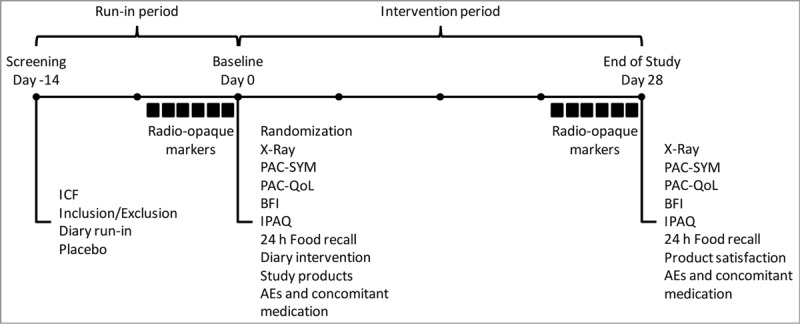
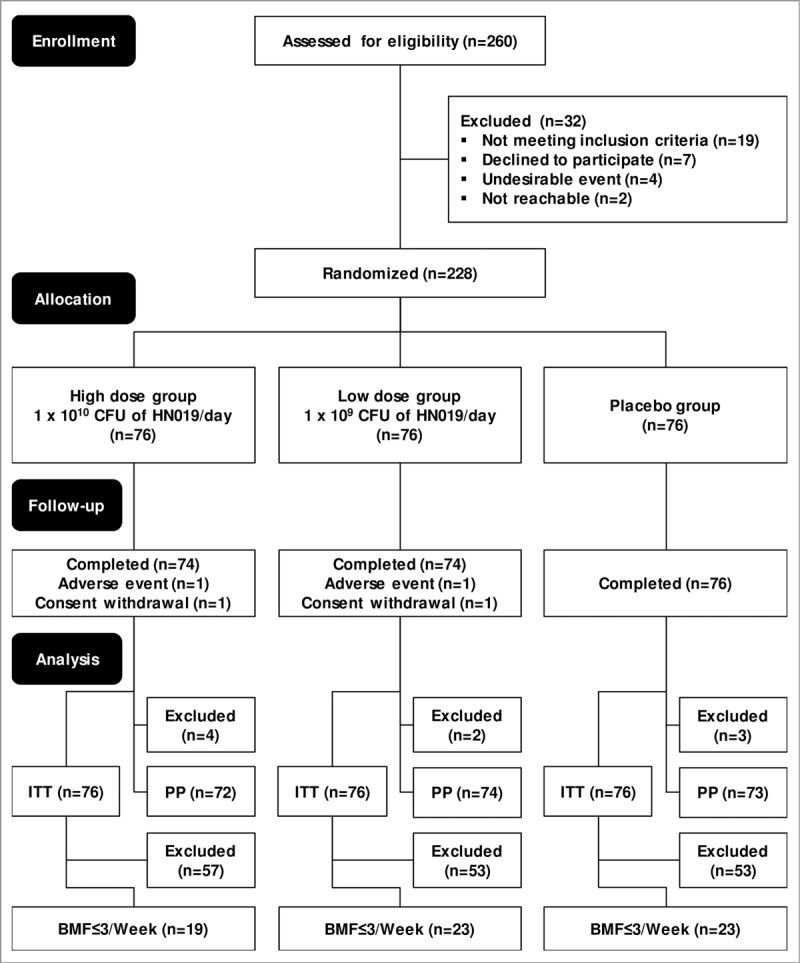
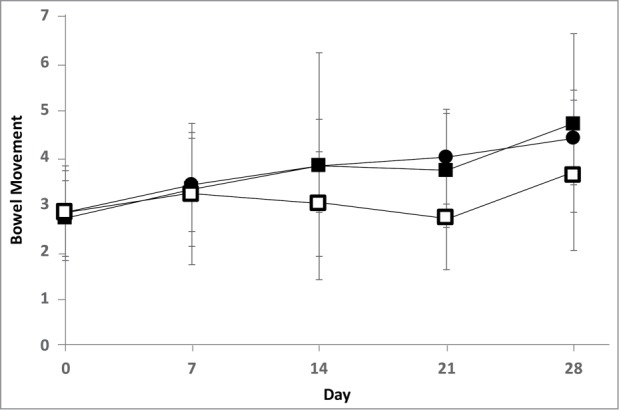
CFU of HN019/day for constipation. A total of 228 adults who were diagnosed with functional constipation according to the Rome III criteria were randomized in a double-blind and placebo-controlled trial. Colonic transit time (CTT), the primary outcome, and secondary outcomes that were measured using inventories-patient assessment of constipation symptoms (PAC-SYM) and quality of life (PAC-QoL), bowel function index (BFI), bowel movement frequency (BMF), stool consistency, degree of straining, bowel emptying, bloating, and pain severity-were assessed. Ancillary parameters and harms were also evaluated. There were no statistically significant differences in the primary or secondary outcomes between interventions. A post hoc analysis of 65 participants with fewer than 3 bowel movements per week (BMF ≤ 3/week) showed a physiologically relevant increase in weekly BMF in the high- (+2.0) and low-dose (+1.7) HN019 groups-by RMANOVA, the HN019 groups with BMF ≤ 3/week, pooled together, had a higher BMF versus placebo (P value = 0.01). Thus, improving low stool frequency could be a target of future interventions with HN019. High-dose HN019 also decreased the degree of straining at Day 28 versus placebo in those with BMF ≤ 3/week (P value = 0.02). Three unlikely related AEs-2 with low-dose HN019 and 1 with placebo-were followed until full recovery. In conclusion, although there were no differences in the primary analysis, HN019 is well tolerated and improves BMF in adults with low stool frequency.
Overview
The claims and statistics of this paper haven’t been checked yet.
Free: it reads the open-access text and checks the first 5 claims that cite a source we can check. Create a free account to check every claim.
Integrity signals
Registry
Cites
Statistics
Figures
Verification
Claims the paper makes
The claims and statistics of this paper haven’t been checked yet.
Free: it reads the open-access text and checks the first 5 claims that cite a source we can check. Create a free account to check every claim.
Claims other papers make about this one
Each is checked against this paper’s own text: does it say what the citing paper says it does?
The source backs part of the claim, not all of it — or backs it for a different population, condition or comparison.
In the citing paper
“Bifidobacterium animalis subsp lactis HN019 (HN019) has been shown to improve constipation and gastrointestinal tract symptoms in adults at doses ranging from 1.0 × 10⁹ to 17.2 × 10⁹ colony-forming units (CFU)/d for 2 to 4 weeks.5,6”
From Eight-Week Supplementation With Bifidobacterium lactis HN019 and Functional Constipation: A Randomized Clinical Trial (2024) · cites this paper as [5]
Experimental — accuracy not yet measuredThe source backs part of the claim, not all of it — or backs it for a different population, condition or comparison.
In the citing paper
“This increase in the placebo group is in line with what was observed earlier for the placebo group in the ITT population of Ibarra and coworkers5 and is likely a placebo effect.”
From Eight-Week Supplementation With Bifidobacterium lactis HN019 and Functional Constipation: A Randomized Clinical Trial (2024) · cites this paper as [5]
Experimental — accuracy not yet measuredThe source backs part of the claim, not all of it — or backs it for a different population, condition or comparison.
In the citing paper
“HN019, the strain investigated in the present study, has been reported to improve BMF in people with constipation.5,6”
From Eight-Week Supplementation With Bifidobacterium lactis HN019 and Functional Constipation: A Randomized Clinical Trial (2024) · cites this paper as [5]
Experimental — accuracy not yet measuredThe source backs part of the claim, not all of it — or backs it for a different population, condition or comparison.
In the citing paper
“The Rome III criteria for functional constipation require a minimum of 2 of 5 criteria to be met for diagnosis, introducing the potential for substantial heterogeneity in a study population.5”
From Eight-Week Supplementation With Bifidobacterium lactis HN019 and Functional Constipation: A Randomized Clinical Trial (2024) · cites this paper as [5]
Experimental — accuracy not yet measuredThe source backs part of the claim, not all of it — or backs it for a different population, condition or comparison.
In the citing paper
“The results of the primary outcome (CSBMs per week) contrast with earlier reports.5,6”
From Eight-Week Supplementation With Bifidobacterium lactis HN019 and Functional Constipation: A Randomized Clinical Trial (2024) · cites this paper as [5]
Experimental — accuracy not yet measured
3 more claims about this paper
Create a free account to see every claim other papers make about this one.
Self-check
Percentages, sums and reported differences re-computed from the paper’s own numbers.
The self-check needs the paper’s full text.
Citations
Cites
CONSORT 2010 Statement: updated guidelines for reporting parallel group randomised trials
the CONSORT Group, Schulz, K. F., Altman, D. G., & Moher, D. (2010) · BMC Medicine · doi:10.1186/1741-7015-8-18 · Cited by 13,371
Cook, R. J., Dickens, B. M., & Fathalla, M. F. (2003) · Reproductive Health and Human Rights · doi:10.1093/acprof:oso/9780199241323.003.0025 · Cited by 10,769
The functional gastrointestinal disorders and the Rome III process
Drossman, D. A. (2006) · Gastroenterology · doi:10.1053/j.gastro.2006.03.008 · Cited by 2,416
CONSORT 2010 statement: Updated guidelines for reporting parallel group randomised trials
Schulz, K. F., Altman, D. G., & Moher, D. (2010) · Journal of Pharmacology and Pharmacotherapeutics · doi:10.4103/0976-500x.72352 · Cited by 2,165
Hagströmer, M., Oja, P., & Sjöström, M. (2006) · Public Health Nutrition · doi:10.1079/phn2005898 · Cited by 1,958 · cited 1×
“On Days 0 and 28, the short version of the International Physical Activity Questionnaire (IPAQ) was answered.(22) Before the visits on Days 0 and 28, they supplied their 24-h food recall—total calories (Kcal), total carbohydrates (g and %Kcal), total lipids (g and %Kcal), total proteins (g and %Kcal), alcohol (g and %…”
MethodBetter Reporting of Harms in Randomized Trials: An Extension of the CONSORT Statement
Ioannidis, J. P. A., Evans, S. J. W., Gøtzsche, P. C., O'Neill, R. T., Altman, D. G., Schulz, K., Moher, D., & for the CONSORT Group* (2004) · Annals of Internal Medicine · doi:10.7326/0003-4819-141-10-200411160-00009 · Cited by 1,593 · cited 1×
“The study has been reported per the CONSORT statement.(19,20)”
MethodThe Medical Dictionary for Regulatory Activities (MedDRA)
Brown, E. G., Wood, L., & Wood, S. (1999) · Drug Safety · doi:10.2165/00002018-199920020-00002 · Cited by 1,390
Suares, N. C., & Ford, A. C. (2011) · American Journal of Gastroenterology · doi:10.1038/ajg.2011.164 · Cited by 904 · cited 1×
“Chronic idiopathic constipation, a gastrointestinal (GI) disorder of colonic or anorectal function, affects 14% of the population worldwide.(1) Historically, health care professionals have defined constipation as fewer than 3 bowel movements per week.”
BackgroundFord, A. C., Quigley, E. M. M., Lacy, B. E., Lembo, A. J., Saito, Y. A., Schiller, L. R., Soffer, E. E., Spiegel, B. M. R., & Moayyedi, P. (2014) · American Journal of Gastroenterology · doi:10.1038/ajg.2014.202 · Cited by 747
Research works printed but not linked: 2
- International Conference on Harmonisation Working Group. ICH harmonised tripartite guideline: Guideline for good clinical practice E6 (R1). International Conference on Harmonisation of Technical Requirements for Registration of Pharmaceuticals for Human Use. 1996;10:1–53.
- WHO. World Health Organization (WHO) Anatomical Therapeutic Chemical (ATC) Classification System. Guidelines for ATC Classification. 1993:23–185.
Cited by
Clostridium species as probiotics: potentials and challenges
Guo, P., Zhang, K., Ma, X., & He, P. (2020) · Journal of Animal Science and Biotechnology · doi:10.1186/s40104-019-0402-1 · Cited by 597
World Gastroenterology Organisation Global Guidelines: Probiotics and Prebiotics
Guarner, F., Sanders, M. E., Szajewska, H., Cohen, H., Eliakim, R., Herrera-deGuise, C., Karakan, T., Merenstein, D., Piscoya, A., Ramakrishna, B., et al. (2024) · Journal of Clinical Gastroenterology · doi:10.1097/mcg.0000000000002002 · Cited by 209
Lai, H., Li, Y., He, Y., Chen, F., Mi, B., Li, J., Xie, J., Ma, G., Yang, J., Xu, K., et al. (2023) · Gut Microbes · doi:10.1080/19490976.2023.2197837 · Cited by 208
Role of gut microbiota in functional constipation
Zhang, S., Wang, R., Li, D., Zhao, L., & Zhu, L. (2021) · Gastroenterology Report · doi:10.1093/gastro/goab035 · Cited by 175
Pan, R., Wang, L., Xu, X., Chen, Y., Wang, H., Wang, G., Zhao, J., & Chen, W. (2022) · Nutrients · doi:10.3390/nu14183704 · Cited by 149
Zhang, C., Jiang, J., Tian, F., Zhao, J., Zhang, H., Zhai, Q., & Chen, W. (2020) · Clinical Nutrition · doi:10.1016/j.clnu.2020.01.005 · Cited by 131
Prebiotics and Probiotics for Gastrointestinal Disorders
Rau, S., Gregg, A., Yaceczko, S. D., & Limketkai, B. N. (2024) · Nutrients · doi:10.3390/nu16060778 · Cited by 141
“Only minor adverse effects were reported such as loose stools, bloating, and abdominal discomfort, which were not significantly different between the probiotic and control groups [89,90].”
BackgroundLi, G., Feng, H., Mao, X.-L., Deng, Y., Wang, X.-B., Zhang, Q., Guo, Y., & Xiao, S. (2023) · Journal of Translational Medicine · doi:10.1186/s12967-023-04306-0 · Cited by 130
Bifidobacterium spp. as functional foods: A review of current status, challenges, and strategies
He, B., Xiong, Y., Hu, T., Zong, M., & Wu, H. (2022) · Critical Reviews in Food Science and Nutrition · doi:10.1080/10408398.2022.2054934 · Cited by 121
Bifidobacterium animalis subsp. lactis HN019 Effects on Gut Health: A Review
Cheng, J., Laitila, A., & Ouwehand, A. C. (2021) · Frontiers in Nutrition · doi:10.3389/fnut.2021.790561 · Cited by 103
“(22), when comparing the measured gastrointestinal symptoms between subjects taken B.”
BackgroundSelf-citationDimidi, E., Mark Scott, S., & Whelan, K. (2020) · Proceedings of the Nutrition Society · doi:10.1017/s0029665119000934 · Cited by 88
Wang, L., Wang, L., Tian, P., Wang, B., Cui, S., Zhao, J., Zhang, H., Qian, L., Wang, Q., Chen, W., et al. (2022) · Food & Function · doi:10.1039/d1fo03896f · Cited by 81
Creedon, A. C., Hung, E. S., Berry, S. E., & Whelan, K. (2020) · Nutrients · doi:10.3390/nu12082347 · Cited by 75
“Future studies may wish to address the impact of nut consumption on gut microbiota and stool output in populations experiencing altered gut microbiota, and sub-optimal gut function such as in constipation [47].”
BackgroundEvidence-Based Clinical Guidelines for Chronic Constipation 2023
Ihara, E., Manabe, N., Ohkubo, H., Ogasawara, N., Ogino, H., Kakimoto, K., Kanazawa, M., Kawahara, H., Kusano, C., Kuribayashi, S., et al. (2024) · Digestion · doi:10.1159/000540912 · Cited by 98
“…of bowel movements in patients with chronic constipation: Lactobacillus casei strain Shirota [120, 121], Bi fi dobacterium lactis [122], Bi fi dobacte-rium animalis [123], Lactobacillus reuteri [124], Lactococcus lactis [125], Lactobacillus plantarum [126], and Bi fi dobacterium bi fi dum G9-1 [127].”
van der Schoot, A., Helander, C., Whelan, K., & Dimidi, E. (2022) · Clinical Nutrition · doi:10.1016/j.clnu.2022.10.015 · Cited by 67
Ma, T., Yang, N., Xie, Y., Li, Y., Xiao, Q., Li, Q., Jin, H., Zheng, L., Sun, Z., Zuo, K., et al. (2023) · Pharmacological Research · doi:10.1016/j.phrs.2023.106755 · Cited by 67
Chai, M., Wang, L., Li, X., Zhao, J., Zhang, H., Wang, G., & Chen, W. (2021) · Food & Function · doi:10.1039/d1fo00559f · Cited by 64
Bacillus coagulans Unique IS2 in Constipation: A Double-Blind, Placebo-Controlled Study
Madempudi, R. S., Neelamraju, J., Ahire, J. J., Gupta, S. K., & Shukla, V. K. (2020) · Probiotics and Antimicrobial Proteins · doi:10.1007/s12602-019-09542-9 · Cited by 60
Araújo, M. M., & Botelho, P. B. (2022) · Frontiers in Nutrition · doi:10.3389/fnut.2022.935830 · Cited by 58
2022 Seoul Consensus on Clinical Practice Guidelines for Functional Constipation
Cho, Y. S., Lee, Y. J., Shin, J. E., Jung, H., Park, S., Kang, S. J., Song, K. H., Kim, J., Lim, H. C., Park, H. S., et al. (2023) · Journal of Neurogastroenterology and Motility · doi:10.5056/jnm23066 · Cited by 54
Efficacy of Probiotic Compounds in Relieving Constipation and Their Colonization in Gut Microbiota
He, Y., Zhu, L., Chen, J., Tang, X., Pan, M., Yuan, W., & Wang, H. (2022) · Molecules · doi:10.3390/molecules27030666 · Cited by 52
Šola, K. F., Vladimir‐Knežević, S., Hrabač, P., Mucalo, I., Saso, L., & Verbanac, D. (2022) · European Journal of Clinical Nutrition · doi:10.1038/s41430-022-01189-0 · Cited by 54
Airaksinen, K., Yeung, N., Lyra, A., Lahtinen, S. J., Huttunen, T., Shanahan, F., & Ouwehand, A. C. (2019) · Beneficial Microbes · doi:10.3920/bm2018.0163 · Cited by 39
“Waller and coworkers (2011) used two dosages of HN019: 1.72×10¹⁰ cfu/ day and 1.8×10⁹ cfu/day, while Ibarra et al. (2018) reported 109 and 1010 cfu/day.”
BackgroundMethodInfluentialSelf-citationThumu, S. C. R., & Halami, P. M. (2019) · Journal of the Science of Food and Agriculture · doi:10.1002/jsfa.10071 · Cited by 38
Alvarez, A.-S., Tap, J., Chambaud, I., Cools-Portier, S., Quinquis, L., Bourlioux, P., Marteau, P., Guillemard, E., Schrezenmeir, J., & Derrien, M. (2020) · Scientific Reports · doi:10.1038/s41598-020-72161-w · Cited by 36
Recent advances in probiotication of fruit and vegetable juices
Rahman, M. S., Emon, D. D., Toma, M. A., Nupur, A. H., Karmoker, P., Iqbal, A., Aziz, M. G., & Alim, M. A. (2023) · Journal of Advanced Veterinary and Animal Research · doi:10.5455/javar.2023.j706 · Cited by 40
Andresen, V., Pehl, C., Becker, G., Frieling, T., Goebel‐Stengel, M., Gundling, F., Herold, A., Karaus, M., Keller, J., Kim, M., et al. (2022) · Zeitschrift für Gastroenterologie · doi:10.1055/a-1880-1928 · Cited by 39
Is Stool Frequency Associated with the Richness and Community Composition of Gut Microbiota?
Kwon, H. J., Lim, J. H., Kang, D., Lim, S., Park, S. J., & Kim, J. H. (2019) · Intestinal Research · doi:10.5217/ir.2018.00149 · Cited by 33
Zhang, T., Liu, W., Lu, H., Cheng, T., Wang, L., Wang, G., Zhang, H., & Chen, W. (2023) · Critical Reviews in Food Science and Nutrition · doi:10.1080/10408398.2023.2278155 · Cited by 33
“A few of the alleviation effects may be unique to patients with certain symptoms, such as those of lactis HN019 and B.longum BB536, which only improved in participants with low bowel frequency (Ibarra et al. 2018).”
Kusumo, P. D., Maulahela, H., Utari, A. P., SURONO, I. S., Soebandrio, A., & Abdullah, M. (2019) · Iranian Journal of Microbiology · doi:10.18502/ijm.v11i5.1957 · Cited by 42
Hata, S., Nakajima, H., Hashimoto, Y., Miyoshi, T., Hosomi, Y., Okamura, T., Majima, S., Nakanishi, N., Senmaru, T., Osaka, T., et al. (2021) · Journal of Diabetes Investigation · doi:10.1111/jdi.13698 · Cited by 36
Morovic, W., Roos, P., Zabel, B., Hidalgo-Cantabrana, C., Kiefer, A., & Barrangou, R. (2018) · Applied and Environmental Microbiology · doi:10.1128/aem.01999-18 · Cited by 31
“Indeed, clinical studies assessing supplementation with B. animalis subsp. lactis have revealed probiotic effects, such as improved gastrointestinal transit and comfort (6–8), immune modulation (9, 10), and control of abdominal fat mass (11).”
Nakamura, Y., Suzuki, S., Murakami, S., Nishimoto, Y., Higashi, K., Watarai, N., Umetsu, J., Ishii, C., Ito, Y., Mori, Y., et al. (2022) · Computational and Structural Biotechnology Journal · doi:10.1016/j.csbj.2022.10.026 · Cited by 29
“Multiple randomized controlled trials have shown that bifidobacteria intake increases bowel movement frequency [11–14] or shortens the gut transit time [15,16].”
BackgroundZhang, C., Zhang, Y., Ma, K., Wang, G., Tang, M., Wang, R., Xia, Z., Xu, Z., Sun, M., Bao, X., et al. (2022) · Annals of Translational Medicine · doi:10.21037/atm-22-458 · Cited by 25
Ibarra, A., Pelipyagina, T., Rueffer, M., Evans, M., & Ouwehand, A. C. (2019) · Nutrients · doi:10.3390/nu11020439 · Cited by 22
Self-citationXu, L., Qiu, B., Ba, F., Zhang, S., Han, S., Chen, H., Wu, Y., Gao, W., Xie, S., Chen, Y., et al. (2024) · Food & Function · doi:10.1039/d4fo04444d · Cited by 23
Wu, H., Chen, X., Zhang, S., & Li, J. (2022) · Nutrients · doi:10.3390/nu14204220 · Cited by 23
“lactis HN019 (HN019) was well tolerated and improved stool frequency, relieving tension in patients with chronic idiopathic constipation in a 28-day clinical trial [72].”
BackgroundDahiya, D., & Nigam, P. S. N. (2023) · Nutrients · doi:10.3390/nu15132979 · Cited by 20
Microbiota modulation in disorders of gut-brain interaction
Marasco, G., Cremon, C., Barbaro, M. R., Bianco, F., Stanghellini, V., & Barbara, G. (2024) · Digestive and Liver Disease · doi:10.1016/j.dld.2024.05.004 · Cited by 23
Kong, X., Wan, G., Tian, R., Liu, S., Liu, K., Clairmont, C. D., Lin, X., Zhang, X., Sherman, H. T., Zhu, J., et al. (2021) · Frontiers in Nutrition · doi:10.3389/fnut.2021.587974 · Cited by 20
Bousdouni, P., Kandyliari, A., & Koutelidakis, A. Ε. (2022) · Gastrointestinal Disorders · doi:10.3390/gidisord4010005 · Cited by 20
Zheng, Y., Xu, L., Zhang, S., Liu, Y., Ni, J., & Xiao, G. (2023) · Frontiers in Nutrition · doi:10.3389/fnut.2023.1196625 · Cited by 18
Cheng, J., Gao, C., Ala-Jaakkola, R., Forssten, S. D., Saarinen, M., Hibberd, A., Ouwehand, A. C., Ibarra, A., Li, D., Nordlund, A., et al. (2024) · JAMA Network Open · doi:10.1001/jamanetworkopen.2024.36888 · Cited by 17
Self-citationMitelmão, F. C. R., Häckel, K., Bergamaschi, C. D. C., Gerenutti, M., Silva, M. T., Balcão, V. M., & Vila, M. M. D. C. (2022) · Medicine · doi:10.1097/md.0000000000031185 · Cited by 19
“In a trial study, Ibarra et al[16] used Bifidobacteria for the treatment of intestinal constipation.”
BackgroundOkada, K., Takami, D., Makizaki, Y., Tanaka, Y., Nakajima, S., Ohno, H., & Sagami, T. (2023) · Bioscience of Microbiota Food and Health · doi:10.12938/bmfh.2022-066 · Cited by 15
“In addition, the efficacy of the PAC-QOL with other probiotics has been evaluated in longer-term studies and studies with more participants [32, 33].”
BackgroundSalo, E., Roche, D., Gomez-Martinez, V. B., Cruz-Domenech, J. M., Garcia-Mora, L. G., Gabernet‐Castello, C., & Freixenet, N. (2017) · Beneficial Microbes · doi:10.1163/18762891-bja00038 · Cited by 15
Mitelmão, F. C. R., Bergamaschi, C. D. C., Gerenutti, M., Hächel, K., Silva, M. T., Balcão, V. M., & Vila, M. M. D. C. (2021) · Medicine · doi:10.1097/md.0000000000024938 · Cited by 16
Chen, K., Zhou, Z., Nie, Y., Cao, Y., Yang, P., Zhang, Y., Xu, P., Yu, Q., Shen, Y., Ma, W., et al. (2024) · Brazilian Journal of Microbiology · doi:10.1007/s42770-024-01276-3 · Cited by 14
“Worldwide, other similar probiotic strains [17–19] of Bifidobacterium animalis subsp. lactis have been shown to contribute to relieving gut dys-motility–related constipation through several mechanisms.”
BackgroundHan, Y., Zhou, Y., Xu, X., Chen, S., Zhang, S., Jiang, N., Liu, Z., Zhang, J., Luo, Z., Zhang, X., et al. (2024) · Nutrients · doi:10.3390/nu16101505 · Cited by 13
“The increased defecation frequency in the TRE group indicated an improvement in bowel motility, the median Bristol score symbolized the normalization of fecal traits, and the decreased PAC-SYM scale scores parallelly represented a general restoration of gastrointestinal symptoms in patients [23,24].”
BackgroundMysonhimer, A. R., Brown, M., Alvarado, D. A., Cornman, E., Esmail, M., Abdiel, T., Gutierrez, K., Vasquez, J., Cannavale, C. N., Miller, M. J., et al. (2024) · Journal of Nutrition · doi:10.1016/j.tjnut.2024.05.028 · Cited by 14
Ito, D., Yamamoto, Y., Maekita, T., Yamagishi, N., Kawashima, S., Yoshikawa, T., Tanioka, K., Yoshida, T., Iguchi, M., Kunitatsu, K., et al. (2022) · Medicine · doi:10.1097/md.0000000000028858 · Cited by 12
Lora, A. T., Penadés, B. F., Oliva, S. L., Arponen, S., Okutan, G., Niño, G. M. S., & Martín, I. S. M. (2023) · Gastroenterology report · doi:10.1093/gastro/goae101 · Cited by 14
“In individuals with low stool frequency ( ≤ 3/week), BSS scores increased and straining during defecation decreased after treat-ment with a high dose of probiotics [20].”
BackgroundChen, J., Liu, X., Bai, T., & Hou, X. (2020) · Clinical and Translational Gastroenterology · doi:10.14309/ctg.0000000000000255 · Cited by 12
Alyousif, Z., Miller, J. L., Auger, J., Sandoval, M., Piano, A., Tompkins, T. A., & Dahl, W. J. (2020) · Molecular Genetics & Genomic Medicine · doi:10.1002/mgg3.1535 · Cited by 11
“B. lactis HN01 was tested at two doses (109 and 1010) using a parallel design in adults diagnosed with functional constipation and although no differences were seen for stool frequency for the group as a whole, 65 subjects with 3 bowel movements per week showed an increase (Ibarra et al., 2018).”
BackgroundMethodGut Microbiota and Metabolite Profiles Associated With Functional Constipation Severity
Wang, J., He, J., Liu, D., Zhang, T., Wu, Y., & Xie, M. (2024) · Microbiology and Immunology · doi:10.1111/1348-0421.13187 · Cited by 11
Dimidi, E. (2025) · Proceedings of The Nutrition Society · doi:10.1017/s0029665125100694 · Cited by 12
“In contrast, RCTs evaluating other strains, B. lactis DN-173 010, B. lactis HN019 and B. lactis LMG P-2138, each significantly increased stool frequency, highlighting the fact the effect on stool frequency is strain-specific (29 – 31) .”
Microbiota treatment of functional constipation: Current status and future prospects
Li, Y., Zhang, X., & Wang, Z.-K. (2024) · World Journal of Hepatology · doi:10.4254/wjh.v16.i5.776 · Cited by 10
Araújo, M. M., Vogado, C. D. O., Mendes, M. M., Gonçalves, V. S. S., & Botelho, P. B. (2022) · Nutrition Reviews · doi:10.1093/nutrit/nuab109 · Cited by 10
Tao, W., Yu, Y., Tan, D., Huang, X., Huang, J., Lin, C., & Yu, R. (2025) · Frontiers in Cellular and Infection Microbiology · doi:10.3389/fcimb.2025.1603442 · Cited by 9
Harris, L. A., Cash, B. D., Moftah, K., & Franklin, H. (2021) · Journal of Clinical Gastroenterology · doi:10.1097/mcg.0000000000001567 · Cited by 10
Araújo, L. D. C., da Silva, R. A. B., Thaís de Paula Colen, R. E. I. S., Salvador, S. L. D. S., Furlaneto, F. A. C., Messora, M. R., Nelson‐Filho, P., Almeida, L. K. Y., Lucisano, M. P., Silva, C. M. P. C., et al. (2023) · Brazilian Oral Research · doi:10.1590/1807-3107bor-2023.vol37.0115 · Cited by 9
Effectiveness of Probiotics in Patients With Constipation: A Systematic Review and Meta-Analysis
Mora, N. G., & Jaramillo, A. P. (2024) · Cureus · doi:10.7759/cureus.52013 · Cited by 12
“Ibarra et al. did not find significant differences in primary or secondary outcomes, including colonic transit time and weekly bowel movement frequency [21].”
BackgroundResultInfluentialJang, J. H., Chang, Y. B., Kim, S. M., Han, K., Sim, W., Hong, K., Suh, H. J., & Han, S. (2025) · Food & Function · doi:10.1039/d4fo04237a · Cited by 7
Mohammed, C., Fuego, J. P., Garcia, K. V., Jamil, H., Rajesh, R. Y., Escobar, A. S., Hassan, M. J., & Rai, M. (2024) · Cureus · doi:10.7759/cureus.57055 · Cited by 9
“In a different investigation, the effects of supplementing with two different dosages of Bifidobacterium animalis subsp. lactis HN019 for 28 days on chronic idiopathic constipation were examined [24].”
BackgroundRole of probiotics and prebiotics in digestion, metabolism, and immunity
Kurian, S. J., Baral, T., Miraj, S. S., & Rao, M. (2022) · Elsevier eBooks · doi:10.1016/b978-0-12-821232-5.00026-4 · Cited by 10
Hashimoto, Y., Nakajima, H., Hata, S., Miyoshi, T., Hosomi, Y., Majima, S., Nakanishi, N., Senmaru, T., Osaka, T., Okada, H., et al. (2020) · Journal of Clinical Biochemistry and Nutrition · doi:10.3164/jcbn.20-100 · Cited by 7
Prebióticos e probióticos na saúde e no tratamento de doenças intestinais: uma revisão integrativa
Marques, C. G., da Cruz, E. M. R. M., Bezerra, V. M., Costa, J. T. G., Lira, S. M., Holanda, M. O., da Silva, J. Y. G., Canabrava, N. D. V., da Silva, B. B., & Guedes, M. I. F. (2020) · Research Society and Development · doi:10.33448/rsd-v9i10.9071 · Cited by 12
Fu, H., Fan, D., Wang, J., Kou, R., Wang, Y., Wu, Y., & Wang, S. (2024) · Food Quality and Safety · doi:10.1093/fqsafe/fyae043 · Cited by 8
Moludi, J., Saber, A., Arab‐Zozani, M., Moradi, S., Azamian, Y., Hajiahmadi, S., Pasdar, Y., & Moradi, F. (2024) · Preventive Nutrition and Food Science · doi:10.3746/pnf.2024.29.3.237 · Cited by 6
“Eight studies were related to constipation (Ding et al., 2016; Cudmore et al., 2017; Ibarra et al., 2018; Xinias et al., 2018; Dimidi et al., 2019; Kommers et al., 2019; Riezzo et al., 2019; Olgac et al., 2020).”
BackgroundMethodInfluentialTan, S., Peng, C., Lin, X., Peng, C., Yang, Y., Liu, S., Huang, L., Bian, Y., Li, Y., & Chen, X. (2025) · Frontiers in Cellular and Infection Microbiology · doi:10.3389/fcimb.2025.1565801 · Cited by 13
Yeung, N., Forssten, S. D., Saarinen, M., Anjum, M., & Ouwehand, A. C. (2023) · Nutrients · doi:10.3390/nu15163541 · Cited by 6
Self-citationHuman Gut Microbiota and the Influence of Probiotics, Prebiotics, and Micronutrients
Pyle, S. (2021) · Elsevier eBooks · doi:10.1016/b978-0-12-819265-8.00076-0 · Cited by 8
Dimidi, E., Mark Scott, S., & Whelan, K. (2020) · Proceedings of the Nutrition Society · doi:10.1017/s0029665119001058 · Cited by 6
Zhu, Y., Chen, X., & Song, G. (2025) · European Journal of Nutrition · doi:10.1007/s00394-025-03826-3 · Cited by 5
“Primary outcome measures included the Patient Assessment of Constipation Symptoms (PAC-SYM) [ 25], the Patient Assessment of Constipation Quality of Life (PAC-QoL) [26 ], the Bowel Function Index (BFI) [ 27], the Bristol Stool Scale (BSS) [ 21], and weekly bowel movement frequency (BMF) [ 21].”
Gui, X., Wu, L., Huang, K., Zeng, R., Zhao, X., Yang, A., Yin, X., Cai, S., Yi, J., & Chu, C. (2025) · Food Research International · doi:10.1016/j.foodres.2025.117714 · Cited by 6
Ong, S., Xu, L., Ang, C. W., Deng, X., Lu, H., & Xu, T. (2024) · Frontiers in Microbiology · doi:10.3389/fmicb.2024.1513723 · Cited by 5
Ala‐Jaakkola, R., Forssten, S. D., Cheng, J., Griffon, F., Metreau, I., Sturm, Y., Lecerf, J., Donazzolo, Y., Junnila, J., Nordlund, A., et al. (2025) · Molecular Nutrition & Food Research · doi:10.1002/mnfr.70081 · Cited by 4
Self-citationLanzetti, J., Queirolo, S., Evans, G. F., Gibello, U., Deregibus, A., & Pera, F. (2025) · Dentistry Journal · doi:10.3390/dj13110526 · Cited by 4
“HN019 is a strain of the bacterial species Bifidobacterium lactis that is non-pathogenic and safe for human consumption: a 2018 randomized controlled trial found that 10 billion CFU (colony forming units) of B. lactis HN019 administered for one month is safe and well tolerated by the body [12].”
Lan, W., Yang, H., Zhong, Z., Luo, C., Huang, Q., Liu, W., Yang, J., Xiang, H., Tang, Y., & Chen, T. (2024) · Food & Function · doi:10.1039/d4fo01471e · Cited by 5
Serkova, M. Y., Avalueva, E. B., & Sitkin, S. I. (2024) · Almanac of Clinical Medicine · doi:10.18786/2072-0505-2024-52-026 · Cited by 4
Lin, M., Li, S., Lin, J., Wan, J., Xu, T., Qi, X., Wei, J., Li, J., Chen, T., & Tu, H. (2026) · Journal of Ethnopharmacology · doi:10.1016/j.jep.2026.121694 · Cited by 3
Hashimoto, Y., Kobayashi, G., Kitagawa, N., Okada, H., Hamaguchi, M., & Fukui, M. (2024) · PLoS ONE · doi:10.1371/journal.pone.0295998 · Cited by 3
A nurse-led educational intervention for relieving idiopathic constipation: a retrospective study
Terzoni, S., Mora, C., Rocco, B. M. C., Sighinolfi, M. C., Gaia, G., Ferrara, P., Pinna, B., & Destrebecq, A. L. L. (2022) · British Journal of Nursing · doi:10.12968/bjon.2022.31.19.984 · Cited by 3
When to use probiotics in luminal gastrointestinal disorders?
Elangovan, A., & Fischer, M. (2020) · Current Opinion in Clinical Nutrition & Metabolic Care · doi:10.1097/mco.0000000000000674 · Cited by 4
“28-Day supplementation of probiotic 1 10(9) CFU/day did not affect stool frequency, consistency, bloating, or quality of life [43].”
BackgroundSeoul Consensus on Clinical Practice Guidelines for Functional Constipation
Song, K. H., Cho, Y. S., Shin, J. E., Jung, H., Park, S., Kang, S. J., Kim, J., Lee, Y. J., Lim, H. C., Park, H. S., et al. (2025) · Korean Journal of Gastroenterology · doi:10.4166/kjg.2024.156 · Cited by 3
New drugs (enzymes and probiotics) in clinical practice
Minushkin, O. N. (2022) · Meditsinskiy sovet = Medical Council · doi:10.21518/2079-701x-2022-16-15-98-103 · Cited by 2
Liu, W., Wang, J., Xue, Y., Li, J., Huang, Y., Zhu, S., Wang, L., Wang, G., Chen, W., & Zhao, J. (2025) · Beneficial Microbes · doi:10.1163/18762891-bja00085 · Cited by 2
Im, Y. J., Lee, K. C., Lee, S., Kim, K. B., & Park, K. (2024) · Korean journal of urology · doi:10.4111/icu.20240086 · Cited by 1
“Some consider the subjective nature, such as infrequent or difficult defecation [15] or quality of stool [16], while others consider objective criteria, such as the amount of impacted stool [17] on kidney, ureter, and bladder (KUB) or colonic transit time [18].”
BackgroundElectroacupuncture Combined with Chinese Medicine Ironing Therapy for Functional Constipation
Li, L., Yan, H., Cao, J., Zhu, F., Feng, P., & Zhou, X. (2024) · Journal of Visualized Experiments · doi:10.3791/65954 · Cited by 1
Weis, C. M. S. C., Gomes, M. M., Vicenzi, B. G., Fabiano, G. A., Lopes, J. D. O., dos Santos, P. D. D. S., Tormen, L., Santos, O. O., Bezerra, R. M. N., Antunes, A. E. C., et al. (2024) · Fermentation · doi:10.3390/fermentation10110570 · Cited by 1
Zhang, Y.-K., Zhang, L., Ni, X., Zhang, S., Jiang, M.-Z., Zhang, S.-L., Xiao, G., Jiang, H., Bi, M., Wang, Y., et al. (2025) · Engineering Microbiology · doi:10.1016/j.engmic.2025.100228 · Cited by 1
Quan, V., & Carey, S. (2025) · Clinical Nutrition ESPEN · doi:10.1016/j.clnesp.2025.102849 · Cited by 1
Targeting Gut Microbiota in the Management of Functional Constipation: A Narrative Review
Takeda, T., Hojo, M., Asaoka, D., & Nagahara, A. (2025) · Internal Medicine · doi:10.2169/internalmedicine.6457-25 · Cited by 2
Allegretti, J. R., Kassam, Z., Kelly, C. R., Grinspan, A. M., El‐Nachef, N., Elzen, C. L. V. D., Jäger, R., & Feuerstadt, P. (2026) · Nutrients · doi:10.3390/nu18020255 · Cited by 2
Gu, Y., Ye, Q., feng, X., Li, J., He, Z., Zhang, M., Hao, Y., & Zhai, Z. (2026) · Food Bioscience · doi:10.1016/j.fbio.2026.108462 · Cited by 2
Kim, Y. S., Park, S.-Y., Kang, S. J., Lee, M. W., Choi, Y., Kim, B. Y., Choi, M., Shin, C. M., Kim, Y. S., Kim, N., et al. (2026) · Journal of Neurogastroenterology and Motility · doi:10.5056/jnm25221 · Cited by 2
Kobayashi, G., Hashimoto, Y., Matsuyama, T., Kitagawa, N., Majima, S., Senmaru, T., Ushigome, E., Okada, H., Nakanishi, N., Hamaguchi, M., et al. (2026) · Diabetes Obesity and Metabolism · doi:10.1111/dom.70805 · Cited by 1
Yang, L., LIU, Y. F., Li, J., Lv, J., Zhang, Q., Cong, M., Shi, H., & Zhang, H. (2026) · ISME Communications · doi:10.1093/ismeco/ycag127 · Cited by 1
“Probiotics have emerged as a promising adjuvant strategy, with prior studies reporting benefits in conditions such as functional dyspepsia, chemotherapy-associated diarrhea, and impaired mucosal integrity [ 41, 42].”
Wang, H., Yang, J., Wu, L., Bian, X., Li, X., Kuang, J., Li, J., Shi, F., Mao, Y., Li, J., et al. (2026) · Frontiers in Nutrition · doi:10.3389/fnut.2026.1786466 · Cited by 1
Li, X., Lan, H., Guan, Y., Wang, L., Zhao, W., He, J., Zhao, Z., Li, M., Han, Q., Gong, Y., et al. (2026) · Nutrients · doi:10.3390/nu18132114 · Cited by 1
Metadata
- Authors
- Ibarra, A., Latreille-Barbier, M., Donazzolo, Y., Pelletier, X., & Ouwehand, A. C.
- Affiliations
- DuPont (Finland) (FI)
- Eurofins Optimed SAS, Clinical Research, Gières, France
- Eurofins (France) (FR)
- Corresponding author
- Ibarra, Alvin
- Venue
- Gut Microbes
- Publisher
- Informa UK Limited
- Published
- 2018-02-08
- Volume
- 9
- Issue
- 3
- Pages
- 236-251
- ISSN
- 1949-0976 (ISSN-L)
- 1949-0984
- PMC
- PMC6219592
- OpenAlex
- W2773593508
- Cited by
- 121
- References
- 53
- Citations by year
- 2026: 14 · 2025: 15 · 2024: 26 · 2023: 17 · 2022: 17 · 2021: 10 · 2020: 11 · 2019: 9 · 2018: 1
- FWCI
- 6.32
- Type
- journal article
- Language
- en
- Open access
- gold
- doi.org
- Licence
- cc-by-nc-nd
- Locations
- Gut Microbes (publishedVersion, cc-by-nc-nd)
- Europe PMC (PubMed Central) (publishedVersion, cc-by-nc-nd)
- PubMed Central (publishedVersion, cc-by-nc-nd)
- PubMed (publishedVersion)
- Funders
- DuPont
- Topics
- Health Sciences › Medicine › Gastroenterology › Gastrointestinal motility and disorders
- Life Sciences › Agricultural and Biological Sciences › Food Science › Probiotics and Fermented Foods
- Life Sciences › Biochemistry, Genetics and Molecular Biology › Molecular Biology › Gut microbiota and health
- Keywords
- functional constipation, colonic transit time, probiotic supplementation, stool frequency, straining, stool consistency, quality of life, dose-ranging, adverse events
- MeSH terms
- Bifidobacterium animalis, Adolescent, Adult, Aged, Constipation, Double-Blind Method, Female, Gastrointestinal Transit, Humans, Male, Middle Aged, Placebos, Quality of Life, Treatment Outcome, Probiotics, Young Adult
About these checks
Registry, retraction, Cites and statistics results are computed, not judged, with one exception: a printed reference that no index lists is read once by a model before it counts as a citation error. Claims are extracted by a model and kept only when their quote appears verbatim in the text; each cited source is then checked, with a model’s help, for whether it says what the claim relies on. Those verdicts can be wrong — read the claim’s quote and the cited source before relying on one.
Statistics and arithmetic are recomputed, not judged.
Confidence bands are shown only for fields calibrated on our annotated test set. None is calibrated yet, so no band is shown.
What counts as a claim ›How we measure confidence ›How we check this ›
Are you an author, or do you see a problem with this page? Request a review
Data sources
Bibliographic data: Semantic Scholar, OpenAlex, Crossref.
Contains information from the Semantic Scholar Academic Graph Datasets, made available under the ODC Attribution License (ODC-BY 1.0).
Semantic Scholar’s data is described in: Kinney, R., et al. (2023). The Semantic Scholar Open Data Platform. arXiv:2301.10140.
