

The DOI matches its Crossref record; 16 of the 16 references it cites were found in a registry or an index.
Integrated hypothesis of dental caries and periodontal diseases
Overview
The claims and statistics of this paper haven’t been checked yet.
Run the check — free, no account needed. It reads the open-access text and checks the sources it cites.
Integrity signals
Registry
Cites
Statistics
Figures
Verification
Claims the paper makes
The claims and statistics of this paper haven’t been checked yet.
Run the check — free, no account needed. It reads the open-access text and checks the sources it cites.
Claims other papers make about this one
Each is checked against this paper’s own text: does it say what the citing paper says it does?
In the citing paper
“With progression to severe fluorosis, sustained enamel damage and altered substrate availability drive the microbiome toward a more proteolytic, alkalinogenic state [52].”
From Severity-dependent alterations in oral microbiota and antibiotic resistance in children with dental fluorosis (2026) · cites this paper as [52]
Self-check
Percentages, sums and reported differences re-computed from the paper’s own numbers.
The self-check needs the paper’s full text.
Citations
Cites
Resilience, Adaptability and Transformability in Social–ecological Systems
Walker, B., Holling, C. S., Carpenter, S. R., & Kinzig, A. P. (2004) · Ecology and Society · doi:10.5751/es-00650-090205 · Cited by 7,821
The nitrate-nitrite-nitric oxide pathway in physiology and therapeutics
Lundberg, J. O., Weitzberg, E., & Gladwin, M. T. (2008) · Nature Reviews Drug Discovery · doi:10.1038/nrd2466 · Cited by 2,739 · cited 1×
“This is called the ‘enterosalivary circulation’ [66].”
Biodiversity enhances ecosystem reliability.
Naeem, S., & Li, S. (1997) · Nature · doi:10.1038/37348 · Cited by 1,438
Defining the healthy “core microbiome” of oral microbial communities
Zaura, E., Keijser, B. J., Huse, S. M., & Crielaard, W. (2009) · BMC Microbiology · doi:10.1186/1471-2180-9-259 · Cited by 1,323
Are dental diseases examples of ecological catastrophes?
Marsh, P. D. (2003) · Microbiology · doi:10.1099/mic.0.26082-0 · Cited by 1,256
Effect on Caries of Restricting Sugars Intake: Systematic Review to Inform WHO Guidelines
Moynihan, P. J., & Kelly, S. A. M. (2014) · Journal of Dental Research · doi:10.1177/0022034513508954 · Cited by 949
Molecular aspects of the pathogenesis of periodontitis
Meyle, J., & Chapple, I. (2015) · Periodontology 2000 · doi:10.1111/prd.12104 · Cited by 705
Oral Microbiome Metabolism: From “Who Are They?” to “What Are They Doing?”
Takahashi, N. (2015) · Journal of Dental Research · doi:10.1177/0022034515606045 · Cited by 488 · cited 9×
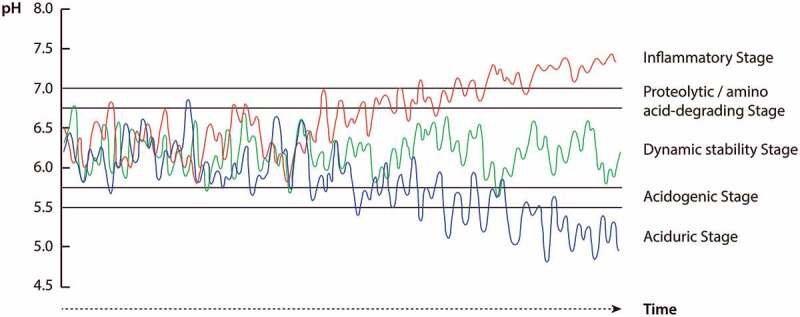
“This protein-rich environment enhances the growth of indigenous proteolytic and amino acid-degrading bacteria, such as Fusobacterium and Prevotella, the alkaline cytotoxic products of which raise the average pH to around neutral values.”
BackgroundInfluentialSelf-citationChapple, I. L. C., Bouchard, P., Cagetti, M. G., Campus, G., Carra, M., Cocco, F., Nibali, L., Hujoel, P., Laine, M. L., Lingström, P., et al. (2017) · Journal Of Clinical Periodontology · doi:10.1111/jcpe.12685 · Cited by 488
Sanz, M., Beighton, D., Curtis, M. A., Cury, J. A., Dige, I., Dommisch, H., Ellwood, R., Giacaman, R. A., Herrera, D., Herzberg, M. C., et al. (2017) · Journal of Clinical Periodontology · doi:10.1111/jcpe.12682 · Cited by 390
Research works printed but not linked: 94
- 10.1177/00220345600390052701 · DOI
- Theilade E, 1976, Oral Sci Rev, 9, 23
- Loesche WJ, 1976, Oral Sci Rev, 9, 65
- 10.1902/jop.1977.48.9.497 · DOI
- 10.1177/00220345790580120905 · DOI
- 10.1111/j.1600-051X.1986.tb01425.x · DOI
- 10.1177/08959374940080022001 · DOI · Paper page
- 10.1038/ismej.2012.174 · DOI
- 10.1111/j.1600-0757.2012.00450.x · DOI
- 10.1111/prd.12169 · DOI
- 10.1111/omi.12065 · DOI
- 10.1016/j.ics.2005.06.071 · DOI
- 10.1159/000159604 · DOI
- 10.1177/0022034510379602 · DOI
- 10.1159/000447309 · DOI
- 10.1146/annurev.ecolsys.35.021103.105711 · DOI · Paper page
- 10.1159/000488948 · DOI
- Diaz PI, 2016, J Calif Dent Assoc, 44, 421, 10.1080/19424396.2016.12221035 · DOI
- 10.1111/jcpe.12679 · DOI
- 10.1177/0022034517742139 · DOI · Paper page
- 10.1111/jcpe.12671 · DOI
- 10.3389/fcimb.2014.00092 · DOI
- 10.1177/00220345920710010401 · DOI
- 10.1159/000016628 · DOI
- 10.1177/00220345910700120601 · DOI
- 10.1177/00220345000790021201 · DOI
- 10.1111/prd.12107 · DOI
- 10.1111/j.1399-302X.1997.tb00733.x · DOI
- 10.1034/j.1399-302X.2003.00054.x · DOI
- 10.1902/jop.2008.080173 · DOI
- 10.1016/0003-9969(91)90091-8 · DOI · Paper page
- 10.1111/j.1600-0757.1994.tb00019.x · DOI
- 10.1111/j.1574-6976.2008.00150.x · DOI
- Lang NP, 2018, J Periodontol, 89, S9, 10.1902/jop.2017.170249 · DOI
- 10.1111/j.1753-4887.2012.00489.x · DOI
- 10.1007/s10021-001-0045-9 · DOI
- 10.5751/ES-03610-150420 · DOI
- 10.1146/annurev.es.04.110173.000245 · DOI · Paper page
- 10.1007/s100219900002 · DOI · Paper page
- 10.1126/science.277.5325.500 · DOI
- 10.4319/lo.2004.49.4_part_2.1269 · DOI
- 10.1890/1540-9295(2003)001[0488:RDECAR]2.0.CO;2 · DOI · Paper page
- 10.1177/00220345870660S103 · DOI
- Edgar M, 1996, Saliva and Oral Health, 81
- 10.1177/154405910608500410 · DOI
- 10.1159/000070450 · DOI
- 10.1111/j.1600-0765.1971.tb00615.x · DOI
- 10.1111/j.1574-6968.2000.tb09393.x · DOI · Paper page
- 10.1016/0003-9969(74)90177-0 · DOI
- 10.1128/IAI.64.2.585-592.1996 · DOI
- 10.1177/10454411970080030301 · DOI
- 10.1177/154405910808700108 · DOI
- 10.1016/S0003-9969(08)70003-7 · DOI
- 10.1099/jmm.0.46118-0 · DOI
- 10.1128/AEM.00606-14 · DOI
- Yamamoto Y, 2017, Oral Health Prev Dent, 15, 153
- 10.1128/IAI.40.1.70-80.1983 · DOI
- Carlsson J, 1986, Textbook of cariology, 74
- 10.1016/0003-9969(74)90267-2 · DOI
- 10.1371/journal.pone.0071227 · DOI
- 10.1111/j.1600-0765.1980.tb00269.x · DOI
- 10.1128/JCM.43.11.5721-5732.2005 · DOI · Paper page
- 10.1159/000446249 · DOI · Paper page
- 10.1016/j.jdent.2016.03.002 · DOI
- 10.1007/s00784-013-0990-7 · DOI
- 10.1038/d41586-019-03595-0 · DOI
- 10.3402/jom.v7.27429 · DOI
- 10.1038/srep22164 · DOI · Paper page
- Nyvad B, Caries Res
- 10.1177/2380084417723625 · DOI
- 10.1111/jcpe.12117 · DOI
- 10.1111/j.1600-0757.2004.03795.x · DOI · Paper page
- Nyvad B, 2015, Dental Caries: the Disease and Its Clinical management, 277
- 10.1177/0022034515590377 · DOI · Paper page
- 10.1002/146558.CD006540.pub2 · DOI
- 10.1159/000489571 · DOI
- 10.1016/B978-0-7236-0368-9.50008-2 · DOI
- Yudkin J, 1972, Pure, white and deadly: the problem of sugar
- 10.1111/jcpe.13094 · DOI
- 10.3945/ajcn.114.089656 · DOI · Paper page
- 10.1177/0022034517745326 · DOI
- 10.2337/diabetes.54.6.1615 · DOI · Paper page
- 10.1002/iub.1610 · DOI
- 10.1111/jcpe.12803 · DOI
- Taylor JJ, 2013, J Clin Periodontol, 40, S113, 10.1111/jcpe.12059 · DOI
- 10.1007/s40496-016-0099-6 · DOI
- 10.1080/20002297.2017.1332710 · DOI
- 10.1111/j.1600-051X.1996.tb01804.x · DOI
- Lal S, 2007, Pediatr Dent, 29, 426
- 10.1111/j.1600-051X.2005.00682.x · DOI
- 10.2337/dc11-2453 · DOI
- 10.1111/j.1600-051X.1995.tb00125.x · DOI
- 10.1111/j.1600-0528.1997.tb00894.x · DOI · Paper page
- 10.1111/prd.12110 · DOI
Cited by
Sorted by citations
Bravo-Lopez, M., Villa-Islas, V., Rocha Arriaga, C., Villaseñor-Altamirano, A. B., Guzmán-Solís, A., Sandoval-Velasco, M., Wesp, J. K., Alcantara, K., López-Corral, A., Gómez-Valdés, J., et al. (2020) · Philosophical Transactions of the Royal Society B: Biological Sciences · doi:10.1098/rstb.2019.0580 · Cited by 40
Xia, Y., Peng, S., Yu, J., Wang, Y., Ye, Y., Liu, M., Shang, L., Cui, X., Wang, P., & Ding, Z. (2026) · Journal of Oral Microbiology · doi:10.1080/20002297.2026.2714622
Metadata
- Authors
- Nyvad, B., & Takahashi, N.
- Affiliations
- Section of Dental Pathology, Operative Dentistry and Endodontics, Department of Dentistry and Oral Health, Aarhus University, Aarhus, Denmark
- Division of Oral Ecology and Biochemistry, Department of Oral Biology, Tohoku University Graduate School of Dentistry, Sendai, Japan
- Venue
- Journal of Oral Microbiology
- Publisher
- Informa UK Limited
- Published
- 2020-01-01
- Volume
- 12
- Issue
- 1
- Pages
- 1710953
- ISSN
- 2000-2297
- PMC
- PMC6968559
- Cited by
- 194
- References
- 16
- Language
- en
- Funders
- Yngve Ericsson Research Prize
About these checks
Registry, retraction, Cites and statistics results are computed, not judged, with one exception: a printed reference that no index lists is read once by a model before it counts as a citation error. Claims are extracted by a model and kept only when their quote appears verbatim in the text; each cited source is then checked, with a model’s help, for whether it says what the claim relies on. Those verdicts can be wrong — read the claim’s quote and the cited source before relying on one.
Statistics and arithmetic are recomputed, not judged.
Confidence bands are shown only for fields calibrated on our annotated test set. None is calibrated yet, so no band is shown.
What counts as a claim ›How we measure confidence ›How we check this ›
Are you an author, or do you see a problem with this page? Request a review
