

Language control in bilinguals: The adaptive control hypothesis
Open accessThe DOI matches its Crossref record; 62 of the 62 references it cites were found in a registry or an index; none of the 36 sources its claims cite is checked for support yet.
Abstract
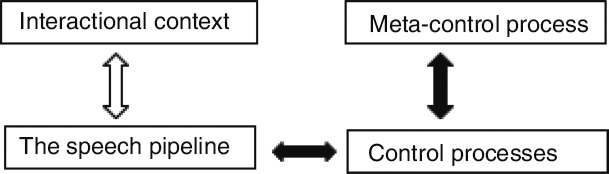
Speech comprehension and production are governed by control processes. We explore their nature and dynamics in bilingual speakers with a focus on speech production. Prior research indicates that individuals increase cognitive control in order to achieve a desired goal. In the adaptive control hypothesis we propose a stronger hypothesis: Language control processes themselves adapt to the recurrent demands placed on them by the interactional context. Adapting a control process means changing a parameter or parameters about the way it works (its neural capacity or efficiency) or the way it works in concert, or in cascade, with other control processes (e.g., its connectedness). We distinguish eight control processes (goal maintenance, conflict monitoring, interference suppression, salient cue detection, selective response inhibition, task disengagement, task engagement, opportunistic planning). We consider the demands on these processes imposed by three interactional contexts (single language, dual language, and dense code-switching). We predict adaptive changes in the neural regions and circuits associated with specific control processes. A dual-language context, for example, is predicted to lead to the adaptation of a circuit mediating a cascade of control processes that circumvents a control dilemma. Effective test of the adaptive control hypothesis requires behavioural and neuroimaging work that assesses language control in a range of tasks within the same individual.
Overview
CoChat Summary
TL;DR
The paper proposes the adaptive control hypothesis: bilingual language control processes themselves adapt to the recurrent demands of three interactional contexts—single-language, dual-language, and dense code-switching—by changing parameters such as neural capacity, efficiency, or coordination. It identifies eight control processes and predicts context-specific behavioural and neural adaptations, especially a dual-language adaptation that circumvents a control dilemma.
Key findings
- The paper distinguishes eight control processes: goal maintenance, conflict monitoring, interference suppression, salient cue detection, selective response inhibition, task disengagement, task engagement, and opportunistic planning.
- It contrasts three interactional contexts: single-language, dual-language, and dense code-switching. Table 1 indicates that single-language context increases demand on goal maintenance and interference control; dual-language context increases demand on goal maintenance, interference control, salient cue detection, selective response inhibition, task disengagement, and task engagement; dense code-switching increases demand on opportunistic planning.
- The hypothesis predicts that dual-language speakers adapt a cascade linking salient cue detection to selective response inhibition, task disengagement, and task engagement to circumvent the control dilemma in which suppression reduces flexibility to switch. Dense code-switching is predicted to adapt a left frontal–right cerebellar circuit for morphosyntactic integration, while single-language context is associated with left inferior regions for suppressing the nontarget language.
- No original quantitative results are reported; the paper is theoretical and offers illustrative behavioural and neuroimaging predictions.
Methods
- Theoretical/review paper with no participants or new empirical data; it proposes the adaptive control hypothesis and derives testable predictions.
- It synthesizes prior work on bilingual language control, cognitive control, neuroimaging, and neuropsychology, using three interactional contexts and eight control processes as an organizing framework.
- The main analysis is conceptual: a table of context-dependent demands and illustrative predictions for behavioural tasks (e.g., cued language switching, Stroop) and neural circuits; it calls for within-individual behavioural and neuroimaging tests across a range of tasks.
Limitations
- The authors state that their illustrative predictions may prove false and that there may be no systematic behavioural or neural differences as a function of interactional context.
- The authors acknowledge circular causation: interactional context may shape adaptive response, but individual differences in predispositions and genetic make-up constrain such effects; they assume individual variation in executive control and sociality is normally distributed.
- The text makes evident that the hypothesis is programmatic and untested in this paper; contexts are idealized, speakers may experience mixtures of contexts, and factors such as proficiency, sensitivity to interaction cost, neuropharmacology, and genetic variation may moderate predicted adaptations.
Model-written summary. Check it against the paper before relying on it.
Integrity signals
Registry
Cites
Statistics
Figures
Verification
Claims the paper makes
0 Valid · 0 Not valid · 30 Not checked · 57 Own results and interpretations
In the paper
“Strikingly, the use of more than one language appears to be a further important factor shaping individual performance on such tasks (e.g., Bialystok, Craik, Green, & Gollan, 2009, for a review).”
§ Language control in bilinguals: The adaptive control hypothesis > Abstract
What the sources say
- Not checked yetcites Bialystok, Craik, Green, & Gollan, 2009 matched to “Bilingual Minds” (2009) source
hedgedstates an association- Asserted: passes — The authors put it forward as true.
- Checkable: passes — It can be checked against evidence.
- Load-bearing: passes — The paper’s conclusions depend on it.
- Based: passes — The paper gives a reason why it holds.
A conclusion the paper draws from its own results — it cites no other source for it, so there is none to check. The quote shows it is in the paper.
In the paper
“In other words, any learning effects during the experiment should be observed earlier for speakers from an interactional context that is best suited to the experimental conditions.”
§ Language control in bilinguals: The adaptive control hypothesis > THE ADAPTIVE CONTROL HYPOTHESIS > Testing the adaptive control hypothesis
plainstates an association- Asserted: passes — The authors put it forward as true.
- Checkable: passes — It can be checked against evidence.
- Load-bearing: passes — The paper’s conclusions depend on it.
- Based: passes — The paper gives a reason why it holds.
In the paper
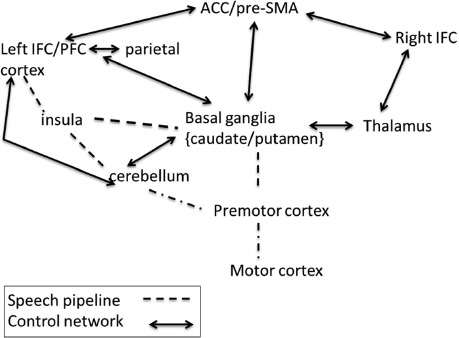
“acknowledged a role of the pre-SMA in initiating speech in language switching (see Luk et al., 2012, for further discussion).”
§ Language control in bilinguals: The adaptive control hypothesis > THE ADAPTIVE CONTROL HYPOTHESIS > Neuroimaging predictions
What the sources say
- Not checked yetcites Luk et al., 2012 matched to “Cognitive control for language switching in bilinguals: A quantitative meta-analysis of functional neuroimaging studies” (2012) source
plainstates an association- Asserted: passes — The authors put it forward as true.
- Checkable: passes — It can be checked against evidence.
- Load-bearing: unclear — It is unclear whether the paper’s conclusions depend on it.
- Based: passes — The paper gives a reason why it holds.
In the paper
“In Figure 2 we include a direct link between frontal cortex and the right cerebellum as a further circuit involved in language control (Fabbro, Moretti, & Bava, 2000).”
§ Language control in bilinguals: The adaptive control hypothesis > THE ADAPTIVE CONTROL HYPOTHESIS > Neuroimaging predictions
What the sources say
- Not checked yetcites Fabbro, Moretti, & Bava, 2000 matched to “Language impairments in patients with cerebellar lesions” (2000) source
plainstates an association- Asserted: passes — The authors put it forward as true.
- Checkable: passes — It can be checked against evidence.
- Load-bearing: passes — The paper’s conclusions depend on it.
- Based: passes — The paper gives a reason why it holds.
In the paper
“Reperfusion of the cerebellum reduces such symptoms (Marien, Engelborghs, Fabbro, & De Deyn, 2001).”
§ Language control in bilinguals: The adaptive control hypothesis > THE ADAPTIVE CONTROL HYPOTHESIS > Neuroimaging predictions
What the sources say
- Not checked yetcites Marien, Engelborghs, Fabbro, & De Deyn, 2001 matched to “The Lateralized Linguistic Cerebellum: A Review and a New Hypothesis” (2001) source
plainstates a cause- Asserted: passes — The authors put it forward as true.
- Checkable: passes — It can be checked against evidence.
- Load-bearing: unclear — It is unclear whether the paper’s conclusions depend on it.
- Based: passes — The paper gives a reason why it holds.
43 more claims
Create a free account to see all 87 claims and to verify the 30 references still open.
- Probably not a substantial claim. 23
- It may state two separate claims as one. 25
Claims other papers make about this one
Each is checked against this paper’s own text: does it say what the citing paper says it does?
In the citing paper
“Alternating between languages requires not only activation of words in the to-be-attended language but also inhibition of words in the language that should no longer be used (‘language control’; Green & Abutalebi, 2013).”
From Language proficiency drives listening-related fatigue in those who communicate in English as their second language (2026) · cites this paper as Green & Abutalebi, 2013
In the citing paper
“Previous work highlights the cognitive demands of switching between multiple languages within a conversation (Green & Abutalebi, 2013).”
From Language proficiency drives listening-related fatigue in those who communicate in English as their second language (2026) · cites this paper as Green & Abutalebi, 2013
Citations
Cites
Miyake, A., Friedman, N. P., Emerson, M. J., Witzki, A. H., Howerter, A., & Wager, T. D. (2000) · Cognitive Psychology · doi:10.1006/cogp.1999.0734 · Cited by 15,798
Clark, H. H. (1996) · doi:10.1017/cbo9780511620539 · Cited by 5,123
Conflict monitoring and anterior cingulate cortex: an update
Botvinick, M. M., Cohen, J. D., & Carter, C. S. (2004) · Trends in Cognitive Sciences · doi:10.1016/j.tics.2004.10.003 · Cited by 3,623
Anterior Cingulate Conflict Monitoring and Adjustments in Control
Kerns, J. G., Cohen, J. D., MacDonald, A. W., Cho, R. Y., Stenger, V. A., & Carter, C. S. (2004) · Science · doi:10.1126/science.1089910 · Cited by 2,891 · cited 4×
“In addition, there is a demand on frontal structures linked to conflict monitoring and interference suppression (e.g., Kerns et al., 2004) and to parietal regions (and frontal regions) associated with task changes.”
BackgroundInfluentialMental control of the bilingual lexico-semantic system
GREEN, D. W. (1998) · Bilingualism Language and Cognition · doi:10.1017/s1366728998000133 · Cited by 2,807
Self-citationUsing language: Communicative acts
Clark, H. H. (1996) · Cited by 2,721
Using language: Index of names
Clark, H. H. (1996) · Cited by 2,720
The variable nature of cognitive control: a dual mechanisms framework
Braver, T. S. (2012) · Trends in Cognitive Sciences · doi:10.1016/j.tics.2011.12.010 · Cited by 2,482 · cited 1×
“One way to recognise the interplay of these processes is to distinguish proactive control processes that establish a task goal from reactive control processes that limit interference with it (Braver, 2012).”
BackgroundInverted-U–Shaped Dopamine Actions on Human Working Memory and Cognitive Control
Cools, R., & D'Esposito, M. (2011) · Biological Psychiatry · doi:10.1016/j.biopsych.2011.03.028 · Cited by 1,673 · cited 2×
“Neuroimaging data also implicate distinct neural regions in task switching and interference control (e.g., Cools & D’Esposito, 2011).”
BackgroundBilingual language production: The neurocognition of language representation and control
Abutalebi, J., & Green, D. (2007) · Journal of Neurolinguistics · doi:10.1016/j.jneuroling.2006.10.003 · Cited by 1,302 · cited 2×
“In previous papers (e.g., Abutalebi & Green, 2007, 2008), we reviewed work showing that both cortical and subcortical structures are involved in language control and language switching (see Luk, Green, Abutalebi, & Grady, 2012, for a recent metaanalysis).”
BackgroundSelf-citation
Cited by
Items 1,401–1,500 of 2,166
Demirkan, E., & Branzi, F. M. (2025) · Human Brain Mapping · doi:10.1002/hbm.70415 · Cited by 1
Non-active voice in heritage Greek
Αλεξιάδου, Ά., & Rizou, V. (2025) · Oxford University Press eBooks · doi:10.1093/9780191987731.003.0009 · Cited by 1
Heritage languages and syntactic theory: An introduction
D’Alessandro, R., Putnam, M. T., & Terenghi, S. (2025) · Oxford University Press eBooks · doi:10.1093/9780191987731.003.0001 · Cited by 1
The shape and size of defective domains: Non-finite clauses in Pennsylvania Dutch
Putnam, M. T. (2025) · Oxford University Press eBooks · doi:10.1093/9780191987731.003.0010 · Cited by 1
Rinke, E., & Flores, C. M. M. (2025) · Oxford University Press eBooks · doi:10.1093/9780191987731.003.0004 · Cited by 1
Language mixing as a pedagogical tool for language learning: a methods development guide
Wigdorowitz, M., Vassiliu, C., Vogelzang, M., & Tsimpli, I. M. (2026) · Language Teaching Research · doi:10.1177/13621688261417934 · Cited by 1
Yang, R. (2020) · Journal of applied linguistics and language research · Cited by 1
Kechu, O., Som, B., Benites, L., & Maehara, R. (2024) · Poznań Studies in Contemporary Linguistics · doi:10.1515/psicl-2023-0015 · Cited by 1
Zhuang, K., Liang, X., Smallwood, J., Jefferies, E., & Vatansever, D. (2026) · Nature Communications · doi:10.1038/s41467-026-75841-9 · Cited by 1
How aging and bilingualism influence language processing: Theoretical and neural models
Rossi, E., & Diaz, M. T. (2017) · Studies in bilingualism · doi:10.1075/sibil.53.03ros · Cited by 1
Gao, F., He, Y., Lin, Y., Tang, S., Ning, Y., & Yuan, Z. (2026) · Bilingualism Language and Cognition · doi:10.1017/s1366728926101163 · Cited by 1
How emotional states modulate cognitive control strategies across language-switching contexts
Liu, S., Liu, D., Huang, J., Liu, L., Schwieter, J. W., & Chen, B. (2026) · Bilingualism Language and Cognition · doi:10.1017/s1366728926101345 · Cited by 1
The effect of different bilingual experiences on attentional control ability
Wang, C., Flemming, K., Cortiana, G., Lammert, J. M., Rafat, Y., Tao, S., & Joanisse, M. F. (2025) · International Journal of Bilingualism · doi:10.1177/13670069251335394 · Cited by 1
Bilingual Cognition: Language, Memory and Judgement
Filipović, L. (2019) · Cambridge University Press eBooks · doi:10.1017/9781108602235.006 · Cited by 1
Bilingualism Research: What We Know and What We Need to Know
Filipović, L. (2019) · Cambridge University Press eBooks · doi:10.1017/9781108602235.003 · Cited by 1
Action Time: CASP for Bilingualism at Work
Filipović, L. (2019) · Cambridge University Press eBooks · doi:10.1017/9781108602235.005 · Cited by 1
Grueso, S., Sánchez‐Benavides, G., Santos‐Santos, M., Subirats, L., Prados, F., Grau‐Rivera, O., & Calabria, M. (2026) · Journal of Alzheimer s Disease · doi:10.1177/13872877261469525 · Cited by 1
Fernander, P. (2023) · Open Access Victoria University of Wellington | Te Herenga Waka (Figshare) · doi:10.26686/wgtn.24452308 · Cited by 1
Cognitive Processes in Language Learning: Insights from Attention Network TheoryPreprint
Rashidi, N., & Dehbozorgfi, M. (2025) · Research Square · doi:10.21203/rs.3.rs-6681307/v1 · Cited by 1
Neuroimaging of Cognitive Reserve in Bilinguals
Gallo, F., & Abutalebi, J. (2025) · Cambridge University Press eBooks · doi:10.1017/9781009202336.004 · Cited by 1
Self-citationThe paradoxical associations between language and executive control in monolinguals and bilinguals
Sanchez-Azanza, V. A., Adrover‐Roig, D., Dash, T., & Ansaldo, A. I. (2025) · Bilingualism Language and Cognition · doi:10.1017/s1366728925100886 · Cited by 1
Zhu, J., Xie, X., Shao, J., & Zhang, C. (2026) · Second language Research · doi:10.1177/02676583261426782 · Cited by 1
Lexical color categories in balanced proficient bilinguals: the case of blue
Simoncelli, C., & Kihlstedt, M. (2025) · Bilingualism Language and Cognition · doi:10.1017/s1366728925100710 · Cited by 1
Brain potentials reveal how emotional arousal affects bilingual language control
Wang, T., Hu, H., Xu, H., Wang, X., Wang, Y., Yin, K., Chen, S., & Yang, Y. (2025) · Journal of Multilingual and Multicultural Development · doi:10.1080/01434632.2025.2526699 · Cited by 1
Aalders, E. M., Daum, M. M., & Wermelinger, S. (2025) · Bilingualism Language and Cognition · doi:10.1017/s1366728925100758 · Cited by 1
Examining language entropy and cognitive performance: evidence from a diverse linguistic context
Beniwal, U., & Singh, D. (2026) · Language and Cognition · doi:10.1017/langcog.2026.10059 · Cited by 1
Tosun, S., & Filipović, L. (2025) · Language Awareness · doi:10.1080/09658416.2025.2499589 · Cited by 1
Neural evidence for a bilingual advantage in conflict monitoring among Dai bilinguals
Yu, R., Zhang, J., Yang, F., & Lin, J. (2025) · Scientific Reports · doi:10.1038/s41598-025-31944-9 · Cited by 1
Choo, K. K., Wong, H. K., & Price, J. M. (2026) · Acta Psychologica · doi:10.1016/j.actpsy.2026.106706 · Cited by 1
The effects of time duration and bilingualism/trilingualism on second-language production
Hsu, H.-L. (2022) · Acta Linguistica Academica · doi:10.1556/2062.2022.00569 · Cited by 1
Behavioral and Neural Correlates of Bilingual Lexical Ambiguity
Whitford, V., & Guedea, E. L. (2020) · Cambridge University Press eBooks · doi:10.1017/9781316535967.010 · Cited by 1
Senaldi, M. S. G., Palma, P., INIESTA, A., & Titone, D. A. (2026) · Bilingualism Language and Cognition · doi:10.1017/s1366728926101059 · Cited by 1
Duan, X., Zhang, Y., Feng, Y., Cui, Y., Ji, T., Zhou, Y., & Yan, H. (2026) · Journal of Neurolinguistics · doi:10.1016/j.jneuroling.2026.101320 · Cited by 1
Rochanavibhata, S., & Atagi, N. (2025) · Frontiers in Developmental Psychology · doi:10.3389/fdpys.2025.1605723 · Cited by 1
Poarch, G. J., Hopp, H., Gastmann, F., Öwerdieck, D., & Schimke, S. (2026) · Journal of Cultural Cognitive Science · doi:10.1007/s41809-026-00201-4 · Cited by 1
Embracing a multilingual approach for assessment in multilingual people with aphasia
Goral, M. (2026) · Logopedics Phoniatrics Vocology · doi:10.1080/14015439.2026.2641477 · Cited by 1
Threshold effects of interactional context on attentional control
Li, M. K., Xu, Q., Shi, X., Zhang, S., & Li, J. (2026) · Frontiers in Psychology · doi:10.3389/fpsyg.2026.1836643 · Cited by 1
Blom, E., & van Witteloostuijn, M. (2026) · Journal of Experimental Child Psychology · doi:10.1016/j.jecp.2026.106486 · Cited by 1
Koch, I., Sánchez, L. M., Koch, C., Roembke, T. C., Philipp, A. M., & Declerck, M. (2026) · Bilingualism Language and Cognition · doi:10.1017/s1366728925100874 · Cited by 1
Two Languages in One Mind in the Classroom
Finger, I., & Weissheimer, J. (2024) · The American Journal of Psychology · doi:10.5406/19398298.137.2.11 · Cited by 1
Within-language and cross-languages prediction: Evidence from semantic classifier congruency
Tong, J., Koch, I., & Philipp, A. M. (2025) · International Journal of Bilingualism · doi:10.1177/13670069251353414 · Cited by 1
Wang, Y., Meng, Y., Yang, Q., & Wang, R. (2025) · Brain Sciences · doi:10.3390/brainsci15121288 · Cited by 1
Zhang, J., Fan, L., & Liu, J. (2024) · International Journal of Bilingual Education and Bilingualism · doi:10.1080/13670050.2024.2315979 · Cited by 1
Bilingualism and language control: From neurolinguistics to neuropsychology
Calabria, M. (2023) · Bilingual processing and acquisition · doi:10.1075/bpa.17.04cal · Cited by 1
Li, Z., Liu, C., Pan, X., Ding, G., & Wang, R. (2025) · Bilingualism Language and Cognition · doi:10.1017/s1366728925000185 · Cited by 1
Fluctuating cognitive benefits in children attending early bilingual immersive instruction
Barbu, C., Gillet, S., & Poncelet, M. (2024) · Journal of Immersion and Content-Based Language Education · doi:10.1075/jicb.22020.cri · Cited by 1
The Effects of Language on Cognitive Flexibility and Related Properties of Executive Functioning
Hildenbrand, L. (2020) · Cited by 1
Sulier, N., Torres, J., & Kroll, J. F. (2026) · PLoS ONE · doi:10.1371/journal.pone.0346505 · Cited by 1
Rosa, P. A. D., Videsott, G., Borsa, V. M., Catricalà, E., Pecco, N., Alemanno, F., Canini, M., Falini, A., Franceschini, R., & Abutalebi, J. (2025) · Brain Sciences · doi:10.3390/brainsci15010054 · Cited by 1
Self-citationCognitive and memory-related effects of child multilingualism
Blom, E. (2020) · Springer eBooks · doi:10.1007/978-3-658-20285-9_16 · Cited by 1
Acevedo-Molina, M. C., Hernández, D. A., Deffner, A. M., Andrews‐Hanna, J. R., Ruiz, J. M., & Grilli, M. D. (2025) · Journal of the International Neuropsychological Society · doi:10.1017/s1355617725000141 · Cited by 1
Zhang, X., Zheng, B., & Wu, Y. J. (2025) · Applied Psycholinguistics · doi:10.1017/s014271642510009x · Cited by 1
Chan, A. S.-L., & Kroll, J. F. (2026) · Journal of Memory and Language · doi:10.1016/j.jml.2026.104782 · Cited by 1
Towards an Equitable Approach to Multilingual Language Assessment in Dementia Care
Europa, E., Mamuyac, E., Bondoc, I. P., Costales, A. A., Santos, B., Olarte, J. A. A., & de Leon, J. (2026) · Topics in Language Disorders · doi:10.1097/tld.0000000000000387 · Cited by 1
Brain potentials reveal activation and inhibition of the non-target L2 in bilinguals’ L1 context
Yang, S., Jiang, S., & Jiang, M. (2025) · International Journal of Bilingualism · doi:10.1177/13670069251384055 · Cited by 1
Cerebellar engagement for narrative comprehension in Chinese-English bilinguals
Tang, C., Li, H., Zhang, J., Yang, M., Chen, J., Liu, L., Tang, X., Yue, Y., Lei, Y., Liu, L., et al. (2025) · Cortex · doi:10.1016/j.cortex.2025.09.015 · Cited by 1
Effect of Bilingualism on Intelligence and Academic Achievement of EFL Learners
Jumani, S., Maqbool, S., & Alphonce, A. (2024) · PAKISTAN LANGUAGES AND HUMANITIES REVIEW · doi:10.47205/plhr.2024(8-i)17 · Cited by 1
Revniuk, V. (2024) · Acta Academiae Beregsasiensis Philologica · doi:10.58423/2786-6726/2024-2-109-127 · Cited by 1
Relationship between Bilingual Experience and Cognitive Control of Bilingual Children
Gong, X., Aktan‐Erciyes, A., & Karadöller, D. Z. (2024) · Dilbilim Araştırmaları Dergisi · doi:10.18492/dad.1463075 · Cited by 1
Multilingual children’s language socialization in central Mali
Cissé, I. A. H. (2024) · Oxford University Press eBooks · doi:10.1093/oso/9780198736516.003.0029 · Cited by 1
Multilingual people and monolingual perceptions
Goodchild, S. (2024) · Oxford University Press eBooks · doi:10.1093/oso/9780198736516.003.0032 · Cited by 1
Biagui, N. B., Nunez, J. J.-F., & Quint, N. (2024) · Oxford University Press eBooks · doi:10.1093/oso/9780198736516.003.0006 · Cited by 1
Switching cost and cognate facilitation between two signed languages
Adam, R., & Morford, J. P. (2026) · Frontiers in Language Sciences · doi:10.3389/flang.2025.1722425 · Cited by 1
Emotional words differentially influence language control in bilinguals: An fMRI study
Liu, W., Liu, H., Xing, Z., & Schwieter, J. W. (2026) · Acta Psychologica · doi:10.1016/j.actpsy.2026.107500 · Cited by 1
Relations among degree of bilingualism and bilateral information processing in children and adults
Sierra, F. J., Weimer, A. A., Lin, Y.-C., Jou, J., Castillo, N., Garcia, C., Suarez, M., Garcia, F. I., Aleman, G., Ortiz, E., et al. (2024) · International Journal of Bilingualism · doi:10.1177/13670069241277499 · Cited by 1
Effects of Italian/English bilingual education on cognitive development: A pilot study
Oberc, K. A., Vettori, G., Bigozzi, L., & Filippi, R. (2025) · International Journal of Bilingualism · doi:10.1177/13670069251358100 · Cited by 1
Lv, C., Liu, H., & Chen, J. (2025) · International Journal of Multilingualism · doi:10.1080/14790718.2025.2542511 · Cited by 1
The aftermath of second language sentence production on the first language
Stolle, S. I., Showole, A. M., Vanderstraeten, L., & Declerck, M. (2025) · Bilingualism Language and Cognition · doi:10.1017/s1366728925100205 · Cited by 1
La variation copule/clitique sujet en romani du Mexique au contact de ser et estar de l'espagnol
Padure, C. (2019) · theses.fr (ABES) · doi:10.70675/e8d61dfaz2d78z4540z988aze895b169147e · Cited by 1
Wang, Y., Liu, K., Fang, Y., & Liu, X. (2026) · Current Psychology · doi:10.1007/s12144-026-09606-4 · Cited by 1
Language Rights for Minorities and the Right to Code-Switch in the United States Workplace
Faingold, E. D. (2022) · Emerald Group Publishing Limited eBooks · doi:10.1108/978-1-64802-770-320251002 · Cited by 1
Mishra, K. K., & Asthana, H. S. (2026) · Cognitive Processing · doi:10.1007/s10339-026-01354-4 · Cited by 1
Bilinguale Interaktion beim Peer-Learning in der Grundschule
Schastak, M. (2020) · Directory of Open access Books (OAPEN Foundation) · Cited by 1
Correlação entre fatores de experiência linguística bilíngue e controle inibitório
Koch, R., & Fontes, A. B. A. D. L. (2018) · Letras de Hoje · doi:10.15448/1984-7726.2018.1.28691 · Cited by 1
BILINGUALISM AND COGNITIVE FLEXIBILITY: EXAMINING THE NEURAL CORRELATES
Gurbanova, A. (2025) · Scientific notes of V I Vernadsky Taurida National University Series Philology Journalism · doi:10.32782/2710-4656/2025.2.2/14 · Cited by 1
A longitudinal study on lexical accessibility and executive control in adult bilinguals
Heimann, J. (2023) · White Rose eTheses Online (University of Leeds, The University of Sheffield, University of York) · Cited by 1
Language usage shapes neural mechanisms of code-switching
Theron-Grimaldi, S., & Božić, M. (2026) · Frontiers in Psychology · doi:10.3389/fpsyg.2026.1959633 · Cited by 1
Sheehan, A., Saddy, D., Krivochen, D. G., Gupta, S., Sibsey, M., & Pliatsikas, C. (2026) · Scientific Reports · doi:10.1038/s41598-026-42094-x · Cited by 1
Language Experience Shapes Creative Idea Generation
Fernández-Duque, M., Chung-Fat-Yim, A., & Marian, V. (2026) · The Journal of Creative Behavior · doi:10.1002/jocb.70128 · Cited by 1
Alexander, K. V., & Alcón, D. (2024) · Oxford University Press eBooks · doi:10.1093/oso/9780198736516.003.0031 · Cited by 1
McLaughlin, F. (2024) · Oxford University Press eBooks · doi:10.1093/oso/9780198736516.003.0025 · Cited by 1
Genetically motivated clusters within Atlantic
Childs, G. T. (2024) · Oxford University Press eBooks · doi:10.1093/oso/9780198736516.003.0003 · Cited by 1
Palapanidi, K. (2025) · Educational linguistics · doi:10.1007/978-3-031-99435-7_8 · Cited by 1
Bilingual false recognition: Examining inferences and language tagging in the dual-language context
Yurtsever, A., Göksun, T., & Gülgöz, S. (2024) · International Journal of Bilingualism · doi:10.1177/13670069241252522 · Cited by 1
Beyond typical learning: Variation in language experience as a lens to the developing mind
Kroll, J. F., Tabori, A. T., & Mech, E. N. (2017) · Applied Psycholinguistics · doi:10.1017/s0142716417000315 · Cited by 1
Adaptation and Validation of the Bilingual Code-Switching Profile Into Kannada
Sahana, K., Narasimhan, S. V., & Yashaswini, G. (2025) · Journal of Speech Language and Hearing Research · doi:10.1044/2025_jslhr-24-00214 · Cited by 1
Lallier, M., Rius-Manau, C., & Carrión-Castillo, A. (2026) · bioRxiv (Cold Spring Harbor Laboratory) · doi:10.64898/2026.04.07.716864 · Cited by 1
Dumrukcic, N., & Kotzor, S. (2024) · Heliyon · doi:10.1016/j.heliyon.2024.e24896 · Cited by 1
Brini, S. (2020) · Murdoch University Research Portal · Cited by 1
Control of Language in Bilingual Speakers with and without Aphasia
Mooijman, S. (2024) · MPG.PuRe (Max Planck Society) · Cited by 1
Cognitive control processes and their neural bases in bilingualism
Heidlmayr, K. D.-M. (2015) · theses.fr (ABES) · doi:10.70675/c48825ddz4d6fz4953zb454zd7404670e67c · Cited by 1
Tabari, F. (2020) · Hispana · Cited by 1
Bilingual lexical and semantic representation of numbers
LACHELIN, R. (2024) · Open Repository and Bibliography (University of Luxembourg) · Cited by 1
Development of executive functions in simultaneous interpreting training: A theoretical exploration
Yang, S., Orlando, M., Kruger, J., & Batchelor, J. (2025) · Interpreting and Society · doi:10.1177/27523810251378277 · Cited by 1
Modulatory factors of grammar learning in second and third languages
Rivera Zurita, M. (2023) · Institutional Repository of the University of Granada (University of Granada) · Cited by 1
Ezzedine, N. (2023) · theses.fr (ABES) · doi:10.70675/9d219e01z21a6z4f0azba4cz7fba7a417efb · Cited by 1
Sharaan, S. (2021) · ERA · doi:10.7488/era/1078 · Cited by 1
Aspects of bilingual language development of Dutch children in Sydney
Janabi, M. (2021) · The Sydney eScholarship Repository (The University of Sydney) · Cited by 1
Language and Literacy Development as Revealed Through the Bilingual Brain
Wagley, N. (2019) · Deep Blue (University of Michigan) · Cited by 1
Metacognitive processes in bilingual second language learners
Reyes Sánchez, M. (2024) · Institutional Repository of the University of Granada (University of Granada) · Cited by 1
Metadata
- Authors
- Green, D. W., & Abutalebi, J.
- Affiliations
- University College London (GB)
- Vita-Salute San Raffaele University (IT)
- Corresponding author
- Green, David W.
- Venue
- Journal of Cognitive Psychology
- Publisher
- Informa UK Limited
- Published
- 2013-05-24
- Volume
- 25
- Issue
- 5
- Pages
- 515-530
- ISSN
- 2044-5911 (ISSN-L)
- 2044-592X
- PMC
- PMC4095950
- OpenAlex
- W2128442137
- Cited by
- 2,163
- References
- 62
- Citations by year
- 2026: 264 · 2025: 271 · 2024: 222 · 2023: 211 · 2022: 197 · 2021: 160 · 2020: 154 · 2019: 254 · 2018: 164 · 2017: 90 · 2016: 82 · 2015: 61 · 2014: 27 · 2013: 3
- FWCI
- 21.17
- Type
- journal article
- Language
- en
- Open access
- hybrid
- doi.org
- Licence
- cc-by
- Locations
- Journal of Cognitive Psychology (publishedVersion, cc-by)
- PubMed Central (publishedVersion, cc-by)
- Europe PMC (PubMed Central) (publishedVersion, cc-by)
- PubMed (publishedVersion)
- UCL Discovery (University College London) (submittedVersion)
- Archivio Istituzionale della Ricerca - Università Vita-Salute San Raffaele (submittedVersion)
- Topics
- Life Sciences › Neuroscience › Cognitive Neuroscience › Neurobiology of Language and Bilingualism
- Social Sciences › Psychology › Developmental and Educational Psychology › Language Development and Disorders
- Life Sciences › Neuroscience › Cognitive Neuroscience › Neural and Behavioral Psychology Studies
- Keywords
- language control, bilingualism, cognitive control, speech production, code-switching, control processes, interference suppression, conflict monitoring, task disengagement, task engagement, goal maintenance, opportunistic planning, neural circuits
About these checks
Registry, retraction, Cites and statistics results are computed, not judged, with one exception: a printed reference that no index lists is read once by a model before it counts as a citation error. Claims are extracted by a model and kept only when their quote appears verbatim in the text; each cited source is then checked, with a model’s help, for whether it says what the claim relies on. Those verdicts can be wrong — read the claim’s quote and the cited source before relying on one.
A language model drew the claims from the paper on 2026-11-24, under version 3 of the claim definition (model deepseek-v4.1-flash, prompt extract-v3).
A second model labelled each claim on 2026-11-24 (model jev-1.13-20260917, definition revision gold-guideline-v0.2).
Statistics and arithmetic are recomputed, not judged.
Confidence bands are shown only for fields calibrated on our annotated test set. None is calibrated yet, so no band is shown.
What counts as a claim ›How we measure confidence ›How we check this ›
Are you an author, or do you see a problem with this page? Request a review
Data sources
Bibliographic data: Semantic Scholar, OpenAlex, Crossref.
Contains information from the Semantic Scholar Academic Graph Datasets, made available under the ODC Attribution License (ODC-BY 1.0).
Semantic Scholar’s data is described in: Kinney, R., et al. (2023). The Semantic Scholar Open Data Platform. arXiv:2301.10140.
