

Language control in bilinguals: The adaptive control hypothesis
Open accessThe DOI matches its Crossref record; 62 of the 62 references it cites were found in a registry or an index; none of the 36 sources its claims cite is checked for support yet.
Abstract
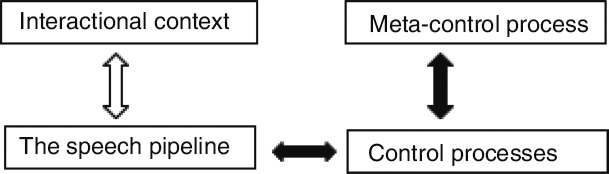
Speech comprehension and production are governed by control processes. We explore their nature and dynamics in bilingual speakers with a focus on speech production. Prior research indicates that individuals increase cognitive control in order to achieve a desired goal. In the adaptive control hypothesis we propose a stronger hypothesis: Language control processes themselves adapt to the recurrent demands placed on them by the interactional context. Adapting a control process means changing a parameter or parameters about the way it works (its neural capacity or efficiency) or the way it works in concert, or in cascade, with other control processes (e.g., its connectedness). We distinguish eight control processes (goal maintenance, conflict monitoring, interference suppression, salient cue detection, selective response inhibition, task disengagement, task engagement, opportunistic planning). We consider the demands on these processes imposed by three interactional contexts (single language, dual language, and dense code-switching). We predict adaptive changes in the neural regions and circuits associated with specific control processes. A dual-language context, for example, is predicted to lead to the adaptation of a circuit mediating a cascade of control processes that circumvents a control dilemma. Effective test of the adaptive control hypothesis requires behavioural and neuroimaging work that assesses language control in a range of tasks within the same individual.
Overview
CoChat Summary
TL;DR
The paper proposes the adaptive control hypothesis: bilingual language control processes themselves adapt to the recurrent demands of three interactional contexts—single-language, dual-language, and dense code-switching—by changing parameters such as neural capacity, efficiency, or coordination. It identifies eight control processes and predicts context-specific behavioural and neural adaptations, especially a dual-language adaptation that circumvents a control dilemma.
Key findings
- The paper distinguishes eight control processes: goal maintenance, conflict monitoring, interference suppression, salient cue detection, selective response inhibition, task disengagement, task engagement, and opportunistic planning.
- It contrasts three interactional contexts: single-language, dual-language, and dense code-switching. Table 1 indicates that single-language context increases demand on goal maintenance and interference control; dual-language context increases demand on goal maintenance, interference control, salient cue detection, selective response inhibition, task disengagement, and task engagement; dense code-switching increases demand on opportunistic planning.
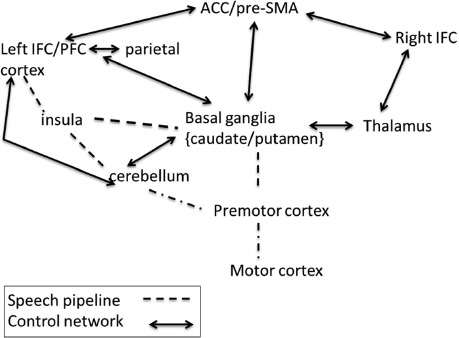
- The hypothesis predicts that dual-language speakers adapt a cascade linking salient cue detection to selective response inhibition, task disengagement, and task engagement to circumvent the control dilemma in which suppression reduces flexibility to switch. Dense code-switching is predicted to adapt a left frontal–right cerebellar circuit for morphosyntactic integration, while single-language context is associated with left inferior regions for suppressing the nontarget language.
- No original quantitative results are reported; the paper is theoretical and offers illustrative behavioural and neuroimaging predictions.
Methods
- Theoretical/review paper with no participants or new empirical data; it proposes the adaptive control hypothesis and derives testable predictions.
- It synthesizes prior work on bilingual language control, cognitive control, neuroimaging, and neuropsychology, using three interactional contexts and eight control processes as an organizing framework.
- The main analysis is conceptual: a table of context-dependent demands and illustrative predictions for behavioural tasks (e.g., cued language switching, Stroop) and neural circuits; it calls for within-individual behavioural and neuroimaging tests across a range of tasks.
Limitations
- The authors state that their illustrative predictions may prove false and that there may be no systematic behavioural or neural differences as a function of interactional context.
- The authors acknowledge circular causation: interactional context may shape adaptive response, but individual differences in predispositions and genetic make-up constrain such effects; they assume individual variation in executive control and sociality is normally distributed.
- The text makes evident that the hypothesis is programmatic and untested in this paper; contexts are idealized, speakers may experience mixtures of contexts, and factors such as proficiency, sensitivity to interaction cost, neuropharmacology, and genetic variation may moderate predicted adaptations.
Model-written summary. Check it against the paper before relying on it.
Integrity signals
Registry
Cites
Statistics
Figures
Verification
Claims the paper makes
0 Valid · 0 Not valid · 30 Not checked · 57 Own results and interpretations
In the paper
“Strikingly, the use of more than one language appears to be a further important factor shaping individual performance on such tasks (e.g., Bialystok, Craik, Green, & Gollan, 2009, for a review).”
§ Language control in bilinguals: The adaptive control hypothesis > Abstract
What the sources say
- Not checked yetcites Bialystok, Craik, Green, & Gollan, 2009 matched to “Bilingual Minds” (2009) source
hedgedstates an association- Asserted: passes — The authors put it forward as true.
- Checkable: passes — It can be checked against evidence.
- Load-bearing: passes — The paper’s conclusions depend on it.
- Based: passes — The paper gives a reason why it holds.
A conclusion the paper draws from its own results — it cites no other source for it, so there is none to check. The quote shows it is in the paper.
In the paper
“In other words, any learning effects during the experiment should be observed earlier for speakers from an interactional context that is best suited to the experimental conditions.”
§ Language control in bilinguals: The adaptive control hypothesis > THE ADAPTIVE CONTROL HYPOTHESIS > Testing the adaptive control hypothesis
plainstates an association- Asserted: passes — The authors put it forward as true.
- Checkable: passes — It can be checked against evidence.
- Load-bearing: passes — The paper’s conclusions depend on it.
- Based: passes — The paper gives a reason why it holds.
In the paper
“acknowledged a role of the pre-SMA in initiating speech in language switching (see Luk et al., 2012, for further discussion).”
§ Language control in bilinguals: The adaptive control hypothesis > THE ADAPTIVE CONTROL HYPOTHESIS > Neuroimaging predictions
What the sources say
- Not checked yetcites Luk et al., 2012 matched to “Cognitive control for language switching in bilinguals: A quantitative meta-analysis of functional neuroimaging studies” (2012) source
plainstates an association- Asserted: passes — The authors put it forward as true.
- Checkable: passes — It can be checked against evidence.
- Load-bearing: unclear — It is unclear whether the paper’s conclusions depend on it.
- Based: passes — The paper gives a reason why it holds.
In the paper
“In Figure 2 we include a direct link between frontal cortex and the right cerebellum as a further circuit involved in language control (Fabbro, Moretti, & Bava, 2000).”
§ Language control in bilinguals: The adaptive control hypothesis > THE ADAPTIVE CONTROL HYPOTHESIS > Neuroimaging predictions
What the sources say
- Not checked yetcites Fabbro, Moretti, & Bava, 2000 matched to “Language impairments in patients with cerebellar lesions” (2000) source
plainstates an association- Asserted: passes — The authors put it forward as true.
- Checkable: passes — It can be checked against evidence.
- Load-bearing: passes — The paper’s conclusions depend on it.
- Based: passes — The paper gives a reason why it holds.
In the paper
“Reperfusion of the cerebellum reduces such symptoms (Marien, Engelborghs, Fabbro, & De Deyn, 2001).”
§ Language control in bilinguals: The adaptive control hypothesis > THE ADAPTIVE CONTROL HYPOTHESIS > Neuroimaging predictions
What the sources say
- Not checked yetcites Marien, Engelborghs, Fabbro, & De Deyn, 2001 matched to “The Lateralized Linguistic Cerebellum: A Review and a New Hypothesis” (2001) source
plainstates a cause- Asserted: passes — The authors put it forward as true.
- Checkable: passes — It can be checked against evidence.
- Load-bearing: unclear — It is unclear whether the paper’s conclusions depend on it.
- Based: passes — The paper gives a reason why it holds.
43 more claims
Create a free account to see all 87 claims and to verify the 30 references still open.
- Probably not a substantial claim. 23
- It may state two separate claims as one. 25
Claims other papers make about this one
Each is checked against this paper’s own text: does it say what the citing paper says it does?
In the citing paper
“Alternating between languages requires not only activation of words in the to-be-attended language but also inhibition of words in the language that should no longer be used (‘language control’; Green & Abutalebi, 2013).”
From Language proficiency drives listening-related fatigue in those who communicate in English as their second language (2026) · cites this paper as Green & Abutalebi, 2013
In the citing paper
“Previous work highlights the cognitive demands of switching between multiple languages within a conversation (Green & Abutalebi, 2013).”
From Language proficiency drives listening-related fatigue in those who communicate in English as their second language (2026) · cites this paper as Green & Abutalebi, 2013
Citations
Cites
Miyake, A., Friedman, N. P., Emerson, M. J., Witzki, A. H., Howerter, A., & Wager, T. D. (2000) · Cognitive Psychology · doi:10.1006/cogp.1999.0734 · Cited by 15,798
Clark, H. H. (1996) · doi:10.1017/cbo9780511620539 · Cited by 5,123
Conflict monitoring and anterior cingulate cortex: an update
Botvinick, M. M., Cohen, J. D., & Carter, C. S. (2004) · Trends in Cognitive Sciences · doi:10.1016/j.tics.2004.10.003 · Cited by 3,623
Anterior Cingulate Conflict Monitoring and Adjustments in Control
Kerns, J. G., Cohen, J. D., MacDonald, A. W., Cho, R. Y., Stenger, V. A., & Carter, C. S. (2004) · Science · doi:10.1126/science.1089910 · Cited by 2,891 · cited 4×
“In addition, there is a demand on frontal structures linked to conflict monitoring and interference suppression (e.g., Kerns et al., 2004) and to parietal regions (and frontal regions) associated with task changes.”
BackgroundInfluentialMental control of the bilingual lexico-semantic system
GREEN, D. W. (1998) · Bilingualism Language and Cognition · doi:10.1017/s1366728998000133 · Cited by 2,807
Self-citationUsing language: Communicative acts
Clark, H. H. (1996) · Cited by 2,721
Using language: Index of names
Clark, H. H. (1996) · Cited by 2,720
The variable nature of cognitive control: a dual mechanisms framework
Braver, T. S. (2012) · Trends in Cognitive Sciences · doi:10.1016/j.tics.2011.12.010 · Cited by 2,482 · cited 1×
“One way to recognise the interplay of these processes is to distinguish proactive control processes that establish a task goal from reactive control processes that limit interference with it (Braver, 2012).”
BackgroundInverted-U–Shaped Dopamine Actions on Human Working Memory and Cognitive Control
Cools, R., & D'Esposito, M. (2011) · Biological Psychiatry · doi:10.1016/j.biopsych.2011.03.028 · Cited by 1,673 · cited 2×
“Neuroimaging data also implicate distinct neural regions in task switching and interference control (e.g., Cools & D’Esposito, 2011).”
BackgroundBilingual language production: The neurocognition of language representation and control
Abutalebi, J., & Green, D. (2007) · Journal of Neurolinguistics · doi:10.1016/j.jneuroling.2006.10.003 · Cited by 1,302 · cited 2×
“In previous papers (e.g., Abutalebi & Green, 2007, 2008), we reviewed work showing that both cortical and subcortical structures are involved in language control and language switching (see Luk, Green, Abutalebi, & Grady, 2012, for a recent metaanalysis).”
BackgroundSelf-citation
Cited by
Items 1,601–1,700 of 2,166
Mannesa, M. N. H. I. S., & Kusrohmaniah, S. (2026) · Journal of Monolingual and Bilingual Speech · doi:10.3138/jmbs-2025-0012
The Modular Cognition Framework
Truscott, J., & Smith, M. S. (2019) · Bilingual processing and acquisition · doi:10.1075/bpa.8.c2
Papafragou, A., Trueswell, J. C., & Gleitman, L. R. (2022) · Oxford University Press eBooks · doi:10.1093/oxfordhb/9780198845003.013.29
Control as inherently internal context: Part I. Goals, value, and emotion as controllers
Truscott, J., & Smith, M. S. (2019) · Bilingual processing and acquisition · doi:10.1075/bpa.8.c7
Yoruk-Sevincli, A., & Yahya, M. (2021) · Nesne Psikoloji Dergisi · doi:10.7816/nesne-09-21-13
Bilingualism and dementia: neural mechanisms and implications for cognitive reserve
Marín-Marín, L. (2022) · Tesis Doctorals en Xarxa (Consorci de Serveis Universitaris de Catalunya) · doi:10.6035/14109.2022.534026
Chen, S., Cao, R., & Cheng, S. (2026) · Behavioral Sciences · doi:10.3390/bs16091486
Truscott, J., & Smith, M. S. (2019) · Bilingual processing and acquisition · doi:10.1075/bpa.8.c5
Whittaker, J. V., Stephens, C., DeCoster, J., Pianta, R. C., Vitiello, V. E., & Ramirez, E. (2026) · Journal of Applied Developmental Psychology · doi:10.1016/j.appdev.2026.101963
Language switching and domain-general control in interpreters
Nour, S., & Struys, E. (2023) · Frontiers in Language Sciences · doi:10.3389/flang.2023.1054126
(2022) · Oxford University Press eBooks · doi:10.1093/oxfordhb/9780198845003.002.0088
Herschensohn, J. (2022) · Bilingual processing and acquisition · doi:10.1075/bpa.15.index
Herschensohn, J. (2022) · Bilingual processing and acquisition · doi:10.1075/bpa.15.ack
Mishra, R. K. (2018) · Springer eBooks · doi:10.1007/978-3-319-92513-4_5
Cabrera-Ontiveros, T. I., García-Cárdenas, D. E., Ramírez, C. I. L., Abarca-Castro, E. A., Talavera-Peña, A. K., & Lagos, J. J. R. (2026) · Cognitive Processing · doi:10.1007/s10339-026-01392-y
Saito, K., Suzukida, Y., Hu, R., Hosaka, I., Magne, V., & Tierney, A. (2025) · SSRN Electronic Journal · doi:10.2139/ssrn.5896814
From the spatial ego to cognitive control: Ellen Bialystok’s early work, 1976–1988
Guerrero, S. L., & Luk, G. (2023) · Studies in bilingualism · doi:10.1075/sibil.64.02leo
The impact of age of onset on bilinguals’ task switching performance in a nonimmigration context
Alipour, J., Safavizade, A. M., & Hashemian, M. (2023) · Journal of Monolingual and Bilingual Speech · doi:10.1558/jmbs.23808
Cognitive Flexibility and Bilingual Language Switching: An fMRI Meta‐Analysis
Chuikova, Z. V., Faber, A., Abutalebi, J., Filatov, A. A., Юрьевич, Ш. Ю., & Myachykov, A. V. (2026) · European Journal of Neuroscience · doi:10.1111/ejn.70591
Self-citationA Review of the Impact of Language Context on Cognitive Control in Bilinguals
姚, 建. (2025) · Advances in Psychology · doi:10.12677/ap.2025.154209
Ger, E., Cibien, S., & Roebers, C. M. (2025) · Applied Cognitive Psychology · doi:10.1002/acp.70073
Consciousness and internal context
Truscott, J., & Smith, M. S. (2019) · Bilingual processing and acquisition · doi:10.1075/bpa.8.c11
Control as inherently internal context: Part II. Self as controller
Truscott, J., & Smith, M. S. (2019) · Bilingual processing and acquisition · doi:10.1075/bpa.8.c8
What Goes on in a Bilingual Mind? The Core Cognitive Mechanisms
Mishra, R. K. (2018) · Springer eBooks · doi:10.1007/978-3-319-92513-4_3
Outside in: External sources of internal context
Truscott, J., & Smith, M. S. (2019) · Bilingual processing and acquisition · doi:10.1075/bpa.8.c3
Attention, Vision and Control in Bilinguals
Mishra, R. K. (2018) · Springer eBooks · doi:10.1007/978-3-319-92513-4_7
(2022) · Oxford University Press eBooks · doi:10.1093/oxfordhb/9780198845003.002.0006
Truscott, J., & Smith, M. S. (2019) · Bilingual processing and acquisition · doi:10.1075/bpa.8.ni
Truscott, J., & Smith, M. S. (2019) · Bilingual processing and acquisition · doi:10.1075/bpa.8.c4
Privitera, A. J., Han, J., Han, K., Yee, J., & Yin, Y. (2026) · Frontiers in Psychology · doi:10.3389/fpsyg.2026.1905413
Learning words amidst speech sound variability
Creel, S. C. (2022) · Oxford University Press eBooks · doi:10.1093/oxfordhb/9780198845003.013.7
Bilingualism predicts executive function resilience after COVID-19 in aging
Grundy, J. G., & Pujols-Beltran, M. (2026) · Proceedings of the National Academy of Sciences · doi:10.1073/pnas.2532470123
Ge, H., Wu, R., & Zhang, C. (2026) · Research in Autism · doi:10.1016/j.reia.2026.203012
Investigating Language to Understand the Mind
Bialystok, E. (2024) · The American Journal of Psychology · doi:10.5406/19398298.137.2.03
Truscott, J., & Smith, M. S. (2019) · Bilingual processing and acquisition · doi:10.1075/bpa.8.prelim
Introduction: Language acquisition, competence and performance
Herschensohn, J. (2022) · Bilingual processing and acquisition · doi:10.1075/bpa.15.intro
The biscriptual advantage in graphomotor control : behavioral and neurophysiological investigations
Alhaddad, G. (2024) · theses.fr (ABES) · doi:10.70675/2e9ecc92z5030z4e90z8b5dz6ae19fd3b48f
Simultaneous crib bilingual development and processing
Herschensohn, J. (2022) · Bilingual processing and acquisition · doi:10.1075/bpa.15.c4
(2020) · Verlag Barbara Budrich eBooks · doi:10.3224/84742378a
Αλεξιάδου, Ά. (2022) · Oxford University Press eBooks · doi:10.1093/oxfordhb/9780198845003.013.2
Bilingualism and cognitive reserve: It’s a matter of top-down or bottom-up process
Boutris, P., Rees, J., Bevan, B., & Izura, C. (2020) · Yearbook of the Poznan Linguistic Meeting · doi:10.14746/yplm.2020.6.5
Biedermann, B., Beyersmann, E., Blosfelds, M., Macapagal, C., Rosevear, A., & Marinovic, W. (2024) · Frontiers in Language Sciences · doi:10.3389/flang.2024.1482861
Truscott, J., & Smith, M. S. (2019) · Bilingual processing and acquisition · doi:10.1075/bpa.8.gi
Holistic resource-rational analysis
Haas, J., & Klein, C. (2020) · Behavioral and Brain Sciences · doi:10.1017/s0140525x19001493
Truscott, J., & Smith, M. S. (2019) · Bilingual processing and acquisition · doi:10.1075/bpa.8.ref
Stojnić, G., & Lepore, E. (2022) · Oxford University Press eBooks · doi:10.1093/oxfordhb/9780198845003.013.20
Monolingual development and processing in children and adults
Herschensohn, J. (2022) · Bilingual processing and acquisition · doi:10.1075/bpa.15.c3
Sequential early child bilingual development and processing
Herschensohn, J. (2022) · Bilingual processing and acquisition · doi:10.1075/bpa.15.c5
Exploring the cognitive interplay between multilingualism, inhibitory control and mind wandering
Xu, Z., Bonifacci, P., & Filippi, R. (2026) · Bilingualism Language and Cognition · doi:10.1017/s1366728926101035
Zheng, Z., Yan, L., & Shen, Y. (2026) · Education Sciences · doi:10.3390/educsci16081243
Gangopadhyay, I., Banerjee, S., & Johnson, R. E. (2026) · Perspectives of the ASHA Special Interest Groups · doi:10.1044/2026_persp-25-00283
Kubo, R., Nishimoto, S., & Nakai, T. (2025) · bioRxiv (Cold Spring Harbor Laboratory) · doi:10.1101/2025.06.17.660057
Brain-LLM Alignment Tracks Training Data, Not TypologyPreprint
Guo, D., Wu, J., & Yiu, S. (2026) · arXiv · doi:10.48550/arxiv.2605.23032
Cui, Y., Sun, J., Sun, Y., Wang, Y., Zhang, Y., Li, J., Wang, S., Zhou, H., Hale, J., Zong, C., et al. (2026) · arXiv · doi:10.48550/arxiv.2604.10627
Thomas, E., Som, B., & Shrivastava, A. (2026) · International Journal of Bilingualism · doi:10.2139/ssrn.5153079
Zhang, Y. (2023) · Lecture Notes in Education Psychology and Public Media · doi:10.54254/2753-7048/20/20231475
Abutalebi, J., Bellini, C., Gallo, F., & Maschio, N. D. (2024) · Elsevier eBooks · doi:10.1016/b978-0-12-820480-1.00124-8
Self-citationHow bilingualism shapes (or does not) the socio-cognitive skills of autistic and neurotypical adultsPreprint
Digard, B. G., Stanfield, A. C., & Fletcher‐Watson, S. (2024) · OSF Preprints (OSF Preprints) · doi:10.31219/osf.io/pzx9d
Perspective Chapter: How can Psycholinguistic Researches Respond To Societal Needs
Kong, L., & Jiang, X. (2024) · IntechOpen eBooks · doi:10.5772/intechopen.1004347
Rothman, J., Miller, D., DeLuca, V., Soares, S. M. P., & Abutalebi, J. (2026) · Linguistic Approaches to Bilingualism · doi:10.1075/lab.26033.rot
Self-citationLanguage processing in multilingual speakers
Aalberse, S., Backus, A., & Muysken, P. (2019) · Studies in bilingualism · doi:10.1075/sibil.58.c9
Moving On and Going Forward in L3/L n Acquisition
Rothman, J., Alonso, J. G., & Puig‐Mayenco, E. (2019) · Cambridge University Press eBooks · doi:10.1017/9781316014660.006
Rothman, J., Alonso, J. G., & Puig‐Mayenco, E. (2019) · Cambridge University Press eBooks · doi:10.1017/9781316014660.005
Rothman, J., Alonso, J. G., & Puig‐Mayenco, E. (2019) · Cambridge University Press eBooks · doi:10.1017/9781316014660.001
Rothman, J., Alonso, J. G., & Puig‐Mayenco, E. (2019) · Cambridge University Press eBooks · doi:10.1017/9781316014660.007
Rothman, J., Alonso, J. G., & Puig‐Mayenco, E. (2019) · Cambridge University Press eBooks · doi:10.1017/9781316014660.008
Rothman, J., Alonso, J. G., & Puig‐Mayenco, E. (2019) · Cambridge University Press eBooks · doi:10.1017/9781316014660.010
Rothman, J., Alonso, J. G., & Puig‐Mayenco, E. (2019) · Cambridge University Press eBooks · doi:10.1017/9781316014660.009
Rothman, J., Alonso, J. G., & Puig‐Mayenco, E. (2019) · Cambridge University Press eBooks · doi:10.1017/9781316014660.011
Bilingualism in Clinical Linguistics
Hammer, C. S., & Edmonds, L. A. (2018) · Cambridge University Press eBooks · doi:10.1017/9781316831922.020
Houwer, A. D., & Ortega, L. (2018) · Cambridge University Press eBooks · doi:10.1017/9781316831922.031
Houwer, A. D., & Ortega, L. (2018) · Cambridge University Press eBooks · doi:10.1017/9781316831922.029
Houwer, A. D., & Ortega, L. (2018) · Cambridge University Press eBooks · doi:10.1017/9781316831922.030
Angermeyer, P. S. (2018) · Cambridge University Press eBooks · doi:10.1017/9781316831922.008
Houwer, A. D., & Ortega, L. (2018) · Cambridge University Press eBooks · doi:10.1017/9781316831922.032
List of abbreviations and grammatical glosses
Aalberse, S., Backus, A., & Muysken, P. (2019) · Studies in bilingualism · doi:10.1075/sibil.58.loa
Aalberse, S., Backus, A., & Muysken, P. (2019) · Studies in bilingualism · doi:10.1075/sibil.58.c11
Aalberse, S., Backus, A., & Muysken, P. (2019) · Studies in bilingualism · doi:10.1075/sibil.58.pre
Social aspects of heritage languages
Aalberse, S., Backus, A., & Muysken, P. (2019) · Studies in bilingualism · doi:10.1075/sibil.58.c3
Grammatical models and research paradigms
Aalberse, S., Backus, A., & Muysken, P. (2019) · Studies in bilingualism · doi:10.1075/sibil.58.c8
Aalberse, S., Backus, A., & Muysken, P. (2019) · Studies in bilingualism · doi:10.1075/sibil.58.ref
Aalberse, S., Backus, A., & Muysken, P. (2019) · Studies in bilingualism · doi:10.1075/sibil.58.c4
Aalberse, S., Backus, A., & Muysken, P. (2019) · Studies in bilingualism · doi:10.1075/sibil.58.lot
Methods for collecting heritage language data
Aalberse, S., Backus, A., & Muysken, P. (2019) · Studies in bilingualism · doi:10.1075/sibil.58.c5
Aalberse, S., Backus, A., & Muysken, P. (2019) · Studies in bilingualism · doi:10.1075/sibil.58.lof
Aalberse, S., Backus, A., & Muysken, P. (2019) · Studies in bilingualism · doi:10.1075/sibil.58.prelim
History of the field of heritage language studies
Aalberse, S., Backus, A., & Muysken, P. (2019) · Studies in bilingualism · doi:10.1075/sibil.58.c2
Heritage speakers and heritage languages
Aalberse, S., Backus, A., & Muysken, P. (2019) · Studies in bilingualism · doi:10.1075/sibil.58.c1
Heritage language phenomena and what triggers them
Aalberse, S., Backus, A., & Muysken, P. (2019) · Studies in bilingualism · doi:10.1075/sibil.58.c7
Technical terms used in this book related to heritage languages
Aalberse, S., Backus, A., & Muysken, P. (2019) · Studies in bilingualism · doi:10.1075/sibil.58.c12
Aalberse, S., Backus, A., & Muysken, P. (2019) · Studies in bilingualism · doi:10.1075/sibil.58.toc
Aalberse, S., Backus, A., & Muysken, P. (2019) · Studies in bilingualism · doi:10.1075/sibil.58.si
Aalberse, S., Backus, A., & Muysken, P. (2019) · Studies in bilingualism · doi:10.1075/sibil.58.li
Studying variability in heritage language speaker populations and the base line
Aalberse, S., Backus, A., & Muysken, P. (2019) · Studies in bilingualism · doi:10.1075/sibil.58.c6
Archibald, J. (2023) · Oxford University Press eBooks · doi:10.1093/oso/9780190923334.002.0004
Archibald, J. (2023) · Oxford University Press eBooks · doi:10.1093/oso/9780190923334.002.0011
Archibald, J. (2023) · Oxford University Press eBooks · doi:10.1093/oso/9780190923334.003.0001
Archibald, J. (2023) · Oxford University Press eBooks · doi:10.1093/oso/9780190923334.002.0009
Metadata
- Authors
- Green, D. W., & Abutalebi, J.
- Affiliations
- University College London (GB)
- Vita-Salute San Raffaele University (IT)
- Corresponding author
- Green, David W.
- Venue
- Journal of Cognitive Psychology
- Publisher
- Informa UK Limited
- Published
- 2013-05-24
- Volume
- 25
- Issue
- 5
- Pages
- 515-530
- ISSN
- 2044-5911 (ISSN-L)
- 2044-592X
- PMC
- PMC4095950
- OpenAlex
- W2128442137
- Cited by
- 2,163
- References
- 62
- Citations by year
- 2026: 264 · 2025: 271 · 2024: 222 · 2023: 211 · 2022: 197 · 2021: 160 · 2020: 154 · 2019: 254 · 2018: 164 · 2017: 90 · 2016: 82 · 2015: 61 · 2014: 27 · 2013: 3
- FWCI
- 21.17
- Type
- journal article
- Language
- en
- Open access
- hybrid
- doi.org
- Licence
- cc-by
- Locations
- Journal of Cognitive Psychology (publishedVersion, cc-by)
- PubMed Central (publishedVersion, cc-by)
- Europe PMC (PubMed Central) (publishedVersion, cc-by)
- PubMed (publishedVersion)
- UCL Discovery (University College London) (submittedVersion)
- Archivio Istituzionale della Ricerca - Università Vita-Salute San Raffaele (submittedVersion)
- Topics
- Life Sciences › Neuroscience › Cognitive Neuroscience › Neurobiology of Language and Bilingualism
- Social Sciences › Psychology › Developmental and Educational Psychology › Language Development and Disorders
- Life Sciences › Neuroscience › Cognitive Neuroscience › Neural and Behavioral Psychology Studies
- Keywords
- language control, bilingualism, cognitive control, speech production, code-switching, control processes, interference suppression, conflict monitoring, task disengagement, task engagement, goal maintenance, opportunistic planning, neural circuits
About these checks
Registry, retraction, Cites and statistics results are computed, not judged, with one exception: a printed reference that no index lists is read once by a model before it counts as a citation error. Claims are extracted by a model and kept only when their quote appears verbatim in the text; each cited source is then checked, with a model’s help, for whether it says what the claim relies on. Those verdicts can be wrong — read the claim’s quote and the cited source before relying on one.
A language model drew the claims from the paper on 2026-11-24, under version 3 of the claim definition (model deepseek-v4.1-flash, prompt extract-v3).
A second model labelled each claim on 2026-11-24 (model jev-1.13-20260917, definition revision gold-guideline-v0.2).
Statistics and arithmetic are recomputed, not judged.
Confidence bands are shown only for fields calibrated on our annotated test set. None is calibrated yet, so no band is shown.
What counts as a claim ›How we measure confidence ›How we check this ›
Are you an author, or do you see a problem with this page? Request a review
Data sources
Bibliographic data: Semantic Scholar, OpenAlex, Crossref.
Contains information from the Semantic Scholar Academic Graph Datasets, made available under the ODC Attribution License (ODC-BY 1.0).
Semantic Scholar’s data is described in: Kinney, R., et al. (2023). The Semantic Scholar Open Data Platform. arXiv:2301.10140.
