

Language control in bilinguals: The adaptive control hypothesis
Open accessThe DOI matches its Crossref record; 62 of the 62 references it cites were found in a registry or an index; none of the 36 sources its claims cite is checked for support yet.
Abstract
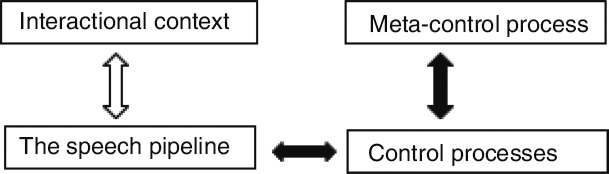
Speech comprehension and production are governed by control processes. We explore their nature and dynamics in bilingual speakers with a focus on speech production. Prior research indicates that individuals increase cognitive control in order to achieve a desired goal. In the adaptive control hypothesis we propose a stronger hypothesis: Language control processes themselves adapt to the recurrent demands placed on them by the interactional context. Adapting a control process means changing a parameter or parameters about the way it works (its neural capacity or efficiency) or the way it works in concert, or in cascade, with other control processes (e.g., its connectedness). We distinguish eight control processes (goal maintenance, conflict monitoring, interference suppression, salient cue detection, selective response inhibition, task disengagement, task engagement, opportunistic planning). We consider the demands on these processes imposed by three interactional contexts (single language, dual language, and dense code-switching). We predict adaptive changes in the neural regions and circuits associated with specific control processes. A dual-language context, for example, is predicted to lead to the adaptation of a circuit mediating a cascade of control processes that circumvents a control dilemma. Effective test of the adaptive control hypothesis requires behavioural and neuroimaging work that assesses language control in a range of tasks within the same individual.
Overview
CoChat Summary
TL;DR
The paper proposes the adaptive control hypothesis: bilingual language control processes themselves adapt to the recurrent demands of three interactional contexts—single-language, dual-language, and dense code-switching—by changing parameters such as neural capacity, efficiency, or coordination. It identifies eight control processes and predicts context-specific behavioural and neural adaptations, especially a dual-language adaptation that circumvents a control dilemma.
Key findings
- The paper distinguishes eight control processes: goal maintenance, conflict monitoring, interference suppression, salient cue detection, selective response inhibition, task disengagement, task engagement, and opportunistic planning.
- It contrasts three interactional contexts: single-language, dual-language, and dense code-switching. Table 1 indicates that single-language context increases demand on goal maintenance and interference control; dual-language context increases demand on goal maintenance, interference control, salient cue detection, selective response inhibition, task disengagement, and task engagement; dense code-switching increases demand on opportunistic planning.
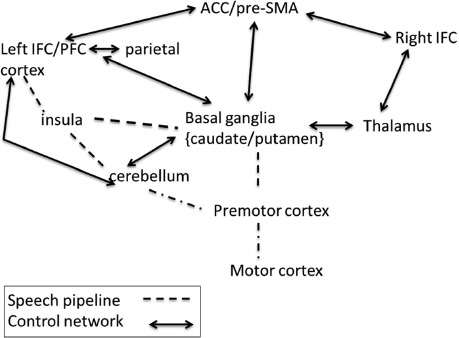
- The hypothesis predicts that dual-language speakers adapt a cascade linking salient cue detection to selective response inhibition, task disengagement, and task engagement to circumvent the control dilemma in which suppression reduces flexibility to switch. Dense code-switching is predicted to adapt a left frontal–right cerebellar circuit for morphosyntactic integration, while single-language context is associated with left inferior regions for suppressing the nontarget language.
- No original quantitative results are reported; the paper is theoretical and offers illustrative behavioural and neuroimaging predictions.
Methods
- Theoretical/review paper with no participants or new empirical data; it proposes the adaptive control hypothesis and derives testable predictions.
- It synthesizes prior work on bilingual language control, cognitive control, neuroimaging, and neuropsychology, using three interactional contexts and eight control processes as an organizing framework.
- The main analysis is conceptual: a table of context-dependent demands and illustrative predictions for behavioural tasks (e.g., cued language switching, Stroop) and neural circuits; it calls for within-individual behavioural and neuroimaging tests across a range of tasks.
Limitations
- The authors state that their illustrative predictions may prove false and that there may be no systematic behavioural or neural differences as a function of interactional context.
- The authors acknowledge circular causation: interactional context may shape adaptive response, but individual differences in predispositions and genetic make-up constrain such effects; they assume individual variation in executive control and sociality is normally distributed.
- The text makes evident that the hypothesis is programmatic and untested in this paper; contexts are idealized, speakers may experience mixtures of contexts, and factors such as proficiency, sensitivity to interaction cost, neuropharmacology, and genetic variation may moderate predicted adaptations.
Model-written summary. Check it against the paper before relying on it.
Integrity signals
Registry
Cites
Statistics
Figures
Verification
Claims the paper makes
0 Valid · 0 Not valid · 30 Not checked · 57 Own results and interpretations
In the paper
“Strikingly, the use of more than one language appears to be a further important factor shaping individual performance on such tasks (e.g., Bialystok, Craik, Green, & Gollan, 2009, for a review).”
§ Language control in bilinguals: The adaptive control hypothesis > Abstract
What the sources say
- Not checked yetcites Bialystok, Craik, Green, & Gollan, 2009 matched to “Bilingual Minds” (2009) source
hedgedstates an association- Asserted: passes — The authors put it forward as true.
- Checkable: passes — It can be checked against evidence.
- Load-bearing: passes — The paper’s conclusions depend on it.
- Based: passes — The paper gives a reason why it holds.
A conclusion the paper draws from its own results — it cites no other source for it, so there is none to check. The quote shows it is in the paper.
In the paper
“In other words, any learning effects during the experiment should be observed earlier for speakers from an interactional context that is best suited to the experimental conditions.”
§ Language control in bilinguals: The adaptive control hypothesis > THE ADAPTIVE CONTROL HYPOTHESIS > Testing the adaptive control hypothesis
plainstates an association- Asserted: passes — The authors put it forward as true.
- Checkable: passes — It can be checked against evidence.
- Load-bearing: passes — The paper’s conclusions depend on it.
- Based: passes — The paper gives a reason why it holds.
In the paper
“acknowledged a role of the pre-SMA in initiating speech in language switching (see Luk et al., 2012, for further discussion).”
§ Language control in bilinguals: The adaptive control hypothesis > THE ADAPTIVE CONTROL HYPOTHESIS > Neuroimaging predictions
What the sources say
- Not checked yetcites Luk et al., 2012 matched to “Cognitive control for language switching in bilinguals: A quantitative meta-analysis of functional neuroimaging studies” (2012) source
plainstates an association- Asserted: passes — The authors put it forward as true.
- Checkable: passes — It can be checked against evidence.
- Load-bearing: unclear — It is unclear whether the paper’s conclusions depend on it.
- Based: passes — The paper gives a reason why it holds.
In the paper
“In Figure 2 we include a direct link between frontal cortex and the right cerebellum as a further circuit involved in language control (Fabbro, Moretti, & Bava, 2000).”
§ Language control in bilinguals: The adaptive control hypothesis > THE ADAPTIVE CONTROL HYPOTHESIS > Neuroimaging predictions
What the sources say
- Not checked yetcites Fabbro, Moretti, & Bava, 2000 matched to “Language impairments in patients with cerebellar lesions” (2000) source
plainstates an association- Asserted: passes — The authors put it forward as true.
- Checkable: passes — It can be checked against evidence.
- Load-bearing: passes — The paper’s conclusions depend on it.
- Based: passes — The paper gives a reason why it holds.
In the paper
“Reperfusion of the cerebellum reduces such symptoms (Marien, Engelborghs, Fabbro, & De Deyn, 2001).”
§ Language control in bilinguals: The adaptive control hypothesis > THE ADAPTIVE CONTROL HYPOTHESIS > Neuroimaging predictions
What the sources say
- Not checked yetcites Marien, Engelborghs, Fabbro, & De Deyn, 2001 matched to “The Lateralized Linguistic Cerebellum: A Review and a New Hypothesis” (2001) source
plainstates a cause- Asserted: passes — The authors put it forward as true.
- Checkable: passes — It can be checked against evidence.
- Load-bearing: unclear — It is unclear whether the paper’s conclusions depend on it.
- Based: passes — The paper gives a reason why it holds.
43 more claims
Create a free account to see all 87 claims and to verify the 30 references still open.
- Probably not a substantial claim. 23
- It may state two separate claims as one. 25
Claims other papers make about this one
Each is checked against this paper’s own text: does it say what the citing paper says it does?
In the citing paper
“Alternating between languages requires not only activation of words in the to-be-attended language but also inhibition of words in the language that should no longer be used (‘language control’; Green & Abutalebi, 2013).”
From Language proficiency drives listening-related fatigue in those who communicate in English as their second language (2026) · cites this paper as Green & Abutalebi, 2013
In the citing paper
“Previous work highlights the cognitive demands of switching between multiple languages within a conversation (Green & Abutalebi, 2013).”
From Language proficiency drives listening-related fatigue in those who communicate in English as their second language (2026) · cites this paper as Green & Abutalebi, 2013
Citations
Cites
Miyake, A., Friedman, N. P., Emerson, M. J., Witzki, A. H., Howerter, A., & Wager, T. D. (2000) · Cognitive Psychology · doi:10.1006/cogp.1999.0734 · Cited by 15,798
Clark, H. H. (1996) · doi:10.1017/cbo9780511620539 · Cited by 5,123
Conflict monitoring and anterior cingulate cortex: an update
Botvinick, M. M., Cohen, J. D., & Carter, C. S. (2004) · Trends in Cognitive Sciences · doi:10.1016/j.tics.2004.10.003 · Cited by 3,623
Anterior Cingulate Conflict Monitoring and Adjustments in Control
Kerns, J. G., Cohen, J. D., MacDonald, A. W., Cho, R. Y., Stenger, V. A., & Carter, C. S. (2004) · Science · doi:10.1126/science.1089910 · Cited by 2,891 · cited 4×
“In addition, there is a demand on frontal structures linked to conflict monitoring and interference suppression (e.g., Kerns et al., 2004) and to parietal regions (and frontal regions) associated with task changes.”
BackgroundInfluentialMental control of the bilingual lexico-semantic system
GREEN, D. W. (1998) · Bilingualism Language and Cognition · doi:10.1017/s1366728998000133 · Cited by 2,807
Self-citationUsing language: Communicative acts
Clark, H. H. (1996) · Cited by 2,721
Using language: Index of names
Clark, H. H. (1996) · Cited by 2,720
The variable nature of cognitive control: a dual mechanisms framework
Braver, T. S. (2012) · Trends in Cognitive Sciences · doi:10.1016/j.tics.2011.12.010 · Cited by 2,482 · cited 1×
“One way to recognise the interplay of these processes is to distinguish proactive control processes that establish a task goal from reactive control processes that limit interference with it (Braver, 2012).”
BackgroundInverted-U–Shaped Dopamine Actions on Human Working Memory and Cognitive Control
Cools, R., & D'Esposito, M. (2011) · Biological Psychiatry · doi:10.1016/j.biopsych.2011.03.028 · Cited by 1,673 · cited 2×
“Neuroimaging data also implicate distinct neural regions in task switching and interference control (e.g., Cools & D’Esposito, 2011).”
BackgroundBilingual language production: The neurocognition of language representation and control
Abutalebi, J., & Green, D. (2007) · Journal of Neurolinguistics · doi:10.1016/j.jneuroling.2006.10.003 · Cited by 1,302 · cited 2×
“In previous papers (e.g., Abutalebi & Green, 2007, 2008), we reviewed work showing that both cortical and subcortical structures are involved in language control and language switching (see Luk, Green, Abutalebi, & Grady, 2012, for a recent metaanalysis).”
BackgroundSelf-citation
Cited by
Items 1,501–1,600 of 2,166
Gong, X. (2024) · OpenMETU (Middle East Technical University) · Cited by 1
Pernas, L. (2024) · RUC (Universidade Da Coruña) · Cited by 1
A Multivariate Characterization Shows that Bilingualism Predicts Attention
Call, T. (2025) · Carleton University's Institutional Repository (MacOdrum Library, Carleton University) · doi:10.22215/etd/2025-16645 · Cited by 1
Gradualness and abruptness in linguistic split: A Nyulnyulan case study
Bowern, C. (2023) · Oxford University Press eBooks · doi:10.1093/oso/9780192845818.003.0025 · Cited by 1
Sound structure and the psycholinguistics of language contact
Babel, M., & Fricke, M. (2023) · Oxford University Press eBooks · doi:10.1093/oso/9780192845818.003.0021 · Cited by 1
The Life Cycle of Language: Past, Present, and Future
Kavitskaya, D., & Yu, A. C. L. (2023) · doi:10.1093/oso/9780192845818.001.0001 · Cited by 1
Increasing morphological mismatch via category loss: The Spanish Future Subjunctive
Juge, M. L. (2023) · Oxford University Press eBooks · doi:10.1093/oso/9780192845818.003.0005 · Cited by 1
Paradigm structure in Sanskrit reduplicants
Steriade, D. (2023) · Oxford University Press eBooks · doi:10.1093/oso/9780192845818.003.0011 · Cited by 1
The structure of dialect diversity in Mono: Evidence from the Sydney M. Lamb Papers
Haynie, H. J., & Toosarvandani, M. (2023) · Oxford University Press eBooks · doi:10.1093/oso/9780192845818.003.0014 · Cited by 1
Typology and history of unusual traits in Nivaclé
Campbell, L. R. (2023) · Oxford University Press eBooks · doi:10.1093/oso/9780192845818.003.0007 · Cited by 1
The life cycle of the Kuuk Thaayorre desiderative
Gaby, A. R. (2023) · Oxford University Press eBooks · doi:10.1093/oso/9780192845818.003.0003 · Cited by 1
Is there a bilingual advantage: testing the role of language mode
Knyshev, E. A. (2018) · K-State Research Exchange (Kansas State University) · Cited by 1
Begum, R., Din, A. U., & Alphonce, A. (2025) · Journal of Social Signs Review · Cited by 1
Heidlmayr, K. D.-M., Doré-Mazars, K., Aparicio, X., & Isel, F. (2016) · HAL · doi:10.1371/journal.pone.0165029.t009 · Cited by 1
Cortelazzo, F. (2017) · theses.fr (ABES) · doi:10.70675/c931da58z17c2z42cdz8d1bzccd30cff3577 · Cited by 1
Music–L2 transfer through executive functions: a narrative review with a focus on inhibitory control
Dabóczy, M., & Molnár, D. (2026) · Acta Academiae Beregsasiensis Philologica · doi:10.58423/2786-6726/2026-2-131-147 · Cited by 1
Toiminnanohjaus kokeneilla kaksikielisillä kielten välisessä kontrollissa
Laine, F., & Uutela-Lynd, S. (2024) · UTUPub (University of Turku) · Cited by 1
Early-English education works no miracles
Goriot, C. (2019) · Cited by 1
Bidialectal Language Processing: An fNIRS Exploration
Nickerson, N. (2024) · Deep Blue (University of Michigan) · doi:10.7302/24000 · Cited by 1
Floquet, O., & Melogno, S. (2024) · Iris (Roma Tre University) · doi:10.13133/9788893773119 · Cited by 1
Resolving the bilingual advantage paradox: The role of individual differences in executive function
Tahak, M., & Moghaddas, B. (2025) · Focus on ELT Journal · doi:10.14744/felt.7.2.6 · Cited by 1
de Putte, E. V. (2018) · Ghent University Academic Bibliography (Ghent University) · Cited by 1
Codeswitching in words and phrases
Archibald, J. (2025) · Continua. · doi:10.59236/continua2.1/archibald · Cited by 1
1357 A situationally based model of language and (trans)languaging in multilingual ecologies
Lüpke, F. (2025) · De Gruyter eBooks · doi:10.1515/9783110989571-007 · Cited by 1
Individual neuroanatomical constraints on cognition and language
Fedeli, D. (n.d.) · Archivio Istituzionale della Ricerca - Università Vita-Salute San Raffaele · Cited by 1
Wynne, H. S. Z. (2016) · Oxford University Research Archive (ORA) (University of Oxford) · doi:10.5287/ora-goravbjzo · Cited by 1
A Review of Eating Disorders: Complications and Cognitive Aspects
Mantar, F. (2026) · BAU Health and Innovation · doi:10.14744/bauh.2025.36844 · Cited by 1
Language Processing Across the Lifespan
Calabria, M. (2024) · SAGE Publications Ltd eBooks · doi:10.4135/9781529616651.n12 · Cited by 1
Exploring the Bilingual Advantage in Executive Control: Using Goal Maintenance and Expectancies
Viswanathan, M. (2015) · YorkSpace (York University) · Cited by 1
MORENO, M. S., Sória, I. N., Gómez, M. F., & Domenech, B. D. (2026) · Aposta · doi:10.23900/ra.v24i118.1680 · Cited by 1
Barbu, C. (2019) · ORBi (University of Liège) · Cited by 1
Cognitive resource allocation during first- and second language reading comprehension
Dylman, A. S., Bjärtå, A., & Bernhardsson, J. (2026) · Journal of Cultural Cognitive Science · doi:10.1007/s41809-026-00208-x · Cited by 1
Contino, K., Duncan, A. V., Weaver, H., Khandelwal, M., Boucher, A. R., & Crespo, K. (2026) · Behavioral Sciences · doi:10.3390/bs16071080 · Cited by 1
Avila, S. M. (2019) · NVA (Nasjonalt vitenarkiv) · Cited by 1
Yahya, M. (2020) · Hacettepe University Institutional Repository (hacettepe.edu.tr) · Cited by 1
Adaptive language control between comprehension and production in bilinguals
Li, C., & Cheng, Q. (2026) · Bilingualism Language and Cognition · doi:10.1017/s1366728926101151 · Cited by 1
The Unbearable Lightness of “Diversity” in Understanding Cognition: A Role for Bilingualism
Mishra, R. K., Madhira, A., & Kapiley, K. (2026) · Topics in Cognitive Science · doi:10.1111/tops.70059 · Cited by 1
Crossroads Corpus creation: Design and case study
Hantgan, A. (2017) · Yearbook of the Poznan Linguistic Meeting · doi:10.1515/yplm-2017-0009 · Cited by 1
The Effects of Code-Switching on Cognitive Control
Bouwer, V. (2018) · Leiden Repository (Leiden University) · Cited by 1
Wang, D., Chen, S., Qin, Y., Wang, S., & Hou, R. (2026) · International Journal of Bilingualism · doi:10.1177/13670069261456515 · Cited by 1
How sentence processing sheds light on mixed language creation
Adamou, E. (2021) · De Gruyter eBooks · doi:10.1515/9781501511257-004 · Cited by 1
Language context flexibly modulates language control mechanisms.Preprint
Timmer, K., Wolna, A., Szewczyk, J., & Wodniecka, Z. (2025) · PsyArXiv (OSF Preprints) · doi:10.31234/osf.io/y9hkz_v1 · Cited by 1
Leivada, E., Kelly-Iturriaga, L. M., Masullo, C., Westergaard, M. R., & Rothman, J. (2024) · PsyArXiv (OSF Preprints) · doi:10.31234/osf.io/29ucp_v3 · Cited by 1
Paniz, M. (2025) · theses.fr (ABES) · doi:10.70675/2408e93ez6b93z48c6z8424z85dd9ce9b1c1 · Cited by 1
Sight-Translation Strategies and Quality. Part 2. The Impact of Directionality
Chernovaty, L., Djovčoš, M., & Ковальчук, Н. М. (2025) · PSYCHOLINGUISTICS · doi:10.31470/2309-1797-2025-37-2-140-167 · Cited by 1
LINGUISTIC-COGNITIVE ECONOMY INDEX IN SIMULTANEOUS INTERPRETING
Skrylnyk, S. V. (2025) · Тrаnscarpathian Philological Studies · doi:10.32782/tps2663-4880/2025.44.2.25 · Cited by 1
Ahmad, M. I., Zaini, H., & Rambe, W. A. (2026) · Diwan Jurnal Bahasa dan Sastra Arab · doi:10.15548/diwan.v18i1.2443 · Cited by 1
Mazumder, D., Pathak, D., Kodali, P., Joshi, A., Agarwal, A., & Patro, J. (2026) · Findings of the Association for Computational Linguistics: EMNLP (Findings of EMNLP) · doi:10.18653/2026.findings-emnlp.1655 · Cited by 1
Leshchenko, Y., Dotsenko, T., & Сергеевна, О. Т. (2022) · Russian Foundation for Basic Research Journal Humanities and social sciences · doi:10.22204/2587-8956-2022-109-02-37-49 · Cited by 1
The impact of multilingualism on cognitive development and brain plasticity: a holistic perspective
Andronic, C. (2025) · Multilingvism și Interculturalitate în Contextul Globalizării · doi:10.53486/micg2024.10 · Cited by 1
Multilingualism and its Impacts on Cognitive Potential of Generation Z
Laila, U., & Kanwal, M. (2026) · Journal of Translation & Multilingualism · Cited by 1
Self-Reported Repertoires And Observed Language Use In The Multilingual Ọrọ Community
Ekpo, G. R. (2022) · SOAS Research Online (SOAS University of London) · doi:10.25501/soas.00032302 · Cited by 1
Ethnobiological inventories: significance of multilingualism and lexical variation in rural Cameroon
Todd, H. (2021) · SOAS Research Online (SOAS University of London) · doi:10.25501/soas.00036204 · Cited by 1
Nuevo, G. N. (2019) · LA Referencia (Red Federada de Repositorios Institucionales de Publicaciones Científicas) · Cited by 1
McGarrigle, R., Havelka, J., & de Bruin, A. (2026) · Psychonomic Bulletin & Review · doi:10.3758/s13423-026-03005-3
The Effects of Bilingualism and Vocabulary Size on Infants’ Cognitive Control
Iliaei, S. P. (2018) · Spectrum Research Repository (Concordia University)
Truscott, J., & Smith, M. S. (2019) · Bilingual processing and acquisition · doi:10.1075/bpa.8.c1
Herschensohn, J. (2022) · Bilingual processing and acquisition · doi:10.1075/bpa.15.pre
Lei, Q., Wang, J., & Yang, X. (2026) · Frontiers in Psychology · doi:10.3389/fpsyg.2026.1778678
Kim, H. Y., & Sung, J. E. (2025) · Eon'eo cheong'gag jang'ae yeon'gu/Communication sciences & disorders · doi:10.12963/csd.250132
How Learners Move From Sound To Morphology
Demuth, K. (2022) · Oxford University Press eBooks · doi:10.1093/oxfordhb/9780198845003.013.8
The Relationship Between Executive Function and Bilingual Language Control
Ong, G. (2019) · Minerva Access (University of Melbourne)
Executive control functions and theory of mind among plurilingual adults
Shaharban, N. V., Rangaiah, B., & Thirumeni, D. (2022) · Journal of Cognitive Psychology · doi:10.1080/20445911.2022.2119989
Antoniou, K., Spanoudis, G. C., & Petinou, K. (2024) · PsyArXiv (OSF Preprints) · doi:10.31234/osf.io/xu9wb
Language development, processing and the brain
Herschensohn, J. (2022) · Bilingual processing and acquisition · doi:10.1075/bpa.15.c1
Jiang, S., Zhang, X., & Chen, B. (2026) · Bilingualism Language and Cognition · doi:10.1017/s1366728926101369
Truscott, J., & Smith, M. S. (2019) · Bilingual processing and acquisition · doi:10.1075/bpa.8.lof
Crain, S. (2022) · Oxford University Press eBooks · doi:10.1093/oxfordhb/9780198845003.013.11
Cognitive control and language control
Truscott, J., & Smith, M. S. (2019) · Bilingual processing and acquisition · doi:10.1075/bpa.8.c6
Bilingual processing and cognition across the lifespan
Herschensohn, J. (2022) · Bilingual processing and acquisition · doi:10.1075/bpa.15.c7
Review and Commentary on the Interactive Effects of Interpreting Experience and Executive Control
胡, 敏. (2021) · Modern Linguistics · doi:10.12677/ml.2021.92039
Barr, P., Fiske, A., Hendry, A. J., & Holmboe, K. (2025) · SSRN Electronic Journal · doi:10.2139/ssrn.5148245
Herschensohn, J. (2022) · Bilingual processing and acquisition · doi:10.1075/bpa.15.prelim
Are executive function and neuroanatomy in ADHD modulated by bilingualism?Preprint
Oak, A., Gutierrez-Schieferl, I. S., & Eden, G. F. (2026) · bioRxiv (Cold Spring Harbor Laboratory) · doi:10.64898/2026.05.13.724877
Piuze, A., Jennings, S., & Poulin‐Dubois, D. (2026) · Infancy · doi:10.1111/infa.70118
The bilingual advantage: Cognitive effects of bilingualism in healthy older Norwegians
Cameron, S. (2018) · NVA (Nasjonalt vitenarkiv)
Herschensohn, J. (2022) · Bilingual processing and acquisition · doi:10.1075/bpa.15.refs
(2022) · Emerald Group Publishing Limited eBooks · doi:10.1108/978-1-64802-622-520251011
Variations of Language Representations in the Brain
Andrews, E., & Kiran, S. (2025) · Cambridge University Press eBooks · doi:10.1017/9781009202336.013
Herschensohn, J. (2022) · Bilingual processing and acquisition · doi:10.1075/bpa.15.toc
Hoversten, L. J., & Martin, C. D. (2026) · Bilingualism Language and Cognition · doi:10.1017/s136672892510093x
An investigation of three sublexical variables and their influence on L2 visual word recognition
Lecerf, M.-A. (2023) · theses.fr (ABES) · doi:10.70675/c61d132fz923fz466dz9d37zfdb5d782844e
Truscott, J., & Smith, M. S. (2019) · Bilingual processing and acquisition · doi:10.1075/bpa.8.c9
The Relationship between Bilingualism, Cognitive Control, and Mind Wandering
Shulley, L. J. (2015) · TopSCHOLAR (Western Kentucky University)
Easy words: Reference resolution in a malevolent referent world
Gleitman, L. R., & Trueswell, J. C. (2022) · Oxford University Press eBooks · doi:10.1093/oxfordhb/9780198845003.013.30
Liu, H., Chaouch-Orozco, A., & Sperlich, D. (2026) · Memory & Cognition · doi:10.3758/s13421-026-01936-9
Internal context and attention, working memory, and effort
Truscott, J., & Smith, M. S. (2019) · Bilingual processing and acquisition · doi:10.1075/bpa.8.c10
LON GITUDINAL STUDIES OF WORKING MEMORY CAPACITY IN SIMULTANEOUS INTERPRETING STUDENTS
Rybakova, N. V. (2023) · Вестник Московского университета. Серия 9. Филология · doi:10.55959/msu0130-0075-9-2023-47-04-17
Learning and Using Written Word Forms
Treiman, R., & Kessler, B. (2022) · Oxford University Press eBooks · doi:10.1093/oxfordhb/9780198845003.013.24
Foreign Language Syndrome: Neurological and Psychiatric Aspects
Ghzawi, A., Madha, A., & Aburashed, R. A. (2025) · Neurology International · doi:10.3390/neurolint17080122
Knowledge of language and its implementation
Herschensohn, J. (2022) · Bilingual processing and acquisition · doi:10.1075/bpa.15.c2
(2022) · Oxford University Press eBooks · doi:10.1093/oxfordhb/9780198845003.002.0004
Truscott, J., & Smith, M. S. (2019) · Bilingual processing and acquisition · doi:10.1075/bpa.8.abbr
Truscott, J., & Smith, M. S. (2019) · Bilingual processing and acquisition · doi:10.1075/bpa.8.toc
Truscott, J., & Smith, M. S. (2019) · Bilingual processing and acquisition · doi:10.1075/bpa.8.c12
The interactive effect of L2 proficiency and interpreting experience on cognitive control
Chen, M., & Xie, Z. (2026) · Journal of Psycholinguistic Research · doi:10.1007/s10936-026-10230-3
Sequential adult second language development and processing
Herschensohn, J. (2022) · Bilingual processing and acquisition · doi:10.1075/bpa.15.c6
胡, 敏. (2021) · Modern Linguistics · doi:10.12677/ml.2021.91027
Metadata
- Authors
- Green, D. W., & Abutalebi, J.
- Affiliations
- University College London (GB)
- Vita-Salute San Raffaele University (IT)
- Corresponding author
- Green, David W.
- Venue
- Journal of Cognitive Psychology
- Publisher
- Informa UK Limited
- Published
- 2013-05-24
- Volume
- 25
- Issue
- 5
- Pages
- 515-530
- ISSN
- 2044-5911 (ISSN-L)
- 2044-592X
- PMC
- PMC4095950
- OpenAlex
- W2128442137
- Cited by
- 2,163
- References
- 62
- Citations by year
- 2026: 264 · 2025: 271 · 2024: 222 · 2023: 211 · 2022: 197 · 2021: 160 · 2020: 154 · 2019: 254 · 2018: 164 · 2017: 90 · 2016: 82 · 2015: 61 · 2014: 27 · 2013: 3
- FWCI
- 21.17
- Type
- journal article
- Language
- en
- Open access
- hybrid
- doi.org
- Licence
- cc-by
- Locations
- Journal of Cognitive Psychology (publishedVersion, cc-by)
- PubMed Central (publishedVersion, cc-by)
- Europe PMC (PubMed Central) (publishedVersion, cc-by)
- PubMed (publishedVersion)
- UCL Discovery (University College London) (submittedVersion)
- Archivio Istituzionale della Ricerca - Università Vita-Salute San Raffaele (submittedVersion)
- Topics
- Life Sciences › Neuroscience › Cognitive Neuroscience › Neurobiology of Language and Bilingualism
- Social Sciences › Psychology › Developmental and Educational Psychology › Language Development and Disorders
- Life Sciences › Neuroscience › Cognitive Neuroscience › Neural and Behavioral Psychology Studies
- Keywords
- language control, bilingualism, cognitive control, speech production, code-switching, control processes, interference suppression, conflict monitoring, task disengagement, task engagement, goal maintenance, opportunistic planning, neural circuits
About these checks
Registry, retraction, Cites and statistics results are computed, not judged, with one exception: a printed reference that no index lists is read once by a model before it counts as a citation error. Claims are extracted by a model and kept only when their quote appears verbatim in the text; each cited source is then checked, with a model’s help, for whether it says what the claim relies on. Those verdicts can be wrong — read the claim’s quote and the cited source before relying on one.
A language model drew the claims from the paper on 2026-11-24, under version 3 of the claim definition (model deepseek-v4.1-flash, prompt extract-v3).
A second model labelled each claim on 2026-11-24 (model jev-1.13-20260917, definition revision gold-guideline-v0.2).
Statistics and arithmetic are recomputed, not judged.
Confidence bands are shown only for fields calibrated on our annotated test set. None is calibrated yet, so no band is shown.
What counts as a claim ›How we measure confidence ›How we check this ›
Are you an author, or do you see a problem with this page? Request a review
Data sources
Bibliographic data: Semantic Scholar, OpenAlex, Crossref.
Contains information from the Semantic Scholar Academic Graph Datasets, made available under the ODC Attribution License (ODC-BY 1.0).
Semantic Scholar’s data is described in: Kinney, R., et al. (2023). The Semantic Scholar Open Data Platform. arXiv:2301.10140.
