

Language control in bilinguals: The adaptive control hypothesis
Open accessThe DOI matches its Crossref record; 62 of the 62 references it cites were found in a registry or an index; none of the 36 sources its claims cite is checked for support yet.
Abstract
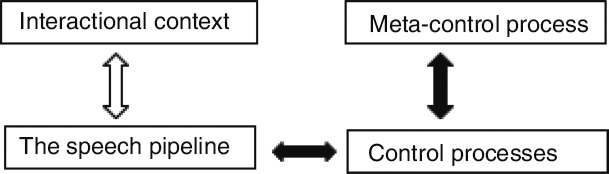
Speech comprehension and production are governed by control processes. We explore their nature and dynamics in bilingual speakers with a focus on speech production. Prior research indicates that individuals increase cognitive control in order to achieve a desired goal. In the adaptive control hypothesis we propose a stronger hypothesis: Language control processes themselves adapt to the recurrent demands placed on them by the interactional context. Adapting a control process means changing a parameter or parameters about the way it works (its neural capacity or efficiency) or the way it works in concert, or in cascade, with other control processes (e.g., its connectedness). We distinguish eight control processes (goal maintenance, conflict monitoring, interference suppression, salient cue detection, selective response inhibition, task disengagement, task engagement, opportunistic planning). We consider the demands on these processes imposed by three interactional contexts (single language, dual language, and dense code-switching). We predict adaptive changes in the neural regions and circuits associated with specific control processes. A dual-language context, for example, is predicted to lead to the adaptation of a circuit mediating a cascade of control processes that circumvents a control dilemma. Effective test of the adaptive control hypothesis requires behavioural and neuroimaging work that assesses language control in a range of tasks within the same individual.
Overview
CoChat Summary
TL;DR
The paper proposes the adaptive control hypothesis: bilingual language control processes themselves adapt to the recurrent demands of three interactional contexts—single-language, dual-language, and dense code-switching—by changing parameters such as neural capacity, efficiency, or coordination. It identifies eight control processes and predicts context-specific behavioural and neural adaptations, especially a dual-language adaptation that circumvents a control dilemma.
Key findings
- The paper distinguishes eight control processes: goal maintenance, conflict monitoring, interference suppression, salient cue detection, selective response inhibition, task disengagement, task engagement, and opportunistic planning.
- It contrasts three interactional contexts: single-language, dual-language, and dense code-switching. Table 1 indicates that single-language context increases demand on goal maintenance and interference control; dual-language context increases demand on goal maintenance, interference control, salient cue detection, selective response inhibition, task disengagement, and task engagement; dense code-switching increases demand on opportunistic planning.
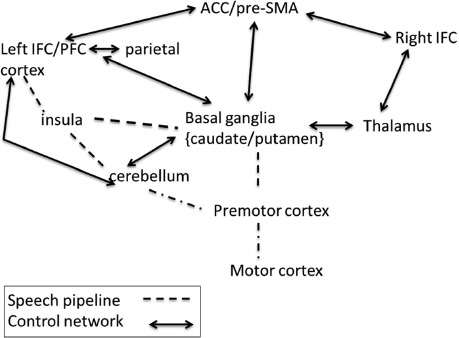
- The hypothesis predicts that dual-language speakers adapt a cascade linking salient cue detection to selective response inhibition, task disengagement, and task engagement to circumvent the control dilemma in which suppression reduces flexibility to switch. Dense code-switching is predicted to adapt a left frontal–right cerebellar circuit for morphosyntactic integration, while single-language context is associated with left inferior regions for suppressing the nontarget language.
- No original quantitative results are reported; the paper is theoretical and offers illustrative behavioural and neuroimaging predictions.
Methods
- Theoretical/review paper with no participants or new empirical data; it proposes the adaptive control hypothesis and derives testable predictions.
- It synthesizes prior work on bilingual language control, cognitive control, neuroimaging, and neuropsychology, using three interactional contexts and eight control processes as an organizing framework.
- The main analysis is conceptual: a table of context-dependent demands and illustrative predictions for behavioural tasks (e.g., cued language switching, Stroop) and neural circuits; it calls for within-individual behavioural and neuroimaging tests across a range of tasks.
Limitations
- The authors state that their illustrative predictions may prove false and that there may be no systematic behavioural or neural differences as a function of interactional context.
- The authors acknowledge circular causation: interactional context may shape adaptive response, but individual differences in predispositions and genetic make-up constrain such effects; they assume individual variation in executive control and sociality is normally distributed.
- The text makes evident that the hypothesis is programmatic and untested in this paper; contexts are idealized, speakers may experience mixtures of contexts, and factors such as proficiency, sensitivity to interaction cost, neuropharmacology, and genetic variation may moderate predicted adaptations.
Model-written summary. Check it against the paper before relying on it.
Integrity signals
Registry
Cites
Statistics
Figures
Verification
Claims the paper makes
0 Valid · 0 Not valid · 30 Not checked · 57 Own results and interpretations
In the paper
“Strikingly, the use of more than one language appears to be a further important factor shaping individual performance on such tasks (e.g., Bialystok, Craik, Green, & Gollan, 2009, for a review).”
§ Language control in bilinguals: The adaptive control hypothesis > Abstract
What the sources say
- Not checked yetcites Bialystok, Craik, Green, & Gollan, 2009 matched to “Bilingual Minds” (2009) source
hedgedstates an association- Asserted: passes — The authors put it forward as true.
- Checkable: passes — It can be checked against evidence.
- Load-bearing: passes — The paper’s conclusions depend on it.
- Based: passes — The paper gives a reason why it holds.
A conclusion the paper draws from its own results — it cites no other source for it, so there is none to check. The quote shows it is in the paper.
In the paper
“In other words, any learning effects during the experiment should be observed earlier for speakers from an interactional context that is best suited to the experimental conditions.”
§ Language control in bilinguals: The adaptive control hypothesis > THE ADAPTIVE CONTROL HYPOTHESIS > Testing the adaptive control hypothesis
plainstates an association- Asserted: passes — The authors put it forward as true.
- Checkable: passes — It can be checked against evidence.
- Load-bearing: passes — The paper’s conclusions depend on it.
- Based: passes — The paper gives a reason why it holds.
In the paper
“acknowledged a role of the pre-SMA in initiating speech in language switching (see Luk et al., 2012, for further discussion).”
§ Language control in bilinguals: The adaptive control hypothesis > THE ADAPTIVE CONTROL HYPOTHESIS > Neuroimaging predictions
What the sources say
- Not checked yetcites Luk et al., 2012 matched to “Cognitive control for language switching in bilinguals: A quantitative meta-analysis of functional neuroimaging studies” (2012) source
plainstates an association- Asserted: passes — The authors put it forward as true.
- Checkable: passes — It can be checked against evidence.
- Load-bearing: unclear — It is unclear whether the paper’s conclusions depend on it.
- Based: passes — The paper gives a reason why it holds.
In the paper
“In Figure 2 we include a direct link between frontal cortex and the right cerebellum as a further circuit involved in language control (Fabbro, Moretti, & Bava, 2000).”
§ Language control in bilinguals: The adaptive control hypothesis > THE ADAPTIVE CONTROL HYPOTHESIS > Neuroimaging predictions
What the sources say
- Not checked yetcites Fabbro, Moretti, & Bava, 2000 matched to “Language impairments in patients with cerebellar lesions” (2000) source
plainstates an association- Asserted: passes — The authors put it forward as true.
- Checkable: passes — It can be checked against evidence.
- Load-bearing: passes — The paper’s conclusions depend on it.
- Based: passes — The paper gives a reason why it holds.
In the paper
“Reperfusion of the cerebellum reduces such symptoms (Marien, Engelborghs, Fabbro, & De Deyn, 2001).”
§ Language control in bilinguals: The adaptive control hypothesis > THE ADAPTIVE CONTROL HYPOTHESIS > Neuroimaging predictions
What the sources say
- Not checked yetcites Marien, Engelborghs, Fabbro, & De Deyn, 2001 matched to “The Lateralized Linguistic Cerebellum: A Review and a New Hypothesis” (2001) source
plainstates a cause- Asserted: passes — The authors put it forward as true.
- Checkable: passes — It can be checked against evidence.
- Load-bearing: unclear — It is unclear whether the paper’s conclusions depend on it.
- Based: passes — The paper gives a reason why it holds.
43 more claims
Create a free account to see all 87 claims and to verify the 30 references still open.
- Probably not a substantial claim. 23
- It may state two separate claims as one. 25
Claims other papers make about this one
Each is checked against this paper’s own text: does it say what the citing paper says it does?
In the citing paper
“Alternating between languages requires not only activation of words in the to-be-attended language but also inhibition of words in the language that should no longer be used (‘language control’; Green & Abutalebi, 2013).”
From Language proficiency drives listening-related fatigue in those who communicate in English as their second language (2026) · cites this paper as Green & Abutalebi, 2013
In the citing paper
“Previous work highlights the cognitive demands of switching between multiple languages within a conversation (Green & Abutalebi, 2013).”
From Language proficiency drives listening-related fatigue in those who communicate in English as their second language (2026) · cites this paper as Green & Abutalebi, 2013
Citations
Cites
Miyake, A., Friedman, N. P., Emerson, M. J., Witzki, A. H., Howerter, A., & Wager, T. D. (2000) · Cognitive Psychology · doi:10.1006/cogp.1999.0734 · Cited by 15,798
Clark, H. H. (1996) · doi:10.1017/cbo9780511620539 · Cited by 5,123
Conflict monitoring and anterior cingulate cortex: an update
Botvinick, M. M., Cohen, J. D., & Carter, C. S. (2004) · Trends in Cognitive Sciences · doi:10.1016/j.tics.2004.10.003 · Cited by 3,623
Anterior Cingulate Conflict Monitoring and Adjustments in Control
Kerns, J. G., Cohen, J. D., MacDonald, A. W., Cho, R. Y., Stenger, V. A., & Carter, C. S. (2004) · Science · doi:10.1126/science.1089910 · Cited by 2,891 · cited 4×
“In addition, there is a demand on frontal structures linked to conflict monitoring and interference suppression (e.g., Kerns et al., 2004) and to parietal regions (and frontal regions) associated with task changes.”
BackgroundInfluentialMental control of the bilingual lexico-semantic system
GREEN, D. W. (1998) · Bilingualism Language and Cognition · doi:10.1017/s1366728998000133 · Cited by 2,807
Self-citationUsing language: Communicative acts
Clark, H. H. (1996) · Cited by 2,721
Using language: Index of names
Clark, H. H. (1996) · Cited by 2,720
The variable nature of cognitive control: a dual mechanisms framework
Braver, T. S. (2012) · Trends in Cognitive Sciences · doi:10.1016/j.tics.2011.12.010 · Cited by 2,482 · cited 1×
“One way to recognise the interplay of these processes is to distinguish proactive control processes that establish a task goal from reactive control processes that limit interference with it (Braver, 2012).”
BackgroundInverted-U–Shaped Dopamine Actions on Human Working Memory and Cognitive Control
Cools, R., & D'Esposito, M. (2011) · Biological Psychiatry · doi:10.1016/j.biopsych.2011.03.028 · Cited by 1,673 · cited 2×
“Neuroimaging data also implicate distinct neural regions in task switching and interference control (e.g., Cools & D’Esposito, 2011).”
BackgroundBilingual language production: The neurocognition of language representation and control
Abutalebi, J., & Green, D. (2007) · Journal of Neurolinguistics · doi:10.1016/j.jneuroling.2006.10.003 · Cited by 1,302 · cited 2×
“In previous papers (e.g., Abutalebi & Green, 2007, 2008), we reviewed work showing that both cortical and subcortical structures are involved in language control and language switching (see Luk, Green, Abutalebi, & Grady, 2012, for a recent metaanalysis).”
BackgroundSelf-citation
Cited by
Items 1,701–1,800 of 2,166
Archibald, J. (2023) · Oxford University Press eBooks · doi:10.1093/oso/9780190923334.002.0010
Archibald, J. (2023) · Oxford University Press eBooks · doi:10.1093/oso/9780190923334.005.0001
Archibald, J. (2023) · Oxford University Press eBooks · doi:10.1093/oso/9780190923334.005.0002
Archibald, J. (2023) · Oxford University Press eBooks · doi:10.1093/oso/9780190923334.002.0005
Archibald, J. (2023) · Oxford University Press eBooks · doi:10.1093/oso/9780190923334.003.0006
Archibald, J. (2023) · Oxford University Press eBooks · doi:10.1093/oso/9780190923334.002.0003
Archibald, J. (2023) · Oxford University Press eBooks · doi:10.1093/oso/9780190923334.002.0007
Wang, R., Guo, Q., Zeng, X., Leong, C., Zhang, C., Zhang, Y., Abutalebi, J., & Myachykov, A. V. (2026) · Neuroimage Reports · doi:10.64898/2026.03.18.26348672
Self-citationBilingual experience shapes brain connectivity in childhood
Argyri, F., Goksan, S., Wei, L., Clayden, J. D., & Liegeois, F. J. (2026) · Bilingualism Language and Cognition · doi:10.1017/s1366728926101849
African Linguistics in North-Eastern and So-Called Anglophone Africa
Simeone-Senelle, M.-C., Smidt, W. G. C., Meyer, R., Jakobi, A., Lusekelo, A., Connell, B., & Akinlabi, A. (2019) · Cambridge University Press eBooks · doi:10.1017/9781108283991.004
African Linguistics in North and in So-Called Francophone Africa
Aissati, A. E., Allame, Y. E. K. E., & Mutaka, P. N. M. (2019) · Cambridge University Press eBooks · doi:10.1017/9781108283991.003
Wolff, H. E. (2019) · Cambridge University Press eBooks · doi:10.1017/9781108283991.025
Wolff, H. E. (2019) · Cambridge University Press eBooks · doi:10.1017/9781108283991.024
Wolff, H. E. (2019) · Cambridge University Press eBooks · doi:10.1017/9781108283991.023
Billig, J. D., Martins, K. K. C., Ramos, M. V. P., Conceição, M. R., & Chu, Y. S. (2025) · Revista Horizontes de Linguistica Aplicada · doi:10.26512/rhla.v24i2.56424
Aphasia and Autism Spectrum Disorders
Andrews, E., & Kiran, S. (2025) · Cambridge University Press eBooks · doi:10.1017/9781009202336.019
Liu, D. (2025) · International Journal of Bilingualism · doi:10.1177/13670069251393089
Spinelli, G., & Sulpizio, S. (2024) · PsyArXiv (OSF Preprints) · doi:10.31234/osf.io/tzjw8
D’Alessandro, R., Putnam, M. T., & Terenghi, S. (2025) · Oxford University Press eBooks · doi:10.1093/9780191987731.002.0004
D’Alessandro, R., Putnam, M. T., & Terenghi, S. (2025) · Oxford University Press eBooks · doi:10.1093/9780191987731.002.0006
Word order and prosody in the expression of information structure
Laleko, O. (2025) · Oxford University Press eBooks · doi:10.1093/9780191987731.003.0007
D’Alessandro, R., Putnam, M. T., & Terenghi, S. (2025) · Oxford University Press eBooks · doi:10.1093/9780191987731.002.0005
The Architecture of Bilingual Phonological Knowledge and Performance
Archibald, J. (2026) · Language and Speech · doi:10.1177/00238309261473989
Grundy, J. G., & Grundy, F. (2026) · Ageing Research Reviews · doi:10.1016/j.arr.2026.103282
Lončarek, E., & Kubota, M. (2026) · Behavioral Sciences · doi:10.3390/bs16091624
Nakamura, M. S., Rossi, E., & Diaz, M. T. (2026) · Neuropsychologia · doi:10.1016/j.neuropsychologia.2026.109359
Language and agingPreprint
Peelle, J. E. (2019) · PsyArXiv (OSF Preprints) · doi:10.31234/osf.io/xp29u_v1
The role of the Frontal Aslant tract in bilingual language controlPreprint
Quartarone, C., Navarrete, E., Gastaldon, S., Budisavljević, S., & Peressotti, F. (2023) · bioRxiv (Cold Spring Harbor Laboratory) · doi:10.1101/2023.02.01.526563
Klaus, J. (2025) · Springer eBooks · doi:10.1007/978-3-662-70454-7_8
Spechtenhauser, B. (2026) · Zeitschrift für Angewandte Linguistik · doi:10.1515/zfal-2026-2005
Learning through bilingual education: Cognitive and academic impacts
Esposito, A. G., & Park, S. (2023) · Studies in bilingualism · doi:10.1075/sibil.64.09esp
Chan, A. S.-L. (2026) · International Journal of Bilingualism · doi:10.1177/13670069261473115
Against Perceiving Meanings: Empedocles Leaped or Loves?
Başoğlu, Y. R. (2026) · Review of Philosophy and Psychology · doi:10.1007/s13164-026-00833-z
Cognitive and Neural Preservation in Older Language Learners: The CNPOLL Framework
Zhang, H., Li, J., Xiao, Y., & Wu, Y. J. (2026) · Journal of Psycholinguistic Research · doi:10.1007/s10936-026-10295-0
Zhang, L., Xu, H., Yang, Y., Mo, Y., & Gao, L. (2026) · Scientific Reports · doi:10.1038/s41598-026-38523-6
Liu, D., Liu, S., Lv, S., Li, X., Huang, J., Jiao, L., & Chen, B. (2026) · Biological Psychology · doi:10.1016/j.biopsycho.2026.109371
Soriano, P. S. (2023) · Logic, argumentation & reasoning · doi:10.1007/978-3-031-46742-4_18
Blumenfeld, H. K., Schroeder, S. R., Bobb, S. C., Freeman, M. R., & Marian, V. (2017) · Studies in bilingualism · doi:10.1075/sibil.53.07blu
Wang, Y., Apperly, I. A., & Krott, A. (2025) · Bilingualism Language and Cognition · doi:10.1017/s1366728925100825
Kaş, B. (2025) · Akademisyen Kitabevi eBooks · doi:10.37609/akya.3809
Öztekin, E., & Erçetin, G. (2026) · Journal of Psycholinguistic Research · doi:10.1007/s10936-026-10268-3
van den Berg, F., Buurke, R. S. S. J., Brouwer, J., Loerts, H., Knooihuizen, R., Bartelds, M., Wieling, M. B., & Keijzer, M. C. J. (2025) · Bilingualism Language and Cognition · doi:10.1017/s136672892510062x
Bilinguals in Action as Language Professionals: Specialised Interpreting and Translating
Filipović, L. (2019) · Cambridge University Press eBooks · doi:10.1017/9781108602235.007
Conclusions and Future Directions
Filipović, L. (2019) · Cambridge University Press eBooks · doi:10.1017/9781108602235.008
Filipović, L. (2019) · Cambridge University Press eBooks · doi:10.1017/9781108602235.011
Filipović, L. (2019) · Cambridge University Press eBooks · doi:10.1017/9781108602235.012
Filipović, L. (2019) · Cambridge University Press eBooks · doi:10.1017/9781108602235.009
Introducing CASP for Bilingualism
Filipović, L. (2019) · Cambridge University Press eBooks · doi:10.1017/9781108602235.004
Filipović, L. (2019) · Cambridge University Press eBooks · doi:10.1017/9781108602235.010
Introduction: The Research Domain of Applied Bilingual Studies
Filipović, L. (2019) · Cambridge University Press eBooks · doi:10.1017/9781108602235.002
Filipović, L. (2019) · Cambridge University Press eBooks · doi:10.1017/9781108602235.001
Chan, C. G. H. (2018) · DR-NTU (Nanyang Technological University) · doi:10.32657/10356/75888
Mishra, R. K. (2018) · Springer eBooks · doi:10.1007/978-3-319-92513-4_2
The Role of Bilingualism in the Formation of Neurocognitive Reserve
Malyshevskaya, A., Gallo, F., Efremov, A., Myachykov, A. V., & Юрьевич, Ш. Ю. (2023) · Neuroscience and Behavioral Physiology · doi:10.1007/s11055-023-01410-y
Neuroimaging Studies of Brain and Language
Andrews, E., & Kiran, S. (2025) · Cambridge University Press eBooks · doi:10.1017/9781009202336.003
The role of right hemisphere in second language processing: Insights from a case study
Papatzalas, C., FOUNTAS, K., Kapsalaki, E. Z., & Papathanasiou, I. (2026) · Clinical Linguistics & Phonetics · doi:10.1080/02699206.2026.2685631
Bilingual Eyewitnesses: Cognitive, Linguistic, and Emotional Factors Affecting Bilingual Memory
Perez, C. O., & Zhang, Y. (2025) · Advances in psychology and law · doi:10.1007/978-3-031-82806-5_3
Just, S. A., DeLuca, V., Rothman, J., & Elvevåg, B. (2026) · Schizophrenia · doi:10.1038/s41537-026-00742-1
Vogelzang, M., Gan, S. D. W., & Setch, J. (2026) · Autism Research · doi:10.1002/aur.70300
Language Immersion Enhances Attentional Speech Processing via Low-Frequency Neural TrackingPreprint
Wang, J., Guo, T., & Božić, M. (2026) · bioRxiv (Cold Spring Harbor Laboratory) · doi:10.64898/2026.06.15.731669
Bazzocchi, N. B. M., Haggar, K. H., Biggs, K., Vannest, J. J., & Washington, K. N. (2026) · Clinical Linguistics & Phonetics · doi:10.1080/02699206.2026.2713439
Language “juggling” in children: Issues of age and methodology in multilingualism research
Singleton, D., & Flynn, C. J. (2025) · Research methods in applied linguistics · doi:10.1075/rmal.13.05sin
Wang, T., Yin, K., Zhou, Q. F., Hu, H., Chen, S., & Wang, M. (2025) · Brain Sciences · doi:10.3390/brainsci15080803
Boudelaa, S., Tibi, S., Alhashmi, N., & Perea, M. (2025) · Bilingualism Language and Cognition · doi:10.1017/s1366728925100503
Leung, K. I., Westmacott, R., Dlamini, N., Rochon, E. A., & Molnar, M. T. (2025) · medRxiv · doi:10.64898/2025.12.09.25341917
Psycholinguistic and Neurolinguistic Aspects of Multilingualism
Goral, M. (2025) · Oxford University Press eBooks · doi:10.1093/acrefore/9780199384655.013.1069
Age-Related Hearing Loss and Cognition: The Role of Bilingualism
Heidari, P., Amiri, M., & Mobarakeh, Z. I. P. (2026) · Journal of Speech Language and Hearing Research · doi:10.1044/2026_jslhr-25-00649
Cued vs. voluntary language switching in frequent code switchers: behavioral costs and benefits
Awada, L., & Köpke, B. (2026) · Bilingualism Language and Cognition · doi:10.1017/s136672892610162x
A Meta-Analysis of Inhibitory Control’s Effect on Code-Switching Comprehension
Chang, X., Ni, H., Su, F., & Wang, P. (2026) · International Journal of Bilingualism · doi:10.1177/13670069261444812
Ye, W., Zhu, M., Li, T., & Qiu, J. (2025) · Behavioral Sciences · doi:10.3390/bs15111481
Gehebe, T., Pazuelo, L., & Marton, K. (2025) · International Journal of Bilingualism · doi:10.1177/13670069251389700
Language Control in Bilingual Aphasia
Gray, T., & Bose, A. (2025) · Cambridge University Press eBooks · doi:10.1017/9781009202336.020
Dong, Y., Ke, Y., Zeng, J., Li, H., Wang, X., & Wu, J. (2025) · Bilingualism Language and Cognition · doi:10.1017/s1366728925100783
Direct and mediating effects of multilingualism on reducing perceived loneliness in the aging brain
Zhou, N., Huang, C.-J., Tsai, P.-Y., Chang, L.-H., Lin, C.-P., Tsai, Y.-H., Tai, J. H. Y., Tzeng, O. J. L., Huang, C.-M., & Huang, F. (2026) · Brain and Language · doi:10.1016/j.bandl.2026.105764
Biliteracy Modulates Cross-Language Orthography Activation
Nijalingappa, T., Madhira, A., Kapiley, K., & Mishra, R. K. (2026) · Springer eBooks · doi:10.1007/978-3-032-01973-8_26
Solving Transfer Puzzles: Multi-Factor Explanations
Filipović, L., & Hawkins, J. A. (2026) · International Journal of Bilingualism · doi:10.1177/13670069261464843
Skrylnyk, S. (2025) · CURRENT TRENDS IN TRANSLATION TEACHING AND LEARNING E · doi:10.51287/cttle20252
Bilingualism as a potential protective factor for cognition and language in brain tumor
Gasa‐Roqué, A., Gabarrós, A., Coello, A. F., Rico, I., Sierpowska, J., & Rodríguez‐Fornells, A. (2026) · Bilingualism Language and Cognition · doi:10.1017/s1366728926101539
Yang, Y. (2024) · Eon'eo cheong'gag jang'ae yeon'gu/Communication sciences & disorders · doi:10.12963/csd.240081
Evidence for bilingualism as a cognitive reserve factor in biomarker-confirmed Alzheimer’s diseasePreprint
Grasso, S. M., Bao, W., Marques‐Kiderle, S. K., Munoz, N. C., Calabria, M., Sala, I., Sánchez‐Saudinós, M. B., Vera-Campuzano, E., Selma‐González, J., Videla, L., et al. (2026) · medRxiv · doi:10.64898/2026.03.31.26349879
Singleton, D., & Flynn, C. J. (2024) · Second language learning and teaching · doi:10.1007/978-3-031-52371-7_10
Changes in real-life linguistic environment benefit executive control: A longitudinal study
Rafeekh, R., & Mishra, R. K. (2025) · International Journal of Bilingualism · doi:10.1177/13670069251393087
Kaushanskaya, M., & Blumenfeld, H. K. (2017) · Springer eBooks · doi:10.1007/978-3-319-56782-2_867-3
Absence of treatment generalization and cross-language transfer in bilingual phonological anomia
Arantzeta, M., & Blanco-Elorrieta, E. (2026) · Aphasiology · doi:10.1080/02687038.2026.2690246
Efficacy of rTMS in Post‐Stroke Bilingual Aphasia: A Single Case Experimental Design
Siklafidou, I.-P., Arheix-Parras, S., Hameau, S., Python, G., & Glize, B. (2026) · International Journal of Language & Communication Disorders · doi:10.1111/1460-6984.70311
Cognitive factors in code-switching: In response to Bentahila and Davies (1992)
Kennis, N., & Branigan, H. P. (2025) · Journal of Neurolinguistics · doi:10.1016/j.jneuroling.2025.101309
Zhang, S., & Zhang, H. (2026) · Bilingualism Language and Cognition · doi:10.1017/s1366728926101564
Duncan, H. D. (2017) · Spectrum Research Repository (Concordia University)
Do bilinguals inhibit one language to speak another
Samuel, S. (2016) · City Research Online (City University London)
The effects of bilingualism on cognitive functioning in older adults
Craik, F. I. M. (2023) · Studies in bilingualism · doi:10.1075/sibil.64.15cra
Networks of Collaboration as a Necessary Tool for Bilingual Research
Bajo, M. T., & Wodniecka, Z. (2024) · The American Journal of Psychology · doi:10.5406/19398298.137.2.05
Raisman-Carlovich, A. J., Carrasco-Ortiz, E. H., & Arias‐Trejo, N. (2025) · Language and Cognition · doi:10.1017/langcog.2025.10036
Mishra, K. A., & Asthana, H. S. (2026) · Current Psychology · doi:10.1007/s12144-026-09649-7
Guo, T., Wu, Y. J., Chen, J., Liu, X., Chen, S., Peng, P., Li, Y., Xie, X., Wen, R., & Guo, T. (2026) · Cognitive Affective & Behavioral Neuroscience · doi:10.3758/s13415-026-01511-4
Koran, L. (2015) · UCL Discovery (University College London)
Language in bilingual speakers with neurodegenerative disease
Mishra, N. K., Misra, S., & Annoni, J. (2025) · Oxford University Press eBooks · doi:10.1093/oxfordhb/9780198888482.013.0020
Limited protective effects of multilingualism against age-related cognitive decline
Planckaert, N., Wilde, V. D., Szmalec, A., & Woumans, E. (2026) · Memory & Cognition · doi:10.3758/s13421-026-01906-1
ZHUANG, B., & Jing, Y. A. N. G. (2026) · Advances in Psychological Science · doi:10.3724/sp.j.1042.2026.0097
Predicting Bilingual Performance: Effects of Subjective and Objective Measures of Bilingual Profile
Albrecht, M. A., Wetterlin, A., & Wheeldon, L. R. (2026) · International Journal of Bilingualism · doi:10.1177/13670069261486216
A comparative study of auditory processing in Kurdish-Turkish bilinguals versus Turkish monolinguals
Kara, H. Ç., Deniz, B., Kara, E., & Baltacı, I. (2025) · The Egyptian Journal of Otolaryngology · doi:10.1186/s43163-025-00844-0
Metadata
- Authors
- Green, D. W., & Abutalebi, J.
- Affiliations
- University College London (GB)
- Vita-Salute San Raffaele University (IT)
- Corresponding author
- Green, David W.
- Venue
- Journal of Cognitive Psychology
- Publisher
- Informa UK Limited
- Published
- 2013-05-24
- Volume
- 25
- Issue
- 5
- Pages
- 515-530
- ISSN
- 2044-5911 (ISSN-L)
- 2044-592X
- PMC
- PMC4095950
- OpenAlex
- W2128442137
- Cited by
- 2,163
- References
- 62
- Citations by year
- 2026: 264 · 2025: 271 · 2024: 222 · 2023: 211 · 2022: 197 · 2021: 160 · 2020: 154 · 2019: 254 · 2018: 164 · 2017: 90 · 2016: 82 · 2015: 61 · 2014: 27 · 2013: 3
- FWCI
- 21.17
- Type
- journal article
- Language
- en
- Open access
- hybrid
- doi.org
- Licence
- cc-by
- Locations
- Journal of Cognitive Psychology (publishedVersion, cc-by)
- PubMed Central (publishedVersion, cc-by)
- Europe PMC (PubMed Central) (publishedVersion, cc-by)
- PubMed (publishedVersion)
- UCL Discovery (University College London) (submittedVersion)
- Archivio Istituzionale della Ricerca - Università Vita-Salute San Raffaele (submittedVersion)
- Topics
- Life Sciences › Neuroscience › Cognitive Neuroscience › Neurobiology of Language and Bilingualism
- Social Sciences › Psychology › Developmental and Educational Psychology › Language Development and Disorders
- Life Sciences › Neuroscience › Cognitive Neuroscience › Neural and Behavioral Psychology Studies
- Keywords
- language control, bilingualism, cognitive control, speech production, code-switching, control processes, interference suppression, conflict monitoring, task disengagement, task engagement, goal maintenance, opportunistic planning, neural circuits
About these checks
Registry, retraction, Cites and statistics results are computed, not judged, with one exception: a printed reference that no index lists is read once by a model before it counts as a citation error. Claims are extracted by a model and kept only when their quote appears verbatim in the text; each cited source is then checked, with a model’s help, for whether it says what the claim relies on. Those verdicts can be wrong — read the claim’s quote and the cited source before relying on one.
A language model drew the claims from the paper on 2026-11-24, under version 3 of the claim definition (model deepseek-v4.1-flash, prompt extract-v3).
A second model labelled each claim on 2026-11-24 (model jev-1.13-20260917, definition revision gold-guideline-v0.2).
Statistics and arithmetic are recomputed, not judged.
Confidence bands are shown only for fields calibrated on our annotated test set. None is calibrated yet, so no band is shown.
What counts as a claim ›How we measure confidence ›How we check this ›
Are you an author, or do you see a problem with this page? Request a review
Data sources
Bibliographic data: Semantic Scholar, OpenAlex, Crossref.
Contains information from the Semantic Scholar Academic Graph Datasets, made available under the ODC Attribution License (ODC-BY 1.0).
Semantic Scholar’s data is described in: Kinney, R., et al. (2023). The Semantic Scholar Open Data Platform. arXiv:2301.10140.
