

High-density mapping of primate digit representations with a 1152-channel µECoG array
Open accessThe DOI matches its Crossref record; 46 of the 46 references it cites were found in a registry or an index.
Abstract
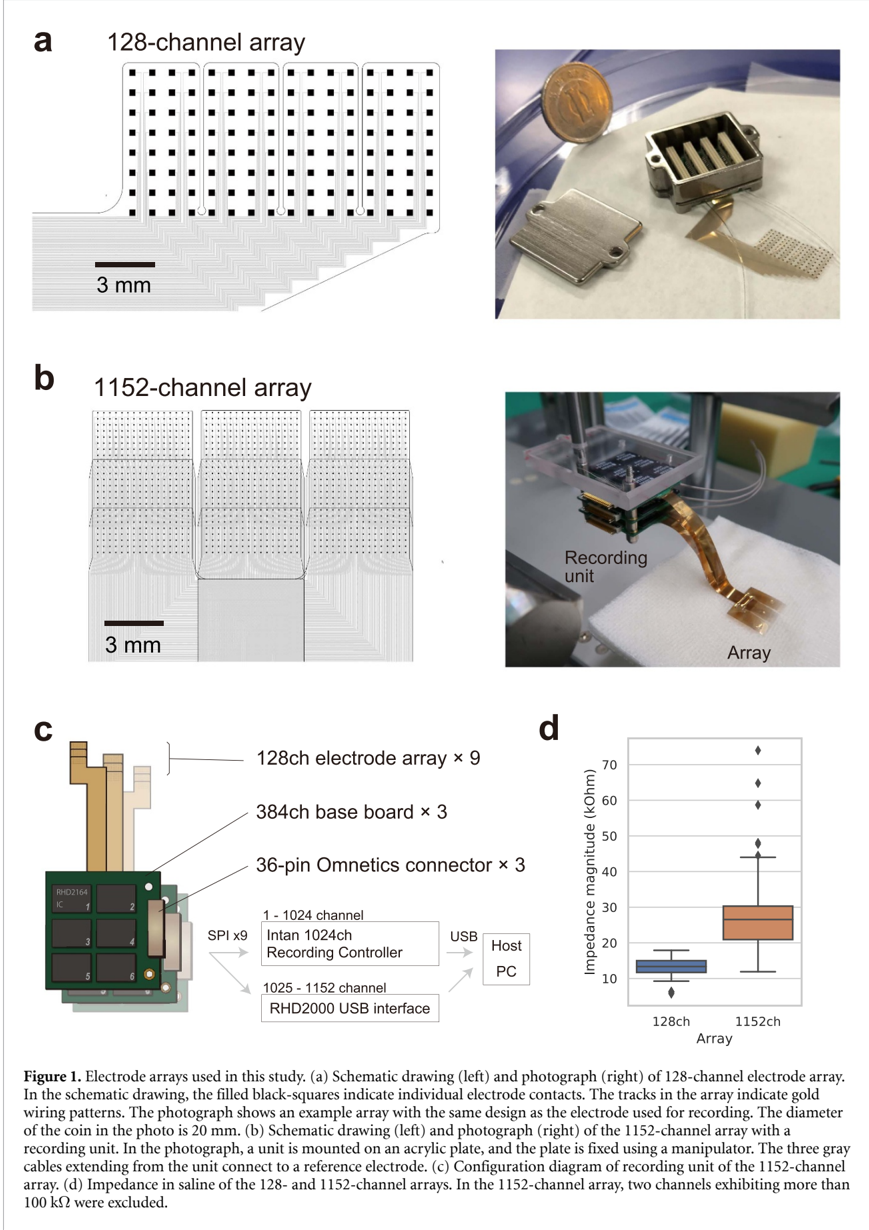
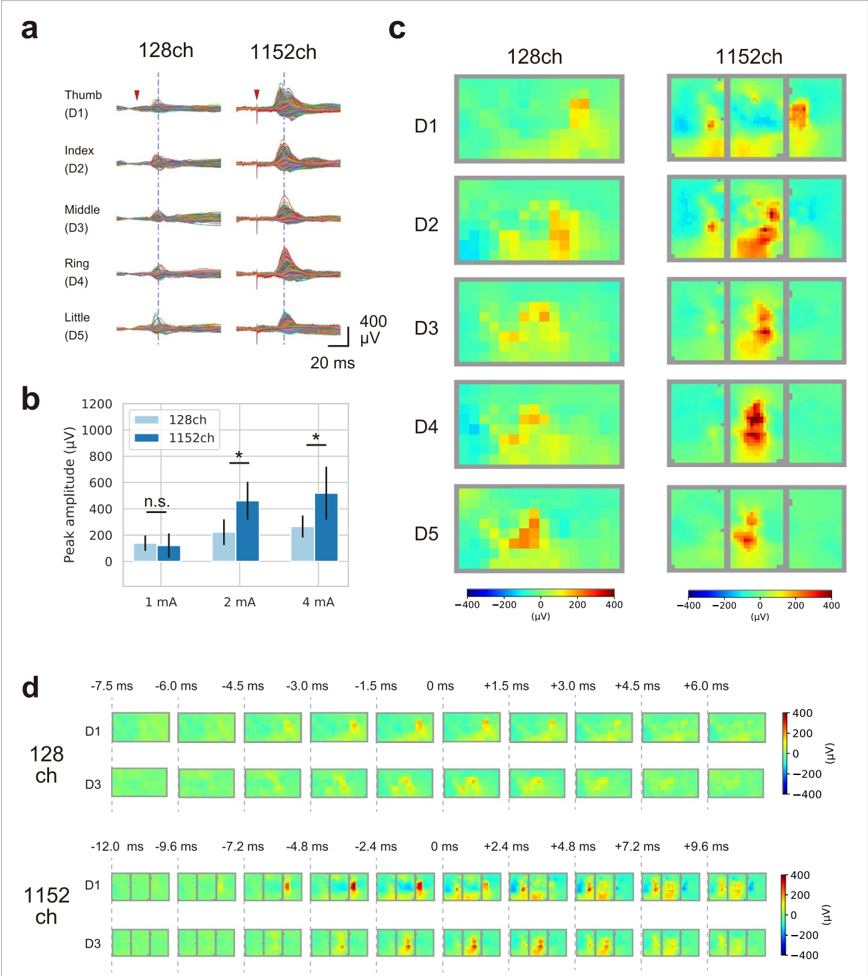
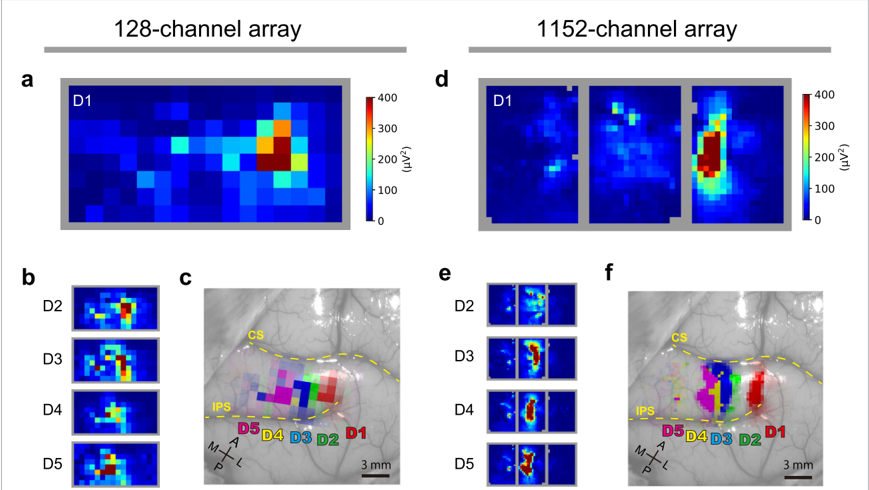
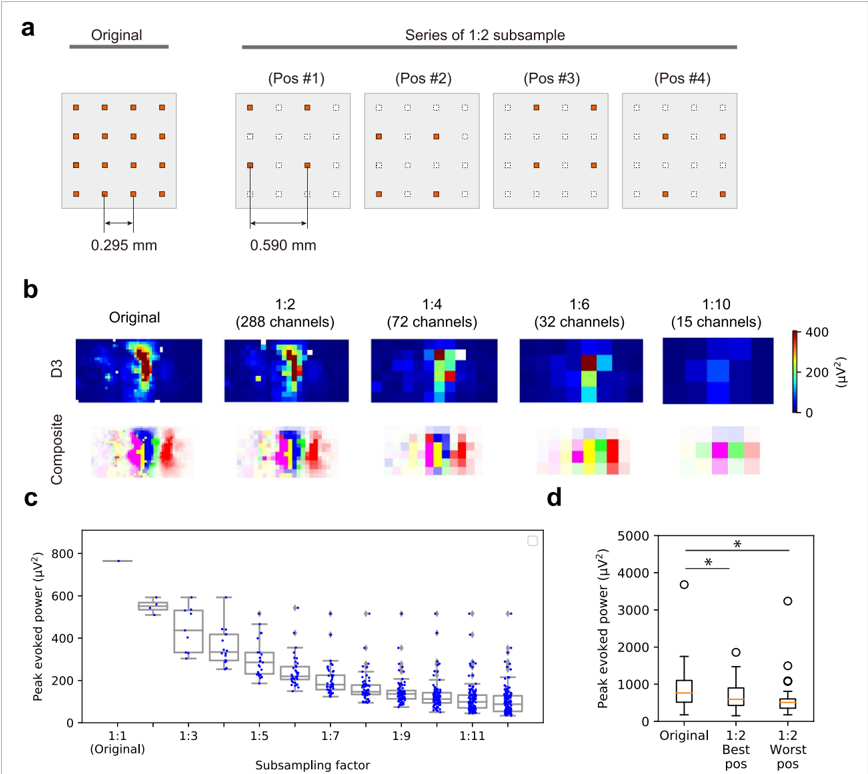
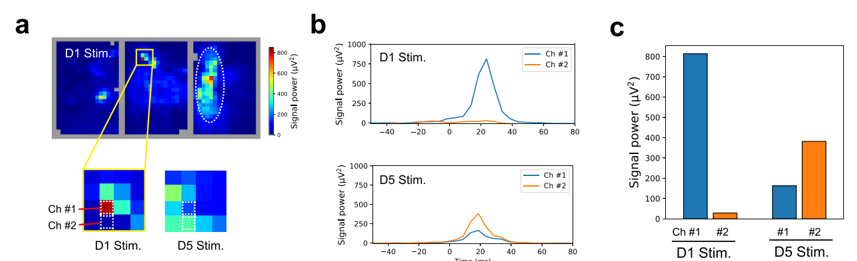
Objective. Advances in brain–machine interfaces (BMIs) are expected to support patients with movement disorders. Electrocorticogram (ECoG) measures electrophysiological activities over a large area using a low-invasive flexible sheet placed on the cortex. ECoG has been considered as a feasible signal source of the clinical BMI device. To capture neural activities more precisely, the feasibility of higher-density arrays has been investigated. However, currently, the number of electrodes is limited to approximately 300 due to wiring difficulties, device size, and system costs. Approach. We developed a high-density recording system with a large coverage (14 × 7 mm 2) and using 1152 electrodes by directly integrating dedicated flexible arrays with the neural-recording application-specific integrated circuits and their interposers. Main results. Comparative experiments with a 128-channel array demonstrated that the proposed device could delineate the entire digit representation of a nonhuman primate. Subsampling analysis revealed that higher-amplitude signals can be measured using higher-density arrays. Significance. We expect that the proposed system that simultaneously establishes large-scale sampling, high temporal-precision of electrophysiology, and high spatial resolution comparable to optical imaging will be suitable for next-generation brain-sensing technology.
Overview
The claims and statistics of this paper haven’t been checked yet.
Free: it reads the open-access text and checks the first 5 claims that cite a source we can check. Create a free account to check every claim.
Integrity signals
Registry
Cites
Statistics
Figures
Verification
Claims the paper makes
The claims and statistics of this paper haven’t been checked yet.
Free: it reads the open-access text and checks the first 5 claims that cite a source we can check. Create a free account to check every claim.
Claims other papers make about this one
Each is checked against this paper’s own text: does it say what the citing paper says it does?
The source backs part of the claim, not all of it — or backs it for a different population, condition or comparison.
In the citing paper
“Different approaches to increase the density and lower the invasiveness of ECoG are currently being developed for use in humans and animal models176–182.”
From The speech neuroprosthesis (2024) · cites this paper as [178]
Experimental — accuracy not yet measured
Self-check
Percentages, sums and reported differences re-computed from the paper’s own numbers.
The self-check needs the paper’s full text.
Citations
Cites
The origin of extracellular fields and currents — EEG, ECoG, LFP and spikes
Buzsáki, G., Anastassiou, C. A., & Koch, C. (2012) · Nature Reviews Neuroscience · doi:10.1038/nrn3241 · Cited by 4,225 · cited 2×
“The surface of an ECoG electrode array involves multiple electrode contacts (channels), and the extracellular potentials generated as a group by the neurons near each electrode can be measured from the brain surface [5, 6].”
BackgroundNeuronal ensemble control of prosthetic devices by a human with tetraplegia
Hochberg, L. R., Serruya, M. D., Friehs, G. M., Mukand, J. A., Saleh, M., Caplan, A. H., Branner, A., Chen, D., Penn, R. D., & Donoghue, J. P. (2006) · Nature · doi:10.1038/nature04970 · Cited by 3,295
Reach and grasp by people with tetraplegia using a neurally controlled robotic arm
Hochberg, L. R., Bacher, D., Jarosiewicz, B., Masse, N. Y., Simeral, J. D., Vogel, J., Haddadin, S., Liu, J., Cash, S. S., van der Smagt, P., et al. (2012) · Nature · doi:10.1038/nature11076 · Cited by 2,719
High-performance neuroprosthetic control by an individual with tetraplegia
Collinger, J. L., Wodlinger, B., Downey, J. E., Wang, W., Tyler-Kabara, E. C., Weber, D. J., McMorland, A. J., Velliste, M., Boninger, M. L., & Schwartz, A. B. (2013) · The Lancet · doi:10.1016/s0140-6736(12)61816-9 · Cited by 1,848
Viventi, J., Kim, D.-H., Vigeland, L., Frechette, E. S., Blanco, J. A., Kim, Y.-S., Avrin, A. E., Tiruvadi, V. R., Hwang, S.-W., Vanleer, A. C., et al. (2011) · Nature Neuroscience · doi:10.1038/nn.2973 · Cited by 1,136
NeuroGrid: recording action potentials from the surface of the brain
Khodagholy, D., Gelinas, J. N., Thesen, T., Doyle, W., Devinsky, O., Malliaras, G. G., & Buzsáki, G. (2015) · Nature Neuroscience · doi:10.1038/nn.3905 · Cited by 938
Novel electrode technologies for neural recordings
Hong, G., & Lieber, C. M. (2019) · Nature Reviews Neuroscience · doi:10.1038/s41583-019-0140-6 · Cited by 695
Decoding motor imagery from the posterior parietal cortex of a tetraplegic human
Aflalo, T., Kellis, S., Klaes, C., Lee, B., Shi, Y., Pejsa, K., Shanfield, K., Hayes-Jackson, S., Aisen, M., Heck, C., et al. (2015) · Science · doi:10.1126/science.aaa5417 · Cited by 649
Two-dimensional movement control using electrocorticographic signals in humans
Schalk, G., Miller, K. J., Anderson, N. R., Wilson, J. A., Smyth, M. D., Ojemann, J. G., Moran, D. W., Wolpaw, J. R., & Leuthardt, E. C. (2008) · Journal of Neural Engineering · doi:10.1088/1741-2560/5/1/008 · Cited by 482 · cited 1×
“Previous studies have demonstrated that humans [7, 8] and nonhuman primates [9] can control external devices, such as computer cursors, by decoding the measured brain activity.”
BackgroundRepresentations of the body surface in postcentral parietal cortex of Macaca fascicularis
Nelson, R. J., Sur, M., Felleman, D. J., & Kaas, J. H. (1980) · Journal of Comparative Neurology · doi:10.1002/cne.901920402 · Cited by 434
An Electrocorticographic Brain Interface in an Individual with Tetraplegia
Wang, W., Collinger, J. L., Degenhart, A. D., Tyler-Kabara, E. C., Schwartz, A. B., Moran, D. W., Weber, D. J., Wodlinger, B., Vinjamuri, R. K., Ashmore, R. C., et al. (2013) · PLoS ONE · doi:10.1371/journal.pone.0055344 · Cited by 402 · cited 1×
“Previous studies have demonstrated that humans [7, 8] and nonhuman primates [9] can control external devices, such as computer cursors, by decoding the measured brain activity.”
BackgroundA MEMS-based flexible multichannel ECoG-electrode array
Rubehn, B., Bosman, C., Oostenveld, R., Fries, P., & Stieglitz, T. (2009) · Journal of Neural Engineering · doi:10.1088/1741-2560/6/3/036003 · Cited by 387
Pesaran, B., Vinck, M., Einevoll, G. T., Sirota, A., Fries, P., Siegel, M., Truccolo, W., Schroeder, C. E., & Srinivasan, R. (2018) · Nature Neuroscience · doi:10.1038/s41593-018-0171-8 · Cited by 370 · cited 1×
“The surface of an ECoG electrode array involves multiple electrode contacts (channels), and the extracellular potentials generated as a group by the neurons near each electrode can be measured from the brain surface [5, 6].”
BackgroundSpatial spectral analysis of human electrocorticograms including the alpha and gamma bands
Freeman, W. J., Rogers, L. J., Holmes, M. D., & Silbergeld, D. L. (2000) · Journal of Neuroscience Methods · doi:10.1016/s0165-0270(99)00160-0 · Cited by 323 · cited 1×
“Previous studies have suggested that the optimal interelectrode distance is approximately 1 mm or more [45, 46] for humans.”
BackgroundElectrocorticographic high gamma activity versus electrical cortical stimulation mapping of naming
Sinai, A., Bowers, C. W., Crainiceanu, C. M., Boatman, D., Gordon, B., Lesser, R. P., Lenz, F. A., & Crone, N. E. (2005) · Brain · doi:10.1093/brain/awh491 · Cited by 266 · cited 1×
“Generally, when mapping the brain activity using ECoG signals, the increase in power at a high frequency called a highgamma band (or broadband gamma) is often used as an indicator of cortical activity [33].”
MethodHuman finger somatotopy in areas 3b, 1, and 2: A 7T fMRI study using a natural stimulus
Martuzzi, R., van der Zwaag, W., Farthouat, J., Gruetter, R., & Blanke, O. (2014) · Human Brain Mapping · doi:10.1002/hbm.22172 · Cited by 213
Chiang, C.-H., Won, S. M., Orsborn, A. L., Yu, K. J., Trumpis, M., Bent, B., Wang, C., Xue, Y., Min, S., Woods, V., et al. (2020) · Science Translational Medicine · doi:10.1126/scitranslmed.aay4682 · Cited by 211
Accurate decoding of reaching movements from field potentials in the absence of spikes
Flint, R. D., Lindberg, E. W., Jordan, L. R., Miller, L. E., & Slutzky, M. W. (2012) · Journal of Neural Engineering · doi:10.1088/1741-2560/9/4/046006 · Cited by 201 · cited 1×
“However, an ECoG electrode array cannot directly measure the single-unit activities of individual neurons, and its decoding ability is less than that of the invasive penetrating electrodes [10].”
BackgroundTowards Large-Scale, Human-Based, Mesoscopic Neurotechnologies
Chang, E. F. (2015) · Neuron · doi:10.1016/j.neuron.2015.03.037 · Cited by 163
Optimal spacing of surface electrode arrays for brain–machine interface applications
Slutzky, M. W., Jordan, L. R., Krieg, T., Chen, M., Mogul, D. J., & Miller, L. E. (2010) · Journal of Neural Engineering · doi:10.1088/1741-2560/7/2/026004 · Cited by 161 · cited 1×
“Previous studies have suggested that the optimal interelectrode distance is approximately 1 mm or more [45, 46] for humans.”
BackgroundSanchez-Panchuelo, R. M., Besle, J., Beckett, A., Bowtell, R., Schluppeck, D., & Francis, S. (2012) · The Journal of Neuroscience · doi:10.1523/jneurosci.2501-12.2012 · Cited by 148
Consistent Features of the Representation of the Hand in Area 3b of Macaque Monkeys
Pons, T. P., Wall, J. T., Garraghty, P. E., Cusick, C. G., & Kaas, J. H. (1987) · Somatosensory Research · doi:10.3109/07367228709144612 · Cited by 121
Investigating the Stability of Fine-Grain Digit Somatotopy in Individual Human Participants
Kolasinski, J., Makin, T. R., Jbabdi, S., Clare, S., Stagg, C. J., & Johansen-Berg, H. (2016) · The Journal of Neuroscience · doi:10.1523/jneurosci.1742-15.2016 · Cited by 107
Does Impedance Matter When Recording Spikes With Polytrodes?
Neto, J. P., Baião, P., Lopes, G., Frazão, J., Nogueira, J., Fortunato, E., Barquinha, P., & Kampff, A. R. (2018) · Frontiers in Neuroscience · doi:10.3389/fnins.2018.00715 · Cited by 103
Shoham, D., & Grinvald, A. (2001) · The Journal of Neuroscience · doi:10.1523/jneurosci.21-17-06820.2001 · Cited by 101 · cited 1×
“This mapping result appropriately captured the topography characteristics of the digit representation previously investigated using other imaging techniques such as high-field MRI [37–40], optical intrinsic signal imaging [41, 42], and voltagesensitive dye [43].”
MethodSchellekens, W., Petridou, N., & Ramsey, N. F. (2018) · NeuroImage · doi:10.1016/j.neuroimage.2018.06.062 · Cited by 98
Overlapping representation of fingers in the somatosensory cortex (area 2) of the conscious monkey
Iwamura, Y., Tanaka, M., & Hikosaka, O. (1980) · Brain Research · doi:10.1016/0006-8993(80)91139-7 · Cited by 94 · cited 1×
“Furthermore, the existence of these separate patches is reported in another literature using penetrating electrodes [36].”
BackgroundKaiju, T., Doi, K., Yokota, M., Watanabe, K., Inoue, M., Ando, H., Takahashi, K., Yoshida, F., Hirata, M., & Suzuki, T. (2017) · Frontiers in Neural Circuits · doi:10.3389/fncir.2017.00020 · Cited by 94 · cited 1×
“As shown in our previous work [11], a flexible array using biocompatible polymer parylene-C [poly(chloro-paraxylylene)] was fabricated using photolithography.”
MethodSelf-citationChen, L. M., Friedman, R. M., Ramsden, B. M., LaMotte, R. H., & Roe, A. W. (2001) · Journal of Neurophysiology · doi:10.1152/jn.2001.86.6.3011 · Cited by 91 · cited 1×
“This mapping result appropriately captured the topography characteristics of the digit representation previously investigated using other imaging techniques such as high-field MRI [37–40], optical intrinsic signal imaging [41, 42], and voltagesensitive dye [43].”
MethodMulti-scale analysis of neural activity in humans: Implications for micro-scale electrocorticography
Kellis, S., Sorensen, L. B., Darvas, F., Sayres, C., O’Neill, K., Brown, R. B., House, P. A., Ojemann, J. G., & Greger, B. E. (2015) · Clinical Neurophysiology · doi:10.1016/j.clinph.2015.06.002 · Cited by 89
Hemispheric Mapping of Secondary Somatosensory Cortex in the Rat
Benison, A. M., Rector, D. M., & Barth, D. S. (2007) · Journal of Neurophysiology · doi:10.1152/jn.00673.2006 · Cited by 69
“Microflex”—A New Assembling Technique for Interconnects
Stieglitz, T., Beutel, H., & Meyer, J. U. (2000) · Journal of Intelligent Material Systems and Structures · doi:10.1106/r7bv-511b-21rj-r2fa · Cited by 67 · cited 8×
“Consequently, without redesigning the board, the number of electrodes can be increased by simply increasing the number of PCBs; even if a failure occurs in each PCB, it can be addressed by individual replacements.”
MethodInfluentialLong-term recording reliability of liquid crystal polymer µ ECoG arrays
Woods, V., Trumpis, M., Bent, B., Palopoli-Trojani, K., Chiang, C.-H., Wang, C., Yu, C., Insanally, M. N., Froemke, R. C., & Viventi, J. (2018) · Journal of Neural Engineering · doi:10.1088/1741-2552/aae39d · Cited by 63
Developing Next-Generation Brain Sensing Technologies—A Review
Robinson, J. T., Xie, C., Pohlmeyer, E. A., Gather, M. C., Kemere, C. T., Kitching, J. E., Malliaras, G. G., Marblestone, A. H., Shepard, K. L., & Stieglitz, T. (2019) · IEEE Sensors Journal · doi:10.1109/jsen.2019.2931159 · Cited by 50
New thin-film surface electrode array enables brain mapping with high spatial acuity in rodents
Konerding, W. S., Froriep, U. P., Kral, A., & Baumhoff, P. (2018) · Scientific Reports · doi:10.1038/s41598-018-22051-z · Cited by 47
A low-cost, multiplexed μ ECoG system for high-density recordings in freely moving rodents
Insanally, M., Trumpis, M., Wang, C., Chiang, C.-H., Woods, V., Palopoli-Trojani, K., Bossi, S., Froemke, R. C., & Viventi, J. (2016) · Journal of Neural Engineering · doi:10.1088/1741-2560/13/2/026030 · Cited by 45
Koch, J., Schuettler, M., Pasluosta, C., & Stieglitz, T. (2019) · Journal of Neural Engineering · doi:10.1088/1741-2552/ab36df · Cited by 43
Fabrication and testing of a large area, high density, parylene MEMS
Ledochowitsch, P., Felus, R. J., Gibboni, R. R., Miyakawa, A., Bao, S., & Maharbiz, M. M. (2011) · 2011 IEEE 24th International Conference on Micro Electro Mechanical Systems · doi:10.1109/memsys.2011.5734604 · Cited by 41
Spatial co-adaptation of cortical control columns in a micro-ECoG brain–computer interface
Rouse, A. G., Williams, J. J., Wheeler, J. J., & Moran, D. W. (2016) · Journal of Neural Engineering · doi:10.1088/1741-2560/13/5/056018 · Cited by 40 · cited 1×
“Previous studies have demonstrated that humans [7, 8] and nonhuman primates [9] can control external devices, such as computer cursors, by decoding the measured brain activity.”
BackgroundCorrelation Structure in Micro-ECoG Recordings is Described by Spatially Coherent Components
Rogers, N., Hermiz, J., Ganji, M., Kaestner, E., Kılıç, K., Hossain, L., Thunemann, M., Cleary, D. R., Carter, B. S., Barba, D., et al. (2019) · PLOS Computational Biology · doi:10.1371/journal.pcbi.1006769 · Cited by 37 · cited 1×
“Previous studies have revealed that a smaller interelectrode distance resulted in a larger correlation between signals from adjacent electrodes [34, 35].”
BackgroundMapping the fine structure of cortical activity with different micro-ECoG electrode array geometries
Wang, X., Gkogkidis, C. A., Iljina, O., Fiederer, L. D. J., Henle, C., Mader, I., Kaminsky, J., Stieglitz, T., Gierthmuehlen, M., & Ball, T. (2017) · Journal of Neural Engineering · doi:10.1088/1741-2552/aa785e · Cited by 35
A low-cost, scalable, current-sensing digital headstage for high channel count μ ECoG
Trumpis, M., Insanally, M., Zou, J., Elsharif, A., Ghomashchi, A., Sertac Artan, N., Froemke, R. C., & Viventi, J. (2017) · Journal of Neural Engineering · doi:10.1088/1741-2552/aa5a82 · Cited by 23
Sub-mm functional decoupling of electrocortical signals through closed-loop BMI learning
Ledochowitsch, P., Koralek, A. C., Moses, D. A., Carmena, J. M., & Maharbiz, M. M. (2013) · Annual International Conference of the IEEE Engineering in Medicine and Biology Society (EMBC) · doi:10.1109/embc.2013.6610825 · Cited by 19
A modular high-density μ ECoG system on macaque vlPFC for auditory cognitive decoding
Chiang, C., Lee, J., Wang, C., Williams, A. J., Lucas, T. H., Cohen, Y. E., & Viventi, J. (2020) · Journal of Neural Engineering · doi:10.1088/1741-2552/ab9986 · Cited by 16
Roe, A. W., Winberry, J. E., & Friedman, R. M. (2017) · Neurophotonics · doi:10.1117/1.nph.4.3.031219 · Cited by 8
A MEMS-Based Flexible High-Density Brain Electrode for Multi-Modal Neural Encoding/Decoding
Xiao, T., Zhang, S., Zhou, Y., & Tao, T. H. (2019) · IEEE International Conference on Micro Electro Mechanical Systems (MEMS) · doi:10.1109/memsys.2019.8870877 · Cited by 3
Cited by
Flexible Electrodes for Brain–Computer Interface System
Wang, J., Wang, T., Liu, H., Wang, K., Kumi, M., Feng, Z., Li, P., & Huang, W. (2023) · Advanced Materials · doi:10.1002/adma.202211012 · Cited by 158
Human brain mapping with multithousand-channel PtNRGrids resolves spatiotemporal dynamics
Tchoe, Y., Bourhis, A. M., Cleary, D. R., Stedelin, B., Lee, J., Tonsfeldt, K. J., Brown, E. C., Siler, D. A., Paulk, A. C., Yang, J. C., et al. (2022) · Science Translational Medicine · doi:10.1126/scitranslmed.abj1441 · Cited by 135
Silva, A. B., Littlejohn, K. T., Liu, J. R., Moses, D. A., & Chang, E. F. (2024) · Nature Reviews Neuroscience · doi:10.1038/s41583-024-00819-9 · Cited by 103
The science and engineering behind sensitized brain-controlled bionic hands
Pandarinath, C., & Bensmaïa, S. J. (2021) · Physiological Reviews · doi:10.1152/physrev.00034.2020 · Cited by 91
Neural interface systems with on-device computing: machine learning and neuromorphic architectures
Yoo, J., & Shoaran, M. (2021) · Current Opinion in Biotechnology · doi:10.1016/j.copbio.2021.10.012 · Cited by 70
Metadata
- Authors
- Kaiju, T., Inoue, M., Hirata, M., & Suzuki, T.
- Affiliations
- Center for Information and Neural Networks (JP)
- Corresponding author
- Suzuki, Takafumi
- Venue
- Journal of Neural Engineering
- Publisher
- IOP Publishing
- Published
- 2021-03-17
- Volume
- 18
- Issue
- 3
- Pages
- 036025
- ISSN
- 1741-2552 (ISSN-L)
- 1741-2560
- OpenAlex
- W3126225477
- Cited by
- 42
- References
- 46
- Citations by year
- 2026: 8 · 2025: 6 · 2024: 10 · 2023: 8 · 2022: 4 · 2021: 6
- FWCI
- 3.23
- Type
- journal article
- Language
- en
- Open access
- hybrid
- doi.org
- Licence
- cc-by
- creativecommons.org/licenses/by/4.0 (vor)
- iopscience.iop.org/info/page/text-and-data-mining (tdm)
- Locations
- Journal of Neural Engineering (publishedVersion, cc-by)
- PubMed (publishedVersion)
- Funders
- National Institute of Information and Communications Technology (Commissioned Research)
- Japan Society for the Promotion of Science (KAKENHI Grant Number 18H05380)
- Core Research for Evolutional Science and Technology (JPMJCR186)
- Topics
- Life Sciences › Neuroscience › Cellular and Molecular Neuroscience › Neuroscience and Neural Engineering
- Life Sciences › Neuroscience › Cognitive Neuroscience › EEG and Brain-Computer Interfaces
- Physical Sciences › Engineering › Electrical and Electronic Engineering › Analog and Mixed-Signal Circuit Design
- Keywords
- electrocorticography, high-density electrode arrays, non-human primates, brain-computer interface, application-specific integrated circuits, interposer, movement disorders, neural recording
- MeSH terms
- Electrocorticography, Animals, Brain Mapping, Electrodes, Implanted, Humans, Primates, Brain-Computer Interfaces
About these checks
Registry, retraction, Cites and statistics results are computed, not judged, with one exception: a printed reference that no index lists is read once by a model before it counts as a citation error. Claims are extracted by a model and kept only when their quote appears verbatim in the text; each cited source is then checked, with a model’s help, for whether it says what the claim relies on. Those verdicts can be wrong — read the claim’s quote and the cited source before relying on one.
Statistics and arithmetic are recomputed, not judged.
Confidence bands are shown only for fields calibrated on our annotated test set. None is calibrated yet, so no band is shown.
What counts as a claim ›How we measure confidence ›How we check this ›
Are you an author, or do you see a problem with this page? Request a review
Data sources
Bibliographic data: Semantic Scholar, OpenAlex, Crossref.
Contains information from the Semantic Scholar Academic Graph Datasets, made available under the ODC Attribution License (ODC-BY 1.0).
Semantic Scholar’s data is described in: Kinney, R., et al. (2023). The Semantic Scholar Open Data Platform. arXiv:2301.10140.
