

Energy sector water use implications of a 2 °C climate policy
Open accessThe DOI matches its Crossref record; 31 of the 31 references it cites were found in a registry or an index.
Abstract
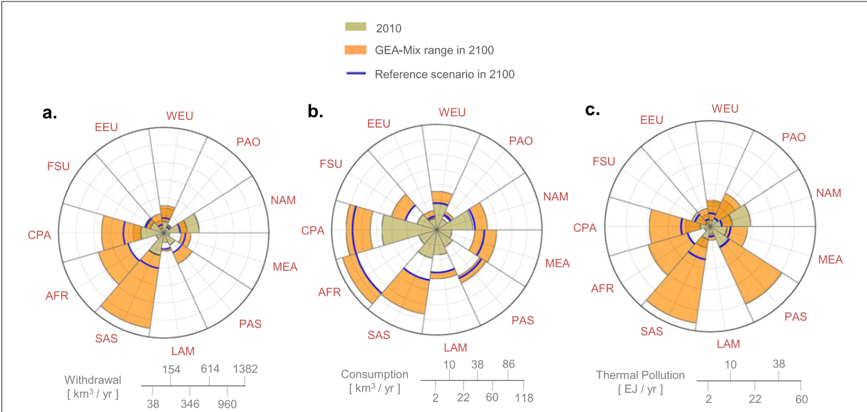
Quantifying water implications of energy transitions is important for assessing long-term freshwater sustainability since large volumes of water are currently used throughout the energy sector. In this paper, we assess direct global energy sector water use and thermal water pollution across a broad range of energy system transformation pathways to assess water impacts of a 2 °C climate policy. A global integrated assessment model is equipped with the capabilities to account for the water impacts of technologies located throughout the energy supply chain. The model framework is applied across a broad range of 2 °C scenarios to highlight long-term water impact uncertainties over the 21st century. We find that water implications vary significantly across scenarios, and that adaptation in power plant cooling technology can considerably reduce global freshwater withdrawals and thermal pollution. Global freshwater consumption increases across all of the investigated 2 °C scenarios as a result of rapidly expanding electricity demand in developing regions and the prevalence of freshwater-cooled thermal power generation. Reducing energy demand emerges as a robust strategy for water conservation, and enables increased technological flexibility on the supply side to fulfill ambitious climate objectives. The results underscore the importance of an integrated approach when developing water, energy, and climate policy, especially in regions where rapid growth in both energy and water demands is anticipated.
Overview
The claims and statistics of this paper haven’t been checked yet.
Free: it reads the open-access text and checks the first 5 claims that cite a source we can check. Create a free account to check every claim.
Integrity signals
Registry
Cites
Statistics
Figures



Verification
Claims the paper makes
The claims and statistics of this paper haven’t been checked yet.
Free: it reads the open-access text and checks the first 5 claims that cite a source we can check. Create a free account to check every claim.
Claims other papers make about this one
Each is checked against this paper’s own text: does it say what the citing paper says it does?
In the citing paper
“The volume of water used by the energy sector alone represents about 15% of global freshwater withdrawals, and extracting and processing freshwater represents about 19% of total usage by the energy sector (Fricko et al. 2016).”
From Scientists’ warning to humanity on the freshwater biodiversity crisis (2021) · cites this paper as Fricko et al. 2016
In the citing paper
“The impacts of bioenergy deployment will need to be evaluated on a case-bycase basis, however.”
From Connecting the sustainable development goals by their energy inter-linkages (2018) · cites this paper as Fricko et al. (2016)
In the citing paper
“An up-scaling of renewables and energy efficiency should lead to lower levels of water polluƟon (chemical and thermal) than a fossil-dominant energy system.”
From Connecting the sustainable development goals by their energy inter-linkages (2018) · cites this paper as Fricko et al. (2016)
Self-check
Percentages, sums and reported differences re-computed from the paper’s own numbers.
The self-check needs the paper’s full text.
Citations
Cites
International Energy Agency (2012) · World Energy Outlook · doi:10.1787/weo-2012-en · Cited by 1,219
Scenarios of long-term socio-economic and environmental development under climate stabilization
Riahi, K., Grübler, A., & Nakicenovic, N. (2007) · Technological Forecasting and Social Change · doi:10.1016/j.techfore.2006.05.026 · Cited by 1,152 · cited 2×
“Access to water in the energy sector is crucial for resource extraction, fuel processing, and electric power generation (Mielke et al 2010, Macknick et al 2012a).”
BackgroundSelf-citationGlobal river discharge and water temperature under climate change
van Vliet, M. T. H., Franssen, W. H. P., Yearsley, J. R., Ludwig, F., Haddeland, I., Lettenmaier, D. P., & Kabat, P. (2013) · Global Environmental Change · doi:10.1016/j.gloenvcha.2012.11.002 · Cited by 1,034
Self-citationThe water footprint of bioenergy
Gerbens-Leenes, W., Hoekstra, A. Y., & van der Meer, T. H. (2009) · Proceedings of the National Academy of Sciences · doi:10.1073/pnas.0812619106 · Cited by 774 · cited 2×
“Furthermore, our analysis does not include the potential irrigation water used for bioenergy feedstock cultivation (Gerbens-Leenes et al 2009).”
BackgroundDöll, P., Hoffmann-Dobrev, H., Portmann, F. T., Siebert, S., Eicker, A., Rodell, M., Strassberg, G., & Scanlon, B. R. (2012) · Journal of Geodynamics · doi:10.1016/j.jog.2011.05.001 · Cited by 740
Macknick, J., Newmark, R., Heath, G., & Hallett, K. C. (2012) · Environmental Research Letters · doi:10.1088/1748-9326/7/4/045802 · Cited by 631 · cited 4×
“Previous analysis at both the regional and global-scale focused mainly on low-carbon electricity generation pathways (Macknick et al 2012b, Davies et al 2013, Kyle et al 2013, Webster et al 2013, Bouckaert et al 2014, Byers et al 2014, Cameron et al 2014).”
BackgroundInfluentialFlörke, M., Kynast, E., Bärlund, I., Eisner, S., Wimmer, F., & Alcamo, J. (2013) · Global Environmental Change · doi:10.1016/j.gloenvcha.2012.10.018 · Cited by 580
Interpretation of High Projections for Global-Mean Warming
Wigley, T. M. L., & Raper, S. C. B. (2001) · Science · doi:10.1126/science.1061604 · Cited by 524
Kriegler, E., Weyant, J. P., Blanford, G. J., Krey, V., Clarke, L., Edmonds, J., Fawcett, A., Luderer, G., Riahi, K., Richels, R., et al. (2014) · Climatic Change · doi:10.1007/s10584-013-0953-7 · Cited by 442
Self-citationProbabilistic cost estimates for climate change mitigation
Rogelj, J., McCollum, D. L., Reisinger, A., Meinshausen, M., & Riahi, K. (2013) · Nature · doi:10.1038/nature11787 · Cited by 322
Self-citation
Research works printed but not linked: 2
- Macknick J, 2012, Environ. Res. Lett., 7
- Macknick J, 2012, Environ. Res. Lett., 7
Cited by
Scientists’ warning to humanity on the freshwater biodiversity crisis
Albert, J. S., Destouni, G., Duke-Sylvester, S. M., Magurran, A. E., Oberdorff, T., Reis, R. E., Winemiller, K. O., & Ripple, W. J. (2021) · Ambio · doi:10.1007/s13280-020-01318-8 · Cited by 943
“The volume of water used by the energy sector alone represents about 15% of global freshwater withdrawals, and extracting and processing freshwater represents about 19% of total usage by the energy sector (Fricko et al. 2016).”
BackgroundConnecting the sustainable development goals by their energy inter-linkages
McCollum, D. L., Echeverri, L. G., Busch, S., Pachauri, S., Parkinson, S., Rogelj, J., Krey, V., Minx, J. C., Nilsson, M., Stevance, A.-S., et al. (2018) · Environmental Research Letters · doi:10.1088/1748-9326/aaafe3 · Cited by 448
Self-citationShared Socio-Economic Pathways of the Energy Sector – Quantifying the Narratives
Bauer, N., Calvin, K., Emmerling, J., Fricko, O., Fujimori, S., Hilaire, J., Eom, J., Krey, V., Kriegler, E., Mouratiadou, I., et al. (2017) · Global Environmental Change · doi:10.1016/j.gloenvcha.2016.07.006 · Cited by 417
“On the other hand, global energy systems are vulnerable to climate change and can serve as means for adaptation to a changing climate (Bazilian et al., 2011; Chandramowli and Felder, 2014; Ciscar and Dowling, 2014; Fricko et al., 2016, 2017; Isaac and van Vuuren, 2009).”
Self-citationLuderer, G., Pehl, M., Arvesen, A., Gibon, T., Bodirsky, B. L., de Boer, H. S., Fricko, O., Hejazi, M., Humpenöder, F., Iyer, G., et al. (2019) · Nature Communications · doi:10.1038/s41467-019-13067-8 · Cited by 366
Self-citationFood–energy–water implications of negative emissions technologies in a +1.5 °C future
Fuhrman, J., McJeon, H., Patel, P., Doney, S. C., Shobe, W. M., & Clarens, A. F. (2020) · Nature Climate Change · doi:10.1038/s41558-020-0876-z · Cited by 229
Baumstark, L., Bauer, N., Benke, F., Bertram, C., Bi, S., Gong, C. C., Dietrich, J. P., Dirnaichner, A., Giannousakis, A., Hilaire, J., et al. (2021) · Geoscientific Model Development · doi:10.5194/gmd-14-6571-2021 · Cited by 218
Sovacool, B. K., Bazilian, M., Griffiths, S., Kim, J., Foley, A., & Rooney, D. (2021) · Renewable and Sustainable Energy Reviews · doi:10.1016/j.rser.2021.110856 · Cited by 206
Flexibility and intensity of global water use
Qin, Y., Mueller, N. D., Siebert, S., Jackson, R. B., AghaKouchak, A., Zimmerman, J. B., Tong, D., Hong, C., & Davis, S. J. (2019) · Nature Sustainability · doi:10.1038/s41893-019-0294-2 · Cited by 199
Sustainable Development, Poverty Eradication and Reducing Inequalities
(2022) · Global Warming of 1.5°C · doi:10.1017/9781009157940.007 · Cited by 178
Mitigation Pathways Compatible with 1.5°C in the Context of Sustainable Development
(2022) · Global Warming of 1.5°C · doi:10.1017/9781009157940.004 · Cited by 154
The water footprint of carbon capture and storage technologies
Rosa, L., Sanchez, D. L., Realmonte, G., Baldocchi, D., & D’Odorico, P. (2020) · Renewable and Sustainable Energy Reviews · doi:10.1016/j.rser.2020.110511 · Cited by 177
Griffiths, S., Sovacool, B. K., Kim, J., Bazilian, M., & Uratani, J. M. (2022) · Energy Research & Social Science · doi:10.1016/j.erss.2022.102542 · Cited by 185
Global thermal pollution of rivers from thermoelectric power plants
Raptis, C., van Vliet, M. T. H., & Pfister, S. (2016) · Environmental Research Letters · doi:10.1088/1748-9326/11/10/104011 · Cited by 175
Self-citationImpacts of 1.5°C Global Warming on Natural and Human Systems
IPCC (2022) · Cambridge University Press eBooks · doi:10.1017/9781009157940.005 · Cited by 221
Falchetta, G., Gernaat, D., Hunt, J. D., & Sterl, S. H. (2019) · Journal of Cleaner Production · doi:10.1016/j.jclepro.2019.05.263 · Cited by 150
“Table S3 (in the Supplementary material) reports the reviewed studies (Mekonnen et al., 2015; Mekonnen & Hoekstra, 2012; Mouratiadou et al., 2016; Davies et al., 2013; Fricko et al., 2016; Meldrum et al., 2013; Bakken et al., 2017) on the impact of power generation - both from fossil fuels and hydropower - on”
BackgroundClimate change and the vulnerability of electricity generation to water stress in the European Union
Behrens, P., van Vliet, M. T. H., Nanninga, T., Walsh, B., & Rodrigues, J. F. D. (2017) · Nature Energy · doi:10.1038/nenergy.2017.114 · Cited by 130
Self-citation(IPCC), I. P. O. C. C. (2023) · Cambridge University Press eBooks · doi:10.1017/9781009157926.011 · Cited by 236
Mouratiadou, I., Biewald, A., Pehl, M., Bonsch, M., Baumstark, L., Klein, D., Popp, A., Luderer, G., & Kriegler, E. (2016) · Environmental Science & Policy · doi:10.1016/j.envsci.2016.06.007 · Cited by 114
“…a consequence, the majority of studies of the current generation of IAMs assessing water demand trends at a global scale (e.g. Bijl et al., 2016; Davies et al., 2013; Fricko et al., 2016; Hejazi et al., 2014; Kyle et al., 2013) still lack a representation of water quantity and quality constraints.”
BackgroundOu, Y., Shi, W., Smith, S. J., Ledna, C. M., West, J. J., Nolte, C. G., & Loughlin, D. H. (2018) · Applied Energy · doi:10.1016/j.apenergy.2018.02.122 · Cited by 99
Balancing clean water-climate change mitigation trade-offs
Parkinson, S. C., Krey, V., Huppmann, D., Kahil, T., McCollum, D. L., Fricko, O., Byers, E. A., Gidden, M., Mayor, B., Khan, Z., et al. (2019) · Environmental Research Letters · doi:10.1088/1748-9326/aaf2a3 · Cited by 103
Self-citationA Continental‐Scale Hydroeconomic Model for Integrating Water‐Energy‐Land Nexus Solutions
Kahil, T., Parkinson, S. C., Satoh, Y., Greve, P., Burek, P., Veldkamp, T., Burtscher, R., Byers, E. A., Djilali, N., Fischer, G., et al. (2018) · Water Resources Research · doi:10.1029/2017wr022478 · Cited by 93
“Hydropower plants are also included in ECHO and their production depend on the BCU level hydropower generation potential (Fricko et al., 2016; Parkinson, Djilali, et al., 2016).”
BackgroundMethodSelf-citationThe water consequences of a transitioning US power sector
Peer, R., & Sanders, K. T. (2017) · Applied Energy · doi:10.1016/j.apenergy.2017.08.021 · Cited by 86
Srinivasan, S., Kholod, N., Chaturvedi, V., Ghosh, P. P., Mathur, R., Clarke, L., Evans, M., Hejazi, M. I., Kanudia, A., Koti, P. N., et al. (2017) · Applied Energy · doi:10.1016/j.apenergy.2017.04.079 · Cited by 79
Satoh, Y., Kahil, T., Byers, E. A., Burek, P., Fischer, G., Tramberend, S., Greve, P., Flörke, M., Eisner, S., Hanasaki, N., et al. (2017) · Earth s Future · doi:10.1002/2016ef000503 · Cited by 89
“The set of water scenarios are applied to three GHMs to project future water demand of sectors such as energy manufacturing and households [Fricko et al., 2016; Wada et al., 2016].”
MethodContribution of buildings climate change mitigation options to sustainable development
Mirasgedis, S., Cabeza, L. F., & Vérez, D. (2024) · Sustainable Cities and Society · doi:10.1016/j.scs.2024.105355 · Cited by 73
Lim, X. Y., Foo, D. C. Y., & Tan, R. R. (2018) · Journal of Cleaner Production · doi:10.1016/j.jclepro.2018.01.158 · Cited by 69
“Although recent study have indicated that CSP (unlike PV) uses as much water as nuclear (Fricko et al., 2016) for wet cooling, the Shams 1 CSP in UAE have successfully operated with drycooling system, which significantly reduces the water consumption (IRENA, 2015).”
BackgroundInfluentialVinca, A., Parkinson, S. C., Byers, E. A., Burek, P., Khan, Z., Krey, V., Diuana, F. A., Wang, Y., Ilyas, A., Köberle, A. C., et al. (2020) · Geoscientific model development · doi:10.5194/gmd-13-1095-2020 · Cited by 73
Self-citationIacobuţă, G., Höhne, N., van Soest, H. L., & Leemans, R. (2021) · Sustainability · doi:10.3390/su131910774 · Cited by 80
Water transfer and losses embodied in the West–East electricity transmission project in China
Zhu, Y., Ke, J., Wang, J., Liu, H., Jiang, S., Blum, H., Zhao, Y., He, G., Meng, Y., & Su, J. (2020) · Applied Energy · doi:10.1016/j.apenergy.2020.115152 · Cited by 58
Reduction of water consumption in thermal power plants with radiative sky cooling
Aili, A., Zhao, D., Tan, G., Yin, X., & Yang, R. (2021) · Applied Energy · doi:10.1016/j.apenergy.2021.117515 · Cited by 58
A pathway of global food supply adaptation in a world with increasingly constrained groundwater
Turner, S. W. D., Hejazi, M. I., Calvin, K., Kyle, P. G., & Kim, S. H. (2019) · The Science of The Total Environment · doi:10.1016/j.scitotenv.2019.04.070 · Cited by 62
Wang, Y., Byers, E. A., Parkinson, S. C., Wanders, N., Wada, Y., Mao, J., & Bielicki, J. M. (2019) · Energy & Environmental Science · doi:10.1039/c9ee02058f · Cited by 62
Self-citationRegional responses to future, demand-driven water scarcity
Cui, R. Y., Calvin, K., Clarke, L., Hejazi, M. I., Kim, S. H., Kyle, P. G., Patel, P., Turner, S. W. D., & Wise, M. (2018) · Environmental Research Letters · doi:10.1088/1748-9326/aad8f7 · Cited by 53
Integrated Solutions for the Water-Energy-Land Nexus: Are Global Models Rising to the Challenge?
Johnson, N., Burek, P., Byers, E. A., Falchetta, G., Flörke, M., Fujimori, S., Havlík, P., Hejazi, M. I., Hunt, J. D., Krey, V., et al. (2019) · Water · doi:10.3390/w11112223 · Cited by 53
“Both global and regional assessments generally suggest that increasing energy demands and electrification will likely lead to growing energy-related water consumption [58,111,119].”
BackgroundInfluentialSelf-citationAccelerating the Transition in the Context of Sustainable Development
(IPCC), I. P. O. C. C. (2023) · Cambridge University Press eBooks · doi:10.1017/9781009157926.019 · Cited by 60
Fujimori, S., Hanasaki, N., & Masui, T. (2016) · Sustainability Science · doi:10.1007/s11625-016-0392-2 · Cited by 49
“For example, Fricko et al. (2016) projected global water use under a climate change mitigation scenario and concluded that CCS, nuclear, and CSP are the major contributors to increased water usage.”
BackgroundRaptis, C., Boucher, J. M., & Pfister, S. (2016) · The Science of The Total Environment · doi:10.1016/j.scitotenv.2016.12.056 · Cited by 50
Small hydropower plants proliferation and fluvial ecosystem conservation nexus
Kuriqi, A., & Jurasz, J. (2022) · Elsevier eBooks · doi:10.1016/b978-0-323-85527-3.00027-3 · Cited by 56
Wan, L., Wang, C., & Cai, W. (2016) · Applied Energy · doi:10.1016/j.apenergy.2016.10.013 · Cited by 36
Advances and challenges in water management within energy systems
Guerra, O. J., & Reklaitis, G. V. (2017) · Renewable and Sustainable Energy Reviews · doi:10.1016/j.rser.2017.10.071 · Cited by 42
Ogland-Hand, J., Bielicki, J. M., Wang, Y., Adams, B. M., Buscheck, T. A., & Saar, M. O. (2019) · Energy Conversion and Management · doi:10.1016/j.enconman.2018.12.019 · Cited by 36
Lin, L., & Chen, Y. (2017) · Sustainability · doi:10.3390/su10010030 · Cited by 35
Water Demand Scenarios for Electricity Generation at the Global and Regional Levels
Terrapon-Pfaff, J., Ortíz, W., Viebahn, P., Kynast, E., & Flörke, M. (2020) · Water · doi:10.3390/w12092482 · Cited by 45
“[34] analyzed the consumptive water use for different scenarios of the International Energy Agency (IEA).”
BackgroundGlobal competing water uses for food and energy
Qin, Y. (2021) · Environmental Research Letters · doi:10.1088/1748-9326/ac06fa · Cited by 36
Water-energy-food nexus in China: An interregional comparison
Li, Y., Zhang, L., Zhang, P., Li, X., & Hao, Y. (2024) · Agricultural Water Management · doi:10.1016/j.agwat.2024.108964 · Cited by 34
Impacts of Groundwater Constraints on Saudi Arabia’s Low-Carbon Electricity Supply Strategy
Parkinson, S. C., Djilali, N., Krey, V., Fricko, O., Johnson, N., Khan, Z., Sedraoui, K., & Almasoud, A. H. (2016) · Environmental Science & Technology · doi:10.1021/acs.est.5b05852 · Cited by 37
Self-citationLiu, L., Parkinson, S. C., Gidden, M., Byers, E. A., Satoh, Y., Riahi, K., & Forman, B. A. (2018) · Environmental Research Letters · doi:10.1088/1748-9326/aab2b5 · Cited by 39
“…regional energy systems suggest that evaporative losses from reservoirs used for hydropower play a significant role in total consumptive water use (Fricko et al 2016, Grubert 2016), such evaporative impacts are missing from existing global-scale assessments of surface water reservoir potential…”
BackgroundSelf-citationLi, N., & Chen, W. (2018) · Energy · doi:10.1016/j.energy.2018.10.039 · Cited by 33
MESSAGEix-GLOBIOM nexus module: integrating water sector and climate impacts
Awais, M., Vinca, A., Byers, E. A., Frank, S., Fricko, O., Boere, E., Burek, P., Poblete-Cazenave, M., Kishimoto, P. N., Mastrucci, A., et al. (2024) · Geoscientific model development · doi:10.5194/gmd-17-2447-2024 · Cited by 49
Self-citationde Vos, L., Biemans, H., Doelman, J., Stehfest, E., & van Vuuren, D. P. (2021) · Environmental Research Letters · doi:10.1088/1748-9326/ac2b5e · Cited by 36
“…have shown potential to mitigate pressure in the nexus through measures involving irrigation efficiency improvements, renewable electricity generation, trade and land use change (Fricko et al 2016, Davis et al 2017, Jägermeyr et al 2017, Rosa et al 2018a, Pastor et al 2019, Zipper et al 2020).”
BackgroundExamining the water–energy–food (WEF) nexus through an SDG lens for the big 5 African countries
Molefe, T., & Inglesi‐Lotz, R. (2022) · Environment Development and Sustainability · doi:10.1007/s10668-022-02650-7 · Cited by 38
“Lastly, from a water point of view, the literature indicates that food, energy and other variables utilise water resources for crop and livestock husbandry, hydropower generation, etc. (Alfstad et al., 2013; Fricko et al., 2016; Conway & Rothausen, 2011; Karp & Richter, 2011).”
BackgroundWater demand for electricity in deep decarbonisation scenarios: a multi-model assessment
Mouratiadou, I., Bevione, M., Bijl, D. L., Drouet, L., Hejazi, M. I., Mima, S., Pehl, M., & Luderer, G. (2017) · Climatic Change · doi:10.1007/s10584-017-2117-7 · Cited by 31
“Most of them analyse also the role of different cooling technologies (Byers et al. 2014; Fricko et al. 2016; Mouratiadou et al. 2016a).”
BackgroundElectricity supply and demand dynamics in Iran considering climate change-induced stresses
Zamanipour, B., Ghadaksaz, H., Keppo, I., & Saboohi, Y. (2022) · Energy · doi:10.1016/j.energy.2022.126118 · Cited by 27
Global assessment of the carbon–water tradeoff of dry cooling for thermal power generation
Qin, Y., Wang, Y., Li, S., Deng, H., Wanders, N., Bosmans, J., Huang, L., Hong, C., Byers, E. A., Gingerich, D. B., et al. (2023) · Nature Water · doi:10.1038/s44221-023-00120-6 · Cited by 30
“Water withdrawal and water consumption coefficients for different generation units are obtained on the basis of earlier studies 19,25,38–41 .”
MethodHodgskiss, L. H., Nagy, J., Barnhart, E. P., Cunningham, A. B., & Fields, M. W. (2016) · Algal Research · doi:10.1016/j.algal.2016.07.014 · Cited by 28
Sun, Y., Nan, Z., Yang, W., & Li, L. (2023) · Climate Services · doi:10.1016/j.cliser.2023.100385 · Cited by 29
“Studies have shown that air and seawater cooling technologies can effectively reduce water use for power generation and reduce water demand by 50 – 80% (Fricko et al., 2016; Kyle et al., 2013).”
Gao, J., Xu, X., Cao, G., Ermoliev, Y. M., Ermolieva, T. Y., & Rovenskaya, E. (2018) · Sustainability · doi:10.3390/su10061689 · Cited by 29
“Some models focus only on the local aspects of resource management, while others provide aggregated development scenarios [25,26].”
BackgroundZhou, Q., Hanasaki, N., Fujimori, S., Yoshikawa, S., Kanae, S., & Okadera, T. (2018) · Water · doi:10.3390/w10070872 · Cited by 20
“investigated several technological pathways to achieve the 2 degrees Celsius target and not inflating water demand [16].”
BackgroundNair, S., & Timms, W. A. (2020) · Journal of Cleaner Production · doi:10.1016/j.jclepro.2020.122085 · Cited by 18
Is the renewables transformation a piece of cake or a pie in the sky?
Zimm, C., Goldemberg, J., Nakićenović, N., & Busch, S. (2019) · Energy Strategy Reviews · doi:10.1016/j.esr.2019.100401 · Cited by 20
Implications of National Climate Targets on the Energy-Water Nexus in Germany: A Case Study
Sehn, V., & Blesl, M. (2020) · Journal of Sustainable Development of Energy Water and Environment Systems · doi:10.13044/j.sdewes.d8.0344 · Cited by 18
Discussion of “Challenges in operationalizing the water–energy–food nexus”
Varis, O., & Keskinen, M. (2018) · Hydrological Sciences Journal · doi:10.1080/02626667.2018.1545094 · Cited by 12
“For instance, the fossil fuel sector has entirely different links to water than the electricity or biofuel sectors (Fricko et al. 2016).”
BackgroundElectricity systems capacity expansion under cooling water availability constraints
Qadrdan, M., Byers, E. A., Chaudry, M., Hall, J. W., Jenkins, N., & Xu, X. (2019) · IET Energy Systems Integration · doi:10.1049/iet-esi.2018.0024 · Cited by 11
Liu, S., Wang, C., Shi, L., Cai, W., & Zhang, L. (2018) · Journal of Environmental Management · doi:10.1016/j.jenvman.2018.04.119 · Cited by 11
Ando, N., Yoshikawa, S., Fujimori, S., & Kanae, S. (2017) · doi:10.5194/hess-2017-27 · Cited by 11
Assessing the impact of changing environment on coal mining water use in China
Wang, B., Zhang, J., Wang, X., & Zhang, X. (2023) · Water-Energy Nexus · doi:10.1016/j.wen.2023.10.005 · Cited by 10
Quantification of selected SDGs in the context of China's climate mitigation pathway
He, C., Jiang, K., Jiao, Y., Xiang, P., Xu, X., & Jiang, W. (2025) · Advances in Climate Change Research · doi:10.1016/j.accre.2025.03.006 · Cited by 10
Raptis, C., Oberschelp, C., & Pfister, S. (2020) · Environmental Research Letters · doi:10.1088/1748-9326/aba6ac · Cited by 10
“where v̇waterOTF has units of m3 s−1; c is the monthly gross capacity factor (described above); wclit (m3 GJ−1) is the technology- and fuel-specific estimate of water consumption per GJ electricity produced retrieved from [34, 35] (see table S5); and G (MW) is each unit’s gross installed electric capacity as reported…”
BackgroundDrawdown’s “System of Solutions” Helps to Achieve the SDGs
Frischmann, C. J., Mehra, M., Allard, R., Bayuk, K., Gouveia, J. P., & Gorman, M. R. (2020) · Encyclopedia of the UN Sustainable Development Goals · doi:10.1007/978-3-319-71067-9_100-1 · Cited by 9
Singh, U., & Colosi, L. M. (2018) · AMBIO · doi:10.1007/s13280-018-1098-8 · Cited by 11
Alignment of energy transition and water resources under the carbon neutrality target in China
He, C., Jiang, K., Xiang, P., Jiang, W., & Zhang, Y. (2024) · Journal of Integrative Environmental Sciences · doi:10.1080/1943815x.2024.2389072 · Cited by 9
“However, energy transition can also have significant potential trade-offs on clean water resources (Byers et al. 2014; Nguyen et al. 2014; Fricko et al. 2016; Ürge-Vorsatz et al. 2016).”
Hosseinnejad, A., Saboohi, Y., Zarei, G., & Shayegan, J. (2022) · Journal of Sustainable Development of Energy Water and Environment Systems · doi:10.13044/j.sdewes.d10.0416 · Cited by 9
Romano, G., Baiani, S., Mancini, F., & Tucci, F. (2023) · Sustainability · doi:10.3390/su151713050 · Cited by 8
Chowdhury, K., Wild, T., Deshmukh, R., Iyer, G. C., & Galelli, S. (2023) · Current Sustainable/Renewable Energy Reports · doi:10.1007/s40518-023-00229-y · Cited by 8
“First, the need for cooling water links the output of these plants to variability in hydro-climatological processes, including limited water availability and intake water temperature that reduce efficiency of thermal plants [32–35].”
Gosse, P., & Samie, R. (2020) · Water-Energy Nexus · doi:10.1016/j.wen.2020.07.001 · Cited by 6
Zhou, Q., Peng, Y., Wu, W., Yabar, H., Han, Y. H., & Li, Y. (2023) · Environment Development and Sustainability · doi:10.1007/s10668-023-03358-y · Cited by 5
“Fricko et al. (2016) examined several technical ways to achieve a 2 °C reduction target without increasing water demand.”
Chlela, S., & Selosse, S. (2024) · International Journal of Sustainable Energy Planning and Management · doi:10.54337/ijsepm.8159 · Cited by 5
Irrigation water desalination using PVP (polyvinylpyrrolidone) coated n-Fe 0 (ZVI, zero valent iron)
Antia, D. D. J. (2018) · Elsevier eBooks · doi:10.1016/b978-0-12-811033-1.00022-6 · Cited by 10
Energy consumption and environmental consequences
Dehghani-Sanij, A., & Bahadori, M. N. (2021) · Elsevier eBooks · doi:10.1016/b978-0-12-822275-1.00012-6 · Cited by 5
Chlela, S., & Selosse, S. (2025) · Current Sustainable/Renewable Energy Reports · doi:10.1007/s40518-025-00271-y · Cited by 13
Cooling Water for Electricity Production in Poland: Assessment and New Perspectives
Kędra, M. (2023) · Energies · doi:10.3390/en16062822 · Cited by 5
Kałuża, T., Kanclerz, J., Hämmerling, M., Janicka, E., & Zaborowski, S. (2024) · Energies · doi:10.3390/en17246267 · Cited by 3
Hayashi, A., Sano, F., Nakagami, Y., & Akimoto, K. (2018) · Mitigation and Adaptation Strategies for Global Change · doi:10.1007/s11027-018-9780-5 · Cited by 4
“For instance, Fricko et al. (2016) assessed global water withdrawal and consumption in the energy sector up to 2100 covering a broad range of uncertainties regarding energy transformation pathways.”
BackgroundResultModeling Transition Paths for the Energy and Transport Sectors: A Literature Review
Vagliasindi, M. (2023) · World Bank policy research working paper · doi:10.1596/1813-9450-10357 · Cited by 4
A top-down approach for climate change mitigation strategies
Marchesi, C., Arrighini, M. F., Zecchi, L., & Volta, M. (2025) · IFAC Journal of Systems and Control · doi:10.1016/j.ifacsc.2025.100297 · Cited by 1
Drawdown’s “System of Solutions” Helps to Achieve the SDGs
Frischmann, C. J., Mehra, M., Allard, R. F., Bayuk, K., Gouveia, J. P., & Gorman, M. R. (2021) · Encyclopedia of the UN sustainable development goals · doi:10.1007/978-3-319-95963-4_100 · Cited by 2
“Double Carbon” Policy May Alleviate China's Water Resource Crisis by Energy Structure TransitionPreprint
Xie, M., Zhang, J., Bao, Z., Wang, G., Wang, J., & Wang, Y. (2023) · SSRN Electronic Journal · doi:10.2139/ssrn.4630665 · Cited by 1
Hydrothermal mode of the flowthrough reservoircooler with respect to its morphometric changes
Bosak, N., Hvozdetskyi, O., & Hnativ, R. (2018) · Eastern-European Journal of Enterprise Technologies · doi:10.15587/1729-4061.2018.128064
“Paper [11] presents a global integrated model for estimation of ways of transformation of a power system with a limitation of temperature influence of 2 oС on fresh water.”
BackgroundBaumstark, L. (2021) · Geoscientific model development · doi:10.5194/gmd-2021-85-ac2
Baumstark, L. (2021) · Geoscientific model development · doi:10.5194/gmd-2021-85-ac1
Baumstark, L., Bauer, N., Benke, F., et al. (2021) · Geoscientific model development · doi:10.5194/gmd-2021-85-cec1
Baumstark, L. (2021) · Geoscientific model development · doi:10.5194/gmd-2021-85-ac5
Topical Editor comment on gmd-2021-85
Baumstark, L., Bauer, N., Benke, F., et al. (2021) · Geoscientific model development · doi:10.5194/gmd-2021-85-ec1
Baumstark, L., Bauer, N., Benke, F., et al. (2021) · Geoscientific model development · doi:10.5194/gmd-2021-85-ec2
Baumstark, L. (2021) · Geoscientific model development · doi:10.5194/gmd-2021-85-ac6
Baumstark, L., Bauer, N., Benke, F., et al. (2021) · Geoscientific model development · doi:10.5194/gmd-2021-85-cec2
Baumstark, L., Bauer, N., Benke, F., et al. (2021) · Geoscientific model development · doi:10.5194/gmd-2021-85-rc2
Baumstark, L. (2021) · Geoscientific model development · doi:10.5194/gmd-2021-85-ac4
Baumstark, L., Bauer, N., Benke, F., et al. (2021) · Geoscientific model development · doi:10.5194/gmd-2021-85-rc1
Baumstark, L. (2021) · Geoscientific model development · doi:10.5194/gmd-2021-85-ac3
Metadata
- Authors
- Fricko, O., Parkinson, S. C., Johnson, N., Strubegger, M., Vliet, M. T. V., & Riahi, K.
- Affiliations
- International Institute for Applied Systems Analysis (AT)
- Corresponding author
- Fricko, Oliver
- Venue
- Environmental Research Letters
- Publisher
- IOP Publishing
- Published
- 2016-03-01
- Volume
- 11
- Issue
- 3
- Pages
- 034011
- ISSN
- 1748-9326 (ISSN-L)
- OpenAlex
- W2289720531
- Semantic Scholar
- 5af1d1501765162e58ad9c8a48ec9e6949e073fb
- Cited by
- 108
- References
- 31
- Citations by year
- 2026: 1 · 2025: 6 · 2024: 7 · 2023: 13 · 2022: 8 · 2021: 20 · 2020: 12 · 2019: 9 · 2018: 16 · 2017: 8 · 2016: 8
- FWCI
- 8.10
- Type
- journal article
- Language
- en
- Open access
- gold
- doi.org
- Licence
- cc-by
- iopscience.iop.org/info/page/text-and-data-mining (tdm, 3 d)
- creativecommons.org/licenses/by/3.0/ (vor, 3 d)
- Locations
- Environmental Research Letters (publishedVersion, cc-by)
- IIASA PURE (International Institute of Applied Systems Analysis) (acceptedVersion)
- Socio-Environmental Systems Modeling (acceptedVersion, cc-by)
- DOAJ (DOAJ: Directory of Open Access Journals) (submittedVersion)
- Data Archiving and Networked Services (DANS) (submittedVersion, cc-by)
- Funders
- European Union’s Horizon 2020 research and innovation programme (642147 (CD-LINKS))
- European Union Seventh Framework Programme (308329 (ADVANCE))
- Natural Sciences & Engineering Research Council of Canada (PGS-D3 scholarship)
- Topics
- Physical Sciences › Environmental Science › Water Science and Technology › Water-Energy-Food Nexus Studies
- Physical Sciences › Environmental Science › Water Science and Technology › Water resources management and optimization
- Physical Sciences › Engineering › Electrical and Electronic Engineering › Integrated Energy Systems Optimization
- Keywords
- freshwater withdrawal, energy transition pathways, electricity demand growth, energy demand reduction, integrated assessment models, water conservation
About these checks
Registry, retraction, Cites and statistics results are computed, not judged, with one exception: a printed reference that no index lists is read once by a model before it counts as a citation error. Claims are extracted by a model and kept only when their quote appears verbatim in the text; each cited source is then checked, with a model’s help, for whether it says what the claim relies on. Those verdicts can be wrong — read the claim’s quote and the cited source before relying on one.
Statistics and arithmetic are recomputed, not judged.
Confidence bands are shown only for fields calibrated on our annotated test set. None is calibrated yet, so no band is shown.
What counts as a claim ›How we measure confidence ›How we check this ›
Are you an author, or do you see a problem with this page? Request a review
Data sources
Bibliographic data: Semantic Scholar, OpenAlex, Crossref.
Contains information from the Semantic Scholar Academic Graph Datasets, made available under the ODC Attribution License (ODC-BY 1.0).
Semantic Scholar’s data is described in: Kinney, R., et al. (2023). The Semantic Scholar Open Data Platform. arXiv:2301.10140.
