

All is not lost: deriving a top-down mass budget of plastic at sea
Open accessThe DOI matches its Crossref record; 35 of the 35 references it cites were found in a registry or an index.
Abstract
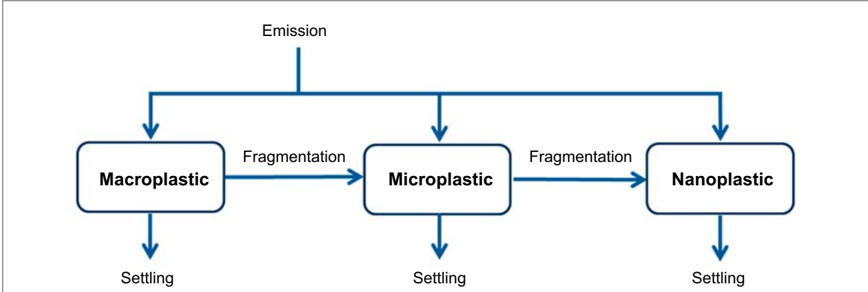
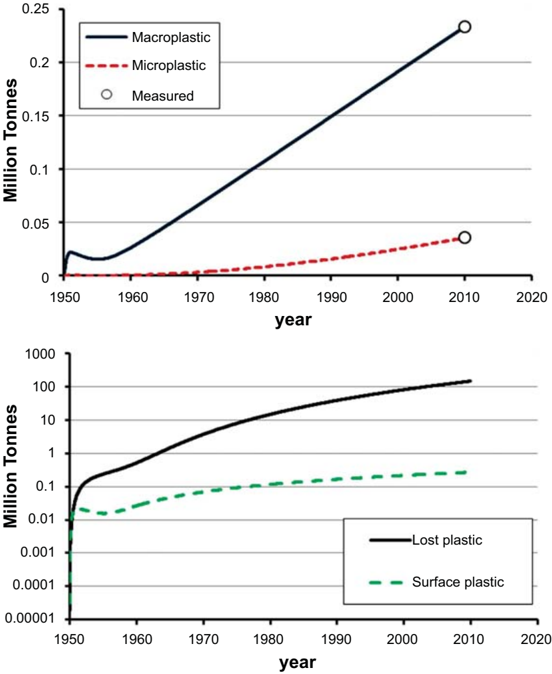
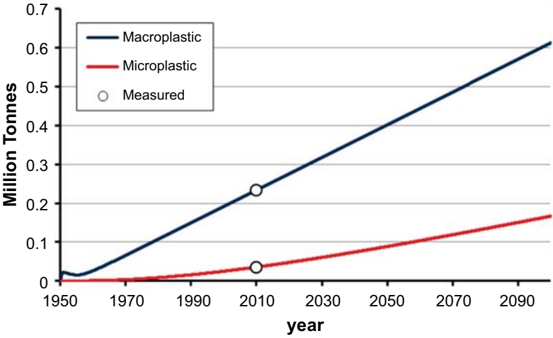
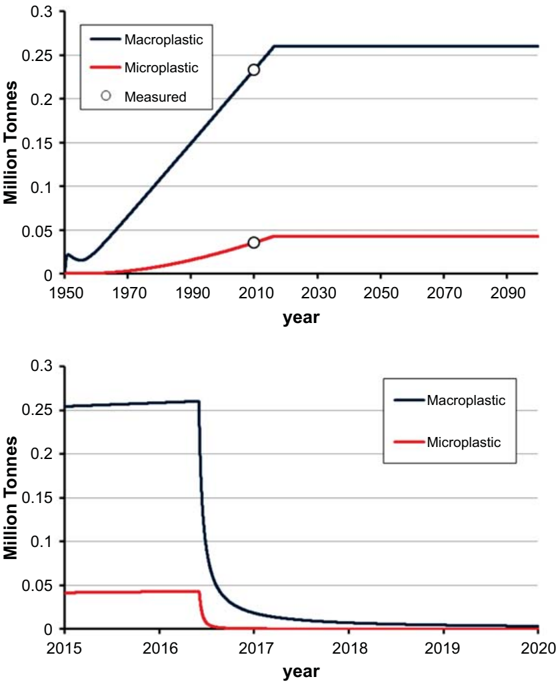
Understanding the global mass inventory is one of the main challenges in present research on plastic marine debris. Especially the fragmentation and vertical transport processes of oceanic plastic are poorly understood. However, whereas fragmentation rates are unknown, information on plastic emissions, concentrations of plastics in the ocean surface layer (OSL) and fragmentation mechanisms is available. Here, we apply a systems engineering analytical approach and propose a tentative 'whole ocean' mass balance model that combines emission data, surface area-normalized plastic fragmentation rates, estimated concentrations in the OSL, and removal from the OSL by sinking. We simulate known plastic abundances in the OSL and calculate an average whole ocean apparent surface area-normalized plastic fragmentation rate constant, given representative radii for macroplastic and microplastic. Simulations show that 99.8% of the plastic that had entered the ocean since 1950 had settled below the OSL by 2016, with an additional 9.4 million tons settling per year. In 2016, the model predicts that of the 0.309 million tons in the OSL, an estimated 83.7% was macroplastic, 13.8% microplastic, and 2.5% was < 0.335 mm 'nanoplastic'. A zero future emission simulation shows that almost all plastic in the OSL would be removed within three years, implying a fast response time of surface plastic abundance to changes in inputs. The model complements current spatially explicit models, points to future experiments that would inform critical model parameters, and allows for further validation when more experimental and field data become available.
Overview
The claims and statistics of this paper haven’t been checked yet.
Free: it reads the open-access text and checks the first 5 claims that cite a source we can check. Create a free account to check every claim.
Integrity signals
Registry
Cites
Statistics
Figures
Verification
Claims the paper makes
The claims and statistics of this paper haven’t been checked yet.
Free: it reads the open-access text and checks the first 5 claims that cite a source we can check. Create a free account to check every claim.
Self-check
Percentages, sums and reported differences re-computed from the paper’s own numbers.
The self-check needs the paper’s full text.
Citations
Cites
Lost at sea: where is all the plastic?
Thompson, R. C., Olsen, Y., Mitchell, R. P., Davis, A., Rowland, S. J., John, A. W. G., McGonigle, D., & Russell, A. E. (2004) · Science · doi:10.1126/science.1094559 · Cited by 7,765 · cited 3×
“This approach complements recent studies that estimate the global inventory from the bottomup using ocean measurements (Thompson et al 2004, Eriksen et al 2014, Cózar et al 2014, van Sebille et al 2015).”
BackgroundEriksen, M., Lebreton, L. C. M., Carson, H. S., Thiel, M., Moore, C. J., Borerro, J. C., Galgani, F., Ryan, P. G., & Reisser, J. (2014) · PLoS ONE · doi:10.1371/journal.pone.0111913 · Cited by 4,710 · cited 7×
“There is much uncertainty in the limited data on abundance of plastic debris in the oceans (Eriksen et al 2014, Cózar et al 2014, Van Sebille et al 2015).”
BackgroundMethodInfluential(2015) · Springer eBooks · doi:10.1007/978-3-319-16510-3 · Cited by 3,502
de Boyer Montégut, C., Madec, G., Fischer, A. S., Lazar, A., & Iudicone, D. (2004) · Journal of Geophysical Research: Oceans · doi:10.1029/2004jc002378 · Cited by 3,182 · cited 1×
“A range of 10– 100 m applies to the vast majority of locations in the world oceans (de Boyer Montégut et al 2004).”
BackgroundPlastic debris in the open ocean
Cózar, A., Echevarría, F., González-Gordillo, J. I., Irigoien, X., Úbeda, B., Hernández-León, S., Palma, Á. T., Navarro, S., García-de-Lomas, J., Ruiz, A., et al. (2014) · Proceedings of the National Academy of Sciences · doi:10.1073/pnas.1314705111 · Cited by 3,133 · cited 5×
“There is much uncertainty in the limited data on abundance of plastic debris in the oceans (Eriksen et al 2014, Cózar et al 2014, Van Sebille et al 2015).”
BackgroundInfluentialMicroplastic ingestion by zooplankton
Cole, M., Lindeque, P., Fileman, E., Halsband, C., Goodhead, R., Moger, J., & Galloway, T. S. (2013) · Environmental Science & Technology · doi:10.1021/es400663f · Cited by 2,763 · cited 1×
“Cole et al 2013, Choy and Drazen 2013, Van Franeker et al 2011b) and return to the OSL, which would result in a time-delay in the OSL abundance that can be assumed tobe small and relatively constant in time.”
BackgroundA global inventory of small floating plastic debris
van Sebille, E., Wilcox, C., Lebreton, L., Maximenko, N., Hardesty, B. D., van Franeker, J. A., Eriksen, M., Siegel, D., Galgani, F., & Law, K. L. (2015) · Environmental Research Letters · doi:10.1088/1748-9326/10/12/124006 · Cited by 1,713 · cited 6×
“There is much uncertainty in the limited data on abundance of plastic debris in the oceans (Eriksen et al 2014, Cózar et al 2014, Van Sebille et al 2015).”
BackgroundInfluentialSelf-citationKoelmans, A. A., Bakir, A., Burton, G. A., & Janssen, C. R. (2016) · Environmental Science & Technology · doi:10.1021/acs.est.5b06069 · Cited by 1,599 · cited 1×
“The BAU scenario assumes that annual plastic production and leakage/emission continue to increase according to the polynomial parameters derived from 1950–2013 data (PlasticsEurope 2013, Koelmans et al 2016).”
Self-citationIngestion of Microplastics by Zooplankton in the Northeast Pacific Ocean
Desforges, J.-P. W., Galbraith, M., & Ross, P. S. (2015) · Archives of Environmental Contamination and Toxicology · doi:10.1007/s00244-015-0172-5 · Cited by 1,019
Ups and Downs in the Ocean: Effects of Biofouling on Vertical Transport of Microplastics
Kooi, M., Nes, E. H. V., Scheffer, M., & Koelmans, A. A. (2017) · Environmental Science & Technology · doi:10.1021/acs.est.6b04702 · Cited by 977 · cited 4×
“Furthermore, it is known that chemical degradation of polymers results in weakening and fragmentation, and that biological colonization and aggregation can induce sinking of buoyant polymers (Kooi et al 2017).”
BackgroundResultInfluentialSelf-citation
Research works printed but not linked: 2
- Plastics—the Facts, 2013, An Analysis of European Latest Plastics Production Demand and Waste Data
- Van Franeker J A, 2011, NOAA Technical Memorandum
Cited by
Items 201–300 of 424
Hernández, I., Castro-Rosero, L. M., Espino, M., & Alsina, J. M. (2024) · Geoscientific model development · doi:10.5194/gmd-17-2221-2024 · Cited by 26
“The Stokes drift is widely acknowledged as being one of the key components for numerical simulations of floating marine debris drift”
BackgroundPawak, V. S., Bhatt, V. K., Sabapathy, M., & Loganathan, V. A. (2024) · Journal of Hazardous Materials · doi:10.1016/j.jhazmat.2024.135976 · Cited by 24
A Review of Atmospheric Micro/Nanoplastics: Insights into Source and Fate for Modelling Studies
Jiang, F., Gao, C., Chan, A. W. H., Topping, D. O., Zhang, H., Li, W., Coe, H., Liu, X., Ching, J., & Zheng, Z. (2025) · Current Pollution Reports · doi:10.1007/s40726-025-00375-5 · Cited by 24
Effect of microfibers combined with UV-B and drought on plant community
Deng, J., Zhou, L. J., Zhou, W., Wang, Q., & Yu, D. (2021) · Chemosphere · doi:10.1016/j.chemosphere.2021.132413 · Cited by 24
Dynamics of Transport, Accumulation, and Export of Plastics at Oceanic Fronts
Suaria, G., Berta, M., Griffa, A., Molcard, A., Özgökmen, T. M., Zambianchi, E., & Aliani, S. (2021) · The handbook of environmental chemistry · doi:10.1007/698_2021_814 · Cited by 27
Reichert, J., Tirpitz, V., Oponczewski, M., Lin, C., Franke, N., Ziegler, M., & Wilke, T. (2023) · The Science of The Total Environment · doi:10.1016/j.scitotenv.2023.169485 · Cited by 23
Zhang, L., Wang, W., Wang, F., Wu, D., Su, Y., Zhan, M., Li, K., Shi, H., & Xie, B. (2025) · Environmental Science & Technology · doi:10.1021/acs.est.4c12227 · Cited by 25
Tang, C. N., Kuwahara, V. S., Leong, S. C. Y., Moh, P. Y., & Yoshida, T. (2023) · Marine Pollution Bulletin · doi:10.1016/j.marpolbul.2023.115182 · Cited by 22
Nakatani, H., Kyan, T., & Muraoka, T. (2020) · Journal of Polymers and the Environment · doi:10.1007/s10924-020-01769-w · Cited by 23
Erkan, H. S., Turan, N. B., Albay, M., & Engin, G. Ö. (2021) · Journal of Cleaner Production · doi:10.1016/j.jclepro.2021.129539 · Cited by 24
Calcite carbonate sinks low-density plastic debris in open oceans
Sun, X., Zhang, Y., Xie, M.-Y., Mai, L., & Zeng, E. Y. (2024) · Nature Communications · doi:10.1038/s41467-024-49074-7 · Cited by 24
““ Missingplastics ” and “ lostplastics ” haveledtobroad investigations into the potential inventories or sinks of LDMPs in the ocean 7 .”
Hajjar, C., Bulle, C., & Boulay, A. (2023) · The International Journal of Life Cycle Assessment · doi:10.1007/s11367-023-02212-7 · Cited by 24
“…et al. (2017) found that almost 99.8% of initially buoyant plastics, emitted to the oceans in 1950, had settled below the ocean surface layer (Koelmans et al. 2017) while Lebreton and Andrady (2019), using a different simple box model, found that the majority of plastic litter also entering…”
InfluentialWickramarachchi, C., Niven, R. K., & Kramer, M. (2024) · Water Research · doi:10.1016/j.watres.2024.122947 · Cited by 20
Microplastics as environmental modifiers of lung disease
Epeslidou, E., Scott, J. S., de Klein, B., Cudia, J. T., Melgert, B. N., & Preković, S. (2025) · EMBO Molecular Medicine · doi:10.1038/s44321-025-00353-w · Cited by 20
“…in fl uencing pelagic and surface-dwelling organisms (Zhang et al, 2017; Hidalgo-Ruz et al, 2012), whereas higher-density polymers like polyvinyl chloride (1.38 g/cm³) readily sediment, directly impacting benthic organisms at sediment-water interfaces (Gomiero et al, 2018; Koelmans et al, 2017).”
InfluentialAn ecotoxicological risk model for the microplastics in arctic waters
Saeed, M. S., Halim, S. Z., Fahd, F., Khan, F. I., Sadiq, R., & Chen, B. (2022) · Environmental Pollution · doi:10.1016/j.envpol.2022.120417 · Cited by 20
Meyerjürgens, J., Ricker, M., Aden, C., Albinus, M., Barrelet, J., Freund, H., Hahner, F., Lettmann, K., Mose, I., Schaal, P., et al. (2023) · Frontiers in Marine Science · doi:10.3389/fmars.2023.1148714 · Cited by 22
“In addition, biological and chemical mechanisms, such as ingestion, settlement, and degradation impact the plastic budget and distribution in the oceans (Wilcox et al., 2015; Koelmans et al., 2017).”
Rochman, C. M., Langenfeld, D., Cable, R. N., Covernton, G. A., Hermabessière, L., McNamee, R. A., Veneruzzo, C., Munno, K., Omer, M., Paterson, M. J., et al. (2025) · Environmental Science & Technology · doi:10.1021/acs.est.5c01441 · Cited by 20
Baas, J. H., Baker, M. L., Buffon, P., Strachan, L. J., Bostock, H., Hodgson, D. M., Eggenhuisen, J. T., & Spychala, Y. (2022) · The Depositional Record · doi:10.1002/dep2.176 · Cited by 19
“In terms of anthropogenic pollutants, sea surface accumulations of plastics account for ca 1% of the estimated global marine plastic budget (Koelmans et al., 2017; Thompson et al., 2004).”
BackgroundA Review of Microplastics in Freshwater Environments: Locations, Methods, and Pollution Loads
Peller, J. R., Nelson, C. R., Babu, B. G., Iceman, C. R., & Kostelnik, E. (2020) · ACS symposium series · doi:10.1021/bk-2020-1352.ch004 · Cited by 21
Spencer, M., Culhane, F. E., Chong, F., Powell, M. O., Holst, R. J. R., & Helm, R. R. (2023) · PeerJ · doi:10.7717/peerj.15021 · Cited by 19
“This is thought to occur mainly through fragmentation into microplastics (Koelmans et al., 2017; Lebreton, Egger & Slat, 2019).”
BackgroundMethodRades, M., Poschet, G., Gegner, H. M., Wilke, T., & Reichert, J. (2024) · Marine Pollution Bulletin · doi:10.1016/j.marpolbul.2024.116631 · Cited by 18
Paris, A., Kwaoga, A., & Hewavitharane, C. (2022) · Marine Pollution Bulletin · doi:10.1016/j.marpolbul.2021.113290 · Cited by 17
Plastics in soil environments: All things considered
Huo, Y., Dijkstra, F. A., Possell, M., & Singh, B. (2022) · Advances in agronomy · doi:10.1016/bs.agron.2022.05.002 · Cited by 22
Seasonal change in fate and transport of plastics from Red River to the coast of Vietnam
Liao, Z., Zou, Q., Vinh, V. D., Pan, Z., & Kaiser, M. J. (2024) · Marine Pollution Bulletin · doi:10.1016/j.marpolbul.2024.116923 · Cited by 18
Composition and Distribution of Marine Anthropogenic Litter in the Barents Sea
Новиков, М. А., Горбачева, Е. А., Prokhorova, T. A., & Kharlamova, M. N. (2021) · Oceanology · doi:10.1134/s0001437021010148 · Cited by 17
Pierdomenico, M., Ridente, D., Casalbore, D., Bella, L. D., Milli, S., & Chiocci, F. L. (2022) · Marine Pollution Bulletin · doi:10.1016/j.marpolbul.2022.113819 · Cited by 18
Computational models to confront the complex pollution footprint of plastic in the environment
MacLeod, M., Domercq, P., Harrison, S., & Praetorius, A. (2023) · Nature Computational Science · doi:10.1038/s43588-023-00445-y · Cited by 18
“Notable examples of computational mass-balance models for plastic include the model of the global ocean by Koelmans et al. 24 and the Mediterranean Sea model by Kaandorp and colleagues 25 .”
BackgroundSeparation, Identification, and Quantification of Microplastics in Environmental Samples
Nandikes, G., Banerjee, O., Mirthipati, M., Bhargavi, A., Jones, H., & Pathak, P. (2024) · ACS symposium series · doi:10.1021/bk-2024-1482.ch001 · Cited by 30
Underwater Macroplastic Detection Using Imaging Sonars
Flores, N. Y., Oswald, S. B., LEUVEN, R. S. E. W., & Collas, F. P. L. (2022) · Frontiers in Environmental Science · doi:10.3389/fenvs.2022.875917 · Cited by 17
Mladinich, K., Holohan, B. A., Shumway, S. E., & Ward, J. E. (2024) · Marine Environmental Research · doi:10.1016/j.marenvres.2024.106606 · Cited by 15
Mikroplastikler, Çevre-İnsan Sağlığı Üzerine Etkileri Ve Analiz Yöntemleri
Esmeray, E., & ARMUTCU, C. (2020) · Düzce Üniversitesi Bilim ve Teknoloji Dergisi · doi:10.29130/dubited.586453 · Cited by 22
Microplastics Pollution in Rivers
Bratovčić, A., Nithin, A., & Sundaramanickam, A. (2022) · Environmental footprints and eco-design of products and processes · doi:10.1007/978-981-16-8440-1_2 · Cited by 16
Gupta, I., Islam, M. S., Xia, L., Pitchai, A., Shannahan, J. H., & Mitra, S. (2024) · Molecules · doi:10.3390/molecules29092033 · Cited by 14
Mladinich, K., Holohan, B. A., Shumway, S. E., & Ward, J. E. (2023) · Marine Environmental Research · doi:10.1016/j.marenvres.2023.106040 · Cited by 15
Rivera-Garibay, O., Méndez-López, M. E., Tórres-Irineo, E., Rivas, M., Santillo, D. J., & Álvarez‐Filip, L. (2024) · Marine Biology · doi:10.1007/s00227-024-04399-1 · Cited by 16
“It has been estimated that, since 1950, 196 million tons of plastics have entered the ocean (Koelmans et al. 2017) and according to Babaremu et al. (2022) the global production of plastic in 2021 is projected to be around 400 million tons to 414 million metric tons disregarding the impact of…”
Quantification and characterization of microplastics ingested by mangrove oysters across West Africa
Mahu, E., Vanderpuye-Orgle, T. J., Boateng, C. M., Edusei, M. O., Yeboah, G. A., Chuku, E. O., Okpei, P., Okyere, I. K., Dodoo‐Arhin, D., & Akintoye, E. A. (2024) · Environmental Science and Pollution Research · doi:10.1007/s11356-024-34470-9 · Cited by 13
“…and widespread nature, they are potentially bioavailable to a wide range of marine organisms and are easily ingested by low trophic suspension, filter and deposit feeders, detritivores, and planktivores (Browne et al. 2008; Graham & Thompson 2009; Koelmans et al. 2017; Murray & Cowie 2011).”
BackgroundHernández, I., Castro-Rosero, L. M., Espino, M., & Alsina, J. M. (2025) · Frontiers in Marine Science · doi:10.3389/fmars.2024.1534678 · Cited by 13
Chen, Q., & Fei, X. (2023) · Resources Conservation and Recycling · doi:10.1016/j.resconrec.2023.107204 · Cited by 14
Optimized and Validated Settling Velocity Measurement for Small Microplastic Particles (10–400 μm)
Dittmar, S., Ruhl, A. S., & Jekel, M. R. (2023) · ACS ES&T Water · doi:10.1021/acsestwater.3c00457 · Cited by 13
Zeilerbauer, L., Lindorfer, J., Fuchs, P., Knoebl, M., Ravnås, A., Maldal, T., Gilje, E., Paulik, C., & Fischer, J. (2024) · Sustainability · doi:10.3390/su16083487 · Cited by 13
“They reckoned that in 3 years, all plastic would sink to the seabed if no new particles were added; thus, this timeframe was used for EPDM in order to simulate 99% removal [50].”
MethodKarpenko, A. A., & Odintsov, V. S. (2023) · Russian Journal of Marine Biology · doi:10.1134/s1063074023040053 · Cited by 12
Geometric relationship between the projected surface area and mass of a plastic particle
Kataoka, T., Iga, Y., Baihaqi, R. A., Hadiyanto, H., & NIHEI, Y. (2024) · Water Research · doi:10.1016/j.watres.2024.122061 · Cited by 12
A Review of Processes and Models for the Export of Microplastics From Terrestrial to Aquatic Systems
Hafiz, A. M. I., Ahmadisharaf, E., Salehi, M., Farner, J. M., White, J. C., Zeng, E. Y., & Nazari, B. (2025) · Wiley Interdisciplinary Reviews Water · doi:10.1002/wat2.70004 · Cited by 12
Schmidt, P. M., Leibig, L., Meyer, L., Roth, C., Bolduan, P., Battagliarin, G., Künkel, A., Harrison, S., Uluşeker, C., & Wohlleben, W. (2025) · The Science of The Total Environment · doi:10.1016/j.scitotenv.2025.181048 · Cited by 11
Monitoring of microplastics in the marine environment
Setälä, O., Granberg, M., Hassellöv, M., Karlsson, T., Mattsson, K., Strand, J., Lehtiniemi, M., Talvitie, J., & Magnusson, K. (2019) · Nordic Council of Ministers eBooks · doi:10.6027/no2019-053 · Cited by 11
“Although plastics can be transported far by surface water currents, most plastic will eventually accumulate in the sediment (Koelmans et al. 2017).”
BackgroundDifference in polypropylene fragmentation mechanism between marine and terrestrial regions
Nakatani, H., Muraoka, T., Ohshima, Y., & Motokucho, S. (2021) · SN Applied Sciences · doi:10.1007/s42452-021-04759-2 · Cited by 12
Posidonia oceanica egagropiles: Good indicators for plastic pollution in coastal areas?
Alomar, C., Compa, M., Fagiano, V., Concato, M., & Deudero, S. (2024) · Regional Studies in Marine Science · doi:10.1016/j.rsma.2024.103653 · Cited by 16
Tirpitz, V., Hutter, M., Hutter, H., Prume, J. A., Koch, M., Wilke, T., & Reichert, J. (2025) · The Science of The Total Environment · doi:10.1016/j.scitotenv.2024.178318 · Cited by 9
Galafton, C., Thonemann, N., & Vijver, M. G. (2025) · The International Journal of Life Cycle Assessment · doi:10.1007/s11367-025-02446-7 · Cited by 10
“Koelmans et al. (2017) assumed that all macro-and microplastic emitted to the ocean fragments over time (including degradation, abrasion, and fragmentation) with mass-based rates proportional to the emission’s surface area.”
InfluentialFRAGMENT-MNP: A model of micro- and nanoplastic fragmentation in the environment
Harrison, S., Uluşeker, C., Pfohl, P. M., Santizo, K. Y., Sipe, J. M., Lopez, B., Praetorius, A., Cross, R. K., Adediran, G. A., Svendsen, C., et al. (2025) · The Journal of Open Source Software · doi:10.21105/joss.08061 · Cited by 9
“…include it only as a loss process (Quik et al., 2023), treat fragmentation as independent of the properties and residence time in the environment (Koelmans et al., 2017), or consider fragmentation as cascading (fragmenting mass can only be partitioned to the next biggest size class, rather than…”
Predicting Drifting Polystyrene Degradation in World Oceans Based on Thermal Decomposition
Kimukai, H., Koizumi, K., Taguchi, H., Okabe, A., Takatama, K., Chung, S.-Y., Kwon, B. G., Nishimura, M., Menteşe, S., & Saido, K. (2022) · ACS ES&T Water · doi:10.1021/acsestwater.2c00023 · Cited by 10
Stolte, A., Dederer, G., Lamp, J., Fenn, C., Lee, M., Frank, W., Howe, C., Günther, M., Vesper, H., & Werner, S. (2022) · Frontiers in Marine Science · doi:10.3389/fmars.2022.981840 · Cited by 9
Laiz, I., Foletti, N., Teles‐Machado, A., Plecha, S. M., Peliz, Á., Sánchez-Leal, R. F., & Bolado-Penagos, M. (2024) · The Science of The Total Environment · doi:10.1016/j.scitotenv.2024.175212 · Cited by 9
Microplastics contamination in coastal environment of Southeast Asia: A systematic review
Arina, N., Hanif, N. M., Hee, Y. Y., Othman, M., Ooi, M. C. G., Ali, M. M., Jansar, K. M., & Latif, M. T. (2025) · Physics and Chemistry of the Earth Parts A/B/C · doi:10.1016/j.pce.2025.103910 · Cited by 11
Perold, V., Moloney, C. L., & Ryan, P. G. (2025) · Environmental Pollution · doi:10.1016/j.envpol.2025.126125 · Cited by 8
From River to Sea: Tracking Plastic Waste Transport via the Hau River, Mekong Delta, Vietnam
Thành, N. T., Minh, H. V. T., Kim, L., Ngân, N. V. C., Toàn, P. V., Tỷ, T. V., Duy, Đ. V., Toan, V. T., & Kumar, P. (2025) · Water · doi:10.3390/w17162438 · Cited by 11
Ghasemi, S., Parastesh, A., Ramezani, H., Padervand, M., Dawi, E. A., Hamzehlouyan, T., Labidi, A., Hajiahmadi, S., Signoretto, M., Lichtfouse, É., et al. (2024) · ACS symposium series · doi:10.1021/bk-2024-1482.ch009 · Cited by 11
Surveillance of Seafood for Microplastics
Kögel, T., Refosco, A., & Maage, A. (2020) · Springer eBooks · doi:10.1007/978-3-030-10618-8_28-1 · Cited by 10
Microplastics in seawater and sediments—distribution and transport
Grego, M., Viršek, M. K., & Bajt, O. (2022) · Elsevier eBooks · doi:10.1016/b978-0-12-822471-7.00002-x · Cited by 11
Balakrishnan, G., Lagarde, F., Chassenieux, C., & Nicolaï, T. (2023) · Microplastics · doi:10.3390/microplastics2020016 · Cited by 8
“Nanoplastics dispersed in the seawater could be part of the “lost plastic” that has been dumped in the sea but is no longer observed at the surface [5,14,15].”
BackgroundWang, K., Du, Y., Li, P., Guan, C., Zhou, M., Wu, L., Liu, Z., & Huang, Z. (2023) · Research Square · doi:10.21203/rs.3.rs-3222853/v1 · Cited by 9
Sông Sài Gòn: Extreme Plastic Pollution Pathways in Riparian Waterways
Cleveland, P., & Morrison, A. (2025) · Sensors · doi:10.3390/s25030937 · Cited by 7
Urmi, M. A., Khan, M. M. R., Alrehaili, A. M., & Rahman, M. M. (2025) · Environmental Science and Pollution Research · doi:10.1007/s11356-025-36671-2 · Cited by 7
“Thin plastic films, commonly used in packaging, were proven to interfere with aquatic organism behavior (Koelmans et al. 2017).”
Investigating local trawl fishing as a source of plastic beach litter
Allison, N. L., Dale, A., Narayanaswamy, B. E., & Turrell, W. R. (2024) · Marine Pollution Bulletin · doi:10.1016/j.marpolbul.2024.116627 · Cited by 7
Microplastic Pollutants in Biotic Systems: Environmental Impact and Remediation Techniques
Khan1, N. A., & Singh2, L. (2024) · ACS symposium series · doi:10.1021/bk-2024-1482 · Cited by 9
López-Hernández, M., Tirpitz, V., Do, M.-S., Czermak, M., Ferrier‐Pagès, C., Reichert, J., & Ziegler, M. (2025) · The Science of The Total Environment · doi:10.1016/j.scitotenv.2025.179026 · Cited by 7
Modelling the transportation of marine plastics over the ocean surface by Cellular Automata
Ng, P. S., Maqueda, M. Á. M., & Goh, K. L. (2023) · Marine Pollution Bulletin · doi:10.1016/j.marpolbul.2023.114950 · Cited by 7
Threats of Microplastic Pollution on Fishes and its Implications on Human Health (Review Article)
El-Naggar, M. M. (2024) · Egyptian Journal of Aquatic Biology and Fisheries · doi:10.21608/ejabf.2024.341282 · Cited by 8
Little change in plastic loads in South Atlantic seabirds since the 1980s
Perold, V., Ronconi, R. A., Moloney, C. L., Dilley, B. J., Connan, M., & Ryan, P. G. (2024) · The Science of The Total Environment · doi:10.1016/j.scitotenv.2024.175343 · Cited by 7
Organic matter production and recycling in marine biofilm developing on common and new plastics
Misic, C., Rafael, A., & Harriague, A. C. (2022) · Marine Environmental Research · doi:10.1016/j.marenvres.2022.105729 · Cited by 8
Transport and Fate of All-Time Released Plastics in the Global OceanPreprint
Wu, P., Xu, R., Wang, X., Schartup, A. T., Luijendijk, A. P., & Zhang, Y. (2021) · EarthArXiv (California Digital Library) · doi:10.31223/x50w58 · Cited by 7
“…different types of plastics τtrans (s -1) is calculated as: bf trans dV dt V = (22) where δ is an adjustable coefficient tuned to match the result of Kooi et al. (2017), and ΔV is the deviation between the volumes of two plastic types, e.g.: ( , ) balanced cleanbalanced clean PE PE V PE PE V V…”
BackgroundMethodInfluentialMicroplastics as Water Pollutants and Sustainable Management Strategies
Erhunmwunse, N. O., Pajiah, T. J., & Ogwu, M. C. (2024) · Springer eBooks · doi:10.1007/978-981-97-4966-9_8 · Cited by 6
Unlocking Passive Collection of Microplastics in Coral Reefs by Adhesion Measurements
Kim, A.-R., Mitra, S. K., & Zhao, B. (2024) · ACS ES&T Water · doi:10.1021/acsestwater.4c00650 · Cited by 6
Innovations and future trends in plastic waste management
Xue, W. (2023) · IWA Publishing eBooks · doi:10.2166/9781789063448_0433 · Cited by 11
New-Age Bioremediation Strategies to Combat Microplastic Pollution in the Environment
Shrinidhi, B., Subhobrata, P., Gangar, T., & Patra, S. (2024) · ACS symposium series · doi:10.1021/bk-2024-1482.ch008 · Cited by 9
Gupta, P., & Kumar, M. M. (2025) · Journal of Contaminant Hydrology · doi:10.1016/j.jconhyd.2025.104623 · Cited by 8
The Henderson Island microcosm: plastic pollution accumulation in the South Pacific
Dijkstra, H. (2025) · Marine Pollution Bulletin · doi:10.1016/j.marpolbul.2025.118095 · Cited by 5
Modeling river and urban related microplastic pollution off the southern United States
Zhou, X., Xiao, S., Ramirez, M., & Bracco, A. (2025) · npj Emerging Contaminants · doi:10.1038/s44454-025-00011-3 · Cited by 7
Catch me if you can: Microplastics hidden in plain sight
Mattsson, K., Masqué, P., Maes, T., & Métian, M. (2025) · Environmental Science & Policy · doi:10.1016/j.envsci.2025.104217 · Cited by 5
Nanoscale plastic pollution: sources, identification and potential mitigation
Boakye, G., Trotta, E., Ambagahawatta, N., Venkataraman, A., Cheeptham, N., & Papadopoulos, C. (2025) · Nanotechnology · doi:10.1088/1361-6528/ae0c1b · Cited by 5
“Koelmans et al [62] developed a global mass balance model to estimate the distribution of plastic debris in marine environments, encompassing macroplastics, MPs, and NPs.”
Vidal, A., Neury‐Ormanni, J., Latchere, O., Roman, C., Gillet, P., Métais, I., & Châtel, A. (2023) · Environmental Science and Pollution Research · doi:10.1007/s11356-023-28900-3 · Cited by 5
Impact of Microplastics on Flora and Fauna
Reshi, Q. M., Ahmed, I., Ahmad, I., & Fazio, F. (2023) · BENTHAM SCIENCE PUBLISHERS eBooks · doi:10.2174/9789815165104123010006 · Cited by 7
The Abundance of Marine Plastic Debris in Indonesia’s Ocean
Winardi, E. A., & Putri, M. R. (2024) · IOP Conference Series Earth and Environmental Science · doi:10.1088/1755-1315/1350/1/012014 · Cited by 5
“…A is the percentage of plastic that ends up in the ocean, with a value of 4.46%, and value B is plastic that has a density lower than seawater, given a value of 65% [4,11,14] With the ratio between global and Indonesian production data in 2018, Indonesia's plastic production can be quantified…”
BackgroundMethodInfluentialThe Ocean Plastic Incubator Chamber (OPIC) system to monitor in situ plastic degradation at sea
Bergami, E., Apeland, B., Sharma, R., Enderlein, P., & Manno, C. (2022) · Environmental Pollution · doi:10.1016/j.envpol.2022.119868 · Cited by 6
Impacts and Mitigation Strategies of Microplastic Pollution
Islam, M. R., Roknuzzaman, A. S. M., Sarker, R., Kadir, M. F., & Kabir, E. R. (2024) · ACS symposium series · doi:10.1021/bk-2024-1482.ch007 · Cited by 6
Ferrari, E., Spagnuolo, A., & Corsi, I. (2025) · Marine Environmental Research · doi:10.1016/j.marenvres.2025.107707 · Cited by 4
Corbett, L. N., de Vogel, F. A., van der Mark, P. B. J., Zettler, E., Mandemaker, L. D. B., Weckhuysen, B. M., Meirer, F., & Amaral‐Zettler, L. (2026) · Environmental Pollution · doi:10.1016/j.envpol.2026.127634 · Cited by 4
The faecal microplastic pump: Zooplankton efficiently transport microplastics to the ocean depths
Richon, C., Gorguès, T., Cole, M., & Aumont, O. (2026) · Environmental Pollution · doi:10.1016/j.envpol.2026.128070 · Cited by 4
Keavney, E., Kane, I., Clare, M. A., Hodgson, D. M., Huvenne, V. A. I., Sumner, E. J., Peakall, J., Mienis, F., & Kranenburg, J. (2025) · Journal of the Geological Society · doi:10.1144/jgs2024-228 · Cited by 4
Slow biological microplastics removal under ocean pollution phase-out trajectories
Andrews, Z. A., Kvale, K., & Hunt, C. F. (2024) · Environmental Research Letters · doi:10.1088/1748-9326/ad472c · Cited by 6
Sources of Synthetic Microfiber Pollutants in the Environment and Their Fate and Toxicity
Naik, B., Sukla, L. B., & Dash, A. K. (2024) · Springer eBooks · doi:10.1007/978-3-031-62600-5_1 · Cited by 4
Cordeiro, R. D. M., Cardoso, V. V., Carneiro, R. N., & Almeida, C. M. M. (2024) · Molecules · doi:10.3390/molecules29184426 · Cited by 4
“The differences in size characterization methods of microplastic particles can have significant implications for regulatory decisions, ecological risk assessments, and the comparability of results across different studies [21].”
BackgroundMarine plastics: what’s wrong with them?
Bonanno, G. (2022) · Elsevier eBooks · doi:10.1016/b978-0-12-822471-7.00001-8 · Cited by 5
Marine Plastics Abatement: Technology, Management, Business and Future Trends (Volume 2)
Koottatep, T., Winijkul, E., & Xue, W. (2023) · IWA Publishing eBooks · doi:10.2166/9781789063448 · Cited by 6
Erhenhi, O. H., Enwemiwe, V. N., Micheal, O. E., Aghahowa, E., Esiwo, E., Obi, C. C., & Omokoro, F. (2024) · UTTAR PRADESH JOURNAL OF ZOOLOGY · doi:10.56557/upjoz/2024/v45i144177 · Cited by 3
Microplastic Formation and Surface Crack Patterns: A Method for Waste Plastic Identification
Nakatani, H., & Dao, A. T. N. (2025) · Molecules · doi:10.3390/molecules30224461 · Cited by 4
Unseen pollutants: Microplastics in deep-sea invertebrates
Mossotto, C., Pastorino, P., Gabetti, A., Maganza, A., Renzi, M., Bentivoglio, T., Anselmi, S., Elia, A. C., Barceló, ., Nicola, M. R. D., et al. (2025) · Journal of Contaminant Hydrology · doi:10.1016/j.jconhyd.2025.104794 · Cited by 5
Amran, N. H., Narrshen, T., & Sariyati, N. H. (2025) · Pakistan Journal of Analytical & Environmental Chemistry · doi:10.21743/pjaec/2025.12.01 · Cited by 3
Kim, S., Shin, J.-H., Ji, Y.-J., Seong, M.-J., Je, C.-Y., Kim, J., & Song, N.-S. (2026) · Journal of Hazardous Materials · doi:10.1016/j.jhazmat.2026.142508 · Cited by 3
Microplastics Pollutants—Potential Impact on Ecosystems
Shukla, A. K., Alam, J., & Alhoshan, M. S. (2024) · ACS symposium series · doi:10.1021/bk-2024-1482.ch005 · Cited by 3
Metadata
- Authors
- Koelmans, A. A., Kooi, M., Law, K. L., & van Sebille, E.
- Affiliations
- Wageningen Marine Research (NL)
- Wageningen University & Research (NL)
- Sea Education Association (US)
- Corresponding author
- Koelmans, Albert A
- Venue
- Environmental Research Letters
- Publisher
- IOP Publishing
- Published
- 2017-11-01
- Volume
- 12
- Issue
- 11
- Pages
- 114028
- ISSN
- 1748-9326 (ISSN-L)
- OpenAlex
- W2767179800
- Cited by
- 396
- References
- 35
- Citations by year
- 2026: 31 · 2025: 47 · 2024: 58 · 2023: 48 · 2022: 55 · 2021: 58 · 2020: 50 · 2019: 32 · 2018: 16
- FWCI
- 12.07
- Type
- journal article
- Language
- en
- Open access
- gold
- doi.org
- Licence
- cc-by
- iopscience.iop.org/info/page/text-and-data-mining (tdm, 9 d)
- creativecommons.org/licenses/by/3.0/ (vor, 9 d)
- Locations
- Environmental Research Letters (publishedVersion, cc-by)
- Socio-Environmental Systems Modeling (acceptedVersion, cc-by)
- DOAJ (DOAJ: Directory of Open Access Journals) (submittedVersion)
- Utrecht University Repository (Utrecht University) (submittedVersion, other-oa)
- Spiral (Imperial College London) (submittedVersion, cc-by)
- Data Archiving and Networked Services (DANS) (submittedVersion, cc-by)
- Funders
- National Science Foundation (OCE-1260403)
- European Research Council (grant agreement No 715386)
- Topics
- Physical Sciences › Environmental Science › Pollution › Microplastics and Plastic Pollution
- Physical Sciences › Earth and Planetary Sciences › Oceanography › Marine Plankton and Biogeochemistry
- Physical Sciences › Environmental Science › Pollution › Oil Spill Detection and Mitigation
- Keywords
- marine plastic debris, mass balance, ocean surface layer, vertical transport, plastic emissions
About these checks
Registry, retraction, Cites and statistics results are computed, not judged, with one exception: a printed reference that no index lists is read once by a model before it counts as a citation error. Claims are extracted by a model and kept only when their quote appears verbatim in the text; each cited source is then checked, with a model’s help, for whether it says what the claim relies on. Those verdicts can be wrong — read the claim’s quote and the cited source before relying on one.
Statistics and arithmetic are recomputed, not judged.
Confidence bands are shown only for fields calibrated on our annotated test set. None is calibrated yet, so no band is shown.
What counts as a claim ›How we measure confidence ›How we check this ›
Are you an author, or do you see a problem with this page? Request a review
Data sources
Bibliographic data: Semantic Scholar, OpenAlex, Crossref.
Contains information from the Semantic Scholar Academic Graph Datasets, made available under the ODC Attribution License (ODC-BY 1.0).
Semantic Scholar’s data is described in: Kinney, R., et al. (2023). The Semantic Scholar Open Data Platform. arXiv:2301.10140.
