

All is not lost: deriving a top-down mass budget of plastic at sea
Open accessThe DOI matches its Crossref record; 35 of the 35 references it cites were found in a registry or an index.
Abstract
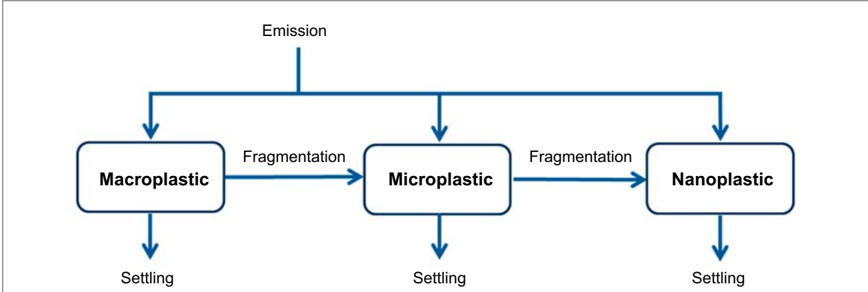
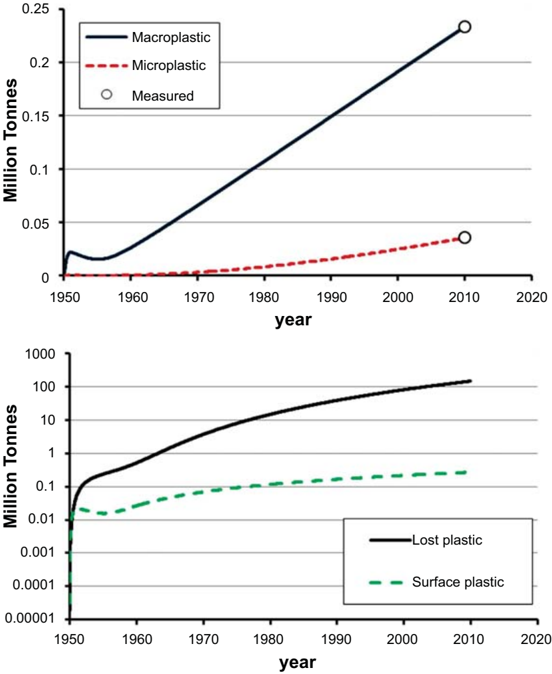
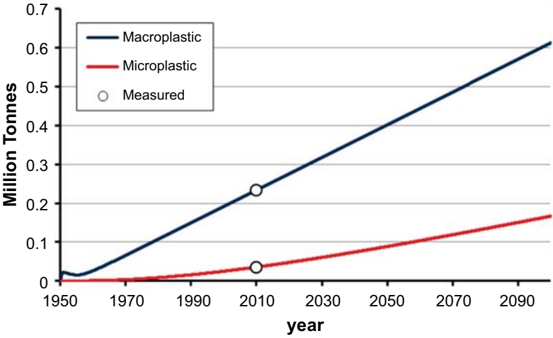
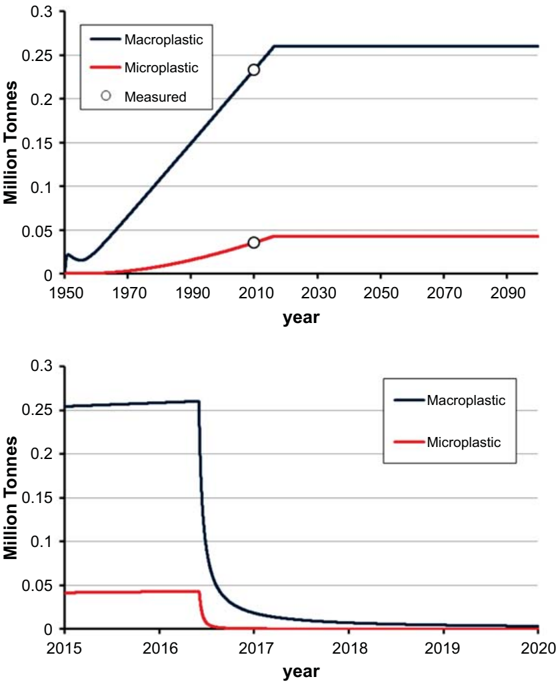
Understanding the global mass inventory is one of the main challenges in present research on plastic marine debris. Especially the fragmentation and vertical transport processes of oceanic plastic are poorly understood. However, whereas fragmentation rates are unknown, information on plastic emissions, concentrations of plastics in the ocean surface layer (OSL) and fragmentation mechanisms is available. Here, we apply a systems engineering analytical approach and propose a tentative 'whole ocean' mass balance model that combines emission data, surface area-normalized plastic fragmentation rates, estimated concentrations in the OSL, and removal from the OSL by sinking. We simulate known plastic abundances in the OSL and calculate an average whole ocean apparent surface area-normalized plastic fragmentation rate constant, given representative radii for macroplastic and microplastic. Simulations show that 99.8% of the plastic that had entered the ocean since 1950 had settled below the OSL by 2016, with an additional 9.4 million tons settling per year. In 2016, the model predicts that of the 0.309 million tons in the OSL, an estimated 83.7% was macroplastic, 13.8% microplastic, and 2.5% was < 0.335 mm 'nanoplastic'. A zero future emission simulation shows that almost all plastic in the OSL would be removed within three years, implying a fast response time of surface plastic abundance to changes in inputs. The model complements current spatially explicit models, points to future experiments that would inform critical model parameters, and allows for further validation when more experimental and field data become available.
Overview
The claims and statistics of this paper haven’t been checked yet.
Free: it reads the open-access text and checks the first 5 claims that cite a source we can check. Create a free account to check every claim.
Integrity signals
Registry
Cites
Statistics
Figures
Verification
Claims the paper makes
The claims and statistics of this paper haven’t been checked yet.
Free: it reads the open-access text and checks the first 5 claims that cite a source we can check. Create a free account to check every claim.
Self-check
Percentages, sums and reported differences re-computed from the paper’s own numbers.
The self-check needs the paper’s full text.
Citations
Cites
Lost at sea: where is all the plastic?
Thompson, R. C., Olsen, Y., Mitchell, R. P., Davis, A., Rowland, S. J., John, A. W. G., McGonigle, D., & Russell, A. E. (2004) · Science · doi:10.1126/science.1094559 · Cited by 7,765 · cited 3×
“This approach complements recent studies that estimate the global inventory from the bottomup using ocean measurements (Thompson et al 2004, Eriksen et al 2014, Cózar et al 2014, van Sebille et al 2015).”
BackgroundEriksen, M., Lebreton, L. C. M., Carson, H. S., Thiel, M., Moore, C. J., Borerro, J. C., Galgani, F., Ryan, P. G., & Reisser, J. (2014) · PLoS ONE · doi:10.1371/journal.pone.0111913 · Cited by 4,710 · cited 7×
“There is much uncertainty in the limited data on abundance of plastic debris in the oceans (Eriksen et al 2014, Cózar et al 2014, Van Sebille et al 2015).”
BackgroundMethodInfluential(2015) · Springer eBooks · doi:10.1007/978-3-319-16510-3 · Cited by 3,502
de Boyer Montégut, C., Madec, G., Fischer, A. S., Lazar, A., & Iudicone, D. (2004) · Journal of Geophysical Research: Oceans · doi:10.1029/2004jc002378 · Cited by 3,182 · cited 1×
“A range of 10– 100 m applies to the vast majority of locations in the world oceans (de Boyer Montégut et al 2004).”
BackgroundPlastic debris in the open ocean
Cózar, A., Echevarría, F., González-Gordillo, J. I., Irigoien, X., Úbeda, B., Hernández-León, S., Palma, Á. T., Navarro, S., García-de-Lomas, J., Ruiz, A., et al. (2014) · Proceedings of the National Academy of Sciences · doi:10.1073/pnas.1314705111 · Cited by 3,133 · cited 5×
“There is much uncertainty in the limited data on abundance of plastic debris in the oceans (Eriksen et al 2014, Cózar et al 2014, Van Sebille et al 2015).”
BackgroundInfluentialMicroplastic ingestion by zooplankton
Cole, M., Lindeque, P., Fileman, E., Halsband, C., Goodhead, R., Moger, J., & Galloway, T. S. (2013) · Environmental Science & Technology · doi:10.1021/es400663f · Cited by 2,763 · cited 1×
“Cole et al 2013, Choy and Drazen 2013, Van Franeker et al 2011b) and return to the OSL, which would result in a time-delay in the OSL abundance that can be assumed tobe small and relatively constant in time.”
BackgroundA global inventory of small floating plastic debris
van Sebille, E., Wilcox, C., Lebreton, L., Maximenko, N., Hardesty, B. D., van Franeker, J. A., Eriksen, M., Siegel, D., Galgani, F., & Law, K. L. (2015) · Environmental Research Letters · doi:10.1088/1748-9326/10/12/124006 · Cited by 1,713 · cited 6×
“There is much uncertainty in the limited data on abundance of plastic debris in the oceans (Eriksen et al 2014, Cózar et al 2014, Van Sebille et al 2015).”
BackgroundInfluentialSelf-citationKoelmans, A. A., Bakir, A., Burton, G. A., & Janssen, C. R. (2016) · Environmental Science & Technology · doi:10.1021/acs.est.5b06069 · Cited by 1,599 · cited 1×
“The BAU scenario assumes that annual plastic production and leakage/emission continue to increase according to the polynomial parameters derived from 1950–2013 data (PlasticsEurope 2013, Koelmans et al 2016).”
Self-citationIngestion of Microplastics by Zooplankton in the Northeast Pacific Ocean
Desforges, J.-P. W., Galbraith, M., & Ross, P. S. (2015) · Archives of Environmental Contamination and Toxicology · doi:10.1007/s00244-015-0172-5 · Cited by 1,019
Ups and Downs in the Ocean: Effects of Biofouling on Vertical Transport of Microplastics
Kooi, M., Nes, E. H. V., Scheffer, M., & Koelmans, A. A. (2017) · Environmental Science & Technology · doi:10.1021/acs.est.6b04702 · Cited by 977 · cited 4×
“Furthermore, it is known that chemical degradation of polymers results in weakening and fragmentation, and that biological colonization and aggregation can induce sinking of buoyant polymers (Kooi et al 2017).”
BackgroundResultInfluentialSelf-citation
Research works printed but not linked: 2
- Plastics—the Facts, 2013, An Analysis of European Latest Plastics Production Demand and Waste Data
- Van Franeker J A, 2011, NOAA Technical Memorandum
Cited by
Items 301–400 of 424
Eshom-Arzadon, F. K., Conway, K., Masura, J., & Baker, M. R. (2025) · Journal of Marine Science and Engineering · doi:10.3390/jmse13081441 · Cited by 3
Behavior of invisible microplastics in aquatic environments
Kwon, B. G. (2025) · Marine Pollution Bulletin · doi:10.1016/j.marpolbul.2025.118739 · Cited by 3
Surveillance of Seafood for Microplastics
Kögel, T., Refosco, A., & Maage, A. (2022) · Springer eBooks · doi:10.1007/978-3-030-39041-9_28 · Cited by 4
Routier, E., Guenther, M., & Terzariol, M. (2024) · Acta Geotechnica · doi:10.1007/s11440-024-02336-6 · Cited by 4
“It is therefore expected that most of the plastic debris will settle along marine sediments [50].”
Sources and fate of plastic particles in northern European coastal waters
Karlsson, T. (2019) · Gothenburg University Publications Electronic Archive (Gothenburg University) · Cited by 5
Effect assessment of nano- and microplastics in freshwater ecosystems
Redondo‐Hasselerharm, P. E. (2020) · doi:10.18174/533220 · Cited by 4
Bari, A., Khairoowala, Z., Khan, S. U., & Farooqi, I. H. (2024) · ACS symposium series · doi:10.1021/bk-2024-1482.ch010 · Cited by 3
Prasad, S. J., Mohanty, P. C., Nair, T. M. B., Joseph, S., & Kumar, T. S. (2025) · Environmental Pollution · doi:10.1016/j.envpol.2025.127045 · Cited by 2
Beyond Abiotic Decay: Fiddler Crabs Accelerate Plastic Fragmentation in Pollution Hotspots
Riascos, J. M., Díaz, D., Restrepo, L., & Galloway, T. S. (2025) · Global Change Biology · doi:10.1111/gcb.70651 · Cited by 2
“Nothing highlights how little we understand about this process better than the discrepancies in the estimated degradation rates in these models, which range from 2.2% year − 1 (Kaandorp et al. 2023) and 3% year − 1 (Koelmans et al. 2017) to > 90% year − 1 (Lebreton et al. 2019).”
InfluentialGarcía-Galindo, C., Gómez‐Lemos, L. A., Quiroga, S., & García‐Urueña, R. (2025) · Diversity · doi:10.3390/d17070468 · Cited by 2
Kuroda, M., Uchida, K., Kitakado, T., Shiode, D., Nemoto, M., Miyamoto, Y., Takada, H., Yamashita, R., Hamada, H., Hagita, R., et al. (2019) · Regional Studies in Marine Science · doi:10.1016/j.rsma.2022.102476 · Cited by 3
Definition and features of microplastics and nanoplastics
Liu, X., Lan, R., Liu, L., Zhao, Y., & Zhao, J. L. (2024) · Elsevier eBooks · doi:10.1016/b978-0-443-15779-0.00007-9 · Cited by 3
Polymer Analysis for Effective Assessment of Microplastic Pollution in Urban Water Bodies
Thacker, S., Pithawala, E. A., Vasava, M. S., & Shah, H. (2024) · Springer eBooks · doi:10.1007/978-3-031-74399-3_7 · Cited by 2
Azam, S. M., Naeem, M., Ahmad, N., Yaqoob, R., Khalid, M., & Lal, V. (2022) · Brazilian Journal of Biology · doi:10.1590/1519-6984.262533 · Cited by 2
Sangale, M. K., Kapoore, R. V., & Gravell, A. (2024) · Springer eBooks · doi:10.1007/978-981-99-8357-5_11 · Cited by 2
Domercq, M., Praetorius, A., & MacLeod, M. (2021) · Zenodo (CERN European Organization for Nuclear Research) · doi:10.5281/zenodo.5216912 · Cited by 2
Microplastic toxicity for fish : beyond simple vectors for pollutants?
Cormier, B. (2020) · theses.fr (ABES) · doi:10.70675/2ed0f996z93c2z462bz9e14zdbabeb9e631b · Cited by 3
Deepwater sedimentary systems: The next 100 years of deepwater
Yeilding, C. A., Sears, R. A., Donovan, Z. M., & Hernández-Molina, F. J. (2022) · Elsevier eBooks · doi:10.1016/b978-0-323-91918-0.00017-7 · Cited by 2
Modeling the Fate and Transport of Microplastics in Various Aquatic Environmental Compartments
Horta, M. J., Krishna, Y. S. R., Seetha, N., & Chatterjee, P. (2025) · Wiley eBooks · doi:10.1002/9781394251100.ch9 · Cited by 2
Sources and Effects of Water Contamination: Characteristics and Ecological Implications
Morales-Polo, C., & Castro, M. D. M. C. (2026) · Springer eBooks · doi:10.1007/978-3-032-03049-8_2 · Cited by 1
Pfohl, P. M., Harrison, S., Praetorius, A., & Wohlleben, W. (2026) · Royal Society of Chemistry eBooks · doi:10.1039/9781837678235-00228 · Cited by 1
Yadav, S., Rout, S., Pulhani, V., & Kumar, A. V. (2026) · Marine Environmental Research · doi:10.1016/j.marenvres.2026.108040 · Cited by 1
Environmental drivers of microplastic distribution within a highly urbanized reef system
Yong, C. L. X., Foo, S. H., & Todd, P. A. (2026) · Marine Pollution Bulletin · doi:10.1016/j.marpolbul.2026.119989 · Cited by 1
Li, Y., Zheng, X., & Tang, C. (2026) · Marine Pollution Bulletin · doi:10.1016/j.marpolbul.2026.120157 · Cited by 1
[Automatic tracking of cleaned dental instruments by means of the RFID technique].
Krejci, I., Ney, H., Bonny, D., Bréhier, C., Massa, N., Negrin, N., & Bovet, M. (2013) · PubMed · Cited by 1
Irregular migration and its impact on the marine environment: Legal aspects
Markiewicz-Stanny, J., & Szuniewicz, M. (2022) · Marine Policy · doi:10.1016/j.marpol.2022.105216 · Cited by 1
Türkiye Kara Sularında Mikroplastik Kirliliğinin Biyota Üzerine Etkisi
Koraltan, İ., & Güven, O. (2022) · Turkish Journal of Agriculture - Food Science and Technology · doi:10.24925/turjaf.v10isp1.2855-2861.5769 · Cited by 1
Karpenko, A. A., & Odintsov, V. S. (2023) · Russian Journal of Marine Biology · doi:10.31857/s0134347523040058 · Cited by 1
Detection methods for emerging microplastics
Huang, S., Pan, Y.-S., Tong, Y., Zhang, Z., Wang, A., & Gao, S.-H. (2024) · Elsevier eBooks · doi:10.1016/b978-0-443-14170-6.00035-4 · Cited by 1
Consoli, P., Grasso, G., Malara, D., Costa, V., Sciutteri, V., Pedà, C., Figurella, F., Campbell, I., Deery, E., & Andaloro, F. (2025) · Ocean & Coastal Management · doi:10.1016/j.ocecoaman.2025.107973 · Cited by 1
Quantifying the Invisible - Micro- and Nanoplastics in the Urban Water Cycle
Mintenig, S. M. (2021) · Utrecht University Repository (Utrecht University) · doi:10.33540/619 · Cited by 1
Plastic Pollution in Urban Rivers: Spatial and Temporal Patterns of Plastic Release and Transport
Haberstroh, C. J. (2021) · Digital Commons - University of South Florida (University of South Florida) · Cited by 2
Towards a Novel Bioremediation System for Microplastic Contaminated Soils
Bilsby, C. (2021) · Kent Academic Repository (University of Kent) · doi:10.22024/unikent/01.02.89665 · Cited by 1
Ecotoxicological risk assessment of microplastics in marine Arctic environment
Saeed, M. S. (2023) · Memorial University Research Repository (Memorial University) · doi:10.48336/91n8-5365 · Cited by 1
Biological Effects and Implications of Micro- and Nanoplastics in the Aquatic Environment
Rist, S. (2019) · Technical University of Denmark, DTU Orbit (Technical University of Denmark, DTU) · Cited by 1
Brettell, D. L. D. F. (2018) · Figshare
Quantifying land-based sources of plastic pollution in South Africa
Weideman, E. A. (2020) · Open University of Cape Town (University of Cape Town)
(2021) · Ocean science · doi:10.5194/os-2021-83-rc3
Kaandorp, M. (2021) · Ocean science · doi:10.5194/os-2021-83-ac2
Kaandorp, M. (2021) · Ocean science · doi:10.5194/os-2021-83-ac1
Generation and Management of Macroplastic Waste
Sangale, M. K., Shahnawaz, M., Kapoore, R. V., Zhu, D., & Ade, A. B. (2022) · Springer eBooks · doi:10.1007/978-981-16-5403-9_2 · Cited by 1
Pattiaratchi, C. B. (2021) · Ocean science · doi:10.5194/os-2020-127-ac2
Pattiaratchi, C. B. (2021) · Ocean science · doi:10.5194/os-2020-127-ac1
Pattiaratchi, C. B. (2021) · Ocean science · doi:10.5194/os-2020-127-ac3
(2021) · Ocean science · doi:10.5194/os-2020-127-rc3
(2021) · Ocean science · doi:10.5194/os-2021-83-rc1
(2021) · Ocean science · doi:10.5194/os-2021-83-rc2
W poszukiwaniu brakującego ogniwa czyli nowa propozycja definiowania mikroplastiku.
Majewski, K. (2023) · Kosmos · doi:10.36921/kos.2022_2885
Boyd, D. (2023) · Queensland University of Technology · doi:10.5204/thesis.eprints.242130 · Cited by 2
Martínez-Álvarez, I. (2020) · theses.fr (ABES) · doi:10.70675/604dd429ze48cz48d5z8c8dzc43844a1f550 · Cited by 2
Protéines en contact avec des macro et microplastiques : devenir en solution et aux interfaces
Schvartz, M. (2023) · theses.fr (ABES) · doi:10.70675/09169c69z54a2z40c8zbc36z21e6c559ecf4 · Cited by 2
A selective separation method for microplastics using ultrasonic jet atomization
Matsuura, H., Furukawa, H., Kondô, A., Kurita, H., Toyoshi, T., Watanabe, Y., Tanikawa, T., & Hashimoto, H. (2024) · Japanese Journal of Applied Physics · doi:10.35848/1347-4065/ad5128
Diatoms Biodegrade Microplastics from Marine EnvironmentsPreprint
Koike, H., Satou, K., Hirose, H., & Isobe, A. (2024) · SSRN Electronic Journal · doi:10.2139/ssrn.4848829
Micro- and Nanosized Plastic: An Alarming Threat to One’s Health
Nagaraja, S. S., Muralidaran, Y., Rajagopal, S. K., & Mishra, P. (2024) · ACS symposium series · doi:10.1021/bk-2024-1482.ch006
Khan, N. A., & Singh, L. (2024) · ACS symposium series · doi:10.1021/bk-2024-1482.pr001
(2024) · ACS symposium series · doi:10.1021/bk-2024-1482.ot001
Mitigation Strategies and Policies for Microplastics Pollution in Biotic Systems
Massahi, T., Hossini, H., Parnoon, K., Nouri, M., Naseri, S., & Dariush, M. (2024) · ACS symposium series · doi:10.1021/bk-2024-1482.ch011 · Cited by 2
(2024) · ACS symposium series · doi:10.1021/bk-2024-1482.ix002
Desai, P. M., Deb, P., & Sugumar, S. (2024) · ACS symposium series · doi:10.1021/bk-2024-1482.ch004
(2024) · ACS symposium series · doi:10.1021/bk-2024-1482.fw001
Mehmood, T., Hassan, M. A., Ashraf, A., Schierz, A., Sardar, M. F., Peng, L., Haider, F. U., Rehman, S., & Ahmad, S. (2024) · ACS symposium series · doi:10.1021/bk-2024-1482.ch003 · Cited by 1
Sampling and Processing of Microplastics from Water
Husien, S., Mahmoud, A. E. D., Ashour, G., Singh, S., Aguilar-Marcelino, L., Ramamurthy, P. C., & Shehata, N. (2024) · ACS symposium series · doi:10.1021/bk-2024-1482.ch002
Justino, A. K. S. (2022) · LA Referencia (Red Federada de Repositorios Institucionales de Publicaciones Científicas) · doi:10.13140/rg.2.2.24272.38404
Havas, V. (2024) · VBN Forskningsportal (Aalborg Universitet) · doi:10.54337/aau757771883
R.E.S.P.E.C.T.: A New Model for Managing Discrimination in the WorkplacePreprint
Walker, S. (2025) · SSRN Electronic Journal · doi:10.2139/ssrn.5029062
Transfer and Fate of Plastic Emissions
Özdamar, A., & Blömer, J. (2025) · Springer handbooks · doi:10.1007/978-3-031-66209-6_38 · Cited by 1
Plastic input, transport, and fate in the ocean
Hoffman, M. J., Daily, J., & Tyler, A. C. (2025) · Elsevier eBooks · doi:10.1016/b978-0-12-822324-6.00013-x
Plastics in the sea: An overview
Mladinich, K., Shumway, S. E., Vondolia, G. K., & Ward, J. E. (2025) · Elsevier eBooks · doi:10.1016/b978-0-12-822324-6.00005-0
We looked for South Africa’s ‘missing’ plastic litter. This is what we found
Ryan, P. G. (2020) · The Conversation · doi:10.64628/aaj.pjjtr44wy
Microplastic Control by Personal Choices, Individual Actions Matter
Martínez‐Salvador, C., Vázquez‐Morillas, A., Cueva, A., Tapia‐Fuentes, J., & Jurado, M. A. M. (2025) · Springer eBooks · doi:10.1007/978-981-96-8979-8_9
Global Research Trends on Nanoplastics in Food: A Bibliometric Analysis of Human Health Concerns
Suriyakala, G., Sathiyaraj, S., Vadakkan, K., Nwe, S. Y., Jayashan, S. S., & Sukrong, S. (2025) · Foods · doi:10.3390/foods14173102
“…properties that set them apart from MPs in that they may behave differently because they are considerably smaller, more reactive, and more mobile, with a greater surface-to-mass ratio, therefore making their behavior distinctly different when entering environmental or biological systems [12,13].”
ANAIS DO I SIMPÓSIO DE ANIMAIS MARINHOS E AQUÁTICOS (I SIPAMAR)
Cavalcante, I. D. L., & Frota, J. V. S. (2025) · doi:10.62642/tec-978-65-83199-37-9
Nanoplastics intensify metal-induced impacts in freshwater ecosystems
de Barros, J. S., Kumar, S., Tanfous, S. B., Graça, M., & Seena, S. (2025) · Aquatic Toxicology · doi:10.1016/j.aquatox.2025.107691
Fram pollution observatory anthropogenic debris pollution in the Arctic
Tekman, M. B. (2023) · Media (https://www.suub.uni-bremen.de/) · doi:10.26092/elib/1988 · Cited by 1
Emerging pollutants in water: innovative approaches of study and treatment
Magrì, D. (2019) · CINECA IRIS Institutial Research Information System (University of Genoa) · doi:10.15167/magri-davide_phd2019-02-21 · Cited by 1
A Scientific Perspective on Microplastics in Nature and Society
Koelmans, B., & Henderson, L. (2019) · Strathprints: The University of Strathclyde institutional repository (University of Strathclyde) · Cited by 7
Faraut, M. (2024) · Sémaphore (Université du Québec à Rimouski)
The impact of microplastics on larvae of the sea urchin Pseudechinus huttoni
Richardson, C. (2021) · Otago University Research Archive (University of Otago)
Kong, X.-Z., Xu, F.-L., He, W., Liu, W.-X., & Yang, B. (2025) · Elsevier eBooks · doi:10.1016/b978-0-443-36304-7.00011-6
Yakushkin, L. E. (2025) · Moscow University Physics Bulletin · doi:10.3103/s002713492570105x
Razgradnja mikroplastike v okolju
Budhiraja, V. (2024) · RUNG
The Global Plastic Cycle: Elucidating the Sources and Fate of Plastic Pollution in the Environment
Zhu, X. (2024) · TSpace (University of Toronto)
Submarine canyons as microplastic reservoirs: insight from a reduced complexity model
Armitage, J., Télès, V., & Rohais, S. (2026) · EGU General Assembly Conference Abstracts · doi:10.5194/egusphere-egu26-3560
Henkel, C., & Hüffer, T. (2026) · Royal Society of Chemistry eBooks · doi:10.1039/9781837678235-00191
Walker, T. R., Hofmann, T., & Singh, N. (2026) · Royal Society of Chemistry eBooks · doi:10.1039/9781837678235-00001
Kazmiruk, T. N. (n.d.) · Summit (Simon Fraser University) · Cited by 4
Andriani, R., Soegianto, A., & Geraldi, A. (2026) · International Conference on Emerging Trends in AI and Computational Technologies (ICONEST) · doi:10.1117/12.3107923
“As previously described by Huang et al. [3], [32], the described color distribution can indicate possible sources of contamination.”
Aspin, A., Stull, M., Brown, P., Benny, A., & Yang, Z. (2026) · ACS Sustainable Resource Management · doi:10.1021/acssusresmgt.6c00068
Déformations de fibres flexibles en écoulement turbulent
Gay, A. (2020) · theses.fr (ABES) · doi:10.70675/bd3e2313z7997z4cd5zad81zcb411e95ea98 · Cited by 1
Environmental fate and behavior of nanoplastics : Implication of physico-chemical processes
Pradel, A. (2021) · theses.fr (ABES) · doi:10.70675/9f258b2fz3d05z4a4ez84bez46dce314f934
Justino, A. K. S. (2022) · theses.fr (ABES) · doi:10.70675/dc18727dz376bz400ez8444z3da275a51f68
Lacasa, C. T. (2023) · theses.fr (ABES) · doi:10.70675/0961b914z717bz41c5z8623z4b63026a32cd
Liao, Y.-J., Chen, Z.-Y., Chen, B.-C., & Juang, K. (2026) · Environmental Geochemistry and Health · doi:10.1007/s10653-026-03196-7
“In contrast, mass-based concentration (mg/kg) provides a more objective and representative measure of pollution status (Koelmans et al., 2017; Simon et al., 2018; Yang et al., 2021).”
Metadata
- Authors
- Koelmans, A. A., Kooi, M., Law, K. L., & van Sebille, E.
- Affiliations
- Wageningen Marine Research (NL)
- Wageningen University & Research (NL)
- Sea Education Association (US)
- Corresponding author
- Koelmans, Albert A
- Venue
- Environmental Research Letters
- Publisher
- IOP Publishing
- Published
- 2017-11-01
- Volume
- 12
- Issue
- 11
- Pages
- 114028
- ISSN
- 1748-9326 (ISSN-L)
- OpenAlex
- W2767179800
- Cited by
- 396
- References
- 35
- Citations by year
- 2026: 31 · 2025: 47 · 2024: 58 · 2023: 48 · 2022: 55 · 2021: 58 · 2020: 50 · 2019: 32 · 2018: 16
- FWCI
- 12.07
- Type
- journal article
- Language
- en
- Open access
- gold
- doi.org
- Licence
- cc-by
- iopscience.iop.org/info/page/text-and-data-mining (tdm, 9 d)
- creativecommons.org/licenses/by/3.0/ (vor, 9 d)
- Locations
- Environmental Research Letters (publishedVersion, cc-by)
- Socio-Environmental Systems Modeling (acceptedVersion, cc-by)
- DOAJ (DOAJ: Directory of Open Access Journals) (submittedVersion)
- Utrecht University Repository (Utrecht University) (submittedVersion, other-oa)
- Spiral (Imperial College London) (submittedVersion, cc-by)
- Data Archiving and Networked Services (DANS) (submittedVersion, cc-by)
- Funders
- National Science Foundation (OCE-1260403)
- European Research Council (grant agreement No 715386)
- Topics
- Physical Sciences › Environmental Science › Pollution › Microplastics and Plastic Pollution
- Physical Sciences › Earth and Planetary Sciences › Oceanography › Marine Plankton and Biogeochemistry
- Physical Sciences › Environmental Science › Pollution › Oil Spill Detection and Mitigation
- Keywords
- marine plastic debris, mass balance, ocean surface layer, vertical transport, plastic emissions
About these checks
Registry, retraction, Cites and statistics results are computed, not judged, with one exception: a printed reference that no index lists is read once by a model before it counts as a citation error. Claims are extracted by a model and kept only when their quote appears verbatim in the text; each cited source is then checked, with a model’s help, for whether it says what the claim relies on. Those verdicts can be wrong — read the claim’s quote and the cited source before relying on one.
Statistics and arithmetic are recomputed, not judged.
Confidence bands are shown only for fields calibrated on our annotated test set. None is calibrated yet, so no band is shown.
What counts as a claim ›How we measure confidence ›How we check this ›
Are you an author, or do you see a problem with this page? Request a review
Data sources
Bibliographic data: Semantic Scholar, OpenAlex, Crossref.
Contains information from the Semantic Scholar Academic Graph Datasets, made available under the ODC Attribution License (ODC-BY 1.0).
Semantic Scholar’s data is described in: Kinney, R., et al. (2023). The Semantic Scholar Open Data Platform. arXiv:2301.10140.
