

All is not lost: deriving a top-down mass budget of plastic at sea
Open accessThe DOI matches its Crossref record; 35 of the 35 references it cites were found in a registry or an index.
Abstract
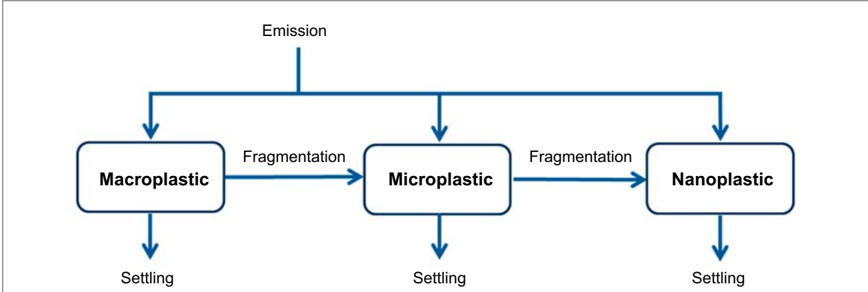
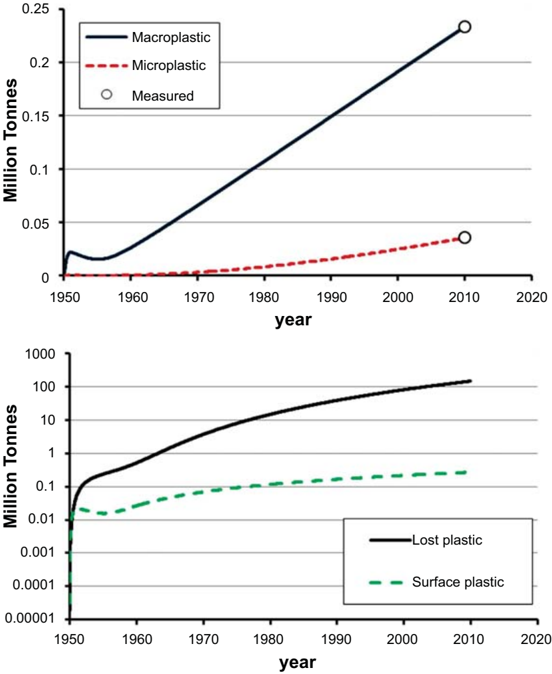
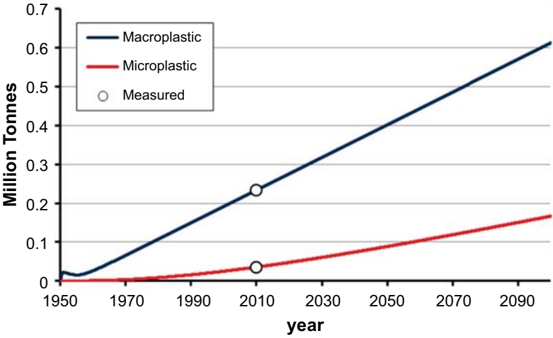
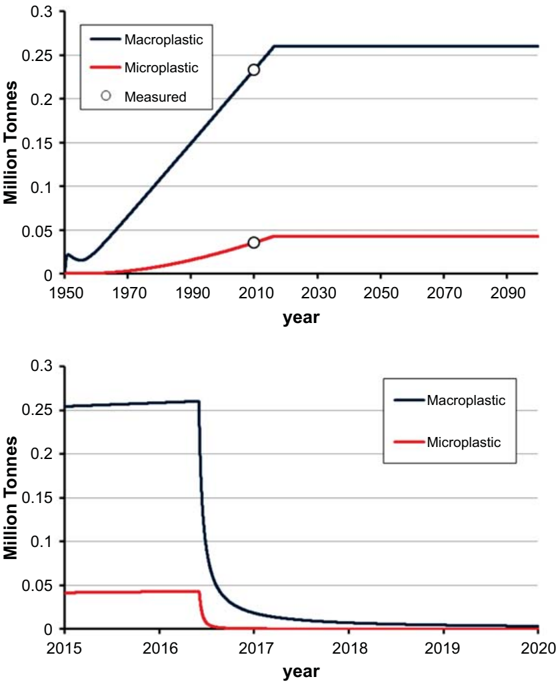
Understanding the global mass inventory is one of the main challenges in present research on plastic marine debris. Especially the fragmentation and vertical transport processes of oceanic plastic are poorly understood. However, whereas fragmentation rates are unknown, information on plastic emissions, concentrations of plastics in the ocean surface layer (OSL) and fragmentation mechanisms is available. Here, we apply a systems engineering analytical approach and propose a tentative 'whole ocean' mass balance model that combines emission data, surface area-normalized plastic fragmentation rates, estimated concentrations in the OSL, and removal from the OSL by sinking. We simulate known plastic abundances in the OSL and calculate an average whole ocean apparent surface area-normalized plastic fragmentation rate constant, given representative radii for macroplastic and microplastic. Simulations show that 99.8% of the plastic that had entered the ocean since 1950 had settled below the OSL by 2016, with an additional 9.4 million tons settling per year. In 2016, the model predicts that of the 0.309 million tons in the OSL, an estimated 83.7% was macroplastic, 13.8% microplastic, and 2.5% was < 0.335 mm 'nanoplastic'. A zero future emission simulation shows that almost all plastic in the OSL would be removed within three years, implying a fast response time of surface plastic abundance to changes in inputs. The model complements current spatially explicit models, points to future experiments that would inform critical model parameters, and allows for further validation when more experimental and field data become available.
Overview
The claims and statistics of this paper haven’t been checked yet.
Free: it reads the open-access text and checks the first 5 claims that cite a source we can check. Create a free account to check every claim.
Integrity signals
Registry
Cites
Statistics
Figures
Verification
Claims the paper makes
The claims and statistics of this paper haven’t been checked yet.
Free: it reads the open-access text and checks the first 5 claims that cite a source we can check. Create a free account to check every claim.
Self-check
Percentages, sums and reported differences re-computed from the paper’s own numbers.
The self-check needs the paper’s full text.
Citations
Cites
Lost at sea: where is all the plastic?
Thompson, R. C., Olsen, Y., Mitchell, R. P., Davis, A., Rowland, S. J., John, A. W. G., McGonigle, D., & Russell, A. E. (2004) · Science · doi:10.1126/science.1094559 · Cited by 7,765 · cited 3×
“This approach complements recent studies that estimate the global inventory from the bottomup using ocean measurements (Thompson et al 2004, Eriksen et al 2014, Cózar et al 2014, van Sebille et al 2015).”
BackgroundEriksen, M., Lebreton, L. C. M., Carson, H. S., Thiel, M., Moore, C. J., Borerro, J. C., Galgani, F., Ryan, P. G., & Reisser, J. (2014) · PLoS ONE · doi:10.1371/journal.pone.0111913 · Cited by 4,710 · cited 7×
“There is much uncertainty in the limited data on abundance of plastic debris in the oceans (Eriksen et al 2014, Cózar et al 2014, Van Sebille et al 2015).”
BackgroundMethodInfluential(2015) · Springer eBooks · doi:10.1007/978-3-319-16510-3 · Cited by 3,502
de Boyer Montégut, C., Madec, G., Fischer, A. S., Lazar, A., & Iudicone, D. (2004) · Journal of Geophysical Research: Oceans · doi:10.1029/2004jc002378 · Cited by 3,182 · cited 1×
“A range of 10– 100 m applies to the vast majority of locations in the world oceans (de Boyer Montégut et al 2004).”
BackgroundPlastic debris in the open ocean
Cózar, A., Echevarría, F., González-Gordillo, J. I., Irigoien, X., Úbeda, B., Hernández-León, S., Palma, Á. T., Navarro, S., García-de-Lomas, J., Ruiz, A., et al. (2014) · Proceedings of the National Academy of Sciences · doi:10.1073/pnas.1314705111 · Cited by 3,133 · cited 5×
“There is much uncertainty in the limited data on abundance of plastic debris in the oceans (Eriksen et al 2014, Cózar et al 2014, Van Sebille et al 2015).”
BackgroundInfluentialMicroplastic ingestion by zooplankton
Cole, M., Lindeque, P., Fileman, E., Halsband, C., Goodhead, R., Moger, J., & Galloway, T. S. (2013) · Environmental Science & Technology · doi:10.1021/es400663f · Cited by 2,763 · cited 1×
“Cole et al 2013, Choy and Drazen 2013, Van Franeker et al 2011b) and return to the OSL, which would result in a time-delay in the OSL abundance that can be assumed tobe small and relatively constant in time.”
BackgroundA global inventory of small floating plastic debris
van Sebille, E., Wilcox, C., Lebreton, L., Maximenko, N., Hardesty, B. D., van Franeker, J. A., Eriksen, M., Siegel, D., Galgani, F., & Law, K. L. (2015) · Environmental Research Letters · doi:10.1088/1748-9326/10/12/124006 · Cited by 1,713 · cited 6×
“There is much uncertainty in the limited data on abundance of plastic debris in the oceans (Eriksen et al 2014, Cózar et al 2014, Van Sebille et al 2015).”
BackgroundInfluentialSelf-citationKoelmans, A. A., Bakir, A., Burton, G. A., & Janssen, C. R. (2016) · Environmental Science & Technology · doi:10.1021/acs.est.5b06069 · Cited by 1,599 · cited 1×
“The BAU scenario assumes that annual plastic production and leakage/emission continue to increase according to the polynomial parameters derived from 1950–2013 data (PlasticsEurope 2013, Koelmans et al 2016).”
Self-citationIngestion of Microplastics by Zooplankton in the Northeast Pacific Ocean
Desforges, J.-P. W., Galbraith, M., & Ross, P. S. (2015) · Archives of Environmental Contamination and Toxicology · doi:10.1007/s00244-015-0172-5 · Cited by 1,019
Ups and Downs in the Ocean: Effects of Biofouling on Vertical Transport of Microplastics
Kooi, M., Nes, E. H. V., Scheffer, M., & Koelmans, A. A. (2017) · Environmental Science & Technology · doi:10.1021/acs.est.6b04702 · Cited by 977 · cited 4×
“Furthermore, it is known that chemical degradation of polymers results in weakening and fragmentation, and that biological colonization and aggregation can induce sinking of buoyant polymers (Kooi et al 2017).”
BackgroundResultInfluentialSelf-citation
Research works printed but not linked: 2
- Plastics—the Facts, 2013, An Analysis of European Latest Plastics Production Demand and Waste Data
- Van Franeker J A, 2011, NOAA Technical Memorandum
Cited by
Items 401–424 of 424
Çağan, A. S., Kankılıç, G. B., Çırak, T., Gökdağ, K., Şener, E., & Tavşanoğlu, Ü. N. (2026) · Water Air & Soil Pollution · doi:10.1007/s11270-026-09476-3
“Although research on microplastics in freshwater environments has increased, most assessments still rely primarily on abundance data, and studies incorporating ecological risk evaluation remain limited (Koelmans et al., 2017; Pan et al., 2021).”
Numerical study of bevelled disk settling hydrodynamics using structure-resolved simulations
Abhimanyu, Mortimer, L., Fairweather, M., Hodgson, D. M., Peakall, J., & Keevil, G. M. (2026) · AIP conference proceedings · doi:10.1063/5.0328398
Mattsson, K., Ekstrand, E., Yun, J., Palluy, T., Sugathapala, T. M., Magnusson, K., Nordberg, K., & Hassellöv, M. (2026) · Microplastics and Nanoplastics · doi:10.21203/rs.3.rs-10164976/v1
Polyethylene and Polypropylene Degradation in the Echinodermata Digestive Organs
Karpenko, A. A., Odintsov, V. S., & Istomina, A. A. (2026) · Ocean Science Journal · doi:10.1007/s12601-026-00283-9
Comparison of inventories of plastic in different global marine reservoirs
Zhu, X., Law, K. L., & Hoffman, M. J. (2026) · Environmental Research Letters · doi:10.1088/1748-9326/ae74e5
“For the three models that included biofouling; one used a fixed fouling rate (Koelmans et al 2017), another allowed for fouling and defouling (Kaandorp et al 2023), and the third assumed a log-normal distribution of bio-fouling rates (Zhang et al 2023).”
Self-citationNakatani, H., Miyaji, T., Sakamoto, M., Motokucho, S., & Dao, A. (2026) · Polymers · doi:10.3390/polym18121436
Zhao, H., Xu, H., Cao, C., Zan, Z., Chen, G., Wang, J., Tang, Q., Yue, W., Liu, Y., & Zhang, B.-T. (2026) · Resources Environment and Sustainability · doi:10.1016/j.resenv.2026.100363
From the Atlantic to the Mediterranean: what factors shape diatom diversity in the plastisphere
Barre, A., Lenoble, V., Lacerda, A. L., Pedrotti, M. L., Casotti, R., Murano, C., Donnarumma, V., Muniategui‐Lorenzo, S., Andrade, J. M., Fernández‐González, V., et al. (2026) · npj Biofilms and Microbiomes · doi:10.1038/s41522-026-01060-1
Kumar, P., Kumari, P., & Sinha, S. (2026) · Springer eBooks · doi:10.1007/978-3-032-17658-5_17
Submarine canyons as microplastic reservoirs: Insight from a reduced complexity model
Armitage, J., Télès, V., & Rohais, S. (2026) · Marine Pollution Bulletin · doi:10.1016/j.marpolbul.2026.120152
Aalifar, A., McKiver, W. J., Ferrarin, C., Pascàlis, F. D., Falcieri, F. M., Zanchettin, D., Madricardo, F., Moschino, V., & Ghezzo, M. (2026) · Marine Pollution Bulletin · doi:10.1016/j.marpolbul.2026.120182
Legacy subsea plastics from the oil and gas industry: Environmental risks of decommissioning in situ
Mendrik, F., Gall, S., Chen, J., Northam, A., Andrady, A. L., & Thompson, R. C. (2026) · Journal of Hazardous Materials · doi:10.1016/j.jhazmat.2026.143055
Simulating microplastic dynamics in fluvial networks: A case study of the Irwell–Mersey river system
Bhagat, N., Marion, A., & Bottacin‐Busolin, A. (2026) · Journal of Contaminant Hydrology · doi:10.1016/j.jconhyd.2026.105079
Gebhardt, C., Beckers, M., & Forster, S. (2026) · Journal of Marine Science and Engineering · doi:10.3390/jmse14151433
Liu, M., Zhang, T., Hu, L., Wang, Z., You, Z.-J., & Xu, J. (2026) · Marine Pollution Bulletin · doi:10.1016/j.marpolbul.2026.120303
Critical review of tools and techniques for predicting microplastics pollution in watershed runoff
Shourov, K. P., & Bathi, J. R. (2026) · Environmental Pollution and Management · doi:10.1016/j.epm.2026.08.003
Rosales, A., Hernández, R., Jiménez-González, M. L., Martínez-Montelongo, J. H., Masuoka‐Ito, D., Zapien, J. A., & Medina-Ramírez, I. E. (2026) · Processes · doi:10.3390/pr14193121
Alnairat, N., Hussein, S. B., Abu-Dalo, D., Nawafleh, D., Farwaneh, S., Assaf, M., Al-Khaial, I. Q., Waleed, H., Al‐Sinjilawi, H. T., Hudaib, B. I., et al. (2026) · Frontiers in Materials · doi:10.3389/fmats.2026.1950397
From ocean to shore: numerical modeling of microplastics in coastal waters
Jongedijk, C. E. (2023) · Spiral (Imperial College London) · doi:10.25560/143549
Enders, K., Lenz, R., Fischer, F., Schwarzer, K., Seiß, G., Fischer, D., & Labrenz, M. (2026) · Microplastics and Nanoplastics · doi:10.1186/s43591-026-00236-y
“Even initially buoyant MP are found to deposit in sediments as a result of particle agglomeration, bio-fouling and degradation [4], which manifests in their frequent presence in sedimentary environments [5, 6].”
Transport and Aging Pathways of Microplastics in Urban Aquatic Systems
Boyer, J. J. (2026) · Digital Commons - University of South Florida (University of South Florida)
From Pollution To Solution: a global assessment of marine litter and plastic pollution
Fahim, I. S., Green, D., Landrigan, P., McGlade, J., Andrady, A., Costa, M., Geyer, R., Gomes, R. L., Hwai, A. T. S., Jambeck, J., et al. (2021) · Repository@Nottingham (University of Nottingham) · Cited by 7
Vahdatiraad, L., Heidari, B., Zarei, S., & Hadavand, B. S. (2026) · Aquatic Toxicology · doi:10.1016/j.aquatox.2026.108073
Microplastics Rapidly Sink and Beach in a Whole-Lake Experiment
Rochman, C. M., Hoffman, M. J., Orihel, D. M., Rennie, M. D., Paterson, M. J., Provencher, J. F., Rooney, R. C., Nuamah, F., Langenfeld, D., Cable, R. N., et al. (2026) · Environmental Science & Technology · doi:10.1021/acs.est.6c09040
Metadata
- Authors
- Koelmans, A. A., Kooi, M., Law, K. L., & van Sebille, E.
- Affiliations
- Wageningen Marine Research (NL)
- Wageningen University & Research (NL)
- Sea Education Association (US)
- Corresponding author
- Koelmans, Albert A
- Venue
- Environmental Research Letters
- Publisher
- IOP Publishing
- Published
- 2017-11-01
- Volume
- 12
- Issue
- 11
- Pages
- 114028
- ISSN
- 1748-9326 (ISSN-L)
- OpenAlex
- W2767179800
- Cited by
- 396
- References
- 35
- Citations by year
- 2026: 31 · 2025: 47 · 2024: 58 · 2023: 48 · 2022: 55 · 2021: 58 · 2020: 50 · 2019: 32 · 2018: 16
- FWCI
- 12.07
- Type
- journal article
- Language
- en
- Open access
- gold
- doi.org
- Licence
- cc-by
- iopscience.iop.org/info/page/text-and-data-mining (tdm, 9 d)
- creativecommons.org/licenses/by/3.0/ (vor, 9 d)
- Locations
- Environmental Research Letters (publishedVersion, cc-by)
- Socio-Environmental Systems Modeling (acceptedVersion, cc-by)
- DOAJ (DOAJ: Directory of Open Access Journals) (submittedVersion)
- Utrecht University Repository (Utrecht University) (submittedVersion, other-oa)
- Spiral (Imperial College London) (submittedVersion, cc-by)
- Data Archiving and Networked Services (DANS) (submittedVersion, cc-by)
- Funders
- National Science Foundation (OCE-1260403)
- European Research Council (grant agreement No 715386)
- Topics
- Physical Sciences › Environmental Science › Pollution › Microplastics and Plastic Pollution
- Physical Sciences › Earth and Planetary Sciences › Oceanography › Marine Plankton and Biogeochemistry
- Physical Sciences › Environmental Science › Pollution › Oil Spill Detection and Mitigation
- Keywords
- marine plastic debris, mass balance, ocean surface layer, vertical transport, plastic emissions
About these checks
Registry, retraction, Cites and statistics results are computed, not judged, with one exception: a printed reference that no index lists is read once by a model before it counts as a citation error. Claims are extracted by a model and kept only when their quote appears verbatim in the text; each cited source is then checked, with a model’s help, for whether it says what the claim relies on. Those verdicts can be wrong — read the claim’s quote and the cited source before relying on one.
Statistics and arithmetic are recomputed, not judged.
Confidence bands are shown only for fields calibrated on our annotated test set. None is calibrated yet, so no band is shown.
What counts as a claim ›How we measure confidence ›How we check this ›
Are you an author, or do you see a problem with this page? Request a review
Data sources
Bibliographic data: Semantic Scholar, OpenAlex, Crossref.
Contains information from the Semantic Scholar Academic Graph Datasets, made available under the ODC Attribution License (ODC-BY 1.0).
Semantic Scholar’s data is described in: Kinney, R., et al. (2023). The Semantic Scholar Open Data Platform. arXiv:2301.10140.
