

The Evolution of Extracellular Matrix
Open accessThe DOI matches its Crossref record; 70 of the 70 references it cites were found in a registry or an index.
Abstract
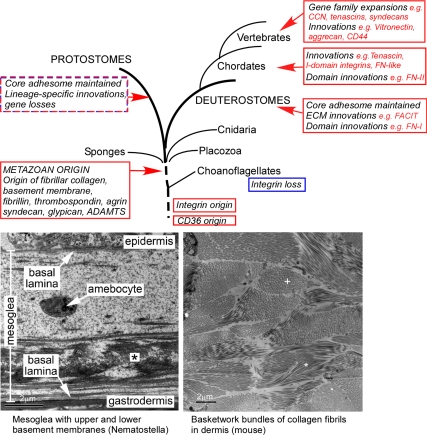
We present a perspective on the molecular evolution of the extracellular matrix (ECM) in metazoa that draws on research publications and data from sequenced genomes and expressed sequence tag libraries. ECM components do not function in isolation, and the biological ECM system or “adhesome” also depends on posttranslational processing enzymes, cell surface receptors, and extracellular proteases. We focus principally on the adhesome of internal tissues and discuss its origins at the dawn of the metazoa and the expansion of complexity that occurred in the chordate lineage. The analyses demonstrate very high conservation of a core adhesome that apparently evolved in a major wave of innovation in conjunction with the origin of metazoa. Integrin, CD36, and certain domains predate the metazoa, and some ECM-related proteins are identified in choanoflagellates as predicted sequences. Modern deuterostomes and vertebrates have many novelties and elaborations of ECM as a result of domain shuffling, domain innovations and gene family expansions. Knowledge of the evolution of metazoan ECM is important for understanding how it is built as a system, its roles in normal tissues and disease processes, and has relevance for tissue engineering, the development of artificial organs, and the goals of synthetic biology.
Overview
The claims and statistics of this paper haven’t been checked yet.
Free: it reads the open-access text and checks the first 5 claims that cite a source we can check. Create a free account to check every claim.
Integrity signals
Registry
Cites
Statistics
Figures
Verification
Claims the paper makes
The claims and statistics of this paper haven’t been checked yet.
Free: it reads the open-access text and checks the first 5 claims that cite a source we can check. Create a free account to check every claim.
Claims other papers make about this one
Each is checked against this paper’s own text: does it say what the citing paper says it does?
In the citing paper
“ESCs are surrounded and maintained by a microenvironment of various cell types and substances [85].”
From Ultraviolet Radiation‐Induced Skin Aging: The Role of DNA Damage and Oxidative Stress in Epidermal Stem Cell Damage Mediated Skin Aging (2016) · cites this paper as [85]
Self-check
Percentages, sums and reported differences re-computed from the paper’s own numbers.
The self-check needs the paper’s full text.
Citations
Cites
Collagen Structure and Stability
Shoulders, M. D., & Raines, R. T. (2009) · Annual Review of Biochemistry · doi:10.1146/annurev.biochem.77.032207.120833 · Cited by 3,923 · cited 1×
“For a GXY triple helix to be stable and assemble into higher order fibrils, additional protein domains and accessory proteins are needed (reviewed by Shoulders and Raines, 2009).”
The Extracellular Matrix: Not Just Pretty Fibrils
Hynes, R. O. (2009) · Science · doi:10.1126/science.1176009 · Cited by 3,527 · cited 2×
“…multi-cellularity is the extracellular matrix (ECM), a multicomponent , proteinaceous network that bridges between cells, contributes to their spatial arrangements by binding cell-surface adhesion receptors, and supports cell survival, differentiation, and tissue organization (Hynes, 2009).”
Two Rounds of Whole Genome Duplication in the Ancestral Vertebrate
Dehal, P., & Boore, J. L. (2005) · PLoS Biology · doi:10.1371/journal.pbio.0030314 · Cited by 1,526 · cited 2×
“Many adhesome components represented by single genes in invertebrate deuterostomes (sea urchin, acorn worm, or sea squirt) form a gene family in vertebrates, most likely due to the two rounds of genome-wide duplication that took place early in the vertebrate lineage (Dehal and Boore 2005; Huxley-Jones et al., 2007) (F…”
Defects in mesoderm, neural tube and vascular development in mouse embryos lacking fibronectin
George, E. L., Georges-Labouesse, E. N., Patel-King, R. S., Rayburn, H., & Hynes, R. O. (1993) · Development · doi:10.1242/dev.119.4.1079 · Cited by 1,305
CD36, a Scavenger Receptor Involved in Immunity, Metabolism, Angiogenesis, and Behavior
Silverstein, R. L., & Febbraio, M. (2009) · Science Signaling · doi:10.1126/scisignal.272re3 · Cited by 1,141
The genome of the choanoflagellate Monosiga brevicollis and the origin of metazoans
King, N., Westbrook, M. J., Young, S. L., Kuo, A., Abedin, M., Chapman, J., Fairclough, S., Hellsten, U., Isogai, Y., Letunic, I., et al. (2008) · Nature · doi:10.1038/nature06617 · Cited by 1,139
Iron-Clad Fibers: A Metal-Based Biological Strategy for Hard Flexible Coatings
Harrington, M. J., Masic, A., Holten-Andersen, N., Waite, J. H., & Fratzl, P. (2010) · Science · doi:10.1126/science.1181044 · Cited by 1,000 · cited 1×
“Such forms of ECM are of increasing interest to bioengineers (Harrington et al., 2010, Mü ller et al., 2009).”
From 2R to 3R: evidence for a fish-specific genome duplication (FSGD)
Meyer, A., & Van de Peer, Y. (2005) · BioEssays · doi:10.1002/bies.20293 · Cited by 945
The Trichoplax genome and the nature of placozoans
Srivastava, M., Begovic, E., Chapman, J., Putnam, N. H., Hellsten, U., Kawashima, T., Kuo, A., Mitros, T., Salamov, A., Carpenter, M. L., et al. (2008) · Nature · doi:10.1038/nature07191 · Cited by 889
Elastic proteins: biological roles and mechanical properties
Gosline, J., Lillie, M., Carrington, E., Guerette, P., Ortlepp, C., & Savage, K. (2002) · Philosophical Transactions of the Royal Society of London. Series B: Biological Sciences · doi:10.1098/rstb.2001.1022 · Cited by 838 · cited 1×
“Elastic proteins have evolved in multiple lineages as counterparts to the relatively inflexible collagen fibers (Gosline et al., 2002).”
Cited by
Items 201–300 of 343
A review on regulation of cell cycle by extracellular matrix
Rais, A., Husain, A., Hasan, G. M., & Hassan, M. I. (2023) · International Journal of Biological Macromolecules · doi:10.1016/j.ijbiomac.2023.123426 · Cited by 18
Mechanobiological Analysis of Nanoparticle Toxicity
Ketebo, A. A., Din, S. U., Lee, G., & Park, S. (2023) · Nanomaterials · doi:10.3390/nano13101682 · Cited by 14
Summers, J. A., Yarbrough, M., Liu, M., McDonald, W. H., Hudson, B. G., Pastor-Pareja, J. C., & Boudko, S. P. (2023) · Journal of Biological Chemistry · doi:10.1016/j.jbc.2023.105394 · Cited by 14
“Evolved, the appearance of the BM advanced the multicellularity of animals to a level of highly diverse and specialized tissues and organs (8 – 11).”
BackgroundTenascin-W: Discovery, Evolution, and Future Prospects
Degen, M., Scherberich, A., & Tucker, R. P. (2021) · Frontiers in Immunology · doi:10.3389/fimmu.2020.623305 · Cited by 14
“Tenascins or tenascin-like proteins are limited to the Phylum Chordata (2, 6, 22, 23), suggesting that tenascins coevolved with a dorsal hollow nerve cord and pharyngeal apparatus.”
BackgroundSelf-citationMcClatchey, S. T., Wang, Z., Linden, L. M., Hastie, E. L., Wang, L., Shen, W., Chen, A., Chi, Q., & Sherwood, D. R. (2016) · eLife · doi:10.7554/elife.17218 · Cited by 16
“BMs are built on polymeric laminin and type IV collagen networks that arose at the time of animal multicellularity, and may have been required for the evolution of complex tissues (Hynes, 2012; Ozbek et al., 2010).”
BackgroundFanous, M. J., Li, Y., Kandel, M. E., Abdeen, A. A., Kilian, K. A., & Popescu, G. (2019) · Journal of Biophotonics · doi:10.1002/jbio.201900178 · Cited by 17
Expression signatures of early-stage and advanced medaka melanomas
Klotz, B. J., Kneitz, S., Regensburger, M., Hahn, L., Dannemann, M., Kelso, J. F., Nickel, B., Lü, Y., Boswell, W. T., Postlethwait, J. H., et al. (2017) · Comparative Biochemistry and Physiology Part C Toxicology & Pharmacology · doi:10.1016/j.cbpc.2017.11.005 · Cited by 15
“ECM receptors are necessary for the interaction between cell adhesion and ECM that can influence cell proliferation, migration or apoptosis (Lu et al., 2012; Ozbek et al., 2010; Schmidt and Friedl, 2010).”
An in silico study on the influence of extracellular matrix mechanics on vasculogenesis
Carrasco-Mantis, A., Alarcón, T., & Sanz‐Herrera, J. A. (2023) · Computer Methods and Programs in Biomedicine · doi:10.1016/j.cmpb.2023.107369 · Cited by 14
Decellularized Extracellular Matrix: The Role of This Complex Biomaterial in Regeneration
de Paula, A. G. P., de Lima, J. D., Bastos, T. S. B., Czaikovski, A. P., Luz, R. B. D. S., Yuasa, B. S., Smanioto, C. C. S., Robert, A. W., & Braga, T. T. (2023) · ACS Omega · doi:10.1021/acsomega.2c06216 · Cited by 16
Trosko, J. E. (2011) · Preventive Nutrition and Food Science · doi:10.3746/jfn.2011.16.4.394 · Cited by 18
Did Tenascin-C Co-Evolve With the General Immune System of Vertebrates?
Orend, G., & Tucker, R. P. (2021) · Frontiers in Immunology · doi:10.3389/fimmu.2021.663902 · Cited by 13
“For example, fibrillar collagens, collagen type IV, fibrillins, perlecan, laminins and nidogen are found in the genomes of sponges and placozoans (20).”
BackgroundSelf-citationExtracellular matrix fluctuations during early embryogenesis
Szabó, A., Rupp, P. A., Rongish, B. J., Little, C. D., & Czirók, A. (2011) · Physical Biology · doi:10.1088/1478-3975/8/4/045006 · Cited by 13
A developmental biologist’s “outside-the-cell” thinking
Sherwood, D. R. (2015) · The Journal of Cell Biology · doi:10.1083/jcb.201501083 · Cited by 12
Amyloids Are Novel Cell-Adhesive Matrices
Jacob, R. S., Das, S., Singh, N., Patel, K., Datta, D., Sen, S., & Maji, S. K. (2018) · Advances in experimental medicine and biology · doi:10.1007/978-981-13-3065-0_7 · Cited by 14
Molecular evolution of the Thrombospondin superfamily
Tucker, R. P., & Adams, J. C. (2023) · Seminars in Cell and Developmental Biology · doi:10.1016/j.semcdb.2023.05.004 · Cited by 14
Self-citationMarkers of Circulating Breast Cancer Cells
López-Muñoz, E., & Méndez-Montes, M. (2013) · Advances in clinical chemistry · doi:10.1016/b978-0-12-407680-8.00007-5 · Cited by 15
Complexity: the organizing principle at the interface of biological (dis)order
Bhat, R., & Pally, D. (2017) · Journal of Genetics · doi:10.1007/s12041-017-0793-8 · Cited by 15
“In fact, the repertoire of extracellular matrix proteins, which can contribute significantly to the rheological properties of tissues, is greater in deuterostomes and especially vertebrates as a result of duplications and domain shuffling and recombinations (Ozbek et al. 2010; Hynes 2012).”
Background(2023) · doi:10.1093/gbe/evad218 · Cited by 11
“Many PRR proteins contain functional domains associated with ligand binding and/or cellular adhesion, coupled with signal transduction (Wheeler et al. 2008; Özbek et al. 2010; Richter et al. 2018; Richter and Levin 2019).”
BackgroundHayn, A., Fischer, T., & Mierke, C. T. (2023) · Frontiers in Cell and Developmental Biology · doi:10.3389/fcell.2023.1148162 · Cited by 11
Yuan, M., Liu, Y., Peng, X., Li, Z., & Lei, M. (2026) · Molecules · doi:10.3390/molecules31061024 · Cited by 11
“…(ECM) is a three-dimensional structure composed of extracellular macromolecules, formed by the combined action of epidermal and dermal cells, that provides physical support and scaffolding for information transfer to tissues and organs, and structure and growth factors to surrounding cells [39–41].”
Cancer Cell Direct Bioprinting: A Focused Review
Lobo, D. A., Ginestra, P. S., Ceretti, E., Puig, T., & Ciurana, J. (2021) · Micromachines · doi:10.3390/mi12070764 · Cited by 12
“In native tissues of multicellular organisms, like humans, cells secrete structural and functional molecules to dynamically maintain the extracellular matrices [20].”
BackgroundDyachuk, V. A. (2018) · Fisheries and Aquaculture Journal · doi:10.4172/2150-3508.1000248 · Cited by 11
“The proteinaceous network of ECM could provide structural support for cellular aggregation such as intercellular bridges, cellular adhesion, and the mechanical properties that are necessary for the proper functioning of multicellular organisms and tissues [3,4].”
BackgroundRecent progress on functional hydrogels as biomaterial for biomedicine
Yang, H., Zeng, T., Jiang, T., Wei, Q., Taherzade, S. D., Peng, X., Zhu, J., & Zhou, Z. (2025) · Results in Chemistry · doi:10.1016/j.rechem.2025.102464 · Cited by 18
The use of microphysiological systems to model metastatic cancer
Jackson, C. E., Green, N. H., English, W., & Claeyssens, F. (2024) · Biofabrication · doi:10.1088/1758-5090/ad3b70 · Cited by 10
“The ECM is comprised of multiple components: proteins, glycoproteins, proteoglycans and polysaccharides, which form both the basement membrane and the interstitial matrix (figure 6) [129, 138].”
BackgroundDetermination of core pathways for oral squamous cell carcinoma via the method of attract
Teng, D., Zhang, G., Bi, M.-X., Li, S., & Wang, Q. (2017) · Journal of Cancer Research and Therapeutics · doi:10.4103/0973-1482.206868 · Cited by 10
Microenvironmental factors involved in human amnion mesenchymal stem cells fate decisions
Syva, S. H., Ampon, K. H., Lasimbang, H. B., & Fatimah, S. S. (2015) · Journal of Tissue Engineering and Regenerative Medicine · doi:10.1002/term.2043 · Cited by 10
“ECM is an insoluble, complex and dynamic network of macromolecules with different biochemical and physical properties (Ozbek et al., 2010; Watt and Huck, 2013).”
BackgroundHuber, R. J., & O’Day, D. H. (2012) · Cellular and Molecular Life Sciences · doi:10.1007/s00018-012-1068-4 · Cited by 10
Fróes, A. M., Freitas, T., Vidal, L., Appolinario, L., Leomil, L., Venas, T. M. M., Campeão, M. E., da Silva, C. J. F., Moreira, A. P. B., Berlinck, R. G. S., et al. (2018) · Frontiers in Marine Science · doi:10.3389/fmars.2018.00081 · Cited by 10
“The extracellular matrix of sponges is rich in proteoglycans, lamninlike subunits, fibronectin, and other structural proteins (Harel and Tanzer, 1993; Özbek et al., 2010); thus, the multiple copies of RTX proteins may help to penetrate the sponge mesohyl.”
BackgroundNie, Y., Han, D., & Li, X. (2023) · Nano Research · doi:10.1007/s12274-023-6330-6 · Cited by 9
Luca, M. D., Crocco, P., Rango, F. D., Passarino, G., & Rose, G. (2016) · Mechanisms of Ageing and Development · doi:10.1016/j.mad.2016.03.003 · Cited by 10
Bianchi, M. V., Awaja, F., & Altankov, G. (2017) · Materials Science and Engineering C · doi:10.1016/j.msec.2017.04.110 · Cited by 9
Guerriero, G. (2012) · Genomics Proteomics & Bioinformatics · doi:10.1016/j.gpb.2012.07.003 · Cited by 9
Tracing evolutionary relicts of positive selection on eight malaria-related immune genes in mammals
Huang, B.-H., & Liao, P. (2014) · Innate Immunity · doi:10.1177/1753425914547744 · Cited by 10
Etxabe, A. G., Pini, J. M., Short, S., Cunha, L., Kille, P., & Watson, G. J. (2020) · Comparative Biochemistry and Physiology Part C Toxicology & Pharmacology · doi:10.1016/j.cbpc.2020.108913 · Cited by 9
Invertebrate and Vertebrate Collagens
Exposito, J., & Lethias, C. (2013) · Biology of extracellular matrix · doi:10.1007/978-3-642-36002-2_3 · Cited by 12
“Recent reviews on the evolution of metazoan extracellular matrix (Ozbek et al. 2010; Hynes 2012) have pointed out several important concepts.”
BackgroundMethodMandelberg, Y., Benayahu, D., & Benayahu, Y. (2016) · Biological Bulletin · doi:10.1086/bblv230n1p68 · Cited by 9
“3b) that falls within the lesser-known fibril range of 10–500 nm (e.g., Parry and Craig, 1984; Tillet et al., 1996).”
BackgroundVarious changes in cryopreserved acellular nerve allografts at −80°C
Zhu, Z., He, B., Huang, Y., Xu, X., Huang, X., Liu, J., Qi, J. H., Zhu, S., Zhu, Q., Xu, Y., et al. (2018) · Neural Regeneration Research · doi:10.4103/1673-5374.237138 · Cited by 9
“In particular, acellular tissue matrix is being widely investigated as a novel approach to organ repair and tissue regeneration and is being actively explored as a bio-derivative (Badylak et al., 2009; Ozbek et al., 2010; Zhu et al., 2015; Xiang et al., 2017).”
BackgroundRetractedEvolution of the Metazoan Extracellular Matrix
Adams, J. C. (2013) · Wiley eBooks · doi:10.1002/9780470015902.a0024606 · Cited by 9
Self-citationMultifaceted Defenses Against Parasitoid Wasps in Diptera
Mortimer, N. T., & Schlenke, T. A. (2025) · Annual Review of Genetics · doi:10.1146/annurev-genet-032425-100252 · Cited by 9
Molecular dynamics of the matrisome across sea anemone life history
Bergheim, B. G., Cole, A. G., Rettel, M., Stein, F., Redl, S., Hess, M. W., Ikmi, A., & Özbek, S. (2025) · eLife · doi:10.7554/elife.105319.3 · Cited by 8
Self-citationLi, T., Liu, J., Cai, H., Wang, B., Feng, Y., & Liu, J. (2018) · International Journal of Biological Sciences · doi:10.7150/ijbs.24765 · Cited by 8
“Extracellular matrix (ECM)is a complex network of macromolecules including proteins, glycoproteins, proteoglycans and polysaccharides with distinctive biochemical and mechanical properties [1].”
BackgroundDeng, Z.-Q., Guo, T., Bi, J., Wang, G.-J., Hu, Y., Du, H., Zhou, Y., Jia, S.-Q., Xing, X.-F., & Ji, J.-F. (2023) · Journal of Translational Medicine · doi:10.1186/s12967-023-04473-0 · Cited by 8
Yue, T., Xiong, S., Zheng, D., Wang, Y., Long, P., Yang, J., Danzeng, D., Gao, H. J., Wen, X., Li, X., et al. (2022) · Frontiers in Bioengineering and Biotechnology · doi:10.3389/fbioe.2022.988683 · Cited by 8
“It not only provides support, but also contains a variety of cytokines and chemokines, providing a good healing environment for injured tissues (Ozbek et al., 2010).”
BackgroundThe Matrisome of Model Organisms: From In-Silico Prediction to Big-Data Annotation
Gebauer, J. M., & Naba, A. (2020) · Biology of extracellular matrix · doi:10.1007/978-3-030-58330-9_2 · Cited by 9
Comparative surface energetic study of Matrigel® and collagen I interactions with endothelial cells
Hill, M. J., & Sarkar, D. (2017) · Colloids and Surfaces B Biointerfaces · doi:10.1016/j.colsurfb.2017.04.004 · Cited by 8
Trosko, J. E. (2018) · Toxicological Sciences · doi:10.1093/toxsci/kfy168 · Cited by 6
Integrins of the Starlet Sea Anemone Nematostella vectensis
Gong, Q., Garvey, K., Qian, C., Yin, I., Wong, G., & Tucker, R. P. (2014) · Biological Bulletin · doi:10.1086/bblv227n3p211 · Cited by 6
“…extracellular matrix of chordates (Tucker et al., 2011), and a number of homologs of chordate extracellular matrix genes have been identified, many of which are known to be integrin ligands in other organisms (Koehler et al., 2009; Ozbek et al., 2010; Tucker et al,, 2013; Tucker and Adams, 2014).”
BackgroundSelf-citationHypoxia and Breast Cancer Metastasis
Schito, L., & Semenza, G. L. (2013) · Cancer drug discovery and develogment/Cancer drug discovery and development · doi:10.1007/978-1-4614-9167-5_1 · Cited by 5
“biochemical properties (Ozbek et al. 2010).”
BackgroundGonçalves, J. D., Dias, J. H., Machado‐Neves, M., Vergani, G. B., Ahmadi, B., Batista, R. I. T. P., Souza‐Fabjan, J. M. G., Oliveira, M. E. F., Bartlewski, P. M., & da Fonseca, J. F. (2024) · Reproductive Biology · doi:10.1016/j.repbio.2024.100920 · Cited by 5
Trosko, J. E. (2018) · Advances in experimental medicine and biology · doi:10.1007/978-4-431-56847-6_7 · Cited by 5
Molins, B., Mesquida, M., & Adán, A. (2022) · Progress in Retinal and Eye Research · doi:10.1016/j.preteyeres.2022.101097 · Cited by 6
RetractedBeyond the matrisome: New frontiers in ECM research
Apte, S., & Naba, A. (2022) · Matrix Biology · doi:10.1016/j.matbio.2022.12.003 · Cited by 5
Piñeiro-Llanes, J., Suzuki‐Hatano, S., Jain, A., Venigalla, S., Kamat, M. N., Basso, K. B. G., Cade, W. T., Simmons, C. S., & Pacak, C. A. (2024) · Biomaterials · doi:10.1016/j.biomaterials.2024.122922 · Cited by 4
The Major Transitions in Early Evolution
Rosslenbroich, B. (2014) · History, philosophy and theory of the life sciences · doi:10.1007/978-3-319-04141-4_4 · Cited by 4
Tumor microenvironment-mediated targeted drug delivery to breast cancer cells
Haider, T., Kanwar, I. L., Pandey, V., Jain, P., & Soni, V. (2022) · Elsevier eBooks · doi:10.1016/b978-0-12-824476-0.00015-2 · Cited by 5
Cofré, J. (2023) · Journal of Biosciences · doi:10.1007/s12038-023-00400-z · Cited by 4
“…only serves as a selective barrier to macromolecules, provides support to epithelial cells, and regulates cell migration (Morrissey and Sherwood 2015), but is also considered an essential element in the transition to multicellularity and tissue evolution (O¨zbek et al. 2010; Fidler et al. 2018).”
Thrombospondins: Conserved mediators and modulators of metazoan extracellular matrix
Adams, J. C. (2024) · International Journal of Experimental Pathology · doi:10.1111/iep.12517 · Cited by 4
Self-citationJoselevitch, J. A., Vargas, T. H. M., Pulz, L. H., Cadrobbi, K. G., Huete, G. C., Nishiya, A. T., Kleeb, S. R., Xavier, J. G., & Strefezzi, R. D. F. (2023) · Veterinary and Comparative Oncology · doi:10.1111/vco.12898 · Cited by 4
5.17 Three-Dimensional Bioengineered Cancer Models
Pereira, B., Lister, N. L., De‐Juan‐Pardo, E. M., Risbridger, G. P., & Ellem, S. J. (2016) · Elsevier eBooks · doi:10.1016/b978-0-12-803581-8.09297-3 · Cited by 5
Becker, B., Doan, J.-M., Wustman, B. A., Carpenter, E. J., Chen, L., Zhang, Y., Wong, G. K., & Melkonian, M. (2015) · Genome Biology and Evolution · doi:10.1093/gbe/evv089 · Cited by 4
“In the latter, Kdo and Dha are present in rhamnogalacturonan II, a component of cell wall pectin (Becker et al. 1994; Popper and Tuohy 2010).”
BackgroundEpithelial cell extrusion underlies starvation-induced cell loss in a sea anemone
Fournon-Berodia, I., Bruderer, N., Christiaen, L., & Steinmetz, P. R. H. (2026) · Nature Communications · doi:10.1038/s41467-026-74437-7 · Cited by 4
“4B ’ , C ’ , D ’ and and Supplementary Data 1).”
InfluentialMolecular and Functional Convergences Associated with Complex Multicellularity in Eukarya
Lobo, F. P., da Costa, D. B., da Silva, T. T. M., & de Oliveira, M. D. (2025) · Molecular Biology and Evolution · doi:10.1093/molbev/msaf013 · Cited by 4
Remodelling of the Extracellular Matrix: Implications for Cancer
Cox, T. R., & Erler, J. T. (2013) · Humana Press eBooks · doi:10.1007/978-1-62703-634-4_4 · Cited by 3
Stem Cell Behavior on Microenvironment Mimicked Surfaces
Öztürk-Öncel, M. Ö., & Garipcan, B. (2016) · Wiley eBooks · doi:10.1002/9781119242642.ch15 · Cited by 3
Adams, J. C., & Tucker, R. P. (2024) · BMC Ecology and Evolution · doi:10.1186/s12862-024-02306-2 · Cited by 4
Self-citationCell–cell and cell–matrix interactions
DeMali, K. A., & Adams, J. C. (2012) · Molecular Biology of the Cell · doi:10.1091/mbc.e11-12-0967 · Cited by 3
“Jo Adams (University of Bristol, United Kingdom) described recent phylogenetic studies that show components of the ECM (unlike integrins and cadherins) to be specific to the metazoa (Ozbek et al., 2010).”
BackgroundSelf-citationUltra‐Tiny Gelatin Nanoparticles‐Assisted 3D Stem Cell Spheroids for Engineering Tissue Regeneration
Kim, D., Kim, W., Sharma, H., Lee, S., Park, C. Y., Park, S., Heo, C. Y., & Kim, J. (2025) · Advanced Healthcare Materials · doi:10.1002/adhm.202501882 · Cited by 4
Collagen remodeling supports Hydra vulgaris head regeneration and stem cell invasion
Cox, B. D., Mah, J. L., Perez, A., & Juliano, C. E. (2026) · Development · doi:10.1242/dev.205368 · Cited by 2
A Tissue Engineered 3D Model of Cancer Cell Invasion for Human Head and Neck Squamous-Cell Carcinoma
Stöth, M., Mineif, A. T., Sauer, F. C., Meyer, T. J., Müller-Diesing, F., Haug, L., Scherzad, A., Steinke, M. R., Rossi, A., & Hackenberg, S. (2024) · Current Issues in Molecular Biology · doi:10.3390/cimb46050250 · Cited by 2
Thrombospondins and Their Receptors: Evolving Functions
Roberts, D. D., & Frazier, W. A. (2013) · Biology of extracellular matrix · doi:10.1007/978-3-642-36002-2_8 · Cited by 2
Assembly of Virus Particles and Virus-like Particles as Templates for Biomedical Applications
Lee, L. A., Balizan, E., Lin, Y., & Wang, Q. (2012) · ACS symposium series · doi:10.1021/bk-2012-1119.ch002 · Cited by 3
Wang, N. Z. L. (2015) · Advancements in Genetic Engineering · doi:10.4172/2169-0111.1000117 · Cited by 2
“The ECM is composed of a large collection of biochemically distinct components including proteins, glycoproteins, proteoglycans, and polysaccharides with different physical and biochemical properties [58-60].”
BackgroundTissue Architecture in Cancer Initiation and Progression
Leggett, S. E., & Nelson, C. M. (2022) · Springer eBooks · doi:10.1007/978-3-030-98950-7_6 · Cited by 2
Tucker, R. P. (2018) · Springer eBooks · doi:10.1007/978-3-319-67199-4_101621 · Cited by 2
Self-citationComparative transcriptomic analysis of large yellow croaker with different flow resistance abilities
Qiao, G., Liu, S., Wang, Y., Wang, X., Yue, Y., Zheng, H., & Peng, S. (2025) · Marine Biology Research · doi:10.1080/17451000.2025.2557888 · Cited by 1
Advancements in Polymeric Membrane Fabrication: Implications for Biomedical Engineering
Haider, A., Shahid, A., Javaid, S., Ahmed, F., Rehman, S. U., Habib, M. A., Ibrahim, A. B. M., & Iqbal, M. (2026) · ChemistrySelect · doi:10.1002/slct.72669 · Cited by 1
Interstitial Spaces: A Basolateral Source of Structure and Signals
Wells, R. G., & Theise, N. D. (2026) · Annual Review of Cell and Developmental Biology · doi:10.1146/annurev-cellbio-111524-023144 · Cited by 3
Chen, Y., Li, J., Peng, Z., Lv, F., Wang, Y., Teng, W., Li, C., & Zhang, L. (2026) · Genome Biology and Evolution · doi:10.1093/gbe/evag146 · Cited by 1
“4), consistent with an ECM-derived shell matrix (Ozbek et al 2010).”
DDRs: receptors that mediate adhesion, migration and invasion in breast cancer cells
Reyes-Uribe, E., Departamento de Biologia Celular, C.-I., Serna‐Marquez, N., & Salazar, E. P. (2015) · AIMS Biophysics · doi:10.3934/biophy.2015.3.303 · Cited by 2
“Moreover, BM constitutes a platform for transmission of mechanical forces and induces the activation of signal transduction pathways [4,5,6].”
BackgroundAndrade, L. N. D. S., Pescatore, L. A., & Chammas, R. J. (2015) · Elsevier eBooks · doi:10.1016/b978-0-12-801238-3.04305-1 · Cited by 1
Breaching and Opening Basement Membrane Barriers: The Anchor Cell Leads the Way
Keeley, D. P., & Sherwood, D. R. (2017) · Biology of extracellular matrix · doi:10.1007/978-3-319-60907-2_6 · Cited by 1
“The genes that encode BM proteins are ancient and emerged concurrently with animal multicellularity (Hynes 2012; Ozbek et al. 2010), suggesting that BMs were required to construct and organize tissues.”
BackgroundAbdel‐Hamid, N. M., Sm, A.-E.-F., Nazmy, M., & As, M. (2016) · Journal of Disease Markers · doi:10.26420/jdismarkers.2016.1036 · Cited by 2
Proteolytic processing of laminin and the role of cryptides in tumoral biology
de Siqueira, A. S., Freitas, V. M., & Jaeger, R. G. (2021) · Elsevier eBooks · doi:10.1016/b978-0-323-85696-6.00009-3 · Cited by 1
Immunohistochemical Detection of Various Proteoglycans in the Extracellular Matrix of Zebra Mussels
Wu, W., Geist, J. P., Beggel, S., Schmitz, C., Milz, S., & Sternecker, K. (2022) · Fishes · doi:10.3390/fishes7020074 · Cited by 1
Matrix Metalloproteinases in Ischemia–Reperfusion Injury in Brain: Antioxidants as Rescuer
Sarkar, S., Chatterjee, S., & Swarnakar, S. (2013) · Springer eBooks · doi:10.1007/978-1-4614-9099-9_4 · Cited by 1
Goulart, E. (2022) · Methods in molecular biology · doi:10.1007/978-1-0716-2716-7_9 · Cited by 4
Comprehensive evaluation of genes related to basement membrane in hepatocellular carcinoma
Wu, G., Li, F., Guo, D., Xi, K., Zheng, D., Huang, R., Wu, X., Li, A., & Liu, X. (2024) · Aging · doi:10.18632/aging.205923 · Cited by 1
“Basement membranes (BMs), an ancient extracellular matrix that appeared with the emergence of multicellular animals [5], are predominately composed of collagen, laminin, and non-collagenous glycoproteins [6].”
BackgroundMolecular-level studies of extracellular matrix proteins conducted using atomic force microscopy
Walker, A. R., Sloneker, J. R., & Garno, J. C. (2024) · Biointerphases · doi:10.1116/6.0003789 · Cited by 1
Dill, M. N., Turner, Z. R., Kapuscinska, P. W., Heiden, K. D., Basso, K. B. G., Simmons, C. S., & Moore, E. (2025) · ACS Biomaterials Science & Engineering · doi:10.1021/acsbiomaterials.5c00810 · Cited by 1
Molecular dynamics of the matrisome across sea anemone life historyPreprint
Bergheim, B. G., Cole, A. G., Rettel, M., Stein, F., Redl, S., Hess, M. W., Ikmi, A., & Özbek, S. (2025) · eLife · doi:10.7554/elife.105319.1 · Cited by 1
Self-citationMolecular dynamics of the matrisome across sea anemone life historyPreprint
Bergheim, B. G., Cole, A. G., Rettel, M., Stein, F., Redl, S., Hess, M. W., Ikmi, A., & Özbek, S. (2025) · eLife · doi:10.7554/elife.105319.2 · Cited by 1
Self-citationBrissard, L. (2018) · theses.fr (ABES) · doi:10.70675/24feb632zea3az4ccbz92e9z6c3512519f0f · Cited by 2
de Siqueira, A. S. (2014) · Digital Library of Theses and Dissertations (Universidade de São Paulo) · doi:10.11606/t.42.2014.tde-24092014-154312 · Cited by 2
Wolff, D. G. (2013) · Digital Library of Theses and Dissertations (Universidade de São Paulo) · doi:10.11606/d.10.2013.tde-27112013-105415
Diet/Nutrition, Inflammation, Cellular Senescence, Stem Cells, Diseases of Aging, and Aging
Trosko, J. E., Tai, M., Sopczynski, B., & Kang, K. (2013) · Elsevier eBooks · doi:10.1016/b978-0-12-397803-5.00011-3 · Cited by 2
Evaluation of L-929 postmitotic daughter cell spreading during their migration on a substrate
Petrov, Y. P., Negulyaev, Y. A., & Цупкина, Н. В. (2012) · Cell and Tissue Biology · doi:10.1134/s1990519x12040098
Saba, I., Jakubowska, W., Chabaud, S., & Bolduc, S. (2016) · InTech eBooks · doi:10.5772/62588
“This elaborated milieu is very dynamic and extremely adaptable [2– 4].”
BackgroundAli, S. S. (2015) · DukeSpace (Duke University)
Metadata
- Authors
- Özbek, S., Balasubramanian, P. G., Chiquet-Ehrismann, R., Tucker, R. P., & Adams, J. C.
- Affiliations
- Heidelberg University (DE)
- Friedrich Miescher Institute for Biomedical Research, Novartis Research Foundation, Basel, Switzerland;
- University of California, Davis (US)
- University of Bristol (GB)
- Corresponding author
- Adams, Josephine C.
- Venue
- Molecular Biology of the Cell
- Published
- 2010-12-15
- Volume
- 21
- Issue
- 24
- Pages
- 4300-4305
- ISSN
- 1059-1524 (ISSN-L)
- 1939-4586
- PMC
- PMC3002383
- OpenAlex
- W2098882954
- Cited by
- 347
- References
- 69
- Citations by year
- 2026: 8 · 2025: 13 · 2024: 19 · 2023: 27 · 2022: 22 · 2021: 20 · 2020: 25 · 2019: 26 · 2018: 32 · 2017: 24 · 2016: 33 · 2015: 29 · 2014: 19 · 2013: 28 · 2012: 15
- FWCI
- 11.40
- Type
- journal article
- Language
- en
- Open access
- green
- www.ncbi.nlm.nih.gov
- Licence
- cc-by-nc-sa
- Locations
- Molecular Biology of the Cell (publishedVersion)
- PubMed Central (publishedVersion, cc-by-nc-sa)
- PubMed (publishedVersion)
- Explore Bristol Research (submittedVersion)
- Bristol Research (University of Bristol) (submittedVersion)
- Topics
- Health Sciences › Medicine › Immunology and Allergy › Cell Adhesion Molecules Research
- Life Sciences › Biochemistry, Genetics and Molecular Biology › Molecular Biology › Developmental Biology and Gene Regulation
- Life Sciences › Agricultural and Biological Sciences › Animal Science and Zoology › Marine Invertebrate Physiology and Ecology
- Keywords
- adhesome, integrins, CD36, choanoflagellates, domain shuffling, gene family expansion, extracellular protease, cell surface receptors, deuterostomes, vertebrates, tissue engineering, synthetic biology
- MeSH terms
- Amino Acid Sequence, Animals, Base Sequence, Biological Evolution, Extracellular Matrix, Humans, Invertebrates, Molecular Sequence Data, Species Specificity, Extracellular Matrix Proteins, Conserved Sequence, Protein Structure, Tertiary, CD36 Antigens, Computational Biology, Chordata, Biodiversity
About these checks
Registry, retraction, Cites and statistics results are computed, not judged, with one exception: a printed reference that no index lists is read once by a model before it counts as a citation error. Claims are extracted by a model and kept only when their quote appears verbatim in the text; each cited source is then checked, with a model’s help, for whether it says what the claim relies on. Those verdicts can be wrong — read the claim’s quote and the cited source before relying on one.
Statistics and arithmetic are recomputed, not judged.
Confidence bands are shown only for fields calibrated on our annotated test set. None is calibrated yet, so no band is shown.
What counts as a claim ›How we measure confidence ›How we check this ›
Are you an author, or do you see a problem with this page? Request a review
Data sources
Bibliographic data: Semantic Scholar, OpenAlex, Crossref.
Contains information from the Semantic Scholar Academic Graph Datasets, made available under the ODC Attribution License (ODC-BY 1.0).
Semantic Scholar’s data is described in: Kinney, R., et al. (2023). The Semantic Scholar Open Data Platform. arXiv:2301.10140.
