

The Evolution of Extracellular Matrix
Open accessThe DOI matches its Crossref record; 70 of the 70 references it cites were found in a registry or an index.
Abstract
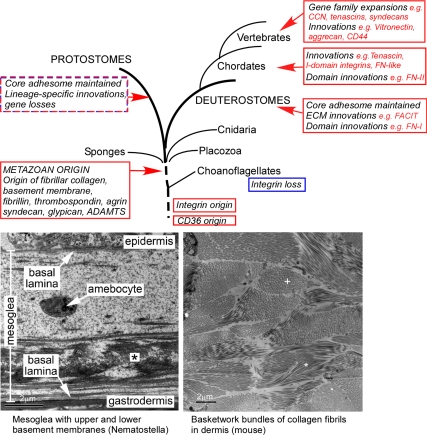
We present a perspective on the molecular evolution of the extracellular matrix (ECM) in metazoa that draws on research publications and data from sequenced genomes and expressed sequence tag libraries. ECM components do not function in isolation, and the biological ECM system or “adhesome” also depends on posttranslational processing enzymes, cell surface receptors, and extracellular proteases. We focus principally on the adhesome of internal tissues and discuss its origins at the dawn of the metazoa and the expansion of complexity that occurred in the chordate lineage. The analyses demonstrate very high conservation of a core adhesome that apparently evolved in a major wave of innovation in conjunction with the origin of metazoa. Integrin, CD36, and certain domains predate the metazoa, and some ECM-related proteins are identified in choanoflagellates as predicted sequences. Modern deuterostomes and vertebrates have many novelties and elaborations of ECM as a result of domain shuffling, domain innovations and gene family expansions. Knowledge of the evolution of metazoan ECM is important for understanding how it is built as a system, its roles in normal tissues and disease processes, and has relevance for tissue engineering, the development of artificial organs, and the goals of synthetic biology.
Overview
The claims and statistics of this paper haven’t been checked yet.
Free: it reads the open-access text and checks the first 5 claims that cite a source we can check. Create a free account to check every claim.
Integrity signals
Registry
Cites
Statistics
Figures
Verification
Claims the paper makes
The claims and statistics of this paper haven’t been checked yet.
Free: it reads the open-access text and checks the first 5 claims that cite a source we can check. Create a free account to check every claim.
Claims other papers make about this one
Each is checked against this paper’s own text: does it say what the citing paper says it does?
In the citing paper
“ESCs are surrounded and maintained by a microenvironment of various cell types and substances [85].”
From Ultraviolet Radiation‐Induced Skin Aging: The Role of DNA Damage and Oxidative Stress in Epidermal Stem Cell Damage Mediated Skin Aging (2016) · cites this paper as [85]
Self-check
Percentages, sums and reported differences re-computed from the paper’s own numbers.
The self-check needs the paper’s full text.
Citations
Cites
Collagen Structure and Stability
Shoulders, M. D., & Raines, R. T. (2009) · Annual Review of Biochemistry · doi:10.1146/annurev.biochem.77.032207.120833 · Cited by 3,923 · cited 1×
“For a GXY triple helix to be stable and assemble into higher order fibrils, additional protein domains and accessory proteins are needed (reviewed by Shoulders and Raines, 2009).”
The Extracellular Matrix: Not Just Pretty Fibrils
Hynes, R. O. (2009) · Science · doi:10.1126/science.1176009 · Cited by 3,527 · cited 2×
“…multi-cellularity is the extracellular matrix (ECM), a multicomponent , proteinaceous network that bridges between cells, contributes to their spatial arrangements by binding cell-surface adhesion receptors, and supports cell survival, differentiation, and tissue organization (Hynes, 2009).”
Two Rounds of Whole Genome Duplication in the Ancestral Vertebrate
Dehal, P., & Boore, J. L. (2005) · PLoS Biology · doi:10.1371/journal.pbio.0030314 · Cited by 1,526 · cited 2×
“Many adhesome components represented by single genes in invertebrate deuterostomes (sea urchin, acorn worm, or sea squirt) form a gene family in vertebrates, most likely due to the two rounds of genome-wide duplication that took place early in the vertebrate lineage (Dehal and Boore 2005; Huxley-Jones et al., 2007) (F…”
Defects in mesoderm, neural tube and vascular development in mouse embryos lacking fibronectin
George, E. L., Georges-Labouesse, E. N., Patel-King, R. S., Rayburn, H., & Hynes, R. O. (1993) · Development · doi:10.1242/dev.119.4.1079 · Cited by 1,305
CD36, a Scavenger Receptor Involved in Immunity, Metabolism, Angiogenesis, and Behavior
Silverstein, R. L., & Febbraio, M. (2009) · Science Signaling · doi:10.1126/scisignal.272re3 · Cited by 1,141
The genome of the choanoflagellate Monosiga brevicollis and the origin of metazoans
King, N., Westbrook, M. J., Young, S. L., Kuo, A., Abedin, M., Chapman, J., Fairclough, S., Hellsten, U., Isogai, Y., Letunic, I., et al. (2008) · Nature · doi:10.1038/nature06617 · Cited by 1,139
Iron-Clad Fibers: A Metal-Based Biological Strategy for Hard Flexible Coatings
Harrington, M. J., Masic, A., Holten-Andersen, N., Waite, J. H., & Fratzl, P. (2010) · Science · doi:10.1126/science.1181044 · Cited by 1,000 · cited 1×
“Such forms of ECM are of increasing interest to bioengineers (Harrington et al., 2010, Mü ller et al., 2009).”
From 2R to 3R: evidence for a fish-specific genome duplication (FSGD)
Meyer, A., & Van de Peer, Y. (2005) · BioEssays · doi:10.1002/bies.20293 · Cited by 945
The Trichoplax genome and the nature of placozoans
Srivastava, M., Begovic, E., Chapman, J., Putnam, N. H., Hellsten, U., Kawashima, T., Kuo, A., Mitros, T., Salamov, A., Carpenter, M. L., et al. (2008) · Nature · doi:10.1038/nature07191 · Cited by 889
Elastic proteins: biological roles and mechanical properties
Gosline, J., Lillie, M., Carrington, E., Guerette, P., Ortlepp, C., & Savage, K. (2002) · Philosophical Transactions of the Royal Society of London. Series B: Biological Sciences · doi:10.1098/rstb.2001.1022 · Cited by 838 · cited 1×
“Elastic proteins have evolved in multiple lineages as counterparts to the relatively inflexible collagen fibers (Gosline et al., 2002).”
Cited by
Items 301–343 of 343
New insights into mutable collagenous tissues: an inspiring model for tissue regeneration
Ribeiro, A. R. (2010) · Portuguese National Funding Agency for Science, Research and Technology (RCAAP Project by FCT) · doi:10.34626/vvdh-6638 · Cited by 1
Caveat emptor: for researchers, a rose will not smell sweet unless we know its composition
Adams, J. C. (2017) · Bioscience Reports · doi:10.1042/bsr20170078
Self-citationStudy of the mechanism of action of bisacodyl in cancer stem-like cells isolated from glioblatoma
Chen, W. (2017) · theses.fr (ABES) · doi:10.70675/1cc6f866z316az4fe7z827cz6b52df901b3f
Importância da protease ADAMTS-1 na invasão local e sistêmica de células do fibrossarcoma.
Guerra, H. N. (2017) · Digital Library of Theses and Dissertations (Universidade de São Paulo) · doi:10.11606/t.42.2017.tde-13032018-100002
Lighterness, A. (2018) · Queensland University of Technology · doi:10.5204/thesis.eprints.122616
Dynamics of cancer cells in the tumor core and role of the extracellular matrix in invasion
Staneva, R. (2018) · theses.fr (ABES) · doi:10.70675/c4d1f55fzbec9z45f1za6eezbd7f83378600
Peptídeo AG73, derivado da laminina, inibindo a proteína podoplanina em linhagem de câncer oral.
Sarmento, M. P. (2018) · Digital Library of Theses and Dissertations (Universidade de São Paulo) · doi:10.11606/d.42.2019.tde-13022019-155021
Engenharia tecidual hepática utilizando células tronco pluripotentes induzidas
Guimarães, E. D. S. G. (2019) · Digital Library of Theses and Dissertations (Universidade de São Paulo) · doi:10.11606/t.41.2019.tde-27082019-093823
Bioengineering The Fracture Callus: Bone Repair Through Fracture Mimetics
Vas, W. J. (2019) · UCL Discovery (University College London)
Lavrentev, S. N., Аксененко, М. Б., Сергеевич, А. А., & Zichenko, I. S. (2020) · Siberian medical review · doi:10.20333/2500136-2020-3-70-77
Eckardt, J. (2020) · eDiss (Georg-August-Universität Göttingen) · doi:10.53846/goediss-8263
Çay, İ., & Pamuk, S. (2021) · Journal of Mechanics in Medicine and Biology · doi:10.1142/s0219519421500275
IL-33: An Extracellular Arbiter of Macrophage Mediated Myogenesis
Bartolacci, J. G. (2021) · D-Scholarship@Pitt (University of Pittsburgh)
Fantin, A. (2020) · TSpace (University of Toronto)
Nishiya, N., & Yonezawa, H. (2021) · The Journal of Antibiotics · doi:10.1038/s41429-021-00461-y
Dawn of a new era in sponge biotechnology
Hesp, K. (2021) · doi:10.18174/540280 · Cited by 3
Tucker, R. P. (2016) · Springer eBooks · doi:10.1007/978-1-4614-6438-9_101621-1
Self-citationChisholm, A. D. (2020) · Faculty Opinions – Post-Publication Peer Review of the Biomedical Literature · doi:10.3410/f.735435864.793580451
Chakraborty, D. D., & Chakraborty, P. (2023) · Current Nanomedicine · doi:10.2174/0124681873270736231024060618 · Cited by 1
Produção de enxertos ósseos a partir da placenta bovina descelularizada
Cordeiro, I. S. (2023) · Digital Library of Theses and Dissertations (Universidade de São Paulo) · doi:10.11606/t.10.2023.tde-28072023-140934
Molecular-Level Studies of Nanopatterned Biomolecules with Atomic Force Microscopy
Walker, A. (2024) · Louisiana State University · doi:10.31390/gradschool_dissertations.6493
Modular Hyaluronan-Based Hydrogels for 3D Cell Culture and Bioprinting
Jury, M. (2022) · Linköping studies in science and technology. Dissertations · doi:10.3384/9789179293437
Expressão de ADAMTS2, BMP1, LOX, LOXL2, MMP14, PDGFRA e SPARC em mastocitomas cutâneos caninos
Joselevitch, J. A. (2024) · Digital Library of Theses and Dissertations (Universidade de São Paulo) · doi:10.11606/t.10.2024.tde-20062024-110535
Extracellular matrix of the nervous system
Nazir, S., Feresten, A. H., Lin, L. D., Hutter, H., & Julian, L. M. (2024) · Elsevier eBooks · doi:10.1016/b978-0-323-95730-4.00002-0 · Cited by 1
FOXO1, une nouvelle cible thérapeutique en immunothérapie anticancéreuse
Marchais, M. (2023) · theses.fr (ABES) · doi:10.70675/44ed8461z635cz4479za968z3874281017f3
A narrative review on tumor microenvironment in malignant tumors
Doğanyiğit, Z., Eroğlu, E., Okan, A., & Yılmaz, S. (2025) · Postępy Higieny i Medycyny Doświadczalnej · doi:10.2478/ahem-2025-0005
Harris, G. M. (2013) · Scholar Commons (University of South Carolina)
Relación entre las proteínas parp-1 y hif-1α durante la respuesta a hipoxia tumoral
Martí, J. M. (2021) · Institutional Repository of the University of Granada (University of Granada)
Decellularized fetal nucleus pulposus extracellular matrix for intervertebral disc regeneration
Fiordalisi, M. F. (2023) · Portuguese National Funding Agency for Science, Research and Technology (RCAAP Project by FCT) · doi:10.34626/n4tt-x768
Devarajan, Y., Prakash, K. S., & Pitchaimani, A. (2026) · In vitro models · doi:10.1007/s44164-025-00102-w
Jeanne, A. (2013) · theses.fr (ABES) · doi:10.70675/ccee0af2z3b65z4e50z99fcza94ebf10ae7b
Pietraszek‐Gremplewicz, K. (2013) · theses.fr (ABES) · doi:10.70675/52dd9d84z6ca5z4eb3z96d8z449666a11714
Role of the bone microenvironment in systemic breast cancer growth and metastasis
Aslan, Y. (2020) · theses.fr (ABES) · doi:10.70675/a6793073zd42dz4dacz843azd9606734d152
Wartenberg, M. (2018) · theses.fr (ABES) · doi:10.70675/4902c8d9zd7cfz4fbaza4dfz6bb7789a1737 · Cited by 1
Régulation de la cathepsine V par l’héparane-sulfate dans les mucopolysaccharidoses
Chazeirat, T. (2020) · theses.fr (ABES) · doi:10.70675/96a0d1a0zcf8az4a58zb268zd5e4beef4ceb
ECM-Mimicking Scaffolds in Advancing Tissue Engineering and Regenerative Medicine
Mumtaz, I., & Maqbool, T. (2026) · Biology of extracellular matrix · doi:10.1007/978-3-032-22618-1_3 · Cited by 1
de Azevedo, G. M., Farias, E., Cavalcante, J. V. F., Ferraz, R. S., Silva, B. W. F., Coelho, D. M., & Dalmolin, R. J. S. (2026) · Genetics and Molecular Biology · doi:10.1590/1678-4685-gmb-2025-0197
“Our results highlight that modules for cellular extravasation and cell adhesion were significantly enriched in the Actinopterygii (ray-finned fishes) and Sauropsida (reptiles and birds) LCAs, respectively.”
Role of the Extracellular Matrix: Enzyme Activities and Metastasis
Choi, I.-K., & Yun, C. (2013) · Springer eBooks · doi:10.1007/978-1-4614-7876-8_11
“The ECM consists of a large collection of diverse molecules including collagens, non-collagenous proteins, and proteoglycans with various physical and biochemical properties [ 21 , 22 ].”
Background
Metadata
- Authors
- Özbek, S., Balasubramanian, P. G., Chiquet-Ehrismann, R., Tucker, R. P., & Adams, J. C.
- Affiliations
- Heidelberg University (DE)
- Friedrich Miescher Institute for Biomedical Research, Novartis Research Foundation, Basel, Switzerland;
- University of California, Davis (US)
- University of Bristol (GB)
- Corresponding author
- Adams, Josephine C.
- Venue
- Molecular Biology of the Cell
- Published
- 2010-12-15
- Volume
- 21
- Issue
- 24
- Pages
- 4300-4305
- ISSN
- 1059-1524 (ISSN-L)
- 1939-4586
- PMC
- PMC3002383
- OpenAlex
- W2098882954
- Cited by
- 347
- References
- 69
- Citations by year
- 2026: 8 · 2025: 13 · 2024: 19 · 2023: 27 · 2022: 22 · 2021: 20 · 2020: 25 · 2019: 26 · 2018: 32 · 2017: 24 · 2016: 33 · 2015: 29 · 2014: 19 · 2013: 28 · 2012: 15
- FWCI
- 11.40
- Type
- journal article
- Language
- en
- Open access
- green
- www.ncbi.nlm.nih.gov
- Licence
- cc-by-nc-sa
- Locations
- Molecular Biology of the Cell (publishedVersion)
- PubMed Central (publishedVersion, cc-by-nc-sa)
- PubMed (publishedVersion)
- Explore Bristol Research (submittedVersion)
- Bristol Research (University of Bristol) (submittedVersion)
- Topics
- Health Sciences › Medicine › Immunology and Allergy › Cell Adhesion Molecules Research
- Life Sciences › Biochemistry, Genetics and Molecular Biology › Molecular Biology › Developmental Biology and Gene Regulation
- Life Sciences › Agricultural and Biological Sciences › Animal Science and Zoology › Marine Invertebrate Physiology and Ecology
- Keywords
- adhesome, integrins, CD36, choanoflagellates, domain shuffling, gene family expansion, extracellular protease, cell surface receptors, deuterostomes, vertebrates, tissue engineering, synthetic biology
- MeSH terms
- Amino Acid Sequence, Animals, Base Sequence, Biological Evolution, Extracellular Matrix, Humans, Invertebrates, Molecular Sequence Data, Species Specificity, Extracellular Matrix Proteins, Conserved Sequence, Protein Structure, Tertiary, CD36 Antigens, Computational Biology, Chordata, Biodiversity
About these checks
Registry, retraction, Cites and statistics results are computed, not judged, with one exception: a printed reference that no index lists is read once by a model before it counts as a citation error. Claims are extracted by a model and kept only when their quote appears verbatim in the text; each cited source is then checked, with a model’s help, for whether it says what the claim relies on. Those verdicts can be wrong — read the claim’s quote and the cited source before relying on one.
Statistics and arithmetic are recomputed, not judged.
Confidence bands are shown only for fields calibrated on our annotated test set. None is calibrated yet, so no band is shown.
What counts as a claim ›How we measure confidence ›How we check this ›
Are you an author, or do you see a problem with this page? Request a review
Data sources
Bibliographic data: Semantic Scholar, OpenAlex, Crossref.
Contains information from the Semantic Scholar Academic Graph Datasets, made available under the ODC Attribution License (ODC-BY 1.0).
Semantic Scholar’s data is described in: Kinney, R., et al. (2023). The Semantic Scholar Open Data Platform. arXiv:2301.10140.
