

The Evolution of Extracellular Matrix
Open accessThe DOI matches its Crossref record; 70 of the 70 references it cites were found in a registry or an index.
Abstract
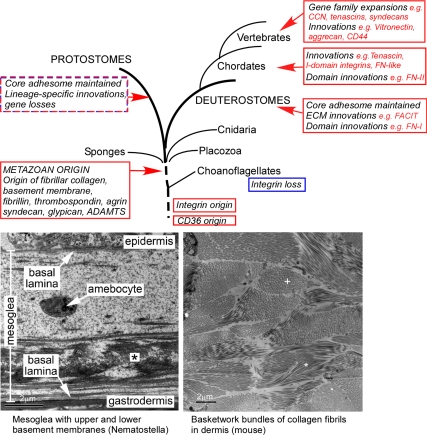
We present a perspective on the molecular evolution of the extracellular matrix (ECM) in metazoa that draws on research publications and data from sequenced genomes and expressed sequence tag libraries. ECM components do not function in isolation, and the biological ECM system or “adhesome” also depends on posttranslational processing enzymes, cell surface receptors, and extracellular proteases. We focus principally on the adhesome of internal tissues and discuss its origins at the dawn of the metazoa and the expansion of complexity that occurred in the chordate lineage. The analyses demonstrate very high conservation of a core adhesome that apparently evolved in a major wave of innovation in conjunction with the origin of metazoa. Integrin, CD36, and certain domains predate the metazoa, and some ECM-related proteins are identified in choanoflagellates as predicted sequences. Modern deuterostomes and vertebrates have many novelties and elaborations of ECM as a result of domain shuffling, domain innovations and gene family expansions. Knowledge of the evolution of metazoan ECM is important for understanding how it is built as a system, its roles in normal tissues and disease processes, and has relevance for tissue engineering, the development of artificial organs, and the goals of synthetic biology.
Overview
The claims and statistics of this paper haven’t been checked yet.
Free: it reads the open-access text and checks the first 5 claims that cite a source we can check. Create a free account to check every claim.
Integrity signals
Registry
Cites
Statistics
Figures
Verification
Claims the paper makes
The claims and statistics of this paper haven’t been checked yet.
Free: it reads the open-access text and checks the first 5 claims that cite a source we can check. Create a free account to check every claim.
Claims other papers make about this one
Each is checked against this paper’s own text: does it say what the citing paper says it does?
In the citing paper
“ESCs are surrounded and maintained by a microenvironment of various cell types and substances [85].”
From Ultraviolet Radiation‐Induced Skin Aging: The Role of DNA Damage and Oxidative Stress in Epidermal Stem Cell Damage Mediated Skin Aging (2016) · cites this paper as [85]
Self-check
Percentages, sums and reported differences re-computed from the paper’s own numbers.
The self-check needs the paper’s full text.
Citations
Cites
Collagen Structure and Stability
Shoulders, M. D., & Raines, R. T. (2009) · Annual Review of Biochemistry · doi:10.1146/annurev.biochem.77.032207.120833 · Cited by 3,923 · cited 1×
“For a GXY triple helix to be stable and assemble into higher order fibrils, additional protein domains and accessory proteins are needed (reviewed by Shoulders and Raines, 2009).”
The Extracellular Matrix: Not Just Pretty Fibrils
Hynes, R. O. (2009) · Science · doi:10.1126/science.1176009 · Cited by 3,527 · cited 2×
“…multi-cellularity is the extracellular matrix (ECM), a multicomponent , proteinaceous network that bridges between cells, contributes to their spatial arrangements by binding cell-surface adhesion receptors, and supports cell survival, differentiation, and tissue organization (Hynes, 2009).”
Two Rounds of Whole Genome Duplication in the Ancestral Vertebrate
Dehal, P., & Boore, J. L. (2005) · PLoS Biology · doi:10.1371/journal.pbio.0030314 · Cited by 1,526 · cited 2×
“Many adhesome components represented by single genes in invertebrate deuterostomes (sea urchin, acorn worm, or sea squirt) form a gene family in vertebrates, most likely due to the two rounds of genome-wide duplication that took place early in the vertebrate lineage (Dehal and Boore 2005; Huxley-Jones et al., 2007) (F…”
Defects in mesoderm, neural tube and vascular development in mouse embryos lacking fibronectin
George, E. L., Georges-Labouesse, E. N., Patel-King, R. S., Rayburn, H., & Hynes, R. O. (1993) · Development · doi:10.1242/dev.119.4.1079 · Cited by 1,305
CD36, a Scavenger Receptor Involved in Immunity, Metabolism, Angiogenesis, and Behavior
Silverstein, R. L., & Febbraio, M. (2009) · Science Signaling · doi:10.1126/scisignal.272re3 · Cited by 1,141
The genome of the choanoflagellate Monosiga brevicollis and the origin of metazoans
King, N., Westbrook, M. J., Young, S. L., Kuo, A., Abedin, M., Chapman, J., Fairclough, S., Hellsten, U., Isogai, Y., Letunic, I., et al. (2008) · Nature · doi:10.1038/nature06617 · Cited by 1,139
Iron-Clad Fibers: A Metal-Based Biological Strategy for Hard Flexible Coatings
Harrington, M. J., Masic, A., Holten-Andersen, N., Waite, J. H., & Fratzl, P. (2010) · Science · doi:10.1126/science.1181044 · Cited by 1,000 · cited 1×
“Such forms of ECM are of increasing interest to bioengineers (Harrington et al., 2010, Mü ller et al., 2009).”
From 2R to 3R: evidence for a fish-specific genome duplication (FSGD)
Meyer, A., & Van de Peer, Y. (2005) · BioEssays · doi:10.1002/bies.20293 · Cited by 945
The Trichoplax genome and the nature of placozoans
Srivastava, M., Begovic, E., Chapman, J., Putnam, N. H., Hellsten, U., Kawashima, T., Kuo, A., Mitros, T., Salamov, A., Carpenter, M. L., et al. (2008) · Nature · doi:10.1038/nature07191 · Cited by 889
Elastic proteins: biological roles and mechanical properties
Gosline, J., Lillie, M., Carrington, E., Guerette, P., Ortlepp, C., & Savage, K. (2002) · Philosophical Transactions of the Royal Society of London. Series B: Biological Sciences · doi:10.1098/rstb.2001.1022 · Cited by 838 · cited 1×
“Elastic proteins have evolved in multiple lineages as counterparts to the relatively inflexible collagen fibers (Gosline et al., 2002).”
Cited by
The extracellular matrix: A dynamic niche in cancer progression
Lu, P., Weaver, V. M., & Werb, Z. (2012) · Journal of Cell Biology · doi:10.1083/jcb.201102147 · Cited by 3,024
Mao, X., Xu, J., Wang, W., Liang, C., Hua, J., Liu, J., Zhang, B., Meng, Q., Yu, X., & Shi, S. (2021) · Molecular Cancer · doi:10.1186/s12943-021-01428-1 · Cited by 2,290
“immune suppression The extracellular matrix (ECM) is a complex network consisting of different macromolecules, including collagens, fibrin, glycoproteins and proteoglycans, responsible for maintaining the architecture, integrity, development and homeostasis of normal tissue [18, 266, 267].”
BackgroundExtracellular Matrix Degradation and Remodeling in Development and Disease
Lu, P., Takai, K., Weaver, V. M., & Werb, Z. (2011) · Cold Spring Harbor Perspectives in Biology · doi:10.1101/cshperspect.a005058 · Cited by 2,265
“The diversity and sophistication of ECM components and their respective cell surface receptors are among the most salient features during metazoan evolution (Har-el and Tanzer 1993; Hutter et al. 2000; Whittaker et al. 2006; Engler et al. 2009; Huxley-Jones et al. 2009; Ozbek et al. 2010).”
BackgroundOverview of the Matrisome--An Inventory of Extracellular Matrix Constituents and Functions
Hynes, R. O., & Naba, A. (2012) · Cold Spring Harbor Perspectives in Biology · doi:10.1101/cshperspect.a004903 · Cited by 1,349
“Comparative analyses of the genomes of different taxa have revealed that some ECM proteins are shared by almost all metazoa, even simple organisms such as sponges, coelenterates, and cnidaria (Huxley-Jones et al. 2007; Ozbek et al. 2010).”
BackgroundExtracellular matrix: A dynamic microenvironment for stem cell niche
Gattazzo, F., Urciuolo, A., & Bonaldo, P. (2014) · Biochimica et Biophysica Acta (BBA) - General Subjects · doi:10.1016/j.bbagen.2014.01.010 · Cited by 1,294
“network of macromolecules with different physical and biochemical properties [1,2].”
BackgroundExtracellular matrix-based materials for regenerative medicine
Hussey, G. S., Dziki, J. L., & Badylak, S. F. (2018) · Nature Reviews Materials · doi:10.1038/s41578-018-0023-x · Cited by 844
The myofibroblast matrix: implications for tissue repair and fibrosis
Klingberg, F., Hinz, B., & White, E. S. (2013) · The Journal of Pathology · doi:10.1002/path.4104 · Cited by 776
Genomic insights into the marine sponge microbiome
Hentschel, U., Piel, J., Degnan, S. M., & Taylor, M. W. (2012) · Nature Reviews Microbiology · doi:10.1038/nrmicro2839 · Cited by 658
The extracellular matrix and transforming growth factor-β1: Tale of a strained relationship
Hinz, B. (2015) · Matrix Biology · doi:10.1016/j.matbio.2015.05.006 · Cited by 608
Nicolas, J., Magli, S., Rabbachin, L., Sampaolesi, S., Nicotra, F., & Russo, L. (2020) · Biomacromolecules · doi:10.1021/acs.biomac.0c00045 · Cited by 509
Matricellular Proteins in Cardiac Adaptation and Disease
Frangogiannis, N. G. (2012) · Physiological Reviews · doi:10.1152/physrev.00008.2011 · Cited by 445
“The extracellular matrix is a key component of multicellular organisms forming an intricate proteinaceous network that fills the extracellular spaces and provides structural support and tissue organization (342).”
BackgroundElastic fibres in health and disease
Baldwin, A. K., Simpson, A., Steer, R., Cain, S. A., & Kielty, C. M. (2013) · Expert Reviews in Molecular Medicine · doi:10.1017/erm.2013.9 · Cited by 427
Cysteine Cathepsins and Their Extracellular Roles: Shaping the Microenvironment
Vidak, E., Javoršek, U., Vizovišek, M., & Turk, B. (2019) · Cells · doi:10.3390/cells8030264 · Cited by 398
The Gene Ontology knowledgebase in 2026
The Gene Ontology Consortium, Aleksander, S. A., Balhoff, J. P., Carbon, S., Cherry, J. M., Ebert, D., Feuermann, M., Gaudet, P., Harris, N. L., Hill, D. P., et al. (2026) · Nucleic Acids Research · doi:10.1093/nar/gkaf1292 · Cited by 175
“The ECM is found in all multicellular organisms and governs or modulates most cellular processes, including cell proliferation, adhesion, migration, or differentiation [42, 43, 44].”
Panich, U., Sittithumcharee, G., Rathviboon, N., & Jirawatnotai, S. (2016) · Stem Cells International · doi:10.1155/2016/7370642 · Cited by 374
“ESCs are surrounded and maintained by a microenvironment of various cell types and substances [85].”
Transmembrane collagen receptors
Leitinger, B. (2011) · Annual Review of Cell and Developmental Biology · doi:10.1146/annurev-cellbio-092910-154013 · Cited by 354
Mechanisms of assembly and remodelling of the extracellular matrix
Naba, A. (2024) · Nature Reviews Molecular Cell Biology · doi:10.1038/s41580-024-00767-3 · Cited by 316
The evolution of metazoan extracellular matrix
Hynes, R. O. (2012) · Journal of Cell Biology · doi:10.1083/jcb.201109041 · Cited by 273
Basement Membranes in Development and Disease
Sekiguchi, R., & Yamada, K. M. (2018) · Current Topics in Developmental Biology · doi:10.1016/bs.ctdb.2018.02.005 · Cited by 243
“Basement membrane proteins are highly conserved among mammals (Ozbek et al., 2010).”
BackgroundCancer Associated Fibroblasts: The Architects of Stroma Remodeling
Santi, A., Kugeratski, F. G., & Zanivan, S. (2018) · PROTEOMICS · doi:10.1002/pmic.201700167 · Cited by 244
Fidler, A. L., Boudko, S. P., Rokas, A., & Hudson, B. G. (2018) · Journal of Cell Science · doi:10.1242/jcs.203950 · Cited by 224
“…cellular activities, including migration, adhesion, delineation of apical–basal polarity and modulation of differentiation during development (Petersen et al., 1992; Lukashev and Werb, 1998; Daley and Yamada, 2013; Hynes, 2009, 2012; Yurchenco, 2011; Ozbek et al., 2010; Henry and Campbell, 1998).”
BackgroundMicrofluidic modelling of the tumor microenvironment for anti-cancer drug development
Shang, M., Soon, R. H., Lim, C. T., Khoo, B. L., & Han, J. (2019) · Lab on a Chip · doi:10.1039/c8lc00970h · Cited by 227
Extracellular Matrix, a Hard Player in Angiogenesis
Mongiat, M., Andreuzzi, E., Tarticchio, G., & Paulitti, A. (2016) · International Journal of Molecular Sciences · doi:10.3390/ijms17111822 · Cited by 223
“The extracellular matrix (ECM) is composed by a variety of proteins, glycoproteins, proteoglycans, and polysaccharides that are endowed with distinct physical and biochemical properties [1].”
BackgroundCancer-associated fibroblasts: A multifaceted driver of breast cancer progression
Luo, H., Tu, G., Liu, Z., & Liu, M. (2015) · Cancer Letters · doi:10.1016/j.canlet.2015.02.018 · Cited by 204
“The ECM is composed of diverse components including proteins, glycoproteins, proteoglycans, and polysaccharides with different physical and biochemical properties [7,140].”
BackgroundThe breast tumor microenvironment: role in cancer development, progression and response to therapy
Mittal, S., Brown, N. J., & Holen, I. (2018) · Expert Review of Molecular Diagnostics · doi:10.1080/14737159.2018.1439382 · Cited by 201
“fibronectin, laminins, glycoproteins, and polysaccharides with different physical and biochemical properties [131,132].”
BackgroundRibosomal protein RPL26 is the principal target of UFMylation
Walczak, C. P., Leto, D. E., Zhang, L., Riepe, C., Muller, R. Y., DaRosa, P. A., Ingolia, N. T., Elias, J. E., & Kopito, R. R. (2019) · Proceedings of the National Academy of Sciences · doi:10.1073/pnas.1816202116 · Cited by 208
“Evolution of the ECM was a key event in the transition from unicellular to multicellular life (41).”
BackgroundCysteine cathepsins in extracellular matrix remodeling: Extracellular matrix degradation and beyond
Vizovišek, M., Fonović, M., & Turk, B. (2019) · Matrix Biology · doi:10.1016/j.matbio.2018.01.024 · Cited by 200
Collagen IV and basement membrane at the evolutionary dawn of metazoan tissues
Fidler, A. L., Darris, C. E., Chetyrkin, S. V., Pedchenko, V. K., Boudko, S. P., Brown, K. L., Gray Jerome, W., Hudson, J. K., Rokas, A., & Hudson, B. G. (2017) · eLife · doi:10.7554/elife.24176 · Cited by 192
“DOI: 10.7554/eLife.24176 2 of 24”
BackgroundInfluentialMechanics of biological networks: from the cell cytoskeleton to connective tissue
Pritchard, R. H., Shery Huang, Y. Y., & Terentjev, E. M. (2014) · Soft Matter · doi:10.1039/c3sm52769g · Cited by 189
Traversing the basement membrane in vivo: A diversity of strategies
Kelley, L. C., Lohmer, L. L., Hagedorn, E. J., & Sherwood, D. R. (2014) · Journal of Cell Biology · doi:10.1083/jcb.201311112 · Cited by 188
Cell-Derived Extracellular Matrix for Tissue Engineering and Regenerative Medicine
Assunção, M., Dehghan-Baniani, D., Yiu, C. H. K., Später, T., Beyer, S., & Blocki, A. (2020) · Frontiers in Bioengineering and Biotechnology · doi:10.3389/fbioe.2020.602009 · Cited by 171
The arterial microenvironment: the where and why of atherosclerosis
Yurdagul, A., Finney, A. C., Woolard, M. D., & Orr, A. W. (2016) · Biochemical Journal · doi:10.1042/bj20150844 · Cited by 185
“The extracellular matrix, a complex organization of collagens, proteoglycans, and glycoproteins, confer physical properties such as rigidity, porosity, and topography to the various tissues of our body [6].”
BackgroundA unique covalent bond in basement membrane is a primordial innovation for tissue evolution
Fidler, A. L., Vanacore, R. M., Chetyrkin, S. V., Pedchenko, V. K., Bhave, G., Yin, V. P., Stothers, C. L., Rose, K. L., McDonald, W. H., Clark, T. A., et al. (2014) · Proceedings of the National Academy of Sciences · doi:10.1073/pnas.1318499111 · Cited by 171
Defining the extracellular matrix using proteomics
Byron, A., Humphries, J. D., & Humphries, M. J. (2013) · International Journal of Experimental Pathology · doi:10.1111/iep.12011 · Cited by 172
“Indeed, the selective adhesion of cells to one another and to the extracellular matrix (ECM) within which they reside is necessary for much of metazoan anatomy and development ( €Ozbek et al. 2010; Hynes 2012).”
BackgroundCo-evolution of Matrisome and Adaptive Adhesion Dynamics Drives Ovarian Cancer Chemoresistance
Pietilä, E. A., Gonzalez-Molina, J., Moyano-Galceran, L., Jamalzadeh, S., Zhang, K., Lehtinen, L., Turunen, S. P., Martins, T. A., Gultekin, O., Lamminen, T., et al. (2021) · Nature Communications · doi:10.1038/s41467-021-24009-8 · Cited by 175
Tumor Microenvironment Targeted Nanotherapy
Fernandes, C., Suares, D., & Yergeri, M. C. (2018) · Frontiers in Pharmacology · doi:10.3389/fphar.2018.01230 · Cited by 161
“Extracellular matrix (ECM) comprises of distinct components having different physical and biochemical properties such as structural proteins (collagen and elastin), specialized proteins (fibrilin, fibronectin, and elastin), proteoglycans, and polysaccharides (hyaluronan) (Özbek et al., 2010).”
BackgroundDecellularized extracellular matrix mediates tissue construction and regeneration
Liu, C., Pei, M., Li, Q., & Zhang, Y. (2021) · Frontiers of Medicine · doi:10.1007/s11684-021-0900-3 · Cited by 167
An active role for basement membrane assembly and modification in tissue sculpting
Morrissey, M. A., & Sherwood, D. R. (2015) · Journal of Cell Science · doi:10.1242/jcs.168021 · Cited by 166
“metazoans (Hynes, 2012; Ozbek et al., 2010).”
The extracellular matrix integrates mitochondrial homeostasis
Zhang, H., Tsui, C. K., Garcia, G., Joe, L. K., Wu, H., Maruichi, A., Fan, W., Pandovski, S., Yoon, P. H., Webster, B. M., et al. (2024) · Cell · doi:10.1016/j.cell.2024.05.057 · Cited by 155
“20 Therefore, it is possible that this phenomenon of ECM-mitochondria communication is conserved across species.”
Zakaria, N., Yusoff, N. M., Zakaria, Z., Lim, M. N., Baharuddin, P. J. N., Fakiruddin, K. S., & Yahaya, B. (2015) · BMC Cancer · doi:10.1186/s12885-015-1086-3 · Cited by 136
“The ECM plays an important role in tissue and organ morphogenesis and in the maintenance of cell and tissue structure and function [40,41].”
BackgroundPeptide‐Based Multifunctional Nanomaterials for Tumor Imaging and Therapy
Zhang, C., Wu, W. H., Li, R., Qiu, W., Zhuang, Z., Cheng, S., & Zhang, X. (2018) · Advanced Functional Materials · doi:10.1002/adfm.201804492 · Cited by 139
A Comprehensive Transcriptomic and Proteomic Analysis of Hydra Head Regeneration
Petersen, H. O., Höger, S. K., Looso, M., Lengfeld, T., Kuhn, A., Warnken, U. H., Nishimiya‐Fujisawa, C., Schnölzer, M., Krüger, M., Özbek, S., et al. (2015) · Molecular Biology and Evolution · doi:10.1093/molbev/msv079 · Cited by 137
Self-citationOrigin and evolution of lysyl oxidases
Grau-Bové, X., Ruiz-Trillo, I., & Rodriguez-Pascual, F. (2015) · Scientific Reports · doi:10.1038/srep10568 · Cited by 124
Collagen cross-linking: insights on the evolution of metazoan extracellular matrix
Rodríguez‐Pascual, F., & Slatter, D. A. (2016) · Scientific Reports · doi:10.1038/srep37374 · Cited by 121
Zhang, W., Zhu, Y., Li, J., Guo, Q., Peng, J., Liu, S., Yang, J., & Wang, Y. (2016) · Tissue Engineering Part B: Reviews · doi:10.1089/ten.teb.2015.0290 · Cited by 115
Wareham, L. K., Baratta, R. O., Buono, B. J. D., Schlumpf, E., & Calkins, D. J. (2024) · Molecular Neurodegeneration · doi:10.1186/s13024-024-00704-0 · Cited by 150
“A key step in the evolutionary transition from uni-cellular to multicellular organisms was the emergence of genes coding for material components of the ECM necessary to provide an environment allowing cells to work as a unit [5, 6].”
BackgroundDivide or Conquer: Cell Cycle Regulation of Invasive Behavior
Kohrman, A. Q., & Matus, D. Q. (2017) · Trends in Cell Biology · doi:10.1016/j.tcb.2016.08.003 · Cited by 117
“The basement membrane (BM, see Glossary), or basal lamina, is a specialized form of extracellular matrix (see Glossary) and a metazoan innovation [1, 2] that likely helped support the evolution of the three-dimensional body plan [3, 4].”
BackgroundThe basement membrane as a structured surface – role in vascular health and disease
Leclech, C., Natale, C. F., & Barakat, A. I. (2020) · Journal of Cell Science · doi:10.1242/jcs.239889 · Cited by 126
Chemotherapeutic drug delivery by tumoral extracellular matrix targeting
Raavé, R., van Kuppevelt, T. H., & Daamen, W. F. (2018) · Journal of Controlled Release · doi:10.1016/j.jconrel.2018.01.029 · Cited by 106
“heparan sulfate and chondroitin sulfate) [21,22].”
Teuscher, A. C., Jongsma, E., Davis, M. N., Statzer, C., Gebauer, J. M., Naba, A., & Ewald, C. Y. (2019) · Matrix Biology Plus · doi:10.1016/j.mbplus.2018.11.001 · Cited by 117
“Although fibrillar collagens are found in metazoans [47,48], our computational approach did not find any genes encoding fibrillar collagens in the C.”
BackgroundThe Extracellular Matrix in Bronchopulmonary Dysplasia: Target and Source
Mižíková, I., & Morty, R. E. (2015) · Frontiers in Medicine · doi:10.3389/fmed.2015.00091 · Cited by 114
“The ECM represents a very complex network of structurally, mechanically, and biochemically heterogeneous components (25).”
BackgroundGupta, K., & Burns, T. C. (2018) · Frontiers in Oncology · doi:10.3389/fonc.2018.00503 · Cited by 106
“The GBM ECM Promotes Tumor Growth and Cell Invasion Distinct from normal brain and other solid tumors, the GBM ECM is comprised of a diverse array of glycoproteins, proteoglycans, and polysaccharides that form specialized structures that signal through cell surface receptors (18).”
BackgroundThe role of matricellular proteins in glaucoma
Wallace, D. M., Murphy-Ullrich, J. E., Downs, J. C., & O'Brien, C. J. (2014) · Matrix Biology · doi:10.1016/j.matbio.2014.03.007 · Cited by 97
“The ECM is a key component of multicellular organisms forming an intricate proteinaceous network that fi lls the extracellular spaces and provides structural support and tissue organization (Ozbek et al., 2010).”
Dong, Z., Zhao, P., Wang, C., Zhang, Y., Chen, J., Wang, X., Lin, Y., & Xia, Q. (2013) · Journal of Proteome Research · doi:10.1021/pr4005772 · Cited by 97
Tzanakakis, G. N., Kavasi, R., Voudouri, K., Berdiaki, A., Spyridaki, I., Tsatsakis, A. M., & Nikitovic, D. (2017) · Developmental Dynamics · doi:10.1002/dvdy.24557 · Cited by 99
“, 2010) and embedded in the very essence of the evolution process (Ozbek et al., 2010).”
BackgroundPhylogenetic evidence for the modular evolution of metazoan signalling pathways
Babonis, L. S., & Martindale, M. Q. (2017) · Philosophical Transactions of the Royal Society B: Biological Sciences · doi:10.1098/rstb.2015.0477 · Cited by 90
Variations in basement membrane mechanics are linked to epithelial morphogenesis
Chlasta, J., Milani, P., Runel, G., Duteyrat, J.-L., Arias, L., Lamiré, L.-A., Boudaoud, A., & Grammont, M. (2017) · Development · doi:10.1242/dev.152652 · Cited by 103
Mosher, D. F., & Adams, J. C. (2012) · Matrix Biology · doi:10.1016/j.matbio.2012.01.003 · Cited by 95
Self-citationTissue-specific parameters for the design of ECM-mimetic biomaterials
Tonti, O. R., Larson, H., Lipp, S. N., Luetkemeyer, C. M., Makam, M., Vargas, D., Wilcox, S. M., & Calve, S. (2021) · Acta Biomaterialia · doi:10.1016/j.actbio.2021.04.017 · Cited by 88
Hierarchical Mechanics of Connective Tissues: Integrating Insights from Nano to Macroscopic Studies
Goh, K. L., Listrat, A., & Béchet, D. (2014) · Journal of Biomedical Nanotechnology · doi:10.1166/jbn.2014.1960 · Cited by 99
Farokhi, M., Mottaghitalab, F., Shokrgozar, M. A., Kaplan, D. L., Kim, H., & Kundu, S. C. (2016) · International Materials Reviews · doi:10.1080/09506608.2016.1252551 · Cited by 86
“physical cues that are responsible for the communication with cells [58,59].”
BackgroundNauroy, P., Hughes, S., Naba, A., & Ruggiero, F. (2017) · Matrix Biology · doi:10.1016/j.matbio.2017.07.001 · Cited by 85
Invadopodia and basement membrane invasion in vivo
Lohmer, L. L., Kelley, L. C., Hagedorn, E. J., & Sherwood, D. R. (2014) · Cell Adhesion & Migration · doi:10.4161/cam.28406 · Cited by 87
“elegans invadopodia also have molecular markers shared by cancer cell invadopodia, including the membrane anchored Rac GTPases, the actin regulatory protein Ena/ VASP, and the phospholipid PI(4,5)P2.”
Integration of Extracellular Matrices into Organ‐on‐Chip Systems
Kutluk, H., Bastounis, E. E., & Constantinou, I. (2023) · Advanced Healthcare Materials · doi:10.1002/adhm.202203256 · Cited by 84
Periostin in Skin Tissue Skin-Related Diseases
Yamaguchi, Y. (2014) · Allergology International · doi:10.2332/allergolint.13-rai-0685 · Cited by 85
ROS-major mediators of extracellular matrix remodeling during tumor progression
Nikitovic, D., Corsini, E., Kouretas, D., Tsatsakis, A. M., & Tzanakakis, G. N. (2013) · Food and Chemical Toxicology · doi:10.1016/j.fct.2013.06.013 · Cited by 88
“The ECM is composed of a large collection of biochemically distinct components including proteins, glycoproteins, proteoglycans, and GAGs with different physical and biochemical properties (Ozbek et al., 2010).”
BackgroundER-to-Golgi Transport: A Sizeable Problem
McCaughey, J., & Stephens, D. J. (2019) · Trends in Cell Biology · doi:10.1016/j.tcb.2019.08.007 · Cited by 83
Wang, Z., Song, X., Cui, Y., Cheng, K., Tian, X., Dong, M., & Liu, L. (2021) · Journal of Colloid and Interface Science · doi:10.1016/j.jcis.2021.02.099 · Cited by 80
SPARC Promotes Cell Invasion In Vivo by Decreasing Type IV Collagen Levels in the Basement Membrane
Morrissey, M. A., Jayadev, R., Miley, G. R., Blebea, C. A., Chi, Q., Ihara, S., & Sherwood, D. R. (2016) · PLoS Genetics · doi:10.1371/journal.pgen.1005905 · Cited by 86
“The co-emergence of SPARC with collagen in basal metazoans and the presence of the highly conserved collagen-binding site in SPARC proteins [37,83] suggest that SPARC and collagen have an ancient functional relationship.”
BackgroundMorrissey, M. A., Keeley, D. P., Hagedorn, E. J., McClatchey, S. T., Chi, Q., Hall, D. H., & Sherwood, D. R. (2014) · Developmental Cell · doi:10.1016/j.devcel.2014.08.024 · Cited by 83
“Basement membrane (BM) is a conserved, sheet-like extracellular matrix that surrounds most tissues, providing structural support, barrier functions, and a surface for signaling activities (Ozbek et al., 2010; Yurchenco, 2011).”
BackgroundExtracellular matrix motion and early morphogenesis
Loganathan, R., Rongish, B. J., Smith, C. M., Filla, M. B., Czirok, A., Bénazéraf, B., & Little, C. D. (2016) · Development · doi:10.1242/dev.127886 · Cited by 76
“ECM components arose with metazoans (multicellular animals), with collagen, laminin and fibrillin 2 being conserved from sponges to humans, whereas fibronectin first appeared in the cartilaginous fishes (Ozbek et al., 2010).”
BackgroundMiroshnikova, Y. A., Rozenberg, G. I., Cassereau, L., Pickup, M., Mouw, J. K., Ou, G., Templeman, K. L., Hannachi, E.-I., Gooch, K. J., Sarang-Sieminski, A. L., et al. (2017) · Molecular Biology of the Cell · doi:10.1091/mbc.e17-02-0126 · Cited by 74
“To explore the possibility of a relationship between FN and the malignant phenotype of MECs, we conducted reconstituted basement Desgrosellier and Cheresh, 2010; Nam et al., 2010; Ozbek et al., 2010; Gehler et al., 2013; Pickup et al., 2014; Theocharis et al., 2015).”
MethodHow many aqueous humor outflow pathways are there?
Costagliola, C., dell’Omo, R., Agnifili, L., Bartollino, S., Fea, A. M., Uva, M. G., Zeppa, L., & Mastropasqua, L. (2019) · Survey of Ophthalmology · doi:10.1016/j.survophthal.2019.10.002 · Cited by 76
Fischer, N. G., & Aparicio, C. (2022) · Bioactive Materials · doi:10.1016/j.bioactmat.2022.03.019 · Cited by 84
The Evolution of the Secreted Regulatory Protein Progranulin
Palfree, R. G. E., Bennett, H. P. J., & Bateman, A. (2015) · PLOS ONE · doi:10.1371/journal.pone.0133749 · Cited by 70
“Although choanoflagellates possess cadherins and other adhesion proteins [74, 75] the extracellular matrix proteins and secreted regulatory proteins that characterize even the earliest metazoan taxa are absent [76, 77].”
BackgroundThe role of lamina cribrosa cells in optic nerve head fibrosis in glaucoma
Wallace, D., & O'Brien, C. J. (2015) · Experimental Eye Research · doi:10.1016/j.exer.2014.12.006 · Cited by 71
“The ECM is a key component of multicellular organisms forming an intricate proteinaceous network that fills the extracellular spaces and provides structural support and tissue organization (Ozbek et al., 2010).”
BackgroundBreast tumor stroma: A driving force in the development of resistance to therapies
Majidinia, M., & Yousefi, B. (2017) · Chemical Biology & Drug Design · doi:10.1111/cbdd.12893 · Cited by 68
Bale, S., Pooladanda, V., Sunkoju, M., & Godugu, C. (2018) · Frontiers in Pharmacology · doi:10.3389/fphar.2018.00248 · Cited by 74
“Mounting evidence suggest that A549 (lung type-II alveolar epithelial) cells undergo obvious EMT transformation and play a crucial role in pathogenesis of PF; accompanied by increased expression of mesenchymal markers and decreased expression of epithelial markers that results in excess ECM deposition (Özbek et al., 2…”
BackgroundLeading the invasion: The role of Cathepsin S in the tumour microenvironment
McDowell, S. H., Gallaher, S. A., Burden, R. E., & Scott, C. J. (2020) · Biochimica et Biophysica Acta (BBA) - Molecular Cell Research · doi:10.1016/j.bbamcr.2020.118781 · Cited by 73
Lugo-Cintrón, K. M., Ayuso, J. M., White, B. R., Harari, P. M., Ponik, S. M., Beebe, D. J., Gong, M. M., & Virumbrales-Muñoz, M. (2020) · Lab on a Chip · doi:10.1039/d0lc00099j · Cited by 64
Progress in the mechanical modulation of cell functions in tissue engineering
Dey, K., Roca, E., Ramorino, G., & Sartore, L. (2020) · Biomaterials Science · doi:10.1039/d0bm01255f · Cited by 68
Sherwood, D. R., & Plastino, J. (2018) · Genetics · doi:10.1534/genetics.117.300082 · Cited by 65
“CDC-42 seeds invadopodia in part through its effector WSP-1 (WASP), which activates the Arp2/3 complex, an actin polymerization nucleator (Shakir et al. 2008; Padrick and Rosen 2010; Lohmer et al. 2016).”
BackgroundTumor organoids: From inception to future in cancer research
Yang, L., Yang, S., Li, X., Li, B., Li, Y., Zhang, X., Ma, Y., Peng, X., Jin, H., Fan, Q., et al. (2019) · Cancer Letters · doi:10.1016/j.canlet.2019.04.005 · Cited by 65
Microenvironment Cell Contribution to Lymphoma Immunity
Kumar, D., & Xu, M. L. (2018) · Frontiers in Oncology · doi:10.3389/fonc.2018.00288 · Cited by 66
“The extracellular matrix is a network of physically and biochemically distinct macromolecules, like proteins, glycoproteins, and proteoglycans, which constitute the basement membrane and interstitial matrix and are central to the maintenance of structural integrity and regulation of cell behavior in organs (79).”
BackgroundAtypical basement membranes and basement membrane diversity – what is normal anyway?
Pastor-Pareja, J. C. (2020) · Journal of Cell Science · doi:10.1242/jcs.241794 · Cited by 61
“and gave rise to all extant animal phyla (Adams, 2013; Nielsen, 2019; Özbek et al., 2010) (see figure).”
BackgroundQuantitative phase imaging reveals matrix stiffness-dependent growth and migration of cancer cells
Li, Y., Fanous, M. J., Kilian, K. A., & Popescu, G. (2019) · Scientific Reports · doi:10.1038/s41598-018-36551-5 · Cited by 54
Yang, N., & Friedl, A. (2016) · PLoS ONE · doi:10.1371/journal.pone.0150132 · Cited by 63
“In addition to serving as a structural scaffold, the ECM regulates a wide variety of key cellular events including adhesion, migration, proliferation, differentiation and survival (for reviews see [1,2]).”
BackgroundTissue Morphogenesis Through Dynamic Cell and Matrix Interactions
Wu, D., Yamada, K. M., & Wang, S. (2023) · Annual Review of Cell and Developmental Biology · doi:10.1146/annurev-cellbio-020223-031019 · Cited by 56
“Fibrillin microfibrils are also conserved throughout metazoans (Özbek et al. 2010).”
BackgroundInfluentialAn essential role for decorin in bladder cancer invasiveness
Behi, M. E., Krumeich, S., Lodillinsky, C., Kamoun, A., Tibaldi, L., Sugano, G., de Reyniès, A., Chapeaublanc, E., Laplanche, A., Lebrét, T., et al. (2013) · EMBO Molecular Medicine · doi:10.1002/emmm.201302655 · Cited by 58
“The tumour microenvironment contains non ‐ cellular components, especially the extracellular matrix (ECM), composed of a variety of proteins, proteoglycans and polysaccharides (Ozbek et al, 2010).”
The Alanine World Model for the Development of the Amino Acid Repertoire in Protein Biosynthesis
Kubyshkin, V., & Budiša, N. (2019) · International Journal of Molecular Sciences · doi:10.3390/ijms20215507 · Cited by 58
“However, once we agree that collagen was a much later evolutionary invention [32], we should face the fact that the primitive polypeptides made out of this set were barely functional.”
BackgroundIsabella, A. J., & Horne‐Badovinac, S. (2015) · Current topics in membranes · doi:10.1016/bs.ctm.2015.07.001 · Cited by 57
Rho–ROCK signaling regulates tumor-microenvironment interactions
Johan, M. Z., & Samuel, M. S. (2018) · Biochemical Society Transactions · doi:10.1042/bst20180334 · Cited by 54
Diverse and Productive Source of Biopolymer Inspiration: Marine Collagens
Fassini, D., Wilkie, I. C., Pozzolini, M., Ferrario, C., Sugni, M., Rocha, M. S., Giovine, M., Bonasoro, F., Silva, T. H., & Reis, R. L. (2021) · Biomacromolecules · doi:10.1021/acs.biomac.1c00013 · Cited by 54
Nonlinear elasticity of semiflexible filament networks
Meng, F., & Terentjev, E. M. (2016) · Soft Matter · doi:10.1039/c6sm01029f · Cited by 57
Nidogen: A matrix protein with potential roles in musculoskeletal tissue regeneration
Zhou, S., Chen, S., Pei, Y. A., & Pei, M. (2021) · Genes & Diseases · doi:10.1016/j.gendis.2021.03.004 · Cited by 54
Cancer Stem Cells and Metastasis
Nandy, S., & Lakshmanaswamy, R. (2017) · Progress in molecular biology and translational science · doi:10.1016/bs.pmbts.2017.07.007 · Cited by 52
The circadian clock and extracellular matrix homeostasis in aging and age-related diseases
Dudek, M., Swift, J., & Meng, Q. (2023) · American Journal of Physiology-Cell Physiology · doi:10.1152/ajpcell.00122.2023 · Cited by 52
Zhao, M., Altankov, G., Hohmann, U., Bennett, M., Salmerón‐Sánchez, M., Dehghani, F., & Groth, T. (2016) · Acta Biomaterialia · doi:10.1016/j.actbio.2016.05.023 · Cited by 50
Molecular Events at Tissue–Biomaterial Interface
Kyriakides, T. R. (2015) · Elsevier eBooks · doi:10.1016/b978-0-12-800196-7.00005-0 · Cited by 60
Getting Nervous: An Evolutionary Overhaul for Communication
Varoqueaux, F., & Fasshauer, D. (2017) · Annual Review of Genetics · doi:10.1146/annurev-genet-120116-024648 · Cited by 50
Metadata
- Authors
- Özbek, S., Balasubramanian, P. G., Chiquet-Ehrismann, R., Tucker, R. P., & Adams, J. C.
- Affiliations
- Heidelberg University (DE)
- Friedrich Miescher Institute for Biomedical Research, Novartis Research Foundation, Basel, Switzerland;
- University of California, Davis (US)
- University of Bristol (GB)
- Corresponding author
- Adams, Josephine C.
- Venue
- Molecular Biology of the Cell
- Published
- 2010-12-15
- Volume
- 21
- Issue
- 24
- Pages
- 4300-4305
- ISSN
- 1059-1524 (ISSN-L)
- 1939-4586
- PMC
- PMC3002383
- OpenAlex
- W2098882954
- Cited by
- 347
- References
- 69
- Citations by year
- 2026: 8 · 2025: 13 · 2024: 19 · 2023: 27 · 2022: 22 · 2021: 20 · 2020: 25 · 2019: 26 · 2018: 32 · 2017: 24 · 2016: 33 · 2015: 29 · 2014: 19 · 2013: 28 · 2012: 15
- FWCI
- 11.40
- Type
- journal article
- Language
- en
- Open access
- green
- www.ncbi.nlm.nih.gov
- Licence
- cc-by-nc-sa
- Locations
- Molecular Biology of the Cell (publishedVersion)
- PubMed Central (publishedVersion, cc-by-nc-sa)
- PubMed (publishedVersion)
- Explore Bristol Research (submittedVersion)
- Bristol Research (University of Bristol) (submittedVersion)
- Topics
- Health Sciences › Medicine › Immunology and Allergy › Cell Adhesion Molecules Research
- Life Sciences › Biochemistry, Genetics and Molecular Biology › Molecular Biology › Developmental Biology and Gene Regulation
- Life Sciences › Agricultural and Biological Sciences › Animal Science and Zoology › Marine Invertebrate Physiology and Ecology
- Keywords
- adhesome, integrins, CD36, choanoflagellates, domain shuffling, gene family expansion, extracellular protease, cell surface receptors, deuterostomes, vertebrates, tissue engineering, synthetic biology
- MeSH terms
- Amino Acid Sequence, Animals, Base Sequence, Biological Evolution, Extracellular Matrix, Humans, Invertebrates, Molecular Sequence Data, Species Specificity, Extracellular Matrix Proteins, Conserved Sequence, Protein Structure, Tertiary, CD36 Antigens, Computational Biology, Chordata, Biodiversity
About these checks
Registry, retraction, Cites and statistics results are computed, not judged, with one exception: a printed reference that no index lists is read once by a model before it counts as a citation error. Claims are extracted by a model and kept only when their quote appears verbatim in the text; each cited source is then checked, with a model’s help, for whether it says what the claim relies on. Those verdicts can be wrong — read the claim’s quote and the cited source before relying on one.
Statistics and arithmetic are recomputed, not judged.
Confidence bands are shown only for fields calibrated on our annotated test set. None is calibrated yet, so no band is shown.
What counts as a claim ›How we measure confidence ›How we check this ›
Are you an author, or do you see a problem with this page? Request a review
Data sources
Bibliographic data: Semantic Scholar, OpenAlex, Crossref.
Contains information from the Semantic Scholar Academic Graph Datasets, made available under the ODC Attribution License (ODC-BY 1.0).
Semantic Scholar’s data is described in: Kinney, R., et al. (2023). The Semantic Scholar Open Data Platform. arXiv:2301.10140.
