

The Evolution of Extracellular Matrix
Open accessThe DOI matches its Crossref record; 70 of the 70 references it cites were found in a registry or an index.
Abstract
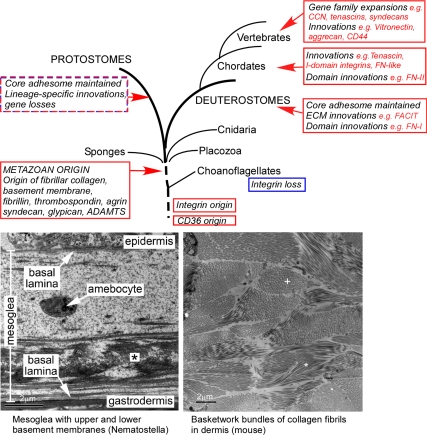
We present a perspective on the molecular evolution of the extracellular matrix (ECM) in metazoa that draws on research publications and data from sequenced genomes and expressed sequence tag libraries. ECM components do not function in isolation, and the biological ECM system or “adhesome” also depends on posttranslational processing enzymes, cell surface receptors, and extracellular proteases. We focus principally on the adhesome of internal tissues and discuss its origins at the dawn of the metazoa and the expansion of complexity that occurred in the chordate lineage. The analyses demonstrate very high conservation of a core adhesome that apparently evolved in a major wave of innovation in conjunction with the origin of metazoa. Integrin, CD36, and certain domains predate the metazoa, and some ECM-related proteins are identified in choanoflagellates as predicted sequences. Modern deuterostomes and vertebrates have many novelties and elaborations of ECM as a result of domain shuffling, domain innovations and gene family expansions. Knowledge of the evolution of metazoan ECM is important for understanding how it is built as a system, its roles in normal tissues and disease processes, and has relevance for tissue engineering, the development of artificial organs, and the goals of synthetic biology.
Overview
The claims and statistics of this paper haven’t been checked yet.
Free: it reads the open-access text and checks the first 5 claims that cite a source we can check. Create a free account to check every claim.
Integrity signals
Registry
Cites
Statistics
Figures
Verification
Claims the paper makes
The claims and statistics of this paper haven’t been checked yet.
Free: it reads the open-access text and checks the first 5 claims that cite a source we can check. Create a free account to check every claim.
Claims other papers make about this one
Each is checked against this paper’s own text: does it say what the citing paper says it does?
In the citing paper
“ESCs are surrounded and maintained by a microenvironment of various cell types and substances [85].”
From Ultraviolet Radiation‐Induced Skin Aging: The Role of DNA Damage and Oxidative Stress in Epidermal Stem Cell Damage Mediated Skin Aging (2016) · cites this paper as [85]
Self-check
Percentages, sums and reported differences re-computed from the paper’s own numbers.
The self-check needs the paper’s full text.
Citations
Cites
Collagen Structure and Stability
Shoulders, M. D., & Raines, R. T. (2009) · Annual Review of Biochemistry · doi:10.1146/annurev.biochem.77.032207.120833 · Cited by 3,923 · cited 1×
“For a GXY triple helix to be stable and assemble into higher order fibrils, additional protein domains and accessory proteins are needed (reviewed by Shoulders and Raines, 2009).”
The Extracellular Matrix: Not Just Pretty Fibrils
Hynes, R. O. (2009) · Science · doi:10.1126/science.1176009 · Cited by 3,527 · cited 2×
“…multi-cellularity is the extracellular matrix (ECM), a multicomponent , proteinaceous network that bridges between cells, contributes to their spatial arrangements by binding cell-surface adhesion receptors, and supports cell survival, differentiation, and tissue organization (Hynes, 2009).”
Two Rounds of Whole Genome Duplication in the Ancestral Vertebrate
Dehal, P., & Boore, J. L. (2005) · PLoS Biology · doi:10.1371/journal.pbio.0030314 · Cited by 1,526 · cited 2×
“Many adhesome components represented by single genes in invertebrate deuterostomes (sea urchin, acorn worm, or sea squirt) form a gene family in vertebrates, most likely due to the two rounds of genome-wide duplication that took place early in the vertebrate lineage (Dehal and Boore 2005; Huxley-Jones et al., 2007) (F…”
Defects in mesoderm, neural tube and vascular development in mouse embryos lacking fibronectin
George, E. L., Georges-Labouesse, E. N., Patel-King, R. S., Rayburn, H., & Hynes, R. O. (1993) · Development · doi:10.1242/dev.119.4.1079 · Cited by 1,305
CD36, a Scavenger Receptor Involved in Immunity, Metabolism, Angiogenesis, and Behavior
Silverstein, R. L., & Febbraio, M. (2009) · Science Signaling · doi:10.1126/scisignal.272re3 · Cited by 1,141
The genome of the choanoflagellate Monosiga brevicollis and the origin of metazoans
King, N., Westbrook, M. J., Young, S. L., Kuo, A., Abedin, M., Chapman, J., Fairclough, S., Hellsten, U., Isogai, Y., Letunic, I., et al. (2008) · Nature · doi:10.1038/nature06617 · Cited by 1,139
Iron-Clad Fibers: A Metal-Based Biological Strategy for Hard Flexible Coatings
Harrington, M. J., Masic, A., Holten-Andersen, N., Waite, J. H., & Fratzl, P. (2010) · Science · doi:10.1126/science.1181044 · Cited by 1,000 · cited 1×
“Such forms of ECM are of increasing interest to bioengineers (Harrington et al., 2010, Mü ller et al., 2009).”
From 2R to 3R: evidence for a fish-specific genome duplication (FSGD)
Meyer, A., & Van de Peer, Y. (2005) · BioEssays · doi:10.1002/bies.20293 · Cited by 945
The Trichoplax genome and the nature of placozoans
Srivastava, M., Begovic, E., Chapman, J., Putnam, N. H., Hellsten, U., Kawashima, T., Kuo, A., Mitros, T., Salamov, A., Carpenter, M. L., et al. (2008) · Nature · doi:10.1038/nature07191 · Cited by 889
Elastic proteins: biological roles and mechanical properties
Gosline, J., Lillie, M., Carrington, E., Guerette, P., Ortlepp, C., & Savage, K. (2002) · Philosophical Transactions of the Royal Society of London. Series B: Biological Sciences · doi:10.1098/rstb.2001.1022 · Cited by 838 · cited 1×
“Elastic proteins have evolved in multiple lineages as counterparts to the relatively inflexible collagen fibers (Gosline et al., 2002).”
Cited by
Items 101–200 of 343
Epithelial Ovarian Cancer: A Five Year Review
Arnaoutoglou, C., Dampala, K., Anthoulakis, C., Papanikolaou, E. G. E., Tentas, I., Dragoutsos, G., Machairiotis, N., Zarogoulidis, P., Ioannidis, A., Matthaios, D., et al. (2023) · Medicina · doi:10.3390/medicina59071183 · Cited by 49
“The extracellular matrix has a dynamic and complex molecular network with distinctive structural and biochemical characteristics [30].”
BackgroundTu, H., Huhtala, P., Lee, H., Adams, J. C., & Pihlajaniemi, T. A. (2015) · BMC Evolutionary Biology · doi:10.1186/s12862-015-0554-3 · Cited by 51
“The complete genome sequences of multiple metazoans and especially domain arrangement studies have revealed the conservation and diversity of ECM proteins in metazoans [1, 2].”
Self-citationXiao, M., Li, X., Song, Q., Zhang, Q., Lazzarino, M., Cheng, G., Severino, F. P. U., & Torre, V. (2018) · Advanced Materials · doi:10.1002/adma.201806132 · Cited by 48
Appunni, S., Anand, V., Khandelwal, M., Seth, A., Mathur, S. R., & Sharma, A. (2017) · Tumor Biology · doi:10.1177/1010428317699112 · Cited by 47
Lommel, M., Strompen, J., Hellewell, A. L., Balasubramanian, G. P., Christofidou, E. D., Thomson, A. R., Boyle, A. L., Woolfson, D. N., Puglisi, K., Hartl, M., et al. (2018) · Scientific Reports · doi:10.1038/s41598-018-30035-2 · Cited by 46
Self-citationThe Expression and Possible Functions of Tenascin-W During Development and Disease
Tucker, R. P., & Degen, M. (2019) · Frontiers in Cell and Developmental Biology · doi:10.3389/fcell.2019.00053 · Cited by 47
Self-citationAlbacete-Albacete, L., Sánchez‐Álvarez, M., & del Pozo, M. Á. (2021) · Frontiers in Immunology · doi:10.3389/fimmu.2021.671485 · Cited by 47
“A connective substance among tissues ensuring nurturing and functional coordination between cells evolved, giving rise to the extracellular matrix (ECM) (1, 2).”
BackgroundWang, X., Ansari, A., Pierre, V., Young, K., Kothapalli, C. R., von Recum, H. A., & Senyo, S. E. (2022) · Advanced Healthcare Materials · doi:10.1002/adhm.202102265 · Cited by 48
A Therapeutic Potential for Marine Skeletal Proteins in Bone Regeneration
Green, D. W., Padula, M. P., Santos, J., Chou, J., MILTHORPE, B. K., & Ben‐Nissan, B. (2013) · Marine Drugs · doi:10.3390/md11041203 · Cited by 45
“A significant number of marine invertebrates produce biochemicals within extracellular matrices and connective tissues, with like-for-like molecular structures, building block sequences and functions to human versions [18,19].”
BackgroundTargeting the lysyl oxidases in tumour desmoplasia
Chitty, J. L., Setargew, Y. F. I., & Cox, T. R. (2019) · Biochemical Society Transactions · doi:10.1042/bst20190098 · Cited by 42
Importance of the stem cell microenvironment for ophthalmological cell-based therapy
Wan, P., Wang, B.-W., & Wang, Z.-C. (2015) · World Journal of Stem Cells · doi:10.4252/wjsc.v7.i2.448 · Cited by 46
In-silico definition of the Drosophila melanogaster matrisome
Davis, M. N., Horne‐Badovinac, S., & Naba, A. (2019) · Matrix Biology Plus · doi:10.1016/j.mbplus.2019.100015 · Cited by 42
“The ECM organizes the tissues of all metazoans [3].”
BackgroundHe, Y., Wang, W., Lin, S., Yang, Y., Song, L., Jing, Y., Chen, L., He, Z., Li, W. S., Xiong, A., et al. (2021) · Bioactive Materials · doi:10.1016/j.bioactmat.2021.07.030 · Cited by 42
“Extracellular matrix (ECM) is a nature-designed biomaterial that underwent material optimization for over 600 million years [64].”
BackgroundJung, J. P., Sprangers, A. J., Byce, J. R., Su, J., Squirrell, J. M., Messersmith, P. B., Eliceiri, K. W., & Ogle, B. M. (2013) · Biomacromolecules · doi:10.1021/bm400728e · Cited by 42
Evolving strategies and application of proteins and peptide therapeutics in cancer treatment
Mukherjee, A. G., Wanjari, U. R., Gopalakrishnan, A. V., Bradu, P., Biswas, A., Ganesan, R., Renu, K., Dey, A., Vellingiri, B., Allali, A. E., et al. (2023) · Biomedicine & Pharmacotherapy · doi:10.1016/j.biopha.2023.114832 · Cited by 41
Role of lineage-specific matrix in stem cell chondrogenesis
Li, J., Narayanan, K., Zhang, Y., Hill, R. C., He, F., Hansen, K. C., & Pei, M. (2019) · Biomaterials · doi:10.1016/j.biomaterials.2019.119681 · Cited by 39
Evolution of the Perlecan/HSPG2 Gene and Its Activation in Regenerating Nematostella vectensis
Warren, C. R., Kassir, E., Spurlin, J. W., Martinez, J. R., Putnam, N. H., & Farach‐Carson, M. C. (2015) · PLoS ONE · doi:10.1371/journal.pone.0124578 · Cited by 37
“Although one study found [29] that a perlecan homologue is found in the publically accessible genome of the hemoscleromorph sponge Oscarella carmela, our search for this homologue found many laminin, LDL receptor, Titin, and hemicentin homologues, but only one curious transcript that encoded a protein identified by BL…”
BackgroundCell division and targeted cell cycle arrest opens and stabilizes basement membrane gaps
Matus, D. Q., Chang, E., Makohon‐Moore, S. C., Hagedorn, M. A., Chi, Q., & Sherwood, D. R. (2014) · Nature Communications · doi:10.1038/ncomms5184 · Cited by 37
Engineering a Cell Home for Stem Cell Homing and Accommodation
Wu, R., Yin, Y., He, X., Li, X., & Chen, F. (2017) · Advanced Biosystems · doi:10.1002/adbi.201700004 · Cited by 38
Biomolecular analysis of matrix proteoglycans as biomarkers in non small cell lung cancer
Rangel, M. P., de Sá, V. K., Prieto, T. G., Martins, J. R. M., Olivieri, E. R., Carraro, D. M., Takagaki, T. Y., & Capelozzi, V. L. (2018) · Glycoconjugate Journal · doi:10.1007/s10719-018-9815-x · Cited by 38
Trosko, J. E. (2013) · The Anatomical Record · doi:10.1002/ar.22793 · Cited by 36
“…“niche” in this simple multicellular organism, needed to sequester the unique specialized cells, the germinal and somatic stem cells (Nursall, 1959; Saul, 2008; Mohyeldin et al., 2010; Ozbek et al., 2010) were selected for to provide a microenvironment to help maintain the conditions of “stemness.””
BackgroundEpithelial-mesenchymal status influences how cells deposit fibrillin microfibrils
Baldwin, A. K., Cain, S. A., Lennon, R., Godwin, A. R. F., Merry, C. L. R., & Kielty, C. M. (2013) · Journal of Cell Science · doi:10.1242/jcs.134270 · Cited by 36
“8) that is compatible with pre-chordates, which lack FN (Esko and Lindahl, 2001; Hynes, 2012; Johnson et al., 2009; Ozbek et al., 2010; Tucker and Chiquet-Ehrismann, 2009).”
BackgroundInfluentialElectrochemiluminescence Imaging of Cellular Contact Guidance on Microfabricated Substrates
Ding, L., Zhou, P., Yan, Y., & Su, B. (2023) · Chemical & Biomedical Imaging · doi:10.1021/cbmi.3c00066 · Cited by 36
Adhesion Networks of Cnidarians
Tucker, R. P., & Adams, J. C. (2014) · International review of cytology · doi:10.1016/b978-0-12-800097-7.00008-7 · Cited by 38
Self-citationThe evolution of the dystroglycan complex, a major mediator of muscle integrity
Adams, J. C., & Brancaccio, A. (2015) · Biology Open · doi:10.1242/bio.012468 · Cited by 35
“adhaerens and cnidarians (Fig. 6B; Ozbek et al., 2010; Tucker and Adams, 2014).”
BackgroundSelf-citationProteoglycans in mechanobiology of tissues and organs: Normal functions and mechanopathology
Farach‐Carson, M. C., Wu, D., & França, C. M. (2024) · Proteoglycan Research · doi:10.1002/pgr2.21 · Cited by 37
Roles of Fibulin-2 in Carcinogenesis
Zhang, H., Hui, D., & Fu, X. (2020) · Medical Science Monitor · doi:10.12659/msm.918099 · Cited by 6
Revisiting the Tenascins: Exploitable as Cancer Targets?
Tucker, R. P., & Degen, M. (2022) · Frontiers in Oncology · doi:10.3389/fonc.2022.908247 · Cited by 37
Self-citationCromar, G. L., Wong, K., Loughran, N. B., On, T., Song, H., Xiong, X., Zhang, Z., & Parkinson, J. (2014) · Genome Biology and Evolution · doi:10.1093/gbe/evu228 · Cited by 33
“These include several members of the extracellular matrix (ECM), a fundamental metazoan innovation with central roles in a variety of diverse functions including: Respiration, feeding, reproduction, locomotion, osmoregulation, hemostasis, and cognition (Di Lullo et al. 2002; Ozbek et al. 2010; Hynes 2012).”
BackgroundMatricellular Proteins: Functional Insights From Non-mammalian Animal Models
Adams, J. C. (2018) · Current topics in developmental biology/Current Topics in Developmental Biology · doi:10.1016/bs.ctdb.2018.02.003 · Cited by 34
Self-citationCancer‐associated fibroblasts: Is it a key to an intricate lock of tumorigenesis?
Aden, D., Zaheer, S., Ahluwalia, H., & Ranga, S. (2023) · Cell Biology International · doi:10.1002/cbin.12004 · Cited by 33
“C (TNC) and fibronectin (Egeblad et al., 2010; Özbek et al., 2010).”
Intermolecular interactions of thrombospondins drive their accumulation in extracellular matrix
Kim, D. J., Christofidou, E. D., Keene, D. R., Milde, M. H., & Adams, J. C. (2015) · Molecular Biology of the Cell · doi:10.1091/mbc.e14-05-0996 · Cited by 33
“Thrombospondins (TSPs) are multidomain, extracellular, calciumbinding glycoproteins that are conserved from sponges to humans (Bentley and Adams, 2010; Ozbek et al., 2010).”
BackgroundSelf-citationThe other eukaryotes in light of evolutionary protistology
O’Malley, M. A., Simpson, A. G. B., & Roger, A. J. (2012) · Biology & Philosophy · doi:10.1007/s10539-012-9354-y · Cited by 35
“Questions about the direction and rate of evolutionary change can be asked on the basis of phylogeny-based comparison (Pagel 1997).”
BackgroundKellaway, S. C., Roberton, V. H., Jones, J. N., Loczenski, R., Phillips, J. B., & White, L. J. (2022) · Acta Biomaterialia · doi:10.1016/j.actbio.2022.12.003 · Cited by 32
Yam, G. H., Teo, E. P. W., Setiawan, M., Lovatt, M., Yusoff, N. Z. B. M., Fuest, M., Goh, B. T., & Mehta, J. S. (2018) · Journal of Cellular and Molecular Medicine · doi:10.1111/jcmm.13589 · Cited by 32
“glycoproteins, proteoglycans and polysaccharides with different physical and biochemical properties.(54) The dynamic and interactive cell-ECM biology contributes to cell survival, proliferation and differentiation.”
BackgroundInsider trading: Extracellular matrix proteins and their non‐canonical intracellular roles
Hellewell, A. L., & Adams, J. C. (2015) · BioEssays · doi:10.1002/bies.201500103 · Cited by 30
“The scope of the examples we will discuss excludes ‘matrisome affiliated’ proteins that only share limited architectural or biochemical similarities with core ECM proteins, and non-ECM ‘adhesome’ proteins (this term considers the complete biological system of the ECM, which depends on post-translational processing, ce…”
BackgroundInfluentialSelf-citationZhong, W., Pan, G., Wang, L., Li, S., Ou, J., Xu, M., Li, J., Zhu, B., Cao, X., Ma, H., et al. (2016) · Circulation Research · doi:10.1161/circresaha.116.309603 · Cited by 31
Bongolan, T., Whiteley, J., Castillo-Prado, J., Fantin, A., Larsen, B. G., Wong, C. J., Mazilescu, L., Kawamura, M., Urbanellis, P., Jonebring, A., et al. (2022) · Biomaterials Science · doi:10.1039/d1bm01017d · Cited by 29
Williams, F., Tew, H. A., Paul, C. E., & Adams, J. C. (2014) · Matrix Biology · doi:10.1016/j.matbio.2014.02.002 · Cited by 32
Self-citationDempsey, C. E., Bigotti, M. G., Adams, J. C., & Brancaccio, A. (2019) · Frontiers in Molecular Biosciences · doi:10.3389/fmolb.2019.00018 · Cited by 29
Self-citationMechanical and Morphological Analysis of Cancer Cells on Nanostructured Substrates
Ning, D., Duong, B., Thomas, G. M., Qiao, Y., Ma, L., Wen, Q., & Su, M. (2016) · Langmuir · doi:10.1021/acs.langmuir.5b04469 · Cited by 29
The evolution of the Glycomic Codes of extracellular matrices
Buckeridge, M. S. (2017) · Biosystems · doi:10.1016/j.biosystems.2017.10.003 · Cited by 30
Basement Membranes in the Worm
Clay, M. R., & Sherwood, D. R. (2015) · Current topics in membranes · doi:10.1016/bs.ctm.2015.08.001 · Cited by 35
Tursch, A., Mercadante, D., Tennigkeit, J., Gräter, F., & Özbek, S. (2016) · Scientific Reports · doi:10.1038/srep25709 · Cited by 27
Self-citationExtracellular matrix dynamics and functions in the social amoeba Dictyostelium: A critical review
Huber, R. J., & O’Day, D. H. (2016) · Biochimica et Biophysica Acta (BBA) - General Subjects · doi:10.1016/j.bbagen.2016.09.026 · Cited by 28
Zhang, W., Yang, J., Zhu, Y., Sun, X., Guo, W., Liu, X., Jing, X., Guo, G., Guo, Q., Peng, J., et al. (2019) · Cell and Tissue Banking · doi:10.1007/s10561-019-09774-7 · Cited by 26
Fibronectin contributes to notochord intercalation in the invertebrate chordate, Ciona intestinalis
Segade, F., Cota, C. D., Famiglietti, A. L., Cha, A., & Davidson, B. (2016) · EvoDevo · doi:10.1186/s13227-016-0056-4 · Cited by 27
“While FN type 3 domains are pervasive, occurring in a wide range of metazoan proteins, FN type 1 domains have only been detected in deuterostome proteins and FN type 2 domains are restricted to chordate proteins [53].”
BackgroundMorales, J. C. F., Xue, Q., & Roh‐Johnson, M. (2022) · Frontiers in Cell and Developmental Biology · doi:10.3389/fcell.2022.943606 · Cited by 26
“In Metazoans, Talin acts as the mechanosensitive hub of adhesions and serves as the initial physical linker between integrin molecules and the actin cytoskeleton (Klapholz and Brown, 2017; Goult et al., 2018).”
BackgroundInfluentialPeptide‐Functionalized Inorganic Oxide Nanomaterials for Solid Cancer Imaging and Therapy
Duan, X., Wang, P., He, L., He, Z., Wang, S., Yang, F., Gao, C., Ren, W., Lin, J., Chen, T., et al. (2024) · Advanced Materials · doi:10.1002/adma.202311548 · Cited by 30
Modelling the early evolution of extracellular matrix from modern Ctenophores and Sponges
Draper, G. W., Shoemark, D. K., & Adams, J. C. (2019) · Essays in Biochemistry · doi:10.1042/ebc20180048 · Cited by 27
Self-citationBarqué, A., Jan, K., Fuente, E. D. L., Nicholas, C. L., Hynes, R. O., & Naba, A. (2020) · Developmental Dynamics · doi:10.1002/dvdy.258 · Cited by 28
Vallet, S. D., Davis, M. N., Barqué, A., Thahab, A. H., Ricard‐Blum, S., & Naba, A. (2021) · Biochemical Journal · doi:10.1042/bcj20200675 · Cited by 27
The Function of Matricellular Proteins in the Lamina Cribrosa and Trabecular Meshwork in Glaucoma
Wallace, D., Pokrovskaya, O., & O'Brien, C. J. (2015) · Journal of Ocular Pharmacology and Therapeutics · doi:10.1089/jop.2014.0163 · Cited by 26
“45 Maintaining the integrity of the ECM is necessary for the normal structure and function of connective tissue.”
Bourrat, P., Takács, P., Doulcier, G., Nitschke, M. C., Black, A. J., Hammerschmidt, K., & Rainey, P. B. (2024) · Ecology and Evolution · doi:10.1002/ece3.70661 · Cited by 25
“Indeed, the production of an extracellular matrix has been essential for the transition from unicellularity to multicellularity (Özbek et al. 2010).”
Leibel, S. L., & Post, M. (2016) · Frontiers in Pediatrics · doi:10.3389/fped.2016.00036 · Cited by 26
“In lung development, the ECM serves as a scaffold that directs cell migration and differentiation, becoming more complex with development (11).”
BackgroundThe pharmaceutical multi-activity of metallofullerenol invigorates cancer therapy
Li, J., Chen, L., Su, H., Yan, L., Gu, Z., Chen, Z., Zhang, A., Zhao, F., & Zhao, Y. (2019) · Nanoscale · doi:10.1039/c9nr04129j · Cited by 26
Maali, Y., Journo, C., Mahieux, R., & Dutartre, H. (2020) · Frontiers in Microbiology · doi:10.3389/fmicb.2020.02041 · Cited by 25
“multicellular organisms, the ECM remains required for conserved functions, such as cell adhesion, intercellular communication, and differentiation (Ozbek et al., 2010; Limoli et al., 2015).”
BackgroundOrigin and Evolution of Epithelial Cell Types
Renard, E., Bivic, A. L., & Borchiellini, C. (2021) · CRC Press eBooks · doi:10.1201/b21831-5 · Cited by 23
Characterization of a fold in TANGO1 evolved from SH3 domains for the export of bulky cargos
Arnolds, O., & Stoll, R. (2023) · Nature Communications · doi:10.1038/s41467-023-37705-4 · Cited by 23
“The evolution of multicellular organisms (metazoa) brought forth the needtosecretebulkycargostosupplytheextracellularmatrixwiththe building blocks it requires 1 .”
Role of Microenvironment in Non-Hodgkin Lymphoma: Understanding the Composition and Biology
Khurana, A., & Ansell, S. M. (2020) · The Cancer Journal · doi:10.1097/ppo.0000000000000446 · Cited by 26
“Extracellular matrix plays a central role in the maintenance of structural integrity and regulation of cell behavior within organs.(123,124) Both the interstitial matrix and basement membrane are composed of proteins, glycoproteins, proteoglycans, and polysaccharides with their own unique biochemical and physical prop…”
BackgroundThe major evolutionary transitions and codes of life
Kun, Á. (2021) · Biosystems · doi:10.1016/j.biosystems.2021.104548 · Cited by 25
Song, N., Li, J., Li, B., Pan, E., & Ma, Y. (2022) · Scientific Reports · doi:10.1038/s41598-022-08610-5 · Cited by 25
Tucker, R. P., Hess, J. F., Gong, Q., Garvey, K., Shibata, B., & Adams, J. C. (2012) · Biology Open · doi:10.1242/bio.20123103 · Cited by 22
“Reverse transcriptase PCR showed that each of the N. vectensis thrombospondins (Nv85341, Nv22035, Nv168100 and Nv30790) is transcribed.”
BackgroundInfluentialSelf-citationProteases from the Regenerating Gut of the Holothurian Eupentacta fraudatrix
Lamash, N. E., & Dolmatov, I. Y. (2013) · PLoS ONE · doi:10.1371/journal.pone.0058433 · Cited by 22
“The extracellular matrix (ECM) plays an important role in the vitality of multicellular organisms [1].”
BackgroundTranscription Factors and the Origin of Animal Multicellularity
Sebé-Pedrós, A., & de Mendoza, A. (2015) · Advances in marine genomics · doi:10.1007/978-94-017-9642-2_18 · Cited by 22
Breaking down barriers: the evolution of cell invasion
Medwig, T. N., & Matus, D. Q. (2017) · Current Opinion in Genetics & Development · doi:10.1016/j.gde.2017.08.003 · Cited by 20
Role of extra cellular proteins in gastric cancer progression and metastasis: an update
Abbaszadegan, M. R., Mojarrad, M., & Moghbeli, M. (2020) · Genes and Environment · doi:10.1186/s41021-020-00157-z · Cited by 21
Cracking the code: Deciphering the role of the tumor microenvironment in osteosarcoma metastasis
Jin, J., Cong, J., Lei, S., Zhang, Q., Zhong, X., Su, Y., Lu, M., Ma, Y., Li, Z., Wang, L., et al. (2023) · International Immunopharmacology · doi:10.1016/j.intimp.2023.110422 · Cited by 22
Theory of the Origin, Evolution, and Nature of Life
Andrulis, E. D. (2011) · Life · doi:10.3390/life2010001 · Cited by 26
“Briefly, this thermodynamic shunt helps clarify not only the proteinaceous extracellular matrix that “links” cells together [727,728],”
BackgroundYong, U., Lee, S., Jung, S., & Jang, J. (2020) · Progress in Biomedical Engineering · doi:10.1088/2516-1091/abb211 · Cited by 21
Genome-wide computational analysis of the secretome of brown algae (Phaeophyceae)
Terauchi, M., Yamagishi, T., Hanyuda, T., & Kawai, H. (2017) · Marine Genomics · doi:10.1016/j.margen.2016.12.002 · Cited by 21
“In animals and land plants, the repertory of secretomes and their evolutional origins have been predicted from complete genome data (Agrawal et al., 2010; Lum and Min, 2011a; Özbek et al., 2010).”
BackgroundAbsence of feedback regulation in the synthesis of COL1A1
Dzobo, K., Leaner, V. D., & Parker, M. I. (2014) · Life Sciences · doi:10.1016/j.lfs.2014.03.006 · Cited by 21
Dominijanni, A. J., Mazzocchi, A. R., Shelkey, E., Forsythe, S. D., Devarasetty, M., & Söker, S. (2020) · Current Opinion in Biomedical Engineering · doi:10.1016/j.cobme.2020.03.005 · Cited by 20
“The ECM comprises of collagens, proteoglycans, laminins and fibronectin.[6] The ECM is crucial for both tissue function and maintenance.”
BackgroundLi, X., Liu, J., Sun, H., Zou, Y., Chen, J., Chen, Y., Chen, C., & Wu, X. (2020) · Acta Biochimica Polonica · doi:10.18388/abp.2020_5158 · Cited by 20
“These molecules are important for tissue and organ morphogenesis and for the maintenance of cell and tissue structure and function (Özbek et al., 2010; Rosso et al., 2004).”
BackgroundRomano, S., Fernàndez-Guerra, A., Reen, F. J., Glöckner, F. O., Crowley, S. P., O’Sullivan, Ó., Cotter, P. D., Adams, C., Dobson, A. D. W., & O’Gara, F. (2016) · Frontiers in Microbiology · doi:10.3389/fmicb.2016.00387 · Cited by 22
The 2016 John J. Abel Award Lecture: Targeting the Mechanical Microenvironment in Cancer
Majeski, H. E., & Yang, J. (2016) · Molecular Pharmacology · doi:10.1124/mol.116.106765 · Cited by 20
“The ECM is comprised of proteins, proteoglycans (PGs), and glycosaminoglycans (GAGs), including collagen (types I, III, and IV), fibronectin, elastin, laminin, hyaluronan (HA), and a variety of other, more tissue-specific, types of ECM molecules (Whittaker et al., 2006; Ozbek et al., 2010).”
BackgroundIntervertebral disc decellularisation: progress and challenges
R. Alfredo Allen 208, 4.-1. P., Fiordalisi, M. F., Silva, A., Barbosa, M. A., Gonçalves, R. M., & Caldeira, J. (2021) · European Cells and Materials · doi:10.22203/ecm.v042a15 · Cited by 19
“Given that ECM proteins are among the most conserved proteins in evolution, with high levels of sequence homology, decellularisation should be enough for explants to be well tolerated (Hutter et al., 2000; Moroni and Mirabella, 2014; Ozbek et al., 2010; van der Rest and Garrone, 1991).”
Background3D-bioprinted microenvironments for sweat gland regeneration
Song, W., Yao, B., Zhu, D., Zhang, Y., Li, Z., Huang, S., & Fu, X. (2022) · Burns & Trauma · doi:10.1093/burnst/tkab044 · Cited by 20
“The niche was mainly composed of neighbor cells, glycosaminoglycans, adhesion proteins, structural proteins and soluble factors [26].”
Murata, A., & Hayashi, S. (2016) · Biology · doi:10.3390/biology5010005 · Cited by 21
“Classical cadherins and metazoan-type ECMs such as fibrillar collagens appear to have a truly metazoan origin, and, thus, are regarded as strong candidates for contributing to the evolution of multicellularity [163–166]; however, it currently remains unknown whether they were present in Urmetazoa before the emergence…”
BackgroundThatikonda, N., Nilebäck, L., Lundin, A. K., Widhe, M., & Hedhammar, M. (2018) · ACS Biomaterials Science & Engineering · doi:10.1021/acsbiomaterials.8b00844 · Cited by 19
Emergence of a Thrombospondin Superfamily at the Origin of Metazoans
Shoemark, D. K., Ziegler, B., Watanabe, H., Strompen, J., Tucker, R. P., Özbek, S., & Adams, J. C. (2019) · Molecular Biology and Evolution · doi:10.1093/molbev/msz060 · Cited by 18
Self-citationJones, R. A., Trejo, B. M., Sil, P., Little, K. A., Pasolli, H. A., Joyce, B. W., Pósfai, E., & Devenport, D. (2023) · The Journal of Cell Biology · doi:10.1083/jcb.202309074 · Cited by 18
Blázquez-Carmona, P., Ruiz-Mateos, R., Fano, J. B., Shapeti, A., Martín‐Alfonso, J. E., Domínguez, J., Oosterwyck, H. V., Reina-Romo, E., & Sanz‐Herrera, J. A. (2024) · Acta Biomaterialia · doi:10.1016/j.actbio.2024.07.002 · Cited by 19
Wang, Y., Chen, R., Wang, Q., Yue, Y., Gao, Q., Wang, C., Zheng, H., & Peng, S. (2022) · Veterinary Sciences · doi:10.3390/vetsci9110632 · Cited by 19
“The ECM is a three-dimensional scaffold comprising collagen, fibronectin, and several other proteins [43,44] and plays an important role in regulating cellular proliferation, differentiation, adhesion, migration, apoptosis, body development, and the establishment and maintenance of homeostasis.”
BackgroundIhida‐Stansbury, K., Ames, J., Chokshi, M., Aiad, N. N., Sanyal, S., Kawabata, K. C., Levental, I., Sundararaghavan, H. G., Burdick, J. A., Janmey, P. A., et al. (2015) · Pulmonary Circulation · doi:10.1086/681272 · Cited by 18
“The ECM is composed of a large collection of biochemically distinct components with different physical and biochemical properties.(1)”
BackgroundVincent, T. L., Woolfson, D. N., & Adams, J. C. (2013) · The International Journal of Biochemistry & Cell Biology · doi:10.1016/j.biocel.2013.07.011 · Cited by 19
Self-citationModel of vascular desmoplastic multispecies tumor growth
Ng, C. F., & Frieboes, H. B. (2017) · Journal of Theoretical Biology · doi:10.1016/j.jtbi.2017.05.013 · Cited by 21
Zhu, D., Krause, M., Yawno, T., Kusuma, G. D., Schwab, R., Barabadi, M., Maleken, A. S., Chan, S. T., Hunt, R. W., Greening, D. W., et al. (2022) · Stem Cell Research & Therapy · doi:10.1186/s13287-022-02874-4 · Cited by 18
“The extracellular matrix (ECM) organization pathway is crucial to stem cell lineage specification, and cell migration and proliferation through its dynamic regulation of the microenvironment [60].”
BackgroundInfluentialThe Role of Stroma in Ovarian Cancer
Silva, A. C. D., Jammal, M. P., Crispim, P. C. A., Murta, E. F. C., & Nomelini, R. S. (2019) · Immunological Investigations · doi:10.1080/08820139.2019.1658770 · Cited by 17
“The ECM is composed of a large collection of biochemically distinct components, including proteins, glycoproteins, proteoglycans, and polysaccharides, each with different physical and biochemical properties (Ozbek et al. 2010).”
BackgroundMaharbiz, M. M. (2012) · Trends in Cell Biology · doi:10.1016/j.tcb.2012.09.002 · Cited by 23
Extracellular Matrix Evolution: An Overview
Adams, J. C. (2013) · Biology of Extracellular Matrix · doi:10.1007/978-3-642-36002-2_1 · Cited by 16
“…a dynamic, multi-protein system, these analyses also need to consider other elements that are essential for a functional ECM “adhesome”, for example, collagen-processing enzymes, extracellular proteases, cross-linking enzymes and ECM adhesion receptors (Ozbek et al. 2010; Hynes and Naba 2012).”
BackgroundSelf-citationShi, Z., Hu, C., Li, H., & Sun, C. (2025) · International Journal of Molecular Sciences · doi:10.3390/ijms26073234 · Cited by 16
“An important aspect of CAF biology that deserves further attention is its heterogeneity.”
Constriction Forces Imposed by Basement Membranes Regulate Developmental Cell Migration
López, E. M., Kabanova, A., Winkel, A. K., Franze, K., Palacios, I. M., & Martin-Bermudo, M. D. (2022) · PLoS Biology · doi:10.1371/journal.pbio.3002172 · Cited by 16
“The basement membrane (BM) is a dense, sheet-like form of an extracellular matrix (ECM) that underlies the basal side of epithelial and endothelial tissues and enwraps most developing organs [1,2].”
BackgroundWu, H. C., Yin, G., Pu, X., Wang, J., Liao, X., & Huang, Z. (2022) · ACS Applied Bio Materials · doi:10.1021/acsabm.2c00264 · Cited by 16
Domain shuffling and the increasing complexity of biological networks
SOUZA, S. J. D. (2012) · BioEssays · doi:10.1002/bies.201200006 · Cited by 18
Harris, G. M., Shazly, T. M., & Jabbarzadeh, E. (2013) · PLoS ONE · doi:10.1371/journal.pone.0081113 · Cited by 16
“composed of large amounts of biochemical components including proteins, glycoproteins, proteoglycans, and polysaccharides with vastly different physical and biochemical properties [23,24].”
Background2-Deoxy glucose regulate MMP-9 in a SIRT-1 dependent and NFkB independent mechanism
Edatt, L., Haritha, K., Sruthi, T. V., Poyyakkara, A., & Kumar, V. B. S. (2016) · Molecular and Cellular Biochemistry · doi:10.1007/s11010-016-2837-4 · Cited by 15
“Matrix remodeling is an important event during the process of tumor metastasis [18] and therefore, an important approach to control cancer metastasis could be inhibiting or suppressing matrix remodeling.”
BackgroundArslan, R., Hendek, M. K., Kısa, Ü., & Olgun, E. (2020) · Oral Diseases · doi:10.1111/odi.13664 · Cited by 15
Preliminary Study on the Antigen-Removal from Extracellular Matrix via Different Decellularization
Wu, H. C., Yin, G., Pu, X., Wang, J., Liao, X., & Huang, Z. (2022) · Tissue Engineering Part C Methods · doi:10.1089/ten.tec.2022.0025 · Cited by 15
Metadata
- Authors
- Özbek, S., Balasubramanian, P. G., Chiquet-Ehrismann, R., Tucker, R. P., & Adams, J. C.
- Affiliations
- Heidelberg University (DE)
- Friedrich Miescher Institute for Biomedical Research, Novartis Research Foundation, Basel, Switzerland;
- University of California, Davis (US)
- University of Bristol (GB)
- Corresponding author
- Adams, Josephine C.
- Venue
- Molecular Biology of the Cell
- Published
- 2010-12-15
- Volume
- 21
- Issue
- 24
- Pages
- 4300-4305
- ISSN
- 1059-1524 (ISSN-L)
- 1939-4586
- PMC
- PMC3002383
- OpenAlex
- W2098882954
- Cited by
- 347
- References
- 69
- Citations by year
- 2026: 8 · 2025: 13 · 2024: 19 · 2023: 27 · 2022: 22 · 2021: 20 · 2020: 25 · 2019: 26 · 2018: 32 · 2017: 24 · 2016: 33 · 2015: 29 · 2014: 19 · 2013: 28 · 2012: 15
- FWCI
- 11.40
- Type
- journal article
- Language
- en
- Open access
- green
- www.ncbi.nlm.nih.gov
- Licence
- cc-by-nc-sa
- Locations
- Molecular Biology of the Cell (publishedVersion)
- PubMed Central (publishedVersion, cc-by-nc-sa)
- PubMed (publishedVersion)
- Explore Bristol Research (submittedVersion)
- Bristol Research (University of Bristol) (submittedVersion)
- Topics
- Health Sciences › Medicine › Immunology and Allergy › Cell Adhesion Molecules Research
- Life Sciences › Biochemistry, Genetics and Molecular Biology › Molecular Biology › Developmental Biology and Gene Regulation
- Life Sciences › Agricultural and Biological Sciences › Animal Science and Zoology › Marine Invertebrate Physiology and Ecology
- Keywords
- adhesome, integrins, CD36, choanoflagellates, domain shuffling, gene family expansion, extracellular protease, cell surface receptors, deuterostomes, vertebrates, tissue engineering, synthetic biology
- MeSH terms
- Amino Acid Sequence, Animals, Base Sequence, Biological Evolution, Extracellular Matrix, Humans, Invertebrates, Molecular Sequence Data, Species Specificity, Extracellular Matrix Proteins, Conserved Sequence, Protein Structure, Tertiary, CD36 Antigens, Computational Biology, Chordata, Biodiversity
About these checks
Registry, retraction, Cites and statistics results are computed, not judged, with one exception: a printed reference that no index lists is read once by a model before it counts as a citation error. Claims are extracted by a model and kept only when their quote appears verbatim in the text; each cited source is then checked, with a model’s help, for whether it says what the claim relies on. Those verdicts can be wrong — read the claim’s quote and the cited source before relying on one.
Statistics and arithmetic are recomputed, not judged.
Confidence bands are shown only for fields calibrated on our annotated test set. None is calibrated yet, so no band is shown.
What counts as a claim ›How we measure confidence ›How we check this ›
Are you an author, or do you see a problem with this page? Request a review
Data sources
Bibliographic data: Semantic Scholar, OpenAlex, Crossref.
Contains information from the Semantic Scholar Academic Graph Datasets, made available under the ODC Attribution License (ODC-BY 1.0).
Semantic Scholar’s data is described in: Kinney, R., et al. (2023). The Semantic Scholar Open Data Platform. arXiv:2301.10140.
