

The energy balance model of obesity: beyond calories in, calories out
Open accessThe DOI matches its Crossref record; 152 of the 154 references it cites were found in a registry or an index.
Abstract
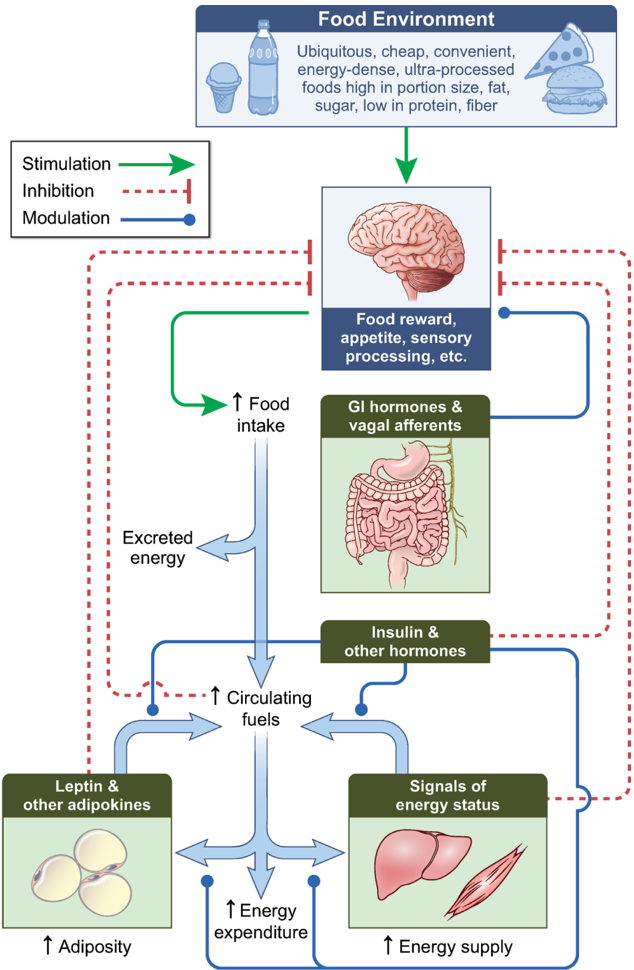
A recent Perspective article described the "carbohydrate-insulin model (CIM)" of obesity, asserting that it "better reflects knowledge on the biology of weight control" as compared with what was described as the "dominant energy balance model (EBM)," which fails to consider "biological mechanisms that promote weight gain." Unfortunately, the Perspective conflated and confused the principle of energy balance, a law of physics that is agnostic as to obesity mechanisms, with the EBM as a theoretical model of obesity that is firmly based on biology. In doing so, the authors presented a false choice between the CIM and a caricature of the EBM that does not reflect modern obesity science. Here, we present a more accurate description of the EBM where the brain is the primary organ responsible for body weight regulation operating mainly below our conscious awareness via complex endocrine, metabolic, and nervous system signals to control food intake in response to the body's dynamic energy needs as well as environmental influences. We also describe the recent history of the CIM and show how the latest "most comprehensive formulation" abandons a formerly central feature that required fat accumulation in adipose tissue to be the primary driver of positive energy balance. As such, the new CIM can be considered a special case of the more comprehensive EBM but with a narrower focus on diets high in glycemic load as the primary factor responsible for common obesity. We review data from a wi…
Overview
The claims and statistics of this paper haven’t been checked yet.
Free: it reads the open-access text and checks the first 5 claims that cite a source we can check. Create a free account to check every claim.
Integrity signals
Registry
Cites
Statistics
Figures
Verification
Claims the paper makes
The claims and statistics of this paper haven’t been checked yet.
Free: it reads the open-access text and checks the first 5 claims that cite a source we can check. Create a free account to check every claim.
Claims other papers make about this one
Each is checked against this paper’s own text: does it say what the citing paper says it does?
The cited source doesn’t support the claim as written.
In the citing paper
“Fat tissue reduction is only possible under negative energy balance, when the energy expended exceeds, the energy supplied from food.”
From Dietary and Behavioral Strategies for Weight Loss and Weight Loss Maintenance: A Narrative Review (2025) · cites this paper as [17]
Checked by a reasoning model — may be wrong.
Experimental — accuracy not yet measuredThe source backs part of the claim, not all of it — or backs it for a different population, condition or comparison.
In the citing paper
“Furthermore, variations in dietary macronutrient composition impact fat loss and individual responses to diet due to complex, multifaceted interactions between metabolism, energy partitioning, and genetic factors.”
From Beyond Calories: Individual Metabolic and Hormonal Adaptations Driving Variability in Weight Management—A State-of-the-Art Narrative Review (2024) · cites this paper as [80]
Experimental — accuracy not yet measuredThe source backs part of the claim, not all of it — or backs it for a different population, condition or comparison.
In the citing paper
“Furthermore, diets emphasizing whole grains, nuts, and vegetables—regardless of carbohydrate content—have shown associations with better weight maintenance compared to those high in refined sugars and saturated fats [80].”
From Beyond Calories: Individual Metabolic and Hormonal Adaptations Driving Variability in Weight Management—A State-of-the-Art Narrative Review (2024) · cites this paper as [80]
Experimental — accuracy not yet measuredThe cited source says what the claim attributes to it.
In the citing paper
“The key factor in successful weight loss is the introduction of a controlled calorie deficit, in line with the basic principles of thermodynamics.”
From Dietary and Behavioral Strategies for Weight Loss and Weight Loss Maintenance: A Narrative Review (2025) · cites this paper as [17]
The cited source says what the claim attributes to it.
In the citing paper
“While the carbohydrate–insulin model posits that high-carbohydrate diets drive insulin secretion, leading to fat storage and weight gain, studies have challenged this by showing that weight loss success depends on broader factors beyond just carbohydrate intake [80].”
From Beyond Calories: Individual Metabolic and Hormonal Adaptations Driving Variability in Weight Management—A State-of-the-Art Narrative Review (2024) · cites this paper as [80]
4 more claims about this paper
Create a free account to see every claim other papers make about this one.
Self-check
Percentages, sums and reported differences re-computed from the paper’s own numbers.
The self-check needs the paper’s full text.
Citations
Cites
Genetic studies of body mass index yield new insights for obesity biology
Study, T. L. C., Locke, A. E., The ADIPOGen Consortium, The AGEN-BMI Working Group, The CARDIOGRAMplusC4D Consortium, The CKDGen Consortium, The, G. L. G. C., The, I. C. B. P., The MAGIC Investigators, The MuTHER Consortium, et al. (2015) · Nature · doi:10.1038/nature14177 · Cited by 4,534
Global nutrition transition and the pandemic of obesity in developing countries
Popkin, B. M., Adair, L. S., & Ng, S. W. (2012) · Nutrition Reviews · doi:10.1111/j.1753-4887.2011.00456.x · Cited by 4,313
Finucane, M. M., Stevens, G. A., Cowan, M. J., Danaei, G., Lin, J. K., Paciorek, C. J., Singh, G. M., Gutierrez, H. R., Lu, Y., Bahalim, A. N., et al. (2011) · The Lancet · doi:10.1016/s0140-6736(10)62037-5 · Cited by 4,050
Changes in diet and lifestyle and long-term weight gain in women and men
Mozaffarian, D., Hao, T., Rimm, E. B., Willett, W. C., & Hu, F. B. (2011) · New England Journal of Medicine · doi:10.1056/nejmoa1014296 · Cited by 2,527
Dynamics of fat cell turnover in humans
Spalding, K. L., Arner, E., Westermark, P. O., Bernard, S., Buchholz, B. A., Bergmann, O., Blomqvist, L., Hoffstedt, J., Näslund, E., Britton, T., et al. (2008) · Nature · doi:10.1038/nature06902 · Cited by 2,357
Role of Brain Insulin Receptor in Control of Body Weight and Reproduction
Brüning, J. C., Gautam, D., Burks, D. J., Gillette, J., Schubert, M., Orban, P. C., Klein, R., Krone, W., Müller-Wieland, D., & Kahn, C. R. (2000) · Science · doi:10.1126/science.289.5487.2122 · Cited by 2,235
Hall, K. D., Ayuketah, A., Brychta, R., Cai, H., Cassimatis, T., Chen, K. Y., Chung, S. T., Costa, E., Courville, A., Darcey, V., et al. (2019) · Cell Metabolism · doi:10.1016/j.cmet.2019.05.008 · Cited by 1,971
Self-citationUltra‐processed products are becoming dominant in the global food system
Monteiro, C. A., Moubarac, J. ‐., Cannon, G., Ng, S. W., & Popkin, B. (2013) · Obesity Reviews · doi:10.1111/obr.12107 · Cited by 1,827
Ludwig (2002) · doi:10.1001/jama.287.18.2414 · Cited by 1,775
Angiogenesis and Inflammation in Peritoneal Dialysis: The Role of Adipocytes
Shi, J., Yu, M., & Sheng, M. (2017) · Kidney and Blood Pressure Research · doi:10.1159/000476017 · Cited by 1,403
Research works printed but not linked: 2
- 46. Hall KD. Predicted impact of adipose insulin resistance on long-term human body composition. Obesity 2006;14(S9):A212.
- 144. Pennington AW. Obesity. Med Times 1952;80(7):389-98.
Cited by
Items 101–200 of 395
Quan, Q., Kim, E. J., Kim, S., Kim, Y. K., Chung, M. H., Tian, Y.-D., Shin, C.-Y., Lee, D. H., & Chung, J. H. (2024) · Journal of Investigative Dermatology · doi:10.1016/j.jid.2024.03.012 · Cited by 13
Yan, J., Ren, C., Dong, Y., Wali, J. A., Song, H., Zhang, Y., Zhang, H., Kou, G., Raubenheimer, D., & Cui, Z. (2023) · Nutrients · doi:10.3390/nu15010251 · Cited by 13
“In general, obesity is caused by a long-term excess of energy intake relative to energy expenditure [5].”
BackgroundOu, Y., Chen, K., Guo, J. Q., Ye, C., Zhou, X., Chen, D., Bian-sheng, L., Liu, C., & Liu, J. (2025) · International Journal of Biological Macromolecules · doi:10.1016/j.ijbiomac.2025.145679 · Cited by 12
Ruocco, C., Ragni, M., Tedesco, L., Segala, A., Servili, M., Riccardi, G., Carruba, M. O., Valerio, A., Nisoli, E., & Visioli, F. (2022) · Nutrition Metabolism and Cardiovascular Diseases · doi:10.1016/j.numecd.2022.03.020 · Cited by 12
Jackson, M. I. (2022) · Metabolites · doi:10.3390/metabo12070591 · Cited by 12
Locasale, J. W., Goncalves, M. D., Tano, M. D., & Burgos-Barragan, G. (2024) · Cold Spring Harbor Perspectives in Medicine · doi:10.1101/cshperspect.a041549 · Cited by 12
Obesity as a disease: a pressing need for alignment
Grannell, A., & le Roux, C. W. (2024) · International Journal of Obesity · doi:10.1038/s41366-024-01582-8 · Cited by 12
“The generation of new hypotheses from the perspective of understanding obesity requires going beyond the traditional energy balance model [10].”
BackgroundMacronutrient interactions and models of obesity: Insights from nutritional geometry
Wali, J. A., Ni, D., Raubenheimer, D., & Simpson, S. J. (2024) · BioEssays · doi:10.1002/bies.202400071 · Cited by 12
“[1,4] Because of its higher caloric value per gram, fat is the most dominant nutrient in EBM that facilitates excess energy intake.”
InfluentialA Mechanistic Rationale for Incretin-Based Therapeutics in the Management of Obesity
Samms, R. J., & Kusminski, C. M. (2024) · Annual Review of Physiology · doi:10.1146/annurev-physiol-022724-105443 · Cited by 12
The energy balance theory is an inconsistent paradigm
Arencibia‐Albite, F. (2022) · Journal of Theoretical Biology · doi:10.1016/j.jtbi.2022.111240 · Cited by 11
Bariatric Surgeon Perspective on Revisional Bariatric Surgery (RBS) for Weight Recurrence
Giannopoulos, S., Kapsampelis, P., Pokala, B., Connors, J. D. N., Hilgendorf, W. A., Timsina, L., Clapp, B. L., Ghanem, O. M., Kindel, T. L., & Stefanidis, D. (2023) · Surgery for Obesity and Related Diseases · doi:10.1016/j.soard.2023.02.027 · Cited by 11
Harefa, K., Ritonga, A. H., Aritonang, B., Gurusinga, R., Wulan, S. H., & Irmayani, I. (2024) · Journal of Biomedicine and Translational Research · doi:10.14710/jbtr.v10i1.20281 · Cited by 11
Yoyo Dieting, Post-Obesity Weight Loss, and Their Relationship with Gut Health
Phuong-Nguyen, K., McGee, S. L., Aston‐Mourney, K., McNeill, B. A., Mahmood, M. Q., & Rivera, L. R. (2024) · Nutrients · doi:10.3390/nu16183170 · Cited by 11
“Energy balance is regulated not only by the central nervous system but is also strongly influenced by various peripheral signals arising from the gastrointestinal tract, pancreas, and adipose tissue, collectively acting to either stimulate or restrict energy intake [68,69].”
BackgroundBillingsley, H. (2023) · Diabetes/Metabolism Research and Reviews · doi:10.1002/dmrr.3633 · Cited by 12
“83 Though the nuances of this model go far beyond ‘calories in versus calories out,’ this concept illustrates why various intermittent fasting interventions result in weight loss.”
Is the energy balance explanation of the obesity epidemic wrong?
Stroebe, W. (2023) · Appetite · doi:10.1016/j.appet.2023.106614 · Cited by 12
“People with overweight or obesity consume more calories than their bodies need for physical exercise and to maintain bodily functions (Hall et al., 2022; Stroebe, 2023).”
InfluentialHoseini, R., Hoseini, Z., Pourahmadi, D., & Kamangar, A. (2025) · BMC Public Health · doi:10.1186/s12889-025-23083-7 · Cited by 10
“This relationship can be attributed to the energy expenditure associated with physical activity, which helps regulate caloric balance and prevent weight gain [31].”
Gonzalez, K. S., Manzano, A. M. S., Samaniego, M. V. P., Tamayo, V. P. S., & Caluña, E. R. M. (2025) · Frontiers in Public Health · doi:10.3389/fpubh.2025.1621661 · Cited by 10
Nagy, L., Rauch, B., Szerafin, T., Uray, K., Tóth, A., & Bai, P. (2022) · Frontiers in Cell and Developmental Biology · doi:10.3389/fcell.2022.979330 · Cited by 11
“Altered organismal energy homeostasis contributes to the induction of metabolic diseases, such as obesity (Hall et al., 2022).”
BackgroundTalay, L., Vickers, M., & Ruiz, L. (2024) · Obesities · doi:10.3390/obesities4030021 · Cited by 10
Intrahepatic triglyceride content: influence of metabolic and genetics drivers
Dearlove, D., & Hodson, L. (2022) · Current Opinion in Clinical Nutrition & Metabolic Care · doi:10.1097/mco.0000000000000838 · Cited by 10
“Chronic energy surplus leads to obesity [11], and obesity-associated dysfunction in adipose tissue may further increase substrate flux to the liver [12,13].”
BackgroundBreeze, P. R., Sworn, K., McGrane, E., Abraham, S., & Cantrell, A. J. (2024) · BMJ Nutrition Prevention & Health · doi:10.1136/bmjnph-2023-000666 · Cited by 9
“Given the importance of energy intake for weight gain 18 and complex system of factors influencing weight gain, 19 this was excluded as an outcome.”
Hyperinsulinaemia as a cause of obesity and cardiometabolic diseases
Guess, N. D., Johnson, J. D., Vaag, A. A., Tahrani, A. A., Corkey, B. E., Bruin, J. E., & Little, J. P. (2026) · Nature Reviews Endocrinology · doi:10.1038/s41574-026-01240-1 · Cited by 9
Nutritional Value Score Rates Foods Based on Nutrient Density and Noncommunicable Disease Prevention
Beal, T., & Ortenzi, F. (2026) · Journal of Nutrition · doi:10.1016/j.tjnut.2026.101443 · Cited by 9
Woo, S.-M., Nguyen, T. N. A., Seon, J.-E., Jang, J. H., Yee, S., Cao, N. T., Choi, H., Yun, C., & Kang, H. (2023) · Molecules · doi:10.3390/molecules28041851 · Cited by 9
“A typical cause of obesity is an imbalance in energy intake and consumption [1].”
Is There an Ideal Diet? Some Insights from the POUNDS Lost Study
Bray, G. A., Qi, L., & Sacks, F. M. (2024) · Nutrients · doi:10.3390/nu16142358 · Cited by 9
“Several low-calorie diets varying in macronutrients have captured a lot of public interest, including high-protein diets, low-carbohydrate diets and low-fat diets [2,3].”
BackgroundAYDOĞAN, K., Kostanoğlu, A., & Törpü, G. C. (2024) · Bezmialem Science · doi:10.14235/bas.galenos.2024.30633 · Cited by 9
The Rhesus Macaque as an Animal Model for Human Nutrition: An Ecological-Evolutionary Perspective
Cui, Z., Dong, Y., Sholl, J., Lu, J., & Raubenheimer, D. (2024) · Annual Review of Animal Biosciences · doi:10.1146/annurev-animal-111523-102354 · Cited by 9
May, W., Goedecke, J. H., & Conradie-Smit, M. (2025) · South African Medical Journal · doi:10.7196/samj.2025.v115i9b.3600 · Cited by 8
“In terms of dietary intake, three dominant theories – the energy balance model (EBM), [84-86] the carbohydrate-insulin model/fuel partitioning (CIM), [84-87] and the more recent OBS/REDOX model [88] − offer insights into how dietary intake has compromised the underlying systems that control weight.”
Uti, D. E., Omang, W. A., Alum, E. U., Ugwu, O. P.-C., Wokoma, M. A., Oplekwu, I. R., Atangwho, I. J., & Egbung, G. E. (2026) · Nutrition and Metabolic Insights · doi:10.1177/11786388251408961 · Cited by 8
“7,8 Body weight regulation happens through multiple central and peripheral systems which control hormonal signals together with neural pathways as well as inflammation.”
Zhan, H., Wang, W., Ge, Y., Liang, Y., Wang, J., Xu, Y., Wu, S., Peng, L., & He, Z. (2024) · Food & Function · doi:10.1039/d4fo00452c · Cited by 8
Pirola, L., Górecka, K. M., Leandro, C. G., & Balcerczyk, A. (2024) · Endocrines · doi:10.3390/endocrines5040042 · Cited by 8
Zhang, T., & Park, S. (2025) · Antioxidants · doi:10.3390/antiox14020170 · Cited by 8
“However, some individuals develop obesity even when their energy intake is lower than their estimated energy requirement (EER), while others can maintain a healthy weight despite consuming more calories than their EER, suggesting the role of genetic factors [2].”
Make America Healthy, Again? The Past, Present and Future of Dietary Guidelines
Klatt, K. C. (2025) · Annual Review of Nutrition · doi:10.1146/annurev-nutr-020725-113350 · Cited by 8
Hunger and satiety responses to diets enriched with cottonseed oil vs. olive oil
Prater, M. C., Scheurell, A. R., Paton, C. M., & Cooper, J. A. (2022) · Physiology & Behavior · doi:10.1016/j.physbeh.2022.114041 · Cited by 8
Müller, M. J., Braun, W., Enderle, J., & Bosy‐Westphal, A. (2022) · European Journal of Clinical Nutrition · doi:10.1038/s41430-022-01208-0 · Cited by 8
“DISCUSSION Since most of our present knowledge about the control of body weight and EB is based on data obtained in animal studies translational research is needed to document their extrapolability to humans [1].”
BackgroundPikó, P., Llanaj, E., Nagy, K., & Ádány, R. (2023) · International Journal of Molecular Sciences · doi:10.3390/ijms24065209 · Cited by 8
“This model places emphasis on the role of unconscious signaling by the endocrine, metabolic, and nervous systems that control food intake [59], while highlighting the contribution of inexpensive, convenient, high in fat and sugar, “ultra-processed” (go through multiple processes) foods to the development of obesity.”
BackgroundSharma, S., Gautam, P., Kumar, A., Joshi, H. C., Dobhal, A., Lohani, U. C., Ahmad, W., & Kumar, S. (2025) · Food and Humanity · doi:10.1016/j.foohum.2025.100718 · Cited by 7
Azmi, M. B., Sehgal, S. A., Asif, U., Musani, S., Abedin, M. F. E., Suri, A., Ahmed, S. D. H., & Qureshi, S. A. (2023) · Journal of Biomolecular Structure and Dynamics · doi:10.1080/07391102.2023.2274970 · Cited by 7
“Adipocytes, play a critical role in energy balance regulation by storing and releasing triglycerides in response to changes in energy status (Hall et al., 2022).”
Ernährung, Stoffwechsel, Gehirn und mentale Gesundheit
Linsmayer, D., Eckert, G. P., Reiff, J., & Braus, D. F. (2024) · Der Nervenarzt · doi:10.1007/s00115-024-01678-6 · Cited by 7
Phytoactives for Obesity Management: Integrating Nanomedicine for Its Effective Delivery
Mandal, A. K., Sahoo, A., Almalki, W. H., Almujri, S. S., Alhamyani, A., Aodah, A. H., Alruwaili, N. K., Kadir, S. Z. B. S. A., Mandal, R. K., Almalki, R. A., et al. (2024) · Nutrition Reviews · doi:10.1093/nutrit/nuae136 · Cited by 7
Storz, M. A., Stübing, F., & Huber, R. (2025) · Nutrition Journal · doi:10.1186/s12937-025-01088-7 · Cited by 7
“Unlike in previous investigations [25], we also considered individuals with an energy intake below 800 kcal/d or above 5000 kcal/d. Energy intake is of particular importance in obese individuals and was thus a main point of interest for this study [35].”
The PCOS puzzle: putting the pieces together for optimal care
Dar, M. A., Maqbool, M., & Ara, I. (2023) · International Journal of Adolescent Medicine and Health · doi:10.1515/ijamh-2023-0102 · Cited by 7
Implication of lipid turnover for the control of energy balance
Bernard, S., & Spalding, K. L. (2023) · Philosophical Transactions of the Royal Society B Biological Sciences · doi:10.1098/rstb.2022.0202 · Cited by 7
Rad, N. C., Karimi, E., Akharat, H. M., Oskoueian, E., & Zareian, M. (2023) · Journal of Functional Foods · doi:10.1016/j.jff.2023.105848 · Cited by 7
Overview of Pediatric Obesity as a Disease
Waldrop, S. W., Ibrahim, A. A., Maya, J., Monthe-Dreze, C., & Stanford, F. C. (2024) · Pediatric Clinics of North America · doi:10.1016/j.pcl.2024.06.003 · Cited by 6
Geary, N., Asarian, L., Graf, G., Gobbi, S., Tobler, P. N., Rehfeld, J. F., & Leeners, B. (2022) · Endocrinology · doi:10.1210/endocr/bqac192 · Cited by 6
Agbonifo, W. O., Chimezie, J., Awoleye, M. O., Francis, H. O., & Adedeji, T. G. (2025) · Clinical Nutrition Open Science · doi:10.1016/j.nutos.2025.01.012 · Cited by 6
Olvera-Mayorga, G., Ramírez‐Silva, C. I., Téllez‐Rojo, M. M., Valvi, D., Deierlein, A. L., Wright, R. O., Arsenault, J. E., Deitchler, M., Bromage, S., & Batis, C. (2025) · Nutrition Reviews · doi:10.1093/nutrit/nuaf035 · Cited by 6
Determinan Kejadian Obesitas Sentral pada Wanita Usia Subur (15-49) Tahun di Indonesia
Nanda, P. V., Fitri, A., Syukri, M., Ibnu, I. N., & Butar, M. B. (2025) · JURNAL RISET RUMPUN ILMU KESEHATAN · doi:10.55606/jurrikes.v4i2.5430 · Cited by 6
The vices and virtues of medical models of obesity
Sholl, J., & BLOCK, A. D. (2024) · Obesity Reviews · doi:10.1111/obr.13828 · Cited by 6
“…between increasing fat levels, alterations in some of the above brain regions, and hormones regulating intake and satiety (e.g., leptin, ghrelin, insulin), which form feedback loops maladaptively defending higher body weight “ set points, ” 41 – 43 (for variations on these models, see 44 ).”
Comprehensive Review of Climate Change Mitigation through Cutting-edge LNG Technologies
Independent Researcher, N., Owulade, O. A., Isi, L. R., Schlumberger Oilfield Services Lagos, N., Essien, N. A., Limited, T. E. E. N., Olugbemi, G. I. T., limited, C. N., Ogu, E., & Independent Researcher, N. (2025) · Engineering and Technology Journal · doi:10.47191/etj/v10i05.09 · Cited by 5
Diabetic Foot - Recent Advances
Raghav, A. (2022) · IntechOpen eBooks · doi:10.5772/intechopen.102211 · Cited by 5
Short-Term Effects of PJE Administration on Metabolic Parameters in Diet-Induced Obesity Mice
Choi, J., Kim, K., Park, S., Kim, M.-K., & Kim, S. (2023) · Foods · doi:10.3390/foods12081675 · Cited by 5
“There has been growing interest in the development of novel anti-obesity drugs that target specific pathways involved in energy balance regulation [41].”
BackgroundMinderis, P., Fokin, A., Povilonis, T., Kvedaras, M., & Ratkevičius, A. (2023) · Nutrients · doi:10.3390/nu15224836 · Cited by 5
“Excessive energy intake leading to energy imbalance is recognized as one of the major causes of obesity as shown in both human and animal studies [1,2].”
BackgroundDewi, S., Setyowati, S., Rachmawati, I. N., & Ayubi, D. (2024) · The Open Public Health Journal · doi:10.2174/0118749445300276240327053131 · Cited by 5
Talay, L., & Vickers, M. (2024) · Pharmacy · doi:10.3390/pharmacy12050135 · Cited by 5
“Consensus around obesity’s genetic component and the role of GLP-1 RAs in modifying neural pathways involved in appetite is relatively well established [15,16].”
The energy balance model compared with the carbohydrate-insulin model
Taubes, G. (2022) · American Journal of Clinical Nutrition · doi:10.1093/ajcn/nqac162 · Cited by 5
Causal models and causal modelling in obesity: foundations, methods and evidence
Zoh, R. S., Yu, X. D., Dawid, A. P., Smith, G. D., French, S., & Allison, D. B. (2023) · Philosophical Transactions of the Royal Society B Biological Sciences · doi:10.1098/rstb.2022.0227 · Cited by 5
“Readers interested in reading more about the carbohydrate–insulin model and the debate that it has generated in the field of obesity are directed to the following references [19,20].”
BackgroundIdentification of a thermogenic target in the dorsal raphe nucleus for weight management in mice
Moura‐Assis, A., Plucińska, K., Meseguer, D., Baleisyte, A., Chen, B., Pellegrino, K., Parolari, L., Shaked, J. T., Page, K. J., Barrows, D., et al. (2026) · Nature Communications · doi:10.1038/s41467-025-68056-x · Cited by 4
“Proper maintenance of energy balance depends on the brain ’ s ability to integrate circulating hormones and fuels into major neural networks that regulate feeding and thermogenesis 1,31 .”
Self-citationMicrobiota-derived metabolites as nutritional signals in insulin resistance and obesity
Gupta, R., Saini, P., Srivastava, V., Ittishree, Manikandan, P., Singh, R., & Zargar, A. A. (2026) · Clinical Nutrition ESPEN · doi:10.1016/j.clnesp.2026.103279 · Cited by 4
The Physiological Regulation of Body Fat Mass
Sumithran, P. (2023) · Gastroenterology Clinics of North America · doi:10.1016/j.gtc.2023.03.003 · Cited by 5
Manzano, A. M. S., Samaniego, M. V. P., Tamayo, V. P. S., Caluña, E. R. M., González, K., Carpio-Arias, T. V., & Padilla, P. D. R. (2025) · International Journal of Environmental Research and Public Health · doi:10.3390/ijerph22071140 · Cited by 4
“Body composition is the result of a complex network of factors, including purely biological ones such as various genetic mechanisms that cause imbalance [10] as well as modifiable factors like physical activity [11] and diet, encompassing meal timing and circadian rhythm disruptions [12].”
Ellison, K. M., Wyatt, H. R., Hill, J. O., & Sayer, R. D. (2024) · Obesity Reviews · doi:10.1111/obr.13706 · Cited by 4
Ijoma, A., Akanbi, S. A., Idemudia, E. A., Aderemi, L., Titus, V. O., Okoye, T. O., Adeyemo, D. A., O’dare, R. A., & Okobi, O. E. (2024) · Cureus · doi:10.7759/cureus.71550 · Cited by 4
Comparing Lifestyle Modifications and the Magnitude of Their Associated Benefit on Cancer Mortality
Dougherty, T. P., & Meyer, J. E. (2023) · Nutrients · doi:10.3390/nu15092038 · Cited by 5
Increased meso-striatal connectivity mediates trait impulsivity in FTO variant carriers
Thanarajah, S. E., Hanßen, R., Melzer, C., & Tittgemeyer, M. (2023) · Frontiers in Endocrinology · doi:10.3389/fendo.2023.1130203 · Cited by 4
Subramaniam, A., Park, B.-J., Raphael, D., Landstrom, M., & Hayes, K. C. (2022) · Nutrients · doi:10.3390/nu14153064 · Cited by 4
Zammit, V. A., & Park, S.-O. (2023) · International Journal of Molecular Sciences · doi:10.3390/ijms24021576 · Cited by 4
“Obesity occurs when triacylglycerol (TAG) is accumulated excessively in white adipose tissues due to excessive food intake and lack of exercise, with increased number and size of adipocyte cells [1,2].”
BackgroundRandomized Controlled Trial of Effects of Behavioral Weight Loss Treatment on Food Cue Reactivity
Chao, A. M., Wadden, T. A., Cao, W., Zhou, Y., Maldonado, D., Cardel, M. I., Foster, G. D., & Loughead, J. (2023) · Nursing Research · doi:10.1097/nnr.0000000000000702 · Cited by 4
Bray, G. A. (2023) · Obesity · doi:10.1002/oby.23921 · Cited by 4
“Johnson et al. [1] describe the energy balance model (championed by Hall and colleagues [3]), the carbohydrate-insulin model (championed by Ludwig and [4] and Taubes [ 5]), as well as the protein-leverage hypothesis, which argues that protein access is a key driver of food intake [6].”
BackgroundFlawed reanalysis fails to support the carbohydrate-insulin model of obesity
Sciarrillo, C. M., Guo, J., Hengist, A., Darcey, V. L., & Hall, K. D. (2024) · Journal of Nutrition · doi:10.1016/j.tjnut.2024.01.024 · Cited by 4
Self-citationUsing Metabolic Testing to Personalize Behavioral Obesity Treatment
Epstein, L. H., Apolzan, J. W., Moore, M., Neuwald, N. V., & Faith, M. S. (2025) · Obesity Science & Practice · doi:10.1002/osp4.70065 · Cited by 3
“Since weight loss and maintenance may be associated with differences in energy balance [114], as well as differences based on the composition of the diet [115], it may be particularly important to assess individual differences in a person's metabolic profile to adapt the diet to their unique needs.”
Istfan, N. W. (2025) · American Journal of Physiology-Endocrinology and Metabolism · doi:10.1152/ajpendo.00487.2024 · Cited by 4
A Hypothesis on the Historical Development of Obesity that is Not Only About Food
Magkos, F. (2025) · Current Obesity Reports · doi:10.1007/s13679-025-00650-y · Cited by 3
“Subsequently, the excess calories from this positive energy balance, no matter their macronutrient source, are stored as body fat causing expansion of adipose tissue (i.e., obesity) [4].”
Hou, J., Chen, P., Chen, F., Li, J., Deng, Z., & Luo, T. F. (2025) · Food Bioscience · doi:10.1016/j.fbio.2025.107272 · Cited by 3
Trends in Obesity Among Canadian Adults: A Population-Level Database Analysis
Mokwenye, V. C., Ochuba, J. N., Fasoro, O. S., Nwokolo, A. S., Osula, O., Sowunmi, M. O., Oramu, C. I., Youkhana, S., Oranu, K. P., Asomugha-Okwara, A., et al. (2025) · Cureus · doi:10.7759/cureus.90206 · Cited by 3
“However, its development and persistence involve more than just lifestyle choices [8].”
The effect of broadband internet on children's weight: Evidence from China
Cheng, W., & Xu, H. (2025) · China Economic Review · doi:10.1016/j.chieco.2025.102540 · Cited by 3
Zhou, J., Zhang, Y., Xuan, C., Yang, L., Kang, X., Li, J., Wang, L., Xiao, H., Zhang, Z., & Liu, D. (2025) · Journal of Agricultural and Food Chemistry · doi:10.1021/acs.jafc.5c06215 · Cited by 3
Udomwongyon, A., Yindee, B., Yathuam, C., Limpaninchart, C., Nakieam, J., Saikiseng, O., Phalaket, S., Pumlamjeak, T., Feldmann, J., Laitip, N., et al. (2025) · Current Research in Nutrition and Food Science Journal · doi:10.12944/crnfsj.13.3.33 · Cited by 3
Gao, L., Liu, Y., Yu, Y., Wu, Y., Zhang, H., Wang, C., Gao, X., Yang, C. X., Zhang, T., Huang, S., et al. (2026) · Cell Metabolism · doi:10.1016/j.cmet.2026.02.005 · Cited by 3
Self-citationProtein Decoys, Alcohol, and Energy Intake: Testing a Mechanistic‐Ecological Model
Grech, A. L., Simpson, S. J., & Raubenheimer, D. (2026) · Obesity Reviews · doi:10.1111/obr.70138 · Cited by 3
“An important priority for future research is to extend the model to include the link between energy intake, energy expenditure [86, 87], and macronutrient oxidation rates, which alcohol pro-foundly affects [88, 89].”
Talay, L., & Vickers, M. (2024) · Obesities · doi:10.3390/obesities4040032 · Cited by 3
Sukma, A. B. (2024) · Jurnal Kesehatan Tambusai · Cited by 3
Friedman, M. I. (2022) · American Journal of Clinical Nutrition · doi:10.1093/ajcn/nqac161 · Cited by 3
The importance of fat-free mass and constituent tissue-organs in the control of human appetite
Hopkins, M., & Blundell, J. E. (2023) · Current Opinion in Clinical Nutrition & Metabolic Care · doi:10.1097/mco.0000000000000965 · Cited by 3
Drynaria rhizome water extract alleviates high‑fat diet‑induced obesity in mice
Gil, T., Park, J., Park, Y., Kim, H.-J., Cominguez, D. C., & An, H. (2023) · Molecular Medicine Reports · doi:10.3892/mmr.2023.13153 · Cited by 3
“obesity is caused by an imbalance between energy intake and expenditure, resulting in the accumulation of excessive white adipose tissue (WaT) (1).”
Izzatunnisa, N., Hakim, F. A., Putra, W. M. I., Rejeki, P. S., Herawati, L., Novida, H., Halim, S., & Pranoto, A. (2024) · Retos · doi:10.47197/retos.v60.107772 · Cited by 3
“The body’s energy balance plays a fundamental role in weight regulation, where excess caloric intake, regardless of its source, is the primary driver of weight gain (Hall et al., 2022).”
Clarification on our critique of the energy balance hypothesis of obesity
Torres-Carot, V., Suárez-González, A., & Lobato-Foulques, C. (2022) · American Journal of Clinical Nutrition · doi:10.1093/ajcn/nqac160 · Cited by 3
Treatment for Childhood Obesity: Using a Biological Model to Inform Dietary Targets
Ebbeling, C. B., & Ludwig, D. S. (2022) · The Journal of Pediatrics · doi:10.1016/j.jpeds.2022.12.004 · Cited by 3
Anggraini, N. V., Ratnawati, D., Ritanti, R., & Widiyastuti, M. (2023) · International Journal of Public Health Science (IJPHS) · doi:10.11591/ijphs.v12i2.22370 · Cited by 3
Mari, L., D’Alleva, M., Graniero, F., Azzini, V., Fiori, F., Marinoni, M., Martino, M. D., Rejc, E., Zaccaron, S., Stafuzza, J., et al. (2025) · International Journal of Environmental Research and Public Health · doi:10.3390/ijerph22050665 · Cited by 2
“Thus, to avoid serious health consequences, people with obesity need to reduce or eliminate risk factors related to diet, sedentary habits, and physical activity levels [5].”
Enhancing Survival Following High-Risk Surgery by Modulating Actionable Items within the Pathobiome
Zaborina, O. Y., Zaborin, A., Keskey, R. C., & Alverdy, J. C. (2025) · IntechOpen eBooks · doi:10.5772/intechopen.1010335 · Cited by 2
Hao, T., Ding, Q., Ma, J., Ding, L., Gao, Y., Zhang, Y., Liang, Y., & Huang, Y. (2025) · Clinical Pediatrics · doi:10.1177/00099228251339210 · Cited by 2
“13 Studies in epidemiology suggest a correlation between exposure to fluoride and a rise in diabetes occurrences, and altered glucose homeostasis, which could be connected to weight gain caused by fluoride.”
Sosa, S., Severo, M., Silva, C. C., & Lopes, C. M. M. (2025) · European Journal of Nutrition · doi:10.1007/s00394-025-03688-9 · Cited by 2
“Also, research supports the positive association of added sugar (AS) with weight gain [22, 23].”
Perna, S., Mazzola, G., Seniga, M., Barrile, G. C., Torello, I., Moroni, A., Mansueto, F., Lazzarotti, A., Veronica, V., Gasparri, C., et al. (2025) · Nutrients · doi:10.3390/nu17132108 · Cited by 2
“…controlled ambient conditions (temperature 22–24 ◦ C, dim light, and quiet environment), by a physical activity level (PAL) estimated according to standardized procedures for energy requirement assessment, as recommended by international guidelines [13] and recent reviews on energy balance [14].”
Liu, P. F., Zhang, M., Li, A., Lv, T., Lu, J., Chen, W., Yin, K., & Zhang, G. (2025) · Obesity Reviews · doi:10.1111/obr.70024 · Cited by 2
Devereaux, A. N. (2025) · Mind & Society · doi:10.1007/s11299-025-00358-5 · Cited by 2
“…commonly believed, with two major camps in medical research being those who believe obesity is primar - ily a result of excessive energy intake (Hall et al 2022) and those who believe it is primarily caused by “fuel partitioning” that is “trapping” fat into storage rather than deploying it for…”
Food Detection to Estimate Calories Using Detection Transformer
Kristanto, J. P. F., Prabowo, D. A., & Nur, Y. S. R. (2026) · Jurnal Teknokes · doi:10.35882/jteknokes.v18i4.132 · Cited by 2
“Excessive caloric intake increases the risk of metabolic and various cardiovascular diseases [1], [2], [3], [4], while insufficient intake may lead to fatigue and impaired concentration [5], [6].”
Wójcik, S., Tomaszewska, M., & Rulkiewicz, A. (2026) · Diagnostics · doi:10.3390/diagnostics16101461 · Cited by 2
“One advantage of predictive models is their ability to capture nonlinear interactions that may be overlooked in standard BMI-based assessments—an important consideration given that obesity pathophysiology extends well beyond simple energy balance [24].”
Corsetti, G., & Pasini, E. (2026) · Nutrients · doi:10.3390/nu18111703 · Cited by 2
Metadata
- Authors
- Hall, K. D., Farooqi, I. S., Friedman, J. M., Klein, S., Loos, R. J., Mangelsdorf, D. J., O’Rahilly, S., Ravussin, E., Redman, L. M., Ryan, D. H., Speakman, J. R., & Tobias, D. K.
- Affiliations
- National Institutes of Health (US)
- University of Cambridge (GB)
- Rockefeller University (US)
- Washington University in St. Louis (US)
- University of Copenhagen (DK)
- The University of Texas Southwestern Medical Center (US)
- Pennington Biomedical Research Center (US)
- University of Aberdeen (GB)
- Brigham and Women's Hospital (US)
- Corresponding author
- Hall, Kevin D
- ORCID
- Venue
- The American Journal of Clinical Nutrition
- Publisher
- Elsevier BV
- Published
- 2022-05
- Volume
- 115
- Issue
- 5
- Pages
- 1243-1254
- ISSN
- 0002-9165 (ISSN-L)
- PMC
- PMC9071483
- OpenAlex
- W4210770895
- Cited by
- 315
- References
- 154
- Citations by year
- 2026: 56 · 2025: 71 · 2024: 66 · 2023: 75 · 2022: 46
- FWCI
- 34.03
- Type
- journal article
- Language
- en
- Open access
- bronze
- doi.org
- Licence
- www.elsevier.com/tdm/userlicense/1.0/ (tdm)
- www.elsevier.com/open-access/userlicense/1.0/ (vor, 365 d)
- Locations
- American Journal of Clinical Nutrition (publishedVersion)
- PubMed Central (publishedVersion)
- Research at the University of Copenhagen (University of Copenhagen) (publishedVersion, other-oa)
- PubMed (publishedVersion)
- Civil War Book Review (submittedVersion)
- Funders
- National Institutes of Health
- National Institute of Diabetes and Digestive and Kidney Diseases
- Topics
- Life Sciences › Neuroscience › Endocrine and Autonomic Systems › Regulation of Appetite and Obesity
- Health Sciences › Medicine › Public Health, Environmental and Occupational Health › Obesity, Physical Activity, Diet
- Health Sciences › Medicine › Endocrinology, Diabetes and Metabolism › Adipokines, Inflammation, and Metabolic Diseases
- Keywords
- obesity, energy balance model, body weight regulation, glycemic load, energy balance, obesity mechanisms
- MeSH terms
- Body Weight, Energy Intake, Energy Metabolism, Humans, Insulin, Obesity
About these checks
Registry, retraction, Cites and statistics results are computed, not judged, with one exception: a printed reference that no index lists is read once by a model before it counts as a citation error. Claims are extracted by a model and kept only when their quote appears verbatim in the text; each cited source is then checked, with a model’s help, for whether it says what the claim relies on. Those verdicts can be wrong — read the claim’s quote and the cited source before relying on one.
Statistics and arithmetic are recomputed, not judged.
Confidence bands are shown only for fields calibrated on our annotated test set. None is calibrated yet, so no band is shown.
What counts as a claim ›How we measure confidence ›How we check this ›
Are you an author, or do you see a problem with this page? Request a review
Data sources
Bibliographic data: Semantic Scholar, OpenAlex, Crossref.
Contains information from the Semantic Scholar Academic Graph Datasets, made available under the ODC Attribution License (ODC-BY 1.0).
Semantic Scholar’s data is described in: Kinney, R., et al. (2023). The Semantic Scholar Open Data Platform. arXiv:2301.10140.
