

The energy balance model of obesity: beyond calories in, calories out
Open accessThe DOI matches its Crossref record; 152 of the 154 references it cites were found in a registry or an index.
Abstract
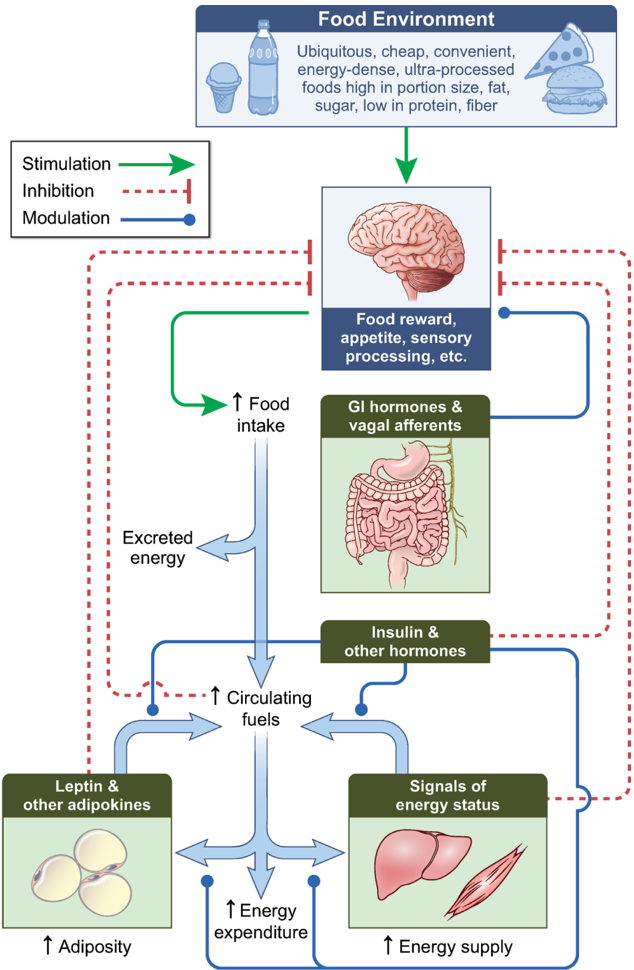
A recent Perspective article described the "carbohydrate-insulin model (CIM)" of obesity, asserting that it "better reflects knowledge on the biology of weight control" as compared with what was described as the "dominant energy balance model (EBM)," which fails to consider "biological mechanisms that promote weight gain." Unfortunately, the Perspective conflated and confused the principle of energy balance, a law of physics that is agnostic as to obesity mechanisms, with the EBM as a theoretical model of obesity that is firmly based on biology. In doing so, the authors presented a false choice between the CIM and a caricature of the EBM that does not reflect modern obesity science. Here, we present a more accurate description of the EBM where the brain is the primary organ responsible for body weight regulation operating mainly below our conscious awareness via complex endocrine, metabolic, and nervous system signals to control food intake in response to the body's dynamic energy needs as well as environmental influences. We also describe the recent history of the CIM and show how the latest "most comprehensive formulation" abandons a formerly central feature that required fat accumulation in adipose tissue to be the primary driver of positive energy balance. As such, the new CIM can be considered a special case of the more comprehensive EBM but with a narrower focus on diets high in glycemic load as the primary factor responsible for common obesity. We review data from a wi…
Overview
The claims and statistics of this paper haven’t been checked yet.
Free: it reads the open-access text and checks the first 5 claims that cite a source we can check. Create a free account to check every claim.
Integrity signals
Registry
Cites
Statistics
Figures
Verification
Claims the paper makes
The claims and statistics of this paper haven’t been checked yet.
Free: it reads the open-access text and checks the first 5 claims that cite a source we can check. Create a free account to check every claim.
Claims other papers make about this one
Each is checked against this paper’s own text: does it say what the citing paper says it does?
The cited source doesn’t support the claim as written.
In the citing paper
“Fat tissue reduction is only possible under negative energy balance, when the energy expended exceeds, the energy supplied from food.”
From Dietary and Behavioral Strategies for Weight Loss and Weight Loss Maintenance: A Narrative Review (2025) · cites this paper as [17]
Checked by a reasoning model — may be wrong.
Experimental — accuracy not yet measuredThe source backs part of the claim, not all of it — or backs it for a different population, condition or comparison.
In the citing paper
“Furthermore, variations in dietary macronutrient composition impact fat loss and individual responses to diet due to complex, multifaceted interactions between metabolism, energy partitioning, and genetic factors.”
From Beyond Calories: Individual Metabolic and Hormonal Adaptations Driving Variability in Weight Management—A State-of-the-Art Narrative Review (2024) · cites this paper as [80]
Experimental — accuracy not yet measuredThe source backs part of the claim, not all of it — or backs it for a different population, condition or comparison.
In the citing paper
“Furthermore, diets emphasizing whole grains, nuts, and vegetables—regardless of carbohydrate content—have shown associations with better weight maintenance compared to those high in refined sugars and saturated fats [80].”
From Beyond Calories: Individual Metabolic and Hormonal Adaptations Driving Variability in Weight Management—A State-of-the-Art Narrative Review (2024) · cites this paper as [80]
Experimental — accuracy not yet measuredThe cited source says what the claim attributes to it.
In the citing paper
“The key factor in successful weight loss is the introduction of a controlled calorie deficit, in line with the basic principles of thermodynamics.”
From Dietary and Behavioral Strategies for Weight Loss and Weight Loss Maintenance: A Narrative Review (2025) · cites this paper as [17]
The cited source says what the claim attributes to it.
In the citing paper
“While the carbohydrate–insulin model posits that high-carbohydrate diets drive insulin secretion, leading to fat storage and weight gain, studies have challenged this by showing that weight loss success depends on broader factors beyond just carbohydrate intake [80].”
From Beyond Calories: Individual Metabolic and Hormonal Adaptations Driving Variability in Weight Management—A State-of-the-Art Narrative Review (2024) · cites this paper as [80]
4 more claims about this paper
Create a free account to see every claim other papers make about this one.
Self-check
Percentages, sums and reported differences re-computed from the paper’s own numbers.
The self-check needs the paper’s full text.
Citations
Cites
Genetic studies of body mass index yield new insights for obesity biology
Study, T. L. C., Locke, A. E., The ADIPOGen Consortium, The AGEN-BMI Working Group, The CARDIOGRAMplusC4D Consortium, The CKDGen Consortium, The, G. L. G. C., The, I. C. B. P., The MAGIC Investigators, The MuTHER Consortium, et al. (2015) · Nature · doi:10.1038/nature14177 · Cited by 4,534
Global nutrition transition and the pandemic of obesity in developing countries
Popkin, B. M., Adair, L. S., & Ng, S. W. (2012) · Nutrition Reviews · doi:10.1111/j.1753-4887.2011.00456.x · Cited by 4,313
Finucane, M. M., Stevens, G. A., Cowan, M. J., Danaei, G., Lin, J. K., Paciorek, C. J., Singh, G. M., Gutierrez, H. R., Lu, Y., Bahalim, A. N., et al. (2011) · The Lancet · doi:10.1016/s0140-6736(10)62037-5 · Cited by 4,050
Changes in diet and lifestyle and long-term weight gain in women and men
Mozaffarian, D., Hao, T., Rimm, E. B., Willett, W. C., & Hu, F. B. (2011) · New England Journal of Medicine · doi:10.1056/nejmoa1014296 · Cited by 2,527
Dynamics of fat cell turnover in humans
Spalding, K. L., Arner, E., Westermark, P. O., Bernard, S., Buchholz, B. A., Bergmann, O., Blomqvist, L., Hoffstedt, J., Näslund, E., Britton, T., et al. (2008) · Nature · doi:10.1038/nature06902 · Cited by 2,357
Role of Brain Insulin Receptor in Control of Body Weight and Reproduction
Brüning, J. C., Gautam, D., Burks, D. J., Gillette, J., Schubert, M., Orban, P. C., Klein, R., Krone, W., Müller-Wieland, D., & Kahn, C. R. (2000) · Science · doi:10.1126/science.289.5487.2122 · Cited by 2,235
Hall, K. D., Ayuketah, A., Brychta, R., Cai, H., Cassimatis, T., Chen, K. Y., Chung, S. T., Costa, E., Courville, A., Darcey, V., et al. (2019) · Cell Metabolism · doi:10.1016/j.cmet.2019.05.008 · Cited by 1,971
Self-citationUltra‐processed products are becoming dominant in the global food system
Monteiro, C. A., Moubarac, J. ‐., Cannon, G., Ng, S. W., & Popkin, B. (2013) · Obesity Reviews · doi:10.1111/obr.12107 · Cited by 1,827
Ludwig (2002) · doi:10.1001/jama.287.18.2414 · Cited by 1,775
Angiogenesis and Inflammation in Peritoneal Dialysis: The Role of Adipocytes
Shi, J., Yu, M., & Sheng, M. (2017) · Kidney and Blood Pressure Research · doi:10.1159/000476017 · Cited by 1,403
Research works printed but not linked: 2
- 46. Hall KD. Predicted impact of adipose insulin resistance on long-term human body composition. Obesity 2006;14(S9):A212.
- 144. Pennington AW. Obesity. Med Times 1952;80(7):389-98.
Cited by
Items 201–300 of 395
Hernández, P., Herrera‐Cuenca, M., Ferrari, G., Almeida, R. Y., García, M. C. Y., Cáceres, M. V., Cortés, L. Y., Sifontes, Y., Landaeta‐Jiménez, M., Gómez, G., et al. (2024) · Frontiers in Nutrition · doi:10.3389/fnut.2024.1380315 · Cited by 2
“Nevertheless, at the individual level, the energy balance model states that the brain serves as the primary organ responsible for regulating body weight through the integration of neuroendocrine-gastrointestinal signaling pathways that either increase or decrease overall EI (10).”
BackgroundInfluentialPeinado, P. J. B., & Sotillo, A. A. (2024) · IntechOpen eBooks · doi:10.5772/intechopen.1007051 · Cited by 2
Hariyanto, A., Mautang, T. W. E., Usman, A., Akhmad, I., Hartati, H., Nasuka, N., & Sholikhah, A. M. (2025) · O Mundo da Saúde · doi:10.15343/0104-7809.202549e16852024i · Cited by 2
Sholl, J. (2022) · Biology & Philosophy · doi:10.1007/s10539-022-09845-2 · Cited by 2
“Overall, however, obesity reflects organism-environment dynamics that, whatever the cause, lead organisms to ingest more than they expend (Hall et al. 2022).”
Halloun, R., Galderisi, A., Caprio, S., & Weiss, R. (2022) · The Journal of Clinical Endocrinology & Metabolism · doi:10.1210/clinem/dgac700 · Cited by 2
Trends in adults’ energy imbalance gaps over two decades in Belgium using system dynamics modelling
Fallah‐Fini, S., Rezaei, T., Ridder, K. D., & Vandevijvere, S. (2023) · BMC Nutrition · doi:10.1186/s40795-023-00721-0 · Cited by 2
“One causal pathway which also was used in this paper is based on the first law of thermodynamics and states that for adipose tissue fat storage to increase, there should be a positive energy imbalance gap [11, 19].”
MethodOrgan cross-talk and the aetiology of obesity – an impasse
Speakman, J. R. (2022) · Journal of Holistic Integrative Pharmacy · doi:10.1016/s2707-3688(23)00060-2 · Cited by 2
Self-citationFox, K., Herrera, Y. M., Abreu, A. M., & Vadiveloo, M. K. (2023) · Journal of Nutrition · doi:10.1016/j.tjnut.2023.12.028 · Cited by 2
Woodie, L. N., Melink, L. C., Alberto, A. J., Burrows, M., Fortin, S. M., Chan, C. C., Hayes, M. R., & Lazar, M. A. (2023) · Molecular Metabolism · doi:10.1016/j.molmet.2023.101861 · Cited by 2
“Although development of obesity is complex and multifactorial, obesity is a disease of energy balance dysregulation in the brain [3,4].”
Irawan, M. A., Tarigan, A. I., & Dalimunthe, S. A. (2024) · International Journal of Public Health Excellence (IJPHE) · doi:10.55299/ijphe.v3i2.756 · Cited by 2
“Obesity occurs when caloric intake exceeds energy expenditure [1].”
Association between Dietary Practices and Growth Trajectories in Preschool Children
Jones, R., Narayan, K. M. V., & Cunningham, S. A. (2024) · American Journal of Epidemiology · doi:10.1093/aje/kwae238 · Cited by 2
Intermittent fasting-induced improving insulin resistance in healthy obese adults: A scoping review
Prabowo, N. D. (2024) · World Nutrition Journal · doi:10.25220/wnj.v08.i1.0005 · Cited by 2
Jalilpiran, Y., Azizi, N., Alipoor, K., Mehranfar, S., Ebaditabar, M., Shab‐Bidar, S., Ostadrahimi, A., & Djafarian, K. (2024) · Health Promotion Perspectives · doi:10.34172/hpp.42570 · Cited by 2
Ahmed, S., Nishigaki, Y., Ali, M. S., Matsui‐Yuasa, I., & Kojima‐Yuasa, A. (2025) · Pharmacological Research - Natural Products · doi:10.1016/j.prenap.2025.100149 · Cited by 2
Linoleic acid metabolism is implicated in the anti-obesity effects of actein in C57BL/6 mice
Chen, J., Yuan, J.-J., Huang, L., Shi, Q., Zhang, X., Qiu, M., & Liu, J. (2025) · Biochemical Pharmacology · doi:10.1016/j.bcp.2025.116793 · Cited by 2
Comparing Gradient Boosting and Linear Models for Calorie Prediction
Prasad, A., Asha, V., Vasumathi, M. T., Gupta, A. K., Nath, A. K., & Gehlot, A. (2025) · International Conference on Disruptive Technologies (ICDT) · doi:10.1109/icdt63985.2025.10986394 · Cited by 2
“However, it may not accurately capture the complexity of the relationship between exercise and calorie burn [1].”
Mitigating Diabetic Foot Ulcers: The Effect of Diet and Microbiome
Coon, S. D. (2023) · IntechOpen eBooks · doi:10.5772/intechopen.106629 · Cited by 2
Macronutrient intake: Hormonal controls, pathological states, and methodological considerations
Przybysz, J. T., DiBrog, A. M., Kern, K. A., Mukherjee, A., Japa, J. E., Waite, M. H., & Mietlicki‐Baase, E. G. (2022) · Appetite · doi:10.1016/j.appet.2022.106365 · Cited by 2
Energy-balance and carbohydrate-insulin models of obesity are not competing propositions
Prakash, S. S. (2022) · International Journal of Obesity · doi:10.1038/s41366-022-01249-2 · Cited by 2
“The proponents of both models have improved upon their previous versions by incorporating the role of brain as the main organ responding to and controlling food intake [3, 4].”
BackgroundReply to G Taubes, MI Friedman, and V Torres-Carot et al
Hall, K. D., Farooqi, I. S., Friedman, J. M., Klein, S., Loos, R. J. F., Mangelsdorf, D. J., O’Rahilly, S., Ravussin, É., Redman, L. M., Ryan, D. H., et al. (2022) · American Journal of Clinical Nutrition · doi:10.1093/ajcn/nqac163 · Cited by 2
Self-citationSilva, C. M., & Filho, I. J. Z. (2023) · International Journal of Nutrology · doi:10.54448/ijn23305 · Cited by 1
“Energy balance is regulated by a complex interplay of endocrine, metabolic, and nervous system signals to control food intake in response to the body's dynamic energy needs and environmental influences [21].”
Steroids and cardiovascular and metabolic disorders
Kumar, R., & McEwan, I. J. (2024) · Elsevier eBooks · doi:10.1016/b978-0-323-91141-2.00003-9 · Cited by 2
Valencia, J. G., Castillo-Paredes, A., Morán-Quiñones, E., & Quiroz, K. (2024) · Nutrición clínica y dietética hospitalaria/Nutrición clínica, dietética hospitalaria · doi:10.12873/442guerra · Cited by 1
Ginting, J. B., & Suci, T. (2025) · Healthy Tadulako Journal (Jurnal Kesehatan Tadulako) · doi:10.22487/htj.v11i1.1481 · Cited by 1
Pantothenic acid plays an important role in reducing body weight
Wang, L., Niu, H., Yu, R., Qi, Q., Li, X., Zhao, F., Li, L., & Shen, D. (2025) · Human Nutrition & Metabolism · doi:10.1016/j.hnm.2025.200336 · Cited by 1
Wang, Y., Shao, H., Lyu, C., Park, K. H., Tran, K. N., Yang, I., Jung, H. W., & Park, Y.-K. (2025) · Nutrients · doi:10.3390/nu17243946 · Cited by 2
“Obesity, resulting from excessive energy intake and reduced physical activity, leads to abnormal fat accumulation in the body [22].”
Integrating Evolutionary Medicine into Nutrition Science: Principles, Pitfalls, and Applications
Dolan, E., Sholl, J., Bolen, D., & Raubenheimer, D. (2025) · Nutrition Reviews · doi:10.1093/nutrit/nuaf275 · Cited by 1
Escárcega-Galaz, A. A., Enriquez-Rabago, E., Garcia-Moreno, M., Leyva-Encinas, S., Robles-Aguilar, C., Arias‐Gastélum, M., Ulloa‐Mercado, G., Gortáres‐Moroyoqui, P., Maldonado-Ulloa, G., Hernández‐Chávez, J. F., et al. (2026) · JMIR Research Protocols · doi:10.2196/82721 · Cited by 1
“Two main biological models have been proposed to explain obesity: the carbohydrate-insulin model [64] and the energy balance model [75], the latter reinforced by current evidence on the high energy contribution of UPFs.”
Majumdar, N., Pokharel, B. R., Williams, F., Rajput, S., Cook, P., & Akula, S. M. (2026) · Journal of Translational Medicine · doi:10.1186/s12967-026-07922-8 · Cited by 1
“This elucidates that dysfunction in any of these metabolic processes may disrupt energy balance and induce obesity or symptoms of obesity such as weight gain [63].”
Ballester, P., Nyhuis, C. C., Morales‐Ghinaglia, N., Lenker, K. P., Calhoun, S. L., Liao, J., Vgontzas, A. N., Liao, D., Bixler, E. O., & Fernández‐Mendoza, J. (2026) · Sleep Health · doi:10.1016/j.sleh.2026.01.008 · Cited by 1
Overcoming impasse in nutrition science
Ludwig, D. S. (2026) · Cell Metabolism · doi:10.1016/j.cmet.2026.01.013 · Cited by 1
Yildirim, A. N., Ahluwalia, R., Baumgart, J. K., Cohen, T. R., MacPherson, M., Jung, M. E., & Purcell, S. A. (2026) · PLoS ONE · doi:10.1371/journal.pone.0336313 · Cited by 1
“Repeated exposure to such cues may strengthen this behavioural response, making it more challenging to maintain energy balance [38,39].”
Taiyeb, A. M., & Saru, A. (2026) · Jurnal Ilmu Gizi dan Dietetik · doi:10.25182/jigd.2026.5.1.379-384 · Cited by 1
Sree, S., Palanisamy, B., Luke, L. H., Subramanian, P. A., & Sivakumar, S. P. (2026) · Discover Public Health · doi:10.1186/s12982-026-01789-2 · Cited by 1
Mukherjee, A., & Dey, C. S. (2026) · Biochimica et Biophysica Acta (BBA) - Molecular Cell Research · doi:10.1016/j.bbamcr.2026.120156 · Cited by 1
Kolanowski, W. (2026) · Nutrition · doi:10.1016/j.nut.2026.113292 · Cited by 1
Combined torso and foot heat exposure reduces acute ad libitum energy intake in young adults
Li, G., Watanabe, D., Inoue, Y., Jin, Q., Ezoe, C., An, N., LEE, J. K. W., & Miyachi, M. (2026) · Temperature · doi:10.1080/23328940.2026.2672316 · Cited by 1
“Excessive energy from overeating, rather than alterations in energy expenditure (EE) alone, can gradually induce overweight or obesity [4,5].”
Feng, H., & Wang, X. (2026) · Frontiers in Physiology · doi:10.3389/fphys.2026.1846567 · Cited by 1
“Early studies suggest that AI-assisted exercise prescription may improve patient satisfaction, adherence rates, and clinical outcomes compared to conventional approaches (Fonseca et al., 2018; Hall et al., 2022).”
Vahid, F., Stopa, V., Malisoux, L., Devaux, Y., Lamy, E., Silva, F. M. S. C. E., Forberger, S., Magistris, T. D., Sureda, A., Monserrat-Mesquida, M., et al. (2026) · Obesity Reviews · doi:10.1111/obr.70175 · Cited by 1
Arencibia‐Albite, F. (2026) · Frontiers in Nutrition · doi:10.3389/fnut.2026.1777554 · Cited by 1
Beyond the Surface: The Hidden Struggles of PCOS
Malik, A. B., Qadrie, Z., & Dar, M. A. (2023) · International Journal of Current Research in Physiology and Pharmacology (IJCRPP) · Cited by 1
Valdez, M. A. T., & Bermúdez, V. (2023) · IntechOpen eBooks · doi:10.5772/intechopen.110665 · Cited by 1
Shahzad, N. (2024) · Journal of Umm Al-Qura University for Applied Sciences · doi:10.1007/s43994-024-00143-z · Cited by 1
“Obesity arises from a chronic energy imbalance marked by excessive caloric intake, often from processed foods, reduced physical activity, and increased sedentary behaviors [5].”
Jiang, S., Zhu, L., Xu, Y., Liu, Z., Cai, J., Zhu, T., Fan, Q., & Zhao, Z. (2024) · Endocrine · doi:10.1007/s12020-024-03932-y · Cited by 1
“Obesity primarily manifests as the excessive accumulation of body fat and is the long-term, cumulative result of energy intake exceeding energy expenditure [1, 2].”
Current Trends in Community Health Models
Bassanello, M., Geppini, R., & Li, X.-N. (2024) · IntechOpen eBooks · doi:10.5772/intechopen.114702 · Cited by 1
Advances in energy balance & metabolism circuitry
Grajales‐Reyes, J. G. (2025) · Advances in genetics · doi:10.1016/bs.adgen.2025.02.003 · Cited by 1
Jiao, W., Park, W. Y., Kim, Y.-I., Kim, J.-H., Kim, B., Song, G., Park, J. Y., Jung, S. J., Kwak, H. J., Choe, S., et al. (2025) · Biochimica et Biophysica Acta (BBA) - Molecular Cell Research · doi:10.1016/j.bbamcr.2025.119952 · Cited by 1
Exploring the anti-diabetic potential of Ulva lactuca flavonoids in a Drosophila model
Sharma, S., Mahmud, A., Patwary, M. A., Hia, M. M., Shukti, S. M., Tisha, N. J., Khan, Z. K., & Miah, M. F. (2025) · Obesity Medicine · doi:10.1016/j.obmed.2025.100616 · Cited by 2
White, P. A., Ludvigsson, J., Jones, M. P., & Faresjö, T. (2025) · Frontiers in Public Health · doi:10.3389/fpubh.2025.1548949 · Cited by 1
“The current dominant theory in obesity research, the energy-balance model, proposes the obesity epidemic to an environment rich in highly processed, cheap, palatable foods with a high sugar and fat content that stimulate the brain’s reward system and drive hedonic eating (33).”
Sebum Secretion: The Missing Chain in the Pathogenesis of Obesity
Hejazi, J. (2025) · Nutrition Reviews · doi:10.1093/nutrit/nuaf064 · Cited by 1
The Complexities of Metabolic Flexibility and Precision Approaches to Sustainable Weight Management
Theodorakis, N., Kreouzi, M., Pappas, A., Feretzakis, G., Sakagianni, A., Kalodanis, K., Αναστασίου, Α., Nikolaou, M., & Koumpouros, Y. (2025) · IGI Global eBooks · doi:10.4018/979-8-3693-5787-3.ch005 · Cited by 1
Macronutrient Intake in Adolescent: European Perspective
Gregorič, M., Benedik, E., & Kotnik, K. Z. (2025) · Springer eBooks · doi:10.1007/978-3-031-32047-7_25-1 · Cited by 1
Pineda, J. C. D., Kokubun, K., & Yamakawa, Y. (2025) · Brain Research Bulletin · doi:10.1016/j.brainresbull.2025.111471 · Cited by 1
Obesity And Oxidative Stress : A Comprehensive Review
Younus, M. I., & Khudair, K. K. (2025) · International Journal of Environmental Sciences · doi:10.64252/32n3gt84 · Cited by 1
Nielsen, D. E., Adise, S., & Davis, X. S. (2024) · Frontiers in Genetics · doi:10.3389/fgene.2024.1371642 · Cited by 1
Nurlatifa, G. (2023) · Walisongo Repository (Walisongo State Islamic University) · Cited by 1
Wainwright, E. (2024) · Nottingham ePrints (University of Nottingham) · Cited by 1
Brain Responses to Sugar: Implications for Alcohol Use Disorder and Obesity
Alessi, J. (2024) · IUScholarWorks (Indiana University) · doi:10.7912/jk4g-3b77 · Cited by 1
'Herz und Schwimmen sind eins': Anmerkungen zum Schwinmmen in Japan als militärische tradition
Niehaus, A. (2005) · Ghent University Academic Bibliography (Ghent University)
Ny teori utfordrer den tradisjonelle energibalansemodellen: men møter kritikk fra fagmiljøet
Kværner, A. S., Svendsen, K., & Olsén, T. (2022) · Norsk tidsskrift for ernæring · doi:10.18261/ntfe.20.2.8
Su, Y., Lee, P.-F., Lin, C.-F., Chen, Y., Lo, K., Chen, H., Lin, I.-T., & Ho, C. (2026) · Nature and Science of Sleep · doi:10.21203/rs.3.rs-1288847/v1
Cellular Mechanisms Involved in Weight Regulation
Farooqi, I. S., & Perdikari, A. (2022) · Elsevier eBooks · doi:10.1016/b978-0-12-821618-7.00281-9
Self-citationExiting the Cave: Exploring the Transition From Paleolithic to Omnivorous Dieting
Øvretveit, K., & Mehus, I. (2022) · Nutrition Today · doi:10.1097/nt.0000000000000563
Obesity - Recent Insights and Therapeutic Options
McFarlane, S. I. (2022) · IntechOpen eBooks · doi:10.5772/intechopen.104318
IN-SILICO ANALYSIS OF CHEMICAL COMPOUNDS ASCORBIC ACID IN LEMON (CITRUS LIMON) FOR ANTIOBESITY
Nasution, M., Dewantara, A., Fijri, N., Dani, A., & Faradina, R. (2022) · ELECTROLYTE · doi:10.54482/electrolyte.v1i01.83
Neto, J. V. (2022) · Digital Library of Theses and Dissertations (Universidade de São Paulo) · doi:10.11606/t.6.2022.tde-11042023-143320
Mikrobiom und metabolisches Syndrom – ein Henne-Ei-Problem?
Hild, B. (2023) · Die Innere Medizin · doi:10.1007/s00108-023-01531-z
A Scoping Review: Catechin-Rich Gambir as A Potential Functional for the Obesity Management
Manik, M., Rahardjo, S. S., & Febrinasari, R. P. (2023) · Proceedings of the International Conference on Nursing and Health Sciences · doi:10.37287/picnhs.v4i1.1815
“The cause of obesity is an energy imbalance, or more specifically, a positive energy balance (Hall et al., 2022).”
The energy-rush and insulin model of obesity
Jia, H. (2023) · Research Ideas and Outcomes · doi:10.3897/rio.9.e108748
Reilly, J. (2023) · Queensland University of Technology · doi:10.5204/thesis.eprints.242770
The Key Approaches to a Successful Weight Loss Plan
Amirkhizi, F., & Shahraki, S. H. (2023) · International journal of basic science in medicine · doi:10.34172/ijbsm.43632
Changes in body weight and leptin: intervention of gambir extract in obese model rats
Manik, M., Rahardjo, S. S., & Febrinasari, R. P. (2023) · Jurnal Gizi dan Dietetik Indonesia (Indonesian Journal of Nutrition and Dietetics) · doi:10.21927/ijnd.2023.11(3).132-142
Moya, M. (2023) · Springer eBooks · doi:10.1007/978-3-031-26727-7_4
Pediatric Obesity: Where Do We Stand Now?
Benavent, M. M. (2023) · Springer eBooks · doi:10.1007/978-3-031-26727-7_10
Contrôle de la prise alimentaire : EBM versus CIM et activité physique
Guy-grand, B. (2024) · Cahiers de Nutrition et de Diététique · doi:10.1016/j.cnd.2024.01.002
Zhang, S., Yao, Z., Zhou, S., Zhang, L., & Liang, J. (2024) · Journal of Men s Health · doi:10.22514/jomh.2024.032
Altamira, V., Angie, E., & Kunardi, S. (2024) · International Journal of Health and Pharmaceutical (IJHP) · doi:10.51601/ijhp.v4i2.321
“Diseases related to energy imbalance and weight increase are among the health consequences of obesity, characterized by an abnormal or excessive buildup of fat in adipose tissue [27].”
Nourishing Dance: An Essential Guide on Nutrition, Body Image, and Eating Disorders
Saigal, M. (2024) · Routledge eBooks · doi:10.4324/9781003366171
Weight Management: An Integrated Medicine Approach
Matecki, A., Greenlaw, P., Ossler, C., Sousa, G., Feng, A., & Arciero, P. J. (2024) · IntechOpen eBooks · doi:10.5772/intechopen.115039
Alnaam, Y. (2024) · Journal of Medicine and Life · doi:10.25122/jml-2023-0356
Carbohydrates in the context of metabolic diseases
Bally, L., & Karagounis, L. G. (2024) · Current Opinion in Clinical Nutrition & Metabolic Care · doi:10.1097/mco.0000000000001041
Pélissier, L., Beraud, D., Pereira, B., Couret, A., Isacco, L., & Thivel, D. (2024) · Technology and Health Care · doi:10.3233/thc-240314
“…have been particularly studied over the last decades in order to better prevent and treat overweight and obesity [1,2], a more recent literature highlights the need for a better understanding of the physiological and psychological adaptations to weight loss (WL) and their related mechanisms [3].”
7. Gasto Energético: medição e importância para a área de nutrição
dos Anjos, L. A., & Wahrlich, V. (2024) · Editora FIOCRUZ eBooks · doi:10.7476/9786557081891.0010
Resistance Training - Bridging Theory and Practice
Branquinho, L., dos Santos, R. V. T., Teixeira, J. E., de França, E., Forte, P. M., & Ferraz, R. M. P. (2024) · IntechOpen eBooks · doi:10.5772/intechopen.1003479
Diani, L. M. (2024) · Digital Library of Theses and Dissertations (Universidade de São Paulo) · doi:10.11606/d.17.2024.tde-26092024-131920
Relation Study of Chemerin Protein Effects at the Obesity Status
Khalaf, M. S. (2024) · European Journal of Theoretical and Applied Sciences · doi:10.59324/ejtas.2024.2(6).40
The Importance of Dietary Intervention in Obesity Management
Seo, Y. B. (2024) · Korean Journal of Family Practice · doi:10.21215/kjfp.2024.14.4.193
Doo, M., Chun, H., Ha, J., & Yoo, Y. D. (2025) · SSRN Electronic Journal · doi:10.2139/ssrn.5069622
African Journal of Biomedical Research
Erna, D., Dioso, R. I., Elengoe, A., & Kamasturyani, Y. (2025) · doi:10.53555//ajbr.v28i1s.3614
Stage-based analysis of an adaptive worksite intervention trial for diabetes prevention
Miller, C. K., King, D., Fujita, K., & Cheavens, J. S. (2025) · Patient Education and Counseling · doi:10.1016/j.pec.2025.108671
“Shunt-ing” down obesity with novel endogenous metabolites
Pai, V. J., & Saghatelian, A. (2025) · Cell Metabolism · doi:10.1016/j.cmet.2025.02.005
Relationship Between Obesity and Food Addiction
Yılmaz, B., & Göbel, P. (2025) · Journal of Advanced Studies in Health Science and Obesity · doi:10.51271/jashso.22
Lassen, P. B. (2025) · Bulletin de l Académie Nationale de Médecine · doi:10.1016/j.banm.2024.12.015
Aziza, A. Y., Sulandjari, S., Afifah, C. A. N., & Pratama, S. A. (2024) · Jurnal Gizi · doi:10.26714/jg.13.2.2024.113-125
Damman, C. J. (2024) · The Conversation · doi:10.64628/aai.9vr56ewu4
Running on empty: Female athletes’ health and performance at risk from not eating enough
McKendry, J., & Oxfeldt, M. (2023) · The Conversation · doi:10.64628/aam.h5n3newqq
Protection against diet-induced obesity by a single-point mutation in Kir2.1 channels
Beverley, K., Munoz, M. D., Ahn, S. J., Master, E. L., Philips, S. A., Fancher, I. S., Xu, P., & Levitan, I. (2026) · Physiology · doi:10.1152/physiol.2026.41.s1.2347418
Green, N. (2025) · Elsevier eBooks · doi:10.1016/b978-0-443-22358-7.00015-0
Yildirim, A. N., Ahluwalia, R., Baumgart, J. K., Cohen, T. R., MacPherson, M., Jung, M. E., & Purcell, S. A. (2025) · medRxiv · doi:10.1101/2025.10.26.25338841
Metadata
- Authors
- Hall, K. D., Farooqi, I. S., Friedman, J. M., Klein, S., Loos, R. J., Mangelsdorf, D. J., O’Rahilly, S., Ravussin, E., Redman, L. M., Ryan, D. H., Speakman, J. R., & Tobias, D. K.
- Affiliations
- National Institutes of Health (US)
- University of Cambridge (GB)
- Rockefeller University (US)
- Washington University in St. Louis (US)
- University of Copenhagen (DK)
- The University of Texas Southwestern Medical Center (US)
- Pennington Biomedical Research Center (US)
- University of Aberdeen (GB)
- Brigham and Women's Hospital (US)
- Corresponding author
- Hall, Kevin D
- ORCID
- Venue
- The American Journal of Clinical Nutrition
- Publisher
- Elsevier BV
- Published
- 2022-05
- Volume
- 115
- Issue
- 5
- Pages
- 1243-1254
- ISSN
- 0002-9165 (ISSN-L)
- PMC
- PMC9071483
- OpenAlex
- W4210770895
- Cited by
- 315
- References
- 154
- Citations by year
- 2026: 56 · 2025: 71 · 2024: 66 · 2023: 75 · 2022: 46
- FWCI
- 34.03
- Type
- journal article
- Language
- en
- Open access
- bronze
- doi.org
- Licence
- www.elsevier.com/tdm/userlicense/1.0/ (tdm)
- www.elsevier.com/open-access/userlicense/1.0/ (vor, 365 d)
- Locations
- American Journal of Clinical Nutrition (publishedVersion)
- PubMed Central (publishedVersion)
- Research at the University of Copenhagen (University of Copenhagen) (publishedVersion, other-oa)
- PubMed (publishedVersion)
- Civil War Book Review (submittedVersion)
- Funders
- National Institutes of Health
- National Institute of Diabetes and Digestive and Kidney Diseases
- Topics
- Life Sciences › Neuroscience › Endocrine and Autonomic Systems › Regulation of Appetite and Obesity
- Health Sciences › Medicine › Public Health, Environmental and Occupational Health › Obesity, Physical Activity, Diet
- Health Sciences › Medicine › Endocrinology, Diabetes and Metabolism › Adipokines, Inflammation, and Metabolic Diseases
- Keywords
- obesity, energy balance model, body weight regulation, glycemic load, energy balance, obesity mechanisms
- MeSH terms
- Body Weight, Energy Intake, Energy Metabolism, Humans, Insulin, Obesity
About these checks
Registry, retraction, Cites and statistics results are computed, not judged, with one exception: a printed reference that no index lists is read once by a model before it counts as a citation error. Claims are extracted by a model and kept only when their quote appears verbatim in the text; each cited source is then checked, with a model’s help, for whether it says what the claim relies on. Those verdicts can be wrong — read the claim’s quote and the cited source before relying on one.
Statistics and arithmetic are recomputed, not judged.
Confidence bands are shown only for fields calibrated on our annotated test set. None is calibrated yet, so no band is shown.
What counts as a claim ›How we measure confidence ›How we check this ›
Are you an author, or do you see a problem with this page? Request a review
Data sources
Bibliographic data: Semantic Scholar, OpenAlex, Crossref.
Contains information from the Semantic Scholar Academic Graph Datasets, made available under the ODC Attribution License (ODC-BY 1.0).
Semantic Scholar’s data is described in: Kinney, R., et al. (2023). The Semantic Scholar Open Data Platform. arXiv:2301.10140.
