

Bending the Curve of Global Freshwater Biodiversity Loss: An Emergency Recovery Plan
Open accessThe DOI matches its Crossref record; 86 of the 94 references it cites were found in a registry or an index; 5 of the 63 sources its claims cite were checked for support.
Abstract
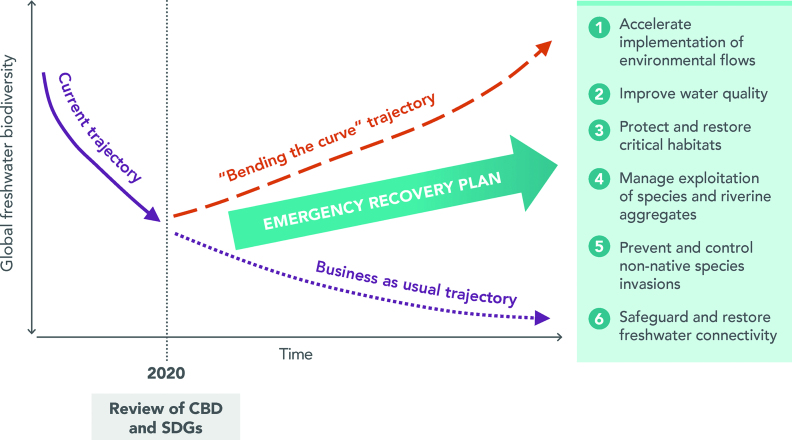
Despite their limited spatial extent, freshwater ecosystems host remarkable biodiversity, including one-third of all vertebrate species. This biodiversity is declining dramatically: Globally, wetlands are vanishing three times faster than forests, and freshwater vertebrate populations have fallen more than twice as steeply as terrestrial or marine populations. Threats to freshwater biodiversity are well documented but coordinated action to reverse the decline is lacking. We present an Emergency Recovery Plan to bend the curve of freshwater biodiversity loss. Priority actions include accelerating implementation of environmental flows; improving water quality; protecting and restoring critical habitats; managing the exploitation of freshwater ecosystem resources, especially species and riverine aggregates; preventing and controlling nonnative species invasions; and safeguarding and restoring river connectivity. We recommend adjustments to targets and indicators for the Convention on Biological Diversity and the Sustainable Development Goals and roles for national and international state and nonstate actors.
Overview
CoChat Summary
TL;DR
The paper presents an Emergency Recovery Plan to reverse global freshwater biodiversity loss through six priority actions: environmental flows, water quality, habitat protection and restoration, sustainable exploitation, invasive species control, and connectivity restoration. It recommends embedding these actions in post-2020 Convention on Biological Diversity and Sustainable Development Goal targets and indicators.
Key findings
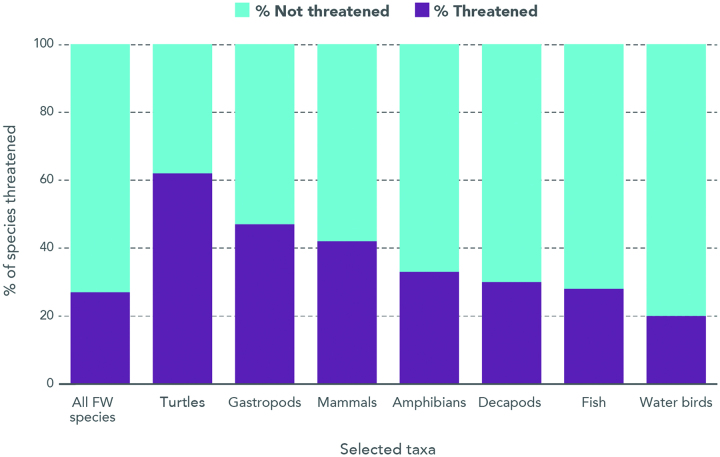
Freshwater ecosystems cover less than 1% of Earth’s surface but host approximately one-third of vertebrate species and 10% of all species; wetlands are vanishing three times faster than forests, and freshwater vertebrate populations have fallen more than twice as steeply as terrestrial or marine populations. Of 29,500 freshwater-dependent species assessed for the IUCN Red List, 27% are threatened with extinction, including an estimated 62% of turtle species, 47% of gastropods, 42% of mammals, 33% of amphibians, 30% of decapod crustaceans, 28% of fishes, and 20% of birds. Freshwater megafauna populations declined by 88% from 1970 to 2012, with the highest declines in Indomalaya (−99%) and Palearctic (−97%) realms. An estimated 30% of natural freshwater ecosystems have disappeared since 1970 and 87% of inland wetlands since 1700; only one-third of the world’s very long rivers remain free flowing, and approximately 3,700 new hydropower dams were identified worldwide at varying planning stages.
Methods
This is a policy and synthesis article, not a primary empirical study; it is structured around six priority actions derived from major causes of freshwater biodiversity loss: flow alteration, pollution, habitat degradation and loss, overexploitation, invasive nonnative species, and connectivity loss. The evidence base consists of cited global assessments, peer-reviewed literature, and implementation case studies from multiple regions, with no new field sample or primary data collection. The main analysis is a narrative review and policy-alignment exercise; Tables 1a and 1b map 13 existing or potential CBD and SDG targets and indicators to the six priority actions.
Limitations
Stated in the paper: implementation examples are “currently isolated successes”; human water demands and transboundary characteristics complicate implementation; data and science-based management are lacking for freshwater fisheries and riverine aggregate extraction; large-scale implementation of nature-based solutions is “in its infancy”; and substantial data gaps remain, including approximately 30% of freshwater mollusk species and 40% of decapod crustaceans classified as data deficient. Evident from the text: the plan is not empirically tested as a whole, relying instead on illustrative case studies and expert synthesis; the paper also notes that offsetting is controversial and open to misapplication.
Model-written summary. Check it against the paper before relying on it.
Integrity signals
Registry
Cites
Statistics
Figures
Verification
Claims the paper makes
5 Valid · 12 Not valid · 50 Not checked · 28 Own results and interpretations
Every source the paper cites for this claim was checked and supports it.
In the paper
“of the fish species assessed for the freshwater ecoregions of the world, over half were confined to a single ecoregion (Abell et al. 2008).”
§ Bending the Curve of Global Freshwater Biodiversity Loss: An Emergency Recovery Plan > Abstract
What the sources say
- Supportedcites Abell et al. 2008 matched to “Freshwater Ecoregions of the World: A New Map of Biogeographic Units for Freshwater Biodiversity Conservation” (2008) source
The “Freshwater ecoregional map and species results” section reports that more than 13,400 freshwater fish species were assigned to ecoregions and more than 6,900 to single ecoregions—over half of those assigned. No page number is supplied in the excerpt. (LLM, conf=0.94)
plain- Asserted: passes — The authors put it forward as true.
- Checkable: passes — It can be checked against evidence.
- Load-bearing: passes — The paper’s conclusions depend on it.
- Based: passes — The paper gives a reason why it holds.
- Supported
The cited sources support only part of this claim — read each source’s verdict below.
In the paper
“Recommendations to address immediate threats to and underlying drivers of global biodiversity loss have focused mainly on terrestrial ecosystems, such as forests and grasslands (e.g., Kok et al. 2018)”
§ Bending the Curve of Global Freshwater Biodiversity Loss: An Emergency Recovery Plan > Abstract
What the sources say
- Partly supportedcites Kok et al. 2018 matched to “Pathways for agriculture and forestry to contribute to terrestrial biodiversity conservation: A global scenario-study” (2018) sourceExperimental — accuracy not yet measured
Our copy supports only the exemplifying part of the attribution: Kok et al. (2018) is itself a terrestrial-scoped recommendations study — the Introduction (p. 1) states it 'evaluates the impacts on biodiversity of different response strategies in the agriculture and forestry sectors', and the Abstract and Sections 2.3/3.1–3.2 build pathways around forests, cropland and grazing land and terrestrial MSA. But no passage makes the comparative claim attributed here, namely that recommendations for global biodiversity loss have focused 'mainly' on terrestrial ecosystems; the closest statement (Introduction) is that societal responses have increased yet remain insufficient, and it credits that to Leadley et al. (2014), CBD (2014) and Tittensor et al. (2014). Aquatic biodiversity is not dismissed as neglected but explicitly handled in a separate companion analysis (Boelee et al., 2017, Introduction), so the 'mainly terrestrial' characterisation and the threats-versus-drivers distinction are not supported by this source. (LLM, conf=0.65)
plain- Asserted: passes — The authors put it forward as true.
- Checkable: passes — It can be checked against evidence.
- Load-bearing: passes — The paper’s conclusions depend on it.
- Based: passes — The paper gives a reason why it holds.
- Partly supported
In the paper
“with the highest declines in the Indomalaya and Palearctic realms (−99% and −97%, respectively; He et al. 2019).”
§ Bending the Curve of Global Freshwater Biodiversity Loss: An Emergency Recovery Plan > Abstract
What the sources say
- Not checked yetcites He et al. 2019
plain- Asserted: passes — The authors put it forward as true.
- Checkable: passes — It can be checked against evidence.
- Load-bearing: unclear — It is unclear whether the paper’s conclusions depend on it.
- Based: passes — The paper gives a reason why it holds.
In the paper
“Populations of freshwater megafauna, defined as animals that reach a body mass of 30 kilograms, declined by 88% from 1970 to 2012”
§ Bending the Curve of Global Freshwater Biodiversity Loss: An Emergency Recovery Plan > Abstract
What the sources say
- Not checked yetcites He et al. 2019
plain- Asserted: passes — The authors put it forward as true.
- Checkable: passes — It can be checked against evidence.
- Load-bearing: passes — The paper’s conclusions depend on it.
- Based: passes — The paper gives a reason why it holds.
In the paper
“Human demands for water will increase in some regions, making implementation more challenging (Palazzo et al. 2019).”
§ Bending the Curve of Global Freshwater Biodiversity Loss: An Emergency Recovery Plan > The Emergency Recovery Plan: Priorities for action > Action 1: Accelerate implementation of environmental flows
What the sources say
- Not checked yetcites Palazzo et al. 2019 matched to “Investment Needs for Irrigation Infrastructure along Different Socioeconomic Pathways” (2019) source
plainstates a cause- Asserted: passes — The authors put it forward as true.
- Checkable: passes — It can be checked against evidence.
- Load-bearing: unclear — It is unclear whether the paper’s conclusions depend on it.
- Based: passes — The paper gives a reason why it holds.
40 more claims
Create a free account to see all 95 claims and to verify the 58 references still open.
- It may state two separate claims as one. 29
- Probably not a substantial claim. 30
Claims other papers make about this one
Each is checked against this paper’s own text: does it say what the citing paper says it does?
The check wasn’t confident either way, so it gives no verdict — never disputed.
In the citing paper
“Hunting at Parker River National Wildlife Refuge represents both a traditional recreational use and serves as an important wildlife management tool.185”
From Protecting and restoring habitats to benefit freshwater biodiversity (2024) · cites this paper as [185]
Experimental — accuracy not yet measured
Citations
Cites
Freshwater biodiversity: importance, threats, status and conservation challenges
Dudgeon, D., Arthington, A. H., Gessner, M. O., Kawabata, Z., Knowler, D. J., Lévêque, C., Naiman, R. J., Prieur‐Richard, A., Soto, D., Stiassny, M. L. J., et al. (2006) · Biological Reviews · doi:10.1017/s1464793105006950 · Cited by 8,489
Self-citationPoff, N. L., Allan, J. D., Bain, M. B., Karr, J. R., Prestegaard, K. L., Richter, B. D., Sparks, R. E., & Stromberg, J. C. (1997) · BioScience · doi:10.2307/1313099 · Cited by 6,500
Pimentel, D., Zuniga, R., & Morrison, D. (2005) · Ecological Economics · doi:10.1016/j.ecolecon.2004.10.002 · Cited by 4,771
Emerging threats and persistent conservation challenges for freshwater biodiversity
Reid, A. J., Carlson, A. K., Creed, I. F., Eliason, E. J., Gell, P. A., Johnson, P. T. J., Kidd, K. A., MacCormack, T. J., Olden, J. D., Ormerod, S. J., et al. (2019) · Biological Reviews · doi:10.1111/brv.12480 · Cited by 3,645
Self-citationBasic Principles and Ecological Consequences of Altered Flow Regimes for Aquatic Biodiversity
BUNN, S. E., & ARTHINGTON, A. H. (2002) · Environmental Management · doi:10.1007/s00267-002-2737-0 · Cited by 3,379
Self-citationCeballos, G., Ehrlich, P. R., & Dirzo, R. (2017) · Proceedings of the National Academy of Sciences · doi:10.1073/pnas.1704949114 · Cited by 2,663
Mapping the world’s free-flowing rivers
Grill, G., Lehner, B., Thieme, M., Geenen, B., Tickner, D., Antonelli, F., Babu, S., Borrelli, P., Cheng, L., Crochetiere, H., et al. (2019) · Nature · doi:10.1038/s41586-019-1111-9 · Cited by 2,473
Self-citationA global boom in hydropower dam construction
Zarfl, C., Lumsdon, A. E., Berlekamp, J., Tydecks, L., & Tockner, K. (2015) · Aquatic Sciences · doi:10.1007/s00027-014-0377-0 · Cited by 2,181
Self-citationHow much wetland has the world lost? Long-term and recent trends in global wetland area
Davidson, N. C. (2014) · Marine and Freshwater Research · doi:10.1071/mf14173 · Cited by 2,177
Abell, R., Thieme, M. L., Revenga, C., Bryer, M., Kottelat, M., Bogutskaya, N., Coad, B., Mandrak, N., Balderas, S. C., Bussing, W., et al. (2008) · BioScience · doi:10.1641/b580507 · Cited by 2,045
Self-citation
Research works printed but not linked: 14
- Döll P, Bunn SE. 2014 Cross-chapter box on the impact of climate change on freshwater ecosystems due to altered river flow regimes. Pages 143– 146 in Field CB et al., eds. Climate Change Impacts, Adaptation, and Vulnerability. Part A: Global and Sectoral Aspects. Contribution of Working Group II to the Fifth Assessment Report of the Intergovernmental Panel on Climate Change. Cambridge University Press.
- Fricke R, Eschmeyer W, van der Laan R 2019 Catalog of fishes: Genera, species, references. California Academy of Sciences. http://researcharchive.calacademy.org/research/ichthyology/catalog/SpeciesByFamily.asp.
- Funge-Smith S. 2018 Review of the State of the World Fishery Resources: Inland Fisheries. Food and Agriculture Organization of the United Nations Fisheries and Aquaculture Circular.
- Harwood A, Johnson S, Richter B, Locke A, Yu X, Tickner D 2017 Listen to the River: Lessons from a Global Review of Environmental Flow Success Stories. World Wildlife Fund.
- [IUCN] International Union for Conservation of Nature 2019 The IUCN Red List of Threatened Species, version 2019-1. IUCN www.iucnredlist.org.
- Koehnken L, Rintoul M. 2018 Impacts of Sand Mining on Ecosystem Structure, Process and Biodiversity in Rivers. World Wildlife Fund International.
- Koning AA. 2018 Riverine Reserves: The Conservation Benefits of Spatial Protection for Rivers in the Context of Environmental Change. University of Wisconsin–Madison.
- Le Quesne T, Kendy E, Weston D 2010 The Implementation Challenge: Taking Stock of Government Policies to Protect and Restore Environmental flows. WWF and The Nature Conservancy.
- Moir K, Thieme M, Opperman J 2016 Securing a Future that Flows: Case Studies of Protection Mechanisms for Rivers. World Wildlife Fund and The Nature Conservancy.
- NBI (Nile Basin Initiative) 2016 Strategy for Management of Environmental Flows in the Nile Basin. Nile Basin Initiative Secretariat. 17p.
- Opperman J et al. 2019a Connected and Flowing: A Renewable Future for Rivers, Climate, and People. WWF and The Nature Conservancy.
- Speed R, Tickner D, Naiman R, Gang L, Sayers P, Yu W, Yuanyuan L, Houjian H, Jianting C, Lili Y 2016 River Restoration: A Strategic Approach to Planning and Management. UNESCO.
- [UNEP] United Nations Environment Programme 2016 Snapshot of the World's Water Quality: Towards a Global Assessment. UNEP.
- UN Environment 2017 A Framework for Freshwater Ecosystem Management, vol. 2: Technical Guide for Classification and Target-Setting. United Nations.
Cited by
Items 1,101–1,200 of 1,243
Velde, K. T., Mairo, A., Peeters, E. T. H. M., Winter, H. V., Tudorache, C., & Slabbekoorn, H. (2024) · SSRN Electronic Journal · doi:10.2139/ssrn.4792618
Giusto, C., Bellati, A., & Belfiore, C. (2025) · Aquatic Insects · doi:10.1080/01650424.2025.2559594
“Freshwater ecosystems are among the most impacted ones, with pressures acting in synergy on the aquatic biota (Tickner et al. 2020), leading to the rapid disappearance of species playing key roles in ecosystem functioning (Lynch et al. 2023).”
The role of eutrophication in the occurrence of phytoplankton blooms from distinct climate regions
Tavares, E. L. D. C. P., & Moura, A. D. N. (2026) · Marine and Freshwater Research · doi:10.1071/mf25025
da Costa, I. D., Costa, L. L., Nunes, N. N. D. S., Mafort, M. E., Zalmon, I. R., & Souza-Lima, R. (2026) · Zoologia (Curitiba) · doi:10.1590/s1984-4689.v43.e25066
Conservation Opportunities for Freshwater Fish Diversity Under the Natura 2000 Network in Spain
Lanzas, M., Sánchez-González, J. R., Morcillo, F., Casals, F., Guil, F., & Hermoso, V. (2026) · Aquatic Conservation Marine and Freshwater Ecosystems · doi:10.1002/aqc.70371
Aşıkkutlu, B. (2026) · Environmental Monitoring and Assessment · doi:10.1007/s10661-026-15853-6
“…highlight the need for integrated management approaches aimed at conserving freshwater ecosystems and ensuring their long-term sustainability through improvements in water quality, habitat restoration, invasive species control, and the preservation of river connectivity (Tickner et al., 2020).”
Wenzhuo, T., School of Ecology and Nature Conservation, B. F. U., Bin, L., et al. (2022) · Journal of Lake Sciences · doi:10.18307/2022.0106
Padda, S. S., & Cardinale, B. J. (2026) · PLoS ONE · doi:10.1371/journal.pone.0354515
“Land-use change alone is projected to imperil more than 1,700 species by 2070 [5], and the potential biodiversity loss is greatest in freshwater ecosystems, which are losing species at rates that are two to three times higher than terrestrial ecosystems [6–7].”
Carvajal‐Quintero, J. D. (2020) · theses.fr (ABES) · doi:10.70675/efdb5066z7426z483bz8952z316c238ef366
Alarming decline of Iran’s Ramsar convention wetlands
Salamattalab, M. M., Noori, R., Shahmohammad, M., Kim, D., Jun, C., Bateni, S. M., Mahdian, M., Hosseinzadeh, M., Siadatmousavi, S. M., Naseh, M. R. V., et al. (2026) · Journal of Hydrology Regional Studies · doi:10.1016/j.ejrh.2026.103860 · Cited by 2
Potential Impacts of Low Flows on Fish Foodscapes and Production in a Braided River
Stoffels, R. J., White, R. S. A., Török, G. T., Measures, R. J., Hogsden, K. L., Rose, A. F., Lambert, P. W., Bilewitch, J., Graham, S. E., Smith, L. M., et al. (2026) · River Research and Applications · doi:10.1002/rra.70137
Mbasso, W. F., Jangir, P., Harrison, A., Fendzi-Donfack, E., & Dagal, I. (2026) · World sustainability series · doi:10.1007/978-3-032-04071-8_4
Shoemaker, T., Nguyen, C., Tiegs, S. D., Costello, D. M., & Kelly, J. J. (2026) · Limnology and Oceanography Methods · doi:10.1002/lom3.70092
Troia, M. J., Javiya, A. V., Doss, R. N., et al. (2024) · doi:10.2139/ssrn.4877615
Yujana, C. A., Aryastana, P., Amir, A., Candrayana, K. W., Rahadiani, A. A. S. D., & Mahaputra, G. P. (2026) · IOP Conference Series Earth and Environmental Science · doi:10.1088/1755-1315/1593/1/012006
“In today’s context of global environmental challenges and climate change, it is essential for researchers, conservation groups, and policymakers to take a broad-scale perspective to study, manage, and protect lakes and reservoirs (4)(5).”
Landscape and Hydro‐Climatic Drivers of Fish Communities in Floodplain Wetlands
González-Murcia, S., Lewis, S., Maxwell, S., McPhan, L. M., Shackleton, M., & Bond, N. R. (2026) · Freshwater Biology · doi:10.1111/fwb.70293 · Cited by 1
Dissolved-oxygen gradients and fish passage in large-river tailraces: a KITS framework
Zhang, S. T., Wang, C., & Liu, D. (2026) · Journal of Ecohydraulics · doi:10.1080/24705357.2026.2696559
Limited Success of Spat Ropes and Rubber Ramps for Restoring Fish Passage at a Perched Culvert
Bowie, S., Boddy, N. C., Baker, C. F., Horrox, J., & Franklin, P. A. (2026) · New Zealand Journal of Marine and Freshwater Research · doi:10.1002/nzm2.70057
Rack, L. E., Freeman, M. C., Cowie, G., Yang, C., McKay, S. K., Craig, L. S., & Wenger, S. J. (2026) · PLOS Water · doi:10.1371/journal.pwat.0000445
Cheng, S., Sun, W., Yang, X., et al. (2023) · doi:10.2139/ssrn.4671699
Giman, B., Richard, R., Gerusu, G. J., et al. (2026) · Aquatic Invertebrates and Ecosystem Research · doi:10.69517/aier.2026.03.01.0007
Altınok, İ. (2026) · Journal of Fish Biology · doi:10.1111/jfb.70573
“…documented global decline of freshwater fish diversity (Spiller et al., 2025; Vardakas et al., 2025), and with freshwater species representing a disproportionate fraction of threatened vertebrates world-wide (Tickner et al., 2020), the cost of getting this distinction wrong is exceptionally high.”
Purnama, A. A., & Masunaga, T. (2023) · Ochrana prírody Slovenska/Ekológia · doi:10.2478/eko-2023-0042 · Cited by 4
Uchida, N., Iwasaki, Y., Kuranishi, R. B., & Kondo, N. I. (2025) · Environmental DNA · doi:10.1002/edn3.70200 · Cited by 2
Perspectives on Protecting African freshwater Ecosystems in the Anthropocene
King, J. M., & Palmer, C. G. (2022) · African Journal of Aquatic Science · doi:10.2989/16085914.2022.2132045
“If the former took three of four decades, the latter will need to be much quicker if we are to halt or reverse the decline (bend the curve) in the condition of Earth’s inland waters (Tickner et al. 2020).”
BackgroundReconstructing Long‐Term Historical Hydrologic Alteration to Support Environmental Flows in Texas
Lueders, M. B., McManamay, R. A., Oliver, J. A., Young, D., Bean, P. T., & Mayes, K. B. (2026) · River Research and Applications · doi:10.1002/rra.70172 · Cited by 1
Shan, C., Guo, H., Huang, D., Ling, Z., Bai, Y., Si, J., & Lu, D. (2026) · SSRN Electronic Journal · doi:10.2139/ssrn.7493444
Fisher Perceptions and Management Challenges in KwaZulu‐Natal's Inland Water Bodies
Makhathini, N., Burnett, M. J., Hanzen, C., et al. (2026) · Aquatic Conservation: Marine and Freshwater Ecosystems · doi:10.1002/aqc.70319
“However, the health and conservation of these eco-systems face increasing threats from anthropogenic activities and environmental stressors, including habitat degradation, pollution and invasive species (Vörösmarty et al. 2010; Du Plessis 2019; Tickner et al. 2020).”
He, X., Tian, Z., Chen, G., Huang, G., Li, H., Li, Y., & Wang, L. (2026) · Water · doi:10.3390/w18050626 · Cited by 1
“Comprehensive and in-depth feasibility assessments are therefore essential to accurately reflect their strategic significance and multi-dimensional benefits [8,9,13,14].”
Freshwater habitats within the Natura 2000 network
Baattrup‐Pedersen, A., Baumane, M., Nielsen, A., Trolle, D., Branco, P., Borgwardt, F., Hering, D., & Birk, S. (2026) · Ecological Applications · doi:10.1002/eap.70241 · Cited by 1
“Freshwater biodiversity is experiencing dramatic declines both globally and in Europe, driven by anthropogenic impacts including water abstraction, flow regulation, dam construction, pollution and widespread habitat loss (e.g., Dudgeon, 2019; Tickner et al., 2020).”
sousa, F. E. L., Pestana, M. C. A., de Oliveira, R. F., de Barros, R. F. M., da Silva, M. P., & Gonella, P. M. (2026) · Kew Bulletin · doi:10.1007/s12225-025-10330-8
Understanding rigor mortis impacts on fish gamete viability
Dantas, R. V., Marques, L. S., Freitas, T. R., et al. (2023) · doi:10.21203/rs.3.rs-3335801/v1
Baker, C., Mahlum, S. K., Williams, P., White, E., Crawford, R., Graham, E., Franklin, P. A., & Baars, D. (2026) · SSRN Electronic Journal · doi:10.2139/ssrn.6867561
Cvetković, A., Veličković, T. Z., Simović, P. M., Petrović, A. S., Đorđević, N. B., Simić, S. B., & Simić, V. (2026) · Kragujevac Journal of Science · doi:10.46793/kgjsci2601071c
(2021) · Transboundary Freshwater Ecosystems in International Law · doi:10.1017/9781108854641.007
A Roadmap for Implementing the Emergency Recovery Plan for Freshwater Biodiversity
Cooke, S. J., Lynch, A. J., Tickner, D., Abell, R., Piczak, M. L., Arthington, A. H., Thieme, M. L., Perry, D. M., Britton, J. R., Dalu, T., et al. (2026) · Environmental Reviews · doi:10.1139/er-2023-0080 · Cited by 2
“However, the original article by Tickner et al. (2020) contains insufficient information for those intending to use it to operationalize each of the six actions that would lead to the recovery of freshwater biodiversity.”
Self-citationFerraz, J. D., Casimiro, A. C. R., Garcia, D. A. Z., Vidotto‐Magnoni, A. P., Magalhães, A. L. B., Tarkan, A. S., Britton, J. R., & Orsi, M. L. (2025) · NeoBiota · doi:10.3897/neobiota.104.167161
“In an attempt to “bend the curve” of freshwater biodiversity loss, these findings support international calls to improve integrative, process-based assessments of invasion impacts (Tickner et al. 2020; Ottoni et al. 2023, 2025).”
Japanese mayfly family classification with a vision transformer modelPreprint
Iwasaki, Y., Arai, H., Tamada, A., et al. (2024) · doi:10.32942/x2p02k
Garden Ponds: Hidden Sources for Plant Invasions?
Barta, B., Márton, Z., Szabó, B., Vad, C. F., Lukács, B., & Horváth, Z. (2025) · Freshwater Biology · doi:10.1111/fwb.70145
Evaluating the Ecologigical Integrity of a Tropical Lake Using Community Degradation Index
Amponsah, S. K. K. (2026) · Çanakkale Onsekiz Mart University Journal of Marine Sciences and Fisheries · doi:10.46384/jmsf.1799116
Есенкожановна, К. Ф., Mirzakul, A., Кулымбет, К., Beiseyeva, G., Saparov, G. A., Tastanbekova, А. А., Yeszhanova, A., Murataliev, M., Toktar, M., & Salmurzauly, R. (2026) · CATENA · doi:10.1016/j.catena.2026.110558
Mohan, C. (2022) · Hydrology and earth system sciences · doi:10.5194/hess-2022-87-ac1
Hansen, A. G., Lepak, J. M., Pate, W. M., Brauch, D., & Avila, B. W. (2025) · Ecosphere · doi:10.1002/ecs2.70412 · Cited by 1
Houart, C. (2023) · Relações Internacionais · doi:10.23906/ri2023.sia02
Santiago, S. G., Santana, G. M., Silva, D. M. L., et al. (2026) · Discover Environment · doi:10.1007/s44274-026-00552-3
“In addition, the proximity of springs to trails and roads intensifies siltation and contributes to point source pollution, which is one of the main vectors of degradation in these ecosystems [46, 77].”
Ren, L., Zheng, Z., Villa, P., Zhao, P., Xu, C., Fu, Y., Zhou, Z., Wu, J., Zhao, X., Li, W., et al. (2026) · Acta Botanica Yunnanica · doi:10.1016/j.pld.2026.04.002
“However, due to human activities and climate change, wetlands are disappearing rapidly around the globe, making their protection and restoration an urgent priority (Tickner et al., 2020; Fluet-Chouinard et al., 2023).”
Brillantes, E. L., Esparagosa, H., Brillantes, N., Cordero, N., Laquihon, M. A., Pojas, Q. I., Balasa, N. K. B., & Tampoy, D. A. (2026) · Research Square · doi:10.21203/rs.3.rs-10460022/v1
Mohan, C. (2022) · Hydrology and earth system sciences · doi:10.5194/hess-2022-87-ac3
Kwenda, T. T., Zvavahera, M., Chinhondo, N. D., et al. (2026) · Frontiers in Conservation Science · doi:10.3389/fcosc.2026.1928898
Impacts on fish and microbial communities occurring in the Amazon River Basin
Barros, D. J., Navarrete, A. A., Vanzela, L. S., Mansano, C. F. M., Medeiros, A. O., & de Morais, P. B. (2025) · Elsevier eBooks · doi:10.1016/b978-0-443-15726-4.00026-8
Ericsson, P., Wu, W., White, P. R., et al. (2026) · Journal of Ecohydraulics · doi:10.1080/24705357.2026.2724870
Salaudeen, A. O., & Olorunmaye, B. A. (2026) · Scientific African · doi:10.1016/j.sciaf.2026.e03641
Peschke, K., Sawallich, L., Köhler, H., & Triebskorn, R. (2024) · Pollutants · doi:10.3390/pollutants4010004 · Cited by 1
River interlinking and biodiversity risks in Indian freshwater ecosystems
Aravind, N. A., Raja, G., Nobinraja, M., & Ravikanth, G. (2026) · Scientific Reports · doi:10.1038/s41598-026-46640-5
“Embedding these principles within the NRLP aligns with global sustainability goals, including SDG 6 (Clean Water and Sanitation), SDG 13 (Climate Action), SDG 15 (Life on Land), and SDG 11 (Sustainable Cities and Communities) 79 .”
Nakata, J. K., Rosa, J., Martens, K., & Higuti, J. (2026) · Aquatic conservation · doi:10.1002/aqc.70466
López‐Casas, S., Restrepo-Santamaría, D., Valencia‐Rodríguez, D., Muñoz-Duque, S., Loaiza-Santana, C. A., & Jiménez-Segura, L. F. (2024) · Revista de Biología Tropical · doi:10.15517/rev.biol.trop..v72i1.57639
Gerfand, B., Gaucherand, S., Berteloot, P., TIXIER, L., Évette, A., & Arthaud, F. (2026) · Ecological Engineering · doi:10.1016/j.ecoleng.2026.108018
Seasonal eDNA-based monitoring of Batrachochytrium dendrobatidis and amphibian species in Norway
Ahmed, O., Andersson, J., Martin-Sanchez, P. M., et al. (2022) · doi:10.1101/2022.08.02.502273
“Tickner et al. (2020) recently presented an emergency recovery plan for freshwater biodiversity, which includes protecting and restoring critical habitats, and preventing the introduction and spread of non-native species.”
BackgroundNeo-Conservation of Biodiversity: A Review of International Endeavors
Shahzaib, M. (2020) · Indonesian Journal of Conservation
Rojo, D., Alonso, A., Pérez, J., Hermosilla, B., Agut, A., Orruño, M., Arana, I., & Boyero, L. (2026) · Freshwater Biology · doi:10.1111/fwb.70163
Chandran, R., Sarkar, U. K., Singh, R. K., et al. (2025) · Records of the Zoological Survey of India · doi:10.26515/rzsi/v124/i1s/2024/172776
Ngcobo, N. B., Burnett, M. J., Hanzen, C., & Downs, C. T. (2026) · African Journal of Aquatic Science · doi:10.2989/16085914.2025.2601072
Bekov, R., & Prodanov, B. (2025) · International Multidisciplinary Scientific GeoConference SGEM ... · doi:10.5593/sgem2025/5.1/s19.004 · Cited by 1
Segurado, P., Branco, P., & Ferreira, M. T. (2022) · MDPI eBooks · doi:10.3390/books978-3-0365-4200-3 · Cited by 1
Dias-Oliveira, T. M., Simões-Silva, M. L., Fôlha-Ferreira, E. D., et al. (2026) · International Journal of Odonatology · doi:10.48156/1388.2026.1917397
(2022) · Hydrology and earth system sciences · doi:10.5194/hess-2022-87-cc1
Martelo, J., Grossman, G. D., & Magalhães, M. F. (2021) · Hydrobiologia · doi:10.1007/s10750-021-04701-y · Cited by 3
Editorial: What’s ahead: navigating the future of environmental science
Siegert, M. J. (2025) · Frontiers in Environmental Science · doi:10.3389/fenvs.2025.1730170
“Arthington point to the application of fi rm governance solutions to freshwater systems such as the Emergency Recovery Plan (ERP) to tackle freshwater biodiversity loss (Tickner et al., 2020), and which has widespread support from freshwater scientists.”
Ranuzi, M., Nagamatsu, B. A., Caetano, W., Schlemper, A. E., Dagosta, F. C. P., & Tagliacollo., V. A. (2026) · Aquatic Sciences · doi:10.1007/s00027-026-01268-5 · Cited by 1
“Although their impact is often initially subtle, it can ultimately be devastating, altering ecological processes and compromising the survival of native species (Latini and Petrere Jr. 2004; Tickner et al. 2020).”
Meza-Matty, I. A., Gudiño‐Elizondo, N., & Ruiz‐Campos, G. (2026) · Journal of Limnology · doi:10.4081/jlimnol.2026.2238
Shi, X., Czerniawski, R., Tanwari, K., & Sługocki, Ł. (2026) · Ecohydrology & Hydrobiology · doi:10.1016/j.ecohyd.2026.100796
Similar won’t make it: Coexistence, habitat availability and suboptimal restoration
Urioste, F. M., Borthagaray, A. I., Cunillera-Montcusí, D., et al. (2024) · doi:10.1101/2024.07.24.604984
Microbial resources and interactions across three-dimensional space for a freshwater ecosystem
Chu, D., Zhang, H., Wang, Z., & Ning, K. (2025) · The Science of The Total Environment · doi:10.1016/j.scitotenv.2025.179522
Salmon, Q. (2022) · theses.fr (ABES) · doi:10.70675/bccdb57az7d2fz4546z9b8dzd58ad8dee7ca · Cited by 1
Schmidt, T., Cairault, A., & Schulz, R. (2023) · Knowledge and Management of Aquatic Ecosystems · doi:10.1051/kmae/2023005
“Protection and restoration of critical freshwater habitats has been suggested as a priority action to “bend the curve of freshwater biodiversity loss” (Tickner et al., 2020).”
BackgroundNon-native aquatic species in the Yellow River Basin, China
Xiong, W., Zhang, W., Deng, Z., Bowler, P. A., Chen, K., & Wang, B. (2025) · Aquatic Invasions · doi:10.3391/ai.2025.20.2.153557 · Cited by 1
Brodeur, Z. P., Sunkara, S. V., Penny, G., et al. (2026) · Journal of Water Resources Planning and Management · doi:10.1061/jwrmd5.wreng-7415
Macroinvertebrate response to streamflow and water quality stressors during the Millennium Drought
Banad, S., Wei, Y., Patil, R. J., & Dhanya, C. T. (2026) · Journal of Environmental Management · doi:10.1016/j.jenvman.2026.130825
Shriberg, M., Floyd, C., Talbot, L., Young, C., Brines, S. J., & McCarthy, J. (2026) · Journal of Great Lakes Research · doi:10.1016/j.jglr.2026.102914
Sattler, J., & Poschlod, P. (2023) · Aquatic Botany · doi:10.1016/j.aquabot.2023.103680
A freshwater resilient and connected network to sustain biodiversity under a changing climate
Anderson, M. G., Olivero, A. P., Barnett, A., Khoury, M. L., & Martin, E. H. (2026) · PLoS ONE · doi:10.1371/journal.pone.0351782
Nadim, M., Jyothi, P. V., & Ali, P. H. A. (2026) · Aquatic Ecology · doi:10.1007/s10452-026-10364-5
“…importance, freshwater ecosystems are undergoing unprecedented degradation due to habitat loss, pollution, hydrological alteration, overexploita-tion of biological resources, climate change, and the introduction of non-native species (Dudgeon et al. 2006; Reid et al. 2019; Tickner et al. 2020).”
Feeding Ecology of the Critically Endangered Gobio insuyanus (Gobionidae)
Johnson, J. E., Yoğurtçuoğlu, B., Kırankaya, Ş. G., et al. (2025) · Ecology and Evolution · doi:10.1002/ece3.71156
“These systems face numerous threats, including habitat fragmentation, pollution, climate change, and especially water abstraction for agricultural and other purposes (Tickner et al. 2020; Tockner 2021).”
Schütz, R., Friedrichs‐Manthey, M., Macher, T., Beermann, A. J., Arle, J., Koschorreck, J., & Leese, F. (2026) · Ecological Indicators · doi:10.1016/j.ecolind.2026.115447 · Cited by 2
Seasonal Fish Passage Patterns Through an Estuarine Fishway in Relation to Tidal Hydraulics
Lv, J., Yang, W., Zhu, P., Zheng, Z., Wang, B., Huang, Y., & Wang, X. (2026) · Animals · doi:10.3390/ani16193014
“Restoring river connectivity has consequently become a major component of freshwater biodiversity conservation [8], and the recovery of fish assemblages after removal of tidal barriers demonstrates the direct role of estuarine connectivity in habitat use [9].”
Błońska, D., Aksu, S., Haubrock, P. J., & Tarkan, A. S. (2025) · NeoBiota · doi:10.3897/neobiota.103.163409
“The range expansion of non-native fish species following ongoing human activity and climatic and environmental changes will present a major challenge for conservation efforts (Tickner et al. 2020).”
Liu, J., Zhang, L., Zhong, Q., Wu, C., Zhang, G., Yu, H., & Li, R. (2026) · Ecological Indicators · doi:10.1016/j.ecolind.2026.114963
Donovan, F. (2024) · Open Access Victoria University of Wellington | Te Herenga Waka (Figshare) · doi:10.26686/wgtn.25790481
Bergman, J. N. (2023) · Carleton University's Institutional Repository (MacOdrum Library, Carleton University) · doi:10.22215/etd/2023-15978
Henriksen, L. D., Larsen, M. B., Johnsen, T. J., Larsen, S. E., Riis, T., & Baattrup‐Pedersen, A. (2023) · Aquatic Botany · doi:10.1016/j.aquabot.2023.103702 · Cited by 1
Future-proofing Freshwaters and Their Dragonfly Sentinels
Samways, M. J. (2024) · CABI eBooks · doi:10.1079/9781789248395.0008
Serré, S. (2022) · Carleton University's Institutional Repository (MacOdrum Library, Carleton University) · doi:10.22215/etd/2022-15231 · Cited by 1
Schlobies, K., van Rooijen, E., Vanzo, D., & Lotsari, E. (2026) · Journal of Ecohydraulics · doi:10.1080/24705357.2026.2716036
“Reversing bio-diversity decline, described as ‘bending the curve’, requires the integration of river restoration with ambitious conservation strategies (Tickner et al. 2020).”
InfluentialSegersten, J., Jansson, R., Degerman, E., Donadi, S., Widén, Å., Malm‐Renöfält, B., & McKie, B. G. (2026) · Water Resources Research · doi:10.1029/2025wr040752 · Cited by 2
“Although e‐flows are increasingly implemented in regulated rivers (Acreman et al., 2014; Tickner et al., 2020), BRs with no or a small static MMD remain common.”
InfluentialNouel, P. C. S., Picarelli, S. B. N., Silva, F. D. O., Carvajal, M., Braslau, H., & Garcia, G. (2026) · Environmental Research Letters · doi:10.1088/1748-9326/ae3dfc
“Though the rate of decline for freshwater species greatly exceeds terrestrial and marine taxa (Tickner et al 2020, van Rees et al 2023, WWF 2024), global conservation efforts have overwhelmingly focused on the latter (Castello et al 2013).”
Metadata
- Authors
- Tickner, D., Opperman, J. J., Abell, R., Acreman, M., Arthington, A. H., Bunn, S. E., Cooke, S. J., Dalton, J., Darwall, W., Edwards, G., Harrison, I., Hughes, K., Jones, T., Leclère, D., Lynch, A. J., Leonard, P., McClain, M. E., Muruven, D., Olden, J. D., Ormerod, S. J., Robinson, J., Tharme, R. E., Thieme, M., Tockner, K., Wright, M., & Young, L.
- Affiliations
- WWF-UK (GB)
- World Wildlife Fund (US)
- Conservation International (US)
- UK Centre for Ecology & Hydrology (GB)
- Griffith University (AU)
- Carleton University (CA)
- International Union for Conservation of Nature (CH)
- International Union for Conservation of Nature (United Kingdom) (GB)
- DJEnvironmental, Harpers Mill, United Kingdom
- International Institute for Applied Systems Analysis (AT)
- United States Geological Survey (US)
- IHE Delft Institute for Water Education (NL)
- Freshwater Practice of WWF International, Zeist, The Netherlands
- University of Washington (US)
- Cardiff University (GB)
- Wildfowl & Wetlands Trust (GB)
- Director of Riverfutures, Cressbrook, United Kingdom
- Leibniz Institute of Freshwater Ecology and Inland Fisheries (DE)
- Corresponding author
- Tickner, David
- ORCID
- Venue
- BioScience
- Publisher
- Oxford University Press (OUP)
- Published
- 2020-02-19
- Volume
- 70
- Issue
- 4
- Pages
- 330-342
- ISSN
- 0006-3568 (ISSN-L)
- 1525-3244
- PMC
- PMC7138689
- OpenAlex
- W2982687801
- Cited by
- 1,241
- References
- 94
- Citations by year
- 2026: 233 · 2025: 222 · 2024: 229 · 2023: 184 · 2022: 192 · 2021: 140 · 2020: 41
- FWCI
- 88.45
- Type
- journal article
- Language
- en
- Open access
- hybrid
- doi.org
- Licence
- Locations
- BioScience (publishedVersion, cc-by-nc)
- Europe PMC (PubMed Central) (publishedVersion, cc-by-nc)
- PubMed Central (publishedVersion, cc-by-nc)
- PubMed (publishedVersion)
- ORCA Online Research @Cardiff (Cardiff University) (acceptedVersion)
- NERC Open Research Archive (Natural Environment Research Council) (acceptedVersion)
- IIASA PURE (International Institute of Applied Systems Analysis) (acceptedVersion)
- Griffith Research Online (submittedVersion, cc-by-nc)
- Funders
- University of Washington
- Cardiff University
- Griffith University
- Technische Universiteit Delft
- WWF International
- Freie Universität Berlin
- U.S. Geological Survey
- School of Aquatic and Fishery Sciences
- Centre for Ecology and Hydrology
- Topics
- Physical Sciences › Environmental Science › Nature and Landscape Conservation › Fish Ecology and Management Studies
- Physical Sciences › Environmental Science › Ecology › Aquatic Ecosystems and Biodiversity
- Physical Sciences › Environmental Science › Ecology › Freshwater macroinvertebrate diversity and ecology
- Keywords
- freshwater biodiversity loss, biodiversity recovery, wetland loss, freshwater vertebrates, environmental flows, water quality, habitat restoration, freshwater management, river connectivity, Convention on Biological Diversity, Sustainable Development Goals
About these checks
Registry, retraction, Cites and statistics results are computed, not judged, with one exception: a printed reference that no index lists is read once by a model before it counts as a citation error. Claims are extracted by a model and kept only when their quote appears verbatim in the text; each cited source is then checked, with a model’s help, for whether it says what the claim relies on. Those verdicts can be wrong — read the claim’s quote and the cited source before relying on one.
The claim verdicts this report counts are experimental: their accuracy is not yet measured.
A language model drew the claims from the paper on 2026-10-05, under version 3 of the claim definition (model deepseek-v4.1-flash, prompt extract-v3).
A second model labelled each claim on 2026-10-05 (model jev-1.13-20260917, definition revision gold-guideline-v0.2).
Cited sources are checked with a language model’s help (gpt-6-sol and qwen3.8-omni-flash).
Statistics and arithmetic are recomputed, not judged.
Confidence bands are shown only for fields calibrated on our annotated test set. None is calibrated yet, so no band is shown.
What counts as a claim ›How we measure confidence ›How we check this ›
Are you an author, or do you see a problem with this page? Request a review
Data sources
Bibliographic data: Semantic Scholar, OpenAlex, Crossref.
Contains information from the Semantic Scholar Academic Graph Datasets, made available under the ODC Attribution License (ODC-BY 1.0).
Semantic Scholar’s data is described in: Kinney, R., et al. (2023). The Semantic Scholar Open Data Platform. arXiv:2301.10140.
