

Bending the Curve of Global Freshwater Biodiversity Loss: An Emergency Recovery Plan
Open accessThe DOI matches its Crossref record; 86 of the 94 references it cites were found in a registry or an index; 5 of the 63 sources its claims cite were checked for support.
Abstract
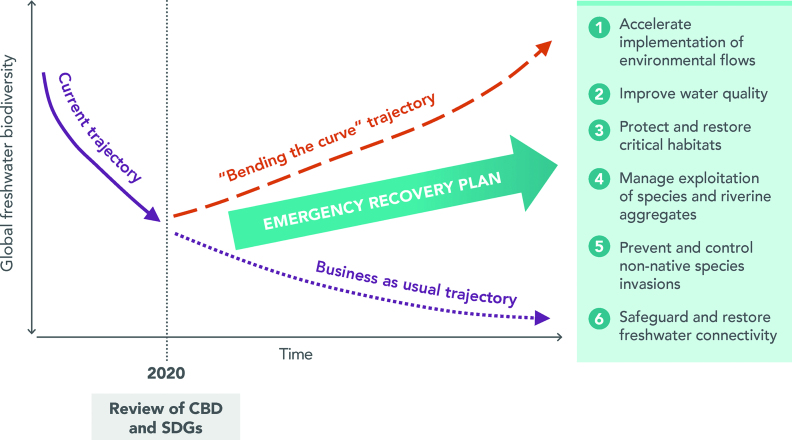
Despite their limited spatial extent, freshwater ecosystems host remarkable biodiversity, including one-third of all vertebrate species. This biodiversity is declining dramatically: Globally, wetlands are vanishing three times faster than forests, and freshwater vertebrate populations have fallen more than twice as steeply as terrestrial or marine populations. Threats to freshwater biodiversity are well documented but coordinated action to reverse the decline is lacking. We present an Emergency Recovery Plan to bend the curve of freshwater biodiversity loss. Priority actions include accelerating implementation of environmental flows; improving water quality; protecting and restoring critical habitats; managing the exploitation of freshwater ecosystem resources, especially species and riverine aggregates; preventing and controlling nonnative species invasions; and safeguarding and restoring river connectivity. We recommend adjustments to targets and indicators for the Convention on Biological Diversity and the Sustainable Development Goals and roles for national and international state and nonstate actors.
Overview
CoChat Summary
TL;DR
The paper presents an Emergency Recovery Plan to reverse global freshwater biodiversity loss through six priority actions: environmental flows, water quality, habitat protection and restoration, sustainable exploitation, invasive species control, and connectivity restoration. It recommends embedding these actions in post-2020 Convention on Biological Diversity and Sustainable Development Goal targets and indicators.
Key findings
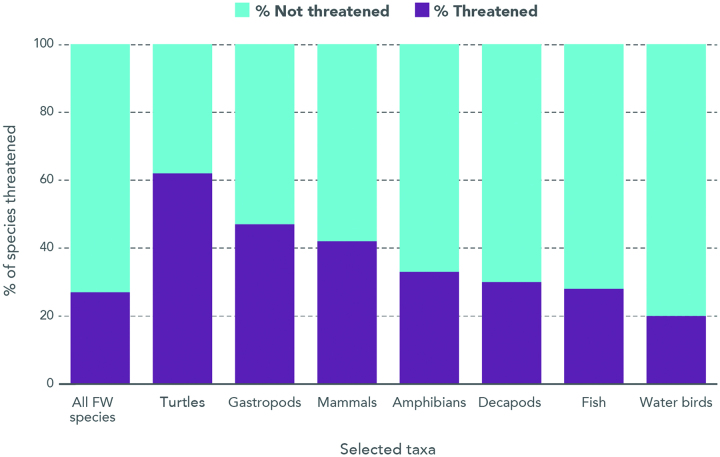
Freshwater ecosystems cover less than 1% of Earth’s surface but host approximately one-third of vertebrate species and 10% of all species; wetlands are vanishing three times faster than forests, and freshwater vertebrate populations have fallen more than twice as steeply as terrestrial or marine populations. Of 29,500 freshwater-dependent species assessed for the IUCN Red List, 27% are threatened with extinction, including an estimated 62% of turtle species, 47% of gastropods, 42% of mammals, 33% of amphibians, 30% of decapod crustaceans, 28% of fishes, and 20% of birds. Freshwater megafauna populations declined by 88% from 1970 to 2012, with the highest declines in Indomalaya (−99%) and Palearctic (−97%) realms. An estimated 30% of natural freshwater ecosystems have disappeared since 1970 and 87% of inland wetlands since 1700; only one-third of the world’s very long rivers remain free flowing, and approximately 3,700 new hydropower dams were identified worldwide at varying planning stages.
Methods
This is a policy and synthesis article, not a primary empirical study; it is structured around six priority actions derived from major causes of freshwater biodiversity loss: flow alteration, pollution, habitat degradation and loss, overexploitation, invasive nonnative species, and connectivity loss. The evidence base consists of cited global assessments, peer-reviewed literature, and implementation case studies from multiple regions, with no new field sample or primary data collection. The main analysis is a narrative review and policy-alignment exercise; Tables 1a and 1b map 13 existing or potential CBD and SDG targets and indicators to the six priority actions.
Limitations
Stated in the paper: implementation examples are “currently isolated successes”; human water demands and transboundary characteristics complicate implementation; data and science-based management are lacking for freshwater fisheries and riverine aggregate extraction; large-scale implementation of nature-based solutions is “in its infancy”; and substantial data gaps remain, including approximately 30% of freshwater mollusk species and 40% of decapod crustaceans classified as data deficient. Evident from the text: the plan is not empirically tested as a whole, relying instead on illustrative case studies and expert synthesis; the paper also notes that offsetting is controversial and open to misapplication.
Model-written summary. Check it against the paper before relying on it.
Integrity signals
Registry
Cites
Statistics
Figures
Verification
Claims the paper makes
5 Valid · 12 Not valid · 50 Not checked · 28 Own results and interpretations
Every source the paper cites for this claim was checked and supports it.
In the paper
“of the fish species assessed for the freshwater ecoregions of the world, over half were confined to a single ecoregion (Abell et al. 2008).”
§ Bending the Curve of Global Freshwater Biodiversity Loss: An Emergency Recovery Plan > Abstract
What the sources say
- Supportedcites Abell et al. 2008 matched to “Freshwater Ecoregions of the World: A New Map of Biogeographic Units for Freshwater Biodiversity Conservation” (2008) source
The “Freshwater ecoregional map and species results” section reports that more than 13,400 freshwater fish species were assigned to ecoregions and more than 6,900 to single ecoregions—over half of those assigned. No page number is supplied in the excerpt. (LLM, conf=0.94)
plain- Asserted: passes — The authors put it forward as true.
- Checkable: passes — It can be checked against evidence.
- Load-bearing: passes — The paper’s conclusions depend on it.
- Based: passes — The paper gives a reason why it holds.
- Supported
The cited sources support only part of this claim — read each source’s verdict below.
In the paper
“Recommendations to address immediate threats to and underlying drivers of global biodiversity loss have focused mainly on terrestrial ecosystems, such as forests and grasslands (e.g., Kok et al. 2018)”
§ Bending the Curve of Global Freshwater Biodiversity Loss: An Emergency Recovery Plan > Abstract
What the sources say
- Partly supportedcites Kok et al. 2018 matched to “Pathways for agriculture and forestry to contribute to terrestrial biodiversity conservation: A global scenario-study” (2018) sourceExperimental — accuracy not yet measured
Our copy supports only the exemplifying part of the attribution: Kok et al. (2018) is itself a terrestrial-scoped recommendations study — the Introduction (p. 1) states it 'evaluates the impacts on biodiversity of different response strategies in the agriculture and forestry sectors', and the Abstract and Sections 2.3/3.1–3.2 build pathways around forests, cropland and grazing land and terrestrial MSA. But no passage makes the comparative claim attributed here, namely that recommendations for global biodiversity loss have focused 'mainly' on terrestrial ecosystems; the closest statement (Introduction) is that societal responses have increased yet remain insufficient, and it credits that to Leadley et al. (2014), CBD (2014) and Tittensor et al. (2014). Aquatic biodiversity is not dismissed as neglected but explicitly handled in a separate companion analysis (Boelee et al., 2017, Introduction), so the 'mainly terrestrial' characterisation and the threats-versus-drivers distinction are not supported by this source. (LLM, conf=0.65)
plain- Asserted: passes — The authors put it forward as true.
- Checkable: passes — It can be checked against evidence.
- Load-bearing: passes — The paper’s conclusions depend on it.
- Based: passes — The paper gives a reason why it holds.
- Partly supported
In the paper
“with the highest declines in the Indomalaya and Palearctic realms (−99% and −97%, respectively; He et al. 2019).”
§ Bending the Curve of Global Freshwater Biodiversity Loss: An Emergency Recovery Plan > Abstract
What the sources say
- Not checked yetcites He et al. 2019
plain- Asserted: passes — The authors put it forward as true.
- Checkable: passes — It can be checked against evidence.
- Load-bearing: unclear — It is unclear whether the paper’s conclusions depend on it.
- Based: passes — The paper gives a reason why it holds.
In the paper
“Populations of freshwater megafauna, defined as animals that reach a body mass of 30 kilograms, declined by 88% from 1970 to 2012”
§ Bending the Curve of Global Freshwater Biodiversity Loss: An Emergency Recovery Plan > Abstract
What the sources say
- Not checked yetcites He et al. 2019
plain- Asserted: passes — The authors put it forward as true.
- Checkable: passes — It can be checked against evidence.
- Load-bearing: passes — The paper’s conclusions depend on it.
- Based: passes — The paper gives a reason why it holds.
In the paper
“Human demands for water will increase in some regions, making implementation more challenging (Palazzo et al. 2019).”
§ Bending the Curve of Global Freshwater Biodiversity Loss: An Emergency Recovery Plan > The Emergency Recovery Plan: Priorities for action > Action 1: Accelerate implementation of environmental flows
What the sources say
- Not checked yetcites Palazzo et al. 2019 matched to “Investment Needs for Irrigation Infrastructure along Different Socioeconomic Pathways” (2019) source
plainstates a cause- Asserted: passes — The authors put it forward as true.
- Checkable: passes — It can be checked against evidence.
- Load-bearing: unclear — It is unclear whether the paper’s conclusions depend on it.
- Based: passes — The paper gives a reason why it holds.
40 more claims
Create a free account to see all 95 claims and to verify the 58 references still open.
- It may state two separate claims as one. 29
- Probably not a substantial claim. 30
Claims other papers make about this one
Each is checked against this paper’s own text: does it say what the citing paper says it does?
The check wasn’t confident either way, so it gives no verdict — never disputed.
In the citing paper
“Hunting at Parker River National Wildlife Refuge represents both a traditional recreational use and serves as an important wildlife management tool.185”
From Protecting and restoring habitats to benefit freshwater biodiversity (2024) · cites this paper as [185]
Experimental — accuracy not yet measured
Citations
Cites
Freshwater biodiversity: importance, threats, status and conservation challenges
Dudgeon, D., Arthington, A. H., Gessner, M. O., Kawabata, Z., Knowler, D. J., Lévêque, C., Naiman, R. J., Prieur‐Richard, A., Soto, D., Stiassny, M. L. J., et al. (2006) · Biological Reviews · doi:10.1017/s1464793105006950 · Cited by 8,489
Self-citationPoff, N. L., Allan, J. D., Bain, M. B., Karr, J. R., Prestegaard, K. L., Richter, B. D., Sparks, R. E., & Stromberg, J. C. (1997) · BioScience · doi:10.2307/1313099 · Cited by 6,500
Pimentel, D., Zuniga, R., & Morrison, D. (2005) · Ecological Economics · doi:10.1016/j.ecolecon.2004.10.002 · Cited by 4,771
Emerging threats and persistent conservation challenges for freshwater biodiversity
Reid, A. J., Carlson, A. K., Creed, I. F., Eliason, E. J., Gell, P. A., Johnson, P. T. J., Kidd, K. A., MacCormack, T. J., Olden, J. D., Ormerod, S. J., et al. (2019) · Biological Reviews · doi:10.1111/brv.12480 · Cited by 3,645
Self-citationBasic Principles and Ecological Consequences of Altered Flow Regimes for Aquatic Biodiversity
BUNN, S. E., & ARTHINGTON, A. H. (2002) · Environmental Management · doi:10.1007/s00267-002-2737-0 · Cited by 3,379
Self-citationCeballos, G., Ehrlich, P. R., & Dirzo, R. (2017) · Proceedings of the National Academy of Sciences · doi:10.1073/pnas.1704949114 · Cited by 2,663
Mapping the world’s free-flowing rivers
Grill, G., Lehner, B., Thieme, M., Geenen, B., Tickner, D., Antonelli, F., Babu, S., Borrelli, P., Cheng, L., Crochetiere, H., et al. (2019) · Nature · doi:10.1038/s41586-019-1111-9 · Cited by 2,473
Self-citationA global boom in hydropower dam construction
Zarfl, C., Lumsdon, A. E., Berlekamp, J., Tydecks, L., & Tockner, K. (2015) · Aquatic Sciences · doi:10.1007/s00027-014-0377-0 · Cited by 2,181
Self-citationHow much wetland has the world lost? Long-term and recent trends in global wetland area
Davidson, N. C. (2014) · Marine and Freshwater Research · doi:10.1071/mf14173 · Cited by 2,177
Abell, R., Thieme, M. L., Revenga, C., Bryer, M., Kottelat, M., Bogutskaya, N., Coad, B., Mandrak, N., Balderas, S. C., Bussing, W., et al. (2008) · BioScience · doi:10.1641/b580507 · Cited by 2,045
Self-citation
Research works printed but not linked: 14
- Döll P, Bunn SE. 2014 Cross-chapter box on the impact of climate change on freshwater ecosystems due to altered river flow regimes. Pages 143– 146 in Field CB et al., eds. Climate Change Impacts, Adaptation, and Vulnerability. Part A: Global and Sectoral Aspects. Contribution of Working Group II to the Fifth Assessment Report of the Intergovernmental Panel on Climate Change. Cambridge University Press.
- Fricke R, Eschmeyer W, van der Laan R 2019 Catalog of fishes: Genera, species, references. California Academy of Sciences. http://researcharchive.calacademy.org/research/ichthyology/catalog/SpeciesByFamily.asp.
- Funge-Smith S. 2018 Review of the State of the World Fishery Resources: Inland Fisheries. Food and Agriculture Organization of the United Nations Fisheries and Aquaculture Circular.
- Harwood A, Johnson S, Richter B, Locke A, Yu X, Tickner D 2017 Listen to the River: Lessons from a Global Review of Environmental Flow Success Stories. World Wildlife Fund.
- [IUCN] International Union for Conservation of Nature 2019 The IUCN Red List of Threatened Species, version 2019-1. IUCN www.iucnredlist.org.
- Koehnken L, Rintoul M. 2018 Impacts of Sand Mining on Ecosystem Structure, Process and Biodiversity in Rivers. World Wildlife Fund International.
- Koning AA. 2018 Riverine Reserves: The Conservation Benefits of Spatial Protection for Rivers in the Context of Environmental Change. University of Wisconsin–Madison.
- Le Quesne T, Kendy E, Weston D 2010 The Implementation Challenge: Taking Stock of Government Policies to Protect and Restore Environmental flows. WWF and The Nature Conservancy.
- Moir K, Thieme M, Opperman J 2016 Securing a Future that Flows: Case Studies of Protection Mechanisms for Rivers. World Wildlife Fund and The Nature Conservancy.
- NBI (Nile Basin Initiative) 2016 Strategy for Management of Environmental Flows in the Nile Basin. Nile Basin Initiative Secretariat. 17p.
- Opperman J et al. 2019a Connected and Flowing: A Renewable Future for Rivers, Climate, and People. WWF and The Nature Conservancy.
- Speed R, Tickner D, Naiman R, Gang L, Sayers P, Yu W, Yuanyuan L, Houjian H, Jianting C, Lili Y 2016 River Restoration: A Strategic Approach to Planning and Management. UNESCO.
- [UNEP] United Nations Environment Programme 2016 Snapshot of the World's Water Quality: Towards a Global Assessment. UNEP.
- UN Environment 2017 A Framework for Freshwater Ecosystem Management, vol. 2: Technical Guide for Classification and Target-Setting. United Nations.
Cited by
Items 301–400 of 1,243
Maliao, R. J., Cahilig, R. C., Cahilig, R. R., & Jaspe, B. T. (2023) · Environment Development and Sustainability · doi:10.1007/s10668-023-04096-x · Cited by 25
“…to multiple threats, such as overexploita-tion, pollution, habitat degradation, and invasive species, and their interacting impacts are magnified by global climate change (CC) (Rivaes et al., 2021; Su et al., 2021; Tickner et al., 2020; Dudgeon, 2019; Jha et al., 2019a, 2019b; Reid et al., 2019).”
Nabout, J. C., Tessarolo, G., Pinheiro, G. H. B., Márquez, L. A. M., & de Carvalho, R. A. (2021) · Global Ecology and Conservation · doi:10.1016/j.gecco.2021.e01958 · Cited by 21
Dai, X., Webb, J. A., Horne, A., Rumpff, L., & Palmer, M. A. (2024) · Journal of Environmental Management · doi:10.1016/j.jenvman.2024.123694 · Cited by 19
Freshwater Fishes of Central America: Distribution, Assessment, and Major Threats
Contreras‐MacBeath, T., Ardón, D. A., Quintana, Y., Angulo, A., Lyons, T., Lardizabal, C. C., McMahan, C. D., Elías, D. J., Matamoros, W. A., Barraza, J. E., et al. (2022) · Diversity · doi:10.3390/d14100793 · Cited by 20
Mining threats in high‐level biodiversity conservation policies
Torres, A., zu Ermgassen, S. O. S. E., Navarro, L. M., Ferri‐Yanez, F., Teixeira, F. Z., Wittkopp, C., Rosa, I. M. D., & Liu, J. (2024) · Conservation Biology · doi:10.1111/cobi.14261 · Cited by 15
“Likewise, reducing the overexploitation of aggregates is considered a top priority for slowing global freshwater biodiversity loss (Tickner et al., 2020).”
BackgroundTracking aquatic animals for fisheries management in European waters
Özgül, A., Birnie‐Gauvin, K., Abecasis, D., Alós, J., Aarestrup, K., Reubens, J., Bolland, J. D., Lök, A., Edwards, J. E., Pengal, P., et al. (2024) · Fisheries Management and Ecology · doi:10.1111/fme.12706 · Cited by 20
Mining threats in high-level biodiversity conservation policies
Torres, A., zu Ermgassen, S. O. S. E., Navarro, L. M., Ferri-Yanez, F., Teixeira, F. Z., Wittkopp, C., Rosa, I. M. D., & Liu, J. (2023) · doi:10.1101/2023.07.30.550308 · Cited by 15
Wang, Y., Ge, J., Zhang, Y., Lu, J., Zhang, Y., & Ma, F. (2024) · Ecological Indicators · doi:10.1016/j.ecolind.2024.112038 · Cited by 18
Freshwater conservation: Lost in limnology?
Barouillet, C., González‐Trujillo, J. D., Geist, J. P., Gíslason, G. M., Grossart, H., Irvine, K., Jähnig, S. C., & Boon, P. J. (2023) · Aquatic Conservation Marine and Freshwater Ecosystems · doi:10.1002/aqc.4049 · Cited by 19
New paths for modelling freshwater nature futures
Kramer, L., Teurlincx, S., Rashleigh, B., Janssen, A. B. G., Janse, J. H., Brauman, K. A., Földesi, C., van Wijk, D., Domis, L. N. D. S., Patil, S. D., et al. (2023) · Sustainability Science · doi:10.1007/s11625-023-01341-0 · Cited by 22
“Existing calls to unite efforts for freshwater biodiversity science and conservation [i.e. ‘Alliance for Freshwater Life’ (Darwall et al. 2018), the ‘Emergency Recovery Plan’ (Tickner et al. 2020), the ‘Recommendations for Safeguarding Freshwater life beyond 2020’ (van Rees et al. 2021)] and the IPBES invitation to mo…”
InfluentialGeo‐eco‐hydrology of the Upper Yellow River
Brierley, G., Han, M., Li, X., Li, Z., & Huang, H. Q. (2022) · Wiley Interdisciplinary Reviews Water · doi:10.1002/wat2.1587 · Cited by 23
“Looking after good condition rivers before they become degraded is a critical component of proactive and precautionary management plans (Tickner et al., 2020; Tockner & Stanford, 2002).”
BackgroundPoint source pollution influences water quality of Patagonian streams more than land cover
Williams‐Subiza, E. A., Assef, Y. A., & Brand, C. (2022) · River Research and Applications · doi:10.1002/rra.3881 · Cited by 15
Schweizer, V., Colloff, M. J., & Pittock, J. (2022) · Environmental Management · doi:10.1007/s00267-022-01692-x · Cited by 17
“As the conservation of wetlands has become increasingly challenging and contested (Green et al. 2017), so priority actions are being considered that go beyond just formal designation in protected areas, which has been considered ‘inconsistently effective’ (Tickner et al. 2020, p. 334).”
BackgroundAfrica's Living Rivers: Managing for Sustainability
King, J. M., & Brown, C. A. (2021) · Daedalus · doi:10.1162/daed_a_01882 · Cited by 19
Offsetting connectivity loss in rivers: Towards a no-net-loss approach for barrier planning
Hermoso, V., & Filipe, A. F. (2021) · Biological Conservation · doi:10.1016/j.biocon.2021.109043 · Cited by 15
Community assembly, functional traits and phylogeny in Himalayan river birds
Sinha, A., Chatterjee, N., Krishnamurthy, R., & Ormerod, S. (2022) · doi:10.22541/au.164390436.66192037/v1 · Cited by 22
Self-citationWegscheider, B., Monk, W. A., Lento, J., Haralampides, K. A., Ndong, M., Linnansaari, T., & Curry, R. A. (2022) · Ecological Indicators · doi:10.1016/j.ecolind.2022.109821 · Cited by 17
Fish community composition in small lakes: The impact of lake genesis and fisheries management
Matern, S., Klefoth, T., Wolter, C., Hussner, A., Simon, J., & Arlinghaus, R. (2022) · Freshwater Biology · doi:10.1111/fwb.14001 · Cited by 19
Montanari, I., Bernardini, N., Gizzi, G., Bolpagni, R., Buldrini, F., Campione, L., Castellari, I., Landi, S., Spiezia, L., & Chiarucci, A. (2022) · Landscape and Ecological Engineering · doi:10.1007/s11355-022-00504-y · Cited by 15
Accelerated human-induced extinction crisis in the world's freshwater mammals
Torres‐Romero, E. J., Fisher, J. T., Nijman, V., He, F., & Eppley, T. M. (2024) · Global Environmental Change Advances · doi:10.1016/j.gecadv.2024.100006 · Cited by 20
Research and innovation missions to transform future water systems
Smith, D. M., Gordon, C., Kittikhoun, A., et al. (2023) · Nature Water · doi:10.1038/s44221-023-00049-w · Cited by 14
Análise Bibliométrica da Qualidade da Água: Uma Perspectiva para a Preservação Ambiental
Abraão, R. P., Sampaio, N. A. D. S., Muhlen, C. V., Reis, J. S. D. M., Colombari, C. V., & Dantas, C. L. R. (2024) · Revista de Gestão Social e Ambiental · doi:10.24857/rgsa.v18n2-096 · Cited by 75
“Esta questão é um dos Objetivos de Desenvolvimento Sustentável (ODS) da Agenda 2030, o ODS 6: Água potável e saneamento (Karthikeyan et al., 2020; Tickner et al., 2020; S. Zhang et al., 2021).”
BackgroundKEYSER, J. D., Hayes, D. S., Marti, B., Siegfried, T., Seliger, C., Schwedhelm, H., Anarbekov, O., Gafurov, Z., Fernández, R. M. L., Ramos‐Diez, I., et al. (2023) · Water · doi:10.3390/w15193482 · Cited by 22
Velde, K. T., Mairo, A., Peeters, E. T. H. M., Winter, H. V., Tudorache, C., & Slabbekoorn, H. (2024) · Environmental Pollution · doi:10.1016/j.envpol.2024.124517 · Cited by 27
Evaluating effectiveness of restoration to address current stressors to riverine fish
Rogosch, J. S., Boehm, H. I. A., Tingley, R. W., Wright, K. D., Webb, E. B., & Paukert, C. P. (2024) · Freshwater Biology · doi:10.1111/fwb.14232 · Cited by 25
Mohan, C., Gleeson, T., Famiglietti, J. S., Virkki, V., Kummu, M., Porkka, M., Wang-Erlandsson, L., Huggins, X., Gerten, D., & Jähnig, S. C. (2022) · Hydrology and Earth System Sciences · doi:10.5194/hess-26-6247-2022 · Cited by 14
“There has been an increased recognition in recent decades of the need to maintain a natural flow regime in streams to sustain healthy ecosystems (Horne et al., 2017; Poff et al., 1997, 2017; Tickner et al., 2020; Tonkin et al., 2021).”
BackgroundDiniz, L. P., Petsch, D. K., Mantovano, T., Rodrigues, L. C., Agostinho, Â. A., & Bonecker, C. C. (2023) · Hydrobiologia · doi:10.1007/s10750-023-05140-7 · Cited by 26
“We’re gonna die!” Do Brazilian conservation units provide protection to the Amazonian chelonians?
Sousa, L. M., Correia, L. L., Alexandre, R. J. R., Pena, S. A., & Vieira, T. B. (2023) · doi:10.21203/rs.3.rs-3730610/v1 · Cited by 14
Mohan, C., Gleeson, T., Famiglietti, J. S., Virkki, V., Kummu, M., Porkka, M., Huggins, X., Wang-Erlandsson, L., Gerten, D., & Jähnig, S. C. (2022) · doi:10.1002/essoar.10507838.2 · Cited by 14
Šigutová, H., Pyszko, P., Bílková, E., & Dolný, A. (2025) · Global Change Biology · doi:10.1111/gcb.70183 · Cited by 16
Hu, X., Tlili, A., Schirmer, K., Bao, M., & Bürgmann, H. (2025) · Environment International · doi:10.1016/j.envint.2025.109465 · Cited by 13
Participatory planning to conserve freshwater ecosystems in the Rift Valley Lakes Basin, Ethiopia
Mekuria, W., Girma, R., Haileslassie, A., et al. (2024) · Journal for Nature Conservation · doi:10.1016/j.jnc.2024.126564 · Cited by 13
Cao, Y., Wang, S., Tian, G., Dong, N., & Lei, Y. (2023) · Land · doi:10.3390/land12061250 · Cited by 14
Cochran, J. K., Banks, C., & Buchwalter, D. B. (2023) · Journal of Experimental Biology · doi:10.1242/jeb.246376 · Cited by 17
Merleau, L.-A., Lourdais, O., Olivier, A., Vittecoq, M., Blouin‐Demers, G., Alliot, F., Burkart, L., Foucault, Y., Leray, C., Migne, E., et al. (2023) · Environmental Pollution · doi:10.1016/j.envpol.2023.122903 · Cited by 13
“Over the past decades, freshwater biodiversity decline has outpaced terrestrial biodiversity decline, especially for vertebrates (Reid et al., 2019; Dudgeon, 2019; Revenga et al., 2005; Tickner et al., 2020).”
Ibrahim, A., Höckendorff, S., Schleheck, D., Epp, L. S., van Kleunen, M., & Meyer, A. (2022) · Environmental DNA · doi:10.1002/edn3.292 · Cited by 10
“…archive of both biotic and abiotic changes in lake catchments and therefore, allow to study the effects of both natural and anthropogenic environmental changes on biological communities through time (Giguet- Covex et al., 2014; Pansu et al., 2015; Tickner et al., 2020; Zimmermann et al., 2017).”
BackgroundWater on fire: losses and the post-war future of ecosystem services from water resources of Ukraine
Hapich, H., Novitskyi, R. O., Onopriienko, D., & Dubov, T. (2024) · Regional Environmental Change · doi:10.1007/s10113-024-02320-6 · Cited by 24
“Scientists today are especially concerned about the fast decline of freshwater biodiversity in Europe (Reid et al. 2018; Tickner et al. 2020).”
Multiple‐stressor effects on leaf litter decomposition in freshwater ecosystems: A meta‐analysis
Madariaga, G. M., Ferreira, V., Arora, R., Mansour, I., David, G. M., Jähnig, S. C., & He, F. (2024) · Functional Ecology · doi:10.1111/1365-2435.14571 · Cited by 18
Conserving Freshwater Ecosystems in India: A call to action
Arora, R., Balachander, T., Agrawal, I., Panda, R., Gupta, D. K., Kasturirangan, A., Vencatesan, J., Sivakumar, K., Kumar, R., Mathur, V. B., et al. (2024) · Aquatic Conservation Marine and Freshwater Ecosystems · doi:10.1002/aqc.4165 · Cited by 15
Hu, P., Zeng, Q., Wang, J., Hou, J., Wang, H. E., Yang, Z., Liu, H., & Zhao, Y. (2021) · Journal of Environmental Management · doi:10.1016/j.jenvman.2021.112572 · Cited by 13
Exploring the Biodiversity of a European NATURA 2000 Mediterranean Lagoon through eDNA Metabarcoding
Specchia, V., Saccomanno, B., Zangaro, F., Tzafesta, E., & Pinna, M. (2022) · Diversity · doi:10.3390/d14110991 · Cited by 16
Ecological Monitoring and Assessment of Freshwater Ecosystems: New Trends and Future Challenges
Stefanidis, K., & Papastergiadou, E. (2024) · Water · doi:10.3390/w16111460 · Cited by 20
Assessing synergistic impacts of climate change and anthropogenic stressors on freshwater ecosystems
Sidibe, G., Sumana, S. L., Shuaibu, A., & Xu, L. (2026) · Biodiversity and Conservation · doi:10.1007/s10531-026-03272-5 · Cited by 19
“Despite their importance, freshwater ecosystems are facing increasing threats from human activities and environmental changes (Tickner et al. 2020; Sidibe et al. 2025).”
Shephard, S., Edwards, K., George, S., Joseph, E., James, S., David, O., Persaud, A., Watson, L. C., & van Vliet, N. (2022) · Fisheries Management and Ecology · doi:10.1111/fme.12604 · Cited by 14
Bett, N. N., Hinch, S. G., Bass, A. L., Braun, D. C., Burnett, N. J., Casselman, M. T., Cooke, S. J., Drenner, S. M., Gelchu, A., Harrower, W. L., et al. (2020) · Hydrobiologia · doi:10.1007/s10750-020-04371-2 · Cited by 15
“The implementation of well-planned, integrative research could play a key role in helping us track losses to biodiversity and identify potential actions for mitigation related to environmental flows and connectivity (Tickner et al., 2020).”
BackgroundSelf-citationGilja, G., Ocvirk, E., & Fliszar, R. (2021) · Applied Sciences · doi:10.3390/app11167708 · Cited by 14
“, reducing sediment transport and disabling migratory species to travel along the river course, which in turn has a negative impact on the river’s ecological status [3], as sometimes the needs of fish populations cannot be met within a single habitat [4].”
BackgroundCommunity perceptions of environmental water: a review
Kosovac, A., Horne, A., & O’Donnell, E. L. (2023) · Environmental Conservation · doi:10.1017/s0376892923000036 · Cited by 12
“This ongoing disputation prompted global action to protect ecological systems of waterways, thus giving rise to the concept of ‘environmental water’ in the 1990s (Poff et al. 1997, Tickner et al. 2020).”
BackgroundApplying Optimization to Support Adaptive Water Management of Rivers
Derepasko, D., Peñas, F. J., Barquín, J., & Völk, M. (2021) · Water · doi:10.3390/w13091281 · Cited by 26
Fish telemetry in African inland waters and its use in management: a review
Burnett, M. J., O'Brien, G. C., Jacobs, F. J., Jewitt, G. P. W., & Downs, C. T. (2021) · Reviews in Fish Biology and Fisheries · doi:10.1007/s11160-021-09650-2 · Cited by 14
Curtis-Quick, J., ULANOV, A. V., Li, Z., Bieber, J. F., Tucker‐Retter, E. K., & Suski, C. D. (2021) · PLoS ONE · doi:10.1371/journal.pone.0258150 · Cited by 13
Full floodplain connectivity: Realising opportunities for ‘Stage 0’ river restoration
Clarke, S. J. (2024) · River Research and Applications · doi:10.1002/rra.4283 · Cited by 15
“Of the six priority areas suggested as a recovery plan for freshwater biodiversity (Tickner et al., 2020), two directly relate to the science and practice of river restoration: protect and restore critical habitats and safeguard and restore freshwater connectivity .”
Šmejkal, M., Kalous, L., Auwerx, J., Gorule, P. A., Jarić, I., Dočkal, O., Fedorčák, J., Muška, M., Thomas, K., Takács, P., et al. (2024) · Biological Conservation · doi:10.1016/j.biocon.2024.110948 · Cited by 23
Centering 30 × 30 conservation initiatives on freshwater ecosystems
Moravek, J. A., Andrews, L. R., Serota, M. W., Dorcy, J. A., Chapman, M., Wilkinson, C. E., Parker‐Shames, P., Van Scoyoc, A., Verta, G., & Brashares, J. S. (2023) · Frontiers in Ecology and the Environment · doi:10.1002/fee.2573 · Cited by 12
“Indeed, recent studies demonstrate that land-based conservation initiatives that lack explicit freshwater priorities often deprioritize and contribute to the decline of freshwater habitats and species (Tickner et al .”
BackgroundCharacterizing dam fragmentation impacts on freshwater fish within life cycle impact assessment
de Visser, S., Barbarossa, V., Keijzer, T., Verones, F., & Dorber, M. (2025) · Environmental Impact Assessment Review · doi:10.1016/j.eiar.2025.107929 · Cited by 12
Extreme events and river biodiversity under climate change
Tonkin, J. D., Siqueira, T., Merder, J., Datry, T., Poff, N. L., Talbot-Jones, J., & Olden, J. D. (2026) · Nature Reviews Biodiversity · doi:10.1038/s44358-026-00131-7 · Cited by 34
Self-citationFish habitat models for a future of novel riverscapes
Hansen, H. H., Comoglio, C., Elings, J., Ericsson, P. S., Goethals, P. L. M., Gosselin, M., Hölker, F., Katopodis, C., Kemp, P. S., Lind, L. A., et al. (2024) · BioScience · doi:10.1093/biosci/biae081 · Cited by 12
“Current fish habitat models support evidence-based decision-making as the freshwater biodiversity crisis continues (Tickner et al.2020 ), but they exhibit numerous shortcomings that limit their full usefulness especially under the novel riverscape concept.”
BackgroundThe importance of ecotype diversity on duckweed growth with and without salt stress
van Moorsel, S. J. (2022) · Journal of Plant Ecology · doi:10.1093/jpe/rtac054 · Cited by 12
Arnbjerg‐Nielsen, K., Gain, A. K., Keskinen, M., Varis, O., & McKnight, U. S. (2022) · Hydrological Sciences Journal · doi:10.1080/02626667.2022.2077651 · Cited by 15
Protected areas maintain neotropical freshwater bird biodiversity in the face of human activity
Barocas, A., Tobler, M. W., Valladares, N. A., Pardo, A. A., Macdonald, D. W., & Swaisgood, R. R. (2023) · Ecological Indicators · doi:10.1016/j.ecolind.2023.110256 · Cited by 15
McLoughlin, C. A., Riddell, E., Petersen, R. M., & Venter, J. S. (2021) · Koedoe · doi:10.4102/koedoe.v63i1.1663 · Cited by 15
Campbell, C. J., Lovett, S., Capon, S. J., Thompson, R. M., & Dyer, F. J. (2023) · Environmental Management · doi:10.1007/s00267-023-01900-2 · Cited by 12
“The need to protect and restore these systems is well recognised globally (Arthington 2021; Tickner et al. 2020), with environmental fl ows or environmental water management (EWM) identi fi ed as a major priority (Anderson et al. 2019; Arthington et al. 2018; Maia 2017).”
Mitigating the cumulative effects of hydropower and climate change on riverine fishes
Bao, J., Twardek, W. M., Zhang, C., Li, W., Mi, X.-Y., Zhang, D., Wu, J., Jiang, H., Cooke, S. J., & Duan, M. (2023) · Reviews in Fish Biology and Fisheries · doi:10.1007/s11160-023-09766-7 · Cited by 17
“Doing so will be critical if we are to meet the call to action to save riverine fishes (Tickner et al. 2020).”
BackgroundSelf-citationTipping points in freshwater ecosystems: an evidence map
de la Riva, A. H. M., Harper, M., Rytwinski, T., Sahdra, A., Taylor, J. J., Bard, B., Bennett, J., Burton, D., Creed, I. F., Haniford, L. S. E., et al. (2023) · Frontiers in Freshwater Science · doi:10.3389/ffwsc.2023.1264427 · Cited by 15
Self-citationMicroreserves are an important tool for amphibian conservation
Steigerwald, E., Chen, J., Oshiro, J., Vredenburg, V. T., Catenazzi, A., & Koo, M. S. (2024) · Communications Biology · doi:10.1038/s42003-024-06510-0 · Cited by 18
“If we are to meet30×30 goals, we must expand the current PAnetworkbyanadditional22millionkm 2 inthenext7years,providingan incredible opportunity to think explicitly about how we might shore up the shortcomings of the current PA network for those taxa it is currently failing 18,19,29 .”
BackgroundThe costs of subsidies and externalities of economic activities driving nature decline
Reyes‐García, V., Villasante, S., Benessaiah, K., Pandit, R., Agrawal, A., Claudet, J., Garibaldi, L. A., Kabisa, M., Pereira, L. M., & Zinngrebe, Y. M. (2025) · AMBIO · doi:10.1007/s13280-025-02147-3 · Cited by 25
“In this context, governments, international organizations, civil society, and some actors in the corporate sector agree that systemic change is urgently needed to protect biodiversity and restore ecosystems (Lecle`re et al. 2020; Tickner et al. 2020; Irvine-Broque and Dempsey 2023; Obura 2023).”
A heuristic tool to assess regional impacts of renewable energy infrastructure on conservation areas
Troia, M. J., McManamay, R. A., Kao, S., & O’Connor, P. (2021) · Biological Conservation · doi:10.1016/j.biocon.2021.109334 · Cited by 10
Taxonomic and functional homogenisation of zooplankton after river damming in Central Brazil
Silva, I. G. D., Colares, L. F., Palheta, L., et al. (2023) · Freshwater Biology · doi:10.1111/fwb.14165 · Cited by 11
Cooke, S. J., Piczak, M. L., Vermaire, J. C., & Kirkwood, A. E. (2023) · FACETS · doi:10.1139/facets-2022-0210 · Cited by 15
Self-citationHow effective is community-based management of freshwater resources? A review
Karres, N., Kang, S., Aldous, A. R., Pattison‐Williams, J. K., & Masuda, Y. J. (2022) · Journal of Environmental Management · doi:10.1016/j.jenvman.2022.116161 · Cited by 21
Tracking a blue wave of ephemeral water across arid southern Africa
Schaffer‐Smith, D., Swift, M., Killea, A., Brennan, A., Naidoo, R., & Swenson, J. J. (2022) · Environmental Research Letters · doi:10.1088/1748-9326/ac98d9 · Cited by 10
Maloney, K. O., Krause, K. P., Cashman, M. J., Daniel, W. M., Gressler, B. P., Wieferich, D. J., & Young, J. A. (2021) · Ecological Indicators · doi:10.1016/j.ecolind.2021.108488 · Cited by 12
Ulaski, M. E., Warkentin, L., Naman, S. M., et al. (2023) · River Research and Applications · doi:10.1002/rra.4200 · Cited by 11
“Therefore, implementing environmental flows and improving water quality are important actions toward reducing the loss of freshwater biodiversity (Tickner et al., 2020).”
BackgroundUrban Areas Create Refugia for Odonates in a Semi-Arid Region
Husband, D. M., & McIntyre, N. E. (2021) · Insects · doi:10.3390/insects12050431 · Cited by 13
Effects of repeated sediment bypassing on stream ecosystems in a Japanese mountainous river
Sueyoshi, M., Miyagawa, Y., Onoda, Y., Hotta, T., KAYABA, Y., & Nakamura, K. (2023) · Restoration Ecology · doi:10.1111/rec.14049 · Cited by 13
“Therefore, restoring the fl ow and sediment regimes is an urgent issue for river restoration (Tickner et al. 2020).”
BackgroundWineland, S. M., Fovargue, R. E., Gill, K. C., Rezapour, S., & Neeson, T. M. (2020) · People and Nature · doi:10.1002/pan3.10169 · Cited by 12
“Climate change and human activities are impacting ecosystems globally, directly contributing to biodiversity loss and threatening human well-being (Díaz et al., 2019; Green et al., 2019; Reside et al., 2018; Scheffers & Pecl, 2019; Tickner et al., 2020).”
BackgroundHarmonizing smart city tech and anthropocentrism for climate resilience and Nature's benefit
Sikandar, S. M., Ali, S. M., & Hassan, Z. (2024) · Social Sciences & Humanities Open · doi:10.1016/j.ssaho.2024.101026 · Cited by 21
Sethi, S. A., Carey, M. P., Gerken, J., Harris, B. P., Wolf, N., Cunningham, C. J., Restrepo, F., & Ashline, J. (2022) · Ecosphere · doi:10.1002/ecs2.4192 · Cited by 15
Zheng, J., Lei, W., & Li, C. (2023) · Forests · doi:10.3390/f14112205 · Cited by 14
Yang, T., Jiang, J., Shi, F., Cai, R., Jiang, H., Sheng, L., & He, C. (2024) · Ecological Engineering · doi:10.1016/j.ecoleng.2024.107376 · Cited by 12
Influence of anthropocene climate change on biodiversity loss in different ecosystems
Nath, S., Shyanti, R. K., & Nath, Y. (2021) · Elsevier eBooks · doi:10.1016/b978-0-12-822928-6.00001-0 · Cited by 16
A meeting framework for inclusive and sustainable science
Blackman, R. C., Bruder, A., Burdon, F. J., Convey, P., Funk, W. C., Jähnig, S. C., Kishe, M. A., Moretti, M. S., Natugonza, V., Pawlowski, J. W., et al. (2020) · Nature Ecology & Evolution · doi:10.1038/s41559-020-1190-x · Cited by 11
Martelo, J., Gkenas, C., Ribeiro, D., Alves, M. J., Ribeiro, F., Cucherousset, J., Gago, J., & Magalhães, M. F. (2024) · The Science of The Total Environment · doi:10.1016/j.scitotenv.2024.172517 · Cited by 12
Stevens, E. R., Hyde, J., Beesley, L., Gwinn, D. C., Thompson, S., Morris, L., Wilson, P. R., & Gleeson, D. B. (2024) · Environmental DNA · doi:10.1002/edn3.70040 · Cited by 14
On the shape and origins of the freshwater species–area relationship
Passy, S. I., Mruzek, J. L., Budnick, W. R., Leboucher, T., Jamoneau, A., Chase, J. M., Soininen, J., Sokol, E. R., Tison‐Rosebery, J., Vilmi, A., et al. (2023) · Ecology · doi:10.1002/ecy.3917 · Cited by 11
Wałęga, A., Kędzior, R., Skalski, T., & Młyński, D. (2025) · Ecological Indicators · doi:10.1016/j.ecolind.2025.113082 · Cited by 12
Maximizing Benefits to Nature and Society in Techno-Ecological Innovation for Water
Dekker, I., Sharifyazd, S., Batung, E. S., & Dubrawski, K. L. (2021) · Sustainability · doi:10.3390/su13116400 · Cited by 13
“32 trillion USD is needed annually for water infrastructure just to maintain business-as-usual [6], and changes in environmental flows and water quality are dramatically impacting terrestrial and aquatic biodiversity [7].”
BackgroundCerasoli, F., Fiasca, B., Lorenzo, T. D., Lombardi, A., Tomassetti, B., Lorenzi, V., Vaccarelli, I., Cicco, M. D., Petitta, M., & Galassi, D. M. P. (2023) · Frontiers in Environmental Science · doi:10.3389/fenvs.2023.1051295 · Cited by 11
“Groundwater ecosystems have been scarcely investigated compared to their surface counterparts (Alley et al., 2016; Boulton, 2020; Tickner et al., 2020; Iannella et al., 2021; Visser et al., 2022), although the two are closely interdependent and, according to Famiglietti (2014), they should be conjunctively managed as…”
BackgroundMoberg, T., Abell, R., Dudley, N., Harrison, I. J., Kang, S., Loures, F. R., Shahbol, N., Thieme, M. L., & Timmins, H. (2024) · doi:10.2305/zokc6253 · Cited by 21
Self-citationNakamura, K., Guerrero‐Campo, J., Ginés, E., Mesquita‐Joanes, F., Alcántara, M., & Sousa, R. (2022) · Hydrobiologia · doi:10.1007/s10750-022-04942-5 · Cited by 18
Malcher, J., Critchell, K., Matthews, T. G., & Lester, R. E. (2023) · The Science of The Total Environment · doi:10.1016/j.scitotenv.2023.165342 · Cited by 11
High nutrient loads hinder successful restoration of natural habitats in freshwater wetlands
Moeslund, J. E., Andersen, D. K., Brunbjerg, A. K., Bruun, H. H., Fløjgaard, C., McQueen, S. N., Nygaard, B., & Ejrnæs, R. (2023) · Restoration Ecology · doi:10.1111/rec.13796 · Cited by 11
Freshwater fish personalities in the Anthropocene
Fudali, A., & Pietrzak, B. (2024) · Ecohydrology & Hydrobiology · doi:10.1016/j.ecohyd.2024.01.002 · Cited by 13
Research networks should improve connectivity for halting freshwater insect extinctions
Valente‐Neto, F., Borges, A. C. P., Urbieta, G. L., Samways, M. J., & Roque, F. D. O. (2021) · Ecological Entomology · doi:10.1111/een.13091 · Cited by 11
“Solutions are now urgently required for managing freshwater systems and their inhabitants (Palmer et al., 2014; Samways et al., 2020; Tickner et al., 2020).”
BackgroundInfluentialCerrilla, C., Afrika, J., Impson, D., Jordaan, M. S., Kotze, N., Paxton, B. R., Reed, C., Schumann, M., van der Walt, J. A., & Shelton, J. M. (2022) · Aquatic Conservation Marine and Freshwater Ecosystems · doi:10.1002/aqc.3785 · Cited by 13
Identifying Riparian Areas of Free Flowing Rivers for Legal Protection: Model Region Mongolia
Surenkhorloo, P., Chimeddorj, B., Dolgorjav, S., Bazarsad, C.-O., Zamba, B., Bayarsaikhan, S., & Heiner, M. (2021) · Sustainability · doi:10.3390/su13020551 · Cited by 15
Cooke, S. J., & Birnie‐Gauvin, K. (2022) · Socio-Ecological Practice Research · doi:10.1007/s42532-022-00129-3 · Cited by 10
Self-citationNawa, N., South, J., Ellender, B. R., Pegg, J., Madzivanzira, T. C., & Wasserman, R. J. (2024) · Freshwater Biology · doi:10.1111/fwb.14308 · Cited by 13
Karádi-Kovács, K., Boda, P., Csabai, Z., Deák, C., Móra, A., Szivák, I., & Schmera, D. (2023) · Hydrobiologia · doi:10.1007/s10750-023-05186-7 · Cited by 14
Citizen Science as a Monitoring Tool in Aquatic Ecology: Trends, Gaps, and Future Perspectives
Lameira, H. L. N., Guerrero-Moreno, M. A., da Silva, E. C., Oliveira, F. A., Teodósio, M. A., Dias‐Silva, K., Moura, J. F., Juen, L., & de Oliveira, J. M. B. (2025) · Sustainability · doi:10.3390/su17114972 · Cited by 20
Marín, D. M., Lasso, C. A., & Gaitan, S. J. C. (2024) · Frontiers in Ecology and Evolution · doi:10.3389/fevo.2024.1409296 · Cited by 91
Metadata
- Authors
- Tickner, D., Opperman, J. J., Abell, R., Acreman, M., Arthington, A. H., Bunn, S. E., Cooke, S. J., Dalton, J., Darwall, W., Edwards, G., Harrison, I., Hughes, K., Jones, T., Leclère, D., Lynch, A. J., Leonard, P., McClain, M. E., Muruven, D., Olden, J. D., Ormerod, S. J., Robinson, J., Tharme, R. E., Thieme, M., Tockner, K., Wright, M., & Young, L.
- Affiliations
- WWF-UK (GB)
- World Wildlife Fund (US)
- Conservation International (US)
- UK Centre for Ecology & Hydrology (GB)
- Griffith University (AU)
- Carleton University (CA)
- International Union for Conservation of Nature (CH)
- International Union for Conservation of Nature (United Kingdom) (GB)
- DJEnvironmental, Harpers Mill, United Kingdom
- International Institute for Applied Systems Analysis (AT)
- United States Geological Survey (US)
- IHE Delft Institute for Water Education (NL)
- Freshwater Practice of WWF International, Zeist, The Netherlands
- University of Washington (US)
- Cardiff University (GB)
- Wildfowl & Wetlands Trust (GB)
- Director of Riverfutures, Cressbrook, United Kingdom
- Leibniz Institute of Freshwater Ecology and Inland Fisheries (DE)
- Corresponding author
- Tickner, David
- ORCID
- Venue
- BioScience
- Publisher
- Oxford University Press (OUP)
- Published
- 2020-02-19
- Volume
- 70
- Issue
- 4
- Pages
- 330-342
- ISSN
- 0006-3568 (ISSN-L)
- 1525-3244
- PMC
- PMC7138689
- OpenAlex
- W2982687801
- Cited by
- 1,241
- References
- 94
- Citations by year
- 2026: 233 · 2025: 222 · 2024: 229 · 2023: 184 · 2022: 192 · 2021: 140 · 2020: 41
- FWCI
- 88.45
- Type
- journal article
- Language
- en
- Open access
- hybrid
- doi.org
- Licence
- Locations
- BioScience (publishedVersion, cc-by-nc)
- Europe PMC (PubMed Central) (publishedVersion, cc-by-nc)
- PubMed Central (publishedVersion, cc-by-nc)
- PubMed (publishedVersion)
- ORCA Online Research @Cardiff (Cardiff University) (acceptedVersion)
- NERC Open Research Archive (Natural Environment Research Council) (acceptedVersion)
- IIASA PURE (International Institute of Applied Systems Analysis) (acceptedVersion)
- Griffith Research Online (submittedVersion, cc-by-nc)
- Funders
- University of Washington
- Cardiff University
- Griffith University
- Technische Universiteit Delft
- WWF International
- Freie Universität Berlin
- U.S. Geological Survey
- School of Aquatic and Fishery Sciences
- Centre for Ecology and Hydrology
- Topics
- Physical Sciences › Environmental Science › Nature and Landscape Conservation › Fish Ecology and Management Studies
- Physical Sciences › Environmental Science › Ecology › Aquatic Ecosystems and Biodiversity
- Physical Sciences › Environmental Science › Ecology › Freshwater macroinvertebrate diversity and ecology
- Keywords
- freshwater biodiversity loss, biodiversity recovery, wetland loss, freshwater vertebrates, environmental flows, water quality, habitat restoration, freshwater management, river connectivity, Convention on Biological Diversity, Sustainable Development Goals
About these checks
Registry, retraction, Cites and statistics results are computed, not judged, with one exception: a printed reference that no index lists is read once by a model before it counts as a citation error. Claims are extracted by a model and kept only when their quote appears verbatim in the text; each cited source is then checked, with a model’s help, for whether it says what the claim relies on. Those verdicts can be wrong — read the claim’s quote and the cited source before relying on one.
The claim verdicts this report counts are experimental: their accuracy is not yet measured.
A language model drew the claims from the paper on 2026-10-05, under version 3 of the claim definition (model deepseek-v4.1-flash, prompt extract-v3).
A second model labelled each claim on 2026-10-05 (model jev-1.13-20260917, definition revision gold-guideline-v0.2).
Cited sources are checked with a language model’s help (gpt-6-sol and qwen3.8-omni-flash).
Statistics and arithmetic are recomputed, not judged.
Confidence bands are shown only for fields calibrated on our annotated test set. None is calibrated yet, so no band is shown.
What counts as a claim ›How we measure confidence ›How we check this ›
Are you an author, or do you see a problem with this page? Request a review
Data sources
Bibliographic data: Semantic Scholar, OpenAlex, Crossref.
Contains information from the Semantic Scholar Academic Graph Datasets, made available under the ODC Attribution License (ODC-BY 1.0).
Semantic Scholar’s data is described in: Kinney, R., et al. (2023). The Semantic Scholar Open Data Platform. arXiv:2301.10140.
