

Bending the Curve of Global Freshwater Biodiversity Loss: An Emergency Recovery Plan
Open accessThe DOI matches its Crossref record; 86 of the 94 references it cites were found in a registry or an index; 5 of the 63 sources its claims cite were checked for support.
Abstract
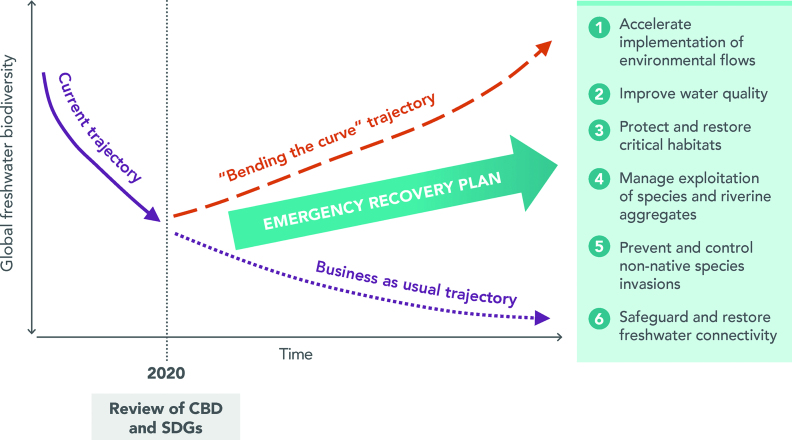
Despite their limited spatial extent, freshwater ecosystems host remarkable biodiversity, including one-third of all vertebrate species. This biodiversity is declining dramatically: Globally, wetlands are vanishing three times faster than forests, and freshwater vertebrate populations have fallen more than twice as steeply as terrestrial or marine populations. Threats to freshwater biodiversity are well documented but coordinated action to reverse the decline is lacking. We present an Emergency Recovery Plan to bend the curve of freshwater biodiversity loss. Priority actions include accelerating implementation of environmental flows; improving water quality; protecting and restoring critical habitats; managing the exploitation of freshwater ecosystem resources, especially species and riverine aggregates; preventing and controlling nonnative species invasions; and safeguarding and restoring river connectivity. We recommend adjustments to targets and indicators for the Convention on Biological Diversity and the Sustainable Development Goals and roles for national and international state and nonstate actors.
Overview
CoChat Summary
TL;DR
The paper presents an Emergency Recovery Plan to reverse global freshwater biodiversity loss through six priority actions: environmental flows, water quality, habitat protection and restoration, sustainable exploitation, invasive species control, and connectivity restoration. It recommends embedding these actions in post-2020 Convention on Biological Diversity and Sustainable Development Goal targets and indicators.
Key findings
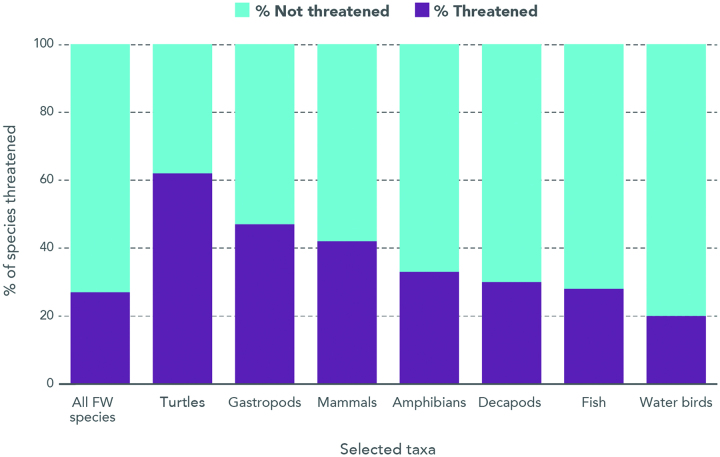
Freshwater ecosystems cover less than 1% of Earth’s surface but host approximately one-third of vertebrate species and 10% of all species; wetlands are vanishing three times faster than forests, and freshwater vertebrate populations have fallen more than twice as steeply as terrestrial or marine populations. Of 29,500 freshwater-dependent species assessed for the IUCN Red List, 27% are threatened with extinction, including an estimated 62% of turtle species, 47% of gastropods, 42% of mammals, 33% of amphibians, 30% of decapod crustaceans, 28% of fishes, and 20% of birds. Freshwater megafauna populations declined by 88% from 1970 to 2012, with the highest declines in Indomalaya (−99%) and Palearctic (−97%) realms. An estimated 30% of natural freshwater ecosystems have disappeared since 1970 and 87% of inland wetlands since 1700; only one-third of the world’s very long rivers remain free flowing, and approximately 3,700 new hydropower dams were identified worldwide at varying planning stages.
Methods
This is a policy and synthesis article, not a primary empirical study; it is structured around six priority actions derived from major causes of freshwater biodiversity loss: flow alteration, pollution, habitat degradation and loss, overexploitation, invasive nonnative species, and connectivity loss. The evidence base consists of cited global assessments, peer-reviewed literature, and implementation case studies from multiple regions, with no new field sample or primary data collection. The main analysis is a narrative review and policy-alignment exercise; Tables 1a and 1b map 13 existing or potential CBD and SDG targets and indicators to the six priority actions.
Limitations
Stated in the paper: implementation examples are “currently isolated successes”; human water demands and transboundary characteristics complicate implementation; data and science-based management are lacking for freshwater fisheries and riverine aggregate extraction; large-scale implementation of nature-based solutions is “in its infancy”; and substantial data gaps remain, including approximately 30% of freshwater mollusk species and 40% of decapod crustaceans classified as data deficient. Evident from the text: the plan is not empirically tested as a whole, relying instead on illustrative case studies and expert synthesis; the paper also notes that offsetting is controversial and open to misapplication.
Model-written summary. Check it against the paper before relying on it.
Integrity signals
Registry
Cites
Statistics
Figures
Verification
Claims the paper makes
5 Valid · 12 Not valid · 50 Not checked · 28 Own results and interpretations
Every source the paper cites for this claim was checked and supports it.
In the paper
“of the fish species assessed for the freshwater ecoregions of the world, over half were confined to a single ecoregion (Abell et al. 2008).”
§ Bending the Curve of Global Freshwater Biodiversity Loss: An Emergency Recovery Plan > Abstract
What the sources say
- Supportedcites Abell et al. 2008 matched to “Freshwater Ecoregions of the World: A New Map of Biogeographic Units for Freshwater Biodiversity Conservation” (2008) source
The “Freshwater ecoregional map and species results” section reports that more than 13,400 freshwater fish species were assigned to ecoregions and more than 6,900 to single ecoregions—over half of those assigned. No page number is supplied in the excerpt. (LLM, conf=0.94)
plain- Asserted: passes — The authors put it forward as true.
- Checkable: passes — It can be checked against evidence.
- Load-bearing: passes — The paper’s conclusions depend on it.
- Based: passes — The paper gives a reason why it holds.
- Supported
The cited sources support only part of this claim — read each source’s verdict below.
In the paper
“Recommendations to address immediate threats to and underlying drivers of global biodiversity loss have focused mainly on terrestrial ecosystems, such as forests and grasslands (e.g., Kok et al. 2018)”
§ Bending the Curve of Global Freshwater Biodiversity Loss: An Emergency Recovery Plan > Abstract
What the sources say
- Partly supportedcites Kok et al. 2018 matched to “Pathways for agriculture and forestry to contribute to terrestrial biodiversity conservation: A global scenario-study” (2018) sourceExperimental — accuracy not yet measured
Our copy supports only the exemplifying part of the attribution: Kok et al. (2018) is itself a terrestrial-scoped recommendations study — the Introduction (p. 1) states it 'evaluates the impacts on biodiversity of different response strategies in the agriculture and forestry sectors', and the Abstract and Sections 2.3/3.1–3.2 build pathways around forests, cropland and grazing land and terrestrial MSA. But no passage makes the comparative claim attributed here, namely that recommendations for global biodiversity loss have focused 'mainly' on terrestrial ecosystems; the closest statement (Introduction) is that societal responses have increased yet remain insufficient, and it credits that to Leadley et al. (2014), CBD (2014) and Tittensor et al. (2014). Aquatic biodiversity is not dismissed as neglected but explicitly handled in a separate companion analysis (Boelee et al., 2017, Introduction), so the 'mainly terrestrial' characterisation and the threats-versus-drivers distinction are not supported by this source. (LLM, conf=0.65)
plain- Asserted: passes — The authors put it forward as true.
- Checkable: passes — It can be checked against evidence.
- Load-bearing: passes — The paper’s conclusions depend on it.
- Based: passes — The paper gives a reason why it holds.
- Partly supported
In the paper
“with the highest declines in the Indomalaya and Palearctic realms (−99% and −97%, respectively; He et al. 2019).”
§ Bending the Curve of Global Freshwater Biodiversity Loss: An Emergency Recovery Plan > Abstract
What the sources say
- Not checked yetcites He et al. 2019
plain- Asserted: passes — The authors put it forward as true.
- Checkable: passes — It can be checked against evidence.
- Load-bearing: unclear — It is unclear whether the paper’s conclusions depend on it.
- Based: passes — The paper gives a reason why it holds.
In the paper
“Populations of freshwater megafauna, defined as animals that reach a body mass of 30 kilograms, declined by 88% from 1970 to 2012”
§ Bending the Curve of Global Freshwater Biodiversity Loss: An Emergency Recovery Plan > Abstract
What the sources say
- Not checked yetcites He et al. 2019
plain- Asserted: passes — The authors put it forward as true.
- Checkable: passes — It can be checked against evidence.
- Load-bearing: passes — The paper’s conclusions depend on it.
- Based: passes — The paper gives a reason why it holds.
In the paper
“Human demands for water will increase in some regions, making implementation more challenging (Palazzo et al. 2019).”
§ Bending the Curve of Global Freshwater Biodiversity Loss: An Emergency Recovery Plan > The Emergency Recovery Plan: Priorities for action > Action 1: Accelerate implementation of environmental flows
What the sources say
- Not checked yetcites Palazzo et al. 2019 matched to “Investment Needs for Irrigation Infrastructure along Different Socioeconomic Pathways” (2019) source
plainstates a cause- Asserted: passes — The authors put it forward as true.
- Checkable: passes — It can be checked against evidence.
- Load-bearing: unclear — It is unclear whether the paper’s conclusions depend on it.
- Based: passes — The paper gives a reason why it holds.
40 more claims
Create a free account to see all 95 claims and to verify the 58 references still open.
- It may state two separate claims as one. 29
- Probably not a substantial claim. 30
Claims other papers make about this one
Each is checked against this paper’s own text: does it say what the citing paper says it does?
The check wasn’t confident either way, so it gives no verdict — never disputed.
In the citing paper
“Hunting at Parker River National Wildlife Refuge represents both a traditional recreational use and serves as an important wildlife management tool.185”
From Protecting and restoring habitats to benefit freshwater biodiversity (2024) · cites this paper as [185]
Experimental — accuracy not yet measured
Citations
Cites
Freshwater biodiversity: importance, threats, status and conservation challenges
Dudgeon, D., Arthington, A. H., Gessner, M. O., Kawabata, Z., Knowler, D. J., Lévêque, C., Naiman, R. J., Prieur‐Richard, A., Soto, D., Stiassny, M. L. J., et al. (2006) · Biological Reviews · doi:10.1017/s1464793105006950 · Cited by 8,489
Self-citationPoff, N. L., Allan, J. D., Bain, M. B., Karr, J. R., Prestegaard, K. L., Richter, B. D., Sparks, R. E., & Stromberg, J. C. (1997) · BioScience · doi:10.2307/1313099 · Cited by 6,500
Pimentel, D., Zuniga, R., & Morrison, D. (2005) · Ecological Economics · doi:10.1016/j.ecolecon.2004.10.002 · Cited by 4,771
Emerging threats and persistent conservation challenges for freshwater biodiversity
Reid, A. J., Carlson, A. K., Creed, I. F., Eliason, E. J., Gell, P. A., Johnson, P. T. J., Kidd, K. A., MacCormack, T. J., Olden, J. D., Ormerod, S. J., et al. (2019) · Biological Reviews · doi:10.1111/brv.12480 · Cited by 3,645
Self-citationBasic Principles and Ecological Consequences of Altered Flow Regimes for Aquatic Biodiversity
BUNN, S. E., & ARTHINGTON, A. H. (2002) · Environmental Management · doi:10.1007/s00267-002-2737-0 · Cited by 3,379
Self-citationCeballos, G., Ehrlich, P. R., & Dirzo, R. (2017) · Proceedings of the National Academy of Sciences · doi:10.1073/pnas.1704949114 · Cited by 2,663
Mapping the world’s free-flowing rivers
Grill, G., Lehner, B., Thieme, M., Geenen, B., Tickner, D., Antonelli, F., Babu, S., Borrelli, P., Cheng, L., Crochetiere, H., et al. (2019) · Nature · doi:10.1038/s41586-019-1111-9 · Cited by 2,473
Self-citationA global boom in hydropower dam construction
Zarfl, C., Lumsdon, A. E., Berlekamp, J., Tydecks, L., & Tockner, K. (2015) · Aquatic Sciences · doi:10.1007/s00027-014-0377-0 · Cited by 2,181
Self-citationHow much wetland has the world lost? Long-term and recent trends in global wetland area
Davidson, N. C. (2014) · Marine and Freshwater Research · doi:10.1071/mf14173 · Cited by 2,177
Abell, R., Thieme, M. L., Revenga, C., Bryer, M., Kottelat, M., Bogutskaya, N., Coad, B., Mandrak, N., Balderas, S. C., Bussing, W., et al. (2008) · BioScience · doi:10.1641/b580507 · Cited by 2,045
Self-citation
Research works printed but not linked: 14
- Döll P, Bunn SE. 2014 Cross-chapter box on the impact of climate change on freshwater ecosystems due to altered river flow regimes. Pages 143– 146 in Field CB et al., eds. Climate Change Impacts, Adaptation, and Vulnerability. Part A: Global and Sectoral Aspects. Contribution of Working Group II to the Fifth Assessment Report of the Intergovernmental Panel on Climate Change. Cambridge University Press.
- Fricke R, Eschmeyer W, van der Laan R 2019 Catalog of fishes: Genera, species, references. California Academy of Sciences. http://researcharchive.calacademy.org/research/ichthyology/catalog/SpeciesByFamily.asp.
- Funge-Smith S. 2018 Review of the State of the World Fishery Resources: Inland Fisheries. Food and Agriculture Organization of the United Nations Fisheries and Aquaculture Circular.
- Harwood A, Johnson S, Richter B, Locke A, Yu X, Tickner D 2017 Listen to the River: Lessons from a Global Review of Environmental Flow Success Stories. World Wildlife Fund.
- [IUCN] International Union for Conservation of Nature 2019 The IUCN Red List of Threatened Species, version 2019-1. IUCN www.iucnredlist.org.
- Koehnken L, Rintoul M. 2018 Impacts of Sand Mining on Ecosystem Structure, Process and Biodiversity in Rivers. World Wildlife Fund International.
- Koning AA. 2018 Riverine Reserves: The Conservation Benefits of Spatial Protection for Rivers in the Context of Environmental Change. University of Wisconsin–Madison.
- Le Quesne T, Kendy E, Weston D 2010 The Implementation Challenge: Taking Stock of Government Policies to Protect and Restore Environmental flows. WWF and The Nature Conservancy.
- Moir K, Thieme M, Opperman J 2016 Securing a Future that Flows: Case Studies of Protection Mechanisms for Rivers. World Wildlife Fund and The Nature Conservancy.
- NBI (Nile Basin Initiative) 2016 Strategy for Management of Environmental Flows in the Nile Basin. Nile Basin Initiative Secretariat. 17p.
- Opperman J et al. 2019a Connected and Flowing: A Renewable Future for Rivers, Climate, and People. WWF and The Nature Conservancy.
- Speed R, Tickner D, Naiman R, Gang L, Sayers P, Yu W, Yuanyuan L, Houjian H, Jianting C, Lili Y 2016 River Restoration: A Strategic Approach to Planning and Management. UNESCO.
- [UNEP] United Nations Environment Programme 2016 Snapshot of the World's Water Quality: Towards a Global Assessment. UNEP.
- UN Environment 2017 A Framework for Freshwater Ecosystem Management, vol. 2: Technical Guide for Classification and Target-Setting. United Nations.
Cited by
Items 1,001–1,100 of 1,243
de Oliveira, E. S., South, J., Vieira, L. D. O., de Oliveira, R. F., & Ottoni, F. P. (2025) · Brazilian Journal of Biology · doi:10.1590/1519-6984.293810
Woodie, C. A., & Anderson, K. E. (2025) · Ecology · doi:10.1002/ecy.70218 · Cited by 1
“Rivers support disproportionately high biodiversity and eco-system functioning but are among the most threatened eco-systems worldwide (Tickner et al., 2020), highlighting the urgent need to understand and protect the processes that govern species persistence in these systems.”
Houart, C. (2023) · Relações Internacionais · doi:10.23906/ri2023.79a02
Samways, M. J. (2024) · CABI eBooks · doi:10.1079/9781789248395.0006
Biocultural Ethics for Human–River–Biosphere Co-Inhabitation
Rozzi, R. (2026) · Philosophies · doi:10.3390/philosophies11040123 · Cited by 1
Wetlands' e-hydroperiod method: frequency-of-occurrence-based approach
Álvarez-Castrejón, S., Salinas-Rodríguez, S. A., Rodríguez Bastarmérito, R., et al. (2026) · doi:10.2139/ssrn.6592415
Pernebayev, Z., Tulbassiyeva, A., Aitimbetova, A., Shingisbayeva, Z., Kural, N., & Abdullah, A. F. (2026) · Sustainability · doi:10.3390/su18178698
Significance of small stream restoration and river network on freshwater fish diversity.
Hayata, G. O. T. O., Akasaka, T., & KAWAGUCHI, Y. (2023) · Ecology and Civil Engineering · doi:10.3825/ece.22-00021
Mohan, C. (2022) · Hydrology and earth system sciences · doi:10.5194/hess-2022-87-ac6
Casanova, A., Heras, S., Abràs, A., Bouza, C., Roldán, M. I., Caballero, A., Martínez, P., Vera, M., & García‐Marín, J. (2026) · Hydrobiologia · doi:10.1007/s10750-026-06418-2
Xin, Y., Cheng, T., Niu, G., & Wang, H. (2026) · Sustainability · doi:10.3390/su18189371
Bocxlaer, B. V., Offerle, J., Ortiz-Sepulveda, C., Habert, R., Holl, A.-C., Denize-Proust, N., Dollion, A. Y., Pawindo, G., Chibwana, F. D., & Cuvillier‐Hot, V. (2025) · NeoBiota · doi:10.3897/neobiota.99.143667 · Cited by 4
“Biotic exchange is a pervasive stressor in freshwater ecosystems and especially in eco-insular lakes because of their discontinuous nature (Sala et al. 2000; Dudgeon et al. 2006; Hecky et al. 2010; Tickner et al. 2020).”
Crivellaro, M., Serrao, L., Bertoldi, W., Bizzi, S., Vitti, A., Hauer, C., Skrame, K., Cekrezi, B., & Zolezzi, G. (2024) · Journal of Environmental Management · doi:10.1016/j.jenvman.2024.122541 · Cited by 2
Drake, S. A., Bruckerhoff, L. A., Miltner, R. J., Shoobs, N. F., & Pennock, C. A. (2026) · Ecological Indicators · doi:10.1016/j.ecolind.2026.115034
Variation in Nutrient Availability for Aquatic Phototrophs and Its Ecological Consequences
MABERLY, S. C. (2024) · Cambridge University Press eBooks · doi:10.1017/9781139049979.021
Chen, Z., Haucke, T., Beery, S., Bennett, K., Powell, A., Zuehsow, L., Vincent, R. E., & Deegan, L. A. (2026) · Remote Sensing in Ecology and Conservation · doi:10.1002/rse2.70055 · Cited by 1
“In the past 50 years, however, freshwater fish abundance has declined by 85% due to anthropogenic pressures including overfishing, habitat loss and degradation, pollution and climate change (Tickner et al., 2020; WWF, 2024).”
Conserving the World's Specialist Riverine Birds
Sinha, A., Chatterjee, N., & Ormerod, S. J. (2026) · Wiley Interdisciplinary Reviews Water · doi:10.1002/wat2.70082 · Cited by 1
“…the global distribution of specialist riverine birds, outline their ecological roles in different running water habitats, and discuss their status, population trends and conservation in the face of widely recognized threats to freshwater ecosystems (Tickner et al. 2020; Dudgeon and Strayer 2025).”
Self-citationGiordano, M., Beardall, J., Beardall, J., & Maberly, S. C. (2024) · Cambridge University Press eBooks · doi:10.1017/9781139049979.018
Lee, J.-H., Han, B.-H., Cho, I.-H., et al. (2026) · Water · doi:10.3390/w18172122
Bird diversity at urban stormwater ponds: Temporal variation and habitat associations
Borntraeger, K. N., & Jackson, D. A. (2026) · Urban Ecosystems · doi:10.1007/s11252-026-01912-w · Cited by 1
“They can often aggressively out - compete native species for foraging or breeding resources development, or modified and degraded during urbaniza - tion (Reid et al. 2019; Tickner et al. 2020).”
Al-Yaseen, B. M., Alahmed, S. G. K., & Hussein, N. A. (2026) · Frontiers in Sustainable Food Systems · doi:10.3389/fsufs.2026.1968827
Marine rewilding principles as a guiding framework for large‐scale ecosystem restoration
Stark, G., Joosten, G. G., Cornerier, A., & Schwarz, R. (2026) · Conservation Science and Practice · doi:10.1111/csp2.70396 · Cited by 1
“Equally important are safeguards that prevent unintended ecological or socioeconomic impacts and financing models that align with ecological timescales (Tickner et al., 2020).”
Martins, M. S., Silva, A. T., Souza, U. P., et al. (2024) · Brazilian Journal of Biology · doi:10.1590/1519-6984.287407
Morphological Quality Index (Mqi), Fish Communities and Biotic Integrity in Agricultural StreamsPreprint
Couture, T., & Biron, P. M. (2023) · SSRN Electronic Journal · doi:10.2139/ssrn.4509011 · Cited by 1
Mohan, C. (2022) · Hydrology and earth system sciences · doi:10.5194/hess-2022-87-ac4
Nur, F. M., Batubara, A. S., Fadli, N., Rizal, S., Siti-Azzizah, M. N., & Muchlisin, Z. A. (2025) · Brazilian Journal of Biology · doi:10.1590/1519-6984.290436
PETIT, E. J., Brind’Amour, A., Danet, A., Dézerald, O., Fabri‐Ruiz, S., Faillettaz, R., Gascuel, D., Lasne, É., Lebigre, C., Nevoux, M., et al. (2026) · BioScience · doi:10.1093/biosci/biag134
Lee, E., Jeong, J., Park, C., Jeong, H., Lee, J., & Min, J.-H. (2025) · Journal of Hydrology · doi:10.1016/j.jhydrol.2025.134215 · Cited by 1
Nurturing rivers in the Anthropocene: a call to action
Sofi, M. S., Rautela, K. S., & Bhat, S. U. (2025) · Environmental Science and Pollution Research · doi:10.1007/s11356-025-37012-z · Cited by 1
LIU, J., Liu, M., Xiong, G., Cheng, Y., Han, C., Geng, H., Wang, X., Wei, S., Yu, N., Zhu, X., et al. (2026) · Water Research · doi:10.1016/j.watres.2026.126530 · Cited by 2
Museums for the Past and Future Meaning of Water
Eulisse, E. (2023) · Blue Papers · doi:10.58981/bluepapers.2023.1.04
Treaties and Other Instruments
(2021) · Transboundary Freshwater Ecosystems in International Law · doi:10.1017/9781108854641.002
Field assessment of biologically inspired shoreline armouring methods on freshwater fish communities
Frempong-Manso, A., Elvidge, C. K., Van de Riet, K., et al. (2026) · Inland Waters · doi:10.1080/20442041.2026.2644317
“However, constructed habitat alterations are causing widespread species decreases, adding to the freshwater biodiversity crisis (Tickner et al. 2020).”
Gabriele, M., & Loulli, E. (2026) · Applied Geomatics · doi:10.1007/s12518-026-00795-y
“…to the second type, as no environmental flow requirement is currently applied (WDD 2009), despite growing recognition that such provisions are essential for sustaining riparian biodiversity in regulated Mediterranean systems (Arthington et al. 2018; Tickner et al. 2020 ; Poff and Zimmerman 2010).”
Vargas, E. E. C., Quispe, H. Y. G., Terrazas, E. G. M., Inquilla, B. D. C., Barriga, R. E. O., Arucutipa, Y. M. C., & Riquelme, R. Q. (2026) · Sustainability · doi:10.3390/su18189413
The Trout Paradox: Scenarios for Managing Introduced Salmonids in New Zealand
Lovelock, B. A., & Hayes, S. (2026) · New Zealand Journal of Marine and Freshwater Research · doi:10.1002/nzm2.70070
Blanchfield, P. J., Rodrigues, T. H., MacNeil, C., et al. (2026) · Biological Invasions · doi:10.1007/s10530-026-03877-5
“Extinction rates of native fishes continue to increase, with recent estimates that up to one-third of native freshwater fishes are at risk (Tickner et al. 2020; Sayer et al. 2025; Vardakas et al. 2025).”
Han, B.-H., Cho, I.-H., Kim, H.-K., Hwang, E.-A., Hwang, S.-O., & Kim, B. (2026) · Research Square · doi:10.21203/rs.3.rs-10087614/v1
Hodson, J., Harwood, M., Choy, K., Cadley, E., Newman, A.-J., & South, J. (2026) · Biological Invasions · doi:10.1007/s10530-026-03864-w
“…than terrestrial and marine realms (Darwall et al. 2018; Tickner et al. 2020) as a result of multiple threats including invasive non-native species, climate-change, over-exploitation, destruction/alteration of habitat and pollution (Strayer and Dudgeon 2010; Reid et al. 2019; Tickner et al. 2020).”
Choi, H., Hwang, S. Y., Kim, Y. R., Kim, Y. R., Seo, J. K., Wang, J. H., Ko, M. S., Kim, J. H., Jang, J. E., Kim, H., et al. (2025) · Environmental Biology Research · doi:10.11626/kjeb.2025.43.4.391
(2022) · Hydrology and earth system sciences · doi:10.5194/hess-2022-87-rc1
Relationship‐building sometimes helps and sometimes hinders the spread of conservation initiatives
Nascimento, R. V., & Neeson, T. M. (2026) · Conservation Science and Practice · doi:10.1111/csp2.70310
“At a time when there is an urgent need for effective practices across ecosystems (Leclère et al., 2020; Rilov et al., 2020; Tickner et al., 2020), leveraging social network science is a promising strategy for scaling up conservation efforts.”
Ceballos-Vázquez, D. M., Nightingale, J., Yebra-Montes, C., South, J., Landa-Cansigno, O., Lugo-Melchor, O. Y., Coronado-Apodaca, K. G., Barrios-Piña, H. A., & Díaz-Torres, O. (2026) · Environmental Research · doi:10.1016/j.envres.2026.125693
Harper, M., Rytwinski, T., Irvine, R. L., & Cooke, S. J. (2024) · Ecological Solutions and Evidence · doi:10.1002/2688-8319.12350
“Freshwater ecosystems are currently experiencing a biodiversity crisis (Albert et al., 2021; Harrison et al., 2018; Tickner et al., 2020).”
Self-citationCroci, Y. (2024) · El Servicio de Difusión de la Creación Intelectual (National University of La Plata) · doi:10.35537/10915/164565 · Cited by 1
Imran, M., & Jabeen, F. (2026) · Acta Ichthyologica et Piscatoria · doi:10.3897/aiep.56.157418
“Globally, fish diversity faces significant threats, ex - acerbated not only by harmful effects on the studied species but also by the worsening natural conditions for native species (Tickner et al. 2020).”
Sears, M. M., Myers, R. A., Nisbet, M. T., Tidwell, M. T., & Troia, M. J. (2025) · Freshwater Biology · doi:10.1111/fwb.14377
Yue, S., Li, H., & Song, F. (2023) · Sustainability · doi:10.3390/su15043645
Thompson, J. R., Duranel, A., Keisser, E., Durepaire, P., & Cubizolle, H. (2026) · Wetlands · doi:10.1007/s13157-026-02046-7 · Cited by 2
“Whilst climate change may not result in rapid, wholesale mire loss (Gallego-Sala and Prentice 2013 ), it will likely impose stress to environments that, alongside many aquatic ecosystems (Tickner et al. 2020 ), have already been impacted by human activities.”
Suh, S., Kim, D.-H., Lee, B.-S., Lee, S., & Seo, J. K. (2026) · Water · doi:10.3390/w18151882
Levin, J. C., Walsh, G., Kleynhans, N., et al. (2026) · Ecohydrology & Hydrobiology · doi:10.1016/j.ecohyd.2026.100762
Guo, J., Zhao, R., & Yao, Y. (2026) · SSRN Electronic Journal · doi:10.2139/ssrn.6878918
Twardek, W. M. (2022) · Carleton University's Institutional Repository (MacOdrum Library, Carleton University) · doi:10.22215/etd/2022-15330
Moraes, K. D. A., Lameira, H. L. N., & de Oliveira, J. M. B. (2025) · Caderno Pedagógico · doi:10.54033/cadpedv22n14-012
(2025) · doi:10.1111/een.70007
“…or restoring dispersal corridors is therefore a key element in supporting population persistence under increasingly variable hydrological regimes and aligns with global priorities for safeguarding river connectivity as outlined in freshwater biodiversity recovery frameworks (Tickner et al., 2020).”
Fang, T., Wang, L., Duan, X., Zou, H., Wang, Y., Yan, W., Xu, L., & Jizheng, P. (2026) · Environmental Impact Assessment Review · doi:10.1016/j.eiar.2026.108522
Fish life-history traits predict abundance-occupancy patterns in artificial lakes
Miranda, L. E. (2023) · Frontiers in Freshwater Science · doi:10.3389/ffwsc.2023.1270939
Korosi, J. B., Coleman, K. A., Hoskin, G. N., Little, A. J., Stewart, E. M., & Thienpont, J. R. (2022) · Canadian Journal of Fisheries and Aquatic Sciences · doi:10.1139/cjfas-2021-0280
Hussain, S. A., Panda, A. K., Sharma, S. P., Shahniaz, N., Barthwal, S. C., Ali, S. Z., & Badola, R. (2026) · PLoS ONE · doi:10.1371/journal.pone.0353661
“These threats, acting alone or synergistically, lead to geographical isolation and limit gene flow, and ultimately increase the risk of local extinctions [4–10].”
Anjinho, P. D. S. (2024) · Digital Library of Theses and Dissertations (Universidade de São Paulo) · doi:10.11606/t.18.2024.tde-25042024-151658
(2022) · Hydrology and earth system sciences · doi:10.5194/hess-2022-87-rc2
de Assis, C. E., Dergam, J. A., Cunha, A. F., et al. (2026) · Journal of Fish Biology · doi:10.1111/jfb.70324
“Fish species not previously recognized by science or that go unnoticed are often left out of conservation measures, and they urgently require conservation intervention (Ottoni et al., 2023, 2025; Tickner et al., 2020; Sayer et al., 2025).”
Spatial variation in fish assemblages is explained by hydrological connectivity
(2022) · doi:10.21203/rs.3.rs-1713960/v1 · Cited by 18
Human‐Induced Extinction Risk of the World's Crocodilians and Chelonians
Torres‐Romero, E. J., Woolrich‐Piña, G. A., Smith, G. R., Ripple, W. J., Lemos‐Espinal, J. A., Sunny, A., & Stanford, C. B. (2025) · Journal of Biogeography · doi:10.1111/jbi.70116 · Cited by 1
“Despite covering less than 3% of Earth's surface, freshwater hab-itats—including rivers, lakes and wetlands—harbour a disproportionately high level of biodiversity, supporting approximately 10% of known animal species and one-third of all vertebrate species (Reid et al. 2019; Tickner et al. 2020).”
InfluentialArthington, A. H., Christian, M., Coyne, P., Edwards, G., Greenwood, D., Mills, K., Petheram, C., Prior, S., & Vanderzalm, J. L. (2026) · Frontiers in Environmental Science · doi:10.3389/fenvs.2025.1688368
“The GBF was critically informed by the publication in 2020 of a freshwater biodiversity Emergency Recovery Plan (ERP) setting out six major priorities for global action and policy development to “bend the curve of freshwater biodiversity loss” (Tickner et al., 2020).”
InfluentialSelf-citationPratt, K., & Prahalad, V. N. (2026) · AMBIO · doi:10.1007/s13280-025-02335-1 · Cited by 1
“Despite these initiatives dating back several decades, the global status of wetlands continues to decline, with wetlands disappearing three times faster than forests (Tickner et al. 2020).”
Dong, X., Cheng, R., Huang, J., Wang, Z., Qi, Z., Zhou, X., Zuo, Q., & Shen, Y. (2026) · Global Ecology and Conservation · doi:10.1016/j.gecco.2026.e04095 · Cited by 2
Sharma, S., & Banyal, H. S. (2026) · World Water Policy · doi:10.1002/wwp2.70095
Using Trail Cameras to Monitor Culvert Connectivity in Wadeable Streams
Twiner, L., Hanks, R. D., & Peoples, B. K. (2026) · River Research and Applications · doi:10.1002/rra.70145
Silver Chub spawning confirmed in the Maumee River, a tributary of Lake Erie
Brown, R. E., Mayer, C. M., Thompson, N. L., et al. (2024) · North American Journal of Fisheries Management · doi:10.1002/nafm.11018
Norambuena, F. A. V., & Coccia, C. (2026) · Wetlands Ecology and Management · doi:10.1007/s11273-026-10122-2
Prata, E. G., Marques, G. M., de Andrade, A. F. A., Konn-Vetterlein, D., Montag, L. F. D. A., Sousa, T., & Freitas, T. M. D. S. (2026) · Ecological Modelling · doi:10.1016/j.ecolmodel.2026.111645
Spatially divergent impacts of global nutrient emission scenarios on freshwater community intactness
Neijnens, F. K., Hoeks, S., Moreira, H., Kuipers, K., Beusen, A. H. W., Geerling, G., Huijbregts, M. A. J., & Schipper, A. M. (2026) · Environmental Challenges · doi:10.1016/j.envc.2026.101417 · Cited by 2
Allan, J. D., Castillo, M. M., & Capps, K. A. (2021) · Springer eBooks · doi:10.1007/978-3-030-61286-3_15
Biggs, J., Ewald, N., Nicolet, P., Case, P., Williams, P., & Tasker, S. J. L. (2025) · Ecological Solutions and Evidence · doi:10.1002/2688-8319.70089 · Cited by 2
Yoon, Y., Hong, S., Kim, B., & Cho, M. (2026) · Results in Engineering · doi:10.1016/j.rineng.2026.111517 · Cited by 1
Future pathways for the ecological quality of global freshwater ecosystems
Janse, J. H., Bakkenes, M., Giesen, P., Barbarossa, V., Bouwman, A., & Kok, M. (2026) · Environmental Science & Policy · doi:10.1016/j.envsci.2026.104380 · Cited by 1
3d Environmental Risk Detection Reveals Climate-Driven Niche Shifts in Alpine Fishes
Wanghe, K., Ahmad, S., Zhang, A., et al. (2025) · doi:10.2139/ssrn.5371317
(2026) · doi:10.1007/s10531-025-03224-5
“This pat - tern is particularly evident in freshwater ecosystems (Tickner et al. 2020 ).”
Znidersic, E., Mathwin, R., Talbot, S., Hall, A., Towsey, M., & Wassens, S. M. (2026) · Ecological Management & Restoration · doi:10.1111/emr.70066
Uncovering insights and unsupervised latent topics in global habitat suitability research
Dhakal, T., Tiwari, S., Kim, T.-S., Bongasie, A., Paudel, T., Kim, J., Jang, G., & Kim, S. (2026) · Environmental Research Communications · doi:10.1088/2515-7620/ae9b6b
Piczak, M. L., Sergio, A. J. A., Brown, C. R., Birch, W. S., Flitcroft, R. L., Krawchuk, M. A., McCarter, C. P. R., Moore, J. W., Murphy, B. P., Penaluna, B. E., et al. (2026) · Global Change Biology · doi:10.1111/gcb.70945 · Cited by 1
“However, biodiversity loss in freshwater ecosystems exceeds losses relative to marine or terrestrial systems (Tickner et al. 2020) resulting in many freshwater ecosystems facing crises of both biodiversity loss and climate change.”
Xu, D., Li, J., Hou, J., Wang, Y., & Xu, Z. (2026) · SSRN Electronic Journal · doi:10.2139/ssrn.7075259
Glassman, D. (2021) · Carleton University's Institutional Repository (MacOdrum Library, Carleton University) · doi:10.22215/etd/2021-14613
The untapped potential of conservation journals to promote freshwater biodiversityPreprint
He, F., Jähnig, S. C., Wetzig, A., & Langhans, S. D. (2020) · bioRxiv (Cold Spring Harbor Laboratory) · doi:10.1101/2020.07.21.214288
Sanders, E., Nimmo, D. G., Hall, A., Wassens, S. M., Turner, J. M., & Michael, D. (2025) · Landscape Ecology · doi:10.1007/s10980-025-02148-3 · Cited by 1
“Environmental flows have been identified as a leading priority action to reduce freshwater biodiversity loss (Tickner et al. 2020).”
Conservation and Sustainable Use of Terrestrial and Inland Freshwater
Gajalakshmi, S. (2026) · Emerald Group Publishing Limited eBooks · doi:10.1108/978-1-83742-272-220261006
A Global Horizon Scan of Emerging Challenges and Opportunities for Sustainable HydropowerPreprint
Boavida, I., Aarestrup, K., Abungba, J. A., Bor, A., Casas‐Mulet, R., Chen, S. F., Franklin, P. A., Gouraud, V., Haas, J., Halleraker, J. H., et al. (2025) · SSRN Electronic Journal · doi:10.2139/ssrn.5377117
Dynamic stressor regimes drive shifts in biofilm-associated parasites
Doliwa, A., Mayombo, N. A. S., Pimentel, I. M., Rehsen, P. M., Vermiert, A., Kaijser, W., Voskuhl, L., Vos, M., Sures, B., & Dunthorn, M. (2026) · Parasitology Research · doi:10.1007/s00436-026-08669-3
“Freshwater ecosystems are highly vulnerable to biodiversity loss and degradation driven by global climate change and anthropogenic pressures (Tickner et al. 2020).”
Bold, M., Kim, K.-J., Yoon, J.-Y., et al. (2024) · Water · doi:10.3390/w16243560
“The biodiversity of freshwater fish has significantly declined in recent decades, primarily due to human activities [2].”
Giusto, C., Bellati, A., Cerini, F., et al. (2026) · Global Ecology and Conservation · doi:10.1016/j.gecco.2026.e04128
Hodson, J., Harwood, M., Choy, K., Cadley, E., Newman, A.-J., & South, J. (2025) · doi:10.21203/rs.3.rs-8038263/v1
Student Perceptions and Commitment to Protecting Aquatic Invertebrates
Bartóková, S., Prokop, P., & Adamcová, M. (2026) · Anthrozoös · doi:10.1080/08927936.2025.2587427
“Their survival depends on stable water quality, temperature, and flow regimes, which are easily disrupted by pollution, damming, water extraction, and climate change (Bonacina et al., 2023; Tickner et al., 2020).”
Velde, K. T., Mairo, A., Peeters, E. T. H. M., Winter, H. V., Tudorache, C., & Slabbekoorn, H. (2024) · SSRN Electronic Journal · doi:10.2139/ssrn.4792618
Metadata
- Authors
- Tickner, D., Opperman, J. J., Abell, R., Acreman, M., Arthington, A. H., Bunn, S. E., Cooke, S. J., Dalton, J., Darwall, W., Edwards, G., Harrison, I., Hughes, K., Jones, T., Leclère, D., Lynch, A. J., Leonard, P., McClain, M. E., Muruven, D., Olden, J. D., Ormerod, S. J., Robinson, J., Tharme, R. E., Thieme, M., Tockner, K., Wright, M., & Young, L.
- Affiliations
- WWF-UK (GB)
- World Wildlife Fund (US)
- Conservation International (US)
- UK Centre for Ecology & Hydrology (GB)
- Griffith University (AU)
- Carleton University (CA)
- International Union for Conservation of Nature (CH)
- International Union for Conservation of Nature (United Kingdom) (GB)
- DJEnvironmental, Harpers Mill, United Kingdom
- International Institute for Applied Systems Analysis (AT)
- United States Geological Survey (US)
- IHE Delft Institute for Water Education (NL)
- Freshwater Practice of WWF International, Zeist, The Netherlands
- University of Washington (US)
- Cardiff University (GB)
- Wildfowl & Wetlands Trust (GB)
- Director of Riverfutures, Cressbrook, United Kingdom
- Leibniz Institute of Freshwater Ecology and Inland Fisheries (DE)
- Corresponding author
- Tickner, David
- ORCID
- Venue
- BioScience
- Publisher
- Oxford University Press (OUP)
- Published
- 2020-02-19
- Volume
- 70
- Issue
- 4
- Pages
- 330-342
- ISSN
- 0006-3568 (ISSN-L)
- 1525-3244
- PMC
- PMC7138689
- OpenAlex
- W2982687801
- Cited by
- 1,241
- References
- 94
- Citations by year
- 2026: 233 · 2025: 222 · 2024: 229 · 2023: 184 · 2022: 192 · 2021: 140 · 2020: 41
- FWCI
- 88.45
- Type
- journal article
- Language
- en
- Open access
- hybrid
- doi.org
- Licence
- Locations
- BioScience (publishedVersion, cc-by-nc)
- Europe PMC (PubMed Central) (publishedVersion, cc-by-nc)
- PubMed Central (publishedVersion, cc-by-nc)
- PubMed (publishedVersion)
- ORCA Online Research @Cardiff (Cardiff University) (acceptedVersion)
- NERC Open Research Archive (Natural Environment Research Council) (acceptedVersion)
- IIASA PURE (International Institute of Applied Systems Analysis) (acceptedVersion)
- Griffith Research Online (submittedVersion, cc-by-nc)
- Funders
- University of Washington
- Cardiff University
- Griffith University
- Technische Universiteit Delft
- WWF International
- Freie Universität Berlin
- U.S. Geological Survey
- School of Aquatic and Fishery Sciences
- Centre for Ecology and Hydrology
- Topics
- Physical Sciences › Environmental Science › Nature and Landscape Conservation › Fish Ecology and Management Studies
- Physical Sciences › Environmental Science › Ecology › Aquatic Ecosystems and Biodiversity
- Physical Sciences › Environmental Science › Ecology › Freshwater macroinvertebrate diversity and ecology
- Keywords
- freshwater biodiversity loss, biodiversity recovery, wetland loss, freshwater vertebrates, environmental flows, water quality, habitat restoration, freshwater management, river connectivity, Convention on Biological Diversity, Sustainable Development Goals
About these checks
Registry, retraction, Cites and statistics results are computed, not judged, with one exception: a printed reference that no index lists is read once by a model before it counts as a citation error. Claims are extracted by a model and kept only when their quote appears verbatim in the text; each cited source is then checked, with a model’s help, for whether it says what the claim relies on. Those verdicts can be wrong — read the claim’s quote and the cited source before relying on one.
The claim verdicts this report counts are experimental: their accuracy is not yet measured.
A language model drew the claims from the paper on 2026-10-05, under version 3 of the claim definition (model deepseek-v4.1-flash, prompt extract-v3).
A second model labelled each claim on 2026-10-05 (model jev-1.13-20260917, definition revision gold-guideline-v0.2).
Cited sources are checked with a language model’s help (gpt-6-sol and qwen3.8-omni-flash).
Statistics and arithmetic are recomputed, not judged.
Confidence bands are shown only for fields calibrated on our annotated test set. None is calibrated yet, so no band is shown.
What counts as a claim ›How we measure confidence ›How we check this ›
Are you an author, or do you see a problem with this page? Request a review
Data sources
Bibliographic data: Semantic Scholar, OpenAlex, Crossref.
Contains information from the Semantic Scholar Academic Graph Datasets, made available under the ODC Attribution License (ODC-BY 1.0).
Semantic Scholar’s data is described in: Kinney, R., et al. (2023). The Semantic Scholar Open Data Platform. arXiv:2301.10140.
