

Bending the Curve of Global Freshwater Biodiversity Loss: An Emergency Recovery Plan
Open accessThe DOI matches its Crossref record; 86 of the 94 references it cites were found in a registry or an index; 5 of the 63 sources its claims cite were checked for support.
Abstract
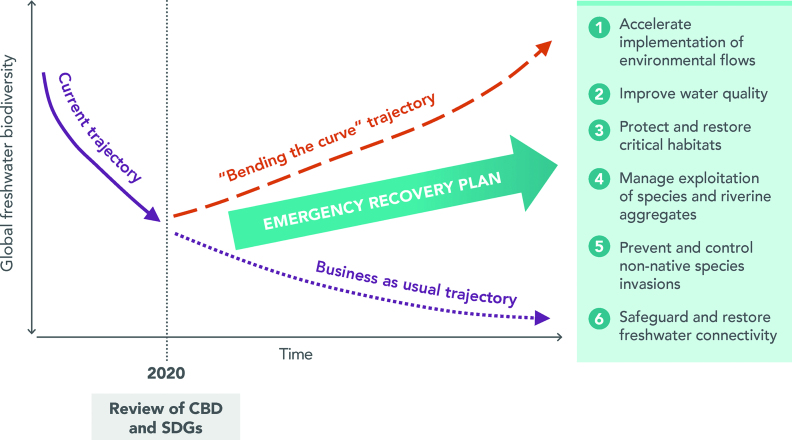
Despite their limited spatial extent, freshwater ecosystems host remarkable biodiversity, including one-third of all vertebrate species. This biodiversity is declining dramatically: Globally, wetlands are vanishing three times faster than forests, and freshwater vertebrate populations have fallen more than twice as steeply as terrestrial or marine populations. Threats to freshwater biodiversity are well documented but coordinated action to reverse the decline is lacking. We present an Emergency Recovery Plan to bend the curve of freshwater biodiversity loss. Priority actions include accelerating implementation of environmental flows; improving water quality; protecting and restoring critical habitats; managing the exploitation of freshwater ecosystem resources, especially species and riverine aggregates; preventing and controlling nonnative species invasions; and safeguarding and restoring river connectivity. We recommend adjustments to targets and indicators for the Convention on Biological Diversity and the Sustainable Development Goals and roles for national and international state and nonstate actors.
Overview
CoChat Summary
TL;DR
The paper presents an Emergency Recovery Plan to reverse global freshwater biodiversity loss through six priority actions: environmental flows, water quality, habitat protection and restoration, sustainable exploitation, invasive species control, and connectivity restoration. It recommends embedding these actions in post-2020 Convention on Biological Diversity and Sustainable Development Goal targets and indicators.
Key findings
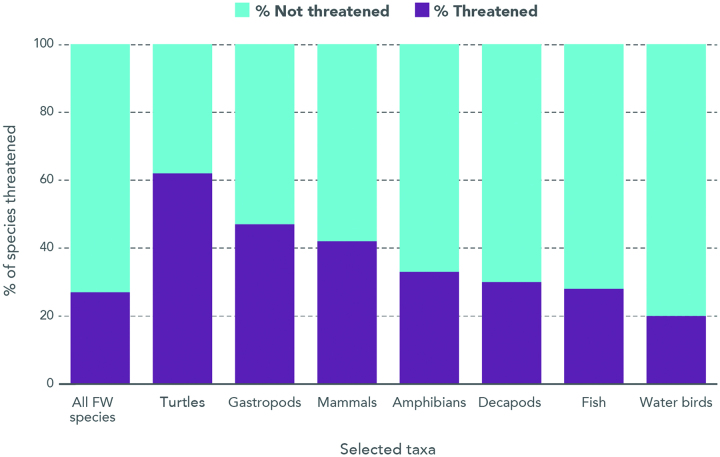
Freshwater ecosystems cover less than 1% of Earth’s surface but host approximately one-third of vertebrate species and 10% of all species; wetlands are vanishing three times faster than forests, and freshwater vertebrate populations have fallen more than twice as steeply as terrestrial or marine populations. Of 29,500 freshwater-dependent species assessed for the IUCN Red List, 27% are threatened with extinction, including an estimated 62% of turtle species, 47% of gastropods, 42% of mammals, 33% of amphibians, 30% of decapod crustaceans, 28% of fishes, and 20% of birds. Freshwater megafauna populations declined by 88% from 1970 to 2012, with the highest declines in Indomalaya (−99%) and Palearctic (−97%) realms. An estimated 30% of natural freshwater ecosystems have disappeared since 1970 and 87% of inland wetlands since 1700; only one-third of the world’s very long rivers remain free flowing, and approximately 3,700 new hydropower dams were identified worldwide at varying planning stages.
Methods
This is a policy and synthesis article, not a primary empirical study; it is structured around six priority actions derived from major causes of freshwater biodiversity loss: flow alteration, pollution, habitat degradation and loss, overexploitation, invasive nonnative species, and connectivity loss. The evidence base consists of cited global assessments, peer-reviewed literature, and implementation case studies from multiple regions, with no new field sample or primary data collection. The main analysis is a narrative review and policy-alignment exercise; Tables 1a and 1b map 13 existing or potential CBD and SDG targets and indicators to the six priority actions.
Limitations
Stated in the paper: implementation examples are “currently isolated successes”; human water demands and transboundary characteristics complicate implementation; data and science-based management are lacking for freshwater fisheries and riverine aggregate extraction; large-scale implementation of nature-based solutions is “in its infancy”; and substantial data gaps remain, including approximately 30% of freshwater mollusk species and 40% of decapod crustaceans classified as data deficient. Evident from the text: the plan is not empirically tested as a whole, relying instead on illustrative case studies and expert synthesis; the paper also notes that offsetting is controversial and open to misapplication.
Model-written summary. Check it against the paper before relying on it.
Integrity signals
Registry
Cites
Statistics
Figures
Verification
Claims the paper makes
5 Valid · 12 Not valid · 50 Not checked · 28 Own results and interpretations
Every source the paper cites for this claim was checked and supports it.
In the paper
“of the fish species assessed for the freshwater ecoregions of the world, over half were confined to a single ecoregion (Abell et al. 2008).”
§ Bending the Curve of Global Freshwater Biodiversity Loss: An Emergency Recovery Plan > Abstract
What the sources say
- Supportedcites Abell et al. 2008 matched to “Freshwater Ecoregions of the World: A New Map of Biogeographic Units for Freshwater Biodiversity Conservation” (2008) source
The “Freshwater ecoregional map and species results” section reports that more than 13,400 freshwater fish species were assigned to ecoregions and more than 6,900 to single ecoregions—over half of those assigned. No page number is supplied in the excerpt. (LLM, conf=0.94)
plain- Asserted: passes — The authors put it forward as true.
- Checkable: passes — It can be checked against evidence.
- Load-bearing: passes — The paper’s conclusions depend on it.
- Based: passes — The paper gives a reason why it holds.
- Supported
The cited sources support only part of this claim — read each source’s verdict below.
In the paper
“Recommendations to address immediate threats to and underlying drivers of global biodiversity loss have focused mainly on terrestrial ecosystems, such as forests and grasslands (e.g., Kok et al. 2018)”
§ Bending the Curve of Global Freshwater Biodiversity Loss: An Emergency Recovery Plan > Abstract
What the sources say
- Partly supportedcites Kok et al. 2018 matched to “Pathways for agriculture and forestry to contribute to terrestrial biodiversity conservation: A global scenario-study” (2018) sourceExperimental — accuracy not yet measured
Our copy supports only the exemplifying part of the attribution: Kok et al. (2018) is itself a terrestrial-scoped recommendations study — the Introduction (p. 1) states it 'evaluates the impacts on biodiversity of different response strategies in the agriculture and forestry sectors', and the Abstract and Sections 2.3/3.1–3.2 build pathways around forests, cropland and grazing land and terrestrial MSA. But no passage makes the comparative claim attributed here, namely that recommendations for global biodiversity loss have focused 'mainly' on terrestrial ecosystems; the closest statement (Introduction) is that societal responses have increased yet remain insufficient, and it credits that to Leadley et al. (2014), CBD (2014) and Tittensor et al. (2014). Aquatic biodiversity is not dismissed as neglected but explicitly handled in a separate companion analysis (Boelee et al., 2017, Introduction), so the 'mainly terrestrial' characterisation and the threats-versus-drivers distinction are not supported by this source. (LLM, conf=0.65)
plain- Asserted: passes — The authors put it forward as true.
- Checkable: passes — It can be checked against evidence.
- Load-bearing: passes — The paper’s conclusions depend on it.
- Based: passes — The paper gives a reason why it holds.
- Partly supported
In the paper
“with the highest declines in the Indomalaya and Palearctic realms (−99% and −97%, respectively; He et al. 2019).”
§ Bending the Curve of Global Freshwater Biodiversity Loss: An Emergency Recovery Plan > Abstract
What the sources say
- Not checked yetcites He et al. 2019
plain- Asserted: passes — The authors put it forward as true.
- Checkable: passes — It can be checked against evidence.
- Load-bearing: unclear — It is unclear whether the paper’s conclusions depend on it.
- Based: passes — The paper gives a reason why it holds.
In the paper
“Populations of freshwater megafauna, defined as animals that reach a body mass of 30 kilograms, declined by 88% from 1970 to 2012”
§ Bending the Curve of Global Freshwater Biodiversity Loss: An Emergency Recovery Plan > Abstract
What the sources say
- Not checked yetcites He et al. 2019
plain- Asserted: passes — The authors put it forward as true.
- Checkable: passes — It can be checked against evidence.
- Load-bearing: passes — The paper’s conclusions depend on it.
- Based: passes — The paper gives a reason why it holds.
In the paper
“Human demands for water will increase in some regions, making implementation more challenging (Palazzo et al. 2019).”
§ Bending the Curve of Global Freshwater Biodiversity Loss: An Emergency Recovery Plan > The Emergency Recovery Plan: Priorities for action > Action 1: Accelerate implementation of environmental flows
What the sources say
- Not checked yetcites Palazzo et al. 2019 matched to “Investment Needs for Irrigation Infrastructure along Different Socioeconomic Pathways” (2019) source
plainstates a cause- Asserted: passes — The authors put it forward as true.
- Checkable: passes — It can be checked against evidence.
- Load-bearing: unclear — It is unclear whether the paper’s conclusions depend on it.
- Based: passes — The paper gives a reason why it holds.
40 more claims
Create a free account to see all 95 claims and to verify the 58 references still open.
- It may state two separate claims as one. 29
- Probably not a substantial claim. 30
Claims other papers make about this one
Each is checked against this paper’s own text: does it say what the citing paper says it does?
The check wasn’t confident either way, so it gives no verdict — never disputed.
In the citing paper
“Hunting at Parker River National Wildlife Refuge represents both a traditional recreational use and serves as an important wildlife management tool.185”
From Protecting and restoring habitats to benefit freshwater biodiversity (2024) · cites this paper as [185]
Experimental — accuracy not yet measured
Citations
Cites
Freshwater biodiversity: importance, threats, status and conservation challenges
Dudgeon, D., Arthington, A. H., Gessner, M. O., Kawabata, Z., Knowler, D. J., Lévêque, C., Naiman, R. J., Prieur‐Richard, A., Soto, D., Stiassny, M. L. J., et al. (2006) · Biological Reviews · doi:10.1017/s1464793105006950 · Cited by 8,489
Self-citationPoff, N. L., Allan, J. D., Bain, M. B., Karr, J. R., Prestegaard, K. L., Richter, B. D., Sparks, R. E., & Stromberg, J. C. (1997) · BioScience · doi:10.2307/1313099 · Cited by 6,500
Pimentel, D., Zuniga, R., & Morrison, D. (2005) · Ecological Economics · doi:10.1016/j.ecolecon.2004.10.002 · Cited by 4,771
Emerging threats and persistent conservation challenges for freshwater biodiversity
Reid, A. J., Carlson, A. K., Creed, I. F., Eliason, E. J., Gell, P. A., Johnson, P. T. J., Kidd, K. A., MacCormack, T. J., Olden, J. D., Ormerod, S. J., et al. (2019) · Biological Reviews · doi:10.1111/brv.12480 · Cited by 3,645
Self-citationBasic Principles and Ecological Consequences of Altered Flow Regimes for Aquatic Biodiversity
BUNN, S. E., & ARTHINGTON, A. H. (2002) · Environmental Management · doi:10.1007/s00267-002-2737-0 · Cited by 3,379
Self-citationCeballos, G., Ehrlich, P. R., & Dirzo, R. (2017) · Proceedings of the National Academy of Sciences · doi:10.1073/pnas.1704949114 · Cited by 2,663
Mapping the world’s free-flowing rivers
Grill, G., Lehner, B., Thieme, M., Geenen, B., Tickner, D., Antonelli, F., Babu, S., Borrelli, P., Cheng, L., Crochetiere, H., et al. (2019) · Nature · doi:10.1038/s41586-019-1111-9 · Cited by 2,473
Self-citationA global boom in hydropower dam construction
Zarfl, C., Lumsdon, A. E., Berlekamp, J., Tydecks, L., & Tockner, K. (2015) · Aquatic Sciences · doi:10.1007/s00027-014-0377-0 · Cited by 2,181
Self-citationHow much wetland has the world lost? Long-term and recent trends in global wetland area
Davidson, N. C. (2014) · Marine and Freshwater Research · doi:10.1071/mf14173 · Cited by 2,177
Abell, R., Thieme, M. L., Revenga, C., Bryer, M., Kottelat, M., Bogutskaya, N., Coad, B., Mandrak, N., Balderas, S. C., Bussing, W., et al. (2008) · BioScience · doi:10.1641/b580507 · Cited by 2,045
Self-citation
Research works printed but not linked: 14
- Döll P, Bunn SE. 2014 Cross-chapter box on the impact of climate change on freshwater ecosystems due to altered river flow regimes. Pages 143– 146 in Field CB et al., eds. Climate Change Impacts, Adaptation, and Vulnerability. Part A: Global and Sectoral Aspects. Contribution of Working Group II to the Fifth Assessment Report of the Intergovernmental Panel on Climate Change. Cambridge University Press.
- Fricke R, Eschmeyer W, van der Laan R 2019 Catalog of fishes: Genera, species, references. California Academy of Sciences. http://researcharchive.calacademy.org/research/ichthyology/catalog/SpeciesByFamily.asp.
- Funge-Smith S. 2018 Review of the State of the World Fishery Resources: Inland Fisheries. Food and Agriculture Organization of the United Nations Fisheries and Aquaculture Circular.
- Harwood A, Johnson S, Richter B, Locke A, Yu X, Tickner D 2017 Listen to the River: Lessons from a Global Review of Environmental Flow Success Stories. World Wildlife Fund.
- [IUCN] International Union for Conservation of Nature 2019 The IUCN Red List of Threatened Species, version 2019-1. IUCN www.iucnredlist.org.
- Koehnken L, Rintoul M. 2018 Impacts of Sand Mining on Ecosystem Structure, Process and Biodiversity in Rivers. World Wildlife Fund International.
- Koning AA. 2018 Riverine Reserves: The Conservation Benefits of Spatial Protection for Rivers in the Context of Environmental Change. University of Wisconsin–Madison.
- Le Quesne T, Kendy E, Weston D 2010 The Implementation Challenge: Taking Stock of Government Policies to Protect and Restore Environmental flows. WWF and The Nature Conservancy.
- Moir K, Thieme M, Opperman J 2016 Securing a Future that Flows: Case Studies of Protection Mechanisms for Rivers. World Wildlife Fund and The Nature Conservancy.
- NBI (Nile Basin Initiative) 2016 Strategy for Management of Environmental Flows in the Nile Basin. Nile Basin Initiative Secretariat. 17p.
- Opperman J et al. 2019a Connected and Flowing: A Renewable Future for Rivers, Climate, and People. WWF and The Nature Conservancy.
- Speed R, Tickner D, Naiman R, Gang L, Sayers P, Yu W, Yuanyuan L, Houjian H, Jianting C, Lili Y 2016 River Restoration: A Strategic Approach to Planning and Management. UNESCO.
- [UNEP] United Nations Environment Programme 2016 Snapshot of the World's Water Quality: Towards a Global Assessment. UNEP.
- UN Environment 2017 A Framework for Freshwater Ecosystem Management, vol. 2: Technical Guide for Classification and Target-Setting. United Nations.
Cited by
Items 701–800 of 1,243
Safeguarding freshwater biodiversity and resilient social-ecological systems in uncertain futures
Arthington, A. H. (2025) · Frontiers in Environmental Science · doi:10.3389/fenvs.2025.1617363 · Cited by 3
“The ERP blueprint has received remarkable support from freshwater scientists, conservation practitioners and many other sectors with support growing apace.”
InfluentialSelf-citationResponse of periphyton fatty acids to experimental changes in aqueous phosphorus
Zhou, B., Wang, Y., You, J., Li, F., Gao, W., Du, Q., Zhang, Y., & Guo, F. (2024) · Aquatic Ecology · doi:10.1007/s10452-024-10115-4 · Cited by 4
“Considering only food quantity ( Chl -a) while disregarding food quality (LC-PUFA) may result in an insufficient supply of LC-PUFA for consumer demands, potentially causing disruptions to river food webs (Yan et al. 2024; Guo et al. 2022; Tickner et al. 2020).”
Brunt, T., & Smith, A. L. (2025) · Animal Conservation · doi:10.1111/acv.13011 · Cited by 5
Nogales, J., Rogéliz, C. A., Ramos, M. A. C., & Vargas‐Luna, A. (2023) · Frontiers in Environmental Science · doi:10.3389/fenvs.2023.1264392 · Cited by 7
BBEST practices: Intentional efforts to identify elusive flow-ecology thresholds
Lueders, M. B., McManamay, R. A., Bouille, D. L., Garrett, K., Roush, L. K., Powers, S. M., Young, D., Bean, P. T., Mayes, K. B., Smith, R., et al. (2025) · Ecological Indicators · doi:10.1016/j.ecolind.2025.113311 · Cited by 4
Barbosa, K. P., Hayes, K. A., Vilela, R. D. V., Barbosa, H. S., MARCHI, C. R., & Thiengo, S. C. (2022) · Malacologia · doi:10.4002/040.065.0101 · Cited by 4
Aquatic habitat response to small dam removal demonstrates recovery in three years
Dietrich, J., Rickard, A., Sethi, S. A., Cuppett, S., & Sullivan, P. J. (2025) · Ecosphere · doi:10.1002/ecs2.70323 · Cited by 6
Threatened Birds in a Changing Mediterranean Wetland: Long-Term Trends and Climate-Driven Threats
Bouregbi, I., Bensakhri, Z., Zebsa, R., Zouaimia, A., Bensouilah, S., Bouteraa, O., Khelifa, R., Ouakid, M. L., Mahdjoub, H., & Houhamdi, M. (2025) · Life · doi:10.3390/life15060892 · Cited by 5
“…have been experiencing various types of climatic and anthropogenic stressors, changing their physical, chemical, and biological characteristics, and threatening the ecosystem services they provide (e.g., water regulation, nutrient cycling, carbon sequestration, and reservoir of biodiversity) [4,5].”
Determinants of Productive Capacity for Stream Salmonids
Rosenfeld, J. S., Ayllón, D., Grant, J. W. A., Naman, S. M., Post, J. R., Matte, J. O., & Monnet, G. (2024) · Fish & fisheries series/Fish and fisheries series (Print) · doi:10.1007/978-3-031-44389-3_21 · Cited by 9
Lagrotteria, A., Roccatello, S., & Doretto, A. (2025) · Ecologies · doi:10.3390/ecologies6020031 · Cited by 4
“Therefore, joint and collective efforts by researchers, professionals, and communities are essential to implement and refine river biomonitoring techniques, especially in the context of the ongoing “freshwater biodiversity crisis” [26,64,65].”
Hezil, W., Samraoui, F., Satour, A., Taferghoust, M., Boucenna, H., Vuataz, L., Gattolliat, J., Sartori, M., & Samraoui, B. (2025) · Alpine Entomology · doi:10.3897/alpento.9.156544 · Cited by 3
Akindele, E. O., Adedapo, A. M., Akinpelu, O. T., Kowobari, E. D., Folorunso, O. C., Fagbohun, I. R., Oladeji, T. A., Aliu, O. O., Adenola, O. S., Adu, B. W., et al. (2025) · Scientific Data · doi:10.1038/s41597-025-04471-5 · Cited by 4
Diversity of wetland zooplankton in the Lachlan River catchment, New South Wales, Australia
Kobayashi, T., Miller, J., Shiel, R. J., et al. (2023) · Australian Zoologist · doi:10.7882/az.2023.021 · Cited by 3
Life on land needs fresh water (SDG 15)
Stokes, G. L., Lynch, A. J., Smidt, S. J., Steel, E. A., Dowd, S., Britton, J. R., Bai, X. B., Brophy, T., Guerrero, G., Cheramy, J., et al. (2024) · Elsevier eBooks · doi:10.1016/b978-0-443-15537-6.00024-0 · Cited by 11
Self-citationInnovative Techniques for Enhancing Water Treatment Efficiency
Sumalatha, B., Babu, D. S., Sudarsini, B., & Indira, M. (2025) · Wiley eBooks · doi:10.1002/9781394303526.ch16 · Cited by 3
Zhang, Y., Zhang, H., Akashi, H. D., Albouy, C. P., Andres, K. J., Barquín, J., Brantschen, J., Connon, R. E., Craine, J. M., Gleeson, D. B., et al. (2026) · Molecular Ecology · doi:10.1101/2025.09.16.676481 · Cited by 3
“Halting this decline is a central target in both the Global Sustainable Development Agenda and the Kunming-Montreal Global Biodiversity Framework (CBD 2022; Obrecht et al. 2021; Tickner et al. 2020).”
Welsh, S. A., Cincotta, D. A., Owens, N. V., & Stauffer, J. R. (2025) · Water · doi:10.3390/w17020221 · Cited by 4
Maximizing the spread of conservation initiatives in social networks
Wineland, S. M., & Neeson, T. M. (2022) · Conservation Science and Practice · doi:10.1111/csp2.12740 · Cited by 6
“Conservation practitioners are grappling with the global challenge of accelerating the adoption of conservation initiatives (Tickner et al., 2020; Leclère et al., 2020; Rilov et al., 2020).”
BackgroundNsengimana, V., Twagirayezu, E., de Dieu Habiyaremye, J., et al. (2025) · Environmental Monitoring and Assessment · doi:10.1007/s10661-025-13817-w · Cited by 2
“In addition, aquatic biodiversity has drastically declined (Tickner et al., 2020), which calls for effective management of the riverine ecosystems (Tiwari et al., 2023).”
Pereira, R., & Calor, A. R. (2025) · PLoS ONE · doi:10.1371/journal.pone.0327580 · Cited by 3
“Due to these characteristics, freshwater environments have the most acute bio-diversity crisis among ecosystems [16].”
Claeson, S. M., Flitcroft, R. L., & Meyer, K. (2025) · Restoration Ecology · doi:10.1111/rec.70079 · Cited by 3
“Precipitous declines in freshwater biodiversity, as well as species-speci fi c listing of aquatic biota under the U.S. Endangered Species Act, are motivating river restoration designed to restore eco-geophysical processes with the goal of enhancing ecosystem health (Tickner et al. 2020).”
Yofukuji, K. Y., Fabrin, T. M. C., Stabile, B. H. M., Agostinho, Â. A., Jezequel, C., Batista-Silva, V. F., Esser, L. F., Ferreira, J. H. D., Ré, R., Tedesco, P. A., et al. (2026) · Global Change Biology · doi:10.1111/gcb.70685 · Cited by 3
“To safeguard freshwater biodiversity and sustain ecosystem services amid global changes, our study advocates halting the construction of new barriers or strategically removing those where environmental costs outweigh any potential benefits (Tickner et al. 2020; Thieme et al. 2023).”
Rosenfeld, J. S. (2025) · Canadian Journal of Fisheries and Aquatic Sciences · doi:10.1139/cjfas-2024-0420 · Cited by 3
Electronic Tagging and Tracking of Animals in Inland Waters
Cooke, S. J., Brooks, J. L., Raby, G. D., Thorstad, E. B., Brownscombe, J. W., Vandergoot, C. S., Lennox, R. J., Bulté, G., Bino, G., & Thiem, J. D. (2022) · Elsevier eBooks · doi:10.1016/b978-0-12-819166-8.00061-x · Cited by 2
Self-citationVictor, N. O. C., Ileberi, E., Daniel, L. O., & Sinneh, I. S. (2025) · Advances in computational intelligence and robotics book series · doi:10.4018/979-8-3693-6829-9.ch012 · Cited by 3
Climate Change is not the Biggest Threat to Freshwater Biodiversity
Costello, M. J. (2022) · Elsevier eBooks · doi:10.1016/b978-0-12-821139-7.00245-2 · Cited by 4
Albertson, L. K., & Maguire, Z. (2025) · River Research and Applications · doi:10.1002/rra.70088 · Cited by 2
“Ecosystem-based management that restores heterogeneity has developed exciting ways to support populations of fresh-water species experiencing anthropogenic influences such as damming (Poff and Zimmerman 2010; Radinger et al. 2023; Tickner et al. 2020).”
Merl, K., Zeiringer, B., Hayes, D. S., Auhser, A., Schmutz, S., & Greimel, F. (2026) · Ecohydrology · doi:10.1002/eco.70216 · Cited by 4
“The loss of aquatic biodiversity due to ecosystem alterations (Dudgeon et al. 2006; Tickner et al. 2020) as well as the effects of climate change (IPCC 2022) are pressing global concerns.”
Xu, Y., Li, J., Chang, L., & An, R. (2025) · Ecology and Evolution · doi:10.1002/ece3.72753 · Cited by 4
Kurtul, I., Haubrock, P. J., Kaya, C., et al. (2025) · Scientific Reports · doi:10.1038/s41598-025-14709-2 · Cited by 2
“To halt biodiversity loss in freshwater habitats like the Bakırçay River drainage and to protect endemic and native species facing extinction, management interventions based on informed concern are urgently needed 27 .”
A Cross-Countries Analysis of Biodiversity Loss and Tourism Demand: Evidence From Count Models
Šergo, Z., Gržinić, J., & Gavranić, T. Z. (2022) · Tourism · doi:10.37741/t.70.4.7 · Cited by 2
“Tickner et al. (2020) in their paper propose an Emergency Recovery Plan to bend the curve of freshwater biodiversity loss.”
Munian, K., Ramli, F. F., ILHAM-NORHAKIM, M. L., Othman, N., Mahyudin, N. A. A., Haris, H., Sariyati, N. H., Najmuddin, M. F., Aman, S., Zaharin, S. F., et al. (2022) · Nature Conservation · doi:10.3897/natureconservation.50.86090 · Cited by 4
An Ecosystem Approach in International Law Concerning Transboundary Freshwater Ecosystems
(2021) · Transboundary Freshwater Ecosystems in International Law · doi:10.1017/9781108854641.008 · Cited by 2
Pérez‐Méndez, N., Echeverría-Progulakis, S., Llevat, R., Alcaráz, C., Martínez‐Eixarch, M., & Català-Forner, M. (2024) · Frontiers in Ecology and Evolution · doi:10.3389/fevo.2024.1439859 · Cited by 3
Abdulmalik-Labe, O. P., & Quilang, J. P. (2024) · Global Ecology and Conservation · doi:10.1016/j.gecco.2024.e03014 · Cited by 2
Spatial and temporal patterns in the threats to at-risk freshwater fish species in Canada
McKelvey, V. M. L., & Mandrak, N. E. (2023) · Canadian Journal of Fisheries and Aquatic Sciences · doi:10.1139/cjfas-2023-0170 · Cited by 2
Brizuela, S. R., Funk, A., Graf, W., Basooma, A., & Hein, T. I. A. (2025) · Restoration Ecology · doi:10.1111/rec.70238 · Cited by 1
“Such measures could have lasting positive effects on aquatic biota, which are essential for the conservation of freshwater biodiversity (Tickner et al. 2020).”
Adhya, T., Banerjee, S., Dey, P., Nanda, S., Santra, S., & Nesha, I. (2024) · Endangered Species Research · doi:10.3354/esr01322 · Cited by 2
(2024) · doi:10.3390/d16030190 · Cited by 3
“They are widely recognized in the specialized literature as a central element for both environmentally sustainable and comprehensive water management, and for achieving related Sustainable Development Goals [2,3,10].”
BackgroundInfluentialThe importance of ecotype diversity on duckweed growth with and without salt stress
van Moorsel, S. (2021) · doi:10.32942/osf.io/u2whp · Cited by 2
Nicolau, G. K., & Edwards, S. (2023) · Diversity · doi:10.3390/d15020306 · Cited by 2
Escape rooms: behavioural response of two invasive crayfish species under water decline scenarios
Ghia, D., Fea, G., Ercoli, F., & Sacchi, R. (2024) · Journal of Limnology · doi:10.4081/jlimnol.2024.2200 · Cited by 2
Forecast on Africa’s power production up to 2030 with related water use and CO2 emissions
Vaca, S., Gerbens-Leenes, P. W., Holmatov, B., Vanham, R., & Vanham, D. (2026) · Nature Communications · doi:10.1038/s41467-026-72692-2 · Cited by 3
Hitchman, S. M., Mather, M. E., & Smith, J. M. (2024) · Diversity · doi:10.3390/d16120722 · Cited by 2
The role of precipitation events in the water quality of a buffer urban ecosystem
Frau, D., Gutiérrez, M. F., & López-Altarriba, E. (2025) · Environmental Monitoring and Assessment · doi:10.1007/s10661-025-14911-9 · Cited by 4
“However, they are among the most threatened ecosystems worldwide (Dudgeon et al., 2006; Erös et al., 2023; Sala et al., 2000) and experience higher rates of environmental degradation and biodiversity loss compared to marine and terrestrial systems (Reid et al., 2019; Tickner et al., 2020).”
Freshwater fish sanctuaries provide benefits for riparian wildlife
Dusevic, M. R., Etherington, B. S., Twardek, W. M., Lepine, T. M., Zolderdo, A. J., Gallagher, A. J., Peiman, K. S., & Cooke, S. J. (2024) · Aquatic Conservation Marine and Freshwater Ecosystems · doi:10.1002/aqc.4232 · Cited by 3
“The conservation of freshwater biodiversity is critical for securing their resiliency in a changing world (Albert et al., 2021), and ambitious efforts are needed to halt freshwater biodiversity losses (Tickner et al., 2020; Twardek et al., 2021).”
Self-citationMustering the troops toward preventative management in lakes
Spears, B. M., Lürling, M., & Hamilton, D. P. (2022) · Inland Waters · doi:10.1080/20442041.2021.2022433 · Cited by 3
“(2022)may be useful in extending preventative actions from individual lakes to landscape and regional scales, providing a template for bending the curve on biodiversity decline (Tickner et al. 2020).”
BackgroundInfluentialPotential for synergistic conservation through area‐based strategies
Zhang, L., Fu, Y.-Q., Li, J., Yan, L., Kou, X.-J., & Ouyang, Z.-Y. (2025) · Conservation Biology · doi:10.1111/cobi.14447 · Cited by 1
“As biodiversity loss continues, ABC could be beneficial for the conservation of freshwater ecosystems because rivers are influenced by the surrounding terrestrial landscape (Dudgeon et al., 2006; Tickner et al., 2020).”
Elas, M., Witkowska, M., & Meissner, W. (2024) · Animals · doi:10.3390/ani14142055 · Cited by 3
“Substantial alterations to river systems and anthropogenic pressures have led to a notable decline in both species diversity and habitat integrity [5,6].”
BackgroundNo attenuation of fish and mammal biodiversity declines in the Guiana Shield
Coutant, O., Lopes‐Lima, M., Murienne, J., Pellissier, L., Quartarollo, G., Valentini, A., Prié, V., & Brosse, S. (2025) · The Science of The Total Environment · doi:10.1016/j.scitotenv.2025.179021 · Cited by 2
Copetti, D. (2023) · Resources · doi:10.3390/resources12050060 · Cited by 2
“Healthy freshwater ecosystems are also necessary for the protection of biodiversity [2].”
BackgroundA fisheries take on the fishy decision to implement a Double-crested Cormorant cull in Ontario
Cooke, S. J. (2021) · Avian Conservation and Ecology · doi:10.5751/ace-02017-160216 · Cited by 5
“A study of Great Cormorants (Phalacrocorax carbo) revealed that consumption of zooplanktivorous fish by cormorants reduced eutrophication by releasing pressure on zooplankton (van Eerden et al. 1995).”
BackgroundSelf-citationIdentifying priority areas for terrestrial ecosystem restoration in China
Cheng, C., Li, F., Wu, J., & Yang, R. (2025) · Cell Reports Sustainability · doi:10.1016/j.crsus.2025.100588 · Cited by 3
Native fish abundance and habitat selection changes in the presence of nonnative piscivores
Jenney, C. J., Bauder, J. M., & Bonar, S. A. (2023) · Ecology Of Freshwater Fish · doi:10.1111/eff.12742 · Cited by 3
Earth’s Imperiled Rivers and Streams
George, R. N., Lueders, M. B., Ruddell, B. L., & McManamay, R. A. (2021) · Elsevier eBooks · doi:10.1016/b978-0-12-821139-7.00066-0 · Cited by 7
Michail, C., Pyle, A., & Chartosia, N. (2024) · Journal of Marine Science and Engineering · doi:10.3390/jmse12071122 · Cited by 2
Low-Carbon and Resilient Urban Development and Adaptation to Climate Change
China Council for International Cooperation on Environment and Development (CCICED) Secretariat (2023) · Springer eBooks · doi:10.1007/978-981-19-9861-4_4 · Cited by 2
Simaika, J. P., Bishop, I. J., KELLY, M. G., & Castañeda, R. A. (2022) · Elsevier eBooks · doi:10.1016/b978-0-12-819166-8.00165-1 · Cited by 3
Cortés‐Guzmán, D., Bowler, D. E., Forio, M. A. E., Goethals, P. L. M., Karaouzas, I., Moulinec, A., Sinclair, J. S., Vannevel, R., Haase, P., & Welti, E. A. R. (2026) · Global Change Biology · doi:10.1111/gcb.70716 · Cited by 4
“Conservation actions aim not only to recover species richness but also to reestablish the complexity and functionality of ecosystems (Leuzinger and Rewald 2021; Tickner et al. 2020).”
Community Diversity and Dynamics of Fish Assemblages in Lake Kanyaboli, Western Kenya
Kondowe, B. N., Masese, F. O., Raburu, P. O., Singini, W., Sitati, A., & Walumona, R. J. (2024) · Aquaculture Fish and Fisheries · doi:10.1002/aff2.70014 · Cited by 2
An analysis of threats to endangered animal taxa in California's freshwater systems
Qin, G., Anderson, K. E., Cassady, A., Rodriguez, L., Syed, E., & Regan, H. M. (2023) · Aquatic Conservation Marine and Freshwater Ecosystems · doi:10.1002/aqc.4057 · Cited by 3
Baker, C. F., Williams, P., Pyper, N., & Franklin, P. A. (2024) · Marine and Freshwater Research · doi:10.1071/mf23207 · Cited by 2
Overview and future prospects of African rivers research
Dalu, T., Masese, F. O., Parker, D. M., Chanyandura, A., Dube, T. J., Fugère, V., Gwapedza, D., Kori, E., McClain, M. E., Madzivanzira, T. C., et al. (2024) · Elsevier eBooks · doi:10.1016/b978-0-443-23898-7.00029-4 · Cited by 30
Self-citationBergman, J. N., Vis, C., Minelga, V., Bennett, J., & Cooke, S. J. (2025) · Aquatic Sciences · doi:10.1007/s00027-025-01182-2 · Cited by 2
“The emergency recovery plan for freshwater biodiversity (Tickner et al. 2020) identifies a number of actions to protect and restore freshwater biodiversity such as the use of protected areas to benefit habitats (Piczak et al. 2023) and aquatic wildlife, including fishes (Cooke et al. 2023).”
Self-citationCitizen Science as a Tool in the Biomonitoring of Freshwater Ecosystems Using Aquatic Insects
Souza, W. R. D., Guerrero-Moreno, M. A., da Silva, E. C., Oliveira, F. A., Lameira, H. L. N., Juen, L., Dias‐Silva, K., Moura, J. F., & de Oliveira, J. M. B. (2025) · Conservation · doi:10.3390/conservation5040075 · Cited by 3
“…ocean and marine conservation [11], SDG 6 (Clean Water and Sanitation) focuses on water management for human use [12], and SDG 15 (Life on Land) only marginally addresses freshwater ecosystems, despite their hosting over 10% of known species and being among the most threatened [11,13,14].”
(2023) · Indian Journal of Ecology · doi:10.55362/2023/iesfac/proc · Cited by 2
Uniting science and local ecological knowledge to address a recent invasion in a protected area
Padilha, J., Teixeira, A., & Sousa, R. (2024) · doi:10.21203/rs.3.rs-4472808/v1 · Cited by 2
Sako, M. P., & McManamay, R. A. (2023) · Conservation Science and Practice · doi:10.1111/csp2.13039 · Cited by 2
“CH areas are frequently federally protected due to the sensitive species living on the lands, and therefore have some reduced risk for development directly on the campus land (Tickner et al., 2020).”
BackgroundXiong, S., Liu, J., Li, P., Meng, X., & Wang, J. (2025) · Ecological Indicators · doi:10.1016/j.ecolind.2025.114273 · Cited by 3
Januchowski-Hartley, S. R., Pawar, S. K., Yang, X., Jorissen, M., Bristol, R., Mantel, S., White, J. C., Januchowski-Hartley, F. A., Roces-Díaz, J. V., Gomez, C. C., et al. (2022) · Journal of Environmental Management · doi:10.1016/j.jenvman.2022.115959 · Cited by 2
Adaptive capacities of inland fisheries facing anthropogenic pressures
Stokes, G. L., Smidt, S. J., Tucker, E. L., Cleary, M., Funge‐Smith, S., Valbo‐Jørgensen, J., Lowe, B. S., & Lynch, A. J. (2024) · Global Environmental Change · doi:10.1016/j.gloenvcha.2024.102949 · Cited by 2
Self-citationCurrent State of Mugger Populations
Bors, M., Shankar, P. G., & Gruszczyńska, J. (2024) · Animals · doi:10.3390/ani14050691 · Cited by 6
“Wetland cover has shrunk by 64% since the year 1900, and 30% of all freshwater ecosystems have been lost since the 1970s [10,11].”
BackgroundGalloway, O., Madliger, C. L., Firth, B. L., Chiotti, J. A., & Pitcher, T. E. (2025) · North American Journal of Aquaculture · doi:10.1093/naaqua/vraf013 · Cited by 4
Understanding and managing inland water biodiversity in the earth critical zone
Bridgewater, P. B., Upadhaya, S., & Poudyal, B. (2025) · Earth Critical Zone · doi:10.1016/j.ecz.2025.100023 · Cited by 3
Elliott, E. M., Sinon, H., Yancy, A. J., Butkus, C. R., Zuccolotto, G., Weitzman, J. N., Bain, D. J., Özpolat, E., Ayo-Bali, A. E., Zidar, K., et al. (2025) · Biogeochemistry · doi:10.1007/s10533-025-01243-6 · Cited by 3
“As recognition of the importance of returning flow variability to restoring river ecosystems has grown, calls to accelerate implementation of adaptive management approaches such as environmental flows (e-flows) have gained momentum (Arthington et al. 2024; Tickner et al. 2020).”
Facing our freshwater crisis via fluid and agile communication: A grand challenge
Miranda, L. E. (2023) · Frontiers in Freshwater Science · doi:10.3389/ffwsc.2023.1068115 · Cited by 2
Boussinet, E., Daverat, F., Bareille, G., Scharbert, A., & Stoll, S. (2025) · Environmental Biology of Fishes · doi:10.1007/s10641-025-01724-5 · Cited by 3
Liu, J., Xu, X., Zhou, L., Chen, Z., Chen, L., Song, T., Feng, S., & Xu, P. (2025) · Aquatic Ecology · doi:10.1007/s10452-025-10178-x · Cited by 2
“Effective fish monitoring methods are essential for assessing changes in fish diversity and can provide a scientific basis for the development and implementation of water ecosystem protection policies (Pereira et al. 2006; Rees et al. 2014; Tickner et al. 2020).”
Chen, B., Shi, L., Gao, Y., Ai, F., Wang, Y., Lougheed, S. C., & Wang, Z. (2024) · The Science of The Total Environment · doi:10.1016/j.scitotenv.2024.178277 · Cited by 3
Pratt, K., & Prahalad, V. N. (2025) · People and Nature · doi:10.1002/pan3.70152 · Cited by 2
“Concerningly, wetlands are also one of the world's most threatened ecosystems, disappearing at a rate of three times faster than forests (Tickner et al., 2020 ).”
KEYSER, J. D., Seliger, C., Hayes, D. S., Schwedhelm, H., Fuentes, P. O., Carey, J. I., Siegfried, T., Marti, B., & Habersack, H. M. (2026) · Applied Energy · doi:10.1016/j.apenergy.2026.127843 · Cited by 2
Guidelines for connectivity conservation and planning in EuropePreprint
Moreira, F., Dias, F. S., Dertien, J., Ceia‐Hasse, A., Borda‐de‐Água, L., Carvalho, S. B., Porto, M., Cosentino, F., Maiorano, L., Sacchi, A., et al. (2024) · doi:10.3897/arphapreprints.e129021 · Cited by 16
Floodplain Productivity in Wet-Dry Tropics
Ndehedehe, C. E. (2022) · Springer eBooks · doi:10.1007/978-3-030-99577-5_18 · Cited by 2
Elvidge, C. K., Bihun, C. J., Davis, C., Ulhaq, S., Fung, D. T. H., Vermaire, J. C., & Cooke, S. J. (2022) · Water Environment Research · doi:10.1002/wer.10747 · Cited by 4
Self-citationWater in the West: Review of Ten Policy Challenges and Research Needed to Address Them
Ward, F. A. (2026) · Journal of Water Resources Planning and Management · doi:10.1061/jwrmd5.wreng-7115 · Cited by 2
Ayllón, D., Railsback, S. F., Harvey, B. C., et al. (2025) · Individual-based Ecology · doi:10.3897/ibe.1.e139560 · Cited by 2
“Freshwater fishes are one of the most endangered animal groups on Earth: for species with adequate information to assess their status, about 30% are threatened with extinction (Tickner et al. 2020; Moyle and Leidy 2023).”
Winners and losers over a ½ century of change in crayfish assemblages of Wyoming, USA
(2023) · doi:10.1086/725318 · Cited by 2
“Freshwater ecosystems throughout the world are threatened by global change, which includes the introduction of nonnative invasive species, habitat fragmentation and degradation, and rapid anthropogenic climate change (Tickner et al. 2020).”
El Derecho de los Ríos en el Estado Constitucional de Derechos y Justicia.
Mosquera-Narváez, G., & Gonzalez-Vivas, A. (2022) · 593 Digital Publisher CEIT · doi:10.33386/593dp.2022.6-1.1271 · Cited by 2
(2022) · doi:10.3390/land11071090 · Cited by 8
Bhatt, M. P., Malla, G. B., Nuño, D. E., Bhatt, S., & Addo-Mensah, A. (2025) · Journal of Water Resource and Protection · doi:10.4236/jwarp.2025.1712051 · Cited by 2
Teittinen, A., Muukkonen, P., & Soininen, J. (2025) · Freshwater Biology · doi:10.1111/fwb.70057 · Cited by 4
Kattel, G., & Xu, M. (2026) · Environmental Science & Technology · doi:10.1021/acs.est.6c00024 · Cited by 1
Adhoobi, A. S. A., Ruheili, A. M. A., Jufaili, S. M. A., & Gallardo, W. G. (2026) · PLoS ONE · doi:10.1371/journal.pone.0346581 · Cited by 1
Maracle, S., Garvie, M., Taylor, C. J. L., Fisher, M., Cumming, B. F., & Lougheed, S. C. (2025) · Ecology and Evolution · doi:10.1002/ece3.71948 · Cited by 1
“…biodiversity declines include over-exploitation, pollution, invasive species, climate change, and habitat loss, fragmentation, and degradation due to drainage, diversions, canalizations, and damming primarily for industrial purposes (Moyle and Leidy 1992; Vaughn 2010; Tickner et al. 2020).”
de Oliveira, L. P., Fratari, M. C., da Silva, R. S., Corrêa, F., Jardim, A. A., Damasceno, M. D. S. J., Menezes, D. S., Lopes, R. E. L., Vieira, L. J. S., & Montag, L. F. D. A. (2025) · Biota Neotropica · doi:10.1590/1676-0611-bn-2024-1702 · Cited by 1
Rivers of North America: Overview and Future Prospects
Allan, J. D., Khoury, M. L., Delong, M. D., Jardine, T. D., & Benke, A. C. (2023) · Elsevier eBooks · doi:10.1016/b978-0-12-818847-7.00007-0 · Cited by 1
Golubović, A., Arsenijević, S., Maričić, M., et al. (2024) · Ecological Engineering · doi:10.1016/j.ecoleng.2024.107346 · Cited by 1
Harwood, M., Broom, C. J., van Wyk, A., Castañeda, R. A., Wong, M. Y. L., Bernard, A. T. F., Stebbing, P., Dunn, A. M., & South, J. (2026) · Knowledge and Management of Aquatic Ecosystems · doi:10.1051/kmae/2026001 · Cited by 1
Metadata
- Authors
- Tickner, D., Opperman, J. J., Abell, R., Acreman, M., Arthington, A. H., Bunn, S. E., Cooke, S. J., Dalton, J., Darwall, W., Edwards, G., Harrison, I., Hughes, K., Jones, T., Leclère, D., Lynch, A. J., Leonard, P., McClain, M. E., Muruven, D., Olden, J. D., Ormerod, S. J., Robinson, J., Tharme, R. E., Thieme, M., Tockner, K., Wright, M., & Young, L.
- Affiliations
- WWF-UK (GB)
- World Wildlife Fund (US)
- Conservation International (US)
- UK Centre for Ecology & Hydrology (GB)
- Griffith University (AU)
- Carleton University (CA)
- International Union for Conservation of Nature (CH)
- International Union for Conservation of Nature (United Kingdom) (GB)
- DJEnvironmental, Harpers Mill, United Kingdom
- International Institute for Applied Systems Analysis (AT)
- United States Geological Survey (US)
- IHE Delft Institute for Water Education (NL)
- Freshwater Practice of WWF International, Zeist, The Netherlands
- University of Washington (US)
- Cardiff University (GB)
- Wildfowl & Wetlands Trust (GB)
- Director of Riverfutures, Cressbrook, United Kingdom
- Leibniz Institute of Freshwater Ecology and Inland Fisheries (DE)
- Corresponding author
- Tickner, David
- ORCID
- Venue
- BioScience
- Publisher
- Oxford University Press (OUP)
- Published
- 2020-02-19
- Volume
- 70
- Issue
- 4
- Pages
- 330-342
- ISSN
- 0006-3568 (ISSN-L)
- 1525-3244
- PMC
- PMC7138689
- OpenAlex
- W2982687801
- Cited by
- 1,241
- References
- 94
- Citations by year
- 2026: 233 · 2025: 222 · 2024: 229 · 2023: 184 · 2022: 192 · 2021: 140 · 2020: 41
- FWCI
- 88.45
- Type
- journal article
- Language
- en
- Open access
- hybrid
- doi.org
- Licence
- Locations
- BioScience (publishedVersion, cc-by-nc)
- Europe PMC (PubMed Central) (publishedVersion, cc-by-nc)
- PubMed Central (publishedVersion, cc-by-nc)
- PubMed (publishedVersion)
- ORCA Online Research @Cardiff (Cardiff University) (acceptedVersion)
- NERC Open Research Archive (Natural Environment Research Council) (acceptedVersion)
- IIASA PURE (International Institute of Applied Systems Analysis) (acceptedVersion)
- Griffith Research Online (submittedVersion, cc-by-nc)
- Funders
- University of Washington
- Cardiff University
- Griffith University
- Technische Universiteit Delft
- WWF International
- Freie Universität Berlin
- U.S. Geological Survey
- School of Aquatic and Fishery Sciences
- Centre for Ecology and Hydrology
- Topics
- Physical Sciences › Environmental Science › Nature and Landscape Conservation › Fish Ecology and Management Studies
- Physical Sciences › Environmental Science › Ecology › Aquatic Ecosystems and Biodiversity
- Physical Sciences › Environmental Science › Ecology › Freshwater macroinvertebrate diversity and ecology
- Keywords
- freshwater biodiversity loss, biodiversity recovery, wetland loss, freshwater vertebrates, environmental flows, water quality, habitat restoration, freshwater management, river connectivity, Convention on Biological Diversity, Sustainable Development Goals
About these checks
Registry, retraction, Cites and statistics results are computed, not judged, with one exception: a printed reference that no index lists is read once by a model before it counts as a citation error. Claims are extracted by a model and kept only when their quote appears verbatim in the text; each cited source is then checked, with a model’s help, for whether it says what the claim relies on. Those verdicts can be wrong — read the claim’s quote and the cited source before relying on one.
The claim verdicts this report counts are experimental: their accuracy is not yet measured.
A language model drew the claims from the paper on 2026-10-05, under version 3 of the claim definition (model deepseek-v4.1-flash, prompt extract-v3).
A second model labelled each claim on 2026-10-05 (model jev-1.13-20260917, definition revision gold-guideline-v0.2).
Cited sources are checked with a language model’s help (gpt-6-sol and qwen3.8-omni-flash).
Statistics and arithmetic are recomputed, not judged.
Confidence bands are shown only for fields calibrated on our annotated test set. None is calibrated yet, so no band is shown.
What counts as a claim ›How we measure confidence ›How we check this ›
Are you an author, or do you see a problem with this page? Request a review
Data sources
Bibliographic data: Semantic Scholar, OpenAlex, Crossref.
Contains information from the Semantic Scholar Academic Graph Datasets, made available under the ODC Attribution License (ODC-BY 1.0).
Semantic Scholar’s data is described in: Kinney, R., et al. (2023). The Semantic Scholar Open Data Platform. arXiv:2301.10140.
