

Bending the Curve of Global Freshwater Biodiversity Loss: An Emergency Recovery Plan
Open accessThe DOI matches its Crossref record; 86 of the 94 references it cites were found in a registry or an index; 5 of the 63 sources its claims cite were checked for support.
Abstract
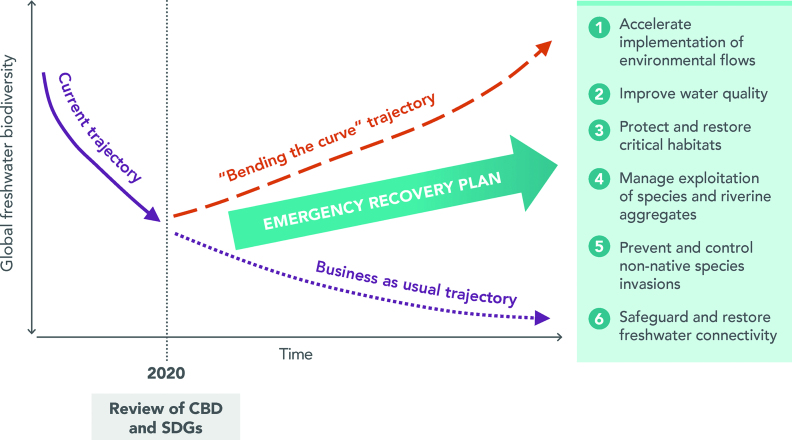
Despite their limited spatial extent, freshwater ecosystems host remarkable biodiversity, including one-third of all vertebrate species. This biodiversity is declining dramatically: Globally, wetlands are vanishing three times faster than forests, and freshwater vertebrate populations have fallen more than twice as steeply as terrestrial or marine populations. Threats to freshwater biodiversity are well documented but coordinated action to reverse the decline is lacking. We present an Emergency Recovery Plan to bend the curve of freshwater biodiversity loss. Priority actions include accelerating implementation of environmental flows; improving water quality; protecting and restoring critical habitats; managing the exploitation of freshwater ecosystem resources, especially species and riverine aggregates; preventing and controlling nonnative species invasions; and safeguarding and restoring river connectivity. We recommend adjustments to targets and indicators for the Convention on Biological Diversity and the Sustainable Development Goals and roles for national and international state and nonstate actors.
Overview
CoChat Summary
TL;DR
The paper presents an Emergency Recovery Plan to reverse global freshwater biodiversity loss through six priority actions: environmental flows, water quality, habitat protection and restoration, sustainable exploitation, invasive species control, and connectivity restoration. It recommends embedding these actions in post-2020 Convention on Biological Diversity and Sustainable Development Goal targets and indicators.
Key findings
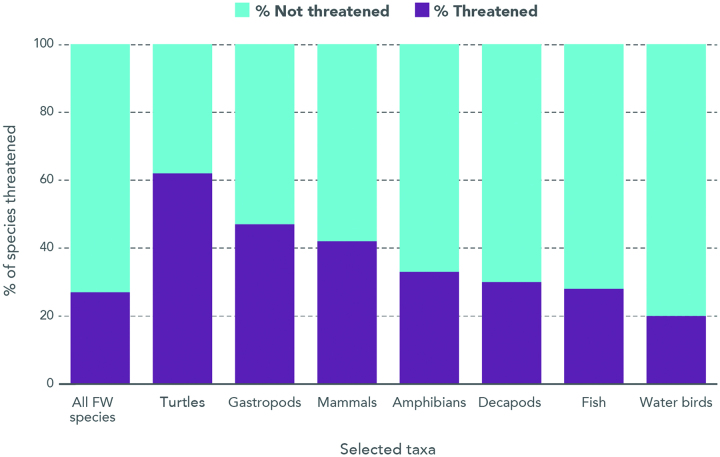
Freshwater ecosystems cover less than 1% of Earth’s surface but host approximately one-third of vertebrate species and 10% of all species; wetlands are vanishing three times faster than forests, and freshwater vertebrate populations have fallen more than twice as steeply as terrestrial or marine populations. Of 29,500 freshwater-dependent species assessed for the IUCN Red List, 27% are threatened with extinction, including an estimated 62% of turtle species, 47% of gastropods, 42% of mammals, 33% of amphibians, 30% of decapod crustaceans, 28% of fishes, and 20% of birds. Freshwater megafauna populations declined by 88% from 1970 to 2012, with the highest declines in Indomalaya (−99%) and Palearctic (−97%) realms. An estimated 30% of natural freshwater ecosystems have disappeared since 1970 and 87% of inland wetlands since 1700; only one-third of the world’s very long rivers remain free flowing, and approximately 3,700 new hydropower dams were identified worldwide at varying planning stages.
Methods
This is a policy and synthesis article, not a primary empirical study; it is structured around six priority actions derived from major causes of freshwater biodiversity loss: flow alteration, pollution, habitat degradation and loss, overexploitation, invasive nonnative species, and connectivity loss. The evidence base consists of cited global assessments, peer-reviewed literature, and implementation case studies from multiple regions, with no new field sample or primary data collection. The main analysis is a narrative review and policy-alignment exercise; Tables 1a and 1b map 13 existing or potential CBD and SDG targets and indicators to the six priority actions.
Limitations
Stated in the paper: implementation examples are “currently isolated successes”; human water demands and transboundary characteristics complicate implementation; data and science-based management are lacking for freshwater fisheries and riverine aggregate extraction; large-scale implementation of nature-based solutions is “in its infancy”; and substantial data gaps remain, including approximately 30% of freshwater mollusk species and 40% of decapod crustaceans classified as data deficient. Evident from the text: the plan is not empirically tested as a whole, relying instead on illustrative case studies and expert synthesis; the paper also notes that offsetting is controversial and open to misapplication.
Model-written summary. Check it against the paper before relying on it.
Integrity signals
Registry
Cites
Statistics
Figures
Verification
Claims the paper makes
5 Valid · 12 Not valid · 50 Not checked · 28 Own results and interpretations
Every source the paper cites for this claim was checked and supports it.
In the paper
“of the fish species assessed for the freshwater ecoregions of the world, over half were confined to a single ecoregion (Abell et al. 2008).”
§ Bending the Curve of Global Freshwater Biodiversity Loss: An Emergency Recovery Plan > Abstract
What the sources say
- Supportedcites Abell et al. 2008 matched to “Freshwater Ecoregions of the World: A New Map of Biogeographic Units for Freshwater Biodiversity Conservation” (2008) source
The “Freshwater ecoregional map and species results” section reports that more than 13,400 freshwater fish species were assigned to ecoregions and more than 6,900 to single ecoregions—over half of those assigned. No page number is supplied in the excerpt. (LLM, conf=0.94)
plain- Asserted: passes — The authors put it forward as true.
- Checkable: passes — It can be checked against evidence.
- Load-bearing: passes — The paper’s conclusions depend on it.
- Based: passes — The paper gives a reason why it holds.
- Supported
The cited sources support only part of this claim — read each source’s verdict below.
In the paper
“Recommendations to address immediate threats to and underlying drivers of global biodiversity loss have focused mainly on terrestrial ecosystems, such as forests and grasslands (e.g., Kok et al. 2018)”
§ Bending the Curve of Global Freshwater Biodiversity Loss: An Emergency Recovery Plan > Abstract
What the sources say
- Partly supportedcites Kok et al. 2018 matched to “Pathways for agriculture and forestry to contribute to terrestrial biodiversity conservation: A global scenario-study” (2018) sourceExperimental — accuracy not yet measured
Our copy supports only the exemplifying part of the attribution: Kok et al. (2018) is itself a terrestrial-scoped recommendations study — the Introduction (p. 1) states it 'evaluates the impacts on biodiversity of different response strategies in the agriculture and forestry sectors', and the Abstract and Sections 2.3/3.1–3.2 build pathways around forests, cropland and grazing land and terrestrial MSA. But no passage makes the comparative claim attributed here, namely that recommendations for global biodiversity loss have focused 'mainly' on terrestrial ecosystems; the closest statement (Introduction) is that societal responses have increased yet remain insufficient, and it credits that to Leadley et al. (2014), CBD (2014) and Tittensor et al. (2014). Aquatic biodiversity is not dismissed as neglected but explicitly handled in a separate companion analysis (Boelee et al., 2017, Introduction), so the 'mainly terrestrial' characterisation and the threats-versus-drivers distinction are not supported by this source. (LLM, conf=0.65)
plain- Asserted: passes — The authors put it forward as true.
- Checkable: passes — It can be checked against evidence.
- Load-bearing: passes — The paper’s conclusions depend on it.
- Based: passes — The paper gives a reason why it holds.
- Partly supported
In the paper
“with the highest declines in the Indomalaya and Palearctic realms (−99% and −97%, respectively; He et al. 2019).”
§ Bending the Curve of Global Freshwater Biodiversity Loss: An Emergency Recovery Plan > Abstract
What the sources say
- Not checked yetcites He et al. 2019
plain- Asserted: passes — The authors put it forward as true.
- Checkable: passes — It can be checked against evidence.
- Load-bearing: unclear — It is unclear whether the paper’s conclusions depend on it.
- Based: passes — The paper gives a reason why it holds.
In the paper
“Populations of freshwater megafauna, defined as animals that reach a body mass of 30 kilograms, declined by 88% from 1970 to 2012”
§ Bending the Curve of Global Freshwater Biodiversity Loss: An Emergency Recovery Plan > Abstract
What the sources say
- Not checked yetcites He et al. 2019
plain- Asserted: passes — The authors put it forward as true.
- Checkable: passes — It can be checked against evidence.
- Load-bearing: passes — The paper’s conclusions depend on it.
- Based: passes — The paper gives a reason why it holds.
In the paper
“Human demands for water will increase in some regions, making implementation more challenging (Palazzo et al. 2019).”
§ Bending the Curve of Global Freshwater Biodiversity Loss: An Emergency Recovery Plan > The Emergency Recovery Plan: Priorities for action > Action 1: Accelerate implementation of environmental flows
What the sources say
- Not checked yetcites Palazzo et al. 2019 matched to “Investment Needs for Irrigation Infrastructure along Different Socioeconomic Pathways” (2019) source
plainstates a cause- Asserted: passes — The authors put it forward as true.
- Checkable: passes — It can be checked against evidence.
- Load-bearing: unclear — It is unclear whether the paper’s conclusions depend on it.
- Based: passes — The paper gives a reason why it holds.
40 more claims
Create a free account to see all 95 claims and to verify the 58 references still open.
- It may state two separate claims as one. 29
- Probably not a substantial claim. 30
Claims other papers make about this one
Each is checked against this paper’s own text: does it say what the citing paper says it does?
The check wasn’t confident either way, so it gives no verdict — never disputed.
In the citing paper
“Hunting at Parker River National Wildlife Refuge represents both a traditional recreational use and serves as an important wildlife management tool.185”
From Protecting and restoring habitats to benefit freshwater biodiversity (2024) · cites this paper as [185]
Experimental — accuracy not yet measured
Citations
Cites
Freshwater biodiversity: importance, threats, status and conservation challenges
Dudgeon, D., Arthington, A. H., Gessner, M. O., Kawabata, Z., Knowler, D. J., Lévêque, C., Naiman, R. J., Prieur‐Richard, A., Soto, D., Stiassny, M. L. J., et al. (2006) · Biological Reviews · doi:10.1017/s1464793105006950 · Cited by 8,489
Self-citationPoff, N. L., Allan, J. D., Bain, M. B., Karr, J. R., Prestegaard, K. L., Richter, B. D., Sparks, R. E., & Stromberg, J. C. (1997) · BioScience · doi:10.2307/1313099 · Cited by 6,500
Pimentel, D., Zuniga, R., & Morrison, D. (2005) · Ecological Economics · doi:10.1016/j.ecolecon.2004.10.002 · Cited by 4,771
Emerging threats and persistent conservation challenges for freshwater biodiversity
Reid, A. J., Carlson, A. K., Creed, I. F., Eliason, E. J., Gell, P. A., Johnson, P. T. J., Kidd, K. A., MacCormack, T. J., Olden, J. D., Ormerod, S. J., et al. (2019) · Biological Reviews · doi:10.1111/brv.12480 · Cited by 3,645
Self-citationBasic Principles and Ecological Consequences of Altered Flow Regimes for Aquatic Biodiversity
BUNN, S. E., & ARTHINGTON, A. H. (2002) · Environmental Management · doi:10.1007/s00267-002-2737-0 · Cited by 3,379
Self-citationCeballos, G., Ehrlich, P. R., & Dirzo, R. (2017) · Proceedings of the National Academy of Sciences · doi:10.1073/pnas.1704949114 · Cited by 2,663
Mapping the world’s free-flowing rivers
Grill, G., Lehner, B., Thieme, M., Geenen, B., Tickner, D., Antonelli, F., Babu, S., Borrelli, P., Cheng, L., Crochetiere, H., et al. (2019) · Nature · doi:10.1038/s41586-019-1111-9 · Cited by 2,473
Self-citationA global boom in hydropower dam construction
Zarfl, C., Lumsdon, A. E., Berlekamp, J., Tydecks, L., & Tockner, K. (2015) · Aquatic Sciences · doi:10.1007/s00027-014-0377-0 · Cited by 2,181
Self-citationHow much wetland has the world lost? Long-term and recent trends in global wetland area
Davidson, N. C. (2014) · Marine and Freshwater Research · doi:10.1071/mf14173 · Cited by 2,177
Abell, R., Thieme, M. L., Revenga, C., Bryer, M., Kottelat, M., Bogutskaya, N., Coad, B., Mandrak, N., Balderas, S. C., Bussing, W., et al. (2008) · BioScience · doi:10.1641/b580507 · Cited by 2,045
Self-citation
Research works printed but not linked: 14
- Döll P, Bunn SE. 2014 Cross-chapter box on the impact of climate change on freshwater ecosystems due to altered river flow regimes. Pages 143– 146 in Field CB et al., eds. Climate Change Impacts, Adaptation, and Vulnerability. Part A: Global and Sectoral Aspects. Contribution of Working Group II to the Fifth Assessment Report of the Intergovernmental Panel on Climate Change. Cambridge University Press.
- Fricke R, Eschmeyer W, van der Laan R 2019 Catalog of fishes: Genera, species, references. California Academy of Sciences. http://researcharchive.calacademy.org/research/ichthyology/catalog/SpeciesByFamily.asp.
- Funge-Smith S. 2018 Review of the State of the World Fishery Resources: Inland Fisheries. Food and Agriculture Organization of the United Nations Fisheries and Aquaculture Circular.
- Harwood A, Johnson S, Richter B, Locke A, Yu X, Tickner D 2017 Listen to the River: Lessons from a Global Review of Environmental Flow Success Stories. World Wildlife Fund.
- [IUCN] International Union for Conservation of Nature 2019 The IUCN Red List of Threatened Species, version 2019-1. IUCN www.iucnredlist.org.
- Koehnken L, Rintoul M. 2018 Impacts of Sand Mining on Ecosystem Structure, Process and Biodiversity in Rivers. World Wildlife Fund International.
- Koning AA. 2018 Riverine Reserves: The Conservation Benefits of Spatial Protection for Rivers in the Context of Environmental Change. University of Wisconsin–Madison.
- Le Quesne T, Kendy E, Weston D 2010 The Implementation Challenge: Taking Stock of Government Policies to Protect and Restore Environmental flows. WWF and The Nature Conservancy.
- Moir K, Thieme M, Opperman J 2016 Securing a Future that Flows: Case Studies of Protection Mechanisms for Rivers. World Wildlife Fund and The Nature Conservancy.
- NBI (Nile Basin Initiative) 2016 Strategy for Management of Environmental Flows in the Nile Basin. Nile Basin Initiative Secretariat. 17p.
- Opperman J et al. 2019a Connected and Flowing: A Renewable Future for Rivers, Climate, and People. WWF and The Nature Conservancy.
- Speed R, Tickner D, Naiman R, Gang L, Sayers P, Yu W, Yuanyuan L, Houjian H, Jianting C, Lili Y 2016 River Restoration: A Strategic Approach to Planning and Management. UNESCO.
- [UNEP] United Nations Environment Programme 2016 Snapshot of the World's Water Quality: Towards a Global Assessment. UNEP.
- UN Environment 2017 A Framework for Freshwater Ecosystem Management, vol. 2: Technical Guide for Classification and Target-Setting. United Nations.
Cited by
Items 901–1,000 of 1,243
(2025) · doi:10.1101/2025.04.02.646737 · Cited by 1
“However, the increasing degradation of these ecosystems and the consequent loss of biodiversity due to several factors including land use change and chemical pollution underscore the urgent need for effective conservation strategies (Persson et al., 2022; Reid et al., 2019; Tickner et al., 2020).”
Baeza Sanz, D., & Matías, A. G. (2023) · Journal of Water and Climate Change · doi:10.2166/wcc.2023.246 · Cited by 1
De, K., & Dwivedi, A. K. (2026) · Natural Resources Forum · doi:10.1111/1477-8947.70071 · Cited by 4
Akkan, B. E., Mutlu, C., & Verep, B. (2025) · Journal of Anatolian Environmental and Animal Sciences · doi:10.35229/jaes.1793470 · Cited by 1
Padilha, J. D. A. G., Teixeira, A., & Sousa, R. (2025) · Hydrobiologia · doi:10.1007/s10750-025-06055-1 · Cited by 3
Flores-Díaz, A. C., & Martínez-Cruz, J. (2022) · Madera y Bosques · doi:10.21829/myb.2022.2832500 · Cited by 1
“…transformadas (Vázquez et al., 2015; Hughes y Vadas, 2021) y, dada la importancia que tienen para los ecosistemas dulceacuícolas y para la sociedad, resulta muy relevante generar conocimiento que permita guiar su recuperación (Naiman et al., 2002; Naiman et al., 2005; Tickner et al., 2020).”
BackgroundAcoustic Profiles of Underwater Soundscapes Affected by Road Traffic
Velde, K. T., & Slabbekoorn, H. (2023) · Springer eBooks · doi:10.1007/978-3-031-10417-6_191-1 · Cited by 3
Tomiczek, T., Márquez, J. R. G., Arlinghaus, R., & Domisch, S. (2026) · Diversity and Distributions · doi:10.1111/ddi.70168 · Cited by 2
“fish harvest (Dudgeon et al. 2006; Tickner et al. 2020).”
Batina, A. (2026) · Limnological Review · doi:10.3390/limnolrev26020017 · Cited by 2
Qiao, J., Liu, Y., Yao, W., Ma, H., Yu, L., Zhao, Q. P., & Ouyang, L. (2026) · Animals · doi:10.3390/ani16010145 · Cited by 1
“The management and protection of freshwater environments and biodiversity have long been significantly underestimated, and it is only in recent years that they have gradually attracted the attention of managers and ecologists [3–5].”
Liu, W., Tian, S., Yang, H., Wang, S., Li, Z., & Yin, X. (2025) · Water Biology and Security · doi:10.1016/j.watbs.2025.100500 · Cited by 9
Complex Life Cycles Shape the Functional Biogeography of European Dragonflies
Iversen, L. L., Márquez, J. R. G., Grigoropoulou, A., O’Connor, M. P., Domisch, S., & Lancaster, L. T. (2025) · Global Ecology and Biogeography · doi:10.1111/geb.70056 · Cited by 1
Pearson, R. G., Zunker-Mellick, B., & Nolen, J. A. (2024) · Pacific Conservation Biology · doi:10.1071/pc24030 · Cited by 2
Cross‐Ecosystem Biodiversity Action Is Systemically Overlooked
Peller, T., & Altermatt, F. (2026) · Conservation Letters · doi:10.1111/con4.70067 · Cited by 1
“Connectivity is often interpreted as the movement of species across landscapes and seascapes (Brodie et al. 2025 ), but the GBF’s language also accommodates a broader understanding that includes connectivity through both biotic and abiotic pathways (Tickner et al. 2020 ).”
Wang, X., Nan, F., Liu, X., & Wu, R. (2025) · Zoosystematics and Evolution · doi:10.3897/zse.101.172606 · Cited by 1
Fang, J., Hou, L., Jia, S., Xu, J., Johnson, A. C., & Jin, X. (2026) · Environment International · doi:10.1016/j.envint.2026.110410 · Cited by 1
When is a knowledge gap filled in environmental monitoring?
Dai, X., Webb, J. A., Horne, A., & Wilkins, T. E. (2025) · Journal of Environmental Management · doi:10.1016/j.jenvman.2025.126217 · Cited by 2
Schulz‐Zunkel, C., Dziock, F., Seele‐Dilbat, C., Bondar‐Kunze, E., & Scholz, M. (2022) · International Review of Hydrobiology · doi:10.1002/iroh.202202131 · Cited by 1
Quantifying small hydropower dam effects on habitats and multiple organism groups in forested rivers
Johnson, R. K., Drakare, S., Kahlert, M., et al. (2025) · Inland Waters · doi:10.1080/20442041.2024.2448915 · Cited by 1
“Construction of dams for water storage and hydropower is one of the main causes accelerating biodiversity loss in freshwaters (Lange et al. 2018, Tickner et al. 2020, Thieme et al. 2021, Hasse et al. 2023).”
Chishui River fish diversity and its driving factors An environmental DNA studyPreprint
Guo, N., Xiao, N., Gao, X., Shen, M., Sun, X., & Li, J. (2023) · doi:10.22541/au.169390643.34951108/v1 · Cited by 1
Seasonal Metacommunity Processes of Benthic Invertebrates in the Vjosa/Aoos River
Martini, J., Fuß, T., Brasseur, M. V., Oester, R., Talluto, L., Walther, F., Wilfling, O., Zizka, V. M. A., Singer, G. A., & Vitecek, S. (2026) · Ecology and Evolution · doi:10.1002/ece3.73307 · Cited by 1
Ofori, B. Y., Mensah, J. B., & Attuquayefio, D. K. (2025) · Environmental Monitoring and Assessment · doi:10.1007/s10661-025-14078-3 · Cited by 1
Schütz, R., Friedrichs‐Manthey, M., Macher, T., Beermann, A. J., Arle, J., Koschorreck, J., & Leese, F. (2025) · bioRxiv (Cold Spring Harbor Laboratory) · doi:10.64898/2025.12.23.696188 · Cited by 1
“Such continuous data collection is particularly important in freshwater ecosystems, which are subject to rapid and complex environmental changes (Kaijser et al., 2025; Tickner et al., 2020).”
Creating a systematic prioritization of stream reaches for conservation of aquatic species
Kiser, A. H., Craig, C. A., Bonner, T. H., Littrell, B., Smith, C. H., Robertson, C. R., Wang, H., Grant, W. E., Johnson, M. S., Lopez, R. R., et al. (2024) · Ecosphere · doi:10.1002/ecs2.4772 · Cited by 1
Silva, O. G. E., Guimarães, T. D. F. R., Becker, F. G., et al. (2024) · Brazilian Journal of Biology · doi:10.1590/1519-6984.285436 · Cited by 1
Impacts of Climate Change and Local Disturbance on Stream Fish Assemblages in the Amazon
Barros, G. G., Mascarenhas, B., Zuanon, J. A. S., & de Deus, C. P. (2024) · Springer eBooks · doi:10.1007/978-3-031-66822-7_4 · Cited by 2
Krishnaraj, V., & Palanisamy, J. (2024) · Water Air & Soil Pollution · doi:10.1007/s11270-024-06963-3 · Cited by 1
“Human activities have an opportunity to increase stressors to river operative (Tickner et al., 2020; Vörösmarty et al., 2010).”
Halse, S. A., & Storey, A. W. (2025) · Pacific Conservation Biology · doi:10.1071/pc24094 · Cited by 1
If not now, when? Converging needs for water security, systemic change, and finance and investment
Smith, D. M. (2022) · Elsevier eBooks · doi:10.1016/b978-0-12-822847-0.00009-0 · Cited by 1
Sze-man, Y., & Anthony, L. (2020) · doi:10.1101/2020.11.17.387696 · Cited by 1
Arthington, A. H. (2022) · Proceedings of the Royal Society of Queensland · doi:10.53060/prsq.2022-22 · Cited by 1
Self-citationEditorial: Women at the frontier of freshwater science
Brizga, S. O., Aguiar, F. C., Pavanelli, C. S., et al. (2025) · Frontiers in Environmental Science · doi:10.3389/fenvs.2025.1672849
Mohan, C. (2022) · Hydrology and earth system sciences · doi:10.5194/hess-2022-87-ac5
ВПЛИВ ПІДВИЩЕНИХ КОНЦЕНТРАЦІЙ ІОНІВ Сo2+ НА МОРФОМЕТРИЧНІ ПОКАЗНИКИ У ПРІСНОВОДНИХ РИБ
Vovchek, N. О., Holineі, H. M., Khomenchuk, V. O., & Kurant, V. Z. (2024) · Scientific Issue Ternopil Volodymyr Hnatiuk National Pedagogical University Series Biology · doi:10.25128/2078-2357.23.3-4.7
Joseph, N., Sreejai, R., & Nair, H. V. (2026) · Inland Waters · doi:10.1080/20442041.2026.2734146
López‐Casas, S., Ávila‐Vargas, L., Jiménez, N., & Obando, J. G. (2024) · Acta Biológica Colombiana · doi:10.15446/abc.v29n3.117023
Approaches to Climate Change through Environmental Flow Indicators
Tesfaye, T. W. (2025) · Sustainable development · doi:10.5772/intechopen.1009521
Mambo, T., Emmanuel, V., Wilson, M. I., Mizani, C. D., Moreira, D. C. L., & Mulungula, P. M. (2026) · SSRN Electronic Journal · doi:10.2139/ssrn.7049792
Macquarie Marshes, Australia: Aquatic ecosystem function and microbial biodiversity
Ralph, T. J., & Kobayashi, T. (2025) · Elsevier eBooks · doi:10.1016/b978-0-443-15726-4.00034-7
Current Status of Greek Lakes and Future Perspectives: Results from WFD Monitoring
Tsiaoussi, V., Mavromati, E., Demertzi, K., Giourieva, V., Katsavouni, S., Kemitzoglou, D., Navrozidou, V., Nikolopoulou, I., Papadimos, D., Patsia, A., et al. (2025) · Springer eBooks · doi:10.1007/978-3-032-02168-7_5
River Basin Organisations, Basin Agreements and European Environmental Law in the UNECE Regime
(2021) · Transboundary Freshwater Ecosystems in International Law · doi:10.1017/9781108854641.010
Global Learning for Promoting Sustainable Practices in Water, Energy, and Marine Resources
Nehar, B., Wróbel, D., Ola, A. M., et al. (2026) · Springer international handbooks of education · doi:10.1007/978-3-032-10711-4_33-1
Silva, M. L., Ottoni, F. P., Viana, D. C., Saraiva, D. J., Justo, M. C. N., & Cohen, S. C. (2025) · Zoosystematics and Evolution · doi:10.3897/zse.101.147382
“…extinctions, as these freshwater ecosystems are being altered, degraded, or destroyed more quickly and sharply, a phenomenon called the “Freshwater Biodiversity Crisis” (Darwall et al. 2018; Harrison et al. 2018; Reid et al. 2019; Albert et al. 2020; Tickner et al. 2020; Ottoni et al. 2023).”
Virkki, V. (2021) · Hydrology and earth system sciences · doi:10.5194/hess-2021-260-ac1
Taxonomic Enumeration of Microalgal Flora of Puthur Lake, Thrissur, Kerala, India
Mithra, S., Ammini, C. J., Bibina, P. B., et al. (2025) · International Journal on Algae · doi:10.1615/interjalgae.v27.i4.10
Zhang, Y., Niu, G., Sui, G., Duan, T., Cheng, T., & Xin, Y. (2026) · Sustainability · doi:10.3390/su18168607 · Cited by 1
“Winter management therefore involves two distinct questions: which water level benchmarks are defensible from the available evidence [4,5], and what upstream replenishment is required to attain those benchmarks under specified operating conditions [6]?”
A Hydrogeochemical Approach to Conserve Coastal Groundwater-Dependent Ecosystems
Dyring, M., Hofmann, H., McDougall, A., et al. (2024) · doi:10.2139/ssrn.4880298
Japanese mayfly family classification with a vision transformer model
Iwasaki, Y., Arai, H., Tamada, A., & Kataoka, H. (2025) · Limnology · doi:10.1007/s10201-025-00805-9
“However, the marked degradation of freshwater ecosystems and loss of freshwater biodiversity highlight the importance of their conservation (Loh et al. 2005; Poff et al. 2007; Reid et al. 2019; Tickner et al. 2020).”
Editorial: Freshwater science in the tropical anthropocene
Keke, U. N., Dalu, T., López‐López, E., & Arimoro, F. O. (2023) · Frontiers in Environmental Science · doi:10.3389/fenvs.2023.1191295 · Cited by 2
Royaux, C. (2024) · theses.fr (ABES) · doi:10.70675/47ccc132zb8acz493az8b90z9ac335fc5d04
Una revisión de la biología de Batrachochytrium dendrobatidis
Marmolejo-Vargas, A. L., Solano, L., Baleta-Osorio, A., & Vergara-Comas, D. (2023) · doi:10.21892/9786287515383.10
Functional Vulnerability Arises From Unsteady Trait‐Based Networks Despite High Redundancy
Ji, S., MacIsaac, H. J., Ding, C., Li, Y., Wang, J., Vannaphon, A., Lyu, J., & Tao, J. (2026) · Ecology Letters · doi:10.1111/ele.70336
The Global Environment Facility approach for allocating biodiversity funding to countriesPreprint
McOwen, C., Burgess, N. D., Ash, N., Baquero, A. C., da Fonseca, G. A. B., Harfoot, M., Hilton‐Taylor, C., Kapos, V., Ravilious, C., Sayor, C., et al. (2022) · bioRxiv (Cold Spring Harbor Laboratory) · doi:10.1101/2022.12.07.519459
(2021) · Transboundary Freshwater Ecosystems in International Law · doi:10.1017/9781108854641.003
Zyl, B. V., Burnett, M. J., Hanzen, C., & Downs, C. T. (2026) · Environmental Biology of Fishes · doi:10.1007/s10641-026-01822-y
“…and Chakona 2020), which is a concern when facing increasing anthropogenic stressors that alter environmental conditions causing local extinctions (Tickner et al. 2020; Burnett et al. 2023), or implementing mitigation measures against anthropogenic structures, for example; fishways are…”
Socioeconomic impacts of Australian redclaw crayfish Cherax quadricarinatus in Lake Kariba
Chakandinakira, A. T., Madzivanzira, T. C., Mashonga, S., Muzvondiwa, J. V., & South, J. (2022) · doi:10.21203/rs.3.rs-1972389/v1 · Cited by 8
Eser, R., Yazıcı, R., & Eroğlu, M. (2026) · Journal of Limnology and Freshwater Fisheries Research · doi:10.17216/limnofish.1908953
Patterns of Freshwater Fish Vulnerability in European Rivers
Mameri, D., Duarte, G., Cabo, J., Segurado, P., Santos, J. M., Figueira, R., Ferreira, M. T., & Branco, P. (2026) · Aquatic Conservation Marine and Freshwater Ecosystems · doi:10.1002/aqc.70387
Resen et al., A. K. (2023) · Egyptian Journal of Aquatic Biology and Fisheries · doi:10.21608/ejabf.2023.298280
Our Ancient Lakes: A Natural History
McKinnon, J. S. (2023) · The MIT Press eBooks · doi:10.7551/mitpress/13625.001.0001 · Cited by 2
de Oliveira, C. A. C. R., Morais, K. S., de Oliveira, J. P. S., Marques, A. D. O., da Silva, A. B. F., Palheta, D. D. C., & Bentes, B. (2025) · SSRN Electronic Journal · doi:10.2139/ssrn.5386891
López-Casas, S., Rogéliz-Prada, C., Atencio-García, V., Moreno-Arias, C., Arenas, D., Rivera-Coley, K., & Jiménez-Segura, L. (2025) · Frontiers in Environmental Science · doi:10.3389/fenvs.2025.1425804
Zhang, S., Zhang, X., Zhong, W., Wang, Y., Zong, S., & Pellissier, L. (2026) · Environmental Science & Technology · doi:10.1021/acs.est.6c05038
Izma, G., McIsaac, D., Raby, M., Yates, A. G., Prosser, R. S., & Rooney, R. C. (2026) · Water Environment Research · doi:10.1002/wer.70463
“With the severe decline of freshwater biodiversity both globally (WWF 2016; Tickner et al. 2020) and in Canada (Desforges et al. 2022), understanding the biological communities occupying SWPs, and the stressors they face, is fundamental to urban biodiversity conservation efforts (Ferzoco and…”
Ferreira, M. W. M., Pontes, J. K. P. N., Ferreira, M. P. P., Santos, J. P., Guimarães, E. C., de Brito, P. S., da Costa, G. C., Ottoni, F. P., de Oliveira, R. F., Dias, L. J. B. D. S., et al. (2025) · Biota Neotropica · doi:10.1590/1676-0611-bn-2025-1784 · Cited by 1
Prototype of a global model for regulating ecosystem services of inland wetlands
de Klein, J. J. M., Janse, J. H., van Dam, A. A., Hes, E. M. A., van Beek, R., Wallnöfer, I., & Verhoeven, J. T. A. (2026) · The Science of The Total Environment · doi:10.1016/j.scitotenv.2026.181899
Biogeographical Regions in the Aegean Archipelago: An Assessment for Freshwater Macroinvertebrates
Lampou, A., Skoulikidis, N., & Bonada, N. (2025) · Journal of Biogeography · doi:10.1111/jbi.70117 · Cited by 1
“This emphasises that the proposed regions are particularly shaped by taxa constrained by dispersal barriers, highlighting the value of trait-based approaches in island biogeography (Tickner et al. 2020).”
(2021) · Transboundary Freshwater Ecosystems in International Law · doi:10.1017/9781108854641.013
Meyer, M., Schindler, M., Wilhelm, K., Gruber, J., Schillinger, A., Hiller, C., Jani, K., Jetter, K., Carranco, A. S., Vesely, K., et al. (2026) · Global Ecology and Conservation · doi:10.1016/j.gecco.2026.e04375
Hogan, J. D., Selwyn, J. D., & Taylor, C. M. (2025) · Ichthyology & Herpetology · doi:10.1643/i2024024 · Cited by 2
“These effects can result in significant changes to resident fish assemblages, including loss of biodiversity, species replacement, species extirpations/extinctions, and proliferation of introduced species (Vo¨ro¨smarty et al., 2010; Tickner et al., 2020).”
Endemic fish promote ecological structure in a tropical biodiversity hotspot
Shukla, R., Fontrodona‐Eslava, A., Atkore, V., Bhat, A., Dahanukar, N., Johnson, J. A., Raghavan, R., Dornelas, M., Magurran, A. E., & Shanker, K. (2026) · Proceedings of the Royal Society B Biological Sciences · doi:10.1098/rspb.2025.1127 · Cited by 1
Bodine, C. S., Buscombe, D., Best, R. J., et al. (2022) · doi:10.31223/x5xp8q
Šigutová, H., Geislerová, P., Šigut, M., & Pyszko, P. (2026) · Environmental Pollution · doi:10.1016/j.envpol.2026.128065
White, J. H., Philipps, C. S., & Chandler, L. B. (2023) · Wetlands Ecology and Management · doi:10.1007/s11273-023-09957-w
“Use of UASs in wetland research has increased notably since 2016, warranted by their immediate conservation concern (Davidson 2014; Tickner et al. 2020).”
BackgroundEffects of water flow and sediment on the decay of environmental DNA in a closed-water system
Tsuji, M., Katano, I., & Doi, H. (2026) · Limnology · doi:10.1007/s10201-026-00846-8
Global patterns of parasite sharing among freshwater turtles
Silva, M., Rato, J., Brandão, P., Rocha, R., Anastácio, P., & Banha, F. (2026) · Parasitology Research · doi:10.1007/s00436-026-08702-5
“…societies (Stanford et al. 2020) and the equilibrium of aquatic ecosystems (Moll and Moll 2004; Lovich et al. 2018), according to the IUCN Red List, freshwater turtles already represent one of the most threatened group of vertebrates (Rhodin et al. 2018; Stanford et al. 2020; Tickner et al. 2020).”
Future climate impacts on biodiversity trends in major global rivers worldwide
Wu, Y., Ma, Q., Qin, L., Peñuelas, J., Liu, X., 王国栋, Rousseau, A. N., & He, F. (2026) · Ecological Frontiers · doi:10.1016/j.ecofro.2025.12.018
Ren, M., Gong, X., Geng, M., Hu, T., Hu, A., Chen, L., Chen, G., & Wang, J. (2026) · Water Research · doi:10.1016/j.watres.2026.126567 · Cited by 2
Bentley, S. B. (2021) · Open Access Victoria University of Wellington | Te Herenga Waka (Figshare) · doi:10.26686/wgtn.17104400.v1 · Cited by 4
Austin, C. M., Ahyong, S. T., Miller, A., Raadik, T. A., Lintermans, M., McCormack, R., Zukowski, S., Hammer, M. P., Grandjean, F., Gilligan, D. M., et al. (2026) · Ecology and Evolution · doi:10.1002/ece3.73428
“To avert the biodiversity crisis the world is currently experiencing, effective conservation prioritisation, planning and management is required to prevent the loss of species, eco-systems and genetic diversity (Dobrzycka-Krahel et al. 2024; Hunter et al. 2021; Tickner et al. 2020).”
Lee, C., Bravetti, G., Marchi, A., Zuffi, G., Sacchetti, S., Nanetti, M., Agostini, A., Lucchini, D., Zaccanti, F., Goffredo, S., et al. (2026) · Environmental and Sustainability Indicators · doi:10.1016/j.indic.2026.101278
Stănescu, S.-V., & Rîșnoveanu, G. (2026) · Water · doi:10.3390/w18020216
Frey, D., Fricker, V., Hischier, C. M., Scheidegger, C., Stofer, S., Zengerer, V., & Fink, S. (2025) · Alpine Botany · doi:10.1007/s00035-025-00336-0
“More-over, planning and assessing riparian ecosystem restoration should involve indicator species reflecting the full range of characteristic habitat types and environmental conditions expected in dynamic, actively braiding rivers (Tickner et al. 2020).”
Lorrain‐Soligon, L. (2023) · theses.fr (ABES) · doi:10.70675/e3a31041z8a2cz4a55za160zcd44e0361612
Hauck, L., Penaluna, B. E., Coble, A. A., Swartz, A. G., & Homyack, J. A. (2026) · Fire Ecology · doi:10.1186/s42408-026-00521-4
“Global calls to action have documented numerous challenges and stressors for freshwater biodiversity, but none have explicitly included wildfire as a key stressor on freshwater biodiversity (Tickner et al. 2020; Albert et al. 2021; Harper et al. 2021).”
Environmental DNA analysis to search for an endangered desert fishPreprint
Fulkerson, A., Gutiérrez‐Barragán, A., Varela‐Romero, A., et al. (2026) · bioRxiv (Cold Spring Harbor Laboratory) · doi:10.64898/2026.05.20.726406
Ecohydrology and water quality strongly influence riverine water ecological healthPreprint
Duan, Y., Song, T., Su, X., Dong, W., Lyu, H., Wan, Y., & Shen, X. (2026) · SSRN Electronic Journal · doi:10.2139/ssrn.6141755
Transboundary Freshwater Ecosystems in International Law
(2021) · Transboundary Freshwater Ecosystems in International Law · doi:10.1017/9781108854641.011
Vukov, D., & Ilić, M. (2026) · Water · doi:10.3390/w18141769
“As a consequence, the spread of non-native species has become an increasingly important consideration in freshwater biodiversity conservation and ecological monitoring programs [5,6].”
(2021) · doi:10.1002/essoar.10507838.1 · Cited by 14
Metadata
- Authors
- Tickner, D., Opperman, J. J., Abell, R., Acreman, M., Arthington, A. H., Bunn, S. E., Cooke, S. J., Dalton, J., Darwall, W., Edwards, G., Harrison, I., Hughes, K., Jones, T., Leclère, D., Lynch, A. J., Leonard, P., McClain, M. E., Muruven, D., Olden, J. D., Ormerod, S. J., Robinson, J., Tharme, R. E., Thieme, M., Tockner, K., Wright, M., & Young, L.
- Affiliations
- WWF-UK (GB)
- World Wildlife Fund (US)
- Conservation International (US)
- UK Centre for Ecology & Hydrology (GB)
- Griffith University (AU)
- Carleton University (CA)
- International Union for Conservation of Nature (CH)
- International Union for Conservation of Nature (United Kingdom) (GB)
- DJEnvironmental, Harpers Mill, United Kingdom
- International Institute for Applied Systems Analysis (AT)
- United States Geological Survey (US)
- IHE Delft Institute for Water Education (NL)
- Freshwater Practice of WWF International, Zeist, The Netherlands
- University of Washington (US)
- Cardiff University (GB)
- Wildfowl & Wetlands Trust (GB)
- Director of Riverfutures, Cressbrook, United Kingdom
- Leibniz Institute of Freshwater Ecology and Inland Fisheries (DE)
- Corresponding author
- Tickner, David
- ORCID
- Venue
- BioScience
- Publisher
- Oxford University Press (OUP)
- Published
- 2020-02-19
- Volume
- 70
- Issue
- 4
- Pages
- 330-342
- ISSN
- 0006-3568 (ISSN-L)
- 1525-3244
- PMC
- PMC7138689
- OpenAlex
- W2982687801
- Cited by
- 1,241
- References
- 94
- Citations by year
- 2026: 233 · 2025: 222 · 2024: 229 · 2023: 184 · 2022: 192 · 2021: 140 · 2020: 41
- FWCI
- 88.45
- Type
- journal article
- Language
- en
- Open access
- hybrid
- doi.org
- Licence
- Locations
- BioScience (publishedVersion, cc-by-nc)
- Europe PMC (PubMed Central) (publishedVersion, cc-by-nc)
- PubMed Central (publishedVersion, cc-by-nc)
- PubMed (publishedVersion)
- ORCA Online Research @Cardiff (Cardiff University) (acceptedVersion)
- NERC Open Research Archive (Natural Environment Research Council) (acceptedVersion)
- IIASA PURE (International Institute of Applied Systems Analysis) (acceptedVersion)
- Griffith Research Online (submittedVersion, cc-by-nc)
- Funders
- University of Washington
- Cardiff University
- Griffith University
- Technische Universiteit Delft
- WWF International
- Freie Universität Berlin
- U.S. Geological Survey
- School of Aquatic and Fishery Sciences
- Centre for Ecology and Hydrology
- Topics
- Physical Sciences › Environmental Science › Nature and Landscape Conservation › Fish Ecology and Management Studies
- Physical Sciences › Environmental Science › Ecology › Aquatic Ecosystems and Biodiversity
- Physical Sciences › Environmental Science › Ecology › Freshwater macroinvertebrate diversity and ecology
- Keywords
- freshwater biodiversity loss, biodiversity recovery, wetland loss, freshwater vertebrates, environmental flows, water quality, habitat restoration, freshwater management, river connectivity, Convention on Biological Diversity, Sustainable Development Goals
About these checks
Registry, retraction, Cites and statistics results are computed, not judged, with one exception: a printed reference that no index lists is read once by a model before it counts as a citation error. Claims are extracted by a model and kept only when their quote appears verbatim in the text; each cited source is then checked, with a model’s help, for whether it says what the claim relies on. Those verdicts can be wrong — read the claim’s quote and the cited source before relying on one.
The claim verdicts this report counts are experimental: their accuracy is not yet measured.
A language model drew the claims from the paper on 2026-10-05, under version 3 of the claim definition (model deepseek-v4.1-flash, prompt extract-v3).
A second model labelled each claim on 2026-10-05 (model jev-1.13-20260917, definition revision gold-guideline-v0.2).
Cited sources are checked with a language model’s help (gpt-6-sol and qwen3.8-omni-flash).
Statistics and arithmetic are recomputed, not judged.
Confidence bands are shown only for fields calibrated on our annotated test set. None is calibrated yet, so no band is shown.
What counts as a claim ›How we measure confidence ›How we check this ›
Are you an author, or do you see a problem with this page? Request a review
Data sources
Bibliographic data: Semantic Scholar, OpenAlex, Crossref.
Contains information from the Semantic Scholar Academic Graph Datasets, made available under the ODC Attribution License (ODC-BY 1.0).
Semantic Scholar’s data is described in: Kinney, R., et al. (2023). The Semantic Scholar Open Data Platform. arXiv:2301.10140.
