

Bending the Curve of Global Freshwater Biodiversity Loss: An Emergency Recovery Plan
Open accessThe DOI matches its Crossref record; 86 of the 94 references it cites were found in a registry or an index; 5 of the 63 sources its claims cite were checked for support.
Abstract
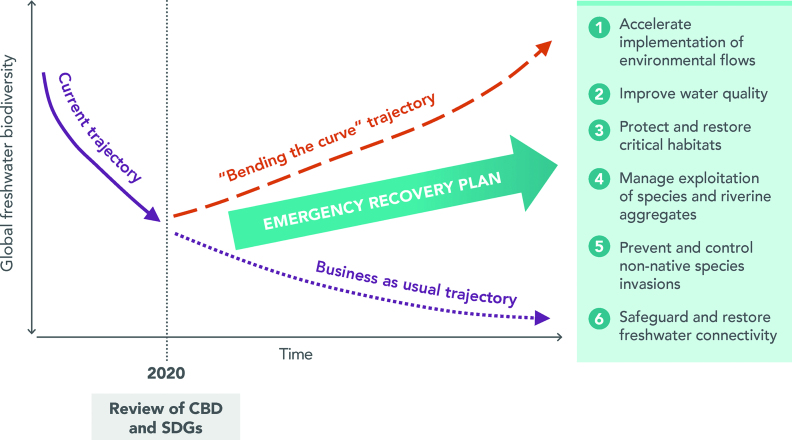
Despite their limited spatial extent, freshwater ecosystems host remarkable biodiversity, including one-third of all vertebrate species. This biodiversity is declining dramatically: Globally, wetlands are vanishing three times faster than forests, and freshwater vertebrate populations have fallen more than twice as steeply as terrestrial or marine populations. Threats to freshwater biodiversity are well documented but coordinated action to reverse the decline is lacking. We present an Emergency Recovery Plan to bend the curve of freshwater biodiversity loss. Priority actions include accelerating implementation of environmental flows; improving water quality; protecting and restoring critical habitats; managing the exploitation of freshwater ecosystem resources, especially species and riverine aggregates; preventing and controlling nonnative species invasions; and safeguarding and restoring river connectivity. We recommend adjustments to targets and indicators for the Convention on Biological Diversity and the Sustainable Development Goals and roles for national and international state and nonstate actors.
Overview
CoChat Summary
TL;DR
The paper presents an Emergency Recovery Plan to reverse global freshwater biodiversity loss through six priority actions: environmental flows, water quality, habitat protection and restoration, sustainable exploitation, invasive species control, and connectivity restoration. It recommends embedding these actions in post-2020 Convention on Biological Diversity and Sustainable Development Goal targets and indicators.
Key findings
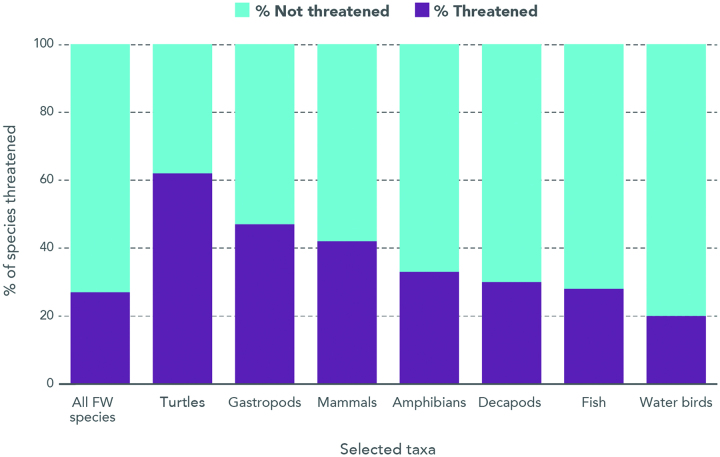
Freshwater ecosystems cover less than 1% of Earth’s surface but host approximately one-third of vertebrate species and 10% of all species; wetlands are vanishing three times faster than forests, and freshwater vertebrate populations have fallen more than twice as steeply as terrestrial or marine populations. Of 29,500 freshwater-dependent species assessed for the IUCN Red List, 27% are threatened with extinction, including an estimated 62% of turtle species, 47% of gastropods, 42% of mammals, 33% of amphibians, 30% of decapod crustaceans, 28% of fishes, and 20% of birds. Freshwater megafauna populations declined by 88% from 1970 to 2012, with the highest declines in Indomalaya (−99%) and Palearctic (−97%) realms. An estimated 30% of natural freshwater ecosystems have disappeared since 1970 and 87% of inland wetlands since 1700; only one-third of the world’s very long rivers remain free flowing, and approximately 3,700 new hydropower dams were identified worldwide at varying planning stages.
Methods
This is a policy and synthesis article, not a primary empirical study; it is structured around six priority actions derived from major causes of freshwater biodiversity loss: flow alteration, pollution, habitat degradation and loss, overexploitation, invasive nonnative species, and connectivity loss. The evidence base consists of cited global assessments, peer-reviewed literature, and implementation case studies from multiple regions, with no new field sample or primary data collection. The main analysis is a narrative review and policy-alignment exercise; Tables 1a and 1b map 13 existing or potential CBD and SDG targets and indicators to the six priority actions.
Limitations
Stated in the paper: implementation examples are “currently isolated successes”; human water demands and transboundary characteristics complicate implementation; data and science-based management are lacking for freshwater fisheries and riverine aggregate extraction; large-scale implementation of nature-based solutions is “in its infancy”; and substantial data gaps remain, including approximately 30% of freshwater mollusk species and 40% of decapod crustaceans classified as data deficient. Evident from the text: the plan is not empirically tested as a whole, relying instead on illustrative case studies and expert synthesis; the paper also notes that offsetting is controversial and open to misapplication.
Model-written summary. Check it against the paper before relying on it.
Integrity signals
Registry
Cites
Statistics
Figures
Verification
Claims the paper makes
5 Valid · 12 Not valid · 50 Not checked · 28 Own results and interpretations
Every source the paper cites for this claim was checked and supports it.
In the paper
“of the fish species assessed for the freshwater ecoregions of the world, over half were confined to a single ecoregion (Abell et al. 2008).”
§ Bending the Curve of Global Freshwater Biodiversity Loss: An Emergency Recovery Plan > Abstract
What the sources say
- Supportedcites Abell et al. 2008 matched to “Freshwater Ecoregions of the World: A New Map of Biogeographic Units for Freshwater Biodiversity Conservation” (2008) source
The “Freshwater ecoregional map and species results” section reports that more than 13,400 freshwater fish species were assigned to ecoregions and more than 6,900 to single ecoregions—over half of those assigned. No page number is supplied in the excerpt. (LLM, conf=0.94)
plain- Asserted: passes — The authors put it forward as true.
- Checkable: passes — It can be checked against evidence.
- Load-bearing: passes — The paper’s conclusions depend on it.
- Based: passes — The paper gives a reason why it holds.
- Supported
The cited sources support only part of this claim — read each source’s verdict below.
In the paper
“Recommendations to address immediate threats to and underlying drivers of global biodiversity loss have focused mainly on terrestrial ecosystems, such as forests and grasslands (e.g., Kok et al. 2018)”
§ Bending the Curve of Global Freshwater Biodiversity Loss: An Emergency Recovery Plan > Abstract
What the sources say
- Partly supportedcites Kok et al. 2018 matched to “Pathways for agriculture and forestry to contribute to terrestrial biodiversity conservation: A global scenario-study” (2018) sourceExperimental — accuracy not yet measured
Our copy supports only the exemplifying part of the attribution: Kok et al. (2018) is itself a terrestrial-scoped recommendations study — the Introduction (p. 1) states it 'evaluates the impacts on biodiversity of different response strategies in the agriculture and forestry sectors', and the Abstract and Sections 2.3/3.1–3.2 build pathways around forests, cropland and grazing land and terrestrial MSA. But no passage makes the comparative claim attributed here, namely that recommendations for global biodiversity loss have focused 'mainly' on terrestrial ecosystems; the closest statement (Introduction) is that societal responses have increased yet remain insufficient, and it credits that to Leadley et al. (2014), CBD (2014) and Tittensor et al. (2014). Aquatic biodiversity is not dismissed as neglected but explicitly handled in a separate companion analysis (Boelee et al., 2017, Introduction), so the 'mainly terrestrial' characterisation and the threats-versus-drivers distinction are not supported by this source. (LLM, conf=0.65)
plain- Asserted: passes — The authors put it forward as true.
- Checkable: passes — It can be checked against evidence.
- Load-bearing: passes — The paper’s conclusions depend on it.
- Based: passes — The paper gives a reason why it holds.
- Partly supported
In the paper
“with the highest declines in the Indomalaya and Palearctic realms (−99% and −97%, respectively; He et al. 2019).”
§ Bending the Curve of Global Freshwater Biodiversity Loss: An Emergency Recovery Plan > Abstract
What the sources say
- Not checked yetcites He et al. 2019
plain- Asserted: passes — The authors put it forward as true.
- Checkable: passes — It can be checked against evidence.
- Load-bearing: unclear — It is unclear whether the paper’s conclusions depend on it.
- Based: passes — The paper gives a reason why it holds.
In the paper
“Populations of freshwater megafauna, defined as animals that reach a body mass of 30 kilograms, declined by 88% from 1970 to 2012”
§ Bending the Curve of Global Freshwater Biodiversity Loss: An Emergency Recovery Plan > Abstract
What the sources say
- Not checked yetcites He et al. 2019
plain- Asserted: passes — The authors put it forward as true.
- Checkable: passes — It can be checked against evidence.
- Load-bearing: passes — The paper’s conclusions depend on it.
- Based: passes — The paper gives a reason why it holds.
In the paper
“Human demands for water will increase in some regions, making implementation more challenging (Palazzo et al. 2019).”
§ Bending the Curve of Global Freshwater Biodiversity Loss: An Emergency Recovery Plan > The Emergency Recovery Plan: Priorities for action > Action 1: Accelerate implementation of environmental flows
What the sources say
- Not checked yetcites Palazzo et al. 2019 matched to “Investment Needs for Irrigation Infrastructure along Different Socioeconomic Pathways” (2019) source
plainstates a cause- Asserted: passes — The authors put it forward as true.
- Checkable: passes — It can be checked against evidence.
- Load-bearing: unclear — It is unclear whether the paper’s conclusions depend on it.
- Based: passes — The paper gives a reason why it holds.
40 more claims
Create a free account to see all 95 claims and to verify the 58 references still open.
- It may state two separate claims as one. 29
- Probably not a substantial claim. 30
Claims other papers make about this one
Each is checked against this paper’s own text: does it say what the citing paper says it does?
The check wasn’t confident either way, so it gives no verdict — never disputed.
In the citing paper
“Hunting at Parker River National Wildlife Refuge represents both a traditional recreational use and serves as an important wildlife management tool.185”
From Protecting and restoring habitats to benefit freshwater biodiversity (2024) · cites this paper as [185]
Experimental — accuracy not yet measured
Citations
Cites
Freshwater biodiversity: importance, threats, status and conservation challenges
Dudgeon, D., Arthington, A. H., Gessner, M. O., Kawabata, Z., Knowler, D. J., Lévêque, C., Naiman, R. J., Prieur‐Richard, A., Soto, D., Stiassny, M. L. J., et al. (2006) · Biological Reviews · doi:10.1017/s1464793105006950 · Cited by 8,489
Self-citationPoff, N. L., Allan, J. D., Bain, M. B., Karr, J. R., Prestegaard, K. L., Richter, B. D., Sparks, R. E., & Stromberg, J. C. (1997) · BioScience · doi:10.2307/1313099 · Cited by 6,500
Pimentel, D., Zuniga, R., & Morrison, D. (2005) · Ecological Economics · doi:10.1016/j.ecolecon.2004.10.002 · Cited by 4,771
Emerging threats and persistent conservation challenges for freshwater biodiversity
Reid, A. J., Carlson, A. K., Creed, I. F., Eliason, E. J., Gell, P. A., Johnson, P. T. J., Kidd, K. A., MacCormack, T. J., Olden, J. D., Ormerod, S. J., et al. (2019) · Biological Reviews · doi:10.1111/brv.12480 · Cited by 3,645
Self-citationBasic Principles and Ecological Consequences of Altered Flow Regimes for Aquatic Biodiversity
BUNN, S. E., & ARTHINGTON, A. H. (2002) · Environmental Management · doi:10.1007/s00267-002-2737-0 · Cited by 3,379
Self-citationCeballos, G., Ehrlich, P. R., & Dirzo, R. (2017) · Proceedings of the National Academy of Sciences · doi:10.1073/pnas.1704949114 · Cited by 2,663
Mapping the world’s free-flowing rivers
Grill, G., Lehner, B., Thieme, M., Geenen, B., Tickner, D., Antonelli, F., Babu, S., Borrelli, P., Cheng, L., Crochetiere, H., et al. (2019) · Nature · doi:10.1038/s41586-019-1111-9 · Cited by 2,473
Self-citationA global boom in hydropower dam construction
Zarfl, C., Lumsdon, A. E., Berlekamp, J., Tydecks, L., & Tockner, K. (2015) · Aquatic Sciences · doi:10.1007/s00027-014-0377-0 · Cited by 2,181
Self-citationHow much wetland has the world lost? Long-term and recent trends in global wetland area
Davidson, N. C. (2014) · Marine and Freshwater Research · doi:10.1071/mf14173 · Cited by 2,177
Abell, R., Thieme, M. L., Revenga, C., Bryer, M., Kottelat, M., Bogutskaya, N., Coad, B., Mandrak, N., Balderas, S. C., Bussing, W., et al. (2008) · BioScience · doi:10.1641/b580507 · Cited by 2,045
Self-citation
Research works printed but not linked: 14
- Döll P, Bunn SE. 2014 Cross-chapter box on the impact of climate change on freshwater ecosystems due to altered river flow regimes. Pages 143– 146 in Field CB et al., eds. Climate Change Impacts, Adaptation, and Vulnerability. Part A: Global and Sectoral Aspects. Contribution of Working Group II to the Fifth Assessment Report of the Intergovernmental Panel on Climate Change. Cambridge University Press.
- Fricke R, Eschmeyer W, van der Laan R 2019 Catalog of fishes: Genera, species, references. California Academy of Sciences. http://researcharchive.calacademy.org/research/ichthyology/catalog/SpeciesByFamily.asp.
- Funge-Smith S. 2018 Review of the State of the World Fishery Resources: Inland Fisheries. Food and Agriculture Organization of the United Nations Fisheries and Aquaculture Circular.
- Harwood A, Johnson S, Richter B, Locke A, Yu X, Tickner D 2017 Listen to the River: Lessons from a Global Review of Environmental Flow Success Stories. World Wildlife Fund.
- [IUCN] International Union for Conservation of Nature 2019 The IUCN Red List of Threatened Species, version 2019-1. IUCN www.iucnredlist.org.
- Koehnken L, Rintoul M. 2018 Impacts of Sand Mining on Ecosystem Structure, Process and Biodiversity in Rivers. World Wildlife Fund International.
- Koning AA. 2018 Riverine Reserves: The Conservation Benefits of Spatial Protection for Rivers in the Context of Environmental Change. University of Wisconsin–Madison.
- Le Quesne T, Kendy E, Weston D 2010 The Implementation Challenge: Taking Stock of Government Policies to Protect and Restore Environmental flows. WWF and The Nature Conservancy.
- Moir K, Thieme M, Opperman J 2016 Securing a Future that Flows: Case Studies of Protection Mechanisms for Rivers. World Wildlife Fund and The Nature Conservancy.
- NBI (Nile Basin Initiative) 2016 Strategy for Management of Environmental Flows in the Nile Basin. Nile Basin Initiative Secretariat. 17p.
- Opperman J et al. 2019a Connected and Flowing: A Renewable Future for Rivers, Climate, and People. WWF and The Nature Conservancy.
- Speed R, Tickner D, Naiman R, Gang L, Sayers P, Yu W, Yuanyuan L, Houjian H, Jianting C, Lili Y 2016 River Restoration: A Strategic Approach to Planning and Management. UNESCO.
- [UNEP] United Nations Environment Programme 2016 Snapshot of the World's Water Quality: Towards a Global Assessment. UNEP.
- UN Environment 2017 A Framework for Freshwater Ecosystem Management, vol. 2: Technical Guide for Classification and Target-Setting. United Nations.
Cited by
Safe and just Earth system boundaries
Rockström, J., Gupta, J., Qin, D., Lade, S. J., Abrams, J. F., Andersen, L. S., Armstrong McKay, D. I., Bai, X., Bala, G., Bunn, S. E., et al. (2023) · Nature · doi:10.1038/s41586-023-06083-8 · Cited by 1,400
“Flow alteration of rivers and wetland systems is a primary cause of reductions in aquatic ecosystem health that lead to reduced water quality, habitat losses and subsequently biodiversity losses (Bunn and Arthington 2002; Tickner et al. 2020).”
Self-citationMore than one million barriers fragment Europe’s rivers
Belletti, B., Garcia de Leaniz, C., Jones, J., Bizzi, S., Börger, L., Segura, G., Castelletti, A., van de Bund, W., Aarestrup, K., Barry, J., et al. (2020) · Nature · doi:10.1038/s41586-020-3005-2 · Cited by 709
Human impacts on global freshwater fish biodiversity
Su, G., Logez, M., Xu, J., Tao, S., Villéger, S., & Brosse, S. (2021) · Science · doi:10.1126/science.abd3369 · Cited by 583
One-quarter of freshwater fauna threatened with extinction
Sayer, C. A., Fernando, E., Jimenez, R. R., Macfarlane, N. B. W., Rapacciuolo, G., Böhm, M., Brooks, T. M., Contreras-MacBeath, T., Cox, N. A., Harrison, I., et al. (2025) · Nature · doi:10.1038/s41586-024-08375-z · Cited by 326
“This will allow evaluation of the contribution of particular actions at specific locations to reducing species extinction risk 4 , enabling establishment of science-based targets for freshwater species conservation, aligned with GBF goal A 36 and with SDG 15.”
InfluentialSelf-citationFreshwater salinisation: a research agenda for a saltier world
Cunillera-Montcusí, D., Beklioğlu, M., Cañedo-Argüelles, M., Jeppesen, E., Ptacnik, R., Amorim, C. A., Arnott, S. E., Berger, S. A., Brucet, S., Dugan, H. A., et al. (2022) · Trends in Ecology & Evolution · doi:10.1016/j.tree.2021.12.005 · Cited by 257
“Research focused on fi lling knowledge gaps would contribute to significantly advancing and concomitantly developing better management strategies (e.g., nature-based solutions) as well as to raising the general awareness of the problem [1,140].”
BackgroundRosa, L. (2022) · Environmental Research Letters · doi:10.1088/1748-9326/ac7408 · Cited by 233
Assessing placement bias of the global river gauge network
Krabbenhoft, C. A., Allen, G. H., Lin, P., Godsey, S. E., Allen, D. C., Burrows, R. M., DelVecchia, A. G., Fritz, K. M., Shanafield, M., Burgin, A. J., et al. (2022) · Nature Sustainability · doi:10.1038/s41893-022-00873-0 · Cited by 217
“2, ‘Protected area’) provide freshwater habitat critical to preserving biodiversity 12 but are under-represented in the existing gauge network (bias values of 0.49 and 0.13, respectively; Fig.”
BackgroundInfluentialSelf-citationPeople need freshwater biodiversity
Lynch, A. J., Cooke, S. J., Arthington, A. H., Baigun, C., Bossenbroek, L., Dickens, C., Harrison, I., Kimirei, I., Langhans, S. D., Murchie, K. J., et al. (2023) · WIREs Water · doi:10.1002/wat2.1633 · Cited by 218
“…future changes in freshwater biodiversity, especially due to changing climates, capacity, and resources, our flexibility to develop, test, and apply new methodologies will be fundamental to help monitor and therefore preserve the ecological integrity of freshwater systems (Tickner et al., 2020).”
BackgroundInfluentialSelf-citationA global agenda for advancing freshwater biodiversity research
Maasri, A., Jähnig, S. C., Adamescu, M. C., Adrian, R., Baigun, C., Baird, D. J., Batista‐Morales, A., Bonada, N., Brown, L. E., Cai, Q., et al. (2022) · Ecology Letters · doi:10.1111/ele.13931 · Cited by 227
Self-citationvan Rees, C. B., Waylen, K. A., Schmidt‐Kloiber, A., Thackeray, S. J., Kalinkat, G., Martens, K., Domisch, S., Lillebø, A. I., Hermoso, V., Grossart, H., et al. (2021) · Conservation Letters · doi:10.1111/conl.12771 · Cited by 192
“Beyond increasing the number of species targeted for prevention and management (Tickner et al., 2020, Action 5), harmonizing IAS listings across CBD parties or EU member states will improve consistency across policy regimes (e.g., Natura 2000, WFD), balance conservation trade-offs between native…”
BackgroundInfluentialThreats, challenges and sustainable conservation strategies for freshwater biodiversity
Ahmed, S. F., Kumar, P. S., Kabir, M., Zuhara, F. T., Mehjabin, A., Tasannum, N., Hoang, A. T., Kabir, Z., & Mofijur, M. (2022) · Environmental Research · doi:10.1016/j.envres.2022.113808 · Cited by 181
Gupta, J., Bai, X., Liverman, D. M., Rockström, J., Qin, D., Stewart-Koster, B., Rocha, J. C., Jacobson, L., Abrams, J. F., Andersen, L. S., et al. (2024) · The Lancet Planetary Health · doi:10.1016/s2542-5196(24)00042-1 · Cited by 197
Self-citationThe conservation status of the world’s freshwater molluscs
Böhm, M., Dewhurst-Richman, N. I., Seddon, M., Ledger, S. E. H., Albrecht, C., Allen, D., Bogan, A. E., Cordeiro, J., Cummings, K. S., Cuttelod, A., et al. (2021) · Hydrobiologia · doi:10.1007/s10750-020-04385-w · Cited by 158
Self-citationIntegrated terrestrial-freshwater planning doubles conservation of tropical aquatic species
Leal, C. G., Lennox, G. D., Ferraz, S. F. B., Ferreira, J., Gardner, T. A., Thomson, J. R., Berenguer, E., Lees, A. C., Hughes, R. M., Mac Nally, R., et al. (2020) · Science · doi:10.1126/science.aba7580 · Cited by 161
“Despite the freshwater biodiversity crisis ( 6 ), freshwater species are rarely considered in broad-scale conservation strategies ( 7-9) .”
Frontiers in quantifying wildlife behavioural responses to chemical pollution
Bertram, M. G., Martin, J. M., McCallum, E. S., Alton, L. A., Brand, J. A., Brooks, B. W., Cerveny, D., Fick, J., Ford, A. T., Hellström, G., et al. (2022) · Biological Reviews · doi:10.1111/brv.12844 · Cited by 158
Fish and macroinvertebrate assemblages reveal extensive degradation of the world's rivers
Feio, M. J., Hughes, R. M., Serra, S. R. Q., Nichols, S. J., Kefford, B. J., Lintermans, M., Robinson, W. A., Odume, O. N., Callisto, M., Macedo, D. R., et al. (2022) · Global Change Biology · doi:10.1111/gcb.16439 · Cited by 175
Global-scale water security and desertification management amidst climate change
Jain, S., Srivastava, A., Khadke, L., Chatterjee, U., & Elbeltagi, A. (2024) · Environmental Science and Pollution Research · doi:10.1007/s11356-024-34916-0 · Cited by 182
“…research on human water security reveals that population and economic growth, mismanaged water use, climate extremes, and a general failure to protect landscapes effectively and inland waterways pose substantial global threats (Chaplin-Kramer et al. 2019; Harrison et al. 2016; Tickner et al. 2020).”
Scientists' warning of threats to mountains
Schmeller, D. S., Urbach, D., Bates, K. A., Catalán, J., Cogălniceanu, D., Fisher, M. C., Friesen, J., Füreder, L., Gaube, V., Haver, M., et al. (2022) · The Science of The Total Environment · doi:10.1016/j.scitotenv.2022.158611 · Cited by 165
“Recent reports indicatethat biodiversity in freshwater ecosystems is declining even faster than in oceans and forests and that the extent of human alteration and impairment of aquatic ecosystems is massive (Tickner et al., 2020).”
Anzali Wetland Crisis: Unraveling the Decline of Iran's Ecological Gem
Mahdian, M., Noori, R., Salamattalab, M. M., Heggy, E., Bateni, S. M., Nohegar, A., Hosseinzadeh, M., Siadatmousavi, S. M., Fadaei, M. R., & Abolfathi, S. (2024) · Journal of Geophysical Research Atmospheres · doi:10.1029/2023jd039538 · Cited by 144
“The rate of wetland loss is estimated to be three times faster than that of forests (Tickner et al., 2020).”
BackgroundBending the curve of global freshwater biodiversity loss: what are the prospects?
Dudgeon, D. L., & Strayer, D. L. (2024) · Biological reviews/Biological reviews of the Cambridge Philosophical Society · doi:10.1111/brv.13137 · Cited by 178
FISHMORPH: A global database on morphological traits of freshwater fishes
Brosse, S., Charpin, N., Su, G., Toussaint, A., Herrera‐R, G. A., Tedesco, P. A., & Villéger, S. (2021) · Global Ecology and Biogeography · doi:10.1111/geb.13395 · Cited by 147
“Introduction Freshwater ecosystems are increasingly considered in biodiversity and conservation studies (Tickner et al., 2020; Reid et al., 2019) as they host a substantial fraction of the world diversity and provide irreplaceable goods and services to humanity (Albert et al.”
Backgrounddel Tánago, M. G., Martínez‐Fernández, V., Aguiar, F. C., Bertoldi, W., Dufour, S., de Jalón, D. G., Garófano‐Gómez, V., Mandžukovski, D., & Rodríguez‐González, P. M. (2021) · Journal of Environmental Management · doi:10.1016/j.jenvman.2021.112730 · Cited by 128
Contemporary perspectives on the ecological impacts of invasive freshwater fishes
Britton, J. R. (2022) · Journal of Fish Biology · doi:10.1111/jfb.15240 · Cited by 158
Global hydro-environmental lake characteristics at high spatial resolution
Lehner, B., Messager, M., Korver, M. C., & Linke, S. (2022) · Scientific Data · doi:10.1038/s41597-022-01425-z · Cited by 135
Measures to safeguard and restore river connectivity
Thieme, M., Birnie-Gauvin, K., Opperman, J. J., Franklin, P. A., Richter, H., Baumgartner, L., Ning, N., Vu, A. V., Brink, K., Sakala, M., et al. (2024) · Environmental Reviews · doi:10.1139/er-2023-0019 · Cited by 106
“In this way, connectivity of freshwater systems is fundamental and co-equal with the other actions needed and presented in this special issue and introduced in Tickner et al. (2020) to support the recovery of freshwater species.”
BackgroundSelf-citationHallam, J., Clare, E. L., Jones, J. I., & Day, J. J. (2021) · Environmental DNA · doi:10.1002/edn3.241 · Cited by 113
Stoffers, T., Buijse, A. D., Geerling, G., Jans, L. H., Schoor, M. M., Poos, J. J., Verreth, J. A. J., & Nagelkerke, L. A. J. (2022) · The Science of The Total Environment · doi:10.1016/j.scitotenv.2022.156509 · Cited by 127
Threshold responses of riverine fish communities to land use conversion across regions of the world
Chen, K., & Olden, J. D. (2020) · Global Change Biology · doi:10.1111/gcb.15251 · Cited by 106
“Land use conversion is a pervasive threat to freshwater ecosystems that compromises water quality, increases water temperature, and alters hydrologic regimes and physical habitat (Reid et al., 2019; Tickner et al., 2020).”
BackgroundSelf-citationComte, L., Olden, J. D., Tedesco, P. A., Ruhí, A., & Giam, X. (2021) · Proceedings of the National Academy of Sciences · doi:10.1073/pnas.2011639118 · Cited by 126
“This is problematic as flowing water ecosystems lie at the forefront of the current biodiversity crisis and are also among the most biodiverse on Earth (6).”
BackgroundSelf-citationMapping the planet’s critical areas for biodiversity and nature’s contributions to people
Neugarten, R., Chaplin‐Kramer, R., Sharp, R., Schuster, R. H., Strimas‐Mackey, M., Roehrdanz, P. R., Mulligan, M. P., van Soesbergen, A., Hole, D. G., Kennedy, C. M., et al. (2024) · Nature Communications · doi:10.1038/s41467-023-43832-9 · Cited by 133
“Biodiversity priorities will bene fi t from data on additional taxa such as plants 38 and invertebrates, marine 39 and freshwater 40 species.”
BackgroundThe political effects of emergency frames in sustainability
Patterson, J., Wyborn, C. A., Westman, L. K., Brisbois, M. C., Milkoreit, M., & Jayaram, D. (2021) · Nature Sustainability · doi:10.1038/s41893-021-00749-9 · Cited by 126
Sources of antibiotics pollutants in the aquatic environment under SARS-CoV-2 pandemic situation
Sosa‐Hernández, J. E., Rodas-Zuluaga, L. I., López-Pacheco, I. Y., Melchor-Martínez, E. M., Aghalari, Z., Limón, D. S., Iqbal, H. M. N., & Parra‐Saldívar, R. (2021) · Case Studies in Chemical and Environmental Engineering · doi:10.1016/j.cscee.2021.100127 · Cited by 108
“Paramount strategies to avoid the mentioned scene is by water reuse at a high percentage [1,2,9,10].”
Harper, M., Mejbel, H. S., Longert, D., Abell, R., Beard, T. D., Bennett, J. R., Carlson, S. M., Darwall, W., Dell, A., Domisch, S., et al. (2021) · Aquatic Conservation: Marine and Freshwater Ecosystems · doi:10.1002/aqc.3634 · Cited by 90
Self-citationBell, D. A., Kovach, R. P., Muhlfeld, C. C., Al‐Chokhachy, R. K., Cline, T. J., Whited, D. C., Schmetterling, D. A., Lukacs, P. M., & Whiteley, A. R. (2021) · Science Advances · doi:10.1126/sciadv.abj5471 · Cited by 113
Comte, L., Carvajal‐Quintero, J. D., Tedesco, P. A., Giam, X., Brose, U., Erős, T., Filipe, A. F., Fortin, M., Irving, K., Jacquet, C., et al. (2020) · Global Ecology and Biogeography · doi:10.1111/geb.13210 · Cited by 95
“Primarily, it will provide the needed baseline information for conservation and restoration efforts to bend the curve of freshwater biodiversity loss (Tickner et al., 2020).”
BackgroundInfluentialSelf-citationFuture of Freshwater Ecosystems in a 1.5°C Warmer World
Capon, S. J., Stewart‐Koster, B., & Bunn, S. E. (2021) · Frontiers in Environmental Science · doi:10.3389/fenvs.2021.784642 · Cited by 115
“Indeed, rates of freshwater biodiversity loss over recent decades far outstrip those of terrestrial or marine species (Tickner et al., 2020), and even relatively modest global warming of 1.”
BackgroundInfluentialSelf-citationAn integrated spatio-temporal view of riverine biodiversity using environmental DNA metabarcoding
Perry, W. B., Seymour, M., Orsini, L., Jâms, I. B., Milner, N. J., Edwards, F., Harvey, R., de Bruyn, M., Bista, I., Walsh, K. A., et al. (2024) · Nature Communications · doi:10.1038/s41467-024-48640-3 · Cited by 108
Britton, J. R., Lynch, A. J., Bardal, H., Bradbeer, S. J., Coetzee, J. A., Coughlan, N. E., Dalu, T., Tricarico, E., Gallardo, B., Lintermans, M., et al. (2023) · Environmental Reviews · doi:10.1139/er-2022-0103 · Cited by 81
Self-citationMezger, G., del Tánago, M. G., & Stefano, L. D. (2020) · Journal of Hydrology · doi:10.1016/j.jhydrol.2020.125732 · Cited by 91
A global perspective on the influence of the COVID-19 pandemic on freshwater fish biodiversity
Cooke, S. J., Twardek, W. M., Lynch, A. J., Cowx, I. G., Olden, J. D., Funge‐Smith, S., Lorenzen, K., Arlinghaus, R., Chen, Y., Weyl, O. L. F., et al. (2020) · Biological Conservation · doi:10.1016/j.biocon.2020.108932 · Cited by 89
Self-citationIncreasing Risk of Ecological Change to Major Rivers of the World With Global Warming
Thompson, J. R., Gosling, S. N., Zaherpour, J., & Laizé, C. (2021) · Earth s Future · doi:10.1029/2021ef002048 · Cited by 107
“Understanding the risks that climate change poses for environmental flows around the globe is, however, crucial for identifying potential future hotspots and for targeting ecosystem conservation efforts (Tickner et al., 2020).”
BackgroundEnvironmental parasitology: stressor effects on aquatic parasites
Sures, B., Nachev, M., Schwelm, J., Grabner, D. S., & Selbach, C. (2023) · Trends in Parasitology · doi:10.1016/j.pt.2023.03.005 · Cited by 102
The geography of metapopulation synchrony in dendritic river networks
Larsen, S., Comte, L., Filipe, A. F., Fortin, M., Jacquet, C., Ryser, R., Tedesco, P. A., Brose, U., Erős, T., Giam, X., et al. (2021) · Ecology Letters · doi:10.1111/ele.13699 · Cited by 78
Self-citationExpanding conservation culturomics and iEcology from terrestrial to aquatic realms
Jarić, I., Roll, U., Arlinghaus, R., Belmaker, J., Chen, Y., China, V., Douda, K., Essl, F., Jähnig, S. C., Jeschke, J. M., et al. (2020) · PLoS Biology · doi:10.1371/journal.pbio.3000935 · Cited by 76
Grand Challenges to Support the Freshwater Biodiversity Emergency Recovery Plan
Arthington, A. H. (2021) · Frontiers in Environmental Science · doi:10.3389/fenvs.2021.664313 · Cited by 89
“An Emergency Recovery Plan for freshwater biodiversity, published by 25 authors from 14 organizations (Tickner et al., 2020), sets out six major priorities for global action and policy development to “bend the curve of freshwater biodiversity loss.”
BackgroundSelf-citationSkidmore, P., & Wheaton, J. M. (2022) · Anthropocene · doi:10.1016/j.ancene.2022.100334 · Cited by 87
Vanham, D., Alfieri, L., Flörke, M., Grimaldi, S., Lorini, V., de Roo, A. P. J., & Feyen, L. (2021) · The Lancet Planetary Health · doi:10.1016/s2542-5196(21)00234-5 · Cited by 87
Overlooked risks and opportunities in groundwatersheds of the world’s protected areas
Huggins, X., Gleeson, T., Serrano, D., Zipper, S. C., Jehn, F., Rohde, M. M., Abell, R., Vigerstøl, K., & Hartmann, A. (2023) · Nature Sustainability · doi:10.1038/s41893-023-01086-9 · Cited by 90
Self-citationClimate change shifts the timing of nutritional flux from aquatic insects
Shipley, J. R., Twining, C. W., Mathieu‐Resuge, M., Parmar, T. P., Kainz, M. J., Martin‐Creuzburg, D., Weber, C., Winkler, D. W., Graham, C. H., & Matthews, B. (2022) · Current Biology · doi:10.1016/j.cub.2022.01.057 · Cited by 99
“than those in adjacent terrestrial habitats.(53) Coupled with the additional threats posed by climate change, these dramatic differences in nutritional output highlight the importance of conserving nutrient hotspots that are key sources of nutritional diversity across the landscape.”
BackgroundA green-gray path to global water security and sustainable infrastructure
Vörösmarty, C. J., Stewart‐Koster, B., Green, P., Boone, E. L., Flörke, M., Fischer, G., Wiberg, D. A., Bunn, S. E., Bhaduri, A., McIntyre, P. B., et al. (2021) · Global Environmental Change · doi:10.1016/j.gloenvcha.2021.102344 · Cited by 89
“…from population and economic growth, mismanaged water use, climate extremes and a general failure to effectively protect landscapes and inland waterways (V ¨ or ¨ osmarty et al., 2010; Chaplin-Kramer et al., 2019; Harrison et al., 2016; Gleick, 2018; Tickner et al., 2020; Díaz et al., 2019).”
BackgroundSelf-citationThe potential for nature-based solutions to combat the freshwater biodiversity crisis
van Rees, C. B., Jumani, S., Abera, L. E., Rack, L. E., McKay, S. K., & Wenger, S. J. (2023) · PLOS Water · doi:10.1371/journal.pwat.0000126 · Cited by 93
Navigating trade-offs between dams and river conservation
Thieme, M. L., Tickner, D., Grill, G., Carvallo, J. P., Goichot, M., Hartmann, J., HIGGINS, J. V., Lehner, B., Mulligan, M. P., Nilsson, C. F., et al. (2021) · Global Sustainability · doi:10.1017/sus.2021.15 · Cited by 76
“Reconciling dams with freshwater system health remains one of the world’s greatest conservation challenges and is fundamental to the maintenance and recovery of freshwater biodiversity and vital ecosystem services (Tickner et al., 2020b).”
BackgroundSelf-citationFenu, G., Bacchetta, G., Christodoulou, C. S., Cogoni, D., Fournaraki, C., Pietro, G. D. G. G., Gotsiou, P., Kyratzis, A. C., Piazza, C., Vicens, M., et al. (2020) · Diversity · doi:10.3390/d12040157 · Cited by 74
Wineland, S. M., Başağaoğlu, H., Fleming, J., Friedman, J. R., Garza-Díaz, L. E., Kellogg, W., Koch, J., Lane, B., Mirchi, A., Nava, L. F., et al. (2021) · Wiley Interdisciplinary Reviews Water · doi:10.1002/wat2.1565 · Cited by 89
“Despite widespread recognition of the benefits and need to establish e-flows, implementation has been slow (Tickner et al., 2020), with limited examples of broad, systematic success (Harwood et al.”
BackgroundToward Improved Understanding of Streamflow Effects on Freshwater Fishes
Freeman, M. C., Bestgen, K. R., Carlisle, D. M., Frimpong, E. A., Franssen, N. R., Gido, K. B., Irwin, E. R., Kanno, Y., Luce, C. H., McKay, S. K., et al. (2022) · Fisheries · doi:10.1002/fsh.10731 · Cited by 85
Self-citationStoffers, T., Altermatt, F., Baldan, D., Bilous, O. P., Borgwardt, F., Buijse, A. D., Bondar‐Kunze, E., Cid, N., Erős, T., Ferreira, M. T., et al. (2024) · Wiley Interdisciplinary Reviews Water · doi:10.1002/wat2.1717 · Cited by 95
“Similar thought experiments can be achieved on water quality or quantity, habitat availability, or pathogens (Hermoso et al., 2021; Liermann et al., 2012; Tickner et al., 2020).”
BackgroundTowards global dominance of invasive alien plants in freshwater ecosystems: the dawn of the Exocene?
Bolpagni, R. (2021) · Hydrobiologia · doi:10.1007/s10750-020-04490-w · Cited by 75
Pimentão, A. R., Cuco, A. P., Pascoal, C., Cássio, F., & Castro, B. B. (2024) · Environmental Pollution · doi:10.1016/j.envpol.2024.123678 · Cited by 73
Arthington, A. H., Tickner, D., McClain, M. E., Acreman, M. C., Anderson, E. P., Babu, S., Dickens, C. W. S., Horne, A. C., Kaushal, N., Monk, W. A., et al. (2024) · Environmental Reviews · doi:10.1139/er-2022-0126 · Cited by 67
Self-citationBrierley, G., & Fryirs, K. (2022) · Geoscience Letters · doi:10.1186/s40562-022-00223-0 · Cited by 87
The alarming state of freshwater biodiversity in Canada
Desforges, J. E., Clarke, J., Harmsen, E. J., Jardine, A. M., Robichaud, J. A., Serré, S., Chakrabarty, P., Bennett, J., Hanna, D. E. L., Smol, J. P., et al. (2021) · Canadian Journal of Fisheries and Aquatic Sciences · doi:10.1139/cjfas-2021-0073 · Cited by 92
Self-citationProtecting and restoring habitats to benefit freshwater biodiversity
Piczak, M. L., Perry, D., Cooke, S. J., Harrison, I., Benitez, S., Koning, A., Peng, L., Limbu, P., Smokorowski, K. E., Salinas-Rodriguez, S., et al. (2024) · Environmental Reviews · doi:10.1139/er-2023-0034 · Cited by 68
“Tickner et al. (2020) identified the Action of protecting and restoring habitats to Bend the Curve for global freshwater biodiversity.”
BackgroundInfluentialSelf-citationNon-perennial segments in river networks
Datry, T., Boulton, A. J., Fritz, K. M., Stubbington, R., Cid, N., Crabot, J., & Tockner, K. (2023) · Nature Reviews Earth & Environment · doi:10.1038/s43017-023-00495-w · Cited by 88
“Rivers cover less than 2% of the surface of the Earth but contain approximately 13% of all described species and provide key ecosystem services such as provision of drinking water and food, regulation of climate and opportunities for recreation 1,2 .”
BackgroundSelf-citationEvaluating The Global State of Ecosystems and Natural Resources: within and beyond The SDGs
Dickens, C., McCartney, M., Tickner, D., Harrison, I. J., Pacheco, P., & Ndhlovu, B. (2020) · doi:10.20944/preprints202008.0185.v1 · Cited by 66
“[75] providing an Emergency Recovery Plan for freshwater ecosystems and biodiversity including indicators that could support the SDGs and the CBS monitoring.”
BackgroundSelf-citationWetland degradation and its impacts on livelihoods and sustainable development goals: An overview
Kundu, S., Kundu, B., Rana, N. K., & Mahato, S. (2024) · Sustainable Production and Consumption · doi:10.1016/j.spc.2024.05.024 · Cited by 103
Calabon, M. S., Hyde, K., Jones, E., Bao, D., Bhunjun, C. S., Phukhamsakda, C., Shen, H. F., Gentekaki, E., Sharie, A. A., de Barros, J. S., et al. (2023) · Mycosphere · doi:10.5943/mycosphere/14/1/4 · Cited by 91
Small artificial impoundments have big implications for hydrology and freshwater biodiversity
Morden, R., Horne, A., Bond, N. R., Nathan, R., & Olden, J. D. (2022) · Frontiers in Ecology and the Environment · doi:10.1002/fee.2454 · Cited by 63
Self-citationSmall artificial impoundments have big implications for hydrology and freshwater biodiversity
Morden, R., Horne, A., Bond, N., Nathan, R., & Olden, J. (2022) · doi:10.31223/x5q62r · Cited by 63
Self-citationLateral and longitudinal fish environmental DNA distribution in dynamic riverine habitats
Thalinger, B., Kirschner, D., Pütz, Y., Moritz, C., Schwarzenberger, R., Wanzenböck, J., & Traugott, M. (2021) · Environmental DNA · doi:10.1002/edn3.171 · Cited by 66
“In times of rapid environmental changes, there is a growing need for biomonitoring in both terrestrial and aquatic systems (Cardinale et al., 2012; Tickner et al., 2020).”
BackgroundYan, K., Guo, F., Kainz, M. J., Li, F., Gao, W., Bunn, S. E., & Zhang, Y. (2023) · Biological reviews/Biological reviews of the Cambridge Philosophical Society · doi:10.1111/brv.13017 · Cited by 68
“Increased fecundity can lead to increased population size and decreased risk of extirpation (Tickner et al ., 2020), which is critical for biodiversity conservation.”
BackgroundSelf-citationUsing invertebrate functional traits to improve flow variability assessment within European rivers
Laini, A., Burgazzi, G., Chadd, R. P., England, J., Tziortzis, I., Ventrucci, M., Vezza, P., Wood, P. J., Viaroli, P., & Guareschi, S. (2022) · The Science of The Total Environment · doi:10.1016/j.scitotenv.2022.155047 · Cited by 46
Li, F., Qin, S., Wang, Z., Zhang, Y., & Yang, Z. (2022) · The Science of The Total Environment · doi:10.1016/j.scitotenv.2022.158958 · Cited by 59
Anthropogenic nutrient inputs cause excessive algal growth for nearly half the world’s population
McDowell, R. W., Luo, D., Pletnyakov, P., Upsdell, M. P., & Dodds, W. K. (2025) · Nature Communications · doi:10.1038/s41467-025-57054-8 · Cited by 73
Evaluating the Global State of Ecosystems and Natural Resources: Within and Beyond the SDGs
Dickens, C., McCartney, M., Tickner, D., Harrison, I. J., Pacheco, P., & Ndhlovu, B. (2020) · Sustainability · doi:10.3390/su12187381 · Cited by 65
Self-citationHuang, S., Yoshitake, K., Watabe, S., et al. (2022) · Journal of Environmental Management · doi:10.1016/j.jenvman.2022.116310 · Cited by 56
A roadmap for the conservation of freshwater mussels in Europe
Sousa, R., Zając, T. A., Halabowski, D., Aksenova, O. V., Bespalaya, Y. V., Carvalho, F., Castro, P., Douda, K., da Silva, J. P., Ferreira‐Rodríguez, N., et al. (2022) · Conservation Biology · doi:10.1111/cobi.13994 · Cited by 66
“This situation has put the freshwater biodiversity crisis in the news headlines and resulted in an urgent call to lessen species loss in these systems (Tickner et al., 2020).”
BackgroundRehabilitating Valley Floors to a Stage 0 Condition: A Synthesis of Opening Outcomes
Flitcroft, R. L., Brignon, W. R., Staab, B. P., Bellmore, J. R., Burnett, J., Burns, P., Cluer, B. L., Giannico, G., Helstab, J. M., Jennings, J. C., et al. (2022) · Frontiers in Environmental Science · doi:10.3389/fenvs.2022.892268 · Cited by 53
Impacts of loss of free-flowing rivers on global freshwater megafauna
He, F., Thieme, M. L., Zarfl, C., Grill, G., Lehner, B., Hogan, Z. S., Tockner, K., & Jähnig, S. C. (2021) · Biological Conservation · doi:10.1016/j.biocon.2021.109335 · Cited by 62
Self-citationPast and recent anthropogenic pressures drive rapid changes in riverine fish communities
Danet, A., Giam, X., Olden, J. D., & Comte, L. (2024) · Nature Ecology & Evolution · doi:10.1038/s41559-023-02271-x · Cited by 70
“Advancing this knowledge is particularly relevant for freshwater ecosystems, where vertebrate populations are declining substantially faster than those in terrestrial or marine systems 7 .”
BackgroundSelf-citationA European map of groundwater pH and calcium
Hájek, M., Jiménez-Alfaro, B., Hájek, O., Brancaleoni, L., Cantonati, M., Carbognani, M., Dedić, A., Dítě, D., Gerdol, R., Hájková, P., et al. (2021) · Earth System Science Data · doi:10.5194/essd-13-1089-2021 · Cited by 55
Sinclair, J. S., Welti, E. A. R., Altermatt, F., Álvarez‐Cabria, M., Aroviita, J., Baker, N. J., Barešová, L., Barquín, J., Bonacina, L., Bonada, N., et al. (2024) · Nature Ecology & Evolution · doi:10.1038/s41559-023-02305-4 · Cited by 64
Genetic variation in westslope cutthroat trout reveals that widespread genetic rescue is warranted
Kovach, R. P., Leary, R. F., Bell, D. A., Painter, S., Lodmell, A., & Whiteley, A. R. (2021) · Canadian Journal of Fisheries and Aquatic Sciences · doi:10.1139/cjfas-2021-0102 · Cited by 51
Higgins, J., Zablocki, J., Newsock, A., Krolopp, A., Tabas, P., & Salama, M. (2021) · Sustainability · doi:10.3390/su13041950 · Cited by 49
“Freshwater ecosystems are structured, and their integrity is sustained, by a suite of natural patterns and processes [16,50,51].”
BackgroundSimaika, J. P., Stribling, J. B., Lento, J., Bruder, A., Poikāne, S., Moretti, M. S., Rivers-Moore, N., Meissner, K. K., & Macadam, C. R. (2024) · The Science of The Total Environment · doi:10.1016/j.scitotenv.2024.170360 · Cited by 77
Introducing ‘riverconn’: an R package to assess river connectivity indices
Baldan, D., Cunillera‐Montcusí, D., Funk, A., & Hein, T. I. A. (2022) · Environmental Modelling & Software · doi:10.1016/j.envsoft.2022.105470 · Cited by 50
Hein, T. I. A., Hauer, C., Schmid, M. S., Stöglehner, G., Stumpp, C., Ertl, T., Graf, W., Habersack, H. M., Haidvogl, G., Hood-Nowotny, R. C., et al. (2021) · The Science of The Total Environment · doi:10.1016/j.scitotenv.2021.149619 · Cited by 52
Alexander, S. M., Provencher, J. F., Henri, D. A., Nanayakkara, L., Taylor, J. J., Berberi, A., Lloren, J. I., Johnson, J. T., Ballard, M., & Cooke, S. J. (2021) · Ecological Solutions and Evidence · doi:10.1002/2688-8319.12085 · Cited by 68
“Furthermore, bridging knowledge systems offers a promising approach and pathway to help bend the curve on freshwater biodiversity (sensu Tickner et al., 2020) and achieve the UN Sustainable Development Goals (e.g., Goals 14 and 15).”
BackgroundSelf-citationTao, J., Ding, C., Chen, J., Ding, L., Brosse, S., Heino, J., Hermoso, V., Wu, R., Wang, Z., Hu, J., et al. (2023) · Conservation Biology · doi:10.1111/cobi.14036 · Cited by 56
“Additionally, designing freshwater PAs could also have positive repercussions for terrestrial biodiversity (Heino et al., 2021; Leal et al., 2020), which is reported to be declining rapidly in Asia (Toussaint et al., 2021; WWF, 2020).”
BackgroundInfluentialFear generalization and behavioral responses to multiple dangers
Sih, A., Chung, H. J., Neylan, I. P., Ortiz‐Jimenez, C. A., Sakai, O., & Szeligowski, R. V. (2022) · Trends in Ecology & Evolution · doi:10.1016/j.tree.2022.11.001 · Cited by 52
Wetlands contribution and linkage to support SDGs , its indicators and targets‐ A critical review
Mohanty, S., Pandey, P. C., Pandey, M. K., Srivastava, P. K., & Dwivedi, C. S. (2024) · Sustainable Development · doi:10.1002/sd.2948 · Cited by 56
White, J. C., Fornaroli, R., Hill, M. J., et al. (2021) · Water Research · doi:10.1016/j.watres.2020.116651 · Cited by 46
Fingerprinting hydrological and biogeochemical drivers of freshwater quality
Heathwaite, A. L., & Bieroza, M. (2020) · Hydrological Processes · doi:10.1002/hyp.13973 · Cited by 52
“…ecosystems underpin human survival regarding water security yet the biodiversity on which their functioning depends remains threatened worldwide despite efforts during the decade of ‘Water for Life’ (Dudgeon et al., 2006); we are now looking at emergency recovery plans (Tickner et al., 2020).”
BackgroundOperational methods for prioritizing the removal of river barriers: synthesis and guidance
Garcia de Leaniz, C., & O'Hanley, J. R. (2022) · Science of The Total Environment · doi:10.1016/j.scitotenv.2022.157471 · Cited by 49
“…uncertainties related to the potential spread of invasive species (Cooper et al., 2021; Hermoso et al., 2021; Jones et al., 2021b; Muha et al., 2021) and with future demands for water resources (Baumgartner et al., 2021; Duarte et al., 2021; Radinger and García-Berthou, 2020; Tickner et al., 2020).”
Wantzen, K. M. (2022) · Geographical Journal · doi:10.1111/geoj.12476 · Cited by 68
Semmouri, I., Vercauteren, M., Acker, E. V., Pequeur, E., Asselman, J., & Janssen, C. (2023) · The Science of The Total Environment · doi:10.1016/j.scitotenv.2023.162192 · Cited by 52
Water security consequences of the Russia-Ukraine war and the post-war outlook
Hapich, H., Novitskyi, R. O., Onopriienko, D., Dent, D., & Roubík, H. (2024) · Water Security · doi:10.1016/j.wasec.2024.100167 · Cited by 81
Global Metrics for Terrestrial Biodiversity
Burgess, N. D., Ali, N., Bedford, J., Bhola, N., Brooks, S. E., Cierna, A., Correa, R. J., Harris, M., Hargey, A., Hughes, J., et al. (2024) · Annual Review of Environment and Resources · doi:10.1146/annurev-environ-121522-045106 · Cited by 96
Fishing ban halts seven decades of biodiversity decline in the Yangtze River
Xiong, F., Li, Z., Brosse, S., Olden, J. D., Cooke, S. J., Yang, B., Lu, Y., Gao, W., Xin, W., & Chen, Y. (2026) · Science · doi:10.1126/science.adu5160 · Cited by 56
Self-citationOn the relevance of animal behavior to the management and conservation of fishes and fisheries
Cooke, S. J., Auld, H. L., Birnie‐Gauvin, K., Elvidge, C. K., Piczak, M. L., Twardek, W. M., Raby, G. D., Brownscombe, J. W., Midwood, J. D., Lennox, R. J., et al. (2022) · Environmental Biology of Fishes · doi:10.1007/s10641-022-01255-3 · Cited by 52
“In recent decades, habitat alteration and loss have intensified within aquatic ecosystems, particularly the degradation of lotic systems to support various human uses (e.g., energy production, flood control, irrigation, agriculture, sand mining; Tickner et al. 2020).”
Self-citationRiparian land use and in-channel stressors drive fish community structure in the Yangtze River
Xiong, F., Olden, J. D., Lü, Y., Liu, H., Qu, X., Xia, W., Guo, C., Wu, X., Infante, D. M., Wang, L., et al. (2021) · Landscape Ecology · doi:10.1007/s10980-021-01278-8 · Cited by 45
Self-citation
Metadata
- Authors
- Tickner, D., Opperman, J. J., Abell, R., Acreman, M., Arthington, A. H., Bunn, S. E., Cooke, S. J., Dalton, J., Darwall, W., Edwards, G., Harrison, I., Hughes, K., Jones, T., Leclère, D., Lynch, A. J., Leonard, P., McClain, M. E., Muruven, D., Olden, J. D., Ormerod, S. J., Robinson, J., Tharme, R. E., Thieme, M., Tockner, K., Wright, M., & Young, L.
- Affiliations
- WWF-UK (GB)
- World Wildlife Fund (US)
- Conservation International (US)
- UK Centre for Ecology & Hydrology (GB)
- Griffith University (AU)
- Carleton University (CA)
- International Union for Conservation of Nature (CH)
- International Union for Conservation of Nature (United Kingdom) (GB)
- DJEnvironmental, Harpers Mill, United Kingdom
- International Institute for Applied Systems Analysis (AT)
- United States Geological Survey (US)
- IHE Delft Institute for Water Education (NL)
- Freshwater Practice of WWF International, Zeist, The Netherlands
- University of Washington (US)
- Cardiff University (GB)
- Wildfowl & Wetlands Trust (GB)
- Director of Riverfutures, Cressbrook, United Kingdom
- Leibniz Institute of Freshwater Ecology and Inland Fisheries (DE)
- Corresponding author
- Tickner, David
- ORCID
- Venue
- BioScience
- Publisher
- Oxford University Press (OUP)
- Published
- 2020-02-19
- Volume
- 70
- Issue
- 4
- Pages
- 330-342
- ISSN
- 0006-3568 (ISSN-L)
- 1525-3244
- PMC
- PMC7138689
- OpenAlex
- W2982687801
- Cited by
- 1,241
- References
- 94
- Citations by year
- 2026: 233 · 2025: 222 · 2024: 229 · 2023: 184 · 2022: 192 · 2021: 140 · 2020: 41
- FWCI
- 88.45
- Type
- journal article
- Language
- en
- Open access
- hybrid
- doi.org
- Licence
- Locations
- BioScience (publishedVersion, cc-by-nc)
- Europe PMC (PubMed Central) (publishedVersion, cc-by-nc)
- PubMed Central (publishedVersion, cc-by-nc)
- PubMed (publishedVersion)
- ORCA Online Research @Cardiff (Cardiff University) (acceptedVersion)
- NERC Open Research Archive (Natural Environment Research Council) (acceptedVersion)
- IIASA PURE (International Institute of Applied Systems Analysis) (acceptedVersion)
- Griffith Research Online (submittedVersion, cc-by-nc)
- Funders
- University of Washington
- Cardiff University
- Griffith University
- Technische Universiteit Delft
- WWF International
- Freie Universität Berlin
- U.S. Geological Survey
- School of Aquatic and Fishery Sciences
- Centre for Ecology and Hydrology
- Topics
- Physical Sciences › Environmental Science › Nature and Landscape Conservation › Fish Ecology and Management Studies
- Physical Sciences › Environmental Science › Ecology › Aquatic Ecosystems and Biodiversity
- Physical Sciences › Environmental Science › Ecology › Freshwater macroinvertebrate diversity and ecology
- Keywords
- freshwater biodiversity loss, biodiversity recovery, wetland loss, freshwater vertebrates, environmental flows, water quality, habitat restoration, freshwater management, river connectivity, Convention on Biological Diversity, Sustainable Development Goals
About these checks
Registry, retraction, Cites and statistics results are computed, not judged, with one exception: a printed reference that no index lists is read once by a model before it counts as a citation error. Claims are extracted by a model and kept only when their quote appears verbatim in the text; each cited source is then checked, with a model’s help, for whether it says what the claim relies on. Those verdicts can be wrong — read the claim’s quote and the cited source before relying on one.
The claim verdicts this report counts are experimental: their accuracy is not yet measured.
A language model drew the claims from the paper on 2026-10-05, under version 3 of the claim definition (model deepseek-v4.1-flash, prompt extract-v3).
A second model labelled each claim on 2026-10-05 (model jev-1.13-20260917, definition revision gold-guideline-v0.2).
Cited sources are checked with a language model’s help (gpt-6-sol and qwen3.8-omni-flash).
Statistics and arithmetic are recomputed, not judged.
Confidence bands are shown only for fields calibrated on our annotated test set. None is calibrated yet, so no band is shown.
What counts as a claim ›How we measure confidence ›How we check this ›
Are you an author, or do you see a problem with this page? Request a review
Data sources
Bibliographic data: Semantic Scholar, OpenAlex, Crossref.
Contains information from the Semantic Scholar Academic Graph Datasets, made available under the ODC Attribution License (ODC-BY 1.0).
Semantic Scholar’s data is described in: Kinney, R., et al. (2023). The Semantic Scholar Open Data Platform. arXiv:2301.10140.
