

Bending the Curve of Global Freshwater Biodiversity Loss: An Emergency Recovery Plan
Open accessThe DOI matches its Crossref record; 86 of the 94 references it cites were found in a registry or an index; 5 of the 63 sources its claims cite were checked for support.
Abstract
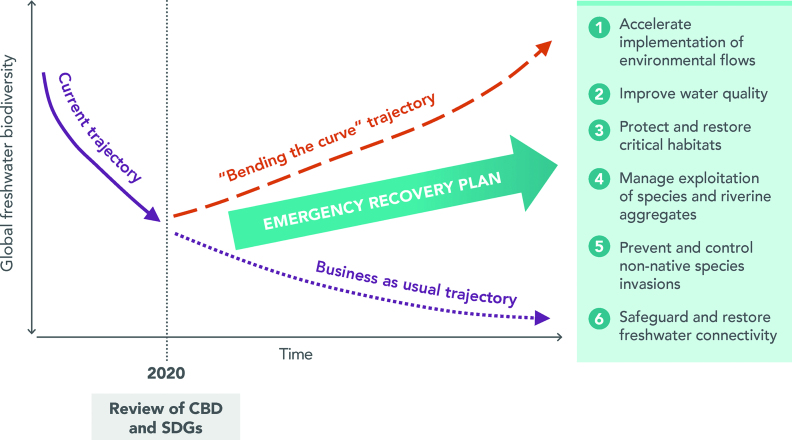
Despite their limited spatial extent, freshwater ecosystems host remarkable biodiversity, including one-third of all vertebrate species. This biodiversity is declining dramatically: Globally, wetlands are vanishing three times faster than forests, and freshwater vertebrate populations have fallen more than twice as steeply as terrestrial or marine populations. Threats to freshwater biodiversity are well documented but coordinated action to reverse the decline is lacking. We present an Emergency Recovery Plan to bend the curve of freshwater biodiversity loss. Priority actions include accelerating implementation of environmental flows; improving water quality; protecting and restoring critical habitats; managing the exploitation of freshwater ecosystem resources, especially species and riverine aggregates; preventing and controlling nonnative species invasions; and safeguarding and restoring river connectivity. We recommend adjustments to targets and indicators for the Convention on Biological Diversity and the Sustainable Development Goals and roles for national and international state and nonstate actors.
Overview
CoChat Summary
TL;DR
The paper presents an Emergency Recovery Plan to reverse global freshwater biodiversity loss through six priority actions: environmental flows, water quality, habitat protection and restoration, sustainable exploitation, invasive species control, and connectivity restoration. It recommends embedding these actions in post-2020 Convention on Biological Diversity and Sustainable Development Goal targets and indicators.
Key findings
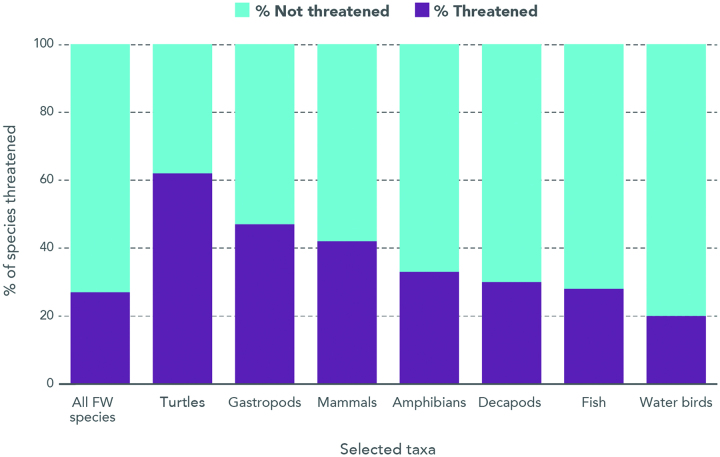
Freshwater ecosystems cover less than 1% of Earth’s surface but host approximately one-third of vertebrate species and 10% of all species; wetlands are vanishing three times faster than forests, and freshwater vertebrate populations have fallen more than twice as steeply as terrestrial or marine populations. Of 29,500 freshwater-dependent species assessed for the IUCN Red List, 27% are threatened with extinction, including an estimated 62% of turtle species, 47% of gastropods, 42% of mammals, 33% of amphibians, 30% of decapod crustaceans, 28% of fishes, and 20% of birds. Freshwater megafauna populations declined by 88% from 1970 to 2012, with the highest declines in Indomalaya (−99%) and Palearctic (−97%) realms. An estimated 30% of natural freshwater ecosystems have disappeared since 1970 and 87% of inland wetlands since 1700; only one-third of the world’s very long rivers remain free flowing, and approximately 3,700 new hydropower dams were identified worldwide at varying planning stages.
Methods
This is a policy and synthesis article, not a primary empirical study; it is structured around six priority actions derived from major causes of freshwater biodiversity loss: flow alteration, pollution, habitat degradation and loss, overexploitation, invasive nonnative species, and connectivity loss. The evidence base consists of cited global assessments, peer-reviewed literature, and implementation case studies from multiple regions, with no new field sample or primary data collection. The main analysis is a narrative review and policy-alignment exercise; Tables 1a and 1b map 13 existing or potential CBD and SDG targets and indicators to the six priority actions.
Limitations
Stated in the paper: implementation examples are “currently isolated successes”; human water demands and transboundary characteristics complicate implementation; data and science-based management are lacking for freshwater fisheries and riverine aggregate extraction; large-scale implementation of nature-based solutions is “in its infancy”; and substantial data gaps remain, including approximately 30% of freshwater mollusk species and 40% of decapod crustaceans classified as data deficient. Evident from the text: the plan is not empirically tested as a whole, relying instead on illustrative case studies and expert synthesis; the paper also notes that offsetting is controversial and open to misapplication.
Model-written summary. Check it against the paper before relying on it.
Integrity signals
Registry
Cites
Statistics
Figures
Verification
Claims the paper makes
5 Valid · 12 Not valid · 50 Not checked · 28 Own results and interpretations
Every source the paper cites for this claim was checked and supports it.
In the paper
“of the fish species assessed for the freshwater ecoregions of the world, over half were confined to a single ecoregion (Abell et al. 2008).”
§ Bending the Curve of Global Freshwater Biodiversity Loss: An Emergency Recovery Plan > Abstract
What the sources say
- Supportedcites Abell et al. 2008 matched to “Freshwater Ecoregions of the World: A New Map of Biogeographic Units for Freshwater Biodiversity Conservation” (2008) source
The “Freshwater ecoregional map and species results” section reports that more than 13,400 freshwater fish species were assigned to ecoregions and more than 6,900 to single ecoregions—over half of those assigned. No page number is supplied in the excerpt. (LLM, conf=0.94)
plain- Asserted: passes — The authors put it forward as true.
- Checkable: passes — It can be checked against evidence.
- Load-bearing: passes — The paper’s conclusions depend on it.
- Based: passes — The paper gives a reason why it holds.
- Supported
The cited sources support only part of this claim — read each source’s verdict below.
In the paper
“Recommendations to address immediate threats to and underlying drivers of global biodiversity loss have focused mainly on terrestrial ecosystems, such as forests and grasslands (e.g., Kok et al. 2018)”
§ Bending the Curve of Global Freshwater Biodiversity Loss: An Emergency Recovery Plan > Abstract
What the sources say
- Partly supportedcites Kok et al. 2018 matched to “Pathways for agriculture and forestry to contribute to terrestrial biodiversity conservation: A global scenario-study” (2018) sourceExperimental — accuracy not yet measured
Our copy supports only the exemplifying part of the attribution: Kok et al. (2018) is itself a terrestrial-scoped recommendations study — the Introduction (p. 1) states it 'evaluates the impacts on biodiversity of different response strategies in the agriculture and forestry sectors', and the Abstract and Sections 2.3/3.1–3.2 build pathways around forests, cropland and grazing land and terrestrial MSA. But no passage makes the comparative claim attributed here, namely that recommendations for global biodiversity loss have focused 'mainly' on terrestrial ecosystems; the closest statement (Introduction) is that societal responses have increased yet remain insufficient, and it credits that to Leadley et al. (2014), CBD (2014) and Tittensor et al. (2014). Aquatic biodiversity is not dismissed as neglected but explicitly handled in a separate companion analysis (Boelee et al., 2017, Introduction), so the 'mainly terrestrial' characterisation and the threats-versus-drivers distinction are not supported by this source. (LLM, conf=0.65)
plain- Asserted: passes — The authors put it forward as true.
- Checkable: passes — It can be checked against evidence.
- Load-bearing: passes — The paper’s conclusions depend on it.
- Based: passes — The paper gives a reason why it holds.
- Partly supported
In the paper
“with the highest declines in the Indomalaya and Palearctic realms (−99% and −97%, respectively; He et al. 2019).”
§ Bending the Curve of Global Freshwater Biodiversity Loss: An Emergency Recovery Plan > Abstract
What the sources say
- Not checked yetcites He et al. 2019
plain- Asserted: passes — The authors put it forward as true.
- Checkable: passes — It can be checked against evidence.
- Load-bearing: unclear — It is unclear whether the paper’s conclusions depend on it.
- Based: passes — The paper gives a reason why it holds.
In the paper
“Populations of freshwater megafauna, defined as animals that reach a body mass of 30 kilograms, declined by 88% from 1970 to 2012”
§ Bending the Curve of Global Freshwater Biodiversity Loss: An Emergency Recovery Plan > Abstract
What the sources say
- Not checked yetcites He et al. 2019
plain- Asserted: passes — The authors put it forward as true.
- Checkable: passes — It can be checked against evidence.
- Load-bearing: passes — The paper’s conclusions depend on it.
- Based: passes — The paper gives a reason why it holds.
In the paper
“Human demands for water will increase in some regions, making implementation more challenging (Palazzo et al. 2019).”
§ Bending the Curve of Global Freshwater Biodiversity Loss: An Emergency Recovery Plan > The Emergency Recovery Plan: Priorities for action > Action 1: Accelerate implementation of environmental flows
What the sources say
- Not checked yetcites Palazzo et al. 2019 matched to “Investment Needs for Irrigation Infrastructure along Different Socioeconomic Pathways” (2019) source
plainstates a cause- Asserted: passes — The authors put it forward as true.
- Checkable: passes — It can be checked against evidence.
- Load-bearing: unclear — It is unclear whether the paper’s conclusions depend on it.
- Based: passes — The paper gives a reason why it holds.
40 more claims
Create a free account to see all 95 claims and to verify the 58 references still open.
- It may state two separate claims as one. 29
- Probably not a substantial claim. 30
Claims other papers make about this one
Each is checked against this paper’s own text: does it say what the citing paper says it does?
The check wasn’t confident either way, so it gives no verdict — never disputed.
In the citing paper
“Hunting at Parker River National Wildlife Refuge represents both a traditional recreational use and serves as an important wildlife management tool.185”
From Protecting and restoring habitats to benefit freshwater biodiversity (2024) · cites this paper as [185]
Experimental — accuracy not yet measured
Citations
Cites
Freshwater biodiversity: importance, threats, status and conservation challenges
Dudgeon, D., Arthington, A. H., Gessner, M. O., Kawabata, Z., Knowler, D. J., Lévêque, C., Naiman, R. J., Prieur‐Richard, A., Soto, D., Stiassny, M. L. J., et al. (2006) · Biological Reviews · doi:10.1017/s1464793105006950 · Cited by 8,489
Self-citationPoff, N. L., Allan, J. D., Bain, M. B., Karr, J. R., Prestegaard, K. L., Richter, B. D., Sparks, R. E., & Stromberg, J. C. (1997) · BioScience · doi:10.2307/1313099 · Cited by 6,500
Pimentel, D., Zuniga, R., & Morrison, D. (2005) · Ecological Economics · doi:10.1016/j.ecolecon.2004.10.002 · Cited by 4,771
Emerging threats and persistent conservation challenges for freshwater biodiversity
Reid, A. J., Carlson, A. K., Creed, I. F., Eliason, E. J., Gell, P. A., Johnson, P. T. J., Kidd, K. A., MacCormack, T. J., Olden, J. D., Ormerod, S. J., et al. (2019) · Biological Reviews · doi:10.1111/brv.12480 · Cited by 3,645
Self-citationBasic Principles and Ecological Consequences of Altered Flow Regimes for Aquatic Biodiversity
BUNN, S. E., & ARTHINGTON, A. H. (2002) · Environmental Management · doi:10.1007/s00267-002-2737-0 · Cited by 3,379
Self-citationCeballos, G., Ehrlich, P. R., & Dirzo, R. (2017) · Proceedings of the National Academy of Sciences · doi:10.1073/pnas.1704949114 · Cited by 2,663
Mapping the world’s free-flowing rivers
Grill, G., Lehner, B., Thieme, M., Geenen, B., Tickner, D., Antonelli, F., Babu, S., Borrelli, P., Cheng, L., Crochetiere, H., et al. (2019) · Nature · doi:10.1038/s41586-019-1111-9 · Cited by 2,473
Self-citationA global boom in hydropower dam construction
Zarfl, C., Lumsdon, A. E., Berlekamp, J., Tydecks, L., & Tockner, K. (2015) · Aquatic Sciences · doi:10.1007/s00027-014-0377-0 · Cited by 2,181
Self-citationHow much wetland has the world lost? Long-term and recent trends in global wetland area
Davidson, N. C. (2014) · Marine and Freshwater Research · doi:10.1071/mf14173 · Cited by 2,177
Abell, R., Thieme, M. L., Revenga, C., Bryer, M., Kottelat, M., Bogutskaya, N., Coad, B., Mandrak, N., Balderas, S. C., Bussing, W., et al. (2008) · BioScience · doi:10.1641/b580507 · Cited by 2,045
Self-citation
Research works printed but not linked: 14
- Döll P, Bunn SE. 2014 Cross-chapter box on the impact of climate change on freshwater ecosystems due to altered river flow regimes. Pages 143– 146 in Field CB et al., eds. Climate Change Impacts, Adaptation, and Vulnerability. Part A: Global and Sectoral Aspects. Contribution of Working Group II to the Fifth Assessment Report of the Intergovernmental Panel on Climate Change. Cambridge University Press.
- Fricke R, Eschmeyer W, van der Laan R 2019 Catalog of fishes: Genera, species, references. California Academy of Sciences. http://researcharchive.calacademy.org/research/ichthyology/catalog/SpeciesByFamily.asp.
- Funge-Smith S. 2018 Review of the State of the World Fishery Resources: Inland Fisheries. Food and Agriculture Organization of the United Nations Fisheries and Aquaculture Circular.
- Harwood A, Johnson S, Richter B, Locke A, Yu X, Tickner D 2017 Listen to the River: Lessons from a Global Review of Environmental Flow Success Stories. World Wildlife Fund.
- [IUCN] International Union for Conservation of Nature 2019 The IUCN Red List of Threatened Species, version 2019-1. IUCN www.iucnredlist.org.
- Koehnken L, Rintoul M. 2018 Impacts of Sand Mining on Ecosystem Structure, Process and Biodiversity in Rivers. World Wildlife Fund International.
- Koning AA. 2018 Riverine Reserves: The Conservation Benefits of Spatial Protection for Rivers in the Context of Environmental Change. University of Wisconsin–Madison.
- Le Quesne T, Kendy E, Weston D 2010 The Implementation Challenge: Taking Stock of Government Policies to Protect and Restore Environmental flows. WWF and The Nature Conservancy.
- Moir K, Thieme M, Opperman J 2016 Securing a Future that Flows: Case Studies of Protection Mechanisms for Rivers. World Wildlife Fund and The Nature Conservancy.
- NBI (Nile Basin Initiative) 2016 Strategy for Management of Environmental Flows in the Nile Basin. Nile Basin Initiative Secretariat. 17p.
- Opperman J et al. 2019a Connected and Flowing: A Renewable Future for Rivers, Climate, and People. WWF and The Nature Conservancy.
- Speed R, Tickner D, Naiman R, Gang L, Sayers P, Yu W, Yuanyuan L, Houjian H, Jianting C, Lili Y 2016 River Restoration: A Strategic Approach to Planning and Management. UNESCO.
- [UNEP] United Nations Environment Programme 2016 Snapshot of the World's Water Quality: Towards a Global Assessment. UNEP.
- UN Environment 2017 A Framework for Freshwater Ecosystem Management, vol. 2: Technical Guide for Classification and Target-Setting. United Nations.
Cited by
Items 801–900 of 1,243
Mohanty, M., & Tare, V. (2026) · Water Resources Management · doi:10.1007/s11269-025-04389-y · Cited by 1
“Across the world this regulation has reduced biodiversity and the benefits that healthy rivers once provided (Poff 2009 ; Grill et al. 2019 ; Tickner et al. 2020 ; Zarfl et al. 2015).”
Gravel washing as a lacustrine spawning habitat restoration method for smallmouth bass
Glassman, D. M., Hlina, B. L., Donaldson, L., Abrams, A. E. I., Bergman, J. N., Chhor, A. D., Stoot, L. J., & Cooke, S. J. (2024) · Aquatic Living Resources · doi:10.1051/alr/2024010 · Cited by 1
“A recent emergency action plan was constructed to address the freshwater biodiversity crisis by halting future declines in species abundance through the development of novel recovery plans (Tickner et al., 2020).”
BackgroundSelf-citationO’Mara, K., Pusey, B., Carpenter-Bundhoo, L., et al. (2026) · Pacific Conservation Biology · doi:10.1071/pc26033 · Cited by 1
Fish spawning events stimulate trophic hotspots across freshwater food webs
Fernandes, T. J., Hale, K. R. S., Studden, B. M., et al. (2025) · doi:10.1101/2025.09.30.679526 · Cited by 1
Pratt, K., & Prahalad, V. N. (2024) · Research Square · doi:10.21203/rs.3.rs-5427912/v1 · Cited by 1
Figary, S., Meyer, M. F., Pilla, R. M., Currie, W. J. S., Alcocer, J., Alfonso, M. B., Andrews, C. M., Anneville, O., Geraldes, A. M., Arnott, S. E., et al. (2026) · Limnology and Oceanography Letters · doi:10.1002/lol2.70152 · Cited by 1
“The Living Planet Index, which measures global biodiversity trends across habitats, shows that the decline of inland water populations continues to outpace those of marine or terrestrial ecosystems (Reid et al. 2019; Tickner et al. 2020; WWF 2022).”
Law, A., Willby, N. J., Spencer, T., Bryan, D., Foster, G. N., Handley, L. L., Liao, W., Sellers, G. S., & Nummi, P. (2026) · Landscape Ecology · doi:10.1007/s10980-026-02303-4 · Cited by 1
“The recovery of freshwater biodiversity and ecosystem functioning is arguably the most fundamental challenge in restoration ecology (Tickner et al. 2020; Maasri et al. 2022).”
Biao, W. A. N. G., Yuqi, W. A. N. G., He, N., Mingxing, D. U., & You, P. (2024) · Integrative Zoology · doi:10.1111/1749-4877.12916 · Cited by 5
Stanicka, A., Kobak, J., Hildebrand, J., Cichy, A., Wiśniewski, K., Szarmach, D., Lesiak, K., Urbaniak, J., Augustyniak, M., Dlouhy, Z., et al. (2025) · Freshwater Biology · doi:10.1111/fwb.70125 · Cited by 1
Velocity of Climate Change and the Vulnerability of Mountain Lake Landscapes
Parisek, C. A., Walter, J. A., Sadro, S., & Rypel, A. L. (2025) · Environmental Science & Technology · doi:10.1021/acs.est.5c03154 · Cited by 1
Chen, Y., Eggleton, M. A., Moore, M. J., & Phelps, Q. E. (2024) · Ecological Processes · doi:10.1186/s13717-024-00531-7 · Cited by 1
“To bend the freshwater biodiversity loss curve, many conservation, restoration, and management strategies and approaches are needed (Tickner et al. 2020).”
BackgroundIndustrial waste powder for the removal of acid dye from contaminated water
Shaheen, R., & Hanif, M. A. (2025) · Heliyon · doi:10.1016/j.heliyon.2025.e44282 · Cited by 3
Jordaan, M. S., Barrow, S., Kadye, W., et al. (2024) · African Journal of Aquatic Science · doi:10.2989/16085914.2023.2289561 · Cited by 1
Cárdenas, M. Q., Silva, M. L., Viana, D. C., Cohen, S. C., & Ottoni, F. P. (2024) · Revista Brasileira de Parasitologia Veterinária/Brazilian Journal of Veterinary Parasitology · doi:10.1590/s1984-29612024051 · Cited by 3
“These aims should be considered one of humanity’s highest priorities (Darwall et al., 2018; Albert et al., 2021; Tickner et al., 2020; Ottoni et al., 2023).”
BackgroundPorras-Rivera, G., Górski, K., Chiang, G., et al. (2026) · Environmental Toxicology and Pharmacology · doi:10.1016/j.etap.2026.104961 · Cited by 1
How the Choice of Spatial Resolution Affects Freshwater Fish Species Distribution Models
Fundaro', D., Hilbers, J. P., Kuipers, K., & Schipper, A. M. (2026) · Ecology and Evolution · doi:10.1002/ece3.73472 · Cited by 1
Paíz, R., Thomas, R. Q., Carey, C. C., et al. (2024) · doi:10.2139/ssrn.4888712 · Cited by 1
Five rules to protect Golden Mahseer from hydropower
Bukhari, H., Brown, C. A., Joubert, A. R., & Esler, K. J. (2025) · Aquatic Sciences · doi:10.1007/s00027-025-01231-w · Cited by 1
“Supporting this finding, Tickner et al. (2020) outline six key actions to address global freshwater biodiversity loss, two of which focus on regulating resource extraction and preserving eco-system connectivity.”
Cowx, I. G., Lai, Q. T., Vu, A. V., Tao, J., Sukumasavin, N., Phouthavong, K., Ngor, P. B., & Hughes, K. A. (2026) · Reviews in Fisheries Science & Aquaculture · doi:10.1080/23308249.2026.2636521 · Cited by 1
“…those that have become invasive, have long plagued aquatic environments and, along with over-exploitation and habitat loss, are considered major global threats to native biodiversity (Casal 2006; Dudgeon et al. 2006; Pyšek et al. 2020; Tickner et al. 2020; Subiza et al. 2021; Sayer et al. 2025).”
Self-citationTell Us a Story Granddad: Age and Origin of an Iconic Australian Lungfish
Mayne, B. T., Espinoza, T., & Roberts, D. T. (2022) · Frontiers in Environmental Science · doi:10.3389/fenvs.2022.931467 · Cited by 1
“…global biodiversity advocates have called for specific actions to support freshwater biodiversity conservation, including the need to identify and promote freshwater flagship species, such as N. forsteri, in public education programs (Ebner et al., 2016; Tickner et al., 2020; Rees et al., 2021).”
BackgroundUrban planning to support the conservation of freshwater biodiversity
Currie, H. A. L., Kirkwood, A. E., Imhof, J. G., Piczak, M. L., Creed, I. F., Lapointe, N. W. R., Mandrak, N. E., Null, S. E., Harding, J. S., Rooney, R. C., et al. (2026) · Journal of Environmental Planning and Management · doi:10.1080/09640568.2026.2638827 · Cited by 1
“…ERP and other global sustainability frameworks (e.g. SDGs and Kunming-Montreal Global Biodiversity Framework) outline the high-level actions required to protect and restore biodiversity (e.g. improve water quality, protect and restore habitat, enhance or maintain connectivity; see Tickner et al .”
InfluentialSelf-citationBiodiversity Conservation, Ecosystem Services and One Health
McMahon, B. J., Caminade, C., Meneghi, D. D., Doyle, C., Garnier, J., Hitziger, M., Keune, H., Kock, R. A., Martin, C., Patterson, G. E., et al. (2024) · CABI eBooks · doi:10.1079/9781800623002.0008 · Cited by 5
The Impact of Climate Change on the Water Sector in Spain
Albiac, J., Esteban, E., Calvo, E., Martínez, Y., Baccour, S., & Kahil, T. (2025) · Water Economics and Policy · doi:10.1142/s2382624x25400132 · Cited by 2
Januchowski-Hartley, S. R., Giannoulatou, I. D., Evans, J., & Howells, S. (2025) · People and Nature · doi:10.1002/pan3.70041 · Cited by 3
“Such waters are also among the world's most modified and threatened ecosystems (Grill et al., 2019 ; Tickner et al., 2020 ).”
Native crayfish shows high desiccation tolerance and potential to outcompete invader
Bayer, L. M., & Magoulick, D. D. (2025) · Biological Invasions · doi:10.1007/s10530-025-03675-5 · Cited by 1
“We found no significant interaction between drought and threatened habitats globally, with declines in biodiversity far surpassing marine or terrestrial systems (Dudgeon et al. 2006; Martinuzzi et al. 2014; Tickner et al. 2020).”
Ma, F., Huang, H., Yang, Q., Altermatt, F., Hong, P., Luo, M., & Wang, S. (2026) · Nature Communications · doi:10.1038/s41467-026-73311-w · Cited by 9
“Suchaneutraleffect possiblyarisesfromthebalanceamongtheextinctionofnativespecies and the establishment of non-native species 10,58,60 , and/or the replacement of specialists by generalists 61,62 .”
Khosa, D., South, J., Matam, N. Y., Mofu, L., Wasserman, R. J., & Weyl, O. L. F. (2023) · Knowledge and Management of Aquatic Ecosystems · doi:10.1051/kmae/2022026 · Cited by 2
“Global biodiversity is changing at an alarming rate as a consequence of anthropogenic induced stressors (Rosenzweig, 2001; Tickner et al., 2020), including habitat degradation, environmental pollution, invasion by non-native species and climate change (Sala et al., 2000; Reid et al., 2019).”
BackgroundMarcaccio, J. V., Costa, J. G., Parker, S. R., & Midwood, J. D. (2025) · Applied Geomatics · doi:10.1007/s12518-025-00607-9 · Cited by 2
“This exceeds declines in the oceans, making conservation and management of freshwater fish habitat essential to supporting their recovery (He et al. 2019; Tickner et al. 2020, Nyboer et al. 2021).”
Temporal Patterns and Drivers of Freshwater Fish Beta‐Diversity of Gravel Pit Lakes
Garcia, F., Cucherousset, J., & Olden, J. D. (2025) · Ecology Of Freshwater Fish · doi:10.1111/eff.70024 · Cited by 1
Self-citation(2024) · Advances in Ecological Research · doi:10.1016/bs.aecr.2024.10.003 · Cited by 1
Li, Z., Li, P., Zhang, J., Zhou, X., & Tian, S. (2025) · Environmental Research · doi:10.1016/j.envres.2025.123000 · Cited by 3
Parajuli, R., Dixon, M. D., Blalock, A., Fowler, A., Sigdel, S., Magnuson, K. I., Wenger, S. J., Suedel, B., Crane, D. J., & van Rees, C. B. (2026) · Journal of Applied Ecology · doi:10.1111/1365-2664.70485 · Cited by 3
Medina-Madariaga, G., Nguyen, H. H., Kiesel, J., Peters, K., Feld, C. K., Jähnig, S. C., & Torres-Cambas, Y. (2025) · Ecological Informatics · doi:10.1016/j.ecoinf.2025.103395 · Cited by 1
Freed, S., Lo, M. G. Y., McCartney, M. P., Allison, E. H., Smith, D. M., Joffre, O. M., & Sinclair, F. (2025) · Nature Food · doi:10.1038/s43016-025-01152-9 · Cited by 2
“This includes agricultural water management 31 .”
What do stakeholders perceive as success in large scale environmental monitoring design?
Dai, X., Webb, J. A., & Horne, A. (2025) · Frontiers in Environmental Science · doi:10.3389/fenvs.2024.1389122 · Cited by 1
Caputo, L., Molina, C. R., Ayllon, R., & Benavides, I. F. (2024) · Inland Waters · doi:10.1080/20442041.2024.2359329 · Cited by 1
“…such as land use change, eutrophication, hydrological disturbance, chemical pollution, overexploitation, and invasive species are affecting the structure and functioning of freshwater ecosystems at the global level (Janse et al. 2015, Tickner et al. 2020, Woolway et al. 2020, Merz et al. 2023).”
Mpopetsi, P. P., Dondofema, F., Mangadze, T., Masese, F. O., Munyai, L. F., & Dalu, T. (2024) · Elsevier eBooks · doi:10.1016/b978-0-443-23898-7.00025-7 · Cited by 4
Section introduction: Human Pressures and Management of Inland Waters
Irvine, K., Warner, S., & Chapman, D. V. (2022) · Elsevier eBooks · doi:10.1016/b978-0-12-819166-8.00214-0 · Cited by 1
Morden, R., Horne, A., Nathan, R. J., Bond, N. R., & Fowler, K. (2025) · Journal of Hydrology · doi:10.1016/j.jhydrol.2025.133583 · Cited by 3
Chen, Y., Colloff, M. J., Doherty, M. D., & Pittock, J. (2025) · Marine and Freshwater Research · doi:10.1071/mf24205 · Cited by 2
Gu, S., Du, X., Su, J., Guo, C., Deng, H., Deng, Y., & Wang, S. (2025) · Journal of Environmental Management · doi:10.1016/j.jenvman.2025.128203 · Cited by 3
Multiple stressors in river networks: local and downstream effects on freshwater macroinvertebrates
(2024) · doi:10.1101/2024.09.27.615445 · Cited by 5
A theory of change to reverse the current Mexican freshwater fish extinction crisis
Contreras-MacBeath, T., Mejia Mojica, H., & Rivas González, J. M. (2022) · Frontiers in Environmental Science · doi:10.3389/fenvs.2022.998246 · Cited by 1
“Nowhere is the biodiversity crisis more acute than in freshwater ecosystems (Tickner et al., 2020).”
BackgroundZyl, B. V. (2023) · ResearchSpace (University of KwaZulu-Natal) · doi:10.29086/10413/22595 · Cited by 2
Morbidelli, M., Alberti, D., Ciampelli, P., Forni, S., Innocenti, G., Marsella, S. A., Melone, B., Orlando, M., Rossi, A., Zoccola, A., et al. (2026) · The European Zoological Journal · doi:10.1080/24750263.2025.2603044 · Cited by 2
de Oliveira, C. A. C. R., Morais, K. S., de Oliveira, J. P. S., de Oliveira Marques, A., da Silva, A. B. F., da Conceição Palheta, D., & Bentes, B. (2026) · Scientific Reports · doi:10.1038/s41598-026-43889-8 · Cited by 1
Bader, S., Gaye‐Siessegger, J., Scholz, B., Ferreira, M., & Brinker, A. (2024) · PLoS ONE · doi:10.1371/journal.pone.0299774 · Cited by 2
“The increasing human population places ever greater demands on ecosystems [1], especially on freshwater bodies, the most threatened of aquatic habitats [2] and one that is subject to the requirements of many stakeholders.”
Salinas-Rodríguez, S. A., & Martínez Pacheco, A. I. (2024) · doi:10.20944/preprints202401.0453.v1 · Cited by 3
Shu, L., Ludwig, A., Pan, H., Lin, J., Xu, Y., Shan, H., Cao, T., & Peng, Z. (2026) · Ecology and Evolution · doi:10.1002/ece3.73082 · Cited by 1
McClain, M. E., & Masese, F. O. (2024) · Elsevier eBooks · doi:10.1016/b978-0-443-23898-7.00028-2 · Cited by 20
Self-citationAcoustic Profiles of Underwater Soundscapes Affected by Road Traffic
Velde, K. T., & Slabbekoorn, H. (2024) · Springer eBooks · doi:10.1007/978-3-031-50256-9_191 · Cited by 2
Karimi, M., & Shokoohi, A. (2025) · Wetlands · doi:10.1007/s13157-025-01984-y · Cited by 1
Baker, C. F., Mahlum, S., & Rowe, D. K. (2025) · New Zealand Journal of Marine and Freshwater Research · doi:10.1080/00288330.2024.2446744 · Cited by 1
“As fragmentation is known to be a key threat to freshwater biodiversity globally (Fuller et al. 2015; Tickner et al. 2020; Franklin et al. 2022), it is critical to identify barriers that limit the upstream movement of bluegill bully populations and focus resources to mitigate their e ff ects.”
Can We Turn Harmful Invasive Non-Native Fish Species into a Valuable Food Resource?
Jaćimović, M., Stanković, M., Trbović, D., Nikolić, D., Smederevac‐Lalić, M. M., & Marković, Z. (2025) · Fishes · doi:10.3390/fishes10050207 · Cited by 3
Freshwater Fish Populations in Eastern Ontario Benefit from Long Standing Protected Areas
Zolderdo, A. J. (2021) · Carleton University's Institutional Repository (MacOdrum Library, Carleton University) · doi:10.22215/etd/2021-14421 · Cited by 1
Stankevičiūtė, M., Bučaitė, A., Pažusienė, J., et al. (2026) · Fishes · doi:10.3390/fishes11030181 · Cited by 1
Dalla Vecchia, A., Adamec, L., & Bolpagni, R. (2025) · Perspectives in Plant Ecology, Evolution and Systematics · doi:10.1016/j.ppees.2025.125871 · Cited by 1
Seasonal Catch Rates of the Endemic Olympic Mudminnow in Wetland Habitat
Williams, O. F., Tabor, R. A., DeHaan, P. W., et al. (2022) · Northwest Science · doi:10.3955/046.095.0205 · Cited by 1
Revealing the spatial–temporal patterns of hydropeaking induced by the Three Gorges Dam, China
Liu, X., & Tian, T. (2025) · Journal of Hydrology · doi:10.1016/j.jhydrol.2025.134269 · Cited by 5
Sabater, L. M., Franceschini, M. C., Higuti, J., et al. (2025) · Aquatic Conservation: Marine and Freshwater Ecosystems · doi:10.1002/aqc.70221 · Cited by 1
Wang, S., Zhang, D., Zhang, P., Li, Y., & Yang, Z. (2026) · Journal of Environmental Management · doi:10.1016/j.jenvman.2026.130096 · Cited by 1
Mahlum, S. K., Baker, C. F., Lake, M., White, E., Williams, A. K., Williams, P., & Franklin, P. A. (2025) · Ecological Solutions and Evidence · doi:10.1002/2688-8319.70130 · Cited by 3
Fish and Fisheries of the Republic of North Macedonia, Current Situation, and its Perspective
Talevski, T., Trajchevski, B., Talevska, M., & Tasevska, O. (2023) · Fish & fisheries series/Fish and fisheries series (Print) · doi:10.1007/978-3-031-36926-1_6 · Cited by 1
Qi, Z., Xiong, F., Hu, X., et al. (2025) · Animals · doi:10.3390/ani15213109 · Cited by 1
“The expansion of cropland and artificial surfaces in the middle reaches of the Han River has increased the discharge of nutrients such as nitrogen and phosphorus from surface and groundwater [56].”
Kuhn, I. M., Quintard, B., Theißinger, K., & Georges, J. (2025) · NeoBiota · doi:10.3897/neobiota.100.147371 · Cited by 2
Factors affecting colonization and assemblage structure of fish in newly created ponds
Janáč, M., Bojková, J., Hnilička, M., Jurajda, P., Palupová, E., Šlapanský, L., & Sychra, J. (2025) · Scientific Reports · doi:10.1038/s41598-025-27349-3 · Cited by 5
Paquette, C., Girolamo, D. J. D., Pham, J., Ovaskainen, O., Gagné, S., Leclerc, V., Beisner, B. E., Fugère, V., & Taranu, Z. E. (2026) · Global Change Biology · doi:10.1111/gcb.70845 · Cited by 4
“Species responses to climate change are particularly acute in lakes and rivers, where physical and biological processes are tightly coupled and climate-driven stressors spread rapidly across trophic levels (Tickner et al. 2020).”
Miscanthus×giganteusgrowth and control in simulated upland and wetland habitats
Turnage, G., Byrd, J. D., & Madsen, J. D. (2022) · Invasive Plant Science and Management · doi:10.1017/inp.2022.1 · Cited by 1
“2005) on earth but are also some of the most vulnerable and degraded habitats due to anthropogenic and environmental factors (Hu et al. 2017a, 2017b; Tickner et al. 2020).”
BackgroundMirza, S., Gregory‐Eaves, I., & Huot, Y. (2025) · Diversity and Distributions · doi:10.1111/ddi.13953 · Cited by 1
“These interactions include biodiversity and community dynamics (e.g., predator prey interactions) as one system can have substantial effects on the diversity of the others (Knight et al. 2005; Tickner et al. 2020).”
Sub-meter resolution wetland map of Hainan with detailed types from multi-source satellite imagery
Zhang, X., Liu, J., Liu, S., et al. (2025) · Frontiers in Marine Science · doi:10.3389/fmars.2025.1653430 · Cited by 1
ALSHREEF, A. A. M. H., Kocaman, A., & Amr, S. S. A. (2026) · Desalination and Water Treatment · doi:10.1016/j.dwt.2026.101673 · Cited by 3
Lamouille‐Hébert, M., Arthaud, F., Besnard, A. G., Reynaud, N., Tormos, T., & Datry, T. (2025) · Hydrobiologia · doi:10.1007/s10750-025-06009-7 · Cited by 1
Biodiversity Loss in Streams Due to Human Diversion Activities
Sadhiyan, B., Kumari, M., Madan, S., & Maurya, R. (2024) · Practice, progress, and proficiency in sustainability · doi:10.4018/979-8-3693-6950-0.ch007 · Cited by 1
The Scale‐Dependency in Freshwater Habitat Regionalisation Analyses
Schürz, M., Márquez, J. R. G., & Domisch, S. (2025) · Ecohydrology · doi:10.1002/eco.70018 · Cited by 1
Botrel, M., Maranger, R. J., Trottier, L. L., Cusson, M., Iversen, L. L., Noisette, F., Nozais, C., Turgeon, K., Bertolo, A., André-Alphonse, T., et al. (2026) · Limnology and Oceanography Letters · doi:10.1002/lol2.70145 · Cited by 2
Rigby, C. R., & Gaeta, J. W. (2026) · River Research and Applications · doi:10.1002/rra.70155 · Cited by 2
“Indeed, our study highlights the need to protect environmental flows, which are critical for recovering aquatic ecosystems and species (Tickner et al. 2020).”
Why adding habitat can destabilize species coexistence – consequences to restoration
Urioste, F. M., Borthagaray, A. I., Cunillera‐Montcusí, D., Soutullo, Á., & Arim, M. (2026) · Oikos · doi:10.1002/oik.11895 · Cited by 1
“Habitat loss is considered one of the main drivers of the current biodiversity crisis (FAO 2019, Tickner et al. 2020), being identified as a cause for biodiversity loss at Why adding habitat can destabilize species coexistence – consequences to restoration several organizational levels from the…”
Mining threats in high-level biodiversity conservation policies
Torres, A., zu Ermgassen, S. O. S. E., Navarro, L. M., Ferri-Yanez, F., Teixeira, F. Z., Wittkopp, C., Rosa, I. M. D., & Liu, J. (2023) · doi:10.1101/2023.07.30.550308 · Cited by 15
Ghosh, M., Panja, S., Dutta, M., & Homechaudhuri, S. (2024) · Fisheries Management and Ecology · doi:10.1111/fme.12705 · Cited by 1
Kjærstad, G., Majaneva, M. A. M., Falahati‐Anbaran, M., et al. (2022) · Frontiers in Environmental Science · doi:10.3389/fenvs.2022.872739 · Cited by 1
“Freshwater ecosystems, which hold a disproportionately high share of species compared to their area, are among the most threatened habitat types, and need particular attention by nature management authorities (Tickner et al., 2020).”
BackgroundLintermans, M., Lutz, M. L., Whiterod, N. S., et al. (2024) · SSRN Electronic Journal · doi:10.2139/ssrn.4836219 · Cited by 1
Building an Inclusive, Green and Low-Carbon Economy: CCICED Annual Policy Report 2022
China Council for International Cooperation on Environment and Development (CCICED) Secretariat (2023) · Springer eBooks · doi:10.1007/978-981-19-9861-4 · Cited by 5
Artificial habitats provide refuge for a threatened freshwater mussel in south-western Australia
Daviot, J. R., Lymbery, A. J., Lawrie, A. D., Cottingham, A., & Beatty, S. J. (2026) · Pacific Conservation Biology · doi:10.1071/pc25073 · Cited by 1
A multi-criteria approach to identify priority regions for freshwater biodiversity conservation
Anas, M. U. M., Drake, D. A. R., Morris, T. J., & Mandrak, N. E. (2025) · FACETS · doi:10.1139/facets-2024-0153 · Cited by 1
Feckler, A., Stehle, S., Beisel, J., Chanez, E., Joschko, T. J., Roodt, A. P., Schmidt, T., Schreiner, V. C., Schulz, R., Staentzel, C., et al. (2026) · Archives of Environmental Contamination and Toxicology · doi:10.1007/s00244-026-01205-5 · Cited by 1
“They host rich biodiversity, making them essential for both biodiversity conservation and the ecological state of larger downstream rivers (Reid et al. 2019; Tickner et al. 2020).”
Giet, W. B. Y., Yang, Y., Li, Z., Cao, C., Wang, Q., Liu, S., Wang, N., Zheng, H., Xu, Y., & Yao, W. (2025) · Journal for Nature Conservation · doi:10.1016/j.jnc.2025.127190 · Cited by 1
Vieira-Guimarães, F., Pinheiro, R. F. M., & Sarmento-Soares, L. M. (2026) · Anais da Academia Brasileira de Ciências · doi:10.1590/0001-3765202620240731 · Cited by 1
Collins, K. M., Schliep, E. M., Wagner, T., & Wikle, C. K. (2025) · Water Resources Research · doi:10.1029/2024wr039500 · Cited by 1
“For example, streamflow is a critical spawning and migration cue for many freshwater riverine fishes (Catalano, 2015; Flitcroft et al., 2016; Valdez et al., 2019)—which are one of the most imperiled taxa globally (Su et al., 2021; Tickner et al., 2020).”
Implications of Climate Change for Freshwater Fisheries
Kelly, S., Barry, J., & Kelly, F. L. (2021) · Elsevier eBooks · doi:10.1016/b978-0-12-819166-8.00122-5 · Cited by 2
van Rees, C. B. (2024) · SSRN Electronic Journal · doi:10.2139/ssrn.4791536 · Cited by 1
Matin, G. N., Panici, D., Bennett, G. L., & Brazier, R. (2026) · Earth-Science Reviews · doi:10.1016/j.earscirev.2026.105450 · Cited by 1
Medina Madariaga, G., Nguyen, H. H., Kiesel, J., Peters, K., Feld, C. K., Jaehnig, S. C., & Cambas, Y. T. (2024) · doi:10.1101/2024.05.28.596146 · Cited by 1
Miyata, K., Inoue, Y., Kitazaki, N., et al. (2026) · Marine Environmental Research · doi:10.1016/j.marenvres.2025.107632 · Cited by 1
Mather, M. E., Bergtold, J. S., Caldas, M. M., Bernick, E. M., Moore, T. L. C., Granço, G., Sheshukov, A. Y., & Ciampitti, I. A. (2024) · Sustainability · doi:10.3390/su162310625 · Cited by 1
Rodríguez‐Rey, M., Consuegra, S., & de Leániz, C. G. (2023) · Aquatic Invasions · doi:10.3391/ai.2023.18.4.111481 · Cited by 2
(2025) · doi:10.1101/2025.04.02.646737 · Cited by 1
“However, the increasing degradation of these ecosystems and the consequent loss of biodiversity due to several factors including land use change and chemical pollution underscore the urgent need for effective conservation strategies (Persson et al., 2022; Reid et al., 2019; Tickner et al., 2020).”
Baeza Sanz, D., & Matías, A. G. (2023) · Journal of Water and Climate Change · doi:10.2166/wcc.2023.246 · Cited by 1
De, K., & Dwivedi, A. K. (2026) · Natural Resources Forum · doi:10.1111/1477-8947.70071 · Cited by 4
Metadata
- Authors
- Tickner, D., Opperman, J. J., Abell, R., Acreman, M., Arthington, A. H., Bunn, S. E., Cooke, S. J., Dalton, J., Darwall, W., Edwards, G., Harrison, I., Hughes, K., Jones, T., Leclère, D., Lynch, A. J., Leonard, P., McClain, M. E., Muruven, D., Olden, J. D., Ormerod, S. J., Robinson, J., Tharme, R. E., Thieme, M., Tockner, K., Wright, M., & Young, L.
- Affiliations
- WWF-UK (GB)
- World Wildlife Fund (US)
- Conservation International (US)
- UK Centre for Ecology & Hydrology (GB)
- Griffith University (AU)
- Carleton University (CA)
- International Union for Conservation of Nature (CH)
- International Union for Conservation of Nature (United Kingdom) (GB)
- DJEnvironmental, Harpers Mill, United Kingdom
- International Institute for Applied Systems Analysis (AT)
- United States Geological Survey (US)
- IHE Delft Institute for Water Education (NL)
- Freshwater Practice of WWF International, Zeist, The Netherlands
- University of Washington (US)
- Cardiff University (GB)
- Wildfowl & Wetlands Trust (GB)
- Director of Riverfutures, Cressbrook, United Kingdom
- Leibniz Institute of Freshwater Ecology and Inland Fisheries (DE)
- Corresponding author
- Tickner, David
- ORCID
- Venue
- BioScience
- Publisher
- Oxford University Press (OUP)
- Published
- 2020-02-19
- Volume
- 70
- Issue
- 4
- Pages
- 330-342
- ISSN
- 0006-3568 (ISSN-L)
- 1525-3244
- PMC
- PMC7138689
- OpenAlex
- W2982687801
- Cited by
- 1,241
- References
- 94
- Citations by year
- 2026: 233 · 2025: 222 · 2024: 229 · 2023: 184 · 2022: 192 · 2021: 140 · 2020: 41
- FWCI
- 88.45
- Type
- journal article
- Language
- en
- Open access
- hybrid
- doi.org
- Licence
- Locations
- BioScience (publishedVersion, cc-by-nc)
- Europe PMC (PubMed Central) (publishedVersion, cc-by-nc)
- PubMed Central (publishedVersion, cc-by-nc)
- PubMed (publishedVersion)
- ORCA Online Research @Cardiff (Cardiff University) (acceptedVersion)
- NERC Open Research Archive (Natural Environment Research Council) (acceptedVersion)
- IIASA PURE (International Institute of Applied Systems Analysis) (acceptedVersion)
- Griffith Research Online (submittedVersion, cc-by-nc)
- Funders
- University of Washington
- Cardiff University
- Griffith University
- Technische Universiteit Delft
- WWF International
- Freie Universität Berlin
- U.S. Geological Survey
- School of Aquatic and Fishery Sciences
- Centre for Ecology and Hydrology
- Topics
- Physical Sciences › Environmental Science › Nature and Landscape Conservation › Fish Ecology and Management Studies
- Physical Sciences › Environmental Science › Ecology › Aquatic Ecosystems and Biodiversity
- Physical Sciences › Environmental Science › Ecology › Freshwater macroinvertebrate diversity and ecology
- Keywords
- freshwater biodiversity loss, biodiversity recovery, wetland loss, freshwater vertebrates, environmental flows, water quality, habitat restoration, freshwater management, river connectivity, Convention on Biological Diversity, Sustainable Development Goals
About these checks
Registry, retraction, Cites and statistics results are computed, not judged, with one exception: a printed reference that no index lists is read once by a model before it counts as a citation error. Claims are extracted by a model and kept only when their quote appears verbatim in the text; each cited source is then checked, with a model’s help, for whether it says what the claim relies on. Those verdicts can be wrong — read the claim’s quote and the cited source before relying on one.
The claim verdicts this report counts are experimental: their accuracy is not yet measured.
A language model drew the claims from the paper on 2026-10-05, under version 3 of the claim definition (model deepseek-v4.1-flash, prompt extract-v3).
A second model labelled each claim on 2026-10-05 (model jev-1.13-20260917, definition revision gold-guideline-v0.2).
Cited sources are checked with a language model’s help (gpt-6-sol and qwen3.8-omni-flash).
Statistics and arithmetic are recomputed, not judged.
Confidence bands are shown only for fields calibrated on our annotated test set. None is calibrated yet, so no band is shown.
What counts as a claim ›How we measure confidence ›How we check this ›
Are you an author, or do you see a problem with this page? Request a review
Data sources
Bibliographic data: Semantic Scholar, OpenAlex, Crossref.
Contains information from the Semantic Scholar Academic Graph Datasets, made available under the ODC Attribution License (ODC-BY 1.0).
Semantic Scholar’s data is described in: Kinney, R., et al. (2023). The Semantic Scholar Open Data Platform. arXiv:2301.10140.
