

Aerobic, resistance, or combined exercise training and cardiovascular risk profile in overweight or obese adults: the CardioRACE trial
Open accessThe DOI matches its Crossref record; 45 of the 46 references it cites were found in a registry or an index; 25 of the 37 sources its claims cite were checked for support.
Abstract
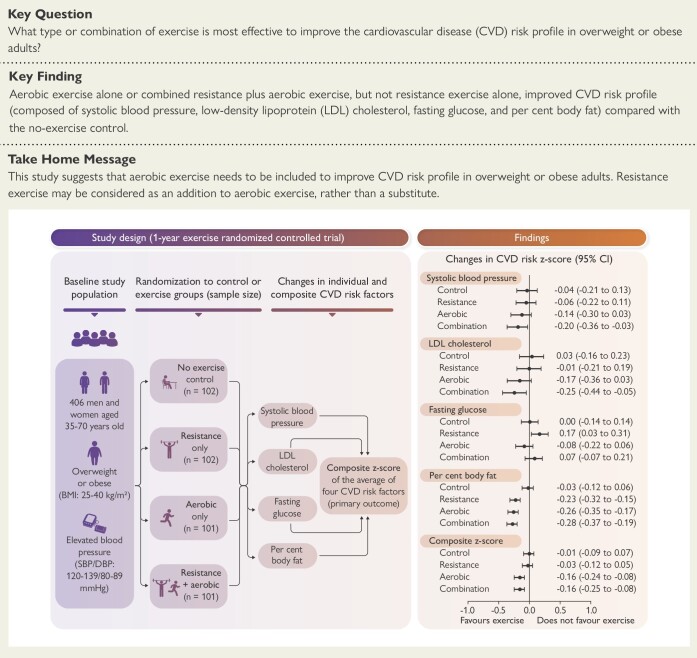
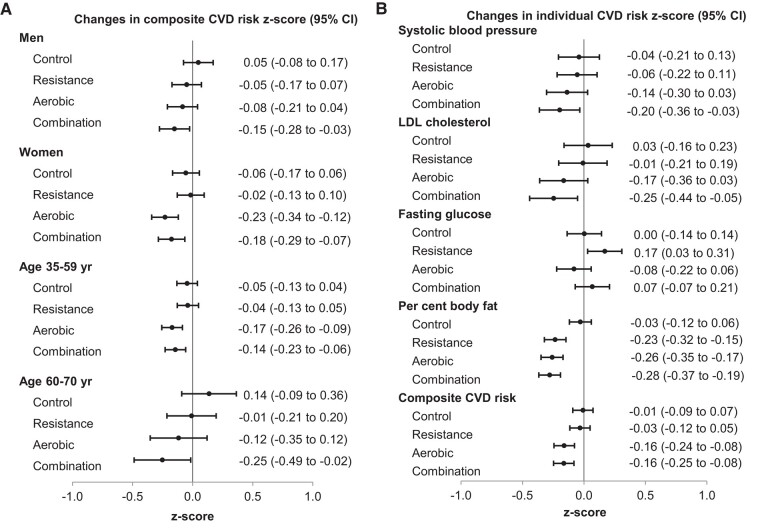
Background and Aims: To determine the comparative efficacy of resistance, aerobic, and combined resistance plus aerobic exercise on cardiovascular disease (CVD) risk profile. Methods: This randomized controlled trial enrolled 406 adults aged 35–70 years with overweight or obesity and elevated blood pressure. Participants were randomly assigned to resistance (n = 102), aerobic (n = 101), combined resistance plus aerobic exercise (n = 101), or no-exercise control (n = 102). All exercise participants were prescribed 1 h of time-matched supervised exercise (the combination group with 30 min of each resistance and aerobic exercise) three times per week for 1 year. The primary outcome was the change from baseline to 1 year in the standardized composite Z-score of four well-established CVD risk factors: systolic blood pressure, low-density lipoprotein (LDL) cholesterol, fasting glucose, and per cent body fat. Results: Among 406 participants (53% women), 381 (94%) completed 1-year follow-up. Compared with the control group, the composite Z-score decreased at 1 year, which indicates improved CVD risk profile, in the aerobic {mean difference, −0.15 [95% confidence interval (CI): −0.27 to −0.04]; P = .01} and combination [mean difference, −0.16 (95% CI: −0.27 to −0.04); P = .009] groups, but not in the resistance [mean difference, −0.02 (95% CI: −0.14 to 0.09); P = .69] group. Both aerobic and combination groups had greater reductions in the composite Z-score compared with the resistance group (both P = .03), and there was no difference between the aerobic and combination groups (P = .96). Regarding the four individual CVD risk factors, only per cent body fat decreased in all three exercise groups at 1 year, but systolic blood pressure, LDL cholesterol, and fasting glucose did not decrease in any exercise groups, compared with the control group. Conclusions: In adults with overweight or obesity, aerobic exercise alone or combined resistance plus aerobic exercise, but not resistance exercise alone, improved composite CVD risk profile compared with the control.
Overview
CoChat Summary
TL;DR
In the CardioRACE randomized trial of 406 adults with overweight or obesity and elevated blood pressure, aerobic exercise alone or combined resistance plus aerobic exercise improved a composite CVD risk Z-score over 1 year compared with no-exercise control, while resistance exercise alone did not. The combined group achieved similar composite risk improvement to aerobic exercise alone despite doing half the aerobic dose.
Key findings
- The composite CVD risk Z-score decreased versus control in the aerobic group {mean difference, −0.15 [95% CI: −0.27 to −0.04]; P = .01} and combination group {−0.16 [−0.27 to −0.04]; P = .009}, but not the resistance group {−0.02 [−0.14 to 0.09]; P = .69}. Aerobic and combination groups had greater reductions than resistance (both P = .03), with no difference between aerobic and combination (P = .96).
- Among the four individual components, only per cent body fat decreased in all exercise groups versus control: resistance −0.9% (−1.4 to −0.3; P = .001), aerobic −1.0% (−1.5 to −0.4; P < .001), and combination −1.0% (−1.6 to −0.5; P < .001). Systolic blood pressure, LDL cholesterol, and fasting glucose did not decrease in any exercise group versus control.
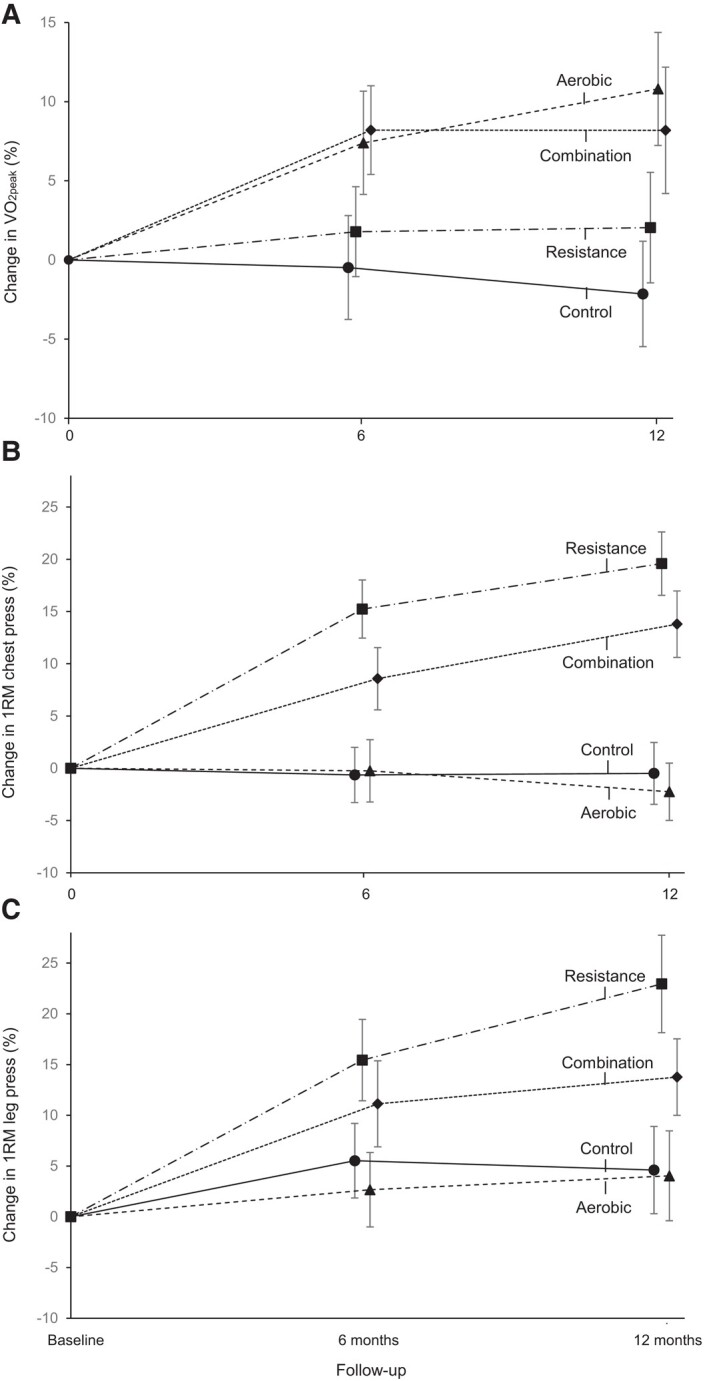
- Secondary outcomes included increased HDL cholesterol in all exercise groups versus control (resistance 1.9 mg/dL, P = .04; aerobic 2.0 mg/dL, P = .03; combination 2.3 mg/dL, P = .01), decreased waist circumference in aerobic (−1.9 cm, P = .03) and combination (−2.2 cm, P = .01), increased lean body mass in resistance (1.2 kg, P < .001), and increased VO2peak in resistance (1.3 mL/kg/min, P = .048), aerobic (3.5 mL/kg/min, P < .001), and combination (2.7 mL/kg/min, P < .001).
- Estimated 10-year Framingham CHD risk decreased in the combination group by −1.1% (from 7.2% to 6.1%; P < .001) and was larger than control (P = .03), with no significant changes in aerobic (−0.5%; P = .10) or resistance (0.1%; P = .76) groups.
Methods
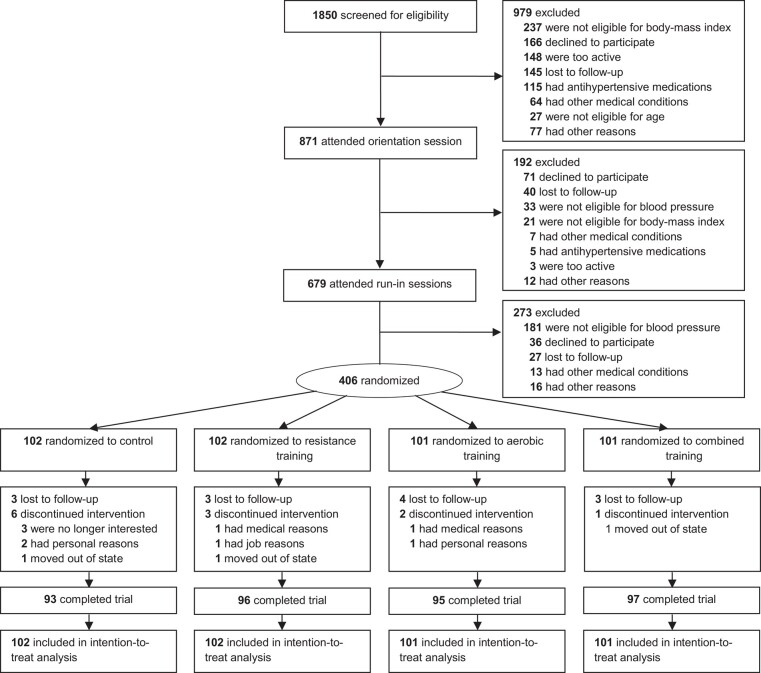
- Randomized controlled trial conducted July 2017–March 2020 at Iowa State University; 406 adults aged 35–70 years, BMI 25–40 kg/m², elevated blood pressure 120–139/80–89 mmHg without antihypertensive medications, inactive, and non-smokers were randomized to resistance (n = 102), aerobic (n = 101), combined resistance plus aerobic (n = 101), or no-exercise control (n = 102); 381 (94%) completed 1-year follow-up.
- Exercise groups were prescribed time-matched supervised exercise 3 times/week for 1 year: 60 min/session total, with 50 min resistance, 50 min aerobic, or 25 min each in the combination group; control received no exercise during year 1 but was offered delayed exercise. All participants received DASH diet education and counseling.
- The primary outcome was change from baseline to 1 year in a standardized composite Z-score of systolic blood pressure, LDL cholesterol, fasting glucose, and per cent body fat. Analyses used linear mixed effects models with repeated measures, intention-to-treat, adjusted for age, sex, and baseline outcome value, with Bonferroni correction for three control comparisons.
Limitations
- The paper states that most participants were white and well educated, limiting generalizability; it was a single-centre supervised efficacy trial, so real-world effects may differ; whether improved composite risk lowers hard CVD events is unknown; exercise groups were matched by time rather than energy expenditure; participants were not blinded; baseline activity and diet were self-reported; and the pedometer did not capture all activity.
- The paper also states that aerobic attendance at 1 year was lower (77%) than resistance (84%, P = .04) or combination (85%, P = .02), and that per-protocol results suggested aerobic exercise might be more efficacious at a sufficient dose while combined exercise may be more effective long term due to adherence.
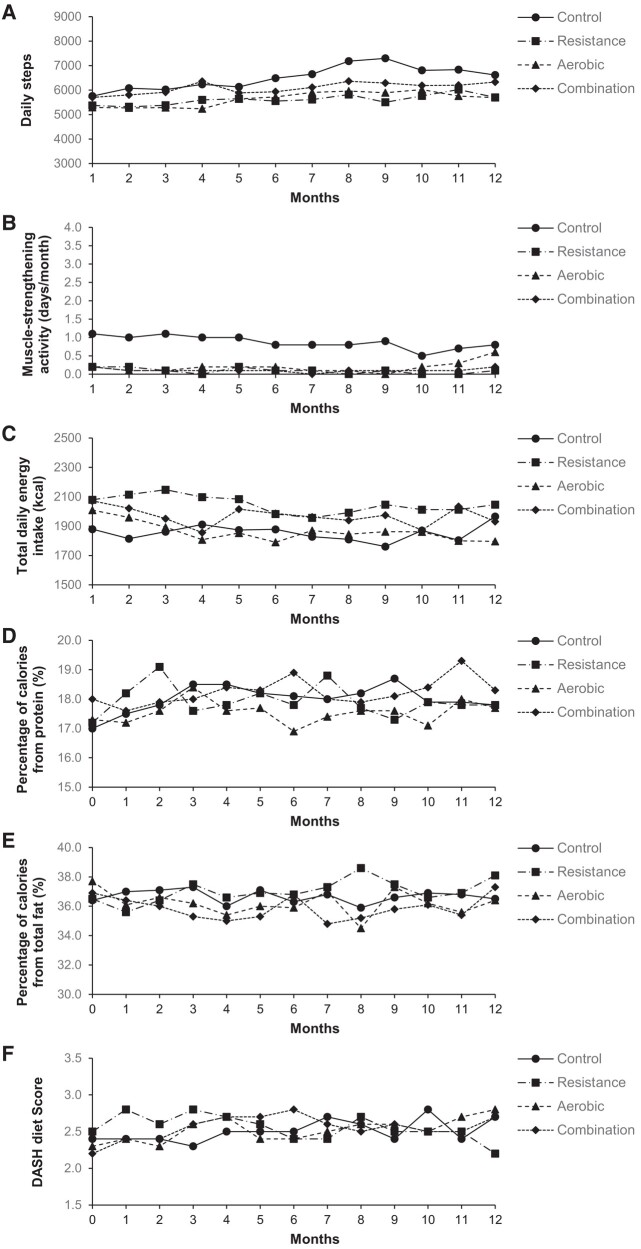
- Evident from the text: changes in individual risk factors were modest, which the authors attribute partly to relatively healthy participants with mildly elevated baseline risk factors and limited room for improvement; the control group also had nonsignificantly more daily steps and muscle-strengthening activity, which the authors note could plausibly have influenced results.
Model-written summary. Check it against the paper before relying on it.
Integrity signals
Registry
Cites
Statistics
Figures
Verification
Claims the paper makes
13 Valid · 1 Not valid · 5 Not checked · 118 Own results and interpretations
Every source the paper cites for this claim was checked and supports it.
In the paper
“The Healthy Ageing through Internet Counselling in the Elderly (HATICE) trial observed a reduction of −0.09 in their composite average Z-score, derived from systolic blood pressure, LDL-C, and BMI after an 18-month healthy lifestyle intervention including physical activity counselling.39”
§ Aerobic, resistance, or combined exercise training and cardiovascular risk profile in overweight or obese adults: the CardioRACE trial > Discussion
What the sources say
- Supportedcites [39] Richard E, van Charante EP M, Hoevenaar-Blom MP, Coley N, Barbera M, van der Groep A, et al Healthy ageing through internet counselling in the elderly (HATICE): a multinational, randomised controlled trial. Lancet Digit Health 2019; 1: e424– 34. 10.1016/S2589-7500(19)30153-0 33323224 source
The Results (p. 6) report that the composite score of systolic blood pressure, LDL cholesterol, and BMI improved by 0.09 in the intervention group after approximately 18 months—equivalent to a 0.09 reduction in the risk-factor score. The intervention included coach-supported lifestyle advice, and the Intervention platform section (p. 4) lists physical activity among the health priorities. The 0.09 figure is the intervention group’s change, not the difference from the control group, which was −0.05. (LLM, conf=0.90)
plainstates a cause- Asserted: passes — The authors put it forward as true.
- Checkable: passes — It can be checked against evidence.
- Load-bearing: unclear — It is unclear whether the paper’s conclusions depend on it.
- Based: passes — The paper gives a reason why it holds.
- Supported
The cited sources support only part of this claim — read each source’s verdict below.
In the paper
“every −1% body fat reduction is associated with −3%, −4%, and −8% lower risks of developing CVD risk factors of hypertension, hypercholesterolaemia, and metabolic syndrome, respectively, in our early study.42”
§ Aerobic, resistance, or combined exercise training and cardiovascular risk profile in overweight or obese adults: the CardioRACE trial > Discussion
What the sources say
- Partly supportedcites [42] Lee DC, Sui X, Church TS, Lavie CJ, Jackson AS, Blair SN. Changes in fitness and fatness on the development of cardiovascular disease risk factors hypertension, metabolic syndrome, and hypercholesterolemia. J Am Coll Cardiol 2012; 59: 665– 72. 10.1016/j.jacc.2011.11.013 22322083 PMC3293498 sourceExperimental — accuracy not yet measured
The Results report that each unit increase in percent body fat was associated with 4%, 5%, and 10% higher risks of hypertension, hypercholesterolemia, and metabolic syndrome, respectively. This supports the direction of the claimed association, but the paper does not report the stated 3%, 4%, and 8% risk reductions for a one-unit decrease; reversing an increase does not yield the same percentages. (LLM, conf=0.86)
plainstates an association- Asserted: passes — The authors put it forward as true.
- Checkable: passes — It can be checked against evidence.
- Load-bearing: passes — The paper’s conclusions depend on it.
- Based: passes — The paper gives a reason why it holds.
- Partly supported
The cited sources support only part of this claim — read each source’s verdict below.
In the paper
“Observational studies also suggest that combined exercise provides somewhat larger (although generally not statistically different compared with either resistance or aerobic exercise alone) risk reductions in developing clinical endpoints such as metabolic syndrome,33 hypercholesterolaemia,34 obesity,35 and CVD morbidity and mortality.36–38”
§ Aerobic, resistance, or combined exercise training and cardiovascular risk profile in overweight or obese adults: the CardioRACE trial > Discussion
What the sources say
- Supportedcites [33] Bakker EA, Lee DC, Sui X, Artero EG, Ruiz JR, Eijsvogels TMH, et al Association of resistance exercise, independent of and combined with aerobic exercise, with the incidence of metabolic syndrome. Mayo Clin Proc 2017; 92: 1214– 22. 10.1016/j.mayocp.2017.02.018 28622914 PMC5546793 source
Citation 33 supports the metabolic-syndrome portion of the sentence; the other endpoints have separate citations. The Results report a 25% lower risk among participants meeting both exercise guidelines, while the Abstract Results report a 17% lower risk associated with meeting the resistance-exercise guideline after adjustment for aerobic exercise. The Discussion describes the combined finding as suggesting additional benefits; the cited passages do not establish a statistically significant difference between exercise types. (LLM, conf=0.88)
- Supportedcites [34] Bakker EA, Lee DC, Sui X, Eijsvogels TMH, Ortega FB, Lee IM, et al Association of resistance exercise with the incidence of hypercholesterolemia in men. Mayo Clin Proc 2018; 93: 419– 28. 10.1016/j.mayocp.2017.11.024 29428677 PMC5889308 source
Citation 34 supports the hypercholesterolaemia part of the sentence, not the other endpoints assigned to other citations. The Results (page unavailable) report that men meeting both exercise guidelines had the lowest observed risk of incident hypercholesterolaemia; they also found no significant interaction between the exercise types. (LLM, conf=0.89)
- Supportedcites [35] Brellenthin AG, Lee DC, Bennie JA, Sui X, Blair SN. Resistance exercise, alone and in combination with aerobic exercise, and obesity in Dallas, Texas, US: a prospective cohort study. PLoS Med 2021; 18: e1003687. 10.1371/journal.pmed.1003687 34161329 PMC8266085 source
The Results report that participants meeting both aerobic and resistance exercise guidelines had the lowest hazard ratios for incident obesity, compared with those meeting either guideline alone or neither. This supports the obesity portion of the citing sentence, which is the part attributed to this paper. (LLM, conf=0.91)
- Partly supportedcites [36] Liu Y, Lee DC, Li Y, Zhu W, Zhang R, Sui X, et al Associations of resistance exercise with cardiovascular disease morbidity and mortality. Med Sci Sports Exerc 2019; 51: 499– 508. 10.1249/MSS.0000000000001822 30376511 PMC7385554 sourceExperimental — accuracy not yet measured
The Results (page not provided) report lower risks of total CVD events and CVD morbidity with resistance exercise both among participants meeting aerobic-exercise guidelines and among those not meeting them; the reported CVD-event reductions are somewhat larger in the former group. The paper does not establish that combined exercise reduces CVD morbidity and mortality more than either exercise type alone, or that the differences between those exercise groups are generally not statistically significant. (LLM, conf=0.85)
- Partly supportedcites [37] Lopez-Bueno R, Ahmadi M, Stamatakis E, Yang L, Del Pozo CB. Prospective associations of different combinations of aerobic and muscle-strengthening activity with all-cause, cardiovascular, and cancer mortality. JAMA Intern Med 2023; 183: 982– 90. 10.1001/jamainternmed.2023.3093 37548973 PMC10407764 sourceExperimental — accuracy not yet measured
The Results report that a combination of aerobic and muscle-strengthening activity had the greatest observed reduction in CVD mortality risk. The paper’s stated outcomes are mortality, not CVD morbidity, and it does not establish that the combined regimen differs statistically from either exercise type alone (Results and Abstract; page unavailable). (LLM, conf=0.88)
- Partly supportedcites [38] Stamatakis E, Lee IM, Bennie J, Freeston J, Hamer M, O’Donovan G, et al Does strength-promoting exercise confer unique health benefits? A pooled analysis of data on 11 population cohorts with all-cause, cancer, and cardiovascular mortality endpoints. Am J Epidemiol 2018; 187: 1102– 12. 10.1093/aje/kwx345 29099919 sourceExperimental — accuracy not yet measured
The 'Adherence to strength exercise and aerobic guidelines' results (p. 4) report lower CVD mortality with aerobic exercise alone and say an alternative analysis provided clearer evidence of lower CVD mortality among those meeting both guidelines. They do not establish that combined exercise produced a larger CVD risk reduction than either type alone. The study assessed CVD mortality, not CVD morbidity. (LLM, conf=0.84)
hedgedstates a cause- Asserted: passes — The authors put it forward as true.
- Checkable: passes — It can be checked against evidence.
- Load-bearing: unclear — It is unclear whether the paper’s conclusions depend on it.
- Based: passes — The paper gives a reason why it holds.
- Supported
The cited sources support only part of this claim — read each source’s verdict below.
In the paper
“This composite Z-score reduction of −0.09 was associated with hazard ratios (95% CIs) of 0.86 (0.52–1.43) and 0.30 (0.10–0.93) for incident total CVD and stroke risk, respectively, compared to the control group in 2724 older adults”
§ Aerobic, resistance, or combined exercise training and cardiovascular risk profile in overweight or obese adults: the CardioRACE trial > Discussion
What the sources say
- Partly supportedcites [39] Richard E, van Charante EP M, Hoevenaar-Blom MP, Coley N, Barbera M, van der Groep A, et al Healthy ageing through internet counselling in the elderly (HATICE): a multinational, randomised controlled trial. Lancet Digit Health 2019; 1: e424– 34. 10.1016/S2589-7500(19)30153-0 33323224 sourceExperimental — accuracy not yet measured
The Results (p. 6) report a 0.09 improvement in the intervention group’s composite score, versus 0.04 in controls; the table on p. 10 gives the quoted hazard ratios and confidence intervals for total cardiovascular disease and stroke. These are separate intervention-versus-control findings, not an analysis associating the Z-score reduction itself with event risk. The Results (p. 6) also note that the total cardiovascular disease difference was not significant. (LLM, conf=0.86)
plainstates an associationn = 2,724- Asserted: passes — The authors put it forward as true.
- Checkable: passes — It can be checked against evidence.
- Load-bearing: unclear — It is unclear whether the paper’s conclusions depend on it.
- Based: passes — The paper gives a reason why it holds.
- Partly supported
A result the paper reports from its own data — it cites no other source for it, so there is none to check. The quote shows it is in the paper.
In the paper
“The combination group that did half (30 min/session) of each resistance and aerobic exercise improved composite CVD risk profile similar to the full (60 min/session) aerobic exercise alone.”
§ Aerobic, resistance, or combined exercise training and cardiovascular risk profile in overweight or obese adults: the CardioRACE trial > Discussion
plain- Asserted: passes — The authors put it forward as true.
- Checkable: passes — It can be checked against evidence.
- Load-bearing: passes — The paper’s conclusions depend on it.
- Based: passes — The paper gives a reason why it holds.
76 more claims
Create a free account to see all 137 claims and to verify the 1 reference still open.
- It may state two separate claims as one. 37
- Probably not a substantial claim. 29
- The quote only partly states this claim. 1
Self-check
Percentages, sums and reported differences re-computed from the paper’s own numbers.
Each contradiction between two passages listed here was confirmed by an independent check.
Rated minor: it would not touch a result — a value no result rests on, a p-value that stays on the same side of the significance level, or a conflict that is clerical, resolved elsewhere in the paper, or outside its own findings.
In the paper
§ Aerobic, resistance, or combined exercise training and cardiovascular risk profile in overweight or obese adults: the CardioRACE trial > Abstract > Methods
“the combination group with 30 min of each resistance and aerobic exercise”
§ Aerobic, resistance, or combined exercise training and cardiovascular risk profile in overweight or obese adults: the CardioRACE trial > Methods > Interventions
“25 min of resistance plus 25 min of aerobic training for the combination group”
Rated minor: it would not touch a result — a value no result rests on, a p-value that stays on the same side of the significance level, or a conflict that is clerical, resolved elsewhere in the paper, or outside its own findings.
In the paper
“| Married | 83 (83%) | 83 (83%) | 85 (85%) | 86 (86%) | 337 (83%) |”
§ Aerobic, resistance, or combined exercise training and cardiovascular risk profile in overweight or obese adults: the CardioRACE trial > Results > Participants and intervention fidelity
Reported 83 · recomputed 81.372549
Citations
Cites
Global Burden of Cardiovascular Diseases and Risk Factors, 1990–2019
Roth, G. A., Mensah, G. A., Johnson, C. O., Addolorato, G., Ammirati, E., Baddour, L. M., Barengo, N. C., Beaton, A. Z., Benjamin, E. J., Benziger, C. P., et al. (2020) · Journal of the American College of Cardiology · doi:10.1016/j.jacc.2020.11.010 · Cited by 11,449
Prediction of coronary heart disease using risk factor categories
Wilson, P. W. F., D’Agostino, R. B., Levy, D., Belanger, A. M., Silbershatz, H., & Kannel, W. B. (1998) · Circulation · doi:10.1161/01.cir.97.18.1837 · Cited by 9,581 · cited 2×
“10,11,14,22 Because the exact relative importance of each CVD risk factor was unclear in this specific population, we used the unweighted average of the four CVD risk factors, which is also common for a composite CVD risk score generation.”
Method(2014) · Medical Entomology and Zoology · Cited by 9,400
Health effects of overweight and obesity in 195 countries over 25 years
Collaborators, T. G. 2. O. (2017) · New England Journal of Medicine · doi:10.1056/nejmoa1614362 · Cited by 7,918 · cited 7×
“We used reverse score (multiplied by − 1) for HDL-C, cardiorespiratory fitness, and muscular strength, which have inverse relationships with CVD.”
BackgroundMethodInfluentialHeart Disease and Stroke Statistics—2021 Update: A Report From the American Heart Association
Virani, S. S., Alonso, A., Aparicio, H. J., Benjamin, E. J., Bittencourt, M. S., Callaway, C. W., Carson, A. P., Chamberlain, A. M., Cheng, S., Delling, F. N., et al. (2021) · Circulation · doi:10.1161/cir.0000000000000950 · Cited by 5,784
2013 ACC/AHA Guideline on the Assessment of Cardiovascular Risk
Goff, D. C., Lloyd-Jones, D. M., Bennett, G., Coady, S., D’Agostino, R. B., Gibbons, R., Greenland, P., Lackland, D. T., Levy, D., O’Donnell, C. J., et al. (2014) · Journal of the American College of Cardiology · doi:10.1016/j.jacc.2013.11.005 · Cited by 4,945
Kodama, S. (2009) · JAMA · doi:10.1001/jama.2009.681 · Cited by 3,035 · cited 2×
“…study; thus, the effects of exercise outside the supervised lab in real world are likely to be Figure 4 Continued 79, 76, 74, 72, 68, 66, and 46, respectively, for diet (total daily energy intake, percentage of calories from protein, percentage of calories from total fat, and Dietary…”
BackgroundLloyd-Jones, D. M., Allen, N. B., Anderson, C. A. M., Black, T., Brewer, L. C., Foraker, R. E., Grandner, M. A., Lavretsky, H., Perak, A. M., Sharma, G., et al. (2022) · Circulation · doi:10.1161/cir.0000000000001078 · Cited by 2,785 · cited 3×
“10,11,14,22 Because the exact relative importance of each CVD risk factor was unclear in this specific population, we used the unweighted average of the four CVD risk factors, which is also common for a composite CVD risk score generation.”
Method2020 ESC guidelines on sports cardiology and exercise in patients with cardiovascular disease
Pelliccia, A., Sharma, S., Gati, S., Bäck, M., Börjesson, M., Caselli, S., Collet, J.-P., Corrado, D., Drezner, J. A., Halle, M., et al. (2021) · European Heart Journal · doi:10.1093/eurheartj/ehaa605 · Cited by 1,958 · cited 2×
“5 Our finding further provides evidence-based data that replacing half of aerobic exercise with resistance exercise, without extra exercise time, may be an effective option to improve CVD risk profile in adults with overweight or obesity.”
BackgroundLeong, D. P., Teo, K. K., Rangarajan, S., Lopez-Jaramillo, P., Avezum, A., Orlandini, A., Seron, P., Ahmed, S. H., Rosengren, A., Kelishadi, R., et al. (2015) · The Lancet · doi:10.1016/s0140-6736(14)62000-6 · Cited by 1,876
Thompson, P. D., Arena, R., Riebe, D., & Pescatello, L. S. (2013) · Current Sports Medicine Reports · doi:10.1249/jsr.0b013e31829a68cf · Cited by 1,823
Exercise Training for Blood Pressure: A Systematic Review and Meta‐analysis
Cornelissen, V. A., & Smart, N. A. (2013) · Journal of the American Heart Association · doi:10.1161/jaha.112.004473 · Cited by 1,683 · cited 1×
“…CVD risk profile, meta-analyses suggested that aerobic or combined exercise is generally superior to resistance exercise on blood pressure, 29 body fat, 30 glucose metabolism, and lipid profile, 31,32 although these data were mostly from small ( n 30 per group) and short (2–6 months)…”
BackgroundEffects of the amount and intensity of exercise on plasma lipoproteins
Kraus, W. E., Houmard, J. A., Duscha, B. D., Knetzger, K. J., Wharton, M. B., McCartney, J. S., Bales, C. W., Henes, S., Samsa, G. P., Otvos, J. D., et al. (2002) · New England Journal of Medicine · doi:10.1056/nejmoa020194 · Cited by 1,554 · cited 1×
“12,20,27,44 This study underscores important findings on cardiorespiratory fitness and muscular strength by different types of exercise in relation to CVD prevention.”
BackgroundGrundy, S. M., Pasternak, R., Greenland, P., Smith, S., & Fuster, V. (1999) · Circulation · doi:10.1161/01.cir.100.13.1481 · Cited by 1,315
An experimental study of physical fitness of Air Force personnel.
Balke, B., & Ware, R. W. (1959) · PubMed · Cited by 1,174
Church, T. S., Blair, S. N., Cocreham, S., Johannsen, N., Johnson, W., Kramer, K., Mikus, C. R., Myers, V., Nauta, M., Rodarte, R. Q., et al. (2010) · JAMA · doi:10.1001/jama.2010.1710 · Cited by 944 · cited 5×
“…also reported that the improvements in CVD risk factors were generally larger in patient populations, 43 including greater metabolic benefits in people living with diabetes, 12,17 which may explain the lack of significant changes in fasting glucose in our sample mostly without diabetes (98%).”
BackgroundMethodInfluentialSubar, A. F., Kirkpatrick, S. I., Mittl, B., Zimmerman, T. P., Thompson, F. E., Bingley, C., Willis, G., Islam, N. G., Baranowski, T., McNutt, S., et al. (2012) · Journal of the Academy of Nutrition and Dietetics · doi:10.1016/j.jand.2012.04.016 · Cited by 934 · cited 1×
“19 To minimize dropout, we employed various strategies including motivational interviewing, behavioural contract signing, flexible exercise scheduling, upper (e.g. rotator cuff) and lower body (e.g. knee) injury prevention exercises, and regular exercise adherence reports.”
MethodLin, X., Zhang, X., Guo, J., Roberts, C. K., McKenzie, S., Wu, W., Liu, S., & Song, Y. (2015) · Journal of the American Heart Association · doi:10.1161/jaha.115.002014 · Cited by 758 · cited 1×
“Earlier studies also reported that the improvements in CVD risk factors were generally larger in patient populations, 43 including greater metabolic benefits in people living with diabetes, 12,17 which may explain the lack of significant changes in fasting glucose in our sample mostly without…”
BackgroundChurch, T. S., Earnest, C. P., Skinner, J. S., & Blair, S. N. (2007) · JAMA · doi:10.1001/jama.297.19.2081 · Cited by 756 · cited 2×
“12,20,27,44 This study underscores important findings on cardiorespiratory fitness and muscular strength by different types of exercise in relation to CVD prevention.”
BackgroundAerobic or Resistance Exercise, or Both, in Dieting Obese Older Adults
Villareal, D. T., Aguirre, L., Gurney, A. B., Waters, D. L., Sinacore, D. R., Colombo, E., Armamento-Villareal, R., & Qualls, C. (2017) · New England Journal of Medicine · doi:10.1056/nejmoa1616338 · Cited by 754
Clustering of metabolic factors and coronary heart disease
Wilson, P. W. F., Kannel, W. B., Silbershatz, H., & D'Agostino, R. B. (1999) · Archives of Internal Medicine · doi:10.1001/archinte.159.10.1104 · Cited by 712 · cited 1×
“8,9 Therefore, to assess and predict future CVD, composite CVD risk scores (e.g. Framingham or atherosclerotic CVD risk scores) are widely used in clinical practice, yet are not usually applied in clinical trials.”
BackgroundStefanick, M. L., Mackey, S., Sheehan, M., Ellsworth, N., Haskell, W. L., & Wood, P. D. (1998) · New England Journal of Medicine · doi:10.1056/nejm199807023390103 · Cited by 629 · cited 1×
“21,40,41 However, our study was designed to induce no or negligible weight loss to investigate the independent effects of exercise on CVD risk factors.”
BackgroundLee, D.-C., Sui, X., Artero, E. G., Lee, I.-M., Church, T. S., McAuley, P. A., Stanford, F. C., Kohl, H. W., & Blair, S. N. (2011) · Circulation · doi:10.1161/circulationaha.111.038422 · Cited by 572 · cited 2×
“35,45,47”
ResultSelf-citationEssentials of strength training and conditioning
Haff, G. G., & Triplett, N. T. (2016) · Edith Cowan University Research Online (Edith Cowan University) · Cited by 566
Goodpaster, B. H., DeLany, J. P., Otto, A. D., Kuller, L., Vockley, J., South-Paul, J. E., Thomas, S. B., Brown, J., McTigue, K., Hames, K. C., et al. (2010) · JAMA · doi:10.1001/jama.2010.1505 · Cited by 558 · cited 2×
“21,40,41 However, our study was designed to induce no or negligible weight loss to investigate the independent effects of exercise on CVD risk factors.”
BackgroundWood, P. D., Stefanick, M. L., Williams, P. T., & Haskell, W. L. (1991) · New England Journal of Medicine · doi:10.1056/nejm199108153250703 · Cited by 520
Schroeder, E. C., Franke, W. D., Sharp, R. L., & Lee, D.-C. (2019) · PLoS ONE · doi:10.1371/journal.pone.0210292 · Cited by 295 · cited 1×
“25 The estimated power was also adequate ( > 90”
BackgroundSelf-citationChanges in Fitness and Fatness on the Development of Cardiovascular Disease Risk Factors
Lee, D.-C., Sui, X., Church, T. S., Lavie, C. J., Jackson, A. S., & Blair, S. N. (2012) · Journal of the American College of Cardiology · doi:10.1016/j.jacc.2011.11.013 · Cited by 285 · cited 1×
“42 Considering the growing global epidemic of obesity and its strong associations with CVD progression, 6 the improvements in per cent body fat and CVD risk profile through exercise with minimal weight loss may be important given that weight loss is challenging, especially in individuals with…”
BackgroundSelf-citationSchwingshackl, L., Missbach, B., Dias, S., König, J., & Hoffmann, G. (2014) · Diabetologia · doi:10.1007/s00125-014-3303-z · Cited by 264 · cited 1×
“…meta-analyses suggested that aerobic or combined exercise is generally superior to resistance exercise on blood pressure, 29 body fat, 30 glucose metabolism, and lipid profile, 31,32 although these data were mostly from small ( n 30 per group) and short (2–6 months) exercise interventions.”
BackgroundWewege, M. A., Thom, J. M., Rye, K.-A., & Parmenter, B. J. (2018) · Atherosclerosis · doi:10.1016/j.atherosclerosis.2018.05.002 · Cited by 210 · cited 1×
“…meta-analyses suggested that aerobic or combined exercise is generally superior to resistance exercise on blood pressure, 29 body fat, 30 glucose metabolism, and lipid profile, 31,32 although these data were mostly from small ( n 30 per group) and short (2–6 months) exercise interventions.”
BackgroundStamatakis, E., Lee, I. M., Bennie, J., Freeston, J., Hamer, M., O’Donovan, G., Ding, D., Bauman, A., & Mavros, Y. (2018) · American Journal of Epidemiology · doi:10.1093/aje/kwx345 · Cited by 198
Ross, R., Hudson, R., Stotz, P. J., & Lam, M. (2015) · Annals of Internal Medicine · doi:10.7326/m14-1189 · Cited by 188 · cited 1×
“12,20,27,44 This study underscores important findings on cardiorespiratory fitness and muscular strength by different types of exercise in relation to CVD prevention.”
BackgroundAssociations of resistance exercise with cardiovascular disease morbidity and mortality
LIU, Y., LEE, D.-C., LI, Y., ZHU, W., ZHANG, R., SUI, X., LAVIE, C. J., & BLAIR, S. N. (2019) · Medicine & Science in Sports & Exercise · doi:10.1249/mss.0000000000001822 · Cited by 187
Self-citationSchwingshackl, L., Dias, S., Strasser, B., & Hoffmann, G. (2013) · PLoS ONE · doi:10.1371/journal.pone.0082853 · Cited by 180 · cited 1×
“…risk profile, meta-analyses suggested that aerobic or combined exercise is generally superior to resistance exercise on blood pressure, 29 body fat, 30 glucose metabolism, and lipid profile, 31,32 although these data were mostly from small ( n 30 per group) and short (2–6 months) exercise…”
BackgroundAnalysis of Variance of Multiply Imputed Data
van Ginkel, J. R., & Kroonenberg, P. M. (2014) · Multivariate Behavioral Research · doi:10.1080/00273171.2013.855890 · Cited by 152 · cited 1×
“26 We used linear mixed effects models with repeated measures including both baseline and follow-up data.”
MethodRichard, E., Moll van Charante, E. P., Hoevenaar-Blom, M. P., Coley, N., Barbera, M., van der Groep, A., Meiller, Y., Mangialasche, F., Beishuizen, C. B., Jongstra, S., et al. (2019) · The Lancet Digital Health · doi:10.1016/s2589-7500(19)30153-0 · Cited by 150 · cited 1×
“39 This composite Z -score reduction of − 0.09 was associated with hazard ratios (95% CIs) of 0.86 (0.52–1.43) and 0.30 (0.10–0.93) for incident total CVD and stroke risk, respectively, compared to the control group in 2724 older adults, although 95% CIs were wide, and the hazard ratios were likely…”
ResultInfluentialClustering of cardiovascular disease risk factors
Criqui, M. H., Barrett-Connor, E., Holdbrook, M. J., Austin, M., & Turner, J. D. (1980) · Preventive Medicine · doi:10.1016/0091-7435(80)90047-x · Cited by 131 · cited 1×
“8,9 Therefore, to assess and predict future CVD, composite CVD risk scores (e.g. Framingham or atherosclerotic CVD risk scores) are widely used in clinical practice, yet are not usually applied in clinical trials.”
BackgroundBakker, E. A., Lee, D.-C., Sui, X., Artero, E. G., Ruiz, J. R., Eijsvogels, T. M. H., Lavie, C. J., & Blair, S. N. (2017) · Mayo Clinic Proceedings · doi:10.1016/j.mayocp.2017.02.018 · Cited by 76
Self-citationSigal, R. J., Kenny, G. P., Boulé, N. G., Wells, G. A., Prud'homme, D., Fortier, M., Reid, R. D., Tulloch, H., Coyle, D., Phillips, P., et al. (2007) · Annals of Internal Medicine · doi:10.7326/0003-4819-147-6-200709180-00005 · Cited by 48
Brellenthin, A. G., Lanningham-Foster, L. M., Kohut, M. L., Li, Y., Church, T. S., Blair, S. N., & Lee, D.-C. (2019) · American Heart Journal · doi:10.1016/j.ahj.2019.08.008 · Cited by 43 · cited 5×
“15,25”
BackgroundInfluentialSelf-citationBrellenthin, A. G., Lee, D.-C., Bennie, J. A., Sui, X., & Blair, S. N. (2021) · PLOS Medicine · doi:10.1371/journal.pmed.1003687 · Cited by 41 · cited 1×
“35,45,47”
Self-citationLópez-Bueno, R., Ahmadi, M., Stamatakis, E., Yang, L., & del Pozo Cruz, B. (2023) · JAMA Internal Medicine · doi:10.1001/jamainternmed.2023.3093 · Cited by 40
Association of resistance exercise with the incidence of hypercholesterolemia in men
Bakker, E. A., Lee, D.-C., Sui, X., Eijsvogels, T. M. H., Ortega, F. B., Lee, I.-M., Lavie, C. J., & Blair, S. N. (2018) · Mayo Clinic Proceedings · doi:10.1016/j.mayocp.2017.11.024 · Cited by 33
Self-citationDiagnostic status and age at diagnosis of hypertension on adherence to lifestyle recommendations
Kim, H., & Andrade, F. C. D. (2018) · Preventive Medicine Reports · doi:10.1016/j.pmedr.2018.11.005 · Cited by 17
Your Guide to Lowering Blood Pressure
(2013) · PsycEXTRA Dataset · doi:10.1037/e364692004-001 · Cited by 6
Aerobic and Resistance Training for Patients With Type 2 Diabetes—Reply
Church, T. S. (2011) · JAMA · doi:10.1001/jama.2011.227
Research works printed but not linked: 1
- World Health Organization. WHO Guidelines on Physical Activity and Sedentary Behaviour. Geneva: World Health Organization; 2020. https://www.who.int/publications/i/item/9789240015128 (17 May 2023, date last accessed). 33369898
Cited by
Cardiovascular Aging and Exercise: Implications for Heart Failure Prevention and Management.
Subramanian, V., Tucker, W., Peters, A. E., Upadhya, B., Kitzman, D., & Pandey, A. (2025) · Circulation Research · doi:10.1161/circresaha.125.325531 · Cited by 32
Chen, Z., Zhou, R., Liu, X., Wang, J., Wang, L., Lv, Y., & Yu, L. (2025) · Life · doi:10.3390/life15020166 · Cited by 45
“However, the effects and mechanisms of AE on lipids improvement are unclear [27].”
Tanaka, A., & Node, K. (2024) · Hypertension Research · doi:10.1038/s41440-024-01737-0 · Cited by 29
Amare, F., Alemu, Y., Enichalew, M., Demilie, Y., & Adamu, S. (2024) · BMC Sports Science Medicine and Rehabilitation · doi:10.1186/s13102-024-00982-7 · Cited by 37
“Therefore, enhancing cardio-metabolic risk factors with sustained exercise modalities can lead to better health outcomes [15, 16].”
BackgroundInter-organ metabolic interaction networks in non-alcoholic fatty liver disease
Fan, Y., Zhang, S., Wang, Y., Wang, H., Li, H., & Bai, L. (2025) · Frontiers in Endocrinology · doi:10.3389/fendo.2024.1494560 · Cited by 28
Metadata
- Authors
- Lee, D.-C., Brellenthin, A. G., Lanningham-Foster, L. M., Kohut, M. L., & Li, Y.
- Affiliations
- Iowa State University (US)
- Department of Kinesiology, Iowa State University , 534 Wallace Road, Ames, IA 50011 , USA
- University of California, Riverside (US)
- Corresponding author
- Lee, Duck-chul
- Venue
- European Heart Journal
- Publisher
- Oxford University Press (OUP)
- Published
- 2024-01-17
- Volume
- 45
- Issue
- 13
- Pages
- 1127-1142
- ISSN
- 0195-668X (ISSN-L)
- 1522-9645
- PMC
- PMC10984570
- OpenAlex
- W4390989018
- Semantic Scholar
- 75b1ee9fe00752c9144426541933819a5f591460
- Cited by
- 108
- References
- 44
- Citations by year
- 2026: 46 · 2025: 39 · 2024: 23
- FWCI
- 17.15
- Type
- journal article
- Language
- en
- Open access
- hybrid
- doi.org
- Licence
- Locations
- European Heart Journal (publishedVersion, cc-by)
- PubMed Central (publishedVersion, cc-by)
- PubMed (publishedVersion)
- Funders
- National Heart, Lung, and Blood Institute
- US National Institutes of Health (R01HL133069)
- Topics
- Health Sciences › Medicine › Physiology (medical) › Cardiovascular and exercise physiology
- Health Sciences › Medicine › Public Health, Environmental and Occupational Health › Physical Activity and Health
- Health Sciences › Medicine › Endocrinology, Diabetes and Metabolism › Diabetes, Cardiovascular Risks, and Lipoproteins
- Keywords
- aerobic exercise, resistance training, concurrent training, cardiovascular risk profile, overweight, obesity, elevated blood pressure, systolic blood pressure, LDL cholesterol, fasting blood glucose, body fat percentage, cardiovascular risk factors, supervised exercise
- MeSH terms
- Heart Disease Risk Factors, Adult, Cardiovascular Diseases, Female, Glucose, Humans, Cholesterol, LDL, Male, Obesity, Risk Factors, Exercise, Overweight
About these checks
Registry, retraction, Cites and statistics results are computed, not judged, with one exception: a printed reference that no index lists is read once by a model before it counts as a citation error. Claims are extracted by a model and kept only when their quote appears verbatim in the text; each cited source is then checked, with a model’s help, for whether it says what the claim relies on. Those verdicts can be wrong — read the claim’s quote and the cited source before relying on one.
The claim verdicts this report counts are experimental: their accuracy is not yet measured.
A language model drew the claims from the paper on 2026-10-10, under version 3 of the claim definition (model deepseek-v4.1-flash, prompt extract-v3).
A second model labelled each claim on 2026-10-10 (model jev-1.13-20260917, definition revision gold-guideline-v0.2).
Cited sources are checked with a language model’s help (gpt-6-sol).
Statistics and arithmetic are recomputed, not judged.
Confidence bands are shown only for fields calibrated on our annotated test set. None is calibrated yet, so no band is shown.
What counts as a claim ›How we measure confidence ›How we check this ›
Are you an author, or do you see a problem with this page? Request a review
Data sources
Bibliographic data: Semantic Scholar, OpenAlex, Crossref.
Contains information from the Semantic Scholar Academic Graph Datasets, made available under the ODC Attribution License (ODC-BY 1.0).
Semantic Scholar’s data is described in: Kinney, R., et al. (2023). The Semantic Scholar Open Data Platform. arXiv:2301.10140.
