

Grip Strength Cutpoints for the Identification of Clinically Relevant Weakness
Open accessThe DOI matches its Crossref record; 38 of the 38 references it cites were found in a registry or an index.
Abstract
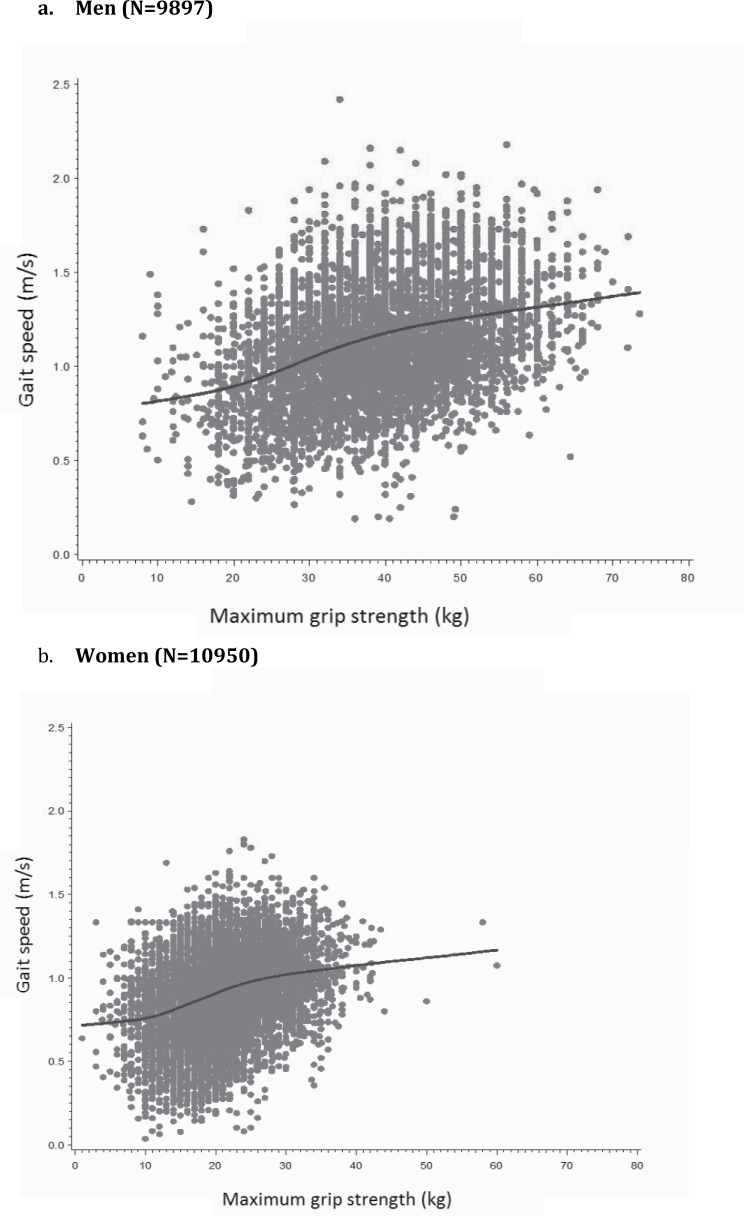
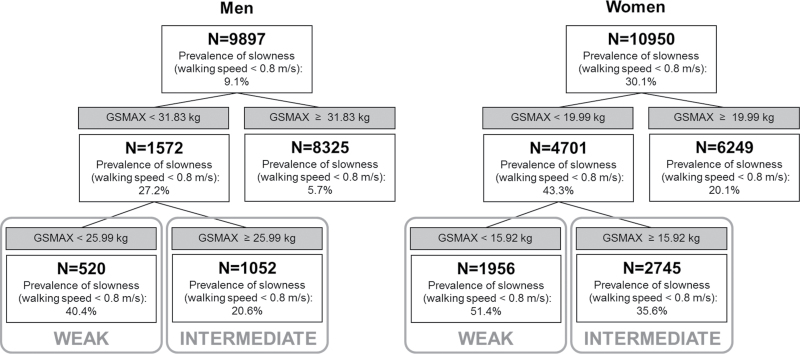
BACKGROUND: Weakness is common and contributes to disability, but no consensus exists regarding a strength cutpoint to identify persons at high risk. This analysis, conducted as part of the Foundation for the National Institutes of Health Sarcopenia Project, sought to identify cutpoints that distinguish weakness associated with mobility impairment, defined as gait speed less than 0.8 m/s. METHODS: In pooled cross-sectional data (9,897 men and 10,950 women), Classification and Regression Tree analysis was used to derive cutpoints for grip strength associated with mobility impairment. RESULTS: In men, a grip strength of 26-32 kg was classified as "intermediate" and less than 26 kg as "weak"; 11% of men were intermediate and 5% were weak. Compared with men with normal strength, odds ratios for mobility impairment were 3.63 (95% CI: 3.01-4.38) and 7.62 (95% CI 6.13-9.49), respectively. In women, a grip strength of 16-20 kg was classified as "intermediate" and less than 16 kg as "weak"; 25% of women were intermediate and 18% were weak. Compared with women with normal strength, odds ratios for mobility impairment were 2.44 (95% CI 2.20-2.71) and 4.42 (95% CI 3.94-4.97), respectively. Weakness based on these cutpoints was associated with mobility impairment across subgroups based on age, body mass index, height, and disease status. Notably, in women, grip strength divided by body mass index provided better fit relative to grip strength alone, but fit was not sufficiently improved to merit different measures by gender and use of a more complex measure. CONCLUSIONS: Cutpoints for weakness derived from this large, diverse sample of older adults may be useful to identify populations who may benefit from interventions to improve muscle strength and function.
Overview
The claims and statistics of this paper haven’t been checked yet.
Free: it reads the open-access text and checks the first 5 claims that cite a source we can check. Create a free account to check every claim.
Integrity signals
Registry
Cites
Statistics
Figures
Verification
Claims the paper makes
The claims and statistics of this paper haven’t been checked yet.
Free: it reads the open-access text and checks the first 5 claims that cite a source we can check. Create a free account to check every claim.
Claims other papers make about this one
Each is checked against this paper’s own text: does it say what the citing paper says it does?
The source backs part of the claim, not all of it — or backs it for a different population, condition or comparison.
In the citing paper
“while data from FNIH classified 4.1% of men and 14.0% of women as having sarcopenic obesity using high BMI and low grip strength as measures of obesity and low muscle strength, respectively202.”
From Sarcopenic obesity in older adults: aetiology, epidemiology and treatment strategies (2018) · cites this paper as [202]
Experimental — accuracy not yet measuredThe source backs part of the claim, not all of it — or backs it for a different population, condition or comparison.
In the citing paper
“For example, grip strength less than 26kg or 16kg for men and women respectively is highly predictive of mobility disability.”
From Successful aging: Advancing the science of physical independence in older adults (2015) · cites this paper as Alley, Shardell, Peters, McLean, Dam, Kenny, Fragala, Harris, Kiel, Guralnik, Ferrucci, Kritchevsky, Studenski, Vassileva, and Cawthon 2014
Experimental — accuracy not yet measuredThe check wasn’t confident either way, so it gives no verdict — never disputed.
In the citing paper
“Efforts to create cutpoints for muscle mass and muscle strength from population studies (community-dwelling older adults) recommended cutpoint for grip strength of 26 kg for men vs. 16 kg for women, and for appendicular lean body mass (measured with DXA) of 19.75 kg for men vs. 15.02 kg for women (Alley et al., 2014; Cawthon et al., 2014).”
From Myosteatosis in the Context of Skeletal Muscle Function Deficit: An Interdisciplinary Workshop at the National Institute on Aging (2020) · cites this paper as Alley et al., 2014
Experimental — accuracy not yet measuredIn the citing paper
“Efforts to create cutpoints for muscle mass and muscle strength from population studies (community-dwelling older adults) recommended cutpoint for grip strength of 26 kg for men vs. 16 kg for women, and for appendicular lean body mass (measured with DXA) of 19.75 kg for men vs. 15.02 kg for women (Alley et al., 2014; Cawthon et al., 2014).”
From Myosteatosis in the Context of Skeletal Muscle Function Deficit: An Interdisciplinary Workshop at the National Institute on Aging (2020) · cites this paper as Alley et al., 2014
In the citing paper
“Sarcopenia is a muscle disease (muscle failure) rooted in adverse muscle changes that accrue across a lifetime; sarcopenia is common among adults of older age but can also occur earlier in life.”
From Sarcopenia: revised European consensus on definition and diagnosis (2019) · cites this paper as [30]
Self-check
Percentages, sums and reported differences re-computed from the paper’s own numbers.
The self-check needs the paper’s full text.
Citations
Cites
Classification and Regression Trees.
Gordon, A. D., Breiman, L., Friedman, J. H., Olshen, R. A., & Stone, C. J. (1984) · Biometrics · doi:10.2307/2530946 · Cited by 23,522
Classification and Regression Trees.
Ryzin, J. V., Breiman, L., Friedman, J. H., Olshen, R. A., & Stone, C. J. (1986) · Journal of the American Statistical Association · doi:10.2307/2288003 · Cited by 20,825
Sarcopenia: European consensus on definition and diagnosis
Cruz-Jentoft, A. J., Baeyens, J. P., Bauer, J. M., Boirie, Y., Cederholm, T., Landi, F., Martin, F. C., Michel, J.-P., Rolland, Y., Schneider, S. M., et al. (2010) · Age and Ageing · doi:10.1093/ageing/afq034 · Cited by 11,601
Risk Factors for Hip Fracture in White Women
Cummings, S. R., Nevitt, M. C., Browner, W. S., Stone, K., Fox, K. M., Ensrud, K. E., Cauley, J., Black, D., & Vogt, T. M. (1995) · New England Journal of Medicine · doi:10.1056/nejm199503233321202 · Cited by 3,595 · cited 1×
“Participants Data available for this phase of the FNIH Sarcopenia Project analysis included: the Study of Osteoporotic Fractures, both the original cohort (study Visit 6) (14) and African American cohort (study Visit 1) (15); the Osteoporotic Fractures in Men Study (baseline visit) (16); the Health, Aging and Body Com…”
MethodFielding, R. A., Vellas, B., Evans, W. J., Bhasin, S., Morley, J. E., Newman, A. B., Abellan van Kan, G., Andrieu, S., Bauer, J., Breuille, D., et al. (2011) · Journal of the American Medical Directors Association · doi:10.1016/j.jamda.2011.01.003 · Cited by 3,256
Self-citationGoodpaster, B. H., Park, S. W., Harris, T. B., Kritchevsky, S. B., Nevitt, M., Schwartz, A. V., Simonsick, E. M., Tylavsky, F. A., Visser, M., Newman, A. B., et al. (2006) · The Journals of Gerontology Series A: Biological Sciences and Medical Sciences · doi:10.1093/gerona/61.10.1059 · Cited by 3,083 · cited 1×
“Strength declines more rapidly in men at older ages (32), and the association between strength and physical function appears stronger in men than in women (5,33).”
BackgroundSelf-citationRoberts, H. C., Denison, H. J., Martin, H. J., Patel, H. P., Syddall, H., Cooper, C., & Sayer, A. A. (2011) · Age and Ageing · doi:10.1093/ageing/afr051 · Cited by 3,001 · cited 3×
“By using the maximum measured grip strength from either hand, we sought to minimize variation based on these factors, but variation due to dynamometer used, hand position, and other factors may still exist (28).”
BackgroundMethodInfluentialStudenski, S. A., Peters, K. W., Alley, D. E., Cawthon, P. M., McLean, R. R., Harris, T. B., Ferrucci, L., Guralnik, J. M., Fragala, M. S., Kenny, A. M., et al. (2014) · The Journals of Gerontology: Series A · doi:10.1093/gerona/glu010 · Cited by 2,545
Self-citationEpidemiological approaches to heart disease: the Framingham study
Dawber, T. R., Meadors, G. F., & Moore, F. E. (1951) · American Journal of Public Health and the Nations Health · doi:10.2105/ajph.41.3.279 · Cited by 2,148 · cited 1×
“Participants Data available for this phase of the FNIH Sarcopenia Project analysis included: the Study of Osteoporotic Fractures, both the original cohort (study Visit 6) (14) and African American cohort (study Visit 1) (15); the Osteoporotic Fractures in Men Study (baseline visit) (16); the Health, Aging and Body Com…”
MethodLauretani, F., Russo, C. R., Bandinelli, S., Bartali, B., Cavazzini, C., Di Iorio, A., Corsi, A. M., Rantanen, T., Guralnik, J. M., & Ferrucci, L. (2003) · Journal of Applied Physiology · doi:10.1152/japplphysiol.00246.2003 · Cited by 1,946 · cited 2×
“M USCLE weakness is related to poor physical performance and incident mobility limitations among older adults (1–6).”
BackgroundSelf-citation
Research works printed but not linked: 4
- 2012, The Journals of Gerontology Series A: Biological Sciences and Medical Sciences, 67, 28
- 2014, The Journals of Gerontology Series A: Biological Sciences and Medical Sciences, 5, 567
- 2007, American Journal of Epidemiology, 165, 1076, 10.1093/aje/kwk115 · DOI · Paper page
- 2010, Physical Therapy, 90, 196, 10.2522/ptj.20090079 · DOI · Paper page
Cited by
Items 101–200 of 535
Lim, S. K., & Kong, S. (2022) · Aging Clinical and Experimental Research · doi:10.1007/s40520-022-02078-z · Cited by 64
“Earlier studies of the physical ability of older adults and the diagnosis of sarcopenia have mostly focused on mobility, including gait speed [11], agility and dynamic balance [12], and mobility disorders [13], rather than on physical fitness.”
BackgroundKotronia, E., Wannamethee, S. G., Papacosta, O., Whincup, P. H., LENNON, L. T., Visser, M., Weyant, R. J., Harris, T. B., & Ramsay, S. E. (2019) · Journal of the American Medical Directors Association · doi:10.1016/j.jamda.2019.06.010 · Cited by 63
Self-citationImpact of sarcopenia in trauma and surgical patient population: A literature review
Wahlen, B. M., Mekkodathil, A. A., Al-Thani, H. A. S., & El-Menyar, A. A. (2019) · Asian Journal of Surgery · doi:10.1016/j.asjsur.2019.10.010 · Cited by 61
Prevalence of Cognitive Frailty, Do Psychosocial-Related Factors Matter?
Navarro‐Pardo, E., Facal-Mayo, D., Campos‐Magdaleno, M., Pereiro, A. X., & Juncos‐Rabadán, O. (2020) · Brain Sciences · doi:10.3390/brainsci10120968 · Cited by 54
“Regarding frailty status, the involuntary weight loss criterion is considered to be met when the response to the question, “Have you eaten less due to poor appetite, digestive problems, chewing or swallowing difficulties in the last 3 months?” or to the question about recent weight loss is positive; the criterion for…”
BackgroundFrailty Phenotype and Healthcare Costs and Utilization in Older Men
Ensrud, K. E., Kats, A. M., Schousboe, J. T., Taylor, B. C., Vo, T., Cawthon, P. M., Hoffman, A. R., Langsetmo, L., & (MrOS), F. T. O. F. I. M. S. (2020) · Journal of the American Geriatrics Society · doi:10.1111/jgs.16522 · Cited by 61
“Weakness: Y7 grip strength less than 32 kg.(19) 3.”
BackgroundSelf-citationYoowannakul, S., Tangvoraphonkchai, K., Vongsanim, S., Mohamed, A. F., & Davenport, A. (2018) · Journal of Human Nutrition and Dietetics · doi:10.1111/jhn.12555 · Cited by 60
“Sarcopenia was defined according to the Foundation for the National Institutes of Health Sarcopenia Project (FNIH) cut-off weakness with a HGS of <26 kg for men and <16 kg for women (11) and then an appendicular muscle mass of <19.”
MethodHarris-Love, M. O., Avila, N. A., Adams, B., Zhou, J., Seamon, B., Ismail, C., Zaidi, S. H., Kassner, C. A., Liu, F., & Blackman, M. R. (2018) · Journal of Clinical Medicine · doi:10.3390/jcm7100340 · Cited by 53
“The primary measures of general physical performance and mobility were peak force from hand grip dynamometry and gait speed derived from the 10-m walk test given the extensive use of these assessments in clinical trials involving ambulatory older adults [26,31].”
MethodBodilsen, A. C., Klausen, H. H., Petersen, J., Beyer, N., Andersen, O., Jørgensen, L. M., Juul‐Larsen, H. G., & Bandholm, T. (2016) · PLoS ONE · doi:10.1371/journal.pone.0154350 · Cited by 61
“The explanatory variables were HGSMen (HGSM), HGSWomen (HGSW), GS, CS, and CAS, and the response variable was limited mobility at follow-up.”
BackgroundMethodInfluentialVidoni, M. L., Gabriel, K. P., Luo, S., Simonsick, E. M., & Day, R. S. (2017) · The Journals of Gerontology Series A · doi:10.1093/gerona/glx161 · Cited by 60
Gi, Y.-M., Jung, B., Kim, K., Cho, J., & Ha, I. (2020) · PLoS ONE · doi:10.1371/journal.pone.0218058 · Cited by 58
“Previous studies on the relationship between handgrip strength and anemia have been controversial [4, 12, 22, 23].”
BackgroundMethodFragala, M. S., Dam, T.-T. L., Barber, V., Judge, J. O., Studenski, S. A., Cawthon, P. M., McLean, R. R., Harris, T. B., Ferrucci, L., Guralnik, J. M., et al. (2015) · The Journals of Gerontology: Series A · doi:10.1093/gerona/glu110 · Cited by 51
“Thus, if achieved increases in strength bring weak individuals above the previously established thresholds for clinically meaningful weakness (21), strength improvements may be considered clinically meaningful.”
BackgroundSelf-citationFatigability: A Prognostic Indicator of Phenotypic Aging
Schrack, J. A., Simonsick, E. M., & Glynn, N. W. (2020) · The Journals of Gerontology Series A · doi:10.1093/gerona/glaa185 · Cited by 63
“Fatigability joins a long line of reliable, validated well-documented “red flags” or early markers of something amiss in the lives of older adults including the Short Physical Performance Battery (35), usual gait speed (36), grip strength (37), the 6-minute (38) and long-distance corridor walks (39), and the frailty p…”
BackgroundSpexoto, M. C. B., Ramírez, P. C., Máximo, R. D. O., Steptoe, A., de Oliveira, C. M., & Alexandre, T. D. S. (2022) · Age and Ageing · doi:10.1093/ageing/afac164 · Cited by 67
“[14] found that HGS <26 kg for men (23.”
BackgroundWu, C., Smit, E., Peralta, C. A., Sarathy, H., & Odden, M. C. (2017) · Journal of the American Geriatrics Society · doi:10.1111/jgs.14816 · Cited by 52
Alexandre, T. D. S., Aubertin‐Leheudre, M., Carvalho, L. P., Máximo, R. D. O., Corona, L. P., de Brito, T. R. P., Nunes, D. P., Santos, J. L. F., Duarte, Y. A. D. O., & Lebrão, M. L. (2017) · Clinical Nutrition · doi:10.1016/j.clnu.2017.06.009 · Cited by 53
Abro, A., Delicata, L.-A., Vongsanim, S., & Davenport, A. (2018) · European Journal of Clinical Nutrition · doi:10.1038/s41430-018-0238-3 · Cited by 57
“Sarcopenia was defined according to the Foundation for the National Institutes of Health Sarcopenia Project (FNIH) cut off weakness with a HGS of <26 kg for men and <16 kg for women [14], and then appendicular muscle mass of <19.”
Grip Strength Is Associated with Longitudinal Health Maintenance and Improvement in Adolescents
Peterson, M. D., Gordon, P. M., Smeding, S., & Visich, P. S. (2018) · The Journal of Pediatrics · doi:10.1016/j.jpeds.2018.07.020 · Cited by 55
Work, retirement, and muscle strength loss in old age
Bertoni, M., Maggi, S., & Weber, G. (2017) · Health Economics · doi:10.1002/hec.3517 · Cited by 59
“For both the Alley et al. (2014) definition of low follow‐up strength and the percentage decline definition, we consistently find a protective short‐term effect and a damaging effect of retirement duration for a given age.”
BackgroundMueller, S., Wagner, J., Smith, J., Voelkle, M. C., & Gerstorf, D. (2018) · Journal of Personality and Social Psychology · doi:10.1037/pspp0000173 · Cited by 55
Development of Pharmacotherapies for the Treatment of Sarcopenia
Rooks, D., & Roubenoff, R. (2019) · The Journal of Frailty & Aging · doi:10.14283/jfa.2019.11 · Cited by 46
“Lower muscle strength, including when assessed by handgrip, is associated with higher risks for falling, chronic disease, impaired mobility and disability (57, 75, 93).”
Muscle Mass, Quality, and Composition Changes During Atrophy and Sarcopenia
Yamada, Y. (2018) · Advances in experimental medicine and biology · doi:10.1007/978-981-13-1435-3_3 · Cited by 51
The Current Understanding of Sarcopenia: Emerging Tools and Interventional Possibilities
Delmonico, M. J., & Beck, D. T. (2016) · American Journal of Lifestyle Medicine · doi:10.1177/1559827615594343 · Cited by 61
Stuck, A. K., Tsai, L.-C., Freystaetter, G., Vellas, B. J., Kanis, J. А., Rizzoli, R., Kressig, R. W., Armbrecht, G., Silva, J. A. P. D., Dawson-Hughes, B. F., et al. (2023) · The journal of nutrition health & aging · doi:10.1007/s12603-023-1888-y · Cited by 59
“Moreover, there are other internationally acknowledged consensus definitions of sarcopenia that include the same sarcopenia components as EWGSOP2 (low muscle strength and low muscle mass) but apply other cut-points for these measures (7-9).”
Gingrich, A., Spiegel, A., Kob, R., Schoene, D., Skurk, T., Hauner, H., Sieber, C. C., Volkert, D., & Kiesswetter, E. (2017) · Nutrients · doi:10.3390/nu9121358 · Cited by 56
“A handgrip strength of <26 kg (men) or <16 kg (women) was categorized as ‘weak’ [47].”
Accuracy of different handgrip values to identify mobility limitation in older adults
Delinocente, M. L. B., de Carvalho, D. H. T., Máximo, R. D. O., Chagas, M. H. N., Santos, J. L. F., Duarte, Y. A. D. O., Steptoe, A., de Oliveira, C., & Alexandre, T. D. S. (2021) · Archives of Gerontology and Geriatrics · doi:10.1016/j.archger.2021.104347 · Cited by 27
“However, neither the grip strength cutoff of < 16kg for women, previously proposed by Alley and collaborators (2014), nor < 27kg for men presented good accuracy when applied to the present sample.(2,10)”
BackgroundReal-world gait speed estimation, frailty and handgrip strength: a cohort-based study
Soltani, A., Abolhassani, N., Marques-Vidal, P. M., Aminian, K., Vollenweider, P., & Paraschiv-Ionescu, A. (2021) · Scientific Reports · doi:10.1038/s41598-021-98359-0 · Cited by 50
Kim, M., Won, C. W., & Kim, M. (2018) · PLoS ONE · doi:10.1371/journal.pone.0201275 · Cited by 56
Selaković, I., Dubljanin-Raspopović, E., Markovic‐Denic, L., Marušić, V., Cirkovic, A. M., Kadija, M., Vujadinović, S. T., & Tulić, G. (2019) · PLoS ONE · doi:10.1371/journal.pone.0213223 · Cited by 50
He, Q., Wang, X., Yang, C., Zhuang, X., Yue, Y., Jing, H., Hu, J., Sun, M., & Guo, L. (2020) · Journal of Diabetes Research · doi:10.1155/2020/6973469 · Cited by 50
Dynapenia, abdominal obesity or both: which accelerates the gait speed decline most?
Máximo, R. D. O., de Oliveira, D. C., Ramírez, P. C., Luiz, M. M., de Souza, A. F., Delinocente, M. L. B., Steptoe, A., de Oliveira, C. M., & Alexandre, T. D. S. (2021) · Age and Ageing · doi:10.1093/ageing/afab093 · Cited by 58
Relevance to assess and preserve muscle strength in aging field
Buckinx, F., & Aubertin‐Leheudre, M. (2019) · Progress in Neuro-Psychopharmacology and Biological Psychiatry · doi:10.1016/j.pnpbp.2019.109663 · Cited by 60
GARY, R. A., Dunbar, S. B., Higgins, M. K., Butts, B., Corwin, E. J., Hepburn, K. W., Butler, J., & Miller, A. H. (2018) · Journal of Applied Gerontology · doi:10.1177/0733464817746757 · Cited by 48
“The mean value for each hand was used for strength (Alley et al., 2014; Roberts et al., 2011).”
MethodBianchi, L., Maietti, E., Abete, P., Bellelli, G., Bo, M., Cherubini, A., Corica, F., Bari, M. D., Maggio, M. G., Martone, A. M., et al. (2019) · The Journals of Gerontology Series A · doi:10.1093/gerona/glz249 · Cited by 60
“The corresponding cut-offs for the FNIH criteria were 26 kg and 16 kg for men and women, respectively (16).”
MethodUsing hand grip strength to detect slow walking speed in older adults: the Yilan study
Lin, Y.-H., Chen, H., Hsu, N., & Chou, P. (2021) · BMC Geriatrics · doi:10.1186/s12877-021-02361-0 · Cited by 56
Functional decline among older cancer survivors in the Baltimore longitudinal study of aging
Siddique, S., Simonsick, E. M., & Gallicchio, L. M. (2021) · Journal of the American Geriatrics Society · doi:10.1111/jgs.17369 · Cited by 46
“'Weak' grip strength was defined as a grip strength <26 kg for men and <16 kg for women.(20) Usual gait speed (m/s) is measured twice over a 6-m course; the faster of the two trials was used for this analysis.”
BackgroundUeshima, J., Maeda, K., Shimizu, A., Inoue, T., Murotani, K., Mori, N., Satake, S., Matsui, Y., & Arai, H. (2021) · Archives of Gerontology and Geriatrics · doi:10.1016/j.archger.2021.104484 · Cited by 46
McGrath, R., Lang, J. J., Ortega, F. B., Chaput, J., Zhang, K., Smith, J., Vincent, B. M., Castro‐Piñero, J., Cuenca‐García, M., & Tomkinson, G. R. (2022) · Archives of Gerontology and Geriatrics · doi:10.1016/j.archger.2022.104716 · Cited by 47
Nutritional assessment in idiopathic pulmonary fibrosis: a prospective multicentre study
Faverio, P., Fumagalli, A., Conti, S., Madotto, F., Bini, F., Harari, S. A., Mondoni, M., Oggionni, T., Barisione, E., Ceruti, P., et al. (2021) · ERJ Open Research · doi:10.1183/23120541.00443-2021 · Cited by 44
“32 kg for men and 16-20 kg for women [21]) and weak (< 26 kg for men and < 16 kg for women [21]) grip strength, respectively.”
Mendes, J., Afonso, C., Moreira, P. A. M., Padrão, P., Santos, A., Borges, N., Negrão, R., & do Amaral, T. F. (2018) · Journal of Parenteral and Enteral Nutrition · doi:10.1002/jpen.1424 · Cited by 49
Bahat, G., Tufan, A., Kılıç, C., Öztürk, S., Akpınar, T. S., Köse, M., Erten, N., Karan, M. A., & Cruz-Jentoft, A. J. (2018) · Aging Clinical and Experimental Research · doi:10.1007/s40520-018-1042-6 · Cited by 44
Marzban, M., Nabipour, I., Farhadi, A., Ostovar, A., Larijani, B. A., Darabi, A. H., Shabankari, E., & Gholizade, M. (2021) · BMC Geriatrics · doi:10.1186/s12877-021-02285-9 · Cited by 45
“Thus, we used RHGS instead of absolute handgrip strength, defined as the average value for maximum grip strength of the dominant hand divided by BMI, which was calculated as weight divided by height squared (kg/m(2)) [25].”
MethodPeterson, M. D., Zhang, P., Duchowny, K. A., Markides, K. S., Ottenbacher, K. J., & Snih, S. A. (2016) · The Journals of Gerontology Series A: Biological Sciences and Medical Sciences · doi:10.1093/gerona/glw051 · Cited by 37
“Recent research supports the role that muscle atrophy and weakness may play on the progression of secondary complications with aging or disease, and national efforts to identify thresholds for low strength (1,2) among adults may help clinicians screen patients for prognostic risk.”
BackgroundRosenberg, T., Montgomery, P. R., Hay, V., & Lattimer, R. (2019) · BMJ Open · doi:10.1136/bmjopen-2019-032712 · Cited by 49
Muscle Weakness Is Associated With Diabetes in Older Mexicans: The Mexican Health and Aging Study
Peterson, M. D., McGrath, R. P., Zhang, P., Markides, K. S., Snih, S. A., & Wong, R. (2016) · Journal of the American Medical Directors Association · doi:10.1016/j.jamda.2016.06.007 · Cited by 42
Dynapenia and Metabolic Health in Obese and Nonobese Adults Aged 70 Years and Older: The LIFE Study
Aubertin‐Leheudre, M., Anton, S. D., Beavers, D. P., Manini, T. M., Fielding, R. A., Newman, A. B., Church, T., Kritchevsky, S. B., Conroy, D. E., McDermott, M. M., et al. (2016) · Journal of the American Medical Directors Association · doi:10.1016/j.jamda.2016.10.001 · Cited by 41
Self-citationBrefka, S., Dallmeier, D., Mühlbauer, V., Arnim, C. A. F. V., Bollig, C., Onder, G., Petrović, M., Schönfeldt‐Lecuona, C., Seibert, M., Torbahn, G., et al. (2019) · Journal of the American Medical Directors Association · doi:10.1016/j.jamda.2018.11.008 · Cited by 44
McGrath, R., Erlandson, K. M., Vincent, B. M., Hackney, K. J., Herrmann, S. D., & Clark, B. C. (2019) · The Journal of Frailty & Aging · doi:10.14283/jfa.2018.47 · Cited by 40
“This result is compatible with the results of other investigations suggesting decreased HGS is associated with physically driven tasks such as individual ADLs and gait speed (21, 22).”
Yamashita, M., Kamiya, K., Matsunaga, A., Kitamura, T., Hamazaki, N., Matsuzawa, R., Nozaki, K., Tanaka, S., Nakamura, T., Maekawa, E., et al. (2019) · Journal of Cardiology · doi:10.1016/j.jjcc.2019.02.010 · Cited by 34
Park, S. H., Kim, D. J., & Plank, L. D. (2020) · European Journal of Clinical Nutrition · doi:10.1038/s41430-020-0591-x · Cited by 37
Ramírez‐Vélez, R., Izquierdo, M., García‐Hermoso, A., Ordoñez‐Mora, L. T., Cano, C. A., Campo-Lucumí, F., & Pérez-Sousa, M. Á. (2022) · Scientific Reports · doi:10.1038/s41598-022-15757-8 · Cited by 40
Martins, J. C., Aguiar, L. T., Lara, E. M., Teixeira‐Salmela, L. F., & Faria, C. D. C. D. M. (2015) · Brazilian Journal of Physical Therapy · doi:10.1590/bjpt-rbf.2014.0118 · Cited by 49
“74) [3-5] 80 (77); [6-371]”
Kozakai, R., Ando, F., Kim, H. Y., Yuki, A., Otsuka, R., & Shimokata, H. (2016) · The Journal of Physical Fitness and Sports Medicine · doi:10.7600/jpfsm.5.87 · Cited by 38
Radder, B., Prange-Lasonder, G. B., Kottink, A. I. R., Holmberg, J., Sletta, K., Dijk, M. V., Meyer, T., Buurke, J. H., & Rietman, J. S. (2018) · Assistive Technology · doi:10.1080/10400435.2018.1453888 · Cited by 35
“Handgrip strength data indicate that the participants of this study ranged from “weak” to “normal,” based on cutoff points related to increased risk for mobility limitations (Alley et al., 2014; Sallinen et al., 2010).”
BackgroundRecent Progress in Sarcopenia Research: a Focus on Operationalizing a Definition of Sarcopenia
Cawthon, P. M. (2018) · Current Osteoporosis Reports · doi:10.1007/s11914-018-0484-2 · Cited by 41
Self-citationParker, K. R. B., Rhee, Y. S., Tomkinson, G. R., Vincent, B. M., O’Connor, M. L., & McGrath, R. (2020) · Journal of the American Medical Directors Association · doi:10.1016/j.jamda.2020.11.006 · Cited by 36
Prognostic Value of Handgrip Strength in Older Adults Undergoing Cardiac Surgery
Fountotos, R., Munir, H., Goldfarb, M., Lauck, S., Kim, D. H., Perrault, L. P., Arora, R. C., Moss, E., Rudski, L., Bendayan, M., et al. (2021) · Canadian Journal of Cardiology · doi:10.1016/j.cjca.2021.08.016 · Cited by 42
Cai, Y., Tian, Q., Gross, A. L., Wang, H., Jian‐Yu, E., Agrawal, Y., Simonsick, E. M., Ferrucci, L., & Schrack, J. A. (2022) · The Journals of Gerontology Series A · doi:10.1093/gerona/glac001 · Cited by 44
Self-citationPrevalence of Sarcopenia in Women with Breast Cancer
Morlino, D., Marra, M., Cioffi, I., Santarpia, L., Placido, P. D., Giuliano, M., Angelis, C. D., Carrano, S., Verrazzo, A., Buono, G., et al. (2022) · Nutrients · doi:10.3390/nu14091839 · Cited by 38
“Recently, the European Working Group on Sarcopenia in Older People (EWGSOP2) published a revised consensus on the definition and diagnosis of sarcopenia, by focusing on low muscle strength, also called dynapenia, as a key characteristic of sarcopenia that is measured by hand grip strength (HGS) [8,11,12].”
BackgroundComparing absolute handgrip strength and handgrip strength normalized to body weight in aging adults
McGrath, R. (2019) · Aging Clinical and Experimental Research · doi:10.1007/s40520-019-01126-5 · Cited by 34
KEMMLER, W. K., Sieber, C. C., Freiberger, E., & von Stengel, S. (2017) · Gerontology · doi:10.1159/000477935 · Cited by 37
Collins, K. S., Johnson, N., Klawitter, L. A., Waldera, R., Stastny, S., Kraemer, W. J., Christensen, B. K., & McGrath, R. P. (2020) · International Journal of Environmental Research and Public Health · doi:10.3390/ijerph17093231 · Cited by 41
“Additionally, the “10% rule” was used to determine HGS asymmetry in participants; however, HGS ratios may vary between hands at an individual level [34].”
BackgroundMethodCumulative and Incremental Value of Sarcopenia Components on Predicting Adverse Outcomes
Lam, F. M. H., Su, Y., Lu, Z., Yu, R., Leung, J. C. S., & Kwok, T. C. Y. (2020) · Journal of the American Medical Directors Association · doi:10.1016/j.jamda.2020.05.056 · Cited by 34
Kim, M., & Won, C. W. (2021) · Journal of the American Medical Directors Association · doi:10.1016/j.jamda.2021.11.007 · Cited by 41
Cooper, R., Bann, D., Wloch, E. G., Adams, J. E., & Kuh, D. J. (2014) · The Journals of Gerontology Series A · doi:10.1093/gerona/glu214 · Cited by 39
“Using the FNIH criteria, low lean mass and weakness were both associated with higher odds of slowness and self-reported difficulties walking (Table 2).”
InfluentialIversen, E., Bodilsen, A. C., Klausen, H. H., Treldal, C., Andersen, O., Houlind, M. B., & Petersen, J. (2018) · Basic & Clinical Pharmacology & Toxicology · doi:10.1111/bcpt.13156 · Cited by 37
“Handgrip strength was used to identify patients with muscle weakness,(28) with cut‐off values of 26 kg in men and 16 kg in women.(30) Patients were also scored by a frailty index (FI‐OutRef) representing cumulative organ dysfunction, calculated as number of laboratory results outside of reference interval for 17 stand…”
MethodHandgrip strength predicts length of stay and quality of life in and out of hospital
McNicholl, T., Curtis, L., Dubin, J. A., Mourtzakis, M., Nasser, R., Laporte, M., & Keller, H. (2019) · Clinical Nutrition · doi:10.1016/j.clnu.2019.11.006 · Cited by 37
Stuck, A. K., Mäder, N. C., Bertschi, D., Limacher, A., & Kressig, R. W. (2021) · International Journal of Environmental Research and Public Health · doi:10.3390/ijerph18073498 · Cited by 40
“(5) The Foundation for the National Institutes of Health Biomarkers Consortium Sarcopenia Project 2 (FNIH 2) [11].”
BackgroundInfluentialRecommendations for Reducing Heterogeneity in Handgrip Strength Protocols
McGrath, R., Cawthon, P. M., Clark, B. C., Fielding, R. A., Lang, J. J., & Tomkinson, G. R. (2022) · The Journal of Frailty & Aging · doi:10.14283/jfa.2022.21 · Cited by 33
“Slow gait speed has continued to serve as the centerpiece outcome for determining cut-point derived weakness because muscle dysfunction limits the ambulatory movements involved in physical performance (4, 44, 47).”
BackgroundSelf-citationLim, J. P., Yew, S., Tay, L., Chew, J. L., Yeo, A., Ismail, N. H., Ding, Y. Y., & Lim, W. S. (2020) · The journal of nutrition health & aging · doi:10.1007/s12603-020-1461-x · Cited by 35
Prevalence of reduced muscle strength in older U.S. adults: United States, 2011-2012.
Looker, A. C., & Wang, C. (2015) · PubMed · Cited by 32
[Muscular fitness and cardiometabolic risk factors among Colombian young adults].
Ramírez‐Vélez, R., Meneses-Echavez, J. F., González‐Ruíz, K., & Correa‐Bautista, J. E. (2014) · PubMed · doi:10.3305/nh.2014.30.4.7684 · Cited by 51
Is dynapenic abdominal obesity a risk factor for cardiovascular mortality? A competing risk analysis
Ramírez, P. C., de Oliveira, D. C., Máximo, R. D. O., de Souza, A. F., Luiz, M. M., Delinocente, M. L. B., Steptoe, A., de Oliveira, C. M., & Alexandre, T. D. S. (2023) · Age and Ageing · doi:10.1093/ageing/afac301 · Cited by 34
“Dynapenia was defined as grip strength <26 kg for men and < 16 kg for women [28].”
BackgroundAnderson, L. J., Lee, J., Mallen, M. C., Migula, D., Liu, H. M., Wu, P., Dash, A., & Garcia, J. M. (2020) · Clinical Nutrition · doi:10.1016/j.clnu.2020.07.001 · Cited by 32
“In contrast, the recommended functional impairment cut-point for HGS is between 26-30 kg in healthy older men [36, 37].”
BackgroundJoosten, E., Detroyer, E., & Milisen, K. (2016) · BMC Geriatrics · doi:10.1186/s12877-016-0326-y · Cited by 35
Kuczmarski, M. F., Pohlig, R. T., Stave Shupe, E., Zonderman, A. B., & Evans, M. K. (2018) · The Journal of nutrition, health and aging · doi:10.1007/s12603-018-1006-8 · Cited by 30
“Evidence exists that muscle strength per body mass index (BMI) would be an appropriate relative strength index in clinical settings (1, 10-12).”
BackgroundMethodMendham, A. E., Goedecke, J. H., Micklesfield, L. K., Brooks, N. E., Faber, M., Christensen, D. L., Gallagher, I. J., Lundin‐Olsson, L., Myburgh, K. H., Odunitan-Wayas, F. A., et al. (2021) · BMC Geriatrics · doi:10.1186/s12877-021-02132-x · Cited by 35
“Previous findings have shown that sarcopenia defined using methods considering both stature and fat mass are better at predicting weakness, reduced physical function and overall sarcopenia related disability than using ASMI and grip strength methods alone [3, 6, 12, 13].”
BackgroundMethodMediterranean Diet attenuates risk of frailty and sarcopenia: New insights and future directions
McClure, R., & Villani, A. M. (2017) · JCSM Clinical Reports · doi:10.17987/jcsm-cr.v2i2.45 · Cited by 33
MECHANISMS OF ENDOCRINE DISEASE: Sarcopenia in endocrine and non-endocrine disorders
Borba, V. Z. C., Costa, T. M. D. R. L., Moreira, C. A., & Boguszewski, C. L. (2019) · European Journal of Endocrinology · doi:10.1530/eje-18-0937 · Cited by 33
Temporal trends in handgrip strength for older Japanese adults between 1998 and 2017
Tomkinson, G. R., Kidokoro, T., Dufner, T. J., Noi, S., Fitzgerald, J. S., & McGrath, R. (2020) · Age and Ageing · doi:10.1093/ageing/afaa021 · Cited by 33
Klawitter, L., Vincent, B. M., Choi, B.-J., Smith, J., Hammer, K. D., Jurivich, D. A., Dahl, L. J., & McGrath, R. (2021) · The Journal of Strength and Conditioning Research · doi:10.1519/jsc.0000000000004166 · Cited by 34
“Journal of Strength and Conditioning Research 36(1)/106–112”
BackgroundInfluentialOrces, C. H. (2016) · Aging Clinical and Experimental Research · doi:10.1007/s40520-016-0678-3 · Cited by 36
“The present findings contrast with those results from the FNIH Sarcopenia Project in which only 5% of men and 18% of women were classified with muscle weakness [10].”
Chai, L., Zhang, D., & Fan, J. (2024) · Scientific Reports · doi:10.1038/s41598-024-80487-y · Cited by 41
“better indicator for muscle weakness and more predictive of adverse outcomes 8,12 , whereas others not 13 .”
Dulac, M., Boutros, G. E. H., Pion, C. H., Barbat‐Artigas, S., Gouspillou, G., & Aubertin‐Leheudre, M. (2016) · Brazilian Journal of Physical Therapy · doi:10.1590/bjpt-rbf.2014.0184 · Cited by 32
Muscle thickness contribution to sit-to-stand ability in institutionalized older adults
Angulo, Á. M., Galán-Mercant, A., & Vargas, A. I. C. (2019) · Aging Clinical and Experimental Research · doi:10.1007/s40520-019-01328-x · Cited by 29
Rosso, A. L., Studenski, S. A., Longstreth, W. T., Jr., Brach, J. S., Boudreau, R. M., & Rosano, C. (2016) · The Journals of Gerontology Series A · doi:10.1093/gerona/glw224 · Cited by 30
Self-citationRemelli, F., Maietti, E., Abete, P., Bellelli, G., Bo, M., Cherubini, A., Corica, F., Bari, M. D., Maggio, M. G., Rizzo, M. R., et al. (2021) · Aging Clinical and Experimental Research · doi:10.1007/s40520-021-01949-1 · Cited by 28
Fernandes, J., Pérez‐Zepeda, M. U., Béland, F., Guralnik, J. M., Zunzunegui, M. V., & Guerra, R. O. (2016) · AGE · doi:10.1007/s11357-016-9888-z · Cited by 32
“The differences of general characteristics between research sites and FNIH Project sites were analyzed using independent t test for continuous variables.”
BackgroundMethodInfluentialSelf-citationGarcía‐Hermoso, A., Tordecilla‐Sanders, A., Correa‐Bautista, J. E., Peterson, M. D., Izquierdo, M., Quino-Ávila, A. C., Sandoval-Cuéllar, C., González‐Ruíz, K., & Ramírez‐Vélez, R. (2018) · Journal of sport and health science/Journal of Sport and Health Science · doi:10.1016/j.jshs.2018.09.004 · Cited by 31
Chiles Shaffer, N., Ferrucci, L., Shardell, M., Simonsick, E. M., & Studenski, S. (2017) · Journal of the American Geriatrics Society · doi:10.1111/jgs.14706 · Cited by 25
“New lean mass cutpoints were derived based on previously described, less-conservative, intermediate FNIH WeakI cutpoints.(7) The FNIH intermediate definitions showed stronger agreement with EWGSOP than the original weakness and low lean mass cutpoints and better agreement without BMI adjustment.”
MethodSelf-citationKim, M., & Won, C. W. (2018) · Archives of Gerontology and Geriatrics · doi:10.1016/j.archger.2018.12.009 · Cited by 27
Petnehazy, N., Barnes, H. N., Newman, A. B., Kritchevsky, S. B., Cummings, S. R., Hepple, R. T., & Cawthon, P. M. (2024) · The Journal of Frailty & Aging · doi:10.14283/jfa.2024.45 · Cited by 35
“Grip strength is an efficient tool to measure muscle strength (4, 28–30).”
Self-citationWoo, J., & Leung, J. (2016) · The Journals of Gerontology Series A: Biological Sciences and Medical Sciences · doi:10.1093/gerona/glv197 · Cited by 24
“In the Sarcopenia FNIH project (13,15,17), different cut points were obtained for Caucasians.”
MethodCai, Y., Liu, L., Wang, J., Gao, Y., Guo, Z., & Ping, Z. (2020) · Aging Clinical and Experimental Research · doi:10.1007/s40520-020-01614-z · Cited by 29
Jun, S., Cowan, A., Dwyer, J. T., Campbell, W. W., Thalacker‐Mercer, A. E., Gahche, J. J., & Bailey, R. L. (2021) · Journal of Nutrition · doi:10.1093/jn/nxab288 · Cited by 34
Preoperative Muscle Strength Is a Predictor of Outcomes After Esophagectomy
Colcord, M. E., Benbow, J. H., Trufan, S. J., Gower, N. L., Byrne, M. E., Shea, R. E., Watson, M. D., Hill, J. S., Squires, M. H., & Salo, J. C. (2021) · Journal of Gastrointestinal Surgery · doi:10.1007/s11605-021-05183-y · Cited by 28
Ensrud, K. E., Schousboe, J. T., Kats, A. M., Taylor, B. C., Boyd, C. M., & Langsetmo, L. (2023) · Annals of Internal Medicine · doi:10.7326/m22-2626 · Cited by 28
Identification and treatment of older persons with sarcopenia
Lauretani, F., Bautmans, I., Vita, F. D., Nardelli, A., Ceda, G. P., & Maggio, M. G. (2014) · The Aging Male · doi:10.3109/13685538.2014.958457 · Cited by 28
“In accordance to what has been reported by Lauretani and colleagues [12], the authors also suggested grip strength cut-offs values of 26–32 kg in men and 16–20 kg in women for classifying older persons with intermediate weakness [15].”
ResultFox, B., Henwood, T. R., Schaap, L. S., Bruyère, O., Reginster, J., Beaudart, C., Buckinx, F., Roberts, H. C., Cooper, C. C., Cherubini, A., et al. (2015) · The JBI Database of Systematic Reviews and Implementation Reports · doi:10.11124/jbisrir-2015-2256 · Cited by 27
“JBI Database of Systematic Reviews & Implementation Reports 2015;13(10) 50 - 59”
BackgroundSampaio, R. A. C., Sampaio, P. Y. S., Castaño, L. A. A., Barbieri, J. F., Coelho‐Júnior, H. J., Arai, H., Uchida, M. C., & Gutierrez, G. L. (2017) · Sao Paulo Medical Journal · doi:10.1590/1516-3180.2017.0049030517 · Cited by 30
Handgrip Strength, but Not 5‐Meter Walk, Adds Value to a Clinical Nutrition Assessment
McNicholl, T., Dubin, J. A., Curtis, L., Mourtzakis, M., Nasser, R., Laporte, M., & Keller, H. (2018) · Nutrition in Clinical Practice · doi:10.1002/ncp.10198 · Cited by 24
Metadata
- Authors
- Alley, D. E., Shardell, M. D., Peters, K. W., McLean, R. R., Dam, T.-T. L., Kenny, A. M., Fragala, M. S., Harris, T. B., Kiel, D. P., Guralnik, J. M., Ferrucci, L., Kritchevsky, S. B., Studenski, S. A., Vassileva, M. T., & Cawthon, P. M.
- Affiliations
- University of Maryland, Baltimore (US)
- California Pacific Medical Center (US)
- Beth Israel Deaconess Medical Center (US)
- Columbia University (US)
- University of Central Florida (US)
- National Institutes of Health (US)
- National Institute on Aging (US)
- Wake Forest University (US)
- University of Pittsburgh (US)
- Foundation for the National Institutes of Health (US)
- Corresponding author
- Alley, D. E.
- ORCID
- Venue
- The Journals of Gerontology Series A: Biological Sciences and Medical Sciences
- Publisher
- Oxford University Press (OUP)
- Published
- 2014-04-14
- Volume
- 69
- Issue
- 5
- Pages
- 559-566
- ISSN
- 1079-5006 (ISSN-L)
- 1758-535X
- PMC
- PMC3991145
- OpenAlex
- W2127873216
- Cited by
- 535
- References
- 38
- Citations by year
- 2026: 32 · 2025: 40 · 2024: 49 · 2023: 45 · 2022: 41 · 2021: 60 · 2020: 41 · 2019: 46 · 2018: 47 · 2017: 44 · 2016: 39 · 2015: 35 · 2014: 16
- FWCI
- 29.78
- Type
- journal article
- Language
- en
- Open access
- hybrid
- doi.org
- Licence
- cc-by-nc
- Locations
- The Journals of Gerontology Series A (publishedVersion, cc-by-nc)
- Europe PMC (PubMed Central) (publishedVersion, cc-by-nc)
- PubMed Central (publishedVersion, cc-by-nc)
- PubMed (publishedVersion)
- Digital Access to Scholarship at Harvard (DASH) (Harvard University) (submittedVersion, cc-by)
- Journal of International Crisis and Risk Communication Research (submittedVersion)
- Funders
- National Institutes of Health (1u13ag041583-01)
- National Institute on Aging (1U13AG041583, P30AG024827)
- Topics
- Health Sciences › Medicine › Physiology (medical) › Nutrition and Health in Aging
- Health Sciences › Medicine › Geriatrics and Gerontology › Frailty in Older Adults
- Health Sciences › Health Professions › Physical Therapy, Sports Therapy and Rehabilitation › Balance, Gait, and Falls Prevention
- Keywords
- grip strength, muscle weakness, cut-off values, mobility impairment, walking speed, sarcopenia, older adults, sex differences, body mass index, muscle strength
- MeSH terms
- Age Factors, Aged, Aged, 80 and over, Cross-Sectional Studies, Female, Gait, Humans, Male, Sex Factors, United States, Hand Strength, Muscle Weakness, Mobility Limitation, Sarcopenia
About these checks
Registry, retraction, Cites and statistics results are computed, not judged, with one exception: a printed reference that no index lists is read once by a model before it counts as a citation error. Claims are extracted by a model and kept only when their quote appears verbatim in the text; each cited source is then checked, with a model’s help, for whether it says what the claim relies on. Those verdicts can be wrong — read the claim’s quote and the cited source before relying on one.
Statistics and arithmetic are recomputed, not judged.
Confidence bands are shown only for fields calibrated on our annotated test set. None is calibrated yet, so no band is shown.
What counts as a claim ›How we measure confidence ›How we check this ›
Are you an author, or do you see a problem with this page? Request a review
Data sources
Bibliographic data: Semantic Scholar, OpenAlex, Crossref.
Contains information from the Semantic Scholar Academic Graph Datasets, made available under the ODC Attribution License (ODC-BY 1.0).
Semantic Scholar’s data is described in: Kinney, R., et al. (2023). The Semantic Scholar Open Data Platform. arXiv:2301.10140.
